




Abstract
This study examines the moderating effect of attachment orientation (anxiety and avoidance) on emotional and behavioral responses following interactions with a partner in a dynamic interdependent framework. Data were collected from 54 heterosexual cohabiting Japanese couples (108 participants) using the experience sampling method. Participants recorded their emotions, their partner’s behaviors, and the valence of these behaviors four times daily over 14 days. After controlling for intrapersonal and interpersonal effects between emotions and behaviors, results from the dynamic actor-partner interdependent model showed that women’s attachment anxiety strengthened their positive emotional and behavioral responses to their partners’ behaviors. In contrast, women’s attachment avoidance weakened their positive emotional responses to their partners’ behaviors. Additionally, men’s attachment avoidance weakened women’s behavioral responses to their behavior. While the statistical power was not high and thus limits the strength of our conclusions, these findings suggest the role of attachment orientations in shaping emotional and behavioral responses in daily romantic interactions.
Keywords
Introduction
Individuals are highly motivated to preserve valued relationships to satisfy their fundamental need to belong (Arriaga, 2013). High-quality romantic relationships, such as marriage, are linked to longevity and fewer health problems (Robles, 2014). However, the numerous interactions inherent in interdependent life make it difficult for relationship quality to remain stable. Daily interactions—ranging from encouraging (e.g., expressions of care and appreciation) to mundane (e.g., cleaning the dirty floor), discouraging (e.g., ineffective support and conflict), or profound (e.g., separation from a partner)—routinely test romantic relationships. To maintain these relationships, individuals must develop effective responses to such interactions (Murray et al., 2015). Although appropriate interactions and responses improve the quality of romantic relationships (Arican-Dinc & Gable, 2023), not everyone manages them well. For example, individuals with low self-esteem may have a heightened need for constant affection, support, and reassurance, yet they tend to resist self-disclosure, making it difficult for their partners to understand and meet their emotional needs (Forest & Wood, 2011; Marigold et al., 2014). Conversely, neurotic individuals are relatively quick to make accusations and blame others for their mistakes (Karney & Bradbury, 1997).
Adult Attachment and Romantic Relationships
In addition to these personal characteristics, this study examines attachment orientations, which play an important role in romantic relationships (Crowell et al., 2016; Gillath et al., 2016). Attachment theory is a theoretical framework for understanding relationships between infants and caregivers, and serves as a useful and influential framework for examining adults’ information processing and interpersonal functioning. These include attitudes, emotions, affect regulation, and behavioral strategies (Mikulincer & Shaver, 2007). In adulthood, individual differences in attachment result from variations in the content of the internal working models of the self and others. These differences are conceptualized along two dimensions: anxiety and avoidance.
Anxiety reflects an individual’s sensitivity and hypervigilance to signs of rejection and abandonment by a romantic partner. In attachment anxiety, perceived threats to the attachment bond trigger hyperactivation of the attachment system, which manifests as excessive and sometimes intrusive reassurance-seeking behaviors aimed at reconnecting with the attachment figure (Dugal et al., 2023). Individuals with high attachment anxiety may deploy controlling or coercive behaviors in response to rejection cues to elicit support and commitment from their romantic partners (Mikulincer & Shaver, 2007). Avoidance reflects an individual’s discomfort with emotional intimacy, vulnerability, and interdependence. The perception of a threat to one’s independence leads to the deactivation of the attachment system. This deactivation often manifests as emotional detachment or behaviors that maximize distance from the attachment figure, preventing attachment-avoidance individuals from becoming involved and participating in the relationship (Feeney, 2008). Thus, individuals with high attachment avoidance report lower levels of intimacy, passion, and commitment in their romantic relationships (Levy & Davis, 1988).
Adult Attachment and Emotional and Behavioral Responses Following Interactions
Studies have shown that attachment anxiety or avoidance are associated with emotions and behaviors following interactions with a partner (Altgelt & Meltzer, 2019; Dugal et al., 2023). Individuals with high attachment anxiety are particularly sensitive to their partner’s behavior, which significantly shapes their emotional and behavioral responses. A strong desire for closeness and intimacy, coupled with concerns about rejection, makes them hypersensitive to rejection cues from their partner and more influenced by their partner’s behavior. During negative interactions, such as conflicts, they often employ hyperactivating strategies, which involve heightened attention to negative thoughts and emotions, as well as the amplification and strong expression of negative feelings (Winterheld, 2016). These behaviors may manifest as seeking reassurance or engaging in hostile or punitive behaviors in response to their partner’s negativity. Conversely, when faced with positive behaviors from their partners, individuals with high attachment anxiety may experience joy and gratitude (Mikulincer & Shaver 2005) and are more likely to express appreciation toward their partners (Collins et al., 2006). At the same time, their intense emotional expressions can strongly influence their partner’s emotions and behaviors. For example, exaggerated displays of hurt or excessive negative emotions during conflict may elicit responses such as increased guilt or efforts to provide reassurance from their partner (Caldwell & Shaver, 2012; Overall et al., 2015). Thus, attachment anxiety not only strengthens the influence of the partner’s behavior on their emotions and behavior (actor effect), but also enhances the impact of their behaviors on their partner’s emotions and behaviors in return (partner effect).
Conversely, attachment avoidance weakens one’s emotional and behavioral responses to their partner’s behaviors. Discomfort with intimacy and a desire to maintain independence make individuals with high attachment avoidance less influenced by their partner’s actions. They tend to adopt deactivating strategies, such as diverting attention away from threat-related emotions, denying emotional experiences, suppressing emotions, and inhibiting emotional expression following negative interactions with a partner (Monti & Rudolph, 2014). They have a low willingness to minimize or engage in conflict (Collins et al., 2006). Furthermore, individuals with high attachment avoidance often respond to their partner’s positive behaviors with emotional detachment. For example, when facing positive actions from their partner, individuals with high attachment avoidance tend to experience relatively low levels of happiness, are less likely to express gratitude, and may even distance themselves from their partner (Collins et al., 2006; Mikulincer et al., 2006). At the same time, their emotional repression and limited involvement make it less likely that their own behaviors will significantly influence their partner’s emotions or behaviors. Suppressed emotions and inhibited emotional expression hinder their partner’s ability to accurately perceive or respond to their needs (Rodriguez et al., 2019). Consequently, attachment avoidance not only weakens the influence of the partner’s behavior on their emotions and behaviors (actor effect), but also reduces the impact of their behaviors on the partner’s emotions and behaviors (partner effect).
Adult Attachment and Emotional and Behavioral Responses in a Dynamic and Interdependent Framework
The above studies are based on data from a hypothetical scenario method (Collins et al., 2006) or diary recordings (Mikulincer et al., 2006; Overall, et al., 2015), which fail to capture the nuances of daily interactions and are susceptible to recall bias (Huelsnitz et al., 2018). To address these limitations, some studies have employed the experience sampling method (ESM) (Dančík et al., 2021; Sheinbaum et al., 2015), an intraday self-report technique where participants are prompted at random or at predetermined intervals to report their current experiences. By repeatedly assessing participants in their daily environments over a short time, ESM highlights detailed fluctuations in daily life and collects information at the time of the signal. Although these ESM studies provide valuable insights into interactions over time—for instance, individuals with high attachment anxiety reported higher levels of negative emotions (Sheinbaum et al., 2015), while those with high attachment avoidance experienced lower levels of positive emotions (Dančík et al., 2021)—they do not capture dynamic changes arising from mutual influences within dyads. Other studies, such as those by Butner et al. (2007) and Randall and Butler (2013), have examined temporal associations between partners’ emotions as dynamic changes shaped by mutual influences and the moderating effects of attachment orientations on these associations. However, they have not fully integrated emotions and behaviors within a single framework. Specifically, how both partners’ attachment orientations influence the associations between interactions at one time point and each other’s emotional and behavioral responses at the next remains insufficiently examined.
To address these limitations, the present study integrates two complementary perspectives—the dynamic framework and the interdependent framework—to examine how attachment orientations moderate emotional and behavioral responses within couples.
The dynamic framework examines how intensive longitudinal data collected via ESM, such as emotions or behaviors, unfold, fluctuate, and influence each other over time (see Figure 1a). While previous studies on romantic relationships have used ESM, they have often neglected to address issues within a dynamic framework (Sels et al., 2021). A key strength of the dynamic framework is its ability to capture intrapersonal effects. One such intrapersonal effect is that an individual’s emotions or behaviors are relatively stable and tend to persist from one moment to the next (emotion inertia and behavior stability; Adachi & Willoughby, 2015; Kuppens, 2015). Another intrapersonal effect is the interaction between an individual’s emotions and behaviors. For example, negative emotions like anger may lead to intimate violence (Birkley & Eckhardt, 2015), while prosocial behaviors can promote the happiness of the actor (Aknin et al., 2013). This suggests that emotions and behaviors at subsequent time points can be predicted by those at earlier time points in a dynamic framework (termed emotion elicitation and behavior induction, respectively, in this study). However, despite their theoretical importance, these intrapersonal effects have often been neglected in prior ESM research.

Graphical Display of the (a) dynamic framework and (b) interdependent framework.
In contrast, the interdependent framework addresses issues in romantic relationships by considering both partners’ outcomes within a single framework (see Figure 1b). Romantic relationships are typically interdependent, meaning that individuals in such relationships are influenced by each other’s thoughts, emotions, and behaviors (Rusbult & Van Lange, 2003). In addition to emotional responses and behavioral responses, there are other interdependent patterns (interpersonal effects) in which an individual’s emotions and behaviors are influenced by their partner’s emotional states (Overall et al., 2015; Weber & Hülür, 2021). For instance, an individual’s emotions can be predicted by their partner’s emotions (emotion contagion; Weber & Hülür, 2021). Similarly, a partner’s negative emotions can increase an individual’s hostile behavior (termed inter-behavior induction; Overall et al., 2015). While this framework has highlighted the importance of dyadic mutual influence, it is typically applied to cross-sectional or low-frequency longitudinal data and thus fails to capture how these interactions unfold dynamically over time.
The presence of both intrapersonal effects (emotion inertia, behavior stability, emotion elicitation, and behavior induction) and interpersonal effects (emotion contagion and inter-behavior induction) may distort the associations between interactions at one time point to emotional and behavioral responses at the next time point. However, few studies have attempted to control for both types of effects simultaneously. To bridge this gap, we used a dynamic interdependent framework (see Figure 2), which allows for the integration of temporal dynamics and dyadic interdependence. This approach provides a more comprehensive understanding of how attachment orientations moderate emotional and behavioral responses following interactions with partners in real-world settings.
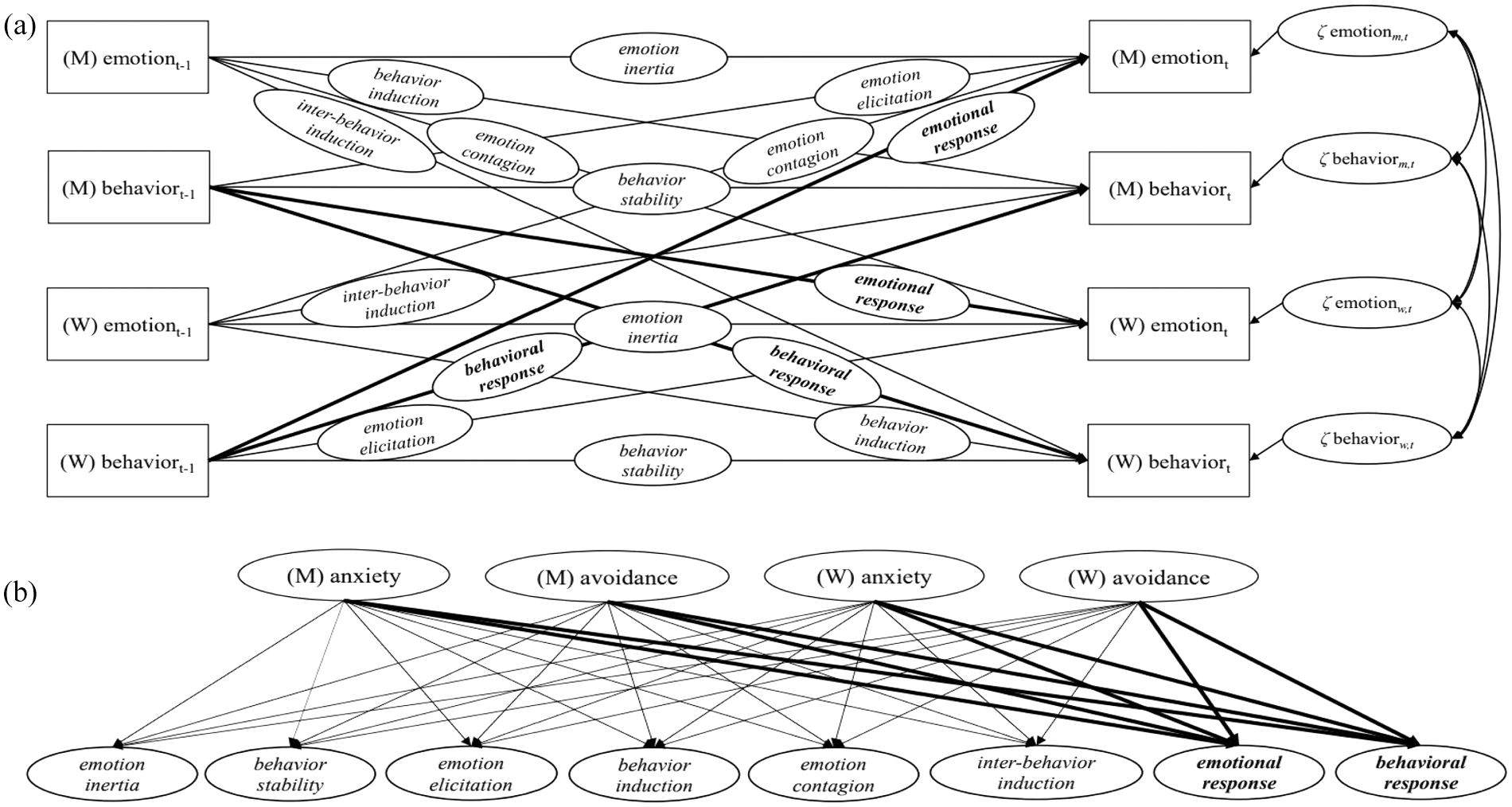
A dynamic interdependent framework utilizing the dynamic actor–partner interdependent model. (a) Within–Dyad level. (b) Between–Dyad level.
Study Hypotheses
Based on attachment-related hyperactivating and deactivating strategies in emotional and behavioral responses, individuals with high anxiety are more likely to be influenced by their partners’ emotions and behaviors and to influence their partners’ emotions and behaviors (e.g., Collins et al., 2006; Winterheld, 2016;). Conversely, individuals with high avoidance are less likely to be influenced by their partners’ emotions and behaviors and less likely to influence their partners’ emotions and behaviors (e.g., Collins et al., 2006; Monti & Rudolph, 2014). Thus, we proposed the following hypotheses:
As will be discussed later, it should be noted that the limited statistical power makes it challenging to draw definitive conclusions regarding these hypotheses. The evaluations presented in the Discussion section are based on the assumption that sufficient statistical power was achieved. Therefore, this study provides reference information on the potential outcomes that could emerge when applying the dynamic interdependence framework.
Method
Participants
The participants were 54 pairs of cohabiting heterosexual Japanese couples (men Mage = 38.04 years, SD = 8.03, Range = 23–60; women Mage = 35.5 years, SD = 7.53, Range = 23–59). The durations of their relationships ranged from 21 months to 34 years (M = 11.10 years, SD = 7.20). Approximately 88.9% of the participants (48 pairs) were married, while the remaining pairs were in dating relationships. Both men and women reported high relationship satisfaction (men M = 4.29 years, SD = 0.65; women M = 4.13, SD = 0.84; on a 5-point scale). Most participants had a college degree or higher (85.2% of men, 75.8% of women).
Procedure
Participants were recruited through a Japanese cloud-sourcing service. Eligibility criteria included cohabitation with a partner (including common-law partners but excluding long-distance relationships), ownership of individual smartphones with access to the LINE app, and completion of identity verification on the platform. Participants provided informed consent electronically before beginning the study. They were informed of the purpose of the research, procedures, potential risks, and their rights to withdraw at any time without penalty. Dyads were excluded if either partner did not consent or failed to meet these criteria. After providing informed consent, they completed a preliminary survey that included demographic information (age, educational status, etc.) and attachment orientations. Over 14 days, participants completed a daily survey four times per day, prompted by Exkuma, an online experience sampling tool (Ozaki, 2021), between 10:00 a.m. and 9:00 p.m. Although there is no universally established standard in the literature, a two-week period with 3 to 7 measurements per day is commonly used in intensive longitudinal studies on emotion dynamics in romantic couples, as it typically yields 20 or more measurements per person (Luginbuehl & Schoebi, 2020; McNeish et al., 2021). Surveys were spaced at least 2 hr apart, with an option to delay responses by up to 60 min. After 60 min, the survey form automatically closed, and no data was recorded beyond this time window; thus, responses exceeding this limit were not included in the dataset. The daily survey signal was simultaneously activated for both partners in each dyad. Participants were instructed to complete the survey separately and to avoid discussing their answers with their partners. A total of 56 surveys were conducted. Participants were informed in advance that their rewards would be based on their response rates, and payment was provided upon survey completion. Participants who completed up to 56 surveys received 10,000 JPY. The chosen sample size (N) and time of assessments (T) were determined based on available resources and are comparable to the observations (N × T) used in the model by Savord et al. (2022), which this study references. According to the power analysis conducted by Schultzberg and Muthén (2018), these observations had limited statistical power, falling short of the recommended value of 0.8. Nonetheless, efforts were made to maximize the available budget and collect sufficient data to partially address the research gaps identified in the introduction. This study was approved by the Research Ethics Review Board, Department of Management Studies, Graduate School of Social Sciences, Hiroshima University (December 14, 2021). Participation in the study involved minimal risk, as participants responded to brief self-report items about their daily experiences and emotions. The potential benefits of the study, such as advancing the understanding of relationship dynamics and emotional interdependence, were judged to outweigh the minor risks.
Survey Content
Preliminary Survey Content
Attachment orientations were measured using the Japanese version of the Experience of Close Relationship-Relationship Structure (ECR-RS), developed by Fraley et al. (2011) and translated into Japanese by Komura et al. (2016). Several studies support the validity of the Japanese version of the ECR-RS (e.g., Miyagawa & Kanemasa, 2022). It consists of two subfactors: anxiety (Cronbach’s α = .826) and avoidance (α = .776). Anxiety comprises three items, such as: “I’m afraid that this person may abandon me.” Avoidance comprises six items, such as: “I don’t feel comfortable opening up to this person.” Responses are recorded on a 7-point Likert scale, ranging from 1 (strongly disagree) to 7 (strongly agree). The validity of this scale has been assessed following Messick’s (1995) concept of validity.
We included an attention-check item (“Please select ‘Not at all’ for this item”) in the preliminary survey to determine the extent to effort minimization and increase the validity of our data (Miura & Kobayashi, 2015). As all partners responded correctly to the attention-check item, no dyads were excluded from the analysis. This ensures that the dyadic data used in this study is reliable.
Daily Survey Content
Participants reported the extent of positive emotions (“cheerful,”“satisfied,” and “relaxed”) and negative emotions (“uncertain,”“lonely,”“anxious,”“guilty,”“down,” and “irritated”) they experienced at a specified time point using a 5-point Likert scale, ranging from 1 (not at all) to 5 (extremely). These items were adapted from previous ESM studies (Myin-Germeys et al., 2001; Rintala et al., 2020), which successfully used similar items to assess positive and negative emotions and have demonstrated validity in similar research contexts. The reliability of the emotion measures was αwithin = .755/ αbetween = .909 for positive emotions and αwithin = .722/αbetween = .933 for negative emotions.
Daily interaction behaviors in romantic relationships were assessed using items from a previous ESM study extracted from daily life (Souma et al., 2016), containing 19 patterns. These behaviors were developed under procedures ensuring construct validity in content aspects (see Supplemental Material for details). Since prior research suggests that behaviors must be noticed by the recipient to affect them (cf., Visserman et al., 2019), we used partner reports to collect these interactions. Specifically, participants were asked to report their partner’s behavior toward them in the previous 2 hr, by e-mail or LINE, a messaging app and social media platform. They were instructed to select one specific behavior from the list of negative behaviors that best described their partner’s actions, which comprised seven items (e.g., “My partner was angry at me”). If no negative behavior item was selected, participants were then prompted to choose from the list of seven positive behavior items (e.g., “My partner cared about me”). If no positive behavior item was selected, participants were then asked to select from the list of five neutral behavior items (e.g., “My partner chatted with me”). If none of these behaviors applied, participants were asked to provide a free description of the behavior. This order of presentation—negative, positive, then neutral—was based on theoretical considerations. According to attachment theory, the attachment system is more likely to be activated in response to threats (Mikulincer & Shaver, 2003). While attachment can also be triggered in non-threatening situations, we prioritized negative interactions to better capture contexts in which the effects of attachment orientations are more pronounced. No count balancing was performed for this reason. Subsequently, they were asked to evaluate their reported behavior on a scale from 1 (negative) to 5 (positive).
Data Analysis
The data were analyzed using the longitudinal actor–partner interdependence model (L-APIM) in the dynamic structural equation model (DSEM) for distinguishable dyads (Savord et al., 2022), referred to as the dynamic APIM in this study (see Figure. 2). The models had two levels: within-dyad and between-dyad.
At the within-dyad level, we examined how the emotions and behaviors of both partners at the current time point (t) were influenced by their own and their partner’s emotions and behaviors at the previous time point (t−1). This level allowed us to capture intrapersonal and interpersonal time-lagged effects. For intrapersonal effects, the current emotions of men and women were regressed on their own time-lagged emotions (emotion inertia) and behaviors (emotion elicitation). The current behaviors of men and women were regressed on their time-lagged behaviors (behavior stability) and emotions (behavior induction). For interpersonal effect, the current emotions and behaviors of men and women were regressed on their partners’ time-lagged emotions (emotion contagion and inter-behavior induction). These effects were controlled for in the analysis. The current emotions and behaviors of men and women were also regressed on their partners’ time-lagged behaviors, reflecting the emotional response and behavioral response to their partners’ behaviors. These eight time-lagged effects were estimated separately for men and women. All corresponding regression coefficients (all the paths shown in Figure. 2a) were modeled as latent random slopes, allowing them to vary across dyads.
At the between-dyad level, we tested whether these time-lagged associations were moderated by individual differences in attachment orientations (see Figure 2b). Specifically, men’s and women’s attachment anxiety and avoidance were included as predictors of the random slopes representing emotional and behavioral responses to partner interactions (H1 and H2). Moderating effects of the attachment orientations on other intrapersonal and interpersonal effects were estimated as an exploratory test, with the results reported in the Supplementary Material.
Residual variances of men’s and women’s emotions (ζemotion m,t /ζemotion w,t ) and the valence of behavior (ζbehavior m,t /ζ behavior w,t ) were allowed to covary at the between-dyad level. Due to the complexity of the model, two separate models were constructed: one for positive emotions and one for negative emotions. Bayesian estimation with Markov Chain Monte Carlo in Mplus Version 8.8 (Muthén & Muthén, 2017) was used for model estimation. The Mplus Syntax is provided in the Supplementary Material.
Results
The number of responses in the daily survey was 5,622 (93.6%), of which 4,018 (71.5%) reported the behaviors of the participants’ partners. Of these reported behaviors, 134 (3.3%) were negative, 2,218 (55.2%) were positive, and 1,666 (41.5%) were neutral. Partners’ evaluations of the behaviors were transformed into individual behavior valence before analysis. Descriptive statistics for the variables are shown in Table 1. Positive emotions, negative emotions, and the valence of behavior had high intra-class correlation coefficients (ICC; .35–.71). The frequency of initiated behaviors, as well as within-level and between-level correlations for each variable, are provided in the Supplemental Material (see Table S1 and Table S2).
Descriptive Statistics of Study Variables.

Note. SD = standard deviation, ICC = intraclass correlation coefficient.
Emotion Inertia, Behavior Stability, Emotion Elicitation, and Behavior Induction in the Intrapersonal Process
Results from the dynamic APIM are presented in Tables 2 and 3 for positive and negative emotions, respectively. In this section, the term “predicted” refers to a statistical association in which the variable at a previous time point is associated with the variable at the current time point, after accounting for the model’s paths and covariances.
Estimate of Paths between Positive Emotion and Behavior in the Dynamic APIM and Moderating Effects of Attachment Orientations.

Note. M = men, W = women, b = mean estimate, 95% CI = 95% confidence interval.
Fixed effects in
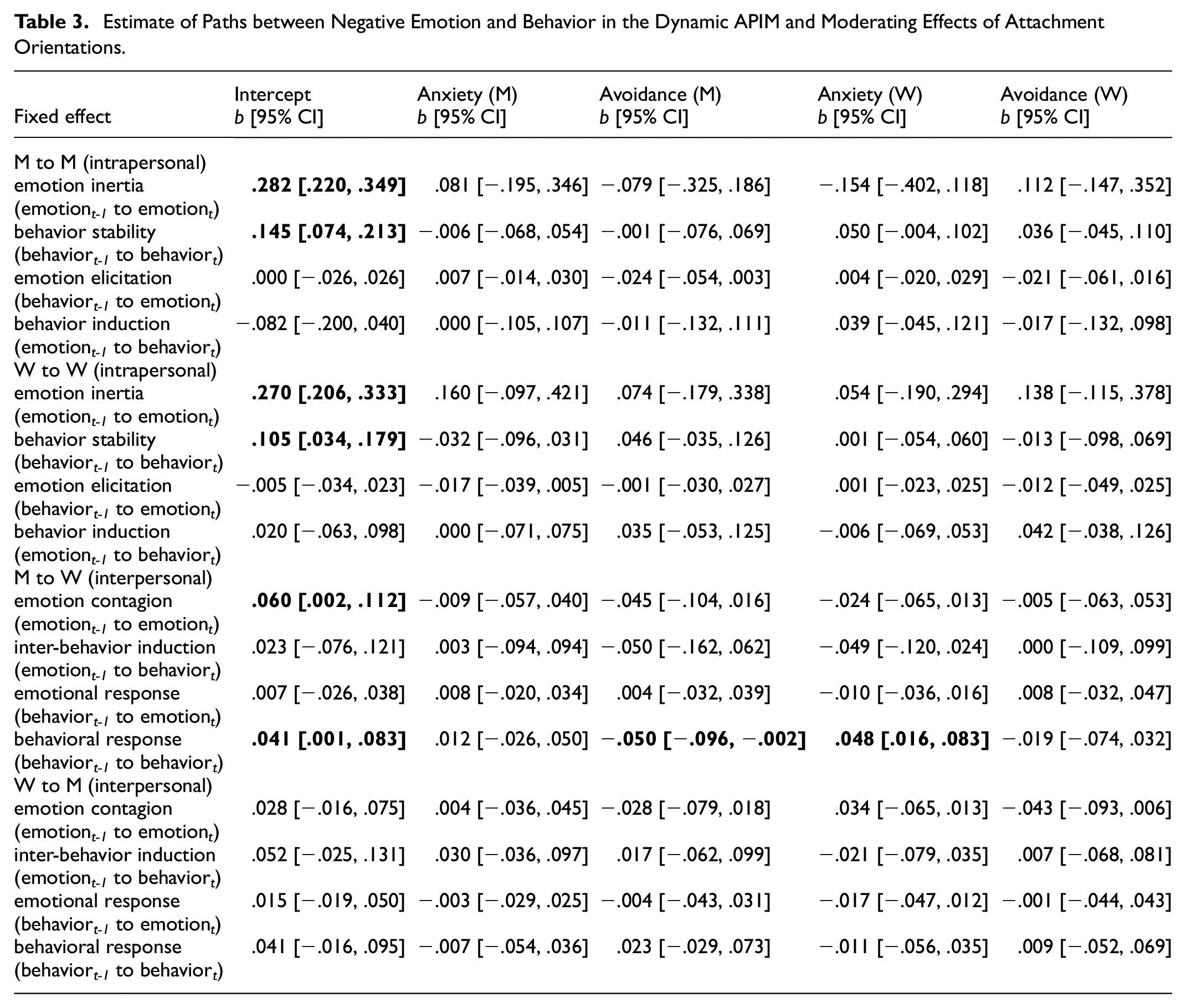
Estimate of Paths between Negative Emotion and Behavior in the Dynamic APIM and Moderating Effects of Attachment Orientations.
For positive emotions, both men and women showed significant emotion inertia (men, b = .229, 95%CI [.171, .286]; women, b = .164, 95%CI [.105, .223]), indicating that high positive emotions at a previous time point predicted high positive emotions at the current time point. Both men and women also exhibited significant behavior stability (men, b = 166, 95%CI [.093, .238]; women, b = .104, 95%CI [.035, .176]), indicating that positive behaviors at a previous time point predicted positive behaviors at the current time point. Emotion elicitation and behavior induction were positive and significant only for men (emotion elicitation: b = .052, 95%CI [.000, .109]; behavior induction: b = .073, 95%CI [.020, .128]), indicating the intrapersonal process wherein men’s positive emotions and behaviors influenced each other.
For negative emotions, both men and women showed significant emotion inertia (men, b = .282, 95%CI [.220, .349]; women, b = .270, 95%CI [.206, .333]), indicating that high negative emotions at a previous time point predicted high negative emotions at the current time point. Both men and women also exhibited significant behavior stability (men, b = .145, 95%CI [.074, .213]; women, b = .105, 95%CI [.034, .179]), indicating that negative behaviors at a previous time point predicted negative behaviors at the current time point. Since the valence of behavior was the same across models, the results for behavior stability did not differ significantly from those presented in Table 2. Emotion elicitation and behavior induction were not observed for negative emotions. These results partly support the existence of intrapersonal effects (emotion inertia, behavior stability, emotion elicitation, and behavior induction), which influence emotional and behavioral responses to behaviors from partners in the dynamic APIM.
Emotion Contagion and Inter-Behavior Induction in the Interpersonal Process
For positive emotions, as shown in Table 2, emotion contagion and inter-behavior induction were significant only from men to women (emotion contagion, b = .074, 95%CI [.030, .118]; inter-behavior induction, b = .074, 95%CI [.029, .121]), indicating that high positive emotions of men at a previous time point predicted high positive emotions and behaviors of women at the current time point. For negative emotions, as shown in Table 3, emotion contagion was significant only from men to women (b = .060, 95%CI [.002, .112]), indicating that high negative emotions of men at a previous time point predicted high negative emotions of women at the current time point. Inter-behavior induction was not observed for negative emotions. These results partly support the existence of interpersonal effects (emotion contagion and inter-behavior induction), which influence emotional and behavioral responses to behaviors from partners in the dynamic APIM.
Emotional and Behavioral Responses and the Moderating Effect of Attachment Orientations
For positive emotions, as shown in Table 2, only women’s emotional responses were significant (b = .074, 95%CI [.014, .127]), indicating that men’s positive behaviors at a previous time point predicted women’s high positive emotions at the current time point. Behavioral responses were not significant for either men or women. At the between-dyad level, the moderating effects of women’s attachment anxiety on their emotional (b = .046, 95%CI [.003, .087]) and behavioral responses (b = .045, 95%CI [.013, .081]) to men were positive and significant. This indicated that women’s attachment anxiety strengthened the extent of their emotional and behavioral responses. Simple slope analysis revealed that in women with high (+1 SD) attachment anxiety, more positive behaviors of men at a previous time point predicted higher positive emotions (b = .140, 95%CI [.058, .224]) and behaviors (b = .096, 95%CI [.022, .170]) of women at the current time point. For women with lower (−1 SD) attachment anxiety, these associations were not significant. Conversely, the moderating effects of women’s attachment avoidance on their emotional responses to men were negative and significant (b = −.062, 95%CI [−.118, −.002]), indicating that women’s attachment avoidance weakened the extent of their emotional response. Simple slope analysis revealed that for women with lower (−1SD) attachment avoidance, more positive behaviors of men at the previous time point predicted higher positive emotions of women at the current time point (b = .137, 95%CI [.049, .223]). For women with higher (+1 SD) attachment avoidance, these associations were not significant. The moderating effects of men’s attachment avoidance on women’s behavioral responses to men were negative and significant (b = −.054, 95%CI [−.098, −.005]). This indicated that the attachment avoidance of men weakened the extent of women’s behavioral responses. Simple slope analysis revealed that for men with lower (−1 SD) attachment avoidance, more positive behaviors of men at a previous time point predicted more positive behaviors of women at the current time point (b = .088, 95%CI [.029, .145]). For men with higher (+1 SD) attachment avoidance, these associations were not significant.
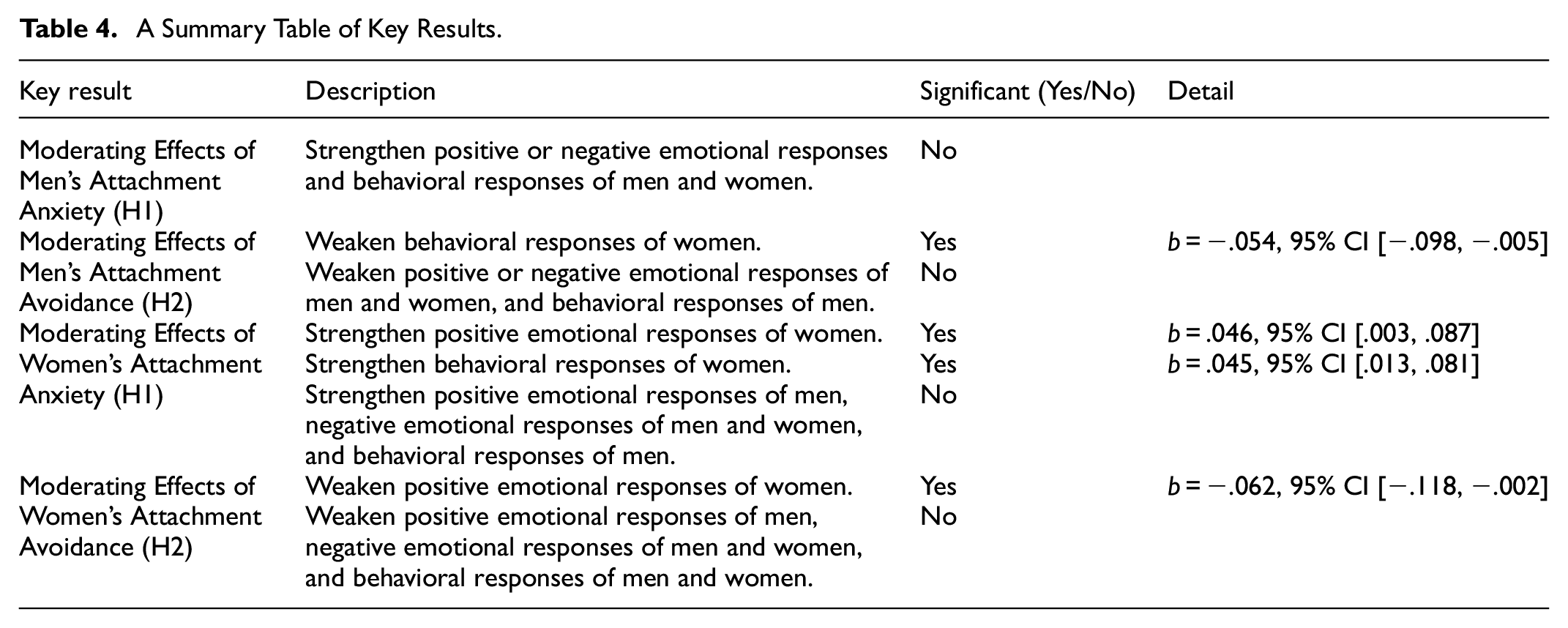
For negative emotions, as shown in Table 3, only women’s behavioral responses were positive and significant (b = .041, 95% CI [.001, .083]), indicating that men’s negative behaviors at the previous time point predicted women’s negative emotions at the current time point. Emotional responses were not significant for either men or women. At the between-dyad level, the moderating effect of women’s attachment anxiety on their behavioral responses to men was positive and significant (b = .048, 95%CI [.016, .083]), while the moderating effect of men’s attachment avoidance on women’s behavioral responses to men was negative and significant (b = −.050, 95%CI [−.096, −.002]). Since the valence of behavior was the same across these two models, these results did not differ significantly from those shown in Table 2. The key results addressing our hypotheses are summarized in Table 4.
A Summary Table of Key Results.
Since some of the 95% CIs for significant interpersonal processes and the moderating effects of attachment orientations on emotional and behavioral responses were close to zero, we conducted a Wald test to examine gender differences on these effects. The results indicated a significant difference between the path from men’s positive emotions to women’s behaviors and the path from women’s positive emotions to men’s behaviors (inter-behavior induction in Table 2; χ2(1) = 11.024, p < .001). Regarding the moderating effects of attachment orientations, the difference between the effect of men’s and women’s attachment anxiety on the path from men’s behaviors to women’s positive emotions was significant (emotional response in Table 2; χ2(1) = 4.503, p = .034).
Discussion
This study investigated the moderating effect of attachment orientations on emotional and behavioral responses following interactions in romantic relationships using dynamic APIM. We identified intrapersonal effects (emotion inertia, behavior stability, emotion elicitation, and behavior induction) and interpersonal effects (emotion contagion and inter-behavior induction) within a dynamic interdependent framework of emotion and behavior. After controlling for these effects, we found that women’s attachment anxiety strengthened their positive emotional and behavioral responses to men, while women’s attachment avoidance weakened their positive emotional responses to men. Additionally, we found that men’s attachment avoidance weakened women’s behavioral responses to men.
Intrapersonal and Interpersonal Processes in Romantic Relationships
The intrapersonal effects of emotion inertia and behavior stability were positive for both women and men. However, emotion elicitation and behavior induction were positive only for men with positive emotions. Conversely, the interpersonal effect of emotion contagion was positive only from men to women, and inter-behavior induction was positive only from men to women with positive emotions. These findings align with previous studies showing that emotions and behaviors are stable and carry over from one moment to the next, while also being interdependent between partners (Adachi & Willoughby, 2015; Kuppens, 2015; Rusbult & Van Lange, 2003). This difference between emotional and behavioral responses may be due to differences in how emotions and behaviors are processed and expressed in daily life. Emotions tend to arise automatically and are often immediately felt or perceived during interactions, which may explain why emotional influences between partners were more consistently observed. In contrast, behaviors are usually more deliberate and may be strategically regulated, especially in situations involving conflict or tension (Jensen-Campbell & Graziano, 2001). Additionally, because behavioral data in this study were reported by partners, differences in perception or reporting may have added variability. Previous research also suggests that people may intentionally adjust or suppress their behaviors to maintain relationship harmony or avoid escalation (Jensen-Campbell & Graziano, 2001), which could make such effects more difficult to detect.
Furthermore, gender differences were observed in some aspects of intrapersonal and interpersonal processes. The behaviors of women were influenced by their partners, whereas the emotions and behaviors of men were influenced more by themselves. One possible explanation lies in differences in relational-interdependent self-construal between men and women. Women tend to be more interdependent, whereas men are more independent (Henry & Cliffordson, 2013). Therefore, women are more likely to be conscious of others and their relationships, and may adjust their behavior to accommodate their partners in romantic relationships. In contrast, men focus more on themselves and on influencing their partners (Flinkenflogel et al., 2017). In addition, gender role norms and social role theory (Eagly & Steffen, 1984; Eagly & Wood, 2012) suggest that social expectations may lead men and women to prioritize different aspects of romantic relationships. For instance, men may underreport emotional dependence due to masculine stereotypes favoring autonomy and self-reliance, while women may overreport attentiveness to partners to align with norms of care and nurturance. Such self-presentational tendencies could affect self-report data in daily surveys and contribute to apparent gender differences in emotional and behavioral influence. Moreover, differences in the socioeconomic status of Japanese participants may amplify these gender differences. In traditional heterosexual relationships, women often hold lower status, which may make them more likely to be influenced by their partners (e.g., Larson & Almeida, 1999). This is consistent with Japan’s ranking of 118th out of 146 countries in the Gender Gap Index (GGI), with particularly low scores in political and economic parity (cf., Pal et al., 2024). However, given that some path coefficients were relatively small, with 95%CIs close to zero, these findings including gender differences should be interpreted with caution. Further investigation is required to validate the results, which hold theoretical implications, and to better understand their significance.
This study contributes to the literature by integrating intrapersonal and interpersonal processes, which have typically been discussed separately in previous studies, into a single dynamic framework. It suggests associations between the daily emotions and behaviors of couples, with high ecological validity. These results emphasize the potential importance of considering these effects when examining the moderating role of attachment orientations on emotional and behavioral responses.
Moderating Effect of Attachment Orientations on Emotional and Behavioral Response
Regarding the moderating effect of attachment anxiety, women’s attachment anxiety strengthened the association between perceived partner behavior and their own emotional and behavioral responses, partly supporting H1. That is, women high in attachment anxiety reported higher positive emotions when their partner’s behavior was perceived as positive and lower positive emotions when the behavior was perceived as negative, compared to women low in attachment anxiety. This result is consistent with prior findings indicating that individuals high in attachment anxiety tend to experience intense emotional fluctuations in romantic interactions. For example, Hazan and Shaver (1987) and Tidwell et al. (1996) found that individuals with high attachment anxiety as going through “emotional roller coasters”, rapidly shifting between emotional highs and lows in romantic interactions. Similarly, Hepper and Carnelley (2012) found that individuals high in attachment anxiety exhibited greater fluctuations in self-esteem in response to daily interpersonal feedback. Therefore, this result is theoretically consistent with previous research suggesting that attachment anxiety is associated with heightened emotional reactivity to perceived partner behavior (hyperactivating strategies). Their intense desire for closeness and reassurance may lead to more frequent emotional fluctuations in daily life (Kouri et al., 2024).
Regarding the moderating effect of attachment avoidance, women’s attachment avoidance weakened their positive emotional responses, and men’s attachment avoidance weakened women’s behavioral responses to men’s behaviors, partly supporting H2. Individuals with attachment avoidance tend to use deactivating strategies, such as suppressing their emotions, to maintain behavioral independence and emotional distance from romantic partners (Mikulincer et al., 2006). High or low positive emotional responses to a partner’s positive behaviors may alter their emotional distance and quality of the relationship (McNulty & Dugas, 2019), which contradicts the goals of attachment-avoidance individuals. Consequently, attachment-avoidant individuals weakened their responses, aligning with their goal of preserving independence and emotional detachment.
Notably, men’s attachment avoidance weakened women’s behavioral responses, and individuals’ responses were also moderated by their partner’s attachment orientations. Since interactions, whether positive or negative, affect the quality of romantic relationships (Arican-Dinc & Gable, 2023), individuals with high attachment avoidance may try to minimize the influence of their own behavior to maintain distance and autonomy. Previous studies have emphasized that individuals’ experience of a relationship can be affected by their partner’s attachment orientations, beyond their own attachment orientations (Rodriguez et al., 2021). Therefore, examining only the influence of the actor’s attachment overlooks at least half of the picture. Previous studies have primarily discussed the moderating effect of individuals’ attachment orientations (e.g., Collins et al., 2006; Sadikaj et al., 2011). This study expands on previous research by demonstrating how partner attachment orientations also moderate responses to interactions.
However, our findings showed that the moderating effects of attachment orientations on men’s responses were not significant. Gender differences in relational-interdependent self-construal, as discussed above, suggest that women are more influenced by their partners than men. Additionally, the moderating effects of attachment orientations on negative emotional responses were not observed in either men or women. This may be due to the limited number of negative behaviors (3%) collected in this study, making it difficult to capture variations in negative emotions using a dynamic APIM. Another possible explanation is that, in contrast to positive and neutral behaviors, negative behaviors (e.g., conflicts) are often associated with decreased relationship satisfaction. To maintain their relationship, individuals with high commitment actively avoid the impact of, and mitigate the threat posed by, negative behaviors from their partners (Arriaga et al., 2007). Participants in this study reported high relationship satisfaction, which led to fewer negative behaviors and served as a buffer against the effects of attachment orientations on negative emotional responses (Tran & Simpson, 2009). This suggests a possible selection bias for high-satisfaction couples. Future research should examine variables related to negative behaviors in more diverse samples with a broader range of relationship satisfaction.
Limitations and Future Perspectives
Using the experience sampling method and a dynamic interdependent framework, this study suggested how the attachment orientations of both partners influence each other’s responses over time. However, there are several limitations that must be addressed.
First, while the number of effective observations (participants (N) × assessments (T)) in this study was three times greater than in the dynamic APIM referenced (Savord et al., 2022), it was still not large enough to ensure sufficient statistical power due to the model’s complexity. Power analysis using Monte Carlo Simulations of DSEM having one outcome variable with a random intercept and random slope reveals that at least 2,000 observations are needed for a statistical power of 0.8 (Schultzberg & Muthén, 2018). In this study, post-hoc power analyses revealed that the observed statistical power for the significant moderation effects according to our hypothesis. The statistical power for the moderation effect of women’s attachment anxiety on their own emotional responses (b = .046, 95% CI [.003, .087]) was 0.55, and for the moderation effect of women’s attachment avoidance on their own emotional responses (b = −.062, 95% CI [−.118, −.002]) was 0.52, both relatively low. In contrast, the power for the moderation effect of women’s attachment anxiety on their own behavioral responses (b = .045, 95% CI [.013, .081]) was 0.97, and for the moderation effect of men’s attachment avoidance on women’s behavioral responses (b = −.057, 95% CI [−.097, −.016]) was 0.95, indicating sufficient power. Moreover, Monte Carlo simulations were conducted to estimate the minimum detectable standardized effect sizes (MDES) under the current sample and model conditions. The results showed that to achieve a power of 0.80, effect sizes of approximately b = .66 (for women’s attachment anxiety) and b = −.91 (for women’s attachment avoidance) would be required, indicating that smaller effects may have gone undetected. This limited statistical power may partly explain why some of the 95% CIs of significant effects in this study were close to zero, increasing the risk of falsely rejecting true effects as insignificant (Type II error; Anderson, 2019).
Additionally, this study exclusively involved cohabiting Japanese heterosexual couples, which limits the theoretical generalizability of the findings (e.g., effects were observed only from men to women, potentially influenced by gender or economic disparities) across different relationship types and cultural contexts. While we discussed potential explanations for the observed gender differences in relational-interdependent self-construal and socioeconomic disparities within Japan, these factors were not directly measured or statistically controlled in our model. Future studies should increase the number of participants through sensitivity analysis based on the parameters of this study to ensure adequate power. In multilevel models, sensitivity analyses have shown that increasing the number of participants tends to have a greater impact on statistical power than increasing the number of assessments (Lane & Hennes, 2018). In addition, future research should include more diverse dyads, such as those differing in race, relationship structure (e.g., non-cohabiting, same-sex, or cross-cultural couples), and cultural background. Incorporating contextual variables (e.g., income equality) will also be important to enhance the generalizability and robustness of the findings., and incorporate contextual variables (e.g., income equality) to enhance the generalizability of the results. Replicating the study with these considerations will help further disentangle the effect of attachment orientations within the dynamic interdependent framework of romantic relationships.
Second, this study did not examine the effects of the interaction patterns between the actor and partner attachment orientations. As discussed above, the attachment orientations of both partners play an important role in romantic relationships, beyond just one’s own attachment orientations. Having a partner with high attachment avoidance is associated with high negative emotions for the individual, and having a partner with high attachment anxiety is linked to lower relationship satisfaction for the individual following a conflict (Prager et al., 2015). Although our results revealed that men’s attachment avoidance weakened women’s behavioral responses, suggesting the importance of partners’ attachment orientations, these interaction patterns were not examined. Considering that responses to daily interactions could influence relationship quality (Murray et al., 2015), future studies should include interaction patterns in the dynamic APIM to clarify the mechanisms by which attachment orientations affect responses in romantic relationships, as well as how these moderating effects are associated with relationship quality.
Conclusion
This study provides a nuanced understanding of how attachment orientations moderate emotional and behavioral responses within romantic relationships. By integrating both intrapersonal and interpersonal processes into a dynamic interdependent framework, our findings show that women’s attachment anxiety strengthened their positive emotional and behavioral responses, while women’s attachment avoidance weakened their positive emotional responses. Additionally, men’s attachment avoidance weakened the behavioral responses of women. These results reveal that attachment anxiety and avoidance play significant, yet distinct, roles in shaping interactions between partners through hyperactivating and deactivating strategies. While the statistical power was not high and thus limits the strength of our conclusions, our findings suggest the complexity of these dynamics and offer valuable insights into the mechanisms underlying relationship functioning in daily life. Future research should expand on these findings by including diverse populations and examining the interaction patterns of attachment orientations to better understand their influence on relationship quality.
Supplemental Material
sj-docx-1-sgo-10.1177_21582440251374801 – Supplemental material for Interdependent Hearts: The Role of Attachment Orientations in Relationship Responses from a Dynamic Interdependence Framework
Supplemental material, sj-docx-1-sgo-10.1177_21582440251374801 for Interdependent Hearts: The Role of Attachment Orientations in Relationship Responses from a Dynamic Interdependence Framework by Xinyu Xie, Toshihiko Souma, Kentaro Komura, Yuji Kanemasa and Ken’ichiro Nakashima in SAGE Open
Footnotes
Acknowledgements
This manuscript has not been published or presented elsewhere in part or in entirety and is not under consideration by another journal. However, please note that another manuscript including different variables from the same dataset used in this current study, has been accepted for publication in Japanese Psychological Research Vol.68, No.1 and is now in press. After careful consideration, we have determined that this does not constitute a dual submission and are submitting this manuscript accordingly. If necessary, we can provide details of the in-press manuscript.

Ethical Considerations
This study was performed in line with the principles of the Declaration of Helsinki. Approval was granted by the Research Ethics Review Board, Department of Management Studies, Graduate School of Social Sciences, Hiroshima University (Dec. 14, 2021).
Consent to Participate
Informed consent was obtained from all individual participants included in the study.
Author Contributions
Xinyu Xie and Toshihiko Souma contributed to the study conception. Material preparation and data collection were performed by Toshihiko Souma and Xinyu Xie. Analysis was performed by Xinyu Xie. The first draft of the manuscript was written by Xinyu Xie and all authors commented on previous versions of the manuscript. All authors read and approved the final manuscript.
Funding
The authors disclosed receipt of the following financial support for the research, authorship, and/or publication of this article: This research was supported by JSPS KAKENHI (Grant No. JP18H01080, JP19H01748).
Declaration of Conflicting Interests
The authors declared no potential conflicts of interest with respect to the research, authorship, and/or publication of this article.
Data Availability Statement
The datasets analyzed during the current study are not publicly available due to the principle of protection of privacy but are available from the corresponding author on reasonable request. Mplus syntax of Dynamic Actor-Partner Interdependence Model (Dynamic APIM) is available in the Supporting Material.
Supplemental Material
Supplemental material for this article is available online.
References
Supplementary Material
Please find the following supplemental material available below.
For Open Access articles published under a Creative Commons License, all supplemental material carries the same license as the article it is associated with.
For non-Open Access articles published, all supplemental material carries a non-exclusive license, and permission requests for re-use of supplemental material or any part of supplemental material shall be sent directly to the copyright owner as specified in the copyright notice associated with the article.
