




Abstract
K-pop has become a global phenomenon that has attracted a loyal group of individuals to join their fandom. Their fanaticism may appear enthusiastic about K-pop idols; however, K-pop fandom membership is also presumed to benefit mental health. In the present study, the researchers aimed to answer if K-pop fandom identity can predict mental health, specifically subjective well-being and depression. Moreover, the researchers aimed to identify whether social connectedness could mediate the relationship between K-pop fandom identity and subjective well-being and depression. The researchers hypothesized that one’s K-pop fandom identity can positively influence one’s subjective well-being and negatively influence one’s depression due to the mediation of social connectedness as a psychological resource. Using data from 425 K-pop fans, the researchers conducted linear regression and mediation analyses. The results revealed that K-pop fandom identity significantly predicted subjective well-being. Furthermore, social connectedness fully mediated the relationship between K-pop fandom identity and subjective well-being. Additionally, K-pop fandom identity also directly predicted lower levels of depression, but social connectedness was not correlated with depression; hence, it was dropped from the mediation model. The implications of these findings and directions for future studies are elaborated on in their respective sections.
Introduction
Korean pop culture has become accessible through soft power, such as Korean dramas, dance, and music (Igno & Cenidoza, 2016); however, Korean Pop music (K-Pop) has become more popular because internet platforms promote Korean singers and engage the audience with upbeat music and catchy songs (Igno & Cenidoza, 2016).
Through artistic music videos, K-pop has showcased the beauty of the Korean language and culture (Middlebury Languages School, 2023). Its popularity continues to grow, with milestones including the popular boy group BTS becoming the first Korean group nominated in the highly prestigious Grammy Awards (Farha, 2021) and the first K-Pop group to debut at number 1 in the Billboard Hot 100 music chart with their single, Dynamite (Dinges, 2020).
The recognition of K-pop can be attributed to internal and external factors, including consumer participation from fans (Kong, 2016). K-Pop fans possess a collective identity (Kong, 2016) and categorize themselves into specific fandoms, which are collective groups of enthusiastic and loyal admirers of particular interest (e.g., K-Pop, celebrity, media fandoms; Reysen & Branscombe, 2010; Tsay-Vogel & Sanders, 2017). Membership in a social group satisfies an individual’s need to belong (Baumeister & Leary, 1995) because social connectedness becomes possible through social identification (Haslam et al., 2022). In social identity, individuals do not see members of the same group as “others” but embrace them as one of “us” (Haslam et al., 2009). An antecedent to forming social connections is having a sense of similarity (Seppala et al., 2013), and this is possible in groups where individuals meet “like-minded” members (Reysen et al., 2017). In the context of the present study, one of the factors that made K-pop successful was the emotional connection between K-pop idols and their fandom (Kong, 2016). Members of a K-pop fandom affiliate, network, and collaborate to express their admiration and support toward their favorite idols (Bermudez et al., 2020). Moreover, Social Identity Theory posits that individuals categorize themselves according to social groups they strongly identify with and emotionally value (Tajfel & Turner, 1979). Having a sense of social identity influences well-being and can act as a protective factor against threats to mental health (Jetten et al., 2009). Furthermore, social identities can improve well-being by satisfying basic psychological needs such as belongingness, meaning, self-esteem, and control (Greenaway et al., 2015), and in a study by Cruwys et al. (2014), social identity also plays a crucial role in depression by providing psychological resources antithetical to depression, such as meaning, social support, social influence, and belongingness.
K-Pop Fandom Identity
A fandom is defined as a collective grouping of fanatics dedicated to admiring a respective interest (e.g., celebrities; Reysen & Branscombe, 2010). According to the facets of Social Identity Theory by Tajfel and Turner (1979), a fandom fits the description of a social group where an individual places emotional significance and importance. Through social groups, individuals can also meet members with a similar mindset (Reysen et al., 2017). They are provided with an ingroup prototype of perceptions, attitudes, feelings, and behaviors that their group validates (Hogg, 2001). When members’ social identity becomes salient, they integrate their group membership into their self-concept and start behaving according to their designated prototype (Abrams & Hogg, 1990). Furthermore, in a study by Pang and Zhang (2024), service quality also positively influenced one’s identification, which is positively associated with emotional attachment. In the same study, the researchers reported that when WeChat, an instant messaging application from China, provided satisfactory services to their customers, the more they identified as consumers and felt emotional attachment to the respective product (Pang & Zhang, 2024).
The present study applies Social Identity Theory (1979) similarly. K-pop fans consciously associate themselves with a respective fandom due to a common interest in a K-pop act. Individuals join fandoms to achieve membership and be part of a collective group with which they experience a strong connection (Chadborn et al., 2018; Jacobson, 2003). Moreover, in applying Pang and Zhang’s (2024) study on service quality, identification, and emotional attachment, the fan service and content K-pop idols provide lead fans to identify as members of their fandom and feel an emotional attachment to these celebrities. These K-pop fandoms distinguish themselves through fandom names associated with their favorite idols. Examples of these include those of the famous boy group The Bangtan Boys (BTS) called the Adorable Representative MC for Youth (“ARMY” for short; Abd-Rahim, 2019; Park et al., 2021) or of the popular K-Pop girl group BLACKPINK, called the “Blinks’’ (Glassby, 2020). Group members of these fandoms affiliate with one another and form collaborations to express their admiration and support toward their favorite idol or group (Bermudez et al., 2020).
Because of its growing popularity overseas, K-pop continues to build a loyal fanbase in the Philippines (Vergonia, 2018). The K-pop wave started in the country as early as the 2000s when Korean singer Shim Mina released the song, Answer the Phone (Mallorca, 2023). Moreover, the appeal to Korean pop culture was further fueled when singer-actress Sandara Park, formerly based in the Philippines, gained fame as a member of the K-pop group 2NE1 (Tautho, 2023). The popularity of K-pop continues to grow, with K-pop conventions held annually and concerts by different K-pop singers and groups being sold out often (Vergonia, 2018). Because of the continuous patronization of Korean-related products, South Korea has branded the Philippines as one of its best markets (Igno & Cenidoza, 2016). This suggests the massive popularity of K-pop in the Philippines, and Filipino K-pop fans are known to be among the most passionate about their fandoms (Layug, 2022). There are many reasons why K-pop appeals to the Philippines: These include “catchy lyrics against the backdrop of a memorable musical sequence repeated throughout the song with an energetic dance choreography.” (Vergonia, 2018). Moreover, Tim Kim, CEO of Kamp Global, stated that K-pop appeals to Filipinos because of the shared love both Filipinos and Koreans have toward music (Mallorca, 2023).
The present study will focus on Filipino K-pop fans who identify as members of their respective K-pop fandoms. The researchers aim to investigate the effects of K-pop fandom identity on different facets of mental health, such as subjective well-being and depression.
K-Pop Fandom Identity and Subjective Well-Being
The researchers intended to investigate the benefits of membership and identification in social groups in the context of K-Pop fandom identity and how it can enrich a specific aspect of well-being, namely subjective well-being. According to the Dual-Factor Model of Mental Health, subjective well-being (SWB) is a positive indicator of mental health (Greenspoon & Saklofske, 2001; Suldo & Shaffer, 2008). SWB, or happiness in layperson’s terms, is the subjective assessment of how one perceives one’s life positively (Diener, 1984; Veenhoven, 2006). It varies depending on how one experiences satisfaction with their life (Pavot & Diener, 1993), positive affect, and low levels of negative affect (Diener, 2000; Haq & Tentama, 2020).
An individual with subjective well-being experiences satisfaction, which feels pleasant most of the time, and only experiences occasional negative feelings (Diener & Tay, 2017). It is the optimal wellness of an individual (Wang et al., 2011), and those experiencing happiness are more likely to be productive, creative, helpful, and healthy (Diener & Tay, 2017). In previous studies, it has been observed that there is a strong association between social identity/group membership and different aspects of well-being. Jetten et al. (2017) postulated the group circumstance hypothesis by applying the different concepts of Social Identity Theory (Tajfel & Turner, 1979) as a “social cure” for well-being. Social cure implies that an individual’s well-being is influenced by how they define themselves regarding social identity (Jetten et al., 2017). In particular, individuals who identify with a high-status group achieve a positive identity, shown in their feelings of higher well-being and self-esteem (Jetten et al., 2017). Social identity is suitable for individuals in a manner that groups provide them with a sense of place, purpose, and belonging, which, in turn, enriches their well-being (Haslam et al., 2009). In a study by Yabut and colleagues (2024) on religious social identity, it was reported that identification with Nazarene devotees fostered positive outcomes such as hope and effervescence due to feelings of shared identity, purpose and vision of reality. Moreover, in a study by Reysen et al. (2022), they reported that fandom identification predicted increased social activities (e.g., attending events), which predicted greater well-being among the Furries fandom. These results are likely due to promoting new friendships and maintaining relationships with fellow fans (Reysen et al., 2022). In K-pop fandoms, similar to those from previous studies (Haslam et al., 2009; Jetten et al., 2017; Reysen et al., 2022; Yabut et al., 2024), subjective well-being can be achieved through the psychological resources provided by their social identity as K-pop fans.
K-Pop Fandom Identity and Depression
Potential adverse outcomes, specifically depression, are another variable the researchers investigated as a potential outcome of K-pop fandom identity. It is hypothesized that the more one identifies with their K-Pop fandom, the more likely they are to experience lower levels of depression. Subjective well-being and psychopathology are not the opposite of the same continuum (Suldo & Shaffer, 2008) but are two independent yet correlated constructs that are essential to understanding one’s complete mental health (Greenspoon & Saklofske, 2001; Wang et al., 2011). Psychopathology is a spectrum of conditions related to mental illness, such as anxiety, phobias, and depression (Krueger & Markon, 2006). The latter is the fourth leading cause of death (World Health Organization [WHO], 2023). Depression is a prolonged and persistent state of sadness (WHO, 2001), with symptoms including: markedly diminished interest in activities that one used to enjoy (American Psychiatric Association [APA], 2013), weight changes (e.g., weight loss/gain, appetite), insomnia/hypersomnia, psychomotor agitation/retardation, fatigue, excessive feelings of worthlessness or guilt, diminished ability to think or concentrate, and recurrent thoughts of death or suicidal ideation that occur almost every day for 2 weeks (APA, 2013). The state of an individual with depression is persistent and severely debilitating, which may cause impairment in their normal functioning (e.g., social, occupational; APA, 2013; Chamberlain & Sahakian, 2004).
Causes of depression include psychosocial factors such as the lack or loss of social identity (Cruwys et al., 2014). Jetten et al. (2017) applied social identity as a social cure through the social identity hypothesis, stating that social identity is essential in protecting against ill health and can protect people from experiencing negative well-being. In applying the facets of social identity, meaning and influence can be obtained through their favorite K-pop idols’ influence and source material, which could act as inspiration to emulate in their personal life (Chadborn et al., 2017), and support and belongingness can be provided by fellow members of the K-Pop fandom due to feelings of social connectedness (Chadborn et al., 2017) and friendships formed within the fandom. A similar study on membership in the science fiction fandom and depression has been conducted by Anderson et al. (2022), resulting in positive mental health experiences among female science fiction fans (Anderson et al., 2022). This is due to the fandom’s openness to mental health topics and reducing its stigma (Anderson et al., 2022).
Similarly, K-pop fans could also be more open to discussing and embracing their mental health within fandom in the same way their favorite K-pop idols may share (e.g., BTS talking about their mental health and empowering ARMYs; Anderson et al., 2022; Sim, 2021). When applied to K-pop fandom identity, these factors could result in lower levels of depression. On the other hand, a conflicting report from Pang and Quan (2023) introduced the variable Fear of Missing Out (FoMO), which can be detrimental to one’s psychological well-being. Individuals are more susceptible to FoMO when highly engaged in social networking services (SNS; Pang & Quan, 2023). Fans can view intriguing and enticing content online, and detrimental effects are caused by social media stalking and upward contrast (Pang & Quan, 2023). K-pop fans use social media to connect, support, and promote their favorite idols (Roslan, 2023). However, their fanaticism toward their idols can lead to them having a high need to seek information and media-related content related to their favorite K-pop idols; thus, they may experience FoMO (Ananda & Windah, 2021), which can be detrimental to one’s well-being (Pang & Quan, 2023).
However, the researchers have focused on the positive benefits K-pop fandoms can offer their members. Chase (2023) stated that idols can be positive role models for fans and provide “safer” entertainment than some of those in Western music. In previous studies, it has been reported that fans could get inspiration from their favorite idols to emulate in their life (Chadborn et al., 2017), and support and belongingness can be provided by fellow members of the K-Pop fandom due to feelings of social connectedness (Chadborn et al., 2017). When these resources are applied to their K-pop fandom identity, these factors could result in lower levels of depression.
Social Connectedness as a Mediator Between K-Pop Fandom Identity and Subjective Well-Being
K-pop fandoms can be a place where an individual can form social connections with fellow fans. In social groups, one can meet with like-minded others (Reysen et al., 2017), and this sense of similarity enables the feeling of social connectedness (Seppala et al., 2013), which is defined as the experience of belonging and relatedness toward their social network (Van Bel et al., 2009). It is entrenched in an individual’s subjective experience of positive relationships with others (Seppala et al., 2013). A sense of social connectedness can be indicated by feelings of care toward and being cared for by others, belonging to a group or community, and experiencing emotions such as love, companionship, or affection (Safeer & Cohen, 2021). An antecedent to forming social connectedness is meeting with individuals who have a sense of similarity, enabling the opportunity for forming social connections with members by having more emotional, affectionate, and positive social interactions (Seppala et al., 2013).
In the present study of K-pop fandoms, the researchers hypothesized that social connectedness would mediate identification with K-pop fandom and subjective well-being among its members. Being a K-pop fan gives the individual a sense of belonging (Jenol, 2020). When an individual encounters someone from the same fandom, their similarity allows them to begin interpersonal interaction, eventually leading to a feeling of social connection (Jenol, 2020). Among fandoms, social connection manifests through affiliation and strengthening of friendships, making their membership much more essential and meaningful to them (Bermudez et al., 2020; Reysen et al., 2017). An example of how this occurs was presented in a study by, who also conducted a study on K-pop fans and the meaning of their identity. One of their highlighted results was the friendships formed within the fandom. One of their participants stated that being a fan means belonging to a fandom where they can express and share anything about their interests, and there would be fans who would listen and understand, which makes them feel good and perceive these people as their friends (Jenol, 2020)—in a related topic to fandoms, Cho and Chiu (2024) also discussed that social connectedness can induce feelings of nostalgia among (satellite sport) fans, which encouraged the latter to attend sporting events that led to stronger emotional connection and subjective well-being.
Moreover, compared to non-K-pop fans, it was reported that K-pop fans were more understanding of their interest (Jenol, 2020). Aside from social interactions, fandoms could also be a place for fans to provide empathic responses and helping behaviors to fellow members, which then contribute to increasing their social connection and affirming the relationship as friends through the same social group. These interactions permit an individual to experience the benefits of social connection, such as having meaningful and close relationships, support, companionship, affection, and feelings of belongingness toward a group (Safeer & Cohen, 2021). In addition, Pang and Zhang (2024) reported that belongingness can be evident in one’s service consumption. In the same study, the more WeChat provided service quality to consumers, the more they felt a sense of affiliation with the company and an emotional attachment toward them (Pang & Zhang, 2024). In another study, Pang et al. (2024) added that social interaction, social trust, and perceived homophily positively affect electronic word-of-mouth (e-WOM) engagement. This suggests that when individuals experience trust and perceived similarity with one another, they are more likely to discuss and share their experiences about certain products with one another (Pang et al., 2024).
In applying this to the present study, if an individual’s respective K-pop fandom provides satisfactory service quality, they will likely feel more affiliation with fellow fans. They are also more likely to discuss their experiences with K-pop with one another due to social trust and perceived similarity. Thus, the social connectedness obtained from a K-pop fandom can also be beneficial to one’s mental health, specifically one’s subjective well-being, due to the provision of benefits from their positive interactions, such as inducing positive feelings from cheerful and affectionate social connections with similar others (Seppala et al., 2013).
Social Connectedness as a Mediator Between K-Pop Fandom Identity and Depression
Aside from its psychological benefits, social connectedness is also considered an essential factor that can lower the risks of depression. In a study by Frick et al. (2021), it was reported that patients with chronic depression were reported to have lower perception of social connectedness (Frick et al., 2021). Such can lead to consequences such as more significant psychological distress (Seppala et al., 2013) and increased risk of suicide ideation and behavior (Gunn et al., 2018). Moreover, suicidal ideation is also considered the byproduct of failure to feel socially connected and seeing oneself as a burden to others (Gunn et al., 2018). Galloway and Henry (2014) reported that the more socially connected an individual felt, the more they considered themselves mentally healthy and reported fewer depressive symptoms. In line with social identity, individuals form social connections with similar others, promoting more positive social interactions, empathy, and prosocial emotions and behaviors with ingroup members (Seppala et al., 2013). Moreover, when feeling socially connected, they feel more caring and are more likely to provide support in the spirit of their shared identity (Jetten et al., 2017; Safeer & Cohen, 2021). This allows for an individual to feel more socially connected, which further protects an individual from the risks of psychological distress and depressive symptoms such as suicide ideation and behavior (Figure 1).

A visual representation of the hypothesized model of the mediation of social connectedness on the relationships between K-Pop fandom identity, subjective well-being, and depression.
Hence, in the present study, the researchers aim to investigate if the social identity of K-pop fans influences their mental health through subjective well-being and depression and if social connectedness mediates the relationship among these variables. The researchers hypothesized that a higher level of one’s K-Pop fandom identity can lead to higher levels of social connectedness. Moreover, through the mediation of social connectedness, the hypothesized outcomes are increased subjective well-being and lower levels of depression.
Method
Research Design
The research design for the study was descriptive-correlational and utilized survey methods. Data was gathered using scales that measure specific variables (e.g., the BBC Subjective Well-Being Scale was used to measure an individual’s level of subjective well-being; Pontin et al., 2013), and a heterogeneous sample of K-Pop fans (e.g., low level, moderate level, and high level) was recruited by online random sampling.
Participants
Four hundred twenty-five participants, 291 females, 130 males, and 4 others (e.g., undisclosed or members of the LGBTQ+ community), were included in the study. The average age of the participants was 24.69 years old (SD = 5.29), with the youngest being 18 and the eldest being 60 years old. Most respondents were from the age group of 21 to 25 years old (45.41%). All participants identified as Filipino citizens, with most living in the National Capital Region area (NCR; 41.41%). Moreover, all participants also identified themselves as members of the K-Pop fandom, with the three most frequent responses being: ARMY (20.94%), Blink (14.59%), and Karat (10.35%), and the lowest response being a tie between 12 fandoms (i.e., Atiny, Blackjack, Goldenness, ID, Inspirit, Junniverse, JYJ Fandom, LIGHT, Miracle, OneIt, Starlight, and White Angels) with 0.24% response rate each.
Measures
K-Pop Fandom Identity Scale
The 12-item Social Identity Scale by Cameron (2004) was utilized in the present study as a tool for assessing an individual’s social identity in terms of ingroup ties (item numbers 1–4), centrality (item numbers 5–8), and ingroup affect (item numbers 9–12). For the present study, the researchers revised the scale in the context of K-pop fandoms (e.g., “I feel strong ties with other members of my K-Pop fandom.”), and will be measured through a 7-point Likert scale (7 = Strongly Agree, 1 = Strongly Disagree). The responses were scored based on the overall scale, and specific items will be scored in reverse (e.g., “I find it difficult to form a bond with members from my K-Pop fandom”). Higher scores on the scale indicate higher identification with one’s K-pop fandom. The reliability of the scale revised for the present study is α = .87.
Fandom Social Connectedness Scale (FFS-SC)
The subscale for social connection with one’s fandom by Chadborn et al. (2017) measured an individual’s sense of social connectedness with their fandom. The subscale used for the present study consisted of two items revised to fit the measure of K-Pop fandoms (e.g., “My involvement with my K-Pop fandom provides me with an activity to share with my existing friends/ways to stay connected.”). The scale utilizes a 5-point Likert Scale (5 = Very True, 1 = Not True At All), and higher scores indicate higher levels of social connectedness with one’s K-Pop fandom. The reliability of the revised scale is α = .70.
The BBC-Subjective Well-Being Scale (BBC-SWB)
The researchers utilize the BBC-Subjective Well-Being Scale (Pontin et al., 2013), which measures feelings of subjective well-being. Initially, on a 24-item scale, the researchers removed 11 unnecessary items from the present study (e.g., “Are you happy with your physical health?”). The present scale consists of 13 self-reported items that assess one’s perceived subjective well-being in terms of their well-being (e.g., “Do you feel able to enjoy life?”) and social relationships (e.g., “Are you happy with friendships and personal relationships?”). The questionnaire uses a 5-point Likert scale (5 = Extremely, 1 = Not at all), and higher scores indicate higher subjective well-being. The reliability of the revised scale is α = .94.
Depression Scale
The researchers use the Depression Scale in the present study, derived from the Depression, Anxiety, and Stress Scales-21 items (DASS-21) by Lovibond and Lovibond (1995). The measure for the present study consisted of seven self-reported items on the symptoms of depression (e.g., “I could not seem to experience any positive feeling at all.”) and how it would apply to the individual. The scale uses a 4-point Likert Scale (3 = applied to me very much or most of the time, 0 = did not apply to me at all), and higher scores indicate higher levels of depression. The reliability of the scale is α = .93.
Procedure
The researchers used an online questionnaire (i.e., Google Forms). They distributed it in different online K-Pop forums and social media platforms (e.g., Facebook, Instagram, Twitter) for the convenience of both parties. The researchers reached out to a broader audience through online surveys, especially those from provincial areas (e.g., Visayas and Mindanao provinces). Ethical considerations, such as data privacy and the participant’s identity, were considered because all data was gathered online. To further ensure the credibility of the data, participants must identify as members of the K-Pop fandom and must be at least 18 years old. Once participants had consented to participate in the study, they answered a questionnaire that contained 43 items and measures of the four different variables in the study (i.e., K-Pop Fandom Identity Scale, Social Connectedness Scale, BBC Subjective Well-Being Scale, and Depression Scale). The overall survey will take approximately 15 to 30 min to finish. After data gathering and screening outliers (i.e., 52 participants were removed), the researchers gathered data from 425 participants for data analysis.
Data Analysis
The researchers initially gathered 477 respondents; however, upon removing those who did not meet the criteria (e.g., non-K-Pop fans, non-Filipino citizens), only 425 respondents remained. The statistical tool used in the study was JAMOVI (The Jamovi Project, 2023). Skewness and kurtosis were analyzed to ensure data was normally distributed. The computation of descriptive statistics such as the mean, standard deviation, and correlation coefficients of different variables followed this. Moreover, the researchers opted to remove the pathways for social connectedness and depression because they were not significantly correlated. The researchers also analyzed multiple regression to determine the relationship between K-pop fandom identity, social connectedness, subjective well-being, and depression. On the other hand, they also used mediation analysis and structural equation modeling to test the model’s significance and the presence of indirect effects and causal relationships from social connectedness toward K-Pop fandom identity and subjective well-being.
Results
This chapter describes and summarizes the statistical analyses utilized to evaluate the research questions and hypotheses described in the previous chapters. The chapter begins with a report on the descriptives and correlations of the studied variables (i.e., K-Pop fandom identity, social connectedness, subjective well-being, and depression). This is followed by a table on the linear regression analyses of the predictor variable, K-Pop fandom identity, and the mediating variables, social connectedness, on the criterion variables, subjective well-being, and depression. Finally, a visual diagram of the different pathways of the model and mediation analysis will be reported. The data presented will be summarized and described based on the results presented.
Descriptive statistics and correlation analysis were conducted, and the results are presented in Table 1. K-Pop fandom identity was reported to have a weak positive correlation with subjective well-being and a weak negative correlation with depression. Moreover, social connectedness was also reported to have weak positive correlations with subjective well-being; however, social connectedness was shown to have no significant correlation with depression. As a result of the latter, the pathway for social connectedness and depression was dropped from the model.
Means, Standard Deviations, and Correlations with Confidence Intervals.

Note. N = 425.
p < .01. ***p < .001.
According to the data presented in Table 2, a significant relationship exists between K-pop fandom identity and subjective well-being (β = .15, p = .00). This finding suggests that an individual’s level of identification with their K-pop fandom can predict higher levels of subjective well-being. Additionally, a significant relationship was found between K-pop fandom identity and depression (β = −.34, p < .001), indicating that stronger identification with a K-pop fandom is associated with lower levels of depression. Thus, an individual’s identification with their K-pop fandom can serve as a predictor of decreased depressive symptoms (Table 3).
Linear Regression Analysis with K-pop Fandom Identity as a Predictor Variable (N = 425).
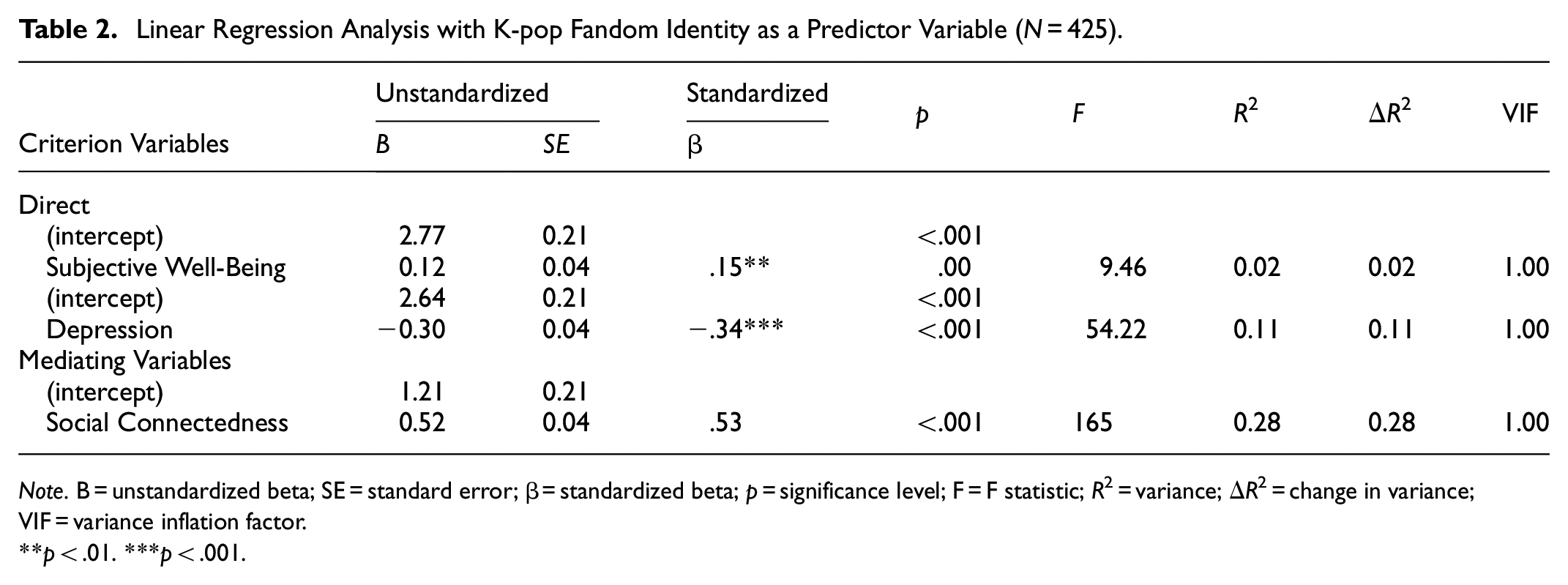
Note. B = unstandardized beta; SE = standard error; β = standardized beta; p = significance level; F = F statistic; R2 = variance; ΔR2 = change in variance; VIF = variance inflation factor.
p < .01. ***p < .001.
Mediation Analysis with Subjective Well-Being as Criterion Variable (N = 425).

Note. KFI = K-pop fandom identity; SC = social connectedness; SWB = subjective well-being.
p < .01. ***p < .001.
Structural equation modeling indicated a strong model fit, with a chi-square value of X2(three, N = 425) =158.38, p < .001. The confirmatory factor analyses demonstrated excellent fit indices, including a Tucker-Lewis Index (TLI) and Comparative Fit Index (CFI) of 1.00, as well as a Standardized Root Mean Square Residual (SRMR) of 0.01 and a Root Mean Square Error of Approximation (RMSEA) of 0.01. These values suggest an excellent overall fit for the relationships among the variables. Furthermore, mediation analysis revealed a significant total effect between K-pop fandom identity and subjective well-being (B = 0.12, p = .00), indicating that higher identification with a K-pop fandom predicts greater subjective well-being. Social connectedness also had a significant indirect effect in mediating this relationship (B = 0.08, p = .00), with the confidence interval entirely above zero (0.03–0.13), further supporting the mediating role of social connectedness in the link between fandom identity and well-being.
Based on the results presented in Figure 2, there was a non-significant direct relation between K-Pop identity and subjective well-being. Instead, K-pop fandom identity was positively related to social connectedness (β = .52, p < .001), which was positively related to subjective well-being (β = .15, p = .00). This has led to a full mediation of social connectedness between K-pop fandom identity and subjective well-being.

A visual representation of the indirect effect of social connectedness on the relationship between K-pop fandom identity and subjective well-being.
Discussion
The discussion describes and summarizes the implications of the findings. The direct effect of K-pop fandom identity on the outcome variables, subjective well-being, and depression is first reviewed. Then the mediating effect of social connectedness on the relationship between K-pop fandom identity, subjective well-being, and depression is discussed.
The Direct Effect of K-Pop Fandom Identity on Subjective Well-Being
Based on the results from the previous section, K-pop fandom identity was significantly associated with subjective well-being (Table 2). This is consistent with the position that one’s social identity can impact one’s well-being (Greenaway et al., 2015) and provide its members with positive consequences (Haslam et al., 2009). In the present study, social identity takes the form of K-pop fandom identity and has been shown to affect their subjective well-being positively. Jetten et al. (2017) integrated the social identity theory into “social cure,” which posits that the extent an individual identifies with the group, the more likely they are to experience the benefits of their membership. These benefits include satisfying global psychological needs, such as belongingness, self-esteem, control, and meaningful existence (Greenaway et al., 2015).
An example of how these resources can be applied to K-pop fandoms: Laffan (2020) reported that categorization as a K-pop fan (i.e., “yes” or “no”) has led to higher levels of fanship, which is followed by higher levels of positive psychosocial outcomes (e.g., happiness, self-esteem, social connectedness) due to perceived accessibility toward their favorite K-Pop idols and fellow fans. Other benefits, such as increased self-esteem, have also been found in similar studies: Sivanesan and Mokhtar (2024) reported that K-pop fans with high levels of fanship, defined as an individual’s sense of connection toward their object of devotion (Reysen & Branscombe, 2010), were reported to have high levels of self-esteem due to feeling socially connected with fans and participating in fandom activities that boosted their confidence (Sivanesan & Mokhtar, 2024). Belonging is also a psychological resource that social identity can provide (Greenaway et al., 2015). Jenol (2020) reported that being a K-pop fan offers a sense of belonging. When an individual encounters someone from the same fandom, their similarity allows them to begin interpersonal interaction that will eventually lead to a feeling of social connection (Jenol, 2020), which manifests as the formation and strengthening of friendships with one another, which makes their membership much more essential and meaningful to them (Reysen et al., 2017, 2022). Social identity can also give an individual a sense of control and meaningful existence (Greenaway et al., 2015). An example of this can be shown in a study by Click et al. (2013) on Lady Gaga’s fans, also known as “Little Monsters.” Through her music and persona, Lady Gaga has inspired Little Monsters to be more empowered and self-confident and to embrace their differences (Click et al., 2013). When applied in the context of K-pop fandom identity, these resources can also benefit its members and their subjective well-being.
The Direct Effect of K-Pop Fandom Identity on Depression
The complete measure of mental health is not only an assessment of subjective well-being but also includes the assessment of the presence of psychopathology (Suldo & Shaffer, 2008). In the present study, symptoms of depression were analyzed as a specific measure of psychopathology. Consistent with the hypothesis of the study, results presented that K-Pop fandom identity was significantly and negatively associated with depression (Table 2). In applying the facets of social identity as a social cure, group membership can act as a profound influence against threats to one’s mental health (Jetten et al., 2009). Moreover, Jetten et al. (2017) posit that social identity is central to ill health and can be a resource to decrease negative well-being among its members. Cruwys et al. (2014) asserted that individuals who lack meaningful social relationships are more prone to depression. However, social identities with meaningful groups will predict lower levels of depression. This is made possible due to the provision of psychological resources that, while also being beneficial to one’s well-being (Greenaway et al., 2015), are also antithetical to depression, such as meaning to life, social support, social influence, and sense of belongingness (Cruwys et al., 2014).
In the context of the present study, these antithetical resources can be accessible through membership in a K-pop fandom. Psychological processes such as meaning and influence can be obtained by looking at their favorite K-pop idols (Chadborn et al., 2017) as influences that inspire them. These fans may look to them as a reference through the themes, attitudes, and content that K-pop idols represent. A similar result is found in Tribe et al. (2021) study on the Harry Potter fandom. Despite being a fictional character, Harry Potter inspired loyal fans to experience better mental health recovery. This is done when they internalize the story of Harry Potter, which contains themes of heroism, struggles, and hope, which they use as inspiration (Tribe et al., 2021). In K-pop fandoms, content released by K-pop idols can be comforting for fans and may motivate them to overcome hardships and live a life worth living conducted a qualitative study by where a fan shared that the lyrics of the song “Breathe” by the late singer Kim Jonghyun (1990–2017), which tackled the topic of depression and mental illness, with the music and lyrics acting as comfort to them in difficult moments. Moreover, BTS’ platform on love and togetherness (UNICEF, 2021a) has also inspired ARMYs to be more empowered and to practice self-love (UNICEF, 2018). This encourages and inspires their fans positively to conform to their normative attitudes and behaviors, which may reduce the risks of depression. Fellow members and friendships can also provide resources of support and belongingness they experience within the K-pop fandom because of their social connectedness (Chadborn et al., 2017). K-pop fandoms foster social connections through members affiliating, networking, and collaborating out of admiration toward their favorite K-pop idols (Bermudez et al., 2020). This can lead to forming and strengthening friendships with fellow fans, lowering feelings of loneliness (Reysen et al., 2017). K-pop fans can also have more empathy toward one another because they have common interests and an understanding of fanaticism toward their favorite K-pop idols (Jenol, 2020). This permits them to have more meaningful and close relationships with one another (Safeer & Cohen, 2021) and provide support (e.g., social support) in the spirit of their shared identity (Jetten et al., 2017). Due to that, individuals experience fewer feelings of loneliness and isolation (Safeer & Cohen, 2021), further reducing their risk of manifesting depression (Weziak-Bialowolska et al., 2022).
The Mediation of Social Connectedness on K-Pop Fandom Identity and Subjective Well-Being
In the present study, social connectedness fully mediated the relationship between K-pop fandom identity and subjective well-being. This implies that the influence of K-pop fandom identity on subjective well-being is associated with the perceived social connections one experiences with one fandom. The extent to which individuals define themselves in terms of social identity determines how they perceive themselves to be connected and positively oriented with those of shared identity (Jetten et al., 2017). In social groups like fandoms, one can form social connections with like-minded others (Reysen et al., 2017), and their sense of similarity is an antecedent to forming this relationship (Seppala et al., 2013). In a similar study by Laffan et al. (2023), members of the same fandom may also experience a psychological sense of community due to their shared interests, which can lead to positive collective psychological outcomes for their well-being. Furthermore, social connectedness was related to subjective well-being due to the emotional support and social participation provided to the individual (Hsu & Chang, 2015). The similarity these individuals experience from their respective groups is associated with more emotional, affectionate, and positive social interactions (Seppala et al., 2013).
In the present research on K-pop fandoms, members affiliate, network, and collaborate to support their favorite groups (Bermudez et al., 2020). The social connections with one another can also pave the way for more pronounced empathic responses (Seppala et al., 2013). K-pop fans are encouraged to share and express their experiences and interests, which only their fellow fans would understand, allowing one another to feel good about themselves and see each other as friends (Jenol, 2020). Moreover, members could also receive social, emotional, and coping resources from fellow fans in the spirit of their shared identity (Jetten et al., 2017; Reysen et al., 2017). Through their sense of similarity and bonds formed, members of the same fandom can form meaningful and close relationships (Safeer & Cohen, 2021), mediating social connectedness between K-Pop fandom identity and subjective well-being.
The Mediation of Social Connectedness on K-Pop Fandom Identity and Depression
Contrary to the literature that states that social connectedness leads to reduced depressive symptoms (Galloway & Henry, 2014; Safeer & Cohen, 2021; Weziak-Bialowolska et al., 2022), the present study reported that social connectedness did not correlate with depression. Despite K-pop fandom identity being positively associated with social connectedness (Table 2 and Figure 2), social connectedness had no relationship with depression in the model. The researchers believe this may be due to K-pop fandom interactions mostly being online through social media (Roslan, 2023). Moukalled et al. (2021) reported that individuals, particularly depressed adolescents, were less likely to report “feeling better” after interacting with online peers compared to offline interaction. This suggests that while social connectedness may be positively associated with subjective well-being, it may not be enough to lessen depressive symptoms K-pop fans may experience because their interactions may be limited online.
Conclusion
In this study, identifying as a member of the K-pop fandom was shown to have different effects on the mental health of K-pop fans. K-pop fandom identity alone had a positive association with subjective well-being and was negatively correlated with depression. This is consistent with the application of social identity, where membership in a social group can provide psychological resources beneficial to well-being (Greenaway et al., 2015; Haslam et al., 2009) and antithetical to depression (Cruwys et al., 2014). Through membership in the K-pop fandom, individuals are provided with resources of belonging, support, influence, control, and meaning (Cruwys et al., 2014; Greenaway et al., 2015). Moreover, the mediation of social connectedness has shown that K-pop fandom identity was indirectly associated with subjective well-being. This alludes to the fact that emotional and positive social interactions and friendships formed with fellow K-Pop fans could satisfy their need to belong and influence them positively.
Implications to Practice
The present study’s findings benefit clinical practice if the client identifies as a K-pop fan. The psychological resources their K-pop fandom provides (e.g., belonging and support from fellow fans, influence and meaning from respective K-pop idols) can help them in their treatment. For example, a member of the K-pop fandom who feels social isolation and loneliness may be encouraged to satisfy their need to belong through Behavioral Activation (Villines, 2021). This can be done by assisting the client in applying interaction with fellow fans as an activity. This can be done through K-pop communities and forums or K-pop conventions.
Furthermore, K-pop fandoms can also act as support groups for fans where they can openly share their experiences and support one another in times of struggle. This can encourage them to experience positive interactions with fellow fans, which can be reinforcing as a practice for clients and may have positive consequences for their well-being. Moreover, the stories, content, and platforms promoted by K-pop idols can help the client see a reference in their recovery. Like Harry Potter fans using the story as inspiration for recovery (Tribe et al., 2021), K-pop fans can incorporate content by their favorite idols into their cognition and help motivate them to overcome their problems. An example of this includes an ARMY struggling with self-esteem who can look at BTS’“LOVE MYSELF” campaign and empowering songs as a reference to practice self-confidence to overcome their problem with self-esteem (Jhajhria, 2020; UNICEF, 2021b).
Limitations and Recommendations
In regard to the study’s limitations, the researchers utilized an online survey to collect data for the present study, which allows participants to quickly provide fake information (e.g., declare themselves Filipino citizens despite not being Filipino). The present study also has an age requirement of being at least 18 years old; however, K-pop has a target audience of a younger demographic as early as the age of 15 years (Le, 2018), so the experiences of a younger K-pop fan may be different compared to older fans. Moreover, during data collection, the researchers invited a diverse sample of K-Pop fans from different K-Pop fandoms (e.g., ARMYs, Blinks, Karats, and the like) rather than a singular fandom, so the experiences of these K-Pop fans may be vastly different from one another. Because K-pop is the main focus of the study, data relies only on responses from K-pop fans, which may limit the generalizability of the findings to other types of fandoms or broader populations. Furthermore, the revised social connectedness subscale (Chadborn et al., 2017) utilized for the present study only had two items, which may have needed to be more reliable to measure social connectedness. Lastly, the results showed that social connectedness mediated between K-pop fandom identity and subjective well-being; however, there was a lack of a mediating effect on depression, which weakened the whole model of the study. The lack of mediation between social connectedness and depression may be because the social connectedness scale used in the present study (Chadborn et al., 2017) only utilized two items, which may not be enough to capture the essence of the respective variable. Hence, the researchers dropped the model between K-pop fandom identity, social connectedness, and depression.
For future studies, the researchers recommend allowing a younger sample (at least 15–17 years old and with the consent of parents/guardians) to participate in the study and observe K-pop fandoms individually to observe if there are different experiences for younger K-pop fans and other fandoms. Moreover, aside from using survey methods, the researchers recommend conducting a longitudinal study on the K-pop fandom identity and social connectedness experienced by younger K-pop fans throughout significant stages of their lives. This is because of major changes individuals may experience as they age regarding understanding themselves and the world (Donohue, 2022). Moreover, because of the limited sample of K-pop fandoms chosen for the study, the researchers also recommend studying other fandoms aside from K-pop fans, such as political (e.g., Kamala Harris, Donald Trump), movies (e.g., Marvel Cinematic Universe), television series (e.g., Pokémon), and other celebrity/media fandoms. Results may vary because fandoms have different contents and platforms that their fans may utilize and internalize as normative. The researchers also recommend adapting other scales of social connectedness with more items (e.g., Social Connectedness Scale - Revised by Lee et al., 2001]) to see if it has higher reliability in measuring the variable, which may lead to different results compared to the present study. Lastly, due to the limitation of social connectedness as a model, the researchers recommend exploring the differences between online and offline social connectedness among fandoms. Furthermore, exploring alternative mediators aside from social connectedness (e.g., self-esteem, coping strategies, stress levels) should also be considered. The exploration of other potential mediators may provide a more comprehensive understanding of the underlying psychological processes that may influence the relationship between K-pop fandom identity and depression.
Footnotes
Author Note
The researchers declare that they are the authors of this research paper. To the best of their knowledge, this article has no material previously published by others except where due acknowledgment has been made.

Ethical Considerations
This study complied with the Ethical Standards of the Psychological Association of the Philippines (PAP) and the American Psychological Association (APA).
Informed Consent
The researchers provided the participants with an informed consent regarding information about the study, as follows:
Dear Participant,
Thank you for your interest in my research. Before you proceed with the survey, please read the following information:
○ Yes, I have read and understood the information provided about the study and consent to participating in answering the survey.
○ No, I do not consent to proceed with the survey.
Funding
The authors received no financial support for the research, authorship, and/or publication of this article.
Declaration of Conflicting Interests
The authors declared no potential conflicts of interest with respect to the research, authorship, and/or publication of this article.
Data Availability Statement
Data can be made available by the authors upon reasonable request.