



Abstract
Daily routines have been found to be effective in reducing problem behaviours in adolescents. Daily Activities for Youth Opportunity (DAY-Opp) were assessed through validity and reliability analyses. The sample consisted of 165 typically developing adolescents (109 girls and 56 boys, mean age 16.06 ± 2.55 years). Differences were analysed using the Mann-Whitney U test with Bonferroni for multiple comparisons. The levels of frequency, independence and satisfaction, which are sub-dimensions of “DAY-Opp,” were evaluated by multivariate linear regression. Cronbach’s alpha internal consistency coefficients of the two-factor structure were used for reliability analysis and the results are as follows: .863 for total scale, .842 for the independence subscale and .861 for frequency. Test-retest reliability was assessed using the ICC. Frequency of 0.903, independence of 0.826, satisfaction of 0.976 and the total scale of 0.801 were obtained. It was found that the average DAY-Opp frequency scores in late adolescence were significantly lower than the averages in early and middle adolescence (χ2 = 15.320, p < .001). Mean independence scores in early adolescence are significantly lower than mean scores in middle and late adolescence. (χ2 = 17.608, p < .001). Concurrent validity was assessed; There was a significant, positive correlation between the DAY-Opp and the GSE (r = .251, p < .001). The model established with age, GSE variable explains 86.1% of the variation in the satisfaction variable. This scale likely helps researchers, professionals understand the patterns and habits of adolescents in their daily lives, aiding in various studies or interventions related to adolescent behaviour and development.
Introduction
Adolescents participate in the morning routine, which includes activities of daily living and self-care activities. They engage in occupations, such as full- or part-time work, and training and volunteering (Rodger et al., 2011; Widmark & Fristedt, 2019). Mealtimes, bedtimes, homework, peer activities, and extracurricular schedules are examples of typical routines (Denham, 2003; Sytsma et al., 2001). It is advised to establish daily routines that help teenagers cope with their emotions with a sense of stability and control and get them ready for the transition to young adulthood. They form a mechanism for achieving goals and sequencing live, build routines, improve or impair health (AOTA, 2020; Koome et al., 2012). The repetitive nature of routines may strengthen neural connections, facilitating more efficient information processing and supporting the development and consolidation of skills and knowledge (Shonkoff & Phillips, 2000). Regular routines provide opportunities for adolescents to practice and strengthen these connections, contributing to cognitive growth and brain development.
Routines play a crucial role in enhancing family well-being (Denham, 2003) by providing stability and predictability in family life, thereby supporting social, emotional and mental well-being and promoting health (Koome et al., 2012). They are also important factors in reducing the impact of everyday stressors and protecting young people’s physical and mental health from these effects (Stoppelbein et al., 2019). It also serves to identify activities that contribute to adolescents’ adjustment by providing environmental cues for consistent and predictable behaviours throughout the day. Having opportunities to implement expected behaviours through daily routines helps adolescents to generate and maintain appropriate behaviours (Barton et al., 2019). Consistent routines are associated with reduced impulsivity, aggression and oppositional behaviour in adolescents. Some studies suggest that meaningful family routines help maintain identity, self-efficacy, self-confidence, self-worth and independence, and a sense of belonging, while other studies emphasise the importance of routines for behavioural development and psychobiological adjustment in adolescents (A. M. La Greca & Ranta, 2015;A. M. La Greca & Ranta, 2015). Family rituals have been shown to protect children from the negative effects of alcohol and drug use in the home and to improve their physical health. Adolescents who participate in family rituals, especially around meals, have lower rates of drug abuse, alcoholism and smoking (Abar et al., 2017; Barton et al., 2019). Regular schedules have been shown to improve executive function in teenagers, which includes skills such as working memory, inhibition and self-control (Frisch & Rosenblum, 2014; Piscitello et al., 2019). In addition, children who have consistent routines at home show better compliance, cooperation and willingness to participate, all of which can improve their social skills (Keltner, 1990).
The literature shows that family routines increase adolescents’ sense of security and self-efficacy (A. M. La Greca & Ranta, 2015; Curtis, 2015). Epidemiological studies have shown that adolescents who frequently eat dinner with their families have fewer risky health behaviours (e.g., substance use; Goldfarb et al., 2015) and better adjustment than adolescents without a mealtime routine (Koome et al., 2012; Miller et al., 2012). For example, Kiser and colleagues found that adolescents with behavioural and emotional problems had fewer family routines than those with well-adjusted behaviour (Kiser et al., 2005). Similarly, Harris et al. found that daily routines affect symptom severity in those diagnosed with Attention Deficit/Hyperactivity Disorder (ADHD; Harris et al., 2014). Family routines can prevent the harmful effects of poverty and social violence (Budescu & Taylor, 2013; David et al., 2015; Roche & Ghazarian, 2012). Daily routines have been found to be effective in reducing problem behaviours in children: as the frequency of participation in family routines increases, so does the child’s participation in school work and education, as well as cooperative and harmonious behaviour (Keltner, 1990; Wolin & Bennett, 1984). Similar results have been found in other studies (Rodger et al., 2011). Children with sleep disorders have been reported to have better sleep quality after establishing a bedtime routine (Kaur & Bhoday, 2017). Teenagers who don’t get enough sleep can suffer from sleep disorders, which can have a detrimental effect on their academic performance, cognitive abilities, emotional control and propensity to take risks (Kaur & Bhoday, 2017).
They found that low-income adolescent girl had fewer behavioural and emotional problems when their parents provided routines. Routines have been found to promote adaptation, often in times of family stress, and are associated with adolescents’ greater emotion regulation, task completion, and adjustment (Thompson & Meyer, 2009). Fewer psychological symptoms were found among young people from divorced families when regular family routines were present (AOTA, 2020; Koome et al., 2012; Piscitello et al., 2019; Hammons, & Fiese, 2011).
Routines are assessed in different ways in the literature. In our review of the literature, we identified several questionnaires that measure different aspects of adolescents’ lives, such as changing time perception, enjoyment and satisfaction, challenge and competence, boredom, need and necessity, tedium, deeper engagement and self-identification, self-knowledge (Meyer, 2008; Widmark & Fristedt, 2019). For example, the 27-item Adaptation and Daily Responsibilities Life Questionnaire (Sytsma et al., 2001), the Adolescent Routines Questionnaire with 33 items (Meyer, 2008), and the Waisman Activities of Daily Living Scale (Maenner et al., 2013) are some of the tools used for disabled adolescents and adults. Weisman’s Activities of Daily Living (W-ADL) Scale for adolescents and adults with developmental disabilities measure the degree of autonomy in performing typical activities of daily living, such as dressing, personal hygiene, housework and household chores, meal-related activities, and activities outside the home (Maenner et al., 2013). The target groups for W-ADL are the young and the adult intellectual or developmental disability (including autism, fragile X, Down syndrome, intellectual disability of unknown or other cause; Maenner et al., 2013).
Although psychometrically sound measures of routines exist for children (e.g., Sytsma et al., 2001), similar measures specifically for adolescents are lacking. Some problems arise in surveys that assess routines. Many studies also use single-item scores to assess routines, such as how often a family eats dinner together (e.g., Lanza & Taylor, 2010). This inconsistency in the assessment of adolescents’ routines limits the generalisability of the results. However, the impact of routines on adolescent adjustment is not fully understood. The paucity of empirically derived measures of routines is likely to account for the paucity of research on the role of routines in adolescent adjustment (Piscitello et al., 2019).
Given the potential value of routines in supporting adolescents’ transition to adulthood, the paucity of research is striking. The repetitive and predictable nature of these routines is highlighted as a key element that helps to mitigate the effects of external challenges and thus supports adolescents’ psychological well-being and development. From this perspective, building on this research, it is important to show how the strategic implementation of routines can be a vital tool in supporting adolescents’ capacity to adapt to different environmental contexts. Adolescence is a period characterised by increased identity development and independence. Therefore, parents may not be aware of all aspects of adolescents’ routines. Therefore, the development of specific interventions for adolescents and their parents can be a valuable addition to existing tools.
Studies focus on the extent to which parents are involved in their children’s daily activities such as homework, extracurricular activities, and peer relationships (Jules et al., 2021). Studies show that when research focuses on the extent to which parents are involved in their children’s daily activities, such as homework, extracurricular activities and peer relationships, it is crucial to consider the frequency and absence of adolescents’ participation in daily routines when designing interventions to improve parent-teen and family communication (Benner et al., 2016; Piscitello et al., 2019).
Daily Activities for Youth Opportunity (DAY-Opp) questionnaire facilitates obtaining information about the amount and types of support needed in adolescents’ daily routines, aiding in the collaborative development of strategies that support and enhance adolescents’ daily performance (Fogel et al., 2021).
Therefore, assessing the adolescent’s activity routine should be a guiding factor in measuring the extent of improvement in parent-teen relationships and overall functioning in clinical applications by implementing routine-based interventions and measuring the effectiveness of the intervention (D. Albert et al., 2013; Federici & Skaalvik, 2013). Despite the association of routines with positive family relationships and reduced conflicts, establishment of routines is not emphasised in most evidence-based treatments. Significant insights have been gained into the important role of routines in promoting adelocyte development. Despite this recognition, the mechanisms of routines are still not fully understood. A deeper investigation of the subtle effects of routines on development is crucial to advance our theoretical understanding in this field. Finally, we are examining the validity of DAY-Opp in predicting adolescent adjustment and adaptive skills. In this study, we aimed to develop psychometrically robust self-report measurements regarding adolescents’ daily routines. We believe that DAY-Opp includes items consistent with the main dimensions of adolescent routines. Therefore, we aimed to study the validity and reliability of the scale adapted to Turkish (Fogel et al., 2021; Fogel & Rosenblum, 2016).
Approaches and methods to be applied:
Material and Method
DAY-Opp Scale Translation and Adaptation
The necessary permissions were obtained from the researchers who developed the scale. We applied the Guillemin’s technique twice to five expert panellists and the test form to 165 individuals (Guillemin et al., 1993).
Designing the Turkish language equivalent of the DAY-Opp scale. First, we designed the Turkish language equivalent of the scale. In this process, five expert occupational therapists, from academicians translated the scale from English to Turkish. The Turkish text of scale was prepared by examining all translated texts one by one and choosing the translation that best represents each item. In the next stage, the Turkish scale was translated back into English by two blind reviewers who are keen on English and Turkish. The process of establishing the language equivalence of the scale was completed by evaluating whether the English translation was similar to the original scale. In the second stage, we assessed the content validity (Encan, 2005; Lawshe, 1975). The expert opinions of five academicians who had a doctorate in the field of occupational therapy were consulted to evaluate the comprehensibleness of the questionnaire. After the content validity analysis, we came to a conclusion that we could use the Turkish scale in our study. After the translation, the author of the scale received the questionnaire in its original form and the content was approved. The pilot study was conducted on ten adolescents who were selected according to certain inclusion criteria. After the pilot study, we determined that all items were understandable in the scale, and the sample group was tested to assess the validity and reliability. In the third stage, the questionnaire, whose language equivalence and content validity were confirmed, was filled out by the adolescents in an appropriate environment via face-to-face interviews. Filling out the data collection forms took approximately 15 to 20 min.
Materials Methods
Design
The study employed a quantitative research design and included 165 individuals who were continuing their education in primary and secondary schools. Two hundred students were invited to participate in the study; however, 165 agreed to take part. Participants were included in the face-to-face questionnaire evaluation conducted in schools affiliated with the Ministry of National Education. The study was initiated with informed consent from participants. Informed consent for participation was obtained from the parents of children under the age of 18. The students were informed about the purpose of the study, and written consent was obtained from them. Participants were assured of anonymity, and that the data would be used solely for research purposes. Completion of the questionnaires took approximately 20 min. Ethical approval was granted by the Non-Interventional Scientific Research Ethics Committee of İstanbul Aydın University.
Procedure
Following the approval of the ethics committee, the study was conducted between October 15, 2021, and January 15, 2022. Individuals who voluntarily agreed to participate and were open to communication constituted the sample group of the study. All participants were informed about the purpose and procedure of the study prior to the evaluation. The study was conducted in accordance with the Declaration of Helsinki. The study was initiated with informed consent from participants. Respondents gave written consent for review and signature before starting interviews. Individuals who did not wish to participate were excluded from the evaluation. Participants were asked about their age, parents’ educational level, and other demographic information through a demographic information form. Questionnaire forms were used for the evaluation. Participants took part in the face-to-face questionnaire assessment conducted in schools affiliated with the Ministry of National Education.
Ethical Considerations
Ethical approval for the study was granted by the Non-Interventional Scientific Research Ethics Committee of İstanbul Aydın University, dated 08.09.2021 and numbered 2021/560.
All participants were informed that they could withdraw from the study at any time and that their data could be removed from the study upon request. The study design minimised the risk of harm to participants, as all data were anonymised and it was impossible for any individual’s information to be disclosed to other participants. Moreover, since the study involved only the administration of questionnaires, there was no risk of harm to the participants. Since the study did not involve any interventions or the collection of sensitive personal data, there was no risk of harm to the participants. The potential benefits of the research for society and the participants outweigh any risks, as the study posed virtually no risk to the participants.
Participants
The sample consisted of 165 students from 6 public schools located in the Ankara region of Turkey Informed consent for participation was obtained from the parents of children under the age of 18. The students were informed about the purpose of the study, and written consent was obtained from them for participation.
Inclusion Criteria
The participants should: 1. be between 11 and 19 years; of age 2. accept the consent form; 3. be able to communicate; 4. volunteer to participate in the study; 5. have Turkish as their l language; 6. be adolescents with normal development. Shown in the flowchart.
Exclusion Criteria
The participants should: 1. not be younger than 11 or be older than 19 years old; 2. not be unable to communicate; 3. Haven’t volunteered to participate in the study; 4. not have any psychiatric or emotional disorders; 5. not have any autism spectrum disorders; 6. not have any physical disabilities or neurological diseases.
Assessment Scales
Sample Size
The sample calculation was performed with the correlation test at 80% power and .05 significance level, which yielded that a total of 165 participants was sufficient for the study.
Statistical Analysis
Absolute values and percentages were given as descriptors, and the deviation for continuous data. The descriptive statistics for continuous data consisted of the mean ± standard deviation and of frequency and percentage for categorical data. The Kolmogorov–Smirnov test was used to control the conformity of the continuous data to the normal distribution. One-way ANOVA was performed to evaluate the distribution of the scale scores by age group and the Kruskal–Wallis test was used for scores that did not fit the normal distribution. In case of a difference, the Mann–Whitney U test with Bonferroni correction was deployed to measure multiple comparisons. In order to decide on the number of sub-dimensions of Part A, which includes 37 items of the Day-Opp scale, the psychometric features of the scale were evaluated with validity and reliability analyses. Cronbach’s alpha (α) internal consistency coefficient, test–retest reliability, and the intraclass correlation coefficient (ICC) was used to assess the reliability of the scale (Kline, 1999). Explanatory factor analysis (EFA) was used to examine the structural validity of the scale. Bartlett’s test of sphericity and Kaiser–Meyer–Olkin (KMO) test were used to determine the suitability of the data structure for factor analysis (Pett et al., 2003). The concurrent validity of the DAY-Opp scale was evaluated using Spearman correlation analysis by looking at the relationship between the Self-Efficacy scale (Fiske, 1982). SPSS 21 for Windows was used for data evaluation (SPSS Inc. Chicago, IL, USA) and statistical decisions were made at a significance level of 0.05.
Results
Of the 165 participants included in the study (Table 1), 109 (66.1%) were female and 56 (33.9%) were male. The average age of the participants was 16.06 ± 2.55 years. Considering the education level, 101 (61.2%) were high school graduates. A total of 95 (57.6%) participants owned the house they lived in; the rate of those living with their parents was high (154, 93.3%), and 149 (90.3%) were children of working families. The mean of sustainable daily routines was 3.60 ± 1.09, and the mean of easy adaptation to routine changes was 3.58 ± 1.10.
Demographic Characteristics.

EFA Results
The dimension structure of Part A, which includes 37 items of the scale, and how many sub-dimensions it consists of were evaluated via EFA, which is a method of assessing construct validity (Pett et al., 2003). Table 2 shows that the KMO value is 0.769, suggesting medium sample adequacy (Kaiser et al., 2005). Bartlett’s test of sphericity (χ2 = 2,577, df = 666, p < .001) shows that the correlation matrix of the data is different from the unit matrix. According to this result, the correlation matrix is suitable for EFA. In order to decide on the number of sub-dimensions of Part A, the principal axis method was used for factor extraction and the oblimin method was used for oblique factor rotation (Pett et al., 2003). We excluded 8 out of 37 items because their factor loads were less than 0.30. A structure consisting of 29 items and 2 dimensions was obtained using EFA (Table 2). Among the 29 items, 15 pertain to the frequency subscale (1, 3, 5, 6, 7, 9, 10, 12, 14, 18, 20, 22, 27, 36, and 37) and 14 to the independence subscale (2, 4, 8, 13, 15, 19, 21, 23, 28, 29, 30, 31, 32, and 34).
DAY-Opp Questionnaire’s Explanatory Factor Analysis Results.

Reliability of the DAY-Opp Scale
The Cronbach’s alpha internal consistency coefficients of the two-dimensional structure were used for the reliability analysis and the results are as follows: .863 for the total scale, .842 for the subscale independence, and .861 for the subscale frequency. The internal consistency of the five items in Part B which measures satisfaction is α = .743. Since the Cronbach’s alpha coefficient of the total scale and other subscale of the scale was found to be higher than the .70 cutoff point stated by Nunally and Bernstein (1994), the scale was deemed reliable (Table 2).
Test–Retest Reliability of the DAY-Opp Scale
The test–retest reliability, which shows invariance over time, was evaluated using the ICC. A frequency of 0.903, independence of 0.826, satisfaction of 0.976, and total scale of 0.801 were obtained. Since this value exceeds the 0.70 cutoff point stated by Kline (1999), we can suggest that the scale exhibits a stable structure that does not change over time.
Age Group Differences: Differential Validity
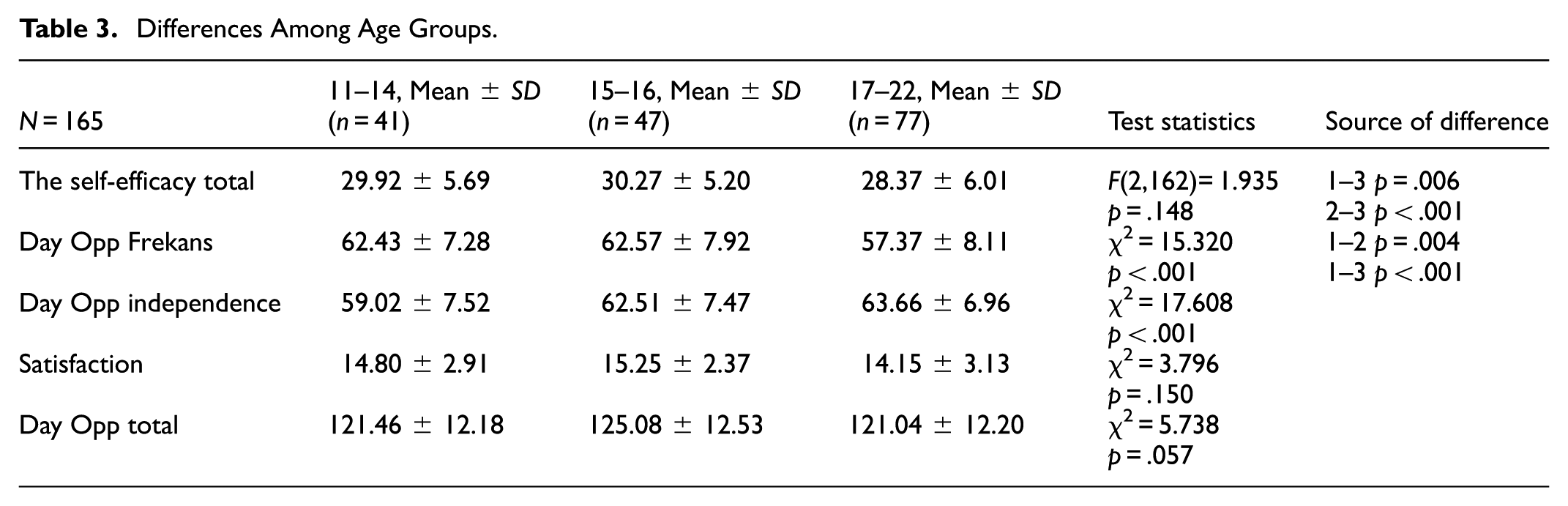
The age variable was divided into three groups: early adolescence (ages 11–14 years, M = 12.70, SD = 1.05), middle adolescence (ages 15–16 years, M = 15.55, SD = 0.50), and late adolescence (ages 17–19 years, M = 18.15, SD = 1.63).
In Table 3, the discriminant validity was evaluated whether the mean score of the scale was different among the three age groups. The General Self-Efficacy (GES) total score distribution was found to be similar for all age groups (F(2,162) = 1.935, p = .148). The frequency score distribution also differed between age groups (χ2 = 15.320, p < .001). Once again, the Mann–Whitney U test with Bonferroni correction showed that the mean for the late adolescence group (57.37 ± 8.11) was significantly lower than the mean for the early adolescence group (62.43 ± 7.28) and middle adolescence (62.57 ± 7.92; 1–3 p = .006, 2–3 p < .001). The independence score distribution was found to be different between age groups (χ2 = 17.608, p < .001). As for the previous cases, the Mann–Whitney U test with Bonferroni correction revealed that the mean for the early adolescence group (59.02 ± 7.52) was significantly lower than the mean for the middle adolescence group (62.51 ± 7.47) and late adolescence group (63.66 ± 6.96; 1–2 p = .004, 1–3 p < .001). The satisfaction score distribution was found to be similar between age groups (χ2 = 3.796, p = .150). It was observed that the distribution of the total scores was also similar between age groups (χ2 = 5.738, p = .057).
Differences Among Age Groups.
Concurrent Validity
In Table 4, concurrent validity was evaluated by examining the relationship between the DAY-Opp scale and GSE (used as a reference test). According to the Spearman correlation analysis results in Table 4, there was positive correlations between the total scale, the frequency and independence subscales, and GSE (total scale: r = .251, p = .001; frequency: r = .274, p < .001; independence: r = .199, p = .010). There was a significant, very high positive correlation between satisfaction and GSE (r = .899, p < .001).
Correlations Between DAY-Opp and Self-Efficacy Questionnaires.

“DAY-Opp Survey Predictive Validity”
The predictive validity of the “DAY-Opp” scale, which is one of the types of referential validity, was calculated using the variables “self-efficacy” and age.
The predictive validity of frequency, independence and satisfaction levels, which are the sub-dimensions of the “DAY-Opp” scale, was evaluated by Multivariate Linear Regression using the Stepwise variable selection method. Among the assumptions of Linear Regression; Multicollinearity Variance Inflation Ratio (VIF), Autocorrelation between errors Durbin-Watson (D-W) test, nonlinear relationship between effective observations Cook distance and variables, normal distribution of errors, homogeneity of variance and outlier observations were examined through residual plots.
In Table 5, by using GSE and Age independent variables, a model that predicts the frequency scores, which is a sub-dimension of the “DAY-Opp” scale, was tried to be obtained with the Stepwise variable selection method. As a result of the examination of the standardised residual distributions for the holistic model, 2 extremely distant, influential observations (observations 27 and 43) were removed from the data set. Since the VIF value is less than 10, there is no multicollinearity (VIF < 10) and there is no autocorrelation between errors (D-W = 2,213). The holistic model was significant (F(2,160) = 9.577, p < .001) and the contribution of both variables to the model was statistically significant (p = .002 and p = .012). The established model explains 10.7% of the variation in the frequency variable. A 1-unit increase in GSE score leads to a 0.330-unit increase in the frequency variable and a 1-unit increase in age leads to a 0.649-unit decrease in the frequency variable (Field, 2013).
Stepwise Regression: Predicting “DAY-Opp” Questionnaire Frequency Level.

GSE: General Self-Efficacy Scale. DAY-Opp: Daily Activities for Youth Opportunity.
In Table 5, a model predicting the change in the Independence score, which is a sub-dimension of the “DAY-Opp” scale, was obtained by using the Stepwise variable selection method using GSE and Age variables. As a result of the examination of the standardised residual distributions for the holistic model, 3 extremely distant, influential and outlier observations (observations 27, 105 and 127) were removed from the data set. Since the VIF value is less than 10, there is no multicollinearity (VIF < 10) and there is no autocorrelation between errors (D-W = 1.895). The holistic model was significant (F(2,159) = 11.020, p < .001) and the contribution of both variables to the model was statistically significant (p < .001). The model explains 12.2% of the variation in the Independence variable. A 1-unit increase in the GSE score leads to a 0.334-unit increase in the Independence variable and a 1-year increase in age leads to a 0.819-unit increase in the Independence variable (Field, 2013).
In Table 5, a model that predicts the change in the Satisfaction score, which is a sub-dimension of the “DAY-Opp” scale, was obtained using the Stepwise variable selection method using GSE and Age variables. As a result of the examination of the standardised residual distributions for the holistic model, 1 extremely outlier observation (164th observation) was removed from the data set. Since the VIF value is less than 10, there is no multicollinearity (VIF < 10) and no autocorrelation between errors (D-W = 1.759). The overall model was significant (F(1,162) = 962.936, p < .001) and the contribution of the GSE variable to the model was statistically significant (p < .001). The model explains 85.6% of the variation in the Satisfaction variable. An increase of 1 unit in the GSE score leads to an increase of 0.470 units in the Satisfaction variable (Field, 2013).
Discussion
In this study, we aimed to translate the DAY-Opp scale, which evaluates the daily routines of adolescents, into Turkish and to perform a validity and reliability study. EFA was applied first, and since the factor loads of the items (11, 16, 17, 24, 25, 26, 33, and 35) of the scale are less than 0.30, they were removed from the Turkish version of the scale (Buyukozturk, 2008).
Internal Consistency and Test–Retest Reliability
This study shows that the questionnaire’s Turkish version on adolescents’ daily routines is valid and reliable. The range for Cronbach’s alpha coefficients is from .743 to .863. The higher the Cronbach’s alpha coefficient, the higher the reliability of the scale (Aypay, 2010; Karagöz, 2014; Tezbaşaran, 1997). This value shows that the questionnaire is a highly reliable measurement tool. This is in agreement with the study of Fogel et al. (2021), who obtained Cronbach’s coefficients between 0.71 and 0.84. Our results are also in line with the results of the validity study of the daily routine activities scale of Meyer (2008), who found a Cronbach’s alpha coefficient of .85 for the adolescent sample. The retest temporal reliability estimates over a 10-day period were also reasonable. The test–retest reliability, which shows invariance over time, was evaluated using the ICC. We found the following values for the sub-dimensions: 0.903 for frequency, 0.826 for independence, 0.976 for satisfaction, and 0.801 for the total scale. It can be said that the scale exhibits a stable structure that does not change over time, since it exceeds the 0.70 cutoff point specified by Kline (1994). In the study of Meyer (2008), in which 33 cases were evaluated via test–retest measurements at an interval of approximately 2 weeks, the intraclass reliability coefficient was found to be 0.70. It is pleasing that the scale reliability is higher in our study.
Discriminant and Concurrent Validity
When we examined the results to demonstrate whether the mean scores of the discriminant validity scale were different among the three age groups (early, middle, and late adolescence), we observed that the distribution of the GSE total scores was similar in all age groups. We found that the frequency of participation in routine activities was lower in late adolescence than in early and middle adolescence. Furthermore, the independence status was lower in early adolescence than in middle and late adolescence. These findings are similar to previous studies which have reported a decline in the frequency of participation (Jarus et al., 2010) and increasing independence (Rodger et al., 2011) as adolescents grow older (Fogel et al., 2021). Fogel et al.’s study is similar to our work. Adolescence brings about a variety of developmental changes and transitions, but the most obvious ones are in the physical and psychosocial domains (A. M. La Greca & Ranta, 2015). Early adolescence, or the period between primary and secondary school, is a time when they are still very dependent on adult authority. In terms of expectations and opportunities, teenagers in upper secondary school have very different life experiences than those in middle school or high school. As late adolescents approach adulthood, they may expect more independence, social interaction and financial sufficiency. These procedures are standard and universal across all nations and cultures (Curtis, 2015). The lack of a significant difference in satisfaction level in our study was also reported by Fogel et al. Similar to our study, a study conducted by Piscitello et al. (2019) identified difficulties related to the frequency of adolescent engagement, particularly with an increasing age, specifically highlighted the issue of school absenteeism (Piscitello et al., 2019).However, the processes mediating these relationships have not been sufficiently investigated. In research, it is argued that the implementation of activity routines can encourage behaviours that are crucial for academic success. It was found that well-organised, routinised adolescents rarely skipped school, did their homework diligently and showed concentration in school while fulfilling their responsibilities. These findings indicate that the implementation of homework routines is beneficial in improving study skills and classroom readiness (Meyer & Kelley, 2007). And it is consistent with previous research showing that routines contribute to adolescents’ overall health and psychosocial adjustment (Piscitello et al., 2019).
In addition, adherence to routines during adolescence has been found to be positively associated with emotional self-regulation in early adulthood (Barton et al., 2019).
It was suggested that parents of high-achieving adolescents should be encouraged to develop and maintain routines at home, with the idea that the behaviours supported by these routines (such as responsibility and self-efficacy) would improve the academic performance of adolescents. Not surprisingly, research has shown a positive association between participation in school-related routines (e.g., sustaining attention, completing homework, and submitting assignments on time) and adolescent success.
Daily routines have been shown to improve executive function in adolescents, which includes skills such as inhibition, working memory and self-control (Frisch & Rosenblum, 2014; Piscitello et al., 2019; C. Wang et al., 2019 ). Additionally, it has been demonstrated that such engagement is positively correlated with other factors that may help adolescents avoid problematic behaviours in school (e.g., self-efficacy and autonomy; Smith, Thompson, Maynard, 2022).
The concurrent validity examination between the DAY-Opp scale and the GSE scale showed significant moderate positive correlations between the DAY-Opp and the GSE. In their study, Fogel et al. (2021) found significant moderate positive correlations between the DAY-Opp and the GSE. In our study, self-efficacy was associated with daily routines among adolescents and was a predictor. It was determined that the self-efficacy variable explained %10.7 of the variation in the DAY-Opp frequency variable, %12.2 of the variation in the independence variable, and %85.6 of the variation in the satisfaction variable. Teenagers place a lot of importance on relationships with their peers and their school outside of the family (D. Albert et al., 2013; Federici & Skaalvik, 2014; Jules et al., 2021). Students’ participation in activities (e.g., schooling) is influenced by both personal (e.g., goals and executive functions) and situational (e.g., instruction and teacher support) factors. These elements provide children hints about how effectively they are learning. Adolescents who continue to study have stronger self-efficacy (Wigelsworth et al., 2017; Zuffianò et al., 2013) and are better able to handle increased expectations, and they have more precise perceptions of their skills, values, and attributes (J. Y. Lee & Park, 2017; Y. Liu et al., 2018; Meesters et al., 2017; Santrock, 2014; Zuffianò et al., 2013; Reynolds & Johnson, 2011). According to studies, self-efficacy helps adolescents cope with the transition to early adulthood and has an impact on their life satisfaction (D. Albert et al., 2013; Burger & Samuel, 2017; Federici & Skaalvik, 2013; Grych et al., 2015; Santrock, 2014; Telef & Karaca, 2020). High levels of self-efficacy are associated with goal setting, persistence, and constructive ways to dealing with failures (Burger & Samuel, 2017).
Research consistently shows that regular participation is a strong determinant of academic learning, development and personal empowerment, linked to positive academic outcomes, and emphasises its role in successful transitions to further education programmes and career progression (Benner et al., 2016; Benner, 2011; M. T. Wang & Eccles, 2013).Research shows that participation prevents early school leaving (Eccles & Roeser, 2011). Although studies have investigated cognitive and emotional engagement simultaneously, it has been explained that both are important for adolescent development and success (Piscitello et al., 2019; Sinatra et al., 2015). In the study by Piscitello, et.al., a positive correlation was found between adaptive skills (Time Management, Extracurricular/Social Routines, Home Routines, and Hygiene Routines) and adjustment skills in relation to adolescents (Piscitello et al., 2019). Consistent with the literature, these findings also suggest that routines are associated with constructive use of time, including academic engagement and participation in extracurricular activities (Benner et al., 2016; Larson et al., 2006). Understanding the importance of sustaining attention in school and regular attendance can be strengthened in a systematic environment that includes adolescents’ responsibilities and time management. Additionally, serving as a model for management practices can create a framework for more organised adolescents, and they can implement these modelled practices as strategies for school engagement (Krauss et al., 2017; Salmela-Aro et al., 2021).
Studies focus on the extent to which parents are involved in the daily activities of their children, such as homework, extracurricular activities, and peer relationships (Benner et al., 2016). Parents living in more organised households tend to directly participate in their children’s education (e.g., assisting with household chores, attending parent-teacher conferences; Parents can emphasise the importance of adolescents’ diligence and responsibility by communicating their expectations and relationships with the school to teachers (Thomas et al., 2020; Zhan & Sherraden, 2011). These activities reinforce the significance of adolescent routines related to the importance of school studies (Benner et al., 2016; Cheung & Pomerantz, 2011; Salmela-Aro et al., 2021). Parents’ efforts can strengthen teachers’ initiatives to enhance adolescents’ motivation and engagement, and improve students’ understanding of education (Ansong et al., 2017; Gil et al., 2021; Reardon, 2018; Turan, 2018; D. Yang et al., 2022; Taylor & Lopez, 2005). Our study has been conducted on families with a good socio-economic status.
In studies involving adolescents from families with low socio-economic status, poverty poses a significant risk to academic success (W. D. Albert et al., 2020; Betthäuser et al., 2023; J. Liu et al., 2022; Munir et al., 2023; Reardon, 2018; Smith, 2021; Z. Wang et al., 2017; Yeung et al., 2022). In contrast to these studies, poverty exists in adolescents who reach late adolescence and achieve academic success despite significant risks associated with changes in the school environment and individual developmental processes. Researchs have indicated that routines are positively correlated with increased school engagement (Seaton & Taylor, 2003), better literacy and math skills (Ferretti & Bub, 2017; Zajicek-Farber et al., 2014), and improved academic self-efficacy (Budescu & Taylor, 2013; Roche & Ghazarian, 2012). Although low income is a disadvantage, there is evidence that this can be overcome with school family support to ensure activity routines (Barger et al., 2019; H. Liu et al., 2021; Seban & Perdeci, 2016). It is important to determine the content of the support to be provided to children and families at socioeconomic risk. Factors affecting academic achievement were also investigated in students who were socioeconomically at risk but had high academic achievement and had developed the ability to cope with these negative conditions in their lives (D. B. Lee et al., 2019; H. Liu et al., 2021). Studies conducted in have indicated that beneath this success lie protective and motivating factors (Ellis & Del Giudice, 2019; Salmela-Aro et al., 2021; Ren et al., 2020). “Protective factors” are defined as elements that can reflect preventive or ameliorative effects, serving as positive regulators of risks or challenges (Ellis & Del Giudice, 2019). It includes psychosocial characteristics such as social and academic abilities, problem-solving, autonomy, and a sense of purpose, as well as environmental factors arising from the student’s family (e.g., parenting, high expectations, etc.), school (e.g., positive teacher-student relationships, supportive school environment, etc.), and community (Ellis & Del Giudice, 2019; Y. Yang et al., 2022; Zhang et al., 2020; Zhou et al., 2022). Other studies emphasised teacher support, learning styles and the teaching methods and techniques they used. Adolescents are aware of their own abilities and limitations, have a positive outlook on life, and are particularly aware of their learning and working styles and how they learn (Hafeez, 2021; Hawkins, 2011; Salmela-Aro et al., 2021).
Students who believe they can succeed academically are more likely to be motivated to learn and to employ more productive study strategies. According to Bandura (1995), there are four possible sources of self-efficacy beliefs: verbal persuasion, emotional states, vicarious experiences, and mastery experiences. Teachers can benefit from differentiated instruction in this situation, which tries to modify instruction, assignments, and academic tasks in accordance with each student’s unique needs and skill set during in-class activities. By giving students mastery experiences in classroom environments, this strategy can reinforce their sense of self-efficacy (Ramli & Yusoff, 2020; Zhang et al., 2020). Additionally, teachers can support students in strengthening their self-efficacy beliefs by utilising verbal persuasion techniques like encouragement and positive feedback in addition to vicarious experiences like peer models (Ramli & Yusoff, 2020; Zhang et al., 2020; H. Liu et al., 2021). Therefore, considering the challenges students face during middle school years, it is important to conceptualise an educational approach that prioritises preventive and ameliorative effects to ensure their success. In conclusion, teachers have opportunities to engage in direct interactions addressing. For instance, those who possess qualities such as positive teacher-student relationships, engaging communication, recognising students’ efforts, and accepting students’ challenges and interests are increasingly important for middle school students who often seek support from adults outside the home (Hafeez, 2021; Hu et al., 2024).
The DAY-Opp scale asks questions regarding adolescents’ daily activities, participation opportunities, task demands, and types and amounts of assistance used or required. It is of utmost importance to collectively create plans and strategies for enhancing and supporting adolescents’ everyday performance. In addition, the findings of this study show the importance of self-efficacy in occupational therapy assessment and intervention processes involving teenagers.
Limitations
Overall, the results of this study provide initial support for the psychometric properties of the DAYY OPP. While the findings are promising, they should be considered in light of some limitations. The participant samples primarily consisted of middle to upper-income, dual-parent, and high-education level families. Most of the participants had high socioeconomic level. The majority of parents are married and highly educated. This circumstance might lead to prejudice. In future studies, including a more diverse sample demographically could be beneficial to enhance the generalisability of the results. There are still unanswered questions of a more specific nature, such how involvement types and student engagement aspects interact. What effects do various parental involvement circumstances (e.g., educational attainment, duration of involvement) have on student engagement? and Are those connections favourable or unfavourable? We suggest the following paths for further development based on the findings of our review work and the mentioned restrictions. First, we demand that more studies on these subjects be conducted with children from vulnerable backgrounds, such as economically challenged families, single-parent households, and pupils who fall behind in emerging nations. This is critical because under privileged kids are more likely to experience malad justment and disengagement, and they are also more susceptible to the detrimental effects of disengagement. While increasing parental involvement in their children’s education is a necessary first step, there are other factors to consider when it comes to parental involvement. For instance, a study indicated that while controlling, person-focussed, and negative-affective parenting styles may be detrimental to children, autonomy-supportive, process-focussed, and positive-affective parents may be advantageous to their offspring. In light of parental pressure to achieve academic achievement, Valerie Walkerdine and colleagues’ study, for instance, underlined the necessity and concerns to look at the psychodynamic process (i.e., stress, anxiety) involved in working-class (school) girls and boys. Those can be difficult yet fascinating subjects to research in the future.
Conclusion
Important insights into the critical role of routines in promoting adolescents’ development were obtained. Understanding adolescents’ daily routine activities can reveal important information about their current performance, their strengths and the challenges they face in actively participating in daily life. The DAY-Opp questionnaire provides information about adolescents’ daily routines, opportunities for participation, task demands and the amount and types of help used and needed. It helps to collaboratively develop strategies that support and improve the daily performance of adolescents. The routine of adolescents should be carefully handled by experts, as it can reduce problematic behaviours in adolescents. This is important for their lives and should always be considered as part of a comprehensive assessment. It has been shown that if the routine activities of adolescents are not properly managed, problematic behaviours may persist. Therefore, the development of positive social behaviours in adolescents holds significant importance for adolescents, their families, and society due to its personal and social outcomes. In our study, the Self-efficacy variable was associated with and predictive of daily routines among adolescents. In conclusion, we have shown how activity routines interact with low self-efficacy. This is intricately linked to reduced self-efficacy and warrants serious attention not only in the context of activity routines, which have been extensively addressed in the existing literature, but also in the fields of public health and adolescent health. Innovative clinical and policy tools that can help integrate interdisciplinary preventive support for at-risk adolescents should be addressed. Considering the results of the current study, trainings can be given to reduce problematic behaviours in adolescents and increase their self-efficacy levels. In addition, it is of great importance to provide training activities for families living with adolescents in order to raise awareness. Research on the mechanisms at the intersection of academic achievement, school attendance and family management practices may have critical potential to support families. In order for school-teacher collaboration to be productive and continuous, teachers and school administrators need to know not only the student but also the family, environment and needs. Ayrıca, araştırma ergenlerin karşılaşabileceği potansiyel iflas riskini de göz ardı etmektedir.
Footnotes
Acknowledgements
We would like to thank everyone who participated in this study.

Ethical Approval
The ethical approval for the research was granted by the Ethics Committee for Non-Interventional Scientific Research at the University of Istanbul Aydın, dated 08.09.2021 and numbered 2021/560.
Ethical Considerations
Non-Interventional Scientific Research Ethics Committee at İstanbul Aydın University approved the study (decision no: 2021/560, date: 08.09.2021), which was to be conducted according to Declaration of Helsinki. The participation was on a voluntary basis and written consent was obtained from the adolescents and their families. The participants were made aware of the goal of the study and the measuring methods prior to application.
Consent to Participate
We ensured that the participants’ consent was obtained before each face-to-face interview and each questionnaire. We asked each adolescents and their families at the start of the interview if we had their consent to process and use their data for scientific publications.
Consent for Publication
To begin the assessment, participants were required to read and approve an informed consent. Informed consent was obtained from the parent and/or legal guardian to participate in the study.
Author Contributions
Ayşe Göktaş, Volkan Türkmen; concepts, design (concept and design of study or acquisition of data or analysis and interpretation of data), definition of intellectual content, literature search, clinical studies, manuscript preparation, manuscript editing, and manuscript review (revising it critically for important intellectual content). Corresponding author (Ayşe Göktaş), take responsibility of the integrity of the work as a whole from inception to published article and should be designated as “guarantor.”
Funding
The authors received no financial support for the research, authorship, and/or publication of this article.
Declaration of Conflicting Interests
The authors declared no potential conflicts of interest with respect to the research, authorship, and/or publication of this article.
Data Availability Statement
Data can be shared when deemed necessary.