




Abstract
There is a growing body of research on FoMO, yet the causal link between maximization and FoMO remains underexplored. This paper addresses this gap by investigating the mediating role of variety-seeking in the relationship between maximization and FoMO. Two studies were conducted, a survey (n = 209) and an experiment (n = 102), to provide converging evidence for the relationship between FoMO and maximization. Data analysis revealed that maximization leads to FoMO experience, and variety-seeking partially mediates this relationship. Our paper presents some promising avenues for further research by exploring the relationship between FoMO and the maximization tendency. This paper contributes to the literature by suggesting that when individuals try to make the best decision among alternatives—maximize, their variety-seeking tendency causes them to experience FoMO.
Introduction
The rise of social networking sites (SNS) has increased individuals’ exposure to the others’ experiences (Alt, 2018; Blackwell et al., 2017). This heightened exposure often triggers the fear of missing out (FoMO), defined as the “pervasive apprehension that others might be having rewarding experiences from which one is absent” (Przybylski et al., 2013). Supporting this, the MassMutual Consumer Spending & Saving data—collected from a nationally representative sample of 1,000 Americans along with an oversample of 250 U.S. office workers—reveals that consumers experiencing FoMO spend an additional $765 per month compared to the previous year (Businesswire, 2021) and frequently make reactive purchases within 24 hr (Gilbert, 2021). FoMO is also widespread: 58% of individuals report experiencing it regularly, and 81% experience it occasionally (Hayran et al., 2020). The prevalence of this affective state underscores how modern social dynamics, particularly in digitally connected environments, amplify opportunities for social comparison and intensify the fear of missing out, making it an increasingly relevant topic in contemporary psychological research.
FoMO has attracted significant attention from researchers, resulting in a growing body of literature that aims to understand its nature. Previous studies have proposed several theoretical foundations, including self-determination theory (Przybylski et al., 2013), self-concept theory (Zhang et al., 2020), and self-construal theory (Dogan, 2019). FoMO has been linked to SNS use (Beyens et al., 2016; Fioravanti et al., 2021; Yin et al., 2021), alcohol consumption (Riordan et al., 2015), smartphone use (Coco et al., 2020; Elhai et al., 2021; Franchina et al., 2018; Wolniewicz et al., 2018), narcissism (Błachnio & Przepiórka, 2018), well-being (Brown & Kuss, 2020; Reer et al., 2019; Roberts & David, 2020), the need to belong (Duman & Ozkara, 2021), and personality traits (Rozgonjuk et al., 2021; Sindermann et al., 2021). While these studies have deepened our understanding of FoMO, this paper explores its underexamined link with maximization—an intrinsic inclination to make the best possible decision among various options (Schwartz et al., 2002).
This paper addresses a key gap by investigating the relationship between FoMO and the tendency to maximize. Specifically, it examines whether and why FoMO is associated with maximization, proposing variety-seeking as a mediating mechanism. To achieve this, we first establish the association between FoMO and maximization tendency. Next, we investigate the mediating role of variety seeking in this relationship. The contribution of this paper is two fold. First, it conceptually and empirically links two seemingly unrelated constructs—FoMO and maximization tendency—that have received limited joint attention. This integration of prior research on these constructs paves the way for new avenues of exploration. Second, and more importantly, the paper explains their connection by introducing variety-seeking as a mediating construct. In essence, we propose that one of the drivers of the FoMO experience is a tendency toward variety seeking. Simply put, the relationship between FoMO and other related constructs can be better understood through the lens of variety seeking. To contextualize our findings, we draw upon an array of recognized theories, including Self-Determination Theory, Social Comparison Theory, and Social Identity Theory, among others. These perspectives provide a comprehensive framework for examining how personality traits and cognitive processes shape individuals’ responses to the abundance of options and social information in the digital age. By integrating these theoretical approaches, we aim to offer a deeper understanding of the relationship between maximizing tendency and FoMO, thereby contributing to the broader literature on decision-making and psychological well-being.
Conceptual Background
Fear of Missing Out (FoMO)
The concept of FoMO is frequently attributed to Watson and Meyer (1985), although this reference is not locatable (Hodkinson, 2019); however, academic interest has surged since the 2010s (Hodkinson, 2019). FoMO has been defined in various ways over time. Przybylski et al. (2013, p. 1841) described it as “a pervasive apprehension that others might be having rewarding experiences from which one is absent.” Expanding on this, Gioia et al. (2021, p. 2) characterized FoMO as “the desire to stay continually connected with what others are doing.” In contrast, Zhang et al. (2020) conceptualized FoMO from the perspective of self-concept, emphasizing that it arises when individuals perceive a missed experience as a psychological threat to both their private and public selves.
Early FoMO research focused primarily on its connection to social media and problematic smartphone use (Alt, 2015; Carbonell et al., 2013; Przybylski et al., 2013). Over time, the scope expanded to encompass various aspects of individuals’ daily lives, including anxiety severity (Dhir et al., 2018; Oberst et al., 2017; Scalzo & Martinez, 2017), self-concept (Dogan, 2019), self-esteem (Buglass et al., 2017), purchase likelihood (Good & Hyman, 2020), and buying behavior (Kang et al., 2019).
Przybylski et al. (2013) argued that FoMO arises from a basic desire for social interaction. Roberts and David (2020) identified FoMO as a precursor to social connection. Alt (2015) demonstrated that FoMO mediates the link between motivational factors and social media engagement in educational contexts. During the COVID-19 lockdown, FoMO also contributed to increased problematic social networking sites (SNS) use (Gioia et al., 2021).
FoMO is generally linked to negative outcomes (Turkle, 2017), including reduced well-being (Stead & Bibby, 2017), life satisfaction (Elhai et al., 2016), poor sleep quality, stress, fatigue (Milyavskaya et al., 2018), increased alcohol use (Riordan et al., 2018), academic demotivation (Alt & Boniel-Nissim, 2018), and distracted driving (Przybylski et al., 2013).
In addition to psychologists, recent studies by marketing scholars have revealed that FoMO is a crucial factor for understanding modern consumer behavior (Good & Hyman, 2021). By reducing the intention to repeat everyday experiences, FoMO threatens consumer loyalty (Hayran et al., 2020). Unlike researchers who focus on the adverse outcomes of FoMO, Good and Hyman (2020) found that anticipated elation, a positive emotion triggered by FoMO, influences purchasing behavior. Furthermore, FoMO is often considered a driving force behind conformity consumption, prompting individuals to choose culturally popular brands (Kang et al., 2019).
Antecedents of FoMO
While most FoMO research emphasizes its consequences, less attention has been given to its antecedents, which are fundamental to its formation. Studies have identified key predictors, including personality traits, social dynamics, and technology-related factors. Personality traits such as neuroticism are positively associated with FoMO, while conscientiousness, extraversion, and openness are negatively associated with it (Rozgonjuk et al., 2021). Neurotic individuals are more prone to anxiety and dissatisfaction, which heightens sensitivity to potential exclusion. Similarly, low self-esteem and high extraversion increase the need for external validation and consistent social engagement, making individuals more vulnerable to FoMO (Gori et al., 2023).
According to Festinger’s Social Comparison Theory (Festinger, 1954), people assess their status and experiences by comparing themselves to others. In the context of FoMO, social comparison—particularly upward comparison—intensifies feelings of inadequacy and the fear of exclusion. This is consistent with research showing that FoMO is more prevalent among individuals who frequently compare themselves to others on social media platforms (Wang et al., 2023).
Similarly, Self-Determination Theory (SDT; Deci & Ryan, 1985) posits autonomy, competence, and relatedness as fundamental psychological needs. FoMO arises when these needs—particularly relatedness—are unmet. While social media may partially fulfill them, it often intensifies FoMO by exposing users to activities and social interactions they are not part of (Przybylski et al., 2013).
Maximization and Variety-Seeking as Antecedents of FoMO
Building on this framework, this study presents maximizing and variety-seeking as new antecedents of FoMO. Maximizers, who have a continuous desire to find the best option in any decision, are more likely to experience FoMO due to their heightened sensitivity to missed opportunities and alternative choices (Schwartz et al., 2002). This aligns with self-concept theory (Sirgy, 1982), which highlights the disparity between the ideal and actual self as a source of psychological distress. In their pursuit of perfect outcomes, maximizers often perceive discrepancies between what they want and what they achieve, heightening their susceptibility to FoMO.
Variety-seeking—a desire to explore diverse options—can intensify FoMO. According to Need for uniqueness theory (Snyder & Fromkin, 1980), people seek variety to differentiate themselves, but this increases exposure to greater range of social comparisons, making them more vulnerable to FoMO. Social Distinctiveness Theory (Brewer, 1991) adds that the tension between fitting in and standing out heightens FoMO, especially when individuals perceive others as having unique and rewarding experiences.
Maximization
The tendency to maximize, characterized by an individual’s drive to make optimal choices, has been linked to heightened psychological discomfort when navigating numerous alternatives (Schwartz et al., 2002). Recent findings link this trait to adverse outcomes such as obsessive-compulsive tendencies (Oren et al., 2018), problematic social media use (Müller et al., 2020), and increased choice or commitment anxiety (Kenner & Sage, 2024). By examining the underexplored connection between maximization and FoMO, this study sheds light on how personality traits shape emerging digital-age phenomena, offering valuable insights into the broader societal implications of maximizing behavior.
Maximizers and satisficers differ in their strategies for making choices, approaches to alternatives, and their choice moods (Iyengar & Lepper, 2000; Schwartz et al., 2002). Based on the views of Simon (1955, 1956), maximizing and satisficing are defined as follows: “to maximize is to seek the best and requires an exhaustive search of all possibilities, while to satisfice is to seek good enough, searching until encountering an option that meets the threshold of acceptability” (Iyengar et al., 2006, p. 143). From this perspective, maximizers engage in extensive alternative comparison and strongly prefer the best possible result (Ma & Roese, 2014). In contrast, satisficers prefer to settling for good enough options rather than pursuing the best (Diab et al., 2008). Satisficers consider and choose from fewer alternatives than maximizers, aiming to find an acceptable option that meets their expectations (Lai, 2011).
When maximizers settle on a choice, they often remain uncertain whether it was the best, as they cannot evaluate all possible options—lowering their chances of reaching the maximization goal (Schwartz et al., 2002). Despite seeking more options to optimize outcomes, they frequently feel dissatisfied due to the effort and trade-offs involved—known as the maximization paradox (Dar-Nimrod et al., 2009). It is also argued that, while the tendency to maximize has both positive and negative outcomes, maximizers are less happy than satisficers. This view is explained by the idea that maximizers’ search for multiple alternatives may increase the likelihood of both positive and negative outcomes; however, they are ultimately less happy because they tend to focus on negative outcomes (Polman, 2010). These explanations suggest that maximizing and satisficing represent a dichotomy. However, as emphasized in previous studies, the tendency to maximize should be considered a continuous dimension, rather than a binary concept (Cheek & Schwartz, 2016; Ma & Roese, 2014; Xia & Bechwati, 2021).
Maximization has gained interdisciplinary attention, with early research emphasizing concept definition and measurement development (Cheek & Schwartz, 2016; Dalal et al., 2015; Diab et al., 2008; Lai, 2010; Misuraca & Fasolo, 2018; Nenkov et al., 2008; Richardson et al., 2014; Rim et al., 2011; Schwartz et al., 2002; Turner et al., 2012; Weinhardt et al., 2012). More recent work has expanded into diverse domains, including friendship selection (Newman et al., 2018), consumer decision-making across goods, services, and experiences, and life decisions (Kokkoris, 2018), the responses of maximizers to threats to freedom of choice during the COVID-19 lockdown (Kokkoris, 2020), saving intentions (Brannon, 2021), multichannel shopping experience (Harris et al., 2021), cognitive biases (Misuraca et al., 2021), cardiovascular responses during choice overload (Saltsman et al., 2021), evaluating product bundles (Xia & Bechwati, 2021), and the post-choice information search (K. Kim, 2022).
Previous research consistently links the tendency to maximize with negative outcomes. Although some studies emphasize that this may be caused by issues arising from measurement (Diab et al., 2008; Kokkoris, 2016; Weinhardt et al., 2012), maximizing tendency is generally associated with adverse outcomes such as depression (Ma & Roese, 2014; Newman et al., 2018; Schwartz et al., 2002), lower satisfaction with choice (Dar-Nimrod et al., 2009; Iyengar et al., 2006; Sparks et al., 2012), and more problematic decision-making styles (Parker et al., 2007).
Variety Seeking
Some individuals are unable to satisfy their wants and needs with a single item, and instead prefer to explore multiple (or, in some cases, a combination of) brands and products (Rubio et al., 2019). They deliberately vary their choices (both the items and the way they select them) on a regular basis (H. S. Kim & Drolet, 2003). This internal drive for variety often shifts preferences toward new or unexplored options across different product and service categories (Givon, 1984; Grünhagen et al., 2012; Kahn et al., 1986). This tendency toward variety-seeking may even lead consumers to choose less favorable or satisfying items over their preferred ones (Olsen et al., 2016; Ratner & Kahn, 2002). Whether it is for the present or the future, consumers crave variety in their choices (Gullo et al., 2019).
Previous literature suggests that variety-seeking behavior is motivated by three intrinsic sources: (1) satiation, where accumulated experience with a product drives an individual to explore available options; (2) the search for novelty, which drives individuals to seek new choices; and (3) using variety to avoid uncertainty and become acquainted with future alternatives (tastes; Berné et al., 2001; Kahn, 1995; McAlister & Pessemier, 1982). A body of research associates variety-seeking with the optimum stimulation level (OSL), where consumers with high OSL pursue greater stimulation from their environment by seeking variety or taking risks (Sharma et al., 2010a, 2010b; Steenkamp & Baumgartner, 1992). Consumers use variety-seeking to overcome the boredom associated with habitual and routine purchases, as the consumption of various products is expected to generate positive stimulation and arousal. Related research supports this notion, as variety-seeking is particularly evident for hedonic products (compared to non-hedonic ones) on which consumers quickly satiate (Fishbach et al., 2011). Contextual factors may also influence consumers’ variety-seeking tendencies, with varying social contexts and audiences leading individuals to select the relevant product for the occasion. Variety-seeking is also prevalent when consumers seek to satisfy their need for uniqueness by choosing an item different from what others have selected (Sharma et al., 2010a).
Variety-seeking helps consumers overcome satiation caused by habitual and recurrent choices, thereby maximizing their satisfaction by offering a range of options (Sevilla et al., 2019). Similar to variety-seeking, maximization tendencies are shaped by contextual factors. When the consequences of a choice are publicly visible, maximizers may prefer more variety. Individuals high in maximization typically invest greater time and cognitive effort in evaluating alternatives, aiming to select the optimal option among all available choices (Lin, 2015).
Although one component of maximizing tendency is alternative search (Nenkov et al., 2008; Schwartz et al., 2002; Turner et al., 2012), variety-seeking refers to a different construct. The search for alternatives, which tends to maximize, is necessarily associated with a “search for the best.” However, variety-seeking does not necessarily entail a “search for the best.” Variety-seeking is more about creating and experiencing a range of options, whether better or worse, rather than finding the best option. A study that found variety-seeking is not related to maximization (Kahnx et al., 1997), showed that participants rarely consumed their best alternatives, suggesting that variety-seeking behavior may fail to maximize pleasure.
Items measuring alternative search in maximization scales (Turner et al., 2012), emphasize an intensive and deliberate evaluation of options aimed at identifying the best choice. However, variety-seeking refers to seeking diversity in choices and is associated with consumers’ preference for a range of different options, rather than adhering to their usual preferences (Kahn, 1995). In this sense, it can be argued that variety-seeking is related to the idea that even if consumers find an alternative that maximizes their utility, they do not remain loyal to it; instead, they turn to other options. In sum, it is clear that the search for alternatives for maximization purposes and variety-seeking are distinct from one another. That is, maximizers intrinsically focus on maximizing the outcome, while variety-seekers primarily focus on enhancing the number of options available.
To better understand the relationship between maximization and variety-seeking, it is important to distinguish variety-seeking from alternative-seeking, as each is driven by different motivators. Despite their similarities, variety-seeking and alternative-seeking reflect separate behavioral drivers. Variety-seeking involves exploring new and different options, motivated by curiosity or a desire for stimulation, whereas alternative-seeking focuses on evaluating options to identify an optimal choice. Maximizers, who aim to make the best decisions, frequently use variety-seeking to broaden their choice set and reduce uncertainty, thereby increasing the likelihood of finding the “best” option. Satisficers, on the other hand, accept “good enough” outcomes, which reduces their desire for variety. Thus, variety-seeking aligns with maximizers’ extensive search for optimality, as confirmed by Kahn and Ratner (2005) and Schwartz et al. (2002). This theoretical alignment highlights the relevance of variety-seeking in the pursuit of maximizing tendencies.
Hypothesis Development
One of the adverse outcomes linked to the maximization tendency is the fear of missing out (FoMO; Milyavskaya et al., 2018). A recent study examining the relationship between maximization and FoMO found that although there is no direct relationship between maximization and problematic social network use, FoMO mediates this effect (Müller et al., 2020). Another study examinig the relationship between problematic smartphone use and maximization revealed a positive relationship between problematic smartphone use, maximization, and FoMO. Accordingly, the tendency to maximize increases the likelihood of experiencing FoMO, which, in turn, raises the risk of problematic smartphone use (Servidio, 2023). In addition to the tendency to seek more options in pursuit of the best, maximizers’ interest in and comparison with others’ choices, as compared to satisficers, can be considered a factor that triggers FoMO (Schwartz et al., 2002; Weaver et al., 2015). Taken together, these findings suggest that maximization tendency may serve as an antecedent to FoMO.
Although previous findings suggest a relationship between maximization tendency and FoMO, the causal link between these two has yet to be clarified. Therefore, it is hypothesized that maximization influences FoMO, based on the notion that maximizers, in their pursuit of the “best” option, may experience FoMO regarding other options they forgo as a result of their choice.
Maximizers are more prone to engage in social and counterfactual comparisons, which reduce satisfaction and intensify the FoMO. Variety-seeking is expected to amplify these tendencies by presenting consumers with more options (Broniarczyk, 2018). Consumers may evaluate additional options through variety-seeking in an effort to identify the best available alternative, as variety seekers tend to be more curious and invest more effort in their search (Rubio et al., 2019). This extensive evaluation process is more likely to evoke FoMO if consumers are dissatisfied with their outcomes. Specifically, curiosity about alternatives that have not been explored but may offer greater utility can influence satisfaction with the decision (Sevilla et al., 2019), leading to feelings of regret and opportunity cost (Malone & Lusk, 2019), which ultimately foster FoMO. In many purchasing situations, consumers struggle to determine what they might have experienced if they had chosen a different option (Sánchez-García et al., 2012). Variety seekers, who are more prone to boredom, actively seek out and explore alternative options (Nagar & Gandotra, 2016). For individuals with a tendency toward variety seeking, this heightened awareness of missed opportunities can strengthen the belief that a better option is always available, thereby amplifying the experience of FoMO. Moreover, determining the right amount of variety to identify the best alternative is a challenging task (Sevilla et al., 2019). Variety seekers, driven by a desire for novelty and stimulation, actively seek new experiences and options. This behavior increases their exposure to new opportunities and social comparisons, heightening their vulnerability to FOMO. According to social comparison theory (Festinger, 1954), people are motivated to evaluate their circumstances by comparing themselves to others. For variety seekers, encountering diverse experiences or outcomes—especially those showcased on social media—can amplify feelings of missing out, as they constantly compare their own experiences to those of others (Przybylski et al., 2013). Consequently, variety seeking can intensify FOMO, particularly in environments where social validation and status are readily accessible.
In sum, maximizers’ desire to optimize their choices may drive them to seek variety as a means of exploring their options. However, this behavior may also heighten their awareness of what they did not choose, thereby linking variety seeking to an increased sense of FOMO. In these instances, maximizing can induce FOMO, as consumers imagine the appeal of the alternatives they did not select. Thus, variety-seeking is likely to serve as a mediator between maximizing tendencies and the fear of missing out.
Therefore, we expect variety-seeking to positively mediate the relationship between maximization and FoMO (See Figure 1).

The proposed conceptual model.
Methodology
The study employed a convenience sampling approach, with participants recruited through Amazon Mechanical Turk (MTurk), a platform known for providing access to diverse and reliable participant pools for behavioral research (Buhrmester et al., 2011). To ensure high-quality data, participants were screened based on specific criteria, including being at least 18 years old, residing in the United States, and having a minimum MTurk approval rating of 95%. These selection criteria were designed to enhance the reliability of the responses and improve the generalizability of the findings within the U.S. context.
MTurk is a widely used platform known for its efficiency in collecting data for psychological and consumer behavior studies. It allows researchers to access a diverse sample that represents various demographics, including age, education, and socioeconomic status (Paolacci & Chandler, 2014). This broad participant pool makes MTurk particularly suitable for researching psychological constructs such as maximizing and FoMO, which are not confined to any particular demographic or professional group.
Ethical Considerations
This research involved human participants and adhered to ethical standards in accordance with the 1964 Helsinki Declaration and its later amendments. Ethical approval was obtained from the university’s ethics committee (Date: 13.05.2024, No: 2024/07). All participants provided informed consent before participating in the study. The study design minimized the risk of harm, and participants were free to withdraw at any time. The potential benefits of this research to understanding consumer psychology outweigh any minimal risk posed to participants.
Study 1
The objective of Study 1 was to provide initial cross-sectional evidence in support of our hypotheses. Specifically, we tested these hypotheses using cross-sectional survey data.
Participants and Procedure
Following the exclusion of forty-nine (nfemale = 27, Mage = 35.3) careless respondents, who are categorized according to their responses on attention check items, our final sample size is 209 adults (nfemale = 88, Mage = 38.3, SDage = 11.5, Minage = 23, Maxage = 69, Mannualincome = $57,948).
The cross-sectional survey data were collected via the M-Turk platform. The participants were invited to participate in our survey, which included measures and attention check items, in exchange for $ 0.25.
After participants signed the consent form, they were allowed to begin responding to survey, which was consisted of two attention check items, demographic questions, and a battery of psychometric scale items. All responses were recorded with a 7-point Likert scale (1 = Disagree, 7 = Agree).
Measurement
Attention Check Items
We adopted a bogus-item approach (Meade & Craig, 2012) to filter careless respondents out from the data. Particularly, our bogus items are “I am a dinosaur who has a supernatural power” and “I was born on February 31st.” We categorized participants who rated those items five or higher (out of seven) as careless respondents since it is not logical to agree with those bogus items. This operationalization excluded 41 participants from the data, resulting in a final sample size of 209.
Maximization
We operationalized the construct of maximization using a unidimensional seven-item scale (α = .73) developed by Dalal et al. (2015). The items were “I don’t like having to settle for good enough,”“I am a maximizer,”“No matter what I do, I have the highest standards for myself,”“I would wait for the best option, no matter how long it takes,”“I never settle for second best,”“I never settle,” and “No matter what it takes, I always try to choose the best thing.” The participants responded to the items on a 7-point Likert scale with 1 = “Strongly Agree” and 7 = “Strongly disagree”.
Variety Seeking
This construct was operationalized with a uni-dimensional five-item scale (α = .72) developed by Olsen et al. (2016). The items were “I am constantly seeking new ideas and experiences,”“I dislike change and variety in daily routine (Reverse),”“I like continually changing activities,”“I prefer a routine way of life compared to one full of change (Reverse),” and “I like to experience novelty and change in daily routine.” The participants responded to the scale items on a 7-point Likert scale (1 = strongly disagree, 7 = strongly agree).
FoMO
Initially, all (ten) items of FoMO scale (Przybylski et al., 2013) were discussed among the co-authors and five of those items were evaluated as vague and unclear. Therefore, we adopted the remaining five items from the unidimensional scale developed by Przybylski et al. (2013). Thus, we measured FoMO with these five items (α = .84). The items were “I fear my friends have more rewarding experiences than me,”“I get worried when I find out my friends are having fun without me,”“It bothers me when I miss an opportunity to meet up with friends,”“When I miss out on a planned get-together, it bothers me,” and “When I go on vacation, I continue to keep tabs on what my friends are doing.” Responses were recorded on 7-point Likert scale (1 = strongly disagree, 7 = strongly agree).
Findings
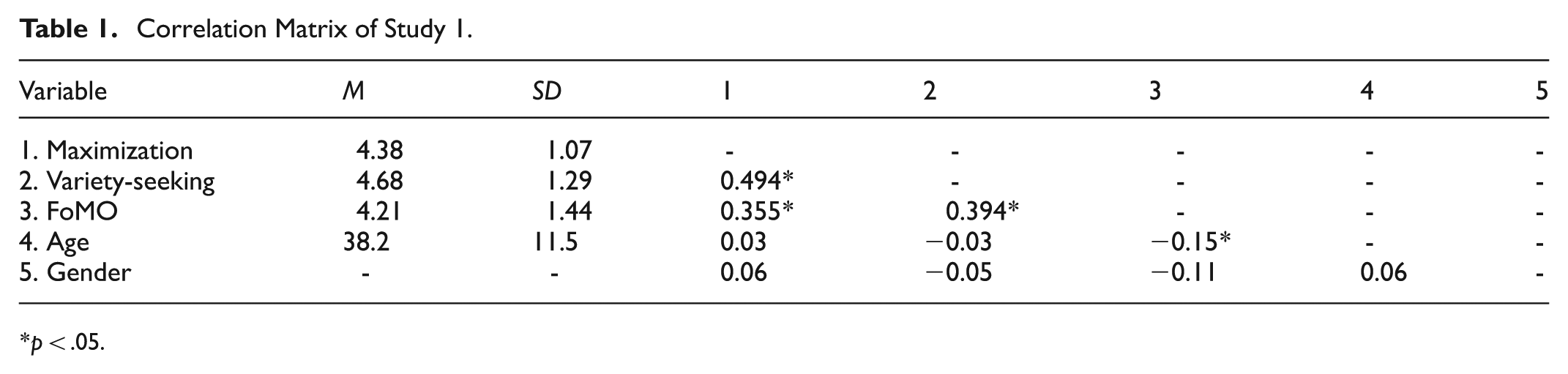
As we can see at Table 1, variety-seeking was found to be positively associated with maximization (r (207) = 0.49, p < .01) and FoMO (r (207) = 0.39, p < .01). In addition, we also found a positive correlation between variety-seeking and FoMO, r (207) = .36, p < .01, which provides an initial (cross-sectional) support to H1.
Correlation Matrix of Study 1.
p < .05.
To test our H2, we performed a generalized linear regression model that includes three blocks. First, we regressed FoMO on age and gender (R2 = 0.18, see Table 2).
Generalized Linear Model Results.

Second, we added the maximization to the model as another predictor (R2 = 0.41, see Table 2). The model reveals a positive association between maximization and FoMO (β = .49, p < .01), controlling age and gender.
Lastly, we included variety-seeking as another predictor in the model (R2 = 0.48, see Table 2). Results showed that both maximization (β = .31, p < .01) and variety-seeking (β = .30, p < .01) has a positive correlation with FoMO. However, the relationship coefficient between maximization and FoMO diminished (Bbefore = 0.49, p < .01, Bafter = 0.31, p < .01) due to the inclusion of variety-seeking to the model. Moreover, the change in R2 was also found to be significant (▲R2 = .07, F = 14.4, ▲df = 1, p < .01). These findings provide support for our H2.
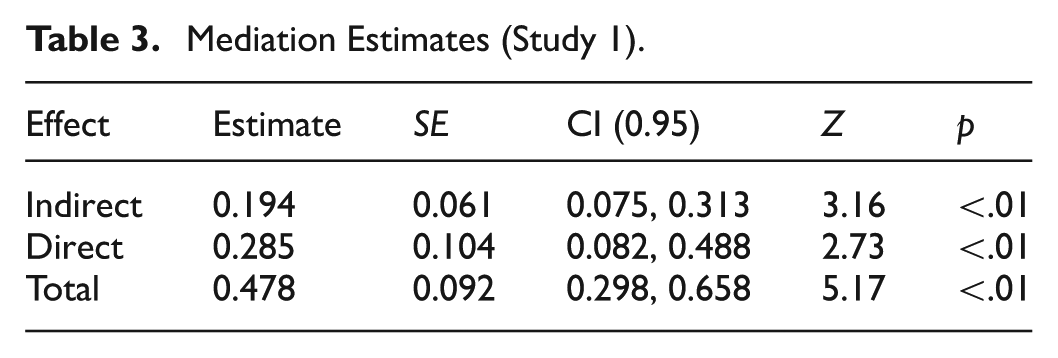
To provide corroborating evidence for our H2, we also performed a mediation test using the Process model (Hayes, 2013), which included 10,000 bootstrapping (see Table 3). The findings demonstrated that variety-seeking positively and partially mediates the relationship between maximization and FoMO (βindirect = 0.194, SEindirect = 0.061, pindirect < 0.01). Thus, this finding provides a corroborating support for our H2.
Mediation Estimates (Study 1).
Discussion
Based on cross-sectional survey data collected from 209 MTurk participants, we found that maximization and FoMO are positively correlated (H1), and this relationship is positively and partially mediated by variety-seeking (H2). Although these findings provide initial support to our hypotheses, the cross-sectional design falls short of establishing a causal link. Thus, we conducted another study, in which between-subjects experimental design is performed, to provide corroborating and consistent evidence about our hypotheses.
Study 2
The objective of Study 2 was to test the mediating role of variety-seeking in the causal relationship between maximization and FoMO, following to establishment of this causal link. Particularly, we tested our hypotheses using a between-subjects experimental design in this study.
Participants and Procedure
We recruited 102 MTurk participants (Mage = 41.1, SDage = 12.8, 54 nfemale = 48). They were paid $ 0.50 in exchange for their participation. Our design was a between-subjects experimental design with two conditions, namely, control condition and maximization condition. Participants were randomly (simple) assigned to either control (n = 51) or maximization condition (n = 51). Neither gender (χ2(1) = 0.157, p = .69) nor age (t(100) = −0.416, p = .67) distribution differentiates across two conditions.
The process was the same for both conditions, except for the maximization manipulation. First, participants were asked to sign a consent form to proceed. Then, they were assigned to one of the two conditions. Participants, assigned to the control conditions, were not exposed to any manipulation. They responded to a battery of scale items, including maximization, variety-seeking, and FoMO items. They also reported demographic characteristics. On the other hand, participants assigned to the maximization condition were exposed to maximization manipulation. Following this manipulation, they responded to the same battery of scale items, including, maximization, variety-seeking, FoMO, demographic items.
We adopted the maximization manipulation technique developed by Ma and Roese (2014), because the validity and reliability of this manipulation have established across numerous studies (Cheek & Schwartz, 2016; Luan & Li, 2017; Mao, 2016). Particularly, participants were asked to respond to five questions that focused on “choosing the best option.” Questions were “Which pop star do you think has the best vocal ability?,”“Which country do you think is the best place to visit?,”“Which university do you think offers the best education?,”“Which type of job do you think offers the highest salary?,” and “Which type of pet do you think is the smartest?.”
Following these questions, we checked the manipulation by using the Schwartz et al. (2002) maximization scale.
After participants had completed the study, they were thanked and briefed.
Measurement
Maximization
We measured the construct of maximization using a unidimensional thirteen-item scale (α = .86) developed by Schwartz et al. (2002). The sample items were “I often find it difficult to shop for a gift for a friend,”“I never settle for second best,”“Whenever I’m faced with a choice, I try to imagine what all the other possibilities are,”“No matter what I do, I have the highest standards for myself,” and “When I watch TV, I channel surf, often scanning through the available options even while attempting to watch one program.” The participants’ responses to these items were recorded on a 7-point Likert scale (1 = strongly disagree, 7 = strongly agree). We also used this measurement as a manipulation check.
Variety Seeking
This construct was operationalized with a uni-dimensional five-item scale (α = .80) developed by Olsen et al. (2016). The items were “I am constantly seeking new ideas and experiences,”“I dislike change and variety in daily routine (Reverse),”“I like continually changing activities,”“I prefer a routine way of life compared to one full of change (Reverse),” and “I like to experience novelty and change in daily routine.” The participants’ responses to these items were recorded on a 7-point Likert scale (1 = strongly disagree, 7 = strongly agree).
FoMO
We adopted five items from the unidimensional scale (α = .91) developed by Przybylski et al. (2013). Thus, we measured FoMO with these five items. The items were “I fear my friends have more rewarding experiences than me,”“I get worried when I find out my friends are having fun without me,”“It bothers me when I miss an opportunity to meet up with friends,”“When I miss out on a planned get-together it bothers me,” and “When I go on vacation, I continue to keep tabs on what my friends are doing.” Responses were recorded on 7-point Likert scale (1 = strongly disagree, 7 = strongly agree).
Findings
We calculated the power of the test with a priori approach via the G-Power package program (Faul et al., 2009). Findings indicate that our hypothesis test has an adequate power (β = .81; d = 0.50; α = .05; n1 = 51; n2 = 51).
First, we checked whether the maximization manipulation worked. Independent sample t-test results showed that participants in maximization condition (M = 4.80, SD = 1.21) has a greater maximization tendency than participant in control condition (M = 3.69, SD = 1.16; t(100) = 4.76, p < .01, d = 0.93). Thus, we conclude that our maximization manipulation was successful.
Second, we performed another independent sample t-test to test our H1. Results indicated that participants in the maximization condition (M = 4.55, SD = 1.42) had a greater FoMO tendency than participants in the control condition (M = 2.83, SD = 1.44; t(100) = 6.08, p < .01, d = 1.20). Thus, we conclude that maximization leads to FoMO. That is, H1 is supported.
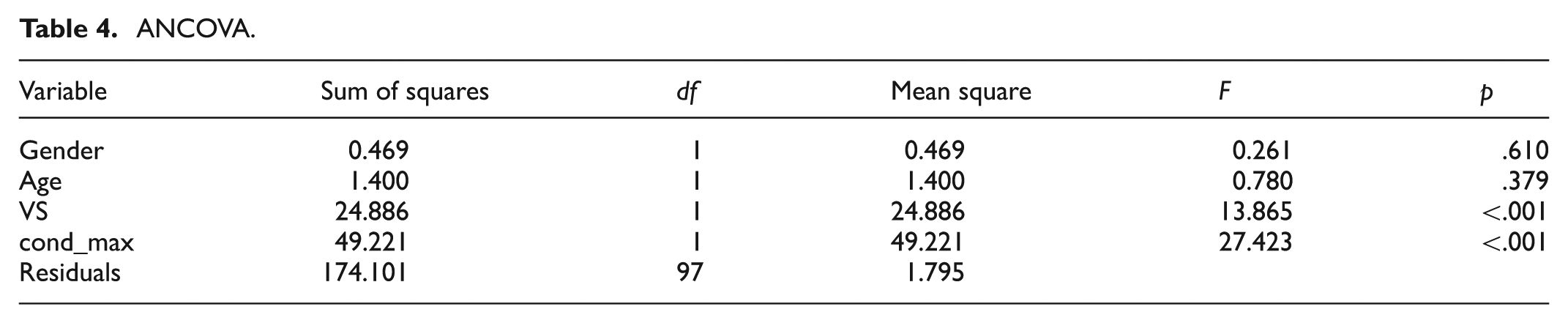
Furthermore, we performed a one-way ANCOVA, controlling age, gender, and variety seeking. ANCOVA results produced further support for H1 (F = 27.423, p < .01, η2 = 0.20). The detailed findings are depicted in Table 4.
ANCOVA.
Last and foremost, we run the Process model (Hayes, 2013) within the entire sample to test the mediator role of variety-seeking in the causal relationship between maximization and FoMO. We estimated the parameters using 10,000 bootstrapps (see Tables 5–9). The results showed that variety-seeking positively and partially mediates the relationship between maximization and FoMO (βindirect = 0.280, SEindirect = 0.127, pindirect < 0.05). Thus, H2 is also supported.
Mediation Estimates (Study 2).

p < .01, **p < .05.
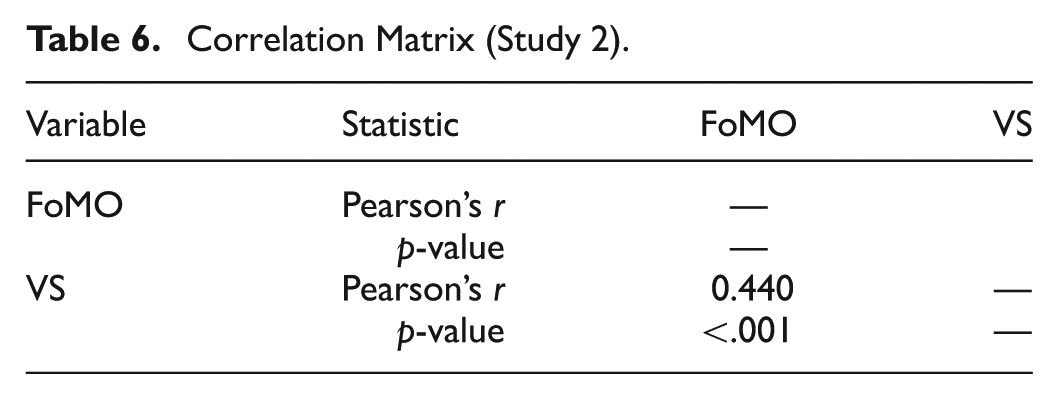
Correlation Matrix (Study 2).
Descriptives (Study 2).

Model Fit Measures (Study 2).

Model Coefficients—VS (Study 2).

Discussion
Based on between-subjects experimental data collected from 102 MTurk participants, we showed that maximization has a positive effect on FoMO (H1), and this relationship is positively mediated by variety-seeking (H2). In addition to the cross-sectional survey findings of Study 1, this experimental study provides corroborating evidence to support our hypotheses.
General Discussion
This study provides a distinct examination of how FoMO is activated by positioning maximization and variety-seeking within various theoretical frameworks. These antecedents not only expand the theoretical scope of FoMO research but also address a significant gap in literature by linking personality traits and behavioral tendencies to FoMO. Through a combination of a cross-sectional survey and an experimental study, we demonstrate that maximization has a positive influence on FoMO, with this effect being mediated by variety-seeking. In other words, the positive relationship between maximization and FoMO is partially mediated by a variety-seeking tendency.
While previous studies suggest a link between maximization and FoMO (Milyavskaya et al., 2018; Müller et al., 2020; Servidio, 2023), this paper proposes a causal relationship, arguing that maximizing behavior actively contributes to FoMO. The logic stems from the fact that maximizers, in their pursuit of the best outcome, are more prone to curiosity about missed alternatives—a mindset that aligns closely with the psychological dynamics of FoMO. This is based on the notion that individuals high in maximization are more likely to dwell on unchosen options and what they might be missing out on compared to others. To maximize outcomes, individuals must evaluate all available options, and this evaluation often occurs through social media use, which is triggered by FoMO (Roberts & David, 2020). If we consider FoMO as a negative outcome, our findings align with prior research showing that maximization is positively associated with adverse psychological effects (Baker et al., 2016; de Bruin et al., 2016; Elhai et al., 2016). s previous research notes, FoMO is fueled by the desire for better and more (Przybylski et al., 2013), and anxiety over not experiencing highly valued events or products (Good & Hyman, 2020). Consistent with these findings (Müller et al., 2020; Servidio, 2023), our study highlights the link between maximization and FoMO. Therefore, the discrepancy between the desire for better experiences and actual experiences—conceptualized as the gap between the ideal self and actual self (Sirgy, 1982)—is likely to be more pronounced in individuals with higher levels of FoMO.
Second, this study identifies variety-seeking as a key mediating mechanism linking maximization to FoMO. Previous studies show that individuals with a maximization tendency engage in more intense information-seeking and evaluation of alternatives (Iyengar et al., 2006; Müller et al., 2020), behaviors that are linked to negative outcomes such as dissatisfaction and regret (Schwartz et al., 2002). These adverse outcomes are also associated with the effort exerted by maximizers as they search for multiple alternatives (Polman, 2010). Additionally, research suggests that the pre-purchase information-seeking behavior of maximizers, as well as their sense of time pressure, is influenced by the variety of available options (Chowdhury et al., 2009; Khare et al., 2021). In line with these findings, the current study supports the argument that individuals with a high maximization tendency are more likely to experience FoMO through increased information-seeking.
While prior research has examined the link between variety-seeking and FoMO, the findings remain inconclusive. For instance, Park and Kramer (2019) found that FoMO is related to lower self-esteem and increased variety-seeking, while Hayran et al. (2016, 2020) found no significant relationship between variety-seeking and FoMO. To reconcile these discrepancies, our study proposes a mediating framework: individuals high in maximization are more likely to exhibit variety-seeking behavior, which in turn increases their susceptibility to FoMO. This perspective aligns with previous findings suggesting that “mere satisfaction” is often insufficient to sustain engagement with a choice, as the appeal of unchosen alternatives can reduce commitment (Hayran et al., 2016). Thus, the tendency to seek variety—particularly among maximizers—can amplify FoMO by increasing awareness of missed or alternative experiences.
These findings also support prior research highlighting the influential role of social media in shaping psychological and behavioral outcomes, particularly among individuals with high maximization tendencies. Social media platforms are intentionally designed to engage users by offering an almost infinite variety of curated content, which encourages upward social comparisons and amplifies feelings of regret and dissatisfaction (Keles et al., 2020; Krasnova et al., 2013). For maximizers, who are naturally inclined to evaluate every possible outcome to make the “best” decision, this digital environment intensifies psychological distress by presenting attractive, yet often unattainable or ultimately unfulfilling opportunities (Müller et al., 2020; Schwartz et al., 2002).
The interplay between maximization tendencies, variety-seeking, and FoMO is particularly pronounced in the context of social media, where the continuous flow of curated content heightens awareness of unchosen experiences and stimulates the urge to explore additional options (Przybylski et al., 2013; Roberts & David, 2020). Social media not only reinforces these personality-driven behaviors but also amplifies their psychological consequences, including dissatisfaction and anxiety. Future research should investigate the underlying mechanisms through which social media environments intensify FoMO and examine potential interventions—such as digital literacy training or self-regulation techniques—that may help mitigate its negative effects (Elhai et al., 2016; O’Reilly et al., 2018).
This study demonstrates that FoMO is significantly influenced by maximization tendencies, with variety-seeking serving as a key mediating mechanism. These findings align with Self-Determination Theory (SDT), which underscores the importance of autonomy in decision-making (Deci & Ryan, 1985). Maximizers, driven by the desire to select the “best” option, may experience greater psychological distress in a choice-rich environment, where the overwhelming number of options can compromise their sense of autonomy. When decisions feel unsatisfactory or incomplete, this dissatisfaction can intensify FoMO, particularly if they perceive others as making better choices or living more fulfilling lives (M. T. Argan et al., 2024; Przybylski et al., 2013). Thus, FoMO may emerge as a response to both internal pressures for perfection and external cues of social comparison.
Social Comparison Theory further supports our findings by showing how individuals with high levels of maximization may engage in frequent upward comparisons on social media, leading to increased anxiety about missing out on the “best” experiences or opportunities (Polman, 2010). This comparison, coupled with the constant stream of information from social media, intensifies feelings of FOMO (Tandon et al., 2025). In parallel, Social Identity Theory clarifies that maximizers may feel pressured to align their preferences with the core values or actions of their social groups, increasing the pressure to make optimal choices (Singh & Banerjee, 2024). As a result, maximizers may experience FoMO due to a perceived sense of social detachment when their decisions do not meet group expectations or norms (Tajfel & Turner, 1986).
These findings also align with Need for Uniqueness Theory, which posits that individuals, such as maximizers, are motivated to make distinctive choices that set them apart from others. However, in a world filled with similar possibilities, the desire for uniqueness can exacerbate negative emotional consequences, such as FoMO (M. Argan et al., 2022). Similarly, Self-Concept Theory suggests that maximizers are guided by an internal pursuit of their ideal self, selecting options that reflect their personal values and desired self-image (Zhang et al., 2020). When maximizers fail to make the “best” choice, the discrepancy between their actual and ideal selves may contribute to FoMO, as they become dissatisfied with their decisions and experiences (Sirgy, 1982). Together, these perspectives highlight how identity-related motivations can heighten the psychological costs of maximization.
Practical Implications
The study’s findings hold valuable implications for marketing practitioners and consumer behavior researchers, particularly in digital environments. The identified link between maximizing tendencies and FoMO underscores the need for marketing strategies that address decision fatigue and the adverse effects of excessive choices. Social networking platforms and e-commerce sites can better support consumers prone to FoMO by incorporating features such as streamlined recommendation algorithms, curated product lists, and decision-support tools. These measures can enhance user satisfaction, reduce cognitive overload, and simplify decision-making, thereby alleviating feelings of anxiety and indecision.
Marketers should carefully consider the psychological effects of scarcity and exclusivity in advertising, as these strategies may unintentionally heighten FoMO among consumers with strong maximizing tendencies. Instead, ads should emphasize the unique benefits and personal relevance of products, focusing on what consumers gain rather than what they might miss. For instance, loyalty programs that highlight commitment and long-term value over constant variety can resonate with maximizers, fostering deeper customer relationships. By prioritizing satisfaction and long-term engagement, marketers can build lasting loyalty and create more fulfilling consumer experiences.
The interplay between maximization, FoMO, and variety-seeking presents a strategic opportunity for businesses to enhance consumer experience and decision confidence. By building trust and providing resources like personalized recommendations, expert advice, or clear comparisons, companies can ease the decision-making burden for maximizers. This approach supports customers in making confident choices while fostering brand loyalty and encouraging positive word-of-mouth. In competitive digital markets, simplifying choices and offering clarity helps mitigate decision fatigue, allowing businesses to cultivate stronger and more enduring customer relationships.
Theoretical Contributions
Incorporating maximization into the study significantly broadens the theoretical understanding of consumer behavior and psychological well-being. It connects decision-making theories with emerging digital phenomena, illustrating how a prominent personality trait can predict online experiences such as FoMO. Additionally, identifying variety-seeking as a mediator offers valuable insights into the mechanisms linking maximization tendencies to behavioral outcomes, enhancing our understanding of the interplay between individual differences and digital behaviors.
This study also contributes theoretically by integrating principles from Self-Determination Theory and Social Comparison Theory to examine how maximization tendencies operate in digital contexts. By examining maximization tendencies through the lens of FoMO, the findings extend decision-making theories to highly interconnected and choice-saturated digital contexts. This approach highlights the broader relevance of maximization in understanding consumer behavior and psychological well-being in modern, digitally driven environments.
Overall, this study not only underscores the social significance of maximizing behavior but also opens avenues for future research to develop interventions and tools that address these tendencies, thereby expanding the practical and theoretical applications of maximization principles.
Limitations and Future Directions
The present research is subject to certain limitations. First, the use of self-reported measures may introduce bias, particularly social desirability effects, which could influence participants’ responses. Although self-reports are appropriate for subjective constructs like maximizing, variety-seeking, and FoMO, future research should incorporate complementary methods, such as behavioral data, observational approaches, or implicit measures, to enhance validity. Additionally, observing participants’ behaviors or utilizing dyadic survey designs could provide richer insights and mitigate limitations associated with self-report methodologies.
Second, while we establish the mediating role of variety-seeking in the relationship between maximization and FoMO, these findings may be influenced by certain variables. Future studies should explore potential moderators and test the boundary conditions of our model. For example, self-construal could moderate the relationship, as recent research suggests that individuals with interdependent self-construal are more likely to experience FoMO in their daily lives (Dogan, 2019). There is also a lack of examination into potential mediators that could help to elucidate the link between variety seeking and FOMO. While our findings show a direct association, future studies might look into how other psychological elements like social comparison, self-esteem, or emotional regulation may mediate this relationship. Identifying these mediators may strengthen the theoretical underpinnings of the processes by which variety seeking drives FOMO, while also providing practical insights into how individuals can manage these dynamics in the context of social media and digital interactions.
Third, with the rapid growth of social networking sites like Facebook, Instagram, and TikTok, individuals are increasingly aware of their social circle’s activities and experiences. This heightened connectivity raises the likelihood of experiencing FoMO. Therefore, future studies should examine the moderating role of social media use in the relationship between maximization, variety-seeking, and FoMO.
Fourth, although we used a between-subject experimental design with randomization, our relatively small sample size limits the ability to draw strong causal conclusions. Future research should replicate our findings with a larger sample to strengthen causal inferences.
Fifth, the temporal order of the variables cannot be established due to the limitations of the research design. Specifically, we did not adopt an experimental-causal-chain design, which would establish the causal effect of the mediator on the dependent variable after establishing the causal effect of the independent variable on the dependent variable. Future research can address this limitation by employing an experimental-causal-chain design (Spencer et al., 2005) to better establish the temporal sequence and causality between the variables.
Sixth, maximizers are expected to overthink and ruminate during the decision-making process due to their inherent desire to make the best choice (Schwartz et al., 2002). Consistent with this, individuals who try to maximize outcomes tend to engage in more detailed thinking. Rumination (Nolen-Hoeksema et al., 2008) could therefore act as another mediator in the relationship between maximization and FoMO. Future research should explore and compare the mediating roles of variety-seeking and rumination by constructing a parallel mediation model.
Additionally, our findings, based on participants from the MTurk platform, offer valuable insights into the relationship between maximizing tendencies and FoMO. However, the generalizability of these results could be enhanced by considering the influence of cultural contexts on decision-making behaviors and the psychological effects of FoMO. Key cultural factors, such as individualism vs. collectivism, power distance, and uncertainty avoidance (Hofstede, 1984; Triandis, 1995), significantly shape how individuals perceive social comparisons and choices, highlighting the need for cross-cultural examination in future research.
For instance, in individualistic cultures, where personal achievement and autonomy are emphasized, maximizers may feel compelled to optimize their decisions, leading to heightened FOMO when exposed to curated content on social media. In contrast, collectivistic cultures prioritize social harmony and conformity, potentially reducing FoMO intensity, as group norms are more influential than individual desires. Similarly, in cultures with high uncertainty avoidance, individuals may experience greater discomfort with the abundance of choices, potentially influencing the relationship between maximizing tendencies and FoMO.
Future research should explore how cultural orientations interact with maximizing tendencies to influence FOMO across various populations. Cross-cultural studies could investigate whether the mechanisms underlying FOMO, such as variety-seeking and social comparison, function differently in environments where cultural values emphasize community well-being over individual optimization. This line of inquiry would not only broaden the practical implications of our findings but also offer a deeper understanding of how the digital environment shapes psychological outcomes in culturally diverse groups.
Last and foremost, the study’s cross-sectional design limits our ability to conclude the temporal nature of the relationships between maximizing, variety-seeking, and FOMO. Without longitudinal data, we cannot determine whether these associations remain consistent over time or vary based on context, life stage, or external influences. Future research should employ longitudinal designs to examine how these components evolve and interact, offering deeper insights into how long-term exposure to digital environments or changes in consumer behavior over the lifespan might impact maximizing tendencies and FOMO.
Conclusion
Previous studies reveal that when there is too much choice, it can create problems and may hinder mental health and well-being (Roets et al., 2012). Every new alternative diminishes one’s sense of well-being by a small amount, and more choices may lead to anxiety, regret, excessively high expectations, and self-blame (Schwartz, 2004). Similarly, the maximization tendency produces similar post-consumption outcomes such as dissatisfaction, regret, increased stress, anxiety, depression, and lower life satisfaction (Purvis et al., 2011). The maximizers’ lower well-being stems from their desire to pursue more options with limited resources (Schwartz, 2004). In general, maximizers are more exposed to the negative consequences of having too many options (Roets et al., 2012). Recent findings reveal a link between maximization and FoMO, which is positively associated with neuroticism (Rozgonjuk et al., 2021), and suggest a mediator role for variety-seeking. Although this study didn’t investigate the serial link between Maximization—Variety Seeking—FoMO and other negative consumer traits, such as well-being, it certainly opens up further research avenues for investigation.
Overall, our findings indicate that individuals with a strong inclination to seek the best possible option (maximizers) are more prone to experiencing FOMO. Additionally, this relationship is positively mediated by variety-seeking, suggesting that the drive for diverse experiences amplifies the sense of missing out.
Footnotes
ORCID iDs

Ethical Considerations
“All procedures performed in studies involving human participants were in accordance with the ethical standards of the institutional and/or national research committee and with the 1964 Helsinki declaration and its later amendments or comparable ethical standards.”
This research involved human participants and adhered to ethical standards in accordance with the 1964 Helsinki Declaration and its later amendments. Ethical approval was obtained from Manisa Celal Bayar University Social Sciences Ethics Committee (Date: 13.05.2024, No: 2024/07).
Consent to Participate
Informed consent was obtained from all individual participants involved in the study.
All participants provided informed consent before participating in the study. The study design minimized the risk of harm, and participants were free to withdraw at any time. The potential benefits of this research to understanding consumer psychology outweigh any minimal risk posed to participants.
Author Contributions
Funding
The authors received no financial support for the research, authorship, and/or publication of this article.
Declaration of Conflicting Interests
The authors declared no potential conflicts of interest with respect to the research, authorship, and/or publication of this article.
Data Availability Statement
Data is attached to the submitted manuscript.