




Abstract
This article investigates service and price competition in a variety seeking market, with the consideration of brand name awareness on consumers. Variety seeking behavior is modeled as a decrease in the willingness to pay for product purchased on the previous occasion. Under a three-stage Hotelling-type model, we show that variety seeking intensifies the competition when both firms are equally known. However, when one firm is better known than the other, it softens the competition observing the differentiation of equilibrium policies. In addition, variety seeking increases both the price and service gaps to exaggerate market differentiation. Under both scenarios firms adjust the service level in the second period so as to prevent consumers from switching, if keeping prices committed across periods. Furthermore, if consumers on average have a higher propensity to one firm, the variety seeking behavior leads to a higher total profits and a higher consumer surplus.
Introduction
Variety often motivates consumers to switch although inertia keeps them coming back. Variety seeking is the tendency of consumers to seek diversity in their choices of services or goods over time (Kahn, 1995), which has been extensively observed in the selection of foods, fashion clothes, experience goods (experience goods are products whose quality cannot be determined by inspection, so that consumers need to buy the product to learn its quality, Wernerfelt, 1991), service goods, and many others (Caro & Martinez-de-Albeniz, 2012; Kahn, 1995).
Variety seeking in consumer choices has been studied in marketing since decades ago (See, e.g., Bass et al., 1972; Che & Sudhir, 2007; Kahn et al., 1986). A well-accepted explanation is that consumers will be less attracted or get bored by the repeat purchasing (Jeuland, 1978; McAlister, 1982; McAlister & Pessemier, 1982). Along with this negative state dependence, the variety seeking behavior can be captured by a staying cost (Seetharaman & Che, 2009), or an attractiveness reduction for the previously purchased brand (Sajeesh & Raju, 2010). Following Sajeesh and Raju (2010), this article operationalizes variety seeking as a reduction in the willingness to pay for repetitive purchasing.
Although in practice firms have incorporated the consumer variety seeking behavior into their strategic decision making, for example, Zara attracts consumers to revisit its stores via introducing new products on a regular basis and thus reducing the consumer satiation (Caro & Martinez-de-Albeniz, 2012; Ghemawat & Nueno, 2003). In another instance, Coca-Cola introduced Coca-Cola free-style machine to allow consumers to select from mixtures of avors of Coca-cola branded products. Only a few papers have analytically examined the impact of consumer variety seeking on firms’ competing decisions. Earlier studies focus on price competition (see, e.g., Klemperer, 1987; Seetharaman & Che, 2009). Recent studies extend the competition to multiple dimensions, for example, product positioning and pricing competition (Sajeesh & Raju, 2010), pricing and product offering competition (Caro & Martinez-de-Albeniz, 2012), and price competition with vertical differentiation consumers (Zeithammer & Thomadsen, 2013). While previous research has addressed the effect of consumer variety seeking on prices, there exists no research on the effects of variety seeking on quality(service) competition. Our study fills this gap in the literature.
However, the current work ignores an important factor which has a huge impact on the consumer product valuation, firms’ brand name value. A study reveals that the approval rating for Kellogg’s Corn Flakes increased from 47% to 59% when this brand name was revealed to the consumers (Aaker, 1997). In practice, firms spend millions of dollars annually on advertising to build their brand awareness (Keller, 2002, p. 67). For example, the Ford Motor Company invested over 12 billion dollars to acquire prestigious brand names such as Jaguar, Aston Martin, Volvo, and Land Rover (Naik et al., 2008). With the brand name awareness, consumers tend to have a higher willingness to pay for the superior (better known) firm (premium to the firms’ reputation, see, e.g., Wang et al., 2004). In addition, if consumers strongly prefer their favorite brand over the other brands in the product category, extrinsic motivations are high and variety seeking is inhibited (Van Trijp et al., 1996). Among the very few study on the impact of brand name value in competition, results reveal that a brand name’s value may moderate inter-firm competition (Desai, 2001; Shimp, 1981; Michaelidou, 2009).
The purpose of this article is then to disentangle the impact of consumers’ variety seeking behavior as well as their brand name awareness on firm’s competing strategies. Consider firms compete in two dimensions: pricing and service levels (Following the definition of “quality” in Desai, 2001, the term service refers to a single attribute or a combination of attributes exhibiting the “more-is-better” property), the latter of which is often treated as a important product attribute to attract consumers, especially for the experience goods and service products. A typical example goes to Disney land in Orlando, which offers four different theme parks to keep tourists coming back. Acknowledging the price changing cost and other marketing consideration, firms commit their prices once determined, but allow the service levels to adjust across time periods. For example, movie theaters employ a uniform price for differentiated goods, amusement parks and restaurants do not vary their prices often.
Employing a two-period Hotelling-type model, we obtain some interesting findings. In a duopoly competition setting, when the two firms’ brand awareness is the same, referred as the symmetric competition, variety seeking intensifies the firm competition: both firms commit the same service level and charge the same prices but obtain a lower profit than that when the consumers are not variety seeking. We call it centralization effect. The optimal service levels are lower in Period 1 compared to that in Period 2. The enhanced service level offered by a firm in Period 2 tends to entice the variety seeking consumers to stay instead of switching to the competing firm. Interestingly, both the optimal prices and the average service levels across time periods remain the same as compared to the market without variety seeking consumers. Therefore, consumers do not benefit from their variety seeking behavior on average, which, however, hurts the firm’s profits. Such results of centralized effect can also be extended to oligopoly competition.
When the duopoly competition is asymmetric, where the two competing firms have different brand name values, consumers exhibit a higher willingness-to-pay for the product of the superior (better known) firm. The combinatorial effect of variety seeking (intensifying competition) and brand name value (moderating competition) seems vague. Results show that the superior firm employs a high-service-high-price policy, while the inferior firm adopts a low-service-lie-price policy. We call it differentiation effect. Such differentiation then softens the competition. The more variety seeking consumers in the market, as well as the larger the difference in firm’s brand name values, the differentiation effect becomes more salient. In addition, the superior firm benefits from variety seeking if it has a fairly high brand name value; otherwise, it gets worse as compared to the market without variety seeking consumers. On the contrary, variety seeking always hurts the inferior firm. In that sense, to establish a fairly high brand name recognition can be regarded as an effective tactic for firms to hedge the loss from variety seeking. Similar as in the symmetric competition, both firms increase their service levels in the second period so as to prevent consumers from switching. Although the results are based on the assumption that consumers have the same satiation level even when they are facing different firms, without loss of generality, the differentiation effect continues to hold when consumers have different satiation levels to different firms. However, when more firms join the competition, the problem becomes very challenging and the previous results no longer hold.
The rest of this article is organized as follows. Section “Related Work” reviews the related work. Section “The Model” describes the model. In duopoly setting, Sections “Symmetric Competition” and “Asymmetric Competition” analyze the symmetric and asymmetric competition, respectively. Extensions are discussed in Section “Extended Discussion,” and concluding remarks are provided in Section “Conclusion and Future Extensions.” All the proofs are relegated to the Supplemental Appendix.
Related Work
Variety seeking in consumer choices has been studies in marketing since decades ago. Readers interested in understanding why and how consumers seek variety can refer to review papers of McAlister and Pessemier (1982) and Kahn (1995). In this article, we confine to the variety arising over time for repetitive purchase and ignore the situation where a consumer chooses a portfolio of options at one time. Motivations for variety seeking could be consumers will be less attracted by the repeat purchasing (McAlister & Pessemier, 1982), consumers get bored for repetitive experience of any kind (Jeuland, 1978; McAlister, 1982); or simply because changing is rewarding in itself to the consumer (Given, 1984). To capture the consumer variety seeking behavior, varied models have been applied. A well-accepted one is based on negative state dependence. For example, Seetharaman and Che (2009) use a staying cost to capture the variety seeking behavior, which follows Klemperer (1987) to study the inertia from the viewpoint of switching cost. Sajeesh and Raju (2010) relates to the change in the attractiveness of the previously chosen alternative vis-a-vis other alternatives objective desire, and model variety seeking as a relative reduction in the consumer willingness to pay for the previously purchased brand. Other approaches include using Markov process to represent a customer’s purchasing pattern (see, for example, Givon, 1984), and more complicating models (see Kahn, 1995 for details).
Our work closely relates to a thin but growing literature on competition issues in a variety seeking market. Earlier studies are confined to price competition. In a two-period setting, Klemperer (1987) uses switching cost to model variety and find that firms form a collusion and charge higher prices in the second period. Modeling variety as both staying cost and a “mirror” of the previous purchasing preference, Seetharaman and Che (2009) find price collusion in both periods. A few recent studies extend the competition to multiple dimensions. For example, Sajeesh and Raju (2010) extend the base model to consider both product positioning and pricing competition. They show that variety-seeking actually reduces product differentiation in location equilibrium. They also find firms charge higher prices in Period 1 and lower prices in Period 2 so as prevent consumers from switching. Overall variety seeking harms the firms but benefits the consumers. Caro and Martinez-de-Albeniz (2012) extend to the decisions of pricing and product offering in competition environments, considering the impact of product design on the consumers satiation levels. Further, Zeithammer and Thomadsen (2013) analyze the satiation effect on the price competition in a vertically differentiated duopoly environment. They capture the preference for variety as a diminishing marginal utility for multiple units of the same firm’s products, and find that when qualities are similar, variety seeking soften price competition and increases both prices and profits in equilibrium. Ning et al. (2018) extend the traditional Hotelling model by taking into account the effects of externality on both parties. With the presence of variety seeking, both the original and pirated parties will adopt higher prices in the first period. Surprisingly, variety seeking brings higher profits to both parties in two periods. Moreover, Niu et al. (2019) build a two-period stylized model by assuming firms’ cost is effort-dependent, which characterizes the tradeoff between managing variety seeking customers and the cost of quality improvement. They argue that firms’ highly efficient quality improvement can be harmful when customers are variety seeking. However, if qualities differ enough, price competition is intensified and profits are lowered down. Liu et al. (2019) find that the number of variety-seeking consumers who switched from buying traditional products (high level of service and high price) to buying sharing products(low level of service and low price) was greater than those who switched from buying sharing products to buying traditional products. Recently, in empirical research or experimental research, Mittelman et al. (2016) find that consumers seek more variety when choosing from single than from bundled offerings. Baltas et al. (2017) reveal that in hedonic product categories, consumers seek more variety in sensory attributes, whereas in utilitarian product categories, they seek more variety in functional attributes. Firms need to pay more attention to non-price competition. Martenson (2018) assume that rewards drive variety-seeking vacation behavior in Europe by focusing on what drives European consumers’ variety-seeking vacation behavior.
As an important component of brand equity, brand name awareness has been studied intensively in marketing literature, mostly focusing on the impact on consumer utility. Study on impact of brand name value on competition is only a few. Two papers relate to our model. Under duopoly competition, Katz (1984) and Desai (2001) consider the impact of the brand name values in a product-line design model where firms compete in both quality and price. They find that brand may moderate cannibalization and inter-firm competition.
In the extended discussion, we next consider the oligopoly competition. In an oligopoly market with symmetric competition, assuming firms uniformly located on a circumference referenced the model (Brenner, 2005) and compete only with the adjacent firms, the presence of variety seeking consumers intensifies the firm competition. Similar to that in a duopoly competition, firms increase their service levels in the second period so as to prevent consumers from switching to the counterpart. And the equilibrium price and service levels further decrease as more firms join the competition. As we known, previous research has concentrated on duopoly markets. The question of how the number of firms affects the equilibrium outcome was widely ignored. Linear utility models with multiple firms located on a circumference were analyzed (Economides, 1989; Salop, 1979). The price equilibrium exists in the subgame characterized by an equidistance of succeeding firms. Nevertheless, a perfect equilibrium could not be found for every subgame. About the
Our paper contributes to the literature by considering service and price competition in a variety seeking market and extends the existing work in three ways: first, we consider both price and service competition in a variety seeking market; second, we take the impact of brand name awareness into consideration; third, we discuss in both duopoly and oligopoly settings. When the firms have the same brand name awareness, our results show that variety seeking increases the competition in firms, and firms tend to make equivalent price and service decisions. This verifies the findings in Sajeesh and Raju (2010) in a “mirror” way. Firms offer lower service in Period 1 and higher service in Period 2 to reduce switching. The results in duopoly competition can be extended to an oligopoly setting. When firms have different brand name values, differentiation is observed in the equilibrium. However, such gap increases with the presence of variety seeking consumers, which counteract the intuition that variety seeking tends to cause uniform competing decisions. Alternatively, the presence of variety seeking consumers in markets with asymmetric brand name recognition tends to soften competition.
The Model
To align our study with prior literature, we follow the hotelling framework to model the duopoly competition (see, e.g., Sajeesh & Raju, 2010; Seetharaman & Che, 2009). Each firm locates at the end points of a Hotelling line [0,1], where Firm 1 locates at Point 0 and Firm 2 locates at Point 1. In Period 0, the firms simultaneously set prices. In Period 1, the firms decide the service levels and consumers buy the product that maximizes their utility. In Period 2, firms adjust the second-period service levels, and consumers again decide to buy the product that maximizes their utility. We assume full coverage of the market. The sequence of the events is summarized in Figure 1. Details of the model are described in the following.
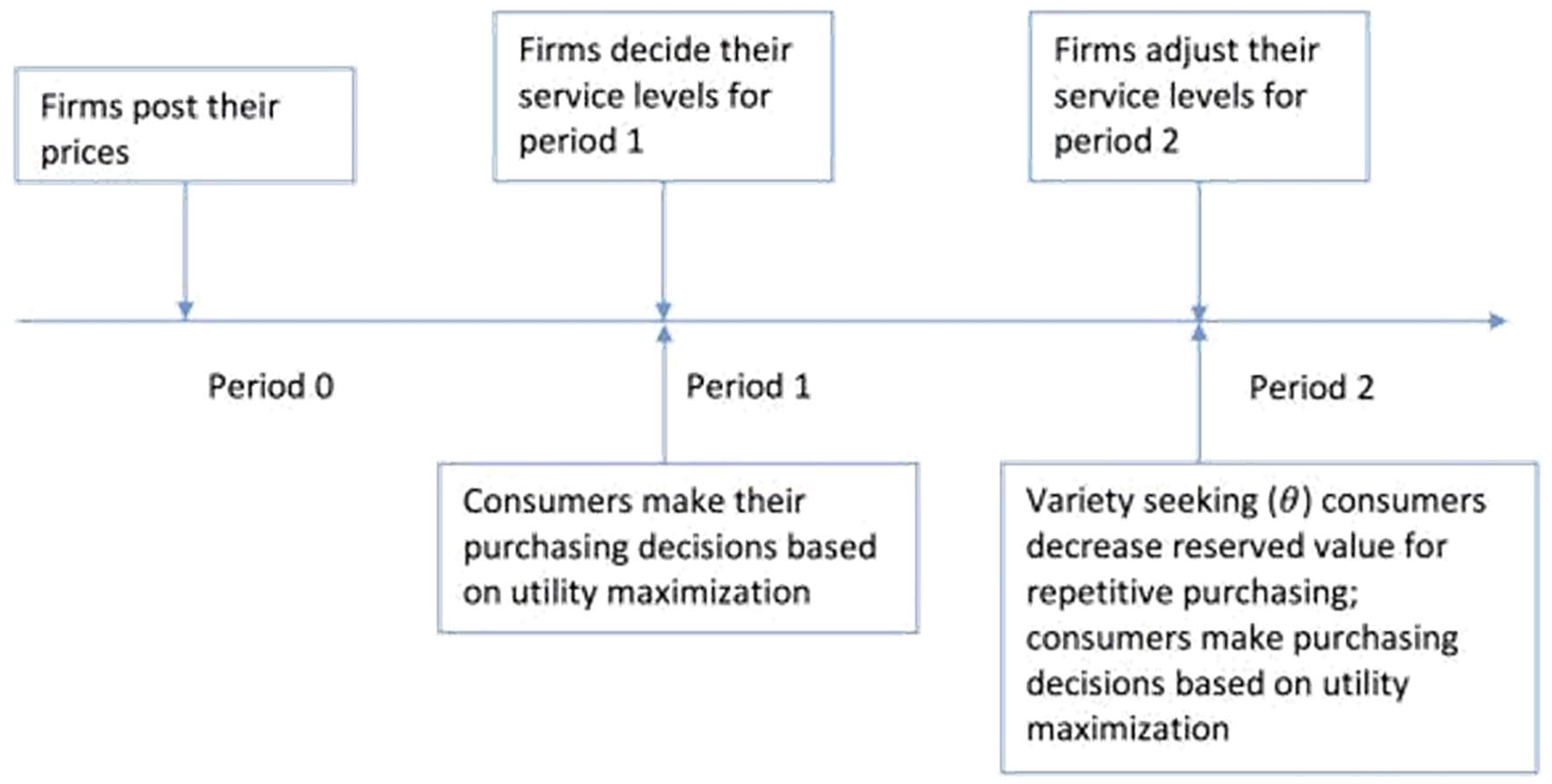
Event sequence.
Firms
In the duopoly setting, firm i sets the prices for the competing products at Period 0, that is,
Each firm has a brand name value and consumers have premium she is willing to pay for firm i’s product,
Firm i’s profit in period j, j = 1, 2, is then

where
Consumers
We assume that the consumers are distributed uniformly over the interval of the hotelling line [0,1]. The market is fully covered and the total number of consumers is normalized to 1. A consumer’s position on the line represents her ideal preference and incurs a transportation cost of
Each consumer in the market buys one and only product in each period from the firm which provides her the maximum utility in that period. Consumers have preferences over both service level and brand name. A consumer derives a utility of

where


Period 1 corresponds to the first purchase occasion. For a fraction θ of consumers in the market,

Where
In Period 2, the variety seeking behavior causes the demand for Firm 1 at Period 2 from three types of consumers, as illustrated in Figure 2.
Type 1: Among the

Type 2: Among the


Consumer types.
Type 3: Among the

Therefore, this fraction of consumers equals

Adding the three types of demands together, the aggregated demand for Firm 1 in Period 2 is then
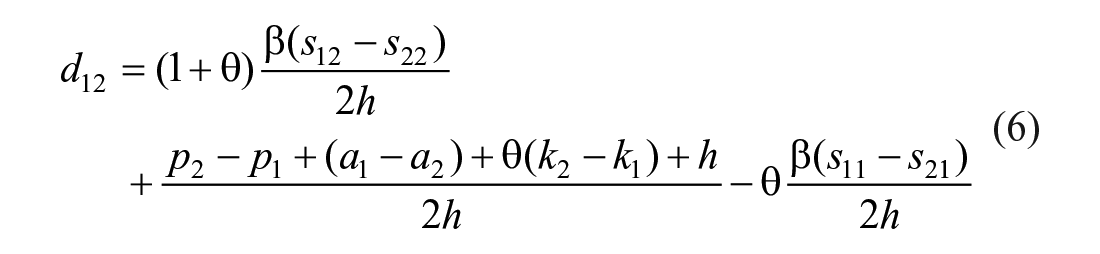
Similarly, the aggregated demand for Firm 2 in Period 2 is

In the next two sections, we investigate the duopoly competition under symmetric and asymmetric scenarios, respectively. We use superscript “
Symmetric Competition
We first consider symmetric competition, where each firm has the same brand name value. Without loss of generality, let
Substituting


Similarly, by equations (6) and (7), the aggregated demand for each firm in Period 2 is then


The objective of firm i is then to decide

Working backward, the equilibrium solutions are summarized in Proposition 4.1. It should be noted that the condition
Proposition 4.1
Under symmetric competition, if
Notice
Corollary 4.1
Under symmetric competition, when there are no variety seeking consumers in the market, the equilibrium prices and service decisions are
The results are straightforward simply substituting
Proposition 4.1 reveals that under symmetric competition both firms make the same service and price decisions, exhibiting so-called centralization effect. This is consistent with the findings in Sajeesh and Raju (2010), in which the firms differentiate less in their location decisions and make the same price decisions in the presence of variety seeking consumers. The equilibrium prices are determined by forces: a high price for pursuing high profit margin (revenue effect) and a low price for increasing market share (demand effect). Interestingly, with price commitment, variety seeking does not change the pricing decisions for both firms.
However, variety seeking affects firms service level decisions in a different way. In general, two opposite effects are responsible for firms’ service level decisions. On the one hand, firms increase service levels so as to capture a large market share (demand effect); on the other hand, a higher service level incurs a higher service cost (cost effect). The relative strengths of these effects determine the service levels in equilibrium. Higher variety seeking induces lower service levels in the first period and higher service levels in the second period, as compared to the benchmark case where there is no variety seeking consumers. As θ increases, such service gaps increase further. Firms realize that once consumers have made their purchase in Period 1, the variety seeking consumers become targets to the competing firm. So, firms enhance service levels in Period 2 to prevent consumers from switching. This is consistent with Sajeesh and Raju (2010), where firms lower prices in Period 2 to retain consumers. It is also in line with the empirical suggestion in Zhang et al. (2000) that rear-loaded promotions may be more suitable in variety seeking markets.
Variety seeking also has impact on the decisions in Period 1. Higher
One might wonder why variety seeking does not impact firms’ pricing decisions, and lead to increased service competition in Period 2. Notice that price should be determined at Period 0 and committed thereafter, with the same brand name awareness and the same disutility effect for satiation, firms “lock” on the same price level. Instead, they use the ability to adjust the service levels in different periods to catch the variety seeking consumers. It should be pointed out that our results are different from Klemperer (1987) and Seetharaman and Che (2009), where price collusion is observed in the second period, but consistent with Sajeesh and Raju (2010) where intensive price competition in Period 2 is observed.
When both firms have the same brand name awareness, Corollary 1 indicates that both firms make the same price and service decisions when there is no variety seeking consumers in the market. The competition is then intensified and exhibits to be a centralized competition. Each firm equally shares the market, that is,

We are now ready to study the impact of variety seeking behavior on consumer utility, demand, and firm profit.
Proposition 4.2
Under symmetric competition, the presence of variety seeking consumers does not change the average service and price. Firms share the market equally. However, each firm’s profit is decreasing concave in θ.
Similar as in Sajeesh and Raju (2010), the presence of variety seeking behavior has a negative impact on firm profits. However, different from Sajeesh and Raju (2010) where the average prices are lower than the price without variety seeking, our results show that the average service levels keep the same as in the market without variety seeking. Therefore, variety seeking behavior does not change consumer’s average utility originated from the firms’ decisions, although the net utility decreases because of the satiation effect. However, because of the convex service cost function, a firm needs to pay additional cost to keep the same service level on average, as compared to the market without variety seeking consumers. In addition, firm profits decrease less as θ increases.
Asymmetric Competition
This section analyzes asymmetric competition, where firms have different brand name values. Without loss of generality, let
We start with the analysis of
With the Same Satiation Level:
Substituting



Firms decide the service and price decisions to maximize their total profits in two periods. The equilibriums under asymmetric competition are then summarized as in the following. It should be noted that the condition

If

Proposition 5.1
Under asymmetric competition, with θ variety seeking consumers, 0 ≤ θ ≤ 1, if
When
Corollary 5.1
Under symmetric competition, when there are no variety-seeking consumers in the market, that is,
The results are straightforward simply substituting
Interestingly, in contrast with the centralization effect when both firms have the same brand-name values, Proposition 5.1 and Corollary 5.1 reveal a differentiation effect when competing firms have different brand name values. The superior (better known) firm could charge a higher price and offers a higher service level, while the inferior (less known) firm charges a lower price and provides with a lower service level. Such differentiations in prices and service levels are also consistent with the findings in Katz (1984) and Desai (2001), where the authors show that brand name value may moderate inter-firm competition.
However, similar as in the symmetric competition scenario, firms set a lower service level in the first period and enhance it in the second period so as to prevent variety-seeking consumers from switching.
For address convenience, we denote by price difference as the difference in prices between firms at the same period, that is,
Proposition 5.2 characterizes the impact of the variety seeking fraction θ, and the brand name value a on the firms competition decisions.
Proposition 5.2
Under asymmetric competition, if
The presence of variety seeking enlarges the degree of differentiation, that is,
As the θ increased, the
As θ increases, firms’ price differentiation (
As a increases, the superior firm makes higher price and higher service levels in both periods; while the inferior firm makes lower price and lower service levels in both periods.
As a increases, service differentiations in both periods increase, that is,

h = 5, a = 2, α = 1, β = 0.8, price changes with θ.

h = 5, a = 2; α = 1, β = 0.8, price changes with θ.
Our results reveal the presence of variety seeking actually exaggerates the extent of differentiation when firms have different brand values. Different from the symmetric competition environment, where pricing decisions are irrelevant to θ, the better known firm can now charge a higher price (i.e., revenue effect dominates) while the less known firm charges a lower price (i.e., demand effect dominates), as compared to the market without variety seeking consumers. In addition, such price gap increases when more consumers tend to be variety seeking. See Figures 3 and 4 for illustrations.
Our results also indicate that with variety seeking, the superior firm tends to enhance the service level in the second period (i.e.,
Furthermore, with more variety-seeking consumers in the market, we observe that the upper bound of the service differentiation in Period 1 shrinks, that is,
Finally, brand name value exaggerates the differentiation effect. A higher brand name value enlarges both the price differentiation and the service differentiation. With a higher brand name value, the superior firm then enhances its service level more in the second period; instead, the inferior firm increases the service level less when facing the second selling opportunity.
Impact on consumers and firm profits
We next check the impact of the presence of variety seeking consumers and brand name value on the firm profits.
Proposition 5.3
Under asymmetric competition, with θ consumers in the market,
When
If
If
When
If
However, the presence of variety seeking always hurts the inferior firm. In addition, as
The following corollary further indicates the monotonicity of firm profit with respect to θ and a.
Corollary 5.2. Under asymmetric competition, under the condition of
When
When
When

h = 5, α = 1, β = 0.8, and a = 10, each firm’s profit changes with θ.

h = 5, α = 1, β = 0.8, and a = 2, each firm’s profit changes with θ.
This proposition reveals a combinational impact of the brand name value and the satiation effect on firm’s profits. When consumers have a high recognition of the brand name, the variety-seeking behavior benefits the better known firm. However, when the brand name value is low, the superior firm does not benefit from the variety-seeking behavior. On the contrary, the inferior firm also damages from the variety-seeking behavior.
With Different Satiation Levels:
Next, we extend the analysis to a more general case
Proposition 5.4
Under asymmetric competition, with θ variety-seeking consumers in the market,
The following proposition is supposed to illustrate the sensitivity of θ, a, and
Proposition 5.5
Under asymmetric competition, if
Under asymmetric competition, when consumers have different satiation effects for different firms, the equilibrium of service and price decisions are then the combined tradeoff of both the brand name awareness and the satiation.
Proposition 5.6
Under asymmetric competition, with θ variety seeking consumers in the market,
As
If
In addition,
Extended Discussion
In the extended discussion, we consider the competition among more than two firms in the market. Similarly with the duopoly market, in two periods games, N firms compete on the service levels with price commitment, and there are θ consumers with variety seeking distributed uniformly in the market,

Oligopoly hotelling model.
We first consider the competition between firm
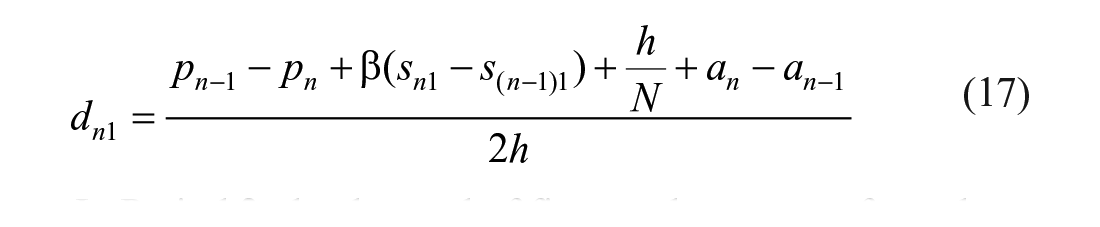
In Period 2, the demand of firm
Type 1 consumers are without variety seeking behavior and the number of those consumers equals

Type 2 consumers are those who are variety seeking and purchase from firm

Type 3 consumers are those who purchase from firm

Therefore, the demand of firm

Similarly, we can get the demand of firm

The total demand of firm

Symmetric Competition
We first consider the competition when all firms have the same brand name value, that is,
Proposition 6.1
Under symmetric competition, with 0 < θ < 1 variety seeking consumers in the market, if
Asymmetric Competition
The analysis for asymmetric competition becomes much more challenging when
Proposition 6.2
When
Proposition 6.3
When
In asymmetry competition, Each Firm’s strategy is affected not only by brand names awareness but also the average brand names awareness of all competitors. The Firm’s price maybe not affected by variety seeking if the propensity that consumers for it is equal to that average propensity of all competitors.
Conclusion and Future Extensions
We study competitive pricing and quality strategies in markets where consumers seek variety. Variety seeking behavior is modeled as a decrease in the willingness to pay for the product purchased on the previous purchase occasion. In symmetry competition, our results showed that although variety seeking did not affect the price of both firm and the average consumers surplus, the quality in Period 2 will be improved and in Period 1 will be decreased, the total profits of the market will be less than that without variety seeking, and we can conclude that the firms need to pay the cost for the potential loss of market share resulting of variety seeking. In asymmetry competition, when the firms are different brand names awareness, our results showed that the firms adopts the asymmetry strategies, the firm with more propensity supply the high price and high quality, the firm with less propensity supply the low price and low quality, the consumers who purchased from the firm with more propensity will gain the less average surplus and the consumers who purchased from the firm with less propensity will gain more average surplus, and the variety seeking increased the differentiate. When the firms have both different brand name awareness and satiation effect, if the firm with the more propensity has the less satiation effect, we surprisingly found that the conclusion is same as that with the same satiation effect. If the firm with the more propensity has more satiation effect, we got that if the firms have disadvantages in brand names, they can make up for it by decreasing the consumers satiation. Finally, we considered the situation of the service commitment in both firms, in symmetry competition, contrast with price commitment, although the total profit is also reduced with variety seeking, the average consumers surplus were increased, it same as Sajeesh and Raju (2010). For preventing variety seeking, the firms will prefer price commitment to service commitment, and under price commitment, the consumers did not gain additive consumers surplus by variety, and thus, it may decrease the incentive for variety seeking. As future research, we will study that the price is committed in one firm and the quality is committed in the other one. The models and policies discussed in this article examined by empirical or experimental research would be a significant future research.
Finally, it should be pointed out that our model does not apply for products where the degree of differentiation across vertical segments is so large that competition across the different quality segments is extremely weak (for example, high-end and low-end lodging industry).
Supplemental Material
sj-docx-1-sgo-10.1177_21582440211004154 – Supplemental material for Competition in a Variety Seeking Market With Brand Name Awareness
Supplemental material, sj-docx-1-sgo-10.1177_21582440211004154 for Competition in a Variety Seeking Market With Brand Name Awareness by Liyang Xiong, Honglei Yu and Zhanqing Wang in SAGE Open
Footnotes
Declaration of Conflicting Interests
The author(s) declared no potential conflicts of interest with respect to the research, authorship, and/or publication of this article.
Funding
The author(s) received no financial support for the research, authorship, and/or publication of this article.

References
Supplementary Material
Please find the following supplemental material available below.
For Open Access articles published under a Creative Commons License, all supplemental material carries the same license as the article it is associated with.
For non-Open Access articles published, all supplemental material carries a non-exclusive license, and permission requests for re-use of supplemental material or any part of supplemental material shall be sent directly to the copyright owner as specified in the copyright notice associated with the article.
