



Abstract
Environmental education (EE) seeks to inspire individuals to adopt sustainable practices and foster a deeper awareness of environmental responsibility. Effective EE develops and enhances environmental knowledge, connectedness to nature (CN), and builds socially benefitting attributes that prepare individuals and communities to undertake positive EE action collaboratively. EE combines promoting environmental knowledge and internal motivation, namely being connected to the natural world, as a holistic strategy for increasing environmental awareness. The current study examined the relationships between EE and green behaviour (GB), employing insights from the environmental competence model. The link between the aforementioned variables was investigated to determine the role of CN as a mediator and social dominance orientation (SDO) as a moderator. A cross-sectional methodology was employed to gather data from 421 university students using a convenience sampling method through self-reported questionnaires measuring the CN scale, GB inventory, and SDO scale. Structural equation modelling and PROCESS methodologies were used for data analysis. The study’s findings confirmed the hypothesised conceptual model: EE was positively associated with GB. Furthermore, CN improved the positive relationships between EE and GB. Moreover, SDO has significantly reduced the positive association of direct and mediated links. This research provides empirical evidence for the education-nature association and bears practical implications for social dominance ideologies and beliefs.
Keywords
Introduction
Green behaviour (GB) includes environmental concern and advocacy for ecologically beneficial behaviours, intentions, and attitudes. It refers to the actions and conduct of individuals that are helpful in sustaining environmental preservation (Varela-Candamio et al., 2018). It is crucial to preserve the Earth, as humans are responsible for many environmental problems, including pollution, water scarcity, global warming, and biodiversity loss (Poškus, 2018). Encouraging GB in people, particularly students, is important in the current environmental crisis. GB is the key to solving our natural problems and laying the base for long-term sustainable practices that can prevent the negative consequences of human activity on the environment. The determinants of such behaviour, whether promoting or restricting, must be understood to develop efficient environmental interventions and educational programmes. GB includes attitudes, intentions, and actions towards the environment. It is a multidimensional construct as conceptualised by scholars in the field. For instance, in their study of GB, Milfont and Duckitt (2010) considered ecological behaviour, environmental citizenship, and environmental organisation donations as components of GB. Similarly, Jia et al. (2015) assessed environmental engagement, environmental identity, and environmental views. In this study, we used ecological-friendly indicators to analyse the complex concept of GB (Zhao et al., 2018). This study adopts a similar approach, using indicators of ecologically responsible behaviour to assess GB among students. Understanding the underlying causes of GB is important because promoting such behaviour is a key step towards achieving environmental sustainability.
Environmental education (EE) is one of the key predictors of GB explored in this study. Exposure to EE is known to enhance students’ ecological awareness, responsibility, and motivation to engage in sustainable practices. Importantly, this type of education does more than transfer knowledge; it fosters emotional and psychological connections to nature that can result in long-term behavioural change (Begum, Jingwei, Marwat, et al., 2021). The attachment to nature due to focused EE is crucial for environmentally friendly behaviour. According to Leopold (1949) in his book A Sand County Almanac, p. viii. “We treat land as a commodity that belongs to us, so we abuse it. We may begin to treat the land with love and respect when we see it as a community. Furthermore, if we consider ourselves plain and simple members of the natural world, we must improve our environmentally responsible persons.” The concept of CN is not new, but recently, it has attracted much interest and empirical research. In this context, the study also seeks to determine whether CN serves as a mediating mechanism that explains how EE fosters GB among students.
Human behaviours have harmful impacts on the global environment. It is responsible for environmental problems such as pollution, water shortage, global warming, and the decline of ecosystem diversity to a certain extent. Sociodominant people are more concerned about group or interpersonal dominance than equality in general or in their relationships (Pratto et al., 2013). Social dominance orientation (SDO), for example, might limit generosity in giving resources to outgroups (Kleppestø et al., 2021). In turn, ethnic and racial outgroups experience more significant prejudice and discrimination (Sidanius et al., 2017). SDO has been demonstrated to predict a wide range of intergroup attitudes and actions, making it one of social and personality psychology’s most frequently used indicators (Ho et al., 2015). Remarkably, research shows that this permanent inclination for hierarchy and inequality affects the likelihood of group-relevant variables and is connected to GB. In one of the earliest studies on SDO, Sidanius et al. (1994) demonstrated that people with higher SDO scores were less likely to support environmental policies than people with lower SDO scores. This negative association persisted even after controlling for political-economic conservatism. Therefore, it is important to understand those harmful social behaviours and promote ecological behaviour in individuals. Thus, an important part of this study is to explore whether SDO moderates the relationship between EE and GB, potentially weakening or altering its effect.
This study contributes two significant contributions to the literature. Firstly, the study widens the available literature by finding the mediating effect of CN in the relationship between EE and GB. Very limited studies have considered CN as the mediator between GB and EE (Kim et al., 2018; Zsóka et al., 2013). Therefore, this study explains the relationship between EE and GB through the mediating role of CN. Secondly, the role of social dominance is critical regarding nature, yet it has not been widely explored (Waterhouse, 2024). The scope of the current research widened the literature by proposing SDO as a moderator between GB and EE. Hence, this study explored the mediating effect of CN and the moderating role of SDO in understanding the relationship between EE and GB.
Therefore, the research objectives are as follows: (1) to examine the effect of EE and CN on GB, (2) to explore the mediating role of CN, and (3) to investigate the moderating role of SDO.
In the following sections, literature and hypothesis development are discussed. After that, the study’s methodology is debated. The results and analysis section follows this. Hypotheses of our study are tested with AMOS and SPSS software through structural equation modelling. Data were collected from university students. Finally, the authors discuss their findings, conclusions, and proposed future recommendations.
Literature Review
Environmental Education and Green Behaviour
EE involves approaches and programmes that develop environmental-related values, knowledge, attitudes, and skills to train people to take informed actions regarding the environment (Fien, 2000). EE seeks to cultivate knowledge that promotes environmental sustainability. This objective is achieved by enhancing cognitive understanding and fostering awareness of the societal significance of GB. Amoah and Addoah (2021) emphasise that achieving environmental sustainability requires individuals to possess adequate environmental knowledge. Such knowledge is crucial in shaping positive attitudes and values towards sustainability. EE enables the examination of current environmental challenges and raises awareness about these issues, serving as a foundation for developing practical solutions (Fei & Li, 2025; Zikargae et al., 2022). EE catalyses activism, driving efforts that range from influencing environmental policies and reducing resource wastage to lowering carbon emissions, mitigating climate change, promoting green initiatives, preserving air and water resources, and encouraging the adoption of renewable energy. The activism then leads to policymakers being aware of environmental issues that are of public interest, consequently leading to legislation that helps safeguard the environment. Through EE, individuals will be able to recognise how environmental issues such as climate change and global warming pose an urgency for the global community. EE develops environmental awareness and responsibility, positively impacting attitudes towards environment-friendly lifestyles (Begum, Jingwei, Marwat, et al., 2021). EE is a critical component of biodiversity protection efforts (Ahirwar & Singh, 2024). GB is a broad term, but environmental concerns and support for environmentally beneficial activities, intents, and attitudes are often described as GB (Gulzari et al., 2022). Many scholars have examined GB as a multidimensional concept (Jia et al., 2015; Milfont et al., 2018). Milfont et al. (2018) advocated researching environmental citizenship acts, ecological behaviours, and environmental organisations’ donations to examine GB. Jia et al. (2015) assessed environmental engagement, environmental identity, and environmental views. In this study, we used ecological-friendly indicators to analyse the complex concept of GB (Zhao et al., 2018).
EE is essential for tackling environmental challenges, focusing on protecting and conserving global resources to ensure healthy and sustainable living. Its influence on ecological behaviours has been widely studied across the globe (Begum, Jingwei, Haider, et al., 2021; Begum, Jingwei, Marwat, et al., 2021). The relationship varies based on area, development, culture, etc. Most studies found that EE positively correlates with environmentally friendly behaviour; however, some studies found that an EE degree is not always associated with an environmentally friendly lifestyle (Diamantopoulos et al., 2003; Schlegelmilch et al., 1996). For example, Ek and Söderholm (2008) found no connection between a high degree of education (university enrolment) and the decision to use green electricity. Furthermore, Ayalon et al. (2013) discovered no indication of the impact of education on recycling habits. Consumers with a high degree of education were not persuaded to buy eco-labelled seafood, according to Wessells et al. (1999). Whereas, Grafton (2014) discovered that water conservation and a high degree of education have a negative association.
In contrast, several studies have indicated that EE enhances people’s understanding of the environment and stimulates them to engage in pro-environmental behaviour in various situations. Extant literature, for example, shows that EE encourages people to recycle (Thoo et al., 2022). Researchers also discovered that EE influences people’s food choices, such as choosing environment-friendly food. For instance, EE persons usually prefer eco-friendly buying (Lee & Hung, 2024), conserving water, and saving energy (Singha et al., 2022). Furthermore, EE attainment is also associated with higher rates of ecological behaviour. For example, Hossain et al. (2022) discovered that people aware of green electricity (which, in a way, is a form of EE) would empathise and support increased green electricity generation. College students are willing to sacrifice financial well-being for environmental quality . Furthermore, students who know about environmental problems are more concerned about the environment (Xiao et al., 2013). Torgler and García-Valiñas (2007) found that, alongside formal EE in institutions, informal education through print, electronic, and social media significantly contributes to raising environmental awareness and knowledge.
Some researchers argue that EE does not always lead to actions aimed at promoting sustainability. Heeren et al. (2016) conducted research among university students in the USA and concluded that knowledge has a weak correlation with behaviour. They argued that knowledge alone is not a strong predictor of behaviour, but acknowledged that combining knowledge with social and psychological factors can influence actions. Similar research was conducted by Hasiloglu and Kunduraci (2018) to determine the correlation between environmental awareness and consequent behaviour and practices among learners. Myers et al. (2004) say that EE effectively develops knowledge and positive environmental attitudes. However, they note that this knowledge does not translate to behavioural change. The disconnect the researchers identify does not lead them to proclaim that it is futile to conduct EE. This gap can be sealed by the research findings of Heeren et al. (2016). According to them, as much as knowledge is not a predictor of behaviour, if appropriate norms and values accompany it, it has the potential to influence the behaviour of individuals. The challenge lies in identifying a practical approach to EE that enhances both environmental awareness and subsequent actions. Based on these insights and counterarguments, a holistic approach to EE should impart environmental knowledge and promote GB, allowing the two elements to complement each other.
Connectedness to Nature
The perceived relationship between nature and the individual is defined as CN (Liu et al., 2019). Many studies indicate that CN works as an antecedent towards GB (Arendt & Matthes, 2016; Klaniecki et al., 2018; Ray et al., 2021). Indeed, the best predictor of ecological behaviour appears to be one’s connection to nature. The fact that ecological behaviour and CN share up to 60% of shared variance has been demonstrated across studies (Arendt & Matthes, 2016; Otto & Pensini, 2017). Nature connection is thought to be a crucial condition for engaging in ecological behaviours. It provides an internal motivation for following an environmentally friendly lifestyle since, when one is more connected to nature, intentionally harming the natural environment directly impacts one’s own well-being. CN motivates a person towards GB largely seems to emerge from the Maslow’s theory of Motivation (Neher, 1991), according to which the sense of belongingness and affiliations motivates a person towards a certain behaviour to satisfy their need of affiliation with the nature.
Individuals’ ecological behaviour is driven by EE and CN (Kaiser et al., 2008). A person’s interest in learning about the natural environment and how to conserve it may increase due to their connection to it. According to empirical results, environmental knowledge and GB are sometimes weakly related (Kaiser et al., 2008; Roczen et al., 2014). This is most likely owing to one’s extremely low levels of environmental knowledge, which are not unusual, as evidenced by other studies (Begum, Jingwei, Marwat, et al., 2021). Due to the interconnected nature of these conceptions, learning about how nature works may affect their sense of connection to nature. CN may also enhance environmental knowledge. Consequently, the CN is reported to be a better predictor of ecological behaviour than EE (Roczen et al., 2014).
Social Dominance Orientation
SDO is a personality trait that measures the degree to which people desire their in-group (vs. lower-status outgroups) to be superior and dominant over other groups. People with high-SDOs are predisposed to prioritise the interests of their group over collective-level (e.g., ecological) interests. This tendency regularly makes them sympathetic towards collective behaviours that enhance in-group power, possibly even at the cost of environmental well-being (Pratto et al., 2013; Sidanius et al., 1994). Modern environmental problems are primarily based on the idea that humans affect nature (Milfont et al., 2018; Milfont & Sibley, 2016). This is conceptually similar to social dominance theory, which examines people’s attitudes towards society’s hierarchical and unequal relationships (Pratto et al., 2013; Sidanius et al., 1994). In social dominance theory, SDO is the primary individual-level variable determining individuals’ preference for group-based hierarchy or inequality (Sidanius et al., 1994). SDO individuals care predominantly about group dominance or interpersonal dominance rather than individual or general equality (Son Hing et al., 2007). Sidanius and Pratto (2001) found that several group-based attitudes and behaviours were related to SDO, which might make individuals less generous in providing resources to outgroups and exacerbate prejudice and discrimination against ethnic and racial outgroups (Li & Shen, 2022; Son Hing et al., 2007).
Human relations characterised by unequal power relationships are characteristic of SDO. According to social dominance theory (SDT), the coexistence of asymmetric power distribution as a function of differential physical, cognitive, or behavioural characteristics, combined with respective fitness advantages, can serve as sufficient motivation for the emergence of hierarchically stratified arrangements between human groups. In contrast to traditional hierarchical axes that emphasise intergroup relationships among humans, the anthropocentric hierarchical axis addresses observable power imbalances between human and non-human species (speciesism) as well as between humans and the natural environment (anthropocentrism; Sidanius et al., 2017). The anthropocentric hierarchical axis provides a broader relational framework, conceptualising various connections between humans, non-human animals, and the natural environment (Sidanius et al., 1994). An anthropocentric hierarchical axis could enable the application of SDT-based predictions to human perceptions, beliefs, attitudes, and behaviours towards non-human species and the natural world. As a result, humans, as a species, possess a wide range of cognitive and behavioural abilities that grant them significant control and dominance over their environment (Handley & Mathew, 2020).
SDO reflects a hierarchical way of thinking that is inconsistent with ecocentric and egalitarian environmental values. People high in SDO are more inclined to see nature as instrumental – a resource to be used by humans – rather than as an entity with intrinsic value (Milfont & Sibley, 2016). This human-centred perspective here undercuts the environmentalist message of preserving the natural world. Therefore, SDO may serve as a psychological filter that makes people less responsive to EE messages and inclines them to deny, adapt, or ignore them. Even if exposed to EE, high-SDO individuals might not translate ecological knowledge into action because intrinsic values emphasise human dominance and superiority over nature (Häkkinen & Akrami, 2014; Zhao et al., 2018). This has an impact on emotional bonding with nature, too. It has been suggested that EE promotes CN in many participants, but people with high SDO may experience difficulties emotionally connecting with non-human beings. Green-focused communities of high SDO may still refuse pro-environmental action because these values threaten their position of hierarchical dominance (Zhao et al., 2018).
Research Model and Hypotheses Development
EE plays a pivotal role in fostering individuals’ awareness, understanding, and commitment to ecological sustainability. Its ultimate purpose extends beyond merely imparting knowledge; it seeks to inspire individuals to adopt and sustain more environmentally conscious lifestyles, which is increasingly critical in the face of global environmental challenges. Research shows that achieving this goal requires not only a cognitive understanding of environmental issues but also an emotional and motivational engagement with nature and sustainability. This dual focus is supported by studies suggesting that cognitive competence and a sense of CN are crucial in promoting pro-environmental behaviour (Kollmuss & Agyeman, 2002; Monroe et al., 2008). Building on this, we advocate for a comprehensive environmental competence model (ECM) that encompasses both intellectual and motivational abilities. Intellectual abilities include knowledge of environmental systems, sustainability principles, and the implications of human actions on ecosystems. However, knowledge alone may not lead to behavioural change; thus, motivational factors, such as personal values, environmental concern, and emotional engagement, are equally important. According to (Zelezny & Schultz, 2000) and (Mayer & Frantz,2004), individuals who feel connected to nature are more likely to engage in behaviours that protect the environment. This suggests that EE should not only focus on knowledge transmission but also on fostering a deeper emotional connection with the natural world, which enhances intrinsic motivation to act in environmentally friendly ways (Kaiser et al., 2008; Roczen et al., 2014).
The ECM posits that EE must be holistic, involving cognitive, affective, and behavioural dimensions to nurture authentic ecological behaviour. Developing a sense of CN is essential for transforming environmental awareness into action. This notion is supported by evidence from pro-environmental psychology, which highlights that emotional engagement with nature can amplify the impact of knowledge on behaviour, creating a more profound and lasting commitment to sustainability. Moreover, ECM suggests that education which challenges existing worldviews and encourages personal reflection can lead to significant shifts in behaviour and values, particularly regarding GB. This theory posits that EE and developing a sense of connection with nature are necessary to achieve authentic ecological behaviour. Therefore, we hypothesise a positive relationship between EE and GB, as both cognitive understanding and emotional connection are necessary for fostering genuine ecological behaviour. In this context, EE is expected to increase environmental knowledge and enhance individuals’ environmental values, attitudes, and, ultimately, their GB. This comprehensive approach could potentially lead to more significant, long-term environmental outcomes. Therefore, we hypothesise the following:
Conducting EE through connectedness to nature-based methodology allows students to gain environmental knowledge while building a sense of connection to nature through natural interaction and experiences. Furthermore, EE through nature interaction enhances students’ affective relationship to nature, attention to ecological challenges, and social relationships through personal experiences. For example, Palmberg and Kuru (2000) found that exposure to nature increased students’ self-confidence and sense of safety, leading them to engage in outdoor activities for longer. The students who experienced outdoor activities displayed a stronger sense of empathic bond with nature, demonstrated that they were more prosocial, and showed higher moral standards. Similarly, Ballantyne and Packer (2002) also found that students prefer natural learning environments, which affects their opinions and behaviour towards the environment. Overall, EE through CN is an excellent teaching technique, particularly when it includes an awareness of how human actions affect the ecosystem. Nature will take on new significance for the students as a result of this.
In addition, substantial evidence suggests a strong correlation between CN and GB, as demonstrated by several studies (Kaiser et al., 2008; Liu et al., 2019; Mayer & Frantz, 2004; Ray et al., 2021). CN, often described as the emotional bond between individuals and the natural world, plays a key role in shaping pro-environmental attitudes and behaviours. When people feel more CN, they are more likely to adopt behaviours that protect and sustain the environment. This notion is supported by research indicating that individuals who develop a sense of attachment or affinity to nature exhibit higher levels of ecological awareness and engage in more eco-friendly practices (Liu et al., 2019; Zhou et al., 2025). Thus, Ecological well-being is closely linked to EE and a sense of CN. EE is the foundation, providing individuals with the knowledge and skills necessary to understand environmental challenges and solutions. However, this education alone may not be sufficient to drive behavioural change. The ECM (Roczen et al., 2014) posits that cognitive understanding must be coupled with emotional engagement, specifically, a connection to nature, to influence ecological behaviour meaningfully. Research further supports this model by highlighting that a CN amplifies the effects of EE on ecological behaviour, making individuals more likely to act in environmentally responsible ways. Given this perspective, we propose that EE is most effective when a sense of CN mediates it. In other words, while EE provides the intellectual framework for eco-friendly behaviour, the emotional connection to nature catalyses and reinforces the motivation to act on this knowledge. From this standpoint, we hypothesise that the relationship between EE and GB is mediated by an individual’s CN. Consequently, a stronger connection to nature enhances the likelihood that EE will lead to pro-environmental and GB. Therefore, we hypothesise the following:
Researchers have suggested that the social dominance theory provides a theoretical framework for understanding the relationship between a person and the environment (Milfont et al., 2013, 2018; Milfont & Sibley, 2016). Similarly, the social world is characterised by hierarchies and inequalities, translating into the natural world (Jylhä et al., 2016). Milfont and Duckitt (2010) found that pro-environmental attitudes and practices antagonise SDO. The necessity to sustain and enforce group-based hierarchical social systems drives their dominance over the environment (Fischer et al., 2012). Individuals with a high SDO are less sensitive to the environment, less appreciative of environmental policies, more supportive of inequality in the environment, prioritise business gains over environmental protection, and exploit the environment’s unsustainable ways (Milfont et al., 2013; Milfont & Duckitt, 2010; Son Hing et al., 2007).
A more comprehensive study from Hornsey et al. (2016) highlights a broader and more nuanced approach to understanding the link between education or knowledge about climate change and environmentally friendly action. Their research emphasises that EE is crucial for raising awareness, but it does not always lead to concrete ecological behaviours. This suggests that merely knowing about environmental issues is often insufficient to drive behavioural change. Psychological, social, and cultural factors frequently mediate or moderate the relationship between knowledge and action. As Hornsey and colleagues suggest, casting a broader net involves considering other constructs and dimensions of GB that may influence how education translates into action. For example, emotional engagement, value systems, social norms, and even political ideologies can shape an individual’s willingness to act on their environmental knowledge. One such factor is SDO, a personality trait that reflects an individual’s preference for hierarchy in social settings and a desire for their own group to dominate others. SDO has been shown to negatively influence environmental concern and action, as those with high SDO tend to prioritise human dominance over nature and are less likely to view environmental protection as important. Increasing evidence points to the necessity of recognising SDO as a contingency that affects how people translate environmental beliefs into action. For instance, research demonstrates that individuals with higher levels of SDO are more resistant to environmental messaging and less likely to engage in sustainable behaviours, even when they possess knowledge about climate change or other ecological issues (Häkkinen & Akrami, 2014). This suggests that SDO acts as a psychological barrier, weakening the link between environmental knowledge and GB. The relationship between EE and GB is notably weakened when SDO is included as a moderator. Those with higher SDO may interpret EE through a lens that reinforces their hierarchical worldview, leading them to devalue the importance of ecological sustainability. This underscores the importance of considering SDO when evaluating the efficacy of EE programmes, as its presence can mitigate the positive impact of knowledge on behaviour.
Based on the above arguments, we propose that SDO plays a negative moderating role in the relationship between EE and GB. Specifically, individuals with higher levels of SDO may be less likely to act on their environmental knowledge, thus weakening the direct relationship between education and GB. Furthermore, SDO may also negatively moderate the indirect relationship between EE and GB when mediated by factors such as CN. In this view, we hypothesise that SDO reduces the likelihood that EE will result in direct and indirect pro-environmental action. Understanding this moderating role is crucial for designing more effective EE programmes that account for individual differences in social and psychological orientations. The theoretical framework of the current study has been shown in Figure 1. Based on the preceding discussion, we propose the following hypotheses:

Theoretical framework of the study.
Methodology
Sampling Procedure
To address our research questions: (1) Is there a relationship between EE and GB? (2) Does the relationship between EE and GB differ based on SDO? University students were chosen for data collection due to their awareness of ecological well-being and concern for environmental issues (Janmaimool & Khajohnmanee, 2019; Kim et al., 2018). Universities in Islamabad, the capital of Pakistan, were selected as the study target area. Regarding environmental issues, very little work was carried out in Islamabad. A convenience sampling method was employed for data collection across six universities, comprising three public and three private institutions. The class coordinators and department heads approved our request for data collection. The research survey was conducted in the classrooms, and the aims and nature were explained to them before distributing the questionnaire. The questionnaires were administered physically.
The ethical norms were upheld throughout the data collection process. The participants gave their informed consent through a consent form. The duly filled questionnaires were collected from students in sealed, anonymous envelopes, which eliminated the risk of disclosing participants’ confidentiality. A statement at the beginning of the questionnaire openly informed participants that they could choose not to answer any question and that they could withdraw from the survey at any stage without any consequences. Among the 550 questionnaires distributed, 439 were returned. The yielding response rate was 79.8%. Furthermore, out of the returned questionnaires, 18 were irrelevant due to incompleteness or careless responses, leaving 421 usable questionnaires for analytical treatment. The demographics of students are given in Table 1.
Demographic Profile of the Respondents.
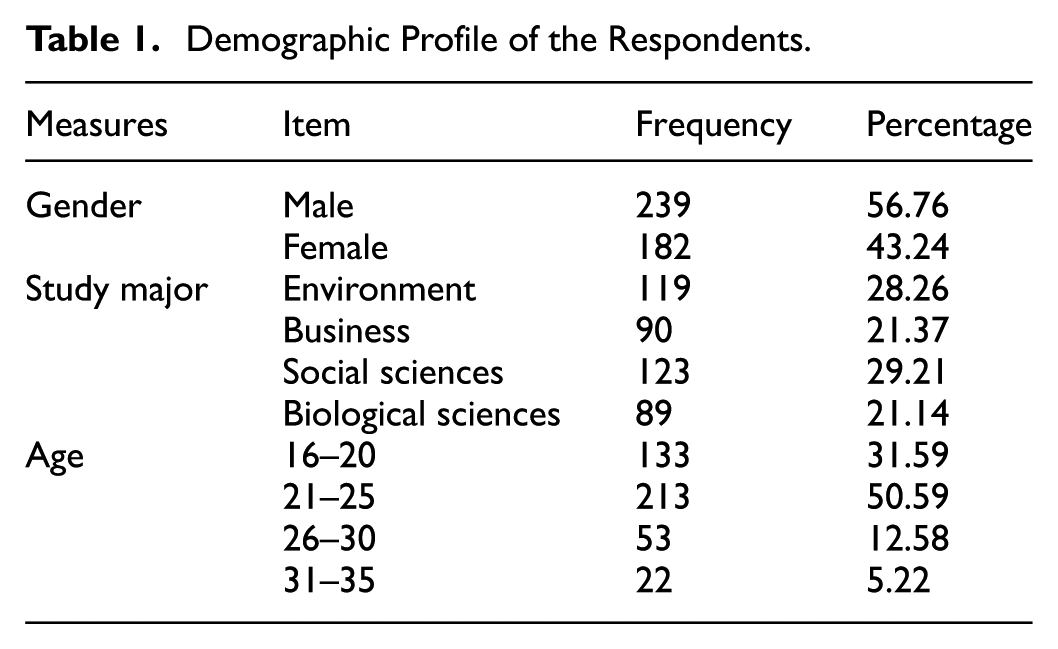
Student demographics are most affected by gender, age, and study major. Since these variables have been shown in the literature to have profound effects on student behaviour regarding going green (Coelho et al., 2017), it was determined that these factors would be used as control variables for this study. For example, some researchers reported that women are more environment-friendly than men, while others reported that postgraduates are more sensitive to the environment. Majors related to nature and the environment create a better understanding of global environmental issues than those who do not study it (Carfora et al., 2017; Zsóka et al., 2013).
Constructs and Measures
The scales for measuring the constructs were adopted from previous studies. Unless otherwise stated, all the items were measured by a 5-point scale ranging from strongly disagree (1) to strongly agree (5).
Environmental Education
We used eight items adopted from Pérez-Rodríguez et al. (2017) and Varela-Candamio et al. (2018) studies to determine EE. The sample item is, “Facing the current environmental problems, it is a priority to integrate EE at universities.”
Connectedness to Nature
The CN scale was measured with five items adopted from Mayer and Frantz (2004), which were already tested by various studies (Otto & Pensini, 2017; Ray et al., 2021). The sample item is, “I often feel a sense of oneness with the natural world around me.”
Social Dominance Orientation
The SDO scale, having 4 items, was used from Pratto et al. (2013). The sample item is, “In setting priorities, we must consider all groups.”
Green Behaviour
GB was assessed using a 14-item scale developed by Kaiser et al. (2003). The sample item was, “I will sign a petition in support of promoting GB.”
Normality Tests
Due to the use of convenience sampling, we conducted univariate and multivariate tests to confirm the normality and adequacy of data for analysis through SEM . We conducted skewness and Kurtosis to examine univariate normality and Mardia’s test for multivariate normality. As shown in Table 2, the values of skewness and Kurtosis are lower than the threshold values (−2 to +2) (Kline, 2016). The Mardia’s test was conducted using AMOS by estimating the multivariate kurtosis critical ratio. The statistics indicated that the values for all four variables were lower than the threshold values of 5.0 (Byrne, 2010). These tests suggest that the data met the assumptions of normality, supporting the appropriateness of the SEM applied.
Data Normality Indicators.

Note. SDO = social dominance orientation; GB = green behaviour; EE = environmental education; CN = connectedness to nature.
Justification of Sample Size
To determine whether our sample size is enough for SEM, we relied on recommendations from the literature (Li et al., 2025). Kline (2016) recommends a minimum sample size of 200 for SEM, whereas others suggest 5 to 10 respondents per the estimated parameter. Based on our latent variables and their items, our model results in at least 90 estimated parameters, which should require at least 450 respondents based on 5:1. Whereas our final sample size is 450, which is near the threshold but much exceeds the minimum 200, thus providing a satisfactory power for SEM analysis. Moreover, the normality test in the preceding section provides additional proof that the data is appropriate for CFA and SEM.
Hence, the data were suitable for using structural equation modelling (SEM), which was conducted using CFA and path analysis. AMOS 23 was used to conduct SEM. In the first step, the items were loaded on their corresponding constructs. Next, the output of CFA was used to test the reliability and validity of the constructs. The next step was to conduct the path analysis to test the proposed hypotheses. As AMOS cannot directly test the moderated mediation effect (Hypotheses 5–7), the PROCESS model was used to test the effect.
Common Method Bias
Cross-sectional data are often vulnerable to biases such as social desirability and common method bias. Therefore, certain procedural measures during data collection to reduce such biases as suggested by Podsakoff et al. (2012) were adopted. First, a time lag was introduced and data on predicting and criterion variables were collected at different periods of time. Second, every respondent received a different sequence of items in order to reduce the priming effect of an individual item of the questionnaire. Third, the questionnaire was accompanied by a cover letter that informed respondents there were no right or wrong answers and assured them that their responses would remain confidential.
After data collection, statistical measures were adopted to test for the common method bias. Harman’s single factor was used to test for the variance explained by a single factor. After loading all the items on the desirable four factors, the factors explaining the majority of the variance (32%) were less than the threshold level of 50%. Additionally, all the observed variables were loaded on common latent factors besides their corresponding latent factors. Per the criterion, the variance explained by the common latent factors should be less than 25% (Williams et al., 1989), which in the current case was 23%.
Confirmatory Factor Analysis
All the items were loaded onto their corresponding latent factors during the confirmatory factor analysis (CFA). The CFA gives us two significant findings.
Goodness of Fit
The goodness of fit (GOF) is recommended when doing SEM as it helps to ensure that the data fits well with the proposed model. Standard fit indices to determine the GOF are RMSEA, GFI, CFI, Chi-square (χ2 ), and degree of freedom (df). The smaller values of χ2 relative to df, χ2/df ≤ 2, show a good fit (Alavi et al., 2020). Similarly, the recommended values for GFI, CFI, SRMR, and RMSEA are ≥0.90, ≥0.90, ≤0.05, ≤0.05, respectively (Binheem et al., 2021; Sukkamart et al., 2023). The model fit indices (χ2 = 356.79, χ2/df = 1.39, CFI = 0.97, TLI = 0.97, RMSEA = 0.04, SRMR = 0.03) suggest that the data exhibited an excellent fit to the proposed four-factor model as shown in Table 3.
GOF Results.

Reliability and Validity Analysis
Although the scales were already developed and had good reliability and validity (please see their source mentioned in section 4.2 for reference), yet we tested the scale again for the said parameters due to different contexts and samples. The scale reliability was measured by Cronbach’s alpha and Composite reliability (CR). Both measures of construct reliability were above 0.70, a threshold value specified in the case of construct reliability (Bagozzi, 1983; Fornell & Larcker, 1981), which shows excellent consistency among the scale items. Besides, the scale’s validity was evaluated based on construct and discriminant validity. The average variance extracted (AVE) was estimated to determine the construct validity, and it was found that the value of all four measures was above the standard value of 0.50 (Fornell & Larcker, 1981), thereby confirming the construct validity for all measures. Finally, the discriminant validity was estimated by comparing the square-rooted AVEs of the respective constructs with the correlation estimates between the constructs. Per the rules, the value of square-rooted AVEs should be larger than the correlation estimates that were achieved in the current case. See the reliability and validity analysis results, along with descriptive statistics in Table 4.
Descriptive, Correlation, Reliability and Validity Estimates.

Note. M = means; SD = standard deviation; AVE = average variance extracted; CR = composite reliability; b**p < .01; α = Cronbach’s alpha; EE = environmental education; CN = connectedness to nature; GB = green behaviour; SDO = social dominance orientation.
Path Analysis
The next phase involved testing the proposed hypotheses through path analysis (refer to Table 5 for the results). Concerning the control variables, both gender (β = .10, p < .05) and field of study (β = .13, p < .05) showed significant associations with GB. It was observed that ED had a positive and direct impact on GB (β = .15, p < .001), supporting Hypothesis 1. Additionally, there was a positive and direct relationship between EE and CN (β = .21, p < .01), which, in turn, was positively and directly associated with GB (β = .31, p < .001), thus confirming Hypotheses 2 and 3. Moreover, using the bootstrapping method with 5,000 samples and a 95% confidence interval, it was found that CN mediated the relationship between EE and GB (Indirect effect = 0.06, SE = 0.04, CI [0.04, 0.12]), supporting Hypothesis 4.
Path Analysis Estimates.

Note: EE = environmental education; GB = green behaviour; CN = connectedness to the nature; SDO = social dominance orientation; SE = standard error; CR = critical ratio.
Furthermore, as proposed by Hypothesis 5, the interactive effect of EE and SDO on GB was negative and significant (β = −.19, p < .05), conforming to the fact that SDO minimises the impact of EE on GB. Further, the effect of the interaction term of SDO and EE on CN was also negative and significant (β = −.25, p < .01), conforming to hypothesis 6, which suggests that SDO students are less likely to connect with the nature even if they gain EE. The structural model has been demonstrated in Figure 2.
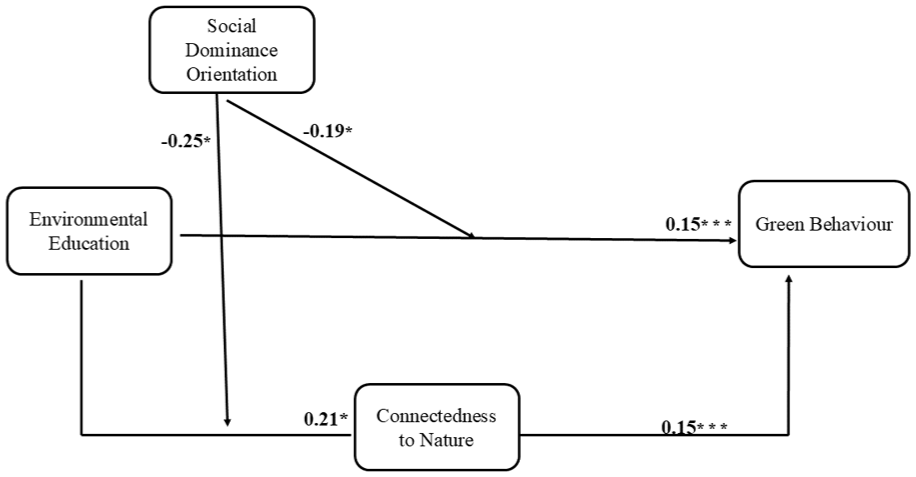
Structural model estimates.
Additionally, refer to Table 6 for the direct, indirect, and total effects.
Direct, Indirect, and Total Effect.
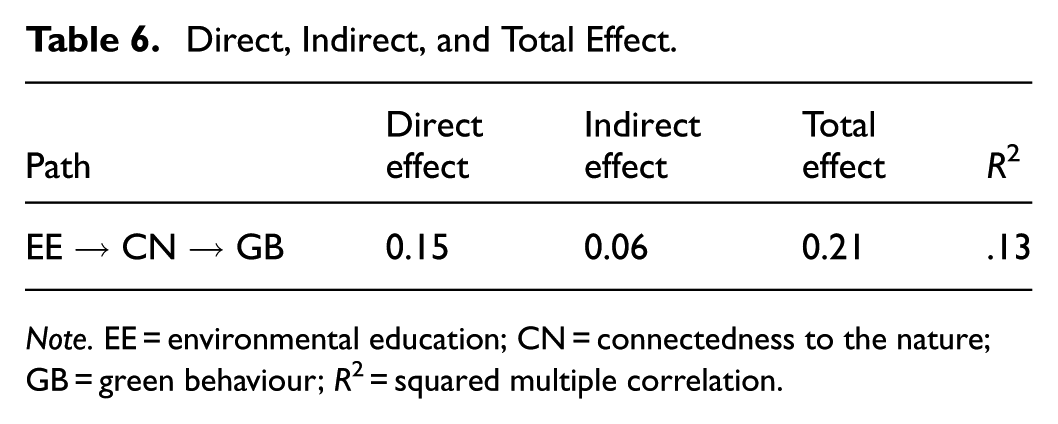
Note. EE = environmental education; CN = connectedness to the nature; GB = green behaviour; R2 = squared multiple correlation.
To further assess the moderating effect of SDO, Process Models 1 and 7 were employed to examine the relationships at both high and low levels of SDO, with results presented in Table 7. High and low values were defined as one standard deviation (SD) above and below the mean. For Process Model 1, the direct relationship between EE and GB was weaker at higher levels of SDO (β = .07, SE = 0.02, CI [0.01, 0.10]) than at lower levels of SDO (β = 0.14, SE = 0.02, CI [0.08, 0.17]). The direction of this relationship is illustrated in Figure 4. In Process Model 7, the indirect effect of EE on GB was weaker at higher levels of SDO (β = .07, SE = 0.04, CI [0.03, 0.10]) than that of the lower levels of SDO (β = .11, SE = 0.06, CI [0.05, 0.14]). The moderation effects are separately displayed in Figures 3 and 4. These findings support Hypotheses 5–7. A detailed summary of the status of the hypothesis is given in Table 8.
Moderation Effect of Social Dominance Orientation (SDO).


Moderated mediation of social dominance.

Direct moderation effect of social dominance orientation.
Hypothesis Summary Table.

Note. EE = environmental education; GB = green behaviour; SDO = social dominance orientation; CN = connectedness to the nature.
Discussion and Practical Implications
This study enhances our understanding of how EE fosters environmentally friendly behaviours. It highlights the role of EE in increasing knowledge about ecosystems through direct engagement with nature. The research reveals a positive relationship between EE and GB, with CN as a mediator. Theoretically, this work makes a valuable contribution to the literature by demonstrating that EE significantly impacts ecological behaviour, a link mediated by CN and moderated by SDO. Additionally, the study found that SDO negatively moderates this relationship, with higher levels of SDO weakening the connection between EE and GB.
In the current study, we have highlighted that EE is actually a sort of investment in the young generation to make them environmentally responsible citizens. This may help to develop the youngsters by developing their knowledge, skills, and abilities related to environmental concerns and protection. In turn, the CN and GB reflects the outcome of EE, which is actually the return of such education. This aligns with our research objective of understanding how educational investments can promote sustainable behaviours among students. Furthermore, this is also aligns with global educational frameworks such as UNESCO’s Education for Sustainable Development (ESD), which emphasises empowering youth to make informed environmental decisions across socio-cultural contexts. For instance, as on an individual level, a household with the attitude of GB may engage in pro-environmental behaviour that is being rewarded in the form of a tax credit. In some countries, individuals who use environmentally friendly equipment such as solar, wind, and geothermal energy may receive a 30% tax credit. For example, the residential clean energy credit in the United States supports households investing in renewable energy systems to reduce their environmental footprint (Chen et al., 2022). Similarly, it has been estimated that happy employees are 20% more productive in their work, and environmental quality is a significant measure of one’s happiness. Similarly, individuals and organisations violating environmental rules and regulations may be penalised and fined. For instance, in some countries, causing environmental pollution may cost a $50,000 penalty. Educating individuals may avoid such penalties. In short, GB is a form of return on investment that avoids financial costs, earns rewards, etc. In order to go beyond descriptive insights, we recommend that children’s institutions should prioritise and institutionalise CN as an explicit goal in EE. For example, experiences that involve nature immersion, like field trips to ecosystems, nature conservatories, or projects in the nature-based school setting, should be highlighted. These practices contribute to strengthening the emotional relationship of students with nature, which, as is confirmed by this study, constitutes the most relevant mediating variable when fostering GB. Furthermore, educators can integrate reflective activities (e.g., nature journaling and environmental storytelling) that facilitate self-affiliation with ecological systems. These teaching resources have been suggested to encourage values of responsibility towards the environment in students and support the permanence of changes in behaviour.
In the context of SDO, these findings would imply the need for differentiated educational approaches that suit the diverse dominance orientations of students. Teachers may consider dialogical teaching methods that cultivate reflection on human-nature relationships and social fairness. These strategies may counteract the impact of high SDO by attacking hierarchical perspectives of the world and expressing non-discriminatory environmental values. Education programmes should also train teachers to identify and deal with resistance to environmental messages, specifically in high SDO learners.
Equipping teachers with evidence-based strategies for fostering empathy, collective identity, and moral concern can reduce ideological barriers to environmental engagement. From a policy standpoint, education ministries should support longitudinal tracking of EE outcomes by including indicators of nature-connectedness and GB in national education assessment frameworks. This allows for more targeted improvement of programmes and confirms whether emotional and behavioural outcomes are being achieved over time. These practical implications further demonstrate how education can incentivise GB, directly supporting our research question of how EE influences sustainable actions.
The primary objective of this research is to explore how individuals’ beliefs and perceptions of EE influence the promotion of GB by fostering a connection with nature. This study reinforces previous findings that EE can strengthen the bond between students and nature, motivating them to adopt more sustainable lifestyles. For instance, Otto and Pensini (2017) found that nature-based EE can positively enhance environmental behaviour.
Ballantyne et al. (2008) found out that raising public awareness of biodiversity is a crucial step in conserving natural habitats, understanding the threats to biodiversity, and understanding counteractive measures can be taken, and EE is a significant source of awareness. Hence, the results suggest that EE improves GB since it educates students about their actions and consequences.
In this study, CN was found to mediate the relationship between EE and GB, indicating how vital it is to encourage students to conserve nature and live sustainably. Nature connection has been proposed as a crucial driver of pro-environmental emotions. In order to take action to protect the natural world, Mayer and Frantz (2004) argue that humans need to feel connected with nature and our findings largely confirm the previous findings that nature connection is a powerful predictor of pro-environmental beliefs and behaviour (Hornsey et al., 2016). Research from the Netherlands by Nisbet et al. (2009) supports this view – using their “Nature Relatedness Scale,” they demonstrated that participants with higher nature-relatedness scores engaged more in sustainable actions like recycling and energy conservation. From the theoretical perspective that connection to nature is a fundamental human need, most of this work assumes, either explicitly or implicitly, that nature is more of a cause than an outcome of flourishing. These findings suggest that a connection with nature fosters environmental concern and encourages the adoption of greener lifestyles, such as conserving water and electricity. This finding further supports our hypothesis that CN the positive relationship between EE and GB.
This study also looked into the moderating effect of SDO on the relationship between EE and GB via CN. An individual’s inclination towards group-based inequality and hierarchy is assessed by SDO, which has been shown to predict attitudes and behaviours related to intergroup relations as well as environmental concerns. Our findings suggest that people with increased levels of SDO were less likely to engage in environmental citizenship behaviours such as signing petitions to support environmental protection, boycotting companies that are not environmentally friendly, or sending messages expressing support for the environment (Zhao et al., 2018). Similarly, those with high SDO were less likely to engage in private-sector actions to reduce energy consumption and negative environmental impacts and less likely to donate to an environmental organisation. This result confirms our research hypothesis and means that people high in SDO have less GB, which also emphasises this variable’s relevance for forming environmental attitudes. The fact that SDO was adversely associated with both GB and CN demonstrates the importance of this individual difference variable in comprehending environmental problems (Milfont & Sibley, 2016). SDO indexes the basic urge to develop and sustain hierarchical social structures, which aids in explaining hierarchical relationships between humans and the natural environment. Theoretically, the support of social inequality among social groups is promoted due to SDO. Environmental exploitation can contribute to disseminating or widening societal inequality, especially when it perpetuates and widens the gap between privileged and disadvantaged groups (Milfont et al., 2018; Milfont & Sibley, 2016). The more people are aware of the power differential between groups, the more their views are influenced by their orientation towards inequality (Pratto et al., 2013). When it comes to the environment, the grouping power difference is evident through societal inequality, lack of societal growth, and environmental standards; the more those who favour group inequality will seek to exploit the environment. This shows that persons who support social inequity, lack of societal progress, and environmental norms have a more substantial reason not to engage in pro-environmental practices. On the other hand, the lower the participants’ SDO, the more they supported pro-environmental measures. Those societies with a more equal income distribution, educational attainment, and life expectancy are more likely to exhibit this association, along with those with better environmental performance.
This trend can be seen in cross-national comparisons – countries with lower SDO, such as those in Europe (with higher overall HDI), typically show more significant concern about the environment and more support for climate-related policy measures. This result reveals the connection between social values and environmental patterns, as shown by the research on 21 European societies (Graça, 2021). These findings indicate that individuals low in SDO show more of a tendency towards GB, which is consistent with our prediction for positive roles of lower levels of SDO in environmental responsibility behaviours.
Limitations and Future Directions
This study has several limitations that future research could address. First, the scope of the target demographic was somewhat restricted, as the study focused solely on university students, a small portion of the overall population. This homogeneity may limit the external validity of the findings, as university students tend to differ from the general population in terms of age, educational exposure, socio-economic background, and access to environmental knowledge. As such, caution is warranted in generalising the results to other populations, including rural communities, older adults, or non-academic cohorts. Including working professionals, housewives, and individuals from various other societal backgrounds could offer more comprehensive insights. Additionally, real-life behaviour might differ between university students and professionals, which could influence the findings. Future research could examine patterns of green ecological behaviour across different life stages and occupations.
A valuable extension of this study would involve comparing the results with similar studies conducted in different regions and cultures. Such comparisons could provide a deeper understanding of cultural and behavioural variations in green ecological behaviours across the globe. Although the study found potential impacts of EE within the context of institutions in Pakistan’s capital, applying the same methodology to other regions and institutions would enhance the robustness of the findings. This approach could also highlight areas for improving educational environments and potentially inspire new educational concepts for broader application.
The empirical evaluation of EE programmes is essential for both theoretical and practical advancements in this field. Our findings suggest that students’ positive perceptions and beliefs about nature-based EE are linked to improved environmental knowledge and a stronger connection to nature, which, in turn, leads to greater ecological behaviour. However, further investigation is needed to determine how the amount of time spent in nature and the frequency of such interactions influence long-term effects across an individual’s life.
Future research could explore how these factors evolve over time and identify the most effective ways for nature-based EE to yield lasting results. Additionally, while our hypothesis suggests a causal relationship, it has not been empirically demonstrated. Future studies should focus on establishing causal links to provide a stronger foundation for understanding the effects of CN in EE. Furthermore, retrospective monitoring in this age group poses challenges, and the findings could be tested using alternative indicators. Lastly, while retroactive monitoring could be informative, it may not fully align with our hypothesis and could introduce potential conflicts.
Conclusions
In conclusion, this study underscores the significant role that EE plays in fostering students’ GB through a strengthened CN. EE not only motivates and fosters a sense of connectedness to the natural world but also helps reduce social dominance and mitigate environmental harm. The results align with previous research (Begum, Jingwei, Haider, et al., 2021; Begum, Jingwei, Marwat, et al., 2021; Meyer, 2015; Otto & Pensini, 2017), which supports the idea that EE enhances students’ environmental awareness. Our study reveals that EE equips students with a deeper understanding, making them more inclined to engage in environmentally beneficial actions.
The study confirms that EE encourages students to adopt sustainable practices, promotes environmentally friendly behaviour (H1), CN (H2), and that CN mediates the relationship EE and GB (H3). Additionally, we found that SDO moderates this relationship, with individuals with higher levels of SDO exhibiting less environment-friendly behaviour (H4, H5, H6, and H7). It was observed that individuals with higher support for social hierarchy and inequality tend to be less environmentally conscious, while those with a lower SDO are more attuned to nature and ecological concerns.
Based on these insights, it is recommended that higher education institutions place greater emphasis on both formal and informal EE to achieve sustainable, GB. This recommendation is consistent with prior research that shows EE fosters pro-environmental behaviour. Furthermore, to effectively conserve nature, EE must focus on disseminating knowledge, promoting ecocentric values, and reducing social hierarchies and inequalities.
Footnotes
Acknowledgements
The authors gratefully acknowledge this support, which made the completion of this work possible.

Ethics Considerations
The study was designed in line with Helsinki’s declaration. The study did not formally require the ethical approval from a particular institute or committee since it did not involve the human or animals to be the direct subject of the study. Yet, the study adhered to ethical norms. The study involved the survey that kept the anonymity of the respondents with no risks to their confidentiality.
Consent to Participate
Informed consent was taken through consent form and their participation in their survey was purely based on their choice without being influenced by any means. They were asked that they can withdraw the survey at any time without any consequences. The potential benefits of this research – contributing to understanding and promoting green behaviour – outweigh the minimal risk involved in participating in an anonymous, low-risk survey.
Funding
The authors disclosed receipt of the following financial support for the research, authorship, and/or publication of this article: This research was supported by the China Postdoctoral Science Foundation (Grant No. 377192).
Declaration of Conflicting Interests
The authors declared no potential conflicts of interest with respect to the research, authorship, and/or publication of this article.
Data Availability Statement
The data presented in this study are available on request from the corresponding author.