




Abstract
Marketing and tourism research emphasizes the importance of the co-creation of experience value in creating and maintaining sites of cultural consumption. However, the role of visitor motivation has been relatively overlooked, as have the dynamics of this process in museum space. Addressing these gaps, this study examines the co-creation of museum experience value from the perspective of visitor motivation in seven museums in Chengdu, China. The survey was used to collect 549 valid samples. Using survey questionnaire data and regression and structural equation analysis, this study reveals the significant relationship between visitor motivation, participation, interaction, and experience value in the co-creation of museum experience value. More specifically, participation and interaction play a mediating role in the relationship between visitor motivation and experience value, while visitor knowledge plays a moderating role in the relationship between visitor motivation and experience value. Expanding the literature on experience value co-creation by museum visitors, the results of this study have important implications for museum management.
Introduction
The growth in material consumption and urgent need for spiritual and cultural life has resulted in the rapid growth of diverse cultural industries and new undertakings. In China, many people have begun exploring spiritual life through the extensive and profound Chinese traditional culture (Liu, 2020; Zhou, 2021). As an important vehicle of Chinese excellent traditional culture, museums have become one of the most important destinations of cultural consumption. However, in reality, the majority of museums face fierce competition from other cultural and leisure services, while their attempts to improve visitor experience to attract and retain visitors are constricted by funding limitations (Vareiro et al., 2020). Moreover, most museums continue to be positioned as educational institutions providing learning experiences, ignoring the growing diversification and personalization of visitor experience needs (Antón et al., 2018b; Manna & Palumbo, 2018; Su & Teng, 2018; Vom Lehn, 2006).
Accordingly, some scholars in the fields of marketing and tourism have emphasized the importance of co-creation of experience value (Buonincontri et al., 2017; Campos et al., 2018; Harkison, 2018; Lin et al., 2022; Prebensen et al., 2013). Experiential value co-creation typically considers consumers as active agents in terms of value consumption and production, while consumer engagement is a sine qua non for defining and designing experiences (Prebensen et al., 2013). Campos et al. (2018) describe the co-creation of tourists’ experiential value as the sum of the psychological events that tourists experience when they participate in physical or mental activities and interact with other subjects in their experience environment. The more a tourist invests in a travel experience, the more positive and memorable this can become, with tourists often becoming the co-creators of such an experience through active participation or positive interaction. Many scholars point out that visitors can obtain new experience value through co-creation (Antón et al., 2018a; Tregua et al., 2020). This study examines the co-creation experience value of museum visitors, a relatively overlooked space in the literature. The process of visiting a museum can be divided into three stages: namely, before, during, and after the visit (Antón et al., 2018a; Kuflik et al., 2015). Before the visit, the visitor’s knowledge, plans, attitudes, and motivations are of primary concern (Hein & Alexander, 1998; Falk & Dierking, 2000). The antecedents of different situations may have distinct effects on participatory and interactive behaviors during the visit, ultimately influencing the individual’s experience perception of the visit. During the visit, visitors obtain learning, entertainment, escapism, and esthetic experiences through various participating behaviors (Pine & Gilmore, 1998), which are central to the process of co-creating museum experience value. After the visit, visitors reflect on their experience and engage in content generation by sharing their perceptions with family and friends, online or in the form of feedback to the museum. A pleasant experience may also lead visitors to search for further information about the museum on the Internet or look forward to participating in future activities at the museum in what is called the intensification of the experience (Antón et al., 2018a, 2019).
Museums are one of the most popular types of tourist attraction, providing unique cultural and historical experiences that give visitors a new perception of the past (McKercher, 2004). The continuous expansion of functions has made museums increasingly attractive, with different groups of visitors seeking out specific types of museums at different times. In this respect, museums have seen an increase in both tour groups and individuals visiting on weekdays and holidays (Falk & Dierking, 1992; Hooper-Greenhill, 2006). However, the co-creation of experience value by museumgoers is relatively limited—something researchers and curators seek to change. In this respect, Simon (2010) conducted a case analysis, testing various ways to enhance visitor participation, including treating visitors as contributors and encouraging their collaboration with other visitors to help them create their own personal museum experience. Using the heritage sector as an example, Minkiewicz et al. (2014) explore activities in which consumers co-create experience value in the form of collaborative generation or participation. Antón et al. (2018a) explored the process whereby museum visitors receive personal satisfaction from co-creation based on an assessment of their increased knowledge and planning. In this regard, the researchers demonstrated that visitor motivation is an important but often neglected influencing factor in the co-creation of museum experience value, one that needs further study. Certainly, visitors’ motivation is an important factor influencing their museum experience (Falk & Dierking, 2000; Vareiro et al., 2020). Motivation—often described as the driving force behind all actions and as directly shaping the perception of the overall experience—has proven an important concept in the field of marketing and tourism (Ma et al., 2017; Yoon & Uysal, 2005).
Addressing the call of Antón et al. (2018a), this study explores the influence of visitor motivation on the co-creation of museum experience value in seven well-known museums in Chengdu, China. More specifically, this study examines (1) how visitor motivations affect visitors’ participatory and interactive behavior and experiences value during the visit, (2) how visitors’ participatory and interactive behavior directly influences their experiences value during the visit, and (3) how visitors’ experiences value during the visit influence their related behavioral intentions after the visit.
Accordingly, this study addresses a significant gap in the research, particularly insofar as it explores the impact of each dimension of motivation on the process of co-creation experience value in museum spaces. Moreover, in line with the extant literature, this study confirms the important role of participation and interaction in the process of experiencing value (Antón et al., 2018a; Bilgihan et al., 2015; Jung & Yoon, 2012; Vega-Vazquez et al., 2013), and verifies the mediating effect of participation and interaction in the relationship between motivation and experience value. This study also confirms the importance of visitors’ knowledge and the moderating role of visitor knowledge in the relationship between motivation and experience value (Antón et al., 2018a; Mourali et al., 2005; Teichmann, 2011). Based on its results and emphasizing the need to pay attention to behavioral intention after a visit, this study advances several suggestions of how museums can attract visitors.
Theoretical Background and Conceptual Framework
Visitor Motivation
Maslow (1982) described motivation as “the process of initiating, focusing, and controlling people’s behavior toward a specific goal.” According to Dörnyei et al. (1998), motivation is a psychological process of action caused by various inducements. In the field of marketing, merchants use the in-depth exploration of consumer motivations to predict possible consumer behaviors and formulate corresponding marketing strategies (Grönroos, 2008). Similarly, those in the field of tourism and leisure frequently use tourist motivation to understand tourism and identify the determinants of tourist behavior (Li et al., 2016). However, in the field of museum study, the role of visitor motivation in the process of co-creation experience value has been relatively neglected (Antón et al., 2018a), motivation is also an important antecedent element that affects the visitor process (Foster et al., 2020; López-Guzmán et al., 2019). Based on the research of Antón et al. (2018a), this study further explores the process of co-creation museum experience value from the perspective of visitor motivation.
Visitor motivation is a multidimensional concept defined as the convergence of many components of visitors’ environment that cause them to visit a specific museum in a specific day (Falk, 2009). In respect to people’s motivation to visit museums, Medic et al. (2015) have identified a number of motivations, including spending quality time with family, exploring, learning new things, relaxing, and escaping from reality. Similarly, Allan and Altal (2016) identify five motivations to visit a museum: exploring unfamiliar territory, increasing one’s knowledge through new experiences, enjoying an escapist moment, visiting with friends and family, and simply relaxing. And the classification of these motivational factors is widely adopted in the tourism literature (Allan, 2013, 2014; Kim & Jogaratnam, 2002; Kim et al., 2006). Based on the literature and combined with the results of the pre-investigation, this study explores five dimensions of visitor motivation and their impact on the co-creation of museum experience value: namely, exploration, knowledge gain, escapism, friendship, and relaxation.
Experience Economic Theory
In examining the experience economy, Pine and Gilmore (1998) emphasized the importance of consumers obtaining unique experiences. Consumers can obtain different experiences through active participation, passive participation, absorption, and immersion. Experience can be further divided into four dimensions based on the degree of personal participation: namely, learning, entertainment, esthetics, and escapism experience. In this respect, the learning experience typically refers to the result of knowledge consumption—that is, learning, obtaining information or increasing one’s knowledge. The entertainment experience involves recreation, enjoyment, and fun, while esthetic experience refers to the provision of a place to observe and enjoy the environment and a realistic atmosphere. Finally, while the escapism experience is also a form of entertainment experience, it is an imaginative activity allowing individuals to escape from their reality or routine (Komarac & Ozretić Došen, 2022).
Value comes from experience, and experience provides value. Without experience, there is no value. Simply put, the experience obtained by customers is value (Helkkula et al., 2012; Prahalad & Ramaswamy, 2004b). In the museum context, Frey (1998) note that museums as places with selection, existence, heritage, reputation, and educational value—should provide visitors with a full range of cultural experiences. Many scholars have directly cited the Pine and Gilmore’s (1998) classification of experience in their exploration of museum experience value (Antón et al., 2018a; Lee et al., 2020; Mahdzar et al., 2017). Accordingly, this study explores the value of museum experience in four dimensions: learning, entertainment, esthetics, and escapism experience.
Value Co-creation
Most modern value co-creation theories are derived from two major schools of thought, namely, competition theory and service-led logic. Based on customer experience value from the perspective of competition theory, the first theory emphasizes the co-creation of customer experience as the core mechanism of participation between customers and enterprises, and this interaction as fundamental to creating value (Prahalad & Ramaswamy, 2004a). The other theory of value co-creation is based on service-led logic, whereby the emphasis is primarily placed on the use of value itself rather than exchange value (Vargo et al., 2008).
Given the constant evolution of value co-creation theories, this study focuses on the field of production and consumption. Value co-creation in the field of production emphasizes participation, whereby enterprises encourage consumer representatives to actively engage in specific production activities. Although enterprises still dominate production, consumers are essential insofar as they use the services/product and provide feedback. Significantly, the participative co-creation used in manufacturing can be modified for the service industry (Im et al., 2021; Mathis et al., 2016). In the field of consumption, co-creation emphasizes consumer experience as the core value, with the co-creation process primarily led and controlled by consumers. This is clearly evidenced in specific areas of tourism and retail (de Rojas & Camarero, 2008; Meng & Cui, 2020).
As noted, in the context of museum visitation, there is a lack of co-creation research on the value of visitor experience. Antón et al. (2018a) have explored how museum visitors experienced the perceived value of co-creation through the pleasure of increased knowledge and how this influenced their intention to visit other museums. They also advance the need for future research on the role of visitor motivation as an important antecedent element of the value co-creation process. Accordingly, this study explores the process of co-creation museum experience value from the perspective of visitor motivation.
Research Hypotheses
Motivation and Experience Value
As the driving force behind behavior, motivation directly affects people’s experiences (Moral-Cuadra et al., 2020; Yoon & Uysal, 2005). According to Utman (1997), believed that the stronger someone’s motivation to participate in an activity, the greater the depth of the experience they will derive from it. According to Antón et al. (2018a), visitor motivation may be an important element in the co-creation of experience value. As noted, while the literature has discussed the influence of motivation on experience, there is a lack of research on the influence of specific dimensions of motivation on specific dimensions of experience. In this respect, Elliot and Dweck (2005) show how the motivation to gain knowledge is an important predictor of learning experience. Examining the influence of club activities on motivation, experience and satisfaction, Park and Chon (2011) demonstrate how people’s motives to relax and partake in leisure have a positive impact on their escape from daily life. In their study of the motivation to visit museums, Allan and Altal (2016) pointed out that the main motivation of people entering Jordanian museums is exploration motivation, and the visitor’s experience is particularly strong under the exploration motivation. Meanwhile, studying the preferences of online game players, Tseng and Teng’s (2015) examination of the preferences of online gamers demonstrates how players’ exploration motivations influence their final consumption intentions through various experiences in the virtual environment. According to the research of Utman (1997), Yoon and Uysal (2005), Moral-Cuadra et al. (2020), and others, combined with the specific description of motivations and experiences, it can be inferred that specific dimensions of motivation had an impact on specific dimensions of experience. Based on the foregoing, this study proposes the following hypotheses (H1–H4):
Motivation, Participation, and Interaction
Many scholars have pointed out that participation and interaction enhance the tourism experience, being also essential behaviors to promote the co-creation of experience value (Antón et al., 2018a; Campos et al., 2018). Motivation is often described as the antecedent of a certain behavior (Mook, 1996) and leads people to participate in the activities they expect (Li et al., 2016). Under different motivations, people have different purposes, methods, and degrees of participation in activities (Claycomb et al., 1970; Hyman, 1990). For instance, Alt’s (2018) analysis of social media confirms that the motivation to gain knowledge has a significant positive effect on social media participation. Similarly, Moore (2008) demonstrates that the motivation to gain knowledge is an important factor affecting classroom interaction. Exploring the motivation of learning science in the adult community space, Childers et al. (2022) found that participants’ knowledge and learning motivation are important factors influence their social interaction with other participants and experts.
In respect to friendship and relaxation motivation, Jin et al.’s (2020) exploration of the motivations behind multimedia users’ sharing behavior revealed that users’ friendship and relaxation motivation had a significant influence on their participation behavior. Meanwhile, Yoo and Choi (2019) show how friendship and relaxation motivation influence tourism participation behavior by analyzing the psychological process of tourists in respect to destination selection.
According to Algesheimer et al. (2005), customer participation is an interaction or cooperation activity that customers conduct with others based on certain functions, entertainment, or friendship motivations. Chiu et al. (2006) contend that friendship motivation is the only motivation for interaction on social networks and is the direct cause of individual social behavior in social network research. Discussing consumers’ motivation to participate in value co-creation, Chen et al. (2021) confirmed that consumers’ friendship motivation has a significant positive effect on interaction behavior. The aforementioned literature reveals the influence of friendship, relaxation, and knowledge gain motivations on participatory and interaction behavior. According to the research of Hyman (1990), Claycomb et al. (1970), Li et al. (2016), combined with the specific description of the exploration and escapism motivation, it can be inferred that the visitor’s exploration and escapism motivation will affect participation and Interaction. In the museum context, generally refers to a physical, emotional, spiritual, planned (i.e., organized by the museum) or spontaneous and informal activity. In this respect, participation involves the exploration of participants’ multi-sensory experience (Campos et al., 2018). Interaction is an important source of experience value, and typically achieved by stimulating people’s thoughts, feelings, and creativity (Minkiewicz et al., 2014). Based on the foregoing, this study proposes the following hypotheses (H5–H6):
Participation, Interaction, and Experience
According to Falk and Dierking (2000), visitor interaction and participation are two ways in which museums can create visitor experiences. Museums want to their visitors to become active participants and interact as much as possible during their visit. The development of social networks has greatly facilitated the ease and frequency of interaction between museums and visitors, resulting in their ability to establish a co-creative relationship (Lazzeretti et al., 2015). Burton et al. (2009) argue that the active participation of visitors can enhance their experience and encourage repeat visits to the museum. Kotler et al. (2008) distinguished museum exhibitions according to the degree of participation and interaction, their framework ranging from a simple interactive experience with object displays to complex interplay. Black (2018) discusses the difference between interactive exhibitions and participatory exhibitions for visitors. Pine and Gilmore (1998) divide the experience into four dimensions according to the individual’s participation, indicating that the degree of participation is related to learning, entertainment, escapism, and esthetic experience. Finally, exploring museum experience co-creation, Antón et al. (2018a) confirm that visitors’ participation behavior has a positive and significant impact on the escapism, learning, and entertainment experience, while interactive behavior only has a significant positive impact on learning experience. Based on the foregoing, this study proposes the following hypotheses (H7–H10):
Visitor Experience, Intensification, and Content Generation
In general, the museum experience begins before the visit, takes its main form during the visit, and continues to affect the individual after the visit (Kuflik et al., 2015). Each person may have different experiences after their museum visit. Some visitors evidence their good experience by buying souvenirs and gifts (Dong & Siu, 2013), while others give experience feedback by further collecting information from the museum. It is important to pay attention to relevant experience feedback as it facilitates the visitor experience, including encouraging visitors to visit and feel welcomed to the museum and making them more receptive to the museum experience. Visitors who have a good experience will be more eager to return, as well as actively share and communicate their experiences (Coelho et al., 2018).
This study uses two indicators of intensification and content generation in museum research developed by Antón et al. (2018a, 2019). Exploring the value of visitors’ knowledge and plans in the creation of museum experience, Antón et al. (2018a) found that visitors’ escapism and learning experience have a significant positive effect on intensification and content generation. Su and Teng (2018) extracted the service quality dimension from the negative online reviews of a museum in order to examine visitors’ experience perceptions after their visit. Meanwhile, Nisi et al. (2018) show how mixed reality entertainment experiences increase visitors’ interest in interacting with locals and cultivate more knowledge about the area, which they are more willing to share with those around them. Based on the foregoing, this study proposes the following hypotheses (H11–H12):
The Mediating Role of Participation and Interaction
Most people visit a museum in order to gain some kind of experience—the visit allowing them to relax, learn, interact, explore, and, if they want, participate, contribute, and even cooperate with the museum or other visitors (Black, 2018; Prebensen et al., 2013). Extant studies have shown that the experience value of tourists is related to tourists’ motivation and degree of participation. Motivation influences the degree of participation of tourists, while the participation and interaction of tourists enhances the experience (Bilgihan et al., 2015; Burton et al., 2009; Vega-Vazquez et al., 2013). Examining visitors’ emotional participation in museums, Allan and Altal (2016) observe how different motivations may have different effects on participation, interaction, and experience during the visit. In doing so, the researchers revealed how visitors entering the Jordan Museum are primarily motivated by the desire for exploration, which significantly influences their experience. Based on the foregoing literature and hypotheses (H1–H12), this study proposes the following hypothesis (H13):
The Moderating Role of Knowledge
Visitors’ previous knowledge, interests, skills, beliefs, attitudes, and experiences will affect their interaction and experience in the museum (Falk & Dierking, 2000; Hein & Alexander, 1998). Caru and Cova (2007), in their study of the immersive experience of consumers, that people who frequently visit museums or exhibitions have accumulated a wealth of knowledge, enabling them to participate more actively and gain a better experience. In the field of tourism, Gursoy’s (2003) examination of the relationship between tourist knowledge and experience perception reveals that tourists with more knowledge may have a deeper understanding of tourism-related information, allowing them to better anticipate and make decisions about travel routes. Tourists who lack relevant knowledge are more likely to have high expectations and eventually make irrational travel decisions. Meanwhile, examining visitors at an Austrian tourist attraction, Teichmann (2011) found that tourists who regularly travel abroad accumulate a rich tourism knowledge that heightens their tourism experience perception. According to Antón et al. (2018a), visitors’ knowledge has a positive effect on their learning, entertainment, escapism, and esthetic experience. Based on the foregoing and this study’s hypotheses regarding motivation and experience, this study predicts that visitors’ knowledge plays a moderating role in the relationship between motivation and experience. Drawing on Antón et al.’s (2018a) research, the visitor knowledge measure used in this study reflects the theoretical and empirical knowledge of visitors. More specifically, visitors’ theoretical knowledge generally refers to their hobbies and interests in history, culture, and technology, while visitors’ empirical knowledge generally refers to the knowledge accumulated by frequently participating in such exhibitions and visiting cultural destinations. Therefore, this study proposes the following hypothesis (H14):
In accordance with the above literature and hypotheses (H1–H14), this study proposes the following museum experience value co-creation model based on visitors’ motivation (Figure 1).

Proposed conceptual framework.
Data and Methodology
Data Collection
This study collected data from seven museums in Chengdu, which has approximately one museum for every 135,000 people. Indeed, across China’s cities, Chengdu has the highest number of museums (public and private). This study selected the following general, art and/or history museums for data collection: the Xu Liaoyuan Museum of Modern Art and Design, Jianchuan Museum, Sanhe Classic Car Museum, Chengdu Museum, Jinsha Site Museum, Wuhou Temple Museum, and DuFu Thatched Cottage Museum. The selected museums comprise four public and three private museums, and enjoy high daily foot traffic. Data collected from visitors are representative.
This study used questionnaire surveys to randomly sample visitors at the selected museums between November 2017 and August 2019. This study employed two dissemination methods: (1) questionnaires were provided to museum staff, who were then responsible for disseminating and collecting completed questionnaires; (2) the research team personally visited each museum to disseminate and collect questionnaires. A total of 750 completed questionnaires were collected. After excluding 201 invalid questionnaires, the study sample comprised a total of 549 valid questionnaires, making for a validity rate of 73.2%.
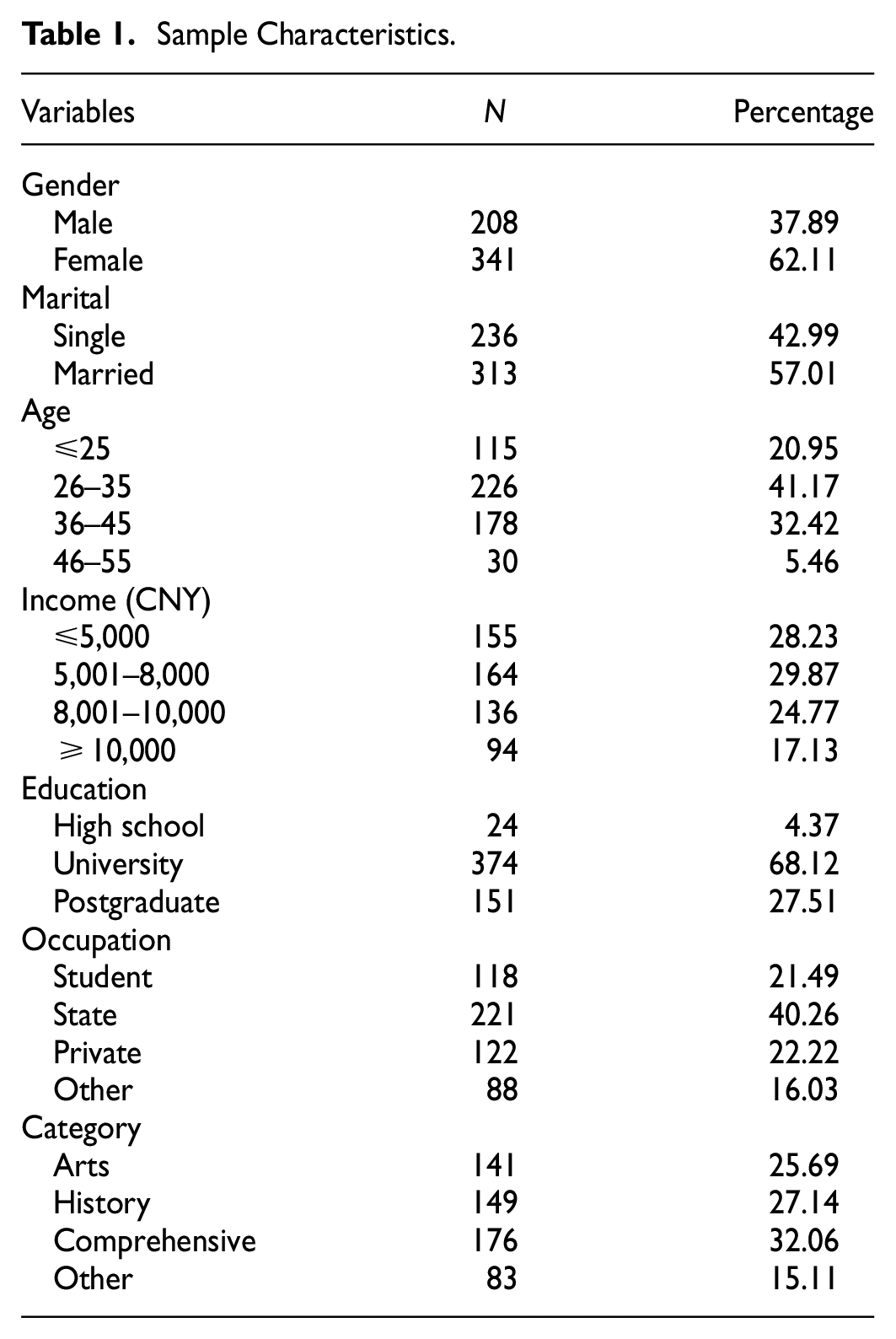
The questionnaire comprises two sections. The first section examines visitor motivation using a five-point Likert scale ranging from 5 = “Strongly agree” to 1 = “Strongly disagree.” The second section collects demographic characteristics, including respondent age, gender, marital status, occupation, education and income of the respondent, and the type of museum visited (Table 1). Table 1 summarizes the distribution of the sample. In addition, the beginning part of the questionnaire specifically explained the purpose of the survey (academic research), the way to fill it out (voluntary and anonymous), and gave the respondent a small gift as a response.
Sample Characteristics.
Measures
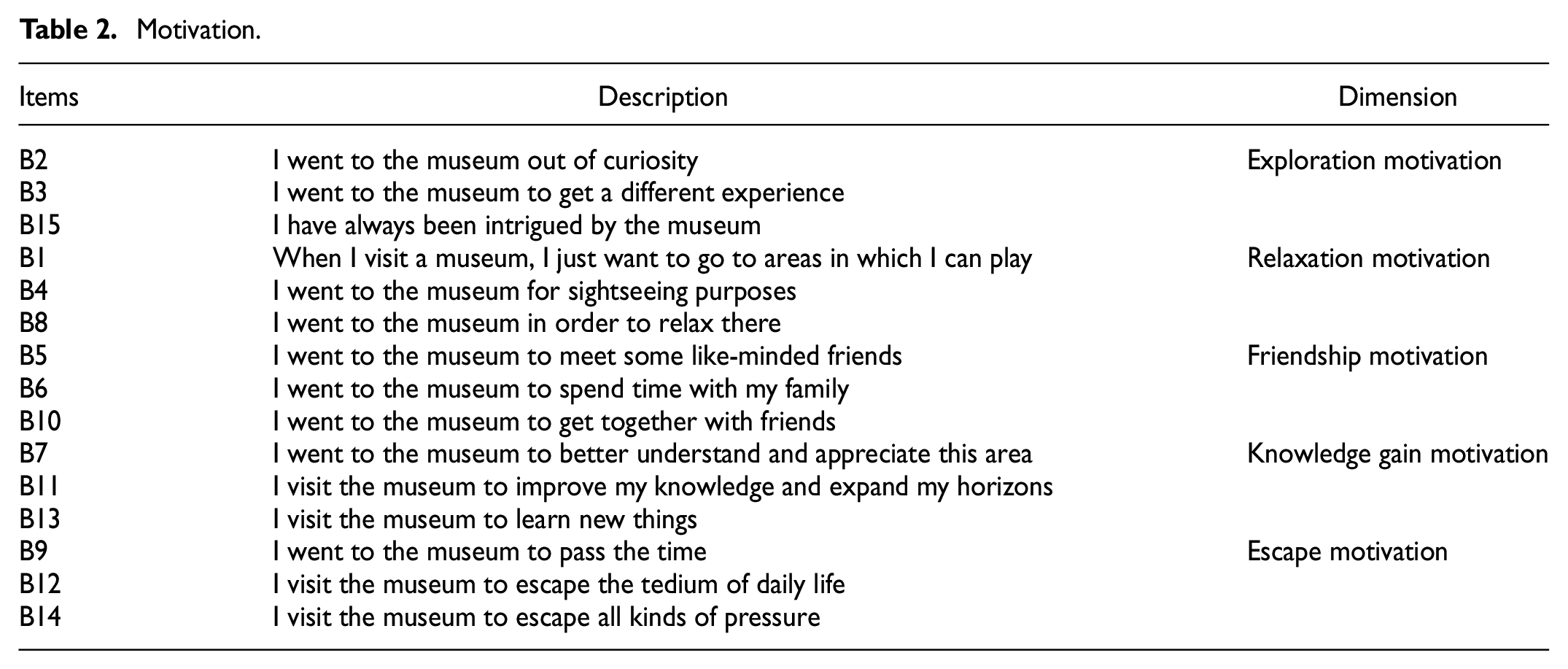
The visitor motivation scale used in this study is largely based on the motivation dimensions and measurement items developed by Medic et al. (2015) and Allan and Altal (2016). Based on the results in the literature and the pre-investigation, this study selected the following motivation dimensions: knowledge gain, exploration, relaxation, friendship, and escape motivation. Table 2 presents this scale and selected measurements items.
Motivation.
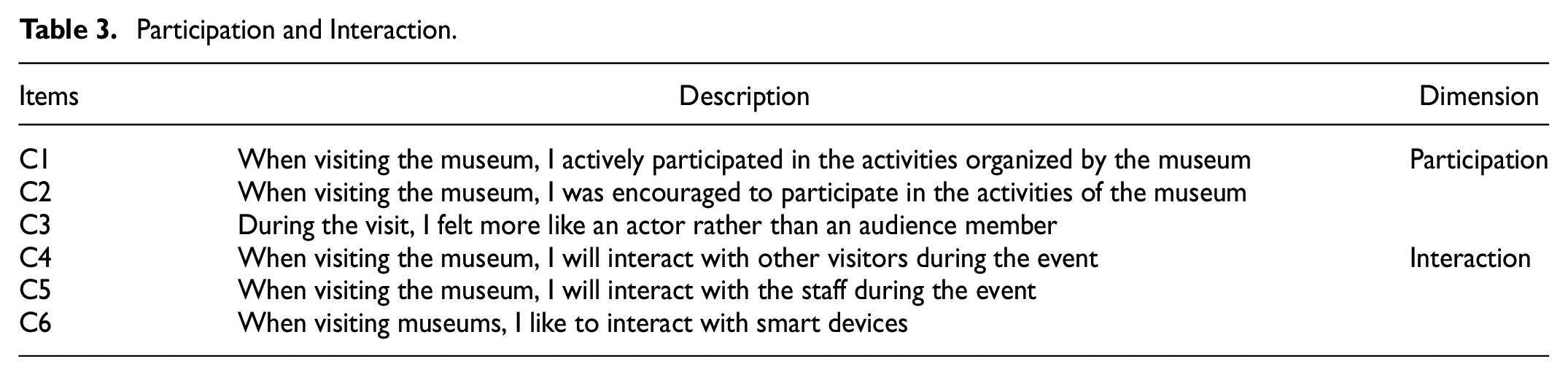
Presented in Table 3, the visitor participation and interaction used in this study scale draws on Yalowitz and Bronnenkant (2009) and Minkiewicz et al. (2014), with the participation and interaction measurement items adjusted to the study context.
Participation and Interaction.
The visitor experience scale used in this study draws on the classification of experience developed by Pine and Gilmore (1998), namely, learning, esthetic, entertainment, and escapism experience. It also comprises specific items drawn from Mathwick et al. (2001) and Oh et al. (2007). Table 4 presents the visitor experience scale and examples of measurement items used in this study.
Experience.

Presented in Table 5, the intensification and content generation scale used in this study adopts the definition of intensification and content generation measurement items developed by Antón et al. (2018a, 2019).
Intensification and Content Generation.

Finally, the visitor knowledge scale used in this study is based on Antón et al.’s (2018a) knowledge measurement items. The scale used in this study summarizes the six measures of visitor knowledge into two categories: theoretical and empirical knowledge. Table 6 presents this scale and items used in this study.
Knowledge.

Common Method Bias
Common method variation generally refers to the false common variation caused by the same data collection method, the characteristics of the item or the response bias of the testee, etc (Campbell & Fiske, 1959). The bias caused by the common method variation is called the common method bias, error is a systematic error (Podsakoff et al., 2003; Simmering et al., 2015). Regarding the common method bias that may exist in this study, this study uses two means to control and test, firstly, through the process control, collecting research data by means of on-the-spot distribution and scanning two-dimensional code, and emphasizing that the questionnaire is only for academic purposes, some reverse items are set in the questionnaire, and the respondents are required to fill in the questionnaire anonymously, so as to reduce the impact of subjective bias. Second, statistical control. According to the suggestion of Podsakoff et al. (2003), we used Harman single factor test method to conduct exploratory factor analysis on all items used in this study. Five common factors with eigenvalues greater than 1 are extracted without rotation. Among them, the first factor explained 22.91% of the total variance, which was lower than the critical value of 40%.
Data Analysis and Results
Reliability and Validity
Data were quantitatively analyzed using regression and structural equations, two methods frequently used in questionnaire data processing (Cai et al., 2020; Shafi et al., 2019). The reliability of the scale is usually described by Cronbach’s α coefficient and composite reliability (CR). As Table 7 shows, the coefficients of all variables are greater than .8, indicating good internal consistency. The CR of all variables is greater than the critical value of 0.7 (Hair et al., 2010), indicating that the collected data have good reliability.
Results of Reliability and Validity.

Note. Items = number of items used in each construct; Loadings = factor loading; CA = Cronbach’s α; CR = composite reliability; AVE = average variance extracted.
The test criteria of validity mainly include convergent validity and discriminant validity. As Table 8 shows, the standardized factor load of each item was greater than 0.6, and the average variance extraction (AVE) was between 0.610 and 0.862. Factor loading and AVE are both greater than the ideal value of 0.5, indicating the scales have good convergence validity. In regard to the discriminant validity, this study used the method recommended by Fornell and Larcker (1981), which involves comparing the square root of the AVE value with the absolute value of the correlation coefficient between variables. The correlation coefficient matrix in Table 8 shows that the square root of the AVE value of all variables on the diagonal is greater than the absolute value of the correlation coefficient of their corresponding dimensions, indicating clear discriminant validity between variables. The aforementionded results indicate the appropriateness of the measurement model.
Descriptive Statistics and Correlation Coefficient Matrix.

Note. Diagonal bold data are the square root of AVE.
p < .05. **p < .01.
Hypothesis Testing
This study used Amos24.0 to test the path coefficients and related research hypotheses of the structural model, the results of which are shown in Table 9. Regarding the performance of structural model fitting indicators, this study reports the main indicators, such as the absolute fit index and value-added fit index, according to the suggestions of Jackson et al. (2009) and Rong (2010). The calculation of the initial model results shows χ2/df = 2.635, GFI = 0.882, AGFI = 0.852, NFI = 0.919, TLI = 0.938, CFI = 0.948, PGFI = 0.073, and RMSEA = 0.055, where the values of GFI and AGFI are less than the minimum requirement of 0.9, indicating that the model requires revision. The indicators of the revised model are:χ2/df = 2.483 (<3), GFI = 0.945, AGFI = 0.921, NFI = 0.965, TLI = 0.973, and CFI = 0.979. These indicators are all higher than the lowest level of 0.9; PGFI = 0.745 (<0.5), and RMSEA = 0.052 (<0.08). The results show that the model meets the required degree of fit.
Direct Path Coefficient and Hypothesis Test.

Note. Regression coefficient is standardized coefficient.
p < .001.
According to the path coefficient presented in Table 9, there is a significant positive correlation between visitor knowledge gain, escape, exploration, relaxation, and friendship motivations and esthetic experience; therefore, H1d, H1e, H1a, H1b, and H1c are supported. Results show a significant positive correlation between the knowledge gain and exploration motivations and learning experience; therefore, H2d and H2a are supported. The knowledge gain and exploration motivations exhibit a significant positive correlation with entertainment experience; therefore, H3d and H3a passed the validation. Results also show a significant positive correlation between the knowledge gain, escape, and exploration motivations and escapism experience; therefore, H4d, H4e, and H4a are supported.
Results reveal a significant positive correlation between the knowledge gain and exploration motivation and participation; therefore, H5d and H5a are supported. There was also a significant positive correlation between the knowledge gain, escape, and friendship motivations and interaction; therefore, H6d, H6e, and H6c are supported. Participation was found to have a significant positive correlation with learning experience; therefore, H8a is supported. Results show a significant positive correlation between interaction and esthetic, escapism, entertainment, and learning experience; therefore, H7b, H10b, H9b, and H8b are supported.
Learning, entertainment, escapism, and esthetic experience were significantly and positively correlated with intensification, indicating that H11b, H11c, H11d, and H11a are supported. Finally, results revealed a significant positive correlation between learning and escapism experience and content generation; therefore, H12b and H12d are supported. The path relationship between variables is shown in Figure 2.
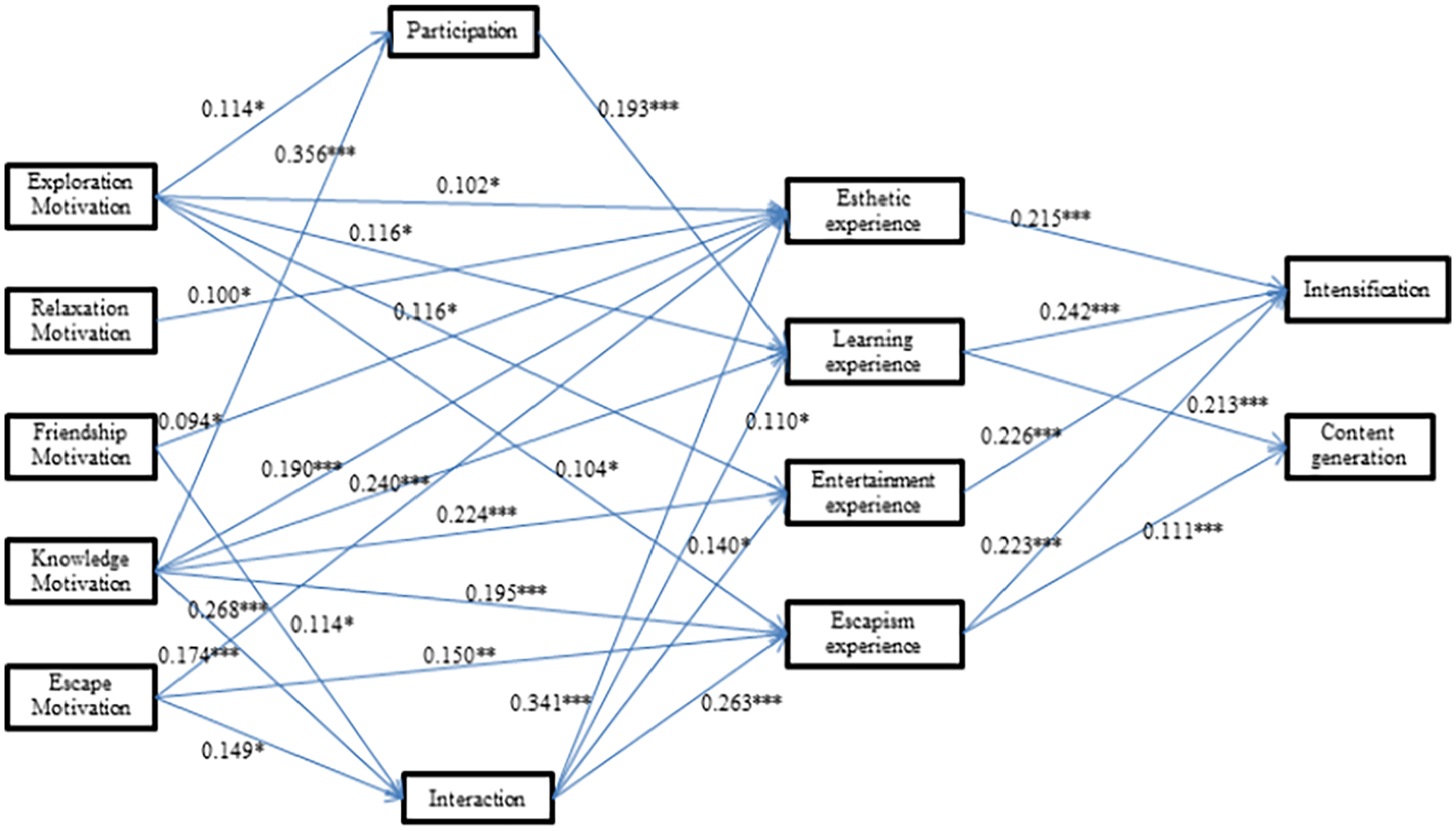
Path relationships between variables.
Mediating Effect
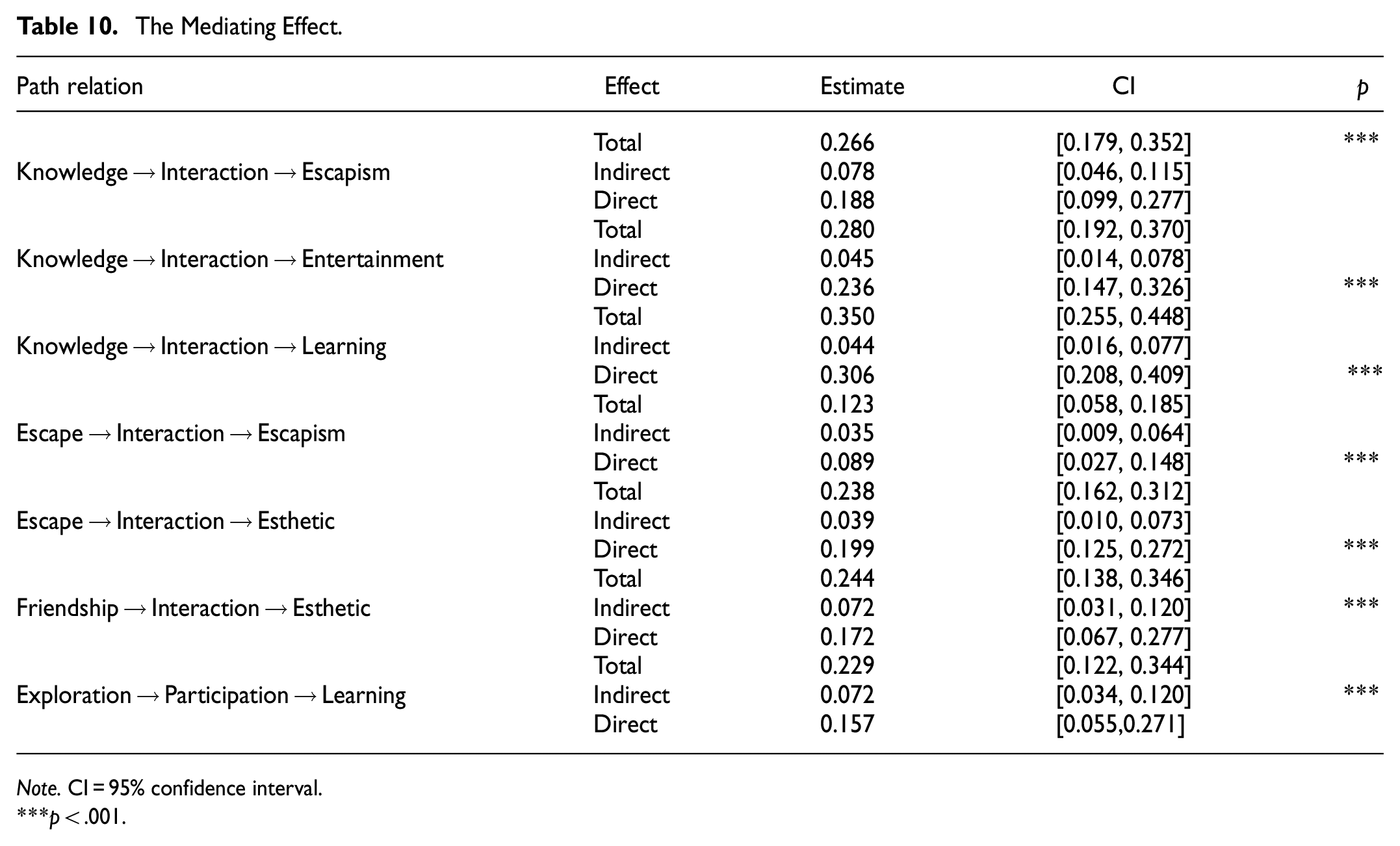
Methods of testing mediating effect typically involve the sequential test developed by Baron and Kenny (1986) and the Bootstrap test. This study used the non-parametric percentile bootstrap test with bias correction to test the significance of the mediation effect under the condition of 5,000 repeated sampling and a 95% confidence interval; the results of which are presented in Table 10.
The Mediating Effect.
Note. CI = 95% confidence interval.
p < .001.
According to the results presented in Table 10, the indirect effect confidence interval, direct effect confidence interval, and total effect confidence interval between knowledge gain motivation and escapism experience, knowledge gain motivation and entertainment experience, knowledge gain motivation and learning experience, escape motivation and escapism experience, escape motivation and esthetic experience, and friendship motivation and esthetic experience do not contain 0, and the significance is less than .001. Accordingly, interaction plays a mediating role in the relationship between the aforementioned motivations and experience; therefore, H13b is partially supported. The indirect, direct, and total effect confidence intervals of participation between exploration motivation and learning experience do not contain 0, and the significance is less than .001, indicating that participation plays a mediating role in the relationship between exploration motivation and learning experience. Therefore, H13a is partially supported.
Moderating Effect
This study uses hierarchical regression to analyze the moderating effect of continuous moderating variables (Wen et al., 2005). Accordingly, this study examines the moderating effect of visitor knowledge on the relationship between motivation and experience value.
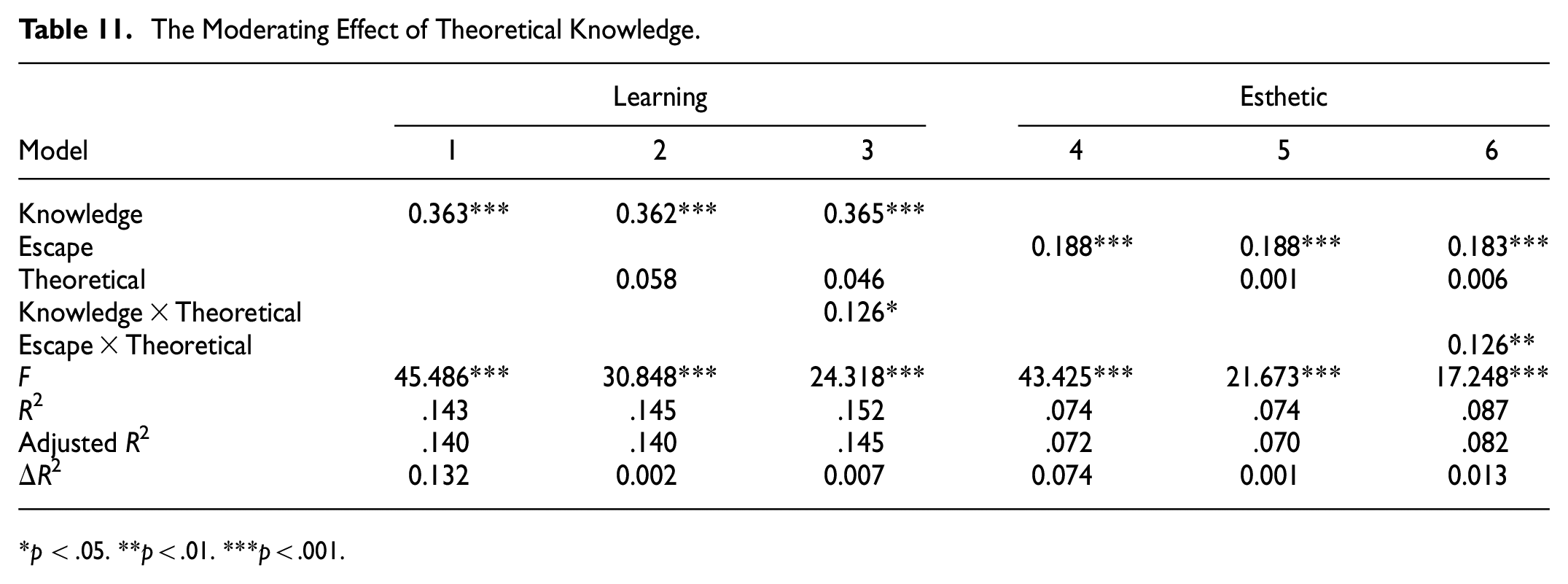
According to the results presented in Table 11, in the third model, the explanatory ability of learning experience increased by 0.7% after adding the interaction item (Knowledge × Theoretical); the significance of the interaction item was .041 (<.05). This indicates that the theoretical knowledge of visitors moderates the influence of knowledge gain motivation on learning experience. In the sixth model, the explanatory ability of esthetic experience increased by 1.3% after the interaction item (Escape × Theoretical); the significance of interaction item was .005 (<.01). This indicates that the theoretical knowledge of visitors moderates the influence of escape motivation on esthetic experience. Therefore, H14b is partially supported.
The Moderating Effect of Theoretical Knowledge.
p < .05. **p < .01. ***p < .001.
According to the results presented in Table 12, in the third model, the explanatory ability of esthetic experience increased by 0.7% after adding interaction items (Knowledge × Empirical); the significance of interaction items was .045 (<.05). This shows that visitors’ empirical knowledge moderates the process by which knowledge gain motivation influences esthetic experience. In the sixth model, the explanatory ability of esthetic experience increased by 1.2% after the interaction item (Relaxation × Empirical), the significance of interaction item was .009 (<.01). This indicates that the empirical knowledge of visitors moderates the influence of relaxation motivation on esthetic experience. In the ninth model, the explanatory ability of escapism experience increased by 0.8% after the interaction item (Knowledge × Empirical) was added; the significance of the interaction item was .026 (<.05). This shows that the empirical knowledge of visitors moderates the influence of knowledge gain motivation on escapism experience. Therefore, H14a is partially verified.
The Moderating Effect of Empirical Knowledge.

p < .05. **p < .01. ***p < .001.
Discussion
This study examines the co-creation of experience value by museum visitors, with co-creation shown to play an important role in enhancing visitor experience by the extant literature (Campos et al., 2018; Harkison, 2018). In the museum context, scholars in a number of different fields have explored how to better design, excavate, and provide in-depth visitor experiences and enhance the attractiveness of museum from a variety of perspectives (Antón et al., 2018a; Simon, 2010). This study expands this literature by exploring the co-creation of museum experience value from the perspective of visitor motivation. The results show that the motivation of visitors is an important antecedent factor that affects the experience value of the museum before the visit, the participation and interaction of the visitors are the core elements of the co-creation of the experience value during the visit, and the content generation and intensification of the visitors is the value of the physical examination after the visit. The main results are analyzed in detail as follows.
Visitor motivation has a direct effect on experience, which is consistent with the results of previous studies (Moral-Cuadra et al., 2020; Yoon & Uysal, 2005). All dimensions of visitor motivation examined in this study were found to enhance the esthetic experience. Motivations to gain knowledge and explore serve to enhance visitors’ learning, entertainment, and escapism experiences. In this respect, this study’s observations regarding the influence of visitors’ knowledge gain and exploration motivations on learning experience are similar to those of previous scholars (Allan & Altal, 2016). While visitors’ escape motivation serves to enhance their escapism experience, the influence of other motivation dimensions on the examined types of experiences was not found to be significant.
Meanwhile, visitors’ knowledge gain and exploration motivations both promote participation, further verifying the results of previous studies (Alt, 2018; Jin et al., 2020; Yoo & Choi, 2019). Results show that visitors’ desire for knowledge, friendship, and escapism promote interaction, which is similar to the findings of previous studies (Childers et al., 2022; Chiu et al., 2006; Moore, 2008; Park & Chon, 2011). The other dimensions of visitor motivation were not found to have a significant impact on participation and interaction. This may reflect the complexity of the process of co-creation experience value in the museum setting, particularly insofar as motivation and experience are essentially psychological activities (Dörnyei et al., 1998; Frey, 1998). Accordingly, the relationship between variables will differ according to the specific context.
Results show that visitor interaction can enhance their learning, entertainment, esthetics, and escapism experience. Visitor participation only enhances learning experience, and participation has no obvious effect on the other dimensions of experience. These results differ from those of Antón et al. (2018a), who found that visitor interaction only has a significant impact on the learning experience. The results of this study indicate that visitor participation has a significant impact on escapism, learning, and entertainment experience. Participation and interaction were found to have a positive impact on all experience dimensions except esthetic experience. Arguably, the interactive projects of these museums provide visitors with a deeper experience, and interactive activities may mobilize the excitement of visitors more than participation in activities. Moreover, while this study’s finding regarding the influence of visitor experience on content generation is consistent with that of Antón et al. (2018a)—that is, escapism and learning experience have a positive effect on content generation, the effects of visitor experience on intensification are not consistent. In contrast to Antón et al. (2018a), visitors’ esthetic and entertainment experiences were found to positively impact intensification. There may be several reasons for this, including the possibility that visitors’ experience perceptions vary across regions. Additionally, museums have become increasingly attractive to the public in recent years, with many outstanding collections exhibited with greater frequency heightening the esthetic and entertainment experience perception of visitors.
The results also show that visitor interaction plays a mediating role in the relationships between the motivation to gain knowledge motivation and escapism, entertainment, and learning experiences; the motivation to escape and the escapism and esthetic experiences; and the motivation for friendship and esthetic experience. Visitor participation also has a partial mediating effect on the relationship between exploration motivation and learning experience. The mediating effects of participation and interaction in the relationships between other motivations and experiences were not found to be significant. Accordingly, the results of this study reveal that visitor interaction and participation play significant mediating roles in the relationship between motivation and experience (Antón et al., 2018a; Bilgihan et al., 2015; Vega-Vazquez et al., 2013).
This study demonstrates that the theoretical knowledge of visitors has a moderating effect on the relationships between knowledge gain motivation and learning experience, and between escape motivation and esthetic experience. The empirical knowledge of visitors moderates the relationships between the motivation to gain knowledge and esthetic experience and escape experience, and between the relaxation motivation and esthetic experience. Visitors knowledge was not found to have a significant effect on the relationship between other motivations and experiences. Moreover, results indicate that interests in art, history, and science exhibit enhance the influence of the motivation to gain knowledge on learning experience, as well as the influence of the motivation for escape on the esthetic experience. Frequent participation in exhibitions also enhances the causal relationship between the motivation to gain knowledge and esthetic and escapism experience, as well as that between the relaxation motivation and esthetic experience.
Management Inspirations
The function of museums has expanded with socioeconomic development to become social spaces for learning and entertainment (Vom Lehn, 2006). Consequently, museums have entered into fierce competition with other leisure cultural activities (Manna & Palumbo, 2018). The museum has become a very attractive tourist and leisure destination, with visiting museums becoming a frequnent habit in many people. Accordingly, managers need to adapt to the changing role of museums, adjusting the operation strategy, and position of the museum in a timely and appropriate manner in order to create better experience and meet visitor expectations.
The active participation and interaction of visitors can greatly improve their experiences. Additionally, visitors with different motivations can enhance the experiences of themselves and others through participation and interaction. Accordingly, participation and interaction are central to improving visitors’ experience (Antón et al., 2018a). Therefore, in order to meet the diversified needs of different types of visitors, managers should focus on redesigning and continuously optimizing the visit path and mode as well as attracting and encouraging more people to participate in activities arranged by the museum.
Significantly, the process of co-creating experience value starts before the visit and continues after it. The results of this study show that visitor knowledge is an important boundary condition between motivation and experience. Accordingly, managers should consider visitor knowledge and encourage people with different types of knowledge to visit various exhibits and exhibitions. As such, visitor motivation and knowledge are antecedents of museums’ attention to management (Falk & Dierking, 2000; Hein & Alexander, 1998). Meanwhile, after the visit, visitors may be wish to participate in future activities arranged by the museum or seek out more information about the museum online. Therefore, the services provided by the museum staff should continue after the museum visit. In this respect, museum staff should continue interacting with visitors using on-and offline network platforms, including encouraging them to provide feedback of their experiences and suggestions. In addition to encouraging them to visit again, this will facilitate the spread of word-of-mouth regarding the museum.
Study Limitations and Future Prospects
While this study has some reference value for related research on museum experience value co-creation, several limitations need to be addressed. First, study data were collected from four public museums and three private museums in Chengdu. This study did not distinguish between the type of museum in analyzing data, if there are differences, a comparative study of visitor experience value co-creation will be done between different museums. In addition, due to the actual situation of the pre-investigation, the age of the visitors in this study is under 55 years old. In the future, further research will be conducted on the experience value co-creation of visitors over 55 years old. Second, this study did not distinguish between visitors visiting ordinary and special exhibits, which can be further explored in future research. Third, based on extant research and in accordance with scientific procedures, this study reduced visitor knowledge dimensions into two categories: namely, visitors’ theoretical and empirical knowledge. In the field of innovation, related studies often further subdivide knowledge categories (Asheim & Coenen, 2005; Nonaka, 1991). In addition, for knowledge as a moderator variable, support will be sought through interviews and more literature in the future.
Footnotes
Note
This research was conducted while [Shuangji Liu] was at [Henan Finance University]. They are now at [Sichuan University] and may be contacted at [
Declaration of Conflicting Interests
The author(s) declared no potential conflicts of interest with respect to the research, authorship, and/or publication of this article.
Funding
The author(s) disclosed receipt of the following financial support for the research, authorship, and/or publication of this article: (1) The key project of the National Social Science Foundation of China: Research on Value Management of Cultural Creativity (18AGL024). (2) Social Science Planning Project of Henan Province, China—Special Project of Cultural Research of Henan Xing Cultural Project: Study on the Cultural Brand Communication of “Walking in Henan and Understanding China” with the Digitization, Ecology and Characteristic Construction of Henan Museum Group (2022XWH236). (3) Sichuan University project funding (2023ZDPY-05). (4) General Project of Humanities and Social Sciences Research in Colleges and Universities in Henan Province, China: Study on Chain Influence Mechanism of Cultural Heritage Tourism Experience under Digital Background (2024-ZDJH-855).
