




Abstract
This work aims to study the web innovation strategies used by Spanish companies in the fashion and accessories sector, with the specific aim of analyzing co-creation as an innovation strategy so that this link with customers will improve efficiency and effectiveness in decision-making. Qualitative research was carried out through in-depth interviews with Spanish professionals and companies in the fashion and accessories sector. Then, a theoretical model was proposed. This model integrates value co-creation, social networking, participation, engagement, feedback, and other variables. This qualitative analysis has relevant value for the professional sector because there are many papers from consumers’ perspective; however, studies from the retail sector’s perspective are less common in the literature. This study contributes ideas for the strategy of co-participation with clients to improve the activity and management of fashion companies.
Introduction
The continued increase in the use of the internet worldwide has led to digitization becoming a source of competitive advantage for both B2C (Business to Consumer) and B2B (Business to Business) companies, leading some authors to start paying attention to the challenges this digitization brings to companies (Leeflang et al., 2014). One of the effects of this digitization is that traditional marketing has ceased to be useful as customers were previously homogeneous and there were few sources of communication and limited reach.
This new market situation is characterized by the use of the internet as a medium that favors the transmission of commercial messages, the facilitation of interaction between customers and companies, the optimization of value co-creation and consumer engagement (Rodríguez et al., 2015), and the expansion of 3.0 internet age. This development has provided to the usage of social networks sites like Facebook, wikis, blogs, video platforms, and recommendation sites (Blasco, 2014). Therefore, according to Lorenzo-Romero et al. (2020), in the world of fashion, new technologies and the use of social networks are key elements of co-creation. Co-creation involves personalized mass co-production and the co-design processes of specific products and services, resulting in new thinking with a collective approach achieved through platforms and social networks (Pardo, 2014). (p. 9)
In short, companies are beginning to realize that despite the great variety of products offered in the market, consumers are not satisfied with them as the market has changed and consumers are connected, informed, active, and have power in the commercial relationship. In addition, consumers want to interact with companies in value creation, seeking to “co-create” value, and companies seek to gain new sources of competitive advantage through the co-creation of feels (Prahalad & Ramaswamy, 2004). Within this point of view, Camargo-Borges and Rasera (2013) “point out that the co-creation plays a role in organizational development, co-creating new meaning and opening up transformation within the organization” (p. 5). This work focuses on the fashion and accessories sector. Based on Lorenzo-Romero et al. (2020), fashion has become one of the most relevant economic sectors of world capitalism, a key element in the international financial market, and a distinctive tool of contemporary cultural movements. In addition, the globalization of communications has led these companies to make both commercial and communicational changes in the way they address their public (massive, complex and demanding). (p. 1)
They now reach marketplaces that would have previously been unachievable (Ruiz, 2012).
Using this context, this work focuses on the fashion and accessories sector, specifically for companies in Spain. Spanish fashion represented 18% of European gross value-added in 2014, and Spain was the fourth European country in fashion exports. The fashion industry represents 2.8% of Spanish GDP and 4.3% of the employment rate, and fashion production in Spain represents 27.6% of turnover. Regarding trade balance, the fashion industry is the sector with the fourth highest exports in Spain, with exactly 8.4% of exports and 8.9% of imports (ACME, 2016).
The aim of this work is to analyze co-creation (active consumer-company participation in companies’ social media) as an innovation strategy. Thus, we first propose how co-creation arises, analyze what is meant by co-creation, and understand the different dimensions that make it up, the factors that condition what consumers co-create, and the objectives that are set with co-creation. This analysis is monitored by a debate of the methodology managed in the qualitative investigation. Then, the main results of the qualitative study are given based on the role of the co-creation strategy by Spanish fashion and accessories companies. Finally, the main conclusions are presented.
This article provides new visions about the current literature related to co-creation in the fashion sector, identifying its antecedents and consequences as an important strategy for online markets, especially when companies use social networks. This study also offers an innovation as it provides the results of a qualitative analysis, which enriches the previous knowledge about the topic, taking into consideration the opinions and experiences of the supply and producer sector. On the other hand, this study opens some future lines of research, mainly quantitative research to confirm the results.
Theoretic Framework
Value Co-Creation: From Consumer to Prosumer
The idea of value co-creation is primarily based totally at the truth that each one customers will play a participatory position in taking part with manufacturers or businesses to create value together (Prahalad & Ramaswamy, 2004; Ranjan & Read, 2016). Joint value creation is conceptualized withinside the literature as a method of change among extraordinary human beings worried withinside the value creation processes (Grönroos, 2011; Vargo & Lusch, 2004) among events for mutual benefit.
Co-creation is established between companies and consumers through the internet and includes other agents involved in this value creation process, such as the public, stakeholders, suppliers, or competitors. Prahalad and Ramaswamy (2004) were the first authors to propose the concept of value creation in the literature, explaining that “quality depends on the infrastructure for interaction between businesses and consumers, oriented around the capacity to create a variety of experiences” (Prahalad and Ramaswamy, 2004, p. 6).
Co-creation is a key term within the service dominant logic approach, in which a series of foundational statements about the market are given (Vargo & Lusch, 2004, 2008).
After reviewing the ten premises on which this approach is based (i.e., the application of specific skills and knowledge is the fundamental unit of exchange; the indirect exchange masks the fundamental unity of the exchange; goods are distribution mechanisms for service provision; knowledge is the main source of competitive advantage; all economies are service economies; the customer is always a co-producer; the organization can provide only value propositions; the approach to service is customer focused and relational; social and economic agents are resource integrators; and the value is always and only determined by the beneficiary), we can highlight the sixth in this research field, which states that the consumer is always a co-creator of value because value creation is interactive. (Vargo & Lusch, 2008, pp. 6–9)
This approach establishes that value is created through the use or consumption of goods. In this case, the client has a dynamic role in the value creation (Lusch et al., 2009).
A customer who actively participates with the company and other customers in the design of a product is known as a prosumer (Prahalad & Ramaswamy, 2004). This participation can be active in both the physical and virtual environments. In addition, consumer participation is voluntary, as providing innovative ideas in the elaboration of innovative goods takes time, effort, and knowledge (Brünink, 2013). For this reason, companies must take this effort into account, adequately compensate consumers (Xia & Suri, 2014), and facilitate their participation.
In summary, the objectives of co-creating value are (Bhalla, 2010) to generate content through ideas, suggestions, and designs; to improve products and services to improve the consumer experience; and to create a new prototype of consumer.
New Technologies and Co-Creation of Experiences
Value co-creation begins with exchanges between the business and consumers that facilitate the co-creation of experiences. This interaction is characterized by dialogue, access, risk-benefit, and transparency. Value creation opportunities increase when companies use personalized co-creation experiences as a unique resource of value. With co-creation, the marketplace becomes a forum where consumers, businesses, and consumer communities have a dialogue. Therefore, the market is similar to a forum where the co-creation of experiences occurs (Prahalad & Ramaswamy, 2004). In addition, co-creation implies that the client participates in the creation, design, and development of the offer by contributing ideas (Mustak et al., 2013; Vargo & Lusch, 2008). According to Lenderman (2008), this participation occurs not only in the design of a product but also in marketing messages and sales channels.
In this respect, within the online context, Dulanto-Jo (2017) notes that the creation of value must be carried out by the company and other collaborators, and this collaboration is possible through new technologies. This participation has been facilitated by new technologies that allow the consumer to participate in any part of the value creation system (Quero & Ventura, 2014). Other authors, such as Rodríguez (2014), note that co-creation involves not only contributing ideas about creation but also ideas about improvements in products and services, opinions, comments, suggestions, complaints, and so on. On the other hand, Domingo et al. (2008) note, as an example, that mass creativity is co-creation understood as a process that is simple in the beginning (e.g., uploading videos to YouTube) and adds small individual contributions that result in an unembraceable whole.
There are several reasons for carrying out a co-creation initiative (Frow et al., 2015): gaining access to resources that generate important networks for the company; improving the consumer experience; enabling self-service so that consumers become more involved in their shopping experience; creating more competitive offers; reducing costs; decreasing the time to launch a product to market; emerging strategy; and creating brand awareness. In this respect, there are three types of dimensions in which the co-creation of experiences occurs in the digital framework (Blasco, 2014):
Co-creation of experiences. This is the simplest level of interaction. In this case, a relationship between the company and the client (one-to-one) is present.
Variety of experience co-creation. This is an intermediate level of complexity, where the interaction occurs between the company and communities of clients (one-to-many).
Finally, the personalization of the co-creation of the experience. This level is characterized by the interaction between various companies and customer communities (many-to-many).
The co-creation of experiences is determined by two factors. The first is the individual factor, which refers to the characteristics of the client as the benefits that he expects from the co-creation process and the preparation that is necessary for his role as co-creator. The second is the environmental factor, which involves the co-creation characteristics of the environment, including the technology necessary to develop the task of co-creation, the connectivity understood as the availability of other consumers to help in this task, and the interactions that occur between the participants. In addition, experience is contingent on the degree to which expectations about the expected benefits of co-creation are met. Therefore, the benefits of co-creation condition the experience of co-creation. Taking this statement into account within the co-creation experience, “six dimensions are differentiated: hedonic experience, cognitive experience, social experience, personal experience, pragmatic experience, and economic experience” (Verleye, 2015, p. 326).
Within the context of new technologies and their contribution to generating the co-creation of experiences, one concept that currently has great importance is omnicanality. This term is defined as the integration of different channels of communication or contact with the customer so that regardless of the channel they use to reach the product, they perceive a homogeneous shopping experience. In short, the client should not perceive that there are several channels, since they must have the same price, product, etc., following the same strategies of intricate communication between them. This concept arises as an evolution of the multichannel concept. Multichannel refers to the set of channels that a company uses to interact with the customer. (Lorenzo-Romero et al., 2020, p. 2)
The difference between the two concepts is that in the case of multichannels, there is no integration of the channels (Deloitte, 2017).
Therefore, omnicanality makes it possible to improve the customer’s shopping experience as it involves the integration of channels. The channels a company has to relate to the customer are (Rivero, 2009) a direct channel (the company does not use intermediaries, that is, it reaches the customer directly, such as in a physical store and telephone sales); an indirect channel (the company uses an intermediary to reach the end customer, such as hotels that use agencies [intermediaries] to sell their products or services); and finally, new channels (including all those channels that use the internet to connect with customers). Within this group, we can also differentiate between direct and indirect channels. Within direct channels, we can find purchases directly from an official website of a product or service. Within indirect channels, we can speak of the portals that recommend or compare products or services. This second group includes social networks, online shops, mobile applications, and so on.
Open Collaboration Practices in the Fashion Industry
Millspaugh and Kent (2016) examine the process of co-creation from the perspective of designer fashion enterprises, exploring their reactions this co-creation. In their study (carried out through 38 interviews with designers and support network sales), they found that brand value is co-created not only through producer–consumer interaction but also with stakeholders (Helm & Jones, 2010). On the other hand, the innovation and the concept connected to that value (Frow et al., 2015)—defining elements of the brand—begin and end with the firm that introduced them through the development of each collection. These findings answer a call for research on the impact of stakeholders on co-creation (Hatch & Schultz, 2010; Frow et al., 2015). Based on these premises, Millspaugh and Kent (2016) analyze the co-creation phenomenon from the perspective of the firm, exploring their interpretation and reaction to co-creation experiences, finding that small and medium enterprises react and respond to the interpretation of their brand identity through the co-creation process as they seek to introduce and grow their firms within the global fashion industry.
Suryana et al. (2017) investigate digital co-creation between clients and suppliers on the internet in the hijab apparel business (Bandung). They analyze different motivations to co-create, based on Nambisan and Baron (2007), among customers in the virtual context of the fashion industry. Their main outcomes indicate that customers have certain motives in regard to participating in customer-and-customer interaction and customer-and-provider interaction, such as idea generation, product evaluation, promotion, and others. On the other hand, clients also expect to obtain benefits in terms of ease of obtaining information related to product usage, expand their network, enhance their knowledge, reputation, etc. (Suryana et al., 2017, p. 47)
Similarly, from the consumer perspective, based on the Technology Acceptation Model (Davis, 1989), Maryam et al. (2015) indicate that social influence has a positive effect on the intention to participate in social media for co-creation purposes, whether directly or indirectly, by affecting customer learning value, social integrative value, and hedonic value experiences, as well as through perceived usefulness and perceived ease of use, within a fashion industry context. (p. 53)
Based on the previously explained current situation, in this article, we adopt a supply perspective to focus on internet co-creation (or user active participation on the website) to analyze the process by which a company and its current or future customers collaborate through the online channel to launch new products or improve existing products or services (Rodríguez, 2014).
Methodology
Once the basic aspects of the theoretical approach have been considered and the objectives have been pursued with this research, the characteristics of the research that will define the information obtained are considered.
The conducted research is of a qualitative nature, and the information-gathering technique used is in-depth interviews by a market research company.
We apply qualitative research with the idea of understanding the opinions and motivations to develop a co-creation strategy with customers in the fashion sector. Qualitative research is the better technique to understand attitudes and behaviors, and it has different advantages. The first is providing a deeper understanding of the object of study, and the second is that it allows the identification of new phenomena that have not been previously considered (Aspers & Corte, 2019).
Based on Lorenzo-Romero et al. (2020), the sample was selected using a quota structure based on characteristics such as geographical location and type of product (textiles, footwear, accessories, and children’s products), taking into account that all companies must have online sales and use internationalization strategies. These quotas have been established on the basis of a study of “Mobile commerce in the fashion sector” carried out by Corporate 360 (2015) and the report on “Omnicanalidad del Retail en España,” carried out by the Interactive Advertising Bureau (IAB, 2015). Thus, the data are as follows: 10 interviews in textiles, five in footwear, three in accessories, and two in children’s fashion. This distribution was established following the report of Corporate 360 (2015), which established a representation of 90% of the fashion sector in Spain, with online sales as follows: 47% textiles, 25% footwear, 17% accessories, and 11% children’s fashion. These interviews took place in Barcelona, Madrid, Valencia, and Castilla-La Mancha.
Furthermore, taking into account the “Textile Trade in Spain” report (MINECO, 2007), we have distinguished three segments according to the information sought: sector experts (academic institutions and professional associations), manufacturers, and distributors.
Therefore, we interviewed academic institutions, such as the European Institute of Design (IED), to tell us which companies are important in the sector; professional associations, such as the Asociación Empresarial del Comercio Textil y Complementos (Acotex) and the Asociación Valenciana de Empresarios de Calzado (Avecal), among others, to provide us with a perspective on the fashion and accessories sector; Showroomprive as a distributor; and finally, companies in the sector, such as Nikita Nipone and Wonders, which gave us specific information about their companies.
These interviews were structured in three blocks: international challenges, multichannel distribution, and questions concerning aspects related to co-creation such as co-creation actions, the means used to co-create, and brand perception in the co-creation process. The interviewees included employees in charge of the digital marketing department of the companies or those who were capable of giving us this perspective.
Some of the interview questions that were based on a literature review (e.g., Blasco, 2014; Constantinides et al., 2015; Nysveen & Pedersen, 2014; Rodríguez, 2014; Rodríguez et al., 2015) are as follows: What interest does the concept of co-creation represent? What co-creation actions does it develop? What benefits does co-creation generate, whether in physical or virtual sales? We are talking about online media that facilitate the active participation of users; what media enable user participation?
The final sample obtained from these entities by sector and geographical area included 20 interviews (one academic institution, one distributor, two professional associations, and 16 business); regarding the size of the interviewed manufacturing companies, based on Lorenzo-Romero et al. (2019), six companies were large, three were medium, three were small, and the last four were start-ups (Table 1). In the process of obtaining the information, we found that the brands were present in more than one geographic zone (with headquarters in some and production in others), and certain brands worked in different kinds of goods; therefore, the final distribution in terms of measures set for the collection of the sample is as shown in Table 2 and is very close to what was initially planned. All the analyzed companies have not the same level of development in Social Media.
Description of Each Interview.
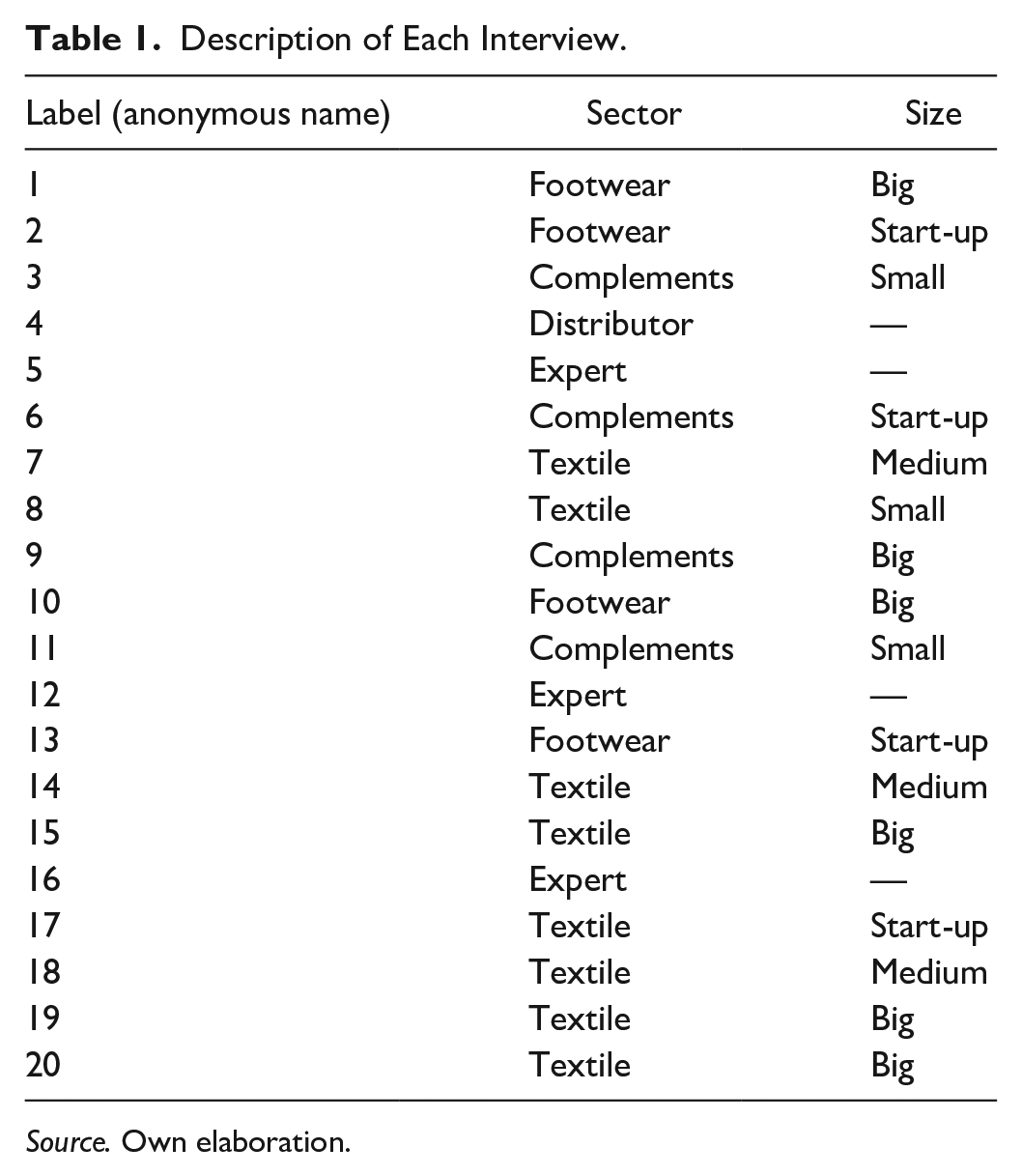
Source. Own elaboration.
Profiles Interviewed (Area and Sector).
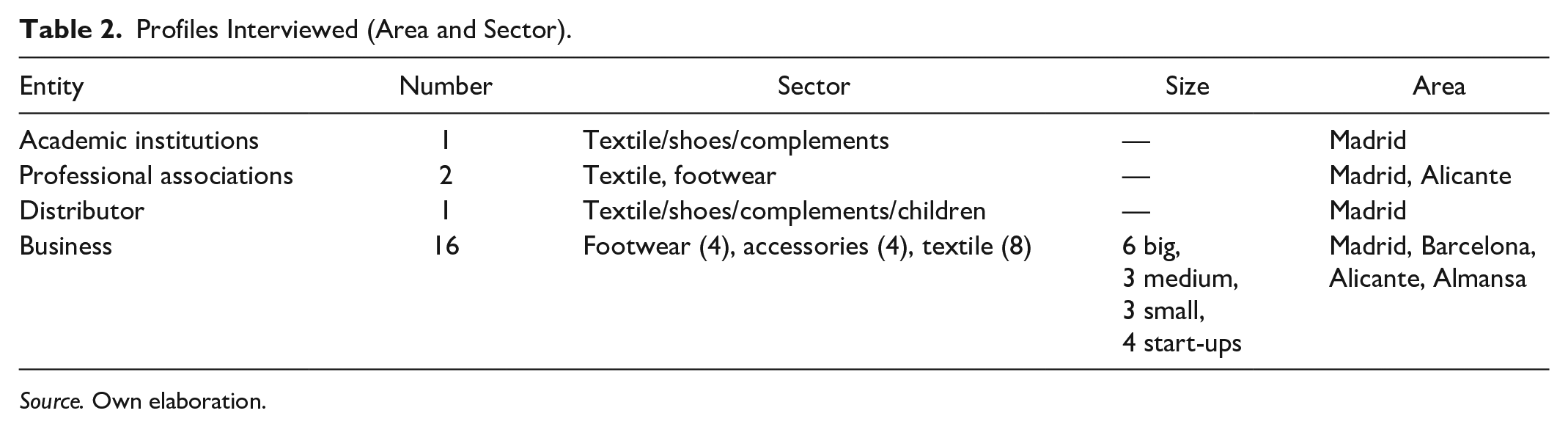
Source. Own elaboration.
Results and Discussion
The following is a description of the main results obtained in the research on the digital revolution in the fashion and accessories sector in Spain.
The results are analyzed in blocks as follows:
First, we analyze what digital development has meant for these companies in terms of contact channels.
Second, the role of social networks is discussed.
Third, the co-creation strategy is analyzed.
Fourth, we identify the value and types of value generated by co-creation for the main agents of the exchange relationship.
Fifth, the analysis delves into the possibilities of creative co-creation.
Finally, a relational model is proposed.
Proposed Relational Model
Considering the theoretic framework and the results obtained in qualitative research, the following relational model is proposed (Figure 1), with which we intend to analyze the relationship between the main variables analyzed in this work.

Theoretical basic network.
Atlas.ti software 1 was used to analyze these relationships. Like Lorenzo-Romero et al. (2020, p. 6), we use “the method of inductive and deductive coding of interviews has been followed, including coding strategies established by Miles et al. (2014).” We use this software similarly to other authors such as Tan et al. (2015).
Therefore, the interviews are coded with 11 codes (Figure 1). We conducted interviews until saturation of the speech was obtained, which provides research reliability. After coding process, considering Lorenzo-Romero et al. (2020), we applied two analysis tools to analyze the information:
A “query tool” to discover the frequency of each code (Table 3).
A “co-occurrence table” to analyze the relationships between codes (Table 4), taking into consideration that we have 669 citations in total in the 20 interviews.
Code Frequency.

Overall Co-Occurrence.

Note. Grey area indicates the co-occurrence between the same code is not exist.
To interpret the results obtained in the proposed relational model, considering Lorenzo-Romero et al. (2020, p. 6), attention is paid to “two parameters: “the “E” value (G: groundedness), which reflects the number of times a code has been cited, and the “D” value (density), which reflects the number of times two codes have been related.” All this is done jointly for the 20 interviews.
The code with the highest number of citations (Table 3) is social networks (457), value for the company (371), feedback (223), value for the consumer (187), and participation (172).
The main results obtained in the research show that consumer participation contributes to the generation of value for the company and for the consumer. This result is in line with Lorenzo-Romero et al. (2020). This participation has been favored using social networks.
The benefits generated by participation include obtaining information (feedback), engaging consumers, obtaining awards, and generating community.
The main value that the company obtains is the information, which it uses to better design strategies and supposes the generation of competitive advantage and an improvement in efficiency. In contrast, the value perceived by the consumer includes belonging to the community, obtaining prizes, and engaging.
Contact Channels
“The channels of contact with the customer have multiplied with digital development and include online shops, social networks, and chats, which are accessed through fixed and mobile devices. These channels connect with physical contact points: shops” (Lorenzo-Romero et al., 2020, p. 6).
In this sense, we find 41 citations that connect social networks with multiple contacts in 15 of 20 interviews (Table 4).
According Lorenzo-Romero et al. (2020), until now, there has been a certain duality between online and offline channels—channels with a certain autonomy that have been operating separately. This duality has made it difficult for the customer to have a single buying experience and for the channels to act in a coordinated and synergistic manner in the sale. (p. 6)
Therefore, one of the experts interviewed thinks that Before you had your physical store, your online store, there began to be—in inverted commas—a kind of struggle between what was sold in the online store and in the physical store; they were like two separate areas, it seemed that there was a kind of struggle and you are seeing that in the end is a single store and that both have to interrelate. (5)
The expert recognized, therefore, that these actions get the consumers to make more purchases and provide value them, considering in business that the customer becomes the focus. In the words of a large textile brand expert, “Today, it is even more important what the audience says than what a specialized journalist might say” (19), “you put the client in the centre and give him the opportunity to experience your brand, not to experience the channels” (20), “no matter where your client accesses, your brand has to be the same always and in all circumstances” (20).
Despite this discourse, the expert stated that this strategy is difficult to implement because of the human and economic effort required for its development.
Therefore, the growing trend at the organizational level is the progressive integration of all online and offline areas, as everything is ultimately related. In this sense, the concept of omnicanality appears 24 times in eight of the 20 interviews (Table 3). In addition, we find 15 citations that connect social networks with omnicanality in seven of the interviews (Table 4).
Thus, the digital area informs the rest of the departments about the consumer perspective but must also be informed of the actions of all the areas to integrate them into this activity; it is about carrying out “common objectives with different strategies.”
Internet access through mobile devices has progressed significantly in recent years; this has significantly expanded the consumer’s moments of contact and purchase and entails the need to establish approaches and develop actions appropriate to this new reality. According to an expert of a medium textile brand, Support is also important, we are now changing the system because we had a system a bit of the beginning, the whole issue of the Internet and did not answer, the other day, I read that there is more Internet browsing on mobile than on computers, PCs or tablets, which forces you to adapt your website, all your campaigns to mobile. (14)
Digital media, especially mobile phones, have made it possible to create a continuous contact space in which it is possible to establish a digital connection at any time and in any place, and this is transferred to the brand–consumer relationship. That is why the development of web platforms responsive to brands is important, given that mobile digital media have represented a growing trend and, in some segments of the population, has become the main channel of access to the brand.
Social Networking
Currently, however, Lorenzo-Romero et al. (2020) point out that “digital transformation is in the field of social networks (SSR)” (p. 7). In addition, active participation of the consumer in online media is developed mainly through the SSR; in this sense, we find 106 citations that relate participation with social networks in 19 of the 20 interviews (Table 4). Thus, a textile expert of a medium brand considers that it is unquestionable whether or not you have to be in social networks, it is a reality, you don’t even think about what it brings you, it is fundamental because communication as we understood it 10 years ago has taken a 360º turn, and all brands have to be there on social networks. (7)
However, it is true that despite this obligation to adopt social networks, an important motivation can be to contact and approach the consumer at an economically advantageous cost. In this sense, we find 288 citations that connect social networks with value for the company in 20 of 20 interviews and 114 citations that connect social networks with value for the customer in 20 of 20 interviews (Table 4).
Nevertheless, in addition to this main motivation or advantage in the use of social networks, consumers recognize other advantages, such as
The possibility of greater democratization of market accessibility, which leads to the proliferation of new brands of entrepreneurs.
Segmentation, that is, focusing on a specific target characterized by different variables at a lower price, which would otherwise be difficult to access. In this sense, we find 45 citations that connect social networks with segmentation in 15 of 20 interviews (Table 4).
The best means to connect with the set of agents that contribute value to the brand, such as influencers and distributors; they recognize that the final customer (in store and online) together with customer-distributor and influencers is what helps to generate repercussion and expand the message. “You get subscribers by showing the product and not chasing them” (10).
A greater agility in circulating the message and the possibility of rectifying, modulating, or complementing the message launched make communication through the social networks a flexible tool, allowing greater adaptation and adequacy of the message.
Obtaining the quantitative response of the consumer in real time and providing valuable qualitative information through comments. In this sense, we find 161 citations that connect social networks with feedback in 19 of 20 interviews (Table 4).
Brand community creation, including promoting brand awareness, collaboration in dissemination, consumer feedback, and engagement with the brand. In this sense, we find 86 citations that connect social networks with community in 17 of 20 interviews, and 52 citations that connect social networks with engagement in 17 of 20 interviews (Table 4).
The personalized attention attribute that characterizes models based on personal contact.
The capacity to know the deficiencies or problems of a service or product, where the Social Network Sites (SNS) helps to reduce the levels of dissatisfaction or abandonment of the brand because of problems with attention or service.
However, some negative aspects were also noted, such as the exposure of the brand; thus, a textile brand expert maintains that “on one hand, it supposes the elimination of intermediaries and a complete exposure to your community, it also supposes being 100% alert to what is happening” (15). Although this negative aspect is partly offset by the possibility offered by social networks to respond and react quickly, a large textile brand expert states that “you can do other things to change their perception, also to take advantage to show you close at least gives you the opportunity to apologize” (20). The problem, then, is not necessarily in making a mistake or having a bad comment but rather not knowing how to redirect these issues into something positive.
This positive balance in the use of social networks has caused them to become one of the fundamental pillars of consumer knowledge, thus acquiring a prominent role as an information center for companies; thus, in the opinion of several experts of major textile brands, “for example, the press department is more linked to us” (19), or “we are not an isolated department, but the rest of the departments work with us and us with the rest; for example, when creating an image, our opinion is very important” (19).
In general, Lorenzo-Romero et al. (2020) state that “the strategy responds to a multichannel approach, whereby brands develop their digital presence in different SSRs” (p. 8). However, Facebook, due to its social and commercial character and its wide penetration, and Instagram, due to its visual character and therefore its greater adaptation to the language of fashion, currently represent the two SSRs of greatest interest for the sector’s brands. Together, these two networks represent a complementary format that combines the commercial, to which SSRs relate, with branding.
However, the use of digital channels by companies extends beyond the Social Networks (SNT) exposed, using other media such as YouTube, Periscope, Google Plus, blogs, and newsletters.
In the case of Small and Medium Enterprises (SMEs), a low capacity of resources, especially human resources, leads to a low presence of professional profiles for the management of SSR, leading to a low capacity to invest time in the development of these channels and a low competence in their professional management.
Co-Creation
The origin of a large part of the actions of brands in the social web space of social networks is due to the new role that the internet user has; this is a user who has acquired new capacities for active participation in the network, which, in short, represents the empowerment of the consumer. Thus, one of the experts interviewed states that “The consumer is king, he always has been, but the power to buy or not to buy is now added to the power to go up or down” (12), and “the consumer knows it.”
Thus, the main trends are represented by a shift from the collective to the individual, a shift from the institutional to the social, and a shift from the mediate to the immediate. In addition, contact goes from being direct to being continuous due to the development of the brands’ digital platforms, mainly in social networks.
However, the power of the user on the internet reveals more spaces than those merely associated with prestige/disprestige (praise or criticism of the brand, denunciation, etc.) and acquires and develops a power of collaboration, a power of creation, and a power of influence, which brands echo and incorporate to a greater or lesser extent in their web spaces.
This process and the relationship space contribute to the generation of important value both for brands and for consumers; it is a space in which value is co-created. Thus, for the brand, consumer participation provides a means to obtain valuable information about the consumer through their feedback and represents an outstanding means to generate links with the brand, consumer collaboration, and engagement with the customer.
In the opinion of a textile brand expert, the formula for getting people to participate is “to have good content, that is, content that people are interested in” (15).
Value Creation in Co-Creation
Considering the context of value co-creation, we consider value creation for brands mainly in the following terms:
Knowledge derived from information that leads to development greater successful tasks;
Fidelity to the brand; and
Consumer participation generating content, disseminating, and justify what the company does.
In this sense, we find 95 citations that connect participation with value for the company in 18 of 20 interviews (Table 4).
On the other hand, value is also created for consumers:
Through the recognition of their participation, which generates a feeling of esteem and belonging to a community; and
Experiential value, which is an experience with the brand that is totally different from that of models distant from previous relationships, for example, through personalization processes.
In this sense, we find 75 citations that connect participation to consumer value in 18 of 20 interviews (Table 4).
Sometimes this participation is emphasized through the offering of rewards; in this sense, we find 42 citations that connect awards with participation in 11 of the 20 interviews (Table 4). Experiential value is important for the customer; however, consumers also like other awards. In this sense, we find 22 citations that connect awards with value for the customer in seven of the 20 interviews (Table 4).
Information collaboration
An important aspect of collaborative logic lies in what interviewees call consumer feedback, which represents one of the main value-added aspects of social networks for brands, along with the emotional aspects of brand engagement. From this perspective, information becomes an important value for the improvement and optimization of products, processes, and services, the development of new offers and, therefore, for innovation.
In this sense, we find 198 citations that connect feedback to company value in 20 of 20 interviews and 37 citations that connect engagement to company value in 14 of 20 interviews (Table 4).
Therefore, the intelligence market develops thanks to the active participation of the consumer. In the words of a start-up representative who was interviewed, “we have some data that allow us to evolve, don’t we, back to the market and return to the client more and more intelligent, don’t we? Trying to improve in all aspects” (6); in the same sense, an expert from a medium-sized textile brand stated, “all the information you get from social networks is shared in the company, with each department and each one takes a little note of that” (7).
Digital technology has made it possible to exponentially increase the amount and speed of this type of collaboration. In addition, it allows for the concept of co-creation, as part of the information is used by companies to develop actions that are more adaptable and appropriate to consumers based on their needs, criteria, and so on. Thus, a textile expert from a medium-sized brand stated, “all the information we receive is always transformed into an action” (7).
In this sense, we find 58 citations that connect participation with feedback in 17 of 20 interviews (Table 4).
In addition, the consumer plays a role as an actor in the evaluation of proposals, and in some cases, this can serve as a kind of pretest.
One of the experts interviewed said, “after having tried the products, he will make his comments or he will consider himself your partner giving you an idea, and in that sense, you have to be very attentive to what they can tell you, for that information today you pay, but if they tell you for free”; in this sense, “people are going to give their opinion and tell you: look, I’m happy with the product but I introduced that change.” (12)
In addition, the main message for the customer is to provide information about the product from the customer’s own perspective, which generates greater credibility for the product. When the comments are positive, it generates reliability and confidence in the brand and in the product and therefore favors the purchase. In this sense, an expert from a highly regarded footwear brand affirmed: I’ve had your boots for fifteen years and I’ve had them perfect, we’ve received that kind of comment a lot, and it’s the best thing that consumers can say about us with regard to quality, that they are boots that last you, they’re good-skinned, well-manufactured and give good results. (10)
In this sense, the interviewees acknowledge that the information contribution of consumers has allowed the following:
Refinement of communication actions: Communication becomes more adapted to consumers and therefore more valued and effective.
Service: Consumer contributions represent different areas of improvement for companies, giving rise to new services and improvement in the online application and services offered.
Product: Information directly influences on product design (e.g., materials, functional aspects, the appearance or shape of the product).
Codeciding proposals: Through the possibility of expressing an opinion on a range of proposals made by the brand.
Collaboration in brand communication: Sharing content.
Relationship and loyalty
Thus, the brand seeks to generate emotional ties with the consumer as a means of establishing a closer and more permanent link that leads to greater brand loyalty.
According to Lorenzo-Romero et al. (2020), everything begins with giving the consumer a relevance within the brand, making him or her “feel unique” and “special,” listening and attending to him or her, and placing him or her at the centre, which will cause the development of an emotional bond and different contributions going forward, including prescription, loyalty, etc. (p. 9)
In line with this, we find 37 citations that connect participation with engagement in 13 of 20 interviews (Table 4).
Consumer collaboration
We emphasize the relationship approach in which value co-creation is the result of the combination of resources and the participation of the user.
Thus, in terms of dissemination, we highlight the opinion of an expert: The social network is what is allowing, in the end, the client that you are going to look for to the social networks is he who makes communication with you . . . but then, you are going to become your greatest prescriber both for marketing campaigns to inform your product. (5)
In terms of collaboration, an expert from a major textile brand said: Many times we upload a photo and people ask, what is the name of that dress? and another user responds. This, for us, is our greatest happiness because, in the end, together we form a community. (19)
In this sense, we find 27 citations that connect participation with community in 13 of 20 interviews (Table 4).
In regard to brand defense, an expert from a large accessories brand considered, “we have our brand as ‘the mother network,’ which we call it. There’s really an audience that likes the brand very much and defends it on their own” (9).
Finally, for the consumer collaboration issues relating to the creation of communication content and product design, the results of the qualitative study are those specified below.
For communication, an expert from an accessories brand affirmed.
“There is a lot of automatic content generation without you asking for it, we are seeing how to link that”; “it has happened to us that the user communicates the brand himself because he makes a video of it and shares it, so he is sharing a content of his that is related to my brand.” (9)
On the other hand, regarding product design, there is a perspective of less development due to the fear of losing the identity and personality of the brand that they have built, which represents a pillar for the competitiveness of the brand and influences the trend factor. Thus, in some cases, entrepreneurs establish that they accept participation in functional aspects but reject participation in the more stylistic aspects of design. In this instance, you will find actions such as naming a product, for example, sneakers.
Generation of relational value
To generate relational value, the companies interviewed follow different strategies:
Group affiliation: Brands encourage the consumer to feel that they belong to the community, and members receive a collective identity. For example, Hawkerians in Hawkers and Pompas in Pompeii: “On the home page of our website, there is a section in which all the images that our consumers of the ‘X community’—the name of the company—upload to Instagram and appear on our website as the ‘X girls’—the name of the company—then, the consumers saw that they were in an album on the main page, which is a way of integrating them into the brand” (1); or “we have a hashtag for X—brand—lovers that we try to integrate the whole family of the brand and to give them that category that only they have, they are only X—brand—lovers that follow us in social networks, we would say” (9).
Self-esteem, being and feeling valued: the recognition and gratitude from the comments made by consumers; the high protagonism that brands give to their customers; certain actions that privilege consumers belonging to the brand community; and consumers who actively participate. An example of recognition: giving the consumer exclusive content, such as watching a spot advertisement in advance of the public.
Realization: understood as the feeling that may be associated with the realization of a given participatory action. For example, to value the custom design of the product.
In this sense, we find 44 citations that connect the community to consumer value in 12 of 20 interviews and 45 citations that connect engagement with value for the consumer in 18 of 20 interviews (Table 4).
Generation of experiential value: Personalization
In general, one of the most important actions in co-creation is the personalization and customization of the product due to the remarkable value effects they produce for brands; this action refers to the field of craftsmanship (the personal and the individual). This model will surely be further developed in the future but already represents a current trend.
In addition, personalization allows not only the consumer but also other professionals outside the brand to be integrated: promotes that the amateur designers themselves or those who are at home, or those who are out there that are recognized, to upload a design and thus be able to say this is from this person, this is from I do not know who, which is still added value. (15)
On the other hand, personalization/customization also represents a differentiated space of possible development for existing brands and new brands as it does not enter the difficult competition of a highly saturated market based on a standardized offer.
In addition to the traditional advantages of personalization, such as satisfaction, loyalty, and engagement, this strategy allows the attainment of a very specific target with greater creativity and in a fashionable way, along with the willingness to pay a higher price than that of standardized products to obtain a product that feels unique and to enjoy an experience during the preconsumer process.
However, although all the companies interviewed coincide in pointing out the interest that this type of action may have in fashion brands. Sometimes, it is considered that it is not important for the brand, because it can suppose an exit from the market to which it is directed due to a price increase that this kind of product may have. Therefore, this process is not appropriate for all brands; however, in the case of start-ups, it is noted that this approach can be a catalyst and synonym for success. Thus, a textile expert from a medium brand considers: That kind of thing is being done by more companies than they’re starting. (7)
Thus, the information channel represents an example of active participation in product development and an alternative to other co-creation channels that are less likely to produce creative consumer participation.
Creative Co-Creation
As previously mentioned, the creative participation of the consumer, apart from the spaces of personalization/customization, seems to be limited only to communication, a space in which there is currently not much development. At this point, some interviewees try to go beyond these results and generate a discourse on possible scenarios in which the creative participation of the consumer can be developed.
The logic of coexistence
The idea of a dual space is raised for brand creation and consumer creation but segregated to allow the reconciliation and cohabitation of both logics: “Something similar has been done by Desigual, it did a curious thing, a collection designed by staff who are not designers at Desigual; it’s not going to be the obvious line of the whole collection, but if you can get a line out of this is what our clients say and what they would such as to see done, why not,” said one of the experts interviewed (5).
Define spaces of relevance
This step originates from the logic of cohabitation in which differentiated spaces integrate both types of creativities. The creative space of the consumer is relevant but will represent a small proportion with respect to the creative space of the brand. In general, consumer participation occurs for a small percentage of a brand’s collections, which are usually left open to adjust to trends in real time.
Personalization/customization as a co-habitation space
Personalization/customization represents a space that attends to the concept of creative cohabitation and allows the creative participation of the consumer in a way that represents the style of the brand and the stylistic trend of the moment within a space delimited by the brand (options for customization are defined by the brand: techniques, colors, materials, etc.).
Sometimes, the consumer’s creativity based on his or her representativeness is integrated into collections, for example, the most repeated designs.
Conclusions
Social networks have enabled a new kind of direct interaction among the brand and the client. This contact was earlier refereed by profitable mediators, such as distributors and stores. In this way, the brand obtains direct data without the partialities represented by the prejudice of the intermediate. The incorporation of the consumer and the information provided represents, in the view of the fashion firms and experts questioned, a change in the “establishment” of fashion. These results are in line with those of other studies, such as Leeflang et al. (2014), Rodríguez et al. (2015), and Blasco (2014).
This change will have important consequences for the actions of brands since it will be possible not only to evaluate the results in a short time but also to be able to redirect them, if necessary. Thus, the action of the brand is part of an iterative process whose result should be more appropriate to the consumer and therefore is of greater value to him or her. (Lorenzo-Romero et al., 2020, p. 9)
Nevertheless, contact between the customer and also the whole happens in a very direct approach and favors a lot of immediate response, which clearly brings price to the client.
In this way, the social web enabled by brands represents a relational space in which outstanding value is forged for brands and consumers.
On the other hand, the emergence of the internet has contributed to the consumer ceasing to have a passive role in exchange relationships and becoming active. This active participation or co-creation extends to sectors such as fashion and accessories. In this sense, the value of networks is not established by the number of followers but by the active participation of the consumer, the interaction and the relationships established, since that is where the value for the brand (information and engagement) and for the consumer is produced. (Lorenzo-Romero et al., 2020, p. 8)
Among the main conclusions, as noted by Prahalad and Ramaswamy (2004), Quero and Ventura (2014), and Dulanto-Jo (2017), customers participate actively with the company in the creation of value thanks to new technologies. In this sense, we note that this work involves the active participation of the consumer in online media, which is developed mainly through social networks as the digital transformation is occurring in this field. The adoption of the social web is motivated by the broad scope it represents with respect to the possibility of contacting and approaching the consumer by reaching certain profiles that would otherwise be more difficult, all at an economically advantageous cost. Therefore, social networks have to do with the idea of profitability that this medium represents, offering great benefits over traditional media (e.g., segmentation, directing the message to a specific target characterized by different variables of age, affinity, etc.) at a substantially lower price. From a global perspective, beyond the final consumer, the role of social networks is noted as an outstanding means to connect with the set of agents that add value to the brand: influencers and distributors. In addition, communication through social networks is a more flexible tool, allowing greater adaptation and adequacy of the message. Undoubtedly, one of the main advantages is the information that it provides about the consumer’s response—consumer feedback—allowing the measurement of the response in tangible period (quantitative perspective) and providing valuable data across comments (qualitative perspective).
The large amount of qualitative and quantitative information generated by social networks poses different challenges for companies: how to turn this information into actions; how to manage it properly, because sometimes it appears in a disorganized way (as is the case of spontaneous comments); how to value the information and determine if it represents common patterns shared by the set of consumers; and how to value the quantitative representativeness.
All these aspects together with the high informative potential that the tool represents lead us to conclude that the development of this system requires the professionalization of this market intelligence work with a growing tendency to specialize within the digital area of the company.
However, as seen in the interviews, the wide application of this adaptation effect in the field of communication and of improvement in service aspects is clear; thus, for its application to products, we propose an in-depth analysis to see its expression in concrete examples and to investigate a possible collaborative and creative role for the consumer.
Thus, there is limited creative entry into communication and, to a greater extent, brand diffusion, which includes commercial work. Going a step further, we wonder about the possible direct influence on product design of consumer feedback processes as well as the possible input of consumer creativity. We see that the main effect has been on the functional aspects of the product and less the aesthetic and stylistic aspects.
However, given the growing trend toward consumer participation, effort is being made to consider other possible avenues. In this way, the idea of cohabitation is developed, which tries to create a development space for the participation of the consumer without implying interference in the brand’s own space. Based on this, it is thought that co-creation, from the creative aspect of the consumer, will attend to the spaces provided because, as is the case of customization platforms, this approach allows the reconciliation of the creative role of the brand with the participatory creative interest of the consumer.
Implications and Limitations
Given theoretic consequences, this article contributes to the theory of the co-creation of value as there are few studies that qualitatively analyze the co-creation of value in the retail sector. Consequently, the outcomes that are materialized by this study are key as value co-creation is an important and contemporary topic.
On the other hand, in the case of managerial implications, co-creation is stimulating for both business and clients. As noted by Prahalad and Ramaswamy (2004), consumers desire to co-generate value. In this sense, our study reveals that consumers participate with the firm and co-create value. This participation makes them identify with the company and feel that the company’s product is unique. This result is in line with Frow et al. (2015), who highlighted that co-creation has several advantages for firms (e.g., leads to brand awareness). Furthermore, consumers seek to personalize/customize their experience and their products, as noted by Blasco (2014); this dimension is important in co-creation.
Finally, as with any study, this study comes with limitations that need to be acknowledged. First, it is not possible to generalize the results as the sample is focused on the apparel business in Spain. Therefore, investigation should be conducted in other states and other areas to make comparisons and contrast the results to enrich the theory.
As future research line, another dimension which could be included in the qualitative investigation is the level of digital responsiveness and customer commitment of the brand. According to Faraoni et al. (2017), companies with a high level of social engagement, for example, show a higher perception of the strategic role of the resource allocation, internal policies, and the content definition in comparison with the perception of lower socially engaged companies. On the other hand, small companies generally do not perceive the relevance of monitoring and controlling Social Media activity highly as compared to large and medium companies. Finally, luxury-brand companies rely more on the strategic role of the target audience dimension, the policy, and the content-planning activity. (p. 253)
As further research, we could take into account whether co-creation influences companies differently depending on the level of maturity in their Social Media strategy.
Finally, we also propose try to classify the companies according to the level of maturity in Social Media, and analyze the results according to this criterion of segmentation. So, we could enlarge the sample with companies “new” to the social media to increase the variety of the sample.
Footnotes
Acknowledgements
We are grateful for the collaboration of Juan Antonio Mondéjar Jiménez for his contribution of advice to this work.
Declaration of Conflicting Interests
The author(s) declared no potential conflicts of interest with respect to the research, authorship, and/or publication of this article.
Funding
The author(s) disclosed receipt of the following financial support for the research, authorship, and/or publication of this article: This study is part of the national research project of the Ram on Areces Foundation, entitled “Open collaboration on the Internet as strategy for innovation and internationalization of the fashion and accesories industry” (2015–2018), and Marketic Research Group.
