




Abstract
As an important component of a company’s annual report, the chairman’s statement offers an important channel for the chairman of the company to report on the company’s performance in unquantified and textual terms. The Chairman’s statement serves as background for the shareholders, investors and wider stakeholders to have an overview of a company’s performance and activities over the course of one year. In this study, three corpora were compiled from the annual reports of listed companies based in Mainland China, Hong Kong and the United States. A corpus-based multi-dimensional analysis was conducted to investigate the linguistic characteristics between translated and non-translated English chairman’s statements. The findings indicate that the translated chairman’s statements of Mainland Chinese companies are informationally denser and more context-independent than the non-translated ones of American and Hong Kong companies. The results of a fine-grained analysis show that the translated and non-translated chairman’s statements have significant differences regards various linguistic features, indicating that cultural differences and translation might constitute important factors in affecting the textual profiling. Our study has yielded some new evidence towards a more comprehensive understanding of the linguistic differences between translated and non-translated chairman’s statements, and enriching the existing knowledge of translational language. This study also offers some practical as well as pedagogical insights into communication issues in business English and business translation.
Plain Language Summary
The chairman’s statement is a report within a company’s annual report where the chairman summarizes how the company performed in the previous year. It is a crucial document that shareholders, investors, and stakeholders pay close attention to. Our study compared chairman’s statements from companies in China, Hong Kong, and the United States. We found that Chinese chairman’s statements tend to contain more information and rely less on the context compared to statements from American and Hong Kong companies. We also noticed that the language used in these statements is quite different, which may be attributed to cultural disparities and translation challenges. These findings help us understand how chairman’s statements are written and how translation affects them. Additionally, they have practical implications for improving business communication and translation practices.
Keywords
Introduction
The chairman’s statement, also referred to as the CEO’s letter or president’s letter, occupies a central position within a company’s annual report. It offers a comprehensive overview of the company’s financial performance over the past year and provides insight into future prospects. Scholars have recognized the chairman’s statement as a valuable source of information for investors, as it is widely read and helps inform decision making (Bhatia, 2010; Canniffe, 2003). In addition to serving as a means of communication between the company and its shareholders and potential investors, the chairman’s statement plays a vital role in shaping and maintaining the company’s image (Jones, 1988). Therefore, the composition of the chairman’s statement is of paramount importance for ensuring effective communication and maintaining a positive corporate image. The linguistic features of chairman’s statements have previously been examined for their genre structure, pronoun use, tone, and use of passive voice (Bhatia, 2013; Conaway & Wardrope, 2010; Dragsted, 2014; Garzone, 2004). However, these studies have not provided a comprehensive analysis of these features or considered the impact of translation on them. This is a notable oversight, as translated chairman’s statements are common in bilingual communities and play a crucial role in communication with stakeholders. Previous research has shown that translation can significantly alter the textual makeup of various genres (Jeanjean, Stolowy, et al., 2010; Liao, 2021), making it important to investigate any potential differences between translated and non-translated chairman’s statements in terms of linguistic and linguistic features. The achievement of communication goals through textual features has been noted in previous studies (Wu et al., 2020), making a thorough examination of these features in chairman’s statements particularly pertinent.
This study aims to address the lack of research on the linguistic features of translated chairman’s statements by using a multi-dimensional analysis (MDA) approach (Biber 1988). MDA, which consists of 67 functionally-related linguistic features organized into six language dimensions, has been shown to be a useful and systematic way to study the linguistic features of narrative disclosure in corporate annual reports (Ren & Lu 2021). By comparing translated and non-translated chairman’s statements using MDA, this study aims to identify any convergence or divergence in linguistic characteristics and provide insights into the potential differences in communication effectiveness between the two text varieties.
Literature Review
Previous Research on Linguistic Features of Chairman’s Statements
In today’s globalized world, English is the dominant language of international business and financial communication. As China’s finance and economy continue to grow rapidly, an increasing number of Chinese companies are going global and seeking investment from external investors to remain competitive in the international market (Ngai & Singh, 2014). In order to effectively communicate with shareholders and investors, these companies prioritize the production of high-quality annual reports, which provide important information for investment decisions (Qian & Sun, 2021). As a key part of the annual report, the chairman’s statement is particularly significant because it summarizes the financial performance of a company’s operations. Therefore, the writing and presentation of chairman’s statements is crucial for promoting a company’s image and improving its public perception. It is not surprising that research on chairman’s statements has received increased academic attention in recent years due to its practical importance.
Wu, Mauranen, and Lei (2020) argue that the success of a text in achieving its communicative goals can be evaluated by analyzing its linguistic and textual features. Previous research on chairman’s statements has largely focused on genre and lexico-grammatical analysis. In particular, genre analysis has emphasized the genre structures of chairman’s statements and identified various moves within them. For instance, Garzone (2004) and Nickerson and De Groot (2005) identified three and six genre moves in chairman’s statements, respectively
Research on chairman’s statements from a lexico-grammatical perspective has often focused on features such as tone, pronoun use, and passive voice. For example, several studies have found that chairman’s statements tend to contain more positive lexical expressions and fewer negative ones (Bhatia, 2013; Hildebrandt & Snyder, 1981; Wang et al., 2012). Hildebrandt and Snyder (1981) observed that positive lexical expressions are used frequently in chairman’s statements, regardless of the financial performance of the company. They also found that negative phrasing is underrepresented in chairman’s statements when a company’s financial performance is poor compared to financially strong years. Alshorman and Shanahan (2021) studied the distribution and use patterns of positive, net positive, and negative words in CEOs’ letters to shareholders of Australian companies and found that a company’s profitability correlates with the positive tone of the text. Li et al. (2019) examined tone alterations in chairman’s statements to predict stock prices of listed companies on the Hong Kong Stock Exchange and found that tone serves as a robust indicator for predicting stock prices in the long term. Pronoun use in chairman’s statements has also been the subject of research. Pronouns are more commonly used in chairman’s statements than in other sections of annual reports (Wang et al., 2012). The use of first-person plural pronouns (“we” and “our”) can convey a sense of inclusiveness (Garzone, 2004) and are more frequently used than their singular counterparts (I and me) to deflect self-promotion in the chairman’s statement (Conaway & Wardrope, 2010). The use of first-person plural pronouns significantly decreases during years when the company has poor financial performance, which is often attributed to external factors and an attempt to reduce personal involvement (Thomas, 1997). Clatworthy and Jones (2006) studied a range of textual characteristics in the chairman’s statements of 100 extremely profitable and extremely unprofitable listed British companies and found that narrative strategies are associated with the company’s financial performance. Specifically, the use of the inclusive personal reference “our” is significantly overrepresented in profitable compared to unprofitable firms. Dragsted (2014) investigated the chairman’s statements of one company over a 10-year period and found that first-person pronouns and the second-person pronoun “you” are frequently used as engaging and persuasive devices to help the company build a more positive relationship with investors and shareholders. The use of passive voice in chairman’s statements has also been studied, with some research finding that it is used to achieve an objective style in chairman’s statements (Garzone, 2004). However, findings on the use of passive voice have been inconsistent and have been found to vary between companies in different regions (Conaway & Wardrope, 2010).
The literature review reveals at least two significant research gaps. Firstly, most studies have focused on isolated language features of chairman’s statements and there is a lack of comprehensive and systematic analysis of their linguistic features using language dimensions. Multi-dimensional analysis (MDA), as proposed by Biber (1988), which combines corpus-linguistic methods and multivariate statistical techniques to study linguistic variation, has been shown to be an effective approach for systematically studying the linguistic features of various text types (Biber, 2004; Diao, 2022; Ren & Lu, 2021; Thompson et al., 2017). However, few studies have applied MDA to the examination of chairman’s statements in corporate annual reports. Secondly, there has been little focus on translated chairman’s statements, which are common in bilingual/multilingual communities where annual reports are available in more than one official language (Jeanjean, Stolowy, et al., 2010). Translated annual reports have received insufficient scrutiny to determine their effectiveness in achieving communication goals (Campbell et al., 2005). Translated texts often exhibit unique linguistic features, known as “translation universals” (Baker, 1993; Blum-Kulka, 1986; Chesterman, 2004). These features may show the variations between translations and non-translations within the same genre (Xu & Li, 2022; Su et al., 2023; Wu & Li, 2022) and impact the effectiveness of communication (Chou et al., 2023; Huang & Li, 2023). Given the connection between textual features and the achievement of communication goals (Wu et al., 2019), it is important to examine potential differences between translated and non-translated chairman’s statements in terms of their effectiveness in communicating information. By systematically studying the unique linguistic features of translated chairman’s statements, we can identify any differences between the two and understand their impact on communication effectiveness.
Multi-Dimensional Analysis
MDA, first proposed by Biber (1988), is an approach used to study genre variation. It consists of 67 linguistic features and uses factor analysis to identify dimensions of language variation. According to Biber (1988), there are three steps in the application of MDA. First, a set of linguistic features is selected and the frequency of their occurrence in a corpus is calculated. Second, factor analysis is used to identify possible clusters of the features and arrange them into a feasible array of factors. The factors are interpreted as textual dimensions by evaluating the communicative functions reflected by their constituent features. Finally, factor scores are computed for the dimensions. The linguistic features contained in each factor have corresponding factor loadings that can be positive or negative. “The dimension score of a text is computed by adding together the factor score of each feature with a positive loading, and then subtracting the factor score of each feature, if any, with a negative loading” (McEnery et al., 2006, p. 288).
Two types of MDA have been used in linguistic and translation research. The first is the standard MDA model of Biber (1988), which includes six dimensions and 67 linguistic features (e.g., Kruger & Van Rooy, 2016; Ren & Lu, 2021). The second is self-designed MDA, in which researchers select language features, run the factor analysis, and interpret the resulting dimensions (e.g., Hu et al., 2016; Xiao, 2009). Over the past 3 decades, MDA has become a widely-used approach for investigating register (Gardner et al., 2019). It has been employed to study the linguistic features of a variety of registers, including conversational texts (e.g., Biber, 2004), website content (e.g., Biber & Kurjian, 2007), social media (e.g., Bohmann et al., 2021; Latif et al., 2021; Lee et al., 2014), and research articles (e.g., Jin, 2021; Liu & Xiao, 2022).
Ren and Lu (2021) used MDA to analyze the narratives in annual reports, focusing on the Management’s Discussion and Analysis (MD&A) section. They found that MD&A in Chinese and American public company annual reports differed significantly in terms of narrative concerns, explicitness of the author’s stance, the presence of abstract information, and the production of time-constrained information (Ren & Lu, 2021). They also discovered that the linguistic features of MD&A in American firms are relatively stable and not affected by variables such as firm size or profitability, while these linguistic features do vary with firm size for Chinese companies. MDA has also been applied in translation studies in recent years, including the investigation of translated language and L2 varieties of English (Kruger & Van Rooy, 2016), translation universals in English translated texts (Hu et al., 2016), translation style (Diao, 2022) and literary translation (Chou & Liu, forthcoming; Su & Liu, 2022).
The Current Study
Given the identified research gaps, this study aims to apply MDA to examine the linguistic features of chairman’s statements from Mainland Chinese companies, Hong Kong companies listed on the Hong Kong Stock Exchange, and American companies listed on the US Stock Exchange. The Hong Kong Stock Exchange is chosen due to its significance in international financial markets (Jeanjean, Lesage, et al., 2010) and its unique historical status (Huang & Wang, 2020). The English annual reports of Mainland Chinese companies listed on the Hong Kong Stock Exchange are Chinese-English translations (ibid.), while the annual reports of Hong Kong corporations are originally written in English due to local language practices (Wang, 2014). This study aims to answer the following three research questions:
RQ1: In what language dimensions do the chairman’s statements of American, Mainland Chinese, and Hong Kong companies differ from each other in multidimensional analysis?
RQ2: How do the chairman’s statements of American, Mainland Chinese, and Hong Kong companies vary in individual features of each dimension?
RQ3: What are the potential reasons for such divergences, if any differences can be identified?
Methods
Corpus
For this study, we have compiled a corpus of chairman’s statements (COCS) from three regions. The data for the corpus were collected from the annual reports of listed companies in Mainland China, Hong Kong, and the United States. The Mainland Chinese and Hong Kong companies are listed on the Hong Kong Exchanges and Clearing Market (HKEX), while the American companies are listed on either The New York Stock Exchange (NYSE) or the National Association of Securities Dealers Automated Quotations (NASDAQ). As shown in Table 1, the COCS corpus contains 100 chairman’s statements from 100 Mainland Chinese companies (henceforth referred to as the CMCS subcorpus), 100 chairman’s statements from 100 Hong Kong companies (henceforth referred to as the HKCS subcorpus), and 100 chairman’s statements from 100 American companies (henceforth referred to as the USCS subcorpus), totaling 448,317 words (see Table 1). The Chinese versions of the chairman’s statements of Mainland Chinese companies have also been collected as a reference.
Design and Descriptive Statistics of COCS.

Data Analysis
In this study, we have chosen to use the multi-dimensional analysis (MDA) developed by Biber (1988), which consists of 67 linguistic features. While there are other MDA models that have been developed, such as the one by Xiao (2009) with 140 language features and the one by Hu et al. (2016) with 96 features, Biber’s (1988) MDA has been applied to various registers such as conversational texts (Biber, 2004), webpages (Biber & Kurjian, 2007), and academic research articles (Thompson et al., 2017) and has been found to have strong theoretical and methodological foundations.
The chairman’s statements in the COCS corpus were analyzed using the Multi-dimensional Analysis Tagger (MAT), developed by Nini (2019). This tool includes the Stanford Tagger (Toutanova et al., 2003) and replicates Biber’s (1988) MDA for genre studies. MAT is able to calculate both dimension and linguistic feature scores for individual texts and groups of texts, including the normalized scores for each linguistic feature (normalized to a frequency per 100 words of running text), the z-scores of each feature, and the scores for each of Biber’s (1988) six dimensions. Additionally, the tool provides figures showing the closest genre of the texts on each dimension as well as the closest genre of the whole corpus. In this study, we used MAT to tag the 67 linguistic features in the three subcorpora and calculate the dimension scores. MAT has been found to have high accuracy and reliability in replicating Biber’s MDA in the identification and classification of different English genres (Nini, 2019).
To answer the research questions, a series of one-way ANOVAs were conducted to measure the differences between the subcorpora of COCS on the six-dimension scores. The homogeneity of variance was checked using Levene’s Test for equality of variances. For data with equal variance, Fisher’s least significant difference (LSD) was used as the post-hoc test after the ANOVA test. For data with unequal variance, the Games-Howell test was used as the post hoc test after the ANOVA test. The significance level was set at .05.
Results
Table 2 reveals the descriptive statistics of the six dimensions of the three subcorpora, along with their closest genre. While all three corpora share the same closest genre, learned exposition, on a whole corpus basis, they differ in certain dimensions (see also Figure 1). Specifically, they have the same closest genre in three dimensions (Dimension 3: Official documents; Dimension 4: Press reportage; Dimension 5: Press reportage), but differ in Dimensions 1, 2, and 6. It appears that the Mainland Chinese and Hong Kong companies have more similarities in terms of dimension scores and closest genre for each dimension, compared to the American companies.
Descriptive Statistics for the Six Dimensions Across the Three Subcorpora.

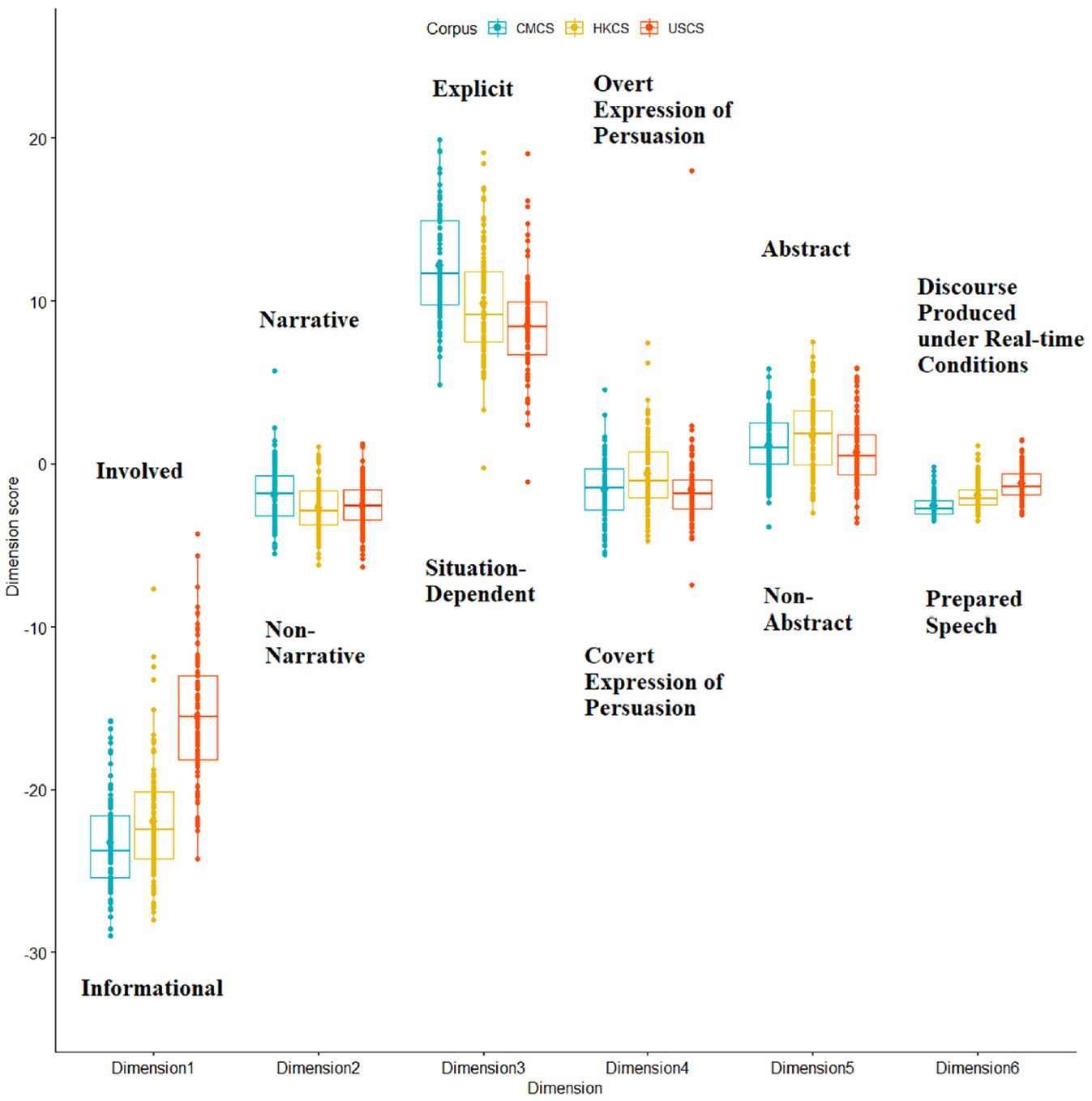
Distribution of dimension scores across the three subcorpora.
According to the results of the variance homogeneity test, the scores of Dimensions 2, 3, and 4 have equal variance, while those of Dimensions 1, 5, and 6 have unequal variance. Therefore, we applied LSD as the post hoc test for ANOVA on Dimensions 2, 3, and 4 and the Games-Howell as the post hoc test for ANOVA on Dimensions 1, 5, and 6. The one-way ANOVA test showed that there are statistically significant differences between the three subcorpora in all six dimensions (p < .05). The post hoc tests were then conducted to identify specific group differences in each dimension (see Table 3). The results of the post hoc tests indicated that the CMCS subcorpus is significantly lower than the USCS and HKCS subcorpora on Dimensions 1 and 2. However, the CMCS subcorpus is significantly higher than the other two subcorpora on Dimensions 2 and 3. For Dimension 4, the CMCS subcorpus is significantly lower than the HKCS subcorpus, but it does not differ significantly from the USCS subcorpus. There is no significant difference between the CMCS and USCS or HKCS subcorpora on Dimension 5. In the following, we will provide a detailed analysis of the results for each dimension.
Pairwise Comparison for the Six Dimensions.
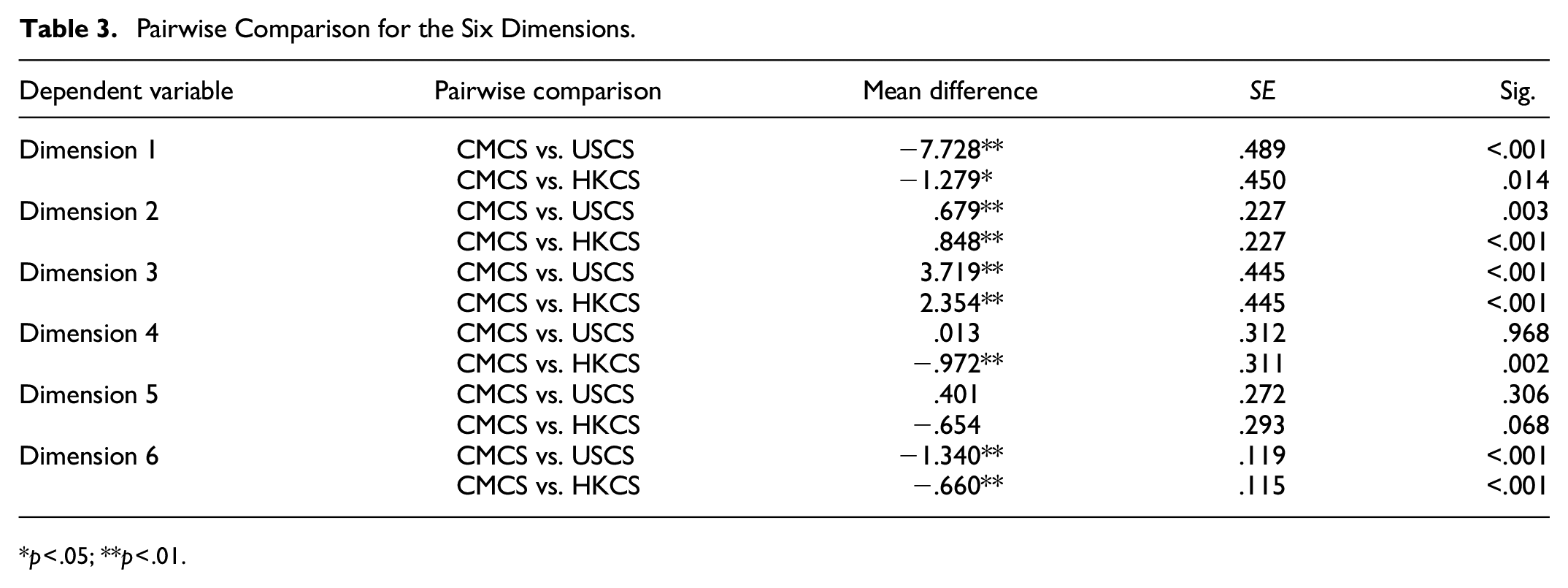
p < .05; **p < .01.
Dimension 1: Involved Versus Informational Discourse
The first dimension of multidimensional analysis, characterized by the opposition between involved and informational discourse, shows the degree to which a text is informational or interactional. A low score on this dimension indicates a high level of informational density, while a high score indicates a high level of interactivity (Biber, 1988). The mean scores of all three subcorpora on Dimension 1 are relatively low, with USCS at −15.52, HKCS at −21.97, and CMCS at −23.24, indicating that the chairman’s statements in all three regions are largely informational in nature. However, post hoc tests reveal significant differences between the three corpora, with the chairman’s statements of Mainland Chinese companies being more informationally dense than those of US and Hong Kong companies.
According to Table 4, of the 28 features in Dimension 1, the three subcorpora differ significantly in 22 linguistic features, with 17 positive-loading features and 5 negative-loading ones. When comparing the CMCS and USCS subcorpora, it is evident that CMCS differs significantly from USCS in all 22 features. Specifically, CMCS has significantly lower values than USCS in 16 positive-loading features, such as private verbs, subordinator “that” deletion, and present tense, as well as one negative-loading feature, the type-token ratio. However, CMCS has higher values in several features, including nouns, word length, total prepositional phrases, attributive adjectives, and the pronoun “it,” with the first four being negative-loading features and the last one being a positive-loading feature. These differences result in a more “involved” style in USCS and a more “informational” style in CMCS. In contrast, the CMCS and HKCS subcorpora resemble each other, with significant differences only found in 8 of the 22 features. Of these, six are positive-loading features and two are negative-loading ones. Specifically, CMCS has significantly lower values in subordinator “that” deletion, present tense, analytic negation, first-person pronouns, and the verb “be” as the main verb, but has higher values in word length, attributive adjectives, and independent clause coordination compared to HKCS.
Language Features Exhibiting Significant Differences Across the Three Corpora in Dimension 1.

p < .05; **p < .01.
Example 1 illustrates a less frequent use of first-person pronouns but a higher frequent use of noun for self-reference in chairman’s statements of Mainland Chinese companies than those of American companies. In this example, the Mainland Chinese company uses “the company” (“
Example 1:
ST:
TT: In addition, the Company continued to expand its circle of friends steadily in 2019, and entered into strategic cooperation agreements with Wolseley Group in the U., Giga Group in Pakistan, and China YTO and CNCDC. (CMCS-Translated English)
We continued to execute on our gasification, carbon capture and hydrogen for mobility growth strategy, and we successfully raised about $5 billion of debt to ensure we are ready for even more profitable growth opportunities. Meanwhile, we returned about $1.1 billion to our shareholders through our dividend, which we increased for the 38th consecutive year. (USCS)
Example 2:
ST:
TT: With its prestigious geographical location and the provision of attentive services, the LVGEM Hotel of the Group recorded an average occupancy rate of 75% and is planned to be upgraded and renovated into a smart business hotel with an aim to further enhance its market competitiveness. (CMCS-Translated English)
Example 3:
The Chinese Central Government will make significant investments in the region and introduce favorable government policies to stimulate and attract private investments that indirectly benefit property investments and property-related sectors in the coming years. (CMCS)
These investments will also drive greater operating efficiencies to keep our customers’ energy costs affordable, create jobs in our communities and deliver strong long-term earnings growth for our shareholders. (USCS)
Dimension 2: Narrative Versus Non-Narrative Concerns
The second dimension characterizes the opposition between narrative and non-narrative discourse. A high score on this dimension indicates that the text contains more narrative elements whereas a low score shows that the text is non-narrative (Biber, 1988). Some features contributing to high scores on this dimension include past tense and third-person pronouns. The means of the three subcorpora on this dimension (US: −2.59; HK: −2.76; −1.91) indicate that they are non-narrative in nature. The one-way ANOVA test and post hoc tests demonstrate that CMCS is significantly higher than USCS and HKCS (p < .05) on this dimension, meaning that the chairmen’s statements of Mainland Chinese companies are relatively more narrative than their counterparts in US and Hong Kong.
Of the six features (all of them are with positive loadings) on Dimension 2, the three subcorpora show statistically significant differences in four features (p < .05) (see Table 5). Overall, the frequency of third-person pronouns is comparatively low across the three subcorpora, showing that chairman’s statement is a text type that addresses the readers directly. In particular, CMCS contains the least third-person pronouns among the three subcorpora, but is overrepresented with present participial clauses than USCS and HKCS. Example 4 exemplifies the utilization of present participial clauses in a CMCS sample. It employs the present participle form (-ing) in the phrase “owing to our early, forceful expansion into lower-tier cities,” which serves to enhance the narrative quality of the text by providing additional context and conveying a sense of cause and effect. In contrast, the USCS sample does not incorporate this feature in a similar context, signaling a distinction in language choice between the two samples.
Language Features Exhibiting Significant Differences Across the Three Corpora in Dimension 2.

p < .05; **p < .01.
Example 4
On the consumer front, owing to our early, forceful expansion into lower-tier cities, we currently enjoy a significant first-mover advantage and stand to benefit from the ongoing trend that demand in lower-tier cities continues to grow alongside the rising levels of consumption. (CMCS-translated English)
As we ended the year, we saw a growing percentage of repeat purchases as customers develop and take advantage of their relationships with their Advisors. (USCS)
Dimension 3: Context-Independent Versus Context-Dependent Discourse
This dimension depicts the opposition between context-independent and context-dependent discourse. According to Conrad and Biber (2001, p. 33), “Dimension 3 represents a continuum between texts that have elaborated, explicit reference, and reference that is more dependent on the situational context.” A high score on this dimension indicates that the text is more context-independent whereas a low score means that the text is more context-dependent. The positive linguistic features of this dimension include WH relative clauses and nominalizations, which are typical features of densely integrated texts, whereas the negative features are generally time and place adverbials which are closely connected with a particular context.
The high means of the three subcorpora indicate that they are relatively context-independent (USCS: 8.47; HKCS: 9.81; CMCS: 12.19). The one-way ANOVA with post hoc tests indicate that CMCS is significantly higher than the other two subcorpora (p < .001). Relatively speaking, the chairman’s statements of Mainland Chinese companies are significantly more context-independent than those in the US and Hong Kong.
Of the eight features on this dimension, six features (four are positive-loading and two are negative-loading features) show statistical differences among the three subcorpora (see Table 6). CMCS has significantly higher values of phrasal coordination and nominalizations (positive-loading features) but lower value of time adverbials (negative-loading feature) than USCS and HKCS. CMCS uses substantially fewer place adverbials (a negative-loading feature) than USCS and fewer “wh” relative clauses on subject position (a positive-loading feature) than HKCS, both contributing to a more context-independent style in the text. Example 5 illustrates a more frequent use of phrasal coordination in the Mainland Chinese subcorpus. In this example, the target text uses “and” four times whereas the source text does not contain any phrasal coordination. Example 6 shows more nominalizations in the translated chairman’s statement of Chinese companies. In this example, the translated text adopts more nominalization forms (“-tion” and “-ment”) instead of verbs, to translate the Chinese verbs in the source text, such as “enhancement” for “
Language Features Exhibiting Significant Differences Across the Three Corpora in Dimension 3.
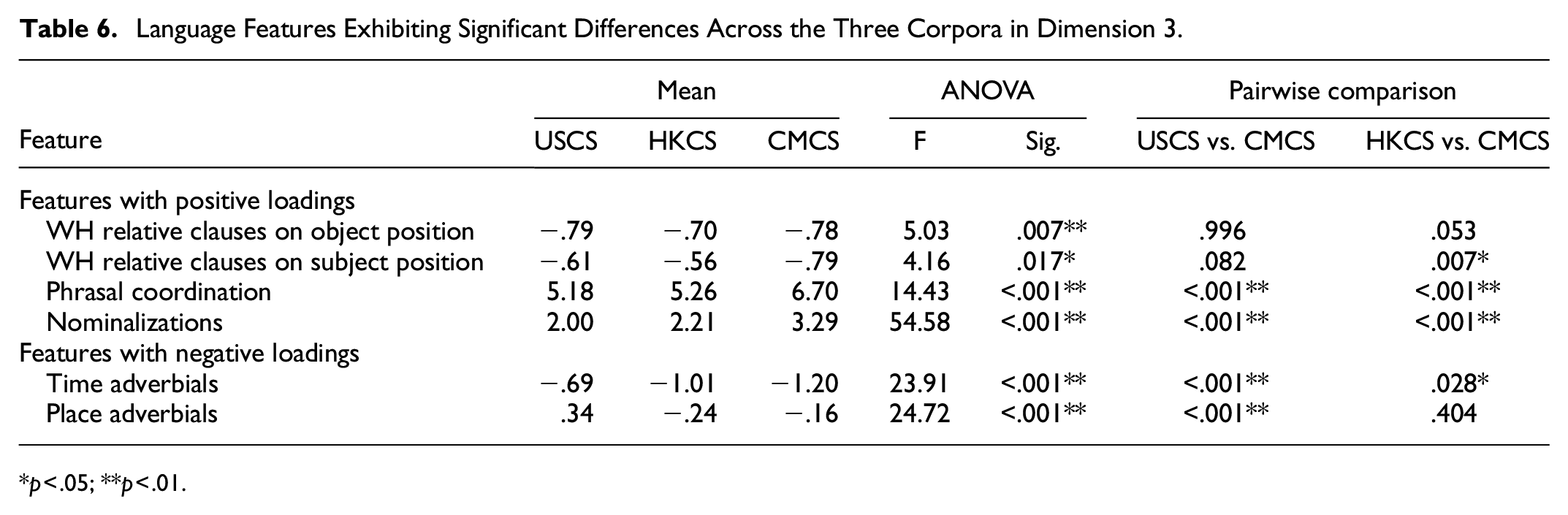
p < .05; **p < .01.
Example 5:
ST:
TT: We plan to accelerate the promotion and application of the “four new” technologies, continue to carry out all-person technical and quality competition related activities, solve technical and quality problems, and continuously reduce manufacturing costs. (CMCS-Translated English)
We believe that international diversification and a focus on sustainability can help provide portfolio resilience, and the disruption created by the coronavirus appears to be accelerating the shift toward sustainable investments. (USCS)
Together with Brexit uncertainties, social unrest in different countries, geopolitical and trade tensions, all will continue to weigh heavily on the global economy. With various adversities and challenges in the current market conditions, the Group’s operations in the year ahead will inevitably be impacted. (HKCS)
Example 6:
ST:
TT: Promote [Promoting] the further enhancement of informatization and intelligentization, in recent years, the “Benchmarking Formosa Plastics” management system of the Group has achieved initial results, with a significant impact in aspects including cost and risk reduction, production efficiency improvement and product quality guarantee. (CMCS-Translated English)
Example 7:
And as we focus on the journey ahead, there’s nowhere else I’d rather be than working alongside the employees of Entergy. (USCS)
As we entered into a new decade, the world has confronted the severe outbreak of coronavirus and challenges that lie ahead. (CMCS-translated English)
Dimension 4: Overt Expression of Persuasion
Dimension 4 measures discourses with overt expression of persuasion from other discourses and only contains positive-loading features. A high score on this dimension reveals that the text explicitly expresses the author’s arguments and opinions. According to Biber (1988, p. 111), this dimension “marks the degree to which persuasion is marked overtly, whether overt marking of the speaker’s own point of view, or an assessment of the advisability or likelihood of an event presented to persuade the addressee.”
Results show that the means of the three subcorpora of this dimension are negative (USCS: −1.61; HKCS: −0.62; CMCS: −1.59), all of which approximating the genre of press reportage. Post hoc test revealed that CMCS is significantly lower than HKCS but does not differ from US significantly, indicating that CMCS has a comparable degree with USCS in terms of overt expression of persuasion, whereas HKCS is relatively less overt than the other two text varieties.
While CMCS and USCS do not exhibit significant differences in this dimension, they do show substantial variations in three out of the six features within this dimension, all of which have positive loadings (please refer to Table 7). Specifically, CMCS uses infinitives and predictive modals less frequently but employs split auxiliaries more often compared to USCS. The balance of these features, despite their positive loadings, does not result in significantly different dimension scores. When comparing CMCS and HKCS, they only demonstrate a statistical difference in one feature within this dimension: infinitives. Example 8 illustrates this by showing that native chairman’s statements from American companies use the word “to” as an infinitive marker more frequently than the translated chairman’s statements from Mainland Chinese companies. On the other hand, Example 9 demonstrates that the translated chairman’s statements from Mainland Chinese companies use the split auxiliary structure more frequently. In this example, this structure contains an auxiliary (the modal verb “will”) followed by an adverb (“fully”) and a verb base form (“utilize”). This language feature, which can enhance the overt expression of persuasion, is relatively less represented in the native chairman’s statements of American companies.
Language Features Exhibiting Significant Differences Across the Three Corpora in Dimension 4.

p < .05; **p < .01.
In summary, despite the lack of significant differences in the overall dimension scores between CMCS and USCS, the analysis of specific linguistic features reveals interesting variations.
Example 8:
In 2019 we began to take the next step in our transformation journey, including a new global operating model and streamlined organizational structure. In April we moved from five to four business groups to better align around our customers and go-to-market models. We have since reorganized the entire company around our new business groups to take full advantage of our transformation capabilities. On January 1st, 2020 we implemented a new, streamlined global operating model designed to improve growth and operational efficiency. (USCS)
This year, we have become more dynamic in our reform and innovation. We continued to pursue both development and reform, prudently carried out mergers and reorganizations, streamlined and improved our internal management in an orderly manner, and launched institutional reforms abroad, in order to constantly cultivate new driving forces for the Company’s development. We fully implemented the “three transformations” proposed by General Secretary Xi Jinping. (CMCS-translated English)
Example 9:
In addition, the Group will fully utilize new media, new channels and new technology to break through the barrier between online and offline marketing, enhance online/offline customer flow as well as increasing customer flow access points. (CMCS-translated English)
We will use our scale and global reach to improve the quality and access to healthcare throughout the world. (USCS)
Dimension 5: Abstract Versus Non-Abstract Information
Dimension 5 differentiates texts with abstract and non-abstract information. A high score on this dimension shows that the text approximates an “abstract style” characterized “by”-passive constructions, conjuncts, “by”-phrases, among others. According to Biber (1988), abstractness of information can be revealed if a text has a relatively high score on this dimension. The means of the three subcorpora on this dimension are all positive (USCS: 0.67; HKCS: 1.73; CMCS: 1.07), which all approximate press reportage as their closest genre. Overall, we can see that the chairman’s statements in these three corpora relatively tend toward abstractness, technicality and formality. The one-way ANOVA with post hoc tests reveals that CMCS is not significantly different from USCS or HKCS, which means that the chairman’s statements in CMCS have comparable degree of abstract information with their counterparts in USCS and HKCS.
In this dimension, CMCS and USCS do not exhibit significant overall differences. However, upon examining individual features within the dimension, four out of six (all with positive loadings) show significant variations (refer to Table 8). Specifically, CMCS uses conjuncts, past participial “whiz” deletion relatives, and other adverbial subordinators more frequently but employs “by”-passives less often compared to USCS. These disparities among the positive-loading features do not result in significant differences in the overall dimension score between CMCS and USCS. When comparing CMCS and HKCS, they show statistical differences in only one feature within this dimension: “by”-passives. Example 10 illustrates this by showing that the native chairman’s statements from American companies use a “by”-passive structure, which includes an alternative form of the “be” verb (“were”), a participle (“accelerated”), and the word “by.” In contrast, the translated chairman’s statements from Mainland Chinese companies prefer the active voice over the passive voice in similar contexts. Furthermore, as demonstrated in Example 11, the CMCS sample uses the conjunct (punctuation + “however”), whereas the USCS sample does not employ this conjunct in comparable contexts. Thus, despite the lack of significant differences in the overall dimension scores between CMCS and USCS, examining individual language features reveals intriguing variations.
Language Features Exhibiting Significant Differences Across the Three Corpora in Dimension 5.

p < .05; **p < .01.
Example 10:
Our extraordinary growth was accelerated by our visionary cluster campus strategy, as informed by Harvard Business Professor Michael E. Porter’s cluster theory. (USCS)
It has accelerated marketing and channel innovations, intensified digital marketing and continuously refined its multi-dimensional c-commerce channel system called “Online Supermarket + Official Flagship Store + Authorized Franchised Store + WeChat Mall” to satisfy consumer demands and their experience in the era of Internet. (CMCS-translated English)
Example 11:
Despite such adversity, however, the construction materials sector managed an outstanding performance in 2018, with 60% growth in profits, making the steel industry in China relatively stable in 2018. (CMCS-translated English)
Despite this, our backlog remained strong at $387 billion with about 80% in services, where we are in daily contact with our customers and enjoy higher margins. (USCS)
Dimension 6: On-Line Information Elaboration
Dimension 6 distinguishes between texts that are informational and produced under real-time conditions compared to other types of texts that are highly integrated (Biber, 1988, p. 114). A high score on this dimension means that the text is overrepresented with “that” relative clauses on object position, “that” adjective complements, and “that” verb complements, indicating that the text is produced spontaneously without prior planning or preparation. Kruger and Van Rooy (2016, p. 43) contend that Dimension 6 contains “elaboration structures that are not densely integrated or cognitively complex, but rather constitute a cognitively less demanding ‘add-on’ strategy to elaboration typical of spoken conversation.”
Results show that the mean of the three subcorpora on Dimension 6 are negative (USCS: −1.28; HKCS: −1.96; CMCS: −2.62), indicating that the texts in these three subcorpora are not spontaneous in nature. In particular, the CMCS subcorpus is significantly lower than USCS and HKCS, indicating that CMCS has fewer linguistic elements that are connected with spontaneous speech than USCS and HKCS.
Three of the four features (all of them are with positive loadings) on Dimension 6 show significant differences among the three subcorpora (see Table 9). As can be seen in the post-hoc test results, CMCS has the lowest frequency among the three subcorpora in the three linguistic features, including demonstratives, “that” relative clauses on object position and “that” adjective complements. Example 12 highlights a distinctive linguistic feature: the use of “that” relative clauses on object position. This feature, more prevalent in both the USCS and HKCS samples, adds spontaneity and clarity by specifying relationships in the sentences. In contrast, the CMCS sample notably omits “that.” For instance, in the phrase “the communities we create,” the word “that” is missing, in contrast to “the communities that we create.” This difference underscores the significance of subtle language choices in shaping the text’s tone and meaning.
Language Features Exhibiting Significant Differences Across the Three Corpora in Dimension 6.

p < .05; **p < .01.
Example 12:
THE FUTURE 2020 taught us powerful lessons that we’ll carry into our approach to the years ahead. (USCS)
Going forward, we will work to solve not only the medical challenge that our products address but, at the same time, the challenge of access and affordability. (USCS)
With the renewed Climate Vision 2050 we are ensuring we can respond to the transformative shifts in our industry, play a pivotal role in the decarbonization that the world needs, and build a solid platform for our business to grow further and thrive for many decades to come. (HKCS)
Our sustainability mission ensures that we take a humancentric, sustainable approach to the communities we create. (CMCS-translated English)
Discussion
The purpose of chairman’s statements is to disclose information by summarizing the content of the annual report in non-quantitative terms, including the operating status of the company, the current opportunities as well as challenges, the plans and goals for the following year (Hu & Tan, 2020). The findings of the study show that the chairman’s statements, both translated and non-translated, are closest to learned exposition with respect to their overall genre characteristics. This indicates a certain degree of genre homogeneity among the three types of chairman’s statements. However, the translated chairman’s statements and non-translated ones still show major differences in textual characteristics, as evidenced by their significant differences on four out of the six language dimensions. Specifically, the translated chairman’s statements of Mainland Chinese companies are found to be more informational (Dimension 1), narrative (Dimension 2), context-independent (Dimension 3) and less spontaneous (Dimension 6) than non-translated ones of American and Hong Kong companies. According to Biber (1988), Dimensions 1, 3, and 5 are most relevant for distinguishing “oral” and “literate” registers. Our results show that translated chairman’s statements are relatively more “literate” than the non-translated ones. This is most evident in Dimension 1 that distinguishes involved from informational discourse. The first dimension is acknowledged as the most robust dimension in the MDA and has been widely used by corpus researchers in register variation research (Egbert & Mahlberg, 2020) because this dimension contains a wide array of language features. Based on Dimension 1, the translated chairman’s statements are informationally much denser and less involved than the other two text types, indicating that the English translations of chairman’s statements are textually different from its counterparts originally written in English.
The linguistic differences between translated and non-translated chairman’s statements may be influenced by several factors, including the interference of the source text in the translations, cultural and regional variations in business communication styles, and disparities in cultural and regional power distance. Firstly, there is possible interference of the source text in the translations and such interference may lead to the differences between translated texts and comparable original texts (Toury, 1995). According to Teich (2003), the influence of source texts is one of the major factors that shape the translated texts and render it different from comparable original texts. This effect is claimed to be the source language shining through in translated texts. As is the case in chairman’s statements, the translated texts may be “oriented more towards the source language” (ibid., p. 145). Hu and Tan (2020) noticed that the CEOs of Mainland Chinese companies refrain from making interaction with the public and they often keep the authoritative image as corporate leaders. Such a communication style is also reflected in the chairman’s statements. In essence, China has higher power distance index than America (Hofstede et al., 2010). In its high-power distance culture, the hierarchy of power and the authority of leaders in Chinese companies are socially accepted (Hu & Tan, 2020). Thus, leaders of Mainland Chinese companies tend to remain authoritative in their tone conveyed through the chairman’s statements. Due to the source language shining-through effect, the translated chairman’s statements of Mainland Chinese companies are less involved and interactional compared with the non-translated ones of American and Hong Kong companies.
Secondly, business English communication has the tendency of becoming more interactional and less formal in capitalist regions such as United States and Hong Kong. The business world lays heavy emphasis on achieving the transactions and yielding positive economic consequences (Jiang & Xu, 2017). Business English is found to be even more interactional than general English (ibid.). This explains why the chairman’s statements originally written in English in these two regions are more interactional than the translated ones of Mainland Chinese companies. As an international financial hub and a former British colony, Hong Kong clearly follows the norms of the west by adopting a more pragmatic approach in business communication. This is also reflected in the norm that annual reports are written in English instead of Chinese in Hong Kong (Courtis & Hassan, 2002). On the other hand, the Mainland Chinese companies listed on the Hong Kong Exchange still largely adopt a more authoritative and distanced style in business communication. This is probably related to the fact that a large number of companies listed in Hong Kong are state-owned instead of privately-owned. It should be noted that the CEOs of these companies are more like officials than business professionals (Yang et al., 2013). To a large extent, these linguistic variation between the translated and non-translated chairman’s statements can be perceived as cultural differences, particularly differences in political culture. Chairman’s statements from American and Hong Kong companies tend to be more effective in engaging and interacting with their audience when compared to translated statements from Mainland Chinese companies. This heightened engagement and interaction not only provide a more compelling communication experience but also have the potential to significantly improve the relationship and communication channels with investors and stakeholders. Consequently, this strengthened communication can further enhance the overall promotion and reputation of American and Hong Kong companies, ultimately contributing to their success and market presence.
Lastly, it is believed that translation is also one of the important factors that shapes the textual profiling of chairman’s statements. According to Pym (2015), translation is essentially a risk-avoidance or risk-taking act (Pym, 2015). For the translation of annual reports, the translator clearly will opt for risk-avoidance strategies in order to minimize possible risks. In other words, they are more inclined to adhere closely to the source texts of Chinese chairman’s statements, which are typically formal and sometimes rigid in nature. When translating such texts, translators often take a more conservative approach, aiming to faithfully replicate the structure and tone of the source text. As a result of this conservative approach, the target texts frequently retain the formality of the original documents, but they may also appear less engaging or personalized than their native counterparts. This phenomenon stems from the translators’ primary focus on faithfully reproducing the original text rather than adapting it to align with the style and tone typical of the target culture. Consequently, the translated chairman’s statements may lose some of the personal touch and engagement that are often present in native corporate communications. This underscores the significant influence that translation processes and decisions can exert on the final product, highlighting the necessity for further research into the strategies employed by translators, especially in the context of corporate communications. Such research can help us better comprehend their impact on the quality and effectiveness of translated texts. In this study, we have demonstrated that the MDA approach can be effectively applied to study the linguistic variations of translated and non-translated chairman’s statements. MDA can offer a more nuanced and comprehensive understanding of the textual features and communication effectiveness of a text type. Previous research on chairman’s statements is often restricted to cherry-picked linguistic features. The use of isolated measures can only present one specific aspect of linguistic features, but often fail to unveil a holistic picture of the texts under investigation. In contrast, MDA can overcome such methodological limitations because the dimensions consist of a set of scientifically-derived textual features.
The findings of the current study also highlight pedagogical and practical implications. Pedagogically, translation teachers and trainers can be empowered with corpus-derived evidence to enhance their teaching, including: (a) deploying the linguistic features as measures for translation quality assessment to overcome the weaknesses of traditional prescriptive assessment methods (see De Sutter et al., 2017); and (b) extracting translation examples, particularly those that linguistic differences are found, for preparing teaching materials and designing classroom activities to increase students’ awareness of the different language styles between different regions. Practically, the findings of the study also provide great value for business communication and business translation in the context of China. As a large number of investors are making investments in the listed Chinese companies through the Hong Kong Stock Exchange, the communication (in)effectiveness as reflected in the textual differences between firms from Mainland China, Hong Kong and the US might be of interest to them.
Conclusion
The present study contributes to the field of translation studies by addressing the relatively less-explored area of non-literary translation, which has received comparatively less attention in previous research, which often focused on literary translation (Sun & Li, 2020). This study highlights the importance of non-literary translation and its relevance to our ever-changing world (Cronin, 2013). By examining the translation of chairman’s statements, it broadens the scope of translation studies beyond the traditional emphasis on literary translation, providing a deeper understanding of the role of translation in society. It underscores the vital role of technical and specialized texts in the financial and business sectors. Moreover, the study emphasizes the significance of context in non-literary translation, where highly specialized terminology and subject matter require a thorough comprehension of the context in which the text is produced and received. This research underscores the importance of considering context in translation, including social, cultural, and historical factors that can influence translation practices.
By employing the MDA approach, our study has uncovered significant disparities between translated English chairman’s statements in annual reports and their non-translated counterparts, despite certain resemblances. This utilization of MDA has allowed us to transition from an emphasis on selective features to a comprehensive exploration of systematic, multi-dimensional language patterns. Through this methodological innovation, we can enhance our comprehension and insights into translated chairman’s statements while emphasizing their distinct characteristics in comparison to the original chairman’s statements. Our study marks a new avenue in the examination of practical translations by establishing connections between their linguistic attributes and their effectiveness in communication. Despite some interesting findings, this study is not without limitations. First, only the Chinese-English language pair is examined in our study and future research can investigate other language pairs to increase the generalizability of the findings. Second, our study is based on Biber’s MDA, which is largely limited to lexical and grammatical categories despite its robustness in characterizing different language and communicative dimensions. Future research can use self-designed MDA by including more indices of semantic and syntactic categories. Furthermore, future research may explore other comprehensive information-theoretic metrics, such as entropy (Liu et al., 2022a, 2022b), to validate existing findings and enhance our understanding of linguistic differences between translated and non-translated chairman’s statements.
Footnotes
Declaration of Conflicting Interests
The author(s) declared no potential conflicts of interest with respect to the research, authorship, and/or publication of this article.
Funding
The author(s) disclosed receipt of the following financial support for the research, authorship, and/or publication of this article: We would like to thank The Hong Kong Polytechnic University for their support through a research grant (Ref No: P0043560) for this study.
Ethics Statement
This study did not involve the use of animal or human subjects, therefore an ethics statement and committee approval number are not applicable.
