




Abstract
Problem-based learning (PBL) is a pedagogical approach that helps learners develop (meta)cognitive and social skills. In PBL, students identify problems, design strategies, implement them, and reflect on their resolution process. When applied in English language teaching (ELT), students interact throughout these phases, developing language competencies. However, PBL application has not been methodically reviewed, despite its potential to reveal pedagogical advancements. This study systematically examines PBL implementation in Korean ELT, focusing on (a) target areas, pedagogical effects and measurement tools, (b) PBL types, and (c) teacher and student roles. The findings and discussions provide instructors with rationales for PBL application in ELT.
Keywords
Introduction
The new directions and methods to improve the national English curriculum have been discussed in Korea (Ministry of Education [MOE], 2015, 2022; Yoon, 2024; Youk et al., 2022). Through the discussions, Korea endeavours to prepare for the era of the fourth industrial revolution (4IR), in which digital, physical, and biological aspects are integrated by digital technologies (Schwab, 2016, 2018). Reconstructing its curriculum, the state attempts to overcome educational limitations in fostering 21st century skills such as creative problem-solving (Lim & Kye, 2019). Such efforts for educational reform are also evident in national English curriculum in East-Asian countries, including Korea (S. Lee, 2020; MOE in China, 2022; Hoang, 2022). Furthermore, with the increasing need for disciplinary convergence to solve complex problems, individuals with interdisciplinary perspectives are advantaged in the 4IR (Organization for Economic Cooperation and Development [OECD], 2019). In response to these challenges, developing (language) learners’ skills to strategically and creatively resolve problems through knowledge integration has become a global issue in education (OECD, 2019; World Economic Forum, 2020). This is true in East-Asian countries such as Korea (MOE, 2015, 2022; Yoon, 2024), China (Y. Chen & Huang, 2022; MOE in China, 2022), and Vietnam (Hoang, 2022).
Problem-based learning (PBL) is an effective approach that fosters cognitive, metacognitive, social and language skills (Ansarian & Lin, 2018; Han, 2023; Lin, 2015, 2018; Xie, 2022). Initially developed in medical education to enhance students’ professionalism (Barrows & Tamblyn, 1980), PBL involved students discussing medical scenarios and devising resolutions (Leatemia et al., 2016). PBL is currently applied across various disciplines, including language education (Jeon & Park, 2021; Malebese & Tlali, 2020; Stentoft et al., 2014). Developing learners’ problem-solving competencies is emphasised in state English language curricula across East-Asia (Kien & Nghia, 2024; MOE, 2022; MOE in China, 2022; Hoang, 2022).
While solving problems, students define issues through knowledge sharing; search for information collaboratively; design solutions through meaning negotiations; apply them; and evaluate their effects, formulating new meanings or modifying existing ones (Han, 2023; Hmelo-Silver, 2004; Mathew-Aydinli, 2007). By monitoring and regulating various meanings, students develop their (meta)cognition, social skills and problem-solving skills, while their language skills are enhanced through discussions (Ansarian & Lin, 2018; Han, 2023). This way, PBL thus promotes learner-centred education and facilitates competencies emphasised by the latest curriculum and the 4IR, such as information processing, creative thinking, self-management, and cooperation (Y. Chen & Huang, 2022; MOE, 2015, 2022; MOE in China, 2022; Hoang, 2022); PBL fosters students’ higher-order thinking skills through metacognitive learning processes and expects various open-ended outcomes, while task-based language teaching (TBLT) focuses on developing students’ language competencies by producing simulational outcomes through structured tasks with distinct language-focused phases (Han, 2023; Ellis, 2003; Francom & Gardner, 2013).
However, empirical studies on PBL-based English language teaching (ELT) programmes in Asia are limited (Ansarian & Lin, 2018), and the implementation of PBL in Korean ELT contexts has not yet been thoroughly addressed. This may reflect East-Asian academic culture, emphasising teacher-centred and exam-oriented education, rooted in Confucianism (Chen & Huang, 2022; Ngo & Tran, 2024; C. Shin, 2012). Within this framework, implementing PBL represents an innovative shift, moving from a traditional hierarchical approach towards a more democratic approach. Therefore, understanding the realities of PBL application in Korean ELT can provide instructors with the rationales to more strategically and context-sensitively design and implement PBL-based ELT programmes.
Gijbels et al. (2005) reviewed the effects of PBL, particularly focusing on student assessment across various disciplines and contexts. Similarly, Mutammimah and Padli (2023) analysed 12 studies on PBL in ELT from 2011 to 2016, noting the positive effects of PBL on learners’ writing skills. However, there remains room for more rigorous evaluation criteria and in-depth analysis of the collected studies. Therefore, a review that analyses studies on the processes and outcomes of PBL in ELT, using validated analysis methods, would provide readers with more applicable understandings for implementing PBL in ELT. The current study aims to systematically review the literature on the applications of PBL in Korean ELT with a focus on the following three aspects.
Research question: In what ways is PBL implemented in Korean ELT, concerning (a) target areas, pedagogical effects, and measurement tools, (b) PBL types, and (c) teacher and student roles?
Based on the findings, the study will discuss implications for context-sensitive implementation of PBL in Korea ELT. The implications will provide practical guidelines for adopting PBL in East-Asian English classrooms, which share similar cultural backgrounds.
Literature Review
Principles of PBL and PBL Implementation
PBL is a learner-centred approach that empowers learners apply various knowledge and skills to solving problems by integrating theory and practice (Savery, 2006). With its pedagogical merits of enhancing students’ knowledge, teamwork, communication, leadership and reflection (Ansarian & Lin, 2018), PBL has expanded to various disciplines, including business, engineering, law, social sciences, teacher education, and language education (Ansarian & Lin, 2018; Han, 2024; Lin, 2018; Walker & Leary, 2009).
In PBL, students tackle ill-structured problems resembling real-world issues (D. W. Lee, 2020) without single solutions (Pretz et al., 2003). The process involves four stages: problem definition, strategy design, strategy implementation and evaluation (Han, 2023, 2024; Hmelo-Silver, 2004). First, students share knowledge to comprehend the problem and establish goals and procedures by comparing different meanings. Second, they design strategies by selecting or creating methods and associating different meanings and evaluate their potential values using logical reasoning. Third, students implement strategies and evaluate outcomes against the goals. If they achieve their goals, they confirm their meanings; if not, they modify their meanings and formulate new strategies. These procedures require constant interactions, meaning negotiation and metacognitive monitoring and regulations (Han, 2024; Kek & Huijser, 2016). Through this process, students improve language and problem-solving skills (Han, 2023; MOE in China, 2022).
Beyond (meta)cognitive, socio-affective, and linguistic benefits, PBL fosters knowledge application and critical thinking. Albanese and Mitchell (1993) found PBL highly engaging and effective for professional preparation. Smits et al. (2002) reported students’ enhanced knowledge and performance, while Dochy et al. (2003) found PBL’s positive effects on knowledge application. According to Gijbels et al. (2005), PBL supports students’ structured conceptual networks linking knowledge to problem solving. Liu and Pásztor (2022) noted its role in improving critical thinking. However, most research focuses on medical or interdisciplinary areas, offering limited guidance for ELT. Therefore, further research, like the current review, is necessary.
Implementation of PBL in East-Asian Countries
PBL is rarely applied in ELT, particularly in Asian contexts. Xie (2022) disclosed that Chinese students studying business English favour PBL activities related to recruiting and marketing. They developed soft skills such as communication, negotiation, leadership, decision-making, teamwork and creative problem solving, while improving English competence, autonomous thinking, and critical thinking. Y. Chen and Huang (2022) demonstrated PBL’s effectiveness in China, showing its potential to enhance self-directed learning, teamwork, communication and English skills in music-related primary English classes.
Ansarian and Lin’s (2018) study observed Taiwanese students improving reading comprehension through a PBL-based, web-assisted English reading course, which also facilitated active learning and cognitive processing. According to C. Chen et al. (2021), Taiwanese students learning English for specific purposes in a VR-assisted PBL context were highly motivated and better acquired vocabulary. Phan Thị, (2023) found that Vietnamese engineering students improved oral and written English communication skills and content knowledge through PBL. The enhanced English language competencies and problem-solving skills also contributed to their increased employability (Ngo & Tran, 2024).
Based on these findings, the current study analyses how PBL’s pedagogical and linguistic benefits are implemented in Korean ELT programmes.
Method
Data Collection and Extraction
The researcher initially used domestic search engines to collect research data: The Research Information Sharing Service (RISS), managed by the Korea Education and Research Information Service (KERIS), and the Korean Citation Index (KCI), managed by the National Research Foundation of Korea (NRF). For journals from international publishers, search engines like Science Direct, Taylor & Francis Online, Willey Online Library, Google, and ERIC were employed. Initial search keywords combined ‘problem-based learning OR PBL’ with ‘English OR English language OR English language learning OR English language teaching OR English education’. More specific searches included combinations like ‘problem-based learning OR PBL’ and ‘English reading, listening, speaking, writing, grammar, vocabulary, translation, interpretation, literature, OR business English’. After eliminating duplicates, 67 were collected.
Studies on language pathology and test-solving were excluded. Dissertations, book chapters, and conference proceedings were also eliminated due to a lack of peer review, overlap with journal publications or absence of empirical data, which resulted in 29 exclusions. Abstracts, key words, and introductions of the remaining 38 articles were reviewed. Nine theoretical studies were excluded as they lacked practical examples. Works on project-based learning or collaborative PBL were excluded with their different pedagogical methods. With the first study published in 2009, the review focused on articles from 2009 to 2022. After final filtering and removing 3 duplicates, 26 articles remained. These studies involved individual or small-group researchers conducting PBL-based ELT programmes at their institutions.
The data extraction processes follows the Preferred Reporting Items for Systematic Reviews and Meta-Analyses (PRISMA) guidelines (Moher et al., 2010; Page et al., 2021) and is summarised in the accompanying flowchart (Figure 1).
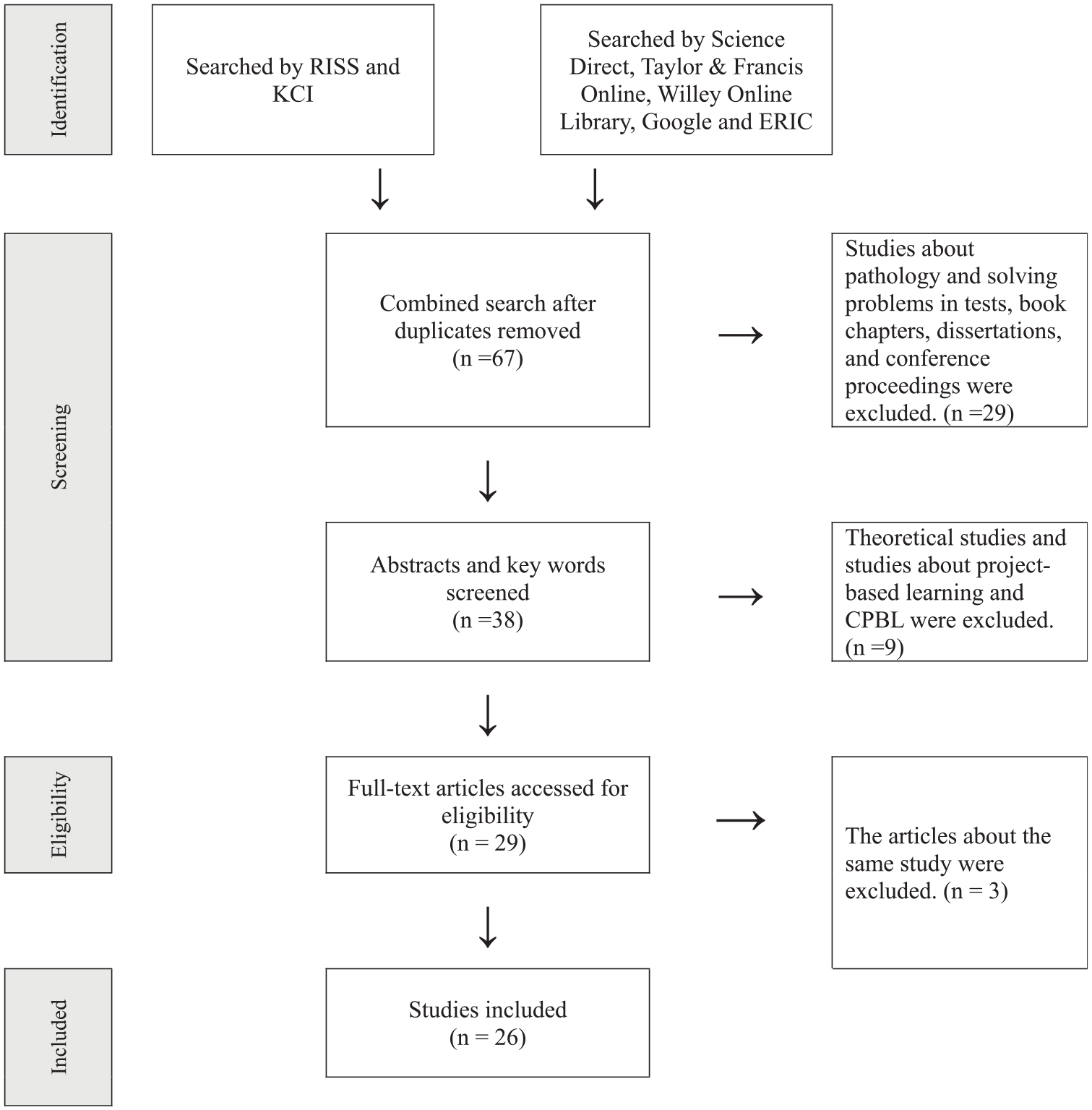
Flow chart of the literature search procedure based on the PRISMA statement.
Data Analysis
Analysis of the Target Areas, Pedagogical Effects and Measurement Tools
PBL is an effective pedagogy that supports learners in constructing content knowledge (Hong & Lin, 2006), improving information searching skills (Schroeder & Zarinnia, 2001), fostering deep text understanding (Hoffman et al., 2003), and developing higher-order thinking skills (Han, 2023; Liu & Pásztor, 2022; Torp & Sage, 2002). It also increases communication and collaboration skills (L’Ecuyer et al., 2015). Studies show that students often develop satisfaction with and positive attitudes towards PBL-based language programmes (S. Chun, 2021; D. W. Lee, 2020). These aspects of linguistic, (meta)cognitive and psychological impacts were used to categorise the target areas and pedagogical effects of PBL-based language programmes in this review. Moreover, by scanning the introduction and results sections of the collected literature and referencing other international research on PBL-based language learning, the researcher inductively established categories of target areas and pedagogical effects (see Table 1). These effects were summarised in an Excel spreadsheet and coded into six categories: one for programme satisfaction, two for language competence, three for language test scores, four for social skills, five for higher-order thinking skills and six for affective aspects. Sub-categories within each area were identified, and totals for each code, including overlaps, were calculated (see Table 5) .
Identified Target Areas and Pedagogical Effects.

Measurement tools to assess pedagogical effects vary depending on the perspectives of observers, students and teachers (Senden et al., 2021). Tests, inventories, observation, interviews, checklists, surveys and attitude scales are effective for gauging student progress (Kolluri, 2021), and can be chosen based on contextual needs. A review of the collected literature revealed no third-party participation in data gathering as instructors conducted PBL lessons and collected data themselves. The current review, thus, attend to whether the data reflect teachers’ and/ or students’ perspectives, as detailed in Table 6.
Tests are the most common tools for assessing instructional impact on learner achievement (Lanahan et al., 2005). Studies measuring students’ language competence improvements mainly adopts test. Students’ academic growth is evaluated through changes in mean and standard deviations between initial and follow-up test scores (Ansarian & Lin, 2018; Lanahan et al., 2005; Lin, 2015, 2018). Situationally-designed tests for cognitive and psychological aspects also fall under this category.
Questionnaires, valued for their cost-effectiveness and efficiency, are widely used in educational research (Senden et al., 2021). This method is reliable, as students develop competence in judging teaching practices through daily pedagogical experiences (Maulana & Helms-Lorenz, 2016).
Reflection involves recapturing, deliberating on and evaluating experiences (Boud et al., 1985). Through reflection, teachers assess their professional behaviours and develop new strategies (Hußner et al., 2023). Self-report, a method based on teacher’s or students’ reflections, reveals teaching and learning processes and students’ perceptions (Ansarian & Lin, 2018). In this study, reflection encompasses various activities, including self-reports, review notes, and open-ended descriptions.
Interviews are a widely used tool for analysing teaching practices in educational research. They have been employed to interpret student teachers’ practices (Göçer, 2013), in-service teachers’ professional identity (Han, 2017, 2021, 2022), and lecturer’s practice or course evaluations (Ansarian & Lin, 2018; Han, 2016a; D. W. Lee, 2020; Lin, 2018). Group interviews also help disclose students’ perspectives on programmes, enabling them reflect on both positive and negative aspects of their learning experiences (University of Exeter, 2022).
Classroom observation is frequently used to analyse practices as an effective tool (White et al., 2022). Regarded as objective (Clare et al., 2001), it typically involves an observer interpreting teaching and learning from an external perspective. However, in the reviewed studies, researchers conducted observations as instructors and insiders.
Learning outcomes are also extensively used to evaluate teaching quality. They reveal knowledge, skills and competencies students are expected to acquire (Sigurgeirsson et al., 2018) and also learning content, teaching strategies, and assessment methods (Spady, 1994), which are significant evidence for diagnosing the effectiveness of teaching and learning.
The tools for measuring the effects of PBL-based ELT programmes are categorised in Table 2. Methodology sections of the collected articles were scanned to identify these tools, which were summarised in an Excel spreadsheet and coded numerically. The frequency of the use of each tool’s usage is presented in Table 6.
Measurement Tools.

Each method has its own strengths and weaknesses, and it can reveal different aspects of an educational phenomenon. For this reason, combining multiple tools is often considered ideal (Kunter & Voss, 2013; Senden et al., 2021). Many articles employed two or more tools to ensure triangulation, which resulted in some overlap in the frequency data.
The choice of measurement tools depends on the specific target areas and pedagogical effects, being addressed. Table 7 and Figure 3 illustrate the relationship between these tools and their applications.
Analysis of the Forms of the Applied PBL
The types of PBL applied were analysed. The form and dynamics of PBL vary based on problem structuredness and students’ self-directedness (Barrows, 1986). Rather than placing these two features on a single horizontal continuum, as Barrows did, plotting them on the X- and Y-axes creates a grid that divides each feature into three levels, resulting in nine distinct types (see Figure 2). Problem structuredness is categorised into (a) complete case (well-structured), (b) partial problem simulation (semi-structured), and (c) full problem simulation (ill-structured). Self-directedness is classified as (a) instructor-led, (b) partially self-led, and (c) self-led. Descriptions of these categories are provided in Table 3.

Representation of PBL Models. *This figure is a transformed version of Barrows (1986) PBL taxonomy adapted by Hung (2011). *IC, PC, SC, IP, PP, SP, IF, PF and SF are combinations of the initials of the X- and Y-axis values.
Attributes of the Coordinates Values.
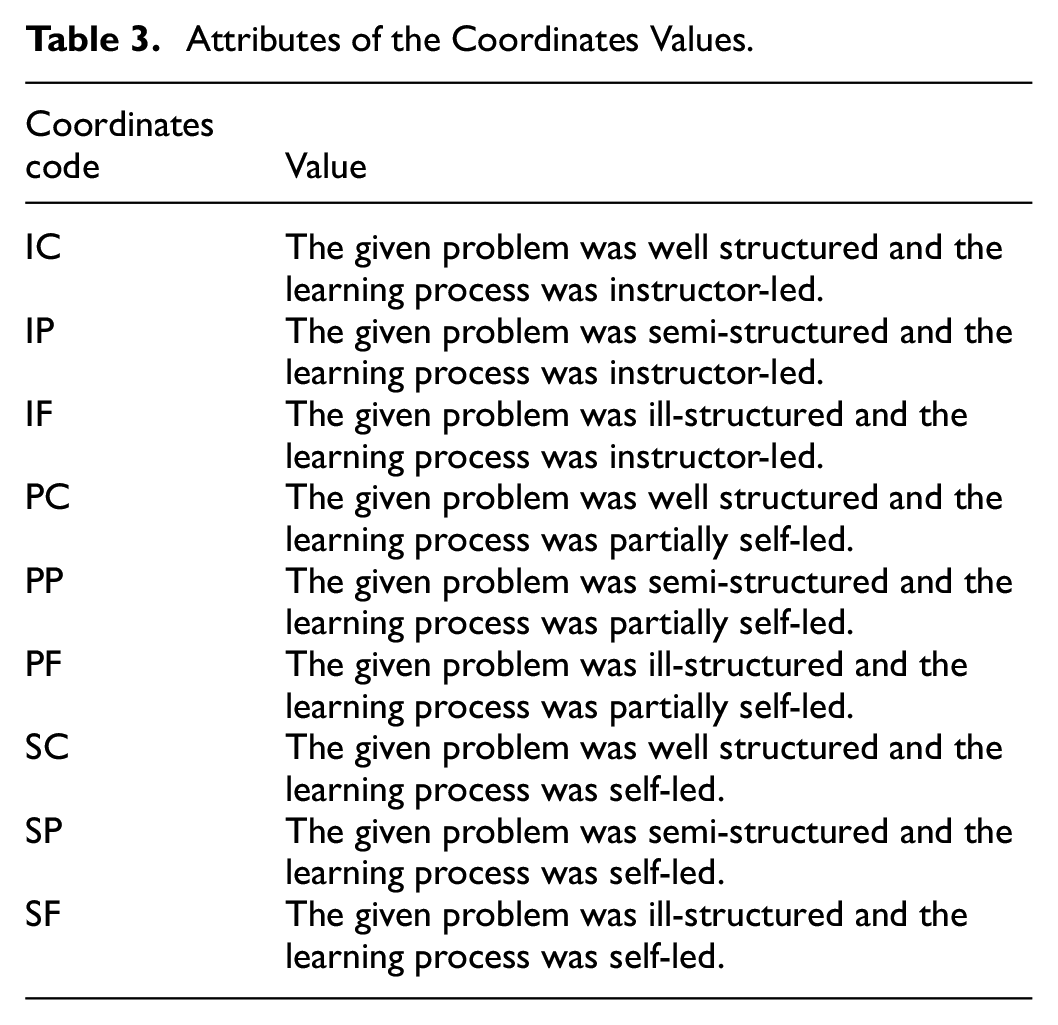
The researcher scanned the methodology and data presentation sections of the articles, summarising the applied problems and teacher and student activities in an Excel spreadsheet. Some studies clearly specified these, while others only mentioned the PBL type and learner autonomy level. By comparing these summaries with Table 3, the PBL types were determined, coded and plotted onto the X–Y matrix (see Figure 4).
Analysis of the Teacher and Student Roles
Alongside the analysis of PBL types, examining teacher and student roles provides guidelines of PBL implementation procedures. Given that human factors are critical for successful PBL implementation (Ferrero et al., 2021; Hung, 2011), understanding these roles enables designing effective PBL in ELT. Following Hung’s (2011) framework, teacher and student roles were analysed in relation to (a) students’ behaviour, (b) facilitators’ behaviour, (c) resources and workload and (d) small group learning. Based on Hung’s descriptions and participant dynamics, each category was specified into three levels, where level 1 indicates rarely activated, level 2 partially activated and level 3 fully activated (see Table 4). When categories were not identifiable in the research, they were marked as NI (not identifiable). Higher sums suggest more learner-centred, interactive implementation with teachers’ modelling, guides and materials. Given that Asian students with their Confucian background may respond differently to pedagogies compared to Western students (Blömeke & Olsen, 2019), the higher sums reflect Korean English teachers’ significant shift from traditional methods to PBL.
Rubric for the Analysis of Teacher and Student Roles.

For a comprehensive understanding of teacher and student roles, the researcher analysed the methodology, data presentation and discussion sections of the articles. The actions, interactions, teaching-learning processes and materials were summarised in an Excel spreadsheet. These summaries were compared with Table 4 to determine the level of the four categories in each article. The summaries were coded with SB1-3(Student Behaviour level1-3), FB1-3(Facilitator Behaviour level1-3), RW1-3(Resources & Workload level1-3), SL1-3(Small Group Leaning level1-3). The coding outcomes were compiled to identify patterns, with calculations of frequencies and percentages by category. An anonymous researcher with a Ph.D. and 10 years of higher education experience also participated in this process. After resolving initial differences in measuring two articles through discussion, agreement was reached (see Table 8).
The following section presents and interprets the data regarding (a) target areas, pedagogical effects and measurement tools, (b) PBL types, and (c) teacher and student roles in PBL-based ELT programmes in Korea.
Results
The Target Areas, Pedagogical Effects and Measurement Tools
The analysed target areas and pedagogical effects are presented in Table 5, with frequencies and percentages coded by categories and sub-categories formulated from summaries of introduction and result sections.
Target Areas and Pedagogical Effects.

Programme satisfaction emerged as the primary focus, with 16 of 26 studies (62.5%) examining this aspect. Students’ satisfaction included aspects such as group work, practical knowledge acquisition (S. Chun, 2021), learning procedures, feedback (D. W. Lee, 2020) and participation (Yun & Maeng, 2021). This reflects Korean instructors’ efforts to implement learner-centred methods (Kweon, 2014; D. W. Lee, 2020), through enhancing students’ recognition of pedagogical effectiveness.
Language competence was the second focus. 46.2% of studies reported students’ improvement in reading, writing, listening, speaking, vocabulary and translation. This outcome reveals PBL’s effectiveness in enhancing students’ language competencies. The third focus was improvement of social skills. Eleven studies (42.3%) identified increased collaboration among learners. In addition, 34.6% of studies demonstrated increased higher-order thinking skills, such as creativity, self-directedness, and critical thinking.
Affective aspects took the fifth rank. Five studies (19.2%) reported increased motivation, participation, interest, self-efficacy and confidence in English language learning. Language test scores was the least focused. Only four (15.4%) targeted academic achievement, test scores or knowledge acquisition. This limited focus reflects Korean English teachers’ hesitation to apply PBL in contexts emphasising Korean Scholastic Aptitude Test preparation (KSAT) (Han, 2016b; Lim & Kye, 2019).
Based on the coding outlined in Table 2, the measurement tools, their frequencies, and relevant perspectives were analysed (see Table 6). While 38.5% of studies adopted a single tool, 61.5% employed multiple tools for data triangulation; ten (38.5%) used two tools, three employed three tools, two used four tools and one employed five tools. Methodologically, 14 studies (53.9%) applied exclusively quantitative tools, three studies (11.5%) qualitative tools and nine studies (34.6%) mixed-methods.
Measurement Tools and Relevant Perspectives.
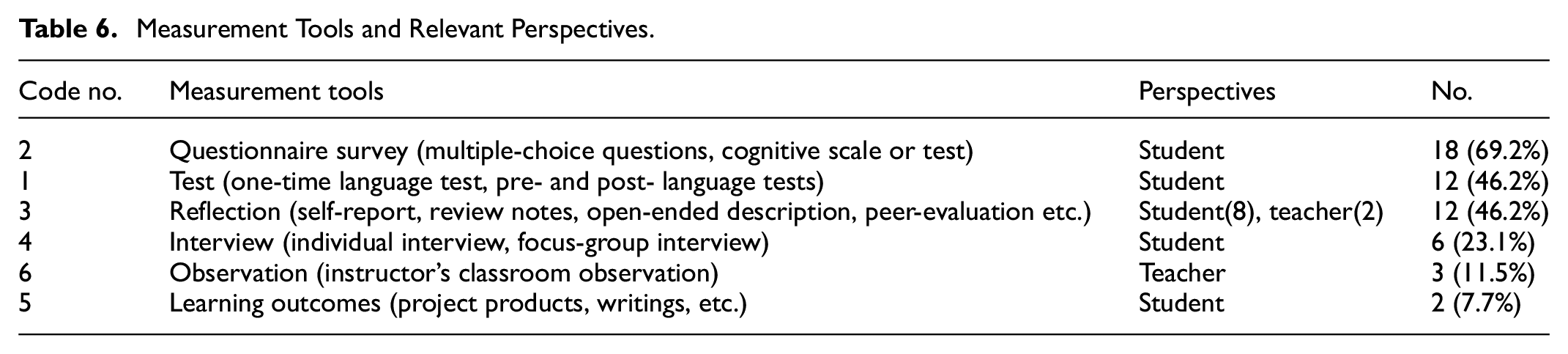
In general, questionnaire surveys, tests, interviews, and learning outcomes were based on student perspective; observation on teacher perspectives; and reflection captured both. While tests are traditionally the most common measurement for practice quality (Lanahan et al., 2005), questionnaire surveys were most frequent, appearing in 69.2% of studies; tests were used in 12 studies (46.2%). The prevalence of these quantitative tools likely reflects their practicality in data collection and analysis.
Among qualitative methods, reflection, including students’ or teacher’s self-reports, open-ended description and teacher review notes, was used in 46.2% of studies, individual and focus-group interviews in 23.1%, teacher observation in 11.5%, and learning outcomes in 7.7%. This lower adoption of qualitative tools suggests they are less popular in Korean pedagogic measurement, possibility due to researchers’ limited training in qualitative data interpretation. Nine studies (Chang, 2020; S. Chun, 2021; S. Y. Kim, 2021; Kwon, 2017; Y. K. Lee, 2017a, 2017b; Y. Lee & Kim, 2019; S. Y. Park & Cho, 2012; Won & Park, 2021) used mixed methods for data triangulation.
Table 7 presents relationships between measurement tools and target areas and pedagogical effects, ordered by frequency (see Tables 5 and 6). Quantitative tools were widely used across all areas. Programme satisfaction studies primarily adopted surveys, tests, reflections and interviews; language competence studies mainly employed tests and surveys; studies of social skills and higher order thinking used surveys and reflections; and studies of affective aspects and language test scores usually applied questionnaire surveys and tests. These patterns are visualised in Figure 3, offering guidance for tools selection in future PBL-based ELT research.
Measurement Tools in Relation to Target Areas and Pedagogical Effects.


Measurement tools in relation to target areas and pedagogical effects.
The PBL Types
The forms and dynamics of PBL were identified through analysis of the collected articles. Figure 4 presents the PBL types by self-directedness and problem structuredness. Among 26 studies, 5 (19.2%) did not explicitly or implicitly disclose their PBL types. Of the remaining 21 cases, the PP type (semi-structured problem with partially self-led mode) was most common (28.6%). SF type (ill-structured problem with self-led mode) was the second most common (23.8%), followed by PC type (well-structured problem with partially self-led implementation; 19%). IC and SP types each appeared in 2 cases (9.5%), while SC and PF each appeared in 1 case (4.8%), and no studies employed IP and IF types.
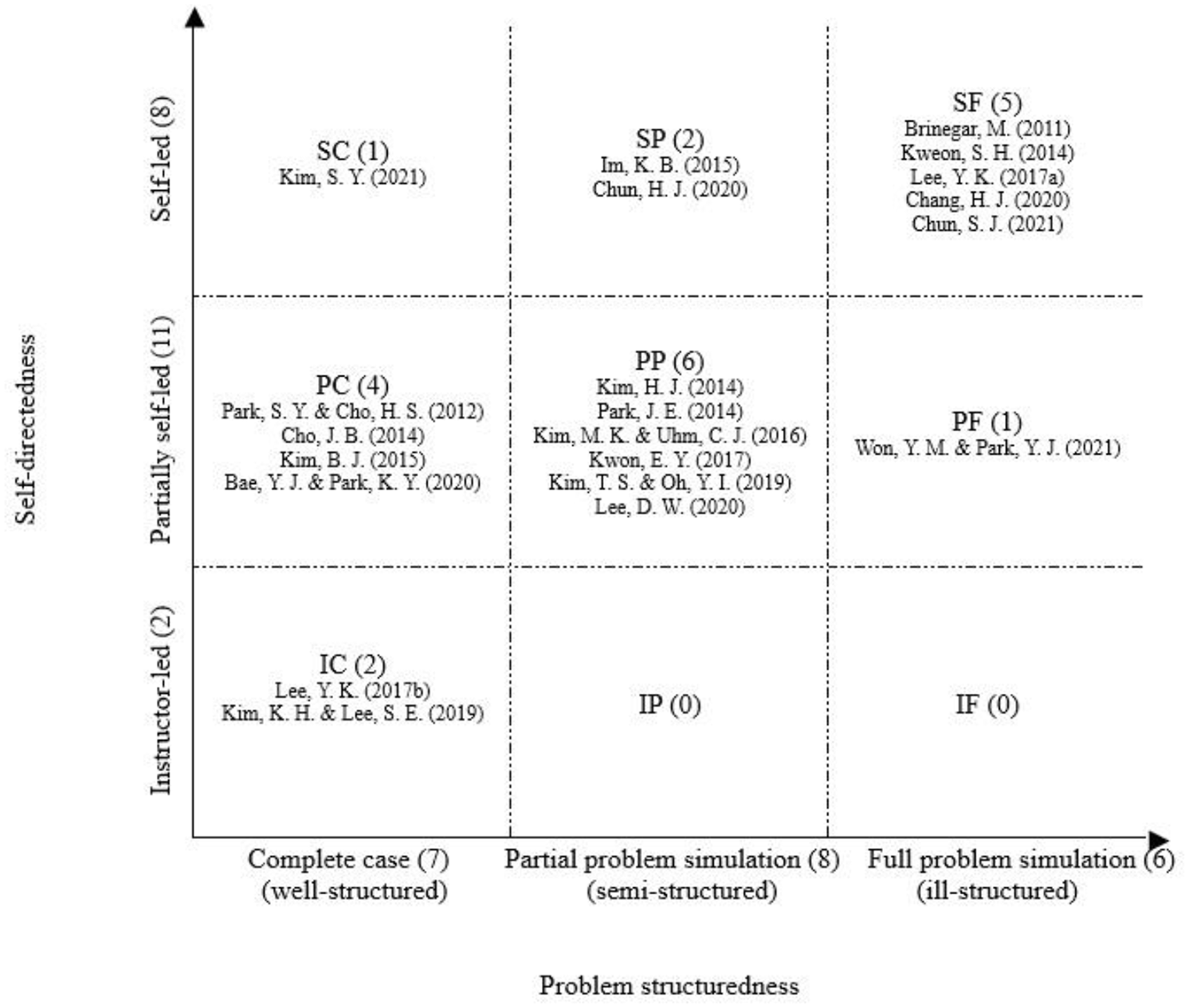
PBL types by self-directedness and problem structuredness. *The types of PBL applied in the studies by Y. Lee and Kim (2019), M. H. Shin (2019), I. H. Park (2020), Yun and Maeng (2021), and S. J. Park et al. (2022) were not identifiable. *IC means instructor-led with complete cases, PC partially self/instructor-led with complete cases, SC self-led with complete cases, IP instructor-led with partial problem simulation, PP partially self/instructor-led with partial problem simulation, SP self-led with partial problem simulation, IF instructor-led with full problem simulation, PF partially self/instructor-led with full problem simulation and SF self-led with full problem simulation.
Regarding problem structuredness, 14 out of 21 studies (66.7%) adopted semi-structured or ill-structured problems. Concerning self-directedness, 19 studies (90.5%) implemented partially self-led or self-led modes of learning. These findings suggest that Korean English teachers have attempted to implement learner-centred constructive lessons through PBL, moving away from traditional teacher-led approaches, although they may face challenges in developing or applying ill-structured problems.
The Teacher and Student Roles in PBL
The implementation of PBL was analysed through four human factors critical to its success (Ferrero et al., 2021; Hung, 2011): (a) students’ behaviour, (b) facilitators’ behaviour, (c) resources and workload, and (d) small group learning. A total score approaching 12 indicates active and interactive PBL implementation with abundant teacher-student roles and supporting materials. Kweon’s (2014) study achieved high in all four factors, scoring 12 and employing the SF mode. In this study, students worked in five groups of six on a PBL-based English literature programme, communicating both in class and online. The lecturer explained the guidance for a collaborative writing project aimed at publishing in the college newspaper – an ill-structured problem scenario with multiple possible outcomes. Students independently defined the problems; clarified hypotheses, prior knowledge and learning issues, and developed action plans; and searched for relevant information. Their manuscripts were peer-reviewed during presentation sessions.
Seven studies (Bae & Park, 2009; Chang, 2020; H. J. Chun, 2020; S. Chun, 2021; B. J. Kim, 2015; S. Y. Kim, 2021; Kwon, 2017) scored above nine, demonstrating active teacher-student interaction and providing clear implementation guidelines for ELT instructors (see Table 8). While no study scored zero, four studies (Cho, 2014; K. Kim & Lee, 2019; T. S. Kim & Oh, 2019; S. J. Park et al., 2022) lacked specific information about the four human-related factors. S. J. Park et al. (2022) omitted data about their PBL type, while the other three studies indicated their types but not teacher-student roles, which potentially compromised their validity. In detail, 38.5% of studies scored level 3 and 26.9% level 2 for students’ behaviour, while 30.8% scored level 3 and 42.3% level 2 for facilitators’ behaviour. Both resources/workload and small group learning showed 30.8% at level 3 and 11.5% at level 2. However, gap information existed: 34.6% (students’ behaviour), 26.9% (facilitators’ behaviour), 57.7% (both resources/workload and small group learning) lacked explicit details (Brinegar, 2011; Im, 2015; Kim, 2014; Kim and Uhm, 2016; Park, 2014).
Analysis of Teacher and Student Roles.

Note. NI = not identifiable.
These findings suggest that while 65% to 70% of the studies showed active student and facilitator roles above mid-level, only 42% revealed sufficient resources/workload and small group learning. The high percentage of missing information in these latter categories may indicate Korean English teachers’ challenges in material preparation, workload management and group dynamics control.
Based on these findings, implications for context-sensitive PBL-based ELT programmes implementation are discussed in the following section.
Discussion
Issues Regarding Target Areas, Pedagogical Effects and Measurement Tools
In more than 60% of studies, instructors adopted PBL to increase students’ satisfaction with their ELT programmes. This suggests that communications and meaning negotiations, group work, learning participation and feedback through PBL enhances students’ learning experiences. Given students’ positive responses, instructors may be more likely to maintain this pedagogical approach. In addition, the demonstrated effects of PBL on course satisfaction provides rationales for Korean English teachers to shift from teacher-led knowledge transmission to student-centred instruction. Instructors can reference research providing specific and systematic PBL procedures, such as Kweon’s (2014) work or studies focused on course evaluation (S. Chun, 2021; T. S. Kim & Oh, 2019; D. W. Lee, 2020), alongside cases from Asia (Ansarian & Lin, 2018; C. Chen et al., 2021; Lin, 2018; Xie, 2022) and other regions (Rillero et al., 2018; Walker & Leary, 2009).
The finding that 46.2% of studies revealed positive effects of PBL on language competencies. These studies show improvements in students’ reading (K. Kim & Lee, 2019; Kwon, 2017), listening (S. Y. Park & Cho, 2012), writing, speaking (Yun & Maeng, 2021) and vocabulary (Y. K. Lee, 2017b; Y. Lee & Kim, 2019) through PBL, providing concrete evidence for PBL’s effectiveness in ELT. However, this relatively low rate suggests that Korean English teachers may still have some scepticism towards PBL as a language teaching method (see Keum, 2019; K. W. Park, 2012). This implies a need for more research on PBL’s effects on language development to further validate its effectiveness.
Then enhancement of language learners’ social skills, higher-order thinking skills and affective aspects through PBL indicates its potential for developing competencies valued in contemporary Korea: collaboration, information processing, creative thinking, and self-management – foundations of English communication competencies (MOE, 2022). These diverse benefits provide multiple rationales for PBL implementation.
In measuring PBL effects in ELT, over 50% of studies used only quantitative tools, 11% qualitative tools and 35% mixed-methods. The prevalence of quantitative approaches in Korea extends beyond ELT to management (Baek, 2006) and advertising (S. Lee & Kim, 2013) research. While quantitative tools have been widely used across all target areas (see Table 7 and Figure 3), optimal tool selection should vary by research area. Researchers’ professional training in qualitative research and development of balanced perspectives on various measurement tools appear necessary. Meanwhile, mixed methods enable more comprehensive understanding of the phenomena through data triangulation (Turner et al., 2016). For example, Kwon (2017) examined changes in students’ listening and reading competencies through tests and interviews, which revealed both students’ performance improvements and perceptions. Similarly, T. S. Kim and Oh (2019) analysed questionnaire responses and group task performance in their study of preservice teachers’ English pronunciation, providing both the teachers’ and students’ perspectives.
The use of qualitative tools alongside quantitative methods would enable researchers to better understand PBL effects on the changes in students’ motivation, identity and learning process, or some metacognitive and affective aspects. However, research on students’ (meta)cognitive and socio-affective aspects has rarely employed qualitative tools (see Table 7). Thus, future research would benefit from incorporating both approaches, allowing for Korean researchers’ and educators’ richer findings in PBL-based ELT programmes.
Issues Regarding PBL Types
PP type (semi-structured problems in a partially self-led mode) was most common (28.6%), followed by SF (ill-structured problems in a self-led mode) and PC (well-structured problems in a partially self-led mode). While SF represents an ideal constructivist approach, preference for PP or PC seems to suggest instructors’ context-sensitive adaptation of PBL in their ELT. Given that radical shifts towards SF may face teachers’ resistance in Confucian educational contexts where educational beliefs differ from Western approaches (Blömeke & Olsen, 2019; Keum, 2019), Korean English teachers appear to select PBL types based on their professional judgement on their contextual particularities. As Korean society and academic culture evolve alongside teachers’ development of professionalism, approaches may gradually shifts towards SF mode.
Regarding problem structuredness, the three levels of categories showed similar distribution, while in self-directedness, partially self-led and self-led modes were dominant (90.5%). This indicates that Korean English teachers’ efforts to implement learner-centred lessons by reducing teacher authority and increasing learner autonomy, which proved satisfactory to students. Future practitioners can thus confidently apply student-led PBL modes, while adjusting teacher-student responsibilities through context analysis. In deed Korea, China and Vietnam have developed distinct interpretations of Confucianism through their unique social and political experiences, leading to varied emphasis in education, leadership, and entrepreneurship (Schenck, 2024; Tho, 2016; Walker & Truong, 2018; Wang & Billioud, 2022). Thus, the mode of self-directedness can be selected flexibly and contextually.
However, only six among 21 studies (28.6%) adopted ill-structured problems. This suggests that Korean teachers may face challenges in designing and managing pedagogical problems for PBL. Thus, providing training workshops or professional development programmes in PBL problem organization, along with distributing guidelines for developing and implementing ill-structured problems, could offer valuable support to PBL practitioners and help them build confidence in running PBL (Ertmer et al., 2017; Keum, 2019). Participation in professional communities can further enhance their problem development skills through collaborative efforts (K. W. Park, 2012).
Issues Regarding Teacher and Student Roles
Understanding teacher and student roles in PBL classes provides specific guidelines for potential PBL practitioners. Eight studies (30.8%) offered detailed descriptions of these roles. They demonstrated effective PBL implementation where students engaged in interactive, self-directed learning within manageable groups, while teachers provided sufficient guidance, materials and modelling. Studies by Bae and Park (2009), H. J. Chun (2020), S. Chun (2021), Kweon (2014), and Kwon (2017) are particularly noteworthy. Kwon’s (2017) study of mobile-mediated PBL clearly defined both roles. The teacher presented ill-structured problems, provided vocabularies and expressions to use and later reviewed students’ language usage against native-like forms. Then, students engaged in mobile-based tasks including information searches and collaborative discussions. These details offer a valuable guideline for mobile-based PBL in ELT.
However, the low rates of active student roles (38.5%) and guiding teacher roles (30.8%) reflect Korean language classrooms may not be fully prepared for complete PBL implementation. This could stem from their university entrance system, which prioritises test scores focusing on reading skills through paper-and-pencil methods (G. Kim et al., 2022), similar to China (Jin, 2022) and Vietnam (Huu Thanh, 2020). Fostering more active student roles and supportive teacher roles in PBL-based language classes requires changes in both language testing methods and teachers’ educational beliefs.
Meanwhile, the absence of information about applied resources, workload, and small group dynamics in 57.5% of studies limits their usefulness for teachers planning PBL-based ELT programmes. For pedagogical benefits and research reliability, studies should explicitly detail teacher-student interactions, materials and procedures. This omission may reflect researchers’ lack of confidence in their material selection and developments and group management. Given that Korean teachers are accustomed to using mandated textbooks and transmitting knowledge (Han, 2016b; Kong & Sung, 2021; Lim & Kye, 2019), their autonomy and professionalism as PBL practitioners may require more development. However, as contextualisation of PBL requires content and procedures of lessons aligned with learners’ background, and perspective (Hearn & Hopper, 2008), teacher training need to focus on cultivating Korean teachers’ ability to develop materials based on student needs, levels, and interests, and to manage student interaction professionally, helping them gain practical knowledge for learner-centred practices.
Conclusion and Further Studies
The current study reviewed PBL implementation in Korean ELT, focusing on (a) target areas, pedagogical effects and measurement tools, (b) PBL types, and (c) teacher and student roles. Over 60% of studies used PBL to increase student satisfaction with ELT programmes. About 46% aimed to enhance students’ language competencies. Others focused on developing social skills, higher-order thinking skills and affective aspects. Over 50% of the studies employed quantitative methods, 11% used qualitative methods and 35% adopted mixed-methods. In terms of problem structuredness, well-structured, semi-structured, and ill-structured forms were applied at nearly equal rates. Concerning self-directedness, partially self-led and fully self-led modes accounted for 90%. Thus, semi-structured problems in partially self-led modes were most common (28%). Only 30% of studies provided detailed descriptions of teacher-student roles, showing interactive, self-directed learning with teacher guidance and modelling.
Further academic endeavours seem necessary. Given the limited literature on PBL-based ELT in Korea, more studies exploring pedagogical rationales, benefits and challenges are needed. Comparative research across different educational levels could provide meaningful information for contextualising PBL. In addition, studies can address the relationship between programme duration and learning effectiveness, as metacognitive skills, social skills, and constructive learning habits take time to develop (Lindt, 2018). Research developing valid and reliable measurement tools for learner cognition, metacognition and social skills transformation would enhance the study quality.
While studies have focused on measuring students’ changes, they have not been interested in identifying changes in instructors in and through PBL-based ELT. Studies about their difficulties in implementing PBL-based ELT programmes or changes in their professionalism and professional identity after running the programmes are expected to provide teachers and researchers with significant rationales for applying PBL. Furthermore, applying this review’s rubrics and models to international PBL studies could offer several implications for advancing PBL-based ELT programmes.
Footnotes

Funding
The author(s) received no financial support for the research, authorship, and/or publication of this article.
Declaration of Conflicting Interests
The author(s) declared no potential conflicts of interest with respect to the research, authorship, and/or publication of this article.
Data Availability Statement
The data that support the finding of this study are available on request from the corresponding author.