




Abstract
Meta-mood encompasses an aspect of emotional intelligence, revealing an individual’s ability in perceiving emotions, regulating emotional states, and comprehending and contemplating mood. Given the scarcity of instruments assessing emotional intelligence in Greece, the present study aimed at adapting and validating the 30-item Trait Meta-Mood Scale (TMMS), originally developed by Salovey and colleagues, for use within the Greek population. The TMMS is a self-report questionnaire designed to assess meta-mood through a five-point Likert-type scale, measuring three factors: Clarity, Attention, and Repair. The sample included 957 adults (707 females), aged 18 to 80 years, representing diverse socioeconomic backgrounds and regions across Greece. Structural validity was assessed through both Exploratory Factor Analysis (EFA – Promax rotation) and Confirmatory Factor Analysis (CFA). Scale score reliability was assessed utilizing Cronbach’s alpha coefficient for each factor, as well as for the overall number of items. The EFA initially provided some support to a potential four-factor model, however validity concerns and further confirmatory factor analyses preferentially supported the three-factor structure of the TMMS. Overall, the scale demonstrated robust scale score reliability, with satisfactory Cronbach’s alpha coefficients for the composite scale and each factor of the original three-factor model (α > .70 for all subscales, and α > .80 for two out of three subscales). In conclusion, this study affirms the TMMS as a reliable tool for assessing trait meta-mood in the Greek population. Furthermore, it adds to the discussion on the potential impact of sex and cultural differences on trait meta-mood and the factorial structure of the questionnaire.
Plain Language Summary
This research describes the adaptation of a scientific tool developed to measure meta-mood, which is considered to be an important aspect of emotional intelligence. This term describes one’s ability in perceiving emotions, regulating emotional states, and comprehending and contemplating their own mood, as well as the mood of others. A small number of scientific tools created to measure emotional intelligence exist in Greece, so we believe that our adaptation of the popular Trait Meta-Mood Scale (TMMS), originally developed by Salovey and colleagues, will provide researchers with evidence that this tool is appropriate to use in the Greek population and will help promote scientific research on this topic in Greece. TMMS is a self-report questionnaire, where participants answer questions revolving around three dimensions of meta-mood: Clarity, Attention, and Repair. To assess the suitability of using this tool in Greece, we collected responses from a large and representative sample of Greeks of all ages (18 – 80) and genders, representing diverse socioeconomic backgrounds and regions across Greece. We use appropriate statistical analyses to make sure that we get an accurate measure of meta-mood and that the translations of the items used retain their original meaning, as developed in the English questionnaire. Overall, our results suggested that the adaptation was successful and that the Greek version of the questionnaire can be used in a similar way to the original research studies with the English questionnaire, to assess trait meta-mood in the Greek population. Furthermore, it adds evidence to an ongoing discussion of potential gender differences in reported trait meta-mood, and whether cultural differences exist on the reported levels of trait meta-mood. These issues can help us better understand the notion of trait meta-mood.
Introduction
In recent years, research on individual differences related to processing and using emotional information is on the rise (Mayer et al., 2008). The main idea behind this is that individuals who can effectively express and understand emotions, attribute meaning to their emotional experiences, and manage their emotions, are likely to achieve better psychological and social adjustment (Ciarrochi et al., 2001). As a general umbrella term, emotional intelligence (EI) accounts for numerous such abilities (Mayer & Salovey, 1997). While there are multiple theoretical frameworks for understanding Emotional Intelligence (EI; see Mayer et al., 2000, for a review), the most prominent is Mayer and Salovey’s (1997) ability model. This model characterizes EI as “the ability to perceive accurately, appraise, and express emotion; the ability to access and/or generate feelings that facilitate thought; the ability to understand emotion and emotional knowledge; and the ability to regulate emotions to foster emotional and intellectual growth” (Mayer & Salovey, 1997, p. 10).
After this initial definition, subsequent conceptualizations of EI integrated additional emotional constructs beyond the established core elements of perceived social emotional attributes, personality traits, and competences, resulting in new mixed models or trait EI (Brackett et al., 2006).
Researchers followed two methodologies to assess emotional intelligence (EI): objective performance assessment (e.g., Mayer-Salovey-Caruso Emotional Intelligence Test – MSCEIT, Mayer et al., 2003) and self-reporting on emotional thinking. Despite the inherent limitations of self-reporting, which represent an indirect approach to evaluating EI constructs, they offer several advantages. For example, these methods are easy to administer, necessitating no previous training for researchers, and are time-efficient. They are particularly suitable for capturing ongoing conscious processes of EI associated with real-life situations, as opposed to the characteristics of EI laboratory assessments which display low ecological validity (Giovannini et al., 2014; Mayer et al., 2000). Furthermore, even prominent performance-based evaluations such as the well-established Mayer-Salovey-Caruso Emotional Intelligence Test (MSCEIT; Mayer et al., 2003) encounter issues concerning their psychometric properties, notably their factor structure (Fan et al., 2010). Therefore, researchers suggest that contemporary research on EI should not exclusively hinge on ability or performance-based assessments but should also incorporate self-report measures (Giovannini et al., 2014).
There are several self-report scales available measuring aspects of EI. For example, some of them focus only on emotional perception (i.e., the Style in the Perception of Affect Scale – (SIPOAS; Bernet, 1995), while others encompass emotional regulation as well (i.e., Mayer & Gaschke, 1988). Meta-mood is a more comprehensive aspect of emotional intelligence, elucidating an individual’s ability in both perceiving emotions and regulating emotional states, in addition to understanding and reflecting on mood (Mayer et al., 2000). Therefore, Mayer and Gaschke (1988) described a reflective “meta-mood experience,” above and beyond the immediate experience of mood (e.g., happiness or sadness). The latter denotes the process through which individuals engage in self-reflection regarding their mood, encompassing both cognitive (i.e., their thoughts) and affective (i.e., their feelings) facets. This meta-experience stems from a regulatory process involving attention, evaluation, and action to modulate one’s emotional state (Salovey et al., 1995).
The Trait Meta-Mood Scale and Theoretically Related Constructs
The Trait Meta-Mood Scale (TMMS) was created to assess individual differences in a mood regulation process known as “meta-mood experience,” a term referring to the monitoring, evaluation, and regulation of emotions (Salovey et al., 1995). The TMMS is designed to evaluate three cognitive dimensions of emotional intelligence: attention to emotions (the degree to which individuals are aware of and focus on their emotional states), clarity (the ability to comprehend and differentiate between emotions), and repair (the capacity to manage moods and mitigate negative emotional experiences). A core assumption for TMMS scores is that they reflect stable, individual differences in how individuals respond to their emotional states. In a recent study assessing the factorial and construct validity of the TMMS with an Australian sample, Palmer et al. (2003) provided evidence supporting the typical factorial structure of the scale (with a potential fourth factor noted). The study also verified the TMMS’s construct validity as a measure of emotional management capabilities (see Fitness & Curtis, 2005).
The concept of meta-mood was approached by two different research traditions (Fernández-Berrocal & Extremera, 2008). The first tradition explored the reflective aspect of meta-mood as a temporary and situational state (state meta-mood), while the second conceptualized meta-mood as a stable characteristic (trait meta-mood). Trait meta-mood was also linked to individuals’ well-being and coping strategies, thus attracting considerable research attention in the next decades (Townshend, 2023). Regarding the attempts to assess trait meta-mood, as mentioned above, the initial effort was made by Mayer and Gaschke (1988), who formulated the 48-item Meta-Mood Experience Scale. This comprehensive scale included subscales that delved into aspects such as control, clarity, acceptance, typicality, and mood variability (Mayer & Gaschke, 1988).
Building upon this groundwork, Salovey et al. (1995) subsequently developed the 30-item Trait Meta-Mood Scale (TMMS) by reducing the number of trait meta-mood factors of the initial questionnaire to three (attention, clarity, repair) using a factor analysis. The Attention subscale measures the degree to which the individuals believe they are attentive, observant, and contemplative with regards to their emotions and moods. The Clarity subscale assesses the ability of individuals to comprehend their emotional states in a clear and consistent manner and make fine distinctions that might correspond to various emotional states. The Repair subscale evaluates the degree to which individuals believe they can regulate and alter their emotional states and moods to adapt more effectively to current circumstances and conditions (Salovey et al., 1995).
To date, the TMMS has been translated and adapted for use in various languages and countries, including Spain (Fernandez-Berrocal et al., 2004), Portugal (Queirós et al., 2005), Italy (Giovannini et al., 2014), France (Maria et al., 2016), Iran (Ramezani & Abdollahi, 2006), Australia (Palmer et al., 2003), Turkey (Aksöz et al., 2010; Bugay et al., 2014), Brazil (Câmara et al., 2023), Cuba (Fernández-Castillo et al., 2023), and Germany (Otto et al., 2001). Sample sizes and critical features differed between studies, with most studies including a convenient sample of only university students (e.g., Aksöz et al., 2010; Bayani, 2009; Fernandez-Berrocal et al., 2004; Maria et al., 2016). The Portuguese study sample comprised of 120 University students aged 18 to 24 years and 120 older adults over 65 years old (Cabral et al., 2021), thereby omitting participants within the age range of 25 to 64. In contrast, the samples in the Australian (n = 310), Italian (n = 885), and Cuban studies (n = 625) were characterized by a wide age range, encompassing young adulthood to old age (15–79, 18–64, and 15–80, respectively; Fernández-Castillo et al., 2023; Giromini et al., 2017; Palmer et al., 2003), and reflecting a more diverse demographic composition.
There is some variation in reported psychometric properties across different studies. The original validation study of the TMMS-48 (Salovey et al., 1995) indicated good scale score reliability for all three subscales (Attention to feelings: α = .86, Clarity of feelings, α = .88, and mood Repair, α = .82). Similarly, studies conducted in Spanish (Fernandez-Berrocal et al., 2004), Portuguese (Queirós et al., 2005), and Cuban populations (Fernández-Castillo et al., 2023) reported good scale score reliability (Cronbach’s a > .85 for all subscales). The Iranian study (Ramezani & Abdollahi, 2006) found acceptable scale score reliability. In the French study (Maria et al., 2016), scale score reliability was acceptable for the Clarity (α = .79) and Repair subscales (α = .74) and good for the Attention subscale (α = .85). The Italian study (Giovannini et al., 2014) reported acceptable scale score reliability for the Repair subscale (α = .75) and good scale score reliability for the Attention (α = .80) and Clarity (α = .87) subscales. The Turkish study (Bugay et al., 2014) indicated acceptable scale score reliability for the Clarity subscale (α = .79), marginally acceptable scale score reliability for the Attention subscale (α = .63), and poor scale score reliability for the Repair subscale (α = .59). Overall, except for the Turkish study, scale score reliability appears to be consistently robust across various studies.
Most previous studies have verified the original three-factor structure of the questionnaire in their respective populations indicating that this model is robust and unaffected by cultural differences. Two studies (Palmer et al., 2003; Raja et al., 2022) propose an alternative four-factor structure which retains the Attention, Clarity and Repair factors and adds a fourth factor. However, in one study (Palmer et al., 2003) only two items loaded independently in this factor thus the factor was not named, and the three-factor model was considered more appropriate for the study population. The other study using a sample of undergraduate psychology students (Raja et al., 2022), reported more items loading in the fourth factor. Researchers named that factor Susceptibility, as it represented how easily the person can switch to a positive/negative outlook.
Moreover, the existing body of research on the role of sex and gender in trait meta-mood, as assessed by the TMMS, remains limited and offers inconclusive findings regarding sex and gender differences in attention, clarity, and mood repair. In general, women tend to exhibit higher scores in attention to their emotions and moods (Giovannini et al., 2014; Maria et al., 2016), whereas men seem to score higher in repairing their moods (Queirós et al., 2005) and achieving clarity in their mood states (Maria et al., 2016). However, studies involving Spanish (Fernandez-Berrocal et al., 2004) and Brazilian samples (Câmara et al., 2023) reported no significant differences between men and women.
Significance and Context of the Study
Greece is a small Mediterranean country in southeast Europe, organized in 52 prefectures (in Greek: nomoi). Given the increasing need for assessing EI and the scarcity of validated instruments suitable for the Greek population, research in Greece is currently constrained by the absence of reliable and valid instruments suitable for EI assessment. In an earlier study, Tsaousis (2008) developed a specialized scale for measuring emotional intelligence in the Greek community, namely the Greek Emotional Intelligence Scale, based on the theoretical framework proposed by Mayer and Salovey (1997). His adaptation included cultural nuances and captured idiomatic, linguistic, and contextual aspects; however, this scale deviated in content from TMMS and did not adequately capture the variety of aspects of trait meta-mood, as it focused on the broader topic of EI.
Furthermore, cross-cultural investigations into EI can help with illuminating the applicability of the TMMS across diverse cultures and populations. Given the importance of cultural adaptation above and beyond mere translation (Arafat et al., 2016), and in order to allow for comparisons that take into account the aforementioned cultural nuances and their effect in the measurement of emotional intelligence between our target (Greek) population and populations in other countries, an approach combining the robustness of existing well-validated scales such as the TTMS with cultural fit and sensitivity, would be the most appropriate.
Research Goals and Hypotheses
For the present study, our primary goal was to translate the TMMS, one of the most widely used self-reported measures of emotional intelligence, in Greek, and evaluate its cultural suitability within the Greek population. Therefore, we examine the psychometric properties of the Greek version of the TMMS by assessing its factorial structure/validity and reliability. Namely, we assess whether a four- or three-factor structure is a better fit for the Greek version of the TMMS.
Overall, based on theoretical proposal (Brito-Costa et al., 2016; Salguero et al., 2010) of the original study by Salovey et al. (1995), we hypothesized (h1) a similar three-factor model (Attention, Repair, Clarity), with comparable psychometric characteristics, to emerge via Confirmatory Factor Analysis (CFA) for our Greek sample. We expect that Cronbach’s α will be >.70 for all factors/subscales. A second hypothesis (h2) was that all factors/subscales will be correlated to one another, given the evidence from studies in other countries’ adaptations of this scale.
As an additional goal of this study, we examined potential sex and gender-based differences in mean TMMS score and subscale scores. Given that a consensus on the role of sex and gender is lacking, and due to inconclusive findings from previous studies on the role of sex and gender in meta-mood self-report assessments, we had no concrete hypothesis regarding these sex and gender differences, apart from the possibility of sex and gender differences in some of the subscales (h3).
Notably, for the purpose of this study, we paid particular attention to both sample size as well as representativeness of the population (c.f. age, area of residence), to account for unique characteristics and cover the heterogeneity of the Greek population.
Materials and Methods
Participants
The study’s sample consisted of a diverse group of 957 participants (707 females and 250 males, 18–80 years old; see Table 1), a sample size near the top range of the required samples regularly used in such studies (Gunawan et al., 2021). Regarding age distribution, 38.9% of the participants fell into the 18 to 29 age group, 21.3% were aged 30 to 39 years, 19.5% were aged 40 to 49 years, 15.4% were aged 50 to 59, and 4.8% were over 60 years old. Educational levels varied within the sample: 15.3% had completed 0 to 12 years of education, 14.8% had received post-secondary education, 35.9% held undergraduate degrees, 28.4% possessed postgraduate degrees, and 5.4% of the participants held doctorate degrees.
The Profile of Our Sample, as a Summary of the Demographic Information Collected.
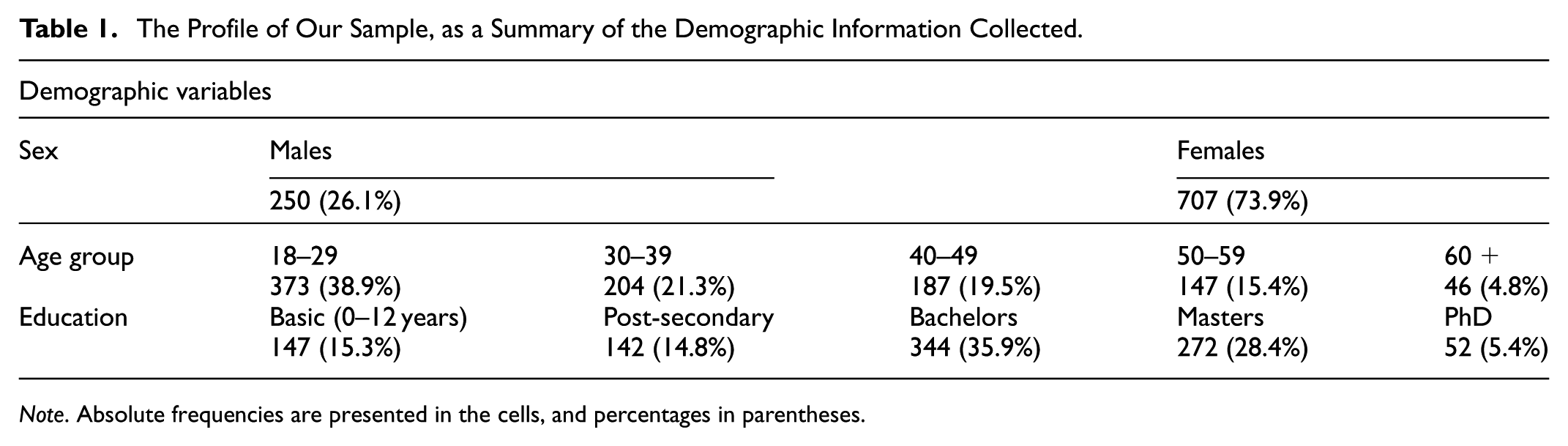
Note. Absolute frequencies are presented in the cells, and percentages in parentheses.
Convenience sampling was used, to allow for a large number of study participants. Prospective participants were recruited through a combination of both online and in person invitations to participate in the study. This approach was designed to maximize the external validity of our measurement, given that each of these approaches provides access to different age and SES groups, since older participants with lower SES are less likely to respond to online recruitment. Specifically, the call for participation for the study was distributed in a combination of ways: online, through social media, and in person with researchers in different Greek cities either visiting random houses and inviting residents to answer a printed version of the questionnaire, or by going to places where participants of particular age groups could be sampled, such as universities, cafes and senior resident clubs. Therefore, the geographical spread of the sample was comprehensive, including residents from all 52 prefectures of Greece. Exclusion criteria of the study comprised self-reported psychiatric or neurological diagnoses, or other medical conditions that could impact Central Nervous System functioning.
Measures
Sociodemographic Data Survey: Age, Sex, and Educational Level
The Sociodemographic Characteristics Questionnaire was designed to obtain information regarding participants’ sex and gender, age group (18–29, 30–39, 40–49, 50–59, 60–80), years of education, their place of residence within a Greek prefecture (village, town, or city), and whether they had received a neurological or psychiatric diagnosis, to be used as an exclusion criterion from the study.
The Original Trait Meta-Mood Scale
The Trait Meta-Mood Scale (TMMS), developed as an assessment tool for emotional intelligence, consists of 30 items grouped into three subscales: Attention to Feeling, Clarity in Discrimination of Feeling, and Mood Repair (Salovey et al., 1995). Example items for each subscale include: Attention (13 items, 8 reverse-scored) such as “Feelings give direction to life”; Clarity (11 items, 5 reverse-scored) such as “I am usually very clear about my feelings”; and Repair (6 items, 2 reverse-scored) such as “When I become upset I remind myself of all the pleasures in life.” Participants rate their agreement on a five-point Likert scale (from 1 = “strongly disagree” to 5 = “strongly agree”). Previously reported scale score reliability for these subscales has been robust, with coefficient alphas of .86, .88, and .82, respectively (Salovey et al., 1995).
Translation Process
This cross-sectional study adhered to the adaptation and validity analysis guidelines outlined by the International Test Commission (Bartram & Hambleton, 2016). When the need to adapt the TMMS for Greek participants arose, the researchers reached out to the primary author of the study “Emotional Attention, Clarity, and Repair: Exploring Emotional Intelligence Using the Trait Meta-Mood Scale” (Salovey et al., 1995). The author, representing himself and co-researchers, approved the adaptation of the instrument for Greek use (see Câmara et al., 2023 for a comparable application).
The translation and adaptation of the TMMS was done using the “forward and backward translation” method, following the protocol recommended by the World Health Organization (WHO; see Arafat et al., 2016, for a similar approach). Initially, the statements were translated into Greek (and adapted for the Greek culture when needed) by a person with an English literature degree and native-like level of English proficiency, who was at the same time a senior psychology student. A second person with an English literature degree, who was also a psychology student and was unaware of the original English text, performed the backwards translation. Both were uninformed about the aims of the study. A post-doctoral researcher with experience, and relevant published studies, in psychometric scale adaptation, verified that the backwards translation text matched the meaning of the original source text and language/ wording is unambiguous. As in the original version, participants rated their level of agreement to each statement using a five-point Likert scale (from 1 = strongly disagree, to 5 = strongly agree). A mean TMMS score, as well as scores on the three distinct subscales (Attention to feelings, Clarity of feelings, and mood Repair), were calculated to assess various aspects of trait meta-mood.
Finally, to assess the face validity of the scale, a focus group was conducted with two Cognitive Psychology faculty members, one English Language faculty member, one Neuropsychology postdoctoral researcher and one Cognitive Psychology postdoctoral researcher. The focus group indicated that the scale has high face validity, and no changes were proposed. The scale was pilot tested on a sample of 30 Greek adults. No issues such as lack of response or too homogenous responses across the sample were found for any items thus all items were retained.
Procedure and Data Collection
Data were collected using the 30-item Trait Meta-Mood Scale, originally developed by Salovey et al. (1995), as translated and adapted in Greek, and a Socio-demographic Characteristics Questionnaire. To conduct this study, the authors obtained approval by the Research Ethics Committee of the University of Western Macedonia (protocol number: 112/2023), and the procedures adhered to the guidelines for engaging human participants in accordance with the Declaration of Helsinki. All participants received thorough information outlining the study’s objectives. Before taking part, each participant formally acknowledged their comprehension of the study’s ethical principles and content by signing an informed consent form. Participants were individually assessed by filling out the two questionnaires at the time and place of their convenience, with a total duration of approximately 10 min.
Data Analysis
We initially assessed the adaptation of the TMMS scale in Greek using an Exploratory Factor Analysis (EFA), to test whether the factorial structure of our data agreed with the original scale as well as adaptations in other languages/countries and selected the items that maximize the internal validity of the emerging factors. After removing items with bad fit, we assessed different models using Confirmatory Factor analyses (CFA) to test the possibility of a three versus four-factor solution that seemed plausible through the results of our EFA as well as existing research studies. We also aimed at discovering a theoretically guided model with the best fit indices, paying particular attention to validity estimators for our emerging factors. Finally, we assessed the reliability of our measurements by calculating Cronbach alphas in the emerging factors, calculated descriptive measures of TMMS scores in the Greek population, explored the correlations between different factors, and assessed the differences in these scores between males and females. Descriptive statistics were computed, including the frequency and count for categorical variables, as well as the mean and standard deviation for continuous variables (c.f. Wei et al., 2015). All data analyses were performed using IBM SPSS v.25.
Results
Exploratory Factor Analysis
We initially explored the factorial structure of our adaptation of the TMMS scale using an EFA with Promax (oblique) rotation, given that the underlying constructs were expected to be interrelated. Unlike orthogonal rotations (e.g., Varimax), Promax allows for factor correlations, which is appropriate in the context of psychological constructs such as emotional attention, clarity, and repair, where some degree of conceptual overlap is anticipated. The Scree plot (and associated Eigenvalues, see Figure 1) seemed to favor a five-factor solution accounting for 50.8% of the total variance in our dataset. This fifth factor though only included three items, and the overall interpretability of this structure did not seem to be ideal. We therefore assessed a simpler, four-factor solution, accounting for a comparable level of 47.1% of the total variance. Unlike previous three-factor models, this model essentially split the “Attention” factor reported in such models in two parts (Aversion of Attention to Feelings/Rational Orientation − 10 items, and Preference for Attention to Feelings/Emotional Orientation – 5 items).

The scree plot resulting from the EFA on the 30 questions of the TMMS.
The “Aversion to Attention” factor accounted for 11.29% of the total variance (with the following factor loadings: Q9 0.29, Q2 0.41, Q11 0.41, Q23 0.46, Q4 0.51, Q17 0.55, Q18 0.56, Q29 0.59, Q3 0.62, Q27 0.62), and the “Preference for Attention” factor accounted for 6.24% of the total variance (with the following factor loadings: Q7 0.43, Q12 0.44, Q10 0.48, Q21 0.51, Q24 0.54). Moreover, the model revealed two additional factors corresponding to “Clarity” (10 items accounting for 21.8% of the total variance with the following factor loadings: Q14 0.32, Q6 0.47, Q20 0.50, Q5 0.54, Q22 0.63, Q15 0.63, Q16 0.68, Q28 0.70, Q30 0.79, Q25 0.80) and “Repair” (five items accounting for 7.76% of the total variance, with the following factor loadings: Q19 0.50, Q13 0.66, Q8 0.69, Q1 0.75, Q26 0.81; Table 2; see also Supplemental Appendix for the full pattern and structure matrix).
Results of Exploratory Factor Analysis.
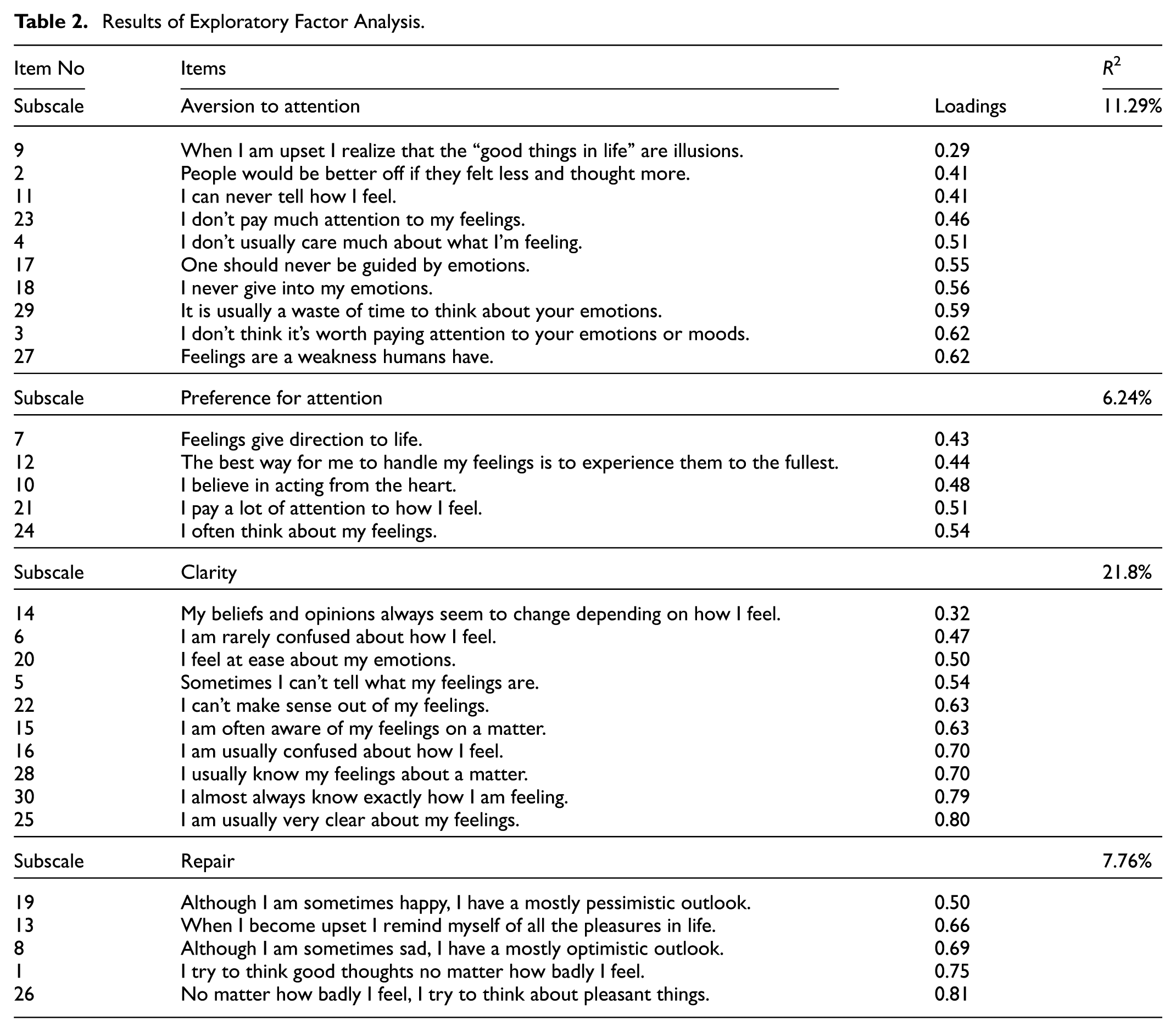
The inter-factor correlations indicated weak to moderate relationships among the factors. Specifically, the correlation between Aversion to Attention and Preference for Attention was .10, between Aversion to Attention and Clarity was .33, and between Aversion to Attention and Repair was .20. Also, between Preference for Attention and Clarity .08, Preference for Attention and Repair .09, and between Clarity and Repair .53 (see Supplemental Appendix).
With the exception of Attention, this factorial structure agrees with the original scale and many of its adaptations to other languages. This model was interesting and appeared to have a plausible interpretation of this split due to cultural particularities of our southern Greek sample, compared to the studies mostly conducted in Northern European and other Western Countries. Nevertheless, we removed five items from subsequent analyses due to the following reasons:
Items 2, 9, 14 for having loadings less than <.40, to increase the internal validity of the Greek scale.
Item 11 for having similarly high loadings (cross-loadings) to more than one factor.
Item 12 for being conceptually dissimilar to the other items in the factor.
Confirmatory Factor Analyses
Based on this preliminary EFA, we conducted further Confirmatory Factor Analyses, using 1,000 bootstrapped datasets extracted from our initial sample. This applies to all analyses presented below. Initially, we conducted a Confirmatory Factor Analysis (CFA) that attempted to distribute the remaining 25 statements into these four factors. In specifying the confirmatory factor analysis (CFA) model, we permitted a small number of error terms to covary within subscales. This decision was guided by both theoretical and empirical considerations. Modification indices suggested the presence of localized strain in the measurement model, and upon inspection, these were attributable to items exhibiting high semantic overlap or similar syntactic structure. The rationale for each correlated residual is summarized below:
Items 23 and 27 both reference individuals’ awareness of their own emotions.
Items 5 and 11 are conceptually near-identical and both reverse-coded.
Items 11 and 25, and 11 and 30, are paraphrases of the same conceptual construct, with reversed valence or coding.
Items 15 and 28 also show near-verbatim conceptual overlap.
Items 16 and 22 are both reverse-coded and semantically redundant.
These residual covariances were not introduced arbitrarily to improve model fit, but to account for shared item variance not captured by the latent construct - often due to redundancy or reverse wording. This approach is consistent with prior TMMS validations, such as Fernández-Berrocal et al. (2025), who also permitted error covariances between similarly worded items within subscales.
This four-factor model (Figure 2) presented a relatively good fit to our data (χ2 (257) = 1,245.49; p < .001, CMIN/df = 4.85, CFI = 0.87, GFI = 0.90, RMSEA = 0.06, SRMR = 0.08). As a guideline for the level of satisfactory fit to the data we follow the suggestion reported in Kline (2000): CFI > 0.9, GFI > 0.95, RMSE/SRMR < 0.08. These are commonly suggested minimum values in other sources as well.
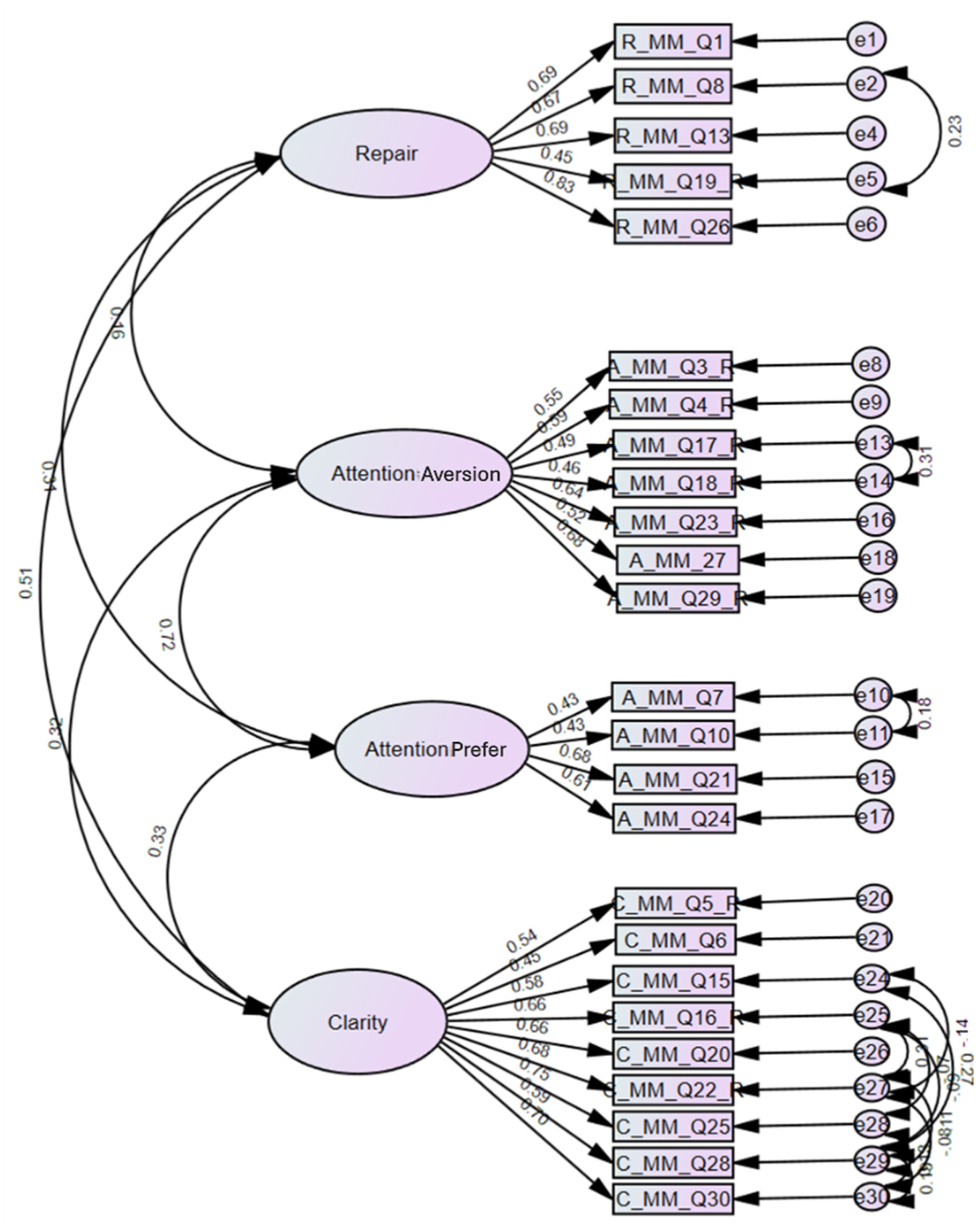
Four-factor model of the Greek TMMS.
Nevertheless, after assessing the Average Variance Extracted (AVE), Composite Reliability (CR) and Mean Shared Variance (MSV) of the four factors, some validity concerns were raised. The CR score for the “Preference for Attention” factor was slightly less than .70 (0.63), AVE for all four factors fell below the minimum 0.50 required (ranging from 0.30 to 0.46), the AVE for the two Attention factors was lower than their respective MSV and the square root of the AVE, particularly for the two Attention factors, was also less than the absolute value of the correlations with another factor. These metrics indicate potential validity concerns (Hair et al., 2010), especially for the two Attention factors, and raise doubts on this split of the typical “Attention” factor (Table 3).
Items in the Four-Factor Model of the Confirmatory Factor Analysis.

Therefore, we attempted to further improve our model and achieve better data fit and validity indicators by running a Confirmatory Factor Analysis (CFA) with three factors, close to the original scale and many of its adaptations to other languages (including a single “Attention” factor). Additionally, we imposed strict criteria on the statements to include in the analysis. Twelve items in total were excluded due to low loadings, cross-loadings, and/or incongruence with their theoretical alignment within factors. Beyond statistical considerations, several of these items also posed potential cultural challenges in the Greek context. For instance, the item “One should never be guided by emotions” conflicted with culturally embedded views of emotion in Mediterranean societies, where emotional expression and intuition are often regarded as integral to decision-making across personal and professional domains. Items with similarly rigid or moralistic framings of emotional behavior tended to perform poorly. In contrast, retained items were typically phrased in more neutral, descriptive terms.
The resulting three-factor CFA model used only 18 items with good internal validity, sufficient loadings (>0.5), and no cross-loadings on more than one factor. This model (Figure 3) exhibited a much better fit to our data (χ2 (125) = 579.01, p < .001; CMIN/df = 4.63, CFI = 0.92, GFI = 0.93, RMSEA = 0.06, SRMR = 0.06). The first factor, “Repair,” included four items with loadings ranging from 0.68 to 0.83. The second factor, “Attention,” included five items with loadings ranging from 0.55 to 0.69. The third factor, “Clarity,” included nine items with loadings spanning from 0.55 to 0.77 (Table 4).

Factorial structure of the Greek TMMS.
Items in the Three-Factor Model of the Confirmatory Factor Analysis.

In this model, the Average Variance Extracted (AVE) for Repair was 0.53, for Clarity 0.40 and for Attention 0.38. Even though AVE was below the 0.50 threshold for two of the three subscales, indicating potential convergent validity issues, it falls within the bounds of what can be considered acceptable (Fornell & Larcker, 1981). All other metrics were above minimum thresholds. AVE for each factor was greater than their respective MSV. Finally, CR for Attention was 0.71, for Repair 0.81, and for Clarity 0.86.
It is worth noting that, apart from the analyses presented, we built and compared various alternative models, with 30 items or less, and three to five factors. Regarding the number of factors, all fit indices favored the three-factor structure, even when considering models with no modifications (such as excluding items with low loadings or incorporating correlations among error terms). This three-factor, 18-item model had the best fit indices, best validity indicators, adequate loadings and lack of cross-loadings. Hence, we decided to keep this three-factor, 18-item model for the Greek version of TMMS, due to its superior psychometric properties, as well as its enhanced theoretical alignment with the original model proposed by Salovey et al. (1995).
Scale Score Reliability (Cronbach’s Alpha [a] & McDonald’s Omega [ω])
The overall scale score reliability estimates (Cronbach’s alpha and McDonalds omega) for the mean score, as well as the subscale scores in the Greek version of the TMMS were very good. Namely, mean TMMS scores show an α = .86 and ω = 0.86. The scale score reliability indicators were α = .81 and ω = 0.81 for Repair, α = .73 and ω = 0.73 for Attention, and α = .86 and ω = 0.86 for Clarity. Therefore, all three subscales of the Greek version of the TMMS demonstrate high scale score reliability, far surpassing the usual required minimum of α > .70 (Kline, 2000).
Descriptive Statistics of the Greek Version of TMMS (18-Item), Subscale Scores Correlations and Sex Differences
For the 18-item Greek version of TMMS, total scores ranged between a minimum score of 31 and maximum 90. Repair scores ranged from 4 to 20, Attention scores from 5 to 25, and Clarity scores from 9 to 45. Means and standard deviations are presented in Table 5.
Trait Meta-Mood Scale Means and Standard Deviations for total Score and Sub-Scores.

The means and standard deviations derived from the present sample provide a useful indication of meta-mood score patterns among Greek adults. However, given that the sex composition of our sample differs from that of the general Greek adult population, these descriptive statistics should be interpreted cautiously. Future research with samples more closely aligned with the demographic proportions of the broader population would contribute to the confirmation and generalization of these findings. All three subscale scores of the TMMS exhibited significant positive correlations with each other, as well as with the overall TMMS score (see Table 6).
Table of Correlations (r) Between TMMS Subscales and Total Scores.
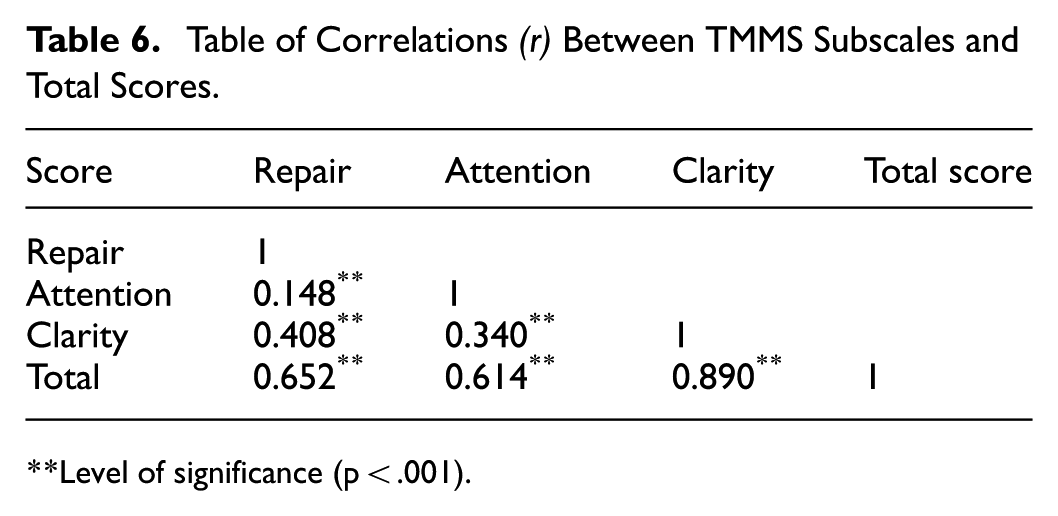
Level of significance (p < .001).
To investigate whether the influence of sex remains consistent across the three subscales, we conducted a MANOVA analysis with sex as the independent variable and each of the subscale scores as the dependent variables. The results indicate a statistically significant difference on the effect of sex on each subscale (F(3,953) = 22.77, p < .001, λ = 0.93, ηp2 = 0.07). Therefore, follow-up comparisons were carried out using a t-test to compare scores of each of the three factors between sexes. The Repair (t(955) = 1.77, p = .08, gHedges = −0.13) and Clarity (t(955) = 0.77, p = .44, gHedges = −0.06) subscales did not show statistically significant differences between sexes. However, a significant difference was found between men and women in the Attention subscale (where equal variances between the two groups were not assumed, due to a statistically significant Levene test (p < .001): t(379.66) = −6.66, p < .001, gHedges = 0.53). This effect size, measured by Hedges d, indicates a medium effect of sex in the Attention subscale, with women (M = 21.64, SD = 3.21) scoring higher than men (M = 19.84, SD = 3.84).
Discussion
The primary objective of the present cross-sectional study was to adapt and validate the Trait Meta-Mood Scale for use within the Greek population, thereby shedding light on the cross-cultural differences in perceived EI. More specifically we assessed structural validity and scale score reliability, along with potential sex differences. Concerning the factor structure of the Greek version of the TMMS, two alternative models were evaluated: a four-factor model comprising 25 items, and a three-factor model comprising 18 items. In line with our initial assumption, a three-factor model consistent with the factorial structure of the original scale (Salovey et al., 1995) appeared to offer the best fit for our data, thus verifying our first hypothesis (h1).
In more detail, the factor analysis revealed that the Greek version performed optimally when reduced to 18 items, suggesting that the effectiveness of the omitted 12 items might have been compromised due to potential cultural challenges faced by the Greek participants. This aligns with previous instances where researchers encountered cultural nuances and developed specialized instruments for emotional intelligence assessment in the Greek population, such as the Greek Emotional Intelligence Scale by Tsaousis (2008). However, it’s noteworthy that these prior instruments did not fully encapsulate the diverse facets of trait meta-mood. In our study, to ensure the highest psychometric quality for the Greek version of the TMMS, we opted to retain only those questions with loadings exceeding 0.50. Similarly high loadings are found in the Spanish version (Fernandez-Berrocal et al., 2004), which has the next least number of items (24) in the original instrument and is the most widely used version of the TMMS.
The scale score reliability indices for the Greek TMMS were deemed quite high, with Cronbach’s α values ranging from 0.73 to 0.86 and overall Cronbach’s α of 0.86. With the exception of the Portuguese version (Cabral et al., 2021), the versions in other countries demonstrated a pattern in which the Repair subscale had a Cronbach’s coefficient consistently lower than the Clarity and Attention subscales. However, in the sample of the present study, the Attention subscale seems to have the lowest Cronbach’s α. Some arguments suggest that the Attention subscale lacks cultural sensitivity for certain cultures (Townshend, 2023), potentially explaining its relatively lower scale score reliability in our sample. It would be intriguing to assess future improved versions of this scale in Greek and explore whether a cultural adaptation of the Attention factor could enhance its appropriateness.
Cronbach’s α of Clarity and Repair subscales in the Greek version were comparable to those in other countries. Specifically, the Cronbach’s α of the Greek version of the Clarity subscale was slightly higher than the French, Portuguese, and Turkish versions (Bugay et al., 2014; Cabral et al., 2021; Maria et al., 2016) and similar to those of Spanish, Italian, Australian and Iranian versions (Bayani, 2009; Fernandez-Berrocal et al., 2004; Giromini et al., 2017; Palmer et al., 2003). The Repair subscale exhibited a Cronbach’s α coefficient slightly higher than the French, Italian, Australian, and Turkish versions (Bugay et al., 2014; Giromini et al., 2017; Maria et al., 2016; Palmer et al., 2003), but slightly lower than the Spanish, Portuguese and Iranian versions (Bayani, 2009; Cabral et al., 2021; Fernandez-Berrocal et al., 2004). The Cronbach’s α for the Greek version of the Attention subscale was similar to that of the Turkish version (Bugay et al., 2014), but slightly lower than the French, Italian, Portuguese, Iranian, and Australian versions (Bayani, 2009; Cabral et al., 2021; Giromini et al., 2017; Maria et al., 2016; Palmer et al., 2003) and considerably lower than the Spanish version (Fernandez-Berrocal et al., 2004). Overall, the Cronbach’s α values found in this study align with those found in studies in other countries, showing small differences. As a point of caution, the reader should keep in mind that, even though we refer to findings from previous studies using the TMMS for conceptual comparison, these studies employed different versions of the scale (e.g., 30-item, 24-item, or 42-item formats). In contrast, the final Greek version used in this study consists of 18 items. While the overall structure of the TMMS is preserved across versions, differences in item composition and scale length limit the comparability of results. Therefore, any parallels drawn between our findings and those of prior research should be interpreted with caution and viewed as conceptual rather than direct comparisons.
When interpreting and comparing results across different TMMS studies, it’s essential to consider variations in sample size and composition. The present study encompasses one of the largest and most diverse samples among TMMS studies. Many countries predominantly focused on university students in their research designs (e.g., Aksöz et al., 2010; Bayani, 2009; Fernandez-Berrocal et al., 2004; Maria et al., 2016), limiting the age range. The Portuguese sample stands out by including 120 University students aged 18 to 24 years and 120 older adults over 65 years old (Cabral et al., 2021), although not all age groups were represented. Australia and Italy also featured wide age ranges from 15 to 79 and 18 to 64, respectively (Giromini et al., 2017; Palmer et al., 2003). Variations in Cronbach’s α values across countries may, in part, be attributed to differences in the composition of study samples.
In terms of the factorial structure of the questionnaire, it’s noteworthy that our EFA results are consistent with two other studies (Palmer et al., 2003; Raja et al., 2022) where a fourth factor additional to the three original TMMS factors (Clarity, Attention, Repair) was introduced. In one of those studies, only two questions loaded independently on the fourth factor, leading the authors to suggest that the original three-factor model is a better fit for their population (Palmer et al., 2003). In the other study (Raja et al., 2022), the fourth factor comprised more items, was named Susceptibility, and represented how easily a person can switch to a positive/negative outlook. Our exploratory factor analysis also initially seemed to favor a four-factor model, but with a different factorial structure from the one reported in those studies. In the Raja et al. (2022) study, the sample consisted only of young adult psychology students, raising the possibility that the emergence of this additional factor may be attributed to the characteristics of that sample. In our study’s four-factor model, the emerging Repair and Clarity factors were identical to the original factors reported by Salovey et al. (1995). The remaining Attention factor (a unitary factor in the original Salovey et al., 1995 study) seemed to be split to the Aversion to Attention (to feelings) and Preference for Attention (to feelings) factors. Essentially, these two factors represent the two main attitudes a person can have regarding attending to their feelings. While this model is interesting and could have a potential explanation within the cultural particularities of the Greek sample, it would merit further attention only upon evidence of convergent validity from future studies in Greece.
Overall, it has been postulated that cultural differences may contribute to the support of four-factor models in some regions; this hypothesis lacks sufficient support. Our study was conducted in Greece, whereas three other studies supporting a four-factor structure were conducted in Australia (Palmer et al., 2003), Portugal (Cabral et al., 2021) and the US (Raja et al., 2022). Despite the total number of factors found being four in all four studies, the emerging factorial structure differed. This divergence could be attributed to cultural differences between these regions; however, it’s noteworthy that the original three-factor model has found support in studies across diverse regions despite cultural differentiation. It could be argued that specific sample characteristics (such as age range, socioeconomic characteristics, etc.) may have contributed to the discovery of different factor structures, but there is no conclusive evidence to support this claim.
All factor/subscale scores (in the original three-factor model) were found to be positively correlated with each other in our sample. Our data therefore also corroborates our second hypothesis (h2). The average scores for Attention, Clarity, and Repair were comparable to those reported in an Australian study by Davies et al. (1998). However, that study only found a significant correlation between the Clarity and Repair subscales (r = .41; as cited in Fitness & Curtis, 2005). The correlations between factors in our study exhibited similar patterns to those observed in Iranian, Turkish, Australian, and Italian versions of TMMS (Aksöz et al., 2010; Bugay et al., 2014; Giovannini et al., 2014; Palmer et al., 2003; Ramezani & Abdollahi, 2006). The correlation between Clarity and Attention (r = .34) was slightly lower than the Turkish (r = .38; Aksöz et al., 2010; Bugay et al., 2014), Australian (r = .39; Palmer et al., 2003), Italian (r = .38; Giovannini et al., 2014), and Iranian versions (r = .51; Ramezani & Abdollahi, 2006). The correlation between Clarity and Repair (r = .41) was higher than the Italian version (r = .38) but lower than the Australian (r = .50) and Turkish versions (r = .63). Lastly, the correlation between Repair and Attention (r = .15) was lower than the Turkish (r = .23), Italian (r = .24) and Iranian (r = .38) versions, but slightly higher than the Australian version (r = .12). These findings, combined with the results from other studies, suggest that emerging factors may not be absolutely independent from each other, but show some overlap. However, within the Greek TMMS, such overlap is relatively low compared to other countries. The large and inclusive sampling, as well as the strict filtering of items to be included in the final Greek TMMS scale, might have contributed to these lower correlations between subscale scores.
There were some sex differences in TMMS scores in our sample with female participants exhibiting higher scores than men in the Attention subscale; however, no sex differences were found in the scores of the Repair and Clarity subscales. Thus, our third hypothesis (h3) is partly verified. Our observation of women surpassing men in Attention to feelings aligns with similar findings in Italian and French samples (Giovannini et al., 2014; Maria et al., 2016), two populations widely considered among the most culturally similar to Greeks within Europe. For instance, researchers in the Italian study attributed their finding to the large number of female psychology students in their sample, a population that might pay more attention to feelings due to their field of study and cultural aspects related to their Italian heritage (Aradilla-Herrero et al., 2014; Giovannini et al., 2014; Gorostiaga et al., 2011). It is worth noting that a similar sex imbalance exists in our study. Nevertheless, despite a more sex-balanced sample allocation in the French study, and students coming from different backgrounds, similar results were observed. Women again scored higher in Attention to feelings, while men scored higher on Clarity to emotions and Repair. This pattern was interpreted as reflecting women’s self-perceived attentiveness to their emotions.
In our study, where sampling encompassed participants from diverse professions and age groups for both men and women, we only found evidence for higher attentiveness scores among women compared to men. Hence, it might be safe to assume that sex disparities in the TMMS align with the assertion in a review by Fischer et al. (2018), claiming that the Western stereotype of women being more emotionally sensitive influences self-perceptions and responses on self-reported EI measures. In any case, additional research comparing performance-based and perceived EI measurements might help elucidate the causes of such sex disparities.
Conclusions
In conclusion, the Greek version of the TMMS exhibited excellent psychometric properties, indicating its reliability and validity as a measure of assessing perceived EI, and more specifically trait meta-mood, within the Greek population. However, findings from the Greek sample also raised questions that significantly contribute to the discourse on cross-cultural disparities. For instance, the removal of several items from the Greek version of the TMMS suggests that not all items were accurately understood and/or phrased in our adaptation. Additionally, the observed sex differences regarding women’s superior attention to feelings requires further investigation and discussion.
Limitations and Strengths
One notable limitation of this study was the significant sex imbalance among participants, with a disproportionately higher number of female participants. While this reflects a common trend in psychological and health-related research, where women are more likely to respond to voluntary participation requests, especially via online platforms, it limits the generalizability of our findings to the broader Greek population where the national gender ratio is nearly 1/1. Future studies should aim for a more balanced gender distribution, potentially through targeted recruitment strategies or stratified sampling.
Additionally, the 60 to 80 age group had fewer participants compared to other age groups. Another limitation was the lack of assessment of convergent validity of the TMMS with other self-reported measurements of EI, primarily due to the unavailability of alternative normed instruments for perceived EI assessment in Greek. Furthermore, the exclusive reliance on perceived EI instruments without linking the scores to performance-based EI assessment is also a limitation common in many such studies. There would be added value in future research that explores associations between perceived and performance-based EI assessments.
Conversely, a major strength of this study lies in its substantial sample size, potentially representing one of the largest cohorts in the context of an initial validation, translation, and adaptation of the TMMS in a foreign context. Moreover, another strength is our inclusive and random sampling method. Our notably diverse sample, covering a wide age range and diverse geographic locations, most likely adds to the external validity of our results. Overall, the current study makes a significant contribution by providing a newly validated and reliable measure in the form of the translated and adapted TMMS to Greek researchers and practitioners. Moreover, it opens the way for trait meta-mood research in Greece, and broadens the scope of research on perceived EI, pointing to new directions for future studies.
Future Research
Moving forward, it is advisable to conduct longitudinal administrations of the TMMS to assess its test-retest reliability. This would provide valuable insights into the stability of the instrument over time. Additionally, further investigations could explore factorial invariance based on sex and age, to enable a thorough analysis of differences. According to Gómez-Núñez et al. (2020), such an approach would provide valuable insights into potential variations in the structure of the TMMS across different demographic categories.
Expanding the application of the TMMS to various clinical and non-clinical populations is a promising avenue for research, offering the potential to uncover insights into the discriminant validity of the tool across diverse contexts. Exploring the applicability of the TMMS beyond Western cultures is another important consideration. Conducting similar studies in non-Western cultures, such as Asian and African countries, would contribute to the understanding of how meta-mood is perceived and experienced across different cultural frameworks.
Supplemental Material
sj-docx-1-sgo-10.1177_21582440251378070 – Supplemental material for Adaptation and Psychometric Properties of the Greek Version of the Trait Meta-Mood Scale
Supplemental material, sj-docx-1-sgo-10.1177_21582440251378070 for Adaptation and Psychometric Properties of the Greek Version of the Trait Meta-Mood Scale by Zoi A. Polyzopoulou, Amaryllis-Chryssi Malegiannaki, Konstantinos Tsagkaridis and Stelios Zygouris in SAGE Open
Footnotes
Acknowledgements
The authors would like to express their gratitude to Chionia Frantzezou and Sophia Chorafa for their invaluable contributions in the forward and backward translation of the Trait Meta-Mood Scale into the Greek language. Additionally, the authors extend their appreciation to Peter Salovey, John Mayer, Susan Lee Goldman, Carolyn Turvey, and Tibor Palfai for granting the necessary licensing for this endeavor.
ORCID iDs

Ethical Considerations
This study was conducted upon approval by the Research Ethics Committee of the University of Western Macedonia (protocol number: 112/2023). All procedures adhered to the guidelines for engaging human participants in accordance with the Declaration of Helsinki.
Consent to Participate
Participants declared their consent for participating in the study by signing an informed consent form after being provided all necessary information on the goals of the study and their right to withdraw their participation at any point.
Author contributions
All authors have contributed significantly to the work. Conceptualization, Z.A.P. and A.-C.M; methodology, Z.A.P., A.-C.M. and K.T.; validation, Z.A.P., A.-C.M., K.T., and S.Z.; formal analysis, Z.A.P., A.-C.M. and K.T; investigation, Z.A.P. and A.-C.M.; resources, Z.A.P.; data curation, Z.A.P., A.-C.M. and K.T.; writing-original draft preparation, Z.A.P. and A.-C.M.; writing-review and editing, Z.A.P., K.T., and S.Z.; visualization, Z.A.P and S.Z.; supervision, A.-C.M. All authors have read and agreed to the published version of the manuscript.
Funding
The authors received no financial support for the research, authorship, and/or publication of this article.
Declaration of Conflicting Interests
The authors declared no potential conflicts of interest with respect to the research, authorship, and/or publication of this article.
Data Availability Statement
Data are available from the corresponding author upon reasonable request.
Supplemental material
Supplemental material for this article is available online.
References
Supplementary Material
Please find the following supplemental material available below.
For Open Access articles published under a Creative Commons License, all supplemental material carries the same license as the article it is associated with.
For non-Open Access articles published, all supplemental material carries a non-exclusive license, and permission requests for re-use of supplemental material or any part of supplemental material shall be sent directly to the copyright owner as specified in the copyright notice associated with the article.
