




Abstract
The unpredictability of external environment has allowed task uncertainty to evolve into a leading feature of the work. In the face of task uncertainty, enhancing employees’ ability to respond to change in their work and environment helps them achieve more long-term and sustainable development within the organization. Based on social information processing theory and the conservation of resources theory, this study aims to investigate the mechanisms by which task uncertainty affects adaptive performance. The sample is based on data from 267 employees across different regions and industries in China. The results showed that task uncertainty respectively has an inverted U-shaped relationship with employee proactive behavior and adaptive performance. Proactive behavior has a mediating role between task uncertainty and employee adaptive performance. Developmental feedback from superiors negatively moderates the inverted U-shaped relationship between task uncertainty and proactive behavior, and also moderates task uncertainty and adaptive performance. The aforementioned research findings reveal the mechanisms of action and the boundary conditions of task uncertainty on adaptive performance. They also help guide organizational managers in stimulating employees’ adaptive performance through job design, as well as by providing developmental feedback and performance evaluations.
Keywords
Introduction
In this day and age, organizations face the combined effects of volatility, uncertainty, complexity, and ambiguity in the external environment (VUCA) and expect their employees’ competency structures and behaviors to evolve with the times as a means of enhancing both individual and organizational performance. The motivation and creativity of employees, as internal components of the organization, become key influencing factors (Thukral, 2021). Adaptive performance refers to an employee’s ability or efficacy to respond quickly to changes in the work situation, emphasizing key words such as initiative, agility, resilience, and resistance to stress, beyond the job content and scope of responsibility defined by the employee’s job (Griffin et al., 2007; Park & Park, 2021; Pulakos et al., 2000). Employees with higher adaptive performance are more capable of adapting to the ever-changing management situations of the VUCA era and taking positive actions to improve their competitive advantage in response to uncertain environments, tasks, and interpersonal relationships in order to access better resources in the organization. In the research on the influencing factors of adaptive performance, scholars mainly focus on personality traits (Marques-Quinteiro et al., 2019; Tang et al., 2024), support from superiors and colleagues (Chiaburu et al., 2013; Pradhan et al., 2017), organizational structure and flexibility (Stańczyk, 2017), leadership (Bonini et al., 2024; Kaltiainen & Hakanen, 2022), job characteristics (Park & Park, 2019; Sherehiy & Karwowski, 2014), and other aspects. Among the factors related to job characteristics, scholars have conducted relatively few studies exploring the impact of task uncertainty on employees’ adaptive performance. Therefore, analyzing the impact of task uncertainty on adaptive performance from the perspective of job characteristics in this study is conducive to enriching the research on the influencing factors of adaptive performance.
In the context of disorderly environmental changes affecting orderly economic and social development, task uncertainty gradually emerges and becomes the leading feature of work (Du et al., 2016), bringing certain impacts to the traditional working mode. Therefore, under the job characteristics of task uncertainty, how employees can improve adaptive performance to enhance their adaptability, responsiveness, and learning ability so as to improve job competence and performance level is a crucial proposition for individuals to grow and develop within the organization (Jundt et al., 2015). On the one hand, existing research has focused on the effects of task uncertainty on team performance (Cordery et al., 2010), individual psychological perceptions (Thau et al., 2007), and behaviors (Du et al., 2016; Yan et al., 2021). On the other hand, Regarding the effectiveness of task uncertainty, existing studies present divergent views. Firstly, most scholars consider task uncertainty as one of the sources that are detrimental to meeting employees’ autonomy needs (Cordery et al., 2010), specifically, task uncertainty can negatively affect employees’ self-adjustment ability and goal-oriented positive efforts (Matta et al., 2017; Um & Oh, 2021). Secondly, some scholars believe that task uncertainty can stimulate individuals’ curiosity and interest (Griffin & Grote, 2020), leading to a challenging work assessment (Irfan et al., 2024), which in turn positively affects individuals’ behavior (B. Guo, 2011; Knobloch, 2005; Yan et al., 2021) and performance (Um & Kim, 2018). Thirdly, other scholars also believe that task uncertainty has two sides and have gradually focused on its double-edged sword effect (Yan & He, 2022). In summary, Scholars have not reached a consistent conclusion regarding the effects of task uncertainty and have primarily focused on its negative impacts (Thau et al., 2007). In addition, Jundt et al. (2015) suggested that effectively handling tasks with variability, complexity, and flexibility is a key factor in achieving adaptive performance. Therefore, it is reasonable to assume that task uncertainty enhances employees’ adaptive performance. However, considering the effect of the intensity of task uncertainty, this study suggests that task uncertainty has an inverted U-shaped effect on adaptive performance. Meanwhile, Previous studies have primarily analyzed the effects of task uncertainty from the perspectives of uncertainty management theory and uncertainty reduction theory. (Griffin & Grote, 2020; Yan & He, 2022). Based on social information processing theory and conservation of resources theory, this study delves deeply into the double-edged sword effect of task uncertainty on adaptive performance from the perspective of information theory, which contributes to deepening scholars’ understanding of the effects of task uncertainty.
Under the conditions of task uncertainty, employees have insufficient information to process tasks, thus, task uncertainty imposes higher job requirements on them. The conservation of resources theory suggests that employees will take proactive behaviors to maintain or increase existing resources (Hobfoll et al., 2018). Prospective, initiative, and anticipatory characteristics of proactive behaviors reflect individuals’ energetic efforts to try to change the environment they are in to meet future expectations (Belschak et al., 2010), as well as constructive behaviors to meet the task requirements of work. In this process, proactive behaviors help individuals reach their desired goals (N. Chen et al., 2021) and improve their situation (Raki et al., 2021; Wee & Fehr, 2021). Previous studies have found that, in addition to being influenced by employees’ own factors (Ma et al., 2021; Tornau & Frese, 2013), leadership styles (Hong et al., 2016; K. Zhou et al., 2023), and the supportive atmosphere of the organization (McCormick et al., 2019), job characteristic factors are also important influences on individual proactive behaviors (Ding & Kuvaas, 2023; Urbach & Weigelt, 2019). However, research on the impact of task uncertainty on proactive behavior is not only limited but also suggests that it can have a negative effect on proactive behavior (Pratama et al., 2023). In terms of the effects of proactive behavior, previous studies have explored its impact on employees’ job performance, colleague relationships, and job innovation, among other aspects (Cooper-Thomas et al., 2014; Gong et al., 2012; Parker et al., 2019; Thompson, 2005). Compared with research on the influencing factors of proactive behavior, scholars have conducted relatively less exploration into the effects of proactive behavior. Based on the above research, in the context of the VUCA era, proactive behavior not only helps employees cope with task uncertainty but also promotes the improvement of their adaptive performance. Proactive behavior may become a key mediating variable for analyzing the relationship between task uncertainty and adaptive performance.
Proactive behaviors of individuals need to be formed in certain contexts. Developmental feedback from superiors is recognized as an important contextual variable in analyzing superior-subordinate interactions (G. Li & Xie, 2023). Superiors wield professional authority and align with employees in shared goals. As a behavior modification tool (J. Zhou, 2003), the main purpose of developmental feedback is to focus on the expectations of employees’ future development, and based on which to provide them with relevant and constructive feedback (Sommer & Kulkarni, 2012). Thus, superiors can offer developmental feedback that furnishes employees with valuable work resources, including support, information, collaboration opportunities, and learning experiences (J. Zhou, 2003). This feedback also mitigates employees’ perception of task uncertainty across emotional, competency-related, and cognitive dimensions. In addition, based on conservation of resources theory, developmental feedback from superiors provides employees with a sense of belonging and caring (W. Su et al., 2019). These emotional resources not only motivate employees to invest more time and energy in coping with task uncertainty, but also promote proactive behaviors and attitudes to address work challenges (Cropanzano et al., 2017; Kim et al., 2018), which in turn improves personal creativity and performance (Sibunruang & Kawai, 2024; Y. Guo et al., 2014; Z. Zhang et al., 2024). In the research on the impact of task uncertainty, scholars have analyzed the effects of internal organizational factors such as personal perception and organizational membership (Du et al., 2016), task complexity (Um & Oh, 2021), sense of organizational support (Chiaburu et al., 2013), and leaders’ control abilities (Colquitt et al., 2012). However, feedback, as the final link in performance management, has not received much attention yet. Based on the above analysis, the introduction of superior developmental feedback in this study to analyze its impact on task uncertainty has certain research value.
Based on the research gaps identified above, this study constructs an analytical path of “environment-behavior-performance” and explores the mechanism by which task uncertainty affects employees’ adaptive performance in the context of Chinese culture. Grounded in social information processing theory and conservation of resources theory, it focuses on analyzing three issues: (1) How does task uncertainty affect employees’ adaptive performance? (2) How does employee proactive behavior mediate the relationship between task uncertainty and employee adaptive performance? (3) How does developmental feedback from superiors moderate the relationships between task uncertainty and both employees’ proactive behavior and adaptive performance? This study presents the following key theoretical contributions. First, it enriches scholars’ understanding of the validity of task uncertainty. Second, the mediating effect of proactive behavior is explored from the perspective of positive psychology. Finally, the moderating effect of superior developmental feedback is analyzed based on conservation of resources theory. In addition, the findings of this study contribute practically by guiding managers in organizations to stimulate employees’ adaptive performance through job design, the provision of developmental feedback, and performance appraisals.
Theoretical Basis and Research Assumptions
Theoretical Basis
The social information processing theory points out that individuals will interpret the information in the social environment they are in and influence their behavioral outcomes through the processes of learning, attribution, and judgment (Salancik & Pfeffer, 1978; Zalesny & Ford, 1990). Furthermore, the conservation of resources theory was initially developed as a stress theory to explain the mechanisms by which individuals cope with stress. It describes the process of resource interaction between individuals and their social environment, clarifying that individuals tend to protect and acquire resources to cope with environmental changes and stress (Hobfoll et al., 2018). In conclusion, both the social information processing theory and the conservation of resource theory reflect the interaction between individuals and their social environment.
Therefore, this study posits that task uncertainty and developmental feedback can be regarded as information related to the work environment. Employees’ acquisition and interpretation of the uncertain information conveyed by tasks can affect their behavior and outcomes. Additionally, task uncertainty can cause employees to feel pressured to meet the demands of their work (Gutnick et al., 2012). On the one hand, when the level of task uncertainty is relatively low, employees have a sense of control and competence over their work (Y. Chen et al., 2024). They complete tasks according to a fixed workflow (Shen et al., 2021). In this situation, employees have neither the motivation nor the need to take proactive behaviors or enhance adaptive performance. On the other hand, when the level of task uncertainty is relatively high, the information and resources required to deal with this uncertainty may exceed the working capacity of employees (Tiwana & Keil, 2009). At this point, employees interpret task uncertainty as obstructive stress. They tend to preserve their existing resources to maintain a sense of control rather than engage in proactive behaviors, thereby reducing adaptive performance (Shoss, 2017). Based on the above analysis, when the level of task uncertainty is moderate, employees have sufficient resources to cope with the work requirements associated with task uncertainty. At this point, they are highly motivated to engage in proactive behaviors, acquire resources to address challenges, and enhance their adaptive performance. In conclusion, task uncertainty has an inverted U-shaped effect on both proactive behavior and adaptive performance.
At the same time, developmental feedback reflects support for work resources from superiors and can alleviate the work pressure caused by task uncertainty (Ong & Johnson, 2023). When the level of developmental feedback is high, it provides emotional and informational resource support for employees, which enhances their expectations of dealing with task uncertainty (Rasheed et al., 2015; Z. Zhang et al., 2024) and thereby helps them engage in proactive behaviors to improve adaptive performance (X. Y. Su et al., 2022; Yang et al., 2019). Based on this, higher developmental feedback from superiors helps mitigate the inverted U-shaped impact of task uncertainty on employees’ proactive behavior and adaptive performance. Conversely, a lower level of developmental feedback from superiors enhances the inverted U-shaped relationship between task uncertainty and employees’ proactive behavior and adaptive performance. Overall, this study, based on social information processing theory and conservation of resources theory, reveals the mechanisms and boundary conditions of the impact of task uncertainty on adaptive performance.
Task Uncertainty and Adaptive Performance
Adaptive performance is a dynamic complement to traditional “task-perimeter” performance, which is the performance of employees who adapt to unpredictable changes. Employees with adaptive performance enhance individual adaptability, flexibility, and initiative to tasks and are drivers of individuals’ long-term development within the organization. Nandini et al. (2022) concluded that different job task characteristics have different predictive effects on employees’ adaptive performance. In the VUCA era, task uncertainty gradually became a more prominent job characteristic and attracted the attention of scholars, but its concept was introduced by Perrow (1970), which refers to the inadequate information required to process a task, resulting in the task not being completed according to the prescribed procedures, and specifically contains two dimensions: first, the analyzability of the task, and second, the variability of the task. Scholars have different insights about task uncertainty, on the one hand, uncertainty perception leads to employees’ reduced sense of precognition, control, and security of the environment (Tiwana & Keil, 2009), and employees’ loss of security generates negative emotions and perceptions such as anxiety, doubt, low work happiness, and low self-efficacy (Colquitt et al., 2012), which shows that task uncertainty is detrimental to employees’ performance or innovation performance. On the other hand, it has also been demonstrated that task uncertainty stimulates individual intelligence and exhibits flexibility, which in turn drives employees to seek ways to solve problems and promotes employees’ advice behavior (Du et al., 2016), employees’ innovative behavior (Pierce et al., 2009), entrepreneurial behaviors (Yan et al., 2021), and job performance (Griffin et al., 2007; Shen et al., 2021).
Conservation of resources theory suggests that task uncertainty poses new job demands that can facilitate employees to break with established ways of working and promote the formation of individual job resources for adaptive performance, which in turn facilitates the reduction of uncertainty perceptions (Knobloch, 2005). Moreover, Starting from the social information processing theory, the implicit complexity and proactive characteristics of task uncertainty stimulate individual thinking and cognition (Frese et al., 2007), and neither too high nor too low a level of task uncertainty can stimulate employees’ adaptive performance, whereas moderate task uncertainty can promote employees’ efforts to enhance adaptive performance in order to overcome obstacles (Ghitulescu, 2013). In conclusion, employees’ interpretation of the stress information conveyed by task uncertainty leads to both positive and negative coping styles (J. Zhang & Luo, 2022). In other words, the relationship between task uncertainty and employees’ adaptive performance is not a simple linear one; rather, it has an inverted U-shaped impact. On the one hand, when task uncertainty is low, employees deal with tasks with a fixed workflow and can obtain relatively sufficient information about the task (Shen et al., 2021). Therefore, employees have a sense of control and competence in their work (Y. Chen et al., 2024). However, a stable way of handling tasks can easily solidify employees’ thought processes and lead them to become complacent with the status quo, which is not conducive to considering possible unstable factors in the working environment. On the other hand, too much task uncertainty is beyond the scope of employees’ thinking in analyzing their work, which makes employees have no ability and resources to adjust their state and behavior in time to adapt to the changes, which in turn will have a negative impact on employees’ adaptive performance (Ghitulescu, 2013; Shoss, 2017). Therefore, only when task uncertainty is kept within a reasonable interval, can employees be prepared for danger, and in addition to being able to deal with fixed work tasks, and are employees also able to take the initiative to mobilize existing resources to cope with volatile work environments and tasks, and actively seek solutions to problems. In this process, employees’ knowledge base, learning ability and adaptability are continuously enhanced, which further improves their adaptive performance. Therefore, the following hypothesis is proposed:
H1: There is an inverted U-shaped relationship between task uncertainty and employees’ adaptive performance. When task uncertainty is moderate, employees’ adaptive performance is at its highest; when task uncertainty is either too low or too high, employees’ adaptive performance is relatively low.
The Mediating Role of Proactive Behavior
Proactive behavior is a goal-oriented set of behaviors such as anticipating, planning, and executing in advance in order to change the future environment as well as cope with future challenges (Grant & Ashford, 2008), and it is also a mechanism by which individuals can achieve career success. In addition to individual personality traits (Smithikrai, 2019) and abilities (Granger et al., 2020), organizational context (Caniëls & Baaten, 2019), leadership style (Smithikrai & Suwannadet, 2018), and other factors, job characteristics also have an impact on employee proactive behaviors (Frese et al., 2007), such as job complexity (Schmitt, 2022), task autonomy (Rank et al., 2007), and the ambiguity of the work environment (Grant & Rothbard, 2013). Previous studies have paid less attention to the impact of task uncertainty on proactive behavior, and scholars have focused more on the negative effects of task uncertainty (Thau et al., 2007). Social information processing theory posits that an individual’s cognitive processes regarding the external environment trigger behavior (Salancik & Pfeffer, 1978). On the one hand, lower degree of task uncertainty can easily make employees form fixed work patterns and thinking, and deal with work tasks passively in accordance with fixed work processes and behaviors (Shen et al., 2021). On the other hand, a higher degree of task uncertainty is an impediment stressor, and the volatility of the work requires information and resources beyond the employee’s ability to work (Tiwana & Keil, 2009), leading to negative emotions and resource depletion (Colquitt et al., 2012; Thau et al., 2007). Meanwhile, conservation of resources theory also points out that individuals have the tendency to conserve existing resources and acquire new resources. Therefore, appropriate uncertainty perception can help employees to adopt proactive behavior to acquire new resources (Tims & Bakker, 2010). In other words, appropriate work situation constraints motivate individuals to think ahead about how to prevent negative outcomes in the future and to generate higher levels of initiative (Kramer et al., 2013). Based on the analysis above, the following hypothesis is proposed.
H2: There is an inverted U-shaped relationship between task uncertainty and employees’ proactive behavior. When task uncertainty is moderate, employees’ proactive behavior is at its highest; when task uncertainty is either too low or too high, employees’ proactive behavior is relatively low.
Proactive behavior helps individuals improve ability to think about problems, problem-solving ability, and predictive ability. Employees’ ability to improve helps enhance their work vitality, dedication and concentration, and generates more work commitment. In the case of more unpredictable factors, the implementation of proactive behavior by individuals can quickly integrate internal and external resources (Meyers, 2020), continuously improve the adaptive ability and flexible adaptability of individuals, and promote employees to be the controllers of crises rather than passive responders, so that in the face of a variety of emergencies and uncertain situations in the future, employees have the ability to solve various problems (Kramer et al., 2013), and enhance the judgment of the organization and employees on job performance (Cooper-Thomas et al., 2014; Thompson, 2005). Fu et al. (2020) also believe that proactive behavior can help employees anticipate changes in demand as well as technological innovations in the organization in advance, and that employees are better able to cope with uncertainty in the workplace and show higher adaptive performance.
Based on social information processing theory, employees’ perceptions of task uncertainty affect their behavior and performance. On the one hand, when higher task uncertainty exceeds employees’ past experience (Tiwana & Keil, 2009), individuals will experience anxiety, worry, doubt, and other emotional experiences (Thau et al., 2007), which is not conducive to individuals to adopting proactive behaviors to directly predict their own environments, and unable to find breakthroughs in the problem proactively, accumulate and deploy resources to deal with a variety of emergencies, which prevents employees from improving adaptive performance. On the other hand, low task uncertainty makes individuals only focus on dealing with immediate work matters (Shen et al., 2021), rather than adopting proactive behaviors to anticipate uncertain situations that may occur, and once complex and ambiguous tasks occur, employees do not have sufficient information resources and ability to cope with the problems that arise, and these uncertain tasks are regarded as a kind of threat, which is detrimental to the adaptive performance of employees. Thus, appropriate task uncertainty allows employees to flexibly use past experiences and actively choose proactive behaviors to cope with uncertainty, thus improving adaptive performance. As a result, the following hypotheses were formulated for this study:
H3: Proactive behavior is positively associated with employee adaptive performance.
H4: Proactive behavior mediates the relationship between task uncertainty and employee adaptive performance.
The Moderating Role of Developmental Feedback
When employees are faced with high levels of uncertainty, information resources provided by other subjects, such as superiors, can help reduce employees’ sense of uncertainty (Deng et al., 2021). Interaction between superiors and subordinates is a common link in organizations, and superiors are the closest and authoritative source of feedback that employees can frequently access (Kacmar et al., 2003), and can provide more supportive information to employees as a way to promote the flow of information within the organization. Therefore, in a dynamic and changing environment, employees need timely and effective feedback from their superiors to deal with task uncertainty (Carmeli et al., 2010). Negative performance feedback and controlling performance feedback are not conducive to the acquisition of effective information by employees, whereas developmental feedback from superiors is conducive to narrowing the information gap, which emphasizes the process of information practice in which superiors provide valuable information to employees to help them grow, and to promote the achievement of expected performance (Chughtai & Buckley, 2010; J. Zhou, 2003). Developmental feedback from superiors is a conditional resource, which can have an impact on an individual’s stress tolerance (Wang et al., 2017), and helps to alleviate the obstructive stress caused by task uncertainty.
Previous studies have shown that superiors’ developmental feedback positively influences employees’ work attitudes, behaviors, and performance, including innovative behavior (G. Li & Xie, 2023; W. Su et al., 2019), task performance (N. Li et al., 2011; Z. Zhang et al., 2024), prevention-focused job Crafting(Wang et al., 2017), proactive change behavior (Joo et al., 2013), etc. Superiors can enhance employees’ sense of control and foreknowledge of the task by providing sufficient and effective information resources, which can positively influence employees’ future work self-clarity (F. Li et al., 2022), thereby alleviating employees’ anxiety and helplessness in coping with task uncertainty, and encouraging employees to adopt proactive behaviors to further enhance adaptive performance; in addition, superiors’ developmental feedback can also bring employees a high supportive perception of organizational climate (Z. Zhang et al., 2024), which makes employees experience the emotional care of their superiors (Rasheed et al., 2015), indicating that superiors have high expectations and trust in employees’ ability to cope with complex and changing work environments. In other words, clear and timely developmental feedback provided by superiors helps to form a stable trust foundation between superiors and subordinates. This trust relationship not only enhances the quality of the superior-subordinate relationship and the effectiveness of subject collaboration (Cheng et al., 2016; Drago-Severson & Blum-DeStefano, 2018; Walumbwa et al., 2011), but also helps to stimulate employees’ innovation, initiative and risk-taking behavior (Rigtering & Weitzel, 2013). Based on conservation of resources theory, developmental feedback from superiors can effectively enhance employees’ intrinsic work motivation (Sibunruang & Kawai, 2024; J. Zhou, 2003), motivate employees to invest more time, energy, and proactive behaviors (X. Y. Su et al., 2022; Yang et al., 2019) to cope with task uncertainty, and then enhance employee performance. Moreover, social information processing theory also suggests that subject interaction and feedback provide effective pathways for forming consistent cognition (Gurbin, 2015). From the above analysis, it can be seen that a lower degree of developmental feedback will make employees feel less support and help from their superiors, and it will be more difficult to obtain timely and effective information about the task, and in this condition, the knowledge reserve and emotional state of the employees are not conducive to their ability to make correct judgments in response to task uncertainty and to adopt positive behaviors to achieve good performance results. Therefore, low developmental feedback enhances the inverted U-shaped effect of task uncertainty, while the inverted U-shaped effect of task uncertainty weakens under higher developmental feedback from superiors. As a result, the following hypotheses were proposed in this study:
H5: Developmental feedback negatively moderates the relationship between task uncertainty and proactive behavior, that is, the higher the degree of developmental feedback, the weaker the inverted U-shaped effect of task uncertainty on proactive behavior.
H6: Developmental feedback negatively moderates the relationship between task uncertainty and employee adaptive performance, that is, the higher the degree of developmental feedback, the weaker the inverted U-shaped effect of task uncertainty on employee adaptive performance.
The research model in this paper is shown in Figure 1.

The research model.
Materials and Methods
Sample Collection
This study employs a questionnaire survey method and uses anonymous questionnaires to collect data. Because we provide the purpose of the survey and a statement at the beginning of the questionnaire, it does not involve the privacy of the participant. If the participant agrees with our statement, he or she will continue to complete the questionnaire. In addition, participants can receive a reward of 1 RMB after completing the questionnaire survey. Some samples relied on the offline distribution of questionnaires by the project teams to which the authors belonged, while the remaining samples were distributed to the authors’ relationship networks within enterprises through online diffusion. A total of 306 questionnaires were distributed over a period of 3 months, eliminating the questionnaires that did not meet the standard, such as regular answers, less time spent, and malicious filling. Finally we obtained 267 valid questionnaires, with an effective rate of 87.25%. The samples were collected from multiple provinces and cities in China, including Beijing, Hubei, and Anhui.
Demographic characterization was carried out using SPSS 29.0. In terms of the gender of the survey respondents, there were 140 males, accounting for 52.4%, and 127 females, accounting for 47.6%, and the gender ratio was basically balanced. In terms of the age distribution of the survey respondents, the 26 to 35 category has a higher number of 121, accounting for 45.3%, and the number in the 46 and over category was lower, at 27, accounting for 10.1%. Bachelor’s degree accounted for the highest proportion of the sample at 47.6%, and high school or junior college and below account for the lowest proportion of the sample at 11.2%. Most of the employees’ working years are distributed in the category of 2 years and below, accounting for 35.2%, and 3 to 5 years account for a smaller number of working years at 17.6%. Finally, most of the survey respondents’ work units are state-owned enterprises, with a cumulative percentage of 74.15%.
Measuring Tools
The survey questionnaire mainly consists of two parts: basic information and the main scale. In addition, the basic information section includes the gender, age, years of service of the employees, and the nature of the unit, which are considered control variables. The main scale utilizes a five-point Likert system, with respondents completing it truthfully based on their actual situations. It primarily draws on established scales developed by authoritative scholars in the field of research. The scale was translated and proofread by two members proficient in English and subsequently revised by experts and professors in the research field to create a survey questionnaire suitable for the Chinese context. The information on the four variables used in this study is as follows:
Task Uncertainty
The scale developed by Withey et al. (1983) was adopted, including two dimensions of exception events and task analyzability, with nine question items. The scale items mainly included, “How many of these tasks are the same from day-to-day,” etc. The scale had a Cronbach’s alpha of .899.
Adaptive Performance
The four-dimensional scale developed by Tao and Wang (2006) was used, including four dimensions of stress and emergency handling, innovative problem solving, continuous learning in the job, and cultural and interpersonal promotion, with a total of 25 items. The scale items mainly include: “I can control my emotions when dealing with urgent issues” and so on. The scale Cronbach’s alpha was tested to be .920.
Proactive Behavior
A seven-item scale developed by Frese et al. (1997) was used. The scale items mainly included, “I actively attack problems,” etc. The scale Cronbach’s alpha was tested to be .977.
Developmental Feedback
A unidimensional scale developed by J. Zhou (2003) was used with three items. The scale items mainly include: “While giving me feedback, my superior focuses on helping me to learn and improve,” etc. Cronbach’s alpha for this scale was .915.
Results
Confirmatory Factor Analysis
Common method bias testing is a technique used to enhance the reliability of analysis results by identifying and controlling systematic errors in research. On the one hand, Harman’s single factor method was tested by exploratory factor analysis with SPSS 29.0 software, and if the one-way variance explained is less than 40%, the common method bias is not serious. The result of exploratory factor analysis showed that the maximum factor variance explained rate was 20.48%, which was less than 40% of the standard, indicating that there was no significant common method bias in our data.
On the other hand, according to Podsakoff et al. (2003), the study used AMOS 29.0 software for Confirmatory Factor Analysis (CFA), and the results in Table 1 showed that the four-factor model had the best fit (χ2/df = 2.074, TLI = 0.901, CFI = 0.907, and RMSEA = 0.064), which indicated that the four variables involved in the study had good discriminant validity. Discriminant validity refers to the ability to distinguish differences in the validity of constructs measured by different scales when assessing distinct constructs. For example, if there are differences between two variables, the discriminant validity should reach or exceed the specified indicator value. In summary, the results of both of these methods indicate that the common method bias of the measurement model is not serious and is within acceptable limits.
Confirmatory Factor Analysis Results.
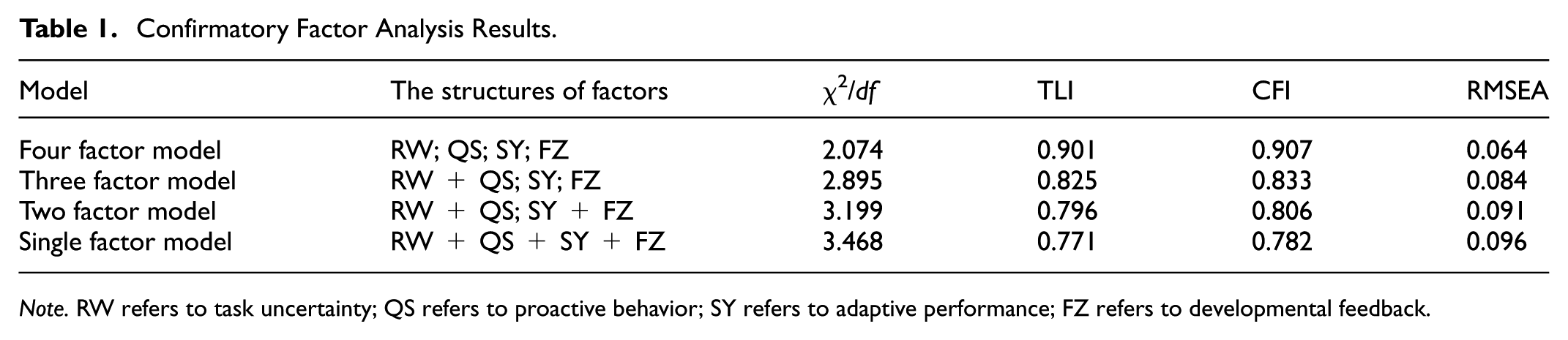
Note. RW refers to task uncertainty; QS refers to proactive behavior; SY refers to adaptive performance; FZ refers to developmental feedback.
Correlation Analysis
From the correlation coefficients between the variables in Table 2, it can be seen that task uncertainty is significantly negatively correlated with employee adaptive performance (r = −.630**, p < .01) and significantly negatively correlated with proactive behavior (r = −.605**, p < .01); proactive behavior is significantly positively correlated with employee adaptive performance (r = .846**, p < .01) and significantly positively correlated with developmental feedback from superiors (r = .595**, p < .01); and adaptive performance was significantly positively correlated with superiors’ developmental feedback (r = .637**, p < .01). The correlation analysis between the above variables lays the foundation for the subsequent hypothesis testing.
Matrix of Mean, Standard Deviation and Correlation Coefficient of Variables (n = 2,67).
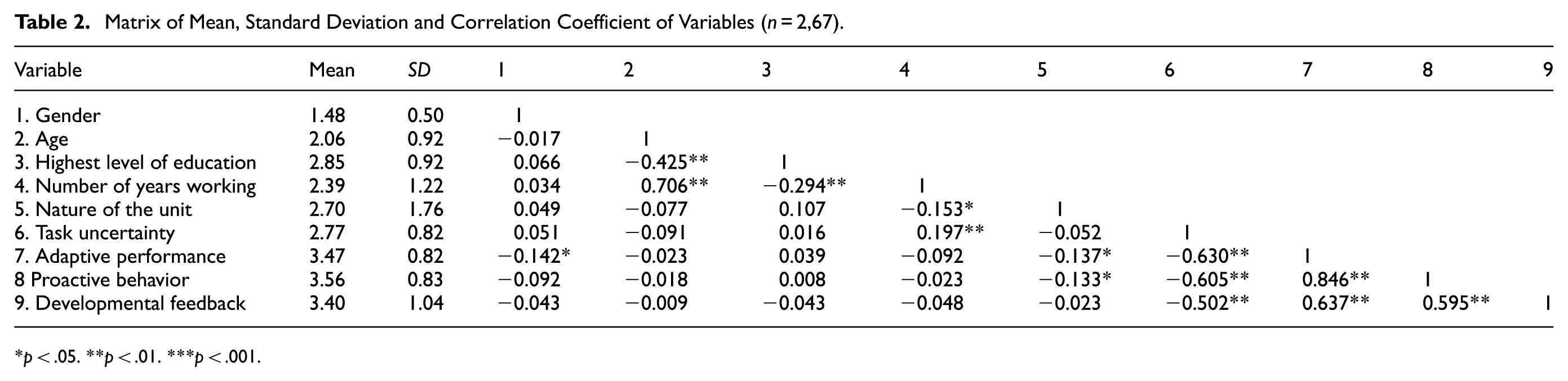
p < .05. **p < .01. ***p < .001.
Hypothesis Testing
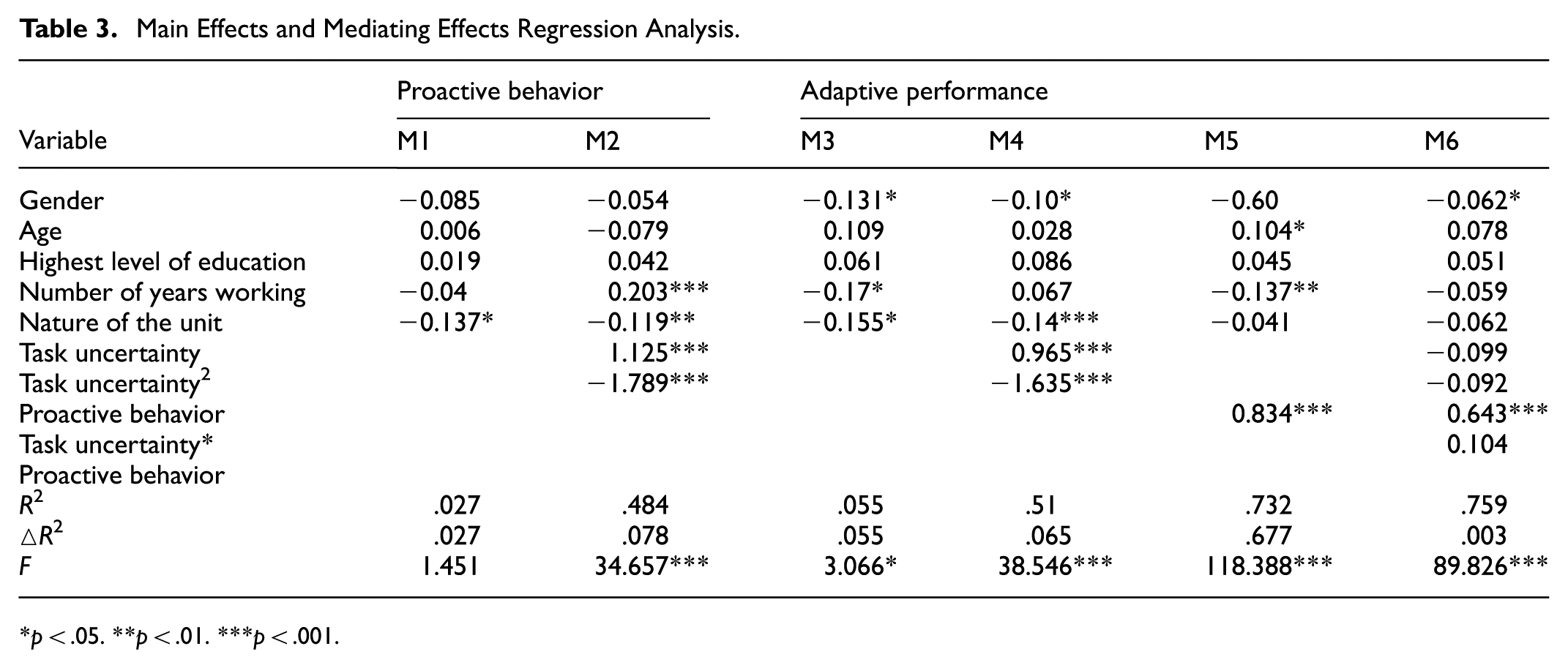
We further clarified the methods suitable for our research problem from the perspective of research method by using the curve estimation method and hierarchical regression method in SPSS 29.0. The research results are presented in Appendix Table 1. The findings indicate that the model with relatively good fitting effect is the quadratic regression model, and the hierarchical regression method can be used to test research hypotheses. In order to test whether there is a mediating effect of proactive behavior between the inverted U-shaped relationship between task uncertainty and adaptive performance, this paper draws on the research of Dong and Ge (2014), Edwards and Lambert (2007), and others, and regresses the main and mediating effects using SPSS29.0 software, and the results are shown in Table 3.
Main Effects and Mediating Effects Regression Analysis.
p < .05. **p < .01. ***p < .001.
Model 4 shows that task uncertainty has a significant positive effect on employee adaptive performance (β = .965, p < .001), while its squared term has a significant negative effect on employee adaptive performance (β = −1.635, p < .001), which indicates that there is an inverted U-shape relationship between task uncertainty and employee adaptive performance, and Hypothesis 1 is supported. Similarly, Model 2 added task uncertainty and the squared term of task uncertainty to Model 1, and the results show that task uncertainty has a significant positive effect on proactive behavior (β = 1.125, p < .001), while its squared term has a significant negative effect on proactive behavior (β = −1.789, p < .001), indicating that there is an inverted U-shape relationship, and Hypothesis 2 is supported.
Model 5 shows a significant positive correlation between proactive behavior and employee adaptive performance (β = .834, p < .001), and Hypothesis 3 is supported. In addition to this, in Model 6 the relationship between the primary and secondary terms of task uncertainty and adaptive performance are not significant (β = −.099, ns; β = −.092, ns), and the interaction term between task uncertainty and proactive behavior is not significant for adaptive performance (β = .104, ns), which indicate that the relationship between proactive behavior and adaptive performance is not affected by task uncertainty. At the same time, there is a significant positive correlation between proactive behavior and adaptive performance (β = .643, p < .001), therefore, proactive behavior mediated the inverted U-shape relationship between task uncertainty and adaptive performance, and Hypothesis 4 is supported.
Drawing on the testing methods of scholars such as Haans et al. (2016), the testing results of this paper are presented in Table 4. In Model 3, the interaction term between the squared term of task uncertainty and developmental feedback from superiors has a significant effect on employees’ proactive behavior (β = 2.145, p < .01), indicating that developmental feedback from superiors has a moderating effect on the inverted U-shape relationship between task uncertainty and proactive behavior, and that Hypothesis 5 is supported. Similarly, the results of Model 6 show that the interaction term between the squared term of task uncertainty and developmental feedback from superiors have a significant effect on employee adaptive performance (β = 1.869, p < .01), indicating that developmental feedback from superiors has a moderating effect on the inverted U-shaped relationship between task uncertainty and employee adaptive performance, and Hypothesis 6 is supported.
Regression Results of Moderated Effects Test.
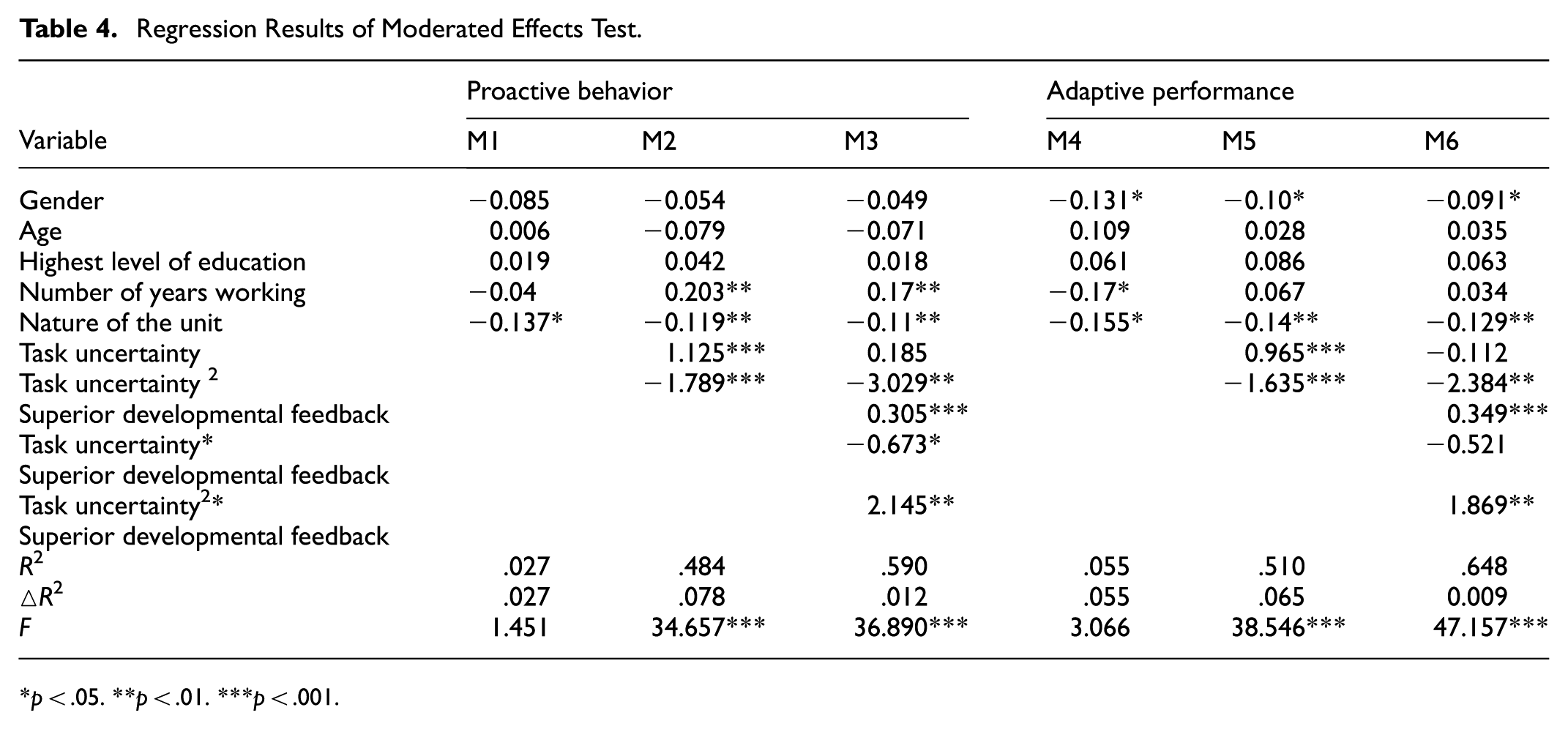
p < .05. **p < .01. ***p < .001.
In order to more intuitively reflect the moderating effect of superiors’ developmental feedback, this paper divides the moderating variables into two groups of high and low, investigates the changes of the two pairs of moderating relationships under different conditions of superiors’ developmental feedback, and draws the moderating effect graphs shown in Figures 2 and 3. As can be seen from Figure 2, superiors’ developmental feedback plays a negative moderating role between task uncertainty and proactive behavior, and the curve also tends to flatten from steep when the level of superiors’ developmental feedback changes from low to high, that is, the higher the level of superiors’ developmental feedback is, the weaker is the effect of task uncertainty on the inverted U-shape relationship of proactive behavior, which further proves that Hypothesis 5 is valid. For the same reason, Figure 3 shows that superiors’ developmental feedback plays a negative moderating role between task uncertainty and employees’ adaptive performance, and the curve becomes more and more flattened when the level of superiors’ developmental feedback changes from low to high, that is, the higher the level of superiors’ developmental feedback is, the weaker the effect of task uncertainty on the inverted U-shape relationship of adaptive performance is, further proving that Hypothesis 6 is valid.

Plot of differences in proactive behavior between high and low superiors’ developmental feedback under the influence of task uncertainty.
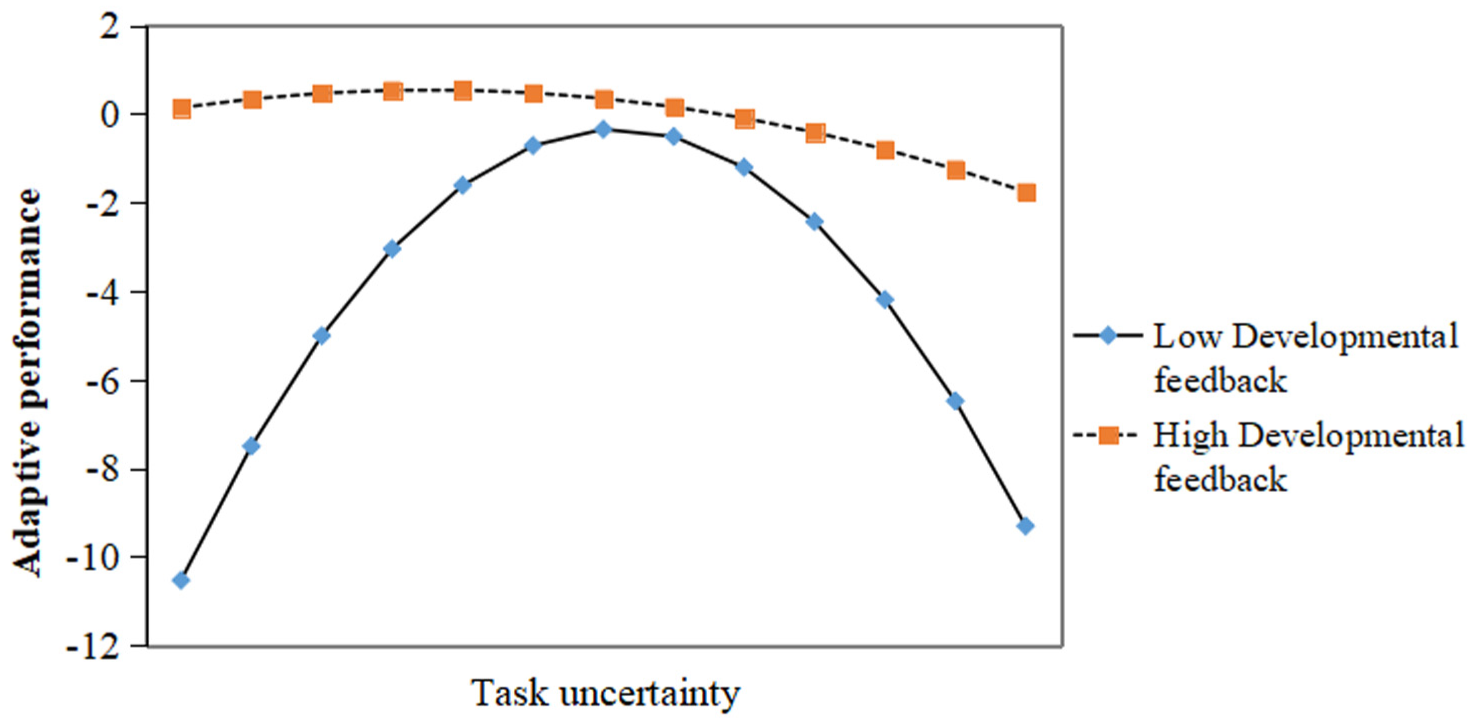
Plot of difference in adaptive performance between high and low superiors’ developmental feedback under the influence of task uncertainty.
Discussion
Theoretical Contributions
Firstly, research has enriched the understanding of the effectiveness of task uncertainty. From previous perspectives, on the one hand, task uncertainty always has a negative impact (Thau et al., 2007), posing risks and threats to individuals and leading to negative consequences such as increased job insecurity and the emergence of emotional exhaustion and negative behaviors among employees (Colquitt et al., 2012). On the other hand, it has also been argued that task uncertainty is equally challenging in nature, and appropriate task uncertainty can bring about potential positive effects to some extent (Griffin & Grote, 2020; Um & Kim, 2018). Therefore, this study, based on the social information processing theory and conservation of resources theory, holds that when employees are confronted with the information conveyed by task uncertainty, their interpretation of the information and resource expectations affect their behavioral outcomes. The findings confirm the inverted U-shaped effect of task uncertainty; that is, moderate task uncertainty has positive effects, echoing the ideas of uncertainty management theory in previous research. However, too much or too little task uncertainty is not conducive to employees choosing proactive behaviors and improving adaptive performance. Based on this, the research findings also enrich the theory of uncertainty management, indicating that individuals do not always have the motivation to take measures to reduce uncertainty. In summary, this study analyzed the effects of task uncertainty from a comprehensive perspective, and the research conclusions also respond to the view that task uncertainty has dual effects (Yan & He, 2022).
Secondly, the study deepened the understanding of the mechanism by which task uncertainty affects adaptive performance along the “environment-behavior-performance” path. Social information processing theory suggests that external environmental information can have an impact on individuals’ attitudes and behaviors (Salancik & Pfeffer, 1978). Based on this, the present study further explores the mediating role of proactive behaviors in the inverted U-shaped effect of task uncertainty on adaptive performance through hypothesis testing, providing new research insights into how task uncertainty affects adaptive performance. From the dual perspectives of task uncertainty and proactive behavior, this study not only responds to scholars’ proposals to analyze adaptive performance from a positive psychology perspective (Tang et al., 2024), but also examines the impact of such neutral concept of task uncertainty (Du et al., 2016; Yan & He, 2022). The research findings suggest that appropriate task uncertainty indicates that employees have obtained relatively sufficient task information, possess adequate resources to complete the tasks, and proactively take countermeasures to adapt to the complexity and variability of those tasks, thereby enhancing their adaptive performance. In contrast, excessively high or low task uncertainty is not conducive to proactive behavior aimed at enhancing adaptive performance.
Thirdly, the study explores the moderating role of superiors’ developmental feedback. We start from the social information processing theory and believe that the information provided by developmental feedback from superiors helps to form consensus between superiors and employees, which in turn affects employees’ attitudes and behaviors (Gurbin, 2015). The findings of this study suggest that developmental feedback provided by superiors is valuable information for employees’ growth and work improvement. Higher-quality interactions between superiors and subordinates can provide employees with informational support and a sense of control (F. Li et al., 2022), making them more willing to choose prospective proactive behaviors and adapt to the challenges brought by environmental changes by accumulating and applying their own resources, thereby improving individual adaptive performance. In conclusion, individuals contribute to adaptive performance in task uncertainty environments through the two-way synergistic interaction effect of internal enhancement behaviors and external supports. The moderating role of superior developmental feedback expands the study of boundary conditions for task uncertainty.
Practical Implications
“Times make heroes,” and the VUCA era brings both threats and challenges. In this context, organizations and employees seize the opportunity to form their own competitive advantage, and the challenge is also a turnaround.
Firstly, superiors should give employees a certain degree of autonomy in their work, and the organization should optimize the design of the work. On the one hand, superiors need to give employees appropriate autonomy, the appropriate level of task uncertainty means to raise the organization’s work requirements for employees. Such work requirements have a certain degree of challenge, but can be completed through the efforts of the organization, which can effectively promote the employees to play the individual initiative, motivate employees to actively face the exceptions to the work, and encourage employees to continue to learn new knowledge and skills, and at the same time, cultivate the employees’ flexibility and adaptability. On the other hand, to avoid excessively high or low task uncertainty, and in line with the organization’s development strategy, the organization should reasonably optimize work design(Park & Park, 2019). This will ensure that employees’ work tasks are not beyond their control while still providing a certain degree of challenge, allowing employees to maintain the initiative to engage in their work.
Secondly, organizations should make full use of human resource management tools to promote proactive behavior among employees. On the one hand, organizations can refine proactive behavior into clear and measurable performance goals and indicators through performance evaluation, ensuring that these indicators include both qualitative and quantitative measures, thereby providing employees with clear work direction. Additionally, organizations can link performance evaluation results with employee compensation to motivate them to take proactive actions. On the other hand, during the talent recruitment stage, a combination of personality trait assessments and management scenario simulations can be used to select candidates with proactive personality traits. Finally, during the growth stage of employees, organizations can strengthen their proactive thinking through training. Moreover, leaders can model proactive behaviors, allowing employees to reinforce their own proactive behavior by imitating their leader’s actions.
Finally, superiors are encouraged to take the initiative to provide developmental feedback to employees. On the one hand, the organization can establish a standardized performance management mechanism in the system to constrain superior feedback and performance management behavior. On the other hand, the organization should keep pace with the times to train leaders and enhance their feedback skills. Moreover, the organization can create a positive feedback atmosphere for superiors by setting an example. At the same time, superiors also need to target the personality traits of employees, and take their acceptable way of giving feedback in order to achieve the full stimulation of employees’ proactive behavior, and enhance their adaptive performance.
Limitations and Directions for Future Research
In order to avoid the appearance of uncontrollable factors affecting the research results, this paper carries out scientific and reasonable control in the stages of scale selection, questionnaire production and distribution, and hypothesis testing, but there are still the following shortcomings. First, in accordance with the research requirements, the scale used in this study is a mature one developed by scholars both domestically and internationally. The reliability of the scale was ensured through a reasonable research design and data analysis. Given that advancements in information technology, such as AI, have created novel working scenarios, scholars can expand the concepts of task uncertainty, and adaptive performance based on this context and develop scales that are suited to it. Second, This study employs gender and organizational nature as control variables. Future research could further analyze the differences in adaptive performance among employees of different genders and organizational types when dealing with task uncertainty. Third, the four variables analyzed in this study were collected through self-assessments by employees. The data analysis indicates that the scale possesses discriminant validity and that there is no common method bias. However, employees’ self-evaluations are likely to encounter issues related to social appropriateness. In terms of research design, future studies can adopt paired surveys, multi-stage surveys, and expand the sample size to further enhance the scientific rigor of the research design. In addition, future research can also adopt a hybrid research approach by combining case analysis, survey experiments, questionnaire surveys, and other methods to conduct research, thereby enhancing the internal and external validity of the results.
Fourth, this study maintains that proactive behavior is a positive action that can lead to favorable performance outcomes for an organization. However, some relevant studies suggest that employees may engage in proactive behaviors to gain personal benefits. In this context, proactive behavior can be seen as a form of self-serving behavior, which may impact the development of interpersonal relationships within the organization. Therefore, future research should focus on exploring the potential negative impacts of proactive behavior. Fifth, in terms of the research perspective, this study analyzed the mechanism of the effect of task uncertainty on adaptive performance from the perspective of job characteristics. With the development of information technologies such as artificial intelligence, subsequent research can be conducted from the perspective of technological innovation for analysis, such as the impact of factors like AI and employee collaboration, digital technology application, and digital literacy on the relationship between task uncertainty and adaptive performance.
Footnotes
Appendix
Model Regression Results.

| Variable | Proactive behavior | Adaptive performance | ||||
|---|---|---|---|---|---|---|
| Curve estimation method | Hierarchical regression method | Curve estimation method | Hierarchical regression method | |||
| M1 | M2 | M3 | M4 | M5 | M6 | |
| Linear regression | Quadratic regression | Quadratic regression | Linear regression | Quadratic regression | Quadratic regression | |
| Task uncertainty | −0.605*** | 1.071*** | 1.125*** | −0.630*** | 1.037*** | 0.965*** |
| Task uncertainty2 | −1.698*** | −1.789*** | −1.689*** | −1.635*** | ||
| R 2 | .366 | .440 | .484 | .397 | .470 | .510 |
| F | 152.664*** | 103.506*** | 34.657*** | 174.560*** | 117.207*** | 38.546*** |
p < .05. **p < .01. ***p < .001.
Note. In appendix Table 1, on the one hand, the results of the curve estimation method (M1 vs. M2; M4 vs. M5) show that the R2 values of the quadratic regression are greater than those of the linear regression. This indicates that the better-fitting model is the quadratic regression model. On the other hand, in the quadratic regression results (M2 vs. M3; M5 vs. M6), all four models are significant, and the R2 values of the quadratic regressions using hierarchical regression are larger and better fitted due to the method’s ability to control for the effects of variables such as gender, age and education. Taking M2 and M3 as an example, the values of the primary and quadratic terms of task uncertainty in M2 are not significantly different from those in M3, and the coefficients of the secondary terms are negative. Similarly, there is no significant difference between M5 and M6, and the coefficient of the quadratic term is also negative. Therefore, the results of the study can demonstrate the inverted U-shaped role of task uncertainty.
Acknowledgements
Thanks to the friends and units who helped to collect the data, thanks to Sage open and peer review experts for their opinions.

Ethical Considerations
Before the questionnaire survey, all participants were introduced to the research purpose and process in detail, thereby obtaining their informed consent. During the study, the questionnaire data was anonymous and confidential, so that the disclosure of responses would not place participants at risk of criminal or civil liability or damage their financial standing, or reputation. Due to the questionnaire survey was conducted in an organizational context, there is also no risk to participants’ employability. In addition, this study was approved by the research committee of Zhongnan University of Economics and Law and all procedures met its ethics standards (with approval no. 201304).
Author Contributions
Conceptualization: Qiufang Li, Yiting He; Methodology: Qiufang Li, Yiting He; Formal analysis and investigation: Yuping Xie; Writing - original draft preparation: Qiufang Li, Yuping Xie; Writing - review and editing: Yuping Xie, Haixia Wei; Funding acquisition: Qiufang Li; Resources: Yuping Xie, Haixia Wei, Shouhui Cao; Supervision: Qiufang Li, Yuping Xie, Shouhui Cao.
Funding
The authors disclosed receipt of the following financial support for the research, authorship, and/or publication of this article: This study was funded by “the Fundamental Research Funds for the Central Universities,” Zhongnan University of Economics and Law [Grant number 202311207].
Declaration of Conflicting Interests
The authors declared no potential conflicts of interest with respect to the research, authorship, and/or publication of this article.
Data Availability Statement
The data that support the findings of this study are available from the corresponding author upon reasonable request.