




Abstract
This study investigates the relationship between workplace diversity and intraindividual identity conflict, on its impact on employee stress within Chilean non-profit organizations. Using a quantitative methodology, data were collected from 173 participants through a two-phase assessment. The findings indicate a positive association between gender diversity and intraindividual identity conflict, while racial diversity is negatively associated with such conflict. Moreover, intraindividual identity conflict was significantly correlated with higher stress levels among employees. These results provide new insights into the dynamic interplay between diversity and identity, showing that while some dimensions of diversity may exacerbate identity conflict, others can mitigate it. This study underscores diversity as a complex, double-edged process affecting both individual well-being and organizational dynamics, emphasizing its role in stress within highly demanding occupations such as non-profit organizations.
Plain language summary
This study explores how diversity in the workplace influences employees’ internal identity struggles and stress levels in non-profit organizations. It examines how perceptions of diversity in gender, race, and socioeconomic status within workgroups relate to identity conflict (a type of internal struggle about one’s sense of self) and employee stress. The research involved 173 employees, who participated in two phases of data collection. In the first phase, employees were asked about how diverse they perceived their workgroups to be in terms of gender, race, and socioeconomic background. In the second phase, the researchers measured the employees’ levels of identity conflict and stress. The findings reveal a complex relationship between diversity and identity conflict. Higher gender diversity was linked to increased identity conflict, suggesting that being in a highly gender-diverse workgroup can sometimes create internal challenges for employees as they navigate their sense of identity. On the other hand, greater racial diversity was associated with lower levels of identity conflict, indicating that some types of diversity might help employees feel more at ease with their identity. In both cases, employees who experienced higher identity conflict also reported higher levels of stress. These results demonstrate that workplace diversity can be a double-edged sword. While diversity has the potential to foster innovation, it can also create personal challenges for employees. Understanding these dynamics is crucial for organizations aiming to build healthy and productive workplaces. This study highlights the importance of addressing identity-related struggles in diverse teams. By implementing supportive practices and policies, organizations can help employees manage these challenges, reduce stress, and promote well-being.
Introduction
Workplace diversity is commonly defined as the presence of differences among individuals within a work unit. While this definition appears straightforward, research into its implications has expanded significantly in recent years, revealing an ambivalent picture of its effects (Nkomo et al., 2019). Task-related diversity—such as differences in education or organizational roles—has been associated with tangible benefits, including enhanced creativity, innovation, and performance (van Knippenberg et al., 2004; van Knippenberg & van Ginkel, 2010). Conversely, demographic diversity unrelated to tasks—such as gender, ethnicity, or socioeconomic status (SES)—has been linked to negative outcomes, including reduced group cohesion, increased conflict, and diminished performance (Subasi et al., 2021).
Much of the literature interprets these adverse effects from an intergroup perspective, suggesting that diversity can activate social categorization processes that reinforce group differences and generate tensions (Belavadi & Hogg, 2021; Tajfel & Turner, 1979). However, less is known about how diversity influences individuals at an intrapersonal level, particularly concerning the tensions arising among their multiple social identities. Rather than focusing solely on intergroup conflicts, it is pertinent to examine how diversity may trigger identity conflicts within individuals, especially in the interplay between their organizational identity and other salient identities, such as gender or SES. While some studies have addressed intergroup identity conflicts (Jansen et al., 2017; Nishii, 2013), evidence on internal identity conflicts—such as those between professional and gender identities—is scarce and fragmented (Kreiner & Ashforth, 2004; Kreiner & Murphy, 2016). This gap is particularly relevant in complex organizational contexts where identity boundaries are dynamic and situational.
Recognizing the effects of diversity on an individual’s distinguishing identity and its interplay with other identities, it can be posited that diversity reshapes identity boundaries. For example, an older worker in a predominantly younger group may experience tension with their “older adult” identity, leading them to adjust—either suppressing or emphasizing—values and behaviors associated with age. Such adjustments might, in turn, reinforce other identities, such as organizational or professional identities.
This study investigates how perceived workplace diversity—in terms of gender, SES, and race—affects the conflict between organizational identity and gender, racial or SES identities among social service workers in Chilean non-profit organizations. These dimensions were selected due to their historical relevance as sources of workplace exclusion (Mor Barak, 2022) and their centrality in highly feminized organizational contexts, such as social services (Jones et al., 2019). Additionally, SES conflict is noteworthy in low-mobility societies, such as developing countries, where SES is a significant source of intergroup tensions (Daude & Robano, 2015; Iversen et al., 2021).
Considering that group-level diversity conflicts negatively impact individual and organizational outcomes (Nishii, 2013), this study examines whether intraindividual identity conflicts are similarly linked to adverse outcomes following evidence that has connected diversity with organizational stress (Jones & Hynie, 2017) and job satisfaction (Hauret & Williams, 2020; Sakuda, 2012).
Studying this issue is crucial for several reasons. First, this research contributes to an underexplored area: the relationship between diversity and individuals’ multiple identities, which remains an urgent, unresolved topic (Greco et al., 2022; Roberson, 2019). Second, examining diversity’s effects from an intraindividual perspective complements existing knowledge by providing a more holistic understanding, as previous research has predominantly focused on intergroup perspectives. Finally, this study contributes to public policy development by analyzing the social service sector. Worker well-being in social services is critical for the resilience of social protection systems, as stress is associated with turnover and poor performance. Threats to these workers’ well-being, such as identity conflicts, may have far-reaching societal implications (Lizano & Mor Barak, 2015; Mata & Tarroja, 2022).
Finally, studying diversity issues within a context like Chile contributes to the development of the literature by examining an underexplored reality, as most diversity studies have focused on developed countries in the so-called Global North (Roberson, 2019).
Workplace Diversity as a Double-Edged Sword
Workplace diversity has been extensively characterized as a “double-edged sword,” offering both advantages and challenges for individuals, teams, and organizations (Atewologun et al., 2016; De Meulenaere et al., 2016; Herring, 2009; Jonsen et al., 2011; Kearney et al., 2009; McFadden, 2015; Shore et al., 2009; Stoermer et al., 2016; van Knippenberg et al., 2013; Werth & Brownlow, 2018).
This reality has been confirmed through various meta-analyses consulted for this research. In this way, Webber and Donahue (2001) analyzed diversity in workgroups and its effects on group cohesion. From a sample of 76 articles published between 1980 and 1999, they selected 24 that met their criteria, integrating 45 correlations. The results of this meta-analysis demonstrated that different types of diversity did not have significant effects on group cohesion and performance.
Subsequently, Horwitz and Horwitz (2007) conducted a meta-analysis including 78 correlations from 35 articles published between 1985 and 2006, focusing on the effect of diversity on performance. The data indicated that task-related diversity had a positive effect on team performance, while diversity unrelated to the task had no significant relationship with performance. Similarly, no effect of team diversity on social integration was found.
Joshi and Roh (2009) utilized information from 39 studies published between 1992 and 2008 to establish that the effects of diversity on performance are small; however, they are amplified when the relationship is controlled by industry sector or by diversity conceptualized as separation.
Bell et al. (2011) conducted another meta-analysis that included 92 articles published between 1980 and 2009, examining the effect of diversity on performance, creativity, and innovation. The results showed that task-related diversities, such as educational level, training, or functional diversity, positively impacted performance, creativity, and innovation. In contrast, diversity unrelated to the task, such as gender and race, had negative effects on team performance.
Finally, Roh et al. (2019) analyzed 51 articles to determine the effect of task-related and non-task-related diversity on communication, debate, relational conflicts, group cohesion, and integration. The results are consistent with previous studies in that diversity is not a generic process and has both positive and negative outcomes. This research concludes that diversity in age and gender has a direct negative effect on team cohesion, relational conflicts, integration, and strategic consensus. It also has an indirect negative effect on organizational performance, while diversity in tenure, education, and experience has a positive effect on information elaboration and company performance.
Collectively, these studies underscore that diversity can lead to both advantageous and detrimental outcomes within groups and organizations. However, there remains limited evidence regarding the effects of diversity at the intraindividual level.
Workplace Diversity and Multiple Identities
The beneficial and harmful outcomes of diversity have traditionally been explained through the Categorization-Elaboration Model (CEM) developed by Van Knippenberg and collaborators (2004). The CEM suggests that the effects of diversity depend on three contingent factors. First, they depend on variables involved in the social categorization process, such as the objective differences between individuals and the extent to which those differences are relevant to the individual. Second, the presence of variables that generate or prevent intergroup biases plays a role. Third, group information elaboration is influenced by task motivation, task competence, and group cohesion.
While the CEM explains how social identities are highlighted and strained within a group, it does not fully account for the effects of diversity at the intraindividual level. To explore the relationship between diversity and the interaction of an individual’s multiple identities, the identity boundary approach developed by Kreiner et al. (2006b, 2006a) appears more appropriate.
Kreiner et al. (2006a, 2016) propose that identity construction is a negotiation process shaped by the boundaries of each identity. The model identifies three types of boundaries: intrusion, distance, and balance. If one aspect of an identity occupies too much space, the boundaries become intrusive. When there is significant separation between identities or identity dimensions, the boundaries adopt a distanced form. Both scenarios result in boundary conflict, leading to unstable identities, heightened tensions between identities, and more pronounced changes in individual identity (Kreiner et al., 2006). Conversely, when the relationship between identities is perceived as optimal, the identities complement one another, becoming more stable and generating balanced identity boundaries (Kreiner et al., 2006).
By integrating the principles of the CEM and the identity boundary theory, it becomes evident that when a difference within a specific identity category becomes salient compared to the group—such as being from a higher social class in a predominantly lower-class group—this salient characteristic is emphasized, leading to changes across various individual identities. Based on this understanding, we propose our first hypothesis
Multiple Identities and Stress
Contemporary literature recognizes that individuals inhabit multiple roles and groups simultaneously, leading to the existence of multiple identities (Ramarajan et al., 2017). While having multiple identities can enhance well-being (Brook et al., 2008; Ng et al., 2023), perceived discrepancies between the meanings of different identities can become threatening and difficult to manage (Karelaia & Guillén, 2014).
Various studies have explored this process. Research shows that higher tolerance for ambiguity, greater resilience, and stronger team identification reduce intraindividual identity conflict, enabling employees to thrive at work (Gibson et al., 2021). Similarly, decreasing identity conflict has been linked to a positive gender identity, which reduces stress, increases life satisfaction, and enables women to view leadership as an attractive goal rather than a duty (Karelaia & Guillén, 2014). Conversely, identity conflict negatively affects intrinsic motivation, perspective-taking, and performance (Ramarajan et al., 2017). Among women, those with greater identity conflict report lower affective motivation to lead (Rabinovich & Morton, 2016). Additionally, intraindividual identity conflict has been negatively associated with job satisfaction and performance (Yang et al., 2021), and individuals experiencing identity conflict report higher stress levels (Jones & Hynie, 2017).
The relationship between the interaction of multiple identities and well-being or stress can be understood through the Job Demands-Resources Theory (JD-R), which examines how job demands (stressful aspects of work) and resources (factors that alleviate stress) impact workplace health and motivation. Demands predict burnout, while resources are linked to satisfaction, well-being, and engagement. Both factors influence performance, with resources enhancing engagement and demands increasing stress (Bakker & Demerouti, 2013, 2017; Demerouti et al., 2001).
Conflicting identity boundaries impose additional effort on individuals, requiring them to reconcile differing identities—meanings, values, and behaviors. From the JD-R perspective, this constitutes a demand (Bakker & Demerouti, 2013). When identity boundaries are distant or overlapping, conflicts and changes in individual identity arise, creating demanding and stressful situations.
Stress, therefore, is closely tied to identity boundary adjustments, as negotiating these boundaries demands cognitive resources to create, maintain, or change identities. When aspects of identity are in conflict, identity becomes threatened, resulting in stress (Schmader & Major, 2017). Based on these premises, the following hypothesis is proposed:
Therefore, this study aims to analyze the impact of gender, socioeconomic status (SES), and racial diversity on the identity conflict and its relation to stress levels of employees in non-governmental organizations (NGOs) providing social services in Chile. The hypothetical model is illustrated in Figure 1.

Research hypothetical model.
Methodology
To test the study hypotheses, a quantitative, observational research approach with exploratory aims was proposed. The research design included two stages. In the first phase, the independent variables (identity conflict) were tested, while in the second phase, the dependent and moderating variables (stress and perception of inclusion) were examined.
Sample
The target population for this research consisted of employees of nonprofit organizations operating in Chile, pursuing social objectives such as poverty alleviation, inclusion of people with disabilities, development of excluded territories, and access to social rights.
Through the Vice-Rectory for Outreach and Engagement at the Universidad de Santiago de Chile, contact was made with the human resources departments of six organizations, and the study was presented to them. To encourage organizational participation, access to aggregated information was promised at the end of the study. Out of the six organizations approached, four agreed to participate.
The total sample consisted of 499 individuals, who were contacted via emails sent by the human resources unit of the participating organizations or directly by the lead researcher. Each participant was thoroughly informed about the study’s purpose, its stages, the confidential handling of information, and the guarantee of anonymity.
To minimize attrition, a common challenge in longitudinal studies (Ruspini, 2002), monetary compensation was offered to those who completed the surveys.
Out of the 499 workers contacted, 242 responded during the first wave and 200 during the second wave. Of these, 173 individuals participated in both stages of the study, representing 33.86% of the initial sample. The detailed distribution by organization is presented in Table 1.
Sample Workers by Organization.

Measures
Diversity
To measure diversity, a scale assessing perceptions of gender, socioeconomic status (SES), and racial diversity was used. This Likert scale ranged from 0 to 4, with higher scores indicating greater diversity. The measure was selected due to its theoretical relevance (Harrison & Klein, 2007) for studying identity processes based on categorization and self-categorization (Hogg, 2016).
Identity Conflict
Intraindividual identity conflict was evaluated using a newly developed Types of Tensions Scale, designed and constructed by one of the authors. Grounded in the theoretical framework of Smith and Lewis (2011), this measure captures tensions between competing values, roles, and senses of belonging in the workplace. The scale comprises three items per conflict type, rated on a 4-point Likert scale (1 = never; 4 = always), with higher scores indicating greater intraindividual identity conflict. Subscales were created to assess gender–organization and SES–organization identity conflicts, and an overall mean score was calculated to represent each participant’s level of identity conflict.
To ensure robust content validity, the scale was reviewed by a panel of four external expert judges—three with backgrounds in management and one psychometrician—who evaluated the clarity and relevance of each item following Sireci’s (2007) guidelines. This rigorous evaluation process enhances the academic rigor and practical credibility of the measure.
Stress
The Oldenburg Burnout Inventory (OLBI; Demerouti et al., 2010) was used to assess stress. OLBI has two subscales: exhaustion, resulting from prolonged exposure to job demands, and disengagement, related to distancing from work tasks and content. The 16-item scale used a 5-point Likert format (1 = strongly disagree, 5 = strongly agree), with reverse scoring for some items. The total score was obtained from the mean of the responses. The higher the scores, the higher the levels of stress.
Perception of Inclusion
Finally, to ensure the effectiveness of the hypothesis tests, the perception of scale by Mor Barak (2022) was used for control purposes. Inclusion refers to an individual’s perception of belonging to organizational systems, both formal and informal, where decisions are made, and information is exchanged. This measure, adapted linguistically and culturally for Chile (Pizarro-Galleguillos & Calderón-Orellana, 2022), consisted of 12 Likert-type statements (1 = strongly disagree, 5 = strongly agree). The total score was obtained from the mean of the responses.
Demographics
Demographic data included self-perceived gender and race. Gender was assessed with the question: How do you identify? (options: woman, man, non-binary). Race was assessed with: How do you consider yourself? (options: white, mestizo, mulatto, Indigenous, Black/Afro-descendant, other). Additional data included age, nationality, experience, education, occupation, and workplace location.
Data Analysis Procedure
The study involved two online questionnaires. The first collected data on independent variables (diversity and identity conflict), while the second, administered 2 to 4 weeks later, assessed the dependent variable (stress).
Ethical approval was obtained from the Ethics Committee of the Universidad de Santiago de Chile. Participants were informed2 about the study’s purpose, questionnaire content, confidentiality, and their voluntary participation. Consent was sought to use their data for research purposes.
The study was conducted from June to October 2021. Once data collection ended, the dataset was processed in SPSS, and hypotheses were tested using structural equation modeling in Mplus©.
Results
Scale Validations
Intraindividual Identity Conflict
Following the administration of the questionnaire, construct validity was assessed through confirmatory factor analysis (CFA) for each dimension of intraindividual identity conflict.
The confirmatory factor analysis (CFA) for the gender–organization intraindividual identity conflict construct demonstrated excellent model fit, (RMSEA 0.00, 90% CI [0.00, 0.00]; CFI 1.00; TLI 1.00; SRMR 0.00).
The confirmatory factor analysis (CFA) for the race–organization intraindividual identity conflict construct demonstrated excellent model fit, with the following indices: RMSEA 0.00, 90% CI [0.00, 0.00]; CFI 1.00; TLI 1.00; SRMR 0.00.
Finally, the confirmatory factor analysis (CFA) for the socioeconomic status–organization intraindividual identity conflict construct demonstrated excellent model fit too (RMSEA 0.00, 90% CI [0.00, 0.00]; CFI 1.00; TLI 1.00; SRMR 0.00).
Regarding factor loads, the estimated parameters are detailed in Table 2.
CFA Results for Each Dimension of Intraindividual Identity Conflict Scale.

p < .01.
Stress
The construct validity of the scale was tested. The factor analysis results presented acceptable adjustment indices (RMSEA 0.11, 90% CI [0.09, 0.12]; CFI 0.83; TLI 0.80; SRMR 0.08). The estimated parameters are detailed in Table 3.
CFA Results for Stress Scale.

p < .01.
Inclusion
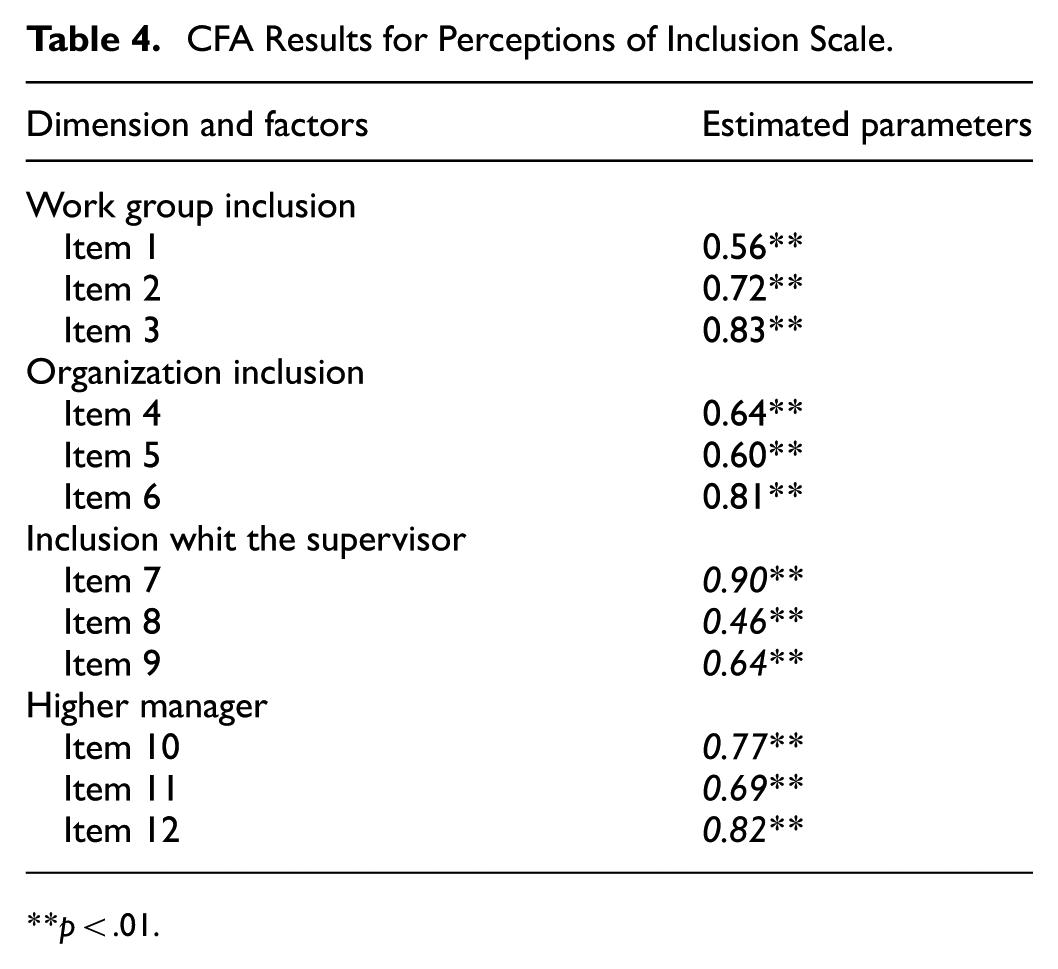
The construct validity of the scale was tested. The factor analysis results presented acceptable adjustment indices (RMSEA 0.07, 90% CI [0.05, 0.09]; CFI 0.95; TLI 0.93; SRMR 0.06). The estimated parameters are detailed in Table 4.
CFA Results for Perceptions of Inclusion Scale.
p < .01.
Descriptive Analysis
Initially, the descriptive analysis of the sample is presented in Table 5.
Descriptive Statistical Analysis of the Main Study Variables.

The participants in the study were predominantly women, with higher education levels and middle to upper-middle socioeconomic status. Regarding diversity, participants perceived greater levels of gender and socioeconomic status (SES) diversity compared to racial diversity on average.
Then, a correlation analysis was conducted, and the results are detailed in Table 6.
Correlations Analysis.

p < .05; **p < .01.
The analysis reveals positive relationships between different diversity measures. Gender diversity correlates with racial diversity (0.48**) and SES diversity (0.36**), while racial and SES diversity are also positively correlated (0.45**).
Additionally, a relationship was observed between racial diversity and identity conflict (−0.17*), as well as between SES diversity and identity conflict (−0.16*). The analysis further indicates a negative relationship between SES diversity and disengagement (−0.27**) and a positive relationship with exhaustion (0.15*). Moreover, identity conflict was positively correlated with stress-related outcomes, specifically disengagement (β = .36, p < .01) and exhaustion (β = .31, p < .05), indicating that higher levels of identity conflict are associated with greater stress. Furthermore, exhaustion was linked to disengagement (0.68**).
Hypothesis Testing
To begin the analysis of the hypothetical model, linear regressions were conducted for each of the hypotheses it comprises. The model showed an adequate fit (RMSEA 0.09, 90% CI [0.08, 0.11]; CFI 0.80; TLI 0.76; SRMR 0.09). The results are presented in Table 7.
Results of Regression of the Hypothetical Model.

Regression analyses revealed a significant positive association between perceived gender diversity and intraindividual gender identity conflict, indicating that higher levels of perceived gender diversity within the workplace are linked to increased internal conflicts related to gender identity. Conversely, a significant negative association was found between perceived racial diversity and intraindividual gender identity conflict, suggesting that greater racial diversity perceptions are associated with reduced internal gender identity conflicts.
Similarly, a positive relationship between both types of conflict and stress was observed, particularly between gender and organizational conflict with exhaustion and disengagement, and between socioeconomic status (SES) and organizational conflict with disengagement.
Thus, these preliminary results establish a relationship between diversity and conflict, and conflict and stress. However, the direction of the results is ambivalent, particularly regarding the relationship between diversity and intraindividual identity conflict. To further test the model, the same regressions were conducted, this time controlling for gender, SES, race, age, and inclusion. The model improved its fit (RMSEA 0.08, 90% CI [0.07, 0.09]; CFI 0.81; TLI 0.77; SRMR 0.08) and confirmed the effect of gender diversity on gender intraindividual identity conflict (β = .17**). Furthermore, ethnic diversity was negatively associated with identity conflict between gender and organization (β = −.29***). Additionally, gender and organizational identity conflicts were positively associated with increased levels of exhaustion (β = .21**) and disengagement (β = .17*), both of which are linked to higher stress levels.
The results also confirmed the effect of inclusion on disengagement (β = −.47***) and exhaustion (β = −.24**) as well as on identity conflict with the organization and gender (β = −.23***) and with the conflict between identity with the organization and SES (β = −.19**). Moreover, the effect of age on disengagement (β = −.31***), exhaustion (β = −.24 ), the conflict between the organization and gender (β = −.16), and between the organization and SES (β = −.21) was observed. Finally, the effect of SES (β = .14*) on exhaustion was observed.
Considering the results, particularly the effects of diversity on identity conflict between gender and organization, a modified model was tested, considering only the conflict between gender identity and organizational identity, controlling for demographic factors and inclusion. The results are presented in Table 8.
Modified Hypothetical Model Indices.

The model shows a better fit (RMSEA 0.07, 90% CI [0.06, 0.08]; CFI 0.85; TLI 0.82; SRMR 0.08) and confirms the positive relationship of gender diversity with the conflict between gender and organizational identity (0.20*). In other words, the higher the perception of gender diversity a person has, the greater the intraidentity conflict between their gender and organizational identities. At the same time, a negative relationship was observed between the perceived diversity of race and the conflict between gender and organizational identity (−0.36***). Thus, people with a greater perception of racial diversity experience less conflict between their gender and organizational identities.
Then, regarding the intraindentity identity conflict between gender and organizational identity, a direct and positive effect with exhaustion (0.21*).
The results also confirmed the effect of inclusion on disengagement (β = −.59) and exhaustion (β = −.24) as well as on identity conflict with the organization and gender (β = −.26***). Additionally, the effect of age on disengagement (β = −.28***), exhaustion (β = −.35***), and the conflict between the organization and gender (β = −.18**) was observed. The effect of SES (β = .14*) on exhaustion was also observed.
Finally, based on the modified model (Figure 2), it is possible to tentatively accept the relationship between gender diversity and the conflict between gender identity and organizational identity. The hypothesis supporting the relationship between identity conflict and stress, specifically with exhaustion, is also accepted.

Hypothesis test results.
Discussion
The study aimed to analyze the effect of gender, socioeconomic status (SES), and race diversity on the conflict between gender and organizational identities, and between SES and organizational identities, as well as the effect of such conflict on stress in workers of NGOs. Although it was not possible to confirm all the hypotheses of the hypothetical model, significant findings were achieved.
Firstly, the study confirmed the negative effect of gender diversity on the conflict between gender identity and organizational identity, as established in H1i. This result is consistent with the study that observed the effect of gender dissimilarity on the perception of identity conflict between gender and occupational identity in police officers (Veldman et al., 2017).
The distinctive aspect of the present study’s result, compared to previous ones, is that the conflict between gender identity and organizational identity was not only positively affected by gender diversity but also negatively affected by racial diversity. In other words, while the perception of greater gender diversity increases the conflict between gender and organizational identities, greater racial diversity reduces this same conflict.
This difference can be explained by the arguments presented by Van Knippenberg et al. (2004) and Kreiner (2006). According to the former, the prominence and significance of an identity that differentiates an individual from a group leads to an awareness of the distinction, which shapes the reality based on that identity. In this case, gender difference became relevant and impacted the construction of individuals’ identities, which, following Kreiner (2006), would affect and shift the boundaries between different identities, diminishing those that are not necessarily valued, generating greater conflict. At the same time, racial diversity would also shift the boundaries between identities, limiting the non-valued identity in a particular context while strengthening another. Therefore, in the case of racial diversity, the conflict would reduce as individuals, confronted with racial differences, would seek greater identification with other identities, such as gender and organizational identity. Thus, the evidence confirms that demographic diversity has both positive and negative outcomes on intraindividual identity conflict.
In this context, several authors have discussed the benefits and limitations of diversity for individuals, groups, and organizations, describing it as a double-edged sword (Atewologun et al., 2016; De Meulenaere et al., 2016; Herring, 2009; Jonsen et al., 2011; Kearney et al., 2009; McFadden, 2015; Shore et al., 2009; Stoermer et al., 2016; van Knippenberg et al., 2013; Werth & Brownlow, 2018). Specifically, the ambivalent effects of demographic diversity have been explained through social categorization processes and informational resources (van Knippenberg et al., 2013), which create issues of group cohesion and creativity development (Van Knippenberg et al., 2004). The significance of the present study lies in its complementing of results that typically observe group dynamics by focusing on the intraindividual experience. By recognizing that gender diversity can have a positive effect on intraindividual identity conflict, while racial diversity has a negative effect, it is possible to argue that, at the intraindividual level, demographic diversity is also a double-edged sword.
Indeed, this explanation aligns with other theories used to describe and understand diversity and its effects. From the perspective of social identity theory (Hogg, 2016; Tajfel, 1984), individuals who differ from others will seek to enhance or minimize their identity, striving to belong to groups that provide benefits, thereby developing intergroup conflicts that, in turn, would generate intraindidivual conflicts.
Thus, it is possible to confirm that diversity mobilizes identities, and although diversity in visible or recognizable factors, such as gender, can have harmful effects, it can also generate favorable effects through processes such as identity conflict, which involves complementing identities and establishing stronger, less changeable boundaries (Kreiner et al., 2006).
The results also allowed for the assertion that intraindividual identity conflict is linked to stress, particularly in its dimension of burnout. This effect is consistent with previous findings related to identity conflict, as less conflict is associated with greater work development (Gibson et al., 2021), greater life satisfaction, and less stress (Jones & Hynie, 2017; Karelaia & Guillén, 2014), as well as higher motivation and performance (Ramarajan, 2014; Ramarajan et al., 2017; Yang et al., 2021).
Thus, it is confirmed that negotiating identity boundaries affects stress, confirming that negotiating identities, within the framework of the job demands-resources theory (Bakker & Demerouti, 2017), can be understood as a demand that must be managed. This would indeed relate to recognizing identity difference as a demand, but it could also be related to managing the potential stigma of organizational identity, stemming from beliefs and prejudices commonly shared in society regarding social work with vulnerable populations, which has been documented in the concept of “dirty work” (Kreiner et al., 2006).
It is noteworthy that the results of identity conflict in stress were relationed mainly whit burnout, understood as a consequence of physical, emotional, and cognitive tensions arising from persistent exposure to certain work demands (Demerouti et al., 2010), and not to disengagement, which refers to distancing oneself from work in general, the work object, and the content of work (Demerouti et al., 2010).
To understand this difference, it is necessary to refer back to Kreiner’s (2006, 2016) proposal, which suggests that if a proportion of an individual’s identity takes up too much space or is insufficient, boundaries will become intrusive or distant, creating conflict, identity changes, and greater instability. Therefore, if dissimilarity persists over time, the conflict will also persist, generating tension and, in turn, stress.
Thus, this result—the confirmation of the effect of intraindividual identity conflict on stress—complements similar results observed at the group level. Indeed, intergroup conflict due to diversity has been linked to negative outcomes. For example, Nishii’s (2013) work confirms that intergroup relationship conflict is negatively related to unit satisfaction. Similarly, the meta-analysis by Roh et al. (2019) concludes that age and gender diversity have a direct negative effect on team cohesion, relational conflicts, integration, and strategic consensus.
In this way, this study contributes to the theoretical development of demographic diversity and its effects, recognizing that gender and racial differences are linked to identity conflict both at the interindividual and intergroup levels.
Finally, it is also important to highlight the effect that racial diversity has on conflict. In this sense, in Chile, the country where the study was conducted, the concept of race does not have the same social and theoretical development as in other societies, such as the United States, where race is at the origin of diversity studies (Ivancevich & Gilbert, 2000). In fact, the study explicitly asked about race, not just self-identification across different identity categories. In the context studied, race as a construct is seen as an unstable, relational, multifunctional, and localized concept, and continues to be commonly used even though contemporary genetics has disproven the existence of biological races, crossing concepts of blood, caste, nation, and human species types (Arre Marful & Catepillán Tessi, 2021). This difference from studies in other contexts further confirms the idea that diversity and its effects are a complex phenomenon, not only dependent on the type of diversity studied, but also on the status of identities (Portocarrero & Carter, 2022), and certainly on the social and cultural context (Stoermer et al., 2016).
In conclusion, acknowledging the ambivalent effect of diversity on intraindividual identity conflict and the complexity of the phenomenon from its results and growing significance, this study underscores the importance of promoting inclusion in workplaces. Indeed, the research confirms that diversity in race and gender, while having double-edged effects at individual, group, and organizational levels (Bell et al., 2011; Horwitz & Horwitz, 2007; Joshi & Roh, 2009; Roh et al., 2019; Webber & Donahue, 2001), is a double-edged sword at the intraindividual level. Thus, the call is to promote inclusive environments, as the evidence confirms the value of inclusion in reducing the negative effects of diversity and strengthening the positive ones (Brimhall et al., 2017). This means that the negative effects of being different from the group, such as in relation to gender, race, or age, can be mitigated or even eliminated if individuals, groups, and organizations undergo inclusion processes. The results described and the role of inclusion can be explained through principles of Social Identity Theory (Tajfel, 1984) and Optimal Distinctiveness Theory (Brewer, 1991). In particular, Mor Barak (2022), Mor Barak et al. (2016) argues that groups based on specific identity characteristics—such as gender, occupation, age, or department—enable or limit access to resources valued by the organization. This intergroup interaction leads to the exclusion of individuals or groups from resources valued in the workplace, bringing negative consequences to excluded groups. Thus, promoting inclusive environments, where all individuals feel recognized in their uniqueness and are treated equitably, would help reduce such conflicts by ensuring that access to these resources is equitable.
Furthermore, the link between identity conflict and burnout highlights the critical role of inclusive practices in safeguarding employee mental health. Organizations should recognize that DEI efforts are not solely about representation but are integral to employee well-being. Embedding DEI into the broader organizational strategy can foster equitable practices that promote inclusive work environments and positive employee well-being
The interpretation of these results must take into account the study’s limitations. Firstly, the workers participating in this research belong to NGOs providing social services. However, not all organizations share the same characteristics. While the services provided were mainly fieldwork, the NGOs’ work also included policy promotion, emphasizing various functions and occupations within the same sector, which may have influenced the results regarding identity conflicts
This research confirmed that being different from the workgroup based on a demographic characteristic such as gender creates issues for individuals, such as identity conflict. At the same time, racial differences negatively affect the tension between organizational conflict and gender identity conflict. Furthermore, the conflict between identities generates harmful outcomes such as stress.
Based on the findings related to racial diversity, this study calls for future research that deepens and expands the concept of race beyond the North American tradition, taking into account the complexities of other contexts, such as Latin America. Indeed, diversity theory has been shaped by over 30 years of research that has largely overlooked the Latin American reality, where class, race, and color carry meanings distinct from those in the United States or Europe (Arre Marful & Catepillán Tessi, 2021).
From the perspective of non-governmental organizations and the observed relationship between identity conflict and stress, it is crucial to promote further studies that explore how identity conflicts affect well-being. This is a key issue for the successful performance of such organizations, as well-being is a direct antecedent of staff turnover (McFadden et al., 2015).
In conclusion, this study reaffirms that demographic diversity is a complex process with diverse outcomes, and therefore difficult to manage. Hence, the findings serve as a call to promote the inclusion of workers, ensuring the recognition of their individuality and equal treatment.
Footnotes
Acknowledgements
The authors would like to thank Pedro Calderón for their valuable contribution to the development of this research.

Ethical Considerations
Ethical approval was obtained from the Ethics Committee of the University of Santiago, Chile (Approval Number: 222/2021). Participants were informed about the study’s purpose, questionnaire content, confidentiality, and their voluntary participation. Consent was sought to use their data for research purposes.
Funding
The authors disclosed receipt of the following financial support for the research, authorship, and/or publication of this article: This work was financed by Mutual de Seguridad with Social Security resources from Law No. 16,744 on Work Accidents and Occupational Health.
Declaration of Conflicting Interests
The authors declared no potential conflicts of interest with respect to the research, authorship, and/or publication of this article.
Data Availability Statement
The data that support the findings of this study are not publicly available due to ethical restrictions.