




Abstract
Not much has been researched in logistics outsourcing in the emerging countries, particularly in the oil and gas industry. This article investigates the feasibility of logistics outsourcing by the international oil and gas companies in the emerging business environment of Nigeria. An exploratory, multicase, qualitative approach was applied, involving 40 interviewees in three international oil companies and three of their logistics service providers. Findings reveal that vendors’ capabilities, host community issues, joint venture influence, and employees’ reactions challenge international oil companies’ logistics outsourcing implementation while relationship management, contract management, and change management skills enable them handle these challenges. The results also show that surveyed organizations implement logistics outsourcing piecemeal and need to scale up their current capabilities to effectively integrate logistics outsourcing. The research confirms logistics outsourcing is achievable in Nigeria, but requires synergies and symbiosis between the oil companies and their local vendors.
Keywords
Introduction
Third party logistics (3PL) outsourcing has become an integral part of organizational supply chain processes. It involves passing on logistics-related activities in part or whole to an external party to execute. Organizations are increasingly practicing it with notable benefits: reduction in operations cost, improvement in flexibility and operationalization of logistics services, reduction in capital investment, and so on (Rahman, 2011; Zacharia, Sanders, & Nix, 2011). Giri and Sarker (2017) suggest that companies have recourse to 3PL to reduce the load of logistics processes and achieve customer satisfaction and competitive advantage (Chen, Goan, & Huang, 2011).
There is increasing global acceptance of the use of 3PL (Sohal, Millen, & Moss, 2002; Zhu, Ng, Wang, & Zhao, 2017), indicating more growth opportunities for 3PL usage by international organizations. Logistics services constitute a critical aspect of the operations and supply processes in the oil & gas business (O&G). O&G operations involve cross-border transactions; exploration and drilling equipment are frequently moved around locations; O&G personnel travel round local and international asset locations and research and development centers; and oil products are also transported internationally, involving long-term global supply agreements (Guajardo, Kylinger, & Ronnqvist, 2013; Shyshou, Gribkovskaia, Laporte, & Fagerholt, 2012).
The O&G faces challenges in providing fit-for-purpose in-house logistics solutions: unfavorable local conditions for the IOCs (International Oil Companies), in-house capacity to deliver specialized logistics solutions, and resource inefficiencies arising from in-house resources that could better be harnessed for O&G’s core activities. Logistics is not regarded as a core activity within the O&G as it is not one of its exploration, production, and refining operations which focus more on mechanical matrices. O&G requires an external agent to provide the human element which is an important factor in logistics service delivery, unbundle logistics burden from the O&G routines, leverage assets for economies of scale and scope, and provide professional logistics services to the oil industry. In this context, Zhu et al. (2017) acknowledge that logistics outsourcing are being increasingly adopted by firms to “reduce costs and increase flexibility” (p. 29).
Country-Specific Logistics Challenges for IOCs
Certain region-specific needs exist that create local challenges for 3PL delivery. The United States and Europe focus more on integrated 3PL services and cost reduction, and Mexico on customer services and core competencies (Arroyo, Gaytan, & De Boer, 2006). Oil producing countries rank low in logistics performance with their peculiar challenges (Hilmola, 2011). Nigeria, an oil producing country, with over 5% logistics infrastructural failure per annum has National Transport Policy that suffers ineffective implementation with corresponding impact in cost of logistics operations (Ugboaja, 2010). It seems then that it would make economic sense for the IOCs to shift toward 3PL outsourcing in Nigeria. This, however, assumes that vendor capability is guaranteed, and that employees’ reaction to 3PL would not lead to logistics outsourcing failure.
Gaps in the Literature
Gaps exist in literature on the benefits and challenges of 3PL services in Nigeria in general and particularly in the oil industry. Much has been reported about 3PL in the developed economies (Arroyo et al., 2006; Lie, Chu, Wang, & Fan, 2013; Sohal et al., 2002), but mostly on services and manufacturing industries. Interestingly, there are cases of sector-driven logistics solutions and country-specific needs (Carneiro, Ribas, & Hamcher, 2010; Holguin-Veras, Jaller, Van Wassenhove, Perez, & Wachtendorf, 2012). Also, there are concerns among stakeholders over employees and their role in the success of such initiatives like 3PL outsourcing (Boohene & Williams, 2012). There is nothing on the O&G in Nigeria, though there are opportunities for local competencies development (Hilmola, 2011; Oko & Obasi, 2014; PricewaterhouseCoopers, 2010; Rahman, 2011; Wright, Forster, & Beale, 2017).
The main objective of this research is to highlight how the benefits of 3PL can support the international supply chain processes in the OICs operating in an emerging economy of Nigeria. It intends to establish the challenges associated with 3PL outsourcing by the international oil companies (IOCs), considering the specific logistics constraints and the unique work situations in Nigeria. It aims to contribute to the general knowledge on international management, specifically 3PL, and present one of the first studies on 3PL in Nigeria in general and in the oil industry in particular.
Research Questions
The following research questions were considered to guide this study:
Research Objectives
The proliferation of 3PL vendors in Nigeria lead to a vendor “hub” formation to ensure skill development for project logistics management for a complex and highly regulated oil industry (Chima, 2007; Sheffi, 2010). The first objective of this study is to ascertain if the IOCs can have any challenges associated with having the right set of 3PL vendors who can provide them the unique industry logistics solutions in Nigeria. The second objective is to establish if the IOCs have the ability to manage interfaces with the external 3PL providers as supplier management is critical to its success (Lai, Chu, Wang, & Fan, 2013). Self, Armenakis, and Schraeder (2007) argue that during change, organizational content, organizational processes, and organizational context can encourage employee resistance. Therefore, the third objective is to determine how employees would respond to 3PL outsourcing and identify how IOCs manage this.
Organization of This Article
The article consists of five sections as follows. Next to this introduction is a detailed literature review of 3PL and logistics in the oil business. Then methodology and methods deployed in the research are discussed in the next session. In the subsequent section, the results of the research are presented, along with the discussions on the findings. Finally, conclusions are drawn based on the outcome of the result, and the implications of the results are discussed.
Literature Review
Extant literatures on outsourcing of logistics function indicate that there is increased interest in the management of 3PLs. Several studies conducted in the past show trends in three major classes, namely, 3PL practices showing regional differences, those with emerging global strategies, and those on logistics outsourcing practices (Arroyo et al., 2006; Rahman, 2011). In this section, existing literature is reviewed in three main areas: global outsourcing and 3PL, managing 3PL and associated relationships, and the change management perspective of 3PL adoption by organizations.
Theoretical Framework
The theoretical framework of this study anchors on two principal theories—the Resource-Based (RBT) and Network Theories (NT). With the RBT, the IOCs can own and mobilize resources that are relevant for logistics services. Companies access 3PL provider resources to save cost for their logistics needs and also improve their logistics services. They draw from the NT to gain from the dependencies available through their relationship with the 3PL providers. However, switching to 3PL outsourcing implies change management. In sum, for IOCs to engage in 3PL outsourcing, they need specific capabilities for relationship management and change processes involving the management of employee reactions to switch from in-house activities to outsourcing. Thus, this study aims to examine the extent to which 3PL vendors in Nigeria are ready to provide logistics support to companies operating in the Oil and Gas industry.
RBT and NT: A brief review
RBT emphasizes that organizations combine resources through complex and unique patterns that give competitive advantage (Barney, 1991). Organizations can gain complementary resources through 3PL which can translate into competitive advantage. Through RBT framework, firms can combine own resources with new and third party resources to cope with the ever changing market dynamics (Lin & Wu, 2014). The 3PL outsourcing results in synergies that increase logistics asset of the providers. Zacharia et al. (2011), however, see this from the Transaction Cost Economics perspective, in which 3PL outsourcing results in synergies that increase providers’ logistics assets. This results in increased combined activities for 3PL users; thus, economies of scope and scale and eventually reduced transaction costs are achieved. Underdeveloped resources could, however, be a deterrent to effective leverage of such external resources. As Jennings (1996) argues, cost of starting and running outsourcing services could be a setback for 3PL. Thus, it is possible for transaction cost to increase where much coordination of external parties is required.
NT emphasizes collaborations from relationship management resulting in economic gain. Leuschner, Carter, Goldsby, and Rogers (2014) find that relationship enables 3PLs and their customers to work closely together to improve logistics customer service and enhance overall firm performance. It is relevant in buyer–seller relationships and 3PL networks where complex systems give rise to network complexities (Hearnshaw & Wilson, 2011; Yan, Francesco, Zhang, & Yang, 2013). Such relationships, however, would require effective change management processes in introducing 3PL into the Nigerian O&G because of the likely multifaceted challenges that could arise (Abdulraheem, Mordi, Ojo, & Ajonbadi, 2013; Boohene & Williams, 2012; Lozano, 2013; Parker, Charlton, Ribeiro, & Pathak, 2013).
Outsourcing and Globalization
Through outsourcing, organizations engage external suppliers or service providers to accomplish not only noncore activities but also some core activities (Michela & Carlotta, 2011). Outsourcing involves such steps as third party supplier selection and managing relationships (Girma & Gorg, 2004; Jennings, 1996). Benefits of outsourcing include resource optimization, competitive advantage, investment and growth opportunities, and risk management (Lai et al., 2013; Michela & Carlotta, 2011; Mitra, 2006; Paulraj & Chen, 2007; Ulrich & Barney, 1984).
There are, however, some downsides of outsourcing (Bettis, Bradley, & Hamel, 1992; Jennings, 1996; Michela & Carlotta, 2011; Tayauova, 2012; Xi, Xu, & Todo, 2013). Outsourcing can result in loss of technological capabilities and industrial decline in manufacturing firms. Outsourcing organizations risk loss of key competencies, control of suppliers, and management skills for coordinating multiple functions. Costs of developing data for process and relationships management, internal misgivings and fears over reliability, and increased management requirements could hinder organizations embracing outsourcing. However, as with any change processes, it is assumed that an effective change management process can help overcome these limitations.
Outsourcing is expanding fast, as a globalization process courtesy of trade liberalization increased competitive pressures and developments in information technology (Capasso, Cusmano, & Morrison, 2013; Lewin, Massini, & Peeters, 2009; Michela & Carlotta, 2011). Globalization has three schools of thought (Peng, 2011). First are those who attribute the 21st-century technological advancements to the birth of globalization, associating it with imposition of multinationals on the world. The second see globalization as part of “human history” that evolves with time.
The third school, the pendulum view, reason that globalization has always existed, but with periodic progressions and retardations. It connects with pre–World War I business cycle risks on stocks in European markets (Nitschka, 2013; Peng, 2011). Camilla, Serlenga, and Shin (2013), however, argue that the periodic swings in globalization have negative impact like the 2008 global decline that was occasioned by the United States’s financial crisis. They, however, uphold that globalization has been instrumental to the increased “technical efficiency” among the European countries.
The benefits from globalization have direct bearing in offshore outsourcing (Agrawal, Goswami & Chatterjee, 2010), such as high value-adding activities outsourcing for innovativeness, savings on labor cost, adoption of industry best practices, and managing competitive pressures (Bertrand & Mol, 2013; Martens, Dreher, & Gaston, 2010). Factor pricing differentials result in cheaper costs of production for some activities in specific countries, giving them comparative advantage for outsourcing (Capasso et al., 2013). Some regions host specific knowledge in some fields, specializing in them with high innovation capabilities and thus attracting outsourcing of related activities while articulating channels for transformation of such knowledge to end users ((Almeida & Kogut, 1999; Gedik, 2012; Kotlarsky, Scarbrough, & Oshri, 2014). Multinationals with huge resource base and high absorptive capacity for knowledge management deploy offshore outsourcing as part of its global strategy thus lowering “transaction and coordinating cost” (Bertrand, 2011).
There are concerns, however, on offshore outsourcing. Organizations require ample knowledge, capability, and adequate resources to effectively coordinate and make decisions on offshore outsourcing (Bertrand, 2011; Bertrand & Mol, 2013; Tjader, May, Shang, & Vargas, 2014).
3PL as offshore outsourcing initiative
The predominant logic is that to be competitive, businesses should achieve high efficiencies in their operations and processes by focusing on core competencies while outsourcing noncore areas like logistics activities (Ho, He, Lee, & Emrouznejad, 2012; Lambert, Knemeyer, & Gardner, 2004). Limitations of appropriability hazards may, however, negatively influence the effectiveness of such values to business firms where clients’ core knowledge is needed in the outsourcing activities (Boguslauskas & Kvedaraviciene, 2009; Martinez-Noya, Gracia-Canal, & Guillen, 2013).
Logistics involves movements of people and materials. The benefits of logistics outsourcing have been reported severally to include cost savings, concentrating of core competencies, professionalism, customer satisfaction, speed of service delivery, resource optimization, and gaining competitive advantage (Arroyo et al., 2006; Lieb, Millen, & Van Wassenhove, 1993; Rabinovich, Windle, Dresner, & Corsi, 1999; Sohal et al., 2002; Tian, Lai, & Daniel, 2008). In stable environments, it can result in improvement of organizational performance with cost leadership and innovative differentiation strategies (Bhatnagar, Sohal, & Millen, 1999; Gilley & Rasheed, 2000).
Outsourcing for small- and medium-scale enterprises, however, appears not to achieve improved logistics performance (Solakivi, Toyli, Engblom, & Ojala, 2011). Savings from logistics outsourcing not reinvested in other activities lead to negative impacts (Dabhilkar & Bengtsson, 2008). Also, logistics outsourcing may result in loss of employee morale, loss of skills, overdependence on suppliers, and poor contract design and implementation (Kremic, Tukel, & Rom, 2006; Mitra, 2006).
Several scholars have conducted country-specific researches on 3PL outsourcing. Rahman (2011) reports the use of 3PL in 40% of Australia’s logistics needs, with a potential increase in the future. Sohal et al. (2002) project increased internationalization of 3PL in Australia. Lieb et al. (1993) report longer 3PL usage among European manufacturers than in United States. Usage of 3PL in Europe and the United States is higher than in Mexico, with the former focusing more on cost servings and service integration while Mexico focuses more on customer services and core competencies (Arroyo et al., 2006). China prefers 3PL providers investing in relationship building, reputation, and information network (Tian et al., 2008; Lai et al., 2013). Chiung-Lin and Pei-Yu (2016) propose that the right integration between 3PLs and their customers leads to better flexibility and enhanced customer satisfaction and productivity.
Managing 3PL and Associated Relationships
Buyer–seller relationships can mar or make the value chain activities’ effectiveness and efficiency (Ackerman, 1996; Paulraj & Chen, 2007). Beneficial client–logistics provider relationship should be strategic, improving with time, and with good management interfaces, that deepens the relationship as long-term logistics outsourcing relationship should encourage trade-offs, trust, and beneficial synergies (Bolumole, 2001; Juntunen, Grant, & Juga, 2010; Mitra, 2006). The 3PL relationship concerns bother on service integration, relationship solutions, and dependency issues, and would require interorganizational relationship management which takes cognizance of collaboration, integration, and cultural elements in such relationships (Boyson, Corsi, Dresner, & Rabinovich, 1999; Chu & Wang, 2012; Lai et al., 2013; Sohail & Malikakkal, 2011).
Achieving improved 3PL service satisfaction and performance requires effective use of power in the social exchange with suppliers, efficient management of “economic transactions” with suppliers, and good “relationship-specific investments” (Tian et al., 2008; Ulrich & Barney, 1984). Customer orientation—the propensity of the service provider to attend to the service user’s needs—and dependability—the 3PL provider’s ability to offer regularly adequate services and the capability to amend deliverables to align with the user’s preferences—are critical in 3PL relationship (Anderson, Coltman, Devinney, & Keating, 2011; Leahy, Murphy, & Poist, 1995; Leuschner et al., 2014; Tian, Ellinger, & Chen, 2010). Communication, collaborative monitoring of service performance, and “long-term relationship” are equally important in managing logistics outsourcing as they deliver sustainable performance, create opportunity for early resolution of conflicts, and provide channels for relationship severance without the rigors of legal and commercial battles (Boyson et al., 1999; Paulraj & Chen, 2007). This, however, will work better in relationships that last long enough to encourage moral and financial investments for conflict resolutions.
Dependency theory (DT) and NT in 3PL relationships
Through DT, organizations depend on external suppliers or vertically integrated processes to enhance their supply chain effectiveness and efficiency, thus gaining competitive advantage via 3PL (Carneiro et al., 2010; Lai et al., 2013). Vertical integration in logistics is better through processes and systems integration as it enables flexibility in competitive environments. Thus, integration and interorganizational relationships would reduce management processes and asset ownership, improving financial performance and dependence in 3PL, which aligns with Zacharia et al.’s (2011) argument on NT. Consistent with these positions, Rabinovich et al. (1999) argue that logistics outsourcing improves customer services, information coordination, and economies of scale and scope. Boyson et al. (1999), however, observe that specific management skills are important in mitigating failures in 3PL relationships management.
In Nigeria, do the IOCs have the in-house capabilities to manage the interorganizational relationships with 3PL providers and do they have the capabilities to form a vertical integration in 3PL processes to gain such dependencies that would guarantee a strategic supply chain solution through the 3PL? This is the basis for Research Question 2: Are in-house capabilities available in IOCs for managing the 3PL?
Change Management Perspective of 3PL Adoption by OICs
Using 3PL services implies a change from the traditional in-house operations. It involves shrinking internal logistics activities and shifting same to the 3PL providers. Uncertainties, fears, and frustration from this, along with long-held practices and routines, may increase employees’ unwillingness to change (Bhatnagar et al., 1999; Gondo, Patterson, & Palacios, 2013; Mitra, 2006; Sohal et al., 2002).
According to Self et al. (2007), the organizational content, organizational processes, and organizational context of change do influence how employees react to organizational change. Organizational content of change implies the impact such a change has on employees, and can cause affective and cognitive resistance. Organizational processes can also change during 3PL transition; as IOCs use structured platforms, developing new standards and processes for 3PL implementation could drive employee behavioral resistance. Also, contextually global competitiveness and internal process improvements during 3PL outsourcing can cause employee resistance. Change management process and practices may thus be important during 3PL adoption.
Scarce Research on Emerging Economies and Oil Industry
Much 3PL research has focused on the developed countries mostly on services and manufacturing industries with nothing on 3PL outsourcing in the oil industry (Arroyo et al., 2006; Rahman, 2011; Zacharia et al., 2011). This is further heightened by the employees’ likely negative reaction to 3PL outsourcing (Boohene & Williams, 2012; Rahman, 2011). In fact, referring to social sustainability, Hosang (2017) identify employees as one of the main drivers whose welfare and well-being are of concern to various stakeholders including government.
Global Outsourcing (2015) lists the commonly outsourced functions to include “information technology tasks such as microchip development as well as many business services such as finance and accounting, human resources, data entry, and customer support centers” (p. 1) and do not include the Oil and Gas industry per say. Knowledge localization results in regions having expertise in certain activities, and there are sector-driven unique logistics solutions (Almeida & Kogut, 1999; Holguin-Veras et al., 2012; Laursen, Masciarelli, & Prencipe, 2012). The oil sector has its peculiar logistics challenges such as oil exporting country-specific economic practices, oil-related environmental issues, and monopolistic influences, making oil exporting countries perform poorly in logistics (Carneiro et al., 2010; Hilmola, 2011).
However, emerging economies have huge growth opportunities with the potential to develop their local competencies and step up their professionalism (PricewaterhouseCoopers, 2010). Nigeria is an emerging economy and 15th largest oil producer with poor infrastructure, poor policy implementation, lack of technological and human resources, and bureaucracy which could hamper logistics (Hilmola, 2011; Ugboaja, 2010). Nigeria currently has a logistics hub for oil and gas operations which can contribute to knowledge build-up and support collaboration between 3PL providers and users (Sheffi, 2012). Oko and Obasi (2014) carry out research on logistics in Nigeria but their focus was on the manufacturing industry. Wright et al. (2017) carry out a study on 3PL outsourcing in some African countries including Nigeria but was on the service industry. They, however, acknowledge that use of 3PL in Nigeria has potential benefits to customers. No 3PL research is made on the Oil and Gas industry in Nigeria (Rahman, 2011). This justifies the need to research on this phenomenon in Nigeria and particularly in the oil industry.
Research Methodology
Design, methods, and philosophy are critical in management research to enable objective inferences from inputs emanating from “social actors” (Miller & Tsang, 2011; Wahyuni, 2012). Methodology covers the participants and sites, the role of the researcher, data gathering techniques, data analysis process, and trustworthiness of the method.
Research Methodology
Traditionally, 3PL research involves large samples for empirical measures and evidential facts, thus quantitative approach is common (Arroyo et al., 2006; Rahman, 2011; Tian et al., 2008). However, unlike such cases which test the applicability of established processes under different scenarios, this research seeks to achieve deeper understanding of how 3PL, a known concept in transportation services, would work in a specialized oil industry under unique and challenging emerging market environment—making exploratory, case study method a preferred option which is already proven excellent tool for logistics research (Easterby-Smith, Thorpe, & Jackson, 2012; Ellram, 1996; Zacharia et al., 2011). To address credibility issue about generalization which is criticized in single case studies, multicase approach involves more than one organization.
Table 1 compares the quantitative approach and the qualitative approach. Where “detailed explanation of best practices” is being sought, exploratory, qualitative methods are better options (Ellram, 1996). Such approaches allow the observer to be part of the process he or she is observing, taking into consideration the observer’s (human) interest, and thus be able to accommodate elements of subjectivity. Rather than using statistics, they enable the observer to gather data and form ideas, thus supporting sense making.
Comparison Between Qualitative and Quantitative Methods in Research.

Source. Adapted from Easterby-Smith, Thorpe, and Jackson (2012, pp. 23-25).
Justification for using case study method
In line with the goal of this article to gain deeper understanding of the IOCs’ challenges and proffer effective ways to manage 3PL within Nigeria’s unique oil industry environment while providing credence to generalization, multicase study approach was preferred.
Participants and Sites
Where participants came from
Three OICs were investigated, along with three of the 3PL providers that render the logistics services to the OICs. A total of 40 participants were selected using convenience sampling. Discriminate sampling process was used to systematically select eligible candidates and organizations to avoid bias and/or lack of precision which are associated with convenience sampling (Easterby-Smith et al., 2012).
Sampling—Who the participants were
A total of 10 participants were interviewed from one IOC, while five participants were interviewed in each of the other two IOCs. All the 20 participants from the IOCs were either from the logistics or procurement functions: three were managers, two heads of units, two planners, seven 3PL contract holders (CH), and six logistics staff or those supporting logistics function.
From the service providers, one of the providers was a major 3PL service contractor providing integrated logistics services to all the OICs under investigation. Ten participants were interviewed, including two managers, three relationship officers, three heads of logistics operations, and two logistics personnel. A total of five participants each from the remaining two 3PL providers were interviewed including their chief executive officers (2), heads of different operations (4), heads of client services (2), and other personnel involved in operations (4).
Table 2 shows the different participants in the research interview and their roles in 3PL in their organizations, justifying their eligibility and inclusion in the interview process and a check against research bias by the researcher’s active involvement.
Participants and Their Individual Roles.
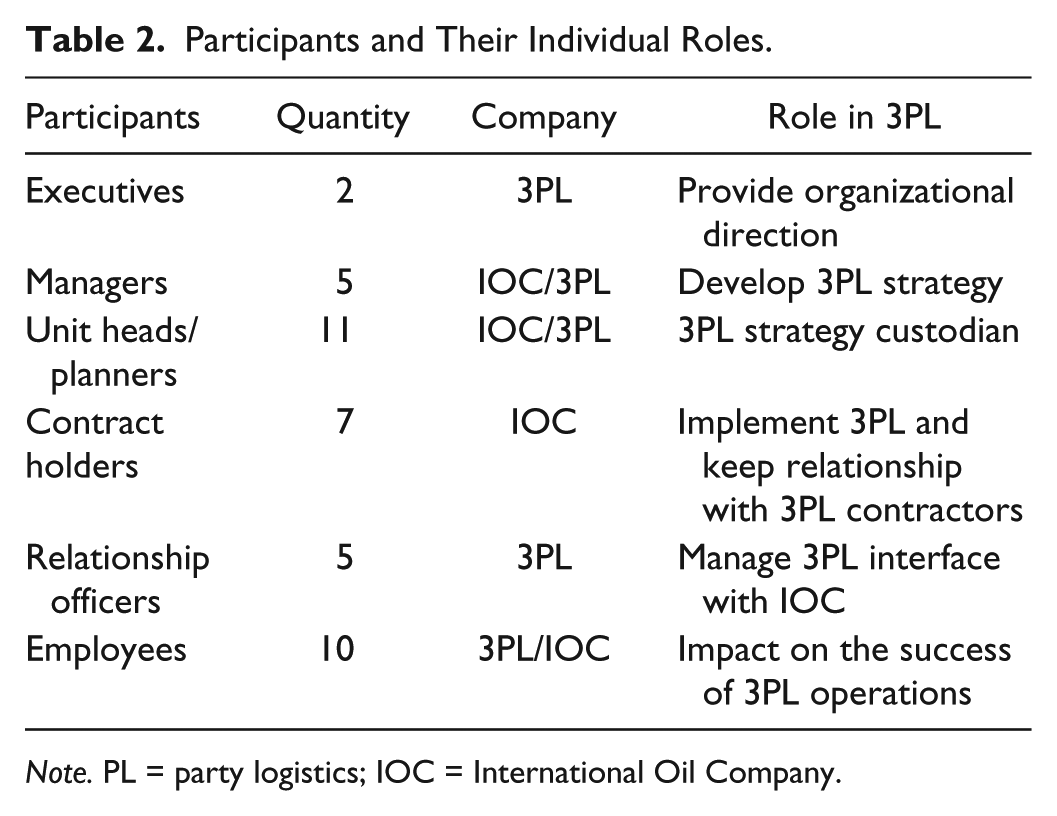
Note. PL = party logistics; IOC = International Oil Company.
Access to participants
Convenience sampling was used in this research for easy access to participants based on determined nonprobability parameters and availability (Ozdemir, St Louis, & Tophas, 2011), using their work experience and the researcher’s network and relationships in the oil industry.
Criteria for choice of participants
Different participants were chosen with emphasis on their roles in 3PL services that are linked to the research problems:
The logistics managers and procurement managers of the IOCs were relevant in relationship issues and change management in the 3PL.
The executives and commercial managers were relevant in providing insights into the issues with client interface and relationship management.
The holders of 3PL contracts in the IOCs were involved because of their knowledge of the capability of their organizations to manage the 3PL contracts.
Employees involved in logistics operations were key in understanding internal organizational challenges that could rob on the 3PL operations.
Ethical issues
Ethical issues exist regarding information gathering in Nigeria’s oil industry. Approval was obtained from Department of Petroleum Resources, the organization that served as a major joint venture partner to the IOCs, for the research’s information gathering. Also, pre-interview question samples were sent ahead of the interview to help participants understand interview trend. A commitment to maintain absolute confidentiality of participants and organizations was also given, thus the noninclusion of participants’ and organizations’ details in the research.
Data Gathering Techniques
According to in-depth interviews, purposive sampling and recording of interviews were used in line with case study methodology (Andrade, 2009; Runeson & Host, 2009). Initial pilot tests were conducted to develop interview questions which were further tested with another set of participants to confirm clear understanding of interviews. Eleven and 10 open-ended and progressive questions were used as guide in the interview sessions with the IOCs and 3PL service providers, respectively (Apendices A and B), and sent to participants ahead of interviews. Purposive sampling method was used to determine participants’ qualification, ensuring their eligibility, along with quota sampling method in which participants were categorized by their roles/positions. Following approval from the Department of Petroleum Resources - Nigerian government regulatory agency for oil and gas activities (DPR), organizations were contacted and dates for interviews scheduled, interviews were held and recorded serially on paper, and data properly labeled for identification and processing.
Data Analysis Process
Recorded discussions were reviewed severally using the constant comparison method; data were compared across different participants’ and commonalities drawn to gain in-depth understanding. Iterative process was also employed, in which participants were contacted more than once for clarification where necessary and the information combined with other participants’ for better understanding.
Trustworthiness of the Method Used
Validity of both method and data
Research methods need to guarantee the acceptability and transferability of a research (Easterby-Smith et al., 2012; Brannen & Nilsen, 2011; Moss et al., 2004). Internal validity, producing similar understanding under different tests, was assured through use of various methods including convenience, constant comparison, and iterative methods to ensure proper representation of participants and better understanding of issues thus minimizing biases. External validity, producing similar results outside research environment, was assured by use of pretesting process for external clarity and engagement of 40 participants across six organizations well beyond the eight interviews that are considered adequate for data dependability (Zacharia et al., 2011).
Reliability of method
Reliability, the ability of an experiment to provide consistent measurements across different tests, was guaranteed through rigorous and transparent constant comparison and iterative approaches of data collection and analysis, along with the pretesting and interview question refining exercises. This assurance of data consistency further adds credence to the generalizability of the research (Moss et al., 2004).
Generalizability
Case study method generates a lot of debate on generalizability—research outcome being applicable outside a given experiment—because of its relatively small sample size (Moss et al., 2004), but with proper representation generalizability is achievable (Brannen & Nilsen, 2011; Wood, 2009). Multicase study method involving three out of six IOCs in Nigeria (50% of industry population) and a balanced approach that included 3PL providers were used. This provided “transparency and rigours” of processes that make for research generalizability (Brannen & Nilsen, 2011).
Presentation of Results and Data Analysis
This session provides findings and in-depth analysis of data using a “systematic approach (and) reliable platform” that would address concerns of inconsistencies associated with differing results in social contexts ( Moss et al., 2004).
Findings and Analysis
Outsourcing of logistics services
Table 3 shows the number of participants and how they were selected. The table consists of participants from both IOCs and 3PL providers, their roles, and how they were distributed. Twenty participants representing 50% were chosen from the IOCs, and another 50% from the 3PL providers. A total of 5% of the participants were Executives from the 3PL providers. Managers interviewed were 13% of the total population, 8% from the IOCs and 5% from the service providers. In all, 27% of the participants were Heads of Departments or Planners, 10% from the IOCs, and 17% from the service providers. A total of seven CH were interviewed representing 17% of the population, all from the IOCs. Five Relationship Officers from 3PL providers were interviewed, representing 13% of the population. In all, 25% of the population interviewed were ordinary employees, 15% from the IOCs and 10% from the service providers.
Interview Participants.

Note. IOC = International Oil Company; PL = Party Logistics.
The participants were asked if their organizations adopted 3PL outsourcing or if they provided such outsourced services to the IOCs. In all, 100% confirmed there were outsourced 3PL services within the oil industry and particularly in the IOCs.
Outsourcing of logistics services from the IOCs’ perspective
As shown in Figure 1, the degree of outsourcing varied across the IOCs and among the different activities.

Activity outsourcing by IOCs.
The table shows the percentage of outsourcing in Land Transport, Marine Transport, International Freights, Aviation Services, and Local Port Handling. For confidentiality, the OICs are referred to as Company A, Company B, and Company C. Company A outsourced its Land and Marine Transport operations, representing 33% of its Land and Marine activities while it handled request processing and planning. Company B outsourced its request processing, planning, and execution of the same services representing 60% but vetted all plans and also participated partly in the execution including owning some of the logistics equipment used for the operations. Company C owned most of the marine and land transport equipment, and also participated in operations and vetting of plans. Actual activities outsourced by Company C were planning and request processing, with little of execution and equipment ownership, representing 40% of the activities.
Aviation services included 10 activities: request processing, scheduling, booking, baggage handling, maintenance, communication with technical team/crew, ownership of specific facilities, flight operations, manifest publication, and management of the health and safety (HSE) aspects of the operations for noncommercial flights. Companies A and C outsourced 90% of the activities, retaining only the HSE aspect, while Company B outsourced 80% retaining resource ownership and HSE aspects.
International Freight services were also almost entirely outsourced. Companies A and B outsourced 60% of the activities consisting of freight collection, transportation, and Customs clearance, and retained Customs duty payment and documentations. Company C outsourced 100% of International Freight. There were, however, exceptional cases where those roles were either reversed or they complement each other in all the three IOCs. Local Ports Handling operation was 100% outsourced by the IOCs.
Overall, Companies B and C perceived there were huge opportunities in the future. This included full outsourcing in almost all the components of logistics service.
Outsourcing of logistics services from the 3PL providers’ perspective
Figure 2 shows the percentage averages of the outsourced activities being wholly handled by the service providers across all operations. Port Operations and Management of Equipment are 100% handled by service providers in all operations that include Marine Services, Land Transport, and Port Operations. Ownership of Equipment scored 37% for Marine Services, the lowest in all the activities. On average, Land Transport recorded 88% of outsourced services wholly handled by service providers, followed by Port Operations with 83%, and lastly Marine Services at 81%.
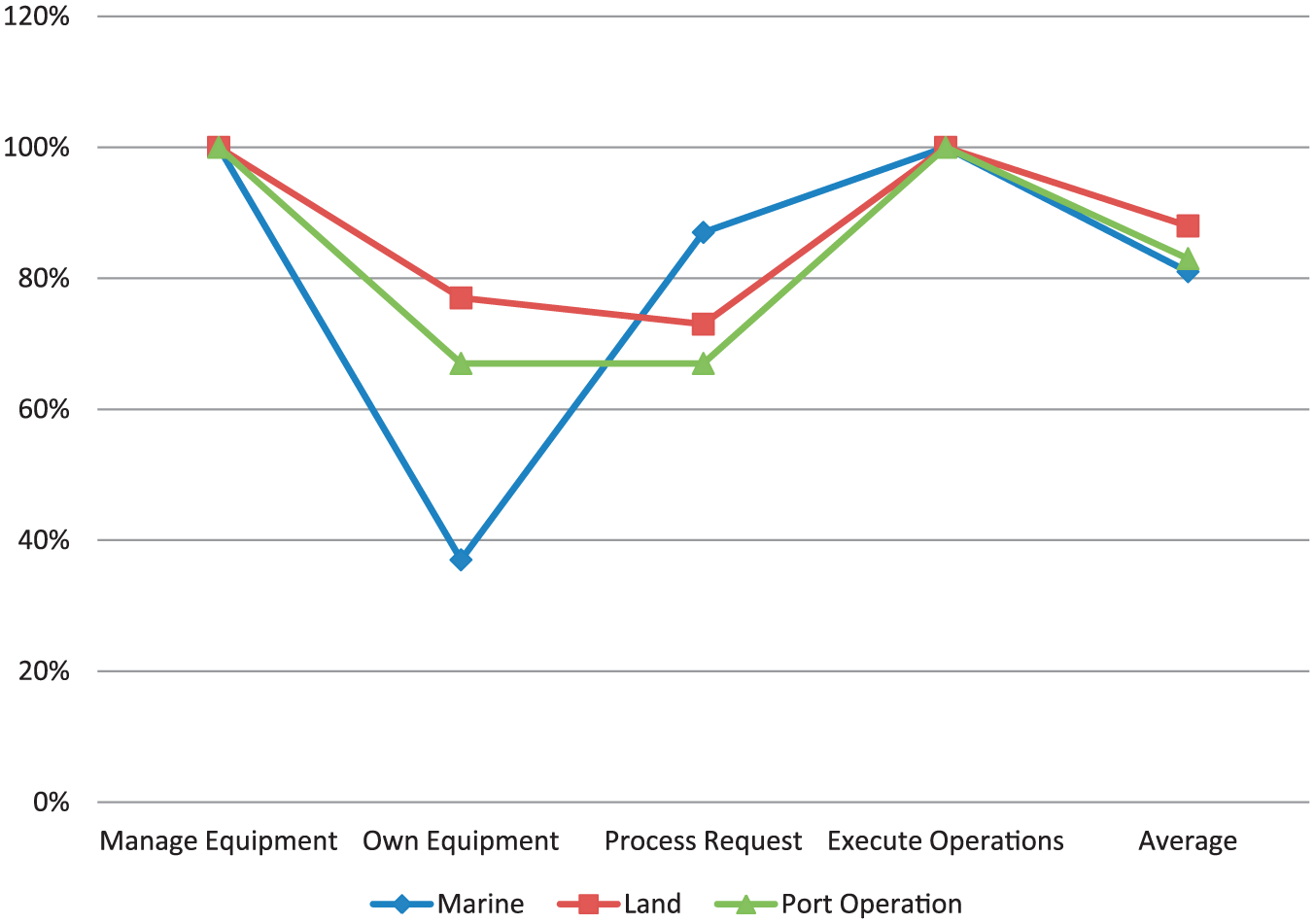
Average percentages of wholly outsourced services.
Benefits and challenges of 3PL in O&G
Participants were equally interviewed on what they considered as benefits of 3PL outsourcing and what constituted challenges in effectively implementing the process. The benefits and challenges of outsourcing are presented in Table 4. The table consists of percentages of respondents from the IOCs and 3PL providers according to the identified benefits or challenges.
Percentage of Respondents on Benefits and Challenges of Outsourcing.

Note. IOC = International Oil Company; JVP = Joint Venture Partners; 3PL = Third Party Logistics.
Both the IOCs and the 3PL providers agreed that there were benefits from the outsourcing of logistics services by the IOCs. The IOCs recorded highest scores of 95% on professionalism and resource optimization, and 90% in efficiency. The service providers recorded 100% on professionalism, efficiency, resource optimization, shared costs, and organizational strategy.
No IOC participants agreed that micro managing service providers or their organizational cultural differences were a challenge; rather, they felt such was strength in enforcing their organizational standards. Comparatively, the service providers scored 85% and 60%, respectively, indicating they were important challenges for them. Similarly, the IOCs scored low in information flow and staff changes, unlike the service providers that scored 100% and 85%, respectively.
Overall, average of 76% of respondents accepted there were benefits in outsourcing, with six activities recording 80% and above. In all, 65% indicated challenges in outsourcing, with four activities scoring above 70%.
Nigerian environment
Interview was carried out on recurring issues emanating from the Nigerian environment, and the findings as perceived by respondents from both IOCs and 3PL providers are presented in Table 5. The table shows the percentage of participants from the IOCs and 3PL providers who responded on given environmental factors, and also gives average of these respondents for each environmental factor.
Percentage of Respondents on Environmental Issues.
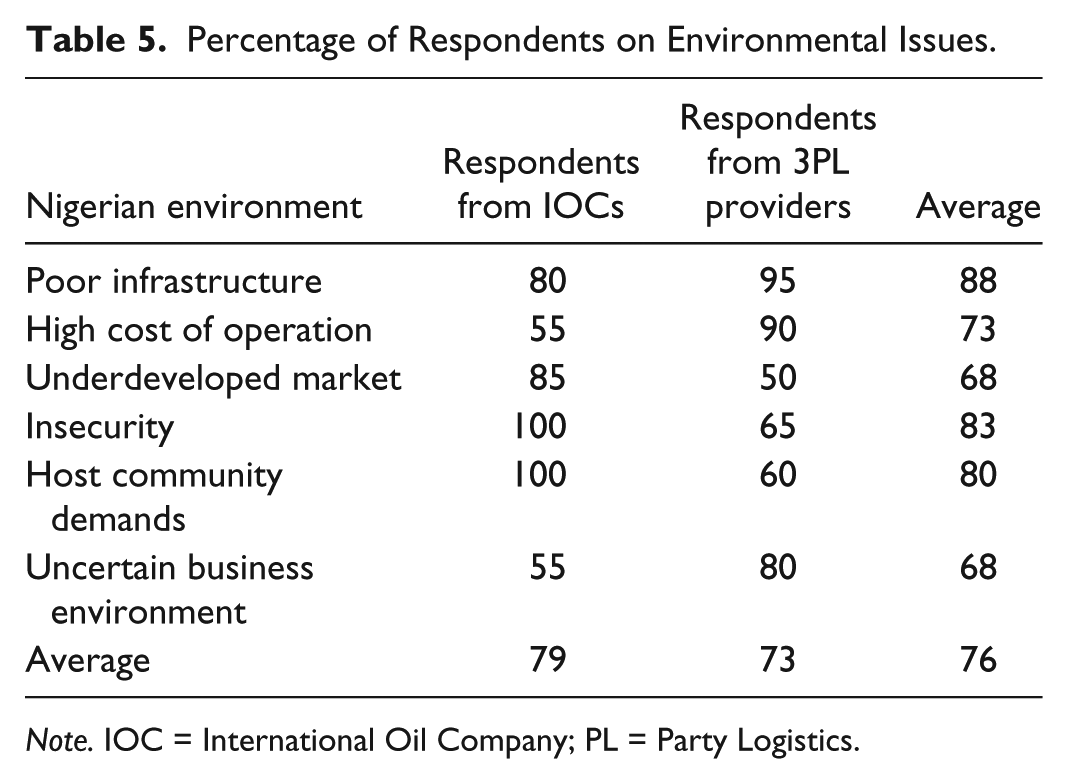
Note. IOC = International Oil Company; PL = Party Logistics.
Six key environmental issues were identified as negatively impacting 3PL outsourcing in O&G with average score of 76%. Poor infrastructure, insecurity in the oil producing area, and host community interference on 3PL contracting scored 80% and above. Highest score in IOCs was 100% in IOCs for insecurity and community issues, while lowest was 55% for high cost of operations. For the service providers, highest score of 95% was recorded in poor infrastructure and lowest of 50% in underdeveloped market for logistics outsourcing.
Organizational resources for 3PL
Table 6 gives the percentages of participants that responded on whether given resources were required for logistics outsourcing and if the IOC owned these resources. Participants identified relationship and contract management skills, training resources, and information technology as important resources required for 3PL implementation by the IOCs in Nigeria. Relationship skill was considered by most participants (90%), followed by training and development resources (80%). In all, 63% of participants accepted that the IOCs have relationship skills to manage 3PL outsourcing, while only 45% accepted that information technology for managing 3PL existed in IOCs.
Percentage of Respondents on Resources Required for 3PL and Whether the Resources Are Available in IOCs.
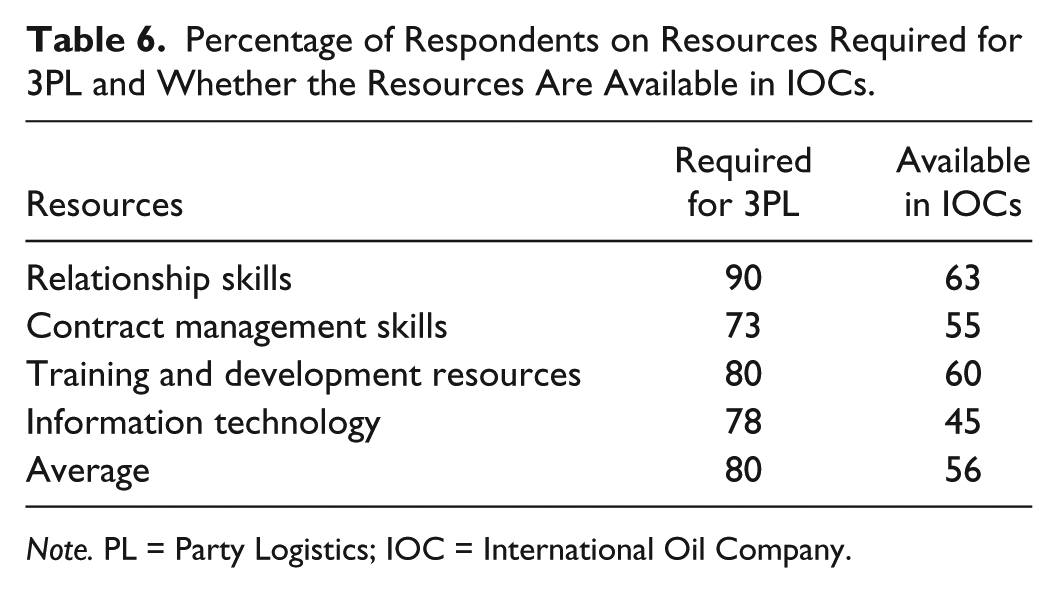
Note. PL = Party Logistics; IOC = International Oil Company.
Employee response to logistics outsourcing
In all, 75% of participants acknowledged that employees were reluctant to accept the transfer of activities they were doing in-house to external parties. Interestingly, 100% of respondents from the IOCs stated that resistance from employees was unlikely to lead to failure of implementation of 3PL outsourcing by their organizations.
Managing potential for failure
Participants were asked to assess the tendency for logistics outsourcing to derail or fail outright and how the potential is managed.
Average of 65% of participants acknowledged the possibility of failure of 3PL outsourcing unless it is effectively managed. Likely failure was attributed to either employee-related issues or vendor-related issues. Table 7 indicates the resources participants considered that the IOCs were using to manage 3PL from failing. For employee-related issues, information management (58% of respondents), exit strategy (40%), and top management involvement (70%) were identified. For vendor-related issues, effective contract management (70%) and direct support to vendors (85%) were identified.
Percentage of Respondents on Managing 3PL Failure.

Note. PL = Party Logistics.
Discussion of Findings
Discussions on the data are presented here. The discussion is broken into logistics outsourcing, 3PL benefits, and challenges of 3PL in O&G; Nigerian environment and organizational resources for 3PL; and employee response to 3PL and managing potential for failure.
Logistics outsourcing, 3PL benefits, and challenges of 3PL in O&G
From the findings, logistics outsourcing was already in practice in the O&G in Nigeria. Benefits identified are similar to those reported by Arroyo et al. (2006), Rabinovich et al. (1999), and Rahman (2011) such as efficiency (saving cost from logistics operations), professionalism (focusing on core business areas), resource optimization (not tying their investments on logistics resources and assets), specialized service delivery and delivery speed (ability to access professional logistics services with guaranteed efficiency and effectiveness), and service integration (flexibility in operations).
Result, however, records highest responses on professionalism, resource optimization, and efficiency compared with Sohal et al.’s (2002) customer service, flexibility, and savings in investment, and Rahman’s (2011) cost reduction, savings in investment, and flexibility. It is suspected that the difference could be because these other researchers investigated routine product distribution–driven organizations, unlike the O&G where logistics demands are inconsistent and thus logistics resource optimization critical. Moreover, their study was based in a developed country Australia with established efficiency factors. Nigeria is a developing country constrained with logistics inefficiencies (Hilmola, 2011), thus professionalism and efficiency would be critical.
Resource optimization was of particular interest in the O&G. IOCs are sharing some marine logistics assets and handling and lifting equipment with other organizations. Outsourcing would enable them release huge resources from assets that are underutilized. This is consistent with Rahman’s (2011) findings that 3PL services reduce both operational cost of services and capital costs of investment. In addition, O&G logistics demands are unpredictable and urgent requiring professional, flexible, and effective services which the 3PL providers are better equipped to provide (Girma & Gorg, 2004; Lieb et al., 1993; Rahman, 2011; Zacharia et al., 2011). With the IOCs deploying their relationship management capabilities, right integration between 3PL providers and the IOCs is expected to produce better flexibility, increased productivity, and customer satisfaction (Chiung-Lin and Pei-Yu, 2016).
Challenges such as information flow, micro managing (control), and differences in organizational cultures are consistent with Lieb et al.’s (1993) findings. However, vendor capability, information flow, and JVP interventions identified as three challenges most participants selected in the result differ from those identified by Sohal et al. (2002). These differences are also attributable to the differences in geographical locations. Such differences underlie the uniqueness in country characteristics, highlighting the need to recognize differences in the application of 3PL outsourcing across the borders (Arroyo et al., 2006).
The benefits of 3PL in Nigeria justify the need to retain these services. IOCs in Nigeria are contending with pipeline failures due to activities from illegal operators. They also face environmental issues such as pollution and losses from theft. By outsourcing logistics, they would be focused on technology development in the O&G that can address these concerns (Rabinovich et al., 1999; Sohal et al., 2002).
How challenges in IOCs impact benefits of 3PL
The unique challenges observed in the findings suggest that peculiarities in 3PL application could cause country-specific challenges in 3PL implementation (Arroyo et al., 2006). This leads to the Research Question 1: What challenges do the IOCs face in managing 3PL in Nigeria?
IOCs operate with global standards and require competent 3PL vendors with adequate resources to implement these standards in IOC-related logistics operations, but the Nigerian Oil and Gas Industry Content Development (Local Content) Act 2010 mandates exclusive consideration of local services organizations for O&G operations (Ovadia, 2013). Consistent with existing reports (Hilmola, 2011; Ihua, 2010), findings indicate that local logistics vendors lack adequate capability for logistics services for the IOCs in Nigeria. Contrary to Ihua (2010), evidence from this research confirms that IOCs do provide capacity-building support, such as liaison with banks for local vendor funding, advanced payment for services, consultancy, and training. This suggests a new drive by the IOCs to overcome their logistics constrains that tend to hinder their operations while gradually implementing the Local Content Act 2010 (Ovadia, 2013). This also aligns with Yang and Zhao (2016) findings that integration as a new form of relationship management in logistics outsourcing in unpredictable environments like Nigeria is beneficial for financial improvement and customer satisfaction.
Personnel training was an interesting discovery. In all, 67% of the 3PL providers were found to have their personnel trained by the IOCs, suggesting that most 3PL providers depended on the IOCs for the capacity building. Thus, knowledge gap may have been more of a challenge for the 3PL providers than for the IOCs.
Closely related to the capacity of local vendors was the JVP’s influence on the choice of strategy for 3PL outsourcing and the sourcing of local vendors for the services. The JVP hold majority shares in the joint venture partnership with the IOCs, enabling them to exert influence on the IOCs’ decisions at the expense of ethically embedded culture of established organizations (Rossouw & Van Vuuren, 2003). IOCs have to develop internal mechanisms for managing these challenges. This explains why the IOCs were found to design capability assessment processes to identify gaps among the local vendors and provide corresponding capacity-building support. It was interesting to observe that the IOCs sometimes rejected JVP’s choices on vendors, bearing alone the cost of investing on their preferred vendors. This aligns with Rossouw and Van Vuuven’s (2003) totally aligned organization that upholds its ethical standard at all cost.
Although information management has been considered a critical factor in 3PL outsourcing (Leahy et al., 1995; Paulraj & Chen, 2007; Rabinovich et al., 1999; Somuyiwa & Adewoye, 2010), emphasis has been on 3PL provider’s ability to provide robust and effective information platform. Findings from this research indicate service providers are looking up to the IOCs, because of 3PL providers’ inadequate resources.
In summary and in response to the Research Question 1, the IOCs do face challenges in managing 3PL outsourcing in Nigeria mostly because of the peculiarity of service and conditions in the country. The IOCs have their internal mechanism for managing these challenges. In addition, there are numerous benefits of 3PL outsourcing in O&G that the IOCs are enjoying currently despite the current challenges of managing the process. Evidence from this research indicates the IOCs are looking forward to further exploiting the opportunities of engaging in full 3PL outsourcing compared with their currently predominantly partial 3PL outsourcing prevalent in the O&G in Nigeria.
Nigerian environment and organizational resources for 3PL
It would have been expected that the Nigerian environmental uncertainties, poor transportation infrastructure/regulation, and unpredictable O&G logistics demands would be a major impediment to IOCs’ 3PL outsourcing because of their influence on supply chain strategies (Paulraj & Chen, 2007; Ugboaja, 2010). The result, however, shows it was the 3PL providers that emphasized the criticality of this factor and not the IOCs. The IOCs see them as service providers’ capabilities development opportunities, which is consistent with Hilmola’s (2011) argument for logistics-unfriendly countries to learn best practices. In addition, OIC’s shifting the risks associated with environmental uncertainties could be their motivation for 3PL (Girma & Gorg, 2004).
Shifting some risk managements to 3PL providers could be a channel for the service providers to develop shared resources. This is consistent with Transaction Cost Economics and Resource-Based Theory schools of thought about business owners’ decision on transaction cost reduction and organizational resource combination for higher performance (Zacharia et al., 2011). The 3PL shared resources enhance IOCs’ concentration on core competence, increasing performance, and increase vendors’ operations scale and scope, creating huge growth opportunities in the emerging economies (PricewaterhouseCoopers, 2010).
IOCs would still have to contend with some of the risks the service providers may not be able to handle. It makes sense then for the IOCs to want to handle the environment-driven negative factors that have to do with vendor characteristics as shown in the findings, while supporting them to grow the capacities they already have. This is most effective if specific competencies that have direct bearings with the O&G logistics operations are developed to assist in knowledge localization and development of logistics hubs for O&G (Almeida & Kogut, 1999; Zacharia et al., 2011). Logistics hub for O&G operations already exists in the Oil & Gas Free Trade Zone located in the oil producing region of the country (Sheffi, 2012).
What organizational resources do the IOCs need to own
The question, then, is if the IOCs really need to own all logistics-related resources. Answering this would address the Research Question 2: Are in-house capabilities available in the IOCs for managing 3PL?
The IOCs would be holding excess capacity should they retain resources meant for functions handled by the 3PL. From the findings, management of communities, vendors, and contracts were considered key for the IOCs. Consistent with Boyson et al. (1999), Tian et al. (2008), and Lai et al. (2013), successful 3PL outsourcing practice requires sound management resources associated with managing these interfaces.
Managing communities are similar to managing vendors. Managing 3PL contracts would, however, require additional skills such as the ability to scope contracts properly, specify clear responsibilities, avoid unrealistic promises and demands, and make provisions for recouping investment through agreements that encourage future benefits (Ackerman, 1996). The 3PL providers argued during the interviews that the IOCs needed logistics operations skills. Their view is supported by Boyson et al. (1999) report that logistics skills are important for managing logistics outsourcing. IOCs, however, can draw from their social exchange power and management capabilities for their 3PL outsourcing (Ulrich & Barney, 1984). Logistics skills needed for the effective management of the 3PL providers through daily interaction with the providers can be acquired as a dynamic learning capability, and as pointed out by Lin and Wu (2014), this kind of learning process significantly improves performance. As the findings suggest and in line with reports on international organizations (Lai et al., 2013), skills and resources for contract, integration, and relationship management exist among the IOCs.
Ackerman (1996) argues though that individual managers’ personal interest could influence the outcome of logistics outsourcing. Such behaviors were reported during the investigation but were minor. Such tendencies would only have minimal impact among the IOCs possibly because of the dominant and impulsively replicated positive behaviors (Gondo et al., 2013) existing in these companies.
However, the results show the IOCs currently manage 3PL piecemeal. They may need to scale up their capability for managing huge and integrated 3PL services in the future.
Therefore, in response to Research Question 2, it is concluded that the capabilities IOCs require for managing 3PL would be mostly those resources for managing communities, vendors, and contracts. Key logistics operations capabilities may not be prerequisites, because in the course of managing the contracts, the critical logistics operations will be available on need-to-know basis. The IOCs do have basic resources for managing 3PL outsourcing, but they would likely need to develop the capability further to enable larger scale outsourcing management.
Employee response to 3PL and managing potential for failure
Findings indicated that initially employees from the IOCs were not favorably disposed to 3PL outsourcing. This is common in 3PL as a change process with employees’ uncertainties, fears, and reinforced old behaviors (Boohene & Williams, 2012; Gondo et al., 2013; Lozano, 2013; Mariana, Daniela, & Nadina, 2013; Mittal, 2012; Rahman, 2011; Sohal et al., 2002).
Interestingly, the IOCs were reported to be effective in managing communication. They understand and apply concepts of communication and change management in their dealing with employees (Mittal, 2012). Also, in line with Self et al.’s (2007) explanation, the IOCs may be succeeding in the outsourcing process because they have been able to align organizational content of 3PL outsourcing and the organizational processes for implementing it with the organizational context for the change in a seamless manner that would be better appreciated and accepted by the employees.
Managing potential failures and employee impact
An interesting outcome from the interview was that respondents from both the IOCs and the 3PL providers were in agreement that IOCs had not recorded failures in the implementation of any 3PL outsourcing initiatives as a result of employee resistance. It would have been expected that IOCs with large workforce would have challenges pushing through with changes that the employees were reluctant to adopt. So why is this different in the case of IOCs in Nigeria? In attempting to answer this, the Research Question 3 will be addressed: How would the employees respond to 3PL outsourcing?
Several researches uphold that 3PL outsourcing lead to negative impacts on employees and thus likely to lead to resistance (Boohene & Williams, 2012; Lozano, 2013; Rahman, 2011; Sohal et al., 2002). As much as 40% to 80% logistics personnel have been reported to be impacted by 3PL outsourcing (Rahman, 2011; Sohal et al., 2002), with serious post implementation impact including lowering of morale.
The findings show that extending 3PL services to integrated package would meet negative response but such resistance was unlikely to result in failure of 3PL outsourcing implementation. Lieb et al. (1993) report similar deviation and linked it to good relationship management. It implies that the IOCs appreciate the import of employee contribution to firm success (Hosang, 2017), have sound skills in change management, can coordinate the change through expert change agents, and are able to motivate employees toward such change (Boyson et al., 1999; Mariana et al., 2013). In sum, regarding Research Question 3, employees in IOC are likely to respond unfavorably to large-scale logistics outsourcing. However, because the IOC have excellent resources for managing change effectively, such reactions are likely to be contained. Thus, resistance from employees would not result in failure of implementation of 3PL outsourcing.
Conclusion
The article reveals that the IOCs face challenges in implementing 3PL outsourcing in Nigeria, their peculiar logistics needs, and the unique local conditions. Challenges identified include 3PL providers’ capability to deliver O&G-specific logistics services, JVP influence in 3PL implementation, and information management between IOCs and the service providers. The IOCs have internal mechanisms to manage these challenges. Moreso, 3PL outsourcing benefits outweigh these challenges, justifying 3PL outsourcing by IOCs in Nigeria.
The article also establishes that Nigeria has unique logistics issues such as underdeveloped logistics market, host community challenges, and poor transportation infrastructure. However, it was revealed that the IOCs only needed relationship and contract management capabilities for managing vendor development, contract management, and the management of communities which were logistics challenges not within 3PL capabilities. The IOCs currently use them in managing outsourced fragmented logistics services, but need further development for integrated logistics services.
Contrary to most existing literature, IOC employees may respond negatively initially to 3PL outsourcing but would end up accepting it. The IOCs have developed good management practices that enable them manage employee issues effectively during 3PL outsourcing implementation. There are job losses during such exercises, but employees are usually prepared to eventually accept the change. This experience is unique and calls for further studies for possible adoption outside the IOCs.
The findings obtained therefrom add to the existing research on 3PL across national dimension from the IOCs with the Nigerian perspective. Thus, the research contributes to the body of knowledge in the field of international business and logistics outsourcing.
Implications of the Research
The outcome of the research has some implications. First, academically it debunks the long-held tradition that global organizations should always deploy their global standards and best practices across borders to achieve streamlined operations, economies of scale and scope, and transparent processes. Consistent with Schilke, Rehmann, and Thomas (2009), standardization may not always translate to good business performance. As the research has shown, the Nigerian environment requires home-grown resources and capabilities that call for collaboration between the IOCs and local vendors that would lead to new capabilities for logistics operations in the O&G. It equally calls for dynamic learning capabilities between the IOCs and local vendors to cope with volatilities in the environment (Lin & Wu, 2014).
Second, it addresses management practices in the IOCs. Organizations deploy 3PL outsourcing strategies with expected gains which when not met lead to early termination of relationships with service providers (Ackerman, 1996; Boyson et al., 1999). IOCs would need to device new working relationships with their vendors that would result in their capacity building. The research throws up the challenge for managers in IOCs to study and design a win-win partnership framework. As Yang and Zhao (2016) see it, this is an innovative means of managing logistics outsourcing relationships. IOCs can leverage on the local vendors’ capacity to manage the challenging security in the oil producing areas, their reticence in coping with the poor logistics infrastructure in Nigeria to deliver logistics services, and their skill in networking with local operators to influence regulations, to solve their peculiar logistics needs better. IOCs providing financial and technical support to the growing 3PL providers in Nigeria can assist in their capacity, improve 3PL services to the O&G, and develop globally competitive logistics service providers.
Third, it emphasizes the importance of change management in organizations. Change management tends to focus on ideas level where consultants work with management teams of organizations to develop structures and resources without effective implementation (Parker et al., 2013). There is apparent lack of academic details in change processes on complex organizations (Kuipers et al., 2014). The experience with the IOCs shows that properly designed and implemented change management processes can pay off.
Fourth, it highlights the need for a more robust and all-inclusive logistics outsourcing strategy by the IOCs to fully harness the benefits of 3PL outsourcing. An integrated logistics outsourcing with effective information sharing and process coordination (Liu, Huo, Liu, & Zhao, 2015) that provides end-to-end service delivery would be more beneficial to the IOCs (Boyson et al., 1999; Rabinovich et al., 1999; Zacharia et al., 2011). The research reveals that this currently is lacking in the O&G in Nigeria. As the research indicates, however, the IOCs are contemplating such initiative.
Limitations of the Research
The research methodology was drawn from the case study method with generalization issues. Also, the interview sessions would introduce the probability of subjective results. Another limitation came from the restricted mode of accessing information in the O&G in Nigeria. The oil and gas regulatory bodies in Nigeria imposed bureaucratic constraints to accessing information, limiting research to three instead of the six IOCs intended by the researchers.
Despite these limitations, the outcome is tenable. The multicase study enabled the researcher to use credible methods for data processing, and to spread the interview across wide population of respondents, thus minimizing the chances of subjectivity and increasing its generalization. Concerning the number of IOCs investigated, the research was able to cover three of the six IOCs in Nigeria, representing 50% of the population.
Areas for Further Studies
This article was an exploratory research. Having established the workability of 3PL outsourcing by IOCs in Nigeria, an extensive and quantitative research would be required to further test the applicability of this established concept under different scenarios.
Another area for future study would be conducting a more focused research on employee behavior with respect to 3PL outsourcing across different industries in Nigeria to determine if the IOCs’ unique result in which the employees tend to welcome rather than resist outsourcing is industry-specific or not.
Footnotes
Appendix A
Appendix B
Authors’ Note
The study was carried out as part of Master in Business Administration studies of the lead author (Emah Patrick Etokudoh) at the University of Liverpool/Laureate, United Kingdom.
Declaration of Conflicting Interests
The author(s) declared no potential conflicts of interest with respect to the research, authorship, and/or publication of this article.
Funding
The author(s) received no financial support for the research, authorship, and/or publication of this article.