




Abstract
This study examines persuasive messages and source credibility in luxury brand influencers’ content within their brand collaborations. It also explores how influencers establish parasocial engagement with followers through their posts. Conducted as an online survey between February and July 2023, the study targeted 400 individuals in Northern Cyprus who follow influencers. Findings indicate that increased parasocial engagement enhances the perceived persuasiveness of messages. A positive relationship between parasocial engagement and source credibility was observed, demonstrating that as influencers’ credibility rises, so does the persuasiveness of their messages. Additionally, the study analyzed relationships between parasocial engagement, persuasive messages, source credibility and demographic factors. While no significant differences were found between parasocial engagement and most demographic characteristics, education level stood out. Individuals with a primary education level showed a greater tendency toward parasocial engagement. A significant difference was noted between source credibility and monthly income, with the highest perceived credibility reported in the 7,000 to 8,999 TL income group. Similarly, persuasive messages were most effective among individuals in this income range. In conclusion, this study highlights the importance of considering demographic differences and parasocial engagement in influencer brand collaborations. It underscores that source credibility and persuasive messages play a crucial role in influencer communication, influencing how audiences perceive and engage with branded content. It has been concluded that strong parasocial bonds in influencer and brand collaborations play a strategic role in establishing effective interaction with the target audience.
Plain language summary
Influencers are individuals who share their experiences, opinions, and recommendations about products and services with their target audience through social media platforms. This study explores persuasive messages and source credibility in the content produced by luxury brand influencers as part of their brand collaborations. Additionally, it investigates how influencers establish parasocial engagement with their followers through their posts.The findings indicate that higher parasocial engagement with influencers enhances the perceived persuasiveness of their messages. The results have demonstrated that as an influencer’s credibility increases, their messages become more persuasive. Individuals with a primary education level exhibited a greater tendency toward parasocial engagement.The highest perceived credibility observed was in the 7,000-8,999 TL income group. Similarly, persuasive messages were most effective among individuals within this income range. In conclusion, the study highlights the importance of considering demographic differences and parasocial engagement in influencer brand collaborations. The findings suggest that source credibility and persuasive messages play a crucial role in influencer brand collaborations, shaping audience perceptions and interactions with branded content. These insights contribute to a deeper understanding of influencer brand collaborations and provide guidance for brands and researchers developing effective communication strategies.
Introduction
With digitalization, consumer behavior has undergone a transformation, and the importance of social media platforms has increased, particularly in the communication strategies of luxury brands. In this context, influencer communication has become a significant tool in the realm of luxury consumption. Social media influencers contribute to brands’ ability to reach their target audience in a more authentic and effective manner through the personal connections they establish with their followers (Han & Balabanis, 2024). The experience based content created by influencers shapes consumer perception and can directly influence purchasing decisions (Sheng et al., 2022).
The three variables underlying this study play a key role in explaining the effectiveness of communication between luxury brands and influencers. One of these variables is source credibility, which refers to the extent to which an influencer is perceived based on qualities such as expertise, honesty, and trustworthiness. Influencers, due to their knowledge and expertise in specific areas, can gain credibility among large social media audiences and are individuals who have a significant impact on their followers’ decisions (Ki & Kim, 2019, p. 905).
Another variable is the persuasive message. This component refers to the structure, language, and emotional tone of the message used in the influencer’s content, which together determine its effectiveness on the audience. The role of social media influencers can be defined as persuading and influencing their followers. In this way, engagement with the product or topic promoted by the influencer is established (De Aquino Carlsson, 2018, p.2). Therefore, the persuasiveness of the message is of great importance. In the persuasion process, social media influencers use platforms such as social media and blogs to influence the attitudes of their target audience. Through this, they can shape their followers’ perceptions and even their purchasing behavior (Ithnin et al., 2020, p.71).
Parasocial engagement refers to the one-sided, yet intimate and seemingly real relationships that individuals form with media figures, in this context, with influencers. Parasocial engagement, which can also be described as the asymmetric engagement between the source and the audience/followers in both traditional and new media environments, is increasingly becoming a subject of scholarly focus (Maheeya & Head, 2024). Tyrväinen and Karjaluoto (2025, p.3) defines parasocial engagements’ features as the cognitive, emotional, and behavioral investments made by a company’s customers in the person or groups with whom they interact. This engagement leads social media users to perceive an influencer as a friend or as part of their social circle; this perception can influence consumer behaviors such as trust, loyalty, and purchase intention (Koay et al., 2024). Influencer content, especially when associated with luxury brands, plays a decisive role in shaping brand perception and brand value (Jansom & Pongsakornrungsilp, 2021).
The primary objective of this study is to examine the parasocial engagement formed between influencers and their followers as a persuasive element within the context of luxury brand communication, and to reveal their role in shaping brand credibility. In addition, it aims to evaluate the process of parasocial engagement established between influencers and their followers in the formation of brand credibility.
Accordingly, several research questions have been formulated to address the main problem of the study. These research questions are as follows:
How do the demographic characteristics of influencer followers differ according to the level of parasocial engagement they develop with influencers?
To what extent are the parasocial relationships, that followers build with influencers, associated with the perceived persuasiveness of the shared messages and the influencer’s level of credibility?
How is the influencer’s level of credibility related to the perceived persuasiveness of the shared messages?
It can be stated that social media influencers serve as an effective communication tool for organizations in creating engagement with their target audiences and stakeholders. Although parasocial communication on social media platforms and the evolving engagement process have gained popularity and effectiveness, it can also be noted that studies and conceptualizations in this field remain relatively limited (Tyrväinen & Karjaluoto, 2025). This research aims to gain a deeper understanding of the effects of influencer communication and the resulting parasocial engagement within the context of luxury brands and seeks to provide original findings that will contribute to communication strategies.
Literature Review
Influencers in Luxury Brand Communication
Luxury and luxury products are defined as goods such as property, jewelry, clothing, and automobiles that are materially and symbolically valuable, confer social status, and evoke a sense of exclusivity and empowerment (Ulaş, 2019, p.186). These luxury products exhibit distinct characteristics in terms of brand names, designers, brand communication activities, store designs, and advertising (Prandelli et al., 2024). With the widespread use of social media, individuals have gained faster and easier access to products and services, which has contributed to the growing use of luxury goods. The increasing popularity and usage of social media applications have not only accelerated luxury brands’ activities in sales and marketing but have also facilitated access to a broader audience (Boylu, 2023). For instance, a study conducted among young people (aged 14–24) in South Korea found that the use of the internet and social media has made luxury products and services more accessible, thereby increasing demand for such goods (Park & Chun, 2025). Based on these findings, it can be stated that social media presents significant opportunities for luxury brands in terms of accessibility and visibility. This situation, when associated with themes such as status-based consumption and visibility, suggests that luxury brands have developed new strategic pathways in their communication processes.
Today, influencers have emerged as one of the prominent tools of strategic communication and are defined as individuals who convey their experiences, opinions, and recommendations regarding products and services to their target audiences via social media (Alkan & Ulas, 2023). Influencers’ content contributes to the formation of loyal follower communities who share similar thoughts and preferences, which in turn facilitates the acceptance of the conveyed messages and the rapid dissemination of implicit advertisements. In this context, brands have recognized the impact of influencers and strategically utilize influencer collaborations in the promotion of their products and services (Daniel et al., 2018; Wiedmann & von Mettenheim, 2021, p. 707). Among the primary reasons brands prefer influencers are their ability to serve as credible content channels and to establish strong and immediate engagement with the target audience (Chopra et al., 2021). Brands that choose this approach observe the influence of influencers on brand awareness and product sales (Ulas & Alkan, 2020). Through influencer collaborations, brands gain easier access to social media data regarding their products or services. This allows them to quickly gather and report on followers’ positive or negative opinions about shared products (Chetioui et al., 2020, p. 1363). Accordingly, it can be stated that influencer collaboration has become an inevitable process for brands today. For brands aiming to leverage influencers’ wide reach and persuasive power, follower trust in the influencer and the persuasion process that stems from it have become key determinants of the success of communication strategies (Eyel & Şen, 2020, p. 13). Qualities such as the influencer’s credibility, expertise, and authenticity directly affect the followers’ perception of trust and, consequently, the persuasiveness of the message. Trust plays a crucial role in influencer communication, as it enables followers to adopt the message more quickly and easily.
This trust based persuasion process is regarded as a critical factor that directly influences the success of a communication strategy. Indeed, a study examining the effects of influencers’ intimate self-disclosures on their ability to persuade followers found that, when the follower–influencer relationship exists within a communal context, the influencer’s personal and emotional revelations foster a sense of trust in the follower, thereby enhancing the persuasive impact (Kim et al., 2024). Similarly, it has been shown that messages from influencers who share deep and personal disclosures are perceived as more persuasive (Kashian, 2024). These findings indicate that an influencer’s sincerity and authenticity are directly related to the perceived persuasive power of their message.
Another factor that plays a significant role in the persuasion process is the influencer’s expertise regarding the product or service. Wiedmann and von Mettenheim (2021) emphasize that source expertise enhances the perception of credibility, which in turn makes consumers more receptive to the messages. Similarly, Onurlu et al. (2022) state that messages delivered by a credible source can lead to attitude changes in consumers. Within this framework, the source credibility conveyed by an influencer when presenting a message significantly in an expertly manner affects the persuasive power of that message.
Within this scope, the following hypothesis has been developed:
This hypothesis is grounded in the assumption that messages communicated by influencers perceived as credible and possessing subject-matter expertise are more likely to be evaluated as persuasive by their followers.
On the other hand, it is believed that individuals’ demographic characteristics also play an active role in both the perception of source credibility and the persuasiveness of the message. For example, demographic factors such as age, gender, and education level may lead to differences in how individuals develop trust and interpret messages.
Accordingly, the following hypotheses are proposed:
This hypothesis suggests that individuals’ perceptions of source credibility may vary depending on their demographic profile.
This hypothesis assumes that individual demographic factors may have a determining effect on perceptions of message persuasiveness.
In conclusion, within the scope of this study, source credibility, the nature of the communication message, and the demographic characteristics of the target audience emerge as fundamental elements that must be considered together to ensure the success of the persuasion process in influencer communication.
Parasocial Engagement and Influencers
Social media platforms have facilitated the emergence of new forms of engagements between users and influencers, providing a conducive environment for the development of parasocial engagements. Through social media, users can directly engage with the influencers they follow and easily access details about their personal lives. This accessibility leads to the creation of deeper emotional bonds, as the personal and intimate content shared by influencers fosters a stronger connection with followers (Khaerunnisa, 2024; Liu & Zheng, 2024). In order to maintain this bond, influencers are expected to remain in regular communication with their followers and to convey a natural appearance and a sense of friendship (Çaycı, 2020, p. 216).
In the age of social media, the impact of parasocial engagement theory has become even more pronounced, as the engagements between influencers and their followers have developed into a much stronger and deeper dynamic than those observed in traditional media (Gökerik, 2024). Parasocial relationships formed with influencers are not limited to emotional bonds alone; they also play a decisive role in various consumption-oriented behaviors such as product recommendations and brand placements. These engagements can shape users’ attitudes toward specific brands or products and influence their purchasing decisions (Aw & Chuah, 2021). Social media influencers and vloggers gain substantial persuasive power through the relationships they establish with their followers. Examining parasocial engagement and relationships in this context offers valuable insights for media influence, advertising, and marketing strategies (Lou & Yuan, 2019; Manchanda et al., 2022).
This study examines the transformation brought about by social media in influencer–follower relationships within the context of parasocial engagements, emphasizing the decisive role these interactions play in shaping feelings of trust, perceptions of message persuasiveness, and source credibility. In line with the hypotheses developed, the study aims to measure the relationship between parasocial engagements, demographic characteristics, and the overall communication process.
Accordingly, the following hypotheses are proposed:
This hypothesis aims to investigate whether demographic variables such as age, gender, and education influence the parasocial bonds individuals form with influencers.
This hypothesis seeks to determine whether followers who have stronger parasocial relationships with influencers perceive the shared messages as more persuasive.
This hypothesis examines whether strong parasocial relationships contribute to the perception of the influencer as a trustworthy and credible source of information.
Based on these hypotheses, the study will evaluate the impact of parasocial engagements on demographic variables, persuasive messaging, and source credibility. In doing so, it aims to identify the key factors influencing influencer-based communication strategies.
Method
In this study, the quantitative research method was adopted, and data were collected through an online survey. The survey form was designed in two sections aligned with the study’s variables. The first section included demographic questions, while the second section incorporated parasocial engagement scales adapted to the influencer context from Karataş’s (2022) doctoral dissertation titled “A Study on the Relationship Between Attachment Dimensions, Parasocial Engagement, and Purchase Intention.” Likewise, the persuasive message and source credibility scales were adapted to influencer content based on Karavar’s (2021) doctoral dissertation titled “The Relationship Between Persuasive Message, Source Credibility, and Consumer Personality Traits in Social Media Advertising: A Study on Micro-Celebrities.”
The reliability and validity of the scales used in the study were assessed. Reliability analysis was performed using Cronbach’s Alpha, which measures internal consistency, while construct validity was evaluated by considering factor loadings and the percentage of variance explained. Additionally, to ensure the accuracy of the analyses, normality tests were conducted, and the distribution characteristics of the data were examined using the Shapiro-Wilk test.
Ethical principles were carefully observed throughout the data collection process of the study. Informed consent was obtained through an information form provided at the beginning of the survey, and participants were asked to give explicit consent confirming their voluntary participation in the research. No personal identifying information was collected; all responses were evaluated anonymously, and the confidentiality of personal data was strictly maintained. Throughout the study, due care was taken to ensure that participants did not experience any physical or psychological harm, and the balance of societal benefit and harm was considered within the framework of ethical responsibility.
The sample of the study consists of 400 participants selected from individuals residing in Northern Cyprus who actively follow influencers. A purposive sampling method was used in determining the sample. Through this method, participants deemed most suitable for the research objectives were selected, allowing the study to focus on a specific target group. However, among the limitations of this method are the low generalizability of the sample and the potential risk of sampling bias. Nevertheless, the sample size was determined using the formula for an unknown population:
The research is based on the following questions:
How do the demographic characteristics of influencer followers differ according to the level of parasocial engagement they develop with influencers?
To what extent are the parasocial relationships, that followers build with influencers, associated with the perceived persuasiveness of the shared messages and the influencer’s level of credibility?
How is the influencer’s level of credibility related to the perceived persuasiveness of the shared messages?
Accordingly, the following hypotheses have been formulated:
Findings
The findings related to the validity of the scales used in the study are presented in the tables below.
Validity Analysis of the Scales Used in the Study
Confirmatory factor analysis (CFA) is most commonly used to test whether certain observed variables form an underlying latent construct, or to assess the existence of predefined relationships among multiple latent variables. In the model, each latent variable is measured by a group of observed variables (Karagöz, 2016, p. 964).
The table above presents the fit indices and the standard acceptable values. In the initial Confirmatory Factor Analysis (CFA) conducted for the study, it was observed that the goodness-of-fit values were below the expected levels. Therefore, six items (i4, i5, k6, t27, t28, t29), which were found to be insignificant in the analysis, were excluded from the dataset, and the fit indices were re-evaluated. The fit index results obtained within the scope of the research were assessed based on the value ranges provided in Tables 1 and 2.
Goodness-of-Fit Indices and Their Standard Values Used in Confirmatory Factor Analysis (Çapık, 2014: 199).

Confirmatory Factor Analysis (CFA) Goodness-of-Fit Values.

The evaluation of the goodness-of-fit indices obtained from the survey data indicates that the model demonstrates an acceptable level of fit. According to the results of the confirmatory factor analysis, the measurement model can be considered to exhibit an adequate fit to the observed data, thereby supporting its construct validity.
Reliability Analysis of the Data Collection Tools Used in the Study
Reliability is defined as the replicability of a measurement process or the consistency of results across repeated measurements (Altunışık et al., 2010, p. 122). It is used to assess whether the items comprising a scale are consistent with one another. Within this scope, the reliability of the survey instrument employed in the study was tested using the Cronbach’s Alpha coefficient.
In this study, the research instrument comprised 73 items, and the overall Cronbach’s Alpha coefficient was calculated as .980, indicating an exceptionally high level of internal consistency. At the dimensions level, the Cronbach’s Alpha values were .941 for the parasocial engagement dimension, .917 for the persuasive message dimension, and .957 for the source credibility dimension. Given that all coefficients fall within the threshold of .80 ≤ α < 1.00, the results suggest a high degree of reliability across all measured constructs. These findings provide evidence for the internal consistency and reliability of the measurement tool employed in the study.
Findings on the Normality Tests of the Study
To determine whether the data follows a normal distribution, a normality test was conducted, and the results are presented below. While there are several tests to examine the normality of data, one of the tests performed in the SPSS program was the assessment of skewness and kurtosis values. It was determined that the skewness and kurtosis values fell within the acceptable range of ±2 range, indicating that the data follows a normal distribution (George & Mallery, 2019, as cited in Haşiloğlu & Hasiloglu Ciftciler, 2023).
In Table 3 above, the normal distributions were checked based on the skewness and kurtosis values. According to this, the skewness and kurtosis values falling between −2 and +2 indicate that the data follows a normal distribution. Therefore, it was deemed appropriate to conduct parametric tests.
Normality Test Results for the Distribution of the Study.
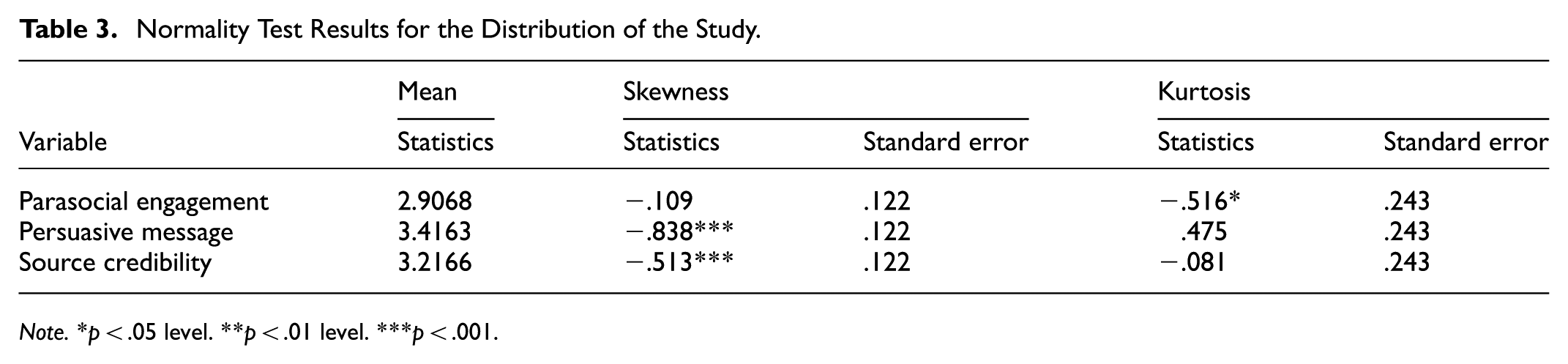
Note.*p < .05 level. **p < .01 level. ***p < .001.
Demographic Findings of the Study
Upon examining Table 4, it is observed that 69.3% (n = 277) of the participants in the study are female, while 30.8% (n = 123) are male. Regarding the age variable, 62.5% of the participants fall within the 18 to 24 age group, 29.0% are between 25%, 31%, and 4.5% are aged 32 and above.
Demographic Characteristics of the Participants.

In terms of educational background, 62.5% of participants hold an undergraduate degree, 29.0% have a postgraduate degree, and 8.5% have completed primary or secondary education. Concerning marital status, 82.5% of the participants are single, whereas 17.5% are married.
When examining monthly income levels, it is found that 23.5% of participants earn between 2,000 and 2,999 TL, 10.3% between 3,000 and 4,999 TL, 11.3% between 5,000 and 6,999 TL, 7.3% between 7,000 and 8,999 TL, and 47.8% report a monthly income of 9,000 TL or above.
Findings on the Hypotheses of Research
The data, obtained in the study and processed using the SPSS program, were analyzed using correlation and regression tests to examine relationships between variables. Additionally, parametric tests, including the T-Test and ANOVA, were employed to assess differences.
ANOVA Test for the Comparison of Mean Scores of Parasocial Engagement Across Demographic Groups.

The mean scores showed the highest level of desire to engage in parasocial engagement with influencers was observed among participants with a primary education background. Conversely, the lowest level of parasocial engagement was found among those with a postgraduate degree. To determine between which groups this difference occurred, pairwise comparisons were conducted using a Post Hoc test. The results indicated a statistically significant difference between participants with primary education and those with postgraduate education.
According to the data presented in Table 6, there is a statistically significant relationship between parasocial engagement with influencers and persuasive messaging (p < .01). The results indicate a moderate, positive correlation between the two variables (r = .62). This suggests that as parasocial engagement with influencers increases, the perceived persuasiveness of their messages also tends to increase. Given that the p-value is less than 0.01,
Correlation Analysis of the Relationship Between Parasocial Engagement and Persuasive Messaging.

Note.*p < .05 level. **p < .01 level. ***p < .001.
Participants’ parasocial engagement with influencers explains
Regression Analysis on the Direction of Parasocial Engagement’s Influence on the Level of Persuasive Messaging.

According to the data presented in Table 8, there is a statistically significant relationship between parasocial engagement with influencers and source credibility (p < .01). The analysis reveals a strong positive correlation between parasocial engagement and source credibility (r = .78). This suggests that as parasocial engagement with influencers increases, their perceived credibility also increases.
Correlation Analysis on the Relationship Between Parasocial Engagement and Source Credibility.

Note.*p < .05 level. **p < .01 level. ***p < .001.
Participants’ parasocial engagement with influencers explains
Regression Analysis on the Direction of Parasocial Engagement’s Influence on Source Credibility.

T-Test for Comparing Mean Scores of Source Credibility Based on Demographic Variables (Gender, Marital Status).

ANOVA Test for Comparing Mean Scores of Source Credibility Based on Demographic Variables (Age, Education, Monthly Income).

T-Test for Comparing Mean Scores of Persuasive Messaging Based on Demographic Variables (Gender, Marital Status).

ANOVA Test for Comparing Mean Scores of Persuasive Messaging Based on Demographic Variables (Age, Education, Monthly Income).

To determine which groups differed significantly, Post Hoc pairwise comparison tests were conducted. The results revealed significant differences in perceived message persuasiveness between participants in the 2,000 to 2,999 TL income group and those in the 3,000 to 4,999 TL, 5,000 to 5,999 TL, and 7,000 to 8,999 TL groups.On the other hand, no significant differences were found between the 3,000 and 4,999 TL group and the 5,000 to 5,999 TL, 7,000 to 8,999 TL, and 9,000 TL and above groups. Similarly, no significant differences were observed between the 5,000 and 5,999 TL group and both the 7,000 to 8,999 TL and 9,000 TL and above income groups.
According to the data presented in Table 14, there is a statistically significant relationship between influencer credibility and persuasive messaging (p < .01). The analysis indicates a strong positive correlation between source credibility and message persuasiveness (r = .80). This suggests that as the perceived credibility of influencers increases, the persuasiveness of their messages also tends to rise.
Correlation Analysis of the Relationship Between Source Credibility and Persuasive Messaging.
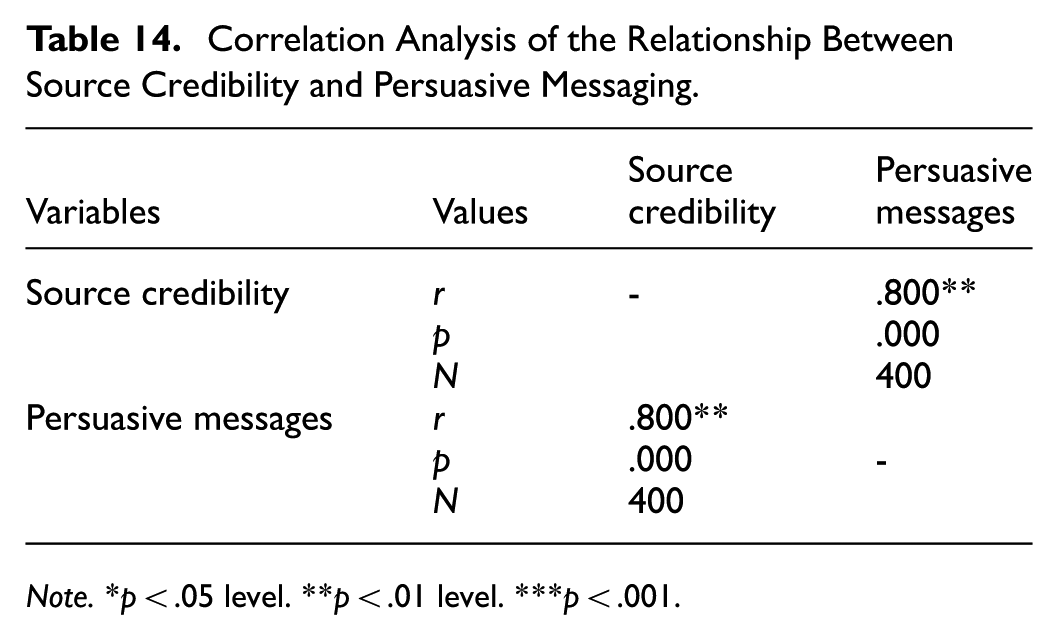
Note.*p < .05 level. **p < .01 level. ***p < .001.
The credibility levels of influencers explain 64% of the variance in the persuasiveness of their messages. In this context, being perceived as credible by followers significantly influences an influencer’s ability to persuade (Table 15).
Regression Analysis on the Direction of Source Credibility’s Influence on the Level of Persuasive Messages.

Discussion and Conclusion
In recent years, the widespread digital transformation across various domains has also become evident in communication processes. In their efforts to engage with target audiences and stakeholders, organizations and brands have increasingly turned to digital platforms and application-based practices. Internet-based applications—commonly regarded as digital communication tools—are now utilized across numerous platforms. Among these, social media platforms and, more specifically, social media influencers have emerged as particularly prominent. It can be argued that social media influencers play an active role in establishing engagement and maintaining ongoing communication between organizations/brands and their target audiences or followers. With the growing prevalence of social media platforms, the presence and influence of social media influencers have become increasingly visible. Today, influencers are engaged in communication processes with their followers through various brand collaboration efforts. Within this context, the concept of parasocial engagement has also gained attention, as it not only facilitates communication but also enhances interaction. Therefore, the parasocial engagement process between the organization/brand and its audience/followers can be considered a key component of sustainable communication strategies. In this process, social media influencers act as dynamic agents and effective communication tools. Particularly in collaborations with brands, influencers play a crucial role in fostering parasocial engagement, and the influence of source-related factors originating from the influencer is also clearly observable.
In this context, the study titled “Influencers in Luxury Brand Communication: An Evaluation of the Relationship Between Source Credibility, Persuasive Message, and Parasocial Engagement” aims to examine the persuasive messaging and source credibility presented in the content produced by luxury brand influencers as part of their brand collaborations. Additionally, the study seeks to explore how influencers establish parasocial engagements with their followers through their social media posts.
In accordance with the main objective of the study, the measured findings and research results are presented in relation to each individual hypothesis. Within the scope of the H1, the study examined whether there were significant differences between parasocial engagement and demographic variables. The analysis revealed a statistically significant difference only between education level and parasocial engagement. No significant differences were found for other variables such as gender, age, marital status, and income. This finding both aligns with and diverges from certain recent studies in the literature, reflecting a mixed pattern in existing research. For instance, in the study conducted by Möri and Fahr (2023), it was indicated that objective similarities such as age and gender enhance parasocial engagement. Similarly, Tyrväinen and Karjaluoto (2025) found that women tend to form stronger parasocial bonds, and that the intensity of such interactions decreases with age. Additionally, their findings reported that single individuals are more likely to develop parasocial relationships compared to their married counterparts.
The finding demonstrated, that the highest level of parasocial tendency was observed among participants with a primary education background while the lowest was among those with undergraduate and higher education, aligns with the studies of Biçim (2019) and Cheng-Xi et al. (2022). These studies revealed that individuals with lower levels of education tend to form emotional bonds with influencers more easily and perceive them as closer. Furthermore, it has been noted that younger individuals tend to form stronger identification with influencers, and that this interaction is reinforced by factors such as age similarity, shared interests, and relationship status. These findings demonstrate that parasocial engagements are closely linked to individuals’ life stages and elements of social identity, thereby supporting the H2 by revealing a meaningful relationship. This result indicates that the emotional bond developed between the influencer and the follower contributes to the perception of the influencer’s messages as more credible, trustworthy, and acceptable. As this bond strengthens, the impact of the messages increases, leading to positive changes in both attitudes and behavioral intentions. Recent studies in literature also support these findings. Balaban et al. (2022) stated that parasocial relationships enhance the perceived credibility of influencers, which in turn has a direct impact on brand attitude and purchase intention. Similarly, Sheng et al. (2022) demonstrated that emotionally and cognitively framed messages strengthen persuasive power through parasocial engagements and perceived value. Agnihotri et al. (2022) further revealed that the relationship between an influencer’s authenticity and consumer purchasing behavior is mediated by parasocial engagement. These findings highlight that parasocial engagement is not only influential at the perceptual level but also plays a decisive role in shaping behavioral outcomes.
The findings obtained in line with the H3 reveal a significant and positive relationship between parasocial engagement and source credibility. This indicates that the emotional bond followers establish with influencers leads them to perceive influencers as more trustworthy and credible sources. As the level of parasocial engagement increases, it creates a foundation for the influencer’s messages to be perceived as more persuasive and impactful. This finding is consistent with previous research in the literature as Bozkurt (2022) emphasized that influencers are often regarded as credible sources of information. In addition, Vu et al. (2024) found that parasocial engagement plays a mediating role in the relationship between source credibility and loyalty. Similarly, Yılmazdoğan et al. (2021) highlighted that in the context of travel content, source credibility is a key determinant in the relationship between parasocial engagement and travel intention. Leite and Baptista’s (2022) study showed that an influencer’s authentic communication positively influences consumer behavior, and that parasocial relationships can, in some cases, exert an even stronger effect than source credibility itself. Zhao et al. (2024) concluded that when designing influencer communication strategies, source credibility, level of engagement, and attractiveness are critical determinants. Overall, parasocial engagements not only involve emotional bonding but also emerge as a critical factor that shapes the perceived credibility of influencers and influences consumer behavior.
The research findings related to H4 reveal that there are significant differences between source credibility and certain demographic variables. While no statistically significant differences were found in relation to gender, marital status, age, or education level, a meaningful relationship was identified between monthly income and source credibility. Specifically, individuals in the 7,000 to 8,999 TL income group were found to perceive influencers as the most credible, whereas those in the 2,000 to 2,999 TL income group demonstrated the lowest levels of perceived source credibility. However, this difference disappears in the 9,000 TL and above income groups, where no significant change in credibility perception was observed. These findings are partially consistent with the study by Karavar (2021). While Karavar reported no significant effect of gender on source credibility, a meaningful relationship was found between age and credibility. Regarding education level, the results present both supporting and contradictory evidence, suggesting that the effect of this variable may be context dependent. Overall, it can be inferred that individuals’ economic status may influence the level of trust they attribute to influencers, and that this effect becomes more pronounced within certain income ranges (Karavar, 2021). In a study by Barari et al. (2025), factors such as age, content diversity, and influencer size were found to impact persuasive effectiveness. Similarly, the meta-analysis conducted by Lee et al. (2024) examined the influence of source credibility, attractiveness, and persuasive messaging by social media influencers in advertising campaigns on consumer attitudes and intentions. Their findings revealed that demographic variables such as age significantly moderate these relationships.
According to the findings related to H5 in the study, no significant differences were found between persuasive messaging and the variables of gender, marital status, age, and education. However, a statistically significant difference was identified between persuasive messaging and monthly income. In this regard, it can be stated that participants in the 7,000 to 8,999 TL income group perceived influencer messages as the most persuasive. Conversely, participants in the 2,000 to 2,999 TL income group were found to perceive these messages as the least persuasive. This finding aligns with Karavar’s (2021) study, which also reported no significant differences between persuasive messaging and the variables of marital status, age, and gender. With respect to education, the results were partially supportive and partially contradictory, suggesting that the impact of educational level on message persuasiveness may be context dependent.
According to H6 in the study, stating that “There is a significant and positive relationship between source credibility and persuasive messaging,” a strong positive correlation was found between the two variables. In other words, as the perceived credibility of influencers increases, the persuasiveness of their messages also tends to rise. This indicates that influencers who are perceived as credible by their followers significantly enhance their ability to persuade. This finding is supported by the study conducted by Szakal et al. (2024) in a Romanian sample, which demonstrated that source credibility plays a significant role in the perceived persuasiveness of influencers’ messages. Similarly, Pan et al. (2025) found that source credibility, along with content quality and influencer characteristics, plays a central role in enhancing persuasive effectiveness consistently observed regardless of message content or platform type.
The findings obtained from the research highlight the role of social media influencers in the brand influencer collaboration process. The study demonstrates that social media influencers, who serve as prominent and effective communication agents in this process, play a key role in shaping the relationships among parasocial engagement, source credibility, and persuasive messaging. These elements have been identified as critical determinants in the overall effectiveness of influencer driven communication.
One of the core components of the study, parasocial engagement, was found to play an active and influential role in the communication process. It was observed that parasocial engagement not only enhances the emotional bond between the influencer and the follower but also increases the perceived credibility of the influencer and the persuasive power of their messages. This effect appears to be particularly pronounced among individuals with lower levels of education and within certain income groups. Another key variable in the study source credibility was also found to be highly influential. In the context of brand collaboration, the credibility of social media influencers as a source plays a significant role in shaping the effectiveness of communication. As source credibility increases, the messages delivered by influencers are perceived as more persuasive. This relationship is supported by recent studies in the literature. Among the demographic variables examined, income level was identified as a significant factor influencing both source credibility and message persuasiveness. This suggests that economic status not only shapes individuals’ perceptions of influencers but also affects how receptive they are to persuasive communication.
In recent years, social media influencers have increasingly played an active role in corporate and brand communication processes. Through their intermediary function, influencers contribute significantly to brand collaborations, with elements such as parasocial engagements emerging as key driving forces. The findings of this study demonstrate that within the framework of brand partnerships, a strong and effective parasocial engagements process develops between the brand and its target audience or followers. In this context, parasocial engagements can be considered a central and decisive factor. Accompanying elements such as source credibility and persuasive messaging also appear to function as influential variables in this process.
In conclusion, the study concludes that strong parasocial bonds and the successful establishment of parasocial engagements play a strategic role in facilitating interactions between influencers, brands, and their audiences. Building parasocial engagements is significantly supported by followers’ trust in the influencer as a credible source, the influencer’s ability to foster that trust, and the persuasive quality of the content they deliver. In today’s highly competitive environment, influencers’ brand driven collaborations serve a strategic function in creating competitive advantage and supporting sustainable communication processes. They contribute to meaningful engagement with target audiences and stakeholders, facilitate brand differentiation, and enhance corporate image. As such, influencer partnerships are increasingly regarded as strategic tools in shaping consumer behavior and reinforcing brand positioning in the marketplace.
Limitations
The study is limited to individuals residing exclusively in Northern Cyprus.
It includes only 400 participants who follow luxury brand influencers.
The purposive sampling method used in the study restricts the generalizability of the findings, as not all members of the population had an equal chance of being included in the sample. Moreover, selecting participants from a heterogeneous group further reduces representativeness. Therefore, the findings of the research can only be generalized to individuals who actively follow influencers, rather than to the broader population.
Suggestions for Further Research
Based on the obtained findings, the following recommendations can be made for future research: The relationship between influencers and various other variables can be examined. Additionally, influencer marketing can be analyzed from the perspective of different generations.
Implications of the Study
Theoretical Implications
This study thoroughly examines the relationship between influencers, parasocial engagement, persuasive messages, and source credibility, filling a significant gap in the field. In particular, the research enhances its originality by investigating how parasocial engagement with influencers affects followers’ perception of messages and the role of this engagement in persuasiveness and source credibility. This finding demonstrates that the nature of the relationship influencers establish with their followers is a critical variable in brand collaboration strategies.
Practical Implications
The research findings indicate that as the credibility of influencers increases, followers perceive the conveyed messages as more persuasive. Additionally, in cases where parasocial engagement is strong, influencer messages become more effective. The study evaluates the impact of demographic factors, particularly education level and income, on influencer credibility and message persuasiveness, contributing to the development of more informed and target audience-oriented influencer brand collaboration strategies.
In this context, it is emphasized that influencer communication should not only focus on content creation but also consider the psychological and sociodemographic characteristics of the follower base. In conclusion, this research serves as a valuable resource for brands and researchers aiming to develop effective communication strategies in influencer brand collaborations.
Footnotes
Author Note
This article is derived from the doctoral dissertation studied within the scope of the Near East University Institute of Social Sciences Media and Communication Studies Ph.D. Program during the 2022–2025 academic years.

Ethical Considerations
Ethics Committee reference number: Near East University, YDÜ/SB/2022/1485.
Author Contributions
Zeynep Alkan %50, Ayhan Dolunay %25, Sevilay Ulaş %25.
Funding
The authors received no financial support for the research, authorship, and/or publication of this article.
Declaration of Conflicting Interests
The authors declared no potential conflicts of interest with respect to the research, authorship, and/or publication of this article.
Data Availability Statement
Data sharing not applicable to this article as no datasets were generated or analyzed during the current study.