




Abstract
With the development of Artificial intelligence (AI) technology, more and more AI-based smart devices are being applied in the service. Although this brings many benefits to enterprises and consumers, AI’s rapid development and application also induces consumers’ anxiety. This negative emotion affects consumers’ cognitive decision-making process. However, previous studies have focused more on the impact of positive emotion induced by AI and less on negative emotion induced by AI. Therefore, this paper starts from the negative emotion induced by AI and builds an influencing factor model of unmanned smart hotels (USH) resistance guided by feelings-as-information theory (FIT) and innovation resistance theory (IRT). Based on 355 questionnaires, the data are empirically tested. The results show that surveillance anxiety and delegation anxiety induced by AI positively impact functional barriers evaluation of USH, and functional barriers evaluation of USH has a positive impact on USH resistance. This paper enriches the research results in AI and USH by exploring the factors affecting USH resistance and providing suggestions for USH’s future development.
Keywords
Introduction
Service robots (SR) are autonomous or semi-autonomous service agents based on AI technology (Wirtz et al., 2018). They are AI-supported systems with at least one of the following capabilities: problem-solving, knowledge representation, reasoning, planning, learning, perception (including computer vision), action, natural language processing, and communication (Rzepka & Berger, 2018). They are mainly oriented to the service industry and are non-productive robots that serve humans. Nowadays, SR have been adopted by many industries. The retail industry uses SR to improve the consumer experience (S. Zhang et al., 2022), consumers use SR to assist in shopping (Aw et al., 2022), medical and health industry uses SR to monitor individual health (Park et al., 2022). The tourism and hotel industry also uses various SR to improve production efficiency, consumer experience satisfaction, usage and recommendation intention (Goel et al., 2022; Luo et al., 2021; Molinillo et al., 2023; Orea-Giner et al., 2022). At the same time, the World Robot-Service Robot report released by the International Federation of Robotics (IFR) shows that the sales of professional SR in the world increased by 37% in 2022, among which hotel robots are the second best-selling professional service robots, with a total of only 20,000 units sold, an increase of 85% year-on-year (Yan & Qian, 2022). Among them, Japan’s “Henn-na Hotel” and China’s “FlyZoo Hotel” can complete everything from check-in to check-out with SR (Chang et al., 2022).
The USH are a new type of hotel that benefits from the development of smart technologies such as AI. They transform interpersonal interaction into human-computer interaction, change traditional hotels’ service configuration mode, and are a product innovation (Mani & Chouk, 2018). Any innovative product must overcome consumer resistance in order to succeed. As a product innovation, USH will inevitably encounter consumer resistance and need to explore the factors that cause consumer resistance to USH. However, existing studies focus more on the factors that promote consumers’ choice of USH and pay less attention to the factors that resist consumers’ visits to USH. Behavioral reasoning theory (BRT) points out that people’s motives to adopt and reasons to resist innovation differ qualitatively, and they influence people’s decisions in different ways. In other words, reasons for resisting innovations are not necessarily the opposite of reasons for adoption (Claudy et al., 2015). Therefore, exploring the promoting factors for USH cannot be used to understand what factors lead to consumer resistance to USH. Moreover, resistance is the key to hindering the success of innovative products. Therefore, based on the practical and theoretical needs mentioned above, this paper explores the factors affecting consumer resistance to USH guided by IRT and FIT.
The most significant difference between USH and traditional hotels (that’s a hotel with human staff providing services, TH) lies in their different service providers, which is both the key to attract consumers with their product innovation and may also be the key to cause consumer resistance. Although SR can arouse consumers’ positive experience, such as novelty (Lin & Mattila, 2021; Y. Wang et al., 2022) pleasure (El-Said & Al Hajri, 2022) and satisfaction (Huang, Chen, et al., 2021; Seo & Lee, 2021), the rapid development of AI can induce consumers’ negative emotion (Hongqun & Peiwen, 2019; Nomura et al., 2008; Qin & Xiaomei, 2021; Song & Kim, 2022). Previous studies have mainly explored the impact of positive emotion induced by AI, and few studies focus on the negative emotion induced by AI. At the same time, studies have shown that negative emotion will affect consumers’ cognition and behavioral intention (Loewenstein et al., 2001). Therefore, this paper starts with the negative emotion induced by AI and tries to explore how negative emotion induced by AI affects the functional barriers evaluation of USH and whether this functional barriers evaluation will lead to consumer resistance to USH.
In summary, this paper contributes to the research outcomes of innovation resistance theory by exploring the issues mentioned above. It demonstrates that besides psychological barriers (Nel & Boshoff, 2021), the emotional experience induced by AI also positively impacts the evaluation of functional barriers. Secondly, this paper extends the innovation resistance theory perspective to the research of USH, which not only enriches the research outcomes of USH but also provides practical guidance for hotel managers who plan to implement technological innovation and reform, pointing out the possible factors that may hinder hotel technological innovation, and helping managers to identify and overcome these possible influencing factors.
Literature Review
Unmanned Smart Hotels
USH is that uses SR as service providers and is equipped with various information and communication technologies (Chang et al., 2022). The research on USH mainly focuses on visit intention (J. J. Kim & Han, 2020; L.-H. Wang et al., 2022; Yang et al., 2021) and post-visit behavior (Chang et al., 2022; S.-H. Chen et al., 2021), but generally speaking, the research on visit intention is more prosperous than the research on post-visit behavior. At the same time, affected by the COVID-19 pandemic, scholars have also started to compare USH and TH. For example, J. J. Kim and Han (2020) found that convenience control, contactless environment, safety, and professionalism are the attribute characteristics of USH which positively impact expected service quality. Expected service quality affects consumers’ negative and positive emotions towards USH. Expected service quality and positive emotions positively impact visit intention, while expected negative emotions harm visit intention. Yang et al. (2021) integrated technology readiness and technology amenities into the technology acceptance model for USH. The study confirmed that technology amenities positively impact perceived usefulness and ease of use but do not impact visit intention. In contrast, technology readiness not impact perceived usefulness and ease of use but positively impacts visit intention. Chang et al. (2022) found that experience motivation, experience confidence, and experience satisfaction affect USH loyalty. L.-H. Wang et al. (2022) showed that efficiency, novelty, preference and non-human interaction encourage consumers to visit USH, while difficulty in use, dislike of human interaction, and insufficient robot technology capabilities hinder consumers from visiting USH.
In the comparative studies of USH and TH, S. S. Kim et al. (2021) explored whether consumers choose USH or TH during COVID-19 and how consumers evaluate the two types of hotels. The study confirmed that consumers’ evaluation of USH will be higher in high-risk situations, and they will prefer to choose USH. The study also confirmed the mediating effect of concerns about safety and social distancing and verified the moderating effect of perceived subjective threat. Xiong et al. (2021) found that consumers’ evaluation of USH will be higher than that of human service only in high-risk pandemic situations. Xingyang et al. (2021) explored the service coldness phenomenon of USH, that is, the unmanned service mode will reduce consumers’ perception of service warmth level, which is more severe in service enterprises with warmth-oriented brand image.
In general, the research on USH could be more prosperous, and more studies explore the factors affecting the visit intention of USH, focusing more on the benefits of using SR. Although the rapid development of AI makes SR have more robust capabilities and can be used more in frontline services, bringing more convenience and benefits to people, this technology also induce people’s negative emotions such as panic and anxiety. Therefore, paying attention to the impact of negative emotions induced by AI on USH is necessary. At the same time, exploring the factors that promote and hinder consumers’ visit intention is equally essential. However, limited empirical research has explored consumer resistance to USH. Therefore, based on the above, this paper explores the resistance to USH from the perspective of AI-induced negative emotion.
Innovation Resistance Theory (IRT)
Innovation resistance is consumers’ resistance to innovation because it causes potential changes to a satisfactory status quo or conflicts with their belief structure (Ram & Sheth, 1989). There has yet to be a consensus on the definition of innovation resistance among relevant scholars. For example, some scholars define innovation resistance as any opposition to product or service that challenges consumers’ status quo and current beliefs (Mani & Chouk, 2018). Mani and Chouk (2019) define it as an adverse reaction caused by negative barriers. Hong et al. (2020) argue that innovation resistance is trying to maintain the current state without making changes when consumers feel pressure to change from the current state. However, more scholars believe that innovation resistance is a reaction or negative attitude to new products and services that trigger change or break the status quo (Mani & Chouk, 2018, 2019). Therefore, this paper adopts the definition of innovation resistance used by more scholars and defines resistance to USH as consumers’ reactions or negative attitudes.
Consumers’ resistance to innovation negatively affects their adoption of innovative products (Prakash & Das, 2022). IRT challenges the pro-innovation bias (Ram & Sheth, 1989). Pro-innovation bias assumes that all innovative products are superior to existing products and will be widely adopted by consumers (Huang, Jin, et al., 2021). Most studies on the adoption of innovative products are based on this perspective. IRT indicates that innovation resistance exists in all product categories and all stages of product evaluation. Generally speaking, resistance before product evaluation is called passive innovation resistance. Active innovation resistance is the behavioral and attitudinal outcome of consumers’ cognitive and emotional evaluation of innovative products after product evaluation (Heidenreich & Handrich, 2015). The tendency of consumers to resist change and their satisfaction with the status quo are reasons for the passive resistance to innovation. According to the tendency to change and the satisfaction with the status quo, passive innovation resistance can be divided into low passive innovation resistance, cognitive passive innovation resistance, situational passive innovation resistance and dual innovation resistance. Active innovation resistance can also be divided into active innovation resistance and very active innovation resistance. Among them, active innovation resistance refers to consumers’ postponing the adoption of innovative products. In contrast, very active innovation resistance refers to consumers’ decision to attack an innovation because they think it is inappropriate (Rodriguez Sanchez et al., 2020). Passive innovation resistance affects active innovation resistance (Heidenreich & Handrich, 2015; Huang et al., 2022).
Functional barriers and psychological barriers are frequently used antecedent variables in the field of innovation resistance research (Huang, Jin, et al., 2021). Functional barriers are further divided into usage, value, and risk barriers, which may occur when consumers perceive significant changes. Usage barriers refer to the incompatibility between innovative products or services and consumers’ habits or life experiences. Value barriers refer to consumers’ perception that innovative products or services do not provide a high cost-performance ratio compared with alternative products. Risk barriers refer to the uncertainty of all innovative products and the possible unexpected effects they may have. There are four categories of risks: physical risk, which refers to the potential harm to a person or property inherent in innovation; economic risk, which means that the higher the cost of innovation; functional risk, which means that users are worried that innovation may not have been thoroughly tested and therefore may not operate normally or reliably; social risk, which means that users may resist innovation because they feel social rejection or peer ridicule when adopting it (Ram & Sheth, 1989). Psychological barriers include traditional barriers and image barriers. Traditional barriers arise when innovation requires consumers to deviate from existing traditions, and the greater the deviation, the more excellent the resistance the innovation faces. Image barrier is an emotional issue which stems from stereotyped thinking (Ram & Sheth, 1989).
Most studies on innovation resistance focus on digital financial services (Chouk & Mani, 2019; Leong et al., 2020; Mani & Chouk, 2018; Nel & Boshoff, 2021) and e-commerce fields (C.-C. Chen et al., 2022; Nel & Boshoff, 2019; Talwar et al., 2020). Nowadays, some scholars also explore consumers’ resistance to green products (Sadiq et al., 2021) and sharing economy (Huang et al., 2022). Generally speaking, researchers pay more attention to the resistance to digital and technology-supported products (Huang, Jin, et al., 2021). AI is a new innovative technology changing many industries’ production and service modes. Therefore, Huang, Jin, et al. (2021) pointed out that studying AI and AI-based products’ resistance is necessary to enrich our understanding of them further. Therefore, this paper responds to their call by exploring the resistance to USH.
Research Model and Hypotheses
Anxiety Induced by AI and Functional Barriers Evaluation of USH
Anxiety is an emotion that consumers often experience when facing risk. It is a mixed feeling of fear and worry about the future without a specific cause of fear. It is a complex emotional state (Bekker et al., 2003). State-trait anxiety theory is a theory often used in anxiety research. It divides anxiety into two types: state anxiety and trait anxiety. A specific situation triggers state anxiety and is a temporary emotional state. Its intensity and fluctuation vary with time, while trait anxiety is a relatively stable personality trait (Park et al., 2022). This study uses state anxiety because it captures the subjective emotional experience of individuals in random experimental situations.
The rapid development of AI can induce anxiety. This anxiety induced by AI refers to the anxiety or fear of people’s work and life in general caused by the advancement of AI technology (Qin & Xiaomei, 2021). However, relevant scholars have no consensus on what kind of anxiety AI induces. Qin and Xiaomei (2021) believe that AI mainly induces two kinds of anxiety, namely the anxiety of the end of human society and the anxiety of unemployment. Hongqun and Peiwen (2019) also express the same opinion, but they also point out that the rapid development of AI will also cause people to worry about individual freedom and comprehensive development, individual privacy. Nomura et al. (2008) start from AI technology itself and point out that the anxiety caused by AI mainly includes communication ability, behavioral characteristics and conversation anxiety. Park et al. (2022) point out in their research on AI in the medical and health field that the anxiety induced by AI is surveillance anxiety and delegation anxiety. According to the research situation of this paper, this paper focuses on surveillance anxiety and delegation anxiety induced by AI. Among them, delegation anxiety refers to the lack of interpersonal communication perceived by people due to AI replacing some human work. Surveillance anxiety refers to the ability of the AI system to collect, process and analyze user information, which induces AI surveillance anxiety (Park et al., 2022).
Feelings-as-information theory (FIT) conceptualizes various subjective feelings of people, including mood, emotion, metacognitive feeling and bodily sensation, and explores their role in human judgment. The theory assumes that people use their feelings as a source of information that affects subsequent judgments, and different feelings provide different types of information (Reading & Reading, 2011). The theory has also been applied in many research situations. For example, Liu et al. (2022) used this theory to explore the impact of self-health perception induced by the health tourism environment on the local attachment to health tourism destinations. The study showed that self-health perception, as a positive subjective emotional experience, has a positive impact on local attachment to health tourism destinations. Yao et al. (2023) also explored the moderating effect of individual recovery perception on tourist participation and psychological ownership in health tourism destination. Asokan Ajitha et al. (2019) found that task-related emotional well-being has a positive impact on service outcomes. Therefore, this paper believes that anxiety induced by AI, as a negative emotion, will act as a signal to affect consumers’ evaluation of USH. At the same time, studies have shown that anxiety increases individuals’ sensitivity to potential environmental risks, produces attention bias and priority processing for them, and tends to interpret the processing results negatively (Tao et al., 2022; Yanying et al., 2019). When the rapid development of AI induces consumers’ anxiety, it will cause consumers to pay more attention to the negative aspects of AI-based products, thus making consumers overestimate the risks faced by adopting such products. Chengde et al. (2012) found that anxiety, as an internal personality trait, causes consumers to underestimate the perceived ease of use of mobile shopping. C.-C. Chen et al. (2022) also found that technology anxiety makes individuals overestimate the risk barriers, usage barriers and value barriers faced by using mobile ticketing APPs. Boeuf (2019) explored the relationship between death anxiety and innovation product evaluation, and found that death anxiety harms innovation product evaluation. In summary, this paper proposes the following hypotheses:
H1a: Delegation anxiety induced by AI has a positive impact on value barrier evaluation of USH.
H1b: Delegation anxiety induced by AI has a positive impact on usage barrier evaluation of USH.
H1c: Delegation anxiety induced by AI has a positive impact on risk barrier evaluation of USH.
H2a: Surveillance anxiety induced by AI has a positive impact on value barrier evaluation of USH.
H2b: Surveillance anxiety induced by AI has a positive impact on usage barrier evaluation of USH.
H2c: Surveillance anxiety induced by AI has a positive impact on risk barrier evaluation of USH.
Functional Barriers Evaluation and Resistance of USH
USH use SR to serve consumers and is equipped with various smart devices. For consumers who often use TH, USH is a significant change; when this change occurs, functional barriers caused by the change also occur. These functional barriers mainly involve evaluating innovative products’ usage, risk, and value barriers. The evaluation of functional barriers to innovative products significantly affects consumers’ innovation adoption or resistance. The impact of functional barriers on innovation adoption is also a key focus of many scholars’ research (Huang, Jin, et al., 2021). Therefore, this paper also pays attention to the impact of functional barriers on innovation resistance.
Value barrier refers to consumers’ perception that using USH does not provide an excellent cost-performance ratio compared with TH. A value barrier occurs when a new product’s performance or monetary value is lower than its alternative product’s. Consumers will adopt new products when they provide an excellent cost-performance ratio compared with old products; that is, consumers’ perception of the relative advantage of new products has a positive impact on new product adoption, unless, it will cause consumers to resist. The endowment effect suggests that consumers need more compensation to give up their original products and accept new ones (Rodriguez Sanchez et al., 2020). To make consumers accept USH, USH must provide more advantages than TH, otherwise, consumers will resist USH out of aversion to potential losses. The impact of the value barrier on consumers’ rejection of innovative products has been confirmed in various research situations, such as consumers’ resistance to digital banking (Nel & Boshoff, 2021), digital tracking APPs (Prakash & Das, 2022), and mobile wallets (Leong et al., 2020). Based on the above discussion, this paper proposes the following hypothesis:
H3: Value barrier has a positive impact on resistance to USH.
The usage barrier is one of the main barriers that hinder consumers from adopting innovative products. The usage barrier manifests when an innovation is not compatible with a customer’s existing work flows, practices, or habits due to the low perceived usability of the innovation. This barrier occurs when consumers perceive using USH as inconvenient, slow, or complex. USH use SR as their service providers, so consumers need to use the SR equipped by the hotel to complete the whole process from check-in to check-out. Before SR were applied to hotels, this kind of hotel service was provided by the human staff, consumers only need to provide personal information to the hotel human staff, and their involvement level could be lower. When USH uses service robots to serve consumers, consumers must interact with these devices to complete the service. The interaction process with these machine devices increases consumers involvement level, increasing their perception of usage barriers and affecting their resistance to USH. Therefore, this paper proposes the following hypothesis:
H4: Usage barrier has a positive impact on resistance to USH.
The uncertainty and unpredictability associated with innovative products are called risk barriers. Risk barriers have many forms, such as performance, money, privacy, and psychological risks (Hong et al., 2020). Privacy risk is a common consumer risk perception in digital product research and is more prominent in smart products (Bawack et al., 2021; F. Zhang et al., 2023). USH, a collection of smart products equipped with various smart devices, has a significant attribute characteristic compared with hotels served by human staff. This smart attribute characteristic is based on collecting consumers’ individual information as input, which is the key to providing smart service. This product has robust data analysis and collection ability, which will arouse consumers’ perception of privacy risk. Therefore, this paper focuses on the impact of privacy risk on resistance to USH. F. Zhang et al. (2023) found that the smart surveillance capability of a smart home can arouse consumers’ privacy concerns, and consumers’ privacy concerns harm usage intention. Henkens et al. (2021) found that the smart attribute of smart home has a positive impact on consumers’ perceived invasiveness. Mani and Chouk (2019) also showed that consumers’ privacy concerns would cause them to reject smart service. USH use AI-based smart service technology, which has a robust data processing, integration and analysis ability, which can arouse consumers’ concern about their privacy, thus causing them to resist USH. Based on the above discussion, this paper proposes the following hypothesis:
H5: Risk barrier has a positive impact on resistance to USH.
This study constructs a conceptual model based on FIT and IRT, as shown in Figure 1. Surveillance anxiety and delegation anxiety are negative emotions induced by AI. Value barrier, usage barrier and risk barrier are functional barriers faced by USH. Resistance is the outcome variable of this paper.
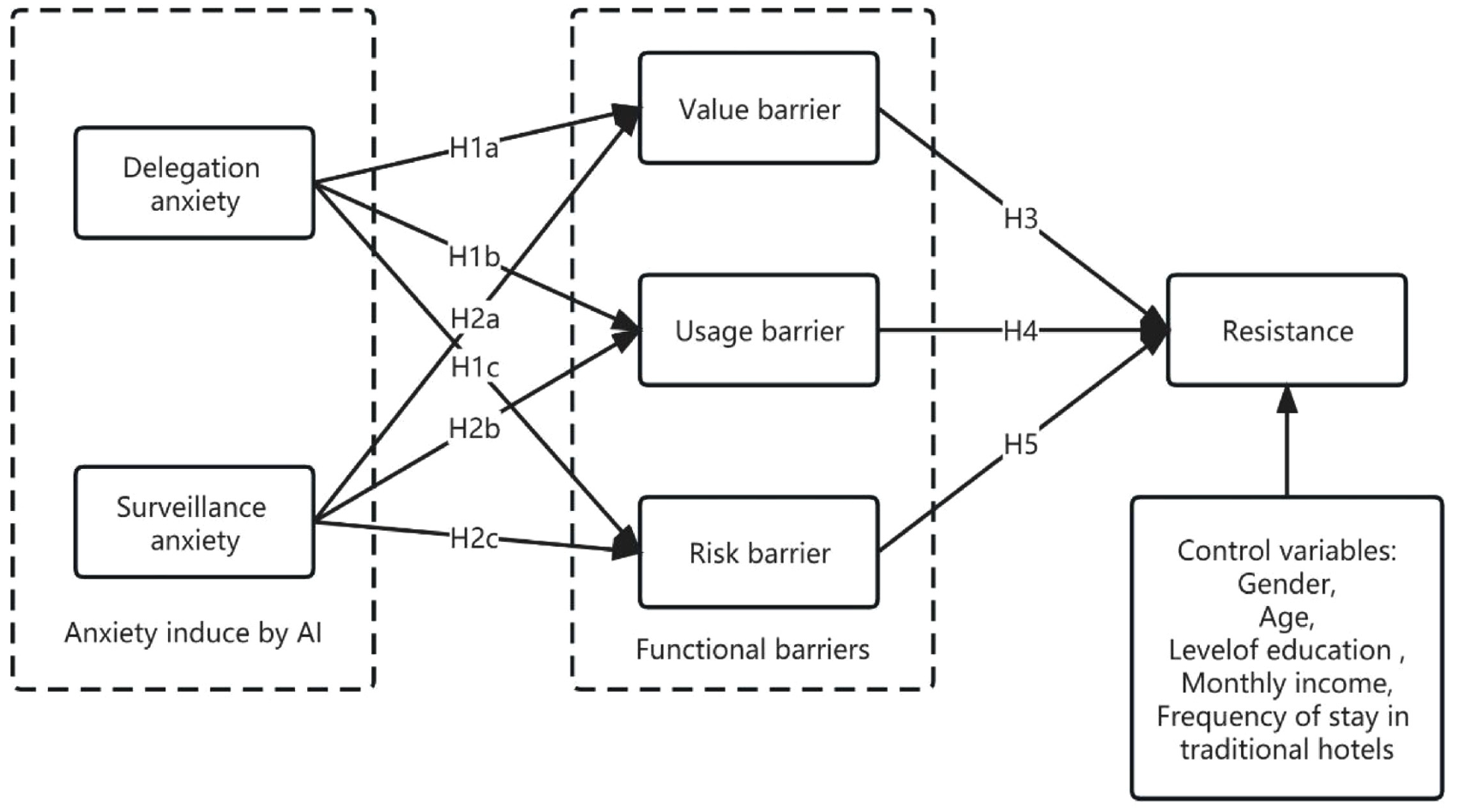
Conceptual model.
Research Method
Sample and Data Collection
This study targets consumers who have stayed in TH but have not stayed in USH. An online questionnaire was made using the Credamo platform, a reputable web-based survey platform in China similar to Amazon Mechanical Turk and widely used in studies across different research areas (Y. Li et al., 2022). The questionnaire consists of three parts. The first part briefly introduces USH. “Unmanned smart hotels are smart hotels that use service robots to provide services for consumers. They use various service robots to serve consumers, such as humanoid front desk reception robots, smart voice assistants—Tmall Genie, robot vacuum cleaners, autonomous delivery robots, etc. When staying in unmanned smart hotels, consumers book rooms in advance on their mobile phones and check in directly on their mobile phones or hotel terminals by face recognition. Smart elevators and touchless door control will automatically perform face recognition. Smart lighting up the room floor, automatically opening the room door. Once entering the room, Tmall Genie smart housekeeper can directly control the indoor temperature, lighting, curtains, TV and other devices by voice. There are also robot delivery and meal delivery services.” In addition to the description of USH, several pictures of service scenarios of USH are also displayed to help respondents better understand USH. The second part includes six variables measured in this study. In order to avoid common method bias, this part also involves two attention check questions. The third part is to measure the demographic information of the participants, including gender, age, monthly income level, and education level.
The convenience sampling method was used for the survey. An online snowball sampling technique was used to recruit participants on WeChat, a popular social media platform in China (X. Zhang et al., 2022). In order to select research samples that meet the purpose of this study, two questions were set in the questionnaire: “How often do you stay in traditional hotels” and “How often do you stay in unmanned smart hotels.” Only those who filled in “never” for the frequency of staying in USH and did not fill in “never” for the frequency of staying in TH were included in the data analysis. A total of 559 questionnaires were collected, of which 355 were valid, with a validity rate of 63.5%. As shown in Table 1, the overall samples (n = 355) included mostly women (n = 220; 62.0%) and fewer men (n = 135; 38.0%). Most participants (n = 310; 87.3%) were aged between 18 and 25 years old. The education level of most people is undergraduate/junior college. Approximately half of the respondents (n = 182, 51.3%) reported a monthly income below 1,999 RMB. Most people (n = 301, 84.8%) stay in traditional hotels 1 to 5 times a year.
Sample Characteristics (n = 355).

Variables and Measurement
The measurement items used for all constructs in this study were based on existing scales and modified according to the research situation. The translation of the scale items strictly followed the translation-back translation procedure. Surveillance anxiety was measured with three items adapted from Kummer et al. (2017). We adapted the three items from Park et al. (2022) to measure delegation anxiety. The usage barrier was measured with three items adapted from Nel and Boshoff (2021). The value barrier was adapted from Verma et al. (2023) using three items to measure. We adapted the three items for measuring risk barrier from Hajiheydari et al. (2021). Finally, we adopted five items for measuring resistance from Nel and Boshoff (2021), Mani and Chouk (2018) and Prakash and Das (2022). All items use a 7-point Likert scale, ranging from 1 to 7, where 1 means strongly disagree and 7 means strongly agree. The control variables were gender, age, level of education, monthly income (RMB), and frequency of stay in traditional hotels.
Data Analysis
This study analyses the data using partial least square-structural equation modelling (PLS-SEM). Compared with the covariance-based structural modelling method, the PLS analysis method has no restrictions on sample size and residual distribution when evaluating the model, is suitable for prediction and theory construction, and has good robustness even when the sample size is small (Hair et al., 2019). Therefore, this study uses Smart PLS 3.0 software to test the reliability and validity of the scale and verify the model hypotheses.
Results
Common Method Bias Test
Harman’s single-factor test method was used to test the common method bias. The results showed that five factors with eigenvalues greater than 1 were obtained without rotation. The first factor explained 34.96% of the variance (<40%) (Podsakoff et al., 2003), indicating that the common method bias did not significantly impact the results of this study.
Measurement Model
The evaluation of the measurement model involves evaluating measurement reliability, convergent validity and discriminant validity. First, when evaluating the reliability of each indicator, the factor loading of each indicator should be greater than .7 (Hair et al., 2019). As shown in Table 2, the factor loading values of each indicator were more significant than .7, indicating that they reached a satisfactory level of indicator reliability (CR) were used to evaluate construct reliability, and .6 to .9 was acceptable. As shown in Table 2, the Cronbach’s α and CR values of each construct were within the level of .6 to .9, indicating that each construct had good internal consistency reliability. The AVE (average variance extracted) was used to evaluate convergent validity, and an AVE value greater than .5 indicated that the construct had good convergent validity. As shown in Table 3, the AVE values of all constructs were more significant than .5, indicating that the constructs had good convergent validity. This paper used Fornell–Larcker and HTMT (heterotrait-monotrait) to evaluate discriminant validity, where the evaluation criterion for Fornell–Larcker was that the square root of AVE should be greater than the correlation coefficient between latent variables, and the evaluation criterion for HTMT was that the value of HTMT should be less than .85. As shown in Table 3, the square root of AVE between all latent variables was more significant than the correlation coefficient between latent variables. The HTMT value of all latent variables was less than .85, indicating that the measurement model had good discriminant validity.
Test the Reliability of the Scale.

Test the Discriminant Validity of the Scale.
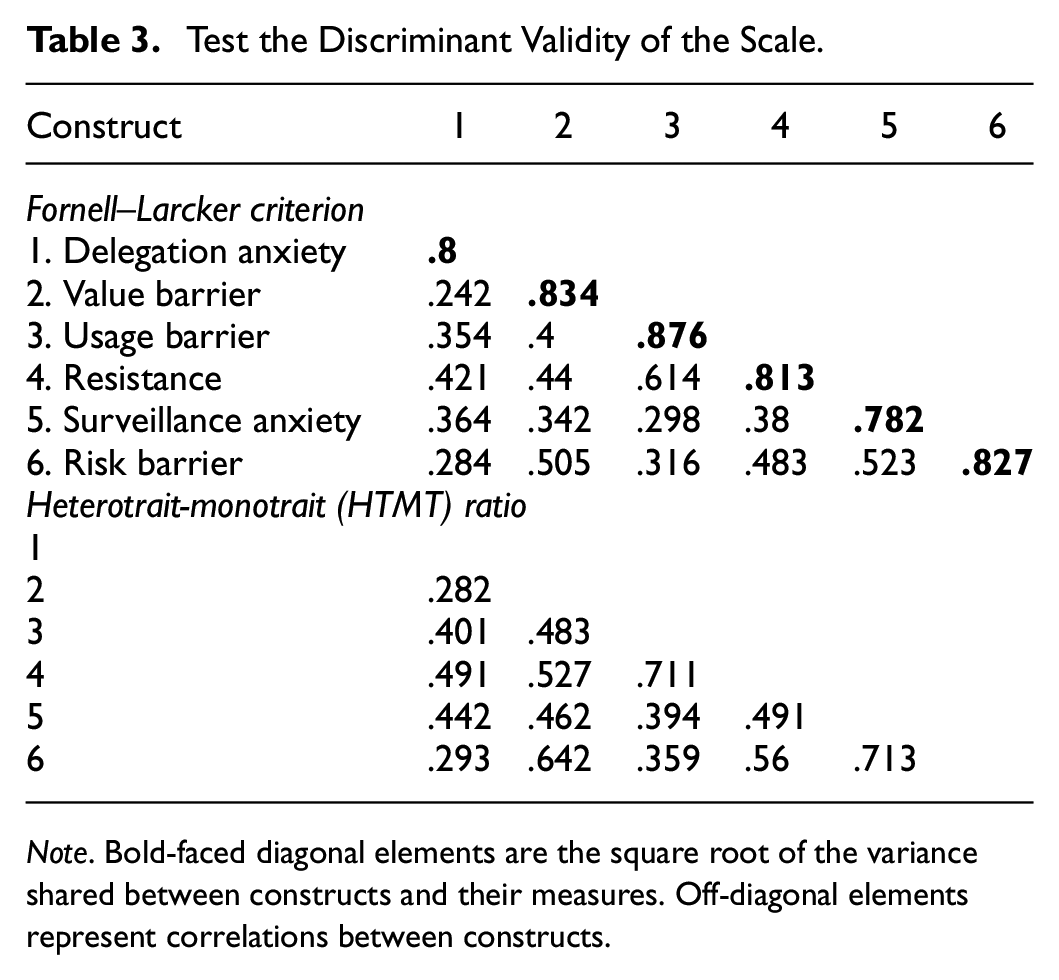
Note. Bold-faced diagonal elements are the square root of the variance shared between constructs and their measures. Off-diagonal elements represent correlations between constructs.
Structural Model
The model was first assessed for multicollinearity issues using the variance inflation factor (VIF) values of the latent construct (Hair et al., 2019). A VIF less than 3 indicates no collinearity problem. In this study, the VIF values of all latent variables were less than 3, indicating that there was no collinearity problem between all latent variables in this study. Then, the R2 and Q2 values of the predictive variables were evaluated to test the model’s predictive ability. All R2 values were more significant than the critical value of .1: value barrier: .133; risk barrier: .284; usage barrier: .158; resistance: .493. At the same time, the Q2 values of all predictive variables were also greater than 0: value barrier: .084; risk barrier: .188; usage barrier: .115; resistance: .315. Demographic variables and TH usage frequency were used as control variables and included in the model. Only TH stay frequency significantly impacted resistance, and other variables had no significant impact on resistance.
The Bootstrapping method of Smart PLS 3.0.0 software was used for 5,000 times sampling. The results of hypothesis testing are shown in the Figure 2 and Table 4. Delegation anxiety had a positive impact on value barrier (β = .136, t = 2.435), usage barrier (β = .283, t = 5.073) and risk barrier (β = .108, t = 2.297), and hypotheses H1a, H1b and H1c were supported. Similarly, surveillance anxiety also had a positive impact on the value barrier (β = .293, t = 4.820), usage barrier (β = .194, t = 3.416) and risk barrier (β = .484, t = 9.011), and hypotheses H2a, H2b and H2c were supported. In addition, the value barrier (β = .096, t = 1.999), usage barrier (β = .472, t = 11.433) and risk barrier (β = .293, t = 6.570) all had a positive impact on resistance to USH, and hypotheses H3, H4 and H5 were supported.

Hypothesis testing results.
Structural Model Results.

p < .05. **p < .01. ***p < .001.
Research Conclusions and Implications
Discussion and Conclusion
This study explores the impact of consumer emotions induced by AI on the functional barrier evaluation of USH and the impact of functional barrier evaluation on their resistance, and the results show that:
(1) Functional barriers (value barrier, usage barrier, risk barrier) are important determinants of consumer resistance to USH. Among them, the usage barrier is the strongest predictor of resistance to USH, indicating that when consumers think that USH is challenging to use, they will refuse to adopt them. AI and other intelligent technologies are not widely used in hotels, and people are unfamiliar with how these devices are applied in the hotel sector. Moreover, AI and other intelligent technologies are weaker than human employees in empathy and responsiveness perception (S. Zhang et al., 2022), which may make consumers think that adopting USH is inconvenient and troublesome, and thus cause them to resist USH. This result is consistent with the research results in other scenarios (C.-C. Chen et al., 2022; Prakash & Das, 2022; X. Wang et al., 2023). The risk barrier is the second most crucial factor affecting resistance to USH. This result indicates that if people think using USH will endanger their personal information, it will lead to consumer resistance USH. The SR have a robust data analysis and collection ability, which will arouse consumers’ perception of privacy risk. This perception of privacy risk is an essential factor that hinders consumers from adopting smart products (Buhalis & Moldavska, 2022). This result is also consistent with the studies of Mani and Chouk (2018) and Mani and Chouk (2019) on smart banking services and Hong et al. (2020) on smart home resistance, indicating that risk perception also causes consumers to resist in the hotel context. Value barrier also has a positive impact on user resistance to USH. The value barrier in this paper refers to whether the performance of USH is better than alternative choices. The results of this paper show that the relative advantage perception of USH is still an important barrier that hinders consumers’ choices. This result is also consistent with the research results in other scenarios (Nel & Boshoff, 2021; Prakash & Das, 2022).
(2) Negative emotion induced by AI lead consumers to overestimate the functional barriers they may face when using USH. It means that the higher the anxiety emotion induced by the AI technology of USH, the higher the perception of value barrier, usage barrier, and risk barrier of USH by consumers. This result is also similar to the research of C.-C. Chen et al. (2022) indicate that technology anxiety positively impacts usage, risk, and value barriers. Among them, the delegation anxiety induced by AI has the most substantial impact on the usage barrier evaluation, while surveillance anxiety has the most substantial impact on the risk barrier evaluation. This paper does not consider the impact of price factors on USH’s resistance. Although some studies have shown that price is one of the essential factors of innovation resistance, it is not consumers’ only or primary demand (Abbas et al., 2017). Consumers will feel more uncertainty and risk when these high-tech products have high autonomy and complexity (J. Li & Huang, 2020). Even though price may affect the resistance to high-tech products, the anxiety aroused by high-tech products among consumers still has a significant impact on their resistance intention.
Theoretical Contributions
Firstly, this study demonstrates that consumer anxiety is a factor that influences functional barrier evaluation of USH, enriching the research findings on innovation resistance. Previous studies on innovation resistance have indicated that psychological barriers are the main factors affecting the assessment of functional barrier. However, this study reveals that in addition to psychological barriers, consumer anxiety also affects the assessment of functional barriers.
Secondly, this study applies the theory of innovation resistance to the context of USH, expanding the explanatory scope of the theory of innovation resistance. Previous research on innovation resistance has mostly focused on digital financial services, e-commerce, green products, and the sharing economy. By applying the theory of innovation resistance to the context of USH, this study expands the explanatory scope of the theory and demonstrates its applicability in explaining resistance to AI-based intelligent products.
Finally, this study enriched the research results of USH. A few studies on USH are from the perspective of innovation diffusion, assuming that consumers are willing to accept innovative products. However, the status quo bias theory suggests that consumers are reluctant to change and tend to maintain the status quo (Mani & Chouk, 2018). At the same time, IRT suggests that the degree of change between innovative products and original products and the incompatibility between innovative products and consumers’ existing belief structure are the main reasons for consumers’ resistance to innovative products, and points out that innovation resistance exists in all product categories (Ram & Sheth, 1989). As a new type of hotel, USH will inevitably face consumer resistance. However, most current research on USH is from a “pro-innovation” perspective, ignoring the research on resistance to USH. This paper starts from the perspective of IRT, enriches the research results of USH, and helps scholars and hotel operators to better understand consumers’ attitudes and adoption intentions towards USH.
Practical Implications
This study explores the factors that hinder consumers from adopting USH, which can help hotel managers better carry out digital-driven technological innovation reform and help hotel managers identify the possible obstacles when carrying out comprehensive technological innovation reform. Solving these factors can help hotels that use technological innovation as a competitive advantage or core “selling point” to develop better.
Firstly, this study shows that the usage barrier is the most vital factor hindering consumers from accessing USH. Therefore, to reduce consumers’ perception of the usage barrier of USH, USH can equip the necessary human staff to reduce consumers’ perception of the usage barrier. In addition, technical developers should endeavor to simplify the various technical operational procedures. For more complex technologies, it is essential to provide accompanying textual explanations and supply instructional videos. This multifaceted approach will aid consumers in better comprehending and operating the technology, thereby reducing their perceived barriers to usage. Secondly, to overcome the impact of the privacy risk barrier, USH should emphasize the security performance of the smart technology they use in their publicity. Using smart technology brands that gain consumers’ trust can also reduce consumers’ perception of privacy risk barriers (Cai et al., 2022; Jain et al., 2022). Value barrier is also essential factor that hinders consumers from adopting USH. New products need to provide more benefits for consumers in order to make consumers switch from original products to new products. Therefore, USH needs to develop marketing strategies to prove to consumers that USH provides tangible and intangible benefits compared with TH. Nowadays, short video social media such as TikTok are viral, so the managers of USH should make full use of these emerging video social media to promote the advantages of USH compared to TH.
The study shows that AI-induced anxiety will increase consumers’ perception of functional barriers to USH. Therefore, in order to reduce consumers’ perception of functional barriers to USH, USH should focus their publicity on “smart” rather than “unmanned” and let consumers pay attention to the smart perception brought by USH rather than the “unmanned” perception. Because “unmanned” may induce consumers’ anxiety and make consumers focus on the threat perception brought by the development of AI and other technologies. Therefore, hotel managers who plan to implement smart reform should emphasize the professional and smart experience brought by the smart devices used by the hotel for consumers in their publicity rather than emphasizing “unmanned.” In addition, while emphasizing that AI and other intelligent technologies bring convenient and professional experiences to users, hotel managers should also appropriately explain to users the working principle of the intelligent technologies adopted by the hotel to reduce users’ surveillance anxiety.
Limitations and Future Research
This paper has several limitations and directions for future research. First, this paper used structural equation modelling to test the linear relationships among the variables, but other factors may affect the resistance to USH. Future research may need to use experimental design to manipulate hotel scenarios, control other confounding factors (such as the price gap between existing USH and TH), and further verify the impact of anxiety arousal on the intention to stay at USH. Second, this paper collected research data through an online survey; the sample did not have actual experience with USH. Although some studies on resistance have used scenario simulation method to explore (Park et al., 2022), future research can collect secondary data and use field data collection methods to test this study’s conclusions further. Third, since USH is an emerging hotel type in the early development stage, it has yet to be widely popularized, and the barriers identified in this paper may change. Therefore, longitudinal research methods are needed to revise the model further and verify it. Finally, this paper only explored resistance as a whole and did not explore specific types of resistance. Resistance can be divided into three types of behavior: rejection, postponement, and opposition (Nel & Boshoff, 2021). Among them, postponement is the weakest form of resistance because consumers are uncertain whether to adopt the innovation and also know when they will adopt the innovation; rejection is a moderate degree of resistance because consumers terminate the innovation adoption process; opposition is the strongest form of resistance because it is a positive behavior that points to opposing the adoption of innovation in some way, such as attacking an innovative product, spreading its negative word-of-mouth. Although many studies on innovation resistance have explored resistance as a whole, future research can explore the factors that cause different resistance behaviors. Nel and Boshoff (2021) results showed that users’ negative attitude towards digital-only banks was the main factor causing their opposition behavior. Similarly, future research can explore which factors cause consumers to postpone the adoption of the USH, which factors cause consumers to reject USH, and which factors will make consumers oppose USH.
Footnotes
Acknowledgements
The author(s) thank the editors and anonymous reviewers of this journal for their constructive comments
Author Contributions
Yingying Yang: Conceptualization, Writing – original draft, Formal Analysis; Peng Lu: Reviewing and editing; Yuanyuan Niu: Reviewing and editing; Guohong Yuan: Conceptualization, Methodology.
Declaration of Conflicting Interests
The author(s) declared no potential conflicts of interest with respect to the research, authorship, and/or publication of this article.
Funding
The author(s) disclosed receipt of the following financial support for the research, authorship, and/or publication of this article: Funded by Hainan Provincial Department of Science and Technology high-level Talent project “Hainan Free Trade Zone (Harbor) Tourism product supply quality measurement model and improvement strategy research” (2019RC094); Funded by Hainan Academician Innovation Platform Research Project “Hainan Province Passenger Flow Forecasting System Development Based on Big Data Technology” (YSPTZX202035); Funded by the innovative research project of Hainan Graduate Students “Exploring the impact of different service recovery subjects and strategies on service recovery satisfaction under the background of Artificial Intelligence service failure” (Qhys2022-63)
Ethical Approval
This study was approved by the Hainan University Research Ethics Committee on April 22, 2023. Identifying information, such as names, images, or specific locations, have been anonymized to ensure participant safety and privacy.

Data Availability Statement
The datasets generated during and/or analyzed during the current study are available from the corresponding author on reasonable request.