




Abstract
Language instructors worldwide use various types and strategies for providing feedback on the learners’ written production. Written corrective feedback (WCF) plays a vital role in systematically learning second or other languages. Additionally, students’ perception of feedback and its delivery has a specific value. Therefore, the current study examined perceptions and preferences of the WCF of EFL students they received in high school back in their home countries. However, the data was collected when they were studying in China as international students. To achieve these objectives, the researchers utilized a self-administered questionnaire and collected data from 91 international students at Chinese University, China. The results showed that most students supported positive statements (in the first part of the questionnaire) regarding WCF perceptions. The most preferred types were direct and unfocused WCF. Also, in order to establish a statistical basis on whether there are differences among various nationalities in terms of their perception, One-way ANOVA was performed. The findings displayed that all nationalities have difference in positive perceptions, and same tendency toward negative perceptions about WCF and focused feedback. Overall, according to their answers, WCF helps them to know what to avoid and adapt to compose an effective writing piece.
Plain Language Summary
The study examined perceptions and preferences of the WCF of EFL students they received in high school back in their home countries. However, the data was collected when they were studying in China as international students. To achieve these objectives, the researchers utilized a self-administered questionnaire and collected data from 91 international students at Chinese University, China. The results showed that most students supported positive statements (in the first part of the questionnaire) regarding WCF perceptions. The most preferred types were direct and unfocused WCF. Also, in order to establish a statistical basis on whether there are differences among various nationalities in terms of their perception, One-way ANOVA was performed. The findings displayed that all nationalities have difference in positive perceptions, and same tendency toward negative perceptions about WCF and focused feedback. Overall, according to their answers, WCF helps them to know what to avoid and adapt to compose an effective writing piece.
Introduction
It takes much work for composition teachers to help their students develop writing competency in a second language. An important goal for educators and educational researchers is to determine the best strategies for helping students who learn a second language writing skills (Polio, 2012). Providing feedback, is one technique teachers/instructors often use to assist learners in improving their writing. English as a Second Language (ESL) instructors and English as a Foreign Language (EFL) learners consider feedback as a crucial component of teaching writing. Feedback is defined as “any procedure used to inform a learner whether an instructional response is right or wrong” (Kepner, 1991, p. 141). Feedback may come in various dimensions, including written feedback from teachers, feedback from peers, and oral comments or conferences. Teachers determine the preferred feedback method for second language (L2) learners (Jacob et al., 1998).
The impact of WCF on writing precision has remained the subject of heated dispute among scholars and researchers for a long (e.g., Chandler, 2003; Ferris, 1999; Truscott, 1996; Truscott & Hsu, 2008).Truscott (1996) initiates the discussion when he urges instructors to stop providing feedback to students writing because he contends that it might be ineffective and harmful to their writing. Nevertheless, several well-designed studies (e.g., Bitchener & Knoch, 2010; Ellis et al., 2008; Sheen, 2007) find that WCF may be beneficial for the accuracy of students’ writing. Although there is still some disagreement on the efficacy of WCF, L2 learners desire feedback on their writing and anticipate getting it from their instructors. They want to know whether or not the writing composition is proficient (Ferris, 2004).
Additionally, instructors think that providing feedback to students on their writing is crucial and that WCF may significantly contribute to raising the correctness of their students’ writing (Brown, 2009; Hyland & Hyland, 2006). In reality, instructors’ opinions may influence their pedagogical strategies and how they provide written corrective feedback. As a result, both instructors and students encourage the use of WCF. Prior research provides evidence that students’ choices and opinions significantly influence feedback. Studies examining how instructors view about WCF align with their actions a teachers practices align with students’ preferences are limited, particularly in the EFL environment. This study investigates the significance of students’ perceptions regarding feedback in second language (L2) writing classes, specifically focusing on written corrective feedback (WCF). The study aims to identify how these perceptions influence the overall effectiveness or potential negative impact of feedback. The current study evaluates the perceptions and preferences of students from nine different nationalities; however, the sample size is limited. The researchers argue that the present study would be a pilot study for future pedagogical implications. After that, the present study may contribute knowledge into the perceptions and preferences field of written corrective feedback studies.
Literature Review
Written corrective feedback (WCF) refers to the feedback provided by writing teachers on students’ writing (Mao & Crosthwaite, 2019). Improvement in writing may improve students’ self-expression, communication, academic success (Graham, 2006), writing performance (Liberty & Conderman, 2018), expression of ideas (Alsamadani, 2018), and freedom of expression (Göçen, 2019). Students often need support and help to improve their writing skills, specifically second language (L2) writing skills (Saragih et al., 2021; Zhang et al., 2021). Therefore, the teacher of L2 may need to provide clear, concise, and correct feedback on their students’ writing(s) (Vattøy & Smith, 2019). Corrective feedback involves assistance through various pedagogical strategies in teaching a second or foreign language (FL) and improving L2 writing skills through written or oral feedback (Al Hilali & McKinley, 2021; Barrot, 2023; Mao and Lee, 2020; Zhang & Cheng, 2021). Hence, the effects and importance of WCF on improving students’ writing skills seem to be extensively researched in L2 learning (Xu, 2023).
In light of previous research findings, it is likely that using WCF can help students spot errors in their writing and provide suggested repairs that can lead to better writing skills and reduce mistakes in their future writings (Chen et al., 2016; Karim & Nassaji, 2018). Some find that feedback negatively affects students’ writing performance if not provided systemically (Higgins et al., 2001; Zumbrunn et al., 2016). In distinctive learning processes, the feedback varies and ultimately makes differences; therefore, students perceive feedback according to the settings of the learning environment (Gamlem & Smith, 2013). Feedback implementation affects when instructors choose feedback-giving strategies. Multiple empirical studies identify corrective feedback strategies (e.g., Chandler, 2003; Ferris, 2006; Robb et al., 1986). This study focuses on four types of WCF that differ in their degree of explicitness: overt correction (i.e., direct WCF), underlining (i.e., indirect WCF), focused feedback (through this, instructors provide feedback on specific features metalinguistically), unfocused feedback (it is a general type of feedback without concentrating on specific linguistic features; Lee, 2019, 2020). In line with Lee (2019) taxonomy of WCF types, overt correction is the most explicit type of WCF, whereas underlining is the least explicit type. In WCF, the metalinguistic explanation is more precise than the error code. Students’ preferences regarding feedback strategies can benefit each learning setting. The effectiveness of feedback works according to the student’s experience of receiving feedback (Ion et al., 2019; Nicol & Macfarlane-Dick, 2006; Salami & Khadawardi, 2022). In addition, it impacts how they react when using feedback in the learning process (Schulz, 2001). The present research explores students’ perceptions of WCF in L2 writing classes, and these perceptions ultimately determine the effectiveness (Li & Roshan, 2019; Lim & Renandya, 2020). It also aims to find out if WCF effects the writing in harmful ways (Lee, 2019; Li & Vuono, 2019; Truscott, 2004). In a study conducted by Kim et al. (2020), the researchers examined the impact of direct and indirect feedback on enhancing writing accuracy. The findings of the study suggest that both forms of feedback can effectively contribute to the improvement of writing accuracy. Furthermore, the researchers contended that the students exhibited a favorable perception of WCF through its effective utilization in collaborative writing, resulting in a good influence on the students’ ultimate written output. In the current context, the selection process is referred to as “preferences” when a person likes one thing over another because they think it is superior (Aydin & Ayranci, 2018). Therefore, when giving feedback in an EFL/ESL environment, instructors should classify the preferences of the students (Diab, 2015; Han, 2017). More research on students’ perceptions may help in the context of dis/agreement (Ferris, 1999; Salami and Khadawardi, 2022; Trabelsi, 2019; Truscott, 1996).
The present researchers collected the participants’ perceptions and preferences of WFC received in their home countries’ high school writing classes. At that time, they were not international students. Therefore, the researchers designed the present study only to report WCF perceptions and preferences of EFL students that they previously experienced in their home countries for writing in English as a foreign language.
In many countries, English is taught as a required subject from first grade through grade 14, but even after 14 years of instruction, the majority of students still struggle to write in proper English. Therefore, there is a need to enhance this learning environment. The numerous research studwe’veee already reviewed demonstrate the importanceteachers’ written corrective feedback (Wang et al., 2022). Students are now the center of the learning process in a classroom that has switched from teacher-centered to learner-centered. Students’ attitudes and needs about receiving instructor feedback must be examined.
Shahbaz et al. (2022) have investigated the preferences of ESL students and teachers of GC Women University, Sialkot, concerning WCF, as well as any similarities and differences between the two. The information was gathered and analyzed using quantitative (questionnaire) and qualitative (interview) techniques. The quantitative data emphasized the learners’ preferences for the kinds, focus, and quantity of WCF. Recent research has shown that error kinds impact learners’ perception and reaction toward the WCF. Hanaoka (2007), in this regard, showed how WCF was more likely to call attention to lexical errors than other types of errors in Japanese language learners. Similar results were found in a study by Mayo and Labandibar (2017) that involved Spanish-speaking English learners.
The present study reports the students’ perceptions of the WCF experienced during their high school EFL classes. For instance, perception defines “how students and teachers perceive the usefulness of written corrective feedback (WCF; e.g., Diab, 2015; Ferris & Roberts, 2001; Hyland, 2003; Leki, 1991; Makino, 1993; Montgomery & Baker, 2007; Schulz, 1996, 2001). Secondly, preference means “the type of WCF students like more than another type” (modified from Cambridge, 2022). The study analyses and reports their preferred strategies of WCF; this research analyses the ESL students’ preferences for four types of WCF, that is, direct and indirect or focused and unfocused feedback types. In the present case, perception means how students perceive WCF in general, and preference defines what type of WCF students prefer in writing classrooms. One-way ANOVA results further presented detailed findings about perception and preference differences regarding nationalities.
Research Questions
The research paper aims to address the following questions:
How did students perceive WCF in general?
What WCF type did students prefer in writing classrooms?
What were the differences among various nationalities regarding their perceptions and preferences?
Methodology
This study is conducted in quantitative and descriptive approaches to learn more about the perceptions and preferences of EFL students that is helpful to them improving their writing skills through the WCF strategies among high school students (now studying as undergraduates in a Chinese university). In this brief research report, the researchers reported the students’ perceptions and preferences experienced in high school classrooms as local students. Later for the experimental part of the research, which is under process in an international setting, the researcher(s) would analyze the data(s) by comparing the results of their previous experiences and intentional experiences.
Participants
The survey obtained data from 91 EFL students who had already taken EFL writing classes in their home countries. Ninety-one participants aged between 19 and 21 involved 49 male and 42 female students belonging to 9 nationalities as Pakistan, India, Bangladesh, Russia, Congo, Morocco, Cambodia, Indonesia and Nepal, with 10 participants from each nationality but 11 from Bangladesh. Moreover, their native languages are Urdu, Hindi, Bengali, Russian, French, Arabic, Khmer, Indonesian and Nepali, respectively. They were all first-year university students majoring in a range of fields, including software, civil engineering, and pharmaceutical science. At least 6 years of formal English teaching were provided to each participant in their secondary and high schools.
Data Collection
For the present study, the researchers adapted the snowball sampling techniques to collect the data. For instance, it was conducted during the pandemic; therefore, one of the researchers invited the participants through the WeChat application to send the message to an EFL student group. The snowball sampling technique was employed to send them the questionnaire, which was converted to google forms, and the researchers asked them to forward it to their peers via e-mail or WeChat to reach the target participants.
Study Instrument
A survey was carried out with the help of a questionnaire (written in the English language) that was split into two parts: the first part studied students’ impressions about WCF, and the second part asked students about their preferred WCF tactics. The questionnaire tool was adapted from Salami and Khadawardi (2022), Rowe and Wood (2008), and Marrs et al. (2016).
Modifications in Statements of the Questionnaire
In previous research on WCF, the researchers employed these questionnaires straightforwardly (Marrs et al., 2016; Rowe & Wood, 2008; Salami & Khadawardi, 2022). For instance, they asked about the constructiveness of perceptions regarding WCF in the first five (1–5) statements and the adverse effects regarding WFC (6–10). However, the present researchers tried alternative ways of swapping them with alternative numbers. The researchers would check whether the participants consciously filled out the questionnaire. While scrutinizing the filled questionnaires, the researchers found that some students filled out the questionnaire wrongly. Therefore, the wrongly filled questionnaires were eliminated. The questionnaire kept two parts; the first part (10 statements) measured the perceptions of students relevant to WCF. Moreover, this section was further separated into two sub-categories, five statements showing constructiveness of perceptions regarding WCF and five statements showing adverse effects regarding WFC. Reliability of this part of the questionnaire and statements was assured using Cronbach’s alpha .89.The second section (15 statements) of the questionnaire measured the students’ preferences regarding the strategies such as direct, indirect, focused, and unfocused. Reliability of this part of the questionnaire and statements were also assured using Cronbach’s alpha .88.The statements in the questionnaire measured the students’ answers through a five-point Likert scale. Through the descriptive statistics method, the data analysis resulted in a percentage, frequency, mean and standard deviation.
Moreover, before administering and distributing the questionnaire, the researcher applied it to 15 students as a pilot study to assess whether they could easily understand the statements and the language of the questionnaire. According to the students’ observations, some statements, and language modifications were made.
Procedure
The study was conducted by involving 91 students from 9 nationalities to evaluate their WCF experiences through preference and perception questionnaire. The questionnaire was sent to them through e-mails and wechat and estimated time for each questionnaire filling was 15 to 20 min which they spent separately. The questionnaire was sent to 155 via online means. The researchers received back 129 filled questionnaires. Finally, 91 questionnaires were analyzed, which were appropriately filled.
Data Analysis
The statistical program for social sciences (SPSS) version 23 was used to statistically analyze every participant’s response. Scores were also generated by SPSS descriptive analysis to provide frequencies and percentages. The average score across all questions revealed the pattern underlying their choices and views of WCF. The difference between national responses to WCF perceptions and feedback type preferences was examined using one-way ANOVA.
Findings
Students’ Perceptions of WCF in Writing Classroom
Most students agreed with the statements that showed the constructiveness of perceptions regarding WCF while learning and getting feedback (see Table 1). For instance, in statement 2, 76.9% of students considered WCF as a tool of proudness enhancement. In statement 4, 72.6% of students agreed that feedback enhances motivation for writing. In statement 6, 76.9% of students felt that feedback makes them confident. In statement 8, 73.6% agreed that feedback positively impacted their writing skills. In statement 10, a larger number of them (75.8%) agreed that feedback helps them become better writers.
Students’ General Perceptions of WCF.

On the other hand, according to the data, 18.7% of the students agreed that the feedback caused “frustration” (statement 1), “hopelessness” (21.56%; statement 3), and “badness” (14.3%) (statement 5) and “unhelpful” (14.3%; statement 7). Moreover, in statement 9, (15.4%) agreed that feedback aroused wrong feelings toward writing.
Overall, the student’s perception of WCF through the survey questionnaire showed that students expect their teachers to provide feedback making them more confident and motivated to learn effectively in the future.
Students’ Preferred WFC Strategies in Writing Classrooms
This part of the survey questionnaire revealed students’ preferred strategies for WCF in the writing classroom. Overall, most of the students (70%) preferred the direct feedback method (See Table 2). In contrast, students’ preference for indirect WCF is more diminutive in numbers compared to direct feedback strategies. For instance, 60% agreed with the statements indicating errors might help learn and explore more by using given codes. At the same time, 56% agreed with the statements that target mistakes via feedback without using codes. Hence, direct feedback and code feedback can be good strategies to rectify crucial errors, which may help to learn more.
Students’ Preferences across Direct and Indirect Strategies in Writing Classes.

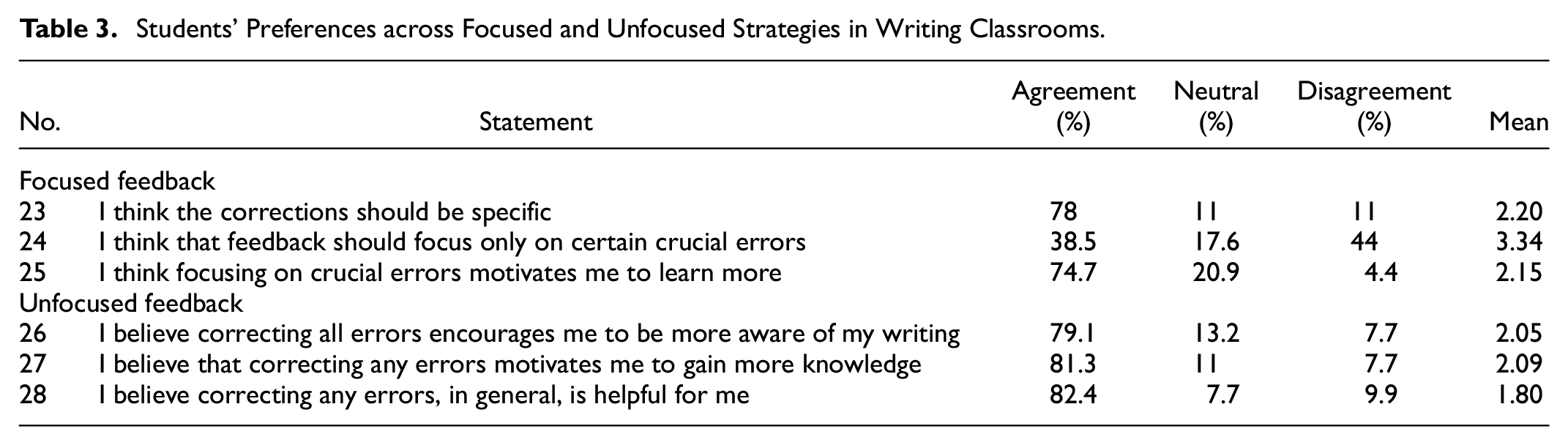
Unfocused feedback was the first and most preferred type of WCF strategy. 79.1% of Students reported that using “unfocused feedback” encouraged them to be more aware of their writing and gain more knowledge. On the other hand, 74.7% of students strongly agreed that WCF should be specific, focusing on the crucial errors that motivated them to learn more (see Table 3).
Students’ Preferences across Focused and Unfocused Strategies in Writing Classrooms.
In order to establish a statistical basis on whether there are differences among various nationalities in terms of their perception, One-way ANOVA was performed. It was observed that there are some differences in opinion among the various nationalities, as can be seen in Table 4. However, some feedback questions were not statistically different among various nationalities. For example, perceptions for question numbers 2, 3, 4, 6, 9, 10, 13, 15, 16, 18, and 19 were statistically different among the various nationalities. In order to know where the differences are coming from, LSD post-hoc multiple comparisons were performed. According to the question 2, Russia as the reference country, revealed that there was a statistical difference between Russia and Pakistan (p < .05), Russia and Morocco (p < .05) and Russia and Bangladesh (p < .05). The difference between Russia and Pakistan (p < .05), Russia and Morocco (p < .05) and Russia and Bangladesh (p < .05) were the source of the variations in perceptions. According to the question 3, India as the reference country, identified that there was a statistical difference between India and Pakistan (p < .05), India and Bangladesh (p < .05), India and Combodia (p < .05), India and Congo (p < .05) and India and Morocco (p < .05). However, it can be seen that the differences in perception for questions on positive feedback were more than negative feedback. Only two questions on negative feedback were statistically different among nationality (Q2 and Q5), compared to four questions on positive feedback (Q1, Q2, Q3, and Q5).
The One-way ANOVA Results for Participants With Different Nationality Backgrounds

Note. PP = positive feedback; NP = negative feedback; DF = direct feedback; IFWC = indirect feedback with codes; IFWOC = indirect feedback without codes; FF = focused feedback; UF = unfocused feedback.
Additionally, all participants feel the same about focused feedback with no significant difference considering their nationalities. It can be seen from the findings that overall, participants have a certain direction and understanding of their feedback preferences no matter which nationality they belong to.
Discussion
The questionnaire was divided into two sections. First about WCF perceptions and second section includes questions about feedback preferences. The participants from different nationalities responded to all questions and it was concluded that their WCF priorities are not much different from others.
Students’ Perceptions of WCF on Writing Tasks
According to the study’s findings, students from nine different nationalities have a positive opinion of adopting WCF in their EFL writing classroom. These findings indicates that learners despite of demographic disparites prefer to have feedback from their teachers on their writing errors. Numerous previous studies have yielded comparable findings (Chen et al., 2016; Hamouda, 2011; Higgins et al., 2001; Mustafa, 2012; Salami & Khadawardi, 2022; Zumbrunn et al., 2016). WCF is critical to the students because that helps them enhance their writing skills and become better writers. These findings are comparable to those of Chen et al. (2016), who found that students favor error fixes since they help them improve their writing.
According to the current study, receiving feedback was also linked to feelings. When students saw their progress, they seemed proud, happy and confident about their writings. The present study found participants from all included nationalities felt confident and motivated when they get feedback on their errors.These findings are in the line with (Aseeri, 2019; Hamouda, 2011; Mustafa, 2012; Qutob & Madini, 2020; Zumbrunn et al., 2016). According to this research report, a large number of EFL students have supported positive statements about WCF, and a smaller number of them find WCF as a tool of “frustration,”“hopelessness,”“badness,” and “unhelpfulness.” These findings support earlier research, indicating that WCF may demotivate students to improve their writing skills (Salami & Khadawardi, 2022; Zumbrunn et al., 2016).
The findings highlight how important it is to comprehend how cultural variables might affect people’s perceptions of and reactions to feedback. Teachers can modify how they communicate, provide feedback, and make decisions in order to promote better understanding and cooperation among students from different cultural backgrounds. This can be done by acknowledging and taking these differences into consideration. The findings attained by employing inferential analysis show difference in positive feedback perceptions of participants from different nationalities, which means demographic differences is another factor in conducting more studies. Overall, participants do favor WCF to improve their writing ability.
The study found that the students had a positive perception of WCF and preferred metalinguistic explanation and direct WCF to be provided by their instructors. This finding is in line with Higgins et al. (20012), Hamouda (2011), Mustafa (2012), Chen et al. (2016), Zumbrunn et al. (2016), and Rezazadeh et al. (2018) who found that students have a positive perception of using WCF in their writing .
Students’ Preference for WCF Types on Writing Tasks
Unfocused feedback was the most preferred strategy by participants. Students believed that employing an unfocused method helped them become more aware of their errors and encouraged them to learn more about them. Using unfocused feedback to increase linguistic correctness in L2 writing was quite successful in many earlier studies (Chandler, 2003; Robb et al., 1986). According to Ellis (2009), offering rich information and proof with unfocused WCF is better than focusing on helping learners become aware of their errors. The students favored unfocused feedback over focused feedback in our study. According to the present study’s findings, students preferred direct feedback. Much research has found that students prefer direct means of providing WCF (Aseeri, 2019; Karim & Nassaji, 2018; Kim et al., 2020; Nicolás-Conesa et al., 2019; Saragih et al., 2021). Indirect feedback with codes displayed a difference of preference among other feedback types. When conducting written feedback studies with students, it is imperative to incorporate the perspectives of both students and teachers in order to take into account the preferences of the students (Balachandran et al., 2017). The importance of taking into account the perspectives held by both educators and learners within the educational realm. (Brown, 2009). However, in a different study by Junqueira and Payant (2015), The significance of discrepancies between student choices and teaching practices on the success of writing in a second language within the context of WCF is underscored. This phenomenon can be attributed to the varying preferences among students for different instructional methods (L2).Students have a firm grasp of the many forms of comments they should get on their written work. Additionally, they feel demotivated and discouraged by sophisticated feedback in a form of circles and underlining and without adjustments. It irritates them, and some people believe that undocumented changes and codes add to the uncertainty. Students always appreciate it when teachers offer helpful, informative criticism.
The results of this study showed that EFL students had a reasonable point of view toward all WCF types. Therefore, the EFL teachers would assist the students regarding all these WCF types. Moreover, teachers would consider students’ preferences and opinions on WCF to provide helpful feedback. As a result, providing specific training programs and workshops in this area to teachers and students would be beneficial.
Pedagogical Implications
This study brings some important insights and contributions to the research of effectiveness of WCF and learners ‘perceptions and preferences about WCF process. The survey results confirm that written corrective feedback (WCF) perception is significant to learners from different nationalities and that the majority of them aspire to write clearly. All of them think they are learning something when they receive written comments and criticism, and they all like their errors especially grammatical ones to be corrected when they write. This research may show how crucial it is to take cultural quirks and inclinations into account when analyzing people’s reactions to feedback, especially when doing so across cultural boundaries. As was evident from the findings, there are students who do not pay attention to instructors’ identification of the errors, and only recognizing WCF does not mean that they comprehend and apply the rules in their following work. The major contribution of the study is for L2 instructors to make sure the feedback they provide is comprehendible for learners.Teachers’ feedback is very helpful for students with the help of teachers’ feedback, the learners are inspired and reinforced.
Conclusion
In EFL courses, WCF is one of the essential methods teachers can employ to improve their students’ writing. This study investigated students’ perceptions and preferences of WCF. A quantitative questionnaire was given to EFL students as part of the study. In response to the first research question, a large number of EFL students had positive perceptions toward WCF in their EFL classes that they had completed in their home countries, and they found it helpful in improving their writing. According to the second study question, students found some WCF tactics more effective than others. The most popular technique among students was unfocused feedback. Additionally, all participants feel the same about focused feedback with no significant difference considering their nationalities. It can be seen from the findings that overall, participants have a certain direction and understanding of their feedback preferences no matter which nationality they belong to.
Future Recommendations and Limitations
There are certain limitations to this study that should be highlighted. The study’s first and most important limitation was the small sample size. Although the researcher(s) included participants from nine countries, the sample was small. Likewise, the researcher(s) collect the data of these distinctive participants from only one university due to the pandemic. Secondly, the researcher(s) would not be able to check ESL students’ proficiency level through a proper scale yet only ask through a simple scale (i.e., (a) Beginner, (b) Intermediate or (c) Advanced). However, this scale could not be analyzed. Third, the classroom setting of the students from the nine countries was not explained because it was not an experimental study at this stage, and some participants had limited exposure to some WCF types.
Based on the first limitation, the present research would recommend that future researchers conduct further studies involving participants from different nationalities. However, they would need to enhance the sample size to increase the validity of the research design. Based on the second limitation, it is recommended that if a researcher conducts a study in more than one country, they would need to check the proficiency level of the ESL students through a proper scale. Based on the third limitation, it is recommended that future researchers who may work with more than one country should explain the classroom settings if they would conduct an experimental study.
Footnotes
Declaration of Conflicting Interests
The author(s) declared no potential conflicts of interest with respect to the research, authorship, and/or publication of this article.
Funding
The author(s) received no financial support for the research, authorship, and/or publication of this article.
Consent
The participants gave their permission after receiving assurances that all of their information would be kept private. People who volunteered for the study indicated on a consent form that they were willing to have their answers published.

Data Availability Statement
Data sharing not applicable to this article as no datasets were generated or analyzed during the current study.