




Abstract
As blended learning pedagogy gains an increasing popularity in higher education, there is a need to continually report both students’ and instructors’ perceptions regarding blended learning in order to generate better learning outcomes. This paper examines how students and instructors perceived the incorporation of MOOCs in students’ blended learning experience and the challenges they encountered. A total of 122 second-year undergraduates enrolling in an English course were surveyed, and five students and three lecturers were interviewed. The finding shows that students had favorable attitudes toward this blended course, expressing a higher level of interaction, flexibility, a better understanding of the learning content, and a richer learning experience. The instructors confirmed the positive impacts of blended learning but also admitted blended teaching increased their time commitment to their jobs. The impediments met by students and instructors in the blended learning environment must be taken into consideration.
Introduction
MOOC, namely Massive Open Online Course, was firstly introduced by George Siemens and Stephen Downes who designed the 12-week online course called “Connectivism and Connective Knowledge” in 2008. There were 25 enrollments for credit and over 2,000 non-credit enrollees (Wang et al., 2017). Since then, MOOC-based blended courses have been a new educational trend over the last decade. Now, MOOC is increasingly incorporated in a myriad of blended courses at the tertiary level (Dale & Singer, 2019), especially in China where there are over 30 million college students in approximately 3,000 universities (Ma & Lee, 2019). Hence, as a huge market for educational innovation, Chinese universities potentially integrate MOOCs into students’ learning journeys. Tons of Chinese universities are in partnership with the largest MOOC platforms, such as icourse (www.icourses163.org), CNMOOC (www.cnmooc.org), and Chinese MOOCs (www.chinesemooc.org; Wang et al., 2019).
MOOC initiative is integrated into a blended learning (BL) environment to offer a customized experience for students in higher education institutions, especially universities. However, previous literature has not reached a consensus on the definition of blended learning. Blended learning is typically defined as a mix of online and face-to-face learning (Baepler et al., 2014; Medina, 2018; Owston et al., 2013; Owston & York, 2018; Smyth et al., 2012). Some teaching and learning activities are shifted online, and classroom time is reduced but not replaced completely. For example, Graham (2006) conceives BL as “the combination of face-to-face instruction and computer-mediated instruction” (p. 5). Garrison and Vaughan (2008) view BL as “the organic integration of thoughtfully selected and complementary face-to-face and online approaches and technologies” (p. 148). One of the reasons why blended learning lacks a unified definition lies in the undecided particular percentage of the course time taken online (Owston & York, 2018). The Online Learning Consortium states that online learning of a blended course should take up from 30% to 79% of the total in-class seat time (Allen et al., 2007). Some insist that over 50% of course time should occur online in order to be considered as a blended program (Baepler et al., 2014). This paper agrees with the claim given by Online Learning Consortium and defines blended learning as the instructional delivery mode combining traditional in-class seat time and online learning.
Within Chinese Universities, traditional face-to-face instruction is still the dominant teaching pedagogy widely used across different majors and courses (Xu et al., 2020). As researchers advocate for blended learning as an alternative pedagogy tool in English courses as well as in other social science courses within the collegiate classroom (Bazelais & Doleck, 2018; de Moura et al., 2021; Taghizadeh & Hajhosseini, 2020; Wang et al., 2019), there is a great need to investigate students’ and instructors’ perceptions and feedback of blended learning attempt. Some research has covered the topic of students’ perceptions of blended learning under different learning and cultural contexts (Bazelais & Doleck, 2018; de Moura et al., 2021; Owston et al., 2013; Smyth et al., 2012; Wang et al., 2019), yet there is still a paucity of literature exploring instructors’ perceptions. Faculty, one of the stakeholders in BL courses, is still relatively understudied concerning the challenges they have in blended teaching. In addition, although certain literature has reported students’ feedback toward blended learning in various majors and fields within Chinese universities, a significant part of such literature is written in Chinese. There is still a lack of English written literature revealing to the world how blended learning is applied in a Chinese university EFL context as well as Chinese teachers’ and students’ feedback (Wang et al, 2019).
This paper documents the implementation of three MOOC-based blended learning classes over one semester of an English course named Western Culture in a Chinese university, as well as presents results of students’ and teachers’ perceptions toward MOOC-based blended learning. In this respect, the objective of this research is twofold: unraveling whether students are satisfied with the current learning mode and analyzing the students’ and teachers’ perceptions behind the implementation of this BL course. To achieve this, the research questions underpinning this study are:
What are the Chinese students’ and teachers’ perceptions toward a MOOC-based blended undergraduate English course?
What are the challenges that students and teachers face in the MOOC-based blended learning context?
Literature Review
In this section, related literature is given a careful review. Besides students’ satisfaction toward blended learning, students’ and teachers’ perceptions of the benefits and challenges of blended learning are reported in details.
Students’ Satisfaction Toward Blended Learning
Various studies have examined students’ satisfaction with respect to BL, and most results confirm that students are more gratified with blended learning than both traditional lecture-based learning and fully online modes of instruction (de Moura et al., 2021; Dziuban et al., 2006; Owston & York, 2018; Owston et al., 2013; Wang et al., 2019). In Owston et al.’s (2013) research, a university embarks on BL as the main instruction method on a large scale across the campus. To determine students’ perceptions, a questionnaire is developed to collect data from 577 students enrolling in 11 courses. The results imply that in comparison with fully physical or virtual instruction, students with better academic achievement expressed a higher level of satisfaction and preference about blended format thanks to the greater convenience and better engagement. High-achieving students also showed their willingness to take another blended course. This is evidenced by the findings in Owston and York (2018) investigating students’ perceptions and performance in response to the blended approach. After surveying learners in 20 undergraduate programs, the results show that 68% of students prefer blended format over fully face-to-face instruction. With regard to the proportion of time devoted to online learning, students’ satisfaction is prone to be higher when around 30% to 50% of classroom seat-time is replaced with online learning. However, low-achieving students in Owston et al.’s (2013) research are much less satisfied with the blended instruction and prefer the traditional lectures. This conflicting result may lie in that low achievers lack independent study skills and feel challenging to comprehend online content without adequate scaffolding. Students may be accustomed to the traditional classroom instruction supported by slides and printed materials to clarify confusing concepts and consolidate knowledge. There is a large amount of research demonstrating the efficacy of traditional learning (Beale et al., 2014; O’Flaherty & Phillips, 2015).
Benefits of Blended Learning
The blended paradigm comprises many potential benefits, including flexibility, accessibility, learner autonomy, better learning outcomes, a higher level of interaction, a better understanding of the subject matter. One of the most-cited benefits of BL is that students are able to complete the online component at a pace conforming to their learning style. Dale and Singer (2019) survey all fourth-year students enrolling in a MOOC-based blended course with a subsequent focus group at the University of Glasgow. The research results give weight to the argument that participants particularly appreciate the flexibility provided by MOOCs allowing them to undertake learning at their own pace. This is corroborated by other researchers suggesting that students can get access to video lectures anytime and anywhere (Baepler et al., 2014; Medina, 2018; Owston et al., 2013; Thai et al., 2017). On the contrary, Jonker et al. (2020) stress that students with limited self-regulatory skills may procrastinate in a flexible blended curriculum.
Internet technology advancement and the availability of Internet connectivity have also fueled the integration of virtual teaching and learning in higher education institutions (Loh et al., 2019). In particular, Net Generation students born after the year 2000 are more technologically savvy and adept at using digital media to satisfy their learning needs (Dziuban et al., 2006).
Another benefit of blended learning is that it increases learner autonomy. In Smyth et al.’s (2012) study, 51 students participating in the focus groups are interviewed to describe their perceptions of taking a postgraduate program by blended learning. Most interviewees express that the BL increases their learning autonomy since they make decisions on how they engage with the program, such as the amount of time dedicated to the course. This finding concurs with that of later studies by Ma and Lee (2019) and Wang et al. (2019) where MOOCs are incorporated into undergraduate courses. It appears that learners exhibiting a higher level of autonomy tend to perform better.
The third highlighted benefit of blended learning is that it brings a higher level of interactive capabilities than conventional lectures (de Moura et al., 2021; Dziuban et al., 2006; Wang et al., 2019). Courses blended with online resources can increase the interactivity among students and facilitate greater instructor-to-student mentoring. From the questionnaire findings of Owston et al.’s (2013) study, participants respond that they are more engaged in BL, especially students with higher academic attainments. A possible explanation is that they make full use of the online platform and face-to-face classes by increasing interaction with teachers and classmates (Melton et al., 2009). There are students reporting that they can receive instructors’ remarks on their assignments faster as compared to traditional courses (Korr et al., 2012), and immediate feedback proves to be educationally effective in acquiring new domains of knowledge (Chen et al., 2018). Similarly, Taghizadeh and Hajhosseini’s (2020) study reveals that teacher-student interaction is the most frequent interaction compared to the interaction between students and learning materials and the interaction among students. This is because the course facilitators reply to students’ questions posted online in a timely manner, give constructive feedback to their comments, and interact with them in relation to course content via both online and offline sessions.
As such, students showing a high level of engagement tend to attain better learning outcomes (Artino & Stephens, 2009). Baepler et al.’s (2014) study centers around students’ learning outcomes in a blended format by administrating two standardized exams, and measures students’ perceptions with a survey instrument. The findings demonstrate that students’ learning outcomes are statistically better than traditional class settings, and they have a favorable attitude toward BL. This is consistent with the results of other empirical research (Bazelais & Doleck, 2018; Israel, 2015; Means et al., 2013; Medina, 2018). Surprisingly, researchers in some studies observe no significant differences in test results under blended instruction in comparison with traditional face-to-face learning and e-learning milieu (Alonso et al., 2011; Moore & Gilmartin, 2010).
In addition, an influential facilitator accounting for students’ readiness toward blended courses is the enhanced learning experience. In Medina’s (2018) research, one of the reported benefits of implementing BL programs from students’ perspective is that varied additional materials provided by blended settings enhance their learning experience and foster a collaborative learning community. A similar conclusion can be found in the studies of Bruff et al. (2013) and South et al. (2008). By reviewing prior research, a great number of students consider blended courses as an effective way to acquire knowledge concerning the subject matter (Littenberg-Tobias & Reich, 2020; Owston et al., 2013; Smyth et al., 2012). This can be attributed to the fact that recorded lectures of blended programs allow students to be well-prepared for the upcoming face-to-face phase and review for quizzes (Johnston et al., 2013).
Challenges of Blended Learning
Meanwhile, an increasing number of studies are focusing on the barriers of MOOC adoption in a BL setting (Mayer, 2009; O’Flaherty & Phillips, 2015; Ramírez-Donoso et al., 2021; Smyth et al., 2012). First of all, some students show apprehension toward the limited interaction and the lack of a sense of community in BL courses (Smyth et al., 2012). Also, some students report that informative and constructive feedback for the online assignments is not given in a timely manner, which is in alignment with the literature suggesting that an absence of prompt feedback gives rise to frustration and a sense of isolation (Anthony et al., 2019). However, other studies show conflicting findings that BL promotes student-to-student and instructor-to-student interactions (Dziuban et al., 2006; Melton et al., 2009; Owston et al., 2013). Korr et al. (2012) also reported that students can receive instructors’ remarks on their BL coursework faster than traditional courses. This inconsistent finding may be attributed to the different amounts of faculty guidance and workload of participants in each individual context. Secondly, in spite of the flexibility of the blended programs, some student participants in Mayer’s (2009) study feel that the online component is overwhelming, as it is invasive in their everyday life. They need to watch related video lectures and finish weekly web-based discussion beforehand, since a certain proportion of marks are allocated to encourage students’ participation. Similarly, Ramírez-Donoso et al. (2021) reported that students are not used to MOOC-based BL mode that requires students’ better learning autonomy and active engagement in the learning process.
As for the challenges encountered by faculty, technical difficulty is one of the most commonly reported limitations of BL (Porter et al., 2016). Some tutors are challenged by web-based technologies, especially veteran teachers who are used to traditional teaching tools in the classroom and resistant to a number of online applications (Zhang et al., 2020). Besides, increased workload is another challenge put forward by teaching staff (Tynan et al., 2015).
Methodology
Questionnaire and semi-structured interviews were employed to explore students’ and teachers’ perceptions of the BL format. Details of the instruments, data collection procedures, and data analysis are presented as follows.
Research Context
A convenience sample of 122 second-year non-English majors from a university in China was invited as participants. Gender was evenly split in this student cohort. They took the course named Western Culture through the instruction of English in the academic year 2019 to 2020. The instructional goals of the Western Culture course at this university are (1) to introduce the Western culture and to compare the differences between Chinese culture and Western culture in various aspects and (2) to strengthen students’ awareness and competence for cross-cultural communication. Western Culture, a 2-credit mandatory course, was timetabled on every Wednesday from 8:00 to 9:40 am throughout 17 weeks. To achieve the instructional goals within a semester, an instructional design was developed to create a blended learning environment. The MOOC was embedded in the curriculum with a study load of 1 hour per week. The course included 15 topics, such as education, festival, cuisine, media, and the like, and each topic featured two reading passages with reading comprehension, language in use, and oral practice. It is important to mention that the online MOOC was supplemental since students met weekly in class for 17 weeks. In other words, students did not have less face-to-face instruction time.
Instructional Design
MOOC videos of the Western Culture course are made by professors from Hubei university and are accessible on the UMOOCs platform (https://moocs.unipus.cn/). Students can access the MOOC platform via multiple devices, including laptops, tablets, and mobile phones. Furthermore, students are required to download a built-in mobile application called “Xuexitong” where MOOC resources are also available. “Xuexitong” is a technology-based implementation tool which assures MOOC content delivery and online and classroom interaction.
The process of instructional design is shown in Figure 1. Course orientation was introduced in the first week, and the next 16 weeks consisted of 90-minute weekly sessions. The blended paradigm was introduced to students in the first week. For online mode, students watched recorded MOOC videos weekly, and then they needed to finish quizzes related to the learning content which were auto-graded. Plus, students were required to post their ideas and thoughts on discussion forum after watching videos. Students were also encouraged to come up with their confusion pertinent to the specific topics, and then the course facilitators reacted to questions and interacted with students online. Supplementary reading materials were also provided on the platform. For face-to-face instruction sessions, students went to the traditional classroom every Wednesday and further explored the designated topic corresponding to each unit under professors’ guidance. Lecture, in-class discussion and group presentation were the main in-class activities. Also, teachers used the “Xuexitong” APP to carry out random roll calls, send out quizzes, and send on-screen comments. Data, such as the number of micro-lectures watched, quizzes completed, and comments submitted, were collected routinely, which contributed to an understanding of students’ engagement and an overall score. Approximately 50% of the final marks were determined by progress reports on videos, completion of quizzes, and online discussion participation, and the remaining 50% of marks were allocated for the final exam and in-class performance.

Instructional design chart.
Instruments
The online survey was administrated in the last class on the 17th week through a survey platform (http://www.sojump.com) in three blended classrooms taught by three instructors. To assess students’ perceptions of blended learning experience, a survey containing two parts was developed. In the first part of the questionnaire, there were two open-ended questions enquiring students’ views on blended instruction in general and what aspect of this blended-learning experience they liked most as well as the challenges they met. This qualitative data was to provide support and present a more comprehensive picture of the students’ perspectives connected with the hybrid model. In the second part of the questionnaire, there were 12 items encompassing four dimensions, namely learner dimension, instructor dimension, course dimension, and technology dimension, following a 5-point Likert scale (Strongly disagree, Disagree, Neither agree nor disagree, Agree, and Strongly agree). These four dimensions (shown in Figure 2) were adopted from the Dimensions and antecedents of perceived e-Learner satisfaction framework developed by Sun et al. (2008). The items within these dimensions assess students’ perceptions regarding their engagement and perceived learning outcomes, student-teacher interaction, course design, and videos and technology applied in the blended-learning. These items were developed based on a review of the literature (Baepler et al., 2014; Owston & York, 2018; Owston et al., 2013). The following framework reveals the details of these four dimensions and related survey questions.
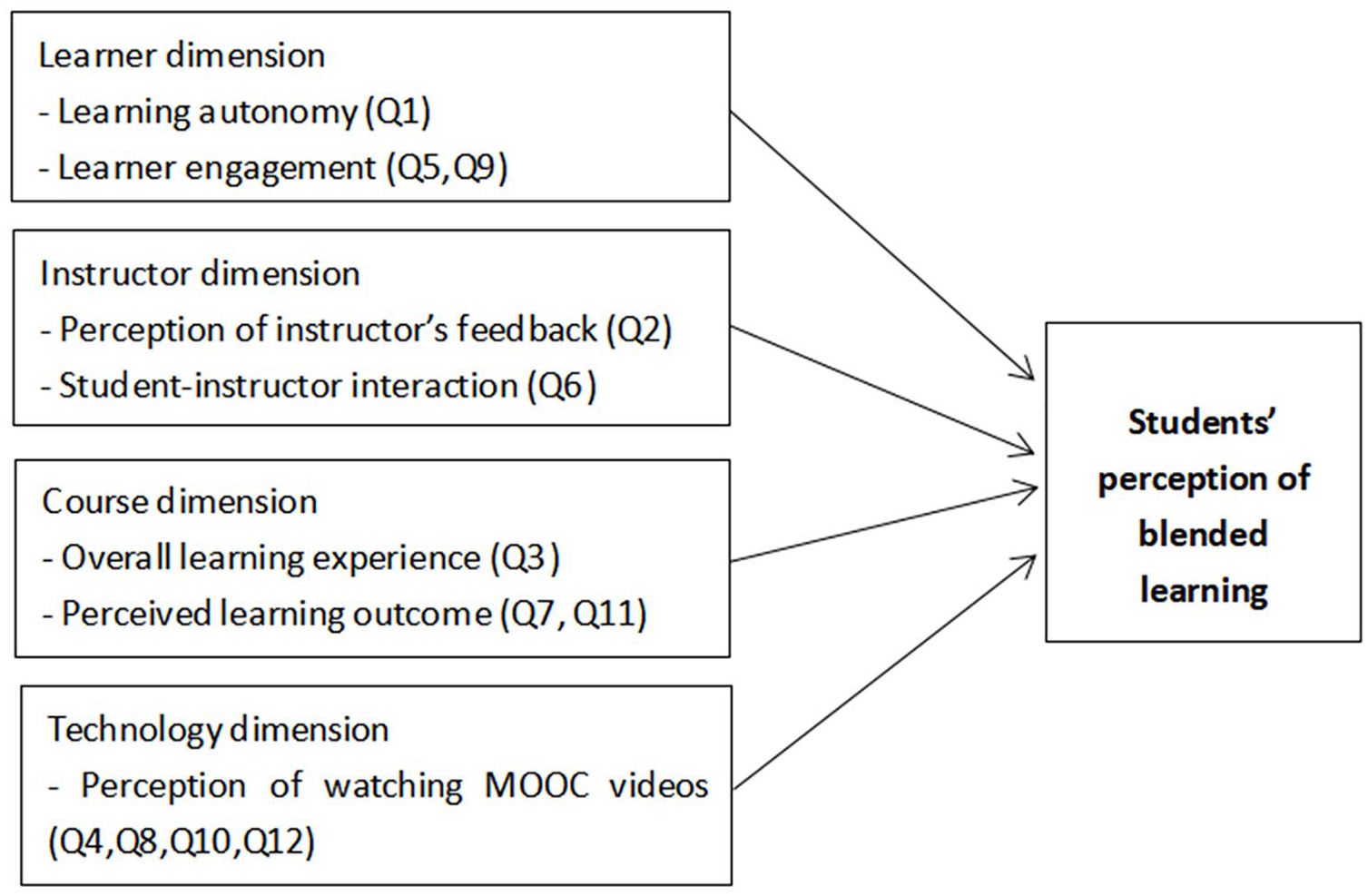
Dimensions and antecedents of students’ perceptions on blended learning.
At the end of the survey, there were basic demographic questions related to participants’ gender, age, major, and willingness to partake in the follow-up interviews. Five students and three lecturers in three classes were invited to proceed with the follow-up interviews. Predetermined interview prompts were used to guide the discussion (Cohen et al., 2007). The length of the interviews was generally within 30 minutes. The interview protocol centered on two main themes: (1) benefits of BL and (2) challenges of BL.
Data Analysis
Qualitative data from the survey and interviews were transcribed verbatim under thematic analysis (Boyatzis, 1998; Braun & Clarke, 2006). This involved a few stages. First, the researchers thematically coded the anonymized data by reading through the transcripts and annotating them to identify relevant codes. Codes were grouped into tentative categories, finally generating categories. Predominant themes emerged from these tentative categories, each containing sub-themes, including “flexibility,” “accessibility,” “autonomy,” “interaction,” “technology,” and so on. Secondly, these themes were grouped into associated research questions. Small specific themes were put into larger independent categories. Finally, the accuracy of coding was scrutinized by both researchers. Quantitative data from the second part of the questionnaire were input into SPSS to collect descriptive statistics.
Results
The results of this paper are presented in accordance with the research questions. In this section, students interviewed are labeled by SI1 (Student Interviewee 1), SI2 (Student Interviewee 2), while faculty are identified by LI1 (Lecturer interviewee 1), LI2 (Lecturer interviewee 2), and so forth. Quotes from students in the first part of the questionnaire are noted by S1 (Student 1), S2 (Student 2), and so on.
Research Question 1: What Are the Chinese Students’ and Teachers’ Perceptions Toward a MOOC-Based Blended Undergraduate English Course?
In this section, students’ and teachers’ perceptions of BL are elaborated separately. Students’ perceptions include their general attitude toward BL and their overall perceptions which were grouped into four dimensions. The details are as follows.
Students’ perceptions of blended learning
In terms of students’ general attitude toward blended learning, this study shows that students tended to prefer BL over entire classroom teaching. Data from the two open-ended questions in part 1 of the survey were analyzed. The result showed that 83% of the respondents (n = 122) believed the blended learning experience was worthwhile; around 11% of the students were not content with this teaching mode, and 6% of them had mixed feelings about blended instruction (see Table 1). Students who were satisfied with blended learning claimed that flexibility, learning more, and deeper understanding associated with blended learning were the three main factors contributing to their satisfaction level. The other factors were interesting videos, more interaction, watching repeatedly, and so on. Those who were unsatisfied with blended learning complained about too many tasks and lacking autonomy. The rest 6% had mixed feelings of blended learning. On the one hand, they admitted having learned more from blended learning. On the other hand, they suffered from too many learning tasks and a lack of learning autonomy.
Themes and Sub-Themes From Students’ Self-Reports in the Questionnaire.

Beyond their general attitude, the students’ overall perceptions of BL were explored under the four dimensions: the learner, instructor, course, and technology dimensions, so as to provide a comprehensive view of their learning feedback. The survey data as well as interview data revealed findings toward each dimension. The descriptive statistics of survey questions could be seen in Table 2, which displayed overall positive feedback from students in each dimension. In the following, the findings of each dimension are given a detailed illustration.
Descriptive Statistics of Survey Questions.

Students’ perception of learner dimension
Survey questions 1, 5, and 9 investigated students’ perception of the learner dimension (see Table 2). Around 77% of participating students acknowledged that this MOOC-integrated program improved their learning autonomy, partly because they can take ownership of their learning. As a student explained in the self-report, “it can ensure my autonomy in learning, because I can freely arrange the time when I want to learn.” (S64)
Students claimed that they were motivated to learn, because online videos give them a lot of liberty in how they engage their learning and they wanted to get better results at the end of the semester, which fosters their self-directed learning. As S11 wrote, “Blended learning provides diversified assessments, so our course results are not merely determined by the final. Therefore, we are motivated to watch MOOC videos and complete the tasks so that we can get higher scores.” (S11)
As for student-to-student interaction, over 70% of students perceived that in-class discussion and online forum gave them more chances to interact with other course participants. An intriguing finding from some students’ responses is that they were more active in sharing opinions online, whereas their inhibited personality resulted in class interaction avoidance.
Some students are quite shy in class, but behind the screen, they are very active and have a lot to share. I think many students do act like this, because introversion is a common trait of Chinese people. They are afraid to speak in front of others, and they are not confident in their English. I am one of them. (SI4)
Students’ perception of instructor dimension
Notably, in survey question 2, a high percentage (95%) of students reported that they could get feedback from teachers promptly (see Table 2). One student in the interview valued the interaction with the teacher online, saying that “I get a thumb-up from my teacher for my work. In the online discussion, when I post my thoughts, teachers will reply and ask me a deeper question and lead me to think.” (SI2)
Hence, positive remarks from teachers can exert encouraging impacts on students, and their guiding questions may lead to students’ thought-provoking insights. Yet, one participant in the interview presented an opposing opinion:
I have involved in the online forum 15 times, but my teacher only replied 2 or 3 times. It is understandable, because there are too many students. In the real class, if I answer questions, I will get the feedback from the teacher at once. (SI1)
An explanation can be put forward for this discrepancy; that is, three instructors may devote different amounts of time to online involvement, or a few students expect more teachers’ feedback than other students.
In addition, survey question 6 revealed that nearly 80% of students expressed strong agreement with the statement that they had more chances to interact with their teachers. As one student said, “What I like best about this blended learning experience is that I have more interaction with the teacher. The teacher not only gives us guidance in the real class, but also answers questions on the online discussion board.” (S8)
Students’ perception of course dimension
A wide cohort of students (90% participants) reported that this blended course provided them with a richer learning experience (see Table 2). Integrating MOOCs in courses is envisaged to be an effective way for students to acquire knowledge from multiple sources. Web-based lectures can be interlinked with slides, supplementary reading materials, relevant website links, and discussion forums. Also, three students asserted that they can learn from teachers with diverse teaching styles in MOOC videos. This is because online videos of this course were recorded by five teachers who may access the topic from differing perspectives.
The result of survey question 7 revealed that 76% of students reported that they had a better understanding of certain topics prior to classroom sessions because of watching MOOC videos. As one student (SI1) explained, “MOOC videos do improve my understanding about Western culture, such as the three architectural styles, because this is the topic that I knew little about before, and the textbook does not provide vivid pictures and description about them.” The findings of survey question 11 showed 63% of the participating students reckoned that this blended instruction enhanced their learning outcomes. Yet, when asked what they liked most about this blended learning experience, no students mentioned better learning outcomes in the self-report inquiry. Concurrently, all student interviewees did not overrate the effects of BL in their learning outcomes. One student interviewee mentioned,
There are 3 videos for each topic, each video lasting for 8 to 10 minutes, so there is so much content for one topic. For me, I can only remember several key points after watching 3 videos, and I forget most of the content afterward. If I didn’t take it as the materials to practice my listening or memorize new vocabulary, I don’t benefit a lot from it. Also, it is quite hard to improve English proficiency by just learning MOOCs for one semester. (SI3)
Students’ perception of technology dimension
Flexibility was the primary reason why students favored a blended curriculum since they could proceed learning at their own pace. Thirty-eight students wrote in the self-report inquiry that their favorite part of BL was to control the pacing and location of their learning at their convenience before classes (see Table 1). The convenience of scheduling and self-directed learning opportunities can be highly conducive to knowledge acquisition. Yet, less than 10 students did complain that the flexibility of blended courses led to exhaustion.
I can decide the time and place to watch it, and this flexible way of learning allows me to adjust my personal arrangements. I can adjust the speech rate of the videos. If I find the speech rate is too quick for me, I can make it slow down and there are Chinese subtitles that make me understand it better. (SI5)
Even though it is very convenient to watch MOOC videos whenever I want, it just makes me feel difficult to separate class time and private time. Outside of class, I also need to spend much time watching lecture videos and discussing questions. It is just exhausting. (SI1)
In relation to accessibility, 78% of students felt they can easily get access to the MOOC videos. Students in this study gave high ratings to the effectiveness of micro-lectures through which they acquired new knowledge. Meanwhile, several students grumbled that the wireless-internet connection on campus was rather slow and unstable, thus postponing engaging online tasks.
In my view, MOOC videos are more likely to be a helper of previewing and reviewing, and we can access those videos whenever it is and wherever we are. It is very convenient. The problem is that the Internet connection in my dormitory is on and off, so sometimes I need to wait until morning to watch MOOC videos when the Internet connection is relatively better. (S19)
In response to survey questions 10 and 12, an overwhelming majority of participants commented positively that MOOC delivery helped them better grasp the corresponding topics and acquire new knowledge. This result indicated that having a connection between classroom learning and online learning in the BL courses helped learners gain knowledge in the first place, and related the acquired knowledge to what their teachers have taught in the real classroom. As a student interviewed put it,
Watching MOOC videos is a good way to preview and get a glance at the topics, and it is easier to understand the topic when I read the textbook. After we have a certain understanding of what we have learned online, we can continue to study or solve more difficult problems offline. (SI3)
To sum up, students’ perceptions toward BL in the four dimensions are overall very positive. They reported an increasing learner autonomy, motivation and engagement associated with BL, more teacher-student interaction, their good feelings of using MOOCs as a better way of learning, and their positive feedback as well as comparatively better learning outcomes related to BL.
Teachers’ perceptions of blended learning
Beyond researching students’ perception, another purpose of this study is to investigate teachers’ perceptions regarding the influence of BL on students. It is possible that participating students may exaggerate the influence of BL on them or tend to report mostly positive feedback. Thus, there is a need to investigate teachers’ perspective since they are observers and evaluators of students’ learning. The following findings were generated from lengthy interviews with three lecturers who delivered Western Culture.
Concerning students’ motivation level in this course, two lecturers observed that most students were motivated to the BL and had high engagement. One reason is that these students had high interest in the course content and enjoyed watching MOOC videos. Another reason is that students’ participation in e-learning activities affected their final marks. Yet, lecturers also noted that a small group of students did have low participation. These students just idled away, sleeping, or gluing their eyes on mobile phone screens in classroom. Neither did these students post anything on a regular basis. Instead, they piled up assignments, or submitted all of them before the deadline.
As for interaction among students, lecturers confirmed that some students were more active in discussing with their classmates in online forum compared to how they were in face-to-face class. According to lecturers’ observation, quite a few students were withdrawn in the face-to-face class and unwilling to talk. Communication apprehension and fear of negative judgment hindered them from articulating in class. However, students were less worried about their language proficiency in online forums and were highly encouraged to get extra marks through online discussion. One lecturer mentioned similar information in the following:
My students are usually active on MOOC platform, because if they interact with other students online, like leaving comments and starting a new thread to discuss with other students, they can get extra scores. Although they can get equal scores if they actively participate in face-to-face classes, most students choose to stay silent. (LI1)
With respect to student-to-teacher interaction, the participating faculty agreed that their interaction with students had increased. The MOOC platform provides students a channel to connect and interact with their teachers through discussion forums and posts. This is especially beneficial to those who are not willing to have face-to-face conversations and classroom interaction with teachers. As one lecturer mentioned,
When Western Culture was a fully face-to-face course, only a few students ask questions and communicate with us in the real classroom or during the ten-minute break. Now, since this course is taught in the blended format, every student is required to answer teachers’ discussion questions and can choose to post their questions when they feel puzzled or seek help. (LI2)
All the participating faculty also confirmed students’ responses and underpinned the accessibility and flexibility of studying from MOOC videos. They stated that students had adequate devices to support their BL, including computers, laptops, tablets, and smartphones, and they can visit MOOC platforms effortlessly. Also, students can arrange their study time on their own, and pause or rewind MOOC videos according to their needs.
Teachers held the same opinion with students regarding students’ better understanding of certain topics under the blended learning mode. Lecturers in the interview agreed that essential vocabulary that students were exposed to in the mini-lecture videos prepared them for understanding the course content and the insightful discussion in class. One lecturer said, “Previously, one classroom was usually taught by one lecturer, but through the innovative use of the Internet, students can be taught by several teachers online.” (LI1)
However, regarding the learning outcomes of BL, three lecturers held inconsistent attitudes. One lecturer stated that the BL setting was beneficial for students’ learning outcomes thanks to the increased learning hours on the MOOC website. As the lecture shared,
MOOC lectures force the students to do pre-learning and spend more time on English. In traditional classes, students seldom take the initiative to learn English outside of classroom. Comparatively, in BL, spending more time on MOOC lectures could improve students’ language proficiency and expand their horizons to some degree. (LI3)
On the other hand, the other two lecturers stated that not all students had done efficient preview or grasped the learning content of MOOC lectures, which affected their learning outcomes. As one lecturer mentioned, “Half of the final marks depend on students’ online performance and participation. Some students couldn’t finish the online discussion or assignment well, so they didn’t perform well.” (LI2)
Research Question 2: What Are the Challenges That Students and Teachers Face in the MOOC-Based Blended Learning Context?
Despite overall positive perception toward BL from the students, there were still a small percentage of students articulating the challenges they faced in BL. There were total 21 students (n = 122, 17% of total participating students) voiced their frustration and highlighted the following demerits of taking BL, including too many tasks, a lack of autonomy, less interaction, and preference toward traditional learning environments, all of which triggered their resistance to BL. The following were the details.
Eight students lamented that this learning mode was not suitable for those who were lacking in learning autonomy, because if students were not self-disciplined, they may feel disoriented and procrastinate. As one student said, “I don’t like this pattern, because it is easy to forget and many students can’t control their schedule.” (S28)
Other eight students insisted that the learning tasks of each unit topic were beyond what they could manage and occupied too much of their time, so they considered this course structure overwhelming.
There are too many videos to watch. Each video is too long to remember after watching it, so I have to spend a lot of time on it. I have many other courses as well, and I am super busy this semester. (S48)
Three students stated outright that they preferred didactic lectures in the classroom, and if some learning activities were shifted to MOOC platform, they may drift away due to asynchronous interaction with classmates and the teacher. Another two students added that the blended program could reduce the opportunities to socially interact with their classmates.
As far as the challenges faced by teachers, all the participating teachers mentioned that BL required them to spend more time on this course. This is because a blended program took more time to develop than a similar course delivered face-to-face, including rewriting teaching plans to incorporate the online component and supervising students’ online learning performance.
Compared with traditional class, this blended course requires teachers to spend more time interacting with students. For example, apart from in-class time, I need to check students’ completion rates on watching MOOC videos, read students’ written answers on discussion topics and reply to students’ questions. (LI2)
Another challenge was faced only by one senior participating lecturer, who expressed a lack of confidence in technological competence, while the other two young faculty members were more confident. Blended course involving the online component is a revolution of the educational paradigm which requires teachers to be proficient in basic technologies. The senior teacher disclosed,
In the past, I just used chalkboard and overhead projector, but now I have to learn how to navigate the MOOC website and manage students’ accounts and interact with students online, all of which are new to me. I feel overwhelmed and unsure. (LI1)
To sum up, the major challenge faced by about 17% students are too many study tasks, a lack of autonomy, and less face-to-face interaction. One major challenge faced by teachers is increased time commitment to their job. Technology challenge is experienced by a senior teacher.
Discussion
In this section, the findings are discussed with the literature in order to further unpack the meaning of these findings. In terms of students’ general attitude toward BL, around 83% of learners favored the blended approach over entire classroom teaching. Therefore, this study taken as a whole arrives at a similar result with previous research that learners held positive attitudes toward blended learning (de Moura et al., 2021; Dziuban et al., 2006; Owston & York, 2018; Owston et al., 2013; Taghizadeh & Hajhosseini, 2020; Wang et al., 2019).
This study found the majority of students’ motivation increased as a result of the blended instruction, which is in line with the previous research results (Ma & Lee, 2019; Smyth et al., 2012; Thai et al., 2017). Also, students in this study reckoned that the interaction with their classmates in BL mode was more than that in traditional classes, because blended teaching carried out classroom discussion, group presentations, coupled with instructional videos, online discussion, and self-assessment tools, which contributed to more interactivity among students. This finding confirms previous studies (Dziuban et al., 2006; Melton et al., 2009). An intriguing result from teachers’ observation of this study is that classroom reticence was still pervasive, even though students actively participated in the online tasks. Students actively replied to and discussed questions with their classmates in online forums, but they remained comparatively reticent in face-to-face classroom activities. Participating students explained that this resulted from their introversion and lack of confidence in speaking English. Yet, de Moura et al. (2021) found that MOOC-based BL transformed students into active learners, as they were more involved in the face-to-face classes. The reason is that MOOC replaced part of the face-to-face instruction hours, and students had to go through much more content in a short time and thus were more concentrated in class. The current study agreed that MOOC-based BL did encourage students to be active online learners, yet students remained quiet in face-to-face classroom discussion. Bruff et al. (2013) reported that in their study on MOOC-based BL, students did not actively participate in the online discussion due to time constraints but favored classroom discussion greatly. This conflicting result is possibly due to different learning contexts and participants. The current research highlights the need for further investigation on the in-class interaction under the BL context.
Students in this study reported that they could generally get prompt feedback from their teachers both on the MOOC platform and in classroom. For one thing, classroom lectures offer students chances to receive prompt guidance and support from instructors, and in-class activities facilitate interactivity with other peers. For another, virtual workspace enables students to get continuous feedback from teachers (Melton et al., 2009). Also, immediate feedback plays a positive role in mastering new knowledge (Chen et al., 2018) and makes students perceive BL to be beneficial for their learning (Anthony et al., 2019). Teachers in this study agreed that there were more chances to interact with students in a BL environment. This finding corresponds to that of Taghizadeh and Hajhosseini (2020) where students reported that interaction between students and teachers significantly increased, because instructors devoted more time to the online supervision and the provision of feedback in a synchronous or asynchronous scenario.
Do students studying in a blended program attain better academic achievement than their counterparts both in a fully face-to-face or online mode of delivery? Previous studies (Bazelais & Doleck, 2018; Israel, 2015; Means et al., 2013; Medina, 2018) gave positive answers. For example, Ramírez-Donoso et al. (2021) reported that students had a higher passing rate in a MOOC-based blended course. However, this study found that only 63% of student participants gave subjective and positive answers. The participating lecturers held a more conservative attitude, asserting that students’ MOOC completion could help them attain better learning outcomes, but if the students lacked active engagement in the online component, the learning outcomes were doubtful. Therefore, further study with the adoption of an experimental research design can be conducted to compare the learning outcomes between BL and other teaching modes.
Yet, participating lecturers and students did reach a consensus that MOOC videos contributed to students’ better understanding of the course topics before face-to-face sessions. To put it differently, MOOC videos of this blended schema helped students get prepared for the upcoming in-person sessions, which mirrors the finding of Johnston et al. (2013). de Moura et al.’s (2021) study also reported that students perceived high functional value and quality regarding the use of MOOCs in the BL process. Similarly, preliminary studies frequently report students’ increased learning gains and a better understanding of the content in MOOC-based BL programs (Littenberg-Tobias & Reich, 2020; Wang et al, 2019).
Moreover, 90% of students in the current study found that this blended course provided them with a richer learning experience. This result is in line with Bruff et al. (2013) in which 10 graduate students expressed that partaking in virtual learning made their MOOC-based BL a wonderful experience through self-selected viewing speed, captions, and embedded quizzes. This result is also further echoed by the study of South et al. (2008) in which students perceived video lectures more favorably than text and the study of de Moura et al. (2021) in which MOOC-based BL made the discipline more attractive to the students.
There was a consensus between the participating teachers and students regarding the encouraging impacts of flexibility. This result reinforces numerous findings in the literature showing that students appreciate the flexibility of MOOC videos, since they can get access to video lectures anytime and anywhere (Baepler et al., 2014; Dale & Singer, 2019; Medina, 2018; Owston et al., 2013; Thai et al., 2017). However, a small percentage of students in this study felt difficult to separate learning time and private time. Smyth et al. (2012) drew the same conclusion, as master students in a school of nursing and midwifery complained that “there was no differentiation between college and home time.” Therefore, time management deserves the attention of educators and learners under the BL context. Another concern derived from flexibility in the BL format is that students may postpone completing online assignments (Jonker et al., 2020).
Most students and lecturers in this study agreed that students can get easy access to MOOC videos. Students can retrieve the videos for previewing and reviewing and get ready for the final as long as Internet connectivity is available (Loh et al., 2019). However, a small percentage of students in this study complained that they had difficulty participating in technology-mediated activities when the Internet connection did not work well. This is also a hindrance outlined in the studies of Anthony et al. (2019) and Porter et al. (2016). Thus, to address the needs of BL adopters, one suggestion for institutional BL implementers is to increase Internet speed to assure the quality of learning.
As far as the challenges that students encountered in this blended course, a small percentage of students reported several challenges, such as too many tasks and a lack of autonomy. It is a good sign that most students did not report challenges, which was consistent with their positive perceptions of BL. Yet, the concerns of a small number of students are still worth attention. A few students in this study complained that the invasiveness of this BL mode made it a tiring experience. Owing to too many online tasks, they found it difficult to juggle this course and other programs. Likewise, Gorissen et al. (2012) argued that the length of video lectures ought to be reasonable, or students’ attention span would shorten. Wang et al. (2019) also suggested not to overload students with too many MOOC learning resources. Therefore, the workload of BL should be appropriately considered, so that students will not feel overwhelmed but get motivated to learn. Regarding the issues of learning autonomy, the majority of participating students in this study claimed that BL improved their learning autonomy, with only a few refuting this statement. It is possible that BL contributes to an increase of learning autonomy for most students, as it is testified in the studies of Smyth et al. (2012) and Wang et al. (2019). However, for students with special learning needs or those who lack learning autonomy or motivation, they need extra attention and assistance from instructors under the BL context. For example, teachers can include more engaging resources and adopt stricter supervision mechanisms to develop students’ learning autonomy.
For the challenges faced by teachers, the evidence of the current study indicated that this blended course had put an extra burden on teachers. They need to conduct and supervise additional online activities outside regular teaching hours in classroom. This finding is congruent with that of Tynan et al. (2015) in which academic staff of a blended course in Australian universities found that designing teaching tasks and renewing pedagogy drove them to work out of hours. The increased workload may not allow teachers to have fruitful virtual conversations with each student, especially for the blended courses with large enrollment. Thus, assisting teachers to manage their workload and providing them with more help, guidance, as well as extra motivation are possibly good ways to encourage them to adopt the blended teaching mode. For instance, institutions should ensure that staff are recognized and valued for their increased workload and time devotion in performance assessment.
In addition, a veteran teacher in this study had anxiety about operating instructional technologies online. This result is analogous with that from Porter et al. (2016) where researchers explored the factors facilitating and impeding BL implementation among teachers in an American university, and found that nearly 30% of faculty interviewees expressed a feeling of technological inadequacy. With a growing number of courses adopting the BL format, blended learning is increasingly popular in China, while special attention should be paid to veteran teachers who have difficulty in using technology in the blended teaching process (Medina, 2018; Orlando, 2014; Zhang et al., 2020). As Anthony et al. (2019) pointed out, the effectiveness of BL implementation was largely associated with lecturers’ use of technology. Hence, instructors, especially veteran teachers, require further training to integrate new technology into curriculum and assessment, thereby facilitating student learning. More precisely, to successfully implement BL programs, it is essential to provide teachers with training related with technology issues, such as application installation, settings, and data acquisition.
Conclusions and Implications
In the past two decades, blended learning has become a growing field of study. To enrich the literature regarding how Chinese students and instructors perceive blended learning, this study evaluated students’ and teachers’ feedback of BL in three Western Culture English classes within one Chinese university, aiming to provide a reference for teaching faculty and policymakers in the future. Overall, findings from this study confirmed the following aspects: (1) Students had positive feedback toward MOOC-based BL and the majority of them favored the increased interaction, flexibility, a better understanding of the learning content and a richer learning experience associated with MOOC-based BL; (2) Teachers asserted the flexibility and accessibility of MOOC-based BL, agreeing with students about students’ higher motivation, a better understanding of certain topics, and increased student-to-teacher interaction under the blended learning mode; (3) However, integration of MOOCs entailed some challenges for both students and teachers. A small percentage of students complained about too many learning tasks and their lack of learning autonomy under BL context and thus preferred conventional face-to-face classroom instruction; participating lecturers admitted that MOOC-based blended teaching increased their time commitment to their jobs and senior faculty faced technology challenges.
This study advocates for adopting MOOC-based BL based on our findings. When adopting BL, some precautions can be taken to counter possible challenges. First of all, teachers should be highly encouraged to adopt BL. They should be given sufficient guidance, assistance, and incentives to manage the increasing workload associated with BL. For example, if faculty spend sufficient non-instructional time giving students guidance online, institutions can consider providing teachers with monetary and non-monetary incentives for teachers’ expanded time in BL practice. Second, for lecturers who experience technology difficulties, there should be ongoing technical assistance in place to give them enough support. Third, as to students who worry about their ability of autonomous learning, teachers can set specific time constraints to make students feel compelled to finish assignments, and students’ online learning should be more strictly monitored. Fourth, when students are confronted with overburdened tasks, lecturers can divide the learning materials into two categories: compulsory learning tasks for all students, and supplements for those who need more resources. Blended courses should be soundly designed and delivered in accordance with target learners’ needs and the institutions’ pedagogical approach, and online and offline components should work in a complementary manner to allow students’ fuller learning.
Blended learning is not a “one size fits all” model. Course designers are supposed to tailor their blended classrooms to satisfy students’ growing expectations and different learning styles. It is for this reason we conduct this research to collect students’ and teachers’ feedback in order to better adopt BL in the English course of Western Culture. This study reported similar findings with those in the majority of literature. Yet, since it is based on the specific context in a Chinese university, it has revealed some differences. First, though students got actively involved in online discussion, the MOOC-based BL did not successfully engage students to actively participate in classroom discussion. Faculty might take this into consideration and stimulate students’ interest in classroom participation. Second, though a great majority of students enjoyed a richer learning experience and a better understanding of the learning content under this MOOC-based BL environment, a comparatively lower percentage of students (63%) reported better academic achievement under this learning context. Teachers were more conservative and highlighted the necessity of students’ active enrollment in BL. It is important to emphasize that face-to-face instruction hours were not reduced in the experimental BL course of this study. Thus, a few students complained about too many online tasks and a lack of learning autonomy. Based on the study of Canadian college students, Owston and York (2018) suggested that instructors seeking to take full advantage of blended learning should consider replacing at least one-third of normal face-to-face time with online learning, because students in the Medium (36%–40% online) and High (50% online) blends tended to have the most positive perceptions of blended learning. Thus, it is suggested that future research studies explore whether the reduction of in-class time would better motivate students and enhance their learning in Chinese universities.
Besides, our contribution to the literature is that, for one thing, we confirmed the general findings in the literature that BL is favored by students and worth promoting. If students’ and teachers’ challenges are given well concern, BL could generate better learning outcomes for a great majority of students. As the Coronavirus pandemic is affecting most countries in the world, blended classes and even full online courses are more often applied, so the feedback of students and teachers needs to be researched. This study has enriched such research and provided insightful suggestions on the MOOC-based BL. For another, previous researchers have laid more emphasis on students’ feedback instead of teachers’ feedback. This study examines both students’ and teachers’ perceptions on BL and thus has provided a holistic view.
Limitations of this study are also acknowledged. This small-scale research only involves 122 students majoring in multiple disciplines and three instructors in three blended classes. The sample size is small and the research design is not an experimental design with control group and treatment group. Thus, the findings may not be generalizable to a wider population taking different courses. However, this study collected data from multiple means and analyzed the data thoroughly. We believe that our findings could be applicable and meaningful to similar teaching contexts in language, literature, and social science disciplines.
Footnotes
Acknowledgements
The authors would like to thank all the participants in the research and thank journal editors and anonymous reviewers for reviewing this paper.
Declaration of Conflicting Interests
The author(s) declared no potential conflicts of interest with respect to the research, authorship, and/or publication of this article.
Funding
The author(s) disclosed receipt of the following financial support for the research, authorship, and/or publication of this article: This research was supported by Hubei University Young Scholars Research Funding for publication.
Ethical Approval
In 2019, before conducting the research, the authors of this study carefully considered all ethical concerns and made every effort to minimize any potential risks for the participants. Participants’ informed consent was obtained before the research.
