




Abstract
Self-reporting surveys in social science are commonly criticized for generating results that are often found not to reflect the actual behavior of participants. This article discusses the limitations of such surveys specifically in exploring the Arabian Gulf context and explains how the Islamic Work Ethic can create biases in survey research. The reflections in this article are based on the author’s experiences in conducting social research in Bahrain using self-reporting questionnaires and focus groups. The discussion presented in this article highlights the salience of socio-cultural factors in designs of research studies and suggests that the cultural context in which a study is conducted may significantly affect the adequacy of specific research methods. This article also implies that, due to societal values, using self-reporting surveys to identify patterns in institutional practice may result in overrated self-evaluations rather than a description of “what is.”
Background to Education in the Gulf States
Education in the Gulf monarchies has long been influenced by strong religious and societal views regarding the goals of schooling. The first schools in the Gulf were kuttabs—that is, places were reciting and memorizing the holy Qur’an was taught (Bahgat, 1999). Schools were also meant to replace family upbringing and graduate citizens who could quickly learn to read and write to work in offices and to teach in schools (Quaddummi, 1995). Due to these influences, and the resultant approaches to teaching and learning based on inculcation and rote pedagogy (Quaddummi, 1995), the Gulf monarchies have struggled to find the balance between their traditional values and the growing requirements of modern education (Bahgat, 1999).
Findlow (2008) offers an analysis of this balance and argues that modernizing education in the Arab states is driven by political and transnational agendas that underpin education reform in the context where secularism and religious fundamentalism meet. This is why we have seen modern curricula and teaching approaches being drawn into the local context of the Gulf countries as a means of alternatives to education that has been perceived by international powers to be in need of modernization but not considered from the local perspective (Hayes et al. 2015). On the other hand, research in areas of teacher work in particular suggests that this modernization does not necessarily take place within practitioner attitudes toward education and that strong religious and regional influences still underlie pedagogical practices in schools (Ali & Al-Kazemi 2007; Mansour, 2013).
Particularly relevant to this article is what Jonathan, Ong, and Hairon (2009) highlight, that, despite working within the boundaries of fast moving internationalized education reforms, teachers in Bahrain continue to demonstrate the Islamic influence on their attitudes toward work. Jonathan et al. (2009) compare how two culturally different groups of teachers engaged with self-evaluations of their work, and provide explanations to particular ratings of their teaching and leadership skills in cultural traditions and religious beliefs of teachers in Bahrain and Singapore. Their analysis showed that Bahraini teachers’ evaluations of their own classroom behaviors were significantly higher than those of teachers in Singapore. The authors linked this discrepancy to Islamic influences on work in Bahrain and the value of “effort” that holds an important place in the Islamic Work Ethic (IWE).
Jonathan et al. (2009) argue that kinship, effort, and competitiveness, which are all core values of the IWE, are still strongly present in Islamic teaching communities like Bahrain. They were described to have influenced the teachers to self-enhance their behavior because Islam praises those who work hard to achieve their goals (Jonathan et al., 2009). Taking these conclusions into account, it seems also that IWE could help in explaining the conflicting research results that will be discussed in this article, especially that the balance between secularism and religious fundamentalism in education in the Gulf seems not to have been completely settled (Pavan, 2014). Within the tensions of global versus local, teachers need to find their way of “pleasing” the government who seem to deploy international curricula as a means to educational improvement but which has been found to violate their own beliefs about education (Hayes et al., 2015). Thus, the IWE seems to be a legitimate lens through which explanations of the ways in which those “internally struggling” teachers engage in research could be understood.
Theoretical Framework—The IWE
IWE is an orientation that originates from the teaching of the Qur’an that describes people’s attitudes toward work in the Islamic context (Rokhman, 2010). It describes a set of principles that guides people’s approach to work and their participation in the workplace (Rokhman, 2010). It also describes work as a virtue and necessity for establishing equilibrium in private and professional life (Rokhman, 2010).
Ali and Al-Owaihan (2008) state that the main principles of the IWE include not only pursuing legitimate business, earning wealth according to capacities, quality of work, paying appropriate wages, relying on self, and generosity but also avoiding bribery, cheating, greed, and monopoly. These principles are derived from the history of the Islamic state where merchants were responsible for the development of its power by trading honestly and building strong relationships (Ali, 2001). IWE is therefore based on the belief that those who work hard will be awarded, people should take advantages of the opportunities that enable them to build their wealth, and they should conduct their business in a fair, transparent, and just way (Ali & Al-Owaihan, 2008).
What is particularly important in looking at IWE as a lens for understanding research is the fact that it differs from the Protestant Work Ethic (PWE), followed largely in Western contexts, in that it emphasizes intentions rather than outcomes (Ali & Al-Owaihan, 2008). Although this difference has been viewed by some researchers to be unimportant in understanding work outcomes (Awan & Akram, 2012), it might be crucial for understanding research outcomes reported in this article. Ali and Al-Owaihan (2008) highlight that . . . intentions constitute significant pillars in the IWE. They clearly differentiate the IWE from the work ethics of other faiths. One of the fundamental assumptions in Islam is that intention rather than result is the criterion upon which work is evaluated in terms of benefits to the community. (p. 12)
Jonathan et al.’s (2009) findings cited in the previous section clearly link those intentions to the high self-ratings of teachers in Bahrain. Those links were significant for understanding the outcomes of the research discussed in this article as one set of findings presented in later sections of this article was taken from a survey study whose aim was to describe the current teaching practices in English language education in Bahrain. Understanding the possible influence of the IWE on teachers work helped in concluding that surveying teachers in schools about their practices was likely to be viewed by those teachers as evaluations of their professional practice. Following the IWE, we can conclude that these evaluations were likely to be based on good intentions, as opposed to the actual classroom behavior (Ali & Al-Owaihan, 2008; Jonathan et al., 2009)
In addition, a deeper analysis of the current English teaching context in Bahrain can also help to fully rationalize the IWE as the theoretical framework for the conclusions drawn here. It seems that the teachers who took part in the survey research could have been under a lot of “performance pressures” associated with the change in the approaches to teaching in schools that were escalated after the quality assurance review by the National Authority for Qualifications & Quality Assurance of Education and Training (NQQAET; Directorate of Government School Reviews, 2014).
The NQQAET review commanded many schools to conduct accurate self-evaluations to improve their overall performance. High performance was going to be judged based on greater academic achievement of students and higher teaching standards (Directorate of Government School Reviews, 2014). Teachers’ professional practice was therefore thoroughly inspected and the results from the reviews were used to design new professional development programs (Directorate of Government School Reviews, 2014). The effectiveness of teachers’ work was therefore judged on how well they have followed on from the training programs they received (Directorate of Government School Reviews, 2014).
Considering these work pressures, the emphasis on intention in the IWE provides a useful lens for conceptualizing the overrated teacher behavior in the survey study discussed in this article. The IWE holds business motives in the highest regard and teaches its followers to “persist in [their] action with a noble end in mind” (Imam Ali, cited in Ali, 2001). For teachers who follow the IWE, the important instruction is that “failure to perfect your work while you are sure of the reward is injustice to yourself” (Ali, 2001, p. 507). The IWE also holds that an important obligation for every man is engagement in economic activities of their nation (Ali, 2001). This in Bahrain can be realized through improving education.
Bahrain’s transition to knowledge economy has spurred views on education grounded in contributing toward the nation’s public good, underpinned by the country’s vision to become the regional economic power in the Gulf (Secretariat General of the Higher Education Council, 2012). The IWE advocates this approach to education by emphasizing that struggle in working toward the realization of national ideals is necessary, which makes the IWE a leading force advocating productivity at work (Ali, 2001). Within this context, teachers need to perform very efficiently to meet the standards that are set for them, demonstrating loyalty to their responsibilities for raising student standards and commitment to public good.
Workers who follow the IWE have been found to have an increased sense of commitment to public good through striving to meet the organizational requirements (Shakil, 2011). In fact, the higher the standards set by an institution, the higher the commitment of workers seems to be (Shakil, 2011). Within this commitment, however, the main emphasis still seems to fall on intentions rather than the actual result of work, and those intentions become the main criterion for evaluation of work (Shakil, 2011).
The IWE therefore provides a useful framework for understanding teachers’ thinking about their work and the motivations behind the high self-ratings of their own behavior in the survey study that will be analyzed here. It seems to suggest that teachers in Bahrain are highly committed to their work and that, through this commitment, they develop intentions to work hard to satisfy the needs of their institutions. Jonathan et al. (2009) had already suggested that these intentions may also affect the validity of evaluations of teachers’ professional practice in the Gulf states, as they are likely to be biased due to the emphasis on those intentions. This article will additionally argue that the influence of the IWE also creates biases in Gulf research which uses self-reporting surveys to describe “what is.”
Review of Literature
Societal and religious beliefs have increasingly been cited in literature as a factor affecting the work of teachers, the decisions made by teachers, and the perceptions of teachers of the research process (e.g., Abu-Saad, 2003; Bahgat, 1999; Mansour, 2013).
Mansour (2013), for instance, argues that it is imperative that we consider teachers’ views and perspectives on education and their own profession as they are crucial in understanding educational provision. This article will argue that it is also important to consider how teachers view the research process and its goals before making decisions regarding the study methods. As teachers’ personal experiences and religious beliefs seem to perpetuate their work, it is also plausible that they play a role in teachers’ attitudes toward research about this work. Mansour (2013) finds that teachers’ own religious beliefs and societal values influence their perspectives on teaching and learning before entering a teacher training course, which in turn affected how they engaged with their training program. The same is said about the research process as research literature on the Arabian Gulf, suggests that cultural beliefs become salient when participants engage with a particular research method (e.g., Thomas, 2008). These conclusions are significant for the discussion in this article because if, for instance, the religious beliefs of pre-service teachers are considered to be crucial for their engagement with training (Mansour, 2013), and if collective nature of Arab societies is thought to be key to conducting focus groups (Thomas, 2008), socio-cultural influences, such as the IWE, are likely to also be crucial for developing an understanding of how teachers respond to survey items about their professional practices.
In fact, a report presented by the International Bureau of Education and National Institute for Educational Research of Japan (IBE & NIER; 1995) suggested that teachers in Bahrain hold specific views on the purposes of research. These views reject everything that could threaten their prerogatives or interests. This has been reflected in the following words in the Geneva meeting where the report was presented: We can certainly observe the paradoxical behaviour of a great part of teachers who previously were described as supporters of using research findings in the Ministry’s decisions. In fact, this group of teachers remain enthusiastic to support such findings as long as these findings are presented as a controversial matter, and therefore as long as their support could bring them in some intellectual distinction or some credit . . . In reality most of the field practitioners are not so enthusiastic to carry out any practice which implies mastering new or additional skills. Therefore, when reforms fail, the bureaucracy can claim that it was not from their lack of effort. (IBE & NIER, 1995, p. 50)
After receiving significant criticism of their practice from 1980 onward (Al-Ahmed, 1994; Al-Hawatchi, 1990), as well as the recommendations from the NQQAET to regularly participate in professional development training (Directorate of Government School Reviews, 2014), it seems that Bahraini teachers might wish to engage in research with the view of protecting their professional prerogatives. Influenced by the IWE, and therefore wishing to protect their future reward, the teachers are likely to engage in research in a way that will demonstrate their intentions to improve their skills and commitment to their work. Being seen as not trying could be viewed by their supervisors as very damaging to their careers, especially that the majority of managers and government officials in the Gulf have been found to build their work relations on the IWE (Ali & Al-Kazemi, 2007; Ali & Al-Owaihan, 2008).
“Effort” in particular seems to characterize the work of education leaders in Bahrain. The Ministry of Education in Bahrain have constantly tried [emphasis added] to reform the national curriculum in English to shift the focus of language education from traditional teaching to communicative approaches and have continually strived [emphasis added] for excellence and innovation (Al-Sulaiti, 2002). Other Islamic leaders and workers, outside the Gulf, in industries such as public sector in Pakistan (Ahmad, 2011) or financial sector in Indonesia (Rokhman, 2010) have also been described as being driven by effort and innovation capability [emphasis added]. Jonathan et al.’s (2009) view is that it is effort [emphasis added] that is behind the high ratings of classroom behavior of teachers in Bahrain, which are grounded in intentions to work hard [emphasis added] rather than the actual actions. This suggests strong links to the IWE and the possibility that the research participants in the study in this article, not wishing to be disclosed as lacking commitment and effort during the research process, engaged in research in a self-appraising and protective manner.
Teachers in particular seem to be the group of professionals who are most likely to follow the IWE as the ethical aspects of their professions are built on moral teaching, public good, and promoting citizenship (Abu-Saad & Hendrix, 1995). These are also the core values of the IWE which is whythe external dominations of foreign cultures connected in the case of Bahrain with transnationalization of education do not play a significant role in the change of teacher attitudes towards work. Research in Arab teachers’ values dominated by the culture of Israel revealed that the “Western” organization of the school where the teachers worked did not seem to have any effect on their attitudes to work (Abu-Saad, 2003). The research found that individual effort in meeting obligations toward their organizations, underpinned by contribution to society and public good, was the strongest value underlying those teachers’ behavior (Abu-Saad, 2003). Abu-Saad (2003) also found that personal effort and achievement were equally valued.
Personal effort, achievement, and best self-interests were strongly emerging in Abu-Saad’s (2003) study due to societal pressures. Both men and women indicated that these were important work values; however, women scored higher on these IWE factors. Although making a distinction between genders is unnecessary for the objectives of this study, Abu-Saad’s conclusions explaining the difference in scores between women and men effectively contextualize the explanations of the findings in this article. Abu-Saad (2003) proposes that the importance of self-interest, achievement, determination, and personal effort for women was underpinned by the need to prove themselves in a profession where they “are not welcomed by all” (p. 48). This has parallels to the situation of teachers in Bahrain which was explained above, concluding that within the context of the current school improvement program, these teachers need to also constantly prove themselves to receive professional recognition based on self-evaluations (Directorate of Government School Reviews, 2014). It is possible, therefore, that the surveys in this study about teacher practice were viewed by the teachers as self-evaluation tools, and the IWE provides a framework for explaining this conclusion.
The strong presence of IWE in Arab workers values (Ali & Al-Kazemi, 2007; Ali & Al-Owaihan, 2008) highlights that the separation of religion from the work context, despite specifically strong secular influences on education in the Gulf (Findlow, 2008), might not have fully taken place. For this reason, the IWE becomes a useful lens for interpreting the conflicting results of the study discussed in this article. Taking into account that teachers’ values shape how they perceive specific circumstances (Schoenfeld, 1998), where taking part in the research is viewed as one of them, the IWE will be used as a framework for understanding what goals teachers establish for themselves in a research project. The principles underlying IWE have been used in a number of research studies discussing the impact of the IWE on various job variables (Awan & Akram, 2012). Engaging with research has been assumed in this study as one of the job variables too, something that teachers in Bahrain perhaps felt they had to do to receive recognition, as the recommendations from the NQQAET encouraged them to continually review research as part of professional development. This perhaps explains why they decided to take part in the study that will be explained below in the first place, but exploring how they thought about their responses through the lens of IWE can help us make better decisions regarding research methods, particularly the use of surveys. This article aims to discuss the limitations of such surveys, specifically in exploring the Arabian Gulf context and explains how the IWE can create biases in survey research.
Background to the Research in Bahrain
The research that is used for the discussion in this article had been conducted in Bahrain for several years. The most significant stages of this research in terms of the aim of this article are centered around two particular sets of findings. The first one is the findings from the self-reporting questionnaire-survey; the second, from the focus groups that were conducted following the survey. To better understand how these findings are used to discuss the limitations of self-reporting surveys in the Arabian Gulf which is the aim of this article, some contextual information is presented below.
The overall aim of the research in Bahrain was to explore the success of Communicative Language Teaching (CLT) in state schools through self-reporting surveys and focus groups with English teachers. The CLT was a new English teaching reform in schools at the time of research and describing how it was received in the new socio-cultural context was important. A survey was therefore designed to gather information about how and whether the classroom practice changed after the introduction of the new reform. Using the survey seemed to be an obvious choice as descriptive surveys are commonly applied in social studies to examine organizational situations at a specific time (Kelley, Clark, Brown, & Sitzia, 2003). Surveys are methods that allow researchers to examine the situations in institutions by describing actions, experiences, and knowledge of the employees (Kelley et al., 2003). Therefore, the survey contained items regarding various aspects of CLT and the teachers were asked to indicate which aspects are implemented in classrooms (details of these items can be viewed in Tables 1-4). Overall, 85 teachers from 10 randomly selected schools completed the survey and data were analyzed descriptively to identify the patterns in teaching.
Teacher Responses (%) to Section of the Questionnaire Regarding Teaching Writing.

Note. Percentages may not equal 100 because not all teachers answered all items.
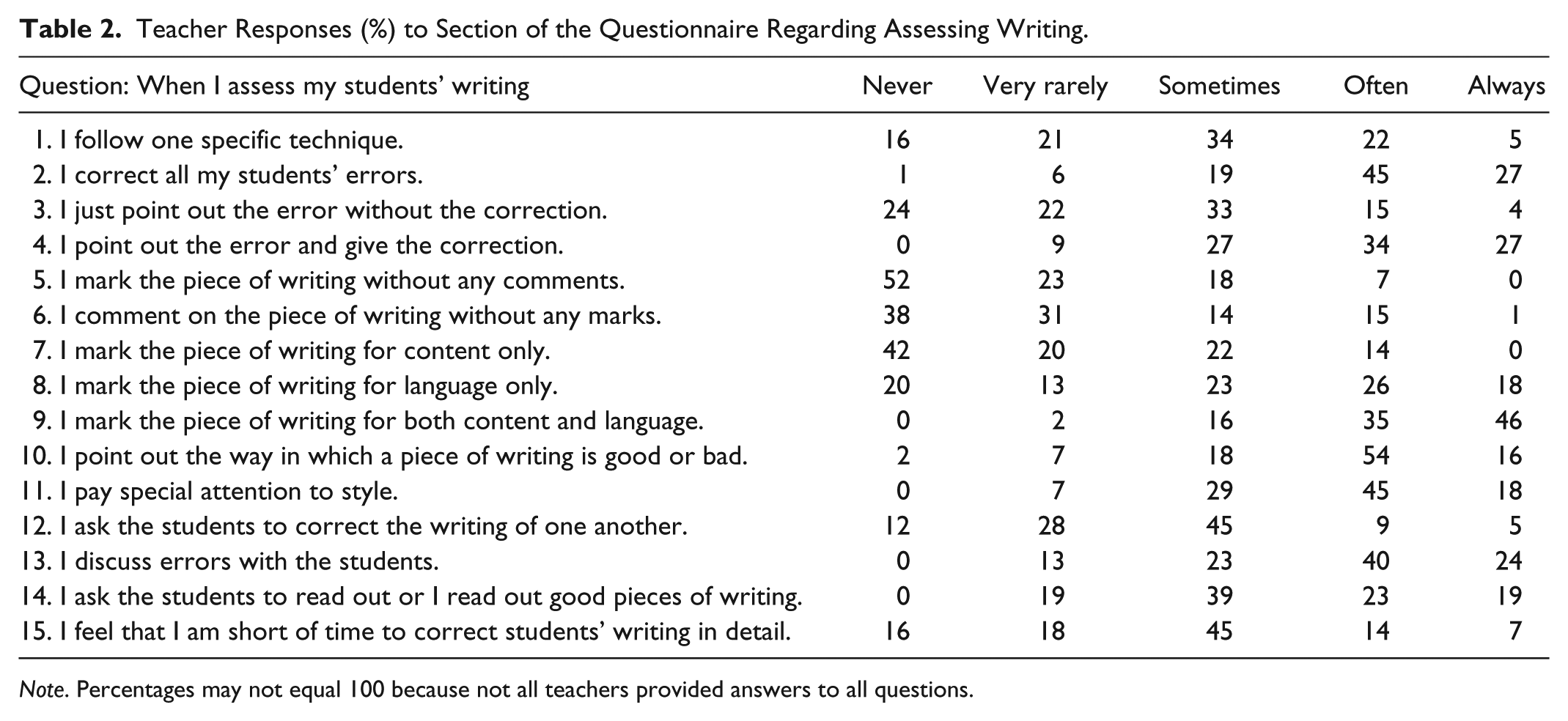
Teacher Responses (%) to Section of the Questionnaire Regarding Assessing Writing.
Note. Percentages may not equal 100 because not all teachers provided answers to all questions.
Teacher Responses (%) to Section of the Questionnaire Regarding Teaching Reading.

Note. Percentages may not equal 100 because not all teachers provided answers to all questions.
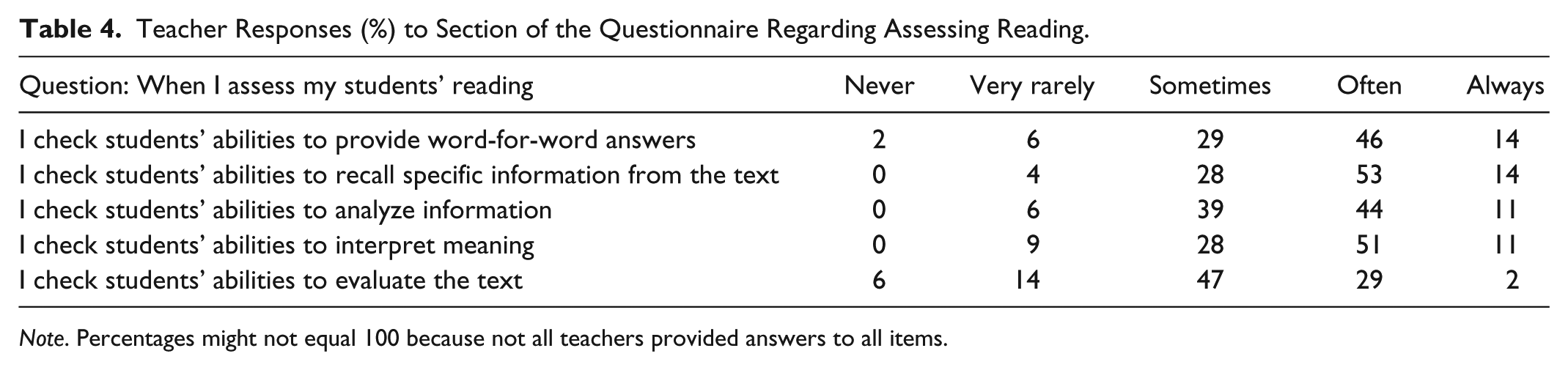
Teacher Responses (%) to Section of the Questionnaire Regarding Assessing Reading.
Note. Percentages might not equal 100 because not all teachers provided answers to all items.
Follow-up focus groups were conducted to explore in more depth the items indicated in the survey-questionnaire. Apart from the purposes of triangulation to develop greater confidence in the research data, the primary aim of the focus groups was to discuss in more detail the teaching situation at that time. The emerging patterns from the focus groups were, however, completely contradictory to the findings indicated by the survey data, which formed the rationale for this article that highlights the limitations of self-reporting surveys in exploring work contexts in the Arabian Gulf.
Although contradictory results may sometimes be noted during a typical triangulation process, it was felt that the conflict of results between those two sets of data was also rooted in the specific socio-cultural frameworks of the research participants. The survey was piloted with a number of potential participants who were asked to provide comments about the clarity of the purpose of the study, the ambiguity of the items, and redundancy of some questions (Bryman, 2008). No comments from teachers in the pilot study were returned that indicated any methodological issues with the survey. The survey items were additionally reviewed by the panel of experts, which added to internal validity of the research.
Lack of methodological issues with the survey had led to conclusions presented in this article. The research on the impact of the IWE on teacher behavior presented above suggested that contextual factors and teacher socio-cultural frameworks are important for understanding their attitudes toward work (e.g., Abu-Saad, 2003). Combined with the lack of methodological issues in the survey research in Bahrain, it is argued in this article that they are also important in understanding teacher attitudes toward research. The review of literature above suggested that the IWE is an equally legitimate framework for understanding individuals’ perspectives on research (Jonathan et al., 2009), which has conceptualized the aim of this article to argue that limitations of survey research in the Arabian Gulf may additionally be caused by the Islamic influences on research participants.
Below, the selected results that show the contradictions between the survey and the focus groups data are presented.
Survey Data
Tables 1 to 4 present the percentages of teacher responses to items related to teaching and assessing reading and writing skills in English.
Within writing strategies (Table 1), the findings imply that a large number of teachers place more emphasis on grammatical and mechanical aspects of language teaching, rather than areas related to text coherence. Trends that are important for the focus of this article can be noted in relation to the focus of writing, where great importance of the writing product, the writing process, and the development of ideas were shown.
Similarly, trends shown in Table 2 with regard to assessing writing indicate important conclusions in terms of the issues raised in this article. These are mainly related to results which show that teachers strongly emphasize marking for content, language, and style.
Table 3 demonstrates that teachers emphasize a variety of reading skills. The results show that the most common reading techniques practiced in Bahraini schools are based on general understanding of texts and they include inferring meaning and identifying main ideas. Table 3 also indicates that teachers often use more focused methods and require the students to read for specific information and guess the meaning of unknown words.
In terms of assessing reading (Table 4), the teachers indicated that most frequently, they ask the students to recall information from texts. They also focus on questions that require interpretation of meaning, evaluation of texts, and critical analysis.
All the survey data presented above are quite contradictory to what emerged during the qualitative focus groups. The findings below illustrate these contradictions.
Focus Groups Data
Contrary to the results presented above, during the focus groups, the teachers indicated that teaching English is based on memorizing model answers for the exam. The teacher comments reported here were coded using consecutive numbers—that is, number 1 was given to the teacher who spoke first, number 2 to the second teacher in each school. Letters A to J were randomly assigned to the 10 schools visited during data collection.
The quotes below illustrate the contradictions with the survey data. Although only selected comments are presented, it needs to be highlighted that these were repeatedly made by many teachers in all schools.
The first quote presents contradictions to the results in Table 1 where it was indicated that great importance is placed on the product and process of writing, as well as coherent development of ideas. Teacher 3B explains that it is difficult to apply these techniques in Bahraini classrooms because students are only interested in memorizing model answers for the exam.
They take the model writing from the teachers. They just need the model for the exam. Yes, we provide them with the model writing . . . They hate you when you try to help them and explain what should be done first and then next, they don’t like that, just direct monotonous way of teaching. That’s it. (Teacher 3B)
Teacher 1E additionally explained that it is also difficult to teach in the way indicated in the survey because it is not the accepted way of teaching in Bahrain.
They have model answers and they learn by heart. But, to be frank, it’s not only the teacher; it’s not the teacher’s choice to do that. In the past, [name] used to give us the topic that will be on the exam and we used to give them a piece of writing and they learnt it by heart. And the teacher who doesn’t do this will be blamed by the students and the parents [all agree]. (Teacher 1E)
This way of teaching is driven by students’ aspirations to achieve high marks in the final exam, which contradicts the methods of teaching and assessing writing and reading in English indicated in the survey: They only want to study because they will have the same question in the final. They don’t want extra information. (Teacher 1A) Very often they say “Give us the writing, and that’s it, we don’t want reading, grammar” and so on because they focus only on writing, they are learning only for tests. (Teacher 3J) My students always say that we only need the writing in your class because this is the thing that will be tested in the exam. “We don’t need to study anything else. Just give us the writing, we will study and we will pass.” (Teacher 6H)
Overall, the results from the survey indicated that various higher order language skills are taught in Bahraini schools and that students’ knowledge is assessed in a way that encourages critical thinking. However, the focus groups comments from the same teachers who completed the survey regarding foreign language pedagogy suggested that learning of English is entirely based on memorization and that assessment is based on reproduction of knowledge. This has had significant implications for the aim of this article, supporting the argument about the limitations of self-reporting surveys in the Arabian Gulf context.
So, What Implications Arose From These Conflicting Results?
As indicated at the beginning of this article, surveys are commonly used to examine “what is” and to describe the state of affairs at a specific time (Kelley et al., 2003). It is also generally known that self-reporting surveys are likely to generate evaluations of behavior that may be higher than the actual actions because respondents always try to create a positive image of themselves (Bryman, 2008). Although this has been widely acknowledged, the analysis in this article indicates that social influences developed through religious affiliations may additionally affect the ratings from self-evaluation questionnaires. The concept of the cultural context as a factor in making research decisions has not been fully embraced by methodological researchers, which is where the discussion of the conflicting results from research in Bahrain in this article, through the lens of IWE, has a potential to make significant contributions. This discussion indicates that the socio-cultural context in which the research is to be conducted might play an important role in research decision making. It is also suggested that certain cultures might be more influential than the others, and the use of IWE in this article to explain the conflict of results substantiates the differing roles of “culture effect” on research outcomes.
While seeking explanations to the conflicting results that were generated in Bahrain, the significance of the IWE as the theoretical framework was quite strong. Viewing the conflict in results through the IWE allowed for greater appreciation of the role of culture in research designs. The IWE is built on four pillars—effort, competition, transparency, and morally responsible conduct—which guide conducting business in Islamic societies (Ali & Al-Owaihan, 2008). Because effort in Islam is held in highest regard (Ali & Al-Owaihan, 2008, p.13), it provides a plausible explanation of why the contradictions between survey and focus groups data occurred. It suggests that the conflict in results could be related to the self-rating nature of the survey which was based on teachers’ self-appraisals of how they teach the English language. If Islam praises those who work hard to achieve the desired goals (Ali & Al-Owaihan, 2008), it is possible that the teachers overrated their classroom behavior. It is also possible that if the survey was based on the ratings from, for instance, their reporting bodies, the biases in the Bahraini research could have been avoided.
Jonathan et al. (2009) state that, generally, it is quite common that self-ratings of what teachers do in the classroom tend to be much higher compared with the actual pedagogical behavior. They also state that it is particularly common in teaching communities such as Bahrain because of the IWE where “the value of work in the IWE is derived from the accompanying intentions rather than from the result of work” (p. 268). This is why “Bahraini teachers seem to engage in more self-promoting to ensure what they indicated in the rating scales were reflective of what was expected” (Jonathan et al., 2009, p. 268). This does not necessarily mean that they do not teach according to the expected levels but that their self-evaluation is primarily based on the long-term objectives of their work.
It was already explained in the background section of this article that Bahraini teachers are under a lot of pressure connected with the new school improvement program (Directorate of Government School Reviews, 2014). It was also explained that, for English teachers, this improvement brought about a new teaching reform based on the CLT approach (Al-Baharna, 2005). The items of the survey discussed in this article therefore matched many of the CLT techniques because the intention of the study in Bahrain was to describe the status of this reform in local schools. It is therefore possible that the teachers who completed the survey recognized these items and overrated their behavior in the classroom, acting in their self-interest (Jonathan et al., 2009). It is also possible that the teachers did it because they thought that the survey was evaluating whether they were doing what they were supposed to do and, as explained earlier in the literature review, they perhaps thought that the research was going to give them some kind of distinction (IBE & NIER, 1995). However, during the follow-up focus group sessions, when the teachers were asked to elaborate more on the difficulties caused by the context in which they were teaching, they were able to reveal the truth because they perhaps thought that the research could result in, for example, reducing some of the teaching pressures.
Kabasakal and Bodur (2002) argue that at times of difficulty, Arab societies come together due to their socially ingrained group loyalty and collective group support. Thomas (2008) explains that this loyalty is also translated to focus groups where participants “stand together” to discuss a research problem, which is why focus groups participants are more likely to reveal the truth. Therefore, while the reflections in this article indicate that the societal values of Arabs in the Gulf affect survey designs in social research in a negative way, the same values seem to play a positive role in studies based on focus groups. Thomas (2008) argues that the use of focus groups in social research is suitable for researchers who engage in exploring Arab cultures because the social collectivity that characterizes Arab people is extremely pertinent to this form of interviewing. According to Thomas (2008), trust between in-group members in Arab cultures is seen as central to conducting group investigations, which, in turn, allows for cultural values and beliefs of the researched to have some breathing space. The broader experiences of conducting focus groups research in Bahrain, which are not reported along the results in this article due to its focus on the conflict between survey and its related focus group data, support this view in that they show real contributions to knowledge as a result of the collective perspective on social practice Hayes et al., 2015).
Finally, the fact that the school teachers were aware that this research was approved by the Ministry of Education might have led the teachers to believe that it was looking to evaluate how the programs in Bahrain were taught. This, on one hand, might be related to reflexivity, which is commonly acknowledged in social research, but, on the other, it might also stem from the strong influences of the IWE. Effort in the IWE is held in the highest regard (Ali & Al-Owaihan, 2008), which invariably involves constant evaluations of self. The report on the perceptions of research in Bahrain cited in the literature review (IBE & NIER, 1995) also explained that teachers are likely to take part in studies that will show their efforts and bring them rewards for their hard work. Therefore, it is possible that they viewed the research discussed in this article as an opportunity to earn some credit, which is why they might have rated their performance very highly.
Conclusion
Overrated participant behavior is quite common in survey research; however, the important conclusion that emerged here was that these ratings may vary depending on the cultural context of research participants. Jonathan et al.’s (2009) research cited earlier supports this by demonstrating differences in self-evaluations of professional behavior between Asian and Bahraini teachers, who were influenced by different orientations on their work. It is therefore possible that if the research discussed in this article was conducted in the Asian context, fewer contradictions would have been found between the survey and the focus groups data.
The important implications from the discussion of the research results from Bahrain in this article are that we ought to consider the deeper values of the culture we are researching in our decision making regarding research methods. It has been argued here, mainly through the analysis of the impact of the IWE on teacher behavior and attitudes toward work, that socio-cultural frameworks of research participants can create biases in survey research. The discussion in this article indicated this by examining how cultural beliefs can create an influence on the type of data that is normally produced through the use of standard surveys. Surveys are used in social science to describe “what is” (Bryman, 2008), which is why a descriptive survey was also designed to examine the situation of English language education in Bahrain. The strong societal beliefs of teachers, however, influenced by the IWE, seemed to have had a significant impact on generating specific data. The analysis also suggested that these influences were perhaps even stronger than the methodological assumptions underlying survey research. This has significant implications for building designs of research studies in Islamic context where religiously shaped views on self-evaluations, work, and performance may affect the adequacy of specific research methods.
Thus, the main recommendations from the analysis presented in this article are that researchers develop a deep understanding of the culture in which the research is to be conducted. The reflections presented here have indicated the need to do this, specifically for the survey research. The discussion in this article provided evidence which implies that societal beliefs should be considered equally with any philosophical, theoretical, and methodological assumptions in research design decision making.
Footnotes
Declaration of Conflicting Interests
The author(s) declared no potential conflicts of interest with respect to the research, authorship, and/or publication of this article.
Funding
The author(s) received no financial support for the research and/or authorship of this article.