




Abstract
Anxiety is part of daily life, and when it is not controlled, it negatively affects performance and success. One type of anxiety that students experience at school as a result of the pressures of educational life is writing anxiety. In the current study, the role of self-regulated learning skills in reducing writing anxiety was examined. The fifth-grade self-regulated writing program (S-rWP) was developed, tested, and revised to align with the text types specified in the native language (L1) course curriculum. A multi-stage random sampling method was used to determine the participants to whom the final program would be applied, and the mean pre-test writing anxiety scores of the two groups, an experimental group and a control group, were close to each other. An instructor trained in self-regulated learning strategies conducted the seven-session program to the experimental group for 6 weeks, while in the same period the same curriculum was conducted to the control group using the traditional teaching method, and finally post-test measurements were taken. Quantitative data from the mixed-method study showed that S-rWP was effective in reducing writing anxiety compared to the standard teaching method. Qualitative data were collected through semi-structured interviews with the participants, the L1 teacher and the instructor. The results show that S-rWP is effective in reducing writing anxiety, in line with the quantitative findings. The participants provided information to support the findings through their opinions, and the L1 teacher and instructor provided information to support the findings through their observations. The results appear to stem from the overlap between students’ writing planning, implementation, and evaluation processes and the three stages of self-regulated learning (forethought, performance, and self-reflection). However, despite these positive outcomes, several suggestions for future research are proposed, taking into account the study’s limitations.
Plain language summary
Since writing is the most difficult of the language skills due to the process involved, writing anxiety is reported to be common among students. Self-regulation is an internal learning system in which individuals can manage themselves by taking into account the feedback of their interaction with their environment. In other words, it means that individuals draw conclusions from the results they have obtained and reveal their subsequent behaviors by taking them into account. We hypothesized that as students begin to master self-regulated learning, their writing anxiety will decrease. Therefore, we tried to prove whether self-regulation is effective on writing anxiety. In this direction, we developed a seven-session program for 5th grade middle school students that enables them to write the texts in the curriculum based on the three stages of self-regulation: planning, implementation, and evaluation. The same curriculum was taught to the experimental group using the developed program and to the control group using the traditional teaching method. Our measurements show that writing practices based on the program we developed can be effective in reducing students’ writing anxiety compared to the traditional teaching method. The semi-structured interviews we conducted with the participants in the treatment group and their native language teachers also give us an idea about the effectiveness of the program. Based on these results, we can suggest that structured writing activities based on self-regulation can be used to reduce writing anxiety. On the other hand, we should add that gender differences should be taken into consideration to make some of the activities in the sessions more interesting.
Introduction
Anxiety is a pervasive issue that has plagued individuals throughout history. It is a state of fear-based anxiety precipitated by a specific situation (Şahin, 2019). Anxiety and worry may manifest in the present moment or in anticipation of an unlikely future event.
It is possible to observe certain physiological reactions in individuals who experience anxiety. As the organism becomes alarmed, a number of symptoms may be observed, including increased blood pressure, dry mouth, increased adrenaline, and muscle tension (Şahin, 2017). The effects of anxiety on individuals extend beyond the physiological realm. Concomitantly, emotional symptoms also manifest. Those experiencing anxiety may also present with a range of emotional symptoms, including feelings of fear, difficulty concentrating, nervousness, and restlessness. Such factors have the potential to negatively impact an individual’s academic success, performance, and effort. Studies carried out on various sample groups confirm this. There are studies that reveal that anxiety affects academic performance in all groups from primary to secondary school and even university students (Akgün et al., 2007; Karaman, 2020; Koçkar et al., 2002; Zheng et al., 2023). In fact, anxiety can reduce an individual’s potential performance. Of course, a certain level of anxiety and stress can keep both body and mind alive and increase the efficiency of physical and mental functions. Anxiety is often unavoidable, but uncontrolled levels of anxiety can impair performance.
Anxiety is a condition that may be experienced by individuals at specific points in time or on a continuous basis. The type of anxiety that arises contingent on the situation experienced and dissipates upon the cessation of the situation is referred to as “state anxiety.” When state anxiety becomes chronic or independent of the triggering situation and the frequency of emotional responses increases, trait anxiety emerges (Özgüven, 2023). Individuals who experience constant anxiety may experience a decrease in motivation, loss of self-confidence, and discouragement from difficulties, which negatively affects their success (Strack et al., 2017).
Anxiety can also exert a positive or negative influence on fundamental language abilities (Deniz & Demir, 2019). One category of anxiety that individuals may experience is what is commonly referred to as “writing anxiety.” Indeed, writing is arguably the most challenging of the language skills, due to the intricate process involved (Yaman, 2010). The anxiety associated with writing skills is considerable, as the activity necessitates the concurrent maintenance of arduous physical and mental processes. Such anxiety precludes individuals from deriving pleasure from their writing activities. Writing anxiety may manifest at any stage of the writing process, for a variety of reasons. Writing anxiety is based on three factors: the individual’s negative evaluation of writing, the fear of being evaluated negatively by others, and the experience of failure in writing (Aytan & Tunçel, 2015). The experience of writing anxiety can be attributed to a number of factors, including a lack of self-confidence prior to writing, inadequate preparation, an inability to review existing knowledge, an inability to determine the purpose and method of writing, an inability to transfer information from the mind to paper, and a concern about receiving negative feedback upon sharing the written work (Gömleksiz et al., 2010).
It is established that moderate levels of anxiety have a beneficial effect on individuals, increasing their motivation to write (Negari & Rezaabadi, 2012). However, high levels of anxiety have been shown to result in avoidance of writing activities, reluctance to write, and a detrimental impact on writing performance, potentially even preventing the development of writing as a habit. A review of the literature on the elimination of writing anxiety reveals studies that suggest increasing the frequency of students’ writing (Karakaya & Ülper, 2011), allowing them to focus on free writing activities (Tiryaki, 2011), and providing them with the necessary support to succeed. In the context of writing activities (Zorbaz, 2010), the provision of feedback (Kurt & Atay, 2007), and peer assessment (Hamzadayı & Çetinkaya, 2011), there are ongoing studies exploring these avenues.
Self-regulation
Self-regulation can be defined as an internal learning system that enables individuals to regulate their own behavior by taking into account feedback from their interactions with their environment (Bandura, 1986). In conclusion, the subsequent behavior is differentiated according to the evaluation of the results of the preceding behavior. It is precisely in the evaluation of the outcome that self-regulatory skills are manifested, thereby providing behavioral diversity (Carver & Scheier, 1999). Although this mechanism may initially appear to be a straightforward response-action-response, research on the skill indicates that self-regulation is in fact a highly complex process (Winne, 2018). The skill identified by social cognitive theory has been conceptualized by numerous researchers as a learning method. Kanfer (1970) proposed a model comprising three components: self-monitoring, self-evaluation, and self-reinforcement. Borkowski (1996) posited that self-regulation represents the highest level of metacognition, encompassing the determination and initiation of a strategy and the monitoring of one’s own performance throughout the process. In Boekaerts’ model (1996, 1997), which can be adapted to educational settings, self-regulation is conceptualized as comprising two distinct aspects: cognitive (planning, goal setting, monitoring, and evaluation) and motivational (beliefs and willingness). Winne (1996) underscores the significance of metacognition for self-regulation, developing his model around four core components: initially, defining the task; then, setting the goal; subsequently, planning; subsequently, implementing; and finally, evaluating the result under the guidance of metacognition. The model developed by Pintrich (2000) divides self-regulation into four phases: forethought, self-monitoring, control, implementation, and evaluation. Each phase in the model encompasses the emotional, behavioral, motivational, and contextual domains. Zimmerman (2013) developed a cyclical model in which the skill is structured into three phases: forethought, performance, and self-reflection. In this model, the learner plans in accordance with a goal or criterion (forethought), makes an effort to achieve it (performance), makes an inference from the outcome (self-reflection), and completes the cycle. The conclusion drawn in the self-reflection stage determines the next behavior.
Self-Regulated Learning and Writing Anxiety
Self-regulated learning (SRL) enables individuals to assume control over the learning process they engage in at school or in the classroom (Pintrich, 2000). Self-regulated learning enables individuals to set objectives for comprehension and learning, select an appropriate strategy to achieve the objective, implement the strategy, and then evaluate the process (Schunk, 1996). Furthermore, SRL provides guidance for individuals to maintain motivation in writing and preparing for academic examinations (Zimmerman et al., 1996).
Writing is one of the competencies that enables individuals to express their feelings, thoughts, and perspectives. As asserted by Grabe and Kaplan (1996), proficiency in writing represents a fundamental prerequisite for academic success. In the post-Covid-19 era, the concept of sustainable education has been confronted with a multitude of challenges. One such challenge is that of writing anxiety. It is established that there is a negative correlation between writing anxiety, which encompasses psychological and physiological states, and writing success and strategies (Waked et al., 2023). Along with somatic symptoms, cognitive symptoms such as anxiety, concentration, avoidance, and negative evaluation that reveal thought processes can also be seen in individuals with writing anxiety. In fact, there are studies that assess these symptoms as the dominant type of writing anxiety (Cheng, 2004; Quvanch & Si Na, 2022). While the self-evaluation and monitoring, goal setting and strategy planning, strategy implementation and monitoring, and strategic outcome monitoring components of SRL and the cognitive, affective, and kinesthetic stages of writing are mutually supportive, studies examining the impact of self-regulated writing on writing anxiety are scarce.
A substantial body of research has been conducted on the relationship between cognitive processes and anxiety. This includes studies by Allmnakrah and Evers (2020), Derakshan and Eysenck (2009), Waked et al. (2023), and Yeh (2015). The aforementioned studies demonstrate that anxiety levels tend to increase when individuals are confronted with challenging and complex tasks, which ultimately results in a decline in the quality and quantity of their written output. In general, studies examining the impact of writing anxiety on individuals have revealed that those with anxiety tend to make errors in their written products, particularly in terms of syntax (Türnük & Aydın, 2020), vocabulary and grammar (Sabti et al., 2019), subordinate clauses, and the number of sentences (Foster et al., 2000). Some studies concentrate on both the underlying causes and the consequences of writing anxiety. The aforementioned studies have identified a number of factors that contribute to the development of writing anxiety. These include difficulties related to language skills, lack of practice, low self-confidence, concern about academic failure, inadequate vocabulary, language problems, and lack of exposure to the language and practice.
In the existing literature, there is a focus on the cognitive aspect of writing skills, with a particular emphasis on self-regulation-based models for individuals with writing difficulties. These include studies by Bai and Guo (2018), Bai et al. (2022), Bi (2020), Graham et al. (1993), Hu and Gao (2018), Mason et al. (2011), and Schunk and Zimmerman (2007). Additionally, studies have focused on perceptions and opinions about self-regulation (Durmazpınar, 2022; Oğuz, 2023), as well as the development of scales specifically for metacognitive writing awareness (Aydın et al., 2017; Farahian, 2015; Kansızoğlu, 2020). Nevertheless, there is a paucity of research examining the relationship between emotional and motivational aspects of writing and writing performance (Camacho et al., 2021; Yan, 2019). A number of studies have revealed a significant relationship between metacognitive strategy perceptions and writing anxiety (Stewart et al., 2015). Furthermore, these studies have demonstrated that the general use of these strategies can alleviate writing anxiety (Zhu et al., 2015). In addition, a number of studies have focused on the effect other studies have examined the impact of self-regulation on writing attitudes (Erol & Kavruk, 2021), identified a correlation between low writing anxiety and enhanced performance in argumentative writing (Balta, 2018), and established a significant relationship between writing anxiety and metacognitive awareness (Balta, 2018). However, further research is needed to gain a more comprehensive, systematic, and targeted understanding of the role of metacognitive strategies in reducing students’ writing anxiety.
Clarifying Key Concepts: Self-Regulation and Self-Regulated Learning
Although the terms self-regulation and self-regulated learning (SRL) are sometimes used interchangeably in the literature, they refer to different but related constructs. Self-regulation is a broad psychological concept that involves individuals’ ability to manage their thoughts, emotions, and behaviors across various areas of life, including social, emotional and behavioral domains (Bandura, 1986; Carver & Scheier, 1999). It includes general processes such as setting goals, controlling impulses, monitoring performance, and adjusting behavior when needed.
In contrast, self-regulated learning (SRL) specifically relates to how learners manage their own learning processes, especially in academic settings. SRL includes planning, setting goals for learning tasks, using strategies effectively, monitoring progress, and evaluating one’s performance (Pintrich, 2000; Winne, 1996, 2018; Zimmerman, 2013).
The writing activities and strategies used in the present study were based on the principles of SRL. More specifically, the Self-Regulated Writing Program (S-rWP) was designed in line with Zimmerman’s (2013) cyclical model, which includes forethought, performance, and self-reflection. Therefore, in the remainder of the paper, the approach is designated as SRL-based, and the findings are discussed within the framework of the self-regulated learning literature.
The purpose of this study is to determine the effect of a self-regulated writing program (S-rWP) on writing anxiety. In this direction, the questions of the study can be listed as follows:
RQ1. What is the level of writing anxiety of students in the experimental and control groups before S-rWP?
RQ2. What is the level of writing anxiety of experimental and control group students after S-rWP?
RQ3. Is S-rWP an effective practice in reducing fifth grade students’ writing anxiety?
RQ4. Can student, instructor, and L1 teacher views of S-rWP explain the effects of the program on writing anxiety?
Hypotheses
The hypotheses established based on the purpose and questions of the research can be listed as follows:
H1. Students’ writing anxiety can be reduced with S-rWP.
H2. The qualitative data collected can explain how the intervention affects students’ writing anxiety.
Methodology
The study employed a mixed method approach to ascertain the efficacy of the implementation in detail and to elucidate the quantitative measurements through qualitative data (Creswell & Creswell, 2018). As is widely acknowledged, mixed research is the preferred methodology when a single quantitative or qualitative data source is insufficient to explain the research questions. This approach provides researchers with a more comprehensive understanding of the results (Baki & Gökçek, 2012). The quantitative component of the study employed a true experimental design to obtain pretest-posttest measurement scores. The qualitative component involved the collection of responses from the participants, the native language (L1) teacher, and the instructor through semi-structured interviews. Moreover, to enhance the precision of the findings and to elicit diverse perspectives (Işık & Semerci, 2019), the current study employed a triangulation approach, whereby data from at least two sources were integrated (Denzin, 2012). Accordingly, an effort was made to integrate the responses obtained from disparate sources, including the instructor, the L1 teacher, and the students.
Participants
The research group consisted of fifth grade students from two different secondary schools affiliated to the X National Directorate of Education, an experimental group (23 participants, 11 girls, 12 boys, mean age: 10.35 ± 0.49) and a control group (25 participants, 10 girls, 15 boys, mean age: 10.36 ± 0.49). Power analysis using G*Power 3.1.9.4 (effect size f = 0.25, α = .05, power = 0.80) calculated a minimum sample size of 40. On the other hand, considering the minimum sample size of 43 for regression omnibus F-test, 40 for regression coefficient t-test, 35 for ANCOVA, 27 for repeated measures (Cohen, 1988, 1992), the current study group is considered sufficient (N = 48). Multi-stage random cluster sampling was used to determine the participant groups. This sampling method helps researchers in terms of labor, time and cost when the population is large and each participant cannot be randomly assigned to groups, that is, random sampling cannot be used (Fraenkel et al., 2023). In fact, it is known that cluster randomization rather than individual randomization is applicable in educational research (Dreyhaupt et al., 2017). Multistage cluster sampling was used in the study (Onwuegbuzie & Collins, 2007). The city center was accepted as the study population and the sample size was determined by power analysis as explained above. The clusters in the study population were listed and the average number of units they contained, namely number fifth grades, was determined. The sample size was divided by the average number of units in each cluster to get the required number of three for the implementation. Finally, three schools were randomly selected, one for the pilot study and the others for inclusion in the experimental and control groups. Inclusion criteria included voluntary participation, signed parental consent and the absence of a diagnosis of mental retardation or specific learning disability. For the qualitative component, interviewees were purposively selected from those whose pre-test total writing anxiety score on the Writing Anxiety Scale for Secondary School Students (Tayşi & Taşkın, 2018) exceeded one standard deviation above the sample mean (i.e., ≥M + 1 SD), corresponding approximately to the top 16% of the distribution. This operational definition ensures transparent and replicable selection of participants with the highest levels of writing anxiety.
Data Collection Tools
Writing Anxiety Scale for Secondary School Students: It was developed by Tayşi and Taşkın (2018) with data collected from 500 participants in order to measure the writing anxiety of secondary school students. The instrument, whose responses are rated on a 5-point Likert scale from strongly agree to strongly disagree, has three dimensions related to motivation to write, to be understood in writing, and to meet the demands of the writing process. The increase in the scores obtained from the 16-item scale form, which has six questions in the motivation dimension and five questions each in the understood and meeting the requirements dimensions, indicates an increase in writing anxiety. In terms of validity, a structure that explains 21.921%, 9.727%, and 9.388% of the variances in motivation, understood and requirement dimensions, respectively, and 41.036% of the total variance was discovered. For reliability, Cronbach’s alpha internal consistency coefficients were reported as .788 for motivation, .701 for understood, .615 for requirement, and .790 for the overall scale. The internal consistency coefficients calculated with the data obtained from the pretest-posttest measures of the current study were .709 to .776 for motivation, .729 to .633 for understood, .706 to .707 for requirement, and .834 to .862 for the overall scale.
Semi-structured interview: The interview included questions for the participants, the instructor, and the L1 teacher. The content of the questions for the students was designed to ascertain their perceptions of the application, whether the application had any impact on their writing anxiety, and if so, in what manner. The instructor was also queried as to whether any change was observed in the students from the outset to the conclusion of the program, and, if so, in what direction. Additionally, the L1 teacher was asked whether any change was observed in the students’ writing anxiety or skills at the conclusion of the intervention and in the quality of the texts they wrote in comparison to the pre-intervention period.
Planning, Program Development, and Pilot Study
Prior to the implementation of the Self-Regulated Writing Program (S-RWP), the question of which grade level and text types to include in the application was subjected to deliberation. It was determined that writing activities assume greater significance at the fifth-grade level. Given the developmental stage, students at this grade level have attained the requisite maturity for independent writing skills (Kavcar et al., 2016). The curriculum of the L1 course at the corresponding grade level was examined, and the writing-based learning outcomes were identified and enumerated. The six text types included in the curriculum (petition, fairy tale, fable, story, memoir, and news) were incorporated into the program. It can be stated that each of the self-regulation models presented under the heading of self-regulation offers distinctive contributions to the field of learning. However, the Self-Regulated Learning Model (Z’SLM) proposed by Zimmerman was selected as the theoretical foundation for the developed program due to its cyclical representation of the skill, which is divided into three principal phases, thereby enhancing its comprehensibility. Accordingly, the stages of forethought, performance, and self-reflection, along with their constituent components, were employed as the foundation for the composition of the text types.
The initial session of the S-rWP was structured to introduce the concept of self-regulation, illustrate its practical applications in daily life, and delineate its cyclical structure, comprising the planning, implementation, and evaluation phases. Each subsequent session was designed to facilitate the development of a specific text type within the aforementioned planning, implementation, and evaluation cycle. The developed program was presented to two Ph.D. researchers working on self-regulation and metacognition to ascertain their views on its suitability for Z’SLM; to two teachers of L1 in secondary school to determine its applicability to students; and to a Ph.D. researcher in L1 to evaluate its comprehensibility. Following the receipt of feedback, minor revisions were made.
To guarantee the S-rWP’s validity and reliability, the researchers determined that the program should be administered by a graduate proficient in the L1. A L1 teacher who volunteered to administer the program was trained for a total of 4 hr, with 2 hr dedicated to self-regulation and self-regulated learning and 2 hr to the developed program. A pilot study is a preliminary research project conducted prior to the main study to ascertain the optimal methodology for the final research (Ismail et al., 2018). In 2017, it was reported that a pilot study is an invaluable tool for feasibility analysis prior to conducting the main study, ensuring the highest quality results. Consequently, it was deemed essential to conduct a pilot study before the actual implementation. To this end, the program comprising seven sessions was implemented over a 6-week period in the fifth grade of a secondary school, with the requisite permissions obtained. The initial session of the program was designed to enhance students’ awareness of the skill in question, while the subsequent session sought to equip them with the ability to utilize the newly acquired skill in their writing. Two researchers accompanied the instructor and recorded whether both sessions were implemented as designed, the duration of each activity, the sufficiency of one class period, and the instructor’s session management (transferring the skill to the participants, responding to questions, etc.) without intervening in the implementation. Subsequently, a meeting was convened with the instructor, during which the identified issues were documented and corrective measures were implemented. One activity from the initial session was eliminated due to time constraints, while others underwent revisions. The subsequent five sessions were conducted in accordance with these adjustments. Following this, another meeting was held with the instructor, who reported that the piloting process had been completed without any issues. This marked the commencement of the implementation phase.
Implementation of the S-rWP
After the pilot study, fifth graders from two different secondary schools were randomly selected for the experimental procedure as described in the method. In the experimental group, the participants’ writing anxiety was measured before starting the application. To ensure reliability, the participants were asked to complete the scale form under a pseudonym. On the same day, the control group, selected from the same class of another secondary school with a low probability of interaction with the students in the treatment class, was also asked to complete the scale form under a pseudonym. The program took place on the same day each week and lasted for a total of 6 weeks. As in the pilot study, the implementation was carried out by the instructor following the developed program.
In the preparation and implementation of the self-regulated writing activities, the basic principles of instructional design, which Gagne (Gagne et al., 1992) associates with mental conditions in the learning process, and Z’SLM were taken into account together. The nine steps in the principles of instructional design (gain attention, state objectives, stimulate recall of prior learning, present content, provide learning guidance, elicit performance, provide feedback, assess performance, enhance retention and transfer) and the stages in the cyclical structure of S-rWP (forethought, performance and self-reflection) were followed.
Accordingly, at the beginning of the sessions in the experimental group, the instructor drew the students’ attention and checked their level of readiness before proceeding with the presentation of the content. After the due diligence, the phase of creating a need specific to the type of text used to develop writing skills, associating it with life and planning writing was started. Again, in parallel with the basic principles of instructional design, the instructor guided the students during the learning process, helped them to reveal their performance and evaluated the students’ performance through the feedback he gave. High performers were asked to produce a new product by choosing a different topic and writing the same type of text. The cyclical structure of the S-rWP was repeated for students whose performance was insufficient. Then each session started after checking the homework from the previous session.
In the writing activities carried out in the control group, the instructor followed the basic principles of instructional design that Gagne (Gagne et al., 1992) associates with mental conditions in the learning process, and unlike the experimental group, instead of the S-rWP, the instructor followed the strategies specified in the official program (MONE, 2019), such as “using methods and techniques such as guided, text completion, reconstructing a text with one’s own words, filling in the blanks, and writing in groups.”
In summary, S-rWP was developed on the basis of Z’SLM and designed in a cyclical structure that includes forethought, performance, and self-reflection phases. The program covers self-regulation awareness in the first session and skill-based writing of text types in the fifth grade curriculum, including petition, fairy tale, fable, story, memoir, and news in the following six sessions. In the sessions, for each text type, the goal is first set based on criteria, then the writing performance is implemented using self-control and self-observation strategies, and finally the self-regulation cycle is completed through self-judgment and feedback. Following Gagne’s instructional design principles, the program follows the steps of attracting attention, checking readiness, guiding, providing feedback, and evaluating, using instructional techniques and materials specific to the type of writing in each session. Thus, the program aims to provide students with a cyclical experience of the above stages for each text type and to integrate self-regulation strategies with writing skills.
Permission for the program was obtained from official institutions and L1 teachers, but the L1 teacher of the experimental group was not informed about the content of the implementation, as the aim was to collect qualitative data afterward.
Fidelity of Implementation
Fidelity of implementation is the degree to which an intervention program is delivered as intended by its developers (Dusenbury et al., 2003). The fidelity with which an intervention is implemented determines its success (Mihalic, 2004). In the present study, implementation was based on the five operational components of fidelity identified by Dane and Schneider (1998): differentiation, adherence, exposure, quality and responsiveness. Differentiation was assessed by having the trainer complete a checklist highlighting the critical components of self-regulation such as forethought, performance and self-reflection in the experimental group’s practice. Adherence was assessed by weekly interviews with the instructor to determine whether the instruction based on the standard instruction in the control condition and the developed program in the experimental condition was implemented as prescribed. For the exposure, both groups participated in the exercises based on their prescribed teaching method for 40 min each week as planned. The quality component has two dimensions: firstly, the willingness and preparation of the practitioner, and secondly, how well the instructor delivers the program. It was observed that the first dimension, the trainer, maintained his enthusiasm throughout the study and had a positive attitude toward the program. As no audio-visual recordings could be made during the implementation due to legal regulations, it was foreseen that it would not be possible to assess the level of the second dimension. To overcome this limitation, in the pilot study the trainer was observed by the researchers and feedback was given to the instructor. Responsiveness was assessed on the basis of interviews with the teacher and it was found that the students in the experimental group were more receptive than those in the control group, especially from the third week onward.
Data Analysis
The current study has two sources of data: quantitative and qualitative. The quantitative data collected from the experimental and control groups before and after the application were subjected to normality analysis. Mean scores were calculated to determine the level of anxiety. The pretest-posttest mean scores of both groups were compared within and between groups. The boxplot method was used for outlier scores, and missing data analysis was performed for blank responses. For normality analysis, two measurements from both groups were excluded due to outlier values. In addition, general linear model (GLM) repeated measures analysis was used to compare the pretest and posttest scores of the groups to assess the interaction of time and condition. Finally, ANCOVA was used to compare posttest scores while controlling for the covariate of pretest scores. The following procedure was used to analyze the qualitative data:
Reliability procedure: Semi-structured interview forms were prepared for the qualitative findings to be collected, based on the sub-problems to which the research seeks answers. Three field experts, two of whom were L1 language educators and one of whom was a psychology expert, gave their opinion on each question as “appropriate, inappropriate, and needs editing.” The feedback given for each question deemed inappropriate or requiring revision was justified. The opinions received were calculated in line with the reliability coefficient formula of Miles et al. (2014). The reliability coefficient of the teacher’s form was calculated as .81, the reliability coefficient of the instructor’s form was calculated as .79, and the reliability coefficient of the student’s form was calculated as .86. Interview transcripts were coded using a constant comparative approach. Initial open codes were grouped into categories through iterative discussion and consensus among the three-member research team.
Trustworthiness of Qualitative Data
To enhance the trustworthiness of the qualitative findings, the study additionally addressed three key quality criteria beyond expert validation and inter-rater agreement:
Credibility
Data triangulation was achieved by integrating perspectives from three sources: student interviews, instructor observations, and L1 teacher feedback.
Peer debriefing sessions were held weekly among the research team to review emerging codes and themes, ensuring that interpretations accurately reflected participants’ meanings.
Dependability
An audit trail was maintained throughout data collection and analysis, including timestamped interview transcripts, coding memos, and decision logs.
A detailed codebook was developed and iteratively refined; all changes were documented and dated to allow an external auditor to trace how themes evolved.
Confirmability
Reflexive journaling was conducted by each researcher after every coding meeting to identify and bracket personal biases.
An external qualitative expert reviewed a random 20% subset of coded transcripts to confirm that findings were grounded in participants’ voices rather than researcher preconceptions.
Coding procedure: After coding the collected data and classifying them according to these codes, the thematization phase was started. The codes obtained after the content analysis were categorized and thematized separately according to similar qualities. When the codes obtained from teachers, trainers and students were categorized in terms of their common characteristics, two themes were formed as “the contribution of S-rWP to the types of writing anxiety” and “the inclusion/exclusion of S-rWP in the teaching process.” In creating these categories, the research objectives, sub problems, and relationship to quantitative findings were considered.
Data reduction procedure: Codes that were not related to the effect of S-rWP on writing anxiety and could not be associated with quantitative findings were used as a data reduction procedure. Results from the student, teacher, and instructor interviews were excluded. Data reduction refers to the process of selecting, focusing, simplifying, abstracting, and transforming data that appear in written field notes or transcriptions, and data reduction occurs continuously until the completion of any qualitative research (Miles et al., 2014). In this way, it was ensured that the unnecessary was eliminated from the large number of findings obtained and the data to be related to quantitative data were clarified.
Results
Quantitative Results
The normality analysis, conducted to ascertain the distribution of the pretest and posttest scores of the groups, indicates that the skewness of the mean scores ranges between −0.278 and 0.809, while the kurtosis falls between −1.286 and 0.697. Accordingly, it was determined that parametric analyses would be employed, given that the distribution exhibited normality (Byrne, 2010). To ascertain the impact of the experimental procedure, the pretest and posttest means of the groups were compared, and the findings are presented in Table 1.
Findings Related to Distribution, Comparison of Pretest and Posttest Means.

Looking at the pretest means of the groups, it can be seen that the motivation to write anxiety of the experiment group is significantly higher than that of the control group, while the other means are not significantly different. On the contrary, the post-test mean scores were significantly lower than those of the control group. Table 1 presents the results for RQ1 and RQ2, indicating that anxiety levels were moderate before implementation and decreased for the experimental group following the intervention.
Table 2 shows that the anxiety scores of the experimental group participants decreased significantly after the implementation. It can be seen that there was no significant difference between the mean pretest and posttest scores of the control group students, who were subjected to the same curriculum as the experiment group and whose measurements were taken on the same day, and even the motivation, requirement and total anxiety scores increased over the 6-week period, although not significantly.
Comparison of Pretest-Posttest Means of the Groups.

Note. r: correlation.
p < .05, **p < .01, ***p < .001.
Since the main purpose of the study was to examine the effect of the intervention by comparing the pretest and posttest scores of the experimental and control groups, general linear model (GLM) repeated measures analysis was preferred. The GLM is ideal for determining how differences between groups change over time by allowing the interaction between time (pretest-posttest) and conditions (experiment-control) to be examined. Repeated measures analysis allows precise assessment of changes over time when the same participants are measured at multiple time points. In this way, the effect of the intervention on the experiment group on writing anxiety can be clearly demonstrated (Gravetter et al., 2021). Repeated measures GLM tests the assumption of sphericity to see if the variances between measures are comparable (Field, 2024). This technique is commonly used, particularly in educational and psychological research, to assess the performance of a study group before and after a training or intervention program (Tabachnick & Fidell, 2019). The use of effect size measures, such as partial eta squared (η2), provides an opportunity to assess the effect of the intervention (Warne, 2018).
Table 3 shows the results of the GLM repeated measures analysis of the motivation, understood, requirement dimensions and total scores of writing anxiety. This analysis examined both the main effect of time and the interaction between time and condition.
GLM Repeated Measures Results.

It was found that the main effect of time created a significant difference between the measures of motivation (F(1,46) = 5.01, p = .030), understood (F(1,46) = 19.81, p = .000), requirement (F(1,46) = 5.92, p = .019), and total anxiety (F(1,46) = 23.58, p = .000). This shows that the time factor makes a significant difference in writing anxiety. The partial η2 value shows that time explains 9.8% of the effect on motivation, 30.1% of the effect on understood, 11.4% of the effect on requirement, and 33.9% of the effect on total anxiety when the total variance is taken into consideration.
When the time × condition interaction was analyzed, the results were (F(1,46) = 24.51, p = .000) for motivation, (F(1,46) = 10.81, p = .002) for understood, (F(1,46) = 12.60, p = .000) for requirement, and for total anxiety (F(1,46) = 37.08, p = .000). This indicates that the difference between pretest and posttest was different in the experiment and control groups. Considering the total variance, the partial η2 explains 34.8% of the effect of the time × condition interaction on motivation, 19% of the effect on understood, 21.5% of the effect on requirement, and 44.6% of the effect on total anxiety. The results for RQ3 can be interpreted as supporting H1, as they indicate that S-rWP is an effective intervention program for reducing anxiety.
Although the posttest mean scores decreased in favor of the experimental group, analysis of covariance (ANCOVA) was used in experimental studies to determine the effect of the intervention on the dependent variable. This is because there may be confounding factors that are not part of the research design but whose effect on the outcome should be taken into account. These factors are called covariates (Hair et al., 2019). This analysis reduces the unexplained residual variance in the dependent variable and determines the true effect of the independent variable on the dependent variable by controlling for the covariate (Tabachnick & Fidell, 2019). In the present study, ANCOVA, a parametric analysis, was used to determine the effect of the intervention on posttest scores by controlling for the pretest covariate of writing anxiety measured prior to S-rWP. Pallant (2020) states that there are five assumptions that must be met in order to run an ANCOVA. When examining the four assumptions relevant to the current study, the first is that the covariate was measured prior to manipulation, the second is that the measurement instrument used by the researcher is valid, reliable, and appropriate for the participants, the third is that there is a linear relationship between the covariate and the dependent variable for each group, and the fourth is that the regression slopes of the covariate and the dependent variable are homogeneous. In this study, pretest measurements were conducted for both groups and it was found that the internal consistency of the measurement tool, which was validated in the development study (Tayşi & Taşkın, 2018), was above .70 across its subdimensions. The scatter plot for the linearity of the dependent variables with the covariate of groups is presented in Figure 1 and the ANCOVA results are presented in Table 4.

Linearity of covariate-dependent variable of experimental and control groups.
ANCOVA Results.

The homogeneity of regression slopes test results for motivation, understood, requirement, and total anxiety indicate that these assumptions were met (F(1,44) = 0.57, p = .453; F(1,44) = 0.76, p = .387; F(1,44) = 0.30, p = .584; F(1,44) = 0.20.38, p = .130). According to the ANCOVA results in Table 4, when the pretest scores were controlled, the intervention had significant effects on the posttest means of motivation (F(1,45) = 20.37, p = .000, η2 = 0.312), understood (F(1,45) = 19.39, p = .001, η2 = 0.215), requirement (F(1,45) = 14.76, p = .002, η2 = 0.191), and total anxiety (F(1,45) = 45.70, p = .000, η2 = 0.504). Bonferroni correction revealed that the difference in means for motivation (experiment = 8.40, control = 12.39), understood (experiment = 8.69, control = 11.60), requirement (experiment = 8.41, control = 11.51), and total anxiety (experiment = 25.11, control = 35.86) decreased in favor of the treatment condition.
Qualitative Results
Based on the qualitative findings obtained from the interviews with the instructor, L1 teacher and students to answer RQ4, it can be said that the effects of S-rWP on writing anxiety can be explained. The findings and results obtained in this direction are discussed starting from Table 5.
Students’ Views on Writing Anxiety Before Implementation.

Table 5 illustrates the students’ responses regarding their writing anxiety and the underlying reasons for this anxiety prior to the implementation of the process. As illustrated in the table, 13 students reported no prior experience with writing anxiety prior to the process. Conversely, 10 students indicated that they experienced writing anxiety for specific reasons. In general, the majority of students did not report experiencing anxiety before, during, or after the act of writing. In examining the underlying causes of anxiety among those who do experience it, peer pressure emerges as the most prevalent factor. Students report feelings of anxiety when their peers engage in behaviors such as laughing and making fun of their writing. In addition to external pressure, students experience anxiety, including fear of making mistakes. Following the implementation of the S-rWP, however, students began to exhibit increased confidence in their writing abilities and in themselves.
In line with the students’ views, the teacher stated that after the S-rWP, the students’ reluctance to share what they had written decreased and their participation increased.
On the other hand, in addition to the students who said they had writing anxiety, some students who did not have anxiety reported that they had some anxiety in this regard, although to a lesser extent, and that the S-rWP reduced or eliminated this situation. Some of the students’ ideas are presented below: “I got rid of the fear that my writing would be laughed at.” (P-4, P-6) “I used to have a fear of writing, but I overcame it.” (P-1) “I used to worry that my friends would laugh at what I wrote and I was embarrassed to read what I wrote, but now I have no such fear.” (P-22) “I started to like writing activities more, but I still find it difficult to share my feelings.” (P-15)
Table 6 shows the results of the students’ experiences with the dimensions of writing anxiety. Ten of the students stated that self-regulation had a positive effect on coping with the anxiety of being motivated to write, and six of them stated that it had a positive effect on the anxiety of understanding the writing. As for coping with anxiety about meeting the demands of the writing process, eight students indicated that self-regulation had a positive effect. The concerns they expressed about these processes are as follows: making spelling mistakes, not meeting the deadline, not being able to follow genre-specific rules, not being able to reach the necessary level of motivation for writing. They reported that S-rWP practices helped them to overcome or reduce these concerns to manageable levels.
Students’ Views on the Contribution of Self-Regulation to Types of Writing Anxiety.

To ascertain whether S-rWP should be incorporated into the pedagogical process, the students’ opinions on this matter were also investigated. Nineteen of the respondents indicated that such activities should be incorporated into the textbooks. The primary rationale for this perspective is that the respondents perceive S-rWP activities to be more enjoyable and efficacious. The primary rationale for this perspective is that S-rWP prompts students to approach tasks in a systematic manner, thereby facilitating the development of competencies in addressing the cognitive and affective challenges inherent to the writing process. The cognitive outcomes include the mastery of the literary genres expressed by the students, a reduction in the number of errors, the ability to recognize errors at the time of writing, and the capacity to describe text sections (introduction, development, conclusion) in a more systematic and detailed manner. The affective outcomes encompass self-confidence in writing, enjoyment of writing, and the expression of feelings and thoughts. At the outset of the intervention, the students exhibited reticence in sharing their feelings and thoughts with their peers. However, by the conclusion of the intervention, they displayed a keen enthusiasm for sharing their written work. This transition from initial apprehension to subsequent enjoyment, particularly in the affective domain of writing, substantiates the efficacy of self-regulation-based activities. A selection of the responses is presented below: “Such activities should be in the textbooks, I think it would be more beneficial if they were in the textbooks, it increases my desire to write” (P-11) “By writing more, I would master the types of writing. I paid more attention to self-editing and tried to make fewer mistakes. Now I can edit the introduction, development, and conclusion parts of the text I write with less difficulty.” (P-19) “I now enjoy writing about my feelings and thoughts. These activities have strengthened my belief that I can write and even write well.” (P-6)
Eight of the students pointed out that their self-regulated learning skills improved thanks to S-rWP, and thus they gained the competence to solve the problems they encountered in the writing process by applying the principles of self-regulation. Another opinion was that S-rWP developed the issues to consider when writing prose genres and the differences in form and style between them. Three of them stated that the S-rWP activities were remarkable. One of them stated that the S-rWP activities had a positive effect on their use of imagination and gave them a sense of accomplishment. Two of them stated that they did not observe any difference between standard activity practices and S-rWP activities. According to some of them, gender emerged as a factor influencing the acceptance of the content of the S-rWP comprehension practices. Because female students stated that they would find it more interesting to do an activity such as designing a doll instead of an airplane activity.
For similar reasons, the L1 teacher also favored including these activities in the textbooks. Especially at the seventh to eighth grade level, where genres such as articles, interviews, and essays are often confused, the teacher states that with such practices, students will be more successful in genre-specific writing and will be better able to distinguish between similar genres (fables, fairy tales). The teacher also stated that positive changes were noticed in the students’ responsibility and care in doing their homework. According to the teacher, there was a significant increase in narrative skills after the activities. In fact, this increase in achievement occurred earlier than expected compared to other similar classes. The teacher also noted that a lesson plan that was out of the normal flow during the implementation process was generally accepted by the students. In addition, the teacher noticed that the students made progress in dealing with writing problems thanks to S-rWP. This improvement also contributed to the affective readiness of writing and students started the writing process more motivated than before S-rWP.
The instructor observed that the number of questions asked about the writing activities at the beginning of the program steadily decreased toward the end of the process. According to instructor, this situation is directly related to the fact that the students have gained the competence to solve the problems they encounter in writing on their own, based on self-regulation. However, the instructor also stated that the 40-min duration of a class session limited his ability to give feedback and that the risk of this situation negatively affecting the whole practice should also be considered. The following codes obtained from the students support the observations of the teacher and the instructor: Gaining self-regulated learning skills: “For example, if there is a mistake after writing something, teacher X corrects it, so we do self-editing. I used to dislike being corrected, but now I can correct my own mistakes.” (P-7, P-11, P-12, P-19). Attention-grabbing: “Acting in an order of occurrence in the activity I was doing caught my attention.” (P-12) Developing self-regulated learning skills: “It became easier for me to see my mistakes after the assessment.” (P-8) Sense of accomplishment: “I am proud of my writing with self-editing.” (P-11)
Regarding the adaptation of S-rWP activities to speaking, listening, and reading skills, 19 of the students whose opinions were sought argued that the program could be useful in these skills. Some of their comments are listed below: “When I spoke, I conveyed my feelings and thoughts in a complicated way. I believe that with self-regulation, I will be able to convey my feelings and thoughts in a more effective and planned way.” (P-15) “The S-rWP event motivates me. I like to share my thoughts in the speech as I like to share what I write.” (P-6) “Such activities are useful for speaking Istanbul Turkish. Especially our teacher’s feedback on word pronunciation is useful for speaking Istanbul Turkish.” (P-19)
In the 2023–2024 academic year in Turkey, speaking and listening exams were added to the assessment and evaluation in L1 courses. Therefore, students were also asked to evaluate the role of S-rWP in these exams, which they experienced for the first time. 20% of them thought that thanks to the activities they would be more ready and adaptable to the new assessment and evaluation system. Most importantly, they believe that they will be able to communicate their thoughts and feelings more systematically before or during speaking than in the standard activities, and that they will be more successful in articulation, which is one of the basic elements of speaking. They also believe that they will be able to take notes and listen more purposefully while listening, so that the listening process will be more systematic with the help of S-rWP. The reason for preferring the reading application is related to the fact that they will be able to identify their mistakes, receive feedback and review their performance in this direction, which will have a positive impact on their success: “I did not pay attention to my mistakes when I read before, with self-editing I can read more successfully according to punctuation marks.” (P-19)
Writing performance is affected by an individual’s proficiency in other language skills. There are many studies that prove this empirically (Allen et al., 2014; Berninger & Abbott, 2010; Wang et al., 2024). As suggested by some students, the L1 teacher thinks that it is more appropriate to include S-rWP in the new assessment and evaluation system in the form of reading, writing, listening and speaking activities, and that success can be increased by including such activities in the textbooks. He also had the following opinion about the inclusion of reading activities based on the program in the textbooks “There are activities to evaluate the book in the reading activities. Students find a critical environment where they can express their likes/dislikes, inconsistencies or contradictions in a chat environment. Students also enjoy this atmosphere. For example, one student took notes about the book he was reading, and when he presented them to me, he was both pleased and motivated.”
Figure 2 shows the codes of the opinions on the inclusion of activities based on S-rWP in Turkish textbooks, derived via constant comparative coding and supported by illustrative quotations. In this regard, all the students interviewed were in favor of including activities based on S-rWP in the textbooks. The emerging themes are that S-rWP will contribute to reducing errors, improving planning skills, gaining self-confidence, self-correction skills by recognizing writing errors, and it will be easier to understand listening and reading skills in addition to writing. In addition, another theme is that S-rWP can make activities more fun.

Themes and codes for the use of S-rWP in knowledge-based skills activities in textbooks.
Error Reduction: “I was conveying my feelings and thoughts in a complicated way while speaking. I believe that with self-regulation, I will convey my feelings and thoughts in a more effective and planned way” (P-15 and P-2) “I didn’t pay attention to my mistakes when I read before, I can read more successfully with self-editing according to punctuation marks.” (P-19) Planning Competence: “I was conveying my feelings and thoughts in a complicated way while speaking. I believe that with self-regulation, I will convey my feelings and thoughts in a more effective and planned way.” (P-15) “I was expressing my feelings and thoughts in a complex way while speaking. I believe that with self-regulation I will be able to express my feelings and thoughts in a more effective and planned manner.” (P-8) Affective Engagement: “It should be because speaking based on self-regulation motivates me more. I believe that I will improve more according to the activities in the book, as in writing.” (P-11) “It should be because speaking in a self-regulated manner makes me more motivated.” (P-2) “My performance and motivation would increase, as would my writing and speaking activities.” (P-6)
Figure 3 shows the themes and codes related to S-rWP’s contributions to writing anxiety. Accordingly, the themes that emerged in the domain of “positive effect on anxiety related to writing motivation” were “overcoming the fear” and “increasing motivation.” There is only one theme related to the domain of “effect on anxiety related to writing comprehension” (overcoming fear of making spelling mistakes). Regarding the “effect on the anxiety of meeting the requirements of the writing process,” the theme “overcoming the fear of failure in the act of writing (time, plan)” was formed on the basis of students’ opinions.
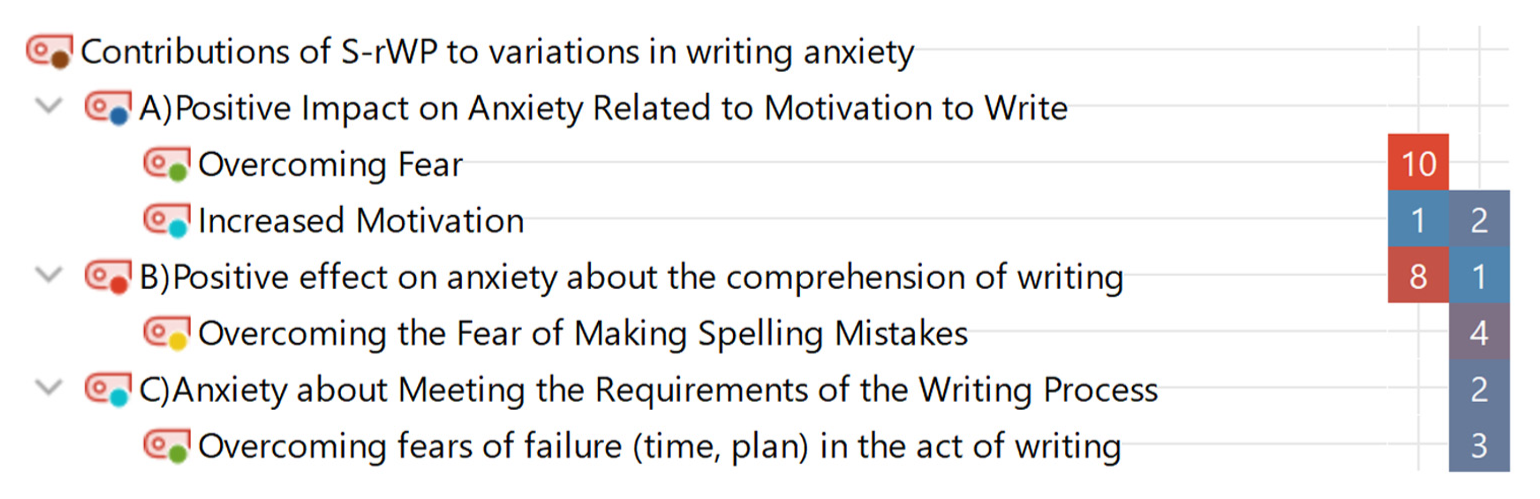
Themes and codes regarding the contribution of S-rWP to writing anxiety.
Based on the qualitative data presented, it is possible to say that students’ writing anxiety was reduced through S-rWP practices, thus confirming hypothesis H2 of the study.
Discussion
The present study examined the impact of writing narrative text types based on S-rWP, developed under the guidance of Z’SLM, on the writing anxiety of fifth-grade students. The quantitative results demonstrate that S-rWP effectively reduced the writing anxiety of the participating students, whereas there was no discernible change in the writing anxiety of those who received instruction through the standard teaching method. The examined anxiety has three dimensions: being motivated to write, being understood and meeting the requirements of writing. The sessions of the developed program consist of the following steps: first, the students are asked to identify the purpose of writing a given text type (e.g., why do we write a petition, why do our elders tell us fairy tales?). Then, they determine the criteria required by the text type and write the text type while being aware of them. Finally, the students evaluate the written text within the framework of the determined criteria and, if there are deficiencies, rewrite the text to eliminate them with the feedback of the instructor. Although the program is divided into three phases—planning, implementation, and evaluation—it is, in fact, more complex than that. Prior to the planning phase, it was essential to ascertain that the participants would be driven by a sense of necessity. Given the established link between motivation to write and writing anxiety (Camacho et al., 2021), One of the components of motivation toward writing is the interest and value of the task (Troia et al., 2012). Encouraging participation in authentic writing tasks is therefore key to improving motivation (Bruning & Horn, 2000). Increased motivation may explain why efforts to create text type requirements at the beginning of each session were effective in reducing writing anxiety motivation.
The remaining concerns pertain to meeting the requirements and being understood. These two variables are closely related, and when the requirements of the text are met, anxiety about comprehension is reduced. Lin and Ho (2009) reported that when educators establish complex and inflexible text formats, students may experience concern regarding their ability to fulfill the specified requirements. Teksan (2012) reported that the majority of middle school students (81%) expressed concern that their writing would not be understood. Additionally, in the same study, approximately three-quarters (73%) of the participants indicated that they experienced difficulty organizing their writing. In the study, students were initially provided with an explanation of the distinguishing characteristics of each text type, thus ensuring that they possessed at least a basic understanding of the subject matter. This approach was adopted in light of the findings of Cheng (2004), which indicated that students tend to experience apprehension when tasked with writing about topics with which they are unfamiliar. The understanding that the text they were tasked with composing should possess its own distinctive attributes may have contributed to a more structured approach in their cognitive process. Indeed, as Magno (2008) posits, the lack of organization can be attributed to inadequate planning during the prewriting phase. The active engagement in metacognition by students who undertake effective planning and proceed to the writing stage by considering the relevant criteria (M. F. Teng, 2021; Tran & Ma, 2025) has been demonstrated to be an effective strategy for reducing anxiety about the requirements. In conclusion, Colognesi et al. (2020) demonstrated that metacognition-based writing instruction results in more comprehensible writing. Additionally, Bin Abdul Hamid (2023) indicated that students’ comprehension anxiety diminished when they were provided with explicit writing objectives and subsequently afforded the chance to methodically assess their writing.
The findings of Yang et al. (2023) regarding the impact of self-regulation–oriented feedback on the development of English learners’ self-regulated writing strategies is consistent with the results of the present study. The students in the study developed self-reinforcement in motivation regulation strategies, which made them more proactive in seeking feedback. It is noteworthy that despite the participants in the study comprising individuals at different age levels, similar effects were observed when the cognitive and emotional readiness levels of the writing process were supported with SRL.
In a related study employing a comparable methodology and objective (L. S. Teng, 2022), the experimental group underwent 16 weeks of SRL strategy training to assess the impact of SRL on L2 instruction. The comparison group was provided with a conventional writing course for the same duration. The data obtained from the reflective journals indicated an enhancement in the levels of self-regulation and strategic behaviors exhibited by EFL learners as a consequence of their involvement in formative assessment activities within the classroom setting. This outcome substantiates the efficacy of self-regulated learning-based practices in fostering the development of diverse writing competencies, both in the L1 and in a foreign language.
The study (Finlayson & McCrudden, 2022) had two noteworthy aspects. First, it aimed to develop teacher-implemented self-regulated learning (SRL) for story writing with Grade 2 students in New Zealand. Second, it investigated the effect of SRL on writing skills. Furthermore, the study group consisted of primary school students, which is also noteworthy. The study concluded that the number, quality, and total vocabulary of elements in the stories written by students who received SRL-based training were higher than those of students who received standard training. As in this mixed-methods study, the teachers’ opinions align with the qualitative findings of the present study. For instance, the teacher observed a discernible improvement in the writing skills of the students involved in S-rWP compared to the other students in the class. Additionally, the teacher noted that SRL-based instruction markedly elevated the overall quality, diversity of text elements, and word count of the students’ narratives compared to the pretest. In the present study, the instructor of the L1 reported that she observed a notable enhancement in the caliber of students’ narrative writing abilities both before and after the implementation of S-rWP. Additionally, noted that the students demonstrated greater success when engaged in writing planning based on story elements. Furthermore, the L1 teacher observed a discernible contrast in the writing performance of the experimental group students in comparison to their counterparts in the same grade level. Furthermore, the teacher noted an increase in student interest and motivation with regard to writing following the intervention. In a similar vein, Lee et al. (2023) investigated the effectiveness of self-regulated learning interventions and reached comparable conclusions. The findings of this study indicate that SRL is a skill that can be effectively guided and encouraged in elementary classrooms, with teacher intervention playing a pivotal role in its instruction. In the current study, the majority of students highlighted the beneficial impact of S-rWP on the writing process, particularly citing the value of the teacher feedback in enhancing their planning, formatting, and coping strategies related to writing anxiety.
The combined qualitative and quantitative findings suggest that self-regulation-based activities not only mitigate writing anxiety but also enhance writing motivation. This finding is attributable to the fact that there is a natural correlation between heightened motivation and diminished anxiety, as previously discussed. Regarding the factors that influence writing anxiety, Sabti et al. (2019) reported that the higher the writing anxiety, the worse the writing performance, while the higher the writing self-efficacy and motivation for writing success, the better the writing performance. These results and the themes in the qualitative findings of the present study have a common thread, as the underlying success observed in students after S-rWP reflects the development of competencies to become more aware of errors and address them with enhanced planning skills. These competencies, in turn, had a positive effect on individuals’ feelings, contributing to a decrease in anxiety and an increase in motivation and enjoyment of achievement. Thus, it was thought that activities could become more enjoyable. However, there are also important similarities between the results of another L2 study and the themes of the current study. The results of the study showed that one of the main causes of high levels of writing anxiety is related to fear of negative teacher feedback and low self-confidence (Rezaei & Jafari, 2014). Therefore, it can be said that developing students’ ability to give self-feedback through S-rWP will have a significant effect on reducing writing anxiety. In addition, it can be said that a student who can give self-feedback overcomes the problem of low self-esteem.
Limitations and Future Research
The instructor who implemented S-rWP observed that the sessions’ duration of one class period (i.e., 40 min) presents a challenge for reviewing the previous assignment and providing feedback in the subsequent session. For this reason, it is recommended that the session duration be set to a minimum of 60 min to ensure more effective feedback in future implementations.
The observation that some female students were uninterested in the airplane activity in the theoretical session and instead suggested activities such as doll-making based on self-regulation phases is considered a limitation of the application. This illustrates the necessity to consider gender differences in future applications within S-rWP.
A limitation of the current study is that the intervention was delivered by a trained practitioner rather than the students’ own teachers; training and involving regular teachers in S-rWP implementation is suggested to enhance validity and reliability. Although an attempt was made to use randomization in determining the study groups, it can be considered as another limitation that no randomization was used in assigning the groups, that is, the participants were naturally grouped.
It can be seen that the writing anxiety pretest scores of the participants in the current study were not high. Although the aim was not to test S-rWP on students with elevated writing anxiety, it is suggested that S-rWP be tested on students with higher levels of writing anxiety.
Considering that peer feedback is also an aspect of self-regulation, it is a limitation that only the instructor provided feedback in the applications. It is suggested that future studies based on S-rWP include peer feedback in the process and describe the procedure again with the subsequent quantitative and qualitative data.
Although the results obtained in this study, which took fidelity of implementation into account, are attributed to the effectiveness of the program, the instructor, and the condition appear to be intertwined. To ensure that the results are entirely due to the condition, rather than the instructor acting as a confounding variable, future studies should be conducted with more than one instructor and should re-evaluate program effectiveness by controlling for instructor differences.
Footnotes

Ethical Considerations
Ethics committee approval of the study was obtained with the decision number 292 dated 06.10.2023 of Bayburt University Ethics Committee.
Consent to Participate
In addition to obtaining the written consent of the students and their parents and filling out the questionnaires under a pseudonym to keep their identities confidential, as mentioned above, assurances were given that the data would not be shared with third parties such as school administrators or teachers and would only be used within the scope of the research. They were also informed that the application did not contain any content that would cause personal discomfort, but that they had the right to stop the program, the survey questions, or any other reason at any stage of the research without facing any sanction and to learn the same content from their L1 teachers. The same assurances and rights were provided to the parents in the consent form they signed.
Funding
The authors received no financial support for the research, authorship, and/or publication of this article.
Declaration of Conflicting Interests
The authors declared no potential conflicts of interest with respect to the research, authorship, and/or publication of this article.
Data Availability Statement
The corresponding author will provide quantitative and qualitative data upon request.