




Abstract
When examining the use of technology in secondary school classes, students’ perspectives have been little investigated in the scientific literature, notwithstanding the importance of their perceptions on how technology benefits their engagement and learning. The objective of this study was to investigate how secondary school students perceive the use of technology in their classes and how it supports their engagement and learning, as well as related success factors. The study followed a descriptive and qualitative research design, through semi-structured individual interviews with 40 students enrolled in 16 different secondary schools in Quebec (Canada). Data were analyzed using a general inductive approach with the aim of meeting the overall objective of this study, while categorizing the main uses of technology in secondary school classes according to the Interactive-Constructive-Active-Passive (ICAP) framework. Our findings suggest that there are technology uses promoting student engagement and learning in each mode of the ICAP framework, depending on the specific context. Students view technologies as tools whose usefulness depends on their respective affordances in different teaching and learning situations. The findings also suggest that students need to be educated in matters of digital technology and choices need to be provided regarding the use of technology or paper and pencil to overcome barriers to their engagement and learning.
Introduction
For the past decade, governments have implemented various action plans to promote the widespread use of technology in education. This has resulted in significant investment in technology for secondary education, a trend that has been further accelerated by the pandemic (OECD, 2023). However, the potential benefits of technology integration in education depend on its uses by teaching staff (Seufert et al., 2021), which range from preparing digital presentations to using it regularly into students’ activities (Antonietti et al., 2025; Backfisch et al., 2021; Blikstad-Balas, 2023; Sailer, Murböck, et al., 2021). While government initiatives aim to improve education through technology, positive results ultimately rely on effective teacher implementation.
While technologies are evolving rapidly, secondary school teachers lack information about potentially beneficial uses in the classroom and related success factors, and they have limited time to experiment with new approaches (Beaudoin et al., 2022; Tammets et al., 2022).The Covid-19 pandemic has led to increased reliance on technology for teaching and learning. However, this has also widened the gaps between schools and students, exacerbating inequalities (Beaunoyer et al., 2020; UNESCO, 2023). There has not been much reflection on how technology may have contributed to teaching and learning in secondary education during the pandemic (Beaudoin et al., 2022; Huck & Zhang, 2021).
When examining technology uses in secondary education, numerous studies have concentrated on how teachers perceive the extent or quality of their use (e.g., Backfisch et al., 2021; Sailer, Schultz-Pernice, et al., 2021). However, students and teachers often experience and understand technology use differently, and their perspectives on how it supports engagement and learning vary significantly (e.g., Howard et al., 2016; Wang et al., 2014). For this reason, it is important to include students in reporting on how technology is used in secondary school classes and how it benefits their engagement and learning, an element largely overlooked in the scientific literature (Consoli et al., 2025; Fransson et al., 2018; Howard et al., 2016; Vongkulluksn et al., 2022). Furthermore, Schmid et al. (2023) have emphasized the significance of examining how technology is currently being used in secondary school classes, making a clear distinction between these practical applications and the innovative uses often highlighted in scientific research. Therefore, the present study focuses on secondary school students’ perspectives on how technology is used in their classes. Through conversations with students from different schools in [geographical_region], this study aims to describe their perceptions of technology uses and how these uses support their engagement and learning in the classroom, as well as related success factors.
Literature Review
Technology Uses in Secondary Education
Blikstad-Balas and Klette (2020) examined the use of technology in 47 junior secondary school classes in Norway. Of the 178 class periods recorded in video format, 42.4% did not make use of technology. In 36.1% of the class periods, only the teacher used technology, while in 11.8% of the class periods, only the students used technology. In 9.7% of the class periods, both teachers and students used technology. Mainly, teachers used the software to present content to their students, while students primarily used it to write in word processing software. The authors concluded that current use of technology is limited, as teachers tend to stick to traditional teaching-centered practices. There is little student participation and a transmissive perspective on content. The authors also observed that students' use of technology was centered on digital writing activities, rather than innovative uses as described in other research studies. Again, students’ perceptions are not presented.
In contrast to the above studies in which researchers collected observational data in the field, Crompton and Burke (2020) conducted a literature review on mobile technologies in K-12 learning, interpreting studies to highlight innovative uses based on the SAMR framework (Puentedura, 2013). Among the 186 selected studies, 52 pertained to secondary education. In the selected studies, 8% of uses were at the substitution level; 38% at the augmentation level; 32% at the modification level; and 22% at the redefinition level. According to the authors, this indicates that mobile devices could potentially redefine learning experiences. They found that 62% of secondary education technology uses involved activities at the modification or redefinition level, such as creating, editing, annotating, and sharing stories on a digital learning platform. The authors also reported that 30% of studies aimed to enhance students' literacy skills, primarily focusing on vocabulary and language at the augmentation level. Another 18% of studies focused on science, mainly at the modification level. Additionally, 14% of studies targeted math, primarily at the augmentation level. Finally, 5.5% of studies explored interdisciplinary contexts, mostly at the redefinition level. Despite the results of this literature review, a very recent study of Antonietti et al. (2025) obtained more conservative results when exploring teachers’ patterns of the use of technology in upper secondary school classes in Switzerland. These authors used the ICAP-Technology Scale (ICAP-TS; Antonietti et al., 2023) to measure how frequently teachers use technology in passive, active, constructive, and interactive activities (Chi & Wylie, 2014). The results showed that most teachers belonged to digital presenter (n = 896) or activators (n = 979) profiles, therefore using technology to present content (passive use) and/or enabling students to practice and interact with the content, often in simple tasks (active use). A third and less common teacher profile was digital constructivists (n = 213), who used technology in active and constructive learning activities, thus demonstrating a more student-centered perspective of learning.
After the COVID-19 pandemic, Majdoub et al. (2024) examined the types of access to digital technologies in secondary school classrooms and their role in promoting student engagement through semi-structured interviews with 17 teachers from 14 schools in [geographical_region] during the 2022 to 2023 school year. Concerning the digital access in secondary school classes, teachers indicated that while students generally had good physical access to technology and were motivated to use it, their digital skills varied significantly, posing challenges for individualized support. Teachers expressed concerns about classroom management, student support and explanations, students' digital skills and ensuring inclusive participation. These concerns could explain why some teachers are reluctant to use technology, aligning with other recent studies that emphasize the necessity of user-friendly technologies in secondary school classrooms (Ateş & Garzón, 2022; Guzzo et al., 2023). Majdoub et al. (2024) also showed that the use of technology promotes student engagement, particularly through interactive or game-based activities and through diversifying classroom tasks. However, the study did not focus on identifying the predominant ways teachers use technology in their classrooms, a broad portrait of these uses lacking in this study as elsewhere in the scientific literature.
Students’ Perceptions of Technology Uses in Secondary Education
Little research has focused on students' perceptions of technology uses in secondary school classes, particularly to support their engagement and learning.
Olofsson et al. (2018) explored how technology can be used to structure and support students’ everyday learning activities and time at school. They conducted 11 semi-structured focus group interviews with 46 students enrolled in three senior secondary schools in Sweden. The participants revealed that technology uses are efficient for ongoing digital documentation and storage, structured note taking during lectures, text processing and editing, peer support, and information sharing. Although smartphones are banned and the local LMS is of an inferior quality at their school, the students referred to these technology resources as highly important for supporting and structuring their schooling. Concerning success factors and apart from technical support, students indicated that they were dependent on teachers’ consistent use of technology, particularly the LMS.
For their part, Almén et al. (2020) conducted individual interviews with 31 secondary school students from 5 schools in Sweden to explore how these students described their experiences of using digital tools at school. Students spoke about the benefits of using technology, such as not having to worry about their handwriting, having all their notes in one place and easily accessible, and being able to work from anywhere. At the same time, the results showed that the use of technology at school was limited by physical access to computers, which were in specific rooms or in trolleys that had to be booked in advance. The authors concluded that students primarily use digital tools as substitutes for traditional ones like paper and pencils. They did not find evidence of innovative uses or new approaches to teaching and learning, attributing this to entrenched practices and the transmission of teaching habits from one generation to the next.
Students’ Perceptions of Technology Uses to Support Their Engagement and Learning in Secondary Education
Phan (2020) led a digital personalized learning initiative (PLI) in collaboration with California secondary schools, during which teachers had access to a professional learning community and received up to 20 hr of PLI training. Focus groups were conducted with 14 secondary school students who had participated in this PLI. The purpose was to determine how the use of technology supported their engagement and how they used technology to express their agentivity, make choices, and collaborate. Students reported being more engaged when using technology in an activity, particularly when they had more autonomy, choice, or flexibility in the task. In their view, personalized learning activities gave them more room to express their choices and demonstrate agentivity. They also acknowledged the benefits of technology in terms of collaboration, allowing them to work and learn from anywhere, at any time. The authors concluded that the digital PLI had a positive influence on the teachers and students who took part in it and called for further research on a larger scale.
Along the same lines, Yates et al. (2021) conducted a large-scale study involving 1975 senior secondary students from 60 schools in New Zealand to examine how technology and pedagogy shaped student engagement during the COVID-19 lockdown. Drawing on Kearney et al.’s (2012) framework emphasizing the influence of personalization, authenticity, and collaboration on students’ experiences, the authors analyzed both quantitative and qualitative questionnaire data. Students reported that flexible access to digital materials fostered ownership over learning and helped them manage their time and pace, although many struggled with motivation in the absence of structured school routines. While some appreciated authentic learning tasks situated in their home context and collaborative digital activities (e.g., group projects and online performances), others expressed a preference for in-class interactions and noted that online collaboration often felt artificial or lacked spontaneity.
Labonté and Smith (2022) examined middle school students’ perceptions (n = 320) on their engagement in self-directed and collaborative learning with and without technology in their classrooms through close-ended questionnaires distributed across 8 schools and 19 classrooms from grades 5 to 9 (55.3% of students being in grade 8) in Alberta, Canada. The results showed that while students engaged in self-directed tasks regardless of technology, collaborative engagement varied in digital settings, with some students reporting decreased collaboration in technology-supported environments. The authors concluded that students may need additional support to engage in collaborative learning tasks with technology, highlighting the need for professional development for teachers to address the diverse uses of technology in classrooms.
Regarding specific uses of technology, Tammets et al. (2022) created a varied set of digital teaching resources for secondary schools, which were tested by 21 teachers in Estonia. Through open-ended questionnaires, 187 students shared their perceptions on pilot activities developed by the teachers with these resources. The students highlighted their appreciation of the video content and illustrations, which facilitated their understanding of the course content. On the other hand, they deplored the overuse of multiple-choice questions in the resources used by their teachers. In general, students found the activities emotionally engaging. Furthermore, the study's quantitative results indicated that students who had less prior experience with digital educational resources were satisfied with traditional frontal instruction and may have struggled more in adapting to new learning methods.
From a disciplinary perspective, Attard and Holmes (2020) conducted a qualitative multiple-case study across four Australian secondary mathematics classrooms. They examined how the use of learning management systems, dynamic digital tools, and teacher-produced video content shaped students’ access to content, self-paced learning, and differentiated pathways. Through classroom observations, teacher and leader interviews, and student focus groups (5–6 students per class), they found that students appreciated the ability to revisit lessons or advance to new topics according to their needs, without being limited by the traditional pace of instruction. Students also valued how technology allowed them to receive personalized feedback and communicate with their teachers outside of scheduled class time. Importantly, students in schools with diverse levels of device access still reported improvements in engagement when digital tools were meaningfully integrated. The study concluded that it is the pedagogical approach more than the specific technologies that redefines learning spaces and fosters student engagement, autonomy, and connection with mathematics.
The importance of interactivity and content engagement becomes even more evident when focusing on language learning environments. Pham (2022) explored the use of technology to engage students in English as a Foreign Language (EFL) instruction in a school in Vietnam. Employing a mixed-methods approach that combined questionnaires (n = 45 students) and semi-structured interviews (n = 6 teachers), the study investigated students’ attitudes towards the use of digital technologies in the classroom. The findings indicated that learners perceived these tools as beneficial for improving vocabulary acquisition, sustaining attention, and facilitating deeper understanding of lesson content.
This observation is echoed in the study by Selvarajoo et al. (2024), who examined Malaysian secondary students’ perceptions of digital learning tools in an EFL class during the endemic phase of COVID-19. Based on questionnaire data from 50 Malaysian students aged 13 to 17, the study demonstrated strong student agreement on the effectiveness of digital tools such as online videos, educational games, and digital dictionaries. These technologies were seen to enhance students’ reading, speaking, and vocabulary skills while also making lessons more interactive and enjoyable.
While the previous studies highlight generally positive outcomes, Sharma (2024) draws attention to more nuanced and inclusive perspectives by focusing specifically on English language learners (ELLs) in a Grade 11 Canadian classroom. Using a qualitative methodology, the study explored how digital tools such as smartphones, translation apps, and online dictionaries support ELLs' engagement and learning. Findings revealed that these technologies played a critical role in helping students navigate language barriers, access academic content, and engage more autonomously with classroom tasks. Students reported using technology both for real-time language support and for researching unfamiliar content and expressed strong preferences for blended approaches that balance traditional and digital instruction.
Although most students in the reviewed studies expressed positive attitudes toward the use of technology, the depth and type of engagement vary. For example, while Pham (2022) and Selvarajoo et al. (2024) highlight how technology makes language learning more interactive and enjoyable, it remains unclear whether this engagement is limited to surface-level participation or whether it translates into deeper learning. Few studies explicitly examine how educational technologies influence cognitive or agentive dimensions of engagement. Sharma’s (2024) work begins to address this by considering how personal technologies help ELL students overcome language barriers and engage more autonomously. Several studies (e.g., Tammets et al., 2022; Labonté & Smith, 2022) also point to a digital divide—not just in terms of access, but also in students’ ability to use technology effectively. This suggests that future research should pay closer attention to how students develop strategies for learning with technology, and how schools can support this process. These observations point to a need for studies that are more grounded in student’ lived experiences, research that looks not only at how technology is used in secondary classrooms, but also at what students themselves consider to be meaningful and engaging. This study aims to contribute to that effort by focusing on students’ perceptions of the ways technology supports their engagement and learning.
Research Questions and Theoretical Framework
The literature review above indicates that the current utilization of technology in secondary education is limited and falls short of the innovative practices discussed in the existing literature (Blikstad-Balas & Klette, 2020; Schmid et al., 2023). In addition, few studies have examined students’ perceptions of technology uses in secondary school classes (Consoli et al., 2025), and especially from a qualitative and interpretative perspective or the success factors associated with such uses. To the best of our knowledge and despite the importance of student engagement in secondary school classes, no study has specifically examined how students perceive the use of technology to support their engagement and learning. Yet several recent studies have emphasized the need to focus on the quality of technology uses, that is, their added value for teaching and learning (Backfisch et al., 2021; Beaudoin et al., 2022; Consoli et al., 2025; Fütterer et al., 2022). Particularly, research is needed to gain a better understanding of how technology can enhance student engagement and learning (Fransson et al., 2018; Vongkulluksn et al., 2022). In the scientific literature reporting on students’ perceptions of technology uses, a picture of the main uses in secondary school classes and how these uses support student engagement and learning is lacking, whether in a specific geographic region or internationally. The literature also falls short on reporting students’ perceptions on success factors related to the use of digital technology in secondary school classes.
Research Questions
Accordingly, this study aims to answer the following specific research questions:
Theoretical Framework
To analyze students' perceptions of technology uses in their classes, these were categorized according to the Interactive Constructive Active Passive (ICAP) framework (Chi, 2009; Chi & Wylie, 2014). The ICAP framework was created to categorize teaching and learning activities by how students are meant to engage cognitively, but has been increasingly used to describe technology’s role in classroom learning (Antonietti et al., 2023; Sailer, Schultz-Pernice, et al., 2021).
The ICAP framework has four modes:
Method
Given the purpose of our research, a descriptive and qualitative research design was appropriate in providing rich and in-depth insights into a phenomenon of interest according to its own actors, namely students (Merriam & Tisdell, 2016). The interviewing technique enabled us to probe further on points the participants wanted to share and discuss, which led to a deeper understanding of their perceptions, particularly regarding the influence technology had on their engagement and learning.
Data Collection and Participants
Ethical approval was granted by the ethics committees at the researchers' universities [blinded for review]. Starting in November 2022, the interviewees were recruited through online and in-person methods, including social media posts and school information booths. Parents who saw the poster invitation on social media talked to their adolescents about the research project while in-person recruitment involved information booths in schools during lunch hours. No specific inclusion criteria were set; therefore, any secondary school student in Quebec (Canada) interested in discussing the use of digital technologies in their classes was welcome to participate. Students who expressed interest contacted the research team via email. They were then provided with consent forms that included detailed written information about the study (e.g., interview themes). Parental consent was also obtained for students under 14. A convenience sample of 40 students from 16 different secondary schools in Quebec (Canada) was recruited, whose individual characteristics are summarized in Table 1. Note that secondary education in Quebec is a five-year program, secondary school levels corresponding to grades 7 to 11. The variety in schools and participants was meant to obtain a broad portrait of the phenomenon of interest. The study focused primarily on public schools to minimize potential biases arising from resource disparities between public and private institutions (ATN, 2023; Couturier, 2024), meaning we did accept only a few students from private schools.
Characteristics of Student-Participants (n = 40).

Individual interviews with students were conducted online via Zoom, each lasting approximately 30 min, between December 2022 and July 2023. Interviews were conducted by two research assistants using an interview guide developed by the research team to prompt participants to describe their perceptions while allowing new ideas to emerge (Merriam & Tisdell, 2016). The semi-structured interview focused on the uses of technology in secondary school classes and students’ perceptions, the support provided or to be improved in relation to these uses, and students' needs regarding their engagement and learning in secondary school classes in relation to technology uses. To capture students' lived experiences as accurately as possible, the interviewers paid close attention to what the students had to say, asking follow-up questions when necessary to clarify their responses and gain a deeper understanding of their perspectives. The detailed interview guide is included in the supplemental material for this article. The interviewers maintained a neutral and objective attitude, prompting the students for more details on their answers to the questions asked (Merriam & Tisdell, 2016). The interviews were audio recorded and transcribed verbatim.
Data Analysis
Data were analyzed using a general inductive approach (Miles et al., 2020) following the steps outlined by Thomas (2006), adapted from Creswell (2002). These steps included: (1) an initial reading of the transcripts, (2) identification of relevant data segments, (3) creation of codes and categories, (4) reduction of overlap and redundancy, and (5) synthesis of findings. First, an in-depth reading of the transcripts was conducted to ensure familiarization with the data and to generate initial codes using a top-down approach driven by the research and interview questions, as well as the students' responses (Miles et al., 2020). The transcripts were then coded line by line by one of the interviewers using MaxQDA. Initial codes were grouped and categorized based on similarities and differences, then potential themes were generated and enriched throughout the process. On several occasions, the coder met with the principal researcher to share their assumptions and thoughts about the coding process, which made it possible to refine and label the developed themes. Wherever possible, interviews and coding were carried out in parallel (Maxwell, 2009). Saturation was reached when no new information emerged from the interviews, that is, no new codes or themes were generated from the additional data (Daher, 2023; Twining et al., 2017). Two more interviews were then conducted and coded to ensure saturation was attained (Daher, 2023).
An in-depth analysis was then carried out by the principal researcher, who recursively compared the raw data, coded segments, and interpretation with the aim of meeting the overall objective of this study (Merriam & Tisdell, 2016). At this point, the main uses of technology in secondary school classes were categorized into Passive, Active, Constructive, and Interactive uses, following the ICAP framework and according to students’ perceptions. This categorization provided a structured and theoretically informed approach to answering the first research question (Deterding & Waters, 2021).
To ensure credibility, investigator triangulation was employed, with multiple researchers involved in coding and analysis (Stahl & King, 2020). During the in-depth analysis and writing of the manuscript, the first four authors of this study were involved in the coding and analysis of the data, with recurring discussions and comparisons between raw data, coded segments, and interpretation. To ensure the study’s trustworthiness, two research assistants were asked to assess the consistency between coded segments and interpretation. They categorized 83 segments using the ICAP framework, then compared and discussed their results until reaching a consensus (95% final inter-coder agreement). Regular discussions with the principal researcher further enhanced data interpretation and dependability (Lincoln & Guba, 1985; Stahl & King, 2020). The credibility of the study was further strengthened by the diversity of participants and schools, which enabled environmental triangulation and providing a comprehensive understanding of the phenomenon (Merriam & Tisdell, 2016; Stahl & King, 2020). Transferability of the study is fostered through methodological transparency and the thick description of findings. The first three authors collaborated to carefully select data segments that will illustrate the results presented in the following section.
Results
What are the Main Uses of Technology in Secondary School Classes and How Do They Support Student Engagement and Learning, According to Students’ Perceptions?
The main uses of technology in secondary school classes, as reported by students, have been categorized based on the four modes of the ICAP model (Table 2). Contributions of these uses to support student engagement and learning are presented below.
Uses of Technology in Secondary School Classes.

Passive Mode
Most of the students found Classroom helpful for managing class activities, for example, using the agenda, finding teaching and learning resources for a class, rereading activity instructions or keeping track of what happened in class if they were absent. As one student explained “the teachers put everything there, their entire course. You know, sometimes when they make PowerPoints for their theory, they post them, so we can easily go back and find what we missed or the exercises, and do them at home” (ÉL28_S5). According to students, using Classroom in classes simplifies the organization of teaching resources, which supports their learning both in the classroom activities and when studying at home. “You know, when teachers put their lesson plans together, well, it definitely helps to manage, let’s say, what we have to do or what we should have to do” (ÉL23_S5). Students can easily reread the instructions for an activity, which promotes their participation. “You have all the explanations written in a text. So, when you have a question, you reread the questions, what you have to do. That makes it easier, I'd say” (ÉL6_S2). Some teachers also share complementary study materials on Classroom, a practice much appreciated by students.
Teachers create study guides for us, then upload them to Classroom. So it's fun to go and get them quickly. Then all the documents they give us, they put on there too. So if you forget your notebook or your document at school, you can have them at home. (ÉL15_S3)
Students have also reported that the use of videos helps them to better understand the interest and meaning of course content in the classroom, adding that the visual format clarifies the teacher’s explanations and thus facilitates comprehension. “Videos help us understand better. Because it’s visual, like, when the teacher tries to explain something to us. It’s like visual. Then, we can better understand what she wants to explain and all that. Then, we can understand it in detail” (ÉL21_S2). For example, showing a video to introduce new content, as a triggering activity, encourages student engagement.
So, in every ECR [Ethics and Religious Culture] class, we listen to a short video to introduce the new concept. Then, it helps me understand better. Then, after that, I’m more engaged in the work because I understand better. I find that it’s better than just listening to the teacher talk like that… and, I wouldn't remember anything of what they said. (ÉL4_S1)
Videos are also used to visualize concepts, particularly in science classes, supporting student engagement and learning.
It was like videos that the physics teacher showed us to deepen our learning. Then, it awakened a real interest in me for all that physics, whereas before I didn't have that. Then, when I started to make links with… Well, in fact, what I saw when he was teaching physics class was just like formulas, numbers, movements, but when he started showing the videos that represented what we saw in class, that's when it started to interest me, and then I said to myself, "OK, this is why we’re learning all this stuff." (ÉL9_S5)
More rarely, a few students mentioned video capsules being shared on Classroom, which aimed to “re-explain the theory, bring in other links, make us understand another way than what they taught in class” (ÉL18_S5), thus supporting their learning. A few students also mentioned using digital applications to visualize concepts in math or science. These applications helped them to better understand course content and stay engaged in activities. “In math, sometimes we have access to Desmos to better represent a graph. Basically, it’s a software where you enter a function, a rule, and it generates the graph. So, you are able to better see what it is” (ÉL17_S5).
Students also frequently extolled the projection of presentations or digital textbooks in the classroom. The projection of the digital textbook, for example, makes it easier for students at the junior secondary level to identify important information, in support of learning. “The teacher doesn't have to tell us everything again; we'll just highlight what's on the board” (ÉL1_S2). A student also mentioned how the act of projecting digital presentations in front of the class could transform a passive mode of using digital technology into an interactive mode where students actively engage in socio-constructivist learning.
I'd like digital technology to be used to help us learn, but not in a boring way. For example, take PowerPoint: there's the slide and we try to understand it. Afterwards, everyone gives their opinion, and that's what really helps the class grasp the ideas in a positive atmosphere. (ÉL5_S3)
According to this scenario, instead of merely copying what a teacher writes on the blackboard, students would gather around a digitally projected slide and actively participate in discussions based on its content. The use of digital presentations would therefore encourage collective discussions on the course content, fostering student engagement and enhancing learning.
Active Mode
In an active mode, most students highlighted the use of large-group digital quizzes (e.g., Kahoot!), often to review course content at the end of a class period, “it’s often to review the material… We often do that at the end of a class to see if we understood what we saw during the class” (ÉL1_S2). Students appreciate the enjoyable, relaxed nature of this technological application, which helps to counteract fatigue or lassitude at the end of a period. “It’s always enjoyable. It relaxes the atmosphere. For example, in science class […] when the teacher says, ‘A nice little Kahoot at the end of the period,’ it always feels good. It relaxes. It creates a slightly more relaxed, more laid-back atmosphere”” (ÉL12_S4). They emphasize that large-group digital quizzes foster participation and concentration, while referring back to previous activities, as they know that the course content will be revised in the quiz. “Kahoot! games are like little studies. You know, it gives us extra material. So that’s a big plus. And it’s fun. Everyone gets involved” (ÉL13_S4). Moreover, large-group digital quizzes provide a way to review, consolidate, and summarize what the students have learned during the class. This is achieved while maintaining student interest through their competitive nature “Kahoot!, let’s say we did one at the end of the class. I think it’s a good way to summarize everything you’ve learned because at the same time I think it sparks interest in the students because let’s say a teacher who speaks in front, it’s less interesting than otherwise let’s say there’s competition, and then you're with your friends ‘Ah OK, I'll succeed first’” (ÉL22_S5).
Students also mentioned the use of online gamified activities as a means of diversifying activities and applying previously presented educational content, thus supporting engagement and learning. “It’s more interesting and fun because it’s often games on the Internet. So, it’s really cool to play. It's more fun than doing it in writing […] For example, in social studies, we played a game about natural disasters. We had to build barriers to protect. It was fun. […] we understand better, like, the damage it causes and how it’s hard to protect” (ÉL25_S1). Students contend that they find completing online gamified activities more engaging than those presented on paper. “I like online activities that we get to do […] Given that they’re interactive, they’re more enjoyable than those presented on paper where you just have to calculate or write” (ÉL27_S2). They allow for “questions that are different from what we usually see” (ÉL10_S4), a response indicating a preference for variety. Students also note that the technology supports learning by providing automatic feedback integrated into the activity, especially in cases where difficulties arise. “I think it’s great because if you don't understand a question, you can ask the computer for help. Then the computer will give you clues, showing you little bits of material that might help you answer properly” (ÉL10_S4).
Students have also reported using electronic dictionaries in various activities. For example, they mentioned using them during dictations or writing tasks: “When we do dictations or write texts, we can use it” (ÉL3_S3). Similarly, during practice exercises, one student noted: “The teachers post exercises for us […] we can use Chrome for a dictionary, like in French or English” (ÉL27_S2). This enriches their learning process by enabling them to find words quickly and easily. “I have two kinds of dictionaries, Usito and Antidote. You can look up the descriptions of words, all the definitions […] It’s much faster […] You write your word, you find it, then you correct it. The system works!” (ÉL21_S2). Students also noted that using online dictionaries gives them more time to focus on writing rather than spending time searching for definitions: “[…] the dictionary, I find it easier to use online than looking it up in a physical dictionary, so we have more time to write instead of searching” (ÉL27_S2).
Constructive Mode
Students have also highlighted the use of digital tools such as online questionnaires (e.g., Google Forms), for which they had to gather information to answer questions about the course content, finding these probes more engaging than paper questionnaires. “The teacher had us do a mini test in Google Forms […] everyone is more motivated when you have the Chromebook; you feel more like going to class than when you’re stuck with just pencils and paper” (ÉL15_S4). Students also appreciate the instantaneous nature of automatic feedback, which supports their learning.
In French, you just receive little questions. You click on ‘Correct,’ and you've already got your answer. After that, let's say your answer is incorrect, you get a really good explanation of what you did wrong. Then, there’s like a little reminder that helps you understand the subject in another way, from another point of view than the teacher’s. (ÉL10_S4)
In some cases, these questionnaires were used along with online information research. Students value the quick and effortless nature of conducting such research, as well as the wide range of sources available, seen as a significant improvement compared to searching through physical paper resources. “[…] research is a lot easier. You go on the Internet, you find documents, and you have lots of different sources […]. So, for sure, it reduces your research time” (ÉL18_S5). Another student echoed this perspective, highlighting the difference between online research and searching through physical books: “[…] instead of opening 15,000 books, we just really open a Google page and then we search for the question, for example, to find information, like you find the same thing, but it takes less time” (ÉL27_S2). Students have also indicated that searching for online information facilitates learning by highlighting the relevance of the subject and making it more understandable. “I would say that working online really help with research, providing a fuller understanding of the subject in question and helping us pinpoint what we find relevant on our own. Plus, it offers more options, if needed, and it's faster” (ÉL24_S5).
Most students also emphasized their preference for writing digital essays, a process which they find more motivating and engaging. As one student noted, “personally, if I have a 1,000-word text to write, I’ll definitely be more motivated to write it on a computer than on paper” (ÉL17_S5). Another added, “writing with the textbox instead of by hand, it’s just the kind of thing that makes you want to work more. […] I don’t really know if it affects the results or not, but I know it gives you courage, and it makes you want to do it” (ÉL6_S2). They also considered digital writing better suited for their generation than producing texts by hand. As one student explained, “we’re more used to screens, so it’s easier for us than writing on lined paper” (ÉL20_S1).
Compared to paper-based writing, the speed with which a digital essay can be written and the possibility of correcting the text foster and reinforce student engagement.
Sometimes, when we have to write texts, we use computers. I think computer-based writing is great fun because it's faster. The process is less daunting than jotting everything down, then doing a draft, then a clean-up. On the computer, the whole process simply works a whole lot better. (ÉL10_S4)
Students also emphasized the physical comfort of typing over handwriting, highlighting that digital writing is less tiring and more enjoyable. “I find it fun. I find it more relaxing, it’s less demanding, and it hurts my hands less” (ÉL29_S3). Another student drew a direct comparison: “There were long assignments, for example, a 1,500-word essay to write by hand. I found it long. It was tiring on the hand, etc. Well, maybe more. I wrote 3,000–4,000 of them, which is quite long to write, whereas on the computer it is less tiring to write” (ÉL9_S5).
Interactive Mode
Most students also reported preparing oral presentations or sometimes essays in teams. The collaborative aspect of these activities enhances their engagement.
I liked collaborative work because you take ideas from everyone, and you get information online, too. So it's fun. […] If there are several of us using Chromebooks, we can do different kinds of things at the same time. For example, I might be drafting the presentation while my teammate is on Google, trying to find more information. (ÉL7_S1)
The ease of collaborative work on the same digital document, even remotely, also supports student engagement in activities. As one student explained, “everyone can work at the same time on the document. If it were on paper, not everyone could write at once because it wouldn’t work, whereas with Google Docs, everyone can do their part at the same time. So that definitely helps” (ÉL20_S1). Another added, “collaboration is easier because if we don’t finish the work in class, we can continue at home. And we can see what the other person is doing, whereas if it’s on paper, only one person can work because the other doesn’t have the sheet” (ÉL24_S5).
Some students also mentioned creating audio-visual content, which they found engaging because of the variety and creativity they bring to the activities.
I have to create a podcast. It's really with technology. We have to film. We have to plan everything. It's varied. It's different from what we usually do and it requires technology. So, obviously, it captures your interest, it awakens you. It's different. Same for last year, I had to film a full video, a kind of mini-series, all that. It uses technology, and it's different. So, once again, it awakens your creativity. You want to do something that captures the attention of others. (ÉL11_S4)
Finally, a few students mentioned the use of digital feedback provided by teachers or digital comments from other students during an activity or project, assessments which served to support their learning and to help them enhance their ongoing work through a process of engaging in discussions with teachers or peers, following a socio-constructivist approach.
Teachers often share documents with us, so they have a direct access to our document while we don’t yet have to hand in the final version. They can see the progress we're making in our work. So if, say, there are changes to be made, if we go down the wrong path, they can come and tell us directly. […] Meanwhile, if you work as a team, the students can see what you've done and say “I don't agree with this; maybe we should add some information to improve the work” or things like that. (ÉL18_S5)
Figure 1 summarizes how technology uses foster student engagement in secondary school classes, according to students’ perceptions.
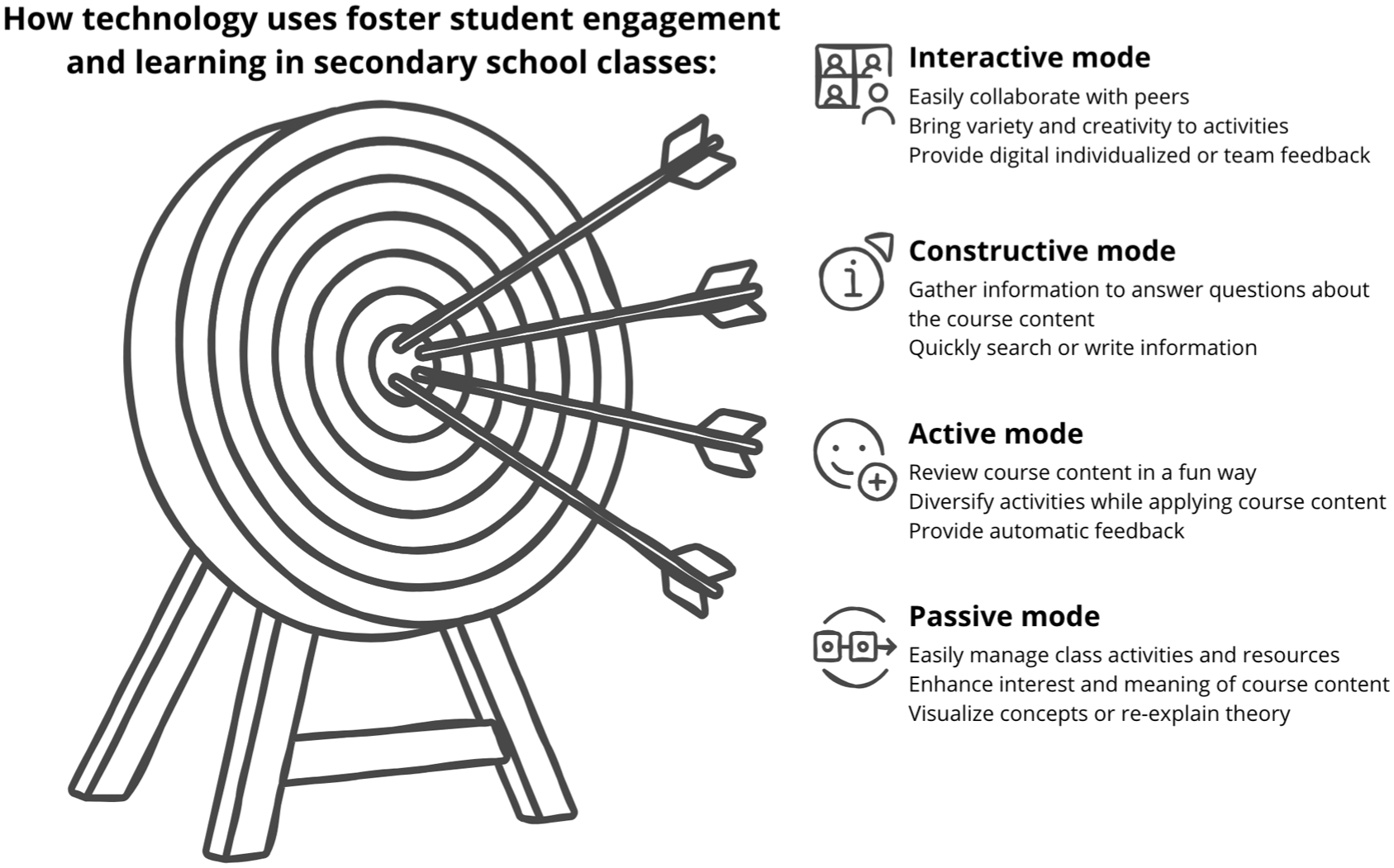
Ways in which technology uses foster student engagement in secondary school classes, following the ICAP modes and according to students’ perceptions.
What Are Success Factors Associated With the Use of Digital Technology in Secondary School Classes, According to Students’ Perceptions?
Based on students’ opinions and needs concerning the use of technology in their classes, two main success factors emerged from the data: 1) using technology as tools with specific affordances that can diversify classroom activities; and 2) encouraging students to develop digital literacy skills and providing them with choices to overcome barriers to their engagement and learning. These success factors are presented below.
Using Technology as Tools With Specific Affordances That can Diversify Classroom Activities
Students describe the utilitarian nature of technology in their lessons, just like paper and pencil. “Sometimes we’re working in our paper notebooks; sometimes we’re on computers. And that means there are several different ways of working” (ÉL13_S4). Among other things, certain digital applications make it easier for all students to share work with their peers. “The group went to see a play. So afterwards you write your opinion in a Google Doc, then put it on Padlet. You don't have to share it with everyone because it's already available for the whole class” (ÉL14_S1). Other applications support classroom note-taking. “When we’re on Notability, we can annotate our own stuff, and you know, add color, draw pictures if you want, circle things. Well, first of all, it's really more fun to learn in this subject” (ÉL28_S5). Some tools also facilitate learning in mathematics. For example, “Netmath, it’s like little games, but it's the king of revision you do in math. It helps you understand the material well” (ÉL32_S2). The affordances of digital applications are exploited here to enrich learning activities in the classroom.
The learning activities come first, while the digital applications serve as an incentive and make it easier for students to participate. “[During a group quiz], there aren’t so many rules. They [the teachers] explain the right and wrong answers, [the] whys [and] often we provide our own explanations; we’re all pumped and shout out the answers to each other across the classroom” (ÉL14_S1). Students also report that technologies help diversify classroom activities.
It’s true that sometimes, what's fun is that with technology, we can vary the things we do. It’s not always just paper and pencil exercises. It's questions that we can answer. There are really several types of things we can do. You know, we can do Kahoot games that also allow us to answer questions, but we’re all together in a group. (ÉL10_S4)
Another added:
Technology at least helps make the class more varied […] it's not always the same kind of class. Like, if it's a teacher who always does the same class, like, just talks and talks without using any tech stuff, well, it gets a bit boring. But if it's someone who talks, explains, shows videos, uses a PowerPoint to explain, well, that's a lot better. (ÉL3_S3)
Encouraging Students to Develop Digital Literacy Skills and Providing Them With Choices to Overcome Barriers to Their Engagement and Learning
Some students commented on distractions that crop up when using technology in classes. Notifications were identified as the main source of distraction:
Well, let's say sometimes it's a little harder to concentrate because when you get notifications […] it can definitely distract you. Of course, you can set "do not disturb" there too, but maybe that's also true sometimes, you know, you might be a little more inclined to go and see things or do something else. (ÉL28_S5)
Though some students mentioned games or other forms of activity. “Well, it often happens in classes where people do other things while the teacher is talking, like playing games, Pooky and all that, but that’s actually detrimental, and we should block games on the Capitole website” (ÉL31_S1). For some students, using technology can distract them from learning, while pencil and paper schoolwork keeps them engaged and focused.
I prefer to do homework in a notebook because often, it’s similar to what we do in our notebooks. […] I don't think it makes much difference to do them on the screen. So, while we're at it, I tell myself that it's better to avoid distractions and do them in our notebooks. […] I work better with paper because, you know, I'm more focused on my task. (ÉL13_S4)
Some students indicated that they felt more competent on paper than with technology. “I prefer doing my schoolwork on paper because what I write is easier to revise; it's also easier to enter the answers” (EL14_S1). Some students also said preferring paper planners over digital ones because they are not familiar with digital technology. “I would say that to plan my study, I prefer to have a paper planner. Well, it relaxes me, and I'm able to manage everything at the same time. I open a page, I have everything I've planned, and in any case, personally, I prefer that” (ÉL17_S5).
Some students expressed concern about a loss of valuable knowledge when using technology such as using auto-correctors (EL22_S5) or relying too heavily on web searches (EL20_S1). A student also mentioned that they did not have to cite their sources for information gleaned from online searches, although they did receive basic information to help evaluate the reliability of such source material (ÉL_39_S5).
When students were asked how they could be better supported in using technology in secondary school classes, some of them mentioned the need for additional formal training on the technologies being used. They suggested video tutorials or more detailed explanations as possible solutions. “It would be useful to have either classes or just videos to show us how it works” (ÉL13_S4). Several students mentioned that the technological explanations provided by teachers were too brief and rushed, which could potentially make the planned activity more difficult. Some students also indicated that not providing proper explanations about the digital applications used in learning activities could discourage or even disengage them from the activity. “The teacher didn't really take the time he should have to fully explain how the application works or how to use it. So I don't think you really feel like using technology all the time with inadequate explanations like that” (ÉL10_S4).
One student also suggested that secondary schools provide incoming students with training on the main technologies used. This would allow students to improve their organizational skills and become proficient in using the technologies that they will encounter in their classes.
I'd like them to teach us how to use the digital applications and the rest of the tech things we'll be using throughout our secondary years. Right from the start of secondary school, they should have taught us that this is Google; that this is Drive. And here is how they work. Here's how to get organized. Here's how to send an assignment; how to send an image. Here's how to cite a source properly. It makes life a lot easier for the student, who’s otherwise forced to learn the ropes alone online. (ÉL9_S5)
Discussion
This study aimed to investigate how secondary school students perceive the use of technology in their classes and how it supports their engagement and learning, as well as related success factors. Within a descriptive and qualitative approach, 40 students took part in semi-structured individual interviews. The data collected from these interviews were analyzed using a general inductive approach. The results are discussed below.
What Are the Main Uses of Technology in Classes and How do They Support Student Engagement and Learning, According to Students’ Perceptions?
For this question, the uses of technology described by students were categorized according to Chi and Wylie’s (2014) ICAP model. An important finding is that the uses of technology highlighted by the students cover all modes of the ICAP model, with no suggestions provided regarding an increased contribution of any mode to support student engagement and learning. While teaching and learning activities are typically ordered based on the four modes of engagement (interactive > constructive > active > passive), our findings suggest that there are technology uses that facilitate student engagement and learning in each mode, depending on the context.
Passive uses of technology in secondary education (e.g., organizing resources in the classroom environment and using videos or digital artifacts to illustrate course content) contribute to student engagement and learning alongside constructive or co-constructive uses of technology (e.g., producing digital essays or audio-visual creative projects). This finding is aligned with the results of a study by Fransson et al. (2018), in which secondary school students described how passive uses of technology support their learning when teachers use the technologies in a clear and structured manner. It does so by visualizing and highlighting course content effectively. Meanwhile, the active use of technology (e.g., interactive online activities) promotes student engagement by incorporating enjoyable elements and adding variety to activities (Fransson et al., 2018). In constructive mode, students focused on the age-appropriate and engaging aspects of digital essays, web searches, and other digital questionnaires. In particular, the ease and speed of digital writing are noted by students, consistent with several studies (Mangen, 2016; Olofsson et al., 2018). Finally, the results of this study, in the interactive mode, show that student engagement is primarily enhanced through activities that encourage collaboration and creativity. These aspects of activities facilitate student learning.
In a recent quantitative study, Consoli et al. (2025) showed that the use of technology to support student learning has a significant positive effect on behavioral engagement, according to students’ perceptions. In the three corresponding survey items, this use of technology referred to making difficult topics more interesting, easier to understand, and facilitating their practice and application. The results of this study enhance our understanding of how various uses of technology in secondary school classes support student engagement and learning, depending on context, by presenting students’ qualitative perceptions. Furthermore, similar to the findings of Blikstad-Balas and Klette (2020) and Schmid et al. (2023), our results indicate that the current uses of technology in secondary school classes are less innovative than those commonly reported in the literature (e.g., virtual reality, personalized learning).
Beyond offering a better understanding of how technology use supports student engagement and learning—and given the reported lack of innovation—teachers need to reflect on and question the added value of technology use in secondary school classrooms to make informed pedagogical decisions. In recent years, several authors have advocated for a more cautious and measured use of digital technologies in education (Céci et al., 2024; Selwyn, 2024). Therefore, even though some passive and active uses are reported by students as supporting their engagement and learning, we urge teachers to employ these tools in moderation. Teachers should continually reflect on the relevance and pedagogical value of each use of technology, considering the specific teaching and learning context (Novoa-Echaurren et al., 2025; Selwyn, 2021).
What Success Factors Are Associated With the Use of Digital Technology in Secondary School Classes, According to Students’ Perceptions?
Students view technologies as tools that can be helpful in their classes, like paper and pencil, recalling some students’ depicting digital technology as “tools of the future” in Almén et al.’ (2020, p. 298) study. The usefulness of these technologies depends on their respective affordances and relevance in different teaching and learning situations. In addition to delineating the affordances of several technologies in line with studies by Olofsson et al. (2018), Phan (2020), or Almén et al. (2020), this study emphasizes the benefits of diversifying activities with the help of technology to promote student engagement. In this regard, Wang et al. (2022) have suggested that experienced teachers have more time to reflect on using technology in innovative and collaborative ways, which in turn enhances student engagement. Hence, thinking about how to diversify classroom activities thanks to specific affordances of digital technologies, while at the same time keeping in mind the recent shift towards cautious and responsible uses, requires time and ongoing professional development for teachers (Novoa-Echaurren et al., 2025; Soufghalem, 2024).
Furthermore, although most students felt engaged when using technology in their secondary school classes, some expressed concerns about distractions, especially from notifications. Some felt more competent with pen and paper approaches and were worried about a loss of knowledge when using technology. This highlighted the need to educate students regarding digital technology so that its uses foster and reinforce student engagement and learning instead of serving as a hindrance sometimes occurs. Teachers would also benefit from engaging in professional development on classroom management when using technology, as it significantly impacts students’ behavioral engagement in learning, although in a lesser extent than support for learning (Consoli et al., 2025). In contrast to Phan’s study (2020), our results indicate that not all students feel engaged when using technology. Therefore, in addition to educating students about digital technology, choices may be provided by teachers whether to use technology or paper and pencil depending on the teaching and learning context.
Finally, some students identified their needs for formal training, aligning with findings from other recent studies (Almén et al., 2020; Soufghalem, 2024). Since teenagers often use technology solely for social networking or entertainment purposes, their digital skills are weak and heterogenous (Ntebutse et al., 2019). More explicit and proactive training in the use of technology is needed to develop students’ digital literacy skills and to ensure smooth learning activities by minimizing obstacles caused by technological difficulties (Bulfin et al., 2016; Soufghalem, 2024). Some students in this study indicated that technologies should be treated as learning objects, echoing other research and recent governmental reports that recommend explicitly teaching how to use technology (e.g., [geographical_region] National Assembly; Yondler & Blau, 2023). In this regard, Kure et al. (2023) emphasized the need for teachers to engage in professional development activities that enable them to foster advanced and subject-specific digital skills in their students. Secondary school students need to be guided in using educational technology, not only to develop digital skills but also to adapt to the rapidly evolving technological landscape (Kure et al., 2023; Soufghalem, 2024).
Limitations and Future Directions
One limitation of this study is that the participants were selected from a convenience sample in Quebec (Canada). Although we tried to recruit students with diverse characteristics and from a wide range of schools, the participants may have been primarily those students who were most engaged or interested in using technology at school. Therefore, future studies could include a more diverse sampling of students from different countries and cultural backgrounds to elicit more valuable insights on how technology can address student engagement among youth and applications that foster and reinforce learning and teaching. Furthermore, although the research team employed young interviewers (graduate and undergraduate students) to encourage secondary school students to speak in detail about their lived experiences, the students tended to respond very quickly and succinctly, despite the interviewers’ efforts. For this reason, we suggest that future studies conduct focus groups during school hours, rather than individual interviews outside of school, possibly facilitated by teachers who are well-regarded by the students. Next, technology uses were categorized based on uses described by students, rather than teachers' intended uses as suggested by Chi and Wylie (2014). Hence students may have described certain applications of technology differently from what teachers had planned since the teachers were perhaps aiming for higher modes of engagement in the ICAP model. In addition, the study only investigated the ways students reported using technology, which might not provide the full picture of what happened in class. Future research could focus on other types of objective data collection instruments such as observation, checklists, and tests to mitigate possible bias inherent in self-reporting responses. Students’ perceptions of using and implementing technology in learning may also differ from those of their teachers. Future research could explore how students and teachers use and perceive the integration of technology into teaching and learning. This would help researchers to bridge the perception gap and enable both teachers and learners to optimize their use of technology.
Conclusion
As Schmid et al. (2023) highlight, it is important to examine how technology is used in secondary school classes, which often differs from the innovative uses described in the scientific literature. Through interviews with 40 participants, this study investigated how students perceive the ways in which technology can support their engagement and learning in secondary school classes. For researchers, the main contribution of this study is that it offers a qualitative and descriptive overview of students’ perceptions of classroom technology use. The ICAP framework enabled us to categorize technology uses according to modes of student engagement, which few prior studies have accomplished from a qualitative standpoint. Specifically focusing on student engagement and learning, our research sheds light on the quality of technology use from secondary school students’ perspectives that teachers may consider when reflecting on the use of technology in their classrooms. By highlighting current and simple uses of technology in secondary school classes, it may help reduce the technological gap between schools. Still, the key questions remain: whether and how it may really enrich a given teaching and learning context, so that teachers can make cautious and thoughtful choices. Given the diversity of students’ needs and preferences, this approach can also coexist with traditional paper and pencil approaches, allowing students to choose their own pathways and demonstrate their agency in the classroom.
Moreover, this study highlights the importance of viewing technology, not only as a support for pedagogy, but also as a learning subject in itself. Helping students develop stronger digital literacy—not just how to operate tools, but how to think critically about their use—can foster deeper engagement and greater autonomy. Encouraging students to express their preferences and take part in decisions around the use of digital tools in class may also strengthen their sense of agency and relevance in the learning process. In parallel, given that not all students have the same level of access or familiarity with digital technologies (Majdoub et al., 2024), it is essential to consider equity in the design and implementation of educational technology. Supporting all learners means making space for inclusive, differentiated, and flexible approaches that account for diverse needs and contexts (Diab et al., 2025).
Supplemental Material
sj-docx-1-sgo-10.1177_21582440251395357 – Supplemental material for Using Technology in Secondary Education to Support Engagement and Learning: Students’ Perspectives
Supplemental material, sj-docx-1-sgo-10.1177_21582440251395357 for Using Technology in Secondary Education to Support Engagement and Learning: Students’ Perspectives by Géraldine Heilporn, Mourad Majdoub, Fatima Diab, Catherine Paré, Ayda Sadat Hejazian, Sawsen Lakhal and Christine Hamel in SAGE Open
Footnotes

Ethical Considerations
Ethical approvals from Université Laval (2022-086/30-03-2022) and Université de Sherbrooke (2022-3471/Heilporn).
Funding
The authors disclosed receipt of the following financial support for the research, authorship, and/or publication of this article: This research was funded by the Social Sciences and Humanities Council of Canada (grant number 430-2022-00266).
Declaration of Conflicting Interests
The authors declared no potential conflicts of interest with respect to the research, authorship, and/or publication of this article.
Data Availability Statement
The data that support the findings of this study are available from the corresponding author upon reasonable request.
Supplemental Material
Supplemental material for this article is available online.
References
Supplementary Material
Please find the following supplemental material available below.
For Open Access articles published under a Creative Commons License, all supplemental material carries the same license as the article it is associated with.
For non-Open Access articles published, all supplemental material carries a non-exclusive license, and permission requests for re-use of supplemental material or any part of supplemental material shall be sent directly to the copyright owner as specified in the copyright notice associated with the article.
