




Abstract
Recently, there has been an emotional turn in news research, but not many scholars conducted contrastive studies of discoursal emotions of the news on climate change between China’s and American media, and not many studies presented the differences in emotions toward the issues of climate change between the two countries’ newspapers. In view of these situations, this study aimed to analyze the detailed differences in discoursal emotions in news on global warming between China’s and American newspapers, as well as the underlying causes for these differences. To achieve this goal, the study constructed the Socio-emotional Theory and employed a combination of corpus approaches, semantic annotation, frequency contrast analysis, and discourse analysis. The results show that, according to contrast of usage frequency, China’s and American newspapers prominently employ 21 and 7 emotional words, respectively. China’s newspapers tend to use these 21 emotional words to highlight the negative impact of global warming and the urgency of its governance, and indicate that some countries might not attach enough importance to and take no action against global warming; American newspapers are inclined to exploit these 7 emotional words to prominently present antithetical views on global warming governance and highlight the unfavorable impact of global warming. Meanwhile, the former utilize the emotional concept of misery prominently, while the latter relatively highlight the emotional concepts of disgust, happiness, and worry. The antitheses between stances of media, the collectivism and the individualism, the harmony thought and the prioritization of interests, and the community with a shared future for mankind and the America first between China and the United States might be the causes for the differences in the above discoursal emotional characteristics. This study could expand theoretical boundaries of discourse analysis, and provide important enlightenment for building and strengthening the international alliances to address global warming.
Introduction
Climate change is closely relevant to human survival and has a significant impact on various aspects of humans’ life and production. Therefore, climate change is usually a hot topic in the media (Jena, 2022, p. 356; Moernaut et al., 2022, p. 1047). At present, there has been an emotional turn in news research (Fang & Cheng, 2022; Wahl-Jorgensen, 2020; Wahl-Jorgensen & Pantti, 2021). Some scholars have explored the discoursal emotions of the news on climate change, revealing the discoursal emotional characteristics and standpoints of specific institutions or individuals. This kind of research has important theoretical and practical significance for understanding how the public perceives climate change, managing relevant public opinion, and formulating strategies for communicating climate change information.
Currently, there are three orientations of the research on media discoursal emotions toward climate change: the analyses of the emotional characteristics of the media reports on climate change (Gardiner et al., 2023), the studies of the impact of media discoursal emotions on the cognition of climate change (Munoz-Carrier et al., 2020), and the analyses of discoursal emotions toward climate change in intercultural communication (Levy & Spicer, 2013). These studies could reveal the causes for the characteristics of the media discoursal emotions toward climate change, as well as the transmission mechanism and roles of the discoursal emotions. However, it seemed that not many studies were involved in the comprehensive and detailed analyses of the discoursal emotional subcategories of the news on climate change (such as anger, happiness, fondness, contentment, disappointment, and fear, etc.), and not many investigations touched upon the contrastive analyses of the differences in discoursal emotions of the news on climate change between China’s and American newspapers.
Global warming is an important manifestation of climate change (Obayelu, 2011, p. 218). Conducting a contrastive study of the discoursal emotions of the news on global warming between China’s and American newspapers could not only bridge the research gap in academia, but also help identify the differences in positions on global warming between China’s and American media, as well as the causes for the differences, which could provide important enlightenment for building, and strengthening the international alliances to address global warming. Given the above reasons, this paper conducted a contrastive study of the discoursal emotions of the news on global warming between China’s and American newspapers, and analyzed the differences in discoursal emotions and the causes for the differences.
The following parts of the paper were organized as follows: Firstly, some relevant studies were introduced in “Literature Review” section so that the research gap was presented. Secondly, the theoretical framework of Socio-emotional Theory was constructed in the “Theoretical Framework” section. Thirdly, problem statement, research objectives, research questions, data, research methods and tools, and research procedures were introduced in the “Research Design” section. Fourthly, in “Data Analysis” section, the paper made contrast of the discoursal emotions of the news on global warming between China’s and American newspapers based on the Socio-emotional Theory, including contrast of the emotional words, analyses of the sentential examples constructed by these emotional words, contrast of the emotional concepts, and investigation into the causes for the differences in the above discoursal emotional characteristics. Finally, the paper conducted a discussion and drew a conclusion.
Literature Review
Given that there were not many investigations into the emotional discourse of the news on global warming, and that global warming is a major aspect of climate change, this study conducted a literature review around relevant research into the news on climate change. Overall, there were three orientations of the studies of media discoursal emotions toward climate change: the analyses of the discoursal emotional characteristics of the media reports on climate change, the studies of the impact of media discoursal emotions on the cognition of climate change, and the analyses of discoursal emotions toward climate change in intercultural communication.
In the analyses of the discoursal emotional characteristics of the media reports on climate change, scholars mainly investigated the distribution of and the causes for the discoursal emotions. For examples, Foust and O'Shannon Murphy (2009, p. 151) explored the apocalyptic discoursal frames of the news on global warming in American newspapers, which could be divided into two categories: the tragic apocalypse and the comic apocalypse. The former highlighted the inevitability of climate change and humans’ inability to change this outcome, while the latter emphasized humans were capable of influencing the climate change. Meanwhile, American newspapers sometimes employed the discoursal emotion of justice when reporting on global warming, that is, newspapers exploited such discoursal strategies as describing the impact of global warming, discussing the measures to mitigate global warming, and amplifying the consequences of global warming, so as to integrate the concept of justice emotion into the discourse of global warming news, and then called on the main responsible parties for global warming to shoulder more responsibilities for climate governance (Rashid, 2011, p. 232). In addition, machine learning algorithm revealed that 15 million tweets over a 13-year period reflected that commentators with different positions (believers, deniers, or neutral) on and emotions (positive, negative, or neutral) toward climate change would utilize different discoursal emotions to comment on climate change. Those who denied climate change would employ more aggressive expressions with negative emotions, and they were more commonly found in Canada, the United States, Japan, and Australia, etc. And those who believed climate change were more inclined to have positive discussions of the action to address climate change (Effrosynidis et al., 2022). Furthermore, the discoursal resources such as affect, judgment, and appreciation (derived from Appraisal Theory) could be used to reveal the differences in discoursal emotions of the news on climate change between China’s and American newspapers, thereby demonstrating the ecological concepts of “ecological priority” and “interest priority” highlighted in China’s and American news, respectively (H. Zhang & Yang, 2022, p. 43). The VADER algorithm could also be employed to analyze the distribution and intensity of the positive and negative emotions in the comments on natural disasters relevant to climate change on Twitter, such as forest fires in Australia, which could reveal the intensity and time series distribution of the negative emotions of mass media toward climate change disasters, and could further reflect the quality of disaster relief and recovery work of relevant departments from the perspective of mass media comments (Gardiner et al., 2023). Moreover, positive and negative discoursal emotions were often utilized by China’s newspapers to build a positive and firm image of China in addressing climate change issues (Liu, 2023, p. 92). Finally, the components of the transitivity system (derived from Systemic Functional Linguistics) could also be employed to reflect the discoursal emotions toward climate change in China’s newspapers, and these emotions originated from the newspapers’ ecological concepts and value orientations of climate governance (Miao & Liu, 2023, pp. 19–22). The above analyses of the discoursal emotional characteristics of the media reports on climate change mainly probed into the polarity of discoursal emotions. Although some studies have investigated specific emotional subcategories such as tragedy, comedy, and justice, it appeared that not many studies comprehensively analyzed the distribution of discoursal emotional subcategories (such as anger, happiness, fondness, contentment, disappointment, and fear, etc.) in the news on climate change so as to reveal the detailed characteristics of the discoursal emotions.
In the studies of the impact of media discoursal emotions on the cognition of climate change, scholars mainly analyzed how the discoursal emotions toward climate change conveyed by the media affected the public’s cognition, attitude, and coping behavior toward climate change. Qualitative research methods such as semi-structured interviews and focus group discussions have been exploited to verify the impact of fearful visual media information about climate change on the respondents’ participation in climate governance. This research has shown that the fearful emotional information usually could not motivate individuals to genuinely engage in climate governance. On the contrary, non-threatening climate images and environmental visual information closely relevant to personal daily emotions and concerns were more likely to attract individuals to engage in climate governance (O’Neill & Nicholson-Cole, 2009, p. 355). At the same time, the network experimental method was used to investigate how different media information on climate change affected the judgment of climate change phenomena and environmental conservation intentions among adult participants in Canada and Australia. Specifically, reports on natural disasters (such as floods) that were empathic (using negative emotions to describe the harm the disasters caused to local people) rather than informative (factual descriptions) and persuasive (disproving certain beliefs) were more likely to convince participants that disasters were caused by climate change and could motivate them to take environmental action (Munoz-Carrier et al., 2020). In addition, grouped experiments could be exploited to compare the different emotional and behavioral responses of participants triggered by different experiences of climate change consequences (e.g., wildfire). These experiments have verified that virtual reality (VR) media (multimodal emotional experiences that approximated to reality) could enhance participants’ risk perception and negative emotions toward climate change more than the regular video media (restricted multimodal emotional experiences) and the text media (text-based emotional experiences), thereby better stimulating their environmental conservation intentions (Meijers et al., 2023, p. 581). Moreover, mixed methods such as the combination of VADER algorithm and thematic analysis could also reveal that the Twitter posts related to climate change could employ five emotional themes: Weary Zealotry, The Hope-Disgust Dialectic, Climate as Proto-Disaster, Idiots and Enemies, and Global Solidarity, to trigger similar emotional responses from others and inspire them to take action to address climate change, thereby forming imagined communities of global risk (Robinson, 2024). The above studies of the impact of media discoursal emotions on the cognition of climate change tended to take the western public as the research objects and employ field research and experimental studies as the primary methods. It seemed that they seldom exploited discourse analysis to investigate the differences in discoursal emotions of the news on climate change in China’s and Western media and the impact of discoursal emotions on climate cognition of Chinese and Western people.
In terms of the analyses of discoursal emotions toward climate change in intercultural communication, scholars have delved in how the news on climate change was understood and reinterpreted in different cultural contexts. Generally speaking, each local community had its own cognitive filters when internalizing knowledge, and these cognitive filters were deeply influenced by emotions, which reflected the cultural attachment and the identity of the community. Cultural attachment often had a significant influence on scientific reasoning, and communities might resist scientific judgment that deviated from their cultural attachment (Hoffman, 2015, pp. 3–4). Therefore, when the news about global climate change was disseminated locally, the news often underwent mutations that conformed to the local cultural attachment. For instance, when the media disseminated the news on climate change, they would form climate imaginaries based on the emotional reactions and value orientations of the local people toward climate change, which were the shared socio-semiotic systems that formed a field according to the local people’s common understandings of the climate. Currently, there are four core climate imaginaries in the world, including “climate apocalypse,”“fossil fuels forever,”“sustainable lifestyles,” and “techno-market.” These imaginaries reflected people’s different understandings and emotional responses to climate change in different social, cultural, and political backgrounds (Levy & Spicer, 2013, p. 659). Meanwhile, emotional resonance and local identity had a significant impact on the local dissemination of the concept of climate change. Thus, when disseminating the information on climate change, the media should fully consider the identity of the audience and their attachment to the local environment, link the impact of climate change with their familiar locations and environment, enhance their emotional resonance, and thereby increase their attention to and engagement in climate change issues. In other words, media communication should adapt to the local socio-cultures (Moser, 2014, pp. 347–348). In addition, using the methods of participant observation, guided interviews, a survey, and experimental methods of cognitive anthropology, Friedrich (2020, pp. 97–99) revealed that after the news on global climate change spread to the Philippine island of Palawan, it was localized into the issues with negative emotions (such as typhoons, earthquakes, abnormal temperatures, and burning garbage) and the activities with positive emotions (such as planting trees). Obviously, the emotions conveyed by the news on climate change were closely related to local environmental knowledge, socio-cultural background, and historical experiences. Specifically, media coverage, tangible experiences of extreme weather, educational activities of non-governmental organizations, and previous beliefs and values have led to the emotional acceptance, transformation, integration, or rejection of the climate change concepts by local communities. Therefore, climate change could be positively interpreted by different local communities as an opportunity for future development or negatively construed as a need for environmental protection (Brüggemann & Rödder, 2020, p. 1). The above analyses of discoursal emotions toward climate change in intercultural communication mainly focused on the variations in the emotions toward the news on climate change in intercultural communication and the causes for the variations. In fact, ethnicity, cultures, geography, etc. shaped the ideologies of a community, and the latter were the main factors of influencing the community’s emotions toward climate change. For instance, individualism and collectivism might lead to different emotions toward climate governance cooperation among different communities. These studies paid attention to the results of the mutations of news dissemination, but it seemed that not many investigations were concerned with the contrast of discoursal emotions of the news on climate change among different communities. Moreover, it appeared that these studies were seldom involved in the analysis of the discoursal emotions toward climate change in China’s news media.
In summary, firstly, the current research on discoursal emotions toward climate change mainly focused on the analyses of the discoursal emotional characteristics of the media reports on climate change, which, nevertheless, mainly involved the emotional polarity, and were seldom concerned with the comprehensive and detailed analyses of the specific subcategories of discoursal emotions of the news on climate change. Secondly, the studies of the impact of media discoursal emotions on the cognition of climate change mainly dealt with Western public, and employed field research and experimental studies as the primary methods to analyze how the discoursal emotions conveyed by the media affected the public’s cognition, attitude, and coping behavior toward climate change. However, it seemed that such studies rarely exploited the method of discourse analysis to investigate the differences in discoursal emotions of the news on climate change in China’s and Western media. Thirdly, the analyses of discoursal emotions toward climate change in intercultural communication concentrated on how the news on climate change was understood and reinterpreted in different cultural contexts. However, it appeared that such studies rarely touched upon the discoursal emotions toward climate change in China’s news media, even less has been said about the contrast of the discoursal emotions between China’s and American newspapers. Finally, global warming is an important aspect of climate change (Obayelu, 2011, p. 218). And currently, it seems as if not many scholars conduct the contrastive studies of the discoursal emotions of the news on global warming between China’s and American newspapers. Nevertheless, such contrastive studies could help clarify the differences in positions on global warming between China’s and American media and the causes for the differences, which might be of great significance for building and strengthening the international alliances to address global warming. Given the above reasons, this article conducted a contrastive study of the discoursal emotions of the news on global warming between China’s and American newspapers, so as to investigate the differences in the emotions and their causes.
Theoretical Framework
At present, the representative theories in the field of discourse analysis comprise Socio-cognitive Approach (Van Dijk, 2018, p. 27), Dialectical Reasoning Approach (Fairclough, 2018, p. 13), Discourse-historical Approach (Reisigl & Wodak, 2016, p. 31), Visual Grammars and Multimodal Discourse Approach (Kress & van Leeuwen, 2001, p. 113), and Multimodal Metaphor Approach (Forceville, 2009, p. 19). Currently, there seems to be a scarcity of theories specifically for the analyses of discoursal emotions in the field of discourse analysis (Y. Zhang, 2022, p. 74). And the Socio-cognitive Approach occasionally touched upon the emotional element, but this element was only a component of cognition (Van Dijk, 2018, p. 30), so in the field of discourse analysis, discoursal emotions did not seem to have received the due attention they deserved. In addition, Wierzbicka (1999, p. 5), Shiau et al. (2021, p. 132), Shahin and Ng (2022, p. 534), Qiang and Liang (2021, p. 63) have argued that emotions and cognition were two distinct psychological elements, and emotions sometimes influenced or dominated cognition. Therefore, the researcher believes that emotions should be separated from the cognitive category and constructed as an independent discoursal theory.
Firstly, discourse can reflect emotions (Peng & Hou, 2023, p. 444), for instance, intelligence, foolishness, diligence, laziness, fondness, disgust, sedation, anger, etc. can reflect or refer to emotions. Secondly, emotions can embody ideologies (i.e., the core components of socio-cultures) (Fenigsen et al., 2020, p. 6; Tamir et al., 2016, p. 67), for example, the fondness for and disgust at the color of red in the East and the West respectively reflect different ideologies. Therefore, the Socio-emotional Theory constructed by the researcher includes three strata: discourse practice, psychology, and socio-cultures, which correspond to the discourse, cognitive models, and ideologies of the Socio-cognitive Approach (Van Dijk, 2018, p. 39). The theoretical framework of Socio-emotional Theory is shown in Figure 1.
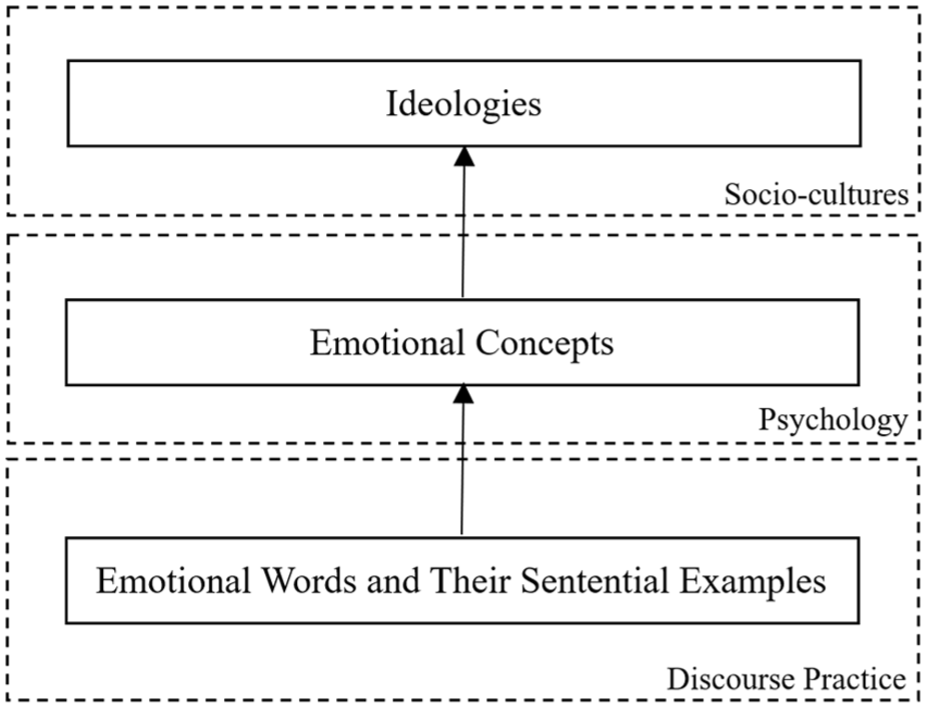
The three strata of Socio-emotional Theory.
In Figure 1, the one-way arrow represents the embodiment relationships. At the stratum of discourse practice, emotional words refer to the specific words that convey emotional states and activities, including the words in 14 categories of emotional concepts: general positive and negative emotions (mainly denoting the positive and negative words that do not directly mention the emotional concepts, such as beauty, excellence, foolishness, etc.), fondness, disgust, sedation, anger, happiness, misery, contentment, disappointment, bravery, fear, carefreeness, worry, etc. (P. E. Rayson, 2003, pp. 188–194). In this study, the emotional words of these 14 categories were defined and identified by the USAS semantic analysis system in WMatrix 5 automatically, and the researcher manually checked and corrected the identification of the emotional words based on the understandings of their semantics. The sentential examples of emotional words refer to the sentences constructed by the emotional words. At the psychological stratum, emotional concepts signify the conceptual or semantic ontology of the 14 categories of discoursal emotions. The classification of these emotional concepts was predefined by the USAS semantic analysis system in WMatrix 5, and the classification process of discoursal emotional concepts occurred concurrently with the identification process of emotional words. At the socio-cultural stratum, ideologies refer to the collection of a specific social group’s attitude, positions, and beliefs toward something (Flowerdew & Richardson, 2018, p. 3). This study employed the framework of Socio-emotional Theory in Figure 1 to analyze the differences in discoursal emotions of the news on global warming between China’s and American newspapers, as well as the causes for the differences. And the research contents covered four aspects: emotional words, sentential examples of the emotional words, emotional concepts, and emotional ideologies.
Research Design
Problem Statement
From the section of “Theoretical Framework”, it can be seen that discoursal emotions can reflect ideologies, in other words, different ideologies may give rise to different discoursal emotions. China and the United States have different politics, cultures, and histories, which might lead to the different ideologies held by people in the two countries. Therefore, it seems possible that there are differences in discoursal emotions expressed in news coverage of global warming between China’s and American newspapers. However, as the section of “Literature Review” indicated, not many scholars investigated these differences in discoursal emotions. Consequently, the divergences in stances on global warming between China’s and American newspapers, as well as the causes for the divergences, remained unclear. It is necessary to conduct a contrastive study of the discoursal emotions of the news on global warming between the two countries’ newspapers, which might offer inspiration to the cooperation in addressing global warming.
Research Objectives
The main objective of this study was to investigate the differences in discoursal emotions of the news on global warming between China’s and American newspapers. And the specific objectives could be listed as follows: (1) To reveal the differences in emotional words in news coverage of global warming between the two countries’ newspapers. (2) To identify the specific meanings conveyed by the emotional words that are relatively frequently used in the above two countries’ news. (3) To disclose the divergences in discoursal emotional concepts in the above two countries’ news. (4) To explain the causes for these differences in the discoursal emotional characteristics.
Research Questions
This study investigated the differences in discoursal emotions of the global warming news between China’s and American newspapers, as well as the causes for the differences, specifically delving in four research questions: (1) What emotional words do the newspapers of the two countries employ relatively prominently? (2) What meanings are embodied by the sentential examples constructed by the emotional words prominently utilized respectively in the newspapers of the two countries? (3) What discoursal emotional concepts do the newspapers of the two countries highlight relatively prominently? (4) What are the causes for these differences in the discoursal emotional characteristics?
Data
China and the United States are among the world’s largest economies and also major countries in terms of carbon emissions. Their policies and action on global climate change have a significant impact on global climate governance. And the two countries’ newspapers can reflect their emotional stances on global warming. Therefore, this paper selected the news on global warming in China’s and American newspapers as the research data. On December 26, 2023, in the LexisNexis Corpus (LexisNexis is a world-renowned corpus that compiles contents from over 2,500 newspapers, as well as more than 1,000 journals and magazines worldwide. Its website is: http://www.lexisnexis.com/ap/academic/.), the researcher selected six representative sub-corpora of China’s and American newspapers, including China Daily (CD), People’s Daily (PD), Global Times (GT), Shanghai Daily (SD), The New York Times (NYT), and USA Today (UT) (These newspapers were selected for the reasons that they contained more relevant news than others, and they were relatively important newspapers in China and the United States.), and exhaustively retrieved the English news with “Global Warming” in the titles, which were released from December 16, 2003 to December 15, 2023. The researcher obtained 47, 30, 17, 27, 330, and 106 pieces of news from the aforementioned newspapers respectively. After manually removing the irrelevant news and deleting the duplicate news, the researcher ultimately obtained 35, 29, 14, 22, 322, and 105 pieces of news from the above newspapers. Subsequently, the researcher cleansed the news by removing the information such as authors, news release dates, news collecting dates, news sources, and explanatory texts, etc., and only retained the titles and main bodies of the news. Moreover, the news in CD, PD, GT, and SD was aggregated into the China’s Corpus (CC), and the news in NYT and UT was assembled into the American Corpus (AC), which contained 47,800 and 345,085 English words respectively. Although sizes of the two corpora were different, this paper employed log-likelihood ratios to contrast the frequency of emotional words and emotional concepts, and log-likelihood ratios were standardized ratios, therefore, the sizes of the corpora had no effect on the contrastive results.
Research Methods and Tools
This study employed the corpus approaches to collect the news on global warming from the LexisNexis corpus, and constructed the corpora of China’s and American newspapers. Meanwhile, WMatrix 5 (The website of WMatrix 5 is https://ucrel-wmatrix5.lancaster.ac.uk/wmatrix5.html. WMatrix 5 is an online machine annotation tool for corpus semantics and part-of-speech tagging, developed by Dr. Rayson from the University of Lancaster in the UK.) was adopted to annotate the emotional words in the news (including the semantic annotation of 14 categories of emotional concepts, such as general positive and negative emotions, fondness, disgust, sedation, anger, happiness, misery, contentment, disappointment, bravery, fear, carefreeness, and worry), it utilized annotation based on the USAS semantic analysis system and the CLAWS part-of-speech coding system, with reported accuracy of 91% (P. Rayson, 2008, p. 529) and 96% to 97% (see https://ucrel.lancs.ac.uk/claws), respectively. And then, the annotation was manually checked and corrected (The researcher verified the accuracy of the attribution of the emotional concepts of the annotated emotional words based on the understandings of the semantics, and if the emotional concept of a word was incorrectly annotated, the word would be re-annotated and re-attributed to the correct emotional concept.). In addition, the researcher exploited AntConc 3.5.7 (Anthony, 2018) and AntBNC Lemma List (https://www.laurenceanthony.net/software/antconc/) to lemmatize the emotional words in CC and AC, and utilized Excel spreadsheets and the log-likelihood ratio calculator (https://ucrel.lancs.ac.uk/llwizard.html) developed by British Lancaster University, to contrast the usage frequency of emotional words and concepts in CC and AC, so as to obtain the emotional words and concepts with significant differences in usage frequency respectively in CC and AC. Furthermore, the researcher employed the discourse analysis method to analyze the differences in the semantics of the sentential examples constructed by the emotional words prominently utilized respectively in CC and AC, and probed into the ideological causes for the differences in emotional words, sentential examples, and emotional concepts between CC and AC.
Research Procedures
Firstly, the researcher gathered the news on global warming in China’s and American newspapers from the LexisNexis corpus, and cleansed the data to build CC and AC. Secondly, the researcher conducted the machine annotation of the emotional words in CC and AC, and manually checked and corrected the annotation. Thirdly, the researcher lemmatized the emotional words in CC and AC, and identified the emotional words with significant differences in usage frequency and the sentences constructed by them, so as to figure out the differences in the emotional discourse practice in the news on global warming between China’s and American newspapers. Fourthly, the emotional concepts with significant differences in usage frequency between CC and AC were identified. Finally, the researcher explained the causes for the differences in the aforementioned discourse practice and emotional concepts from an ideological perspective.
Data Analysis
The Contrast of the Emotional Words
The researcher extracted emotional words from CC and AC, lemmatized them, and calculated the distribution of the usage frequency of the emotional words in CC and AC. Subsequently, the researcher exploited the log-likelihood ratios to identify the emotional words with significant differences in usage frequency between CC and AC, as shown in Table 1.
Emotional Words with Significant Differences in Usage Frequency Between CC and AC.

Note. LLR > 3.84, LLR > 6.63, and LLR > 10.83 are equivalent to p < .05, p< .01, and p< .001 respectively.
According to the log-likelihood ratios (LLR) in Table 1, it can be seen that there are significant differences in the usage frequency of 28 emotional words in 11 categories of emotional concepts between CC and AC. Among the 28 emotional words, the difference in the usage frequency of “suffer” between CC and AC is the largest, while the difference in the usage frequency of “complain” between the two corpora is the smallest. According to the percentages of usage frequency (the ratios of usage frequency of an emotional word to the total numbers of words in CC or AC), it is evident that China’s newspapers tend to employ 21 emotional words more prominently than American newspapers, which include the words of sensitive, dismissive, soft spot (This phrase is considered as two words.), treasure, calm, hit, rebellion, outrage, cruel, ferocious, celebration, suffer, graver, tragically, grim, disappointing, dare, shock, alarm, and flinch, while American newspapers exploit 7 emotional words more notably than China’s newspapers, which comprise the words of love, oppose, opposition, complain, attack, poison, and worry. Among the 21 emotional words that are utilized relatively prominently in Chinese newspapers, there are 6 positive and 15 negative emotional words respectively. Among the 7 emotional words that are exploited relatively notably in American newspapers, there is 1 positive and 6 negative emotional words. Overall, both China’s and American newspapers employ negative emotional words relatively conspicuously, while China’s newspapers make use of emotional words and negative emotional words relatively more prominently than American newspapers.
The Analyses of the Sentential Examples Constructed by Emotional Words
According to Table 1, the researcher extracted the sentential examples constructed by 21 and 7 emotional words highlighted in CC and AC respectively, and analyzed the meanings of the representative sentences in these sentential examples.
The Sentential Examples in CC
According to the analyses in Table 1, it can be seen that China’s newspapers employ 21 emotional words more prominently than American newspapers, which include the words of sensitive, dismissive, soft spot, treasure, calm, hit, rebellion, outrage, cruel, ferocious, celebration, suffer, graver, tragically, grim, disappointing, dare, shock, alarm, and flinch. The representative sentences constructed by these words are as follows.
China’s newspapers mainly use “sensitive” to express the sensitivity of certain regions or species to global warming. For example, (1) Another 1°C rise would result in large decreases in some sensitive natural ecosystems, such as coral reefs, and the extinction of many species, while others will move to cooler areas (CD, 2016/11/11). Example (1) refers to the destructive effects of global warming on certain sensitive ecosystems.
China’s newspapers employ “dismissive” to describe the behavior of disregard for the Paris Climate Agreement. (2) With the United States, the world’s largest historical emitter of greenhouse gases, dismissive of the accord, the rest of the global community must reaffirm its commitment to reducing carbon dioxide emissions (SD, 2017/12/19). Example (2) points out that as the largest greenhouse gas emitter in history, the United States is skeptical of the Paris Climate Agreement, however, other members of the international community should not be influenced by the United States, and must reiterate their commitment to reducing greenhouse gas emissions.
In China’s newspapers, “soft spot” is used to express the meaning of showing a special preference to something. For instance, (3) Passionate about his trade, the winegrower readily admits he has a soft spot for the white Arbane that grows in small bunches of little berries and may have all but disappeared without devotees like Drappier (CD, 2015/09/26). Example (3) indicates that winegrower Drappier shows a special preference to the white Arbane grapes, laying the groundwork for the following discussion on the impact of global warming on the growth of such grapes.
“Treasure” is adopted by China’s newspapers to describe precious sparkling wine. For instance, (4) Today, the rarer grapes that take longer to mature are grown on only 0.3% of the 34,000 hectares (84,000 acres) that produce France’s treasured sparkling wine (CD, 2015/09/26). Example (4) points out that some rare grapes exploited to make precious sparkling wine in France account for a relatively small proportion of all wine grapes, which lays the foundation for the discussion of the influence of global warming on the growth of such grapes in the following text.
China’s newspapers exploit “calm” to express the need to calmly address climate change issues, for example, (5) We need a calmer approach that addresses climate change without scaring us needlessly and that pays heed to the many other challenges facing the planet (SD, 2019/03/29). Example (5) states that mankind needs a more sober approach to address climate change.
In China’s newspapers, “hit” is utilized to indicate that different regions, species, and human production around the world have been affected by high temperatures and extreme weather events. For instance, (6) These effects, which hit those most vulnerable like minorities, children and poorer communities hardest, are just the beginning, the editorial warned (GT, 2021/09/07). This example demonstrates that the adverse effects of global warming have the greatest impact on the most vulnerable groups such as ethnic minorities, children, and impoverished communities, and this impact is only the beginning of the long-term effects.
“Rebellion” is exploited by China’s newspapers to convey how Western citizens resort to nonviolent rebellion to force governments to take measures to curb climate change. For example, (7) “Extinction Rebellion,” an international movement that began last year with a Declaration of Rebellion in London, advocates civil disobedience (SD, 2019/10/16). Example (7) briefly introduces the origin and advocacy of the nonviolent rebellion movement.
China’s newspapers employ “outrage” to express anger toward certain countries for not taking action on global warming. For example, (8) Thunberg justified her outrage by pointing out that the science of climate change has been known for 30 years. World leaders have looked away while the opportunities for a timely transition to a net-zero greenhouse-gas economy slipped by (SD, 2019/10/16). Example (8) shows that Thunberg, a Swedish teenage climate activist, is angry, believing that the scientific knowledge of climate change has been well-known for 30 years, but world leaders still turn a blind eye to the opportunities for a transition to a net-zero greenhouse gas economy.
China’s newspapers utilize “cruel” to refer to the severe impact of global warming on certain regions, for example, (9) “Climate change in Africa is the most cruel and the most unfair,” Royal said, noting that African countries have contributed very little to the problem (SD, 2016/11/08). In example (9), the author reports the words of French Environment Minister Royal, pointing out that climate change in Africa is the most severe and unfair event, as African countries have very few historical responsibilities for causing global warming. In other words, African countries have low carbon dioxide emissions, but they have been severely influenced by global warming.
In China’s newspapers, “ferocious” is used in example (10): And, whatever urgency science cannot convey is being communicated by the planet itself—through a ferocious display of hurricanes, floods, wildfires, and deadly droughts (SD, 2017/12/19). The word “ferocious” is employed to indicate that the Earth is signaling the urgency of needing climate governance by presenting fierce natural disasters.
“Celebration” is exploited by China’s newspapers to assist in conveying that about 500 top corporate executives, technology innovators, government officials, and experts and scholars attach great importance to the issues of global warming, etc. For example, (11) Bringing together about 500 leading corporate executives, technology innovators, government officials and experts and scholars, the annual celebration of great minds focused on a number of key agendas including global economic governance, trade, science and technology, capital market, climate change, inclusive development and urbanization (GT, 2019/11/26).
China’s newspapers employ “suffer” to describe the serious negative impact of global warming on human life. For instance, (12) The majority of this region has suffered many hot days of temperature above 40°C in June and July (CD, 2023/07/07). This example displays that in June and July 2023, the Beijing, Tianjin and Hebei regions in China suffered multiple days of high temperature exceeding 40°C.
China’s newspapers exploit “graver” to express that human beings do not attach enough importance to global warming, for example, (13) The world is facing a series of crises, such as the conflict between Russia and Ukraine, the civil strife in Sudan, the fierce fight between Palestine and Israel, and big power games. But we fail to see that climate change and extreme weather events are graver, more long-term problems (CD, 2023/07/11). This example indicates that human beings are highly concerned about intense regional struggles or games between major powers, but have not realized that climate change and extreme weather events are the more serious and long-term problems.
“Tragically” is utilized to convey the extremely serious negative impact of global warming on human life. For example, (14) Tragically, in several parts of the world, the elderly, frail, and infirm pass away from the effects of excessive heat, when chilled water and the use of an air conditioner would have saved them (CD, 2022/08/09). This example reflects the deadly impact of global warming on the elderly and the weak.
“Grim” is used by China’s newspapers to present the severe negative influence of global warming on human life and economies, for example, (15) The latest synthesis report from the International Panel on Climate Change makes for grim reading—every fraction of a degree of warming comes with escalated threats, from deadly heat waves to shrinking farm harvests, affecting economies, and communities around the world (GT, 2023/05/29). It can be seen that global warming will generate deadly heat waves and lead to reduced farm yields, affecting economies and communities all over the world.
China’s newspapers employ “disappointing” to show people’s disappointment with the action of some developed countries on addressing global warming. For instance, (16) Juncker also said the EU is disappointed and regrets the decision by Trump, but the abandonment of Paris agreement by the US administration will not mean the end of the accord (CD, 2017/06/15). This example indicates that the European Union is disappointed and regretful about the United States’ withdrawing from the Paris Climate Agreement.
“Dare” is exploited to sternly question some national leaders for not fulfilling sufficient responsibilities for addressing global warming. For example, (17) How dare they pretend that “business as usual,” coupled with yet-to-be-discovered technological solutions, will solve the problem (SD, 2019/10/16)? Example (17) reports that Thunberg, a Swedish teenage climate activist, accused some national leaders of tackling global warming with empty words.
“Shock” is utilized by China’s newspapers to express the impact of global warming on human life and production, as well as people’s shock at the negative impact of global warming, for example, (18) The FAO blames the rise in hunger on a proliferation of violent conflicts and “climate-related shocks,” which means specific, extreme events like floods and droughts (SD, 2018/02/01). This example states that the Food and Agriculture Organization of the United Nations attributes the problem of hunger to an increasing number of violent conflicts and climate-related shocks.
China’s newspapers employ “alarm” to indicate the global warming warnings, so as to convey the severity of global warming and its negative impact on the world, for example, (19) Heatwaves scorch North Hemisphere, ring alarm about global warming (PD, 2023/07/25). Example (19) transmits a warning of global warming caused by the heatwaves sweeping across the North Hemisphere.
China’s newspapers exploit “flinch” to state the reasons why people have not actively taken measures to address global warming. For instance, (20) It may be human instinct, but it is certain that in this country we are far better at measuring—and flinching from—the costs of acting as opposed to those of not acting (SD, 2018/11/27). This example indicates that people are skilled at measuring the costs of taking action and inaction, and are more afraid of the former, which implies that people are not actively addressing the global warming dilemma because they are afraid that taking action will lead to increased costs.
In summary, China’s newspapers employ 21 emotional words more prominently than American newspapers, in order to highlight the serious negative impact of global warming on certain regions, species, human life and production, demonstrate the current states and urgency of solving global warming issues, and indicate that some countries do not attach enough importance to and take no action on the global warming issues.
The Sentential Examples in AC
According to Table 1, American newspapers utilize 7 emotional words more prominently than China’s newspapers, including love, oppose, opposition, complain, attack, poison, and worry. The representative sentences constructed by these emotional words are as follows.
American newspapers employ “love” to convey the following information: people’s active response to the global warming issues for the sake of their beloved animals, relatives, or friends; people’s preference for energy-saving and emission reduction technology; the preference of certain species for global warming; the acceleration of global warming by people’s certain hobbies; and the words and action favored by those who doubt climate change. For instance, (21) In a way it’s good for us to see these impacts happening to animals we love, because it might spur a little bit of action (NYT, 2018/03/06). This example suggests that to some extent, it may be a good thing to see our beloved animals being affected by global warming, which may stimulate us to take some action to address global warming.
American newspapers exploit “oppose” to express that some Western countries and communities resist certain measures to address global warming for the sake of their own interests, and some political and professional groups counter the measures that are not conducive to global warming governance. Overall, praise and criticism toward the governance measures are equally mixed. For example, (22) While the three candidates are on record favoring legislative action on global warming, the Bush administration opposes a far-reaching bill (NYT, 2008/06/03). Example (22) demonstrates that the three presidential candidates have opposing positions with the Bush administration on addressing global warming through legislative measures, with the latter opposing this far-reaching legislation.
Similar to “oppose,” the word “opposition” is used by American newspapers to convey the confrontations and differences among Western countries and communities in global warming governance, for example, (23) Any consensus on climate risks will likely intensify pressure on the Bush administration to shift from its current opposition to any cuts in the gases (NYT, 2005/02/01). This example highlights that reaching an agreement on climate risk could intensify the demands on the Bush administration to alter its present opposition to greenhouse gas reduction efforts.
“Complain” is utilized to express the opposing opinions of different countries and communities on global warming governance. For instance, (24) China’s representatives complained that Western nations have for decades avoided commitments made in 1992 to limit emissions (UT, 2010/11/23). Example (24) indicates that China’s representatives have complained that Western nations have consistently evaded for decades the pledges established in 1992 aimed at curbing the release of greenhouse gas, which reflects the opposing stances of the East and the West on greenhouse gas emissions.
American newspapers employ “attack” to reflect that Western political parties, communities, and environmental experts attack each other’s views of global warming governance. For example, (25) “We now have airtight, unimpeachable evidence that ExxonMobil accurately predicted global warming years before it turned around and publicly attacked climate science and scientists,” said Dr. Supran (NYT, 2023/01/13). This example reports the words of Dr. Supran from Harvard University, which indicate that ExxonMobil had accurately forecasted global warming prior to its public denunciation of climate science and scientists. Therefore, this sentence reflects the confrontation between the petrochemical company and scientists.
American newspapers exploit “poison” to mainly convey that global warming has given rise to certain harmful plants, seriously affecting people’s lives and production, for example, (26) With global warming comes a rash of poison ivy; Higher temps, increased CO2 levels “a win-win” for the weed, report says (UT, 2007/07/23). Example (26) shows that as global warming progresses, the proliferation of poison ivy is increasing significantly.
American newspapers make use of “worry” to highlight people’s concerns about the negative impact of global warming on their life and production. For instance, (27) A record number of Americans understand that climate change is real, according to a new survey, and they are increasingly worried about its effects in their lives today (NYT, 2019/01/22). This example states that a new survey shows that most Americans ever understand that climate change is real and they are increasingly concerned about its impact on their life today.
In summary, American newspapers employ 7 emotional words more prominently than China’s newspapers. The former uses these words to highlight the issues of global warming from either positive or negative perspectives, reflecting the opposing views on global warming governance and emphasizing the negative impact of global warming on people’s life and production.
The Contrast of the Emotional Concepts
The researcher utilized Excel spreadsheets to statistically analyze the usage frequency of the 14 categories of emotional concepts after correcting the annotation. The log-likelihood calculator was also adopted to analyze the differences in the usage frequency of the 14 categories of emotional concepts in the news on global warming between China’s and American newspapers. The results are shown in Table 2.
Contrast of Usage Frequency of Emotional Concepts Between CC and AC.
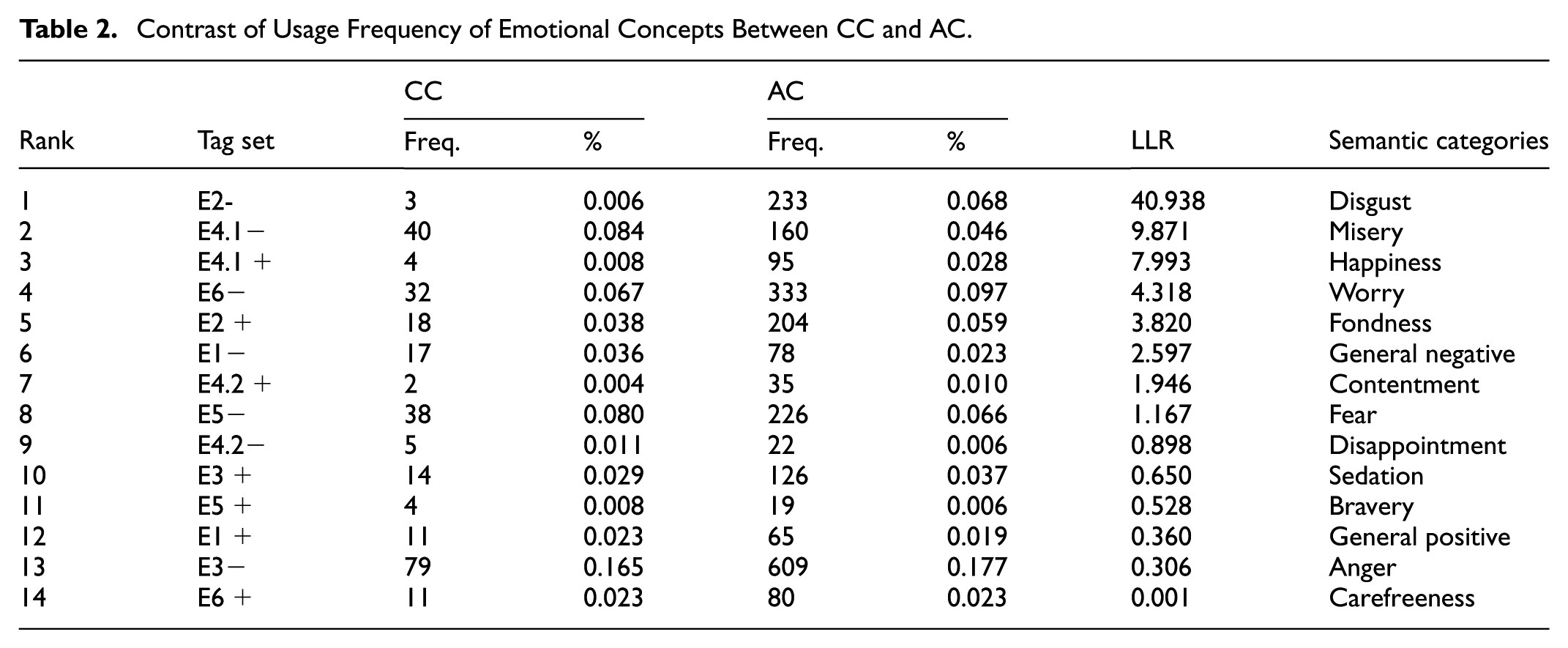
According to the log-likelihood ratios (LLR) in Table 2, there is significant differences in the usage frequency of E2− (disgust), E4.1− (misery), E4.1+ (happiness), and E6− (worry) emotional concepts between China’s and American newspapers. Among them, the difference in the usage frequency of E2− emotional concept between the two countries’ newspapers is the largest, while the difference in the usage frequency of E6+ (carefreeness) emotional concept is the smallest. According to the percentages of usage frequency (the ratios of usage frequency of an emotional concept to the total numbers of words in CC or AC), among the four emotional concepts with significant differences in usage frequency between the two countries’ newspapers, China’s newspapers relatively prominently employ the emotional concept of misery, while American newspapers relatively conspicuously exploit the 3 emotional concepts of disgust, happiness, and worry. Overall, although there are significant differences in the usage frequency of many emotional words between the two countries’ newspapers (involving 28 emotional words in 11 categories of emotional concepts), when all emotional words are aggregated into emotional concepts, the significant effects of the differences in the usage frequency of the 28 emotional words are influenced by the usage frequency (of the emotional words) that are not significantly different between the two countries’ newspapers, which results in small differences in the usage frequency of emotional concepts, that is, there are significant differences in the usage frequency of only 4 categories of emotional concepts.
The Causes for the Differences in the Discoursal Emotional Characteristics
From the contrastive analyses of emotional words and concepts of the news on global warming between China’s and American newspapers, it can be seen that China’s newspapers exploit 21 emotional words more prominently than American newspapers, and make use of these emotional words to highlight the serious negative impact of global warming on certain regions, species, human life and production, demonstrate the current states and urgency of addressing global warming, and indicate that some countries do not attach enough importance to and take no action on the global warming issues. American newspapers, on the other hand, utilize 7 emotional words more prominently than China’s newspapers, and the former employs these words to conspicuously present the issues of global warming from either positive or negative perspectives, reflecting opposing views on global warming governance and highlighting the negative impact of global warming on people’s life and production. In addition, at the stratum of emotional concepts, China’s newspapers relatively prominently exploit the emotional concept of misery, while American newspapers relatively highlight 3 categories of emotional concepts: disgust, happiness, and worry. The ideological differences between China and the United States might be the main causes for the differences in the use of emotional words and concepts. Specifically, these differences in the discoursal emotional characteristics might reflect the antitheses between stances of media in China and the United States, the collectivism and the individualism, the harmony thought and the prioritization of interests, and the community with a shared future for mankind and the America first.
Firstly, the stances of China’s and American media might be different. China’s media are usually controlled by state, they are the spokespersons for the government and maintain the latter’s stances and policies. For instance, China’s newspapers tend to utilize emotional words to display Chinese supportive stances on international cooperation in addressing global warming. However, American media are usually privately owned and independent of state. They might take different stances on the issues of global warming. Therefore, American newspapers often exploit both positive and negative emotional words to present controversies over global warming governance.
Secondly, collectivism is an important component of traditional Chinese cultures and socialist values, which advocates that individuals should be subordinate to a community, society, ethnic group, and country. This ideology might be reflected in the use of emotional words and concepts in China’s newspapers. For example, China’s newspapers seldom employ the emotional words that highlight the opposing views on global warming governance, they are inclined to present a consistent stance on climate governance, emphasize the serious negative impact of global warming on certain regions, species, human life and production, and demonstrate the current states and urgency of addressing global warming. These standpoints could raise public awareness of global warming and promote collective action on global warming governance. Individualism might be one of the core values of American cultures and society, which emphasizes individual rights, freedoms, and independence. This ideology might be embodied in the discoursal emotions of American newspapers. For instance, the sentential examples constructed by the emotional words in American newspapers prominently display the issues of global warming from both positive and negative perspectives, and demonstrate opposing views on global warming governance. The transmission of different perspectives might reflect the embodiment of the independent expression rights of diverse individuals (communities).
Thirdly, the harmony thought is important reflection of the concept of “harmony between nature and man” in traditional Chinese cultures. This ideology advocates the harmonious unity and prosperous coexistence of humanity with the external world such as nature and the universe (Xiao, 2008, p. 31). The sentential examples constructed by emotional words in China’s newspapers tend to highlight the serious negative impact of global warming on certain regions, species, human life and production, and display the current states and urgency of addressing global warming. Meanwhile, China’s newspapers are inclined to exploit relatively prominently the emotional concept of misery. These discoursal emotional features emphasize the disharmony between nature and man, so as to trigger people’s participation in climate governance activities that restore the harmony between man and nature. The United States might adhere to the ideology of prioritization of interests, and believe that international climate conventions have suppressed the development of US economies (H. Zhang & Yang, 2022, p. 50). Therefore, various political parties in the United States might be divided over the issues of global warming governance. These divisions could be reflected in the discoursal emotions of American newspapers, where the emotional words prominently present the issues of global warming from both positive and negative perspectives which convey the opposing views on global warming governance. Moreover, American newspapers relatively prominently utilize 3 categories of emotional concepts: disgust, happiness, and worry, which could embody the conflicts among emotional concepts.
Finally, the ideology of the community with a shared future for mankind is highly advocated by the Chinese government. This ideology tends to emphasize the interconnectedness of the global community and the shared interests among all humans, transcending nationalities, ethnicities, and other distinctions. It is inclined to highlight the critical role of international cooperation and collaborative efforts in tackling shared challenges and achieving collective aspirations for the advancement of humanity (Khan et al., 2021). Therefore, in global warming governance, no country could stand alone. This ideology might be reflected in the discoursal emotional characteristics in China’s newspapers, where the emotional words and their sentential examples tend to display that certain countries do not attach enough importance to and do not take action on the issues of global warming. This judgment is actually based on the premise that in global warming governance, every country needs to fulfill its responsibilities, and no country should turn its back on it. Meanwhile, the ideology of the America first might emphasize that the national interests of the United States take priority over the interests of other countries and international communities (H. Zhang et al., 2021, p. 40). The United States might believe that global warming governance needs to limit carbon dioxide emissions, which would increase the operating costs of enterprises, curbs the economic development of the United States, and sacrifices American interests in favor of benefiting other countries, ultimately infringing on the sovereignty of the United States. Therefore, some political parties in the United States tend to doubt the authenticity of global warming and resist climate governance measures, which might be an important manifestation of the ideology of America first. And American newspapers might be influenced by the ideology of these political parties, leaving a place for their political views when reporting on global warming. Thus, the sentential examples constructed by emotional words in American newspapers are inclined to highlight the issues of global warming from both positive and negative perspectives, present opposing views on global warming governance, and emphasize the conflict between emotional concepts.
Discussion
This study contrasted the discoursal emotions of the news on global warming between China’s and American newspapers, and the research objectives have been achieved, that is, by constructing the Socio-emotional Theory and employing a combination of corpus approaches, semantic annotation, frequency contrast analysis, and discourse analysis, the study disclosed the detailed differences in emotional words, meanings and concepts in news on global warming between China’s and American newspapers, as well as the underlying causes for these differences. Meanwhile, the research questions have been answered. Firstly, this study found that China’s and American newspapers employ 21 and 7 emotional words relatively prominently, respectively. Secondly, the analyses of the sentential examples constructed by these emotional words show that China’s newspapers tend to exploit the 21 emotional words to highlight the serious negative impact of global warming on certain regions, species, human life and production, demonstrate the current states and urgency of addressing global warming, and indicate that some countries might not attach enough importance to and take no action on the issues of global warming; American newspapers are inclined to utilize the 7 emotional words to present the issues of global warming from both positive and negative perspectives, reflecting the opposing views on global warming governance and highlighting the negative impact of global warming on people’s life and production. Thirdly, the analyses of emotional concepts disclose that China’s newspapers relatively prominently use the concept of misery, while American newspapers relatively conspicuously exploit 3 categories of emotional concepts: disgust, happiness, and worry. Finally, the differences in emotional characteristics mentioned above might reflect the antitheses between stances of media, the collectivism and the individualism, the harmony thought and the prioritization of interests, and the community with a shared future for mankind and the America first between China and the United States. In other words, it might be these opposing ideologies that contribute to the discoursal emotional differences in the news on global warming between China’s and American newspapers.
Based on Van Dijk’s (2018, p. 27) Socio-cognitive Approach and previous assertions about the relationship between discourse and emotions, as well as emotions and ideologies (Fenigsen et al., 2020, p. 6; Peng & Hou, 2023, p. 444; Tamir et al., 2016, p. 67), this study constructed the Socio-emotional Theory and revealed the differences in the discoursal emotions of the news on global warming between China’s and American newspapers from three strata: emotional words and their sentential examples, emotional concepts, and ideologies, and disclosed the causes for these differences. The theory and the analytical framework could expand the theoretical boundaries of discourse analysis. Meanwhile, grounded on 14 categories of emotional concepts, this study conducted comprehensive and systematic analyses of the discoursal emotions of relevant news in China’s and American newspapers. In terms of research methods, this study might go further than the studies that only focused on positive and negative polarized emotions (Effrosynidis et al., 2022; Gardiner et al., 2023). It might not only reveal more detailed differences in categories and their distribution of emotional words between China’s and American newspapers, but also demonstrate more specific differences in the use of emotional concepts between the two countries’ newspapers. Therefore, this study might be more refined than some relevant research.
In the analyses of emotional words and their sentential examples, this study discloses that both China’s and American newspapers prominently employ some emotional words. The prominent use of these words by American newspapers to present opposing views on global warming governance is similar to the research findings by Effrosynidis et al. (2022), which suggest that the media will exhibit positive and negative emotional stances on climate issues. However, this study also reveals that China’s newspapers tend to prominently exploit emotional words to demonstrate the harm of global warming and the urgency of addressing it, thereby increasing public attention to and participation in global warming governance. These views reflect that China’s newspapers might only take a consistent supportive stance on climate governance. Therefore, this study might offer more research insights than other relevant studies, that is, research on discoursal emotions of the news on global warming could not be separated from the analyses of political factors. Meanwhile, when countries cooperate in addressing global warming, they might not only need to understand the emotional tendencies and positions in the discourse of each other, but also need to deeply investigate the mutual political environment and mainstream ideologies. They might find it necessary to deeply understand the motives behind each other’s emotional expressions, be tolerant of one another, and seek common ground while acknowledging and respecting their differences. They should conduct the global warming governance on the ground of maximizing the political and economic interests of all countries, so as to enhance the cohesion and governance effectiveness of the alliance.
In the analyses of emotional concepts, this study shows significant differences in the use of 4 categories of emotional concepts (misery, disgust, happiness, and worry) between China’s and American newspapers. Among these emotional concepts, China’s newspapers tend to prominently feature the concept of misery, while American newspapers are inclined to notably employ the other 3 categories of emotional concepts. These emotional concepts share similarities with those identified in previous studies, which disclose the presence of emotions such as disgust (Robinson, 2024), tragedy, and comedy (Foust & O'Shannon Murphy, 2009) in media discourse on climate change. However, this study, based on the statistical analysis of the usage distribution of 14 categories of emotional concepts, concludes that China’s and American newspapers prominently utilize 4 categories of emotional concepts: misery, disgust, happiness, and worry, whose findings might be considered more comprehensive than the results obtained from some non-contrastive studies.
In terms of ideological analysis, based on the viewpoints of H. Zhang and Yang (2022), which suggest that China’s and American news might respectively highlight the ideologies of “ecological priority” and “interest priority,” this study further points out the differences in the discoursal emotional characteristics of the news on global warming between China’s and American newspapers might reflect the antitheses between stances of media, the collectivism and the individualism, the harmony thought and the prioritization of interests, and the community with a shared future for mankind and the America first between China and the United States. And ideologies could dominate the use of discoursal emotions in media reporting on global warming, which might embody the media’s adaptation to local socio-cultures when disseminating the news on global warming (Hoffman, 2015, pp. 3–4; Moser, 2014, pp. 347–348).
Community is a fundamental mode of human survival. To some extent, people living in the same community often share some ideologies, and whether due to habit or imitation of community members, people’s words and action are often influenced by the ideologies of the community. In the contexts of specific ideologies, people usually unconsciously take some emotional stances when depicting climate phenomena that were originally devoid of emotions. These emotional expressions might not only facilitate emotional resonance among communication partners, and promote the dissemination and acceptance of viewpoints, but they might also attract the attention of members of the same community, consolidate consensus of the community, and thus maximize the effectiveness of the communication.
In summary, emotional words and their sentential examples, emotional concepts, and ideologies are closely related to each other, and emotions might be ubiquitous in discoursal communication. Therefore, the Socio-emotional Theory constructed in this paper might provide a new analytical perspective for discourse analysis. Meanwhile, this paper investigated the ideological differences in the news on global warming between China’s and American newspapers from the perspective of discoursal emotions, which might have practical implications for eliminating barriers and misunderstandings in global climate governance. However, the corpora used in this study were limited in size. Future research could employ larger-scale relevant corpora for contrastive analyses, thereby revealing more comprehensive results. Meanwhile, this study employed emotional words as the basis for identifying and analyzing discoursal emotions in news, which might represent a compromise between machine analyses and manual analyses. At present, it seems there are no machine analyses that could accurately identify discoursal emotions in a text with 100% precision. Analysis methods based on emotional words might be more efficient and accurate. The researcher hopes that more scholars can devote themselves to the research on discoursal emotion recognition technology in the future, which would enhance the convenience and accuracy of machine analyses of discoursal emotions, thereby better addressing the analyses of extremely large-scale corpora.
Conclusion
This study employed corpus approaches, semantic annotation, frequency contrast analysis, and discourse analysis to investigate the differences in discoursal emotions of the news on global warming between China’s and American newspapers, as well as the causes for the differences, from the perspective of Socio-emotional Theory. The 4 research questions have been answered. Firstly, China’s newspapers tend to exploit 21 emotional words more prominently than American newspapers, including sensitive, dismissive, soft spot, treasure, calm, hit, rebellion, outrage, cruel, ferocious, celebration, suffer, graver, tragically, grim, disappointing, dare, shock, alarm, and flinch, while American newspapers are inclined to notably utilize 7 emotional words than China’s newspapers, such as love, oppose, opposition, complain, attack, poison, and worry. Secondly, China’s newspapers are apt to employ the above 21 emotional words to emphasize the serious negative impact of global warming on certain regions, species, human life and production, display the current states and urgency of addressing global warming, and state that some countries might not attach enough importance to and take no action on the issues of global warming; American newspapers tend to make use of the above 7 emotional words to present the issues of global warming from both positive and negative perspectives, reflect the opposing views on global warming governance and highlight the negative impact of global warming on people’s life and production. Thirdly, China’s newspapers prominently resort to the emotional concept of misery, while American newspapers conspicuously employ 3 categories of emotional concepts: disgust, happiness, and worry. Finally, the antitheses between stances of media, the collectivism and the individualism, the harmony thought and the prioritization of interests, and the community with a shared future for mankind and the America first between China and the United States might be the causes for the differences in the above discoursal emotional characteristics. This study constructs the Socio-emotional Theory, which could expand the theoretical boundaries of discourse analysis and promote contrastive research on discoursal emotions. Meanwhile, this study might also help identify the differences in the positions of China’s and American media on global warming, as well as the causes underlying the differences, which might provide important insights for building and strengthening the international alliances to address global warming.
Footnotes

Ethical Considerations
This research investigated the news on global warming in publicly available datasets, and thus, ethical review is not applicable.
Consent to Participate
This research probed into the news on global warming in publicly available datasets. Therefore, informed consent is not applicable.
Funding
The author disclosed receipt of the following financial support for the research, authorship, and/or publication of this article: 2024 Annual Planning Project of Chinese Ministry of Education’s Humanities and Social Sciences Research (No. 24YJAZH112).
Declaration of Conflicting Interests
The author declared the following potential conflicts of interest with respect to the research, authorship, and/or publication of this article: The author declares that he has no financial and personal relationships with other people or organizations that can inappropriately influence his work, there is no professional or other personal interest of any nature or kind in any product, service and/or company that could be construed as influencing the position presented in, or the review of, the manuscript entitled.
Data Availability Statement
Data will be provided upon request.