




Abstract
“Climate change scepticism” is a familiar concept in popular and scholarly discourse and generally refers to a family of arguments and individuals that reject, dispute, or question the orthodox view of the climate issue. At close range though, it is evident that the concept is often used casually, without consideration of the complexity of the category it represents. Scholars have varied interpretations of the concept and sometimes actively dispute its meaning and reach. The article proposes that the sceptic phenomenon can be variegated according to the types of sceptic critiques and, additionally, according to sceptics’ attitudinal characteristics. Taxonomies are proposed for each. The types of sceptic arguments are organised in a conceptual hierarchy consisting of two classes of critiques (“core” and “concomitant”), three centers of scepticism (“evidence,” “process,” and “response”), and seven specific objects of scepticism. For the attitudinal characteristics of sceptics, the article takes stock of the different motives, modes, and certainties of belief among sceptics. It proposes some relabeling of the category and subcategories to more accurately describe nuances in sceptic positions, as well as to dispose of unproductive labels. The article suggests how the refined conceptualisation might help observers and policy practitioners to manage the sceptic challenge in a more discerning and constructive fashion.
Keywords
Introduction
The concepts climate change scepticism and climate change sceptic 1 are in wide use and refer to a fairly consistent family of arguments and pool of individuals that reject, dispute, or question the mainstream/orthodox thesis that the global climate is changing primarily due to human activities and that these changes will affect severely both ecosystems and human populations if left unarrested. The concept has a strong negative connotation because nonacceptance of the mainstream thesis is generally considered indefensible given the established nature of the science and the gravity of the problem. The concept is often used as a means to isolate and delegitimise arguments and individuals assigned to the category. Mainstream exponents have little difficulty labeling critics of the orthodoxy as “sceptics” or “deniers.” For many mainstream adherents, it does not matter if one positively rejects, disputes, or is merely unconvinced, ambivalent, or agnostic about the core climate claims. The net effect is the same: nonacceptance of a thesis about which no doubt should exist.
This article critically reexamines the conceptual constitution of the category. It is noted that sceptics from different walks of life and with different levels of expertise deliver a wide array of critiques at the mainstream thesis and display a wide range of intensities of belief (or nonbelief). Some act as vocal public champions of the sceptic cause while others reservedly express unease about the reliability of the science. Some evidently exploit the issue for personal gain and others are seen to raise their critiques as concerned and responsible citizens. These shades of the phenomenon are largely lost in both the public and scholarly discourse where the blanket labels climate change scepticism/denial and climate change sceptic/denier still dominate. And on occasions where the concept is being disentangled, some contestation of the concept and its labels remains evident (Capstick & Pidgeon, 2014; O’Neill & Boykoff, 2010).
Following Capstick and Pidgeon’s (2014) identification of “two broad treatments” of the concept, namely, in relation to its epistemic and behavioural senses, this article sets out a scheme for its further delineation (p. 390). It proposes the isolation of “process scepticism” as a distinct center of scepticism alongside the familiar “evidence” and “response” critiques of sceptics. It is argued that these three conceptual stations allow observers to draw important qualitative distinctions between sceptics based on where their scepticism is anchored. It also helps to show the various ways in which sceptic logic “flows,” for instance, from the evidence center to the process and response centers, or from the process center to the evidence and response centers. It is an important proposition in this analysis that the process center is underrated as a primary source of scepticism from which sceptics might derive their evidence and response misgivings. The article also reflects on the attitudinal variety among sceptics, that is, their different qualities of belief, as well as the labels to describe these. Effort is made to dispose of inaccurate and counterproductive labeling practices.
Improved conceptualisation of climate change scepticism has both academic and practical benefit. The following areas stand out where advances could be made in reducing misinterpretation of the phenomenon and mismanagement of the sceptic challenge.
Climate change scepticism among elites and intellectuals is often constructed as rooted in and motivated by extraepistemic concerns. The scholarly narrative of the scepticism of elites is that it is primarily an artifact of material, political, and ideological forces and that the evidence dispute is a mere smoke screen for these forces to play out (see Gelbspan, 2004; Hamilton, 2006; Hoggan, 2009; Leggett, 2001; McCright & Dunlap, 2010; Oreskes & Conway, 2010; Pooley, 2010). The story of climate change scepticism is one of self-interest and manipulation, of how a scientific controversy was fabricated to confuse the public and decision makers, and delay decisive action against climate change. The logic in this story line is that sceptics are actually defending, knowingly and unknowingly, vested economic interests (those with a stake in the continuation of a fossil fuel–based energy economy) and the prevailing neoliberal free market paradigm (which includes the notions of individual freedom, small government, and economic growth). Although such observations about climate change scepticism and sceptics are well founded, they have come at a cost. Sceptic elites of various persuasions and motivations have come to be understood as disingenuous. Engagement of sceptics has become clichéd—married to the idea that there simply must be extraneous reasons for someone to doubt the mainstream climate view.
Another area of potential misjudgment emanates from the tendency of exponents on both sides to draw stark battle lines between “credible experts” and “fraudsters,” between “sound” science and “junk” science, and between respectable scientific establishments and pseudoscientific lobbies. These debates are important in helping to clear the scientific air, but when they are sweepingly cast as a battle between right and wrong, competent and incompetent, and reputable and disreputable, the opposing side is reduced to a one-dimensional stereotype. In the process, opportunities are lost for the constructive engagement of amenable sceptics.
Potential miscalculation might also occur through misinterpretation of sceptics’ “extended” critiques. Sceptics very rarely confine their critiques to the physical evidence of climate change. They often, and expectedly so, extend their arguments to climate relevant topics, such as debates about the integrity of the scientific processes behind the evidence for dangerous human-caused climate change or debates about society’s response to the climate issue. The dilemma is that although their extended arguments are commensurate with their readings of the science, sceptics are not the only proprietors of these arguments. Many nonsceptics, particularly among right-wing partisans but not exclusively so, are, just like the sceptics, concerned about perceived deficiencies in the processes behind climate science and/or climate policy responses. It is important, therefore, to place the respective types of sceptic critiques into proper perspective.
Most mainstream adherents view the sceptic challenge as a grave threat to the credibility of climate science because it is perceived to undermine the science, rather than enhance it. Cook states that climate change scepticism is “the complete opposite” of genuine scientific scepticism: “It’s coming to a preconceived conclusion and cherry picking the information that backs up your opinion. Global warming scepticism isn’t scepticism at all” (Mulvaney, 2010). The problem with this kind of generalised dismissal of climate scepticism is that sceptics invert such dismissals as proof of their initial concern that scientific processes are not transparent and open to scrutiny. There is a need, therefore, to consider if and how sceptics’ critiques might be used constructively to demonstrate rigour and due process in climate science.
The rest of the article is organised into two main sections, the first to investigate the types of sceptic critiques, that is, the objects of scepticism, and the second to investigate the attitudinal variety among sceptics, that is, their motives, modus operandi, and the certainties of belief that they bring to the debate. Each section ends with a proposal for a taxonomy. The conclusion of the article raises some practical applications of a refined conceptualisation of the phenomenon.
Objects of Scepticism
Evidence Scepticism (Trend, Cause, and Impact Scepticism)
Rahmstorf (2005) pioneered the trend–attribution–impact typology of climate change scepticism, which disentangles sceptics’ challenge of the scientific evidence of anthropogenic climate change. This approach assumes that sceptics follow a “stepped” pattern of scepticism with trend scepticism, that is, denying a significant warming trend or proclaiming a cooling trend, at the pinnacle. Attribution scepticism would be one step down on the scepticism ladder because it might accept the trend claim but not that humans are primarily responsible. Impact scepticism would be another step down because it might accept that humans are altering the climate but downplays the scale of potential negative effects from climate change. The trend–attribution–impact typology enjoys wide currency. Wikipedia (2014) defines climate change denial as a set of organised attempts to downplay, deny, or dismiss the scientific consensus on the extent of global warming (trend claim), its significance (impact claim), and its connection to human behavior (attribution claim). The typology has also been expressed as “stages” of denialism, where a sceptic might start off as a trend sceptic but, as the evidence of global warming mounts, migrate to attribution scepticism and, again, as the evidence of human influence on the climate mounts, migrate to impact scepticism (Hamilton, 2007; Nuccitelli, 2013).
Rahmstorf’s typology is realistic and useful because it mirrors the evidence claims made in Intergovernmental Panel on Climate Change (IPCC) assessment reports, the most authoritative account of the mainstream thesis. The first three chapters of the last complete IPCC Assessment Report, AR4 published in 2007, 2 respectively deal with the trend of climate change, its causes, and its impacts (see Pachauri, Reisinger, & Core Writing Team, 2007). AR4 states that “Warming of the climate system is unequivocal, as is now evident from observations of increases in global average air and ocean temperatures, widespread melting of snow and ice and rising global average sea level” (p. 30). This is the so-called trend claim. It also finds that “Most of the observed increase in global average temperatures since the mid-20th century is very likely due to the observed increase in anthropogenic GHG concentrations” (p. 39). This is the so-called attribution claim. Regarding the impacts of climate change, the report describes different scenarios for different warming stabilisation levels. At a 2 °C above 20th-century average temperature stabilisation level (the lowest modeled by AR4), it foresees “hundreds of millions of people exposed to increased water stress,” “increased damage from floods and storms,” “changed distribution of some disease vectors,” and “increased morbidity and mortality from heat waves, floods and droughts.” These, and many more region specific predictions, are the so-called impact claims.
These claims are fairly unequivocal, and mainstream exponents generally accept them as the core claims of the mainstream climate thesis about which no doubt should exist. Sometimes, sceptics respond to the core claims in equally unequivocal terms, such as in the following examples: Earth’s temperature is currently cooling slightly, ocean heat is declining, global sea-level rise has not accelerated (although the climate models predict that it should) and tropical storm energy is at a thirty-year low. (Carter, 2011, p. 39) The warmists are correct that CO2 is a greenhouse gas and it causes warming, that CO2 levels have been rising, and that it has been warming. Serious sceptics agree with all that, but point out that it does not prove that something else isn’t causing most of the warming. (Evans, 2012) There is no evidence that man’s production of carbon dioxide is causing more extreme weather events. Any change caused by man will be gradual and there will be plenty of time to adapt, as humans have always done. Most people will hardly notice it. (Forbes, 2013b)
More typically, however, sceptic responses are convoluted, which can make it difficult to pinpoint their specific objects of scepticism, as seen in the following statement from the Australian sceptic group, The Carbon Sense Coalition (Forbes, 2013a). The author’s comments appear in square brackets.
The so called greenhouse gases (mainly water vapour and carbon dioxide) have the ability to absorb radiant energy and transmit it to their surroundings [accepting the potential contribution of CO2 to global warming] . . . carbon dioxide occurs in tiny trace amounts in the atmosphere, and any surface heating it could do is already being done by water vapour [not rejecting but downplaying the attribution claim], which is more abundant and affects far more energy wavelengths. . . . It probably makes the nights slightly warmer, especially in higher latitudes during winter; and it probably has little effect on daytime temperatures [limited acceptance of the trend claim]. But additional carbon dioxide in the biosphere gives a major boost to all plants which feed all animals [downplaying negative impacts]. It is not a pollutant, anywhere [rhetorically indemnifying CO2]. (http://carbon-sense.com/, The Carbon Sense Coalition, The Global Warming Gas, or The Bread and Butter of Life? June 17, 2013, http://carbon-sense.com/wp-content/uploads/2013/06/gas-of-global-warming.pdf)
It is proposed here that the trend, attribution, and impact objects constitute the core of the concept “climate change scepticism” because they correlate directly, one-to-one, with the core assertions of the mainstream climate thesis. If the concept is to be preserved in its commonsense meaning as the antithetical climate view, that is, not just any problematic climate view, then the primacy of its grounding in the evidence dispute should be accepted. That the evidence dispute should serve as the definitional heart of the concept is implicitly recognised in studies that present frameworks that place the evidence dimension at the “top” or categorically preceding other dimensions (cf. Capstick & Pidgeon, 2014, pp. 391, 397). Akter, Bennett, and Ward (2012) are somewhat more explicit in this regard when they find that attribution scepticism was “a common source of impact, mitigation and global co-operation scepticism” (p. 25).
The importance of specifying the evidence dispute as the definitional heart of the concept will become clearer in the subsequent sections that discuss sceptics’ “extended” arguments, that is, aspects of the climate debate that are natively commensurate with evidence scepticism but not dependent on it (collectively referred to as “concomitant” objects of scepticism).
Process Scepticism
Sceptics make various critiques of the scientific, bureaucratic, and political processes behind mainstream climate science. Their arguments about the scientific processes include that the massive funding of climate research has become a biasing factor in climate research, that important “new” and contradictory research is habitually overlooked in mainstream climate research, that there are serious lapses in peer review and oversight of published research (in particular, IPCC reports are seen as consensus documents, rather than scientific “truth”), and that overreliance on and manipulation of computer modeling is distorting climate research. The political decision-making processes relating to the climate issue are also directly and indirectly questioned by sceptics when they claim that the climate issue might be a hoax or conspiracy and that prominent mainstream exponents and the media exaggerate the climate threat (see Smith & Leiserowitz, 2012; Whitmarsh, 2011). The context of these suspicions is that the public is being misled and that public decision-making processes are distorted.
Although sceptics’ process critiques are well recognised as an integral part of sceptic arguments, these have hitherto not been presented as a separate center of scepticism. Capstick and Pidgeon (2014) place doubts about the conduct of science, the reliability of mainstream climate expertise, and the portrayal and communication of climate science in the same category as the disputation of the physical evidence, which they collectively call “epistemic scepticism” (pp. 390-391, 397). These objects of scepticism have a similar functional purpose, namely, to cast doubt on “the status and generation of knowledge around climate change.”
It is argued here that sceptics’ process critiques require a distinct conceptual status. The concept process scepticism sets apart a group of sceptic arguments that are not dependent on either evidence or response scepticism but enables and strengthens them. It is proposed that “process scepticism” is a strong center of scepticism and that many sceptics are indeed anchored in this center, rather than the detailed technical contests around the evidence or how society should respond. The process critiques (e.g., there is a lucrative climate industry, scientists pursue funding and shut out dissenting voices, the media exaggerates the threat, environmentalists and socialists drive the climate agenda) appeal intuitively to sceptics, who are strongly oriented in the climate issue by cognitive, cultural, and ideological predispositions (Kahan, 2012; Kahan &Braman, 2006). Scholars have found that process critiques are conspicuously present in the affective imagery cognitive processes responsible for climate change scepticism (Smith & Leiserowitz, 2012).
“Process scepticism,” therefore, offers a conceptual option that allows observers to draw distinctions between three centers of scepticism, the other two being evidence and response scepticism. It helps to differentiate sceptics of the physical evidence who extend their sceptic assault to process issues (and ultimately the response question) from those who have no clear knowledge of, or judgment about, the evidence and ground their apprehensions in perceived process irregularities and response deficiencies.
Process critiques also differ from evidence critiques in that they can be held by nonsceptics. Mike Hulme, a former lead author at the IPCC and patently nonsceptical of the mainstream thesis, has been publicly critical of the IPCC’s emphasis on “consensus building” (Hulme & Mahony, 2010, pp. 10-11), its reluctance to allow scrutiny (Hulme & Mahony, 2013), as well as the apparent closing of ranks by the climate scientists at the center of the so-called Climategate revelations (Hulme, 2013b). Process scepticism is therefore open to sceptics and nonsceptics alike, whereas evidence scepticism, by definition, excludes the nonsceptics.
Response Scepticism
Several observers recognise that scepticism of the public and private responses to the climate issue is an important center of scepticism. Hamilton (2013) argues that response scepticism is one of the common themes in the family of sceptic arguments: First, they deny that climate change is occurring. Then they say that if it is occurring it’s not due to humans. Then they claim that if it is due to humans, the effects are trivial. If the effects are shown to be non-trivial, they opine that the benefits will exceed the damage. If the damage is shown to predominate, they say the cost of avoiding the damage is too high.
Painter is more emphatic and includes “policy sceptics” as a fourth type in his typology (Painter, 2012, p. 196). Capstick and Pidgeon (2014) offer a two-pronged typology with “response scepticism” as the second type next to “epistemic scepticism”. In their conceptualisation, “response scepticism” concerns “(D)oubts about the efficacy of action on climate change; doubts about the personal and societal relevance of climate change” (p. 397). Akter et al. (2012) propose five dimensions of scepticism, the first three of which relate to the evidential base of climate science, and the last two, which they call “mitigation scepticism” and “global co-operation scepticism,” relating to society’s response to the climate issue (p. 3). For some, response scepticism represents the epitome of climate change scepticism. SourceWatch defines a “global warming sceptic” as any position within the umbrella group, “opponents of effective global warming action,” where “effective action” entails putting a price on fossil fuel emissions, such that their true cost becomes clear and the economic “invisible hand” can wreak its market magic. (SourceWatch, 2014)
It could be argued that sceptics would be impelled, on the basis of their contrary reading of climate science, to oppose climate mitigation responses. The majority of sceptics do, in fact, follow the logic of their evidence scepticism through in this way. Yet, some scholars caution that there is no straight line between scientific evidence and one’s choice of response; that a certain reading of the science does not necessarily imply a certain policy preference. Research has shown that people’s support for climate mitigation depends significantly on factors other than their assessment of the probability and severity of future climate risks. Lee and Cameron (2008) found that willingness to pay for climate mitigation varies according to the domestic instrument of choice, as well as the international level of cooperation. The point is also argued philosophically, for instance, Hulme (2013a), who calls for a “repoliticise(ation of) climate change, to challenge the scienticism which suggests that science should trump politics” (p. 295). Anderegg (2010b) makes a similar point: . . . science has little or no special role in determining should we act to curtail climate change and how we should act. This path must be picked up by economists, social scientists, ethicists, humanists, and the general public. (p. 336)
The ambiguity between science and policy is nowhere clearer than in the case of the impact sceptics. Impact scepticism is commensurate with a wide range of possible policy responses. Some impact sceptics dismiss mitigation because for them it is addressing a nonexistent problem. Others have a pragmatic view, believing that even if they do not expect severe negative climate impacts, climate mitigation measures might deliver positive spin-offs in terms of greater energy efficiency and the promotion of cleaner technologies (Van Rensburg, 2012). In addition, impact sceptics find themselves aligned with nonsceptics who oppose mitigation because they doubt the cost-effectiveness of such measures, not because they doubt the negative impacts of climate change. The controversial Danish economist Bjørn Lomborg, who advocates an alternative response path purely based on cost–benefit considerations, is an example (Lomborg, 2009). The differences between impact scepticism and response scepticism blur when sceptics appropriate the arguments of nonsceptics like Lomborg to open another line of attack against the climate change orthodoxy and its supposed economic imperatives.
The ambiguity of opposition to climate policies is also demonstrated by left-wing critiques of carbon pricing mechanisms. A few examples from the Australian context are quoted here. The Green Left Weekly (Butler, 2012), the mouthpiece of a socialist environmentalist activist group, describes the climate change debate as a “fake” debate because the outcomes of the two big national parties’ (the center–right Liberal–National Party [L-NP] Coalition and the center–left Australian Labor Party [ALP]) climate policies would be very similar. Calling the L-NP Coalition “climate deniers” and the ALP climate “pretenders,” it argues that even though the ALP is more ambitious than the L-NP Coalition, its policies too would be too little too late. “To act slowly or to act not at all matters little. Both will bring the exact same result—an unspeakable future of climate catastrophe.” The group is convinced that the reigning economic model cannot solve the climate problem: “. . . the biggest (problem) is that it assumes we can solve the climate crisis with the same kind of thinking that got us into it.” Carbon pricing, as an “indirect lever to bring emissions down” is dismissed in favor of “direct measures” such as the outright prohibition of fossil fuel extraction, closing fossil fuel infrastructure and deploying renewable sources of energy. The Green Left Weekly argument is echoed by the leftist blog En Passant (Passant, 2013), which describes the “discourse between the Government and Opposition” as “irrelevant.” “Labor doesn’t have a commitment to the environment. It has a commitment to capitalism and getting elected.” Just like the Green Left Weekly, it argues that carbon pricing will not solve the problem—“capitalism cannot address climate change.” En Passant calls for “system change” before there could be any hope of addressing climate change.
These sentiments are not confined to Australian environmentalists. Naomi Klein, Canadian anticorporatism, antiglobalisation, and environmentalist writer and activist, believes that the environmental movement is in “deep denial” about the failure of carbon pricing to deliver big emission cuts (Mark, 2013). She argues that climate initiatives like the Kyoto Protocol, the UN Clean Development Mechanism, and the EU Emissions Trading Scheme have “disastrous” track records. They have not reduced emissions, are characterised by “no end of scams,” and have resulted in a massive “corporate giveaway.” Caught up in the “neoliberal economic orthodoxy” many environmentalists have bought into the notion that corporations are part of the solution. She argues that environmentalists should have “fought back,” “defend(ed) the values it stood for,” and “resist(ed) the steamroller that was neoliberalism.” She argues that environmental victories in the past have come through “command-and-control” pieces of legislation; a “top-down regulatory approach.”
Response scepticism is the most distant from evidence scepticism, which is the definitional heart of climate change scepticism. Because it speaks to matters of governance that have relevance quite independent from the climate issue, like the desired level of government regulation, the timing and efficacy of tax/pricing mechanisms, and strategic considerations of a nation’s global responsibilities and capabilities, response scepticism is accessible to a much wider general audience. Reserving a unique conceptual space for response scepticism allows discrimination between sceptics who are grounded in evidence critiques and those who are more concerned about the broader governance issues associated with climate responses.
Proposal for a Taxonomy
Figure 1 shows how the aforementioned types of sceptic arguments can be conceptually organised. At the lowest level of classification, sceptic critiques belong to one of seven specific “objects” or targets of scepticism. Considering the nature of each of these specific sceptic targets, three “centres” of scepticism emerge. The three centers—evidence, process, and response—provide a neat categorisation that provides a home for the technical evidence dispute, a home for arguments about the processes through which the evidence pass beyond the laboratory, and finally a home for arguments about how society should respond to the evidence (or perceived lack of evidence). At the top level of categorisation, the centers of scepticism divide into two broad classes of sceptic arguments. The evidence critiques are labeled core and definitional—“core” because of their antecedent nature and “definitional” to preserve the integrity of “climate change scepticism” as the antithetical climate view. The process and response critiques are labeled concomitant 3 because they are commensurate with but not dependent on evidence scepticism. The core class of critiques defines a sceptic as a sceptic and attracts the concomitant class of critiques that are highly congruent with and supportive of evidence scepticism. In many cases, the concomitant arguments dominate sceptics’ argumentative rationales. They are widely acknowledged as integrally part of the sceptic identity.

Conceptual hierarchy of sceptic critiques.
The distinction between core and concomitant types of critiques remain important though. An individual’s scepticism might primarily reside in the concomitant objects, from where evidence deficiencies are inferred, without the person making (or able to make) an informed assessment of the physical science. Individuals who are rooted in the concomitant objects of scepticism might be expected to be less rigorous and less intense when they profess their views because they have not committed to one or more of the core evidence objects, like the more virulent and outspoken sceptics. Observers and policy practitioners dealing with the sceptic challenge need to approach the concomitant critiques with caution because they can be, and are, held by nonsceptics as well.
Table 1 provides some examples of typical sceptical claims associated with each object of scepticism.
The Objects of Climate Change Scepticism With Accompanying Sceptic Claims.

Note. IPCC = Intergovernmental Panel on Climate Change.
This taxonomy makes clear the bases for drawing distinctions among sceptics and their arguments, and might be used as a practical tool to classify sceptics, bearing in mind, though, that sceptics can be rhetorically skillful and that they often couch or hedge their claims. Also, most sceptics critique a casual mix of variously the evidence, processes, and responses associated with the mainstream view, which can make it difficult to determine their essential dispute or concern. The challenge, from an analytical point of view, is to establish where the weight of an individual’s sceptic claims rests, or which object(s) are instrumental in their arguments. Such analysis would allow meaningful and purposeful discrimination within the sceptic category, the implications of which are highlighted in the “Conclusion” section.
The article now proceeds to deal with additional bases for variegating the sceptic phenomenon. These are collectively called “attitudinal” characteristics because they speak to the character or quality of sceptics’ beliefs, which might be evident through their presumed motives, the way they conduct themselves, and the degree of certainty with which they express their views (boldness of language).
Attitudinal Characteristics of Sceptics
Different Motivations and Modes
Some observers have tried to distinguish between sceptics on the basis of their motivations and, consequently, the modes they have chosen for airing their views. Most of these attempts are premised on the argument that some sceptics are merely using their climate views to advance their material and/or ideological interests, and because of this deception, they should be considered qualitatively different to those who are truly mistaken or misguided about the climate issue.
Painter thinks it is useful to distinguish between “organised scepticism linked to well-funded bodies” and “individual sceptic(s) with no such links” (Painter, 2012, p. 198). Powell (cited in Walker, 2014) distinguishes between “professional science deniers” who do it for money or ideological reasons and scientists who are “contrarian by nature,” who revel in being different and provocative and seriously believe they are advancing the science by questioning the orthodoxies. This typology is closely replicated by Diethelm and McKee’s (2009) distinction between those driven by “greed,” “ideology,” or “faith” and those driven by “eccentricity and idiosyncrasy” (p. 3). Rahmstorf (2005) proposes three sceptic “archetypes”: paid lobbyists (those in the pay of fossil fuel interests), Don Quixotists (those who are “emotionally committed”), and eccentrics (scholars from other scientific disciplines) (p. 79). Hamilton (2014) offers three categories of sceptics based on their inner motives: first, the manufacturers of doubt, who deceive the public with their lies; second, the repeaters of the lies, who amplify the views of the manufacturers for political and personal reasons; and third, the consumers of the lies (the public), who are seduced by the manufacturers and repeaters and resort to “casual denial” for any number of psychological reasons.
What these different typologies have in common is that they make a basic distinction between those who have ulterior motives with their climate scepticism and those who are simply mistaken and/or misguided. For many observers, this is an important distinction because it adds a moral dimension to their analysis. It is a distinction fraught with danger though. It would be extremely difficult (impossible indeed) to factually show or in some other way objectively assess someone’s inner motivations, especially when the person in question is suspected of being disingenuous. And by assigning some inner extraepistemic motivation to participants in the debate, by claiming some corruption of the mind by money, ideology, or politics, resentment and polarisation in the climate debate is merely perpetuated and exacerbated.
A distinction cast, though, between original thinkers (the originators of sceptic critique) and the propagators or reproducers of their thinking, might circumvent the problem of inner motivation and moral character, without blunting the accountability of the most egregious sceptics for their actions. Pendergraft (1998) conceives of “scientists” and “prophets” in the climate change debate, where the scientists are supposed to make the “sober” claims and the prophets amplify and moralise such claims (p. 645). The underlying assumption of such a distinction is that the originators actually scrutinised the science and that the reproducers are accepting what they say on trust and intuition. A greater onus, therefore, rests on the originators to get their science right, particularly if they arrive at antithetical conclusions. They can and should be judged to a higher standard because they speak from some position of authority and command the trust of others.
Different Certainties of Belief
There are qualitative differences between someone who emphatically rejects the mainstream climate thesis, someone who disputes aspects of it, someone who feels doubtful, and someone who feels undecided (agnostic). Most common in the literature is a twofold distinction between “rejectionists” (those who dismiss the mainstream climate thesis or key aspects of it outright) and those who are uncertain or harbor reservations about the veracity of the scientific claims. In a study of public opinion in the United States, Leiserowitz, Maibach, and Roser-Renouf (2009) found a range of seven climate change opinion categories, 4 two of which correspond to climate change scepticism, namely, “doubtful” and “dismissive.” The “dismissive” category differs from the doubtful category in terms of the strength of their belief and their active engagement of the issue (Leiserowitz et al., 2009, p. 4). Cook et al. (2013) distinguish between those “uncertain” of the mainstream thesis and those “rejecting” it (p. 3). Painter’s (2012) typology talks of those holding a “falsely balanced view” (not knowing what to believe) and those holding a “dismissive view” (believing that the climate is not changing or that humans are not responsible for changes) (p. 193). Hoffman (2011) distinguishes between a more passive “sceptical” group that is doubtful about climate change and a much more active and organised “denier” group that is working to discredit climate change science (p. 5). The distinction between rejectionists/dismissers and doubters provides a good measure of the intensity of their beliefs, for the rejectionists are unlikely to embark on the level of activism and categorical denial characteristic of their group if they did not hold such beliefs deeply. Studies have, in fact, found that certainty of belief is an important distinguishing quality between groups of sceptics, with the rejectionists feeling very certain about their views, whereas those who are uncertain/reserved feel less certain about their views (Leiserowitz et al., 2009; Whitmarsh, 2011).
The reject/dismiss category is stable and does not reduce to subcategories. The doubtful category, however, subdivides in multiple ways, depending on the analyst’s preferences. Leiserowitz et al.’s (2009) “doubtful” category is subdivided into three: those believing in the trend of climate change but not its human cause and seriousness, those not believing in the trend, and those who don’t know (p. 4). Brin (2010a, 2010b) identifies three sceptic groups that are distinct from the extreme category, namely, climate agnostics, climate denial followers (the gullible, “koolaid-drinking” tools of a propaganda machine), and rational, open-minded, proscience people who are motivated by curiosity to ask legitimate questions of the mainstream thesis.
There is no easy way to describe and identify the finer distinctions among the doubtful sceptics. Several problems are apparent. First, how do we “spot” or “prove” a sceptic if the individual is very circumspect in his or her views and adept at expressing them in sophisticated ways. And even if someone’s scepticism is quite apparent from his or her public expressions, how do we know to what degree he or she has tailored the tone and explicitness of his or her expressions to the audience? Second, what amount of criticism and what tone would place one sceptic in a more extreme category than another? How do we distinguish between the incessant, vocal, and brazen sceptic on one hand and the occasional sceptic voice on the other if they share exactly the same criticisms? And finally, people can be inconsistent when they express their views. Their arguments might be convoluted, or they might modify their views over time—the so-called “water sloshing in a shallow pan” effect described by Revkin (2010). When individuals are ambiguous in their views, which expression at which point in time would mark the person as a particular type of sceptic?
These problems should not preclude us from trying to disentangle the sceptic phenomenon in terms of the different qualities and intensities of belief of sceptics. Before attempting to capture these differences in a taxonomy, the next section first highlights the complexity of settling on a label that unites the sceptic category and that does not foreclose options for further subclassification.
Labeling Complexities
Although there might be general agreement about who qualifies as “climate change sceptics,” the label sceptic is contested. Climate sceptics claim the label because they believe they are simply fulfilling the inclination and duty of any true scientist, that they are in fact serving science with their scepticism, and that the mainstream scientists are the ones stuck in a rut of groupthink, captive to the vested interests that have accumulated around a supposed climate change “industry” (Carter, 2008). In contrast, various scholars argue that the “scepticism” practiced by climate change sceptics is not scepticism in the true sense of the word, and that the label is a misnomer (Anderegg, 2010a, p. 30; Antilla, 2005, p. 339 fn. 5; Brin, 2010b; Cook & Washington, 2011, pp. 1-2; Dunlap & McCright, 2011, p. 156 n. 1; Hamilton, 2010, p. 117; O’Neill & Boykoff, 2010, p. E151).
As a consequence, scholars have been looking for alternative labels for the sceptic phenomenon. A popular alternative is climate change or global warming “denial,” which scholars have tried to ground theoretically (see Cook & Washington, 2011; Diethelm & McKee, 2009; Dunlap, 2013; Hoofnagle, 2007; McCright & Dunlap, 2010; Nuccitelli, 2013; Specter, 2009; Walker, 2014). Yet, its unfortunate connotation with Holocaust denial, indiscriminate use, and commonsense meaning have all caused serious trouble in the climate debate. Sceptics find the label extremely divisive, to the degree that responses to the label foreclose any meaningful debate. When asked what it would take for him to accept the orthodox position on climate change, Anthony Watts, the creator of one of the most visited sceptic blogs on the Internet, Watts Up With That, responded that a “starting point for the process” would not begin with more facts but instead with a public apology from the high profile scientists who have labeled him and his colleagues “deniers” (Merchant, 2011). Politicians who have had to navigate the climate issue also reflect on the counterproductive effect of the label, like former Australian Prime Minister John Howard (2013): Increasingly offensive language is used. The most egregious example has been the term “denier.” We are all aware of the particular meaning that word has acquired in contemporary parlance. It has been employed in this debate with some malice aforethought.
The denial label is, strictly speaking, misrepresenting the sceptic view. The majority of climate sceptics accept that the climate is changing; many of them agree that human activities are playing a part in the phenomenon, and a select few would even concede that humans might be the dominant cause of current climate trends (the so-called impact sceptics). The trend–attribution–impact typology, in fact, implies that sceptics are disagreeing with parts (rarely all) of the mainstream climate thesis. Furthermore, critique of perceived exaggerations of climate claims, rather than outright denial, is a central feature of sceptic discourse. Whitmarsh (2011) found that the perception that media communication of climate change is alarmist is the single most common characteristic among sceptics. It is, therefore, not surprising that sceptics would rhetorically exploit the semblant misrepresentation behind the denier label. By emphatically arguing their acceptance of climate change and a human contribution to it, they are ostensibly positioning themselves closer to the mainstream science, portraying their own views as critical improvements of the science, and discrediting their detractors for misrepresenting them by calling them climate change deniers.
Another alternative label in limited use is “contrarian” (see Boykoff & Olson, 2013; Brisman, 2012, p. 42; Dunlap & McCright, 2011; Henson, 2011, p. 269; Nuccitelli, 2013). It carries two commonsense meanings, namely, a position of fact, such as in the Oxford Dictionaries (2013): “opposing or rejecting popular opinion or current practice,” or an attitude, such as in the Collins English Dictionary (2013): a “contrary or obstinate person.” It is not an ideal term because of its low currency (Painter, 2012) and of its connotation with flippancy and obstinacy, which applies to a good number of sceptics but certainly not to all. Finally, Jones (2011) proposes “confusionists” as an appropriate label because it best describes the main goal of climate change scepticism, namely, to promote confusion among the public.
In most cases, an observer’s choice of label is probably fairly arbitrary. It is likely that many observers simply persist with the commonly used “sceptic” for purely pragmatic reasons while acknowledging its messy relationship with labels like “denier” and “contrarian” (Antilla, 2005, p. 339 fn. 5; McCright & Dunlap, 2003; Painter, 2012, p. 196).
The article now turns to the task of selecting and justifying categories and labels to describe different qualities of scepticism and organising these in a taxonomy.
Proposal for a Taxonomy
For the overall category, preference is given to Anderegg, Schneider, Harold, and Prall’s (2010) label, “unconvinced of the evidence (UE)” (p. 12107) 5 It accurately reflects the epistemic position of the full range of sceptics, from the agnostic/undecided and doubtful to those who actively dispute or reject some or all of the core mainstream claims. The label unconvinced avoids contestation over the badge scepticism, the positive scientific norm to which both sides in the debate are laying claim to. Avoiding the “scepticism/sceptic” badge altogether would help to limit tangential arguments about who are truly following the scientific tradition, and would deny the semblance of credibility enjoyed by sceptics, many of whom in actual fact practice a very low standard of scientific scepticism.
Subcategorisations are shown in Table 2. At the first level of subcategorisation, the scheme accommodates the wide agreement among scholars and observers that there is a significant qualitative difference between the most extreme sceptics and the rest, hence the uncertain–reject dichotomy. It is appropriate to use the label uncertain to separate the milder forms of scepticism from the rejectionists. The rejectionists represent the most vociferous and blatant sceptic persuasions. They are also far from uncertain in their views. Studies have shown that those at the most extreme end of the scepticism scale feel very confident in their dismissal of climate change evidence (Leiserowitz et al., 2009; Whitmarsh, 2011). The taxonomy steers clear of the labels denier and contrarian due to their semantic connotations to Holocaust denial and personal pettiness.
Certainty of Sceptic Belief: Categories and Labels.
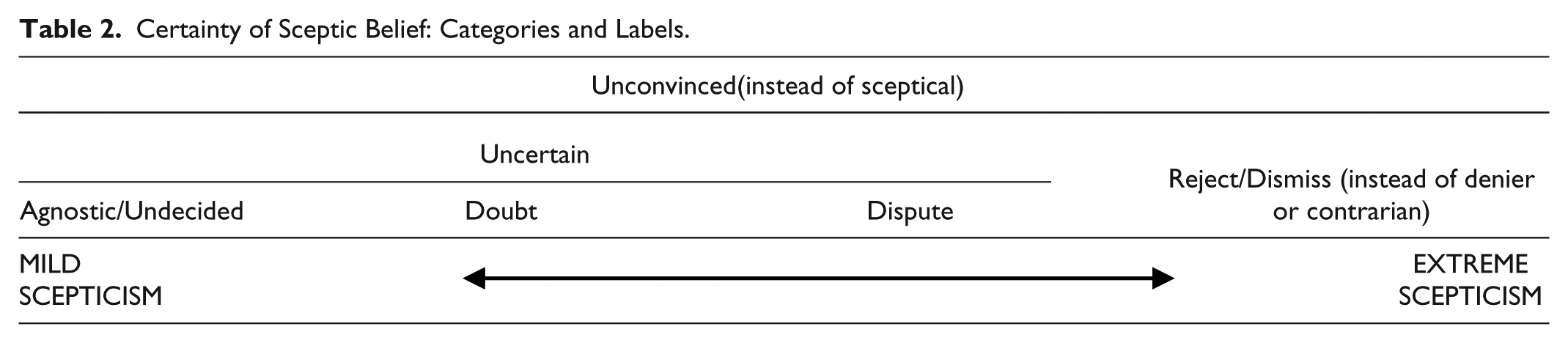
The third and final level of subcategorisation subdivides the “uncertain” group into agnostics, doubters, and disputers to reflect varying degrees and intensities of scepticism in this group. Including the agnostic/undecided here alongside the doubters and disputers is justified because the net effect of their position is the same as that of the other sceptics, namely, nonacceptance of core climate change claims that should be beyond doubt, given the established and advanced nature of the science, the exceptionally high degree of scientific consensus prevailing, and the severity of the problem. The distinctions drawn in the taxonomy are, admittedly, subjective, but they are necessary to capture finer nuances in the sceptic phenomenon.
The proposed taxonomy reflects different intensities of climate change scepticism. For instance, a person emphatically rejecting the entire mainstream climate thesis is more likely to hold such views strongly and to actively challenge mainstream science than someone who is merely doubtful of some key claims. A degree of mobility between these categories can be assumed. For instance, it is conceivable that extraneous events like a particularly hot summer may shift someone from “doubtful” to “undecided” and vice versa. The most extreme end of the spectrum can be expected to be stable because the individuals at this position are likely to have rationalised their views at length and may find themselves heavily invested in this position in terms of professional prestige and opportunities for public exposure. Unavoidably, the labels are open to some degree of interpretation and are not entirely mutually exclusive. They do draw recognisable distinctions though, and dispose of the two most problematic ones, namely, “sceptic” and “denier.”
Conclusion
This article proposes a conceptual design of climate change scepticism that might help an observer to draw both gross and subtle distinctions in the phenomenon. The evidence challenge is placed at the core of what it means to be a climate sceptic, with concomitant objects of scepticism moved to more neutral conceptual ground. The different certainties of sceptic belief are also relabeled for greater semantic accuracy and to dispose of toxic labels. These design elements might help to counter the potential pitfalls in prevailing assessments of climate scepticism, noted at the beginning of the article, and might provide important pointers for those concerned with meeting the sceptic challenge.
First, renewed recognition of the nuances in the sceptic phenomenon might help to counter the unintended but unfortunate ideologising of the debate that had occurred due to the intense interest in the extraepistemic drivers of scepticism. Much of the mainstream response to climate change scepticism fail to convince sceptics precisely because the science is skirted for the sake of a grand theory that casts sceptics as ill-intentioned rather than ill-informed. And once the motivations of a participant are questioned, there could hardly be any chance of constructive dialogue and critique that might improve the quality of the science, the articulation of the science, or the debate in general. The right–wrong, serious–disingenuous dichotomies that dominate so much of the debate has made it difficult to engage sceptics in a discerning fashion, to direct chagrin at the egregious sceptic arguments, and give leeway and credit to those sceptic arguments made in good faith. Pigeonholing sceptics who are sincerely concerned about aspects of the science with those who are egregious and entrenched in their scepticism has an unnecessarily polarising and politicising effect on the participants in the debate and their followers.
Second, greater awareness of the distinction between core and concomitant objects of scepticism might encourage observers and policy practitioners to target their responses. Climate change scepticism hinges on the evidential challenge. Without a credible (in the eyes of the broader public) evidential challenge, either through direct contestation of the physical evidence or doubts about the evidence inferred from perceived process or response deficiencies, climate change scepticism unravels. By focusing on the core (and presumably refutable) sceptic challenges, observers and policy practitioners might avoid getting drawn into the ultimately political and moral debates typical of sceptics’ extended critiques. Sceptics have in the past benefited from the resonance that their policy critiques have enjoyed among nonsceptic or apathetic partisans who oppose incisive climate mitigation measures, for various reasons. Without negating the potential value of addressing sceptics’ extended arguments (i.e., against incisive climate mitigation) in creative ways, the value of a focused, resolute, and sustained response to sceptics’ evidence claims should not be underestimated. It could be argued that the evidence debate provides a neutral and stable access point to sceptics and that successful engagement of sceptics on purely evidence-related matters would flow on to affect the credibility of sceptics’ extended arguments.
Third, systematising and formalising the task of classifying and labeling sceptics (by use of the two taxonomies) might make it easier to distinguish between those sceptics who stand closer to the mainstream view, and might be amenable to argumentation methods and communication strategies, and those who are too extreme and entrenched in their views.
Finally, relocating sceptics’ critiques of the scientific and bureaucratic processes behind mainstream climate science and the implied response imperatives of the mainstream thesis to more neutral conceptual ground “unmerges” the sceptic identity and reclaims these issues as legitimate concerns for everyone, not just sceptics. By lowering the defenses on these issues, it might be possible to dislodge the perception that sceptics are the drivers of public reticence and political indecision in climate matters. By treating the process and response issues as areas of legitimate disputation rather than an elaborate complex of sceptic provocation, observers and policy practitioners might demonstrate their commitment to a careful and thorough test of ideas, which might be all that is needed to convince those sceptics who are uncertain rather than dismissive of mainstream climate science.
Future Research
Capstick and Pidgeon’s (2014) recent investigation of the climate change scepticism concept detected a latent construct in the general population’s view about climate change, which they call “folk psychology.” This construct includes intuitive lay assumptions about human nature, such as “people are too selfish to do anything about climate change” and “it is not in human nature to respond to problems that won’t happen for many years” (Capstick & Pidgeon, 2014, p. 396). Van Rensburg (2013) identified a host of myths of human nature that are particularly recurrent in sceptic discourse, like humans are intelligent, resourceful, resilient, and able to adapt to changing environments, yet are also limited in their true ability to understand, let alone influence or control, the complex and powerful global climatic system. It is not surprising that these notions are present in the context of climate sceptical thought for they serve an integrative purpose and provide continuity between received information and innate information. However, it could be argued that folk psychology constructs are independently important, that is, that they immediately orient people when they are confronted with the climate issue and that they powerfully colour received information about the evidence, processes, and responses to do with climate change. If that were the case, folk psychology might be identified as a key center of climate scepticism (fourth center?), with implications for our conceptual understanding of the phenomenon.
Footnotes
Declaration of Conflicting Interests
The author(s) declared no potential conflicts of interest with respect to the research, authorship, and/or publication of this article.
Funding
The author(s) received no financial support for the research and/or authorship of this article.