




Abstract
This paper aims to analyze the mediating role of the knowledge management (KM) process between collaborative culture and organizational performance at higher education institutions (HEI). A structured questionnaire survey was conducted with 236 faculties of quality accredited HEIs out of 580 fulltime faculties. The knowledge management process positively influenced organizational performance, mediates between collaborative culture and organizational performance but teamwork and diversity indirectly contribute to organizational performance. The findings enriched ideas to policy makers and authorities of HEI emphasizing the need to explore internal collaboration, leverage knowledge management processes for improved performance. The mediating role of the KM process through the application of knowledge-based view theory and system thinking theory has added value significantly in the context of developing economies of South Asia- Nepal.
Keywords
Introduction
In the contemporary economy, the value of knowledge resources is pivotal for competitiveness (Seetanah et al., 2024). However, the field of knowledge management remains mysterious to many (Lam et al., 2021), despite gaining significant attention over the past 25 years (Edgar & Albright, 2023). HEIs sector is recognized as an important sector of the knowledge economy (Alam & Biswas, 2024). Knowledge is recognized as a crucial source of competitive advantage across sectors (Gaviria-Marin et al., 2019; Swan et al., 1999; Villar et al., 2014), influencing both manufacturing and service-oriented organizations, as well as attracting scholars and practitioners alike. Early knowledge management concepts focused on distinguishing between explicit and tacit knowledge (Dalmarco et al., 2017; Nonaka, 1994). Knowledge management process (KMP) involves activities aimed at enhancing organizational effectiveness through knowledge creation, storage, and utilization (Barley et al., 2018; Iqbal et al., 2019; Nonaka & Takeuchi, 1995).
Previous research often overlooked connections between knowledge enablers and barriers in knowledge management process (Iftikhar & Lions, 2022). This study focuses specifically on knowledge enablers, which are organizational mechanisms fostering knowledge within the organization (Krogh et al., 2000). These enablers encompass various components such as technology, culture, and structure (Allameh et al., 2011), all crucial in shaping the knowledge management process. Among these enablers, collaborative culture (CC) stands out as particularly influential (Pérez López et al., 2004). A collaborative culture is a collective values and beliefs held by a team of organizations that endorse flexibility, transparent communication, teamwork, trust, risk toleration, and diversity management, and add a substantial role to developing organizations (Barczak et al., 2010; Park & Lee, 2014; Pérez López et al., 2004). Collectiveness, long-term orientation, uncertainty avoidance, and power symmetry are considered firm-level collaborative culture (Hofstede, 1991) and are gaining importance in the field of higher education research to achieve quality at higher education institutions (HEI; Henard & Roseveare, 2012; Kasmawati, 2019).
In Nepal and South Asia, collaborative culture can be defined as shared values and practices that promotes mutual supports and trust, teamwork, communication and value for diversity to achieve institutional goals (Ahmed et al., 2016). Specific to the context of South Asia, it reflects traditional hierarchical structures in organizations and socio-cultural context prevalent. The cultural aspect in the Asian region promotes collectivism and hierarchical social structure demand respect for authority. Hence, among many dimensions of collaborative culture, we use three: teamwork, trust, and diversity similar to the study Ahmed et al. (2016) to establish the relationship between these dimensions of collaboration, knowledge management process, and organizational performance at higher education institutions (HEI). We utilized the three dimensions of collaborative culture as our study focused on intra-organizational (internal to the organization) as proposed by Burgess et al. (2006). The three dimensions have been validated in many other prior studies (Barczak et al., 2010; Droissart & Tuytens, 2024; Hargreaves & Dawe, 1990). The relationship of collaborative culture with the knowledge management process and organizational performance has not been extensively explored in the context of HEIs. The present study aims to fill the gap and tries to provide the theoretical contribution.
Knowledge management is a process of collecting, arranging, communicating, and analyzing an organization’s information based on the organization’s members’ capacities to increase the value of their core business processes through the development, exchange, coordination, and codification of procedural and explicit knowledge provisions (Nonaka & Takeuchi, 1995). Alavi and Leidner (2001) identified five key processes of knowledge management, Nawaz et al. (2020) and Chua (2004) developed six components, Parikh (2001) categorized it into four components, and Bouthillier and Shearer (2002) proposed six steps and seven steps by Paudel (2019). In this study, we adopted a four-step knowledge management process aligning with the work of Omerzel et al. (2011) which includes knowledge generation, knowledge storage, knowledge transfer, and knowledge application. The four-step knowledge management process has been adopted in the current study as it was utilized in the context of higher education in other studies (Fiscal, 2019; Nanjundeswaraswamy & Swamy, 2022; Rani & Devi, 2024; Vilcea, 2014).
The success of an organization is closely tied to its performance, which can be defined differently by various authors. Some defined performance as goal-directed actions (Godlovitch, 1993), while others considered it a prerequisite for success (Akande, 2011) measured as effectiveness, efficiency, growth, and productivity (Man, 2011). The measurement model of performance is of financial and nonfinancial metrics gage the extent to which goals and outcomes can be achieved. A study by Abubakar et al. (2018) and Kamyabi and Devi (2012) emphasized financial indicators and argued to measure an organization’s ability to generate revenue, invest, and profits. In some instances, financial metrics are used exclusively, while in others, nonfinancial indicators are integrated (Abernethy & Lillis, 1995; Westra et al., 1996). The third category involves the use of both financial and non-financial measures (Bititci et al., 1997; Kaplan & Norton, 1992; MacDougall & Pike, 2003). Many studies focused on teaching and research as performance indicators in HEI (Asif et al., 2013; Asif & Searcy, 2014; Lukman et al., 2010; Manjarres-Henriquez et al., 2009). Some researchers (Badri & Abdulla, 2004; Patel et al., 2011) consider community service as a performance indicator while others include publications, citations, impact factors, research funding, co-authorship percentages, and the h-index (Patel et al., 2011). As many prior studies in the context of HEI have employed non-financial indicators (Asif et al., 2013; Asif & Searcy, 2014; Badri & Abdulla, 2004; Gharsi et al., 2024), we have also employed non-financial indicators to measure the performance of higher education institutions. We used performance measurement indicators of HEI proposed by Muraguri (2016) and the University Grants Commission Nepal (2020) employing teaching and learning, research and consultancy, infrastructure support, and the formulation of policies and procedures by HEI.
Previous research has examined the knowledge management process as a mediator in various contexts (Shehzad et al., 2023; Z. Yang et al., 2018). However, findings regarding the mediating role of KMP have been inconclusive (Ahmed et al., 2016; Alsarayreh & Aljaafreh, 2023; Leoni et al., 2022; Mohammed et al., 2022; Raziq et al., 2024; Waheed et al., 2013). Notably, a comprehensive exploration of the mediating role of KMP in the relationship between collaborative culture and organizational performance within higher education institutions remains largely unexplored, particularly in Nepal and similar developing economies. This raises a critical research question: does the knowledge management process mediate the relationship between collaborative culture and the performance of higher education institutions? The current study addresses this gap by investigating the mediating role of knowledge management process in the relationship between collaborative culture and organizational performance within Nepalese higher education institutions.
The study offers practical insights for HEI administrators and policymakers, emphasizing the importance of fostering a collaborative culture and integrating effective knowledge management strategies to improve key areas like teaching-learning, research, infrastructure and policy development. In doing so, it provides a comprehensive framework for enhancing the overall quality and competitiveness of HEIs, especially in South Asia, where research on this area is scarce. By addressing this, the study not only adds to the theoretical knowledge of collaborative culture, knowledge management and higher education performance but also offers actionable recommendations that can contribute to improving higher education performance in Nepal and similar developing economies.
Literature Review and Hypothesis Development
The prominent theories that provide frameworks for understanding the role of knowledge in institutional settings, and processes involved in optimizing its use for better performance are Knowledge-Based View (KBV) and System Thinking Theory. The KBV theory of the firm proposes knowledge as an important factor that leads to better OP (Grant, 1996). It proposed that the productivity of the employees and the organization depends upon the ability of managers to fully utilize knowledge (Tzortzaki & Mihiotis, 2014). Knowledge is intellectual capital which is a key component for organizational success (Clarke et al., 2011; Wang et al., 2014). The application of the KM process leads to better OP (Alavi & Leidner, 2001; Kianto et al., 2016; Rehman et al., 2021). The Knowledge base view theory were utilized in many prior studies to validate the mediating role of knowledge worker productivity, knowledge shraring and knowledge management practices (Leoni et al., 2022; Sahibzada et al., 2022; Shehzad et al., 2023). Therefore, we utilized the theory to further validate the mediating role of knowledge management process in the context of HEIs institutions.
Additionally, the system thinking theory developed a foundation for the integrative framework that systematically represents the complex and dynamic aspects of KM (Rubenstein-Montano et al., 2001). The input-process-output model by Hackman and Morris (1975) contains information about the link between these three elements. Lee and Choi (2003) also established the relationship by applying this theory to develop an integrative model of KM. The study concluded that the system thinking model though the inclusion of knowledge enablers and KM process directly influenced the OP. The present research employs the model in the context of HEIs. The application of this model especially in the context of HEIs will open avenue for further exploration and validation of the theory. The present study utilizes the system thinking theory as input-process-output in which inputs are collaborative culture, an element of knowledge enablers, knowledge managemet process as process component and higher education institutions performance as output.
There exists extensive prior literature on organizational factors affecting organizational performance. In this regard, many studies have focused on investigating only the effect of collaborative culture on organizational performance (Chuang et al., 2016; Mohammed et al., 2022; Schaubroeck et al., 2007; Tewari & Misra, 2021). Similarly, other studies have investigated the role of knowledge management process in fostering organizational performance (Alavi & Leidner, 2001; Mahdavi Mazdeh & Hesamamiri, 2014; Rehman et al., 2021; Sahibzada et al., 2022). Additionally, some studies have investigated the influence of collaborative culture on knowledge management (Horwitz & Horwitz, 2007; Hsu & Chang, 2014; Staples & Webster, 2008; Z. Yang et al., 2018). However, a very few studies have investigated the inter-linkages among collaborative culture, knowledge management and organizational performance. Studies undertaken in the area have studied the influence of sub-dimensions of collaborative culture such as teamwork, trust and diversity on individual basis on organizational performance. For instance, Chuang et al. (2016) and Mohammed et al. (2022) studied role of trust on organizational performance. Similarly, other studies have investigated the role of teamwork (Farsi, 2022; Tewari & Misra, 2021) and diversity (Turi et al., 2022). Only some studies have included components of knowledge management as a mediator. Those studies have included only the dimensions of knowledge management process as a mediating variable. For example, Waheed et al. (2013) studied the mediating role of knowledge-sharing on relationship between teamwork and performance. Similarly, other studies investigated mediating role of knowledge utilization on relationship between trust and performance (Koohang et al., 2017), and knowledge generation on diversity and organizational performance (Mathuki & Zhang, 2024). However, none of the studies have investigated the mediating role of knowledge management process in relationship between collaborative culture and organizational performance in comprehensive manner. Hence, this study builds upon and extends the current literature in the area by investigating the mediating role of knowledge management process in relationship between collaborative culture and organizational performance.
Collaborative Culture and Knowledge Management Process
The relationship between interpersonal trust and knowledge-sharing behaviors has been widely examined, yet significant debates persist. While Hsu and Chang (2014), Renzl (2008), and Staples and Webster (2008) assert a strong link between interpersonal trust and knowledge sharing, their findings overlook variations across institutional contexts and cultures. Kmieciak (2021) extends this understanding by identifying positive correlations between knowledge donation, knowledge generation, and both vertical and horizontal trust, yet these findings fail to account for scenarios where trust structures are weak or absent. Similarly, Ford (2004) and Wang et al. (2016) emphasize the favorable influence of trust on knowledge generation, but their perspectives remain largely untested in diverse organizational settings. Conversely, Chow and Chan (2008) challenge the universality of this relationship, demonstrating no significant connection between knowledge sharing and social trust among Hong Kong managers. This discrepancy underscores the need for context-specific investigations to understand how trust operates within varying environments.
Teamwork has been posited as a critical enabler of knowledge-sharing behaviors, but the literature presents a complex narrative. Z. Yang et al. (2018) and Reid (2003) highlight teamwork’s role in fostering professional growth and information-seeking behaviors among faculty members. However, Ahmed et al. (2016) argue that the impact of teamwork extends beyond individual gains, positively influencing knowledge donation, collection, and sharing within organizations. While these findings are compelling, they fail to address potential challenges, such as conflicts arising within teams or imbalances in participation. Furthermore, Cummings (2004) contends that diverse work groups enhance knowledge sharing by introducing varied perspectives and competencies, yet this claim is contradicted by Hans et al. (2023), who report that generational diversity negatively affects knowledge sharing in the banking sector. Kim (2018) similarly identify geographical and functional diversity as barriers to effective knowledge sharing, and Lam et al. (2021) argue that language diversity often leads to misunderstandings, disrupting communication and collaboration and ultimately the knowledge management process.
Despite these challenges, the potential benefits of diversity in fostering innovation and knowledge sharing cannot be ignored. Shin et al. (2012) advocate that increasing faculty diversity enhances the knowledge-sharing process, a view supported by Horwitz and Horwitz (2007), who emphasize that workforce diversity, when coupled with employee involvement, facilitates the exchange of unique ideas and innovative solutions. However, these studies often overlook the mechanisms through which diversity’s positive effects can be optimized and its negative effects mitigated. For instance, while Ahmed et al. (2016) align with the positive narrative, their findings remain silent on the specific conditions under which teamwork can counteract diversity-related barriers to knowledge sharing and knowledge management process as a whole.
The critical gaps in this body of work lie in its failure to reconcile these contradictory findings and address the conditional factors influencing trust, teamwork, and diversity in knowledge sharing. This study seeks to address these issues by providing an understanding of how these elements interact in varying institutional contexts. By doing so, it not only contributes to the theoretical discourse but also offers practical insights for fostering effective knowledge-sharing behaviors within organizations. Based on the above information, the hypotheses for the study are: Based on these, we proposed the hypothesis as:
Collaborative Culture and Organizational Performance
Chen and Hung (2010) state that trust influences the knowledge management process and impacts organizational performance, supported by Cheng et al. (2008). Network structure and diverse knowledge access improve managerial and innovative performance (Rodan & Galunic, 2004). Studies show that teamwork, facilitated by leadership, enhances productivity (Schaubroeck et al., 2007). Teamwork boosts knowledge acquisition and sharing, improving OP (Chuang et al., 2016). Mohammed et al. (2022) found that team creativity, trust, and communication enhance task performance in Chinese higher education. Tewari and Misra (2021) revealed that teamwork and trust positively impact performance. Bhatti et al. found that psychological diversity enhances job performance among Saudi Arabian faculty, with similar findings by Kim et al. Turi et al. (2022) and Pokhrel (2023) indicated that diversity impacts OP, with Pandey and Risal (2023) noting that gender and ethnic diversity positively affect performance. Prasad (2017) research also found no significant relationship between diversity and performance. However, it’s important to note that Bland (2012) found contradictory results and was unable to establish a strong relationship between collaborative culture and organizational performance. Therefore, we proposed the hypothesis as:
Knowledge Management Process and Organizational Performance
Organizational success is often linked to performance, defined differently by various authors. Godlovitch (1993) sees performance as goal-directed actions, while Greenberg (2011) includes both financial and non-financial metrics. In higher education, performance indicators include teaching, research, community service and graduation rates (Manjarres-Henriquez et al., 2009). Organizational performance can only be enhanced by the efficient application of knowledge management (Alavi & Leidner, 2001). According to Mahdavi Mazdeh and Hesamamiri (2014), effective implementation of knowledge management procedures as well as efficient administration and usage of available knowledge-based resources are necessary for organizational performance.
Research performance in higher education institutions is improved by knowledge management, such as knowledge sharing (Ismail, 2015). Prior research (Ngah et al., 2016) explored and confirmed a strong and favorable association between knowledge management process and organizational performance. A similar direct association between the knowledge management process and higher education institutions’ performance was validated by Iqbal et al. (2019). Sahibzada et al. (2022) findings revealed that the knowledge management process (generation, storage, transfer and utilization) has a significant effect on organizational performance mediating the knowledge worker productivity. Similarly, prior studies show that knowledge sharing or transfer significantly impacts firm performance (Abdelwhab Ali et al., 2019; Demir et al., 2023; Deng et al., 2023; Farooq, 2018). Masa’deh et al. (2017) found that the knowledge management process, including generation, storage, transfer, and utilization, enhances the performance of universities in Jordan. Mohaghegh et al. (2024) also revealed that knowledge utilization positively influences organizational performance. Therefore, it is hypothesized:
Mediating Role of Knowledge Management Process
A few prior research have investigated the mediating role of knowledge-sharing on relationship between teamwork, trust, and performance (Raziq et al., 2024; Waheed et al., 2013). Koohang et al. (2017) concluded that knowledge management mediate between trust and performance. Z. Yang et al. (2018) identified the mediating role of knowledge sharing collaborative culture and innovation capability. Shehzad et al. (2023) confirmed that the KMP partially mediates these relationships. Mohammed et al. (2022) indicated that trust and teamwork directly affect organizational performance. Mathuki and Zhang (2024) revealed that cognitive diversity impacts performance indirectly through knowledge sharing. Mohaghegh et al. (2024) also revealed that knowledge utilization mediates the relationship between knowledge management practices and organizational performance. Therefore, these mediating hypotheses developed (Figure 1).

Research framework.
Method
Through a structured questionnaire data were collected from 236 full-time faculties of Quality Assurance and Accreditation (QAA) accredited HEIs of Pokhara, Nepal. The reason for inclusion of only QAA-accredited higher education institutions as sample institutions is as QAA accreditation serves as a recognized benchmark for institutional quality in Nepal, the institutions are more likely to have formalized systems, processes, and policies supportive for promoting collaborative culture and effective knowledge management practices, which are central to this study. Additionally, the reason for inclusion of only full-time faculties is they are in better position to provide reliable information on their institution’s collaborative culture, knowledge management practices and organizational performance due to their consistent involvement in institutional activities and decision-making process. There are a total of eight QAA accredited HEIs in Pokhara and the total number of full-time faculties in the institutions is 580 (University Grants Commission Nepal, 2022). The sampling frame was constructed by combining the list of all full-time faculties obtained from the institutions. From the alphabetically sorted list of faculties, sample respondents were selected proportionately and randomly using computer generated random number table with consideration to sampling adequacy with consideration to sampling adequacy as suggested by Krejcie and Morgan (1970). The study used proportionate random sampling to ensure representation across all HEIs. This method was deemed appropriate as the institutions had diverse sizes of faculty population. The construction of sampling frame comprising of complete list of full-time faculties ensured representativeness of the population.
A 7-point Likert scale was used to realize more reliability than a five-point scale and four-point scale (Adelson & McCoach, 2010; Alwin & Krosnick, 1991) and prepared in both Nepali and English language. Back translation was used for translation of questionnaire. First, a university English teacher with mother tongue Nepali translated the questionnaire into Nepali language. Then, another independent translator translated the questionnaire back to English. It was ensured that the emphasis during back translation was on conceptual and cultural equivalence and not only on linguistic equivalence (Bradley, 2013). The validity was determined by comparing similarity of the original and back translated English version.
Collaborative culture has been measured by three constructs: teamwork, trust, and diversity. Items for team and trust used as proposed by Ahmed et al. (2016), Farsi (2022), Chow and Chan (2008), and Kmieciak (2021), and diversity items borrowed from Leveson et al. (2009). For the measurement of the KM process, four items of knowledge generation, four items of knowledge storage, six items of knowledge transfer, and three items of knowledge application are used as suggested by Omerzel et al. (2011) and Paudel (2019). Organizational performance has been measured by the construct proposed by Muraguri (2016) and the Self Study Report (SSR) guidelines issued by the University Grants Commission of Nepal.
A field survey using self-administered questionnaire was employed for data collection. Approval from institution heads of HEIs was taken. Thereafter, faculties were distributed questionnaire during their off-class hours. The study adheres to ethical guidelines and code of conduct for research. This study involved adult university teachers as respondents, and participation in the survey involved minimal risk. Further, the survey minimized risks to participants by adopting voluntary participation, anonymity of participants and the right to withdraw at any time during the survey. The survey did not collect sensitive personal information for protecting participants’ privacy and confidentiality. The potential benefits of this research study which includes advancing knowledge in the area of effective knowledge management practices in higher education context through informing of institutional policies, outweigh the minimal risks associated. Informed consent was obtained from the respondents in written form before the survey. Participants were clearly informed of the study purpose, their right to withdraw at any time and data protection. The data collected was anonymized to ensure participant privacy and confidentiality. The completed questionnaires were collected within a week. Data collection was undertaken from September 2023 to January 2024.
The collected data was analyzed using PLS-SEM with the Smart PLS 4.0 package. It is an established technique for analyzing inter-relationships between latent constructs (Gudergan et al., 2008). Multiple rationale for application of PLS-SEM has been discussed in literature. It is useful for analyzing complex models involving simultaneous estimation of relationships among multiple constructs including mediating analysis (Hair et al., 2017). There exists two approaches to structural equation modeling. The covariance-based SEM requires normally distributed data while variance-based SEM doesn’t require assumption of multivariate normality (Ringle et al., 2020; Wong, 2013). This study employs variance-based PLS-SEM due to data not fulfilling multivariate normality assumption. Additionally, it provides bootstrapping option for testing significance of path coefficients. In this study, bootstrapping method with 5,000 resamples which produces reliable estimates of confidence intervals and standard errors is used (Streukens & Leroi-Werelds, 2016).
The analysis comprised two stages, as recommended by Hair et al. (2019) and Wong (2013). The first stage involved the estimation of the measurement model, which included validating composite reliability, assessing convergent and discriminant validity, and examining the loadings of indicators for the constructs employed. In the second stage, the significance of path coefficients was assessed by employing the bootstrapping method to rigorously test our research hypotheses to gain deeper insights into the relationships within the model. Additionally, to explore mediating effects, Preacher and Hayes (2008) approach was used, which is considered a robust method for examining mediating effects.
The validity and reliability of the research instrument, data collection, and analysis were fully ensured through different measures for quantitative analysis. Faculty members of human resource management, and knowledge management as well as experts in HEI were utilized to place appropriate categories of study variables and questionnaires to ensure content validity. To ensure criterion validity, the test results were compared with the externally published indicators of collaborative culture knowledge management process, and organizational performance. To ensure construct validity, convergent and discriminant validity were utilized. The Average Variance Extracted (AVE) for the measurement of convergent validity (CR) followed Hair et al. (2019) recommendation as AVE greater than 0.5. Discriminant validity was ensured using the Fornell and Larcker (1981) criterion and the Heterotrait-Monatrait Method (HTMT). The value of HTMT depicting inter-construct correlation should be below the value of .85 to ensure discriminant validity (Henseler et al., 2015). Cronbach’s alpha value of greater than .6 ensured item reliabilities as suggested Hair et al. (2019). Pre-testing of the questionnaire was administered during a pilot study involving 10% of the sample to ensure data management consistency and the reliability of the constructs. Harman’s Single Factor Test was used to estimate common method biases. This study found that 23.78% of the variation, which is less than the necessary 50% threshold level, is explained by a single unrotated factor (Podsakoff et al., 2003), and ensured no issues of common method biases.
Results
Measurement Model
The assessment of the measurement model was conducted in two consecutive stages and presented a disjoint two-stage approach. The first stage depicts the reliability and validity of the knowledge management process and organizational performance (Table 1).
First Stage Measurement Model for Reliability and Convergent Validity.

Source: Authors Compilation.
The model incorporated 15 indicators for CC and 4 indicators each for the KM process and OP (Table 2). Notably, all factor loadings exceeded the significant threshold of 0.6, as reported by Hair et al. (2019) except for three items. Those three items were retained because of their relevancy within the model and importance as per the descriptive analysis. The analysis indicates that CR and AVE values for all latent constructs, except for diversity, surpass the recommended thresholds of .7 and .5, respectively. It is noteworthy that since the CR of Diversity exceeds its AVE, it was retained in line with prior research recommendations. Fornell and Larcker (1981) also explain that CR is ensured even though AVE is less than .5 if the CR is higher than .6. Furthermore, Cronbach’s alpha values for all constructs consistently exceeded .6, ensuring a high level of inter-item consistency reliability. These results collectively affirm the reliability of the measurement model and demonstrate strong CR.
Second Stage Measurement Model for Reliability and Convergent Validity.

In the second stage, the reliability and composite reliability of the knowledge management process were analyzed and no problem related to the reliability and validity of the model.
It evidenced that the measurement model exhibits robustness in terms of factor loading, internal consistency, and convergent validity, particularly in the context of the KM process, which is assessed through 17 items across 4 sub-constructs (Table 2). Additionally, the CR values exceeding .7 for all indicators further affirm the model’s reliability and the precision of the measurement approach. Furthermore, the AVE values for all constructs exceeding the threshold of .5 demonstrate robust convergent validity, suggesting that the constructs genuinely measure the latent variables they are intended to represent. Importantly, there are no issues with factor loading, as all constructs exceed the recommended level of .6, as outlined by Hair et al. (2014). This reaffirms the quality of the measurement model and its ability to accurately capture the underlying constructs.
Discriminant Validity
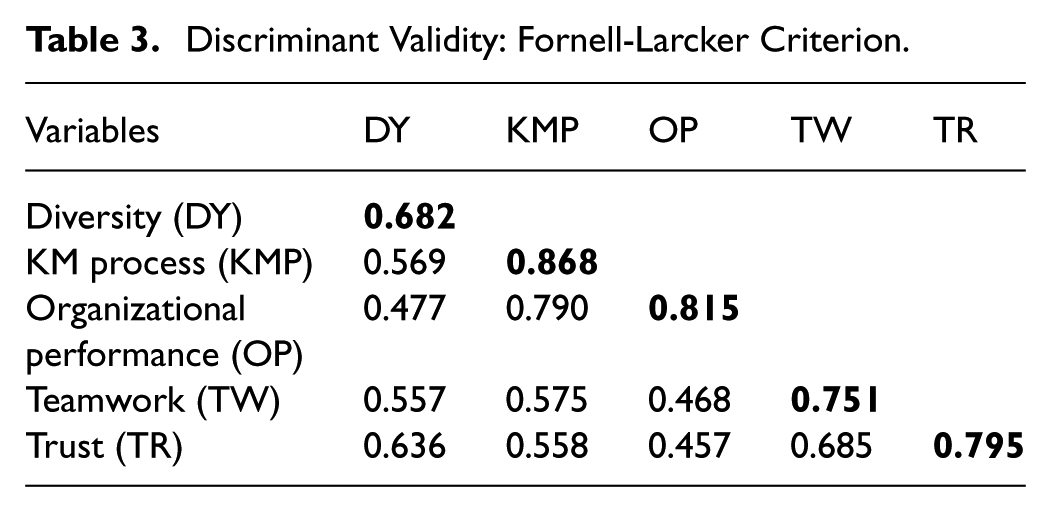
Discriminant validity was evaluated using both the Fornell and Larcker criteria as well as the Heterotrait-Monotrait Method (HTMT) and presented in Table 3. To establish discriminant validity, it is crucial that the square roots of AVE values, displayed along the diagonal, exceed the inter-construct correlations indicated in the lower off-diagonal cells, in line with the principles outlined by Fornell and Larcker (1981). Furthermore, the study also employed the HTMT ratio of correlations to assess discriminant validity. The resulting HTMT values, presented in the upper off-diagonal matrix in Table 4, provide estimates of inter-construct correlations. Importantly, these values are consistently below the specified threshold of 0.85, as recommended by Henseler et al. (2015) for establishing construct validity.
Discriminant Validity: Fornell-Larcker Criterion.
Discriminant Validity: Hetrotrait-Monotrait ratio (HTMT).

The discriminant validity was established as the off-diagonal value as the square root of AVE that is, 0.682, 0.868, 0.815, 0.751, and 0.795 are well above the inter-construct correlation (Table 3), and ensured further path coefficient analysis of direct and indirect effects.
The HTMT values for establishing discriminant validity range from 0.516 to 0.847, consistently falling below the recommended threshold of 0.85, as stipulated by Henseler et al. (2015; see Table 4). This alignment with the established criterion further strengthens the confidence in the discriminant validity and equips it with the necessary foundation for conducting path analysis. This analytical approach enables to exploration of both direct and indirect effects within this research, enhancing the ability to understand the intricate relationships among variables.
Structural Model: Impact of Collaborative Culture and Knowledge Management Process on Organizational Performance
The outcomes of the structural model, illustrating path coefficients, their corresponding t-values, the directionality of the path coefficients, bootstrap confidence intervals, and testing of hypotheses presented in Figure 2 exhibit that R2 values associated with the endogenous constructs offer insights into the explanatory power of the structural model.
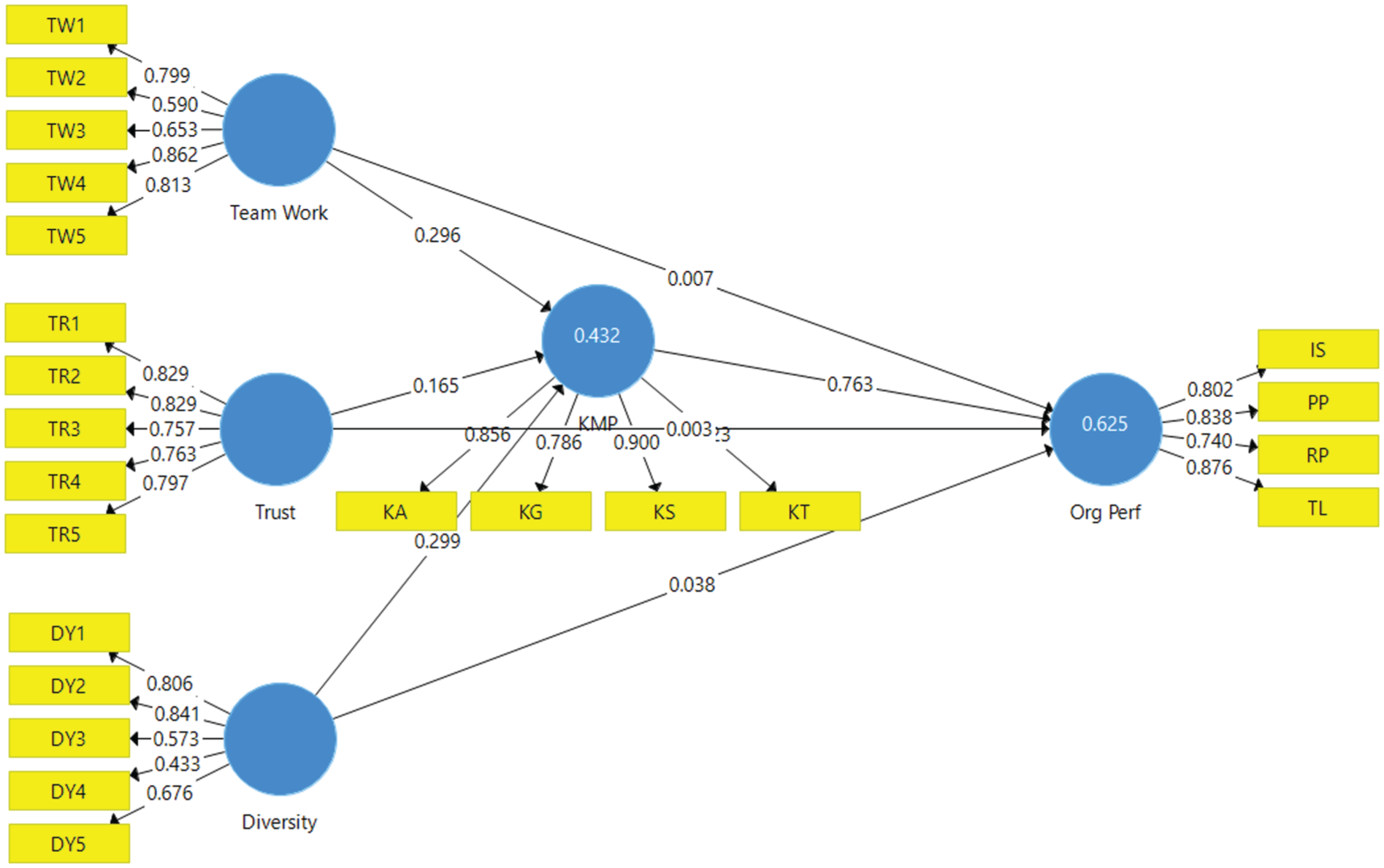
Pictorial representation of structural equation model.
The findings reveal three significant relationships, as evidenced by the statistical significance of the direct path coefficients, while all relationships did not achieve statistical significance. To systematically test the study hypotheses, a two-phase approach was executed. The first phase - the direct impacts of CC on the KM process and subsequently on OP, and in the second phase, the direct effects of the KM process, encompassing knowledge generation, storage, transfer, and utilization, on OP were done. It is noteworthy that the significance of the structural model’s paths and the estimation of standard errors were determined utilizing the bootstrap method, incorporating 5,000 resamples.
In the direct relationship among CC, KM process, and OP, teamwork yielded a significant and positive influence on the KM process (β = .295, p < .001) and lends strong support to H1b (Table 5). Likewise, diversity exhibited a substantial and positive impact on various facets of the KM process, encompassing knowledge generation, storage, transfer, and application (β = .300, p < .001), thereby corroborating H1c. However, results revealed that trust had an insignificant effect on the KM process (β = .164, p > .05), leading to rejection H1a. Similarly, the predictive power of CC constructs on OP, none of these variables exhibited a significant effect (β = −.012, p > .05, β = −.007, p > .05, β = −.035, p > .05) rejecting H2a, H2b, and H2c, respectively. In contrast, the KM process displayed a significant and positive influence on OP within HEI (β = .300, p < .001), providing robust support for H3. These results support examining the mediating role of the KM process.
Structural Model: Impact of Collaborative Culture and Knowledge Management Process on Organizational Performance.

Note. N = 236. Bootstrap samples = 5,000, CI (bias corrected accelerated method (Bca)). LCI = lower confidence interval; UCI = upper confidence interval.
p < 0.001, **p < .01, *p < .05.
The results depict the R2 figure of .432 and .625 of endogenous variables namely KM process and OP. The R2 shows the predictive power of the structural model used in the research. Since the value of R2 lies between .5 and .75, they are labeled as moderate in explaining the endogenous variables. The explanatory power of the model for both the endogenous variables is found to be moderate. The figure of f2 indicates that one f2 value indicates a strong effect with the figure greater than .35. Likewise, two f2 value lies are greater than .02 indicating a small effect. The remaining four f2 figures demonstrate negligible effect.
Mediating Role of Knowledge Management Process
The concept of mediating effect revolves around the involvement of a third variable that plays a crucial role in the relationship between exogenous and endogenous variables. To determine partial or complete mediation, it is opted for a straightforward process outlined by Zhao et al. (2010). First, it establishes the significance of the indirect effect and direct effect. If both the effects are statistically significant, it signifies partial mediation. However, if the direct effect lacks statistical significance, it points toward full mediation.
The direct effect has not been established but the indirect effect has been established and led to the total effect (Table 6). However, in one case both direct and indirect effects were not significant leading to no effect mediation. The results revealed the full mediating role of the KM process between teamwork and OP (β = −.234, p < .01) supporting H4a. Similarly, the mediating role of the KM process has also been established between diversity and OP (β = −.266, p < .001) supporting H4c. In contrast, the mediating role of the KM process between the relationship between trust and OP has not been established β = −.125, p > .05) rejecting H4b.
Mediation Analysis: Mediating Role of Knowledge Management Process.

Note. N = 236. LCI = lower confidence interval; UCI = upper confidence interval.
p < .001, **p < .01, *p < .05.
Discussion
The results of this study align with prior research (Reid, 2003; Z. Yang et al., 2018 ) highlighting the importance of teamwork in fostering knowledge-sharing behavior. Collaborative teams are engaged in knowledge generation, storage, transfer, and application similar to the findings of Ahmed et al. (2016). Interestingly, the research results diverge from earlier research by not finding a significant impact of trust on the KM process (Hsu & Chang, 2014; Renzl, 2008; Staples & Webster, 2008). This divergence emphasizes the contextual variations in the influence of trust on knowledge processes, possibly reflecting unique characteristics of the Nepalese HEI context. This research demonstrated the direct impact of the diversity component on the KM process that aligns with prior studies (Ahmed et al., 2016; Cummings, 2004; Horwitz & Horwitz, 2007). This alignment demonstrates that the diversity component impacts the KM process irrespective of the country and context. It indicates that if HEI encourages a diverse culture within the organization, the knowledge management practices will be enhanced.
These findings did not establish a significant direct relationship between CC in the form of teamwork and organizational performance within HEI in Nepal. The findings contradict earlier findings (Chen & Hung, 2010; Chuang et al., 2016; Karanja et al., 2018; Pandey & Risal, 2023; Pokhrel, 2023) that emphasized a direct positive impact of collaborative culture on organizational performance. These results highlight the complexity of collaborative culture that influences organizational performance, indicating the interplay of trust, teamwork, and diversity which manifest differently in various organizational contexts. Trust was found to have insignificant effect on knowledge management process which may have stemmed from contextual factors in Nepalese HEIs. As respondents of this study comprised of full-time faculties, trust might be implicit or assumed due to long professional relationships, thereby structural factors like teamwork and diversity might have higher influence in driving knowledge-sharing behaviors. Additionally, hierarchical structures in Nepalese HEIs prioritizing formal mechanisms over interpersonal trust in facilitating knowledge management might have produced this result.
The result provides strong support emphasizing the positive relationship between the KM process and OP (Farooq, 2018; Ryan & Daly, 2019; Sahibzada et al., 2022) and reaffirms the KBV theory applicability, demonstrating that effective KM, including generation, storage, transfer, and application, leads to improved OP within HEI (Grant, 1996; Leoni et al., 2022; Sahibzada et al., 2022; Shehzad et al., 2023). The findings consistently support the KBV theory, reinforcing the idea that effective KM processes are instrumental in enhancing OP within HEI (Ahmed et al., 2016; Alavi & Leidner, 2001; Iqbal et al., 2019; Kianto et al., 2016; Rehman et al., 2021) and Nepalese HEI are no exception.
The findings of the mediating role of the knowledge management process align with previous research conducted by Naghavi et al. (2014) and Z. Yang et al. (2018), emphasizing the crucial role of collaborative culture in facilitating knowledge management processes. Similarly, the results show the full mediating effect of the knowledge management process between teamwork and organizational performance, validating the idea that fostering effective teamwork is conducive to enhancing the knowledge management process and, consequently, organizational performance. The mediating role has also been established between a component diversity on organizational performance similar to the findings of Shafique et al. (2023). Furthermore, it corresponds with Shehzad et al. (2023), who demonstrated the mediating effect of the knowledge management process on the relationship between diversity and innovation. Similarly, this research found a fully mediating role of the knowledge management process between diversity and organizational performance.
When examining trust, the results differ from those of Ahmad et al. (2021) and Arsawan et al. (2018) and did not find a significant mediating role of the knowledge management process between trust and organizational performance. This inconsistency could be attributed to contextual variations, suggesting that the influence of trust on the knowledge management process and organizational performance may vary across different settings. Distinct cultural factors specific to Nepal and South Asia in broad could have influenced the role trust has on knowledge management processes. The prevalent collectivist culture in South Asia including Nepal based on interpersonal relationships, group harmony, and mutual trust ( Denison et al., 2004; Hofstede, 1984), is a foundational factor in fostering open communication, knowledge sharing, and collaborative practices both in social and organizational settings (Khilji, 2013). In such context where social structures are hierarchical demanding respect for authority plays a significant role in shaping trust (Yasir et al., 2017). Relational trust with leaders and colleagues is prioritized which may influence knowledge management processes (Kmieciak, 2021; Politis, 2003). In contrary, the same cultural factors can also discourage expression of dissent or raising questions limiting the extent of knowledge-sharing (Al-Saifi, 2015).
The results revealed lack of a direct effect of collaborative culture sub-constructs (teamwork, trust, and diversity) on organizational performance which depicts that these factors can only affect performance through intermediate processes, such as knowledge management. The finding corroborates with the view that collaborative practices, while providing supportive role for conducive work environment, may not impact measurable performance outcomes directly. It suggests that fostering collaborative culture alone is not sufficient, institutions must also take initiatives in creating robust knowledge management processes to realize performance benefits.
The study results are based on sample from accredited HEIs only. Inclusion of non-accredited institutions could have provided different results. QAA accredited HEIs have structured processes, sound governance with a greater focus on meeting quality standards, which fosters environment of collaborative culture and facilitates effective implementation of knowledge management processes (Iqbal, 2021). In contrary, non-accredited HEIs are more likely to have resource constraints, put less emphasis in meeting quality benchmarks, and sub-standard organizational practices (Quarchioni et al., 2022), which could influence the role and nature of influence of knowledge management in relationship between collaborative culture and organizational performance.
Conclusion
Teamwork emerged as a significant driver of the knowledge management process within HEI, reinforcing the idea that collaborative teams stimulate knowledge generation, storage, transfer, and application. Trust, however, did not exert a direct influence on the knowledge management process in the developing economies. Moreover, it did not establish a significant direct relationship between individual components of collaborative culture (Teamwork, Trust, and Diversity) and organizational performance. These results suggest that collaborative culture’s impact on organizational performance might manifest differently in various organizational contexts, underlining the complexity of trust issues within HEI. On the other hand, the knowledge management process displayed a robust positive impact on organizational performance. The results indicate that HEI with efficient KM processes tend to perform better. These findings resonated with prior research emphasizing the vital role of the knowledge management process in enhancing organizational performance, reaffirming the knowledge base view applicability. The study revealed that effective teamwork indirectly enhances organizational performance by fostering an efficient knowledge management process even though trust did not exhibit a significant mediating effect of the knowledge management process on organizational performance. Diversity emerged as a powerful factor when supported by a robust knowledge management process, significantly contributing to enhanced organizational performance, and emphasizing its importance in HEI.
The study highlights the importance of context-specific investigations in nature of relationship among collaborative culture, knowledge management and organizational performance. The study results offer valuable implications for studies in other regions with distinct cultural and institutional context. For instance, organizations in regions with individualistic culture may require different approach to teamwork to foster collaboration. The role of trust was found to be limited in the study which suggests that trust dynamics may vary depending on context, with relational trust being of significance in high-trust societies while formal structures playing significant role in low-trust regions. Diversity in multicultural settings can be valuable for establishing robust knowledge management processes. The findings suggest that cultural dimensions such as collectivism, trust levels, and institutional factors influence the relationship among collaborative culture, knowledge management and organizational performance.
Implications
This finding contributes to the literature on the KBV theory and system thinking theory, emphasizing the importance of an effective knowledge management process in translating collaborative efforts into improved organizational performance. In case of KBV, our results demonstrate the enhancing role of collaborative culture on knowledge management process affirming knowledge as a valued strategic resource in context of resource constrained HEIs in South Asia. Additionally, the study depicts how interconnected process like collaboration and knowledge management enhance organizational performance which provides empirical validation for system thinking theory. Furthermore, the study results indicate HEI needs to translate collaborative culture into knowledge generation, storage, transfer, and application to further enhance organizational performance. It highlights the need for more context-specific investigations in the fields of collaborative culture, knowledge management process, and organizational performance. It implies that HEI needs to focus on internal collaboration and other factors like infrastructure, curriculum, and faculty development in addition to developing trust. The study results depict that HEIs should leverage teamwork to create better knowledge management outcomes for improving organizational performance. For the purpose, initiatives such as establishing cross-functional teams which facilitates the integration of diverse expertise should be undertaken for promoting knowledge creation and sharing. Additionally, conducting team-based training programs, promoting collaborative platforms and facilitating informal networks promotes peer learning and knowledge exchange, enhancing trust among team members in the process.
Authorities can use these findings to form policies that promote research, collaboration, and performance-based funding in HEI. They can design quality assurance mechanisms to ensure HEI maintains high standards of education and research. HEI can use these findings to develop faculty development programs that enhance skills and knowledge transfer. Faculty members contribute more effectively to research and innovation, facilitate knowledge exchange, interdisciplinary research, and resource sharing at HEI to improve performance, and support decisions on performance-based funding models to incentivize improved academic and research outcomes.
Future Research Directions
Future researchers could incorporate a broader spectrum of both accredited and non-accredited institutions to obtain a comprehensive view of collaborative culture, knowledge management process, and organizational performance dynamics. Comparison of accredited and non-accredited institutions to understand how accreditation status influences the relationship among collaborative culture, knowledge management processes, and organizational performance could bring new insights offering a comprehensive understanding of these constructs in diverse institutional contexts.
The study is based on theoretical foundation of knowledge base view theory and system thinking theory in the context of South Asian HEIs and is prone to some limitations. As the knowledge based view theory focuses on knowledge as a primary resource which may not apply to resource constraints institutional situation. Similarly, the system thinking theory may have limited applicability in institutions with fragmented governance and bureaucratic system. Both the theory may not adequately address the socio-cultural dimensions prevalent in South Asian HEIs. Hence, future research could be undertaken through the lense of complementary theories such as institutional or cultural theories. Future research could also explore the influence of cultural factors in greater depth to get better insights on how collaborative culture effects knowledge management process in different organizational and cultural contexts. Further, there are scopes to expand the coverage of geography including multiple regions and countries to enrich the understanding and cover a wider array of variables like leadership, organizational structure, and communication practices, along with political perception that contribute to collaborative culture within HEI employing mixed methods to address multiple objectives simultaneously.
Footnotes

Ethical Considerations
The study adheres to ethical guidelines and code of conduct for research. As the study respondents consisted of adult university teachers who participated voluntarily in a minimal risk survey-based research, the study did not require formal ethical approval.
Consent for Publication
Informed consent in written form and was obtained from the study participants to publish data in cosolidated form and disseminate widely having open access to all.
Consent to Participate
Informed to participatents in written form, assured of thier anonymity and confidentiality of data, and obtained their consent before the survey participation.
Author Contributions
Dhruba Kumar Gautam: Project administration, supervision, editing. Resam Lal Poudel: Conceptualization, Data collection, data curation, design, original draft, and revision. Surya Bahadur G.C.: Methodology, data analysis, revision of the manuscript.
Funding
The authors received no financial support for the research, authorship, and/or publication of this article.
Declaration of Conflicting Interests
The authors declared no potential conflicts of interest with respect to the research, authorship, and/or publication of this article.
Data Availability Statement
The data used in the study can be obtained from the corresponding author upon reasonable request