




Abstract
Proactive work behavior is regarded as a key element in developing human capital among older employees. However, existing studies have insufficiently explored the mechanisms and boundary conditions through which core self-evaluation affects the PWB of this group. To fill this void, we gathered 362 questionnaires from older employees in Chinese enterprises via a two-stage survey method. Based on the lifespan theory of control, we conducted a two-stage time-lagged questionnaire survey in a manufacturing enterprise located in North China. The analysis results of 326 valid questionnaires show that the core self-evaluation of older employees has a positive impact on work proactivity, while occupational future time perspective plays a mediating role in this process, and age-inclusive human resource practices moderate this mediating effect. These findings suggest that organizations can promote proactive actions among older employees by taking their core self-evaluation into account and implementing inclusive policies, which in turn optimizes the performance of the older workforce and refines human resource management approaches.
Plain Language Summary
The primary objective of this study is to explore the impact of OCSE on PWB and to test the mediating role of OFTP and the moderating role of AIHRP. This research employed a two-stage questionnaire collection method, yielding a total of 362 samples. The findings indicate that OCSE has a positive influence on PWB, and OFTP mediates the relationship between OCSE and PWB. AIHRP enhance the relationship between OCSE and OFTP, as well as the indirect effect of OCSE on PWB. The results of this study help to reduce age discrimination and prejudice within the organization and provide literature support for the management of human resources for the older.
Keywords
Introduction
With the acceleration of the global aging process, the proportion of older employees in enterprises has been rising rapidly, making the effective development and utilization of their potential a key issue for organizational sustainable development (Beier et al., 2022). Proactive work behavior (PWB) of older employees, as a critical driver of organizational innovation and knowledge inheritance, has been confirmed to be closely related to positive outcomes such as knowledge sharing (Dewi et al., 2023), successful aging at work (Kooij et al., 2020) and enhanced learning willingness (Bertolino et al., 2011; Zhao et al., 2023). However, existing studies on the influencing factors of older employees’ PWB have long focused on age-related variables, with inconsistent conclusions (Cao et al., 2024; Zacher & Kooij, 2016; Zhang & Wood, 2022), failing to fully reveal the psychological mechanisms behind their proactive behaviors. A recent study suggests that compared with age-related variables, core self-evaluation may more accurately predict the behaviors of older employees (Laguerre et al., 2023). This may be because core self-evaluation, as a higher-order personality trait, enables a deeper understanding of older employees. However, there are few studies exploring its impact on PWB. Therefore, understanding the impact of the above variables and their process mechanisms and conducting in-depth analysis of this psychological process will help to provide strategic suggestions for enterprise management and development of human resources for the older.
To explore these dynamic mechanisms, we apply the lifespan control theory to explain the relationship between OCSE and PWB among older employees. This theory proposes that individuals strive to maintain control over themselves and the external environment throughout their life course (Heckhausen & Schulz, 1995). High OCSE reflects a strong primary control ability, which is often manifested as a form of secondary control in the occupational future time perspective (OFTP; Zacher & Rudolph, 2019b). OFTP relates to an individual’s outlook on their future career and is positively correlated with positive work outcomes such as work engagement and performance (Rudolph et al., 2018). Therefore, OFTP is regarded as a mediating variable linking core self-evaluation and older employees’ proactive work behavior. In addition, as an important psychological construct related to the future development of older employees, the formation and function of OFTP cannot be separated from the influence of situational factors such as organizational human resource practices (AIHRP; Weikamp & Göritz, 2016; Zhao et al., 2023). Implementing age-inclusive human resource practices is an important way to motivate older employees to work proactively (Dwertmann et al., 2016). Therefore, AIHRP are chosen as the boundary condition for how OFTP works between OCSE and proactive work actions, aiming to give practical ideas for managing older employees’ human resources.
In summary, this study examines the relationship between OCSE and PWB, incorporating the mediating role of OFTP and the moderating role of AIHRP. This study is of great value both theoretically and practically. The findings not only improve the application of the lifespan control theory but also expand and deepen its scope, offering new perspectives on how individuals adjust their work behaviors throughout their life course. Practically, this study provides valuable suggestions for organizations to manage older employees’ human resources more efficiently, reduce age discrimination and biases, and create a more inclusive and productive workplace.
Theory and Hypotheses Development
The lifespan theory of control explains how individuals can take initiative in their life development and maintain a sense of control during the aging process by using a range of control strategies across their entire lifespan, from childhood to old age (Heckhausen et al., 2010). Control encompasses primary control and secondary control (Heckhausen, 1997). The development trajectory of Lifespan theory of control is shown in Figure 1. It is clear that people pursue primary control throughout their lives. Both the ability for primary control and the efforts put into secondary control change with age. The capacity for primary control follows an inverted “U” curve: it rises from childhood to middle age, peaks in middle age, and then decreases afterward. In contrast, efforts toward secondary control tend to increase with age, which compensates for the age-related decline in primary control ability and supports efforts to maintain primary control. Thus, for older employees seeking to preserve their primary control, strengthening secondary control efforts becomes a key approach.

Lifespan theory of control.
OCSE and PWB
OCSE refers to the basic evaluations and judgments that older employees form about their own value and abilities (Judge & Hurst, 2008). As a higher-order personality trait, OCSE is more comprehensive than common personality characteristics. It provides a more holistic and representative basis for predicting an individual’s work outcomes (Judge & Bono, 2000), and has strong connections with job performance (Peláez-Fernández et al., 2019), job satisfaction (Låstad et al., 2014), and life satisfaction (Wagstaff et al., 2015).
In past research, scholars have put forward various ideas about PWB (Pratama et al., 2023). However, the most widely used definition in current research comes from Parker and his colleagues (Bakker & Hakanen, 2019; Parker & Collins, 2010), who describe PWB as self-initiated, forward-looking actions that individuals take to change and improve their surroundings or themselves. This definition is favored for its clarity and measurability (Shi et al., 2023), so this study adopts it. Here, PWB is defined as the voluntary actions that older employees take beyond their daily work duties, aiming to actively shape their work environment or achieve personal work goals. As an internal motivation, the effort to overcome challenges and reach work objectives may be influenced by OCSE (Grant & Ashford, 2008). First, older employees with stronger OCSE tend to use a “positive lens” (Judge et al., 1998). Their strong primary control ability helps reduce worries about potential risks and obstacles related to proactive behaviors. Second, individuals with higher OCSE are more inclined to act proactively, mainly due to their inherent confidence and sense of self-efficacy (Geng et al., 2021; Wang & Ding, 2024). Ma et al. (2023)’s research found that individuals with high core self-evaluation have higher innovative behavior at work, and for individuals with depression, high core self-evaluation also has a mitigating effect (Liu et al., 2023). Also, people with high OCSE often take part in more social activities (Fay & Sonnentag, 2010), and these powerful social networks may help them overcome difficult work (Rudolph, 2016). Given the above, we put forward the following hypothesis:
Mediation Effect of Occupational Future Time Perspective
OCSE affects PWB possibly through the role of OFTP. OFTP, which refers to employees’ views on the remaining career time and opportunities, is an important factor in this relationship (Carstensen, 2006). It can effectively account for the work behaviors, personal psychological resources, and subjective perceptions of older employees in the later stages of their careers, and also shape their future behavioral strategies (Ho & Yeung, 2016). The lifespan control theory indicates that older employees must work to enhance secondary control to preserve primary control, manifested in self-reflection and adjustment (Zacher & Rudolph, 2019a). For instance, older employees might sustain an overall sense of control by visualizing success, modifying their expectations, or “feeling younger.” As scholars like Zacher point out, employees with high OCSE, regardless of their actual age, think they still have ample career opportunities and time ahead and believe they possess significant advantages. This perception stems mainly from their strong primary control ability. Thus, to sustain lifelong control, older employees’ secondary control efforts involve recognizing that they, like younger colleagues, have more career time and opportunities. When older employees have lower core self-evaluation, they tend to view themselves negatively, feeling unable to control their work and lacking confidence (Ding et al., 2020), which reduces OFTP. To maintain life control, their secondary control efforts may lead to less PWB. Earlier studies also show that OFTP notably influences people’s work engagement and organizational commitment (Henry et al., 2017; Putri & Purba, 2020).
In summary, as Judge et al. (1997) pointed out, core self-evaluation lets individuals build their own “self-evaluation systems,” which shape assessments of future and career development through emotional diffusion. The lifespan control theory shows that OCSE not only directly positively impacts an individual’s work behavior but also indirectly affects their work behavior and willingness through their OFTP. Based on the above research evidence and related theoretical analysis, this study proposes the following hypotheses:
Moderating Role of AIHRP
AIHRP is a series of business management practices that provide equal recruitment, training, promotion and management support opportunities for employees of all ages regardless of one ’s age. It shows that the organization has the ability and willingness to invest in the knowledge, skills and abilities of employees of different ages (Boehm et al., 2014). The inclusive atmosphere it conveys provides psychological resources for employees to carry out active behavior, and the opportunity of equal training and promotion makes employees feel sufficient organizational support. Employees of different ages feel respected and valued by the organization (E. A. D. S. Oliveira & Cabral-Cardoso, 2018).
AIHRP convey a clear message to employees: individuals of all ages will receive fair treatment, free from age-based discrimination or prejudice. This ensures workers of different ages can benefit (Rudolph et al., 2021). This message provides external support for older employees’ career development (Kleine et al., 2019) and may strengthen the effects of core self-evaluation. Additionally, AIHRP offer necessary knowledge, skills training, and career development opportunities to employees of all ages (Alikaj et al., 2021). Research has found that AIHRP help improve older employees’ knowledge acquisition (Fasbender & Gerpott, 2022). For older employees with OCSE, their inherent confidence and sense of self-efficacy make them more sensitive to and able to utilize external support (Judge & Kammeyer-Mueller, 2011). Specifically, in the context of high AIHRP, older employees with high OCSE will more strongly perceive that their career future still has sufficient development space and opportunities, because the inclusive environment confirms their value and potential. Conversely, in the context of low AIHRP, even if older employees have high OCSE, the lack of organizational support will weaken their perception of career opportunities, thereby reducing the positive impact of OCSE on OFTP.
Building on Hypotheses 3 and 4, the author further expects that AIHRP’s moderating role in the link between OCSE and OFTP will change the indirect impact of OCSE on PWB through OFTP. Therefore, put forward the hypothesis:
In summary, the theoretical model of this paper is shown in Figure 2.

Conceptual model.
Materials and Methods
Participants and Procedure
The research subject of this article is older employees of enterprises, making the age threshold for older employees very important. By reviewing the literature, this study defines older employees as those aged 45 and above. The reason is that the WHO refers to employees aged 45 and above as “older workers” (World Health Organization, 1993), and in previous studies, most scholars have adopted this standard (Bravo et al., 2022; Kulik et al., 2016; Zhao et al., 2023). Therefore, we define employees aged 45 and above as “older workers.”
This study uses the questionnaire method to collect data, mainly taking the older employees of manufacturing companies as the research object. This selection is due to the firm’s severe employee aging issue, with the average employee age being 48. Before issuing the questionnaire, we communicated with the head of the company and informed the purpose of the study and the privacy of the respondents would be protected. Respondents were rewarded for answering the questionnaire. The questionnaires were collected using the online platform Questionnaire Star (https://www.wjx.cn), which is a professional platform for online surveys, evaluations, and voting, and is also one of the largest online data collection platforms in China (Hu et al., 2024). Previous studies have also confirmed that online surveys have good reliability and validity (Lu et al., 2023). The original measurement tools for all variables are mature English scales and processed by rigorous translation-back translation procedures for use in the Chinese context. To further verify the content of the questionnaire, a preliminary offline test was conducted on a sample of 60 participants. Each participant indicated that they could easily understand and complete the questionnaire, so no further modifications were made to the survey.
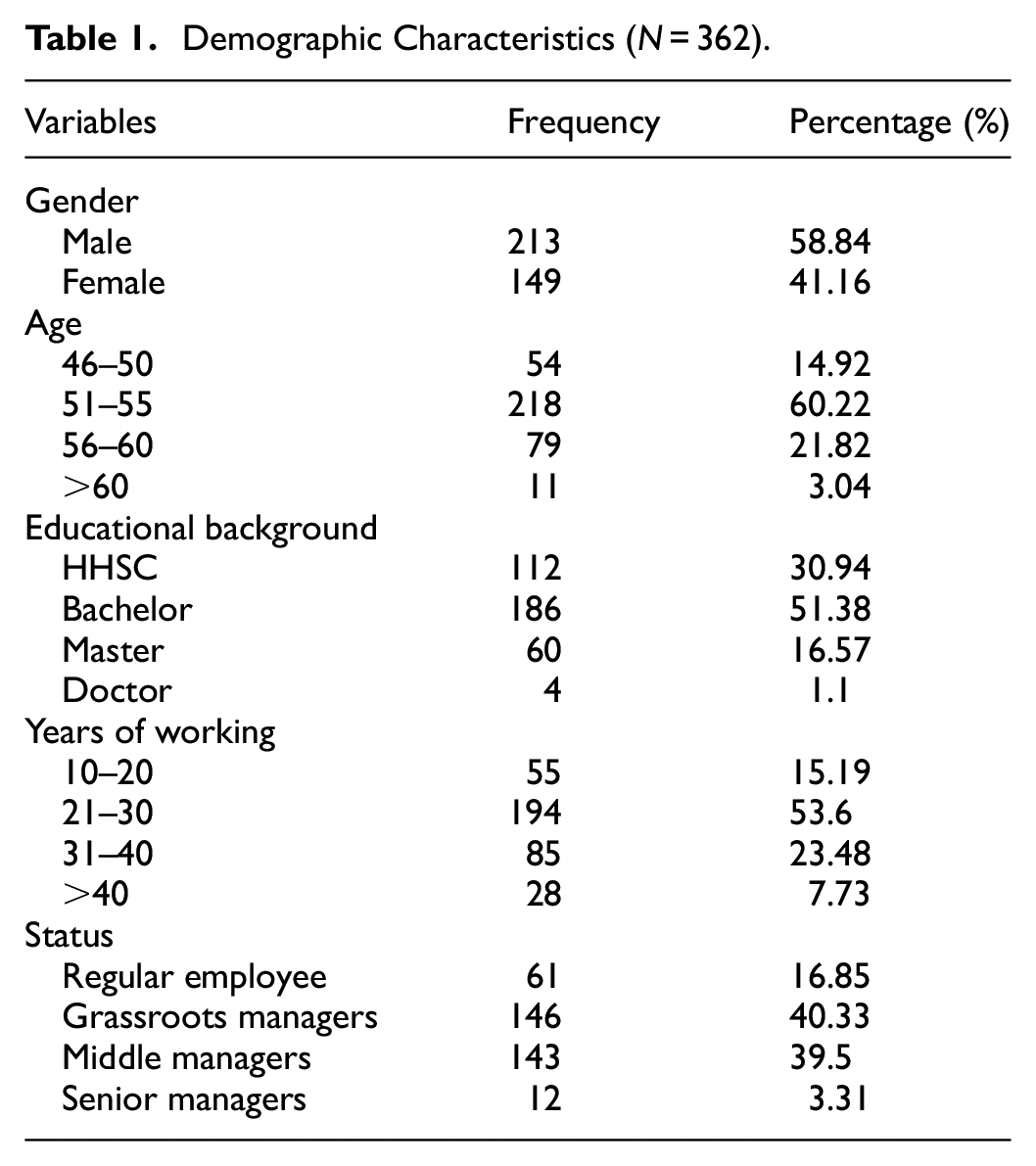
To avoid the influence of common method bias, the questionnaires in this study were administered in two stages. In the first stage, information about OCSE, AIHRP and control variables was collected. After a 2-month interval, the researchers followed up with these employees to collect information regarding OFTP and PWB. In the first phase, 400 questionnaires were distributed, and 384 were retrieved. Two months later, according to the valid samples in the first phase, the questionnaires in the second phase were distributed and 373 questionnaires were collected in the second phase. After matching, 362 questionnaires were collected in the two phases. There were 213 males (58.84%) and 149 females (41.16%). Detailed demographic data of the participants are presented in Table 1.
Demographic Characteristics (N = 362).
Measures
OCSE. The scale developed by Judge et al. (2003), 12 items, the items included “I am confident I get the success I deserve in life,” etc., α = .918.
OFTP. The scale developed by Zacher and Frese (2009), 6 items, the items included “I think my career future time is sufficient,” etc., α = .917.
PWB. The scale developed by Parker and Collins (2010), 10 items, the items included “I will try to bring about improved procedures,” etc., α = .932.
AIHRP. The scale developed by Boehm et al. (2014), 5 items, the items included “ enterprises support employees of different ages to continue to work,” etc., α = .951.
Control variables in this study include gender, age, education, years of work, and job level, Previous studies have indicated that these demographic variables are associated with the behavior of older employees (Zhao et al., 2023).
Analysis Method
Mplus 8.0 is a structural equation modeling software based on statistical modeling. Compared to traditional data analysis software (such as Covariance-Based SEM, CB-SEM), Mplus-SEM offers several key advantages that make it particularly well-suited to the needs of our study. In this study, Mplus 8.0 was used to analyze the factor loading coef-ficients, CR (construct reliability), and AVE (average variance extracted) of the external model and bootstrap-ping validation of the internal model.
Common Method Variance
Although this study uses a time-lagged data collection method, there may still be some homologous bias due to the fact that the variable items are self-assessment items. Therefore, this study used the ULMC method for testing (Richardson et al., 2009). The ULMC results show that after all the measurement items are put into the potential method factors, the five-factor structure model only has a slight change on the basis of the four-factor structure model, and some of the fitting index results become worse, which means that adding common method factors does not significantly improve the fitting index. Therefore, there is no serious common method bias in this study.
Validity Analysis
In order to test whether the scale has accurately measured the degree of each variable, this study uses mplus 8.0 software to test its validity (i.e., OCSE, OFTP, PWB, and AIHRP). The results in Table 2 indicate that the hypothesized four-factor model fits well, which proves that the variables in this research model have good discriminant validity.
Results of the Confirmatory Factor Analysis (N = 362).

Note. OCES = older employees’ core self-evaluation; OFTP = occupational future time perspective; PWB = proactive work behavior; AIHRP = age-inclusive HR practices.
Correlation Analysis
Table 3 presents the mean, standard deviation, correlations among all studied variables, and Cronbach’s alpha. The results showed that there was a significant positive correlation between OCSE and OFTP (r = .169, p < .01). There was a significant positive correlation between OFTP and PWB (r = .347, p < .01), OCSE and PWB (r = .227, p < .01).
Variable Mean, Standard Deviation, Correlation Coefficient and Cronbach Alpha.
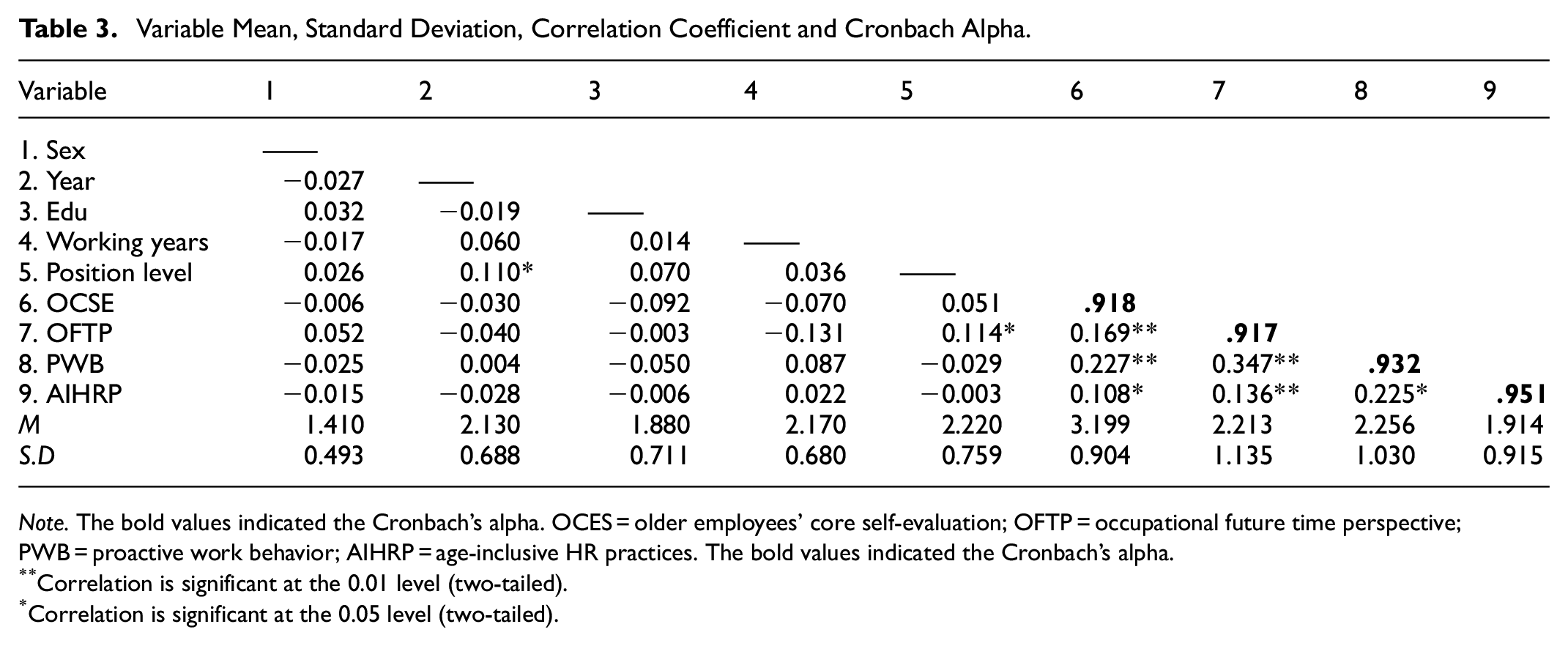
Note. The bold values indicated the Cronbach’s alpha. OCES = older employees’ core self-evaluation; OFTP = occupational future time perspective; PWB = proactive work behavior; AIHRP = age-inclusive HR practices. The bold values indicated the Cronbach’s alpha.
Correlation is significant at the 0.01 level (two-tailed).
Correlation is significant at the 0.05 level (two-tailed).
Results for Direct and Indirect Effect
The analysis results are presented in Table 4. It is observed that OCSE has a significant positive impact on PWB (β = .255, p < .001), so H1 is supported. OCSE also exerts a significant positive effect on OFTP (β = .198, p < .001), thus H2 is supported. To more accurately test the mediating effect, the Bootstrapping Empirical (M-Test) Bootstrapping method is used to examine the mediating role of OFTP. By extracting 1,000 Bootstrapping samples, two 95% confidence intervals (Percentile-based and Bias-corrected) are tested. The analysis results show that the indirect effect of OCSE on OFTP Bia-corrected 95% confidence interval is [0.017,0.078], excluding 0, which indicates that the mediating effect of OFTP on the relationship between OCSE and PWB exists, which verifies H3.
Mediation Analysis Results.

Note. OCES = older employees’ core self-evaluation; OFTP = occupational future time perspective; PWB = proactive work behavior.
Testing the Moderation Effects
From Table 5, we can see that the interaction between OCSE and AIHRP has a significant positive impact on OFTP (β = .223, p < .01). In addition, the simple slope test results show that when the AIHRP level of the enterprise is high, the OCSE has a strong positive impact on OFTP; when the AIHRP level of the enterprise is low, the positive impact of OCSE on OFTP is weak. As shown in Figure 3. H4 is supported.
Testing the Moderation Effects.

Note. OCES = older employees’ core self-evaluation; PWB = proactive work behavior; AIHRP = age-inclusive HR practices.
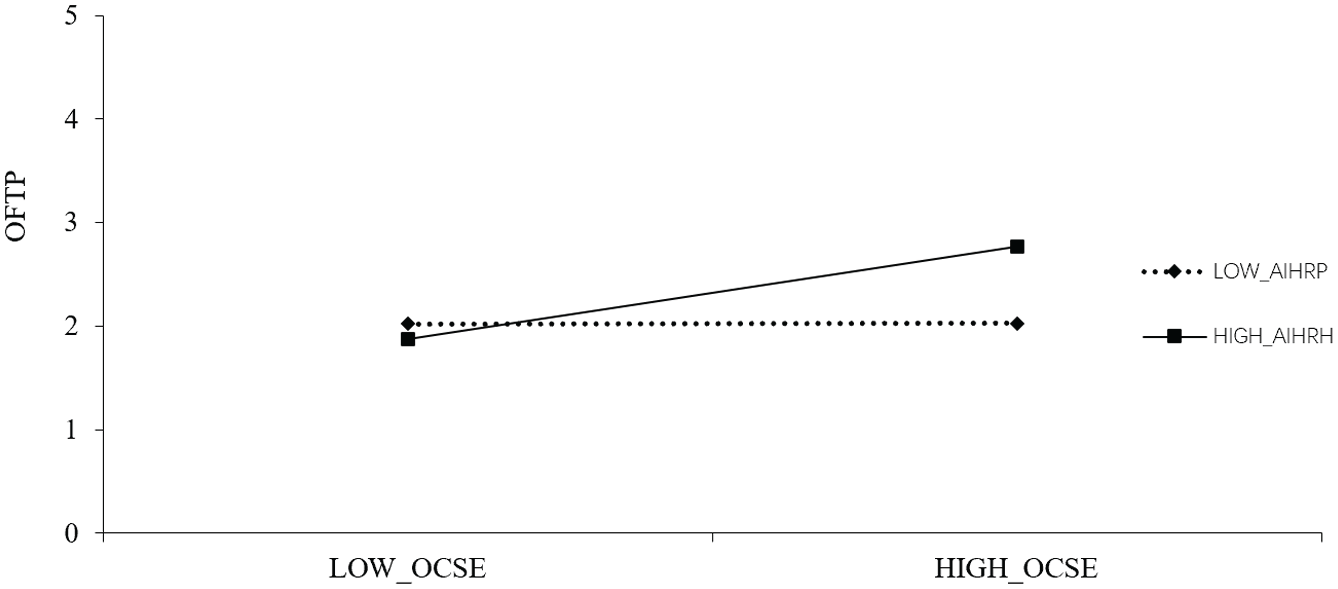
The moderating role of AIHRP between OCSE and OFTP.
Testing the Moderated Mediation Effects
This study further tested the moderated mediating effect. By sampling 5,000 times, Bootstrap test was conducted to analyze the mediating effect of OFTP between OCSE and PWB at different AIHRP levels. It can be seen from Table 6 that when the enterprise AIHRP is high, the indirect effect of OCSE on PWB through OFTP is 0.254, and the 95% unbiased confidence interval is [0.114,0.436], and the indirect effect is significant. When AIHRP is low, the indirect effect value is 0.134, the 95% unbiased confidence interval is [0.065, 0.223], and the indirect effect is significantly negative ; the difference of indirect effects at different levels of AIHRP is 0.120, and the 95% confidence interval is [0.042,0.218], excluding 0. The difference of indirect effects is significant, which supports hypothesis H5.
Testing the Moderated Mediation Effects.

OCES = older employees’ core self-evaluation; OFTP = occupational future time perspective; PWB = proactive work behavior; AIHRP = age-inclusive HR practices.
Discussion
Focusing on labor aging and the proactive development of older employees, this study, based on the lifespan theory of control, explored the influence mechanism of OCSE on their PWB. It empirically tested the mediating role of OFTP and the moderating effect of AIHRP on this mediating role. The research results are helpful for enterprises to understand and stimulate the PWB of the older employees.
Theoretical Implications
This study has three theoretical contributions. First, it explores the connection between OCSE and PWB, offering a fresh perspective on the factors behind older employees’ proactivity. PWB supports knowledge transfer and contributes to successful aging (Burmeister et al., 2016; Shi et al., 2023), making it vital for building older workers’ human capital. In recent years, scholars have actively investigated various factors affecting older employees’ proactivity (Cao et al., 2024; Junker et al., 2022). Our research examines how OCSE shapes their PWB, confirms this link, expands research on PWB antecedents, and answers the call from Laguerre et al. (2023). Furthermore, by applying the lifespan theory of control to explain the relationship between OCSE and PWB, this study verifies the theory’s applicability in this context: it reveals that high OCSE, reflecting strong primary control ability, can directly promote proactive behaviors, thereby enriching the practical scenarios of the lifespan theory of control in explaining work-related behaviors. Second, more and more scholars call for exploring the behavior of older employees from different perspectives (Kornadt et al., 2020; Zacher & Froidevaux, 2021). Our study finds that OCSE significantly and positively predicts PWB. Existing research on older employees’ behaviors has often adopted a fragmented perspective, focusing on either individual traits or environmental factors in isolation, lacking an integrated analysis of how internal traits interact with psychological mechanisms to shape behaviors. This study finds that OCSE significantly and positively predicts PWB, and this relationship is mediated by OFTP. This result aligns with the core principles of the lifespan theory of control, which emphasizes that individuals maintain a sense of self-efficacy and control across the lifespan through primary and secondary control strategies (Heckhausen & Schulz, 1995). Specifically, older employees enhance their OFTP through positive OCSE, which in turn stimulates their PWB. This relationship suggests that as individuals age, they may become more reliant on secondary control strategies, such as adjusting expectations and actively planning for the future, to maintain control and influence in their work environment. At the same time, this is also in line with the research of Henry and other scholars (Henry et al., 2017), proving that the primary task in stimulating the behavior of older employees is to improve their OFTP. Third, this paper confirms that AIHRP can strongly and positively moderate how OCSE affects OFTP, as well as the mediating role of OFTP between OCSE and PWB. This study empirically verifies that AIHRP not only strengthens the positive effect of OCSE on OFTP but also enhances the indirect effect of OCSE on PWB through OFTP. This finding clarifies that organizational-level practices (AIHRP) serve as a critical boundary condition: in an age-inclusive environment, older employees with high OCSE are more likely to perceive sufficient career opportunities (higher OFTP), thereby engaging in more proactive behaviors. By identifying this moderating role, the study bridges the gap between individual-level traits and organizational-level practices in explaining older employees’ PWB, providing a more comprehensive theoretical basis for understanding how to activate older employees’ potential through synergies between individual traits and organizational policies.
Practical Implications
This study has the following implications. First, attach great importance to the role of OCSE and incorporate it into talent management systems. Since OCSE has a significant positive impact on PWB, enterprises should not only focus on the skills and experience of older employees during recruitment and employment but also regard OCSE as a key evaluation criterion. For example, through professional psychological assessment tools, the OCSE level of older employees can be measured to identify those with high self-confidence and self-efficacy, so as to better tap their potential for proactive behavior. At the same time, in the daily management process, managers should adopt positive incentive methods to enhance the OCSE of older employees, such as timely recognition and affirmation of their work achievements, so as to strengthen their positive self-evaluation. Second, the mechanism by which OCSE affects PWB suggests that enhancing older employees’ OFTP is equally important for improving their PWB. Therefore, organizations can adopt targeted measures to strengthen older employees’ OFTP, enabling them to shift from perceiving their career future as limited by age to viewing it as a period with opportunities for continuous participation, growth, and contribution. For example, offering compressed workweeks, remote work options, or phased retirement plans allows older employees to align their work with personal needs, fostering a sense that their career future still possesses adaptability and purpose. This sense of control over their work timeline enhances their OFTP (Fasbender et al., 2019). On the other hand, carry out skill training programs closely related to their current positions and the development needs of the enterprise, help older employees master new knowledge and skills, and let them realize that they still have opportunities for growth and progress in their careers (Allen et al., 2021). In addition, encourage older employees to take on new strategic roles, such as mentors, organizational ambassadors, and knowledge transfer facilitators, and give them corresponding incentives and recognition, so as to enhance their sense of value and expectation for the future career (Calzavara et al., 2020). Lastly, age-based stereotypes about older employees persist. enterprises should formulate and implement formal human resource policies and systems to eliminate age discrimination and prejudice. Specifically, in terms of employment, ensure that older employees have equal opportunities to participate in recruitment and selection; in terms of development, provide them with fair training and promotion channels; in terms of retention, establish a reasonable retirement and re-employment mechanism to ensure that their employment rights are not affected by age (Fan et al., 2023; E. Oliveira, 2021). At the same time, strengthen the publicity and education of age-inclusive concepts within the enterprise, improve the awareness of all employees on the importance of respecting older employees, and build a positive work atmosphere that values diversity and inclusiveness.
Limitation and Future Research
This study has several limitations and possible future directions. First, this study primarily collected questionnaire data online, which may have only attracted certain types of respondents and missed those who do not have access to the internet, potentially causing sampling bias. Therefore, future research could employ more rigorous methods for sample collection. Second, the control variables used in this study were relatively basic and did not fully account for the potential impact of external factors on the results. Thus, future research could collect a broader range of control variables, such as health status and personal income. Third, regarding the research design, even though two data collection methods were used, common method bias is still unavoidable. Future studies can combine self-assessment and peer assessment for data collection. Fourth, future research can adopt situational experiments to test the causal relationship between variables. Finally, based on the factors influencing older employees’ behavior, this paper considered the moderating effect of the situational variable AIHRP. Future research can explore older employees’ proactive behavior from more organizational factors.
Conclusion
The primary objective of this study is to explore the impact of OCSE on PWB and to test the mediating role of OFTP and the moderating role of AIHRP. This research employed a two-stage questionnaire collection method, yielding a total of 362 samples. The findings indicate that OCSE has a positive influence on PWB, and OFTP mediates the relationship between OCSE and PWB. AIHRP enhance the relationship between OCSE and OFTP, as well as the indirect effect of OCSE on PWB. The results of this study help to reduce age discrimination and prejudice within the organization and provide literature support for the management of human resources for the older.
Footnotes

Ethical Considerations
This study did not collect any personally identifiable information from participants. All investigators signed informed consent forms. According to the United States Department of Health and Human Services regulations (45 CFR 46), research involving confidential surveys with no more than minimal risk does not require ethical review by an Institutional Review Board (IRB). Therefore, this study did not require approval from an ethics committee.
Funding
The authors disclosed receipt of the following financial support for the research, authorship, and/or publication of this article: This work was financially supported by Research on Influencing Factors of Cross-cultural Adaptation of International Students in Sino-foreign Cooperative Universities under the Belt and Road Initiative-A Case Study of China-Slovakia Silk Road College (1320240009); Ningbo University of Finance and Economics Talent Fund (1320249090); Shenzhen Polytechnic University Research Fund (6024310010S).
Declaration of Conflicting Interests
The authors declared no potential conflicts of interest with respect to the research, authorship, and/or publication of this article.
Data Availability Statement
The data that support the findings of this study are not publicly available, and restrictions apply to the availability of these data.