




Abstract
The persistent under-performance of Grades 8 and 9 learners in South African schools has led to escalating dropout and repetition rates, necessitating urgent intervention. Despite existing strategies, most efforts focus disproportionately on Grade 12, leaving a critical gap in addressing early high school under-performance. This study was initiated by the Department of Basic Education (Mopani West District, Limpopo Province) in collaboration with the University of Limpopo, and seeks to consolidate existing literature on the factors contributing to under-performance among Grades 8 and 9 learners in South Africa. This scoping review was conducted using Arksey and O’Malley’s five-stage framework to systematically map key themes from relevant studies. The review thematically identified four major factors influencing learner under-performance in Grades 8 and 9: (i) subject content and teacher pedagogy, (ii) learners’ personal and social challenges, (iii) school leadership and management issues, and (iv) systemic barriers. The findings provide a consolidated evidence base for policymakers, school leaders, and teachers to develop targeted interventions. Additionally, the study highlights gaps in the literature, guiding future research on improving academic outcomes in the foundational high school years.
Plain language summary
The Department of Basic Education (Mopani West District) and the University of Limpopo conducted this study to understand why many Grade 8 and 9 learners in South Africa struggle academically, often repeating grades or dropping out. By reviewing existing research, they identified four main reasons for poor performance: (1) difficult subjects and ineffective teaching methods, (2) personal and social challenges faced by learners, (3) weak school leadership, and (4) broader system-wide problems. The study’s findings can help policymakers and teachers develop better strategies to support students, while also pointing out areas where more research is needed to improve learning in the early high school years.
Introduction and Background
The issue of under-performance in schools is both critical and sensitive, demanding thoughtful analysis and intervention. In response to the persistent challenges faced by under-performing schools, many nations, including South Africa, are revisiting their educational policies. The Department of Basic Education in South Africa is actively formulating strategies and tools to transform classroom practices (Mbhalati, 2017). Central to these efforts is the Integrated Quality Management System (IQMS), which serves as a framework for enhancing and monitoring educational performance. According to the Department of Basic Education (DBE, 2015, p. 2), “The IQMS is an integrated quality management system that consists of three programmes, which are aimed at enhancing and monitoring the performance of the education system.”
The IQMS encompasses several key interventions: (i) Whole School Evaluation (WSE), which assesses the whole school through the quality of teaching and learning; (ii) School Improvement Plan (SIP), devised to address weak academic and administrative practices; (iii) Subject Improvement Plan (SIP), which outlines specific strategies to enhance learner performance in individual subjects; (iv) Personal Growth Plan (PGP), focussed on areas requiring educator development, including classroom management and assessment feedback; and (v) Academic Performance Improvement Plan (APIP), addressing broader strategies for enhancing overall academic performance.
In a nutshell, these initiatives are poised to identify the specific support and development needs of teachers, schools, and districts. It provides necessary resources to foster continued growth while promoting accountability across the system. Additionally, it monitors the overall effectiveness of schools. Finally, it includes evaluating individual teacher performance (DBE, 2015; Mbhalati, 2017). While these strategies have demonstrated effectiveness in improving learner outcomes in many South African provinces, particularly in Grade 12, the same progress has not been observed for Grades 8 and 9. Research indicates that learners in Grades 8 and 9 continue to fall significantly short of both national and international educational benchmarks (Bayat et al., 2014; Mbhalati & Jita, 2018; Spaull & Kotze, 2015). The Department of Basic Education’s 2024 report underscores the severity of the situation in the Free State, documenting Grade 8 failure rates of 85.5% and Grade 9 rates of 77% in 2023. These high figures align with trends observed in preceding years.
These statistics are particularly troubling when considering that the Free State has the highest Grade 12 results in the country, further highlighting the urgent need for intervention in earlier grades, especially in provinces like Limpopo, which is known for its lower performance levels. This under-performance can be attributed, in part, to a disproportionate focus on teacher development at the expense of learner-centred strategies, especially for Grades 8 and 9. While interventions have yielded positive outcomes in Grade 12 results, they have not translated into similar success for younger learners.
For instance, Limpopo Province reported a 7.4% increase in 2023 Grade 12 results compared to 2022 (Mogakane, 2024), yet the same improvements are notably absent in the earlier grades. The growing concern over Grades 8 and 9 under-performance is highlighted by high repetition rates (Bayat et al., 2014) and poor performance on international assessments for senior phase learners (PIRLS and TIMSS; Mudzielwana & Ravhuhali, 2017). Such issues significantly exacerbate dropout rates (Tsanwani et al., 2014). Previous research and interventions have predominantly focussed on specific subjects, such as mathematics, natural sciences, and languages, which are critical areas linked to learners’ under-performance (Mapaire, 2016; Mji & Makgato, 2006; Stott, 2019; Tsanwani et al., 2014).
Therefore, a comprehensive, collaborative approach involving researchers, government officials, and various stakeholders is essential to tackle this multifaceted issue. Recognising this need, the Mopani West District within the Limpopo Department of Basic Education, in collaboration with the University of Limpopo, has launched a longitudinal intervention project aimed at identifying solutions for improving Grades 8 and 9 academic performances. Accordingly, this scoping review seeks to consolidate the existing body of research on the factors contributing to under-performance among secondary school learners in these grades within the South African context.
The Significance of the Review
This study addresses a critical juncture in South Africa’s education system by examining the under-performance of Grades 8 and 9 learners in the Mopani West District and broader national context. The significance of this research extends beyond academic metrics to encompass fundamental questions about educational equity, social mobility, and human capital development in post-apartheid South Africa. At the academic level, the transition from primary to secondary education represents a pivotal threshold where learners either consolidate foundational competencies or begin a downward trajectory towards academic failure (Spaull & Kotze, 2015). The alarmingly high failure rates in these grades, reaching 85.5% in Grade 8 mathematics in some provinces (DBE, 2024), signal systemic deficiencies in curriculum articulation, pedagogical approaches, and learning support mechanisms. These middle school years serve as the essential bridge between basic numeracy/literacy and the more specialised demands of the Further Education and Training (FET) phase, making their effective navigation crucial for subsequent academic success (Taylor, 2021).
The social significance of addressing this under-performance becomes evident when considering its long-term consequences. Learners who struggle during these transitional years face dramatically increased risks of early school leaving, with dropout rates peaking between Grades 9 and 10 (Van Der Berg et al., 2016). In communities like Mopani West, where about 628,941 people live in poverty (Department of Corporate Governance and Traditional Affairs, 2019), educational failure at this stage effectively closes pathways to tertiary education and skilled employment, perpetuating intergenerational cycles of disadvantage. The economic implications are substantial, with each cohort of early school leavers estimated to cost the South African economy approximately R40 billion in lost productivity and increased social welfare expenditure (Gustafsson et al., 2021). From a policy perspective, this study challenges the prevailing focus on Grade 12 outcomes as the primary measure of educational success.
As Bertram et al. (2021) demonstrate, the current emphasis on matric results has created perverse incentives where schools prioritise terminal-year interventions over foundational learning. By shifting attention to Grades 8 and 9, this research provides evidence for reorienting accountability systems and resource allocation towards the earlier detection and remediation of learning deficits. The localised focus on Mopani West District offers value, as rural education contexts remain under-researched despite their disproportionate representation in national under-performance statistics (Modiba, 2023).
The district’s combination of linguistic diversity, resource constraints, and geographic isolation presents a microcosm of challenges facing South Africa’s most disadvantaged schools. Findings from this context will therefore have transferable insights for similar rural districts while informing province-specific intervention strategies. Conceptually, the study advances understanding of how systemic, pedagogical, and socio-economic factors intersect to produce educational disadvantage. By applying Edmonds (1979) five-Factor Model to this transitional phase, it tests the framework’s relevance beyond traditional school effectiveness research and proposes context-specific adaptations for South African conditions.
This theoretical contribution complements the practical guidance the study offers to educators and policymakers seeking to interrupt cycles of under-performance before they become entrenched. Ultimately, the significance of this research lies in its potential to reorient educational priorities towards prevention rather than remediation. As international evidence demonstrates (Balestra & Tonkin, 2018), investments in middle school education yield disproportionate returns in terms of retention, achievement, and future employability. For South Africa’s developmental agenda, addressing the Grades 8 and 9 crisis represents not just an educational imperative, but a fundamental requirement for achieving the constitutional right to quality basic education and breaking historical patterns of exclusion. To maintain a context-specific focus, the review is guided by the following research questions:
What are the key factors influencing the under-performance of Grades 8 and 9 learners?
Which subjects exhibit the highest rates of under-performance in these grades?
The Structure of Basic Education in South Africa
Basic Education in South Africa spans primary and secondary schooling, from Grade 1 (ages 6–7) to Grade 12 (ages 18–21). Learners who pass Grade 12 earn a matriculation certificate, enabling access to tertiary education. The system is organised into two bands: General Education and Training (GET), covering Grade R (Kindergarten equivalent) through Grade 9, and Further Education and Training (FET), which includes Grades 10 to 12 and vocational training outside higher education (Maringe, 2021). The GET band is further divided into three phases: the Foundation Phase (Grades R–3), the Intermediate Phase (Grades 4–6), and the Senior Phase (Grades 7–9). Internationally, the Foundation and Intermediate phases align with elementary education, while the Senior Phase corresponds to lower secondary education. For the benefit of this study, it is crucial to indicate that Grades 8 and 9 are meant to form a foundation for Further Education and Training (Taole, 2015). At this point, learners are prepared to select speciality subjects which are categorised into three streams (Commerce, Science & Technology and General subjects). Therefore, it is key that the foundation be strong to withstand the pressure and workload in the FET phase. In Grades 8 and 9, all the subjects are taught and learnt in English except the indigenous languages. However, some of the white owned schools still maintain the autonomy of using Afrikaans for learning and teaching most of the subjects.
Theoretical Framework
This scoping review is grounded on the Five-Factor Model of Effective Schools developed by Edmonds (1979). The Five-Factor Model of Effective Schools is a framework that identifies key characteristics shared by high-performing schools. Developed through educational research, this model highlights the practices and conditions that contribute to learners’ success (Akyurek et al., 2024). The five factors include strong leadership, clear mission and goals, high expectations, frequent monitoring of learners’ progress and a positive school climate (Karatas et al., 2024). These elements work together to create an environment where teaching and learning thrive.
Strong leadership is essential, as effective school principals set a vision, inspire staff, and make data-driven decisions to improve teaching. A clear mission and shared goals ensure that all stakeholders, including teachers, learners, and parents, are aligned in their efforts (Rutter & Maughan, 2002). High expectations for both learners and staff foster a culture of excellence, encouraging perseverance and academic achievement. Moreover, frequent monitoring of learners’ progress allows teachers to identify learning gaps early and adjust instruction accordingly (Reynolds, 2010). Lastly, a positive school climate promotes safety, respect, and engagement, making learners feel valued and motivated to learn (Borkar, 2016).
Research shows that schools excelling in these five areas tend to have higher learner performance, better teacher retention, and stronger community support (Smith, 2014). By focussing on these factors, schools can create a foundation for sustained improvement and equitable outcomes for all learners. This model enabled us to make sense of and interpret the literature-based factors contributing to the under-performance of Grades 8 and 9 learners in South Africa.
Applicability of the Model in the Study
Instructional Leadership faces unique challenges in Mopani West, where school principals often oversee multiple schools with limited training or resources (Modiba, 2023). Without adequate support, even motivated leaders struggle to implement data-driven improvements. However, some schools adapt through peer networks, where principals collaborate to share strategies and pool scarce resources (Munje et al., 2020). High Expectations are often undermined by socioeconomic realities. Teachers may lower standards for learners from disadvantaged backgrounds, while age-based progression policies unintentionally reward minimal effort (Zuma & Potgieter, 2019). Yet, high-performing schools in similar settings prove that clear, uncompromising standards, paired with targeted support, can overcome these barriers (Spaull, 2015).
Frequent Monitoring is hampered by overcrowded classrooms and a lack of assessment tools. Many schools rely on infrequent, high-stakes tests rather than ongoing feedback (Lucy & Mwanza, 2024). Innovative teachers compensate by using peer assessments and visual progress trackers, proving that monitoring can still work in resource-constrained environments (Mabena et al., 2021). School Climate extends beyond the classroom in rural communities. Factors like seasonal farming work, long commutes, and unsafe facilities disrupt learning. Successful schools integrate cultural practices, such as involving local leaders in discipline, to create a more supportive environment (Netshivhumbe & Mudau, 2021). This adapted framework helps identify where interventions can have the greatest impact, moving beyond generic explanations of “rural disadvantage” to actionable solutions
Methods
This scoping review adopts Arksey and O'Malley’s (2005) methodological framework, which provides a structured five-stage approach to ensure methodological rigour. The framework enhances transparency, facilitates replication of the search strategy, and strengthens the reliability of findings. The five stages include (i) formulating the research questions, (ii) identifying relevant studies, (iii) selecting studies, (iv) extracting and charting the data, and (v) synthesising, summarising, and reporting the results. Employing a scoping review was necessary to get a glimpse of what the South African literature says pertaining to the under-performance of Grades 8 and 9 learners. The findings were necessary to inform our project, intending to address the under-performance of Grades 8 and 9 learners in the Mopani West district of Limpopo Province, South Africa. The guiding research questions have been captured in the significance of the study above.
Identifying Relevant Studies
Following Arksey and O'Malley’s (2005) framework, we developed key search terms to facilitate an efficient literature search on factors contributing to the under-performance of Grades 8 and 9 learners in South Africa. To refine these terms and identify relevant databases, we consulted the University of Limpopo’s School of Education librarian. Additionally, we employed Boolean operators (OR & AND) to broaden and consolidate our literature pool. The finalised search terms are presented in Table 1 below.
Search Terms.

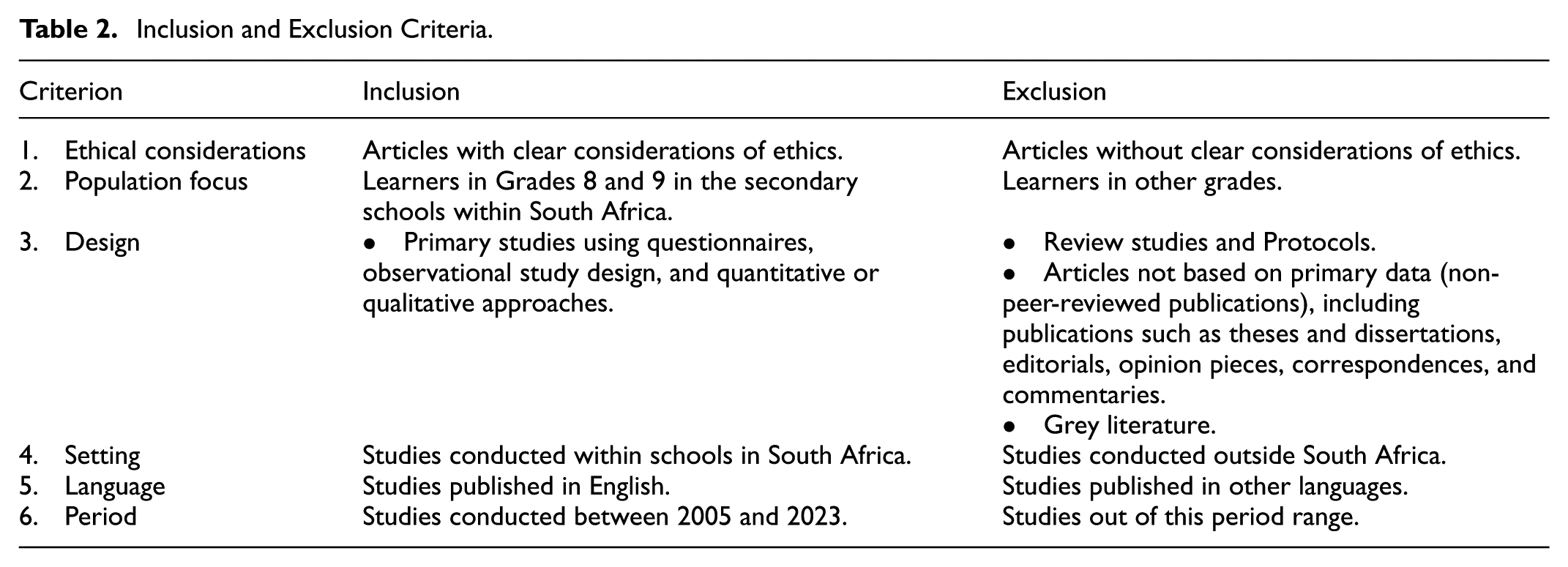
Due to limited human and financial resources, we applied strict inclusion and exclusion criteria to ensure precise study selection from our databases (Peters et al., 2017; Pham et al., 2014). Given the scarcity of literature on this topic in South Africa, we expanded our search period to 18 years (2005–2023). We restricted our review to South African studies to maintain relevance to the local context and its unique challenges. Moreover, due to financial implications associated with translations, this review only considered studies published in English. A detailed breakdown of the selection criteria is provided in Table 2.
Inclusion and Exclusion Criteria.
Literature Sources (Databases)
The literature was sourced from electronic databases, including ProQuest, EBSCOHost, Sabinet African Journals, and African Journals Online. To expand the search, we conducted forward and backwards citation tracking using Google Scholar’s “cited by” and “related articles” features to identify additional relevant studies. Furthermore, we performed a manual backwards search by reviewing the reference lists of included articles to ensure comprehensive data coverage. This entire process was completed over a 3-month period. This was done by independent competent researchers (SN and RM) to ensure repeatability.
Study Selection
We initially retrieved 409 articles from the databases using the selected key search terms. After reviewing the abstracts, we excluded a significant portion as they primarily addressed the under-performance of Grade 12 learners in South Africa, which was irrelevant to our study. Additionally, we removed duplicate articles across databases. Following the strict application of the inclusion and exclusion criteria, 15 relevant articles remained. We then obtained the full texts of these articles, verifying their relevance through a thorough review of titles and content. This process was undertaken by four authors (SN, IM, HN and RM), and the four authors ensured whether to include or exclude a paper; the other author (MS) would be invited to assist. To minimise the instances of selective perception and blind interpretive bias, we employed the inter-rater reliability (IRR) method, where one senior researcher (MT) independently gave a third eye to all the removed full-text papers and the included papers. The selection process adhered to the Preferred Reporting Items for Systematic Reviews and Meta-Analyses (PRISMA) guidelines (Liberati et al., 2009), as illustrated in Figure 1 below.
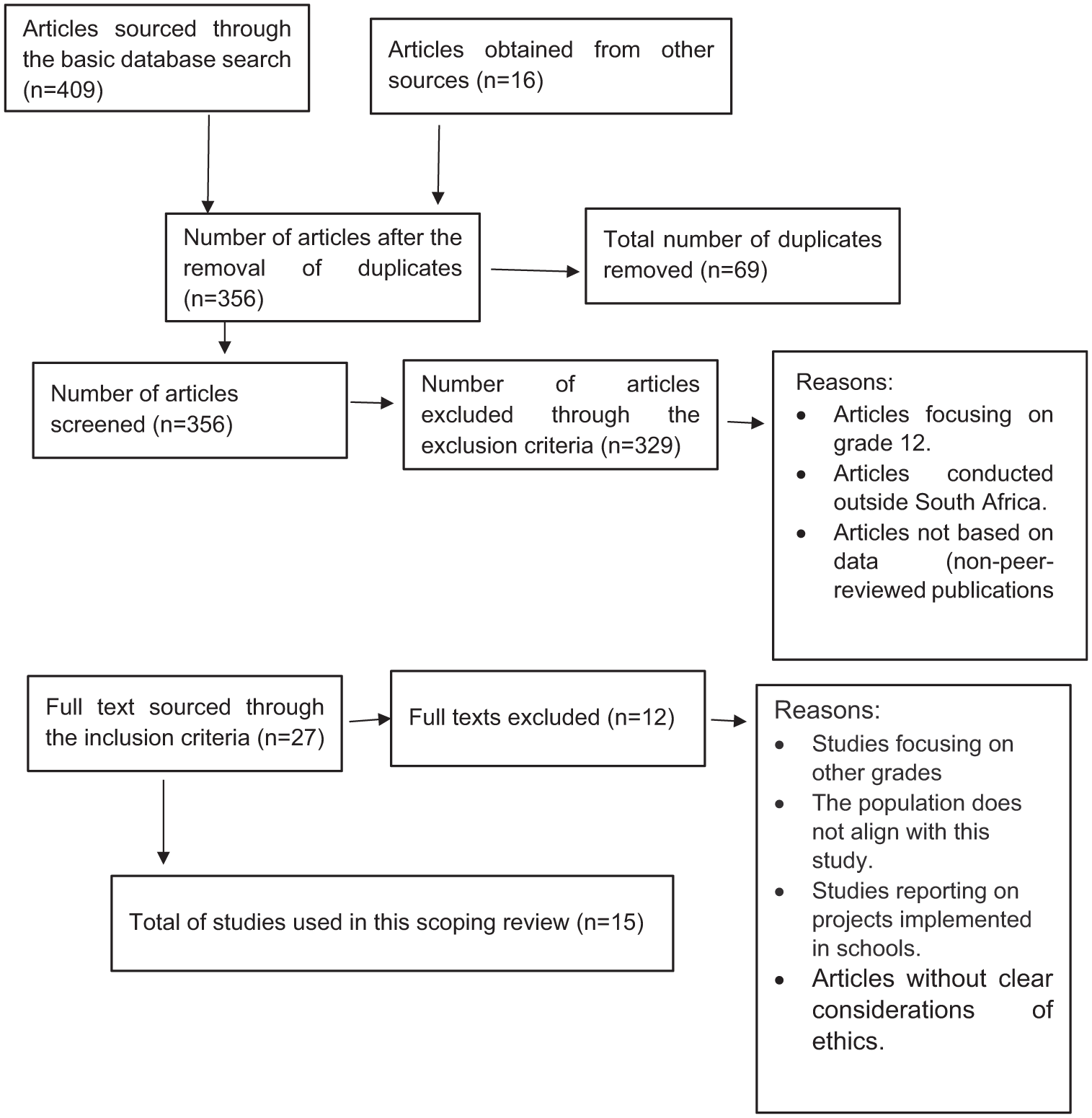
Preferred reporting of items for systematic reviews and meta-analyses (PRISMA) flow diagrams for selection of studies.
Data Charting and Collation
Following Arksey and O'Malley’s (2005) scoping review framework, the fourth stage involves systematically extracting and summarising key data from the selected studies. This process, known as charting, organises relevant information into a structured format. The extracted variables included: Authors and year, Geographic location of the study, Study design and methodology, Sample size, Key findings, Limitations, and recommendations. This process was conducted by four independent authors (SN, IM, HN, and RM), and once again, it was overseen by a senior researcher (MT). This is summarised in Table 3 below.
Chart of the Selected Studies.

Findings
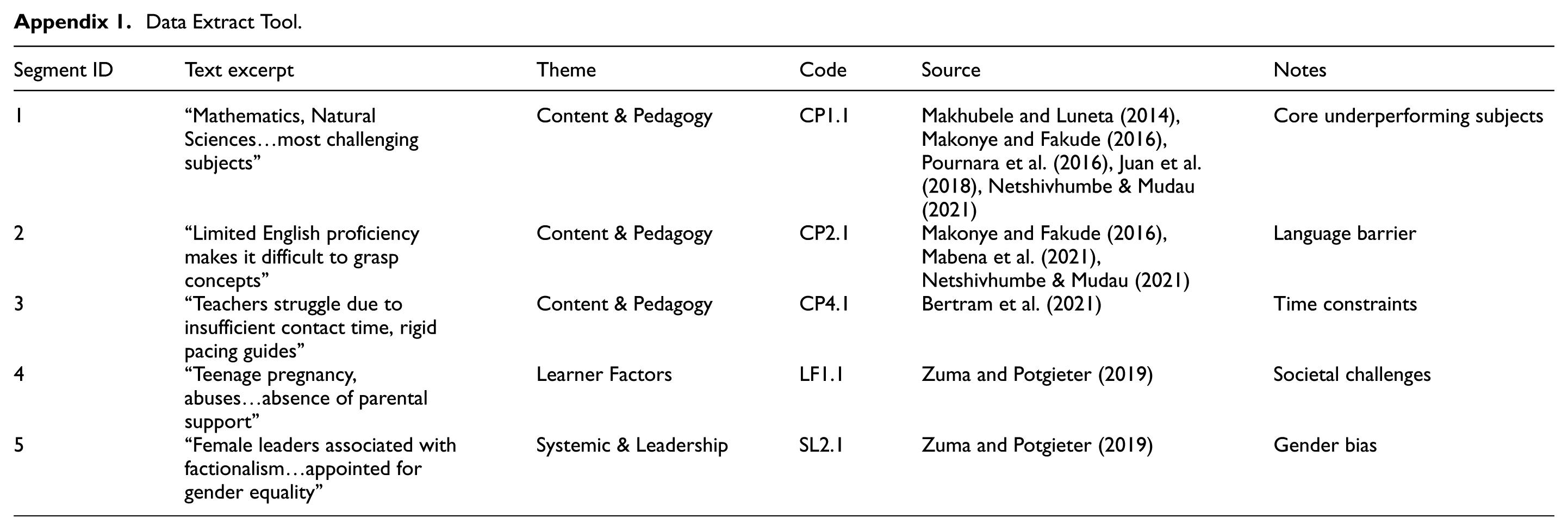
The fifth stage of Arksey and O'Malley's (2005) scoping review framework summarises and reports findings. This scoping review included 15 peer-reviewed articles, all conducted in South Africa, as geographical relevance was a key inclusion criterion. Focussing solely on South African studies ensured that the findings accurately reflected the contextual realities of schools, thereby informing the Univeristy of Limpopo and Mopani West District intervention strategy. This review employed the Inductive coding system, and three themes were generated thereof (see Appendix 1: Data extracting tool). Emerging themes were packaged using thematic data analysis to derive narratives. The review addresses two research questions: (i) What factors contribute to the under-performance of Grade 8 and 9 learners? and (ii) Which subjects underperform these grades the most? Using thematic analysis, we identified three key themes from the findings: (i) content-related and pedagogical challenges, (ii) learners’ personal and social barriers, and (iii) school leadership, management, and systemic factors. These themes provide a structured summary of the contributing factors to learner under-performance in Grades 8 and 9 in South African schools.
Content Subjects and Teacher Paedagogy Factors
Most of the studies (Juan et al., 2018; Makhubele & Luneta, 2014; Makonye & Fakude, 2016; Netshivhumbe & Mudau, 2021; Pournara et al., 2016) included in this scoping review revealed that Mathematics, Natural Sciences (NS), and Economics and Management Sciences (EMS) are the most challenging subjects for learners in these grades, contributing to their under. In Mathematics, the studies highlighted several challenges, including logical errors affecting “addition and subtraction of directed numbers” (Makonye & Fakude, 2016), difficulties with negative numbers and the laws of exponents (Makonye & Fakude, 2016; Pournara et al., 2016), and an imbalance in the quantity and quality of mathematics content taught, leading to the skipping of topics (Makhubele & Luneta, 2014).
In Natural Sciences, learners’ poor performance is primarily attributed to limited access to laboratories for practical science experiences (Netshivhumbe & Mudau, 2021). Additionally, learners’ under-performance in these subjects is exacerbated by the language of instruction, which is English (Mabena et al., 2021; Makonye & Fakude, 2016; Netshivhumbe & Mudau, 2021; Ramothwala et al., 2021). Limited English proficiency makes it difficult for learners to grasp certain mathematics and natural sciences concepts (Mabena et al., 2021; Makonye & Fakude, 2016; Netshivhumbe & Mudau, 2021). Moreover, the issue is worsened in instances where teachers cannot code-switch effectively because they do not speak the same language as their learners.
Learners’ under-performance in these subjects, among others, is also linked to inadequate pedagogical practices by teachers (Bertram et al., 2021; Juan et al., 2018; Mabena et al., 2021; Makhubele & Luneta, 2014; Mkhasibe et al., 2018; Netshivhumbe & Mudau, 2021; Nkanyani & Mudau, 2019; Tabe, 2023). The studies indicated that teachers exhibited several pedagogical issues, such as a lack of content knowledge and teaching skills in mathematics, natural sciences, economics, and management sciences, which may stem from insufficient professional development opportunities.
Furthermore, the review reveals that teachers struggle to cover the required content due to insufficient contact time, rigid pacing guides, poor time management, and inadequate lesson planning (Bertram et al., 2021). As a result, teachers may compromise the quality of instruction to cover the subject matter (Netshivhumbe & Mudau, 2021). Additionally, (Juan et al., 2018) noted that some teachers teach mathematics or other subjects despite them not being their major in their initial qualification. This issue is particularly common in Grades 8 and 9 of South African schools. Edmonds (1979) and Sisman and Turan (2011) are of the notion that effective teaching methodology and relevant content knowledge contribute largely to learner performance. Sisman and Turan (2011) further reiterate that strengthening the integration of effective strategies in teaching methods and support to learners in terms of the subjects or content contributes largely to learner performance. This is further supported by Edmonds (1979), who maintains that through innovative, reflective pedagogic strategies, learner performance could be enhanced.
Learners’ Social and Personal Factors
The under-performance of Grades 8 and 9 is also due to learners’ social and personal issues, which schools have limited control over (Bertram et al., 2021; Mabena et al., 2021; Makhubele & Luneta, 2014; Mokgwathi et al., 2023; Netshivhumbe & Mudau, 2021; Zuma & Potgieter, 2019). At the societal spectrum, the review revealed that issues such as teenage pregnancy, various abuses learners experience at home, societal violence, child-headed homes, poor background of learners, and the absence of parental support heavily contribute to the under-performance of grades 8 and 9 learners (Zuma & Potgieter, 2019). The same view is maintained by (Mabena et al., 2021; Mokgwathi et al., 2023; Netshivhumbe & Mudau, 2021) that the under-performance of learners in mathematics and science is attributed to the poor background of learners, as most depend on social grants for survival, leading to a lack of proper support and basic educational resources. Moreover, Makhubele and Luneta (2014) highlight that societal beliefs about some subjects, such as the myth that “Mathematics and Sciences are difficult.” This affects the attitudes of Grades 8 and 9 learners towards the subjects, ultimately leading to poor performance.
At the learners’ personal spectrum (Bertram et al., 2021; Mabena et al., 2021; Mokgwathi et al., 2023), it is argued that the under-performance of grades 8 and 9 learners is motivated by the personal elements of learners. This includes learners’ failure to catch up with the pace of the curriculum pace-setters, resulting in them being left behind. Teachers do this for compliance; however, the quality of teaching and learning is compromised (Bertram et al., 2021). Furthermore, some Grade 8 and 9 learners reach the grades without a proper grasp of the necessary basic skills and knowledge of the content, because of the progression requirements, which force the system to progress learners based on age and the period that the learner spends in a grade. The older they are and the longer they spend in a grade, the more they must progress to the next grade. This, therefore, puts them at a disadvantage, leading to under-performance (Mabena et al., 2021; Mokgwathi et al., 2023). In addition, learners’ ill-discipline and lack of motivation, especially in mathematics and science, also contribute to the under-performance of learners in Grades 8 and 9.
School Leadership and Management, and Systemic Factors
The scoping review revealed that the under-performance of Grades 8 and 9 learners is ascribed to the management of schools and systemic factors (Juan et al., 2018; Mkhasibe et al., 2018; Modiba, 2023; Netshivhumbe & Awelani, 2021; Zuma & Potgieter, 2019). In the school leadership and management spectrum, it is established that the under-performance of secondary schools, in general, is due to issues such as poor monitoring of teacher performance, normalising the culture of under-performance, insufficient performance boosters or interventions, and limited availability of competent schools’ leaders to achieve better school performance (Modiba, 2023). In the same reasoning, Zuma and Potgieter (2019) snuck in the gender element, maintaining that, indeed, weak leadership leads to schools’ under-performance. However, female leaders are more associated with weak leadership compared to their male counterparts. Furthermore, Zuma and Potgieter (2019) posit that this is the case because female leadership is commonly characterised by factionalism. In addition, Zuma and Potgieter (2019) affirm that this quagmire could be because most female leaders are appointed for gender equality, not based on meritocracy. Another element of leadership and management is the appointment of teachers to teach subjects they were never trained to teach, which is common in Grades 8 and 9 (Juan et al., 2018).
Lastly, Netshivhumbe & Mudau (2021) and Zuma and Potgieter (2019) cited poor school infrastructure as one of the systemic factors leading to the under-performance of grades 8 and 9 learners. We associate this factor with school leadership because we believe that school leadership and management do have some control over this element. Adding to the systemic factors (Netshivhumbe & Mudau, 2021) established that schools do not have science laboratories, hence the under-performance in natural sciences.
Discussions of the Findings
This section discusses the findings and identifies literature gaps. This scoping review discussed the factors contributing to the under-performance of Grades 8 and 9 learners in South African schools. The findings are meant to inform a longitudinal intervention project to be implemented by the Mopani West District in collaboration with the University of Limpopo. In this review, 15 studies satisfied the inclusion criteria and were selected. The findings from the included studies can be summarised into the following themes: (i) content subjects and teacher pedagogy factors, (ii) learners’ personal and social problems, (iii) school leadership and management, and systematic factors. Table 4 below summarises the four themes and their description along with the corresponding tenets of the Edmonds’ Five-Factor Model of Effective Schools
Presentation of Themes and Corresponding Model Tenets.

Presentation of Themes and Corresponding Model Tenets
Under-performance in Grades 8 and 9 arises from a dynamic interplay among weak pedagogy, learner-level barriers, and systemic problems. First, deficiencies in teacher content knowledge and pedagogical strategies in Mathematics, Natural Sciences, and EMS create conceptual gaps that learners carry forward into higher grades (Makonye & Fakude, 2016; Mkhasibe et al., 2018; Pournara et al., 2016). When teachers lack both subject expertise and practical resources such as science laboratories, their capacity to deliver engaging, hands-on lessons is severely hampered (Netshivhumbe & Mudau, 2021; Nkanyani & Mudau, 2019). Simultaneously, socio-economic hardships such as poverty, teenage pregnancy, and child-headed households exacerbate attendance problems and cognitive exhaustion (Bayat et al., 2014; Zuma & Potgieter, 2019). These challenges demand differentiated support that underprepared teachers struggle to provide, resulting in a widening achievement gap. For instance, rural learners facing extreme resource shortages show a 15% deficit in practical science assessments compared to better-resourced peers (Mudzielwana & Ravhuhali, 2017).
At the same time, leadership and management weaknesses, poor performance monitoring, inconsistent application of improvement plans, and appointing non-specialist teachers further undermine instructional quality (Makhubele & Luneta, 2014; Modiba, 2023). Without strong principals and functional School Management Teams (SMTs), schools cannot salvage limited resources or sustain data-driven interventions (Bertram et al., 2021; Tabe, 2023). This interdependence creates a feedback loop: weak leadership perpetuates pedagogical challenges, which amplify learner barriers, all within an under-resourced system that lacks the capacity to break the cycle.
The gravity of these challenges is demarcated according to the geographical situation of the schools. Rural schools report acute shortages of laboratories, textbooks, and qualified science teachers, resulting in significantly lower practical science scores and a 30% higher failure rate in Mathematics compared to urban counterparts (Mudzielwana & Ravhuhali, 2017; Netshivhumbe & Mudau, 2021). Mobile lab initiatives and inter-school resource-sharing networks have shown promise in Mpumalanga, improving practical assessment scores by 10% within 1 year (Maree et al., 2006; Mokgwathi et al., 2023). Semi-urban schools struggle more with language and pacing issues: English-only instruction and rapid grade progression policies leave learners struggling to keep pace, with observations indicating that learners more than 2 weeks behind rarely recover without remedial classes (Maree et al., 2006; Ramothwala et al., 2021). Structured code-switching training for teachers has been linked to a 12% improvement in reading comprehension and increased classroom participation (Makalela, 2015). Such contextual nuances underscore the need for differentiated interventions rather than a one-size-fits-all approach.
Application of the Five-Factor Model
Edmonds’ Five-Factor Model of Effective Schools, emphasising strong leadership, clear mission, high expectations, frequent monitoring, and positive climate, illuminates critical gaps in Grades 8 to 9 classes. Strong leadership is absent in many schools, where principals report limited authority to reallocate budgets or schedule professional development aligned with subject-specific needs (Makhubele & Luneta, 2014; Modiba, 2023). This undermines the model’s first pillar, as ineffective leadership correlates with low teacher morale and fragmented school improvement efforts (Bertram et al., 2021). A clear mission and shared goals are compromised by inconsistent use of Subject Improvement Plans (SIPs) and the Integrated Quality Management System (IQMS) in the senior phase, despite policy mandates (DBE, 2015). Studies highlighted that SIPs often become “tick-box” exercises lacking coherent alignment with classroom practice (Bertram et al., 2021; Reynolds, 2010).
High expectations for both teachers and learners falter when non-specialist teachers lead core subjects, reinforcing myths that “Mathematics and Science are inherently difficult” (Mji & Makgato, 2006; Stott, 2019). This erodes learner self-efficacy and diminishes teacher commitment to continuous improvement (Juan et al., 2018). Frequent monitoring is sporadic, with only a few schools conducting formative assessments more than twice per term (Makonye & Fakude, 2016; Reynolds, 2010). Without timely feedback loops, at-risk learners go unnoticed until challenges have become rooted. A positive school climate is stifled by overcrowded classrooms, limited psycho-social support, and language mismatches between learners and teachers (Ramothwala et al., 2021; Wang & Degol, 2016). These conditions undermine learners’ sense of belonging and motivation, key drivers of engagement and achievement.
To address the challenges addressed above, a holistic strategy must strengthen all five Edmonds factors and address cross-cutting interdependencies by implementing targeted interventions across leadership, planning, teacher development, learner support, and monitoring systems. First, leadership capacity building should involve developing district-level leadership that combines instructional coaching, policy navigation, and strategic resource mobilisation (Leithwood & Jantzi, 2008), along with mentorship pairings between high-performing and under-performing principals to share best practices. Second, aligned improvement planning requires revising SIP templates to include grade-specific diagnostics for Grades 8 to 9 and mandating quarterly progress reviews with community stakeholders (DBE, 2015). Third, targeted teacher development should offer modular, in-service courses on deep content knowledge in Mathematics, Science, and EMS, supported by classroom-based coaching cycles (Mkhasibe et al., 2018; Pournara et al., 2016).
Fourth, integrated learner support systems must embed social workers, psychologists, and nutrition programmes on school campuses to mitigate external barriers (Spaull, 2013; Zuma & Potgieter, 2019), while formalising partnerships with local NGOs and the Department of Social Development for after-school learning and mentorship. Finally, robust monitoring and feedback mechanisms should include rolling out digital assessment platforms for real-time formative data, enabling teachers to quickly identify and remediate learning gaps (Bertram et al., 2021; Reynolds, 2010). Together, these measures could ensure a comprehensive and responsive approach to systemic improvement.
Conclusion
Evidently, the factors contributing to the under-performance of Grades 8 and 9 learners are not new, and they have been reported in the literature from different angles. However, they seem to have been naturalised. This makes them even more stubborn. Challenges such as learners’ psycho-social difficulties, inadequate parental support, systemic barriers, and the insufficient availability of teaching and learning resources are issues that cannot be resolved solely within the school environment. If these challenges continue to be placed solely on the shoulders of schools, meaningful progress will remain elusive. However, it is critical to note that some interventions are there, and they have proven to be effective as they are able to boost the performance of Grade 12 in most schools; this means the focus needs to be spread across the grades rather than only focussing on Grade 12.
Recommendations and Areas of Further Research
Thorough collaborations are necessary involving the Department of Basic Education, Social Development, and the research community to understand and address the external factors contributing to the under-performance of learners. This is to initiate and adapt research-based and context-specific interventions to address the under-performance of Grades 8 and 9 learners.
A thorough skills audit is needed, targeting school principals to generate supporting interventions.
Although it may be difficult, schools should adopt the grade 12 interventions in Grades 8 and 9 because they have proven effective.
More research is needed to understand how South African learners in grade 7 pass very well, but immediately they reach Grade 8, they struggle. This will help establish whether the under-performance is a foundational issue or secondary schools are not doing what they should do.
More research is needed to identify struggling learners in their previous grades to understand where the problem started.
Limitations
The primary limitation of this scoping review is the absence of a formal quality appraisal of included studies. While the Arksey and O’Malley framework facilitates mapping of existing evidence, it does not require critical assessment of methodological rigour. As a result, findings drawn from studies with varying designs, sample sizes, and analytic approaches are synthesised together without weighting for quality, potentially skewing the interpretation of prevalent factors.
Publication and language bias may also affect the comprehensiveness of the review. We restricted our search to English-language, peer-reviewed journal articles, thereby excluding potentially relevant studies published in other languages or contained in grey literature (e.g., government reports, dissertations). Consequently, novel insights from non-indexed sources or local policy documents may have been overlooked.
The thematic synthesis employed relies on subjective coding decisions, despite measures to enhance reliability. The inductive coding and clustering process, while transparent, cannot fully eliminate interpretive bias.
The exclusive focus on South African contexts limits the generalisability of our conclusions to other educational systems. Although context-specific insights are valuable for local policy and practice, cross-national comparisons and transferability of interventions should be approached with caution. Future studies could broaden the scope to include comparative analyses across sub-Saharan Africa.
Footnotes
Appendix
Data Extract Tool.
| Segment ID | Text excerpt | Theme | Code | Source | Notes |
|---|---|---|---|---|---|
| 1 | “Mathematics, Natural Sciences…most challenging subjects” | Content & Pedagogy | CP1.1 | Makhubele and Luneta (2014), Makonye and Fakude (2016), Pournara et al. (2016), Juan et al. (2018), Netshivhumbe & Mudau (2021) | Core underperforming subjects |
| 2 | “Limited English proficiency makes it difficult to grasp concepts” | Content & Pedagogy | CP2.1 | Makonye and Fakude (2016), Mabena et al. (2021), Netshivhumbe & Mudau (2021) | Language barrier |
| 3 | “Teachers struggle due to insufficient contact time, rigid pacing guides” | Content & Pedagogy | CP4.1 | Bertram et al. (2021) | Time constraints |
| 4 | “Teenage pregnancy, abuses…absence of parental support” | Learner Factors | LF1.1 | Zuma and Potgieter (2019) | Societal challenges |
| 5 | “Female leaders associated with factionalism…appointed for gender equality” | Systemic & Leadership | SL2.1 | Zuma and Potgieter (2019) | Gender bias |
Acknowledgements
We would like to acknowledge the DSI-NRF/UL research chair in Schools as Enabling Environments, in conjunction with the Mopani West District, for making this review successful.
ORCID iDs

Ethical Considerations
This review study utilised secondary data, which is available in public research platforms. Therefore, no ethical approval was required.
Funding
The authors received no financial support for the research, authorship, and/or publication of this article.
Declaration of Conflicting Interests
The authors declared no potential conflicts of interest with respect to the research, authorship, and/or publication of this article.
Data Availability Statement
No data were generated or analysed in this study; therefore, data sharing is not applicable.