




Abstract
The Satisfaction with Life Scale (SWLS) and the Satisfaction with Love Life Scale (SWLLS) are cognitive measures of subjective well-being. Each scale includes 5 items. The major goals of this work were to analyze the psychometric features and validity of the abbreviated 3-item forms of the Satisfaction with Life Scale (SWLS-3) and the Satisfaction with Love Life Scale (SWLLS-3), as well as the measurement invariance (MI) by gender and age in a Portuguese population. The sample comprised 1,271 participants with an average age of 38 years. Confirmatory factor analyses (CFA) demonstrated that the two-dimensional model of SWLS-3 and of SWLLS-3 presented good fit indices. The reliability was adequate. Furthermore, these scales demonstrated MI across gender and age. The correlations of the 3- and 5-item measures with these well-being measures were very similar. Overall, the 3-item versions of the SWLS-3 and the SWLLS-3 are presented as valid and reliable measurement tools.
Plain language summary
The Satisfaction with Life Scale (SWLS) and the Satisfaction with Love Life Scale (SWLLS) are cognitive measures of subjective well-being. Each scale includes five items. The major goals of this work were to analyze the psychometric features and validity of the abbreviated three-item forms of the Satisfaction with Life Scale (SWLS-3) and the Satisfaction with Love Life Scale (SWLLS-3), as well as the measurement invariance (MI) by gender and age in a Portuguese population. The sample comprised 1271 participants with an average age of 38 years. Confirmatory factor analyses (CFA) demonstrated that the two-dimensional model of SWLS-3 and of SWLLS-3 presented good fit indices. The reliability was adequate. Furthermore, these scales demonstrated MI across gender and age. The correlations of the three- and five-item measures with these well-being measures were very similar. Overall, the three-item versions of the SWLS-3 and the SWLLS-3 are presented as valid and reliable measurement tools.
Keywords
Introduction
Happiness represents a key issue of human life. The investigation into happiness or subjective well-being (SWB) has increased very substantially in recent decades (Diener et al., 2018). As a result, it is important to know what makes people satisfied.
This research intends to scrutinize the psychometric features and validity of the abbreviated 3-item versions of the Satisfaction with Life Scale (SWLS; Diener et al., 1985) and the Satisfaction with Love Life Scale (SWLLS; Neto, 2012) in a Portuguese population. We are not suggesting that the initial SWLS and SWLLS are inadequate, but that both scales can be supplied in shorter forms, without jeopardizing their psychometric features. It is worthwhile to present support of the application of shorter forms of the SWLS and the SWLLS given that, generally, shorter measures are desirable to be used in “large-scale surveys, pre-screening packets, longitudinal studies, and experience-sampling studies” (Gosling et al., 2003, p. 505). Moreover, “the demand for short scales is currently expanding at an accelerating speed. One reason for the increasing need for short scales could be a changing way to approach psychological research in general. With research questions becoming more and more complex, involving more and more constructs . . .” (Ziegler et al., 2014, p. 185). Short screening instruments provide many practical advantages in professional counseling (Shields et al., 2021). We will very briefly present the theoretical and methodological background of the SWLS and the SWLLS.
Satisfaction With Life
SWB, or what is often called “happiness,” is a core life outcome. It concerns one’s global assessment of life quality (Diener, 1984). Diener et al. (2002) proposed that SWB includes affective and cognitive components. The affective component embraces the presence of positive affect (PA; such as attentive and active) and the absence of negative affect (NA; such as upset and nervous). On the other hand, satisfaction with life (SWL) is the cognitive component of SWB. Subsequently, Diener et al. (2003) proposed four components for the SWB: PA, NA, overall SWL, and domain-specific satisfactions (e.g., friends, migration, and family).
SWL is “a global assessment of a person’s quality of life according to chosen criteria” (Shin & Johnson, 1978, p. 478). In that sense Pavot and Diener (2008, p. 140) observed that “measures of life satisfaction are advantageous because they allow respondents to determine their own criteria for inclusion in the judgment process, and to weight them in the manner they choose.” The research of SWL is relevant as it is related to personal and societal benefits (Diener & Ryan, 2009).
To evaluate the cognitive component of the SWB, the SWLS (Diener et al., 1985) is the most utilized multi-item instrument (Dimitrova & Dominguez, 2015; Pavot & Diener, 2008). The SWLS comprises five statements to assess overall SWL. There are adaptations of the SWLS in many countries worldwide (Emerson et al., 2017), including Portugal (Neto, 1993; Neto et al., 1990). The SWLS has been used across diverse populations including adolescents, adults, older adults, and patients (Pavot & Diener, 2008). Prior investigation shows that the SWLS-5 demonstrates adequate psychometric features (Diener et al., 1985; Pavot, 2014). Most studies have confirmed its unifactorial structure (Emerson et al., 2017; Neto, 1993; Pavot & Diener, 2008). Confirmatory factor analysis (CFA) has shown that the SWLS-5 is invariant across gender (Emerson et al., 2017; Hanzlová, 2022; Hultell & Gustavsson, 2008; Schnettler et al., 2021; Zanon et al., 2014), it is invariant for age (Hultell & Gustavsson, 2008), or partial scalar invariant for age groups (Dimitrova & Dominguez, 2015; Hanzlová, 2022).
Recently, Kjell and Diener (2021) proposed that the first 3 items of the SWLS (“1. In most ways, my life is close to my ideal,”“2. The conditions of my life are excellent”) and “3. I am satisfied with my life”) were the most suitable to forming an abbreviated version (SWLS-3), based on psychometric and theoretical perspectives. Psychometrically, the first three statements presented the strongest factor loadings (Diener et al., 1985). Furthermore, there is investigation indicating that the statements four (“So far I have gotten the important things I want in life”) and five (“If I could live my life over, I would change almost nothing”) are different from the others as they are aging-related (Pavot & Diener, 2008). Theoretically, the first 3 items of the SWLS also make most sense for selection “as they arguably are most directly tapping into the targeted construct” (Kjell & Diener, 2021, p. 184). Kjell and Diener (2021) showed that the SWLS-3 presented very good reliability, fit indices, and measurement invariance (MI) by time and gender. Additionally, the SWLS-3 showed identical validity to the SWLS-5 as it produced identical associations with other evaluations of well-being measures.
Research shows inconsistent results concerning gender differences in SWL. While in some studies women show higher SWL than men (Hanzlová, 2022; Pinquart & Sörensen, 2001), in other studies men obtain higher values (Haring et al., 1984; Moksnes et al., 2014), and some other studies do not find differences according to gender (Batz-Barbarich et al., 2018; Hayes & Joseph, 2002).
Research also shows inconsistent results concerning age differences in SWL. While in some studies older people show greater happiness, in other studies no relation between age and SWL was found (Diener, 1984). Hanzlová (2022) shows that the youngest people report greatest SWL, while the oldest age group report the lowest SWL.
Satisfaction With Love Life
The cognitive component of SWB includes overall judgments of SWL, as well as domain-specific satisfactions, such as the satisfaction with love life (SWLL). Indeed, SWLL is a particular domain of SWL. The SWLL is “a judgmental process in which individuals assess the quality of their love lives on the basis of their own set of criteria” (Neto, 2005, p. 4). It touches the majority of people (Hatfield et al., 2020). SWL represents a significant aspect regarding love given its relationships with improved physical and mental health, and social relations (Graham, 2011; Neto, 2005; Simmons & Lehmann, 2013). The SWLLS was created to evaluate the overall cognitive judgments of SWLL (Neto, 2005) and it includes five statements. The theoretical background of the SWLLS is considerably based on the research of the initial SWLS (Diener et al., 2003).
Diverse works showed adequate psychometric characteristics of the SWLLS (e.g., Guedes, 2011; Nazzal et al., 2019; Soares et al., 2020). Neto and Dimitrova (2017) analyzed the MI of the SWLLS in cultural contexts from Europe, Africa, Asia, and South America. They found the one factor model of the SWLLS in the five cultural contexts dispersed across four continents. These scholars also showed that the SWLLS was suitable to be used in cross-cultural research with emerging adults. Additionally, there are adaptations of the SWLLS to Arabic (Nazzal et al., 2019), and Spanish (Caycho-Rodriguez et al., 2020). Caycho-Rodriguez et al. (2020) evidenced configural, metric and scalar invariance across gender among Peruvian older adults. In a recent study no significant differences in SWLL appeared between Brazilian and Portuguese people (Neto et al., 2023).
There were no significant gender differences for college students from several cultural contexts in SWLL (Nazzal et al., 2019; Neto, 2005; Neto & Dimitrova, 2017). Regarding age effects, adults under 60 presented greater SWLL than older adults (Neto & Pinto, 2015a).
The Present Study
This study has two goals. The first goal aims to give new empirical evidence of the psychometric properties of the SWLS-3 and the SWLLS-3 in an adult Portuguese population, assessing the factorial structure, the reliability, and the measurement invariance across gender and age. To reach this goal, assorted tests were conducted. To evaluate the factorial structure of the SWLS-3 and SWLLS-3 CFA was conducted. The expectation was that the SWLS-3 and SWLLS-3 scores would evidence a two-factor structure (Kjell & Diener, 2021).
The internal consistency of the SWLS-3 and SWLLS-3 was calculated via Cronbach’s alpha, and McDonald’s omega. The expectation was that high reliability of both scales would appear (Diener et al., 1985; Kjell & Diener, 2021; Neto, 2005).
Measurement invariance of the SWLS-3 and SWLLS-3 across gender and age is also tested in the present work, as it is critical to meaningfully compare groups (Han et al., 2019). Just empirical demonstration that gender and age groups similarly comprehend items measuring a latent trait (in our case, SWL and SWLL) provides confident findings to show differences across gender and age. We expected that the measurement features of the analyzes would be independent of the groups (men and women, and age groups) characteristics.
The second goal was to scrutinize the validity of the SWLS-3 and SWLLS-3 by examining their correlations with theoretically related well-being constructs (i.e., self-esteem, satisfaction with sex life, PA, NA, and romantic loneliness). In these terms, the major interest is to make comparisons of the associations with the 5-item instruments. We expected that the associations of the 3- and 5-item scales would be identical.
Self-esteem indicates feelings of personal worth. Orth and Robins (2022, pp. 13–14) concluded that “high self-esteem helps individuals adapt to and succeed in a variety of life domains, including having more satisfying relationships, performing better at school and work, enjoying improved mental and physical health, and refraining from antisocial behavior.” Other scholars also found that greater self-esteem was related to greater life satisfaction and love satisfaction (Arslan, 2019; Diener & Diener, 1995; Moksnes et al., 2014; Nazzal et al., 2019).
Satisfaction with sex life (SWSL) represents “a global evaluation by the person of his or her sex life” (Neto, 2012, p. 19), and it is a relevant component of SWB for most people. SWL and SWLL correlated significantly with SWSL (Neto, 2012; Neto & Pinto, 2015b). Since PA and NA are components of SWB, statistically significant correlations with SWL and SWLL were found (Busseri & Sadava, 2011; Ruiz et al., 2009).
Loneliness is “the cognitive awareness of a deficiency in one’s social and personal relationships and ensuing affective reactions of sadness, emptiness or longing” (Asher & Paquette, 2003, p. 75). It is a subjective feeling, associated with feeling unhappy, unloved. Romantic loneliness is a disagreeable experience of deficits in one’s romantic relationships with potentially negative psychological outcomes (Heinrich & Gullone, 2006; Holt-Lunstad et al., 2015). Romantic loneliness was related to lower SWLL (Neto & Pinto, 2015a).
To sum up, in light of the literature review, we advance five hypotheses:
H1. The SWLS-3 and the SWLLS-3 would present a good fit in a two-factor solution via CFA.
H2. The SWLS-3 and the SWLLS-3 would present good internal consistencies.
H3. The SWLS-3 and the SWLLS-3 would present MI across gender and age.
H4. The SWLS-3 and the SWLLS-3 would present positive correlations with self-esteem, SWSL, and PA, and negative correlations with NA, and romantic loneliness.
H5. It is expected that the well-being measures would present similar correlations for the 3- and 5-item scales of SWL and SWLL.
Whether we find support to H3, it will be possible to test gender and age groups effects on the SWLS-3 and the SWLLS-3. However, as previous research shows inconsistent results concerning the effects of gender and age on satisfaction with life, we do not advance any hypothesis on their effects on these measures.
Method
Participants
The sample consisted of 1,271 participants with an average age of 38 years (SD = 17.26, minimum 18, maximum 79). These were 48% women and 52% men. Three age groups were created according to Erikson’s (1963) psychosocial stages: young adults (18–30 years, 47%), adults (31–59 years, 34%), and older adults (60–79 years, 18%). Regarding the level of education 46% had concluded secondary education or less, 49% attended a university, and 5% did not answer. Single respondents were 57%, married or cohabiting 33%, divorced or widowed 8%, and 2 % did not answer.
Instruments
The Satisfaction With Life Scale (SWLS)
This measure (Diener et al., 1985) comprises five statements (e.g., “So far I have gotten the important things I want in my life”). Ratings ranged from 1 (“Strongly disagree”) to 7 (“Strongly agree”), with greater scores indicating greater SWL. Previous research demonstrated good psychometric features of the SWLS in Portugal (Munoz Sastre et al., 2003; Neto, 1993; Neto et al., 1990).
Satisfaction With Love Life Scale (SWLLS)
The SWLLS includes five statements (e.g., “The conditions of my love life are excellent”). Ratings ranged from 1 (“strongly disagree”) to 7 (“strongly agree”). Higher values denote higher SWLL. The SWLLS demonstrated good psychometric features (Neto, 2005; Neto & Dimitrova, 2017;Neto & Pinto, 2015a).
Self-esteem was assessed with a single-item scale: “I am someone who generally has high self-esteem” (Neto & Fonseca, 2018; Robins et al., 2001). Ratings ranged from 1 (“Strongly disagree”) to 5 (“Strongly agree”), with greater scores indicating greater self-esteem.
Satisfaction With Sex Life Scale (SWSLS)
The SWSLS consists of five statements (e.g., “I am satisfied with my sex life”). Ratings ranged from 1 (“Strongly disagree”) to 7 (“Strongly agree”). Greater values indicate greater SWSL. The SWSLS demonstrated good psychometric features (Neto, 2012; Neto & Pinto, 2015b). For the current study the α and ω values were .90 and .90, respectively.
Positive and Negative Affect Scales (PANAS)
This measure comprises 20 items, ten assessing PA and 10 assessing NA (Simões, 1993; Watson et al., 1988). Participants answered how often they generally experience each emotion with ratings ranging from 1 (“Not at all”) to 5 (“Extremely”). Higher scores denote higher PA and NA. For the current study α and ω values of the Positive affect were .85 and .85, respectively, and of Negative affect were .89 and .89, respectively.
Romantic Loneliness. We used the five statements of the SELSA-S to measure romantic loneliness (DiTommaso et al., 2004; Fernandes & Neto, 2009) (e.g., “I have a romantic partner to whose happiness I contribute”). Ratings ranged from 1 (“Strongly disagree”) to 7 (“Strongly agree”). For this work the α and ω values were .75 and .71, respectively.
Demographic Information
Respondents indicated their gender, age, educational level, civil status, and nationality.
Procedure
The sample was recruited in Lisbon area by four research assistants. The eligibility criteria for inclusion in this research were ≥18 years of age, and Portuguese nationality. Participants were invited to answer a paper-and-pencil survey. Respondents were informed that participation was voluntary, anonymous, and the right to withdraw from the survey at any time. The work was completed following the Declaration of Helsinki, and local ethical norms. Participants provided informed consent. Respondents were not remunerated.
Data Analyses
Descriptive analyses of the items of the SWLS-3 and SWLLS-3 were performed. CFA was implemented to analyze whether a two-factor model had an adequate fit of the SWLS-3 and the SWLLS-3. Goodness-of-fit indices were performed: χ2/df (“ratio chi-square and degrees of random”), GFI (“goodness of fit index”), CFI (“comparative fit index”), SRMR (“standardized root mean square residual”), and RMSEA (“root mean square error of approximation”). Models with χ2/df smaller than 5 are considered as good; models with CFI and GFI values in the .90s or greater suggest an acceptable fit; RMSEA and SRMR with values close to .06 or .08 or lower, respectively, suggest an acceptable fit (Byrne, 2016; Hu & Bentler, 1999). Internal consistency was assessed using the Cronbach’s alpha and McDonald’s Omega.
MI of the SWLS-3 and SWLLS-3 according to gender and age groups was tested via multigroup CFA (MGCFA), which applied growing constraints to a base solution (“configural”): equal factorial loadings (“metric invariance”), and equal factor loadings and intercepts (“scalar invariance”). MGCFA is a multivariate technique in order to establish the psychometric equivalence of test scores for subgroups (Dimitrov, 2010). To test significant differences between models, we used Chen’s (2007) advice in accordance with which a ΔCFI < 0.010, supplemented by ΔRMSEA < 0.015,
To scrutinize potential differences by gender and age groups we performed analysis of variance. Lastly, Pearson’s correlations between SWLS-3 and SWLLS-3 scores, and scores of other measures were used. Data analyses were carried out using IBM SPSS AMOS (version 26). Significance levels were set at 5%.
Results
Descriptive Statistics of the Items
Descriptive statistics for items of the SWLS-3 and the SWLLS-3, and total scores are shown in Table 1. Skewness (between −.51 and −.37) and kurtosis (between −.28 and −.13) coefficients for the SWLS-3 items, and skewness (between −.79 and −.69) and kurtosis (between .02 and .08) coefficients for the SWLLS-3 items show that the univariate normality is verified (Field, 2017). Mardia’s multivariate kurtosis for the items was 31.32, which indicates no strong deviation from normal distribution (Bollen, 1989; Kline, 2005), and do not compromise CFA results.
Descriptive Statistics for the SWL-3 Scale and Items.

Note. N = 1271. Alpha = Cronbach’s alpha for the entire scales or item level Cronbach’s alpha for when item was dropped. Item total r = item total correlation; SWLS = satisfaction with life scale; SWLS 1 = in most ways my life is close to my ideal; SWLS 2 = the conditions of my life are excellent; SWLS 3 = I am satisfied with my life; SWLLS = satisfaction with love life scale; SWLLS 1 = in most ways my love life is close to my ideal; SWLLS 2 = the conditions of my love life are excellent; SWLLS 3 = I am satisfied with my love life.
Dimensionality
Maximum likelihood estimation was utilized in the CFA. No correlation between error terms was permitted. CFA was employed to test whether the statements of the SWLS-3 and the SWLL-3 were best captured in a two-factor in comparison with a one-factor model.
The one-factor demonstrated a bad fit, χ2 = 1261.48, df = 9, χ2/df = 140.16, CFI = 0.71, GFI = 0.74, SRMR = 0.188, and RMSEA = 0.331[90% CI: 0.316, 0.347]. The two-factor model fits the data very well, that is, χ2 = 16.74, df = 8, χ2/df = 2.09, CFI = 0.99, GFI = 0.99, SRMR = .012, and RMSEA = 0.029 [90% CI: 0.008, 0.049], suggesting a good model fit (Hu & Bentler, 1999). All standardized factor loadings (λ) in this model were significant (p < .001) ranging between 0.75 and 0.88, with an average of 0.84 (see Figure 1). Therefore, the findings show that the data fit the two latent factors, which supports construct validity of the SWLS-3, and of the SWLLS-3.

Standardized regression weights for the two-factor model of the satisfaction with life (SWL) and the satisfaction with love life (SWLL) 3-item scales.
Reliability Estimation
The Cronbach’s alpha is high for SWLS-3 (α = .84; 95% CI [0.82, 0.85]), as it is for the SWLS-5 (α = .86; 95% CI [0.85, 0.87]). McDonald’s omega is also high for the SWLS-3 (ω = .84), as it is for the SWLS-5 (ω = .86). The Cronbach’s alpha is high for SWLLS-3 (α = .91; 95% CI [.90, .92]), as it is for the SWLLS-5 (α = .92; 95% CI [.91, .92]). McDonald’s omega is also high for the SWLLS-3 (ω = .91), as it is for the SWLLS-5 (ω = .91).
Measurement Invariance by Gender and Age
MI of the SWLS-3 and SWLLS-3 by gender and age groups was scrutinized by MGCFA. As regards as gender, metric, and scalar invariance of the SWLS-3 between two groups (men = 660, women = 611) was met (Table 2). Regarding age invariance of the SWLS-3 with three groups fit indices were adequate with differences between models below the threshold values.
Results From Measurement Invariance Analyses of the SWLS-3.

χ2 = chi-square; df = degrees of freedom; CFI = comparative fit index; SRMR = standardized root mean square residual; RMSEA = root mean square error of approximation; CI = confidence interval; ΔCFI, ΔSRMR, and ΔRMSEA = change in fit indices between contiguous nested models.
As regards as gender, metric, and scalar invariance of the SWLLS-3 between two groups (males and females) was met (Table 3). Regarding age invariance of the SWLLS-3 with three groups fit indices were adequate with differences between models below the threshold values.
Results From Measurement Invariance Analyses of the SWLLS-3.

χ2 = chi-square; df = degrees of freedom; CFI = comparative fit index; SRMR = standardized root mean square residual; RMSEA = root mean square error of approximation; CI = confidence interval; ΔCFI, ΔSRMR and ΔRMSEA = change in fit indices between contiguous nested models.
From this method we can conclude that both scales are invariant, suggesting that the constructs have similar meanings in all the groups.
Gender and Age Comparisons
ANOVA was performed to assess differences between average scores of groups (gender and age) on the SWLS-3 and SWLLS-3 (Table 4). Results showed a significant main effect of gender on SWLS-3, but the effect size was low, Z(1, 1270) = 4.18, p = .04, ηp2 = 0.003. Females (M = 4.82; SD = 1.18) revealed higher satisfaction with life than males (M = 4.63; SD = 1.35). The analysis also evidenced that the main effect of age was not significant, Z(2, 1,270) = 1,68, p = .19, ηp2 = 0.035. The interaction gender x age was not significant, Z(2, 1,270) = .60, p = .55, ηp2 = 0.001).
Analysis of Variance Results.

Regarding SWLLS-3, the analysis indicated that the main effect of gender was not significant, Z(1, 1,260) = 0.02, p = .90, ηp2 = 0.000 (Table 4). Females (M = 5.10; SD = 1.32) displayed identical SWLL to males (M = 5.07; SD = 1.42). The analysis also evidenced that the main effect of age was significant, although the effect size was low Z(2, 1,260) = 5.12, p = .01, ηp2 = 0.008. Older adults presented less SWLL (M = 4.95; SD = 1.42) than adults (M = 5.25; SD = 1.27). Nevertheless, no significant differences on SWLL appeared between young adults (M = 5.02; SD = 1.42) and older adults, nor between young adults and adults. The interaction gender × age was not significant, Z(2, 1,260) = 2.39, p = .09, ηp2 = 0.004).
Comparing the Validity Between the 3- and 5-Item Scales
The correlation between SWLS-3 and SWLS-5 was very strong (r = .95; 95% CI [.94, .96]) as well as between the SWLLS-3 and the SWLLS-5 (r = .96; 95% CI [.96, .97]). As expected, SWLS-3 and the SWLLS-3 scores correlated significantly and positively with self-esteem, SWSL, and positive affect (Table 5). On the other hand, SWLS-3 and the SWLLS-3 scores correlated significantly and negatively with negative affect and romantic loneliness. The 3- and 5-item measures presented identical correlations with other well-being measures (i.e., self-esteem, SWSL, PA, NA, and romantic loneliness).
Pearson’s Correlation Comparisons Between 3- and 5-Item Scales.
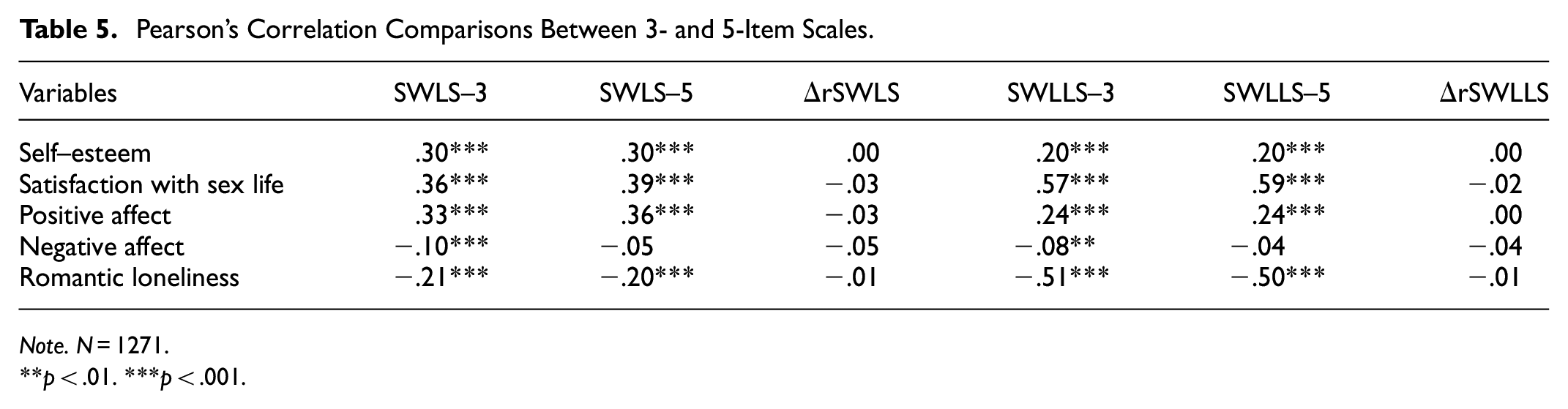
Note. N = 1271.
p < .01. ***p < .001.
Discussion
This study aimed to scrutinize the psychometric properties, and gender and age measurement invariance of the SWLS (Diener et al., 1985) and the SWLLS (Neto, 2012) in its abbreviated 3-item versions. The abbreviated 3-item version of the SWLS was proposed by Kjell and Diener (2021), while the abbreviated 3-item version of the SWLLS was proposed for the first time in this study. The findings verify that these abbreviated versions of the scales show good construct validity and reliability.
First, the SWLS-3 and the SWLLS-3 demonstrated a good fit for a two-factor model. Indeed, the findings presented a much better fit for the two-factor solution than for the one-factor solution (SRMR = 0.012 vs. .188; RMSEA = 0.029 vs. 0.331; CFI = 0.99 vs. 0.71). This two-factor solution is consistent with that evidenced in the initial work (Kjell & Diener, 2021). This supports our first hypothesis.
Second, SWLS-3 and SWLLS-3 showed high internal consistencies (α and ω ≥ .80). This supports our second hypothesis. This is also consistent with results of other works (Espego et al., 2022; Hanzlová, 2022; Kjell & Diener, 2021).
The MI test permit us to conceive that one scale can evaluate one construct by various groups (Rutkowski & Svetina, 2014). Indeed, MGCFA of SWLS-3 and SWLLS-3 evidenced configural, metric, and scalar invariance across genders and age groups. This supports our third hypothesis. Therefore, there is support for invariance of measurement showing that men and women, and young adults, adults and older adults perceive and answer the items in same way. These findings are important which suggest that the comparison of means between groups is meaningful.
The results of the MI of the SWLS-3 and SWLLS-3 across gender and age groups point out substantial implications to the investigation on SWL and SWLL. On the subject, results suggest configural invariance, which indicates that latent factor is identical in each group examined. Thus, females and males, as well as the three age groups conceptualize satisfaction with life and satisfaction with love life similarly. Obtaining metric invariance allow us to engage that SWL and SWLL are identical in each group; that is, the respondents of each group present similar meaning to SWL and SWLL. Lastly, scalar invariance was also obtained, which enables to compare latent means. Therefore, the SWLS-3 and SWLLS-3 evaluate similar constructs by gender and age groups. These findings implicate that SWLS-3 and SWLLS-3 can be used to compare females and males, and age groups. In addition, the findings of MI provide further support to demonstrate that SWLS-3 and SWLLS-3 are valid and reliable measures.
There were significant gender differences on SWLS-3. Women reported higher SWL than men. This finding agrees with prior research (Hanzlová, 2022); however, it contrasts with previous findings on SWLS-5 indicating no important differences in SWL between genders (Batz-Barbarich et al., 2018; Diener & Ryan, 2009; Hayes & Joseph, 2002). The effect of age on SWLS-3 was not significant, consistent with past research that evidenced no important age differences in SWL (Diener, 1984).
Results did not evidence significant differences on SWLLS-3 scores between genders. This is consistent with the previous research which identified no significant gender differences in SWLL-5 for college students (Nazzal et al., 2019; Neto & Dimitrova, 2017; Neto et al., 2023), nor in other satisfaction specific domains, such as job satisfaction (Batz-Barbarich et al., 2018), family satisfaction (Costa & Neto, 2019), or migration satisfaction (Neto & Fonseca, 2018).
However, the effect of age on SWLLS scores was significant. Older adults displayed lower SWLL than adults, but young adults did not differ significantly from the two other age groups. These results contrast with those that found no significant declines in SWL across the life span (Diener et al. 1999).
The relationships of the SWLS-3 and the SWLLS-3 scores with various measures of well-being (self-esteem, SWSL, PA, NA, and romantic loneliness) were as hypothesized, supporting our fourth hypothesis. The positive associations between the SWLS-3 and the SWLLS-3 scores, and self-esteem are consistent with previous research (Arslan, 2019; Diener & Diener, 1995; Moksnes et al., 2014; Nazzal et al., 2019). The positive correlations between the SWLS-3 and the SWLLS-3 scores, and SWSL is also consonant with prior investigation (Neto, 2012; Neto & Pinto, 2015b). In line with prior research (Busseri & Sadava, 2011; Ruiz et al., 2009), PA was positively, and NA negatively related to SWLS-3 and SWLLS-3 scores. As could be expected (Neto & Pinto, 2015a), romantic loneliness was negatively associated with the SWLS-3 and the SWLLS-3 scores.
Finally, it is worth noting that the intercorrelations between the abbreviated versions and the original 5 item measures were very strong (satisfaction with life: r = 0.95; and satisfaction with love life: r = 0.96). Regarding the validity, the 3- and 5-item measures presented almost identical correlations with other well-being measures (including self-esteem, SWSL, positive affect, negative affect, and romantic loneliness). These findings support our fifth hypotheses.
This work has various limitations. Firstly, despite the fact that we used a large sample, the study sample is non-probabilistic, which limits the generalization of the findings. Secondly, data were self-report measures which may generate social desirability. Thirdly, the cross-sectional design of this work prevents causal inferences.
Conclusion
Notwithstanding limitations, the 3-item measures of the SWLS and the SWLLS have evidenced satisfactory psychometric characteristics in this population, as well as invariance of measurement across genders and age. This research is the first to present MI of the SWLLS-3. Indeed, current results filled a gap in the existent literature on the MI of the SWLLS-3, thus improving next investigation. Findings supported the equivalence of the SWLS-3 and of the SWLLS-3 for average comparisons by gender and age groups. As expected, the SWLS-3 and the SWLLS-3 scores correlated positively with self-esteem, SWSL, and PA, and negatively with NA, and romantic loneliness. Finally, the SWLS-3 and the SWLLS-3 presented comparable validity to the 5-item scales by generating very identical correlations with other well-being measures.
Despite their brevity, they are very suitable tools to get reliable and valid indicators of SWL and SWLL. Additionally, for practical ends, the abbreviated 3-item version of the SWLS and of the SWLLS is valuable for persons with short time to fill longer questionnaires. The brevity and ease of administration of the SWLS-3 and of the SWLLS-3 makes them promising instruments for large questionnaires. Therefore, researchers as well as practitioners can profit from utilizing the abbreviated and empirically sound SWLS-3 and SWLLS-3 to evaluate SWL and SWLL. Next research should check measurement invariance across countries to make comparisons between these groups.
Footnotes
Abbreviations
ANOVA: Analysis of variance
CFA: Confirmatory Factor Analysis
CFI: Comparative Fit Index
CI: Confidence interval
GFI: Goodness of Fit Index
M: Mean
MGCFA: Multigroup Confirmatory Factor Analysis
MI: Measurement invariance
NA: Negative affect
PA: Positive affect
RMSEA; Root Mean Square Error of Approximation
SD: Standard deviation
SELSA-S: short version of the Social and Emotional Loneliness Scale-Short version
SPSS: Statistical Package for Social Sciences
SRMR: Standardized Root Mean Square Residual
SWB: Subjective Well Being
SWL: Satisfaction with Life
SWLL: Satisfaction with Love Life
SWLLS: Satisfaction with Love Life Scale
SWLS: Satisfaction with Life Scale
SWSL: Satisfaction with Sex Life
SWSLS: Satisfaction with Sex Life Scale
Declaration of Conflicting Interests
The author(s) declared no potential conflicts of interest with respect to the research, authorship, and/or publication of this article.
Funding
The author(s) disclosed receipt of the following financial support for the research, authorship, and/or publication of this article: This work was supported by national funding from the Portuguese Foundation for Scienceand Technology (UIDB/00050/2020).
Data Availability Statement
Data sharing not applicable to this article as no datasets were generated or analyzed during the current study.
