




Abstract
Previous research on teacher language assessment literacy (LAL) ignored the impact of economic factors on LAL needs. This study aims to fill that gap by examining the perceptions of LAL needs among EFL teachers in Guangzhou and Meizhou, two cities in China representing economically developed and economically underdeveloped settings. The research utilized a questionnaire adapted from Kremmel and Harding and supplemented with semi-structured interviews. Seventy-six teachers participated in the survey, which identified significant differences in four key assessment dimensions: assessment and language pedagogy, assessment principles and interpretation, washback and preparation, and statistical research and methods. Semi-structured interviews with a subset of six teachers revealed three interrelated factors that significantly influence LAL needs: (1) the macro-level educational landscape and policy, (2) the meso-level influence from institutional mandates, resource constraints, and the teacher community for collaboration, and (3) teachers’ educational backgrounds, reflective practices, and identities as assessors from the micro-level. These factors were visualized in a synthesized framework that illustrates the complex social construction of LAL and its relationship with economic disparities. These findings offer practical implications for policymakers and teacher training institutions within China’s compulsory education system, highlighting the need to develop sustainable language assessment practices.
Plain Language Summary
Understanding how economic resources shape teachers’ ability to assess students’ language skills fairly is key to building stronger education systems. Past studies often overlooked the role of funding in shaping teachers’ assessment practices. This study helps fill that gap by comparing English teachers in two Chinese cities: Guangzhou (with more resources) and Meizhou (with fewer resources). Surveys with 76 teachers and interviews with six showed clear differences. Teachers in Guangzhou needed better ways to test language skills, while those in Meizhou needed help with basic language teaching. Four key areas need improvement: clarifying school policies on assessments, making the most of school resources, encouraging teacher teamwork, and reflecting on teaching methods. The findings show that training should match local needs. For example, in areas like Meizhou, where there are fewer resources, teachers can use simple strategies like letting students grade each other’s work to tackle problems like students not paying attention in class. The study also highlights how economic conditions influence the success of education policies. By giving teachers the right training based on their local needs, policymakers can ensure that all students receive quality education regardless of where they live.
Keywords
Introduction
Assessment plays a crucial role in the educational process, serving as a key mechanism to evaluate and guide individuals’ acquisition of knowledge and skills (Baird et al., 2017). The recent shift towards educational accountability and learner-centered pedagogies has broadened the scope of assessment, extending its application to areas such as immigration and citizenship (Chalhoub-Deville, 2016; Z. Yan & Yang, 2022). In China, the “Double Reduction” policy—officially titled Opinions on Further Reducing the Burden of Homework and Off-Campus Training for Compulsory Education Students (Ministry of Education of People’s Republic of China, 2021)—has sparked significant changes in the compulsory education system. This policy requires a reevaluation of assessment practices to align with the goals of holistic student development. This policy advocates for reducing academic stress by limiting homework and examination frequency, thereby encouraging educators to nurture critical thinking and creativity among students. In response, a balanced assessment approach that integrates formative assessments like quizzes, discussions, peer evaluations, and project-based tasks has been recommended to enhance student learning outcomes (Gu, 2021).
Assessment literacy is a vital competency for educators, as it directly influences student learning outcomes (Popham, 2004; Stiggins, 2002). In the domain of applied linguistics, language assessment is recognized as a distinct yet interconnected field within the broader scope of educational assessment (Alderson et al., 2017). Language assessment literacy (LAL) is critical as language serves dual roles, as both the subject and the tool of assessment (Bachman, 1990). Inadequate LAL can undermine the reliability and validity of assessments, subsequently affecting student learning outcomes (Scarino, 2013; Xu & Brown, 2016). Therefore, it is imperative to provide language teachers with comprehensive assessment training to improve their expertise in this area (Gan & Lam, 2020).
Despite the increasing interest in LAL and the demand for assessment training (Fulcher, 2012; Levi & Inbar-Lourie, 2019; X. Yan et al., 2018), empirical research on the geographical origins and methodological frameworks remains limited (Gan & Lam, 2022). No research has yet explored the economic influences on LAL needs among Chinese teachers, especially those in non-tertiary education settings. This study aims to address this research gap by examining the LAL needs of English as a Foreign Language (EFL) teachers in junior high schools in Guangzhou and Meizhou. These two cities represent economically developed (or urban) and economically underdeveloped (or rural) regions in China, respectively, and are linked through the “Inter-city assistance policy” (General Office of the People’s Government of Guangzhou, 2022). Guangzhou, the provincial capital in southern China, ranks as the country’s third most populous city, with over 18 million inhabitants and a per capita GDP of 153,625 yuan in 2022 (Guangzhou Municipal Statistics Bureau, 2023). In contrast, Meizhou in eastern Guangdong has a population of around 5 million and a per capita GDP of 33,764 yuan, barely one-fifth of that of Guangzhou for the same year (Meizhou Municipal Statistics Bureau, 2023). By utilizing a mixed-methods approach, this research aims to advance the professional development of language teachers and foster educational equity. It seeks to investigate the influence of economic factors on LAL needs and provide strategies to narrow the resource disparity between these two cities.
Literature Review
The Conceptualization of LAL
The development of LAL has shifted from analyzing its elements to adopting a holistic and developmental perspective. Initial studies focused on constructing structured programs to address the specific needs of foreign language teachers, treating LAL as a collection of skills necessary for interpreting and applying assessment results in teaching (Brindley, 2001; Fulcher, 2012). The integration of “principles” into LAL broadened its scope, emphasizing not only the knowledge and skills but also the principles that underpin language assessment, and acknowledging its social dimensions (Davies, 2008; Inbar-Lourie, 2008). Recognizing LAL’s dynamic nature, Pill and Harding (2013) introduced a model that spans from basic literacy levels to multidimensional literacy, highlighting the progressive nature of LAL development. Taylor (2013) further refined this model by identifying eight integral components of LAL: knowledge of theory, technical skills, principles and concepts, language pedagogy, sociocultural values, local practices, personal beliefs/attitudes, and scores and decision-making. Expanding on Taylor’s framework, Kremmel and Harding (2019) delineated nine dimensions that detail the developmental facets of LAL, ranging from assessment development and administration to scoring and rating, thereby providing a comprehensive view of the competencies required for practical language assessment.
Through these contributions, LAL has advanced towards a more nuanced understanding of the complex interplay between knowledge, skills, principles, and context in language assessment.
Studies on Teachers’ LAL
Assessment is a critical aspect of education that consumes a significant portion of teachers’ time and attention (Cheng et al., 2004). It is a vital tool for gathering information about student learning and providing feedback to inform instructional methods and practices. Assessment literacy, which encompasses an understanding of sound assessment principles, is crucial for the quality of teachers’ language assessment practices, directly impacting students’ academic performance (Brown & Bailey, 2008; Xu et al., 2016).
Language Assessment Training
LAL is recognized as essential for ensuring effective assessments and contributing to student success. However, research has revealed a deficiency in LAL among teachers (Jeong, 2013; Jin, 2010; Lam, 2015; Larenas & Brunfaut, 2023). Jalilzadeh et al. (2024) emphasized the necessary role of a training course to bridge the gap between theory and practice. To address these issues, various initiatives have been proposed, including tailored textbooks, diverse course formats such as online courses and workshops, and teacher educators’ involvement (Brown & Bailey, 2008; Davies, 2008; Lam, 2015). Additionally, the establishment of expertise exchange networks can help enhance LAL competencies. Strategies for LAL development include a mixed approach to professional development and collaborative sessions involving language teachers and assessment researchers (Baker & Riches, 2018; Levi & Inbar-Lourie, 2019). The simultaneous implementation of LAL training with test development, as suggested by Brunfaut and Harding (2018), can clarify key concepts, foster critical thinking, and improve overall proficiency. These collaborative practices among stakeholders facilitate a balanced exchange of knowledge and skills, emphasizing practical engagement with assessment practices over passive theoretical learning (Fazel & Ali, 2022; Harding et al., 2020; X. Yan & Fan, 2021).
Teachers’ Perceived LAL Level and Training Needs
Some studies have also focused on teachers’ perceived LAL level and their training needs (Tsagari & Vogt, 2017; Vogt & Tsagari, 2014). Other studies indicated that EFL teachers possess a fundamental level of LAL, but there is room for improvement, as inadequate assessment knowledge can restrain their ability to assess and enhance student learning outcomes (Sultana, 2019; Xu, 2016). Differences in training needs across educational settings have been noted by Vogt and Tsagari (2014), highlighting the necessity for context-specific teacher education programs that integrate LAL with broader language assessment aspects. Kim et al. (2019) identified a specific shortfall in K-12 English teachers’ ability to interpret score reports, which disrupts the clear communication of assessment results to students and parents. Abrar-ul-Hassan and Nassaji (2024) highlighted the pivotal role of technology in assessments, advocating for its integration into language education programs. Comprehensive teacher training that prepares educators to effectively use technology in assessment and feedback is thus essential.
Contextual Factors Influencing Teachers’ LAL
LAL is a dynamic professional competency intertwined with the social and cultural dimensions of teaching and learning. Sociocultural theory (Vygotsky, 1978), which views mental functions as socially originated and emphasizes the mediation of behavior and consciousness, has been applied to study LAL. This perspective emphasizes the importance of considering the social and cultural contexts in which assessment practices are implemented (Pryor & Crossouard, 2010). Teachers negotiate classroom and cultural knowledge to align assessment practices with learning objectives (Willis et al., 2013). Studies advocated for incorporating social context into professional assessment training, emphasizing the contextual aspects of LAL (Davies, 2008; Fulcher, 2012). The impact of contextual factors on LAL, such as educational policies and institutional requirements, has been explored, with some studies examining cross-national variances in LAL needs (Song et al., 2020; Vogt & Tsagari, 2014). However, criticism arose regarding the vagueness of this taxonomy of contextual factors (Taylor, 2013). In response, X. Yan et al. (2018) demonstrated a two-layer influence on teachers’ LAL practice and needs, specifically focusing on assessment context and experience. Similarly, Vogt et al. (2020) compared quantitative data from Greece and Germany, reconstructing a framework of contextual factors at the macro-, meso-, and micro-levels for language teachers’ LAL beliefs.
EFL Teachers’ LAL in China
In China, the influence of contextual factors on LAL development has been investigated, with studies examining how national, institutional, and personal contexts shape LAL among EFL teachers (Song et al., 2020). Recent research has extended the exploration to online contexts, raising concerns about the technical, feedback, and ethical dimensions of online assessment literacy (Xu & Qiu, 2022) and writing assessment feedback literacy (Wang et al., 2023). However, most studies focus on EFL teachers in higher education settings (Sun & Zhang, 2022; Xu et al., 2016, 2023), neglecting the perspectives from the non-tertiary education sector. Notably, X. Yan et al. (2018) conducted a small-scale qualitative study within a single middle school, revealing a significant need for EFL teachers to receive more training in assessment practice rather than theoretical knowledge.
The ongoing discussion on contextual factors underscores the need to understand their influence on LAL needs within the same stakeholder groups. Given China’s educational reforms, particularly in compulsory education, it is crucial to examine how contextual factors influence teachers’ LAL needs to bridge the gap between current competencies and desired proficiency. While economic disparities deeply influence the availability of educational resources and professional development opportunities, their impact on LAL is often mediated by other contextual factors, such as school policies, cultural attitudes toward assessment, and teacher training systems. The current literature particularly lacks information regarding the interplay of economic factors and educational policies on EFL teachers’ LAL in a non-tertiary context. To address the identified research gap, this study investigates EFL teachers’ LAL needs in junior high schools in two distinct economic contexts: Guangzhou and Meizhou. By comparing these two cities, the study aims to uncover the differences in LAL needs and the economic factors that account for these variations.
Two research questions guide the study:
What are the LAL needs of EFL teachers from junior high schools in Guangzhou and Meizhou, and are there differences between these two groups of teachers?
If there are differences between these two groups, what factors contribute to such differences?
Methodology
Research Design
This exploratory study utilizes a sequential explanatory mixed-methods design (Creswell & Creswell, 2022) to investigate LAL among EFL teachers in two economically distinct cities of Guangdong Province, China: Guangzhou and Meizhou. The research integrates quantitative and qualitative data collection in two phases: a structured questionnaire to assess targeted teachers’ LAL levels and needs, and semi-structured interviews to explore contextual factors influencing LAL development. The design ensures that quantitative findings inform the qualitative phase, enabling a deeper understanding of the phenomenon. This study has been designed to ensure that participants will not experience any harm or adverse effects.
Context of the Study
The study focuses on Guangzhou, a prosperous provincial capital with abundant educational resources to foster diverse teaching activities, and Meizhou, an economically constrained city with limited educational resources and a reliance on traditional teaching methods. The stark economic contrast between these two cities provides a unique opportunity to examine how economic disparities and educational infrastructure shape EFL teachers’ LAL needs, offering insights into the contextual factors influencing language teachers’ assessment practices and their professional development in different socioeconomic settings.
Participants
Purposive sampling was employed to select four medium-ranking public schools—two from each city—based on comparable educational settings in terms of class size, student demographics, enrollment figures, and accessibility. This strategy, recommended by an expert from the Guangdong Academy of Education, ensured that the selected schools effectively represented their cities, encapsulating the standard EFL instructional context in Guangzhou and Meizhou.
In Guangzhou, Chuangxin and Qiushi schools were chosen as representatives of medium-tier public middle schools, noted for their modern facilities and a higher proportion of postgraduate-qualified teachers. Conversely, Lide and Shuren schools in Meizhou were chosen to represent the region’s medium-tier public middle schools, despite their constrained resources and lower ratios of postgraduate-qualified teachers. These schools offer a solid basis for comparing educational infrastructures across two distinct economic contexts. It should be acknowledged that the small sample size could limit the generalizability of the findings to the broader EFL teacher population in the two cities. However, the study prioritizes depth over breadth, consistent with the principles of purposive sampling (Creswell & Creswell, 2022), targeting information-rich cases to yield comprehensive insights into educational contexts and teacher characteristics. Additionally, the study was conducted during the COVID-19 pandemic, with social distancing measures and travel restrictions in place, posing challenges in participant engagement and affecting enrollment numbers.
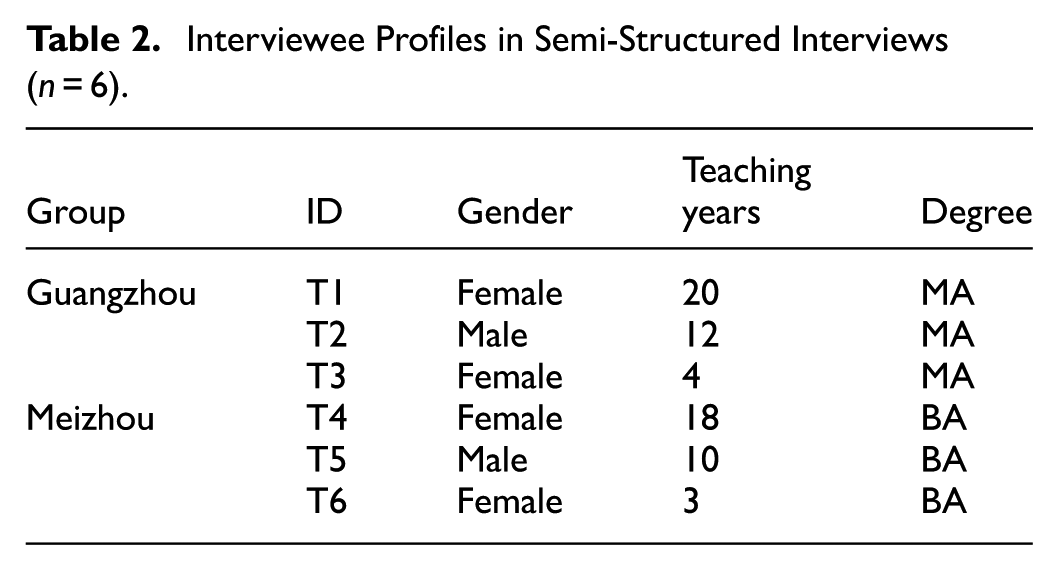
The study aimed to explore the LAL perspectives of EFL teachers in economically developed and economically underdeveloped settings, focusing on representativeness and diversity. Participant demographics (Table 1) and interviewee profiles (Table 2) were carefully considered to provide a comprehensive view of the educational contexts and teacher characteristics. For the qualitative component, six teachers—three from each city—were purposively selected for semi-structured interviews to ensure diverse teaching experiences and educational backgrounds. To maintain anonymity, teachers were assigned unique identifying numbers (T1–T6). The interviews aimed to deepen the understanding of LAL needs and their influencing factors across these contrasting economic contexts.
Participants’ Demographic Information in the Questionnaire (n = 76).

Interviewee Profiles in Semi-Structured Interviews (n = 6).
Data Collection
To refine the research instruments and methods, a pilot study was conducted with 22 teachers who matched the main study’s demographic and experience criteria. Questionnaires were administered online, followed by interviews with two junior high school teachers to test the interview protocol. The feedback from the pilot study was used to enhance the tools for capturing LAL practices and needs. For the main study, the questionnaire was distributed via Wenjuanxing (www.wjx.cn), a reputable platform in China, over 1 month in 2022. Semi-structured interviews were conducted in Chinese, either in person or via Tencent Meeting, each lasting 30 to 45 min, with anonymity ensured throughout the process.
Questionnaire
The questionnaire, adapted from Kremmel and Harding’s (2019) survey, comprehensively covers nine dimensions of LAL (Table 3). The instrument was rigorously developed and refined through expert feedback and empirical reduction using Exploratory Factor Analysis (EFA) on a large-scale dataset (n = 1,086), including responses from China. To align with the study’s context, the questionnaire was translated into Chinese using the back-translation method to ensure equivalence. The Likert scale was adjusted to use Chinese characters, with responses ranging from 0 (no need for knowledge) to 4 (extremely knowledgeable) to enhance comprehension. Complex items were simplified, and culturally relevant examples were added. For instance, Item 14, addressing the use of assessments for social policy enforcement, was clarified with a local context: “In Shanghai, decision-makers use the score of the College English Test to develop residency policies for Chinese college students.” Furthermore, demographic questions regarding class sizes, assessment experience, and practices were included to explore mediating factors in LAL needs.
Confirmed Items and Related Item Numbers in Kremmel and Harding (2019).

The questionnaire, detailed in Supplemental Appendix A, consists of 50 items divided into three main sections: an introduction, a main body (Part One), and a concluding segment (Part Two). The introduction outlines the study’s objectives and assures confidentiality. Part One focuses on LAL core components—assessment knowledge and assessment skills—while Part Two collected demographic information, including work locations (Q1), school types and teaching experience (Q2), their interest in follow-up interviews (Q3), personal details (Q4, Q5, and Q7), and educational backgrounds (Q6). Names and contact details were collected solely for follow-up interviews, with stringent adherence to confidentiality protocols. An open-ended section allowed participants to provide additional insight.
A total of 80 English teachers from selected schools were invited to participate. Written consent was obtained from all participants. Each teacher received RMB 30 as compensation, calculated based on the estimated time required to complete the survey and the minimum wage in Guangdong Province. Data was collected online with responses cleaned to exclude those completed in less than 3 min or showing inconsistencies. This meticulous process ensured data credibility, resulting in a final sample of 76 EFL teachers evenly distributed between Guangzhou and Meizhou.
Semi-Structured Interview
Acknowledging the advice of Kremmel and Harding (2019) and following Dörnyei’s (2007) recommendation, semi-structured interviews were conducted to explore significant LAL dimensions to elicit in-depth insights from participants in the quantitative phase. The interview protocol, adapted from X. Yan et al. (2018), included flexible yet targeted questions (see Supplemental Appendix B) designed to complement the quantitative data and validate findings through methodological triangulation. Questions probed contextual factors influencing teachers’ LAL, specific LAL needs, teaching facilities, available assessment resources, and perceived limitations. Interviews were audio-recorded, transcribed verbatim, and analyzed in detail. Each interviewee was compensated with RMB 100 for their participation, and written consent was obtained from all participants. Data confidentiality was maintained through anonymous processing.
Data Analysis
Data analysis in this study incorporated both quantitative and qualitative approaches. Quantitative data from 76 valid questionnaire responses were analyzed using SPSS 22.0. Internal consistency reliability was assessed via Cronbach’s alpha, yielding reliability coefficients for individual dimensions ranging from .81 to .92, indicating high internal consistency (Dörnyei, 2007). Descriptive statistics, including mean scores, were calculated to address the first research question on LAL needs. Independent sample t-tests were conducted to compare the means of overall LAL needs between EFL teachers in Guangzhou and Meizhou, as well as to explore differences across nine LAL dimensions. This approach allows for a detailed analysis of how economic factors shape LAL requirements.
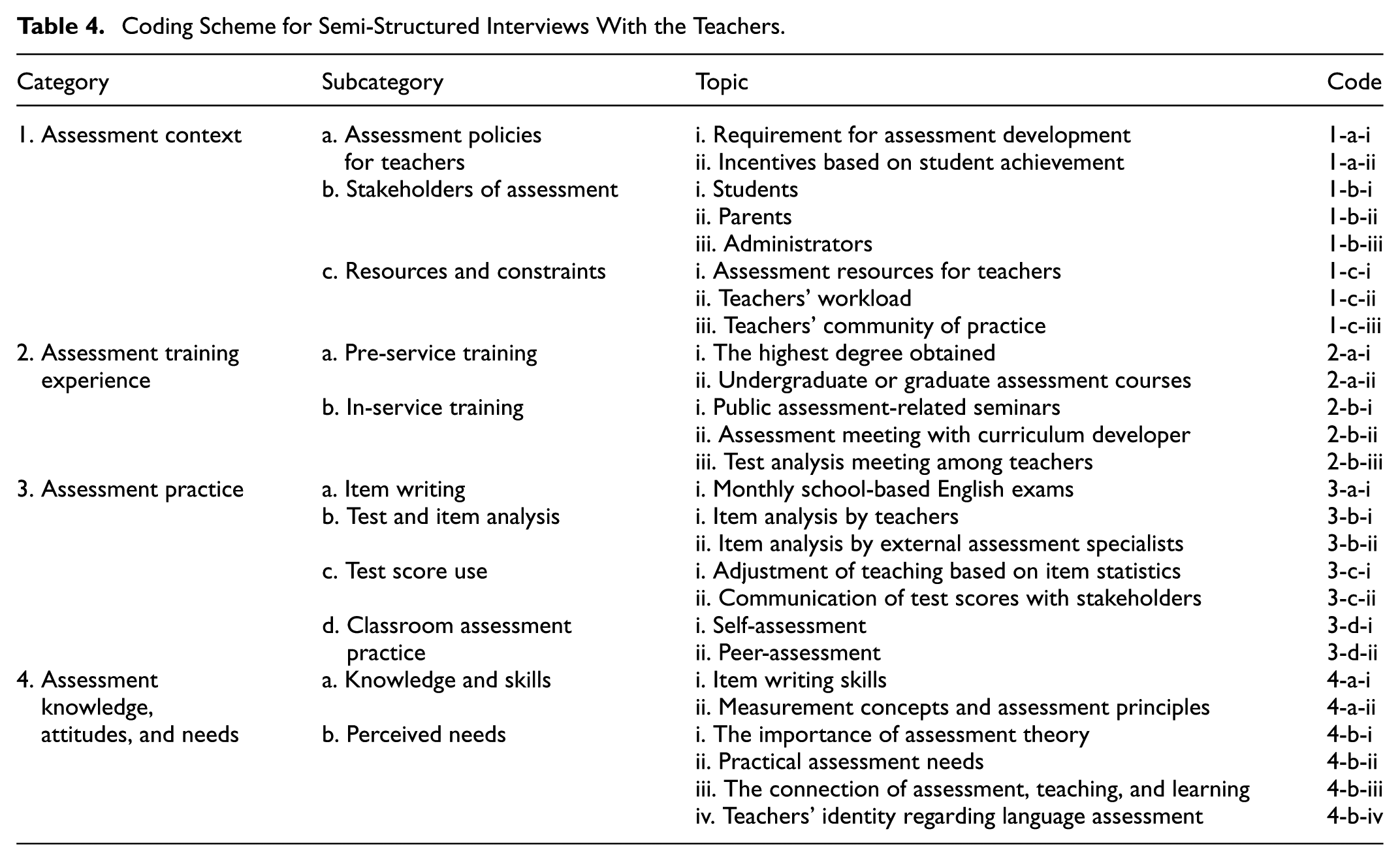
Qualitative data from semi-structured interviews were analyzed using inductive thematic analysis. Audio recordings were transcribed verbatim and coded iteratively based on a framework adapted from X. Yan et al. (2018). The second and third authors independently coded the transcripts manually. NVivo 11 was used to organize codes and ensure investigator triangulation, achieving an inter-coder reliability of approximately 86%. Coding discrepancies were resolved by all authors through consensus-driven discussions to finalize the coding scheme. Emerging themes and sub-themes are summarized in Table 4.
Coding Scheme for Semi-Structured Interviews With the Teachers.
Results
LAL Needs of Junior High School EFL Teachers in Guangzhou and Meizhou
In analyzing the LAL needs of the participating EFL teachers, a Likert scale ranging from 0 to 4 was utilized, with higher scores closer to 4 indicating a greater level of LAL proficiency. The data revealed that half of the teachers (50%) scored in the upper-middle range of the scale, reflecting a notable LAL proficiency. Specifically, the mean score for Guangzhou teachers was 2.43 (SD = 0.87), suggesting an upper-middle level of LAL needs, while Meizhou teachers had a mean score of 2.08 (SD = 1.02), indicating a middle level of LAL proficiency. Table 5 provides a detailed overview of the LAL needs for the teacher samples from both cities.
Descriptive Statistics of LAL Needs for EFL Teachers in Guangzhou and Meizhou.

Notes. 0 = not knowledgeable; 1 = slightly knowledgeable; 2 = moderately knowledgeable; 3 = very knowledgeable; 4 = extremely knowledgeable. ALP = assessment and language pedagogy; API = assessment principles and interpretation; APLP = assessment policy and local practice; WP = washback and preparation; LSUD = language structure, use and development; PBA = personal beliefs and attitudes; SRM = statistical and research methods; SR = scoring and rating; DALA = developing and administering language assessments.
In analyzing the nine dimensions of LAL among EFL teachers in Guangzhou, Assessment in Language Pedagogy (ALP) received the highest mean score (M = 2.74; SD = 0.70), indicating its significance to the teachers. In contrast, Assessment Policy and Local Practices (APLP) had the lowest mean score (M = 1.98; SD = 0.95), suggesting a perceived lower need for knowledge in this area. Notably, Item 3, concerning the use of assessments to diagnose learners’ strengths and weaknesses, scored the highest (M = 3.02; SD = 0.79), highlighting the teachers’ emphasis on assessment for learner evaluation. Conversely, Item 25, regarding local legal regulations for assessment, scored the lowest (M = 1.64; SD = 0.85), indicating a lesser perceived relevance to their practices. In comparison, EFL teachers in Meizhou exhibited a middle-level LAL need (M = 2.08; SD = 1.02), with the highest mean in ALP (M = 2.28; SD = 0.89) and the lowest in APLP (M = 1.78; SD = 1.14), mirroring Guangzhou teachers’ prioritization of pedagogical assessment knowledge over policy and local practices. Item 18, on language skill development, received the highest score in Meizhou (M = 2.57; SD = 1.11), reflecting a greater focus on this aspect within LSUD. The lowest score was for Item 14, on using assessments for social policy enforcement (M = 1.42; SD = 1.08), underscoring a shared disregard for APLP aspects among both Guangzhou and Meizhou teacher samples. Unlike Guangzhou, Meizhou teachers did not show a direct correlation between the highest item score and the dimension with the highest mean score, indicating a divergence in LAL needs prioritization.
Building on Taylor’s (2013) framework for delineating distinct levels of LAL, Figure 1 illustrates the multifaceted LAL needs of EFL teachers in Guangzhou. The depiction indicated a consistent level of needs across various dimensions, except for the ALP dimension, which stands out prominently, and the APLP dimension, which appears less emphasized than the rest.

LAL needs profile of EFL teachers in Guangzhou (n = 38).
Figure 2 portrays the LAL needs profile of EFL teachers in Meizhou. Similarly, the LAL needs of EFL teachers in Meizhou were found to be relatively uniform across all dimensions, with notable emphasis on the ALP and LSUD dimensions. In contrast, the APLP dimension is less important than the others.

LAL needs profile of EFL teachers in Meizhou (n = 38).
Differences in LAL Needs Between EFL Teachers in Guangzhou and Meizhou
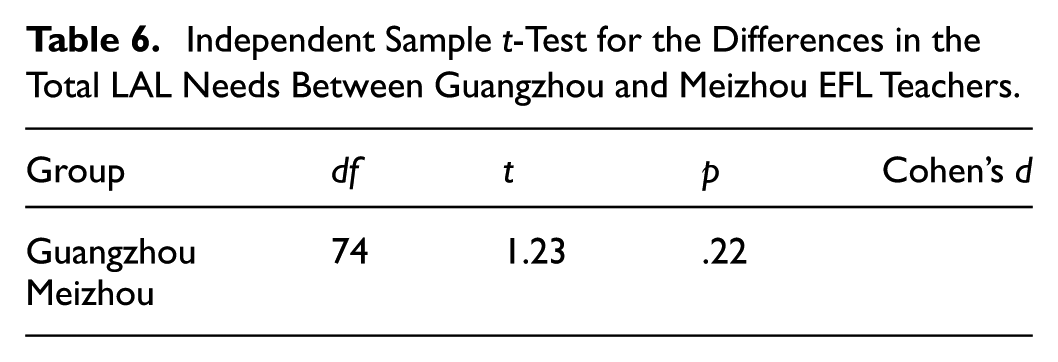
The first independent t-test was conducted to compare the total LAL needs between the two cities, with the city serving as the independent variable and the mean score of LAL needs as the dependent variable. The result is presented in Table 6 and indicates that there was no significant difference between the LAL needs of teachers in the two cities (df = 74, t = 2.252, p > .05). This suggests that the overall level of LAL needs was similar between the two groups of teachers. However, it is worth noting that the small sample size may contribute to the lack of significant findings.
Independent Sample t-Test for the Differences in the Total LAL Needs Between Guangzhou and Meizhou EFL Teachers.
As demonstrated in Table 7, a series of independent t-tests were conducted, with the city as the independent variable and the mean scores of nine dimensions as dependent variables, respectively. The analysis revealed significant differences in four dimensions, namely API (df = 74, t = 2.252, p < .05, Cohen’s d = 0.48), ALP (df = 74, t = −2.714, p < .05, Cohen’s d = 0.58), SRM (df = 74, t = −2.341, p < .05, Cohen’s d = 0.50), and WP (df = 74, t = −2.309, p < .05, Cohen’s d = 0.49). This indicates variations in these dimensions between the two cities’ EFL teachers, and the effect size values of Cohen’s d substantiate the magnitude of the observed differences.
Independent Sample t-Tests for the Differences of LAL Needs in Nine Dimensions Between Guangzhou and Meizhou EFL Teachers.

p < .05.
In particular, when the mean scores of LAL needs were combined with the t-test results, it could be interpreted that the LAL needs of teachers in Guangzhou were significantly higher than those in Meizhou regarding API, ALP, SRM, and WP.
Factors Affecting the Perceived LAL Needs
The analysis of the interview data revealed three contextual factors (macro-level, meso-level, and micro-level) influencing teachers’ perceived LAL needs. These factors align with the multi-layered framework proposed by Vogt et al. (2020), which provides a comprehensive view of the various external and internal factors shaping teachers’ LAL.
Macro-Level: Educational Landscape and Policies
At the macro-level, the schools of Guangzhou and Meizhou are characterized by an exam-oriented culture. While the “Double Reduction” policy in China emphasizes formative assessment, its impact varies by region. The Ministry of Education of China formulates such policies, delegating their implementation to local governments. While official documents articulate these policies, the practical execution and their effects on educational practices require closer examination (Shohamy, 2007). In Guangzhou, frequent tests have mainly been abolished. For example, T1 from Guangzhou observed that: Due to the ‘Double Reduction’ policy, tests were largely canceled and there were only mid-term tests and final tests. (T1, code: 1-a-i)
Meanwhile, in Meizhou, the change is minimal, indicating inconsistent implementation. T4 from Meizhou noted that: The “Double Reduction” policy is not well implemented here … (T4, code: 1-a-i)
Discrepancies in policy execution across different cities and schools highlight the complexities of reconciling the “Double Reduction” goals with the persistent demand for exam preparation.
Meso-Level: Institutional Mandates, Resource Constraints, and Dialogues and Collaboration Between Colleagues
The analysis of interview data from teachers in Guangzhou and Meizhou revealed distinct variations in LAL needs, which were influenced by three key contextual factors: institutional demands, resource constraints, and dialogues and collaboration between colleagues. The critical dimensions of LAL needs, including ALP, API, SRM, and WP, emerged as particularly salient aspects.
In Guangzhou, teachers are challenged to select appropriate assessment techniques from many available resources. Despite periodic professional development, they expressed a pressing demand for structured assessment training to enhance their knowledge and competencies in classroom assessment. The “Double Reduction” policy, which limits assessments to mid-term and final evaluations, has heightened the importance of formative assessments. Teachers recognized the need to integrate formative and summative assessments for comprehensive performance evaluation. However, they reported a lack of knowledge in effectively utilizing formative assessments, as illustrated by T1’s comment: Due to the “Double Reduction” policy, there is an increasing emphasis on formative assessments. However, we struggle with how to use these assessments effectively for a holistic understanding of students’ literacy levels. (T1, code: 1-a-i)
In contrast, the implementation of the “Double Reduction” policy in Meizhou seemed to have minimal impact on teachers’ assessment strategies and ALP needs. Teachers in Meizhou tended to persist with conventional assessment techniques, such as quizzes and exams, within an exam-oriented culture. T4 commented: We continue with our monthly tests and unit quizzes as usual. (T4, code: 1-a-i)
Regarding API, teachers in Guangzhou exhibited a higher level of proficiency than those in Meizhou. This difference can be attributed to stringent rating criteria and participation in meetings analyzing students’ performance on tests. These teachers were required to present their students’ performance data and share insights during these meetings, leading to a growing necessity to deepen their understanding of API. However, this approach may lead to over-competitiveness, as T2 noted: We participate in lengthy meetings to analyze students’ performance in tests, where we dissect the reasons for lower scores, turning it into a competitive analysis process. (T2, code: 3-c-ii)
In Meizhou, the reduced demand for API principles may stem from a more informal assessment approach, with limited emphasis on result interpretation. Teachers reported using test questions from reference books or online sources without changes, highlighting a lack of attention to their reliability and validity. For example, T6 mentioned: We mostly use test questions from reference books or online sources, but we hardly ever make any changes, let alone ensure their reliability and validity. (T6, code: 3-a-i)
Regarding SRM, teachers in Guangzhou showed a stronger inclination towards utilizing assessment statistics to uncover performance characteristics in complex data sets to improve student outcomes. It suggests a significant dialogue between teachers in collaborative data interpretation and strategy refinement. As noted by T1: During post-test analysis meetings, teachers share students’ scores, including average scores and the percentage of top achievers. Some teachers use these scores to predict senior high school entrance exam performance, a practice favored by leaders. (T1, code: 3-c-ii)
In Meizhou, teachers’ lack of interest in exploring assessment data and statistics contributed to a minimal need for SRM. Without explicit mandates from educational institutions, these educators adopted a passive stance within a stagnant educational environment. For example, T6 noted: We usually calculate the pass rate and identify which questions most students struggle with. We don’t have to dive into the statistics or report them to our superiors. (T6, code: 3-c-ii)
A more profound understanding of WP concepts is required for teachers in Guangzhou. This reflects their highly competitive educational environment, which stems from advanced economic development. Teachers faced increasing pressure from school administrators, parents, and students to ensure positive outcomes in student assessments. T2 elaborated on post-exam preparation: After exams, I adjust my teaching approach by grouping students based on their scores. I emphasize specific topics and introduce important test-taking strategies for question types such as Grammar Gap Filling. (T2, code: 3-c-i)
In contrast, teachers in Meizhou exhibited weaker assessment literacy, resulting in a lower perceived need. They encountered difficulties in finding solutions when faced with challenging situations. For example, T4 mentioned: Students facing language use issues are often asked to recite textbook passages, but they continue to struggle with applying English during tests. Despite recognizing my limited LAL, I am reluctant to attend training sessions if available. (T4, codes: 3-c-i, 4-b-ii)
Economic constraints in Meizhou significantly reduced teachers’ demand for LAL, leading to a notable deficiency in this critical competency. Limited access to teaching facilities and professional training further restricts their ability to implement diverse assessment methods. As T5 explained: With advanced facilities, we could conduct regular assessment activities to engage students and enhance the classroom atmosphere. Unfortunately, in my ten years of teaching here, I have only attended training outside the school once. (T5, codes: 1-c-ii, 2-b-i)
Micro-Level: Teachers’ Educational Background, LAL Level, Reflection, and Identities as Assessors
Guangzhou’s strong economy and central location draw a variety of professionals. Among the 38 participants, 23 (61%) held master’s degrees, demonstrating high LAL proficiency and a keen awareness of their assessment knowledge gaps. For instance, T1, an experienced educator with a master’s degree in Education Management, acknowledged the need for continuous refinement of assessment methods despite occasional LAL challenges: I hold a master’s degree in Education Management and have been teaching for twenty years. Throughout my career, I have consistently fine-tuned my assessment methods, even when my LAL skills may have been lacking. (T1, codes: 4-b-i, 4-b-ii)
These teachers exhibited a strong commitment to self-directed learning, with many emphasizing the importance of reflection in their professional growth. For example, T3 highlighted the value of post-assessment reflection, which helped refine their understanding of student performance and identify areas for improvement in LAL: After even a simple quiz, we teachers gotta take a moment to reflect on our students’ performances. (T3, code: 3-c-i)
Conversely, in Meizhou, the reduced educational attainment of the participating teachers, with only one holding a master’s degree (3%), resulted in a less nuanced understanding of LAL concepts. This deficiency led to a reliance on traditional teaching methods, as T4 indicated, with a focus on improving student scores rather than exploring diverse assessment strategies: In the actual teaching process, I barely have time to consider using different assessment methods. Sure, some formative ones like portfolio assessment can be helpful, but we don’t use them because we focus more on boosting students’ scores. (T4, code: 1-c-ii)
The findings suggest that without a solid grasp of LAL, teachers may struggle to innovate their assessment practices, even when recognizing the importance of assessment. T5’s statement reflected this challenge, as the lack of LAL skills hindered efforts to compensate for resource insufficiencies: After five years of teaching, I no longer feel the need to extensively prepare for classes as these resources meet my instructional needs effectively. (T5, code: 3-d-ii)
In contrast to educators in Guangzhou, teachers in Meizhou exhibited minimal introspection regarding their teaching practices. Despite acknowledging the significance of assessment, they grappled with constructing a professional identity as assessors. This struggle is illustrated by T6’s reluctance to engage in professional development or adopt innovative assessment methods due to practical challenges: While my LAL skills may be lacking, I am hesitant to attend training sessions if offered. At times, I consider organizing classroom-based assessments, but due to students’ varying language proficiency levels, for example, three-quarters of the students struggle with accurate pronunciation, I abandoned these initiatives. (T6, codes: 4-b-i, 4-b-ii)
Furthermore, there is a link between students’ inadequate LAL and disengaged classroom dynamics, where teachers prioritized discipline management over pedagogical interactions due to students’ behavioral challenges. For example, T6 noted that smartphone overuse among left-behind children—defined as minors under 18 years old separated from migrant parents for over 6 months (Liang et al., 2017)—disrupted learning engagement: Due to the prevalence of cell phones, most students who are left-behind children stay up late scrolling through their devices, leading to low engagement in class discussions. Collaboration is challenging, with many students struggling to participate and attributing their lack of involvement to poor English skills. (T6, code: 1-b-i)
This analysis stressed the importance of supporting teachers’ LAL development, particularly in regions like Meizhou, where educators face greater challenges in embracing contemporary assessment practices. It also highlights the need for sustainable professional development initiatives that address educators’ specific LAL needs, fostering a more reflective and adaptive approach to teaching and assessment.
Discussion
LAL Needs of EFL Teachers in Guangzhou and Meizhou
This preliminary study revealed significant variation in LAL needs between EFL teachers in Guangzhou and Meizhou, emphasizing the urgency for tailored professional development and effective policy implementation. Teachers in Guangzhou demonstrated comparatively higher LAL needs and actively sought professional development opportunities in line with the “Double Reduction” policy’s emphasis on effective assessment practices. This policy-driven motivation reflected that external mandates could catalyze teacher growth in assessment practice (Fulcher, 2012), illustrating positive top-down washback where assessment policies significantly shape LAL training needs (Vogt et al., 2020). However, the effectiveness of such washback is contingent upon local classroom contexts (McNamara & Knoch, 2019). Teachers in Meizhou who demonstrated moderate LAL needs tended to prioritize language knowledge over assessment expertise. These preferences may stem from their educational background and a perception that assessment knowledge is less critical in their professional roles. This finding contrasts with Vogt and Tsagari’s (2014) emphasis on language skills driven by assessment mandates.
Teachers in both Guangzhou and Meizhou shared a desire for professional advancement. Diagnostic competence within ALP emerged as the highest need, emphasizing the importance of providing quality feedback to students (Koh & Chapman, 2018). Conversely, the APLP dimension was rated as the least needed, implying that policy issues were seen beyond their professional responsibilities, consistent with Kremmel and Harding’s (2019) finding. However, a significant discrepancy in WP was observed. WP ranks second in Kremmel and Harding’s (2019) study (M = 3.01) but was markedly low in Guangzhou (M = 2.52) and Meizhou (M = 2.05), indicating a potential oversight in the influence of testing on teaching and learning, referred to as washback (Khan & Hassan, 2024), by these teachers. The significant differences in the specific dimensions of ALP, API, WP, and SRM among EFL teachers in Guangzhou and Meizhou emphasized the diversity of teacher needs and the complexity of LAL development. Local municipal governments, as primary providers and financiers of compulsory education, significantly influence educational opportunities (Hung, 2023). Guangzhou, with its higher GDP, offers more comprehensive educational support, enhancing teachers’ abilities to integrate assessment into their pedagogy. In contrast, Meizhou’s low GDP imposes economic constraints that curtail educational chances and equitable resource allocation, adversely affecting teachers’ LAL development. Additionally, the high parental absence in economically disadvantaged regions due to parents working away from home reduces communication between teachers and parents. This situation, compounded by economic factors, potentially impedes teachers’ ability to provide comprehensive feedback to stakeholders, a critical element of assessment literacy (Wang et al., 2023).
Factors Influencing the Differences of LAL Needs Between EFL Teachers in Guangzhou and Meizhou
The comparison of EFL teachers’ LAL needs in Guangzhou and Meizhou, as examined through quantitative and qualitative data, reveals a nuanced LAL landscape. A contextualized understanding of these needs necessitates an examination of macro-, meso-, and micro-level factors (Vogt et al., 2020), highlighting the imperative for customized language assessment training initiatives.
Macro-Level: Educational Landscape and Policies
At the macro-level, economic conditions profoundly shape the educational landscape and policies that influence teachers’ LAL needs, with stark contrasts between developed and underdeveloped regions. In Guangzhou, financial resources enable progressive policies, such as funding for teacher training and advanced assessment tools, fostering robust LAL development. Conversely, Meizhou’s reliance on traditional assessment methods reflects limited resources and policy support.
China’s exam-driven educational system, anchored by high-stakes exams like the high-school entrance examination, known as Zhongkao (Ryan, 2019), and the national college entrance examination, known as Gaokao (João Pires, 2019), persists despite the “Double Reduction” policy’s aim to reduce students’ academic stress. Zhongkao, administered at the city level, remains a critical determinant of students’ access to higher-ranked high schools, which are better equipped to prepare students for Gaokao. While the policy decouples teacher evaluations from student exam performance, it risks diminishing motivation for assessment innovation, particularly in under-resourced regions like Meizhou. Previously, teacher evaluations were tied to student scores and class rankings, which provided economic incentives for teachers (X. Yan et al., 2018).
While high LAL does not guarantee teaching excellence (Spolsky, 1995), it is crucial to employ diverse assessment methods that inform teaching decisions and enhance student performance (Tajeddin et al., 2022). Although the immediate impact of new policies on Zhongkao outcomes may be limited, students from different cities within the same province must compete in Gaokao. Teachers in more economically developed regions, such as Guangzhou, who possess higher LAL, are better prepared to guide students through high-stakes exams like Gaokao, offering them a competitive advantage. In contrast, teachers in less developed regions might face challenges that decrease students’ future opportunities, exacerbating regional inequities.
To address these disparities, three policy-driven recommendations are thus proposed. Firstly, targeted funding is prioritized to integrate LAL training into pre-service teacher education in Meizhou, addressing foundational skill gaps and ensuring that future educators acquire essential assessment competencies (Hilden et al., 2024; Lee et al., 2021). Secondly, teacher training programs in both regions are advised to emphasize the washback effect, equipping teachers to design assessments that align with curricular goals—moving beyond exam-focused practices in Guangzhou and improving engagement in Meizhou. Lastly, structured regional partnerships under the “Inter-city assistance policy” (General Office of the People’s Government of Guangzhou, 2022) are established to bridge the LAL gap. For example, Guangzhou’s expertise in innovative methods like peer assessment can be shared through co-developed workshops and training modules, reducing reliance on a top-down approach. By aligning funding, training, and collaboration with regional needs, these initiatives aim to decouple educational quality from economic disparities, fostering equitable outcomes across diverse contexts.
Meso-Level: Institutional Mandates, Resource Constraints, and Dialogues and Collaboration Between Colleagues
At the meso-level, economic factors critically shape institutional mandates, resource availability, and opportunities for professional collaboration, all of which directly influence teachers’ LAL needs. Schools in more prosperous regions, such as Guangzhou, benefit from modern assessment tools and structured professional development programs, fostering innovation and collaborative practices among teachers. In contrast, schools in under-resourced regions like Meizhou face systemic barriers. As a teacher from Meizhou (T5) highlighted, “There is no financial support, and I lose the motivation to attend professional training.” These resource constraints limit the implementation of effective assessments and reduce opportunities for professional dialogue, exacerbating disparities in LAL development.
Moreover, local educational priorities further compound these challenges. In Meizhou, schools’ emphasis on standardized testing narrows the focus to exam preparation, discouraging diverse assessment approaches. As the teacher in Meizhou (T6) noted, “We mostly use test questions from reference books or online sources, but we hardly ever make any changes.” This reliance on pre-made assessments reflects a limited understanding of LAL and undermines teachers’ ability to tailor evaluations to student needs.
Additionally, collaboration among teachers, a key driver of LAL growth, is also economically mediated. In Guangzhou, well-funded schools established professional learning communities that facilitate knowledge sharing and reflective practices, aligning with the need for collaborative quality monitoring (Berry et al., 2019; Vogt et al., 2020). Conversely, Meizhou’s resource limitations restrict such collaboration, leading to isolated teaching practices and slower LAL development.
To address these issues, school administrators are recommended to adopt three strategies. Firstly, allocating resources for ongoing assessment literacy training—particularly in underfunded regions—through workshops on formative assessment techniques and technology-integrated practices. Secondly, fostering collaborative environments through professional learning communities where teachers share experiences and refine assessment strategies collectively. Lastly, encouraging the adoption of varied assessment methods beyond standardized testing, such as classroom-based formative assessments, can help gauge students’ language proficiency and align practices with educational goals more effectively.
Micro-Level: Teachers’ Educational Background, LAL Level, Reflection, and Identities as Assessors
At the micro-level, teachers’ LAL needs are substantially shaped by their educational backgrounds, LAL proficiency, reflective practices, and identities as assessors. While educators with advanced degrees often demonstrate stronger awareness of LAL requirements, disparities between K-12 and college EFL teachers highlight how institutional contexts mediate these individual differences (Sun & Zhang, 2022). In Guangzhou, professional dialogues foster reflective practices and bridge training gaps, aligning with Berry et al.’s (2019) emphasis on collaborative learning. As noted by the teacher from Guangzhou (T3), “After even a simple quiz, we teachers gotta take a moment to reflect on our students’ performances.” In contrast, teachers in under-resourced regions like Meizhou rarely report engagement in reflective practices—a sharp contrast to the collaborative environments observed in Guangzhou.
Furthermore, teachers’ self-identification as assessors also plays a critical role (Looney et al., 2017; Xu & Brown, 2016). Without adequate training and resources, teachers may struggle to adapt their assessment strategies to align with the actual needs of their students. As evidenced by a teacher in Meizhou (T6), “Most students, who are left-behind children, stay up late scrolling through their devices, leading to low engagement in class discussions.” This finding underscores the need for tailored strategies, such as peer assessment, to leverage peer relationships and mitigate challenges linked to parental absence (Ding & Wu, 2023).
To address these challenges, three interventions are thus proposed. Firstly, training programs should prioritize classroom-based assessments, such as peer evaluation, to equip teachers to engage left-behind children through peer learning strategies (Ding & Wu, 2023). Peer relationships have been shown to play a compensatory role in mitigating academic disadvantages (Zhang et al., 2023; Zheng et al., 2023). Secondly, reflective exercises are suggested to be integrated into professional development to enhance teachers’ identities as assessors, as Xu and Brown (2016) advocated. For example, workshops could include case studies on adapting assessments to low-engagement classrooms in under-resourced regions like Meizhou. Lastly, targeted funding is essential to provide mentorship and collaborative platforms for Meizhou teachers, enabling them to transition from passive test administrators to proactive designers of context-sensitive assessments. By aligning these strategies with the sociocultural realities of under-resourced regions, policymakers can address systemic inequities and foster LAL growth rooted in local needs.
The findings establish a dynamic tripartite interaction among economic forces and contextual variables in shaping EFL teachers’ LAL, as illustrated in Figure 3.

Mediation of contextual factors on teachers’ LAL needs.
In summary, economic factors interact with macro-, meso-, and micro-level contextual variables to shape EFL teachers’ LAL needs and practices. At the macro-level, economic conditions influence educational policies and resource allocation; at the meso-level, they affect institutional resources and professional collaboration; and at the micro-level, they indirectly impact teachers’ educational backgrounds and professional identities. This multi-layered interaction aligns with Vogt et al.’s (2020) constructivist framework, emphasizing the complexity of LAL development. These findings underscore the need for multi-level interventions to address economic disparities and contextual challenges.
Conclusion
This exploratory mixed-methods study investigated the LAL needs of EFL teachers between two distinct economic regions. Quantitative analyses revealed contrasting needs profiles: teachers in economically developed regions like Guangzhou prioritized pedagogical assessment skills, such as formative feedback design, whereas counterparts in less developed regions like Meizhou focused on domain-specific linguistic evaluation. While the initial independent sample t-test showed no significant differences in overall LAL needs between EFL teachers in the two cities, subsequent t-tests identified marked disparities in four critical dimensions: ALP, API, WP, and SRM. Qualitative findings contextualized variations through a three-tiered framework, ranging from macro-educational policies to micro-level classroom practices across economically diverse regions in China.
The study has both theoretical and practical implications for researchers, policymakers, school administrators, and EFL teachers. Its contributions are manifold. Theoretically, the study is the first to employ a comparative approach to exploring the impact of economic factors on teachers’ LAL in non-tertiary education under the current assessment reform policy. It establishes a framework to encapsulate the influencing factor, address LAL disparities, and inform targeted teacher training to enhance educational equity.
Practically, the study offers insights into how economic factors shape the implementation of China’s “Double Reduction” education assessment policy and affect teachers’ LAL. This knowledge is crucial for informing policy development to better address the needs of all students and teachers. Furthermore, the research highlights the need for synergies between educational and economic policies to address EFL teachers’ specific challenges in economically disadvantaged regions. By fostering collaboration between regions like Guangzhou and Meizhou, teachers can share expertise, enabling targeted feedback that enhances student performance. Dialogues and peer cooperation are essential for the sustainable development of LAL, as emphasized in prior research (Fazel & Ali, 2022; Levi & Inbar-Lourie, 2019). Lastly, the study promotes educational equity for students from economically underdeveloped regions by enhancing teachers’ awareness of their roles as language assessors and emphasizing peer assessment strategies in training programs. This approach supports teachers in developing effective assessment practices and ensures that students receive equitable educational opportunities, regardless of their economic background.
This study acknowledges three main limitations in terms of generalizability, methodological scope, and contextual depth. Firstly, the small sample size of 76 EFL teachers drawn from only two Chinese cities limits the generalizability of the findings to represent the diverse LAL needs and practices across regions with different socioeconomic and cultural backgrounds, especially rural areas. Secondly, although the adopted instrument from Kremmel and Harding (2019) facilitates cross-study comparisons, its original design targeting generic LAL stakeholders, including test developers and researchers, may fall short in classroom-based assessment practices unique to China’s exam-oriented culture. Additionally, reliance on self-reported data raises the possibility of response bias, while the lack of longitudinal data restricts insights into how LAL needs develop in response to policy changes or professional growth. Finally, while economic disparities were analyzed, the interplay of institutional polices and cultural factors received limited attention.
To address these gaps, future research should focus on developing instruments culturally tailored to the unique context of EFL teaching in China. It should also implement stratified sampling that covers a wider range of regions. Using mixed methods—such as classroom observation, analysis of teaching materials, and surveys of student perceptions—combined with longitudinal designs will enhance the robustness of the findings. This approach will also clarify how regional disparities influence teacher development needs over time. Ultimately, these strategies will better support the creation of practical, context-sensitive frameworks for training programs aimed at improving assessment practices and fostering teacher development.
Supplemental Material
sj-docx-1-sgo-10.1177_21582440251375567 – Supplemental material for Investigating the Economic Influence on the Needs for Language Assessment Literacy among EFL Teachers: A Comparative Study between Middle School EFL Teachers in Guangzhou and Meizhou in China
Supplemental material, sj-docx-1-sgo-10.1177_21582440251375567 for Investigating the Economic Influence on the Needs for Language Assessment Literacy among EFL Teachers: A Comparative Study between Middle School EFL Teachers in Guangzhou and Meizhou in China by Ying Xu, Jie Yuan, Wenxia Liu and Mengni Yang in SAGE Open
Footnotes
Acknowledgements
The authors want to thank all teacher participants in the study.

Ethical Considerations
The study involving human participants were reviewed and approved by the Ethics Committee at School of Foreign Languages, South China University of Technology. The participants provided their written informed consent to participate in this study.
Funding
The authors disclosed receipt of the following financial support for the research, authorship, and/or publication of this article: This work was funded by the National Social Science Foundation of China (22BYY089).
Declaration of Conflicting Interests
The authors declared no potential conflicts of interest with respect to the research, authorship, and/or publication of this article.
Data Availability Statement
Data sharing not applicable to this article as no datasets were generated or analyzed during the current study.
Supplemental Material
Supplemental Material for this article is available online.
References
Supplementary Material
Please find the following supplemental material available below.
For Open Access articles published under a Creative Commons License, all supplemental material carries the same license as the article it is associated with.
For non-Open Access articles published, all supplemental material carries a non-exclusive license, and permission requests for re-use of supplemental material or any part of supplemental material shall be sent directly to the copyright owner as specified in the copyright notice associated with the article.
