




Abstract
The current study aims to fill the gap in the current literature by focusing on the wide scale of nonnative English as a Foreign Language (EFL) teachers’ perceptions and opinions in the specific context of a post-Communist country. It focuses on the link between five demographic variables (age, the length of English language study, English teaching experience, stay in English-speaking countries, and the intensity of communication with English native speakers) of Slovak EFL teachers and their English speaking anxiety (ESA) and English speaking quality (ESQ). The teachers’ self-perceived causes, consequences, factors, and needs concerning their ESA were also detected. Data were collected by both qualitative methods (questionnaire and interview) and quantitative methods (scale and test). The correlation analyses revealed a negative relationship between most variables and teachers’ anxiety and a positive relationship between their age and anxiety. Both qualitative and quantitative results reflect the specifics of teaching EFL in a post-Communist country.
Introduction
As the majority of English language teachers (Canagarajah, 2005) and the majority of students in English as a Foreign Language (EFL) TESOL programs (Medgyes, 1999) worldwide are nonnative speakers of English, the research on nonnative English teachers has enjoyed wide attention in the last few decades. Pioneering works in the 1990s (Braine, 1999; Medgyes, 1994; Phillipson, 1992) opened the floor for a debate on this issue. While the early studies focused on a comparison of native versus nonnative teachers, later on, the research turned to the specifics of nonnative teachers (Bailey, 2001; Llurda, 2005).
Although the myth of the native speaker as an ideal foreign language teacher has already been deconstructed and nonnative teachers have been attributed many virtues (e.g., their empathy with learners’ learning difficulties, having been one themselves; Benke & Medgyes, 2005; Lasagabaster & Sierra, 2005; Moussu, 2006), foreign language teachers are generally supposed to be perfect foreign language speakers.
Most studies on foreign language anxiety concluded that speaking is the most stressful skill in a foreign language, and nonnative teachers usually rate their communication abilities resulting from their self-perceived inadequate language proficiency most negatively (e.g., Horwitz, 1996; Kim & Kim, 2004; Medgyes, 1999; Mousavi, 2007; Moussu, 2006; Rajagopalan, 2005; Reves & Medgyes, 1994; Takahashi, 2009).
Inability to present oneself according to the self-image and self-concept of competence formed in their first language as reasonable and intelligent individuals can situate a foreign language teacher into a cycle of negative self-evaluation, as language and the self are intimately bound (Horwitz, 1996). What is more, students usually sense their teachers’ discomfort in speaking a foreign language, and such apprehension of a teacher’s ego being endangered in front of them can be rather a strong cause of speaking anxiety. This often leads to speaking avoidance behavior (Pajares, 1996), which can be rather harmful in foreign language teaching.
However, most of the existing research on foreign language anxiety has been learner-oriented and has relied on foreign language teachers to implement anxiety-relieving behaviors and practices in their classrooms. Horwitz (1996) was the first researcher to propose that nonnative foreign language teachers may experience feelings of anxiety as well. As teachers and learners constantly interact, teachers’ anxiety can have a number of undesirable effects on foreign language education.
Many factors of foreign language anxiety have received research attention producing rather inconsistent results. However, most of the studies proved the anxiety-reducing effect of living or staying in a foreign language country (e.g., Matsuda & Gobel, 2004; Medgyes, 1994), intensive communication with foreign language native speakers (e.g., Dewaele, Petrides, & Furnham, 2008; Lee, Schutz, & van Vlack, 2017), and foreign language study (e.g., Kim & Kim, 2004; Onwuegbuzie, Bailey, & Daley, 1999). In addition to the above-mentioned influences, a lower age of onset (e.g., Dewaele et al., 2008; Kim & Kim, 2004) and longer practice in teaching foreign language (e.g., Morton, Vesco, Williams, & Awender, 1997; Fish & Fraser, 2003) are also associated with lower anxiety levels.
High-level foreign language competence can be best achieved by intensive communication with native speakers or a longer stay in a foreign language country. In fact, not many nonnative foreign language teachers have time or access to these. Although practice in teaching a foreign language has been proved a viable strategy to reduce anxiety (Fish & Fraser, 2003; Morton et al., 1997; Onwuegbuzie et al., 1999; Preece, 1979; Silvernail & Costello, 1983), some kind of post-Communist countries’ paradox has to be mentioned in the Slovak context (Kralova, 2016).
Many older Slovak teachers of English often experience higher speaking anxiety resulting mostly from a lack of communication with English native speakers and limited opportunities to stay in an English-speaking country during the years of Communism (Kralova, 2016). Similar findings have been revealed in the Korean (Kim & Kim, 2004; Lee et al., 2017), Chinese (Adamson, 2002), Russian (Pavlenko, 2003), and Estonian (Siiner, 2006) contexts.
The Velvet (or Gentle) Revolution was a nonviolent transition of power in Czechoslovakia (the former federation of the Czech lands and Slovakia) in 1989. The results were the end of 41 years of Communist rule and the conversion to a parliamentary democratic republic. These sociopolitical events led to major changes in many aspects of life in the former Czechoslovakia. Within the educational system, one of the most striking changes was the beginning of a massive effort to teach and learn western languages (especially English), as the study of such “capitalist” languages was more or less restricted until 1989. What is more, the traditional grammar-translation teaching methods were replaced with the communicative functional approach.
The seminal works have brought together experiential facts and theoretical principles placing a special emphasis on World Englishes concerns. However, the experiences of nonnative teachers within their own state educational systems remain seriously underinvestigated (Hayes, 2009). Until now, few studies (Medgyes, 1994; Rajagopalan, 2005) have examined nonnative teachers’ self-perceptions, even though their identities have meaningful consequences for their personal as well as professional behaviors (Cowie, 2011; Norton, 1997). Mostly, the sources of teachers’ foreign language anxiety have been investigated, but only rarely have the effects and other circumstances of this complex phenomenon.
This study aims to fill the gap in the current literature by focusing on the wide scale of nonnative EFL teachers’ perceptions and opinions in the specific context of a post-Communist country, applying several quantitative and qualitative methods of data collection to give the research more validity, and cross-checking the findings to understand reality at a deeper level.
Data and Methods
Objectives
The main objectives of the study were to determine whether there is any correlation between the nonnative EFL teachers’ English speaking anxiety (ESA) as a dependent variable and independent variables: the age of the participants (AGE), the length of their English language study (STUDY), the length of their English teaching experience (PRACTICE), the length of their stay in English-speaking countries (STAY), the intensity of their communication with English native speakers (CONTACT), and their English speaking quality (ESQ). These variables are generally considered as facilitating for foreign language anxiety (e.g., Kim, 2008; Medgyes, 1994; Moussu & Llurda, 2008; Nishino, 2012). The teachers’ self-perceived causes, consequences, factors, and needs concerning ESA were detected by the semi-structured interviews, to shed more light on the quantitative data reported.
Taking into account the above-mentioned facts, the following research questions and hypotheses were formulated:
Participants
A total of 175 Slovak EFL in-service teachers, divided into four age groups: Group I (≤30 years of age)—50 participants, Group II (31-40 years)—45 participants, Group III (41-50 years)—37 participants, and Group IV (≥51 years)—43 participants, were selected by stratified random sampling. The age groups were defined according to the sociopolitical circumstances of English language learning within the Slovak context (see section “Introduction”).
The Group I members were born after the Velvet Revolution in 1989, and most of them started learning English in kindergarten, that is, during their critical age for learning foreign languages (before 4-6 years of age). Later on, they had nearly unlimited opportunities to travel and stay abroad, to meet English native speakers or watch and listen to English mass media. Most of the age group II teachers started learning English at primary school (after 6 years of age), whereas the age group III teachers usually started learning English at secondary school (after 14-15 years of age) or at university (after 18 years of age). The age group IV participants had restricted contact with English culture and native speakers, and few of them could study English within the Slovak educational system. Most of them completed their English language study within continuing teacher education during their in-service teaching. What is more, after 1989, they often had other personal or economic limits to travel to or stay in English-speaking countries for an extended period of time.
Instruments
English language background questionnaire
The questionnaire was prepared in the participants’ native language (Slovak) to obtain their relevant demographic data—gender, age, the type and the length of English language study and English teaching experience, the amount of stay in English-speaking countries, and of communication with English native speakers. At the preliminary stage of the background questionnaire design, a flow chart technique was used to plan the sequencing of the questions. Then, the pilot was conducted on a group of 20 respondents with characteristics of the research sample (internal consistency 0.89). The questionnaire (Appendix A) was then refined, and redundant items and items with low reliability were removed.
Then, the coding and classification system for the data analysis was created, and five variables relevant for further analysis were identified—AGE, STUDY, PRACTICE, STAY, and CONTACT. Gender could not be considered in the further analysis as most participants were female. The questionnaire was self-administered by the authors to enable any queries to be addressed immediately. Finally, the coding system for the data analysis on a 5-point ascending scale was created (Appendix B), with the variable AGE operating in real numbers of years.
ESA scale
A self-developed instrument called the ESA scale (Appendix C) was used to examine the participants’ ESA level. Its design was inspired by the Foreign Language Classroom Anxiety Scale (Horwitz, Horwitz, & Cope, 1986), the Phonetics Learning Anxiety Scale (Baran-Łucarz, 2013), Young’s (1990) questionnaire, and based on the authors’ EFL teaching experience. It revealed an acceptable internal consistency level and test-retest reliability (Cronbach’s α = .90).
The scale was written in the participants’ native language and included 20 declarative statements to gather the perceptions of their English speaking skills. The scale required them to indicate the extent to which they agree/disagree with the statements based on a 5-point Likert-type scale. Points were related to varying degrees with 5 points representing strongly agree, 4 = agree, 3 = undecided, 2 = disagree, and 1 = strongly disagree. For the items 2, 5, 12, and 16, a reverse scoring was used.
The ESA scale was structured into five subcomponents: oral performance apprehension (items 1-4), self-concern over speaking (items 5-8), speaking self-image (items 9-12), speaking self-efficacy (items 13-16), and attitude to speaking (items 17-20). The anxiety score ranged from 20 to 120, with higher scores reflecting higher anxiety.
ESQ test
To examine the English language speaking proficiency and to establish the reliability of measuring, one English native speaker and one Slovak native speaker teaching EFL courses in Slovakia for several years conducted the subjective auditory evaluation of the participants’ English speaking performance. The English native speaker was managing the test, and both examiners were evaluating the participants.
Speaking is a complex act with many different elements interacting to produce effective communication (Kaye, 2009). To evaluate this skill accurately, we needed to consider all these elements and evaluate the skill analytically to increase the test reliability. The test was divided into three parts, each part taking about 3 to 4 min. In Part 1, the examiner asked the participant some simple personal questions on everyday familiar topics. In Part 2, the examiner gave the participant a topic about a personal experience to talk about for 2 min. This was followed by one or two quick questions. In Part 3, the participant and examiner had a discussion relating to the subject area in Part 2. The participant was asked to evaluate, justify positions and opinions, make predictions, or express preferences (Kaye, 2009). A mixture of different task types was used in the test: discussion, presentation, description, role-play, interview, using visual prompts, and retelling a story.
Both examiners then evaluated the level of the participant’s performance through observation and comparison against a standard using the equal-appearing interval, 5-point Likert-type scale (5 = excellent; 4 = very good; 3 = quite good; 2 = not very good; 1 = poor) according to four criteria: pronunciation, grammar, vocabulary, and style.
Semi-structured interview
A semi-structured individual interview was used in conjunction with other methods to triangulate the data and to go deeper into the participants’ self-perceptions and experiences concerning oral communication in English. First, the research objectives were thematized and transformed into five direct form questions. The flow chart technique was used to plan the sequencing and framing of the questions. The first question (a) “Is speaking in English stressful for you?” acted as a filter for the following contingency questions: (b) “What are the causes of your stress?” (c) “What are the consequences of your stress?” (d) “What has helped you feel less anxious when speaking English?” and (e) “What would help you feel less anxious when speaking English?”
The interview was conducted in a face-to-face format. The interviewers (authors) informed each participant about the purpose and conduct of the interview and asked for permission to record the responses. The interviewers considered also some prompts to clarify their questions and probes to ask participants to provide details for their responses, if needed. The participants were enabled to answer the questions in their own words and, thus, produced unstructured responses. The interviews were then transcribed and analyzed by generating and classifying. Four variables relevant for further analysis were identified: CAUSES, CONSEQUENCES, FACTORS, and NEEDS. The frequencies of occurrence were counted and regularities followed.
Procedure
This mixed-methods study applied both the qualitative methods (questionnaire and interview) and quantitative methods (scale and test). The instruments were administered with the participants in the sequence mentioned above. The ESA score for each participant was computed by summing up the scores of each scale item. The ESQ score for each participant was obtained by the ESQ test. The interview data were generalized and related to the quantitative data. The individual scores of the respective parts were analyzed using descriptive statistics and nonparametric tests to examine the proportion between the data identified.
Results
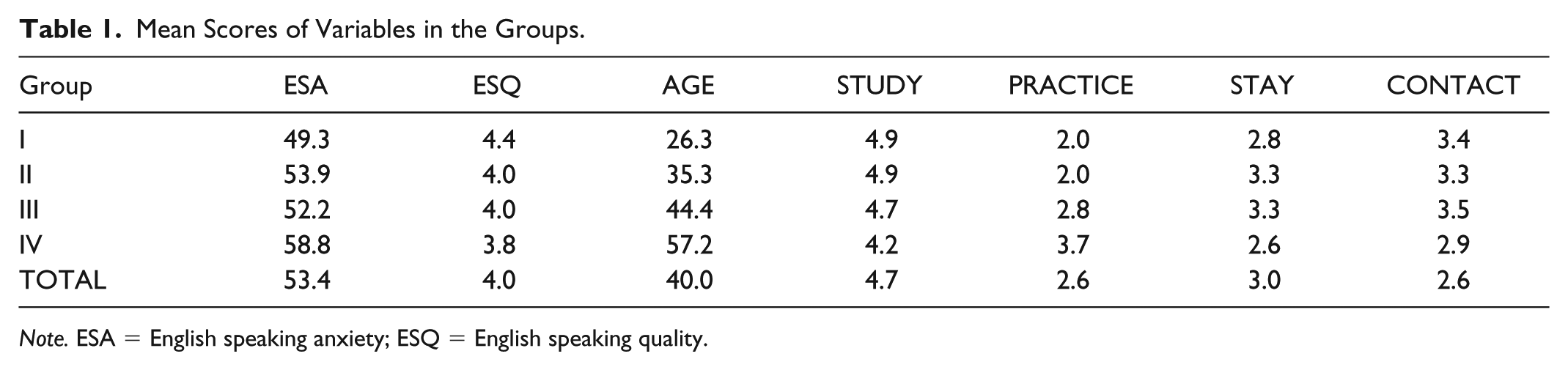
The means of the variables obtained by the questionnaire, scale, and test were calculated for each group (Table 1). There are differences between the groups within each variable. The highest level of ESA was detected in Group IV (58.8) and the lowest level in Group I (49.3). On the contrary, the highest level of ESQ was detected in Group I (4.4) and the lowest level in Group IV (3.8). The scale items most strongly reflecting participants’ speaking anxiety were No. 20 (“It bothers me when I cannot recall some words when I speak English”) with an average score of 3.55 and No. 7 (“I realize that I cannot express myself in English as well as I can in Slovak”) with an average score of 3.34.
Mean Scores of Variables in the Groups.
Note. ESA = English speaking anxiety; ESQ = English speaking quality.
Most of the Group I, II, and III participants have completed the master’s level of their English language STUDY, whereas most of the Group IV participants have completed their English language study within continuing teacher education during their in-service teaching. The variable AGE was more or less in line with the variable PRACTICE—the older the participants were, the more teaching experience they had (Group IV participants had been teaching for more than 30 years, Group I participants for less than 10 years on average). As for the length of STAY in English-speaking countries, it was several weeks and more in Groups II and III. Most Group I and IV participants reported only a-few-days’ stays. The CONTACT with English native speakers was most frequent in Groups I, II, and III (several times a month on average) and less frequent in Group IV.
The Kruskal–Wallis test in the program STATISTICA was used to determine whether the differences between the groups are statistically significant for the variables ESA and ESQ. For ESA, there is the value of test criterion H = 11.611 and the value of probability p = .0088. As p < .01, the differences between the groups are statistically significant at α = .01. Multiple comparisons of ordinal averages by the Kruskal–Wallis test with z score revealed that there is a statistically significant difference between Groups I and IV (p = .000; Figure 1).

ESA mean scores in the groups.
For ESQ, there is the value of test criterion H = 13.548 and the value of probability p = .0036. As p < .01, the differences between the groups are statistically significant at α =.01. Multiple comparisons of ordinal averages by the Kruskal–Wallis test with z score revealed that there is a statistically significant difference between Groups I and IV (p = .004; Figure 2).

ESQ mean scores in the groups.
Furthermore, the correlations between ESA and other variables were analyzed. As the variables were scaled and do not have normal distribution, the coefficient of contingency C and the independence test χ2 were calculated. As p < .01 with all variables, their correlation with ESA is statistically significant at α = .01. A strong level of contingence between ESA and ESQ (.7 ≤ C < .9) and a significant level of contingence between ESA and all other analyzed variables (.5 ≤ C < .7) were detected (Table 2). The correlations between ESA and most independent variables were negative, which means the higher the independent variable score, the lower the ESA score (Figure 3). The only positive correlation was obtained with the ESA–AGE relationship (verified by a positive Spearman coefficient r = .376), which means the older the participants were, the higher ESA score they achieved (Figure 4).
Correlations of ESA and Independent Variables.

Note. ESA = English speaking anxiety; ESQ = English speaking quality.

ESA-ESQ correlation.
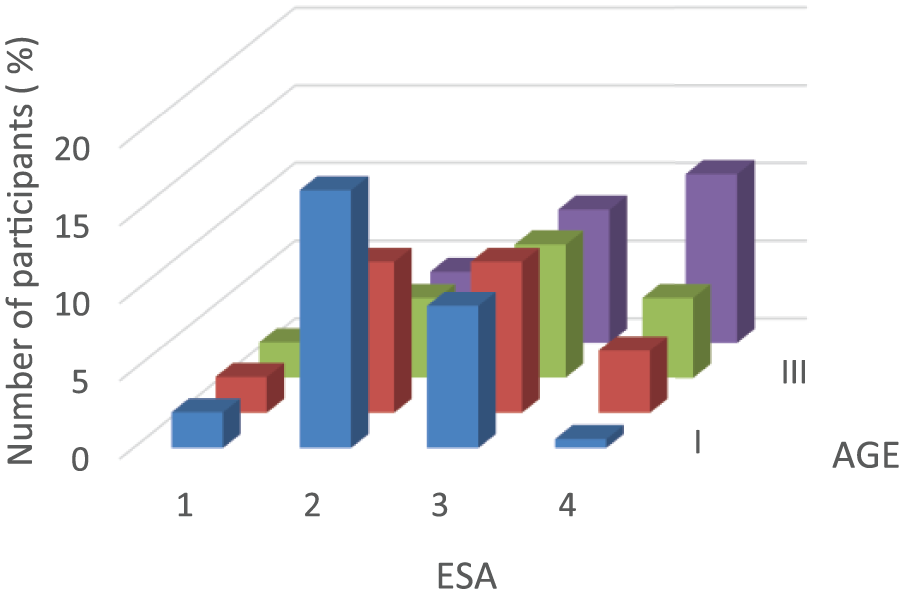
ESA-AGE correlation.
The interviews with teachers revealed that one of the primary CAUSES of their anxiety when speaking English is their self-perceived unsatisfactory English language competence (Figure 5)—production problems (56.0%) being mentioned nearly twice as often as problems with perception (22.9%) (Table 3). Within the production causes, the most relevant issue was vocabulary retrieval (“I often can’t recall the right word . . .”), significantly decreasing with the age of participants.

The competence production causes of ESA in the groups.
The Causes of ESA.
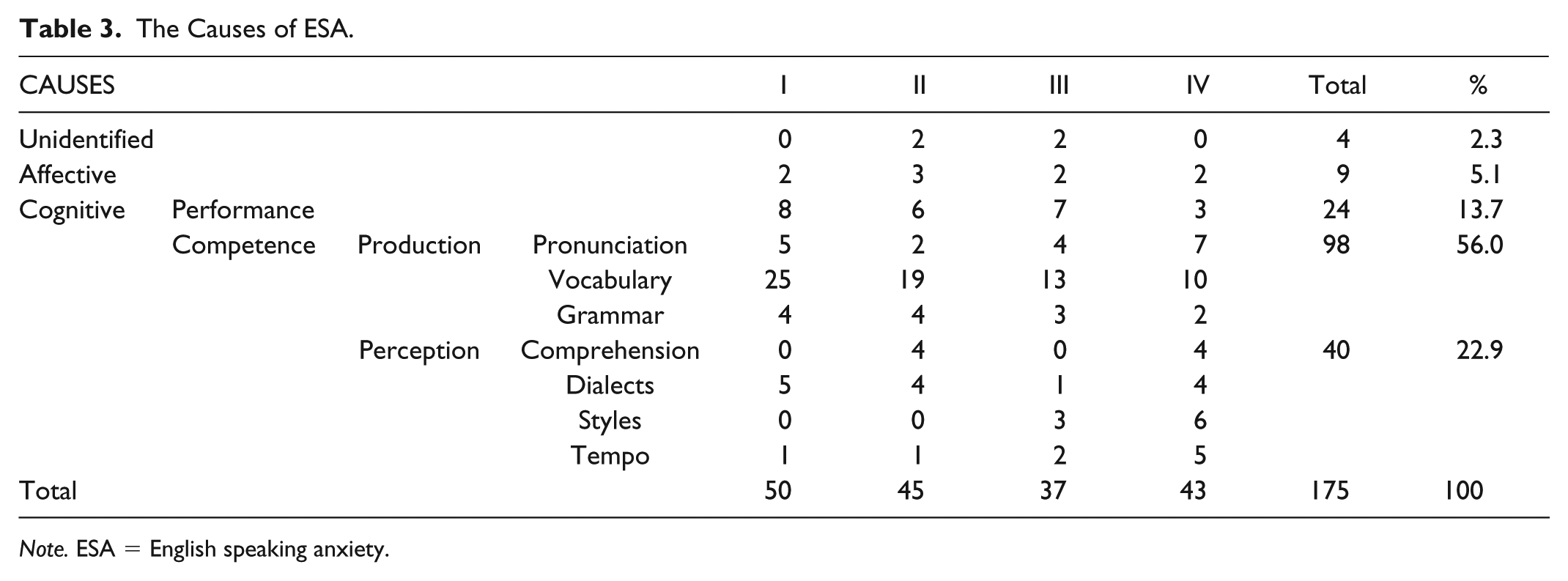
Note. ESA = English speaking anxiety.
Naturally, participants’ ESA CONSEQUENCES were demonstrated mostly in the performance aspect (38.9%), either as hesitation or the application of some communication compensation strategies (most frequently a reformulation: “When I can’t express myself quickly, I try to reformulate the idea somehow . . .”) (Table 4). Problems with vocabulary retrieval and hesitation during speaking seemed to be slightly reduced with age (Figure 6).
The Consequences of ESA.

Note. ESA = English speaking anxiety.

The competence production consequences of ESA in the groups.
As shown in Tables 5 and 6, speaking in English, traveling to and staying in English-speaking countries, and speaking practice were identified as the key facilitative ESA FACTORS and NEEDS (Figures 7 and 8). Speaking was considered as a less influential need with the increasing age of participants. On the contrary, the need of a longer stay in an English-speaking country significantly increased with the age. The participants stated that media (most often . . . “watching films or sitcoms in English”) have helped them feel more confident in English oral communication. Surprisingly, reading English texts was also reflected as helpful in coping with ESA. As one of the participants explained, “I like reading novels for women in English where I learn vocabulary in context. This helps me use this vocabulary more readily when speaking.”
The Factors of ESA.

Note. ESA = English speaking anxiety.
The Needs to Cope with ESA.

Note. ESA = English speaking anxiety.

The factors of ESA.
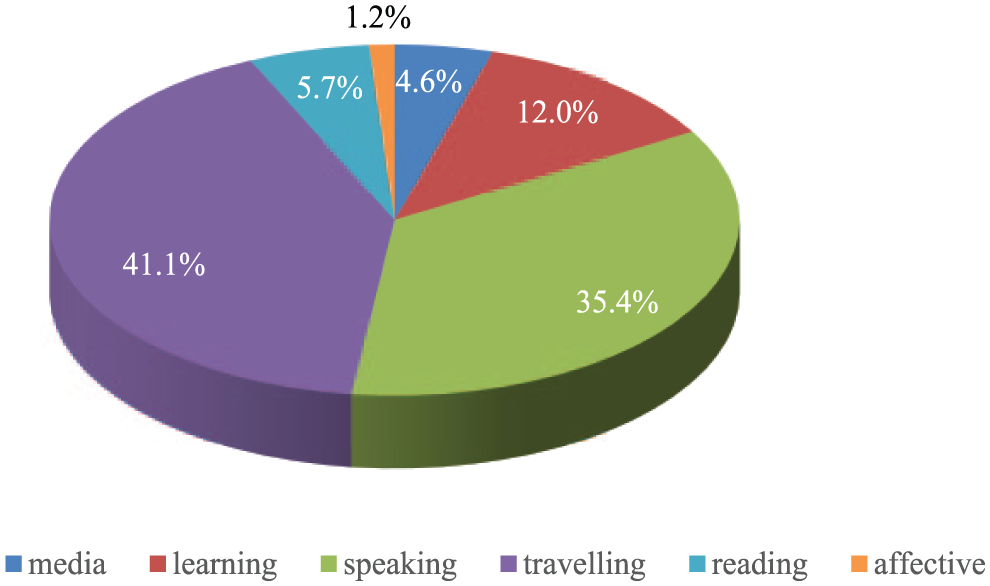
The needs to cope with ESA.
Discussion
As expected, the participants aged more than 50 years suffered from the strongest speaking anxiety, and the youngest participants experienced a significantly lower (by nearly 10%) level of such anxiety. All participants identified their unsatisfactory English language competence as the main cause of their anxiety, reflected mainly in the lack of vocabulary and inauthentic pronunciation. Surprisingly, the problems with vocabulary retrieval were identified most frequently by the youngest participants. Teachers were less concerned about their grammar, which might be explained by the dominating grammar-translation method used during their studies. They tended to feel more comfortable about receptive skills, compared with productive skills (cf. Kim & Kim, 2004).
As for the ESQ, the difference between the best group (I) and the worst group (IV) was also approximately 10%. Group IV reported limited traveling abroad as the strongest drawback in improving their communication in English and proclaimed it as the most urgent need to cope with ESA. Nevertheless, teachers reported mostly financial limits to travel to or stay in English-speaking countries. During the school year, it is practically impossible to miss classes, and many teachers are too exhausted at the end of a school year to study, and what is more, some have to take an extra job during holidays to compensate for their low incomes.
The detected strong negative correlation between ESA and ESQ is in line with most studies in this field (e.g., Horwitz, 2010; Zheng, 2008) concluding that higher foreign language competence reduces foreign language anxiety. Most of the factors analyzed (the length of study, teaching practice, a stay in a foreign language environment, and contact with native speakers) are generally considered as foreign language anxiety facilitators (e.g., Medgyes, 1994; Moussu & Llurda, 2008). In our case, the age was the only factor positively correlating with anxiety. The older the teachers were, the more they suffered from ESA, which seemingly contradicts the traditional belief that the length of foreign language teaching experience is a factor reducing teachers’ foreign language anxiety (e.g., Fish & Fraser, 2003; Onwuegbuzie et al., 1999).
However, it is necessary to explain the discrepancy between the age of teachers and the length of their English teaching practice in the Slovak context. Again, there are several sociological factors at play—teaching is rather a poorly paid job in Slovakia resulting in a low number of graduates in the teaching profession. At the same time, many elderly teachers of English are former teachers of Russian who had become superfluous after the change of regime and received requalification courses in English.
The most critical age of Slovak EFL teachers today is, thus, more than 50 years of age. Many of them lack motivation to study and improve their English speaking skills though they sense them as unsatisfactory. As a result, their most frequent coping strategy is avoidance behavior—they try to avoid spontaneous and continuous speaking activities in their classrooms, which is rather harmful and, in fact, impossible in modern teaching and learning a foreign language.
Teaching today is extremely demanding, both cognitively and emotionally. Students are likely to sense their teachers’ uncertainty in a foreign language, and teachers are afraid of being ridiculed and not accepted as an authority. The teachers, thus, should be supported to cope with their problems (including foreign language anxiety) prior to and during their teaching career. Most Slovak EFL teachers intuitively assume that the most effective remedies in relieving their ESA take two forms—behavioral (“more intensive English speaking practice”) and affective (“something which would reduce our psychological inhibitions to speaking English”). Modern trends in teaching foreign languages emphasize an affective aspect of learning to counterbalance the cognitive aspect, and many researchers (e.g., Dewaele & MacIntyre, 2014) have already acknowledged the need of anxiety coping training for foreign language learners as a supplement to skills training (Kralova, Skorvagova, Tirpakova, & Markechova, 2017).
Conclusion
As the current findings indicate, the sociolingual aspects of learning EFL cannot be ignored. Language identity is complex, dynamic, and highly context-dependent (Faez, 2007). It is hoped that the current study will contribute to the study of varied locally based practices of English language teaching (ELT). Clearly, the research taking ecological and dynamic points of view (Cao, 2009; Hiver & Al-Hoorie, 2016) is needed in the area of foreign language learning and teaching. An exploration of mixed methods is needed, as very few studies (Moussu, 2006) have examined teachers’ individual perspectives. The specifics of the EFL context, thus, ought to be carefully considered and included both in teacher training and continuing teacher education, thereby reflecting the real needs of teachers.
Limitations
The overall findings of this study indicate a strong relationship between the teachers’ ages and ESA in Slovakia as a post-Communist country. However, these findings must be interpreted in light of several limitations. The first one is the space limit, which precluded publishing data on all parts of the research in a single article. The study presents partial data from a larger longitudinal study which could offer additional perspectives on the issue.
The second limitation is the small sample size. Although the groups showed clear tendencies in the data, larger groups may allow group distinctions to emerge more clearly. Finally, future research may want to verify the issue in other countries with similar sociopolitical and historical backgrounds. Although we are aware of the impossibility of achieving total objectivity in this type of research, the objectivity was maximized through the combination of quantitative and qualitative methods. Despite these limitations, it is hoped that another small step has been taken toward a greater understanding of the needs of foreign language teachers in specific local contexts.
Footnotes
Appendix A
Appendix B
Appendix C
Declaration of Conflicting Interests
The author(s) declared no potential conflicts of interest with respect to the research, authorship, and/or publication of this article.
Funding
The author(s) disclosed receipt of the following financial support for the research, authorship, and/or publication of this article: This work was supported by the Scientific Grant Agency of the Ministry of Education, Science, Research and Sport of the Slovak Republic (VEGA 1/0062/17).
