



Abstract
Severe land pollution poses a great detriment to the environment and human welfare, which is a main challenge to the achievement of the 2030 Sustainable Development Goals. However, it lacks evidence to demonstrate whether land pollution regulation can increase people’s subjective well-being (SWB) and what its underlying mechanisms are. This paper delves into the influence of land pollution regulation on rural residents’ SWB based on a nationwide 3,560 individual samples from China. Our results show that land pollution regulation can significantly increase rural residents’ SWB. This effect remains robust after dealing with the potential selection bias and endogeneity problems. Besides, the monetary value of land pollution regulation grounded on the life satisfaction approach shows that the resulting improvement in rural residents’ SWB brought by land pollution regulation is equivalent to 5.3 times of the effect of household income. Moreover, we detect that the positive impact of land pollution regulation on SWB is more noticeable for rural residents with lower education and household income, and those who are junior and old-aged. Further mechanism analysis highlights that agricultural income improvement and health promotion are two crucial mechanisms. Our results highlight the importance of implementing land pollution regulations to facilitate individuals’ SWB.
Introduction
Subjective well-being (SWB), reflecting how people experience and evaluate different aspects of their lives, is a universal measurement of individuals’ happiness and has been widely recognized as a crucial aspect of social development and an essential criterion for evaluating living quality (López-Gil & García-Hermoso, 2022). Improving SWB has become the ultimate goal of public policy and economic development worldwide (Austin, 2016). The third aspiration of the Sustainable Development Goals for 2030 is to achieve “good health and well-being,” which aims to enhance individuals’ SWB (Tang et al., 2021).
Previous literature has proved that environmental pollution is a major obstacle to higher SWB (Shams & Kadow, 2023; Zhang et al., 2023). Therefore, a subsequent question that needs to be answered is whether environmental pollution regulation, a common type of governmental policy meant to address environmental issues, will increase individuals’ SWB. However, only a limited study has explored the effectiveness of environmental pollution regulation on SWB. Two notable exceptions include Z. Jin et al. (2020) and S. Guo et al. (2020), which mainly focus on the impact of the entire environmental pollution regulation or just water pollution regulation on SWB. Hardly any research has examined the impact of land pollution regulation on peoples’ SWB.
In reality, land pollution has emerged as a significant and prevalent environmental issue in many developing countries in recent decades due to rapid industrialization and urbanization. Taking China as an example, according to the second survey of contaminants in land conducted by the Chinese government, 16.1% of the land was considered to be contaminated. Among the polluted land, the ratio of slight-polluted, light-polluted, moderate-polluted, and heavy-polluted land was 11.2%, 2.3%, 1.5%, and 1.1%, respectively (Qu et al., 2016). This severe land pollution has led to reduced crop yields, loss of biodiversity, and increased greenhouse gas emissions, posing great detriment to the ecology and human well-being, which are crucial challenges for achieving the 2030 Sustainable Development Goals. China has made substantial investments and extensive efforts to address land pollution. It is estimated that the Chinese Ministry of Finance has allocated an average of 4.16 billion yuan per year from 2016 to 2021 to carry out the land pollution regulation program (X. Wang & Yang, 2024). However, it remains unknown whether this massive investment in land pollution regulation will help to increase people’s SWB. This issue is worth investigating because it can contribute to understanding the mechanism of land pollution regulation from the standpoint of people’s SWB. It can also provide implications on how to further optimize the environmental regulation system to improve social welfare.
To address the aforementioned gap, we conduct a rigorous quantitative evaluation of the influence of land pollution regulation on people’s SWB and further explore its underlying mechanisms by employing data from a random survey of 3,560 rural residents in China.
We contribute to the literature on SWB by focusing on the effectiveness of pollution regulation in four ways. First, this paper, to our knowledge, is the first attempt to conduct a rigorous quantitative evaluation of the impact of land pollution regulation on peoples’ SWB, which not only adds to the pollution regulation literature but also can lead to global policy directives for pollution control and welfare improvement. Second, we look at the effectiveness of land pollution regulation on SWB in China—the largest developing country with an authoritarian regime in the world. SWB has proved to be positively related to government regulation in the democratic context such as OECD countries (Li et al., 2020). However, there is limited evidence in developing and non-democratic countries, while government regulation may be more decisive in improving people’s SWB due to prevalent market failures in these countries. Third, we evaluate land pollution regulation’s monetary value based on the Life Satisfaction Approach (LSA). It is difficult to quantify a public good’s monetary value like land pollution regulation due to its non-excludable and non-competitive characteristics. We use LSA to calculate the monetary value of land pollution regulation, which can act as a guideline for specific strategies, such as evaluating the advantages of enhancing land pollution regulation, assuring the effective allocation of resources, and persuading the government to maintain its support for land pollution regulation. Fourth, we analyze the underlying mechanisms of how land pollution regulation may affect individuals’ SWB both theoretically and empirically. We hypothesize and test the assumption that the beneficial effects of land pollution regulation on SWB mostly result from the rising health and agricultural income of rural residents. Investigating these underlying mechanisms can provide a clearer path for the government to develop more effective government governance programs to enhance people’s SWB.
The remnant of the study can be separated into six sections. Section 2 introduces the land pollution regulation in China and reviews the related literature. Section 3 proposes our theoretical analysis. Section 4 presents the data and method. Section 5 outlines the baseline empirical analysis, the monetary value of land pollution regulation, the robustness tests, the heterogeneity analysis, and the mechanism analysis. Section 6 concludes the findings, offers relevant policy recommendations, and also gives the limitations and further research directions.
Background and Literature Review
Background
As a result of increased industrialization and urbanization, land pollution has emerged as one of the world’s most severe environmental issues in recent years, particularly in some developing countries such as China. China’s first national land pollution survey shows that 16.1% of the land had been identified to be polluted. According to “The National Farmland Quality Grade Bulletin” in 2019, the average grade of arable land in China is 4.76, and only 31.24% of the total arable land area was evaluated as high-quality with a grade of one to three (Chen & Ye, 2014).
As the world’s largest developing country with one of the largest populations, China’s land resources not only provide basic food security but also serve as crucial means of production and living conditions for rural residents. In response to the contradiction between the severe conditions of land pollution and the importance of land conservation, the central government of China has implemented a series of regulations aimed at improving land quality (see Table 1). Notably, in 2018, National People’s Congress passed the Soil Pollution Prevention and Control Law of the People’s Republic of China, which states that “local governments at all levels should be responsible for the prevention and safe utilization of land pollution in their administrative areas” (X. Wang & Yang, 2024). Therefore, almost every province in China has enacted its own “Soil Pollution Prevention and Control Regulations.” Some of the examples are shown in Table 1.
Some Typical Land Pollution Regulation Policies in China.

Through the aforementioned series of policies and related laws, China has established a land pollution regulation system nationwide. Specific regulation measures include conducting regular nationwide land quality surveys, performing soil risk assessments, and implementing soil remediation and treatment. It is reported that a total of 36.4 billion yuan has been invested in land pollution regulation programs from 2017 to 2021 nationwide, and nine provinces, including Jilin, Jiangsu, Hunan, Hubei, Henan, Shaanxi, Inner Mongolia, Tianjin, and Shandong, have also set up provincial land pollution prevention funds (Huang, 2023). However, due to the characteristics of large investment, long treatment cycles, and low profit of land pollution treatment, local government faces great financial pressure in the process of land pollution regulation. Therefore, land pollution regulation in China is still in the development stage. There are many areas in China, especially rural areas with fewer financial resources, lacking sufficient efforts to regulate land pollution.
Literature Review
Enhancing SWB remains a pressing issue for all nations (Graham et al., 2017), especially for developing countries like China, which are undergoing rapid economic growth (Muganyi et al., 2022; H. Sun et al., 2022). Since the 1950s, a burgeoning body of research has investigated the means of enhancing individuals’ SWB (Liang et al., 2021). Existing studies have demonstrated that individuals’ SWB is influenced by socio-demographic individual factors, including income (Pouwels et al., 2008), education (Tan et al., 2020), age (Labouvie-Vief & Blanchard-Fields, 1982), health (Ngamaba et al., 2017), and marital status (Shams & Kadow, 2023), macro-contextual factors such as ecosystem services (Zhang et al., 2023), city size (Dang et al., 2020), and income gap (J. Jin & Hong, 2022). As environmental problems have gained greater prominence in recent years, a growing body of literature has focused on the influence of environmental pollution on residents’ SWB. Previous studies have demonstrated that environmental pollution will lower residents’ SWB. For example, Van Praag and Baarsma (2005) pointed out that sound pollution from airports will decrease nearby residents’ SWB. Cheng et al. (2022) proved that heavy air pollution will decrease individuals’ SWB. Apart from the above determinants of SWB, there is also a limited study that has explored the correlation between pollution regulation and SWB. For example, Z. Jin et al. (2020) found water pollution regulation cannot enhance individuals’ SWB in its implementation since that reducing water pollution may cause the shutdown of related enterprises and the decline of people’s employment and income. S. Guo et al. (2020) examine the SWB effect of three categories of pollution regulations, namely economic pollution regulation, legal pollution regulation, and supervised pollution regulation, and found that economic pollution regulation significantly improves SWB, while legal pollution regulation has no significant effect and supervised pollution regulation harms SWB.
The above literature greatly expands our understanding of the determinates of SWB. However, less attention has been paid to the effect of environmental pollution regulation on SWB, and only a limited empirical study has investigated the effectiveness of the entire pollution regulation or water pollution regulation on SWB. By contrast, land pollution regulation has been ignored, even though land pollution is “one of the most severe environmental issues in many developing countries” (Chen & Ye, 2014). Consequently, our paper attempts to address this knowledge gap by evaluating the impact of environmental pollution regulation on people’s SWB from the perspective of land pollution regulation, which is conducive to having a supplementary understanding of environmental pollution regulation and enhancing human well-being. By doing so, we aim to provide a more comprehensive understanding of environmental pollution regulation and its implications for SWB, thus contributing to bridging existing knowledge gaps and fostering human welfare.
Theoretical Analysis
By reviewing the previous literature (Li et al., 2020), we propose that land pollution regulation has a positive influence on rural residents’ SWB, and this positive influence is mainly caused by increasing rural residents’ agricultural income and health. Below is the specific theoretical explanation.
Drawing on the utility theory and building on the related literature of Li et al. (2020), we introduce the utility model in classical economics to analyze the impact and its mechanism of land pollution on rural residents’ SWB. Figure 1 depicts the specific conceptual framework, proposing that the utility of rural residents’ SWB (

The conceptual model of the impact of land pollution regulation on SWB.
First, land pollution regulation can enhance rural residents’ SWB by improving their agricultural income. This is because land pollution regulation can effectively improve crop quantity and quality, and thus increase the agricultural income of rural residents (Shao et al., 2019). Chen and Ye (2014) pointed out that land pollution has negative impacts on the quality of agricultural products, which can lead to decreased competitiveness in the market and substantial losses in rural residents’ agricultural income. However, land pollution regulation can restore land fertility and increase organic matter levels in the land by implementing targeted measures, thus improving both crop yield and quality, leading to increased income for rural residents and a subsequent enhancement of their SWB.
Second, land pollution regulation can enhance rural residents’ SWB by improving their health. Land pollution can lead to crop contamination, which may pose a challenge to rural residents’ physical health who consume the contaminated crops (Huamain et al., 1999). For example, long-term consumption of contaminated rice due to land pollution has been widely recognized as a cause of Itai-Itai disease and a decrease in intelligence quotient, which harms rural residents’ physical health (S. Guo et al., 2020). In addition, land contamination can also exert a significant influence on rural residents’ living environment, potentially leading to a harmful influence on their mental health (Okun et al., 1984). For example, in the Kouterwijk community of Belgium, heavy metal land pollution harms rural residents, causing sleep disorders and physical complaints, which seriously affect their mental health (Vandermoere, 2008). The substantial investments and extensive efforts devoted to land pollution regulation have the potential to create a cleaner and more sustainable environment, as well as to improve the infrastructure in rural areas. These improvements can mitigate land pollution and in turn may contribute to the enhancement of individuals’ SWB in these areas (Li et al., 2020).
Hence, the provision of land pollution regulation in villages helps to promote rural residents’ agricultural income and health, thus enhancing their SWB utility.
Methodology
Data
The data utilized in this study is sourced from the China Labor-force Dynamics Survey (CLDS) database for the years 2014, 2016, and 2018. CLDS comprises comprehensive tracing and cross-sectional data on individuals, households, and villages across 29 provinces in China (see Figure 2), making it a nationally representative survey. Since our study focuses on rural residents’ SWB, we delete the non-rural samples and eliminate the invalid cases with missing values. This process yields a final dataset consisting of 3,560 individual-level samples.

The location of 29 provinces.
Variables
Dependent Variable: Rural Residents’ SWB
Rural residents’ SWB is the dependent variable, which can be operationalized by the question in the CLDS survey, namely, “Overall, do you think you feel happy with your daily life?.” Rural residents were asked to rate their happiness on a scale from 1 (very unhappy) to 5 (very happy), with higher scores indicating a higher level of perceived SWB.
Independent Variable: Village-Level Land Pollution Regulation Where the Rural Resident Is Located
The independent variable is land pollution regulation at the village level, rather than at the individual level. This is because land pollution regulation is a public good requiring massive investment and is often implemented by local government. This variable is obtained by asking local rural leaders (such as village chiefs, village committee secretaries, and other relevant officials) the following question: “Has your village ever implemented land pollution regulation?” The answer to this question is implemented or not.
Control Variables
To comprehensively capture the affective determinants of rural residents’ SWB, we include seven control variables in our analysis. These variables are income, age, party member, education, marital status, medical insurance, and village’s green coverage. Existing literature has identified these factors as possible influences on individuals’ affective experiences, and therefore, they are included in our analysis as control variables (Appleton & Song, 2008).
(1) Income. The impact of income on SWB is complex. One perspective is that individuals can use their income to improve material goods, living standards, and other aspects, thereby enhancing their SWB (Diener et al., 2013). However, the correlation between higher income and increased SWB is not necessarily absolute, as demonstrated by the period from 1946 to 1970 in the United States, that despite a significant rise in per capita income, people’s SWB did not exhibit a consistent upward trend (Easterlin, 1974).
(2) Age. The correlation between age and individuals’ SWB is an ambiguous and debated subject in the literature. Some scholars argue that age has a positive influence on SWB, as individuals become better equipped to handle both positive and negative emotions with growing age, leading to an overall greater SWB (Labouvie-Vief & Blanchard-Fields, 1982). However, other studies have suggested a U-shaped feature to explain the interrelationship between age and SWB. For example, S. Sun et al. (2016) reported that there is a decline in SWB with increasing age, followed by an increase in SWB after a certain age. To account for this non-linear relationship, we include the age square as a control variable in our analysis.
(3) Party member. Researchers suggest that being a party member has a positive impact on SWB. On one hand, party membership can help expand an individual’s social network and enhance their social capital, which can contribute to increasing SWB (Appleton & Song, 2008). On the other hand, being a party member can also generate a sense of pride and honor, which is associated with an increase in SWB (Helliwell, 2003).
(4) Education. Education exerts a positive effect on SWB. From one viewpoint, higher-educated individuals tend to have better employment opportunities and higher income, which may contribute to an improvement in SWB (Cuñado & de Gracia, 2012). In addition, higher-educated individuals may be more respected in their daily lives, which can also enhance their SWB (P. Wang et al., 2021).
(5) Marital status. Marriage has been proven to have a positive impact on SWB, as documented by Knight et al. (2009). This is because having a spouse can provide emotional support, which can help individuals cope with life stresses and ultimately enhance SWB (Dang et al., 2020).
(6) Medical insurance. There exists a positive correlation between medical insurance and SWB. Medical insurance offers individuals a sense of security and peace of mind, as they do not have to worry about financial difficulties in the case of unexpected medical expenses. Consequently, medical insurance can enhance their overall SWB (X. Zhao et al., 2019).
(7) Village’s green coverage. The correlation between a village’s green coverage and individuals’ SWB is ambiguous. On the one hand, numerous studies demonstrate positive SWB effects of green coverage. For example, Liu et al. (2022) noticed greening can purify the air and thus reduce air pollution, lowering the local mortality rate and improving people’s SWB. He et al. (2023) also found out that a large green area provides residents with a place to rest and exercise, which in turn enhances their SWB. On the other hand, there is evidence that green coverage might have a negative effect on people with low SWB (Sharifi et al., 2021). Dony et al. (2015) discovered that high green coverage leads to crowds and traffic congestion and thus harmed people’s SWB.
Descriptive Statistics
Table 2 presents the descriptive statistics of the study’s variables. The average SWB score in our sample is 3.643, indicating that the majority of respondents report feeling relatively happy. The mean value of land pollution regulation in China is 0.099, suggesting that 9.9% of surveyed villages have implemented land pollution regulations, showing that land pollution regulation in China is in the early stage. The natural logarithm of rural residents’ income is 9.517 (the corresponding amount is 25468.18 yuan). The average age of rural residents is 47.008 years old. The party members make up 4.3% of the total. Rural residents’ education level is 1.083. Married rural residents account for 90.2% of the total, and 84.1% of rural residents have medical insurance. The average green coverage of villages is more than 54.65%. The above numbers agree with the basic conditions in rural China, indicating that the sample in our study can represent the basic situation of rural residents nationwide.
Descriptive Statistics of Variables.

Model
Baseline Regression: Ordered Probit Model
Rural residents’ SWB is a discrete ordered response variable. Therefore, this paper employs the Ordered Probit model to conduct the regression analysis, which can be represented by Equation 1.

Where

Where
Monetary Value Calculation: Life Satisfaction Approach (LSA)
We employ LSA to calculate the monetary value of land pollution regulation. LSA is an emerging evaluative methodology to quantify the monetary valuation of goods with public characteristics, such as air pollution (C. Sun et al., 2022) and noise pollution (Van Praag & Baarsma, 2005). Drawing upon the methodologies outlined by W. Wang et al. (2021), the specific formula for LSA is as follows:

Where

Where
Correcting Selective Bias: PSM
If the decision to implement land pollution regulation is random, then the aforementioned Ordered Probit model is appropriate. However, it is crucial to recognize that this decision may be self-selected by the villages. In other words, villages may have the discretion to choose whether or not to implement land pollution regulations. For example, Pan et al. (2020) contended that rural environmental management is non-random, in that wealthier villages have more rural environmental management facilities. Therefore, we apply the PSM method to correct this selection bias problem. PSM approach can mitigate self-selection biases within the comparison of treatment groups, enabling a rigorous evaluation of the effectiveness of land pollution regulation (Caliendo & Kopeinig, 2008). The operation of PSM consists of the following two steps.
Firstly, utilizing a logistic regression model to estimate the probability of a village implementing land pollution regulation, as shown in the following equation:

Where
Secondly, we evaluate the average treatment effect on the treated (ATT) using three different matching methods: nearest-neighbor matching, radius matching, and kernel matching. ATT represents the average difference in rural residents’ SWB with and without land pollution regulation, and can be calculated as follows:

In Equation 6, the potential rural residents’ SWB under the adoption and non-adoption of land pollution regulation is represented by
While PSM effectively addresses selection bias, it may still produce biased outcomes due to misspecification. To address this issue and demonstrate the robustness of PSM results, we employ two additional methods recommended by Zheng and Ma (2023): the Inverse Probability Weights (IPW) method and the Inverse Probability Weights Regression Adjustment (IPWRA) method. These approaches aim to overcome the limitations of PSM and provide robust evidence for its findings. Compared to the PSM model, the IPW method offers the advantage of allowing different weighting of confounding variables to adjust their distribution, thereby enhancing the robustness of the ATT. Additionally, the IPWRA method is double-robust, meaning it can provide a more consistent estimation of the ATT compared to the PSM model.
Endogeneity Test: IV Approach
The PSM method described earlier can only mitigate the endogeneity problem arising from observable factors causing selection bias. However, we also need to address endogeneity issues stemming from selection bias based on unobservable factors and other sources such as omitted variables, reverse causality, and measurement error. For example: first, endogeneity issues may arise from the exclusion of crucial variables like rural residents’ perceptions and village location, which could impact both land pollution regulation and rural residents’ SWB. Second, some villages may actively manage land pollution regulation to enhance rural residents’ SWB, leading to endogenous problems related to reverse causality. Third, measurement errors might occur due to the subjective evaluation of rural residents’ SWB.
To address these endogeneity issues stemming from unobservable factors and other sources, this study employs the IV approach. Since both land pollution regulation and rural residents’ SWB are discrete variables, the commonly used two-stage least squares (2SLS) method based on continuous variables is not suitable. Therefore, following the methodology proposed by Gu et al. (2019), we utilize the IV-Oprobit method, which can be defined as follows:


Where
Empirical Estimation Results
In this section, we first employ the Ordered Probit model to examine the relationship between land pollution regulation and rural residents’ SWB. Subsequently, we estimate the monetary value of land pollution regulation. Then, considering the potential endogeneity issue between land pollution regulation and rural residents’ SWB, we also apply PSM and IV techniques to address potential selection bias and endogeneity problems. PSM is effective in accounting for the endogenous problem of sample self-selection (Hirano & Imbens, 2004), while IV can address issues of mutual causality and unobservable variables in the empirical findings. We aim to mitigate selection bias resulting from both observable and unobservable factors by utilizing both methods as robustness checks, thereby obtaining an unbiased estimate of the influence of land pollution regulation on SWB. Furthermore, to enhance the robustness of our findings, we conduct three additional robustness tests. Additionally, we explore the heterogeneous effects of land pollution regulation on rural residents’ SWB. Finally, we delve into the potential mechanisms underlying the influence of land pollution regulation on rural residents’ SWB.
Baseline Results
Table 3 presents the results regarding the impact of land pollution regulation on rural residents’ SWB. In Column (1), the coefficient of land pollution regulation is significantly positive at the 1% level, indicating that land pollution regulation positively contributes to the improvement of rural residents’ SWB. Given that SWB is a discrete ordered variable, we also report the marginal effects of each independent variable in Columns (2) to (6).
The Impact of the Land Pollution Regulation on Rural Residents’ SWB.

Note. Robust standard errors are shown in curves, same as below. Delt-method standard errors are shown in marginal effects’ parentheses, same as below.
, **, and ***Significant at the 10%, 5%, and 1% levels, respectively.
The findings reveal that the marginal effects of land pollution regulation on SWB are negative for lower levels of SWB (SWB = 1, 2, and 3) and positive for higher levels of SWB (SWB = 4 and 5). Specifically, when land pollution regulation in each village increases by one standard deviation (0.299) from the mean (0.099), the probability of being in the lower levels of SWB decreases, while the likelihood of being in the higher levels of SWB increases. For example, the probability of being “very unhappy” (SWB = 1) decreases by .418% (.418% = .014 (the marginal effect of very unhappy) × .299 (one standard deviation)), “relatively unhappy” (SWB = 2) decreases by .897%, and “so-so” (SWB = 3) decreases by 1.944%, while “relatively happy” (SWB = 4) and “very happy” (SWB = 5) increase by 1.076% and 2.213%, respectively. These findings suggest that land pollution regulation can significantly improve rural residents’ SWB.
Regarding the control variables, our results are consistent with current research. We observe a U-shaped association between the age of rural residents and their SWB, which is in line with the study of S. Sun et al. (2016). Rural residents who are party members have higher SWB, which conforms to the study of Helliwell (2003). We also find that education has a significant positive influence on the SWB of rural residents, consistent with the results of J. Wang et al. (2021). Marriage is positively related to rural residents’ SWB, which is in harmony with an earlier study by Dang et al. (2020). Medical insurance has a significant positive influence on rural residents’ SWB, which verifies the findings of X. Zhao et al. (2019). Village’s green coverage significantly decreases rural residents’ SWB. This outcome corresponds to the result of Dony et al. (2015).
Monetary Value of Land Pollution Regulation
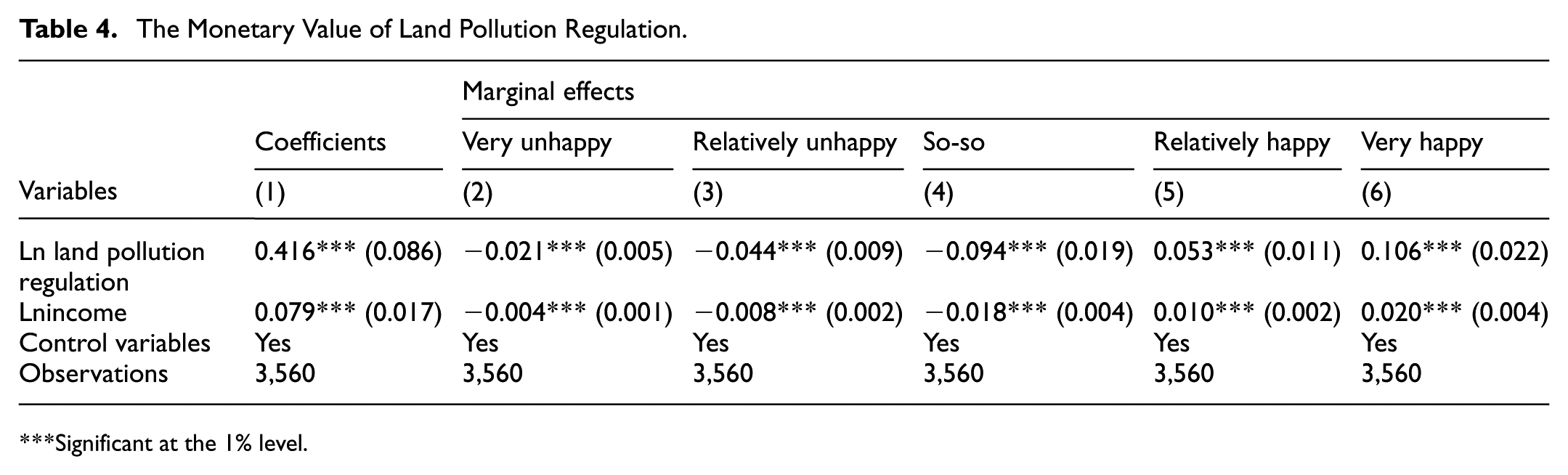
To calculate the monetary value of land pollution regulation, following the approach of Q. Zhao and Xia (2021), we add 1 to the value of land pollution regulation and then take the natural logarithm to re-estimate Equation 1. The findings are presented in Table 4. According to the study of W. Wang et al. (2021), the monetary values are typically obtained at their mean in the ordered probit model. Since the mean of SWB is 3.643 (see Table 2), we calculate the marginal effect at SWB = 4.
The Monetary Value of Land Pollution Regulation.
Significant at the 1% level.
Table 4 shows that the marginal effects of land pollution regulation and rural residents’ annual income are 0.053 and 0.010 at the level of “relatively happy.” Therefore, the monetary value of land pollution regulation is 530% (0.053 ÷ 0.010 = 5.3), which implies that the increase in rural residents’ SWB brought about by a 1% increase in land pollution regulation is equivalent to the increase in SWB brought about by 5.3 times the increase in rural residents’ annual income.
Correcting Selective Bias Using the PSM Method
In this section, we employ the PSM estimator to address potential selection bias, and then conduct several tests to verify the validity and quality of the matching. Firstly, we conduct an overlap test to examine the effectiveness of the PSM. The findings in Figure 3 indicate that the matched treatment and control groups exhibit substantial overlap in their propensity score intervals, suggesting that the overlap assumption is met. Secondly, we perform a balancing test to assess the quality of the matching. This involves comparing several indicators, including the pseudo-R2, chi-square, mean and median of standardized bias values, and B-value, before and after the matching process. Successful matching would result in these indicators exhibiting lower values after matching. The findings in Table 5 confirm that PSM successfully decreases the systematic discrepancies between the matched treatment and control groups, indicating the effectiveness of the matching process.
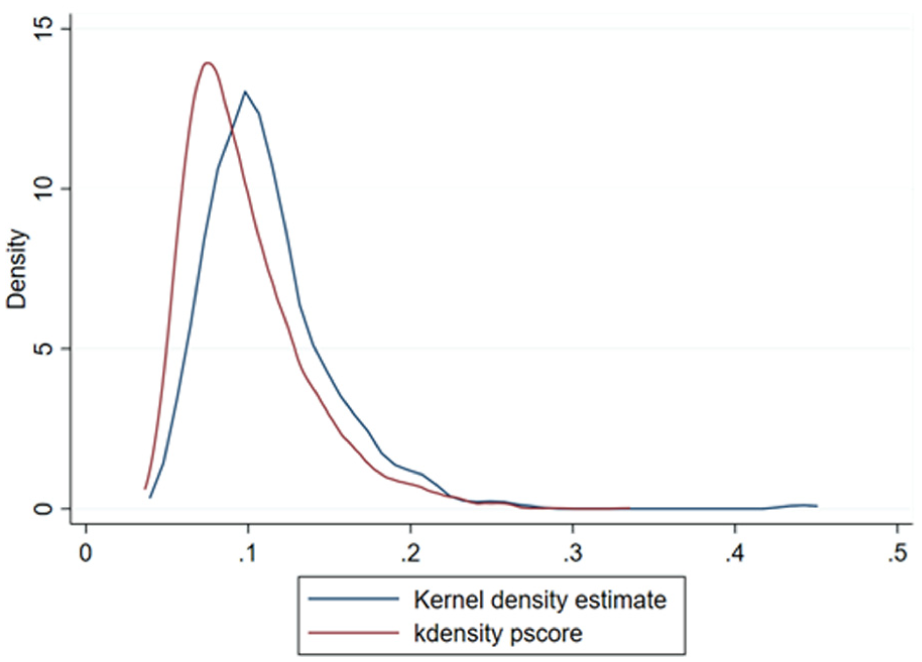
The overlap assumption.
The Balance Tests Before and After PSM.

Once the overlap test and balancing test have been passed, we proceed to estimate the PSM results using various matching methods. Table 6 presents the PSM estimation findings, which reveal that land pollution regulation significantly enhances rural residents’ SWB across all three matching approaches. This finding is consistent with the baseline results, indicating that the positive impact of land pollution regulation on rural residents’ SWB persists even after accounting for observable systematic discrepancies between the samples.
ATT Results of PSM.

Significant at the 1% level.
Additionally, to address the limitations of PSM and demonstrate the robustness of our findings, we also employ the IPW and IPWRA methods to estimate the influence of land pollution regulation on SWB. The outcomes are presented in Table 7. The ATT outcomes based on both methods demonstrate a significant positive effect of land pollution regulation on rural residents’ SWB. Furthermore, the ATT estimates from the IPW and IPWRA methods are largely consistent with those obtained from the PSM approach, confirming the reliability and robustness of our baseline results.
ATT Results of IPW and IPWRA.

Significant at the 1% level.
Endogeneity Test Using the IV approach
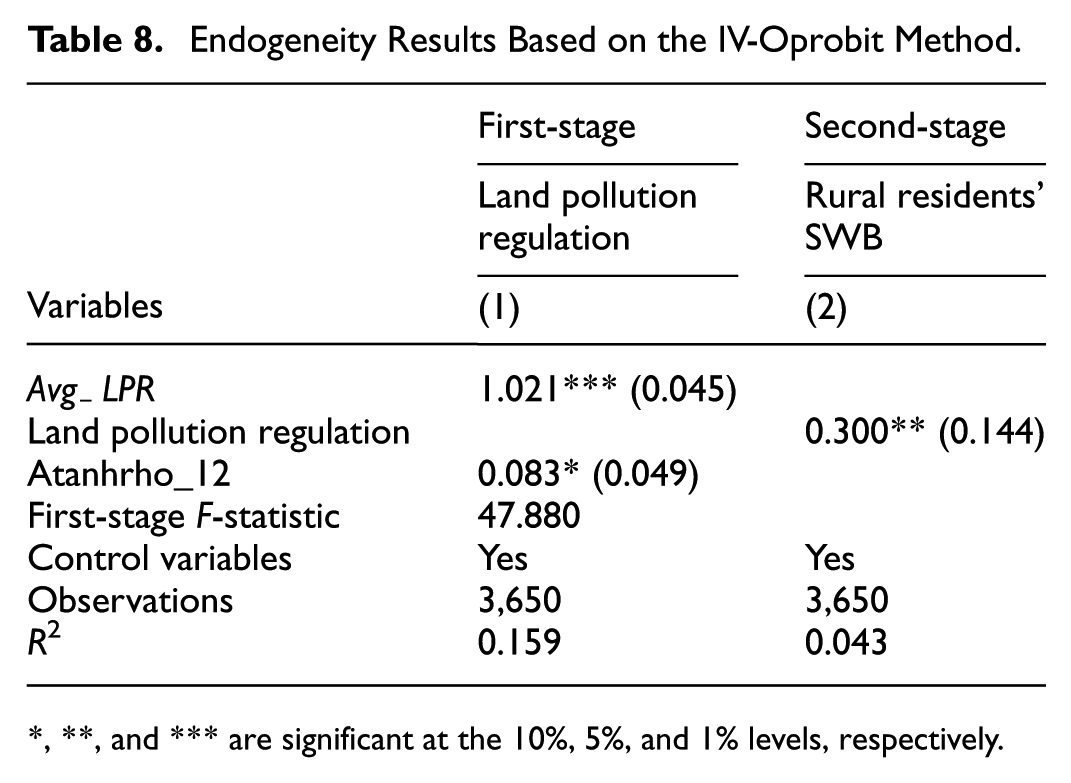
Although the baseline analysis establishes a significant positive relationship between land pollution regulation and rural residents’ SWB, the evaluation results might show bias owing to endogenous factors such as missing variables and mutual causality. To address this concern, we apply the IV-Oprobit method to test for endogeneity problems. Particularly, we use
Endogeneity Results Based on the IV-Oprobit Method.
, **, and *** are significant at the 10%, 5%, and 1% levels, respectively.
Table 8 presents the IV-Oprobit findings. In the first stage, Column (1) reveals a positive correlation between our IV variable,
Robustness Tests
To further validate our previous empirical findings, we conduct additional robustness tests covering three aspects: changing the regression method, recalibrating the value of rural residents’ SWB, and replacing SWB with life satisfaction as the new outcome variable.
Firstly, we alter the regression method. In addition to the Ordered Probit model used in the baseline regression, we also employ the Ordered Logit and Ordinary Least Squares (OLS) methods to ensure the reliability of the model. Columns (1) and (2) of Table 9 present the outcomes of these two methods’ results, indicating that the coefficient of land pollution regulation remains significant and positive, consistent with the baseline results.
Robustness Results.

Significant at the 1% level.
Secondly, we reallocate the value of rural residents’ SWB. To address potential measurement error issues related to rural residents’ subjective evaluation of SWB, we reassign the value of SWB using the method proposed by Lin (2012). This method assigns “very unhappy” and “relatively unhappy” to a value of 0, and “so-so,”“relatively happy,” and “very happy” to a value of 1 if rural residents underreport their SWB. Conversely, if rural residents over-report their SWB, “very unhappy,”“relatively unhappy,” and “so-so” are assigned a value of 0, and “relatively happy” and “very happy” are assigned a value of 1. The findings are presented in Columns (3) and (4) of Table 9, indicating that the coefficient of land pollution regulation remains significantly positive, consistent with the main result.
Thirdly, we replace rural residents’ SWB with life satisfaction as the new dependent variable. Life satisfaction is another commonly used measurement of well-being. Therefore, to further strengthen the robustness of our findings, we measure life satisfaction using individual-level questionnaire in CLDS “Overall, are you satisfied with your life situation?,” with answers varying from 1 (very dissatisfied) to 5 (very satisfied). The regression results regarding life satisfaction as the dependent variable are shown in Column (5) of Table 9. The findings further support the robustness of our previous baseline results.
Heterogeneity Analysis
To address the potential heterogeneity of land pollution regulation’s impact on rural residents’ SWB, we explore whether this influence varies across different dimensions, including individuals’ age, household income, and education levels. This analysis allows us to uncover potential variations in the effects of land pollution regulation on SWB among different demographic and socioeconomic groups. By examining these dimensions, we can gain a deeper understanding of how land pollution regulation may differently affect the SWB of rural residents with diverse characteristics.
Heterogeneity Analysis With Different Ages
Age is a significant determinant of individuals’ SWB, as highlighted in previous studies (Labouvie-Vief & Blanchard-Fields, 1982), implying that the effect of land pollution regulation on rural residents’ SWB could vary across different age groups. To address this heterogeneity, this paper categorizes rural residents into two groups: the “junior and old-aged group” (age < 18 and age > 60) and the “young and middle-aged group” (aged 18–59) according to F. Xu et al. (2022).
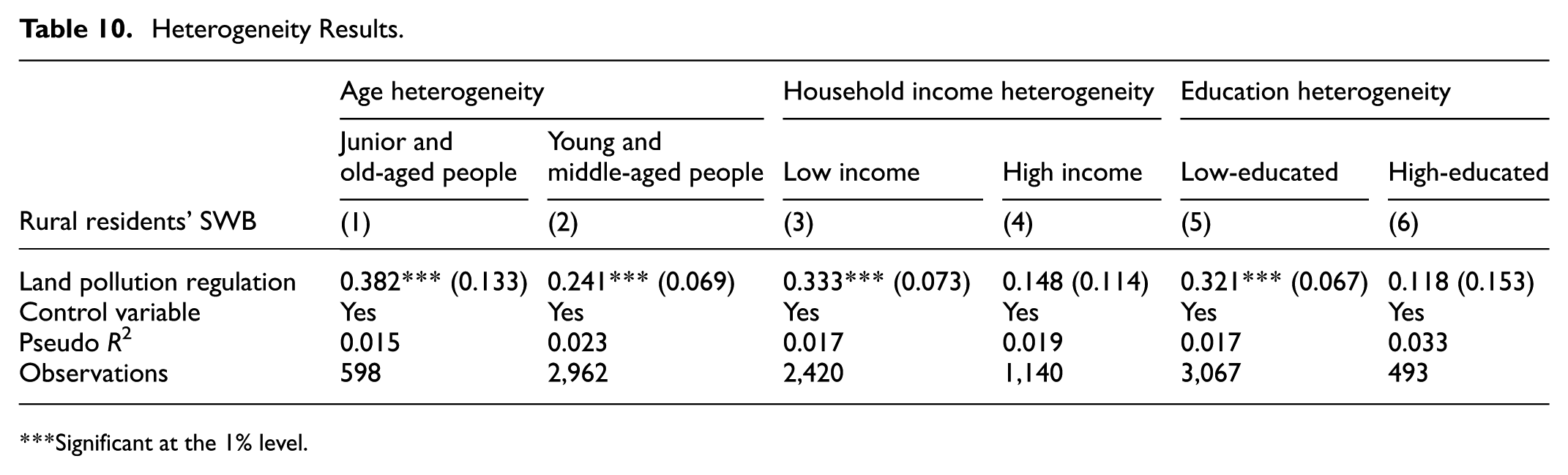
Columns (1) and (2) of Table 10 present the heterogeneity findings across different age groups. We observe that the coefficient of land pollution regulation is significantly positive in all age groups, indicating that land pollution regulation can enhance the SWB of both groups. Moreover, the coefficient of land pollution regulation is larger in the junior and old-aged group, suggesting that land pollution regulation has a greater impact on the SWB of individuals in this age group.
Heterogeneity Results.
Significant at the 1% level.
The following are the probable causes contributing to this outcome. On the one hand, with the massive rural migration in China, most young and middle-aged rural residents have migrated to cities, and they spend less time living in villages. Therefore, it is difficult for them to experience the changes in the rural environment brought by land pollution regulation, resulting in a less obvious SWB enhancement (Hu & Wang, 2020). On the other hand, junior and old-aged rural residents are generally in poor health, and the provision of land pollution regulation can help them improve their health and thus is beneficial to their SWB improvement (Tong et al., 2022).
Heterogeneity Analysis With Different Household Income
Household income is another crucial factor that affects people’s SWB (Cummins, 2000). Hence, it is vital to assess the heterogeneous influence of land pollution regulation on rural residents’ SWB across different household income levels. We separate the sample into two distinct parts, namely the low-income group and the high-income group, according to the mean levels of household income. The low-income group consists of respondents with household income levels equal to or less than the average income in our sample, while the high-income group comprises those with income levels above the average income in our sample.
In Columns (3) and (4) of Table 10, we present the findings of the heterogeneity analysis based on household income. The results indicate that the coefficient of land pollution regulation is significantly positive in the low-income group, suggesting that the SWB of low-income rural residents improves with effective land pollution regulation. However, in the high-income group, we observe an insignificant coefficient of land pollution regulation, indicating that the implementation of land pollution regulation does not affect the SWB of this group.
The aforementioned results can be interpreted through the following reason. Before the implementation of land pollution regulation policies, the overall income disparity among rural residents was relatively small compared to urban residents (Jiang et al., 2022). When a village adopts land pollution regulation measures, improved land quality can lead to an increase in agricultural income. Consequently, low-income rural residents who primarily rely on agricultural income can experience an increase in their earnings, which in turn enhances their SWB. In contrast, high-income rural residents are less dependent on agricultural income; thus, after the implementation of land pollution regulation policies, their household income increases to a lesser extent. Therefore, the slight increase in income benefited from land pollution regulation is unlikely to have a significant impact on the SWB of high-income households.
Heterogeneity Analysis With Different Education
Given that education is also a crucial factor in influencing people’s SWB (Z. Jin et al., 2020), it’s meaningful to examine the heterogeneous consequences of land pollution regulation on SWB across different education levels. To explore this, the sample is sorted into two groups according to their education levels: low-educated and high-educated. In this study, rural residents who have completed secondary and advanced education are considered the high-educated group, while others are classified as the low-educated group.
Columns (5) and (6) of Table 10 present the outcomes of the educational heterogeneity. The findings affirm a significantly positive coefficient of land pollution regulation in the low-educated group, indicating that land pollution regulation can enhance the SWB of individuals with lower education levels. Conversely, the coefficient of land pollution regulation in the high-educated group is insignificant, suggesting that the influence of land pollution regulation on rural residents’ SWB is not significant among individuals with higher education levels. This outcome may be attributed to higher-educated rural residents possessing advanced knowledge and skills in agriculture, enabling them to independently enhance their land quality and crop yields without requiring modifications facilitated by land pollution regulation (Deressa et al., 2009). Thus, the consequence of land pollution regulation on rural residents’ SWB among this group may be less significant.
Mechanism Analysis
The empirical analysis conducted previously has confirmed that land pollution regulation significantly and positively affects rural residents’ SWB. In this section, we aim to investigate the potential mechanisms underlying this positive effect. Drawing on the theoretical framework outlined in Section 2, we posit that land pollution regulation primarily influences rural residents’ SWB by enhancing their agricultural income and health outcomes. To test these proposed mechanisms, we adopt a mediating effects model following the approach outlined by Baron and Kenny (1986). Specifically, we construct a model that examines the mediating effects of agricultural income and health on rural residents’ SWB. The specific model is as follows:


Where
The mediation variables denoted as
To test the mediating effect of rural residents’ agricultural income and health on the relationship between land pollution regulation and SWB, we follow a two-step process. Firstly, we examine the significance of the coefficients
Table 11 presents the findings of the mechanism analysis, with columns (1)–(3) documenting the result of land pollution regulation on rural residents’ SWB and the mechanism test findings of rural residents’ agricultural income, while columns (4) and (5) report the mechanism test results of health. The coefficient of rural residents’ agricultural income
The Mechanism Results.

, ***Significant at the 10% and 1% levels, respectively.
Similarly, columns (4) and (5) reveal that the coefficient of health
Conclusion
Land pollution regulation is determined to people’s SWB improvement. However, relatively little is known about whether and in what ways, pollution regulation can influence rural residents’ SWB (K. Guo et al., 2022; Z. Jin et al., 2020). In this paper, we take land pollution regulation in China—the largest developing country with an authoritarian regime in the world, as an example to understand the character of pollution regulation in people’s SWB to fill the literature gap. Our findings are as follows: firstly, land pollution regulation has a significant positive influence on rural residents’ SWB. Compared to the previous study (K. Guo et al., 2022; Z. Jin et al., 2020), this expands the academic understanding of the correlation between pollution regulation and SWB. To address potential selection bias and endogeneity issues, we employ PSM, IPW, and IPWRA methods, as well as alternative regression models and SWB measures, which further validate our results. Besides, we estimate land pollution regulation’s monetary value and find that rural residents’ SWB benefit derived from land pollution regulation is 5.3 times than those gained from increasing annual income. This contributes to the advancement of methodologies for quantifying the monetary value of public goods, thereby offering valuable case studies for the assessment of value across various strategic interventions. Secondly, heterogeneity analysis indicates that the influence of land pollution regulation on rural residents’ SWB is particularly pronounced for individuals with low education, low household income, and junior and old-aged rural residents. This elucidates a pragmatic roadmap for the future implementation of land pollution regulation. Lastly, our mechanism analysis reveals that rural residents’ agricultural income and health are key mediators in the relationship between land pollution regulation and rural residents’ SWB. This offers a clearer direction for the Chinese government to enhance existing regulations on land pollution, thereby enhancing the rural residents’ SWB.
Based on the research findings mentioned above and the current state of land pollution regulation in rural China, we put forward the following suggestions for improving rural residents’ SWB through land pollution regulation. Firstly, land pollution regulation should be consistently implemented by the government to improve environmental quality and support rural residents’ SWB. Our data shows that land pollution regulation remains inadequate and has a significant potential for improvement. Land pollution will not only affect soil biological activity but also jeopardize the water and atmosphere ecosystem, causing significant harm to human health and the environment. Meanwhile, land pollution regulation is characterized by high investment, long periods, and low profit. To this end, it is necessary to increase the investment in land pollution regulation as much as possible. Secondly, prioritizing efforts toward providing land pollution regulation in rural areas with a higher number of low-educated and low-income residents. According to our examination of heterogeneity, land pollution regulation has a higher effect on SWB for rural residents who are low-educated and low-income. These groups of rural residents constitute a significant proportion of China’s farming population and are highly dependent on local land quality. Hence, providing land pollution regulation to these groups could have a substantial spillover effect in enhancing total people’s SWB.
Despite the findings above, this study has potential limitations and analytical challenges concerning research data and methodology. Regarding research data, only using the three-panel data of CLDS is not enough to establish a rigorous causal relationship between land pollution regulation and rural residents’ SWB. In terms of research methodology, although the study used PSM and IV methods to address endogeneity and enhance the reliability of the findings, precise causal identification remains elusive. Future studies could address these limitations by delving deeper into the findings by using the difference-in-difference method combined with longer years of longitudinal panel data or employing field experimental methods, such as randomized intervention experiments, to better identify the causal relationship between land pollution regulation and rural residents’ SWB.
Footnotes

Author Contributions
Conceptualization, Kaiwen Ji and Hui Mao; Data curation, Xianchun Dan and Yi Yu; Formal analysis, Kaiwen Ji and Dan Pan; Funding acquisition, Dan Pan and Hui Mao; Investigation, Xianchun Dan and Yi Yu; Methodology, Xianchun Dan and Dan Pan; Project administration, Dan Pan and Hui Mao; Software, Xianchun Dan and Yi Yu; Writing—original draft, Kaiwen Ji, Xianchun Dan, Dan Pan, Yi Yu, and Hui Mao; Writing—review & editing, Kaiwen Ji Xianchun Dan, and Hui Mao.
Funding
The authors disclosed receipt of the following financial support for the research, authorship, and/or publication of this article: This study was supported by the National Natural Science Foundation of China (No. 72363012); National Natural Science Foundation of China (No. 23FGLB006); Jiangxi Social Science Foundation Program (No. 24ZXSKJD06); Guizhou Province Philosophy and Social Sciences Planning Special Key Project (No. 25GZZD08).
Declaration of Conflicting Interests
The authors declared no potential conflicts of interest with respect to the research, authorship, and/or publication of this article.
Data Availability Statement
The data that support the findings of this study are available from the Center for Social Science Survey at Sun Yat-sen University in Guangzhou but restrictions apply to the availability of these data, which were used under licence for the current study, and so are not publicly available. Data are however available from the authors upon reasonable request and with permission of the Center for Social Science Survey at Sun Yat-sen University in Guangzhou.