



Abstract
This study examines the influence of personality traits on subjective well-being in 414 Peruvian university students from two different cultural groups, among which 203 belong to a region characterized by collectivist cultural values and 211 are part of a region governed by an individualistic culture. The Big Five Inventory-15 (BFI-15), the WHO-5 Well-Being Index (WHO-5 WBI), and the Satisfaction with Life Scale (SWLS) were applied. The results imply that personality traits, with similarities and differences, affect subjective well-being, depending on the cultural context. Specifically, emotional well-being is directly influenced by extraversion and inversely by neuroticism, in both groups. Furthermore, kindness, openness to experiences, and conscientiousness have a distinct impact on emotional well-being based on the cultural context; in such a way that agreeableness and openness are direct predictors only in the collectivist context, while conscientiousness is only a predictor in the individualistic context. Emotional well-being positively impacts satisfaction with life in both cultures, although differences are observed in predictive power. These findings highlight the importance of considering the particularities of the cultural context in the study and intervention of well-being in university students.
Plain Language Summary
This study explores how personality traits influence the well-being of a group of Peruvian university students from two different cultural contexts. One group comes from a region with a collectivist culture, where community and group values are important, while the other group is from a region with a more individualistic culture, which emphasizes personal goals. The students completed three questionnaires to measure personality and well-being. The results show that personality traits influence well-being, but their impact varies depending on the cultural context. In both groups, more extroverted students tend to have better emotional well-being, while those who experience more negative emotions tend to have lower well-being, especially students from the individualistic context. Additionally, other traits affect well-being differently in each culture. In the collectivist group, being kind and open to new experiences is linked to greater well-being, while in the individualistic group, being organized and responsible plays a more significant role. Furthermore, emotional well-being is closely linked to life satisfaction in both groups, but the level of influence varies. These findings highlight the importance of considering cultural differences when studying and promoting university students’ well-being.
Keywords
Introduction
Is personality a relevant factor in understanding subjective well-being? Does having more or fewer traits of neuroticism, extraversion, openness, conscientiousness, or agreeableness impact our well-being and the way we feel satisfied with our own lives? How do these personality traits influence well-being in different cultural contexts within the same country? Although some of these questions have been addressed by previous research, the search for answers in the Peruvian context is more than necessary, not only because research on subjective well-being is still early in this country, but also because even though in recent years Peru has demonstrated continuous growth in well-being indicators, the high levels of heterogeneity in development indices remind us that inequality gaps have not been overcome, and that Peru continues to be a fragmented country at political, economic, social, and cultural levels.
However, to address the initial questions, it is necessary to start with a conceptual understanding of subjective well-being and to emphasize the importance of its study. Indeed, interest in well-being studies has grown over the last few decades due to its impact on the physical health, longevity, and quality of life of individuals (Diener, 2000; Diener & Chan, 2011; Kushlev et al., 2020). In particular, subjective well-being reflects the individual’s assessment of their overall quality of life (Lucas & Diener, 2015). Furthermore, it is often defined as a conscious experience with the emotions and subjective judgments we make about our own lives, which do not necessarily depend on one’s living conditions (Angner, 2010). So, subjective well-being is considered a multidimensional concept, including a cognitive component and an affective one (Diener, 1984). The latter is characterized by the dominant presence of positive emotions compared to negative ones in such a way that emotional well-being is demonstrated when more pleasant are experienced over a long period than unpleasant emotions (Lucas & Diener, 2009). On the other hand, the cognitive element is related to the judgment that individuals themselves make of their lives by taking into account their expectations and standards (Pavot & Diener, 1993) and is generally measured using life satisfaction or domain satisfaction scales.
Among the factors associated with subjective well-being, personality stands out as a relevant dispositional factor in terms of how we perceive and process information. Therefore, personality is defined as a set of enduring characteristics—specifically, traits and styles—that a subject shows through dispositions and how they differ from the rest in society (Bergner, 2020). Thus, personality traits describe relatively stable patterns of affection, cognition, and behavior (Jovanović, 2019). Empirical evidence has proven that personality has a stronger and more consistent relationship with subjective well-being than life experiences (Lucas & Diener, 2009, 2015); even in older adults, personality traits are more relevant predictors of positive affect and life satisfaction compared to other factors, such as functional capacity, physical health, cognition, and social support (Etxeberria et al., 2019). In the meta-analysis conducted by Anglim et al. (2020), regression models indicated that personality domains (46%) and their facets (53%) can explain approximately half of the observed variance in well-being scales. Moreover, studies carried out with twins have shown that an important proportion of subjective well-being is stable due to personality traits (Steel et al., 2008).
Direct and indirect relationships between subjective well-being and personality can be interpreted considering different indications, such as the fact that there are common biological mechanisms (Steel et al., 2008), emotions are an inherent part of the personality, and personality-based processes influence how the world is perceived (Lucas & Diener, 2009). According to top-down models, personality processes exert an influence on the affectivity and mood of individuals. This affective tendency, in turn, influences all aspects of their lives; thus, a happy person will experience positive emotions more frequently and perceive different aspects of their lives as positive (Lucas & Diener, 2009).
This study addressed personality using the Big Five model, regarded as the most widely used theoretical model with the greatest scientific consensus, comprising a systematic and comprehensive classification of the differences that each person has with their personality (Bäckström et al., 2020). Moreover, these five domains (i.e., agreeableness, conscientiousness, extraversion, neuroticism, and openness to experiences), which are the result of decades of research, offer a solid organizational framework for the study of personality psychology (John & Srivastava, 1999).
Agreeableness is a personality factor that refers to how the person tends to interact with the environment, and it is usually manifested through characteristics such as politeness, compassion, empathy, modesty, and compliance (Tackett et al., 2019). The meta-analysis conducted by Anglim et al. (2020) revealed that the relationships between agreeableness and subjective well-being are modest. Moreover, the association between this trait and life satisfaction has proven to be inconsistent, since some studies obtained a trivial relationship (Fowler et al., 2018; Tanksale, 2015), a weak connection (Suar et al., 2019), or even a negative one (Fors Connolly & Johansson Sevä, 2021). However, in other studies, this turned out to be a significant and direct predictor of satisfaction with life (Jovanović, 2019; Odacı & Cikrikci, 2019; Xu et al., 2017). The discrepancies found between the different studies may be due to factors specific to the context and the particular characteristics of the participants; unfortunately, in Peru, no previous findings have been reported that allow us to expand the analysis.
The conscientiousness factor refers to the tendency to carry out actions in an organized and persistent manner to achieve a specific goal. Prior studies found that conscientiousness is a relevant predictor of subjective well-being (Etxeberria et al., 2019; Fowler et al., 2018; Hu et al., 2022; Suar et al., 2019; Tanksale, 2015), although its association is stronger with life satisfaction and is less related to emotional well-being (Anglim et al., 2020). This makes sense if one considers that conscientiousness is a component of self-regulation, self-discipline, and reflective capacity, then, a high level of this trait is associated with better performance in various areas of life and can lead to the achievement of relevant goals, facilitating a more positive sense of satisfaction with ones’ life.
Extraversion refers to the degree to which individuals build positive social relationships with those surrounding them. It manifests itself through characteristics such as spontaneity, lack of inhibition, enthusiasm, and joy. Costa and McCrae’s (1980) landmark study demonstrated that trait extraversion directly influences positive affect. This may be explained from a structural perspective if we consider that extraversion is linked to the tendency to feel positive emotions; hence, extroverts are more sensitive to reward cues and thus more vulnerable to situations that foster positive emotions (Kim et al., 2018; Lucas & Diener, 2009). An instrumental perspective can also be assumed, as it may be possible for the behavioral pattern associated with extraversion to become a facilitator of positive social interactions, and, through them, environmental rewards may be received more frequently (Anglim et al., 2020). Either way, empirical evidence supports that it is one of the traits most consistently associated with subjective well-being (Anglim et al., 2020; Dong & Ni, 2020; Etxeberria et al., 2019; Fors Connolly & Johansson Sevä, 2021; Fowler et al., 2018; Lucas & Diener, 2009, 2015; Steel et al., 2008; Suar et al., 2019; Tanksale, 2015); although, unfortunately, no data have been reported in the Peruvian context.
Neuroticism is a trait describing the predisposition to intensely and frequently experience unpleasant emotions accompanied by an inadequate self-perception of the ability to cope with stressful stimuli, triggering a sense of lack of control (Barlow et al., 2014). In addition to extraversion, this trait encompasses the factors of personality that are more consistently related to subjective well-being (Anglim et al., 2020; Etxeberria et al., 2019; Fowler et al., 2018; Lucas & Diener, 2009, 2015; Steel et al., 2008; Tanksale, 2015). Costa and McCrae (1980) identified that the neuroticism trait directly impacts negative affect, and a recent meta-analysis (Anglim et al., 2020) reported that this characteristic shows one of the highest average correlations with well-being measures. Moreover, neurotic individuals tend to experience chronic negative affect (Watson & Clark, 1992) and are more sensitive to punishment cues or situations that stimulate negative emotions (Lucas & Diener, 2009). Therefore, a person with high levels of neuroticism tends to experience negative emotions more frequently and with greater intensity.
Finally, the openness to experiences factor is characterized by the need to evaluate and engage in new experiences and a greater willingness to be influenced by stimuli, either external (i.e., experiences and ideas from the environment) or internal (e.g., different feelings and emotions; McCrae, 1993). Previous studies have shown that this trait influences people’s subjective well-being (Dong & Ni, 2020; Mayungbo, 2017; Stephan, 2009; Suar et al., 2019) and a recent meta-analysis identified that it was a modest but significant predictor of well-being (Anglim et al., 2020). These findings can be interpreted by considering that openness to experiences involves aspects such as intellectual curiosity, adaptability to change, imagination, a broad range of interests, and searching for new experiences (McCrae & John, 1992). Therefore, individuals open to new ideas find themselves actively seeking personal growth opportunities that maintain or increase their cognitive skills by reflecting on these experiences (Eldesouky, 2013). Despite the above, some studies report that this trait does not contribute significantly to subjective well-being (Fowler et al., 2018; Tanksale, 2015). These contradictions may reflect cultural differences in the representations that people construct about this trait. For example, in certain contexts, this trait may be associated with a greater propensity to commit certain risk behaviors that in the long term can affect people’s physical and mental health.
The model to be tested in this study (Figure 1) considers that the affective experience offers a source of information that we use to judge our quality of life (Lucas & Diener, 2009); therefore, personality traits have an indirect influence on life satisfaction through their impact on affectivity. In this regard, Costa and McCrae (1980) asserted that extraversion and neuroticism have an impact on positive and negative affect, respectively, and, together, these two components of emotional well-being influence the overall feelings of life satisfaction. Similarly, as per Schimmack et al. (2008), affective balance moderates the predictive capacity of neuroticism on life satisfaction, since this factor influences the affective experience of individuals, which in turn has an impact on the global judgment that they make concerning their lives. Likewise, Jovanovic (2011) identified that none of the personality traits demonstrated a direct contribution to life satisfaction, concluding that the relationship between personality and the cognitive component of subjective well-being is mediated by affectivity.

Theoretical model.
However, this model is tested in two different cultural contexts, since it is known that culture plays a fundamental role in the way we represent and evaluate our well-being and satisfaction with our life. From theoretical frameworks such as individualism-collectivism proposed by Triandis and Suh (2002) or the theory of the cultural construction of the self of Markus and Kitayama (1998), It is argued that cultural differences shape the way people experience and interact with their environment, involving sharing, thinking, motivations, and emotional patterns. In individualistic cultures (CI), it has been reported that the construction of the self is oriented towards the definition of dispositional attributes independent of the context (Markus & Kitayama, 1998), which emphasizes values centered on autonomy, so that important personality traits are valued, promote self-expression, independence, and personal achievement (Triandis & Suh, 2002). In contrast, in collectivist cultures (CC) the self is constructed in a process interdependent on the environment so that individual experience is described as the “self in relation to the other” (Markus & Kitayama, 1998), therefore, personality traits that promote harmony and collective well-being are more appreciated. In short, internalized cultural norms can explain differences in the personal perspectives we use to understand the world and determine the meaning of our own experiences; for this reason, it can be assumed that personality traits affect subjective well-being differently, depending on the particularities, norms and values of the cultural context of origin.
For example, the role of affective experiences in predicting life satisfaction has been shown to have varying degrees in different cultures (Suh et al., 1998). The group of subjects who belong to individualistic cultures (IC) had a stronger correlation with life satisfaction, compared to the group of participants from collectivist cultures (CC), demonstrating weaker relationships. This distinction may be related to the fact that individuals from IC perceive themselves as autonomous and self-sufficient; hence, their emotions and feelings weigh more in the evaluation of their lives. Meanwhile, people from CC value harmonious coexistence with family and friends; therefore, their emotions and feelings weigh less in forming judgments about their own lives (Lucas & Diener, 2009). Moreover, prior empirical evidence has shown that cultural differences play a key role in the relationship between personality and well-being. For example, Kim et al. (2018) proved that the influence of extraversion over life satisfaction had a greater effect in cultural contexts characterized by loose and variable interpersonal relationships in which changing residence is common since they allow for a better adaptation to the environment. However, it is also true that, although there are some cultural variations, some consistently reported findings seem to constitute the core of universal knowledge about well-being, for example, the direct relationship between extraversion and subjective well-being, even in CC (Suh & Choi, 2018). Therefore, studies that allow us to elucidate the nuances of the relationship between personality and well-being based on cultural differences are still relevant and necessary.
From the above, it is known that there is evidence that allows us to sustain that personality traits impact subjective well-being and satisfaction with life, although there are still discrepancies regarding the magnitudes of the influence of each trait in particular, especially the traits of agreeableness and openness. In addition, the relative contribution of these predictors to subjective well-being has rarely been tested in different cultural contexts; even worse, in Peru research on the subject is almost non-existent.
Taking into consideration the above, the participants of this study come from two different sociocultural contexts in Peru. On the one hand, it includes students who reside in Cusco, the region where the Inca culture was established. This is one of the greatest civilizations of Peru, whose inhabitants still preserve its customs and styles of social interactions, characterized by reciprocity and cooperation. Therefore, students from Cusco come from a CC. On the other hand, it considered students who were residents of Lima, the capital of Peru, whose interaction styles are more characteristic of an IC—a society that seeks to foster autonomy and progress on a personal level. So, if it is true that the culture and the context in which we grow up and develop daily are reflected in our behaviors, our tendencies, our affections, and our representations of our own lives; it is expected that the personality traits previously described will have a different impact on the emotional and cognitive components of subjective well-being depending on the origin of the study participants.
Another aspect to consider in this study is the relevance of addressing aspects linked to subjective well-being among university students, as this is the population group that often experiences difficulties in facing new challenges, such as adapting to roles as adults, preparing to enter the professional world, and forming their ideals and values (Gökalp & Topal, 2019). Furthermore, greater well-being in university students has been associated with positive results in their personal and academic lives, as well as a higher level of academic self-efficacy and commitment, better academic performance, and lower levels of stress (Antaramian & Lee, 2017).
Therefore, although previous research has already investigated the influence of personality over subjective well-being, testing models to understand the relationship between these variables is necessary, incorporating cultural differences in the Peruvian context. This is crucial since a broader understanding of the factors involved in subjective well-being will allow for a better approach to its promotion among university students. In this scenario, this study aimed to establish the influence of personality traits over emotional well-being and life satisfaction among Peruvian university students from two different cultural groups (Figure 1), evaluating differences based on their origin, according to the following working hypotheses.
Method
Participants
The participants included 414 people, among which 203 belong to a region characterized by CC values (Mage = 22.7; SDage = 2.35; 49% women) and 211 are part of a region characterized by an IC value (Mage = 21.6; SDage = 2.67; 50% women). The students, representatives of the culture characterized by collectivist values, have grown up and are current residents of the Cusco Region, a southern Andean region, located more than 3,300 m. above sea level, considered the historical capital of Peru and the center of Inca culture. Its population has a strong identity that combines its indigenous roots and colonial influences; in addition to Spanish, Quechua is a widely spoken language in this region. On the other hand, the students representing the culture characterized by individualistic values, have grown up and are residents of Lima, the capital of Peru, located on the central coast. It is the most urbanized and cosmopolitan region of the country, although multiple cultural influences coexist in it due to internal migration, from economic development focused on trade and industry, individual progress and competitiveness are promoted.
The individuals who were part of the sample for this study were selected based on specific and strict inclusion criteria such as being older than 18 and currently attending college. As for the study characteristics, students from both groups were pursuing degrees related to health sciences, business sciences, and social sciences areas, as well as programs associated with engineering and industry. In addition, the percentage of participants who were only in school (55.10%) was higher than that of participants who attended school and worked (44.90%).
Instruments
Satisfaction with Life Scale (SWLS; Diener et al., 1985)
It is a unidimensional measure of life satisfaction composed of five items. This study used the version adapted to the Peruvian context by Caycho-Rodríguez et al. (2018); items are scored using a 5-point Likert-type scale, ranging from strongly disagree (1 point) to strongly agree (5 points). The total score is obtained by summing the points awarded for each item, with a maximum achievable score of 25. Higher scores indicate greater overall life satisfaction.
Well-Being Index (WHO-5 WBI)
It is a unidimensional scale consisting of five items that inquire about the presence of aspects related to emotional well-being. This study used the version adapted to the Peruvian context by Caycho-Rodríguez et al. (2020); items are scored using a Likert-type scale with four response options, ranging from never (0 points) to always (3 points). The total score is calculated by summing the points obtained for each item, resulting in a total score that can range from 0 to 15. Higher scores reflect greater emotional well-being.
Big Five Inventory-15 (BFI-15)
It is a five-dimension instrument that measures the five personality traits (i.e., agreeableness, conscientiousness, extraversion, neuroticism, and openness to experiences). The version adapted to the Peruvian context by Dominguez-Lara and Merino-Soto (2018) consisting of 15 items was used so that each factor can be measured with three items scored in a Likert-type scale with five response options, ranging from strongly disagree (1 point) to strongly agree (5 points).
Procedures
A virtual questionnaire was created using Google Forms for data collection purposes, and its link was sent via Facebook and Instagram. The data collection process lasted approximately 4 weeks. Concerning ethical considerations, the data collection form included informed consent explaining the objective of the study, the voluntary and anonymous nature of participation in it, as well as information on the confidentiality of the data. In addition, contact information for the researchers was provided so that observations or concerns related to the study could be resolved. Only those who gave their consent could complete the questionnaires and, therefore, participate in the research. The data collected was stored securely and unique codes were assigned to each participant, to guarantee the anonymity and confidentiality of their responses. The study was approved by the Teaching Review Board corresponding to the Psychology Program Department of the Universidad San Ignacio de Loyola (2024-I) based on ethical guidelines within the institutional regulations, Helsinki Convention, and Code Ethics of the College of Psychologists of Peru (2017).
Data Analysis
Before the analysis of the structural model, the multicollinearity of the Big Five personality predictors was evaluated by verifying that the correlation coefficients did not exceed the value of .80, and all measures of Variance Inflation Factor (VIF) were less than 5.0, suggesting the absence of multicollinearity. The study model was analyzed by modeling structural equations using the MLR estimator, used for numerical variables, whose characteristic feature is its robustness to inferential normality deviations (Muthen & Muthen, 2017). Adjustment was evaluated using the comparative fit index (CFI), root mean squared error of approximation (RMSEA), and standardized root mean square residual (SRMR). Furthermore, CFI values > 0.90 (Bentler, 1990), RMSEA < 0.080, and SRMR < 0.080 were used (Browne & Cudeck, 1992), and reliability analyses employed the alpha internal consistency method (α).
Data analysis and estimations were performed using the “R” software version 4.2.1 and the “lavaan” package version 0.6-12 (Rosseel, 2012).
Results
The scores of the study variables reached values between 0 and 30 to facilitate their visualization with the consideration that this procedure does not affect the values of the correlations between the variables. Moreover, skewness values were less than 1.5 in absolute value; therefore, it is considered not to have significant deviations from normality (Kline, 2016). Table 1 presents the descriptive and correlation results for both groups of origin, between −.39 and .62 for the study variables; finding significant relationships between the study variables, with magnitudes ranging from small to moderate. Furthermore, this table presents the alpha internal consistency coefficients, which were found to range from the values of .58 to .85.
Descriptive Statistics, Internal Consistency, and Correlations for the Study Variables for Participants from CC (nCC = 203) and IC (nIC = 211).
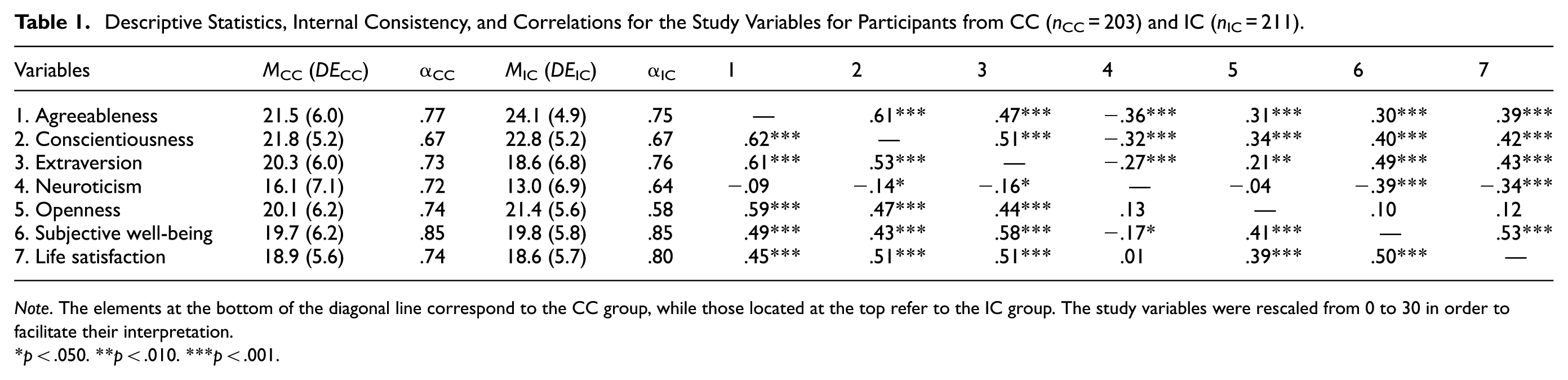
Note. The elements at the bottom of the diagonal line correspond to the CC group, while those located at the top refer to the IC group. The study variables were rescaled from 0 to 30 in order to facilitate their interpretation.
p < .050. **p < .010. ***p < .001.
The analysis of the proposed model for the CC group initially demonstrated an inadequate fit (χ2 (5) = 48.8, p < .001, CFI = 0.690, RMSEA = 0.208, SRMR = 0.089). After reading the modification indexes and evaluating the theoretical relevance of the re-specifications, a better fit to the model is obtained after establishing the relationships between conscientiousness and life satisfaction (β = .29, p < .001), and extraversion, (β = .20, p = .012), thus obtaining a good fit in the model (χ2(3) = 6.2, p = .103, CFI = 0.977, RMSEA = 0.072, SRMR = 0.027); this indicates that the cognitive component of well-being is directly impacted by both personality traits. Previous results can be seen in Figure 2, showing that research hypotheses are also confirmed, except for the relationship between conscientiousness and subjective well-being (β = .07, p = .308), in which no significant influence was found. Finally, 38% of the explained variance was also obtained for life satisfaction.

Results of the explanatory structural model of life satisfaction in the CC group. Standardized estimated parameters are shown.
As for the IC group, an inadequate fit was also obtained initially (χ2 (5) = 20.5, p < .001, CFI = 0.890, RMSEA = 0.121, SRMR = 0.071). After reviewing modification indices and confirming the theoretical relevance, a better fit to the model was obtained after establishing the relationship between conscientiousness and life satisfaction (β = .24, p = .002), thus obtaining a good fit of the model (χ2(4) = 8.8, p = .066, CFI = 0.966, RMSEA = 0.075, SRMR = 0.032), this indicates that the cognitive component of well-being is directly impacted by conscientiousness. Figure 3 presents these results, showing that the research hypotheses are also confirmed, except for the relationship between agreeableness and subjective well-being (β = −.07, p = .337), in which no significant influence was found. Finally, 34% of the explained variance for life satisfaction was also obtained.

Results of the explanatory structural model of life satisfaction in the IC group. Standardized estimated parameters are shown.
Discussion
Today, the importance of the study of subjective well-being lies in its relationship with the quality of life of individuals. Hence, research has aimed to identify factors to predict it, highlighting personality as a relevant variable given its strong and consistent associations with subjective well-being (Lucas & Diener, 2009, 2015). However, few studies make visible the role of the sociocultural context in the relationship between personality and subjective well-being; even more so in the Peruvian context. In that regard, this study’s objective was to establish the influence of personality factors over subjective well-being in Peruvian university students from two different cultural contexts.
As for the first specific hypothesis, agreeableness showed a positive influence over emotional well-being only in the group of students from CC but not in the group of students from IC. The results obtained in the first group of students are similar to those obtained in samples of participants from Serbia (Jovanović, 2019) and China (Xu et al., 2017), demonstrating that in collectivist societies, the tendency toward agreeableness promotes the establishment of positive social relationships and minimizes interpersonal conflicts, generating greater emotional well-being (Anglim et al., 2020).
Prior studies had already reported an association between collectivism and greater agreeableness (Burton et al., 2021; Diener et al., 2003), since in these societies agreeableness is well valued and protected as it is a trait that promotes and strengthens group cohesion (Markus & Kitayama, 1998; Triandis & Suh, 2002); therefore, this association demonstrates that the tendency toward agreeableness reduces interpersonal conflicts and fosters positive relationships with others, leading to greater well-being. Conversely, in individualistic societies, high scores in this trait may be associated with a greater probability of being exploited in social interactions (Fors Connolly & Johansson Sevä, 2021); since in these societies social relationships stand out for their transactional value, people who are too kind can be seen as an opportunity for the establishment of abusive relationships, in which inequality in reciprocity prevails since they are willing to give without receiving anything in return, in addition, they may present a greater willingness to give in situations of conflict. They prioritize the needs of others before their own and may have difficulties setting boundaries. All of this can lead to the development of exploitation dynamics, which could affect personal well-being. Indeed, the findings of this study are consistent with those of a recent investigation, which found that individuals from individualistic cultures perceive less emotional reward from acts of kindness compared to those from collectivistic cultures (Shin et al., 2021). Therefore, in such scenarios, the relationship between agreeableness and subjective well-being is not conclusive. This finding proves that agreeableness can lead to different types of social interaction, depending on the sociocultural context, hence the role we assign to it in our well-being and the evaluation of our lives is variable and depends on the environment in which we operate.
Regarding the second specific hypothesis, conscientiousness positively influences emotional well-being only in the group of IC, being the third most relevant trait after extraversion and neuroticism. This result reveals that in cultural contexts wherein autonomy and personal progress are promoted, conscientiousness is relevant to the achievement of personal goals and objectives, as it is linked to dedication, self-regulation, self-discipline, and being results-oriented (Markus & Kitayama, 1998; Triandis & Suh, 2002), especially in university students who are developing their professional identity (Hu et al., 2022). In turn, the aspects mentioned above may lead to the experience of pleasant emotions more frequently, and to better regulation of unpleasant feelings, thus experiencing lower levels of stress (Schimmack et al., 2008); therefore, the greater the traits of conscientiousness, the higher the emotional well-being in individualistic cultures, where self-discipline and the achievement of personal goals are more highly valued.
Furthermore, a direct effect of conscientiousness on life satisfaction was determined in both study groups, which is consistent with the results of previous studies in which this trait has a more consistent association with life satisfaction in comparison with emotional well-being (Anglim et al., 2020). In other words, this dispositional factor linked to reflective capacity has an impact on the cognitive component of well-being, beyond its impact on the emotional component, regardless of culture. This can be explained by considering that individuals who score high on the conscientiousness factor tend to set higher goals and motivation levels, actively seeking life situations that are beneficial to them, which, in turn, may result in more positive evaluations of their lives, independent of their immediate emotional well-being. According to the findings, there is evidence that life satisfaction does not always depend on emotional state (Lucas et al., 1996) and that personality traits, such as conscientiousness, can have a direct impact on the cognitive component of well-being, regardless of affective state or emotional well-being. However, the study of the relationship between conscientiousness and emotional well-being in collectivist contexts still needs to be deepened, as the findings have been inconclusive.
Regarding the third specific hypothesis, extraversion positively influences emotional well-being in both student groups. This result is consistent with the findings of prior research that suggest that extraversion is one of the traits most consistently associated with subjective well-being (Anglim et al., 2020; Etxeberria et al., 2019; Jovanović, 2019; Lucas & Diener, 2009, 2015; Steel et al., 2008; Tanksale, 2015). The classical study by Schimmack et al. (2002), which considered participants who belonged to individualistic and collectivist cultures, determined that the direct influence of extraversion over the emotional component of subjective well-being is pancultural. Similarly, multinational studies found evidence supporting the universal willingness hypothesis, as significant associations were found between extraversion and subjective well-being in the analysis carried out, both at personal and cultural levels (Cheng et al., 2016; Lynn & Steel, 2006). This finding can be explained by considering that regardless of the culture, extroverts are more sensitive to reward cues; therefore, they have a greater tendency to experience pleasant emotions (Kim et al., 2018; Lucas & Diener, 2009). Furthermore, they tend to build more positive social interactions and therefore receive environmental rewards more frequently, making them feel good, which in turn positively impacts their perception of well-being.
Additionally, based on the evaluation of modification indices, the original model was respecified, establishing a direct relationship between extraversion to life satisfaction only in the group from collectivist cultures. The results align with previous research in which the effect of personality traits on life satisfaction shows cultural variations. Specifically, in the study by Lun and Yeung (2019), it was observed that depressive mood mediated the effect of extraversion on life satisfaction only in the U.S. adult sample, but not in the Hong Kong Chinese adult sample. This suggests that in collectivist contexts, extraversion may have a direct impact on the cognitive component of well-being, without mediation from emotional well-being. This can be explained by considering the social value of extraversion in collectivist contexts, beyond its impact on affectivity and immediate emotional well-being. Indeed, in these settings, the overall evaluation of life is closely linked to the quality of social relationships and collective harmony, transcending the hedonic rewards these interactions may generate. Therefore, extraversion, as a facilitating trait for interaction with others and the formation of social networks, is more directly related to life satisfaction compared to individualistic contexts.
As for the fourth specific hypothesis, neuroticism negatively impacts emotional well-being, both in the group of students from CC and CI, although with greater predictive power in the latter. The results found are as expected since, similar to extraversion, neuroticism has shown a consistent relationship with subjective well-being (Anglim et al., 2020; Etxeberria et al., 2019; Lucas & Diener, 2009, 2015; Steel et al., 2008; Tanksale, 2015), regardless of differences in cultural contexts or the characteristics of the study samples. This relationship can be explained by the fact that neuroticism is related to the experience of chronic negative affect (Watson & Clark, 1992). Therefore, neurotic individuals are more sensitive to punishment cues (Lucas & Diener, 2009) and thus they experience unpleasant emotions more frequently and with greater intensity; all this negatively affects their well-being.
On the other hand, as shown by previous studies, the association between neuroticism and subjective well-being seems to go beyond cultural differences (Cheng et al., 2016; Ksinan et al., 2016; Lynn & Steel, 2006). Nonetheless, neuroticism was the strongest predictor of emotional well-being in IC, a result similar to Schimmack et al. (2002) and Galinha et al. (2016), and closely related to Kuppens et al. (2008), who reported that negative emotional experiences have a higher impact on the well-being of people living in IC than those in CC. This finding suggests that those from IC are more sensitive to dispositional factors affecting their hedonic balance since their well-being largely depends on the enjoyment of personal pleasure (Schimmack et al., 2002). In addition, the emphasis on self-sufficiency, high expectations about personal achievement, and the reduced availability of social support networks, characteristics of IC that are opposed to those of CC, may amplify the negative impact of neuroticism on well-being. Thus, while it is evident that the significance and direction of the influence of neuroticism on subjective well-being are configured as part of pancultural knowledge, it is also shown that the values of individualism and collectivism have a distinct impact on the degree to which neuroticism affects subjective well-being, so it is necessary to continue with the research that allows us to delve into the nuances of this differentiation.
The fifth specific hypothesis, openness to experiences, only has a positive influence over emotional well-being in the group of students from CC. These findings show that in collectivist cultures, a higher tendency to openness to experiences may lead to the search for new and pleasant situations that allow people to grow and increase their well-being, and openness is related to greater well-being, as life is perceived as a growth and transformation process (Anglim et al., 2020). Similar results were obtained from a study conducted with Chinese university students, which reported that openness to experiences promotes subjective well-being through dispositional awe (Dong & Ni, 2020). Moreover, dispositional awe is known to promote the integration of social groups, increase collective commitment, and diminish the sense of self (Bai et al., 2017). Although this variable has not been the subject of this study, it emerges as a tentative explanation for the cultural differences identified regarding the role of openness to experiences as a predictor of subjective well-being. Additionally, it is known that openness to experience promotes social flexibility and group adaptation, which are fundamental aspects for maintaining harmonious relationships, particularly relevant in collectivist environments. Therefore, greater openness may be present in individuals who better conform to social norms and can manage relationships with others more flexibly, all of which would have a positive impact on their emotional well-being.
On the other hand, in IC, openness to experience does not necessarily provide direct emotional advantages; moreover, it has more typically been associated with risky behavior that may lead to negative effects on people’s health and well-being (Rodrigues & Gopalakrishna, 2024), such as substance use or impulsive decision-making. This is more common in individualistic societies, in which there are fewer social restrictions and personal freedoms, and the search for hedonism is exalted; unlike collectivist cultures in which social control and group norms can function as deterrents to these behaviors. Overall, further research is required on the effect of the cultural factor on the relationship between this personality trait and subjective well-being.
Finally, in terms of the sixth specific hypothesis, emotional well-being positively influences life satisfaction, both in CC and IC, although the predictive power is stronger in this last group. The findings confirm that affective experience provides a source of information for evaluating one’s own life (Lucas & Diener, 2009) and that the degree to which these experiences influence life satisfaction varies according to the cultural context (Suh et al., 1998). Thus, the results found are similar to the ones reported by Suh et al. (1998) and Schimmack et al. (2002), finding that in the group of students from an individualistic culture, emotional well-being showed a stronger predictive power on life satisfaction, compared to the group that belonged to a collectivist culture. This finding proves that in the contexts in which autonomy and self-sufficiency are promoted, emotions and personal enjoyment are stronger when they assess their own lives, whereas collectivist contexts attach more value to social interactions and harmonious coexistence with the environment (Lucas & Diener, 2009). This shows that, in individualistic societies, the value of one’s life is focused on introspection and personal experiences, looking for indicators of self-actualization and experience of pleasure and positive emotions; while in collectivist societies, group achievements that reduce the direct impact of emotions on life satisfaction are also important.
In general, the findings presented are consistent with previous studies, which conclude that the predictors of subjective well-being vary across cultures; thus, personality and culture interact in a dynamic and complex way to influence how people experience well-being (Diener et al., 2003). Considering the frameworks of the distinction between collectivism and individualism of Triandis and Suh (2002) and that of the cultural construction of the self of Markus and Kitayama (1998), the findings support the idea that in cultures in which there is an interdependent conception of the self, such as CCs, the personality traits that help to shape and maintain harmonious social relations and that promote belonging and adjustment to the group (e.g., agreeableness) are more relevant for predicting people’s emotional well-being and life satisfaction. In contrast, in cultures where autonomy and independence are more valued, such as CIs, personality traits that guide the achievement of personal goals and self-actualization (e.g., conscientiousness) tend to be more related to well-being. In short, the influence of personality on well-being is not universal; since this relationship is framed in cultural contexts characterized by particular norms and values that determine which traits are considered most beneficial, how these are expressed and internalized in individual experience (Diener et al., 2003; Markus & Kitayama, 1998).
The findings of this study have important implications for the investigation of and approach to subjective well-being. First, it highlights the importance of considering the context and cultural values in the theoretical approach to subjective well-being and the analysis of its predictors. Specifically, this study provides empirical evidence that deepens the understanding of how collectivist and individualist values can shape the relationship between personality and subjective well-being in young people. Additionally, it should be remembered that the findings presented correspond to two groups of young people who come from the same country, which leads us to reflect on the need to build psychological theories contextualized not only to countries but also to regions and localities, especially in contexts as diverse as Peru; this avoids inappropriate generalizations and achieves a deeper understanding of psychological phenomena. Second, it presents useful evidence for approaching and improving well-being, based on the intervention on behavioral patterns that reflect personality traits, which could be malleable. In addition, the results presented highlight the importance of public policy managers related to mental health implementing well-being programs adapted to the values and specific needs of young people according to their sociocultural context. Thus, this study provides new insights into cultural differences and how personality traits predict subjective well-being in two groups of Peruvian students.
However, reporting some study limitations and identifying recommendations for further research is crucial. In this regard, the purposeful nature of the sampling used in this research limits the generalization of the results. However, given that the objective of this study is to analyze the differences in the impact of personality traits on the subjective well-being of Peruvian students from two different cultural groups, relatively homogeneous samples that would allow for making valid comparisons were considered. Even so, future research would benefit from the use of probabilistic sampling techniques and the selection of larger and more heterogeneous samples that take into account the particularities of Peru’s diverse cultural environments; in this way, geographic, socioeconomic, and healthcare access factors that may interact with individuals’ subjective well-being would be considered. Furthermore, whenever possible, the sample could be extended by considering groups of participants from different countries. All of this would help strengthen the consistency and external validity of the findings within a broader study framework.
Regarding the measurements used, it should be noted that some internal consistency values of the BFI-15 subscales may be considered low, particularly the alpha obtained for the Openness subscale in the group from the CC (.58). However, alpha values below .70 and close to .60 can be explained by the fact that this index is strongly influenced by the number of items in the scale, regardless of the average inter-item correlation. Since the BFI-15 subscales consist of only three items, a greater influence of random variability is expected, which affects the alpha value. Despite this, given that the Openness subscale shows higher reliability in the group from the IC, it is recommended to further explore the low consistency of the items in the collectivist group. Additionally, future research could benefit from the use of broader measures.
Another important limitation is that exclusive use was made of self-reporting surveys for data collection, which may be associated with common method biases (Podsakoff et al., 2003). Hence, further research may benefit from the use of multimethod techniques or controlled conditions that allow for gathering data with no methodological risk of bias. Additionally, given the results obtained, it would be useful to deepen the study of potential cultural biases as a result of the use of measurement instruments in collectivist contexts, such as rural environments, considering that most psychometric studies in the Peruvian context use samples limited to the capital of this country. Likewise, the invariance of the measurement between cultural groups was not evaluated for personality and well-being scales. Although this procedure is essential to ensure that constructs are evaluated equivalently, the primary objective of this study was to explore the structural relationships within each cultural group rather than to compare the latent means directly. Future studies should consider evaluating the invariance of measurement to increase the robustness of cross-cultural comparisons.
However, the cross-sectional design of this study does not allow for testing the stability of the relationships found between the study variables. Therefore, longitudinal studies would be relevant to collect evidence on the establishment of causal relationships and evaluation of the stability of the structural effects between the variables of interest. Moreover, direct relationships between certain personality traits and life satisfaction should be explored more thoroughly, as they arise as emerging relationships that may direct further research. Additionally, it is suggested to further explore the mediating mechanisms that may explain cultural differences in the impact of certain personality traits on emotional well-being and life satisfaction. For example, social flexibility, dispositional awe (Dong & Ni, 2020), or tendencies toward risk-taking behaviors (Rodrigues & Gopalakrishna, 2024) in the relationship between openness to experience and emotional well-being, or tendencies toward social exploitation (Fors Connolly & Johansson Sevä, 2021) and emotional closeness (Shin et al., 2021) in the relationship between agreeableness and emotional well-being.
In summary, the results of this study indicate that depending on the context, personality traits, with similarities and differences, influence subjective well-being. In particular, extraversion and neuroticism influence the emotional well-being of students from individualistic and collectivist cultures; however, differences in their predictive power are observed. Agreeableness and openness to experiences only have a slight impact on the well-being of the sample made up of students from CC, whereas conscientiousness turns out to be a significant predictor of well-being only in the sample of students IC. In both groups, emotional well-being positively influences life satisfaction. These findings highlight the importance of addressing psychological phenomena more inclusively and considering the diversity of sociocultural contexts.
Footnotes

Funding
The authors received no financial support for the research, authorship, and/or publication of this article.
Declaration of Conflicting Interests
The authors declared no potential conflicts of interest with respect to the research, authorship, and/or publication of this article.