




Abstract
This study intended to construct a standardized comprehensive questionnaire for assessing midlife crises in middle-aged people. There were a total of 519 middle-aged participants. For exploratory factor analysis, 252 samples were utilized, and for confirmatory factor analysis, 267 samples. An initial pool of 63 items was generated using the theoretical and conceptual insights found in the literature. Following a comprehensive EFA and CFA with good factor loadings, communalities, model fit, reliability, and validity, the number of items was ultimately lowered to 27. The final questionnaire provided a five-factor model, namely, Physical health and Changes, Identity and Self-Reflection, Emotional Distress, Relationship Evaluation, Career, Social Comparisons, and Worries about Mortality. The five factors demonstrated strong internal consistency and validity indices and are shown to be connected and interdependent. Confirmatory factor analysis further strengthened the association of latent variables. This questionnaire is a novel and effective tool that addresses several of the midlife crisis issues that middle-aged persons encounter. Researchers, psychologists, and clinicians can use this questionnaire to help recognize and measure middle-age crises to apply the necessary interventions.
Plain language summary
The paper titled “Psychometric Development of a Midlife Crisis Questionnaire: A Dual Approach Using Exploratory and Confirmatory Factor Analysis” focuses on creating and validating a questionnaire to measure the experiences and challenges associated with a midlife crisis. The study follows a two-step process: Exploratory Factor Analysis (EFA): This step identifies the key factors or themes that emerge from the data, helping to determine the main components of a midlife crisis. Confirmatory Factor Analysis (CFA): This step verifies whether the identified factors fit well with the data and ensures the reliability and validity of the questionnaire. Through this dual approach, the research aims to develop a reliable, standardized tool that can accurately assess various dimensions of a midlife crisis, such as physical health changes, emotional distress, and self-reflection. This new tool will help in better understanding and measuring the midlife crisis experience.
Keywords
Introduction
Even though the stages of childhood and teenage development have received a lot of attention, adult development has remained understudied until recent years, when psychiatrists and psychologists began to explore it more systematically. Three stages of adulthood were distinguished by David Gutmann, a psychologist at the University of Michigan: early adulthood (years 21 to 35), mature adulthood (from 35 to 60), and old age (from 60 forward; Freund & Ritter, 2009). The third quarter of an individual’s average lifespan is considered middle age, a period that falls between young adulthood and old age. Scholars often refer to midlife adults as the “pivot” generation, since they are commonly responsible for supporting generations above and below during challenging times (Fingerman et al., 2010). The concept of “midlife crisis” remains one of the most frequently cited narratives associated with this life stage.
Midlife, which typically occurs between the ages of 35 and 60, is a significant stage of life that marks a period of transformation for both men and women. This phase is often characterized by marriage, separation, divorce, remarriage, parenting, stepparenting, switching careers or employment, pursuing further education, financial strain, caring for elderly parents, and coping with an empty nest. As a result, individuals encounter substantial shifts and increasing challenges during midlife. Whether midlife is experienced as a time of growth and opportunity or one of stress and difficulty largely depends on the person’s coping resources and support systems. It is widely recognized as a time for reflection and re-evaluation of various aspects of one’s life (Coon, 2020).
Canadian psychologist Jaques coined the term “midlife crisis” in 1965 (Infurna et al., 2020). He studied the life trajectories of creative individuals, such as artists, and concluded that many experienced a decline in productivity and moral conflict during midlife. According to him, this crisis stemmed from the realization of one’s mortality and a psychological shift from thinking in terms of “time since birth” to “time left to live.”
Later models of adult development advanced the concept of a midlife crisis or midlife transition, suggesting that individuals gradually become aware of their aging and the limited time remaining in their lives (Druckerman, 2018). By the 20th century, the term “midlife crisis” became widely used to describe the feelings of discontent with one’s job, relationships, and obligations to one’s family, as well as the escalating fear of dying that began to emerge among those over the age of 40. The health risks associated with midlife are particularly significant for men, as they serve as a bridge between the younger and older generations and are given societal duties and obligations (Gething & Papalia, 1995).
According to Erikson’s theory of psychosocial development, the midlife crisis corresponds to the stage of “generativity versus stagnation” and involves their struggle to reaffirm one’s values and life direction. This phase is often triggered by a re-examination of societal expectations such as career, marriage, and personal achievements. Some people view midlife as a stage where goals are achieved and psychological growth slows, resulting in relative stability. People regard it as a psychological pause on the path to old age (Prosen et al., 1972). Middle-aged adults go through a stressful time during midlife, which is a significant time when people may go through various life upheavals (Le et al., 2019).
Review of Literature and Conceptual Background
Midlife is widely regarded as a transitional developmental phase, often marked by emotional, physical, and existential shifts. When this stage is described in the theory of psychosocial development by Erikson (1963) as a friction between generativity and stagnation, Levinson’s life structure theory (1978) highlights the magnitude of role transitions and a personal self-assessment during this period. Increasingly, modern perspectives such as Terror Management Theory (Greenberg & Arndt, 2014) and empirical data (Infurna et al., 2020) propose that midlife brings heightened awareness of mortality, career dissatisfaction, identity confusion, and relationship evaluation. These experiences differ by culture, socioeconomic status, and gender, but they tend to converge around a heightened need for reassessment and readaptation.
Studies have also associated midlife transitions with a drop in overall well-being. Blanchflower & Graham (2022) elaborated on this “midlife dip” as psychologically significant on a level with other major life events. Giuntella et al. (2023) further explained increases in sleep disturbances, suicidal ideation, and work stress during this stage, especially in developed countries. While focusing on the social support and loneliness of empty-nester parents, Cao and Lu (2021) investigated its role. Based on the studies, loneliness mediates between life satisfaction and social support regarding influencing mental health due to the intricate interaction during the midlife stages, especially once children leave their parents’ houses. Kwon and Oh (2021) further strengthened the importance of coping mechanisms and family stress, supported the mediating effect of family stress on midlife crises among South Korean middle-aged men, and their results conclude that midlife crises might get worse through the influence of family stress, but improved self-efficacy and enhancement of support systems in family life can increase good coping. King et al. (2022) investigated the transition into menopause in women living with HIV and reported that, for perimenopausal women, midlife symptoms were even more severe than expected due to psychosocial and behavioral factors. In their study, the authors advocated a biopsychosocial approach for managing midlife in women.
These findings underscore the complexity of midlife; by showing that midlife differs in cultural, gender, and context-specific ways, they often point to a common, pressing need for psychological reassessment and adjustment as part of the human experience. As acknowledged by the breadth and complexity of midlife struggles, it will be useful to develop standardized instruments that can reflect the experience of midlife holistically. This will entail a consideration of current psychometric measures developed with the intent of assessing crisis experiences in midlife.
Existing Scales That Measure Crisis
The Halpern Crisis Scale was created in 1973 to evaluate the presence of crisis episodes (Halpern, 1975). This scale made an effort to streamline the structure of the crisis. This scale has some limitations, as it is developed to measure the clinical aspects that cannot be used to measure crisis in a general scenario. The 52-item midlife crisis scale was developed by Herman and Oles in 1999 (Hermans & Oles, 1999). This scale focuses particularly on midlife but was developed only for the male population, thereby limiting its generalizability. Without adequate psychometric validation, Shek created the 15-item midlife crisis scale in 1996 (D. T. Shek, 1996). Robinson and Wright created the Crisis Definition Question (CD-Q) in 2013. It evaluates assessments of crises that are either contemporary or retrospective (Robinson et al., 2013). The Developmental Crisis Questionnaire (DCQ-12) was constructed by Petrov and Robison in 2022 (Petrov et al., 2022). Though the scale has robust psychometric properties, it measures the generic aspect of the developmental crisis, not particular to midlife. MLC-Q is particularly developed for middle-aged people to assess the crises that they undergo during midlife. Although these frameworks provide some validity to the models, none encapsulate the psychological reality of the midlife experience as a totality. The conceptual structure of the MLC-Q was therefore constructed through a combination of reviewing the literature, engaging in exploratory discussions, and arriving at five primary dimensions. The five core dimensions of the MLC-Q were derived through an in-depth review of the literature and informal interviews with middle-aged people. These domains consistently appeared across empirical studies and theoretical models, and they capture the key psychological themes central to midlife crisis.
Conceptual Foundation and Emergence of Core Dimensions
While previous tools provide partial frameworks, they do not adequately address the nuanced psychological realities of the midlife crisis. Through synthesis of the literature and conducting informal discussions with middle-aged people regarding the concerns they face, particularly at this age, five empirically supported dimensions emerged as central to midlife experience. These dimensions reflect the recurring themes of physical vulnerability, emotional unrest, shifting identities, relational strain, and existential concerns, and they form the theoretical foundation of MLC-Q.
Factor 1. Physical Changes and Health (PCandH)
The relevance of physical health and well-being in midlife is conveyed by Erik Erikson’s theory of generativity versus stagnation. Particularly during middle age, people reflect on their life choices and achievements, which revolves around the idea of identity crisis and resolution (Bretherton, 1992). Physical health and well-being are imperative during this stage since the cultivation of good physicality is important to keep the person working on salient goals and attaining fulfillment. Additionally, Čolović et al. (2020) found that structured physical activity reduces fatigue and psychological distress significantly in middle-aged populations. Contemplation of life choices and achievements may result in an increased resolve in the care of oneself to sustain generativity and not feel stuck. The dimension of physical health and changes involves the kinds of physical alterations that take place during midlife. This, for instance, is the decline of physical energy that begins to accompany most people due to the possible onset of some chronic diseases along with the experience of aging associated with anxiety. In this dimension, weight gain, loss of stamina, and early signs related to age set in. These physical changes trigger people to contemplate the time that has passed since their birth and their mortality. The influence of physical health can be very powerful during the intensity of a midlife crisis, questioning one’s self-worth and life purpose. Concerns about appearance, energy levels, and the fear of becoming physically dependent can trigger deep emotional reactions, such as frustration and depression.
Factor 2. Identity and Self-Reflection (IDandSr)
With the re-evaluation of priorities that middle-aged people undertake, many focus on personal growth and relationships that may have been peripheral. Middle adulthood coincides with the time when individuals are likely to take stock of life and their sense of self—midlife. This may lead to dissatisfaction or a need for personal development, fulfillment, and a contribution that causes incongruence with their developing purpose in life (Marcia & Josselson, 2013). It is a review of life achievements, goals, and one’s place in the world. A person might experience an identity crisis at this stage, wondering whether they have achieved their lifetime potential or fulfilled their goals in life. In this regard, finding meaning in life becomes central and leads to very deep introspection. Self-reflection during a midlife crisis might make an individual reevaluate past decisions, personal values, and life goals and result in a strong desire to reinvent oneself for some individuals (Torges et al., 2018). Confusion of roles will be common as people seek identity in their family, career, or community.
Factor 3. Emotional Distress (ED)
One significant aspect of the midlife crisis is emotional distress, such as depression or anxiety, or a sense of fear of existence for that matter. It is characterized by unhappiness and regret over lost opportunities and uncertainty of the future. According to Pruchno (2018), this factor is primarily due to a loss of vigor, not achieving economic expectations, or not being in an ideal situation in a career. Perhaps the person might be troubled with unmet life expectations, bad health, or emotional problems. This results in an increased emotional instability that tests one’s psychological comfort. Midlife emotional distress is commonly associated with unmet expectations and regret over the choices made at an earlier stage of life (Kaufman, 2017). The unresolved feelings could lead to a strong sense of regret or a feeling of being stuck in a life that doesn’t comply with what they want anymore. Emotional upheaval, such as emotions of despair, worry, and existential anxiety, often is a part of a midlife crisis. Many people suffer from old, unresolved concerns or worries of unrealized potential, often sparking crucial changes in their personal or professional lives to achieve fulfillment and a sense of control (Lachman, 2004). This may lead to fear of aging, social isolation, and emptiness.
Factor 4. Relationship Evaluation (RE)
The fourth dimension is relationship evaluation, about essential critical evaluation of the relationship with spouses, children, and close friends in midlife. This aspect reflects upon marital satisfaction, parent-child relations, and social circles. Many experience dissatisfaction in their relationships, especially about marriage in midlife, when they consider themselves considerably disconnected or unhappy with their partner. Middle-aged adults tend to reevaluate how proximity to people and the economy are balanced, wondering if their relationship intensifies their sense of identity and general well-being. As a result, there can be changes to the vitality of relationships, such as improved communication, an attempt to strengthen emotional bonds, and the realization that it is necessary to conclude unsatisfying and unhealthy relationships to improve greater authenticity and personal development (Bretherton, 1992). The empty nest syndrome, wherein children leave the home, can add to the sense of relationship loss and loneliness (Shmotkin, 2015). Then, there is the assessment of friendships and social networks, which often breeds loneliness or the desire for meaningful relationships. Stresses from these evaluations often result in an emotional rebalancing in which one will seek to find new relationships or reconnect with old ones to seek a better life, for instance.
Factor 5. Career, Social Comparisons and Worries About Mortality (MCandSc)
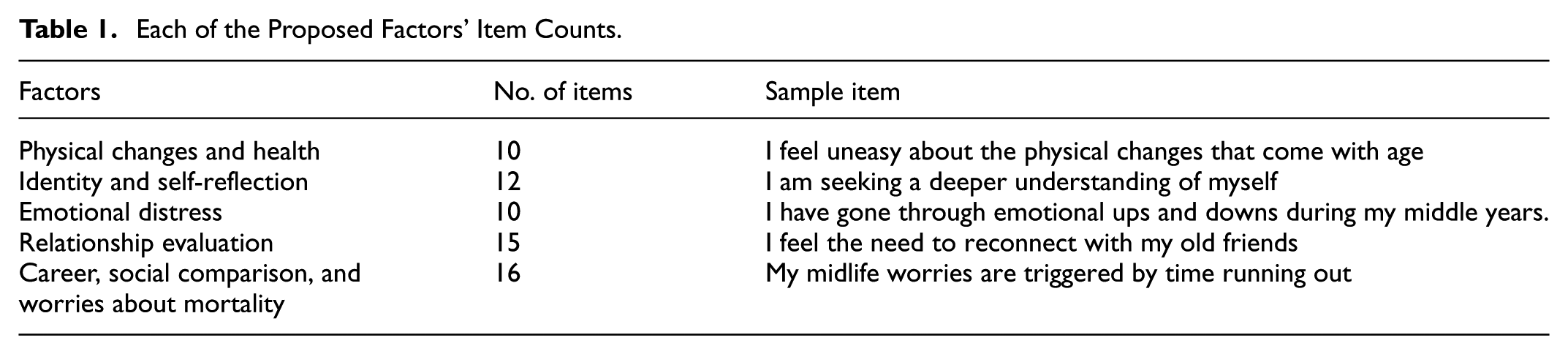
For most individuals, midlife is a time of critical assessment of career accomplishments, aspirations, and satisfaction that usually leads to self-doubt about professional development and the potential for changing careers for greater fulfillment (Sterner, 2012). Super’s Theory of Lifespan and Life-Space points out that career development is not a static process but rather includes a major middle stage in which an individual assesses his or her life accomplishments and plans. As people reflect on their careers, they inevitably begin to make social comparisons, comparing themselves to others. Social Comparison Theory posits that such comparisons may serve to bolster confidence or to create feelings of inadequacy and regret, particularly when the younger colleagues have been advancing more rapidly than one’s career (Bertrand & Lachman, 2003). This discontent with vagueness in career paths often results in existential issues that focus on death and legacy. According to Terror Management Theory by Greenberg, Pyszczynski, & Solomon, knowing one’s mortality influences emotions and behavior, thereby making people more mindful of their impact and left undone dreams (Greenberg & Arndt, 2014). As midlife goes on, an individual starts looking at the value of his life, its usefulness to society, and the time they have left toward achieving their respective goals, causing either distress or a renewed feeling of purpose toward life (Lucas, 2016). Collectively, these five domains reflect the complexity of the midlife experience and highlight the need for a holistic assessment tool. Also, these areas form the conceptual foundation for the MLC-Q. The MLC-Q addresses this need by providing a multidimensional and psychometrically reliable framework that can assess midlife transitions in a culturally appropriate manner. Table 1 lists the original number of items created under each domain and one example item from the scale construction process.
Each of the Proposed Factors’ Item Counts.
Objectives of the Study
To construct a psychometric instrument to assess midlife crisis using exploratory factor analysis and confirmatory factor analysis
To determine the reliability and validity of the midlife crisis questionnaire (MLC-Q) in a sample of middle-aged individuals.
To assess the underlying structure of the questionnaire
To compare the MLC-Q with other existing scales to determine its unique contribution to midlife crisis assessment
Method of study
Participants and Sampling
A total of 519 middle-aged respondents participated in the study. The total number of participants was divided into two groups: 252 responses were used for Exploratory Factor Analysis (EFA) and 267 for Confirmatory Factor Analysis (CFA). The age range of participants was 35 to 60 years (mean age 48.21 and SD 8.34). The inclusion criteria required participants to be within the middle age group of 35 to 60 years and cognitively capable of self-reporting. The participants’ demographic data is included in Table 2.
Demographic Details of the Participants.

Item Development and Scale Construction
Systematic approaches in the development of the items for the Midlife Crisis Questionnaire have ensured the comprehensiveness of the scale, capturing the multi-dimensional nature of midlife crises. This study involved a wide review of empirical literature on midlife crises, psychological resilience, and other related constructs. Articles indexed in Scopus, EBSCO, and Google Scholar were extensively scrutinized for the repeated patterns and themes that occurred frequently. From this literature review, the five themes that emerged were selected: (1) Physical health and change, (2) Identity and self-reflection, (3) Emotional distress, (4) Relationship evaluation, (5) Career social comparison, and worries about mortality. These were selected because these were the issues that were regularly emphasized in the literature as forming an important part of the experience of midlife. We also carried out informal interviews with 10 middle-aged persons (five male and five female) from multiple occupations and educational backgrounds regarding their lived experiences of stress and change during midlife. This allowed us to check for contextuality and cultural fit. We consulted five experts with backgrounds in psychology, psychometrics and adult mental health to enhance the preliminary items’ face validity, clarity, and relevance. Their recommendations were incorporated into the item pool, and the item pool was refined to a group of 52 items tested in our pilot study. This specific step is a common best practice in scale construction because qualitative interviews and expert judgment are key elements of content validity and contextual fit (Boateng et al., 2018; Xie & DeVellis, 1992; Haynes et al., 1995).
Procedure
Ethical Considerations
This study was approved by the Institutional Ethical Committee of the University (Reference number is mentioned in the title page) and complied with the Declaration of Helsinki. The research had a low risk, as the participation was voluntary and the participants completed a self-directed questionnaire, which did not collect sensitive or identifying information. The participants were clearly informed in the participant information sheet that they could skip questions or withdraw from the study at their convenience without penalty to reduce potential psychological or emotional harm.
The research’s possible positive outcomes—a new psychometric measure of midlife crisis development, using it in psychological screening and mental health interventions, and enhancing the understanding of midlife adjustment and well-being—were greater than the minor risks of taking part.
Written and verbal informed consent was sought prior to the study commencing. Participants were informed about the study’s aims, how confidentiality would be maintained, and their entitlements for participation, including the right to refuse or withdraw at any time. The data was collected both online and offline. For a very select few individuals who struggled with understanding some of the terms in the responses, a bilingual interpreter was provided to give additional clarification at the word level on the specific terms. The scale was delivered in English as a consistent method of academic standardization and future cross-cultural validation of the data. The interpreter was instructed not to paraphrase or translate the entire items and to provide clarification only when it was necessary. This method preserved and protected the conceptual integrity of the instrument while allowing for more inclusivity into the sample. No supplementary information was gathered from the participants’ families. A total of 519 samples were collected. The initial 252 responses were analyzed for Exploratory Factor Analysis, and 267 samples were further utilized for Confirmatory Factor Analysis. The respondents were instructed to respond on a 5-point Likert scale, which varied from strongly agree, agree, neutral, disagree, and strongly disagree. The data was put through an analysis to examine the reliability of the initial 50 respondents. The Cronbach alpha of the initial sample was .93. The first set of items was eliminated if the item’s inter-item correlation was relatively low (r < .3), if the item’s mean intensity was less than 2.5, or if fewer than 50% of the sample reported having gone through any of the major stressors that cause a midlife crisis. A cut-off value of 50% was adopted to assess the performance of items retained for the final scale that corresponded to experiences that were common and relevant for the population. That is, items with low endorsement from only a limited section of the sample typically show low variability, adding noise rather than informative data since they may not encompass central aspects of the construct being measured (Boateng et al., 2018; Xie & DeVellis, 1992). This led to the elimination of three items initially. (“I’m adapting to new physical limitations,”“I have observed changes in my physical body as I have reached middle age,” and “I’m motivated to seek novelty and adventure”). The exclusion was carried out until a satisfactory inter-item correlation was obtained among the last 30 items. The reliability (Cronbach alpha) was .921 of the last 30 items. Further, the data was collected from 252 samples for EFA and from 267 samples for CFA. EFA was carried out through IBM SPSS Version 26 (IBM Corp. released 2012), and SPSS and CFA were carried out by SPSS AMOS.
Data Analysis
The psychometric validation process involved two major statistical procedures
Exploratory Factor Analysis
It was administered to 252 subjects using PCA with Promax rotation to analyze the underlying factor structure.
In the suitability of factor analysis, we utilized Bartlett’s test of sphericity and Kaiser-Meyer-Olkin (KMO) test.
Items were retained based on factor loadings > 0.40 and conceptual relevance. Items with very high cross-loadings were reviewed and removed.
Confirmatory Factor Analysis
Confirmatory Factor Analysis was carried out using AMOS with the maximum likelihood estimation method on 267 responses, based on the factor structure obtained from the EFA.
Model fit indices were evaluated by CFI, TLI, RMSEA, and SRMR.
Items with low standardized regression weights (<0.50) or high modification indices were inspected for elimination.
Using the Games Gaskin Excel Extension, a free statistical tool package for Excel, convergent and discriminant validity were examined employing Average Variance Extracted (AVE), Maximum Shared Variance (MSV), and Composite Reliability (CR; Gaskin et al., 2018).
Reliability Analysis
Cronbach’s alpha was utilized to assess the internal consistency of the questionnaire. The threshold is set at ≥0.70, and this is acceptable. Item discrimination was assessed using item-total correlations.
Results
Item Discrimination
The measures of the item discrimination index have been determined using correlational approaches. In these circumstances, every item is associated with the overall score’s internal criterion. This is known as the item-total correlation (Singh, 2022). The validity index shows how much an item discriminates between test takers who have significant differences in the function that the test measures overall. Most specialists believe that item-total score correlation is the most accurate discrimination index. It is preferable if at least 75% of the correlation is positive and ideally over .15 when choosing the items based on item-total correlations (Singh, 2022). In this questionnaire, the item-total correlation was computed to find out the item discrimination. There was only a single item that showed a negative correlation. In the first draft, three items (two items with very weak correlation and one item with negative correlation) were removed. In the second draft, four more items were removed, and the analysis was carried out till the researchers obtained a set of items that had a good correlation. The final draft contained a total number of 30 items. Through confirmatory factor analysis, three more items were deleted, and the final questionnaire contained 27 items that measured midlife crisis symptoms. Table 3 given below depicts the correlation of items.
Correlation of the Items.

Exploratory Factor Analysis (EFA) Findings
Exploratory factor analysis (EFA) is an exploratory method, as the name implies, in which the researcher has no preconceived notions regarding the kind or quantity of variables. In other words, many latent constructs, which are frequently represented by a collection of objects, can be explored to produce a theory or model (Baker, 1963; Henson & Roberts, 2006; Swisher et al., 2004; Thompson, 2004; Williams et al., 2010). The next phase in the psychometric validation process is exploratory factor analysis, which identifies the items’ underlying factor structure (Clark & Watson, 1995). 30 items remained after item-total correlation in data set 1 (n = 252). Bartlett’s test of sphericity was implemented to assess if the data was appropriate for factor analysis. The suitability of the respondent data for factor analysis should be evaluated using several tests before the factors are extracted. Bartlett’s Test of Sphericity (Kaiser & Rice, 1974) and the Kaiser-Meyer-Olkin (KMO; Kaiser, 1970). The KMO index has a range of 0 to 1, with a value of 0.50 being the minimum appropriate for factor analysis. To be appropriate, factor analysis requires a substantial (p < .05) Bartlett’s Test of Sphericity. (Bartlett, 1950). The Kaiser-Meyer-Olkin (KMO) value was 0.872, and Bartlett’s test of sphericity was found to be highly significant (p < .005), meeting the requirements to do factor analysis of the matrix (Tabachnick & Fidell, 2011). To understand the unique variance of each time, a principal component analysis was computed. PCA was followed by ProMax rotation, which is a type of orthogonal rotation performed for uncorrelated factors (Jackson, 2005). The first EFA was run with no fixed number of factors. A total of six factors were extracted in the scree plot and explained 63% of the variance, but we observed numerous cross-loadings in the rotation. Again, we run the EFA with five forced factors. The eigenvalues of the first five values explained a total of 59.7% of the variance, and there were two cross-loadings observed (on Q15 and Q25). Removing Q15 and Q25 affected the internal consistency slightly and made many more items cross-load, which is an indication of the fact that these items have been contributing positively to the total reliability of the questionnaire. That is, such removal could change the factor structure, thus having a lot of importance in appropriately evaluating the retaining of items at the questionnaire-development stage. Given their theoretical importance and acceptable loadings, both were retained in their respective factors to keep the integrity of the questionnaire structure. Also, we decided to keep five factors that are backed up by the literature additionally. The eigenvalues of each factor were 9.007, 2.545, 1.729, 1.469, and 1.264. The scree plot is displayed in Figure 1. The rotated pattern matrix and the communalities of the previous 27 items are displayed in Table 4.

Scree plot.
Factor Loadings and Communalities.

Note. Extraction Method: Principal Component Analysis. Rotation Method: Promax with Kaiser Normalization (Rotation converged in 10 iterations). Dimensions; RE = Relationship Evaluation; MCandSc = Mortality Career and Social comparison; IDandSc = IDentity and Self Reflection; ED = Emotional Distress; PCandH = Physical Changes and Health.
There are no strict rules for the minimum number of items to be kept per factor. But commonly at least two to three items are kept for each factor depending upon its reliability and predictability (MacCallum et al., 1999). The reliability of the retained items of the questionnaire was found to be good (0.921).
Confirmatory Factor Analysis
To determine the structural variance, a confirmatory factor analysis was performed on a different data set (n = 267). CFA is a measuring model that outlines how the observed measurements relate to the theoretical conceptions that underlie them. In contrast to EFA, CFA is theory-driven and aims to establish whether a predefined factor model, which is defined according to theory, can suitably fit a set of observed data. In other words, CFA assesses whether, as previously expected, the variances in the observed variables are determined by a predefined set of factors (i.e., determined by a theory in an a priori manner; D. T. L. Shek & Yu, 2014). In this method, CFA was carried out using the Amos extension of SPSS version 26. Analysis of moment structures (AMOS) adopts a general method of data analysis called causal modeling, analysis of linear structural relations, or analysis of covariance structure structural equation modeling (Wu et al., 2014). One of the four estimating criteria is available in AMOS. For this CFA, the researchers used the maximum likelihood. Analysis was done after closely verifying that the names of the observed variables corresponded with those in the data set.
Model Fit Assessment
Many fit indices have been devised to assess how well a model fits or deviates from an ideal fit. These indices, which measure the discrepancy between the real covariance matrix of the observed data (S) and the covariance matrix predicted by the model, are mostly error-focused. The Standardized Root Mean Square Residual (SRMR) and the Root Mean Square Error of Approximation (RMSEA) are the two often utilized metrics of this type. The global chi-square test’s “exact fit” null hypothesis is replaced with a hypothesis of an approximate or “close” fit using the RMSEA (Steiger, 1998), which calculates the error of the approximate fit.
The ideal RMSEA value typically falls close to 0, indicating a very good fit between the model and the observed data. However, depending on the situation and the study being done, opinions about what makes an “ideal” RMSEA score can change. Although researchers frequently consider other parameters like sample size and model complexity when evaluating model fit, in general, lower RMSEA values suggest better fit. (Browne & Cudeck, 1992) Because it measures the mean squared differences between each bivariate empirical correlation and its corresponding model-implied counterpart, the SRMR is also a “badness of fit” metric (Hu & Bentler, 1998). Higher SRMR values indicate a worse model fit, whereas zero is the greatest possible result, signifying a flawless reproduction of the empirical correlation matrix. Besides the measures of model misfit, the goodness-of-fit measures for example the Goodness of Fit Index (GFI; Jöreskog & Sörbom, 2013), the Normal Fit Index (NFI; Bentler & Bonett, 1980), the non-NFI that is also known as the Tucker-Lewis Index (TLI; Tucker & Lewis, 1973), or the Comparative Fit Index (CFI; Bentler, 1990) exist. For these indices, a model comparison between the proposed model and a baseline model is conducted. A good model fit is typically indicated by CFI values above 0.90, with values closer to 1.00 indicating an even better fit. The recommended values are from the guidelines of Hu and Bentler (1998) and Browne and Cudeck (1992).
In the first step, the data was assessed for any missing values and to make sure that it met the parametric assumptions. A CFA was run on the covariance matrix using the maximum likelihood method. A 30-item model showed poor model fit and indices; we removed three items (Q9, Q13, Q20) with standardized regression (<0.05). Further, we created covariances among the error terms within the same construct, which showed a better model fit. Although CFI and TLI fell below the recommended threshold of 0.95 (Brown, 2006), the model was retained due to theoretical justification and acceptable factor loadings. Future studies may explore modifications to improve fit.
Path Diagram of the Model
Figure 2 represents the path diagram of the hypothesized model. All five latent variables (in ovals) and the observed variables showed logical interrelationships.

Path diagram of the revised model.
Scale Reliability
According to Cronbach’s alpha, each construct’s reliabilities ranged from good to high. In particular, each factor’s Cronbach alpha varied between .68 and .84, and the whole questionnaire’s evaluated reliability was .921. The composite reliability of all the factors was found to be high, and it ranged from .787 to .873. The composite reliability and construct validity were calculated through the free statistical tool package containing James Gaskin Excel (Gaskin et al., 2018). The overall reliability of the factors are shown in Table 5.
Reliability of the Factors.

Note. Model Fit Indices of the Revised Model: χ2 = 846.22, df = 276, χ2/df = 3.066, RMSEA = 0.090, RMR = 0.066, GFI = 0.814, CFI = 0.80.
Convergent and Discriminant Validity
According to convergent validity, each component’s average variance explained should be greater than 0.50 (Fornell & Larcker, 1981). The revised 27-item model shows a better fit with good factor loadings (above 0.50) and good AVE, which shows good convergent validity. The AVE of two factors (relationship evaluation, identity, and self-reflection) is found to be borderline, almost near 5, but considering its composite reliability and Cronbach alpha reliability, the factor is retained and kept for the final version. Malhotra and Dash (2011) claim that the AVE is a conservative indicator of the scale’s convergent validity and that the concept can be adequately explained by the CR 0.70 value. Hence, though the AVE of one construct was a little less than the required values, it was considered acceptable due to the conservative nature of AVE. Table 6 depicts the convergent and discriminant validity of the factors.
Convergent and Discriminant Validity.

Note. RE = relationship evaluation; PCandH = physical health and changes; IDandSR = identity and self reflection; ED = emotional distress; MCandSC = mortality, career, and social comparison; AVE = average variance explained; MSV = maximum shared variance; MaxR(H) = maximum reliability high.
The inter-factor correlation is represented by other values in James Gaskin’s Excel extension, whereas the values in the diagonal bold numbers represent the square root of AVE. The table shows that the diagonal bold values meet the requirement that they be greater than the other values in the corresponding rows and columns. We can therefore conclude that the discriminant validity of our variables is good. First, the AVE of each factor was examined in order to evaluate the discriminant validity. If the square root of each factor’s AVE is greater than the inter-factor correlations, discriminant validity has been attained. Each factor’s discriminant validity is shown in Table 7.
Discriminant Validity of Each Factor.
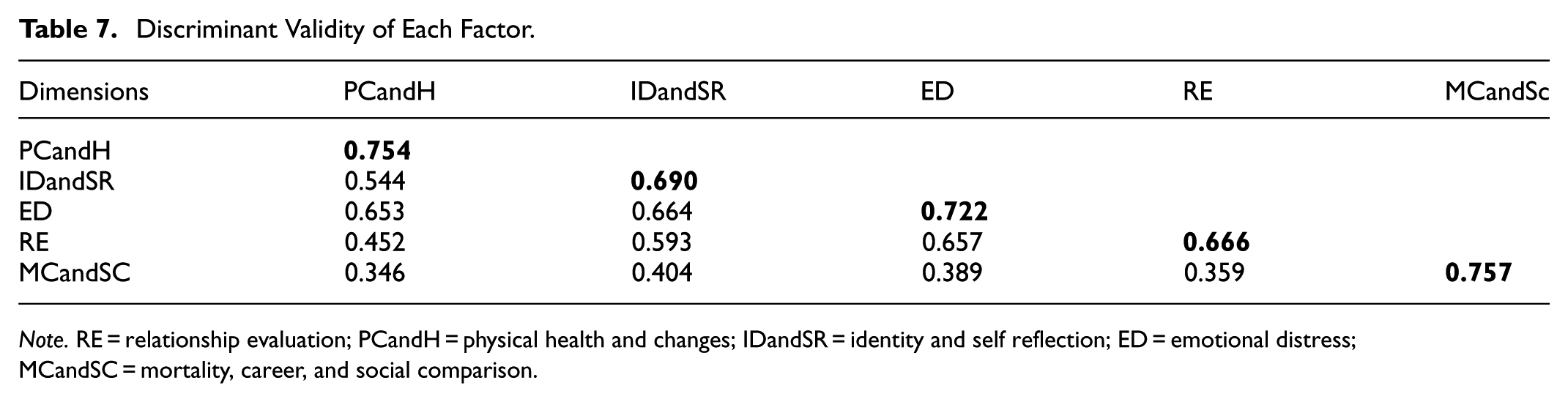
Note. RE = relationship evaluation; PCandH = physical health and changes; IDandSR = identity and self reflection; ED = emotional distress; MCandSC = mortality, career, and social comparison.
Reliability and Validity
Cronbach’s α for total questionnaire = .921
Composite reliability for factors ranged from 0.787 to 0.873.
AVE values were acceptable (≥0.50), except for two factors (borderline).
Discriminant validity was supported, as AVE values exceeded inter-factor correlations.
Discussion
The MLC-Q is a validated, multi-dimensional tool that extends the application of midlife crisis assessment. Unlike previously developed scales, it combines culturally specific stressors such as extended family financial responsibilities and stigma in middle age with career transitions. Development and validation of MLC-Q is one of the important steps to systematically study midlife crises, which, as a multifaceted phenomenon, are understood. The five-factor structure found here within the concepts of physical health and changes, identity and self-reflection, emotional distress, relationship evaluation, career, social comparison, and worries about mortality are in line with long- and well-established theories in psychology as well as with empirics. The study supports Erikson’s generativity versus stagnation theory (1963), which says that this is the middle phase as a reflective stage in terms of achievements in life, identity, and what lies ahead. The results also concur with Levinson’s (1978) life structure model, wherein middle age is the transition period when the era of reckoning assesses the career, relationship, and perceived self, with redefining priorities often evident. This perspective explains midlife crises in terms of an interaction between biological factors, such as aging, menopause, and health problems; psychological factors, including existential anxiety and emotional distress; and social factors, such as family responsibilities and financial stress. The five factors identified in this paper show that midlife crises are not just psychological battles but also signify physical changes, shifts in social roles, and existential concerns.
The psychometric evaluation of MLC-Q yielded high internal consistency and reliability, as indicated by Cronbach’s alpha of the total questionnaire being at .921, while good reliability existed across all the individual factors. However, even though most model fit indices fell within acceptable ranges, CFI (.80) and RMSEA (.09) did not attain the more rigorous cutoffs used by Brown in 2006. Although the RMSEA was 0.09 and CFI was 0.80, which falls outside conventional cutoffs (Brown, 2006), it is controversial to strictly use such cutoffs. Marsh et al. (2004) recommended against overgeneralizing fit indices, stating that model evaluation needs to consider theoretical soundness, sample size, and complexity. Hu and Bentler (1998) also noted the limitations of strict cutoffs. Considering the model’s theoretical relevance and interpretability, these fit values are acceptable for exploratory research. At present, the available scales—the Midlife Crisis Scale by Hermans and Oles in 1999 and the Midlife Crisis Questionnaire by Shek in 1996—are limited in psychometric validation, cultural adaptability, and comprehensive domain coverage. The MLC-Q fills in the gaps and offers a more comprehensive, empirically driven assessment instrument for researchers and clinicians. It appears that the theoretical model is generally supported; however, some refinement may include modifications to the item wording, enhancements to factor loadings, or even explorations of alternative factor structures as fitting the model more closely. Even with these statistical limitations, the scale is a worthwhile tool for the assessment of midlife crises in the middle-aged and is especially helpful given the relative lack of standardized psychometric tools for this age group. Strong reliability (Cronbach’s α = .921) and a robust five-factor structure assure cross-cultural applicability, rendering it very valuable for research, clinical practice, and workplace well-being programs.
Limitations
Despite the strengths of this study, some limitations must be mentioned. The first is that the sample came from a certain population; thus, the findings may not be immediately generalized to any culture. However, after further cross-cultural validation, the scale can be used in other cultural contexts. In the future, more diversity should be achieved in cultural background, gender, and socioeconomic status in the sample population so that the questionnaire could be broadly applicable. Self-report data could have introduced social desirability and recall biases into the study. Midlife crises are subjective, and therefore the crisis symptoms are over- or under-reported according to an individual’s emotional state or expectations in society. Although the five-factor model is grounded conceptually, some of the model fit indices, namely, CFI and RMSEA, suggest areas of improvement. This implies further item modifications, reassessment of factor structures, or integration of higher-order factor analysis. A different limitation of the study was the use of an interpreter to enable the participation of those with language barriers. Although the interpreter only explained terms that were not understood without changing the meaning of the items, the use of an interpreter itself presented the possibility of subtle differences in their understanding or participants’ construction of their responses, allowing for possible subtle variations in which the participants understood certain items in ways that could have also possibly impacted the pacing of data collection (Maneesriwongul & Dixon, 2004). Although English was the intended language adopted for midway pragmatic reasons and potential for cross-cultural use and standardization, the use of a non-systematic translation remains a methodological limitation worthy of note. The study was cross-sectional in design, which made it challenging to assess how symptoms of midlife crisis change over time. Longitudinal research is needed to track midlife crisis trajectories and determine whether individuals experience temporary distress, recurrent crises, or long-term psychological shifts.
Conclusion and Recommendations
Several future research directions are indicated to enhance the robustness of the MLC-Q and deepen the understanding of midlife crises. First, cross-cultural validation is necessary to test whether the five-factor structure holds across different populations. Since midlife crises may be influenced by cultural expectations, religious beliefs, and social norms, comparative studies can identify culturally specific manifestations versus universal experiences. Longitudinal studies should therefore be conducted over time to watch how symptoms evolve. In doing so, for instance, observers can track groups of people throughout several years with the aim of understanding the specific triggers, period, and potential resolution of crises and whether experiences such as transitioning careers, sending children off, or health crises predict more significant crisis experiences.
Alternative measurement models, such as bifactor or hierarchical structures, should then be tested to see whether a more refined model would result in an improvement of statistical fit as well as maintaining theoretical coherence. This will distinguish the core crisis symptoms from situational stressors. Integrating qualitative research methods, for example, in-depth interviews and narrative analysis, could provide deeper insights into the lived experiences of midlife crises. Where quantifiable measures would bring standardization, qualitative methods capture the emotional depth, coping strategies, and personal transformation, which might not be expressed well through the response in the survey.
The practical application of MLC-Q needs to be pursued for clinical and counseling use. The association of midlife crises with mental health issues such as depression, anxiety, and identity crises makes this questionnaire a potentially useful screening instrument for early intervention. Mental health practitioners can involve the MLC-Q in a therapy session, life coaching session, or workplace well-being program to accompany those experiencing professional transitions, conjugal problems, or existential discomfort. The MLC-Q may also be utilized in workplace psychology, in which the organization aims at finding employees with potential burnout or career-satisfied employees. In this respect, the blending of academic and applied research places MLC-Q in a prime position for middle-aged well-being. Though there are limitations, the MLC-Q fills in the gap that has been existing in the literature with a more comprehensive and multi-dimensional assessment tool. Future research based on the recommendations above will further tighten up, validate, and apply the questionnaire, thus ensuring that those facing midlife challenges receive appropriate support, interventions, and a better understanding of their transitions.
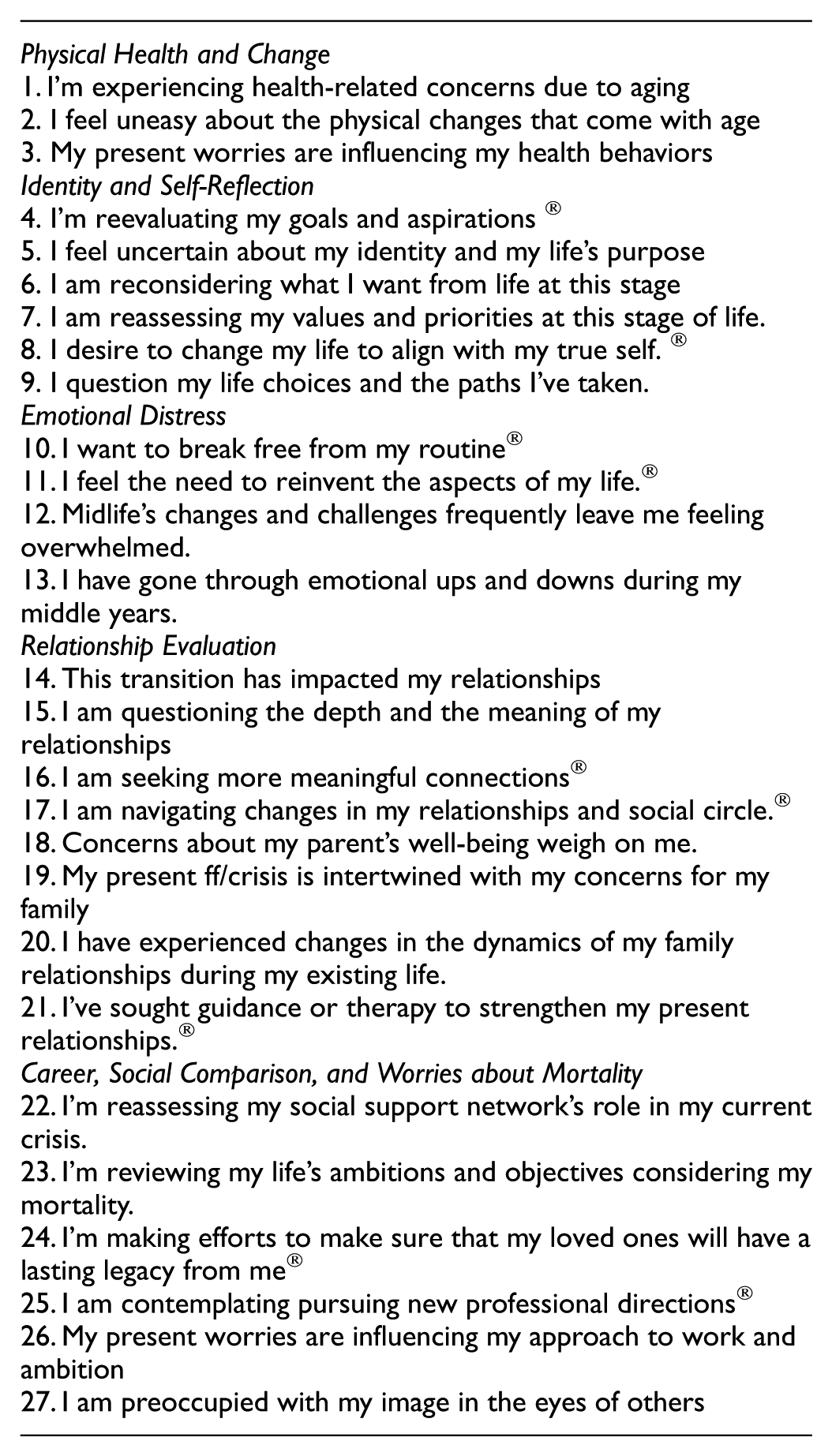
Midlife Crisis Questionnaire (MLC-Q )
Norms
Z-score norms have been developed for the interpretation of the raw scores. Z-score norms refer to the standard deviation units that are used to define the range of scores that fall within a specific range. These norms provide a standardized way to compare an individual score to the average score of a group or population. Generally, a z-score of less than −1.96 or greater than 1.96 is statistically significant, indicating that the individual’s score is significantly different from the group’s mean. Norms for the interpretation of the level of midlife crisis have been given below in Tables 8 and 9 shows total score and the Z score.
Descriptive Statistics of the Midlife Crisis Scale.

Total Score and the Z Score.

Administration
The scale can be administered by the examiner. It may be used in individual conditions. Though there is no time limit, ordinarily it can be completed within 5 to 10 min. Responses to the items are in terms of Likert scale choices: strongly agree, agree, neutral, disagree, and strongly disagree, respectively.
Instructions
Any administrator can use this scale to assess an individual’s midlife crisis level. The responses are to be taken by marking any one choice out of five choices. There are some items with reverse scoring. The items need to be scored as given in Table 10. Responses of the item and the scoring key are given in Table 11 and Table 12 respectively.
Interpretation of the Scores.

Responses of Items.

Scoring Key.

Footnotes

Ethical Considerations
The Institutional Ethical Committee of Lovely Professional University, India (Ref: LPU/IEC-LPU/2024/3/1) approved this study and it was conducted in accordance with the ethical principles of the Declaration of Helsinki. The participants were middle-aged adults who completed voluntarily a self-reported questionnaire regarding experiences related to midlife psychological distress. Approximately the declaration, participants were appropriately informed both verbally and in writing regarding all aspects of the research including the objectives, methods, potential risks and their rights, including the right to refuse participation as well as the right to withdraw from the study at any time without consequence. To mitigate possible psychological or emotional risk, the participants were also made aware that they could skip any question that they found uncomfortable. Participants are never asked for personal identifiers during participation and all responses are anonymous and strictly confidential. The benefits expected from the research, such as contributing to the development of a new psychometric measure of midlife crisis, informing mental health services related to the midlife crisis and contributing to future research, are believed to outweigh the limited risk involved in the research.
Consent to Participate
Written consent was received from all participants prior to data collection.
Author Contributions
Geemol John: Conceptualization; Data Drafting; Data Collection; Initial Data Analysis. Mohammad Amin Wani: Supervision; Ethical Approval and Permission; Data Analysis; Final Drafting; Overall Guidance.
Funding
The authors received no financial support for the research, authorship, and/or publication of this article.
Declaration of Conflicting Interests
The authors declared no potential conflicts of interest with respect to the research, authorship, and/or publication of this article.
Data Availability Statement
There are associated data with the article and can be made available upon requirement.