




Abstract
The digital transformation of banks has recently attracted significant interest from both academia and practice. However, despite the proliferation of relevant academic and non-academic literature, there is no validated scale to measure the level of digital transformation of rural banks (DTORB). This study attempts to fill this gap using a mixed-method approach. First, we used transcribed interviews with 45 rural banking experts and an extensive literature review to construct initial items for the DTORB scale. Then, the initial scale was quantitatively validated using questionnaire data collected from 685 Chinese rural bank managers. The results of the study provide a scale consisting of 18 items conceptualized into five factors: digital technology, digital products, digital strategy, digital inputs, and digital cooperation. The scale was validated by exploratory factor analysis and validation factor analysis. This research suggests three policy implications. First, government departments should formulate and improve policies to support the digital transformation of rural banks. Second, the government should emphasize the construction of digital ecology in rural areas. Third, government departments should actively promote the construction of public technology service platforms. This study provides a theoretical foundation for subsequent in-depth research on digital transformation in rural banks, as well as important insights for rural bank owners and managers.
Plain language summary
Based on the definition of the concept of digital transformation of rural banks, this study develops and validates the Digital Transformation of Rural Banks scale to understand how to effectively implement digital transformation in the operation of rural banks. This research used a mixed-methods approach in which interviews with rural bank managers and an extensive literature review helped researchers develop items for the constructs of the DTORB. The proposed scale was then empirically validated by collecting data from rural banks. Eighteen items were classified into five dimensions of the DTORB: digital technology, digital product, digital strategy, digital input, and digital collaboration. The results were supported by reliability, exploratory factor analysis, convergent validity, and discriminant validity. This study provides a theoretical basis for research in the field of digital transformation of banks and can also help rural bank managers to better understand the practical implications of digital transformation of rural banks.
Introduction
Against the backdrop of a new round of technological revolution and industrial digitalization changes, financial technology has become one of the most important directions for future global financial development. Rural banks have played an important role in better creating specialty financial products to help agriculture, small and micro enterprises, and the local economy. However, their traditional regional and interpersonal advantages are gradually weakened by networked and data-based services, and their development model is out of touch with the platform model and contactless services in the era of digital economy. In the face of the demand for “non-contact” financial services and digital operation requirements, it is particularly urgent for rural banks to enhance their digital capabilities and pace of digital transformation, and to consolidate their traditional advantages by means of science and technology (Y. Zhu & Jin, 2023).
Scholars have explored the frameworks, barriers and influences on digital transformation in banks. Sia et al. (2021) summarize a framework based on DBS Bank’s digital transformation, emphasizing that digitally transformed organizations must incorporate the duality of development and discovery, and the convergence between business and technology, into their organizational design. Diener and Špaček (2021) found that the main barriers to digital transformation in banks come from strategy and management, technology and regulation, customers and employees, while other barriers are distributed in the areas of market knowledge and products, employee and customer engagement, and public interest. J. F. Rodrigues et al. (2020) found that customers, socio-economic and human factors, technological factors, profitability, and risk and security determine the level of digitization of banks. Boufounou et al. (2022) found that customers’ gender, age, education level and the development of epidemics affect the expansion of digital banking. A. R. D. Rodrigues et al. (2022) combined cognitive mapping and the decision-making trial and evaluation laboratory (DEMATEL) method to develop a decision support model to illustrate how to incorporate AI, digitization and cybersecurity into the banking industry. Using data from China’s A-share listed banks from 2011 to 2021, Y. Zhu (2023) finds that fintech can facilitate banks’ digital transformation. Others have examined the impact of digital transformation on banks’ ESG (Y. Zhu & Jin, 2023), performance (Do et al., 2022; Nguyen-Thi-Huong et al., 2023) and stability (Khattak et al., 2023). In summary, existing research has addressed the issue of digital transformation in commercial banks extensively and insightfully, but there is a lack of research addressing the issue of digital transformation of rural banks (DTORB), and no scale has been developed to measure DTORB. Notably, the market positioning of rural banks, which is rooted in counties and serves the public, determines that the goals, modes, and paths of their digital transformation are different from those of large commercial banks. Therefore, developing a scale that can measure the DTORB is an issue that deserves in-depth research.
Since the role of digital transformation of rural banks has become very important for the sustainable development of rural banks and there are limitations of previous studies in measuring digital transformation of rural banks, this research aims to develop DTORB scale by identifying the key factors of digital transformation of rural banks. In terms of research methodology, we used a mixed method of quantitative and qualitative research. In the qualitative approach, literature review and in-depth interviews have helped the author clarify the five factors of DTORB, which led to the development of the scale. In the quantitative method, exploratory and confirmatory factor analysis were conducted on the scale according to Hinkin’s (1998) guidelines. Specifically, this paper answers the following two research questions:
RQ1. What are the dimensions encompassed by digital transformation in rural banks?
RQ2. How to assess digital transformation in rural banks?
This study contributes to the existing literature in three ways. First, it defines the concept of DTORB and improves the theory of rural finance. Previous studies lacked a clear definition of the concept of digital transformation of banks (Dong et al., 2021; Zheng et al., 2023). This study defines the concept of DTORB based on combining the attributes of rural banks with the characteristics of digital transformation of banks. Second, a comprehensive scale was developed to measure DTORB. To ensure methodological rigor, Hinkin’s (1998) widely accepted scale development procedure was followed. The constructed scale passed the reliability and validity tests and provides a valuable tool for evaluating the level of digital transformation in rural banks and related subsequent research. Third, the policy implications of this study can provide operations and insights for the digital transformation of rural banks in developing countries.
The rest of the paper is divided into five sections. The second part is the literature review, including definition of digital transformation, definition of DTORB, and measurement of DTORB. The third part describes the research methodology used to develop the scale, including the research design, data collection methods, qualitative data analysis, instrument development and questionnaire administration. Part four gives the data analysis and results. The fifth part is a discussion of the results. Part six includes conclusions, theoretical and practical implications, limitations and directions for future research.
Review of Literature
Definition of Digital Transformation
Digitalization is becoming the main driving force for enterprises to implement transformation and innovation (Xue et al., 2022). Research on the concept of digital transformation is relatively abundant in the fields of enterprise management, industrial research, and government governance, and the connotation of digital transformation is perceived differently in different fields. In the field of business management research, digital transformation refers to the process of improving enterprise value creation by combining the use of digital technologies to change various aspects of economic activities such as R&D design, manufacturing, and organization of the enterprise. The key elements of digital transformation include digital technology, information carriers, digital resource operations, and management capabilities (Luo, 2022; Verhoef et al., 2021; Warner & Wäger, 2019). Ebert and Duarte (2018) consider digital transformation as the adoption of disruptive technologies by firms to improve productivity, value creation and social welfare, and as a source of entrepreneurship and business dynamism. Wessel et al. (2021) argue that there is a clear difference between digital transformation and IT-enabled organizational transformation, where digital transformation refers to the use of digital technologies to redefine an organization’s value proposition, whereas IT-enabled organizational transformation is simply the use of digital technologies to support an organization’s original value proposition. Peng and Tao (2022) understand digital transformation as “enterprise plus technology plus data” and is characterized by model innovation, value creation, and new economic forms. In the field of industrial research, digital transformation is considered as the process of digital transformation of all elements of the industrial chain with digital technology (Llopis-Albert et al., 2021). In the field of government studies, digital transformation is seen as a means to embed digital technologies in the government hierarchy to drive governance structure reengineering, business process reengineering, and service delivery changes (Mergel et al., 2019). What the above studies have in common is that scholars agree that digital transformation is a process of reengineering the overall processes of an organization, with the application of technology as a core means. More comprehensively, Vial (2019) foregrounds digital transformation as a process in which digital technologies create disruptions that trigger strategic responses from organizations that seek to change their value-creation paths while managing the structural changes and organizational barriers that affect the positive and negative outcomes of this process.
Definition of DTORB
There are few existing studies that address the definition of DTORB. By analyzing the current situation and gaps, problems and challenges of rural banks’ digital transformation, T. H. Zhu and Zhang (2021) proposed specific strategic frameworks and paths, tactical solutions and countermeasures for DTORB, but did not define the concept of DTORB. Banks have been at the forefront of science and technology application practice (Campanella et al., 2017), so their digital transformation does not lose its generality and has its own characteristics. The five major digital technologies that are currently widely used in the banking industry are big data, blockchain, artificial intelligence, cloud computing, and biometrics, and their transformation areas include all the changes in corporate strategy, business model, operational alignment, and organizational structure triggered by the combination of technologies (Hanelt et al., 2021). The digital transformation of rural banks is an important trend in the context of the continued slowdown in economic growth and the decline in business of large commercial banks. Therefore, the goal of their transformation is to build production relationships that match digital productivity and innovate differentiated products with the characteristics of local county economies.
Combined with the previous literature review on the definition of digital transformation, this study defines digital transformation of rural banks as the process of improving the value creation model by establishing digital production relationships in line with digital productivity and innovating service products for different customer segments and businesses through strategic transformation, external cooperation, talent supplementation, organizational innovation, technological improvement, and data utilization with the help of digital technologies such as big data, cloud computing, artificial intelligence, blockchain, and biometrics.
Measurement of DTORB
Digitalization is a systematic and comprehensive process, and it is extremely difficult to accurately measure digitalization at the micro-organizational level. In recent years, a number of studies have used quantitative statistical methods to measure the digital transformation of commercial banks. Some scholars used Python technology to obtain the frequency of keywords related to DT in the annual reports of commercial banks to measure the level of DT (Jiang et al., 2023; Zhai et al., 2023). Xie and Wang (2023) measured the digital transformation of Chinese commercial banks in terms of three dimensions: strategic digitization, operational digitization and management digitization. Specifically, strategic digitization focuses on the degree of attention to digital technology at the overall strategic level of the bank. Business digitization focuses on the extent to which banks are applying digital technologies to financial services. Managing digitalization focuses on the extent to which banks are integrating digital technologies into their governance structures and organizational management. Y. Zhu (2023) uses the number of monthly active users of mobile banking as a proxy variable for banks’ digital transformation. Some scholars measured the level of DTORB. Zheng et al. (2023) construct digital transformation indicators for rural credit unions in five areas: input, organization, business, office digitization, and business collaboration. Dong et al. (2021) used three indicators to measure the level of digital transformation of rural commercial banks, namely the proportion of online wealth management business, the proportion of online payment business, and the proportion of online remittance business.
Financial technology (fintech) is an important factor influencing the digital transformation of commercial banks, and the research results on measuring the level of financial technology application in commercial banks can provide a theoretical basis for the development of DTORB. Specifically, Guo et al. (2022) construct the bank’s fintech adoption index through textual analysis of the bank’s annual report; Li and Jiang (2021) construct the bank’s fintech level indicator system from the perspective of business products, including channel coverage, product usage and business support; Xu et al. (2021) construct the external cooperation indicator of fintech at the individual bank level based on the cooperation between commercial banks and external institutions; Wang et al. (2022) measure the level of financial science and technology investment in commercial banks in terms of personnel input and technology investment. The above scholars’ studies from the perspectives of strategy, product, cooperation, technology, and input provide a solid theoretical foundation for the development of a digital transformation scale for rural banks in this study.
The literature review shows that RBODT can be described as a system of five components, namely digital technology, digital product, digital strategy, digital input, and digital cooperation. Rural banks are weak in fintech due to their small asset size, few technical talents, limited R&D funds and weak fintech power, so the innovation and development of fintech products require collaboration with third parties such as fintech companies (Zhang et al., 2022). The investment of funds and talents for digital transformation is a prerequisite for the digital transformation of rural banks (Mazurchenko et al., 2022), the development and use of digital products is the foundation, and the deep integration of digital technology and finance is the core (A. R. D. Rodrigues et al., 2022). However, digital transformation is not a simple addition of technology use, product development, external cooperation, and human capital investment, but also requires systematic thinking to make the digital transformation of each department reach an effective interface (Peruzzini et al., 2020), and therefore needs to develop a digital transformation strategy (Kutnjak, 2021).
Since the main goal of this study was to develop and validate a scale for the DTORB, the following sections explain the steps taken to achieve this goal.
Research Methodology
Research Design
The traditional Delphi method only applies items from existing studies to the development of a new scale, which has some drawbacks in developing a new scale that is detailed and generalizable (J. Lee & Kim, 2022). When using the Delphi method only, there must be a continuous intervention of subjective expert judgement criteria, which in some cases is not consistent with the direction of the researcher’s study (Hirschhorn, 2019). In this context, this study utilized a mixed-methods technique combining quantitative and qualitative research (Yu et al., 2022). Mixed methods can compensate for the shortcomings when quantitative or qualitative methods are used alone, thus making the developed scales more scientific (McKim, 2017). Through an initial literature review and interviews with rural bank managers to enrich the understanding of the five research factors of DTORB, a preliminary measurement scale for DTORB was developed, which was then reviewed and refined by experts from industry and academia. After pilot testing, the instrument was finalized. Then, a formal questionnaire was launched and the collected data were subjected to exploratory factor analysis (EFA) and validation factor analysis (CFA). Finally, a DTORB scale containing 18 items in five dimensions is presented. Figure 1 shows the scale development steps that were followed according to Hinkin’s (1998) guidelines.

Steps followed to develop the instrument.
Data Collection Method
This study was conducted among rural bank managers in China. After a detailed review and content analysis of relevant literature, a non-probability convenience sampling method was used to interview 45 rural bank experts of different types (39 men and 6 women). Before starting the interviews, respondents were introduced to the background and purpose of the study. During the interviews, we asked rural bank experts about their perceptions of DTORB and rural banks’ priorities in digital transformation practices. Finally, we obtained a total of 1,364 min of recorded interviews through face-to-face and telephone interviews.
Analysis of Qualitative Data
A lot of qualitative information about DTORB was obtained from the interviews with the respondents. After the respondents answered each question item, we asked why or how to do it in order to obtain more comprehensive and detailed information. Most of the interviews were conducted in a face-to-face format. Most of the data were collected within the rural banks where the interviewees worked. All interviews were conducted in Chinese and the audio of the interviews was recorded using a smartphone or mobile recorder. After interviewing 45 rural bank managers, we found that their answers and explanations became repetitive and reached a saturation point, thus stopping further collection. The collected data were analyzed in a narrative framework through an open-coded deductive reasoning approach. Abbas et al. (2021) and Yu et al. (2022) also followed a similar approach in their studies. Specifically, we obtained initial unit meanings directly from the interview transcripts and grouped similar meaning units into themes. The qualitative data analysis proposed five broad themes: digital technology, digital product, digital strategy, digital input, and digital collaboration. The themes presented were categorized according to the high level of repetition of keywords and phrases, which formed the basis of the scale. It is worth noting that the existing literature provides modest information on digital technologies, digital products, digital strategies and digital collaboration factors, however digital input factors are rarely discussed.
Instrument Development
The scale development process followed the guidelines of Hinkin (1998) while drawing on the research of Yu et al. (2022). The initial items of the scale were designed based on literature analysis and interview results. To ensure the content validity of the questionnaire, seven academic experts in finance and management as well as managers of potentially surveyed rural banks reviewed the first draft of the questionnaire. We made minor changes in the language presentation of the questionnaire based on the comments of the experts and managers. The questionnaire is divided into two parts. The first part contains 19 items (reduced to 18 items during exploratory factor analysis (EFA), details of which are given in the EFA section) on different dimensions of digital transformation in rural banks and is measured on a 7-point Likert scale, where 1 indicates strong disagreement and 7 indicates strong agreement. The second section contains nine questions covering basic information about the respondents and their rural banks. The revised questionnaire was pilot-tested with 45 responses to ensure consistency of content and contextual accuracy. The initial responses indicated a range of 0.833 to 0.945 for the internal consistency of the study structure, which adequately meets the minimum value of 0.7 suggested by Hair et al. (2010).
Questionnaire Administration
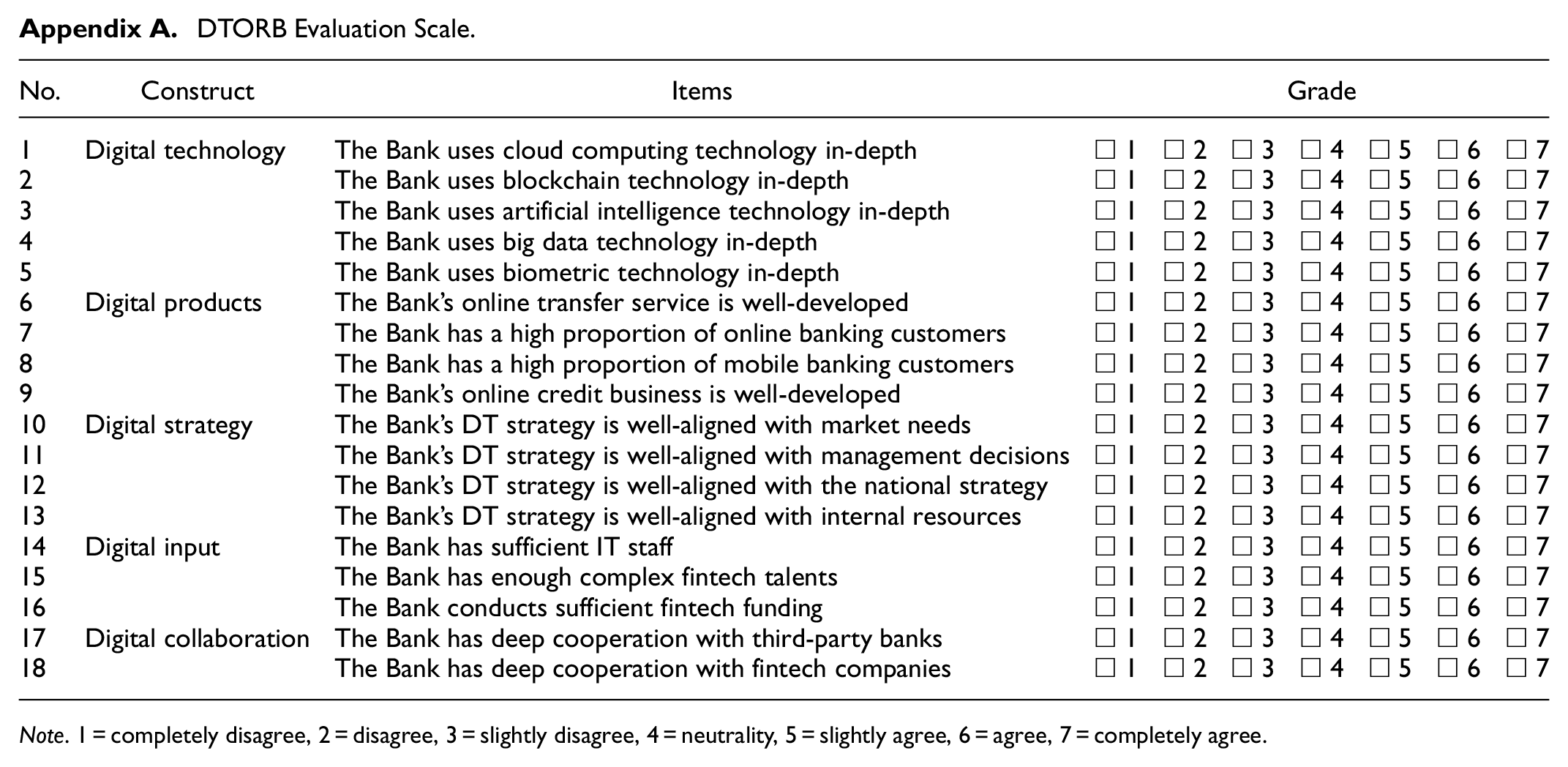
The official research was conducted from May 9 to August 27, 2022, and 703 rural bank managers were randomly selected to distribute questionnaires. After eliminating invalid questionnaires, 685 valid questionnaires were retained, with a valid response rate of 97.4%. The rural banking experts interviewed were drawn from prefecture-level cities in Hebei Province, China, which include Baoding, Cangzhou, Chengde, Hengshui, Langfang, Qinhuangdao, Shijiazhuang, Tangshan, Xingtai, and Zhangjiakou, and cover all of the prefecture-level cities in Hebei Province. The main demographic characteristics of the surveyed sample are shown in Table 1. Appendix A provides the questionnaire.
Demographic Attributes.

Data Analysis and Results
Exploratory Factor Analysis
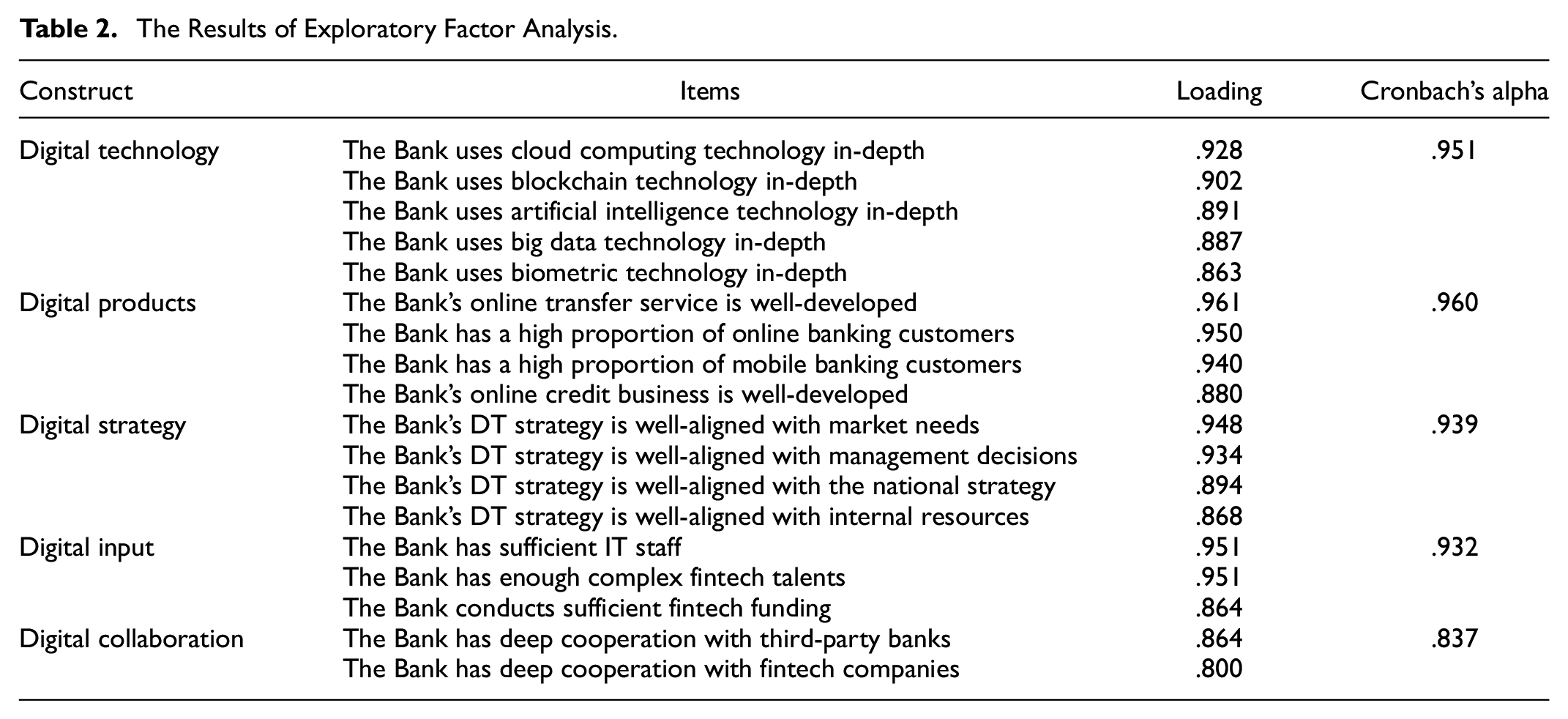
Prior to the factor analysis, the structural validity of the questionnaire was tested. Bartlett’s test of sphericity (χ2 = 3,918.990, df = 153, p = .000) and KMO test (KMO = 0.831) indicated the existence of common factors between the correlation matrices of the question items and allowed for the next step of factor analysis. Principal component analysis was then performed using the method of maximum variance and the classical scale development procedures of Kanungo (1982) and Farh et al. (2004) were used to screen the question items by: (i) extracting factors with eigenvalues greater than 1; (ii) removing items with factor loadings less than .5 on each principal component; and (iii) removing items with differences between factor multiple loadings less than .1. The factor loadings of the item “The Bank’s digital transformation strategy is very detailed” were removed for each principal component less than .5, leaving 18 items. As shown in Table 2, the five principal factors correspond to the five dimensions of digital technology, digital product, digital strategy, digital input and digital cooperation, and the cumulative variance explained by the principal factors is 87.293%, so the five principal factor structure is well confirmed. The eigenvalues of the five dimensions were 4.263, 3.727, 3.416, 2.715, and 1.591, respectively. Then the scales were tested for internal consistency reliability, and the results are shown in Table 2. The overall internal consistency coefficient of the scale is .887, while the internal consistency coefficients of digital technology, digital product, digital strategy, digital input and digital cooperation are .951, .960, .939, .932, and .837, which are all above the standard of .8, indicating that the overall data of the research is highly reliable and has good internal consistency.
The Results of Exploratory Factor Analysis.
Confirmatory Factor Analysis
In this study, a first-order five-factor structural model (Figure 2) was constructed using Amos 25.0 for the validation factor analysis. The results were as follows: χ2/df = 2.086, RMSEA = 0.073, GFI = 0.878, AGFI = 0.832, NFI = 0.936, TLI = 0.957, CFI = 0.965, and IFI = 0.965. The indicators all meet the criteria suggested by Bentler and Bonett (1980), thus indicating a good fit of the model.

Confirmatory factor analysis.
The convergent validity of the scale was tested by measuring the factor loadings of the items and the Average Variance Extracted (AVE). The results showed that the standard loadings for each variable measure were higher than .7 (p < .001), with all CR values ranging from 0.8482 to 0.9689, exceeding the value of 0.7 suggested by Hair et al. (2010). Meanwhile, the AVE values were all above 0.5 (as shown in Table 3). According to Fornell and Larcker (1981), the factor loadings, CR and AVE indicators in this study met the criteria, indicating that the scale had good convergent validity.
The Results of Discriminant Validity and Convergent Validity Analysis.

Note. Values in brackets are the square root of AVE.
The validity of the distinction is determined in two main steps. In the first step, the dimensions were tested for high correlation coefficients and the problem of multicollinearity. As shown in Figure 2, the maximum correlation coefficient between the five dimensions of digital transformation of rural banks is 0.46, which is much less than 0.85 and meets the criteria. In the second step, the correlation coefficients between dimensions are compared with the size of the square root of the AVE of the average number of variances extracted for the corresponding dimension, and if the former is smaller than the latter, the corresponding dimension can be considered to have good discriminant validity between dimensions. As shown in Table 3, the arithmetic square root of each dimension AVE is greater than the correlation coefficient between that dimension and the other dimensions, and it can be concluded that the five-dimensional structural scale of digital transformation of rural banks has good discriminant validity.
Discussing the Results
Significant advances in digital innovation and technology have triggered the Fourth Industrial Revolution and the Fifth Social Revolution, which have had a profound impact on all aspects of human activity (Boufounou et al., 2022). For rural banks, fintech-based digital transformation has great potential to significantly increase the financial value of the bank, create a sustainable competitive advantage, and increase loan size (Chao & Yang, 2023; Naimi-Sadigh et al., 2021). The purpose of this study was to develop and validate a set of scales that could measure the level of digital transformation in rural banks. Based on Hinkin’s (1998) research methodology, this study uses a mixed-method combining qualitative and quantitative approaches as a guide to propose an 18-item five-dimensional scale for measuring DTROB. These five dimensions are digital technology, digital products, digital strategy, digital inputs and digital collaboration. The scale items were generated from in-depth interviews with 45 rural banking experts. The items were further validated in 685 questionnaires addressed to rural bank managers using exploratory factor analysis and validation factor analysis, respectively.
The Digital Technology section includes five items. Example items include: “The bank uses cloud computing technology in depth”; “The bank uses blockchain technology in depth”; “The bank uses artificial intelligence technology in depth”; “The bank uses big data technology in depth”; “The bank uses biometric technology in depth.” This sphere suggests that the application of fintech is at the heart of the digital transformation of rural banks (Naimi-Sadigh et al., 2021). Big data technology can help rural banks mine massive, rich data sets and extract valuable information from these data, thereby assisting rural banks in making lending decisions and improving operational efficiency (Andronie et al., 2023). The decentralized, tamper-proof, traceability, cost reduction, and efficiency features of blockchain technology can enhance the deposit security and risk management capabilities of rural banks (Lăzăroiu et al., 2023). The empowerment of artificial intelligence technology can reduce the cost of new marketing and inventory services for rural banks (A. R. D. Rodrigues et al., 2022). Cloud computing technology helps rural banks consolidate resources and maintain data security. Biometric technology is tamper-proof, private and unique, and can improve the usability of rural banks’ financial technology products, thereby increasing service efficiency (Killeen & Chan, 2018). The items in this factor mainly focus on how deeply rural banks use financial technology. Khattak et al. (2023) also argued that the key to digital transformation within banks lies in the adoption of advanced modern technologies such as artificial intelligence, blockchain, big data, and cloud computing technologies by banks. For this reason, rural banks urgently need to consolidate and rationally deploy the foundation of technology applications, and deepen the integration of digital technology with various businesses.
Digital products included four items: “The bank’s online remittance service is well developed”; “The bank has a high proportion of online banking customers”; “The bank has a high proportion of mobile banking customers”; “The bank’s online lending business is well developed.” Similarly, Dong et al. (2021) argued that the development of online business of rural banks could be used to measure their digital transformation to a certain extent, and thus used three indicators, which are the share of wealth management business, the share of online payment business, and the share of online transfer business of rural banks, to measure the digital transformation of rural banks. It is worth noting that the digital business dimension of this study does not include the degree of online wealth management business share of rural banks. The reason for this is that the results of the interviews with 45 rural bank experts indicate that most of the rural banks in China do not have online wealth management business, which implies that the level of online wealth management business of rural banks in China is low. The proportion of online wealth management business is not an important factor in the digital transformation of rural banks. In addition to this, this study also found that the customer share of mobile banking and internet banking determines the level of digital transformation in rural banks. Therefore, rural banks should pay attention to the needs and experiences of county customers and develop financial products based on the actual situation, which are compatible with the level of the local economy and the characteristics of the industry (Lotriet et al., 2020). Based on the focus on innovation of financial service products and considering the proportion of elderly customers in the county’s customer base, innovative financial products should be simple, easy to understand and easy to promote. Emphasis will be placed on maintaining, upgrading and optimizing platforms with high usage rates, such as online banking, mobile banking, e-banking and WeChat mini-programs, in order to continuously expand and broaden channels for customer acquisition and active customers.
Similar to digital products, the digital strategy theme contained four items, including: “The bank’s DT strategy is well aligned with market needs”; “The bank’s DT strategy is well aligned with management decisions”; “The bank’s DT strategy is well aligned with the national strategy”; “The bank’s DT strategy is well aligned with internal resources.” This finding is in line with Cheng et al. (2023), who argue that commercial banks should strategically strengthen the market orientation of digital transformation and choose appropriate digital transformation paths in relation to their own capabilities. This sphere suggests that the elevation of digital transformation to a strategic level is becoming a consensus among commercial banks. Developing a clear, distinctive, and differentiated digital strategy will help avoid homogeneity problems in the digital transformation of rural banks and improve the success rate of the digital transformation of rural banks.
The digital input contained three elements. Examples of items include: “The bank has enough IT staff”; “The bank has enough complex fintech talent”; “The bank conducts enough fintech financing.” The willingness, ability, and intensity of rural banks to invest in fintech have a significant impact on their digital transformation (Bellardini et al., 2022). I. Lee (2017) also highlights how the development of digital technologies requires significant investment not only in terms of money, but also in terms of labor and time. Bellardini et al.’s (2022) study similarly found that banks wanting to achieve digital transformation need to upgrade the digital skills of their employees. The construction of digital talent team of rural banks should be different from the mode of big banks’ big expansion, guided by digital strategy and business needs, introduce certain composite financial technology talents, and promote the construction of a working model combining independent research and development and external cooperation. It’s worth noting that more digitization funding isn’t always better. The application of digital technology has the characteristics of increasing marginal utility and strong economies of scale, so the digital transformation of rural banks does not have an advantageous input-output ratio compared with large banks, and appropriate funds should be invested after refined calculation and analysis.
Finally, digital collaboration included two items. Sample items included: “The bank has deep cooperation with third-party banks”; “The bank has deep cooperation with fintech companies.”Xu et al. (2021) also studied commercial banks’ fintech cooperation with third parties but only focused on commercial banks’ cooperation with fintech companies, ignoring commercial banks’ cooperation with third-party banks other than themselves. In this area, it is suggested that the digital transformation of rural banks cannot be achieved without digital cooperation with external third-party organizations. At the same time, several studies have confirmed the importance of third-party collaboration in the digital transformation of organizations (Aghimien et al., 2020; Hornuf et al., 2021). From a resource dependency perspective, the resource endowments of external fintech companies or commercial banks with a higher degree of digitization and rural banks are highly complementary. Digital collaboration can help rural banks reduce operating costs, leverage late-stage advantages, and compensate for technology pain points.
This systematically constructed and validated DTORB construct can serve as a basis for researchers to study the impact of DTORB on improving the core competencies and business performance of rural banks. Many theoretical works have emphasized the importance of digital transformation of rural banks. However, the progress of research in this area has been hindered by the fact that the digital transformation of rural banks is still in its infancy, coupled with the lack of relevant statistical data. In this paper, the model fitting of the DTORB scale was systematically investigated and reported. In addition, the advanced scale development method proposed by Hinkin (1998) was applied in this study, and the dimensionality, reliability, and validity of the scale achieved good results, which laid a solid foundation for future research. The DTORB scale developed in this study contributes to the in-depth study of digital transformation of rural banks and the development of digital transformation scales for different industries.
Conclusion
The rapid development of the digital economy has caused the study of digital transformation of organizations to attract the interest of a large number of scholars and managers in recent years. Under the pressure of large commercial banks’ business sinking and fintech companies’ cross-border competition, DTORB has irreplaceable importance for the sustainable development of rural banks. However, despite such widespread interest, the overall conceptualization and empirical validation of the DTORB component is still in its infancy and further research is needed and worthwhile. This paper endeavors to address this issue by developing a reliable and valid scale to measure DTORB. Based on Hinkin’s (1998) study, an 18-item 5-dimensional scale for measuring DTORB is proposed using a mixed qualitative and quantitative approach as a guide. The five dimensions are digital technology, digital product, digital strategy, digital input, and digital collaboration. The items of the scale were generated based on in-depth interviews with 45 rural banking experts. The items were further validated in 685 research questionnaires targeting rural bank managers using exploratory factor analysis and validation factor analysis, respectively. The resulting scale fills a major gap in existing DTROB research.
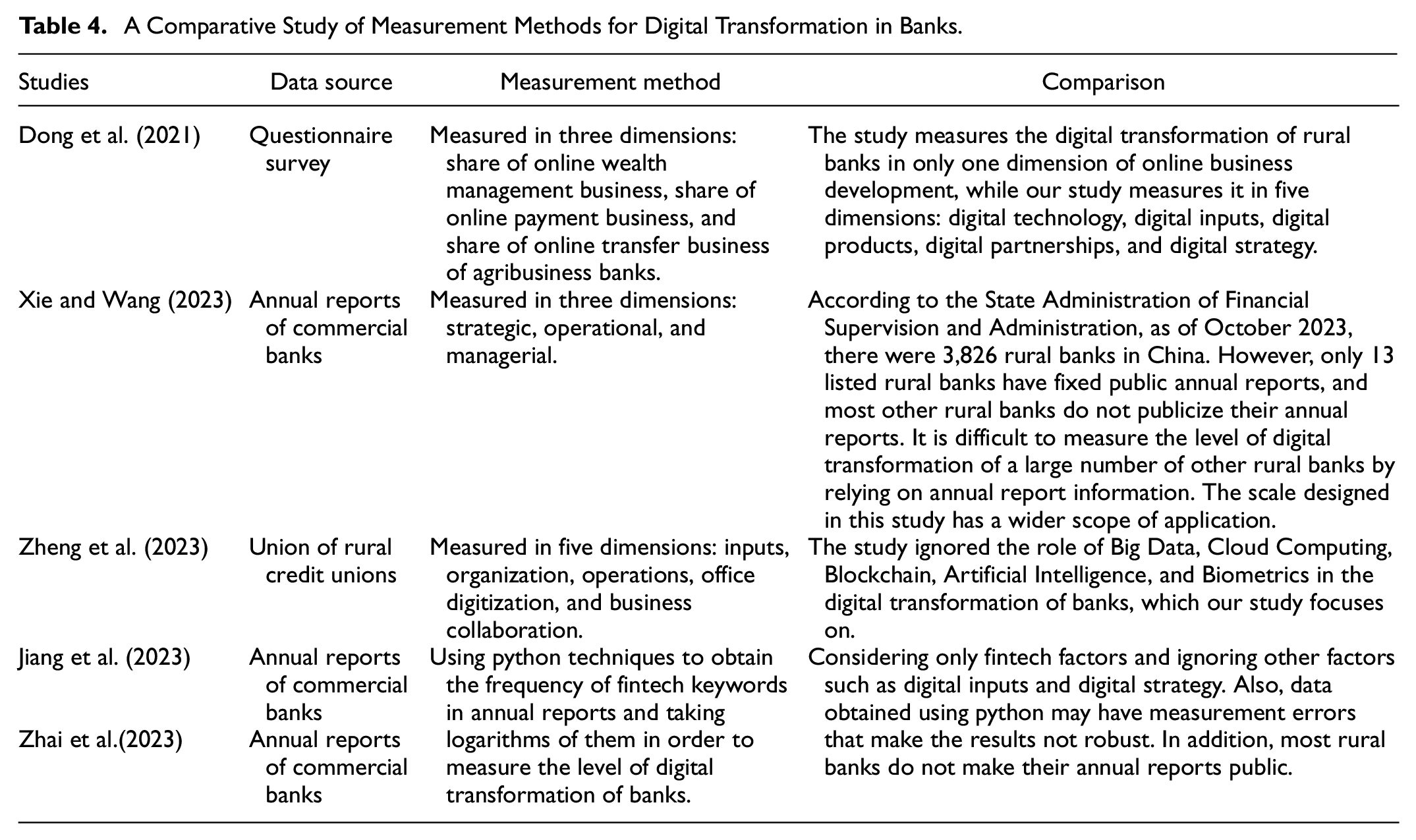
Although other researchers have investigated the frameworks, barriers, influencing factors and their economic consequences of digital transformation in banks (Diener & Špaček, 2021; J. F. Rodrigues et al., 2020; Sia et al., 2021; Y. Zhu & Jin, 2023), no study has yet developed a scale to measure digital transformation in rural banks. Xie and Wang (2023) constructed a system of indicators to measure the digital transformation of commercial banks. However, the indicator is not applicable to rural banks as most of them do not disclose their annual reports to the public. This study developed a comprehensive measurement scale for DTORB, one of the first attempts to contribute conceptually and methodologically to empirical research on DTORB. This study improves the digital transformation indicator system for rural banks constructed by Dong et al. (2021) and Zheng et al. (2023) in terms of content. At the same time, this study also methodologically remedies the inevitable measurement error and result instability of the Python method used by Jiang et al. (2023) and Zhai et al. (2023) to measure the level of digital transformation of banks (Table 4). The scale can be used as a reference for quantitative studies related to digital transformation in rural banks.
A Comparative Study of Measurement Methods for Digital Transformation in Banks.
This study advances digital banking by providing researchers and practitioners with a new digital transformation scale for rural banks. On the one hand, the DTROB scale can provide rural bank managers and practitioners with a detailed guide on how to implement effective digital transformation. It can be used as a checklist by rural banks to ensure that nothing is missed while implementing digital transformation. Rural banks with limited resources can allocate resources based on the scale to ensure the cost-effectiveness of digital transformation. The scale can also be used to assess the digital capabilities of rural banks and identify their digital transformation weaknesses. On the other hand, the scale can be used to investigate how digital transformation capabilities vary across banks based on individual differences (region, level of corporate governance, profitability, etc.) and thus develop differentiated digital transformation strategies for different rural banks.
This study also has some policy implications. First, governments should formulate and improve policies to support the digital transformation of rural banks. Relevant government departments should give appropriate incentives to rural small and medium-sized banks in the process of digital transformation, actively promote the cooperation between rural banks and fintech companies, and build bridges for rural small and medium-sized banks to cooperate with third parties in digitalization. Secondly, the government should focus on digital ecological construction in rural areas, linking medical, health, social security and other e-government information to improve the credit system of rural banks and break the information barriers between government data and financial data. Finally, it should promote the establishment of public technical service platforms, encourage the establishment of platforms that provide different types of technical services, and dilute the costs borne by small and medium-sized rural banks by pooling inputs.
While this study provides important insights for scholars and bank managers, there are some limitations that need to be addressed. First, this study was conducted using rural banks in China, which may limit the applicability to rural banks outside the China region. Investigating the impact of regional context on the digital transformation of rural banks may greatly expand the applicability of the findings of this study in the future. Second, the use of a single respondent may result in some measurement inaccuracies. To overcome this limitation, future research could collect data from multiple respondents to create a composite score to measure the level of digital transformation of each rural bank (Venkatraman & Grant, 1986). Finally, this study did not consider exogenous variables affecting the digital transformation of rural banks, such as government involvement, financial literacy of farmers, and regional digital infrastructure. In future research, addressing exogenous variables related to digital transformation of rural commercial banks could provide academic and practical implications and develop more specific measurement scales for sustainable development of rural banks.
Footnotes
Appendix
DTORB Evaluation Scale.
| No. | Construct | Items | Grade | ||||||
|---|---|---|---|---|---|---|---|---|---|
| 1 | Digital technology | The Bank uses cloud computing technology in-depth | □ 1 | □ 2 | □ 3 | □ 4 | □ 5 | □ 6 | □ 7 |
| 2 | The Bank uses blockchain technology in-depth | □ 1 | □ 2 | □ 3 | □ 4 | □ 5 | □ 6 | □ 7 | |
| 3 | The Bank uses artificial intelligence technology in-depth | □ 1 | □ 2 | □ 3 | □ 4 | □ 5 | □ 6 | □ 7 | |
| 4 | The Bank uses big data technology in-depth | □ 1 | □ 2 | □ 3 | □ 4 | □ 5 | □ 6 | □ 7 | |
| 5 | The Bank uses biometric technology in-depth | □ 1 | □ 2 | □ 3 | □ 4 | □ 5 | □ 6 | □ 7 | |
| 6 | Digital products | The Bank’s online transfer service is well-developed | □ 1 | □ 2 | □ 3 | □ 4 | □ 5 | □ 6 | □ 7 |
| 7 | The Bank has a high proportion of online banking customers | □ 1 | □ 2 | □ 3 | □ 4 | □ 5 | □ 6 | □ 7 | |
| 8 | The Bank has a high proportion of mobile banking customers | □ 1 | □ 2 | □ 3 | □ 4 | □ 5 | □ 6 | □ 7 | |
| 9 | The Bank’s online credit business is well-developed | □ 1 | □ 2 | □ 3 | □ 4 | □ 5 | □ 6 | □ 7 | |
| 10 | Digital strategy | The Bank’s DT strategy is well-aligned with market needs | □ 1 | □ 2 | □ 3 | □ 4 | □ 5 | □ 6 | □ 7 |
| 11 | The Bank’s DT strategy is well-aligned with management decisions | □ 1 | □ 2 | □ 3 | □ 4 | □ 5 | □ 6 | □ 7 | |
| 12 | The Bank’s DT strategy is well-aligned with the national strategy | □ 1 | □ 2 | □ 3 | □ 4 | □ 5 | □ 6 | □ 7 | |
| 13 | The Bank’s DT strategy is well-aligned with internal resources | □ 1 | □ 2 | □ 3 | □ 4 | □ 5 | □ 6 | □ 7 | |
| 14 | Digital input | The Bank has sufficient IT staff | □ 1 | □ 2 | □ 3 | □ 4 | □ 5 | □ 6 | □ 7 |
| 15 | The Bank has enough complex fintech talents | □ 1 | □ 2 | □ 3 | □ 4 | □ 5 | □ 6 | □ 7 | |
| 16 | The Bank conducts sufficient fintech funding | □ 1 | □ 2 | □ 3 | □ 4 | □ 5 | □ 6 | □ 7 | |
| 17 | Digital collaboration | The Bank has deep cooperation with third-party banks | □ 1 | □ 2 | □ 3 | □ 4 | □ 5 | □ 6 | □ 7 |
| 18 | The Bank has deep cooperation with fintech companies | □ 1 | □ 2 | □ 3 | □ 4 | □ 5 | □ 6 | □ 7 | |
Note. 1 = completely disagree, 2 = disagree, 3 = slightly disagree, 4 = neutrality, 5 = slightly agree, 6 = agree, 7 = completely agree.
Declaration of Conflicting Interests
The author(s) declared no potential conflicts of interest with respect to the research, authorship, and/or publication of this article.
Funding
The author(s) disclosed receipt of the following financial support for the research, authorship, and/or publication of this article: This work was supported by the National Social Science Foundation of China [grant number 20BJY156].

Data Availability Statement
The data presented in this study are available on request from the corresponding author.