




Abstract
This study explores the intergenerational dynamics within Koh Kret’s community-based tourism sector, addressing the challenges faced by older business owners and the reluctance of younger generations to inherit family businesses. Despite comprehensive analysis into sustainable tourism and cultural conservation, there are notable deficiencies in understanding the relationship between these elements, especially within the context of family-operated businesses. Through conducting thorough interviews with 25 community members, including local community leaders, older business owner, younger generation, and visitors, this research utilizes grounded theory to examine these interactions and formulate approaches to enhance youth engagement. Key findings will provide detailed insights into the operational difficulties of older entrepreneurs, uncover the motivations behind the younger generation’s reluctance, and propose actionable solutions to promote sustainable tourism. This research aims to fill a critical gap in the literature by offering a holistic approach to intergenerational challenges in community-based tourism, ensuring both the sustainability and cultural integrity of Koh Kret as a tourist destination.
Plain Language Summary
Aims and Purpose of the Research: This study explored why younger people in Koh Kret are hesitant to take over their families’ tourism businesses and the challenges older owners face. Our goal was to understand this generational gap and find ways to encourage young people to get involved, ensuring the community’s tourism remains sustainable. Background of the Research: This issue matters because the future of Koh Kret’s community-based tourism depends on the active participation of the next generation. If young people opt out, family businesses might close, threatening the area’s cultural heritage and economic well-being. This concern isn’t just local, it affects similar communities where traditions and livelihoods are at risk due to generational shifts. Methods and Research Design: It conducted in-depth interviews with 25 individuals: older business owners, younger community members, local leaders, and visitors. Using grounded theory, we analyzed their perspectives to uncover underlying reasons for the generational disconnect. This method was ideal because it allowed us to build theories based on real-world experiences and interactions. Results and Importance: It found that older entrepreneurs struggle with operational challenges like adapting to new technologies and meeting changing tourist expectations. The younger generation’s reluctance stems from different career interests, a desire for modern work environments, and sometimes a lack of appreciation for traditional businesses. These findings were more complex than we anticipated. Understanding these factors is crucial for developing strategies to involve young people, such as modernizing business practices or providing relevant training. The implications extend beyond Koh Kret, offering insights for other communities facing similar issues. Our key message is that bridging the generational gap is essential for sustaining tourism and preserving cultural integrity in community-based destinations.
Keywords
Introduction
Context and Significance
Koh Kret, a small island nestled in the Chao Phraya River near Bangkok, is renowned for its rich cultural heritage and vibrant community life. Historically inhabited by the Mon people, the island has evolved into a significant tourist destination, attracting visitors with its traditional pottery, cultural landmarks, and tranquil atmosphere. However, the rapid growth of tourism presents difficulties that jeopardize the enduring viability of this distinctive region.
Operational and Cultural Challenges
Although tourism brings economic advantages, local communities encounter various challenges in establishing and overseeing community-based tourism projects. Studies have identified operational constraints such as limited access to information and inefficient decision-making structures (Moscardo, 2023), conflicts between economic development and cultural heritage preservation (Chatkaewnapanon & Lee, 2022), and structural barriers including weak community development and unsuitable policies (Khunnikom et al., 2022), the spectrum of operational, structural, and cultural conditions influencing success or failure of initiatives (Nguyen et al., 2022). Moreover, cultural barriers like power differentials and inequitable allocation complicate sustainable tourism efforts (Bumyut et al., 2022).
Technological and Structural Gaps
Emerging research underscores the role of technology in post-pandemic recovery, revealing both opportunities and challenges in digital adaptation (Dikhanbayeva, 2025). Recent models, such as community-based ecotourism frameworks (Khadry & Sianipar, 2024) and Indigenous-led decolonial approaches to resource management (Datta et al., 2025), highlight progress in integrating sustainability and cultural preservation. Similarly, inclusive initiatives empowering marginalized groups, including people with disabilities (Candra et al., 2025), demonstrate broader participatory potential. However, persistent challenges in regions like Malakand Division (Khan et al., 2024) reveal systemic gaps in reconciling tourism growth with equitable governance.
Literature Gap: Intergeneration Dynamics
While previous research emphasizes empowering rural communities in tourism planning and practice (Reindrawati, 2023), and technology-driven safety protocols (Yodsurang et al., 2022), they inadequately address intergenerational dynamics. In addition, the study by Phattanawasin (2009) highlights the delicate balance between tourism development and the preservation of cultural and environmental heritage, underscoring the need for effective management urbanization and tourism impacts. However, these studies often overlook the operational challenges faced by older business owners and the motivational barriers preventing younger generations from engaging in family-run tourism enterprises.
This gap indicates a need for a deeper understanding of the intergenerational factors influencing the sustainability of community tourism in Koh Kret. Utilizing the theoretical construct of intergenerational solidarity (Bengtson & Roberts, 1991), which examines the relationships among various generations within familial and communal contexts, can yield significant understanding of these dynamics.
Study Aims and Research Questions
This study aims to address these gaps by focusing on the intergenerational challenges within Koh Kret’s tourism sector. Specially, it seeks to investigate the specific difficulties faced by older entrepreneurs in managing tourism-related businesses in Koh Kret. It also explores the factors contributing to the younger generation’s hesitation to take over family-run businesses. Furthermore, it aims to formulate strategies to enhance youth engagement and ensure the sustainable development of community tourism.
In order to fulfill these aims, the research endeavors to address the queries provided below. (RQ1) What are the main challenges that older business owners face in operating tourism businesses in Koh Kret? (RQ2) What factors contribute to the reluctance of the younger generation to take over family-run tourism businesses in Koh Kret? (RQ3) How can strategies be formulated to increase the involvement of the younger population in community tourism businesses in Koh Kret?
To explore these questions, this research employs a qualitative strategy, employing grounded theory to unveil insights from in-depth conversations with 25 different people, including locals community leader, older business owners, younger generation, and visitors (Glaser & Strauss, 2017). This approach will provide a comprehensive understanding of the intergenerational dynamics affecting tourism sustainability in Koh Kret. Despite extensive studies on sustainable tourism and cultural conservation, there is a notable deficiency in comprehending the interplay between these elements within the context of family-operated businesses in Koh Kret. Purposeful sampling will guarantee that participants are chosen according to their significance in relation to the research inquiries, thereby augmenting the depth and complexity of the data acquired.
Existing literature has largely disregarded the operational struggles of older entrepreneurs and motivational challenges for younger generations. The goal of this study is to bridge that vital missing link by offering a comprehensive approach for addressing intergenerational issues in community tourism. Theoretical development on intergenerational solidarity will be combined with fieldwork results from Koh Kret to further the understanding of sustainable tourism and community development. This research is a response to this literature gap by exploring the effects of inter-generational relationships on the sustainability of family-operated tourism businesses. The findings have the potential to inform policy and practice in order to provide actionable suggestions for in achieving these three main goals, youth engagement, cultural integrity, and community tourism viability that may be applied locally on Koh Kret or internationally.
This study therefore concludes with an attempt to reconcile the tension between cultural preservation and sustainable tourism development, particularly in terms of intra-community interactions across generations for community tourism on Koh Kret. This research aims at providing possible strategic solutions which have to take into consideration the configurations of cultural preservation and sustainable tourism development by painstakingly looking into the challenges faced by older business owners and why younger generations avoiding these enterprises. The result will help to maintain Koh Kret as a leader of tourist centers with cultural identity and financial strength.
Literature Review
Sustainable Tourism Development
Sustainable tourism development has evolved through three key dimensions: (1) Theoretical frameworks, such as the capitals approach emphasizing human well-being as the ultimate goal of sustainable tourism (Dwyer, 2023), and the interrelation between sustainability and responsible behavior (Mohamadi et al., 2022). (2) Practical tools, including certification programs to translate sustainable tourism into practice and the development of a three-dimensional framework to categorize tools for sustainable tourism engagement (Lesar et al., 2023). (3) Adaptive strategies, such as technological advancements, cultural heritage preservation, rural development, green investment, and sustainable reporting (Roblek et al., 2021). Collectively, these dimensions shape the integration of sustainability principals across sectors.
There are a number of drivers behind the successful sustainability case studies in tourism, particularly in Southeast Asia (and notably Thailand). Both the Sapphaya Community (Best Responsible Tourism award) and the Amphawa Chaipattananurak (ACCP) model exemplify strong leadership and local engagement; however, Sapphaya leverages informal social-capital networks, whereas ACCP relies on formal governance and financial-planning mechanisms (Petison & Kantabutra, 2022; Thananusak & Suriyankietkaew, 2023).
Initiatives like imposing entrance fees to prevent marine litter in coastal areas, such as Libong Island, highlight the effectiveness of tourist willingness to pay, continuous cleaning programs, and enhanced environmental awareness (Panwanitdumrong & Chen, 2022). This is well illustrated by the evolving tourism policy landscape in response to COVID-19 as focus has been given more attention on accommodations quality, hygiene standards and information dissemination infrastructure which holds a key factor for sustainable recovery of Thai tourism (Srisawat et al., 2023).
In addition, the Eco-Friendly Perceived Value (EFPV) in hotel industry has a significant positive effect on tourist satisfaction and behavioral willingness to revisit it (Kokkhangplu et al., 2023), indicating that hotels’ pro-environmental behaviors are helpful for tourism sustainability. Other studies build on the extended Theory of Planned Behavior (TPB), social capital theory, and governance structures framework, explaining how environmental and social concerns interact to shape responsible-tourism intentions (Prasongthan, 2023). Low governance and low education were key barriers to sustainability among the small tourism businesses in Phuket, yet environment was perceived as an integral part of sustainable tourism development which suggest more need for good managerial principals such writes Suwannahong (Fuchs, 2023).
A similar example of community-driven goal-setting tools for the use in foresight processes, with application focus on small communities from rural Thailand who want to design their future tourism development has been discussed elsewhere (community-oriented criteria and framework; Chatkaewnapanon & Lee, 2022). Finally, the Delphi technique was used to predict future numbers of tourists and has suggested several areas for addressing sustainable tourism development in Thailand including education programs are improved upon There is a need for Less stringent immigration policies Updates on tourist information related issuance (Yoopetch et al., 2022). Collectively, these case studies show that sustainable tourism success in Thailand relies on community involvement, leadership incentives, and ecotourism practices. They also underscore the role of viable governance frameworks and adaptive policies integrating sustainability and intergenerational transfer across tourism sectors.
Community-Based Tourism
Building on sustainability, Community-Based Tourism (CBT) requires strategies addressing intergenerational continuity: (1) strong leadership; (2) active local engagement; (3) equitable resource management. (1) Leadership is significantly important since it aids in conserving community endowments and constructing social capital, factors necessary for sustainable tourism (Thananusak & Suriyankietkaew, 2023). (2) The local engagement is also another significant factor for CBT, ensuring the sustainability of this model through reducing disorganization and promoting a sense of ownership among them by actively involving in their community (Kampetch & Jitpakdee, 2019; Thananusak & Suriyankietkaew, 2023). (3) Community cooperative institutions support cross-cultural participation and cooperation by ensuring resources produced from tourism are equitably managed in a way that its benefits reach all members of the community (Zeren et al., 2024). It also re-arranges social relations and property rights to secure individual liberty, that would in turn promote informal power structures among the community (Zeren et al., 2024). Finally, the maintenance of cultural heritage and regional assets is important for retaining tourist interest in authentic experiences but also to build local identity and pride (Kampetch & Jitpakdee, 2019; Thananusak & Suriyankietkaew, 2023). These measures could also play important role in enhancing poverty reduction and intergenerational equity through the integration of local organizations as well as development of resource-based industries, although governmental regulations can sometimes neutralize these efforts by manipulating power disparities (Suyatna et al., 2024). Moreover, providing distinctive culture-based experiences (similar to those found at Baan Rim Klong Homestay) all come down to being able to adapt toward changing behaviors of global visitors which is a fundamental factor in establishing successful CBT initiatives (Kampetch & Jitpakdee, 2019). These principles are intended to ensure that CBT initiatives are sustainable, inclusive and good for the whole community. Common CBT projects encounter various challenges, which can be classified into (1) operational; (2) structural, and (3) cultural problems. (1) Operational challenges are associated with a lack of managerial and marketing capacities, limited expertise in providing various tourist services, and a weak connection to other tourism service providers (Bello & Lambulira, 2023). (2) Structural limitations are integrated with little access to planning specialists, poor community development conditions, financial restrictions, low education level, and ineffective policy and governance approaches (Reindrawati, 2023). (3) Cultural restrictions are based on historical aspects, including colonialism, the extent of community perceptions and knowledge, the level of power abuse and non-compliance, and conflicts of interest (Reindrawati, 2023). Addressing these challenges requires a multi-center approach in terms of offering opportunities. Such capacity-building programs can improve civilians’ ability to manage and service tourists while CBT can be accompanied by special management and operations building (Bello & Lambulira, 2023).
Intergenerational Dynamics in Tourism
Intergenerational dynamics in family-run tourism businesses shape sustainability through three interrelated dimensions: (1) generational knowledge transfer, (2) economic adaptation, and (3) cultural continuity. Older entrepreneurs face market challenges exacerbated by ageism (Kolos & Kenesei, 2023), while younger successors grapple with balancing tradition and innovation (Tubadji et al., 2021). This ageism can be mitigated through increased interaction and education to challenge prejudices. Family-run businesses often externalize risks like labor scarcity, affecting employment conditions and staff retention, which are crucial for sustainability (Glowka & Zehrer, 2019). The endurance of those corporations is harmed by the insufficient adoption of progressive methods, regardless that variables aiding to sustainable practices exist. A lack of innovation adoption further harms the longevity of these businesses, despite existing variables supporting sustainable practices (Elmo et al., 2020). Economic challenges also emerge from the aging of population with negative impacts on tourism consumption at household level, in particular among urban households and those whose members tend to be older. Nevertheless, improving the health level of-old people and in increasing elderly use internet services may reduce this undesirable impact and thus can be a way to encourage tourism consumption (Cai & Zhang, 2023). Finally, senior entrepreneurship in tourist sites is place embedded where older business owners make the best of their desirability because it comes up with entrenchment (Farmaki et al., 2022), however this could be unadjusted to all changes. Together, these difficulties illustrate the opportunity for specific interventions to help aging entrepreneurs in tourism continue to innovate and build their family-owned businesses within this sector.
Young successors’ reluctance to inherit family businesses stems from economic precarity, generational role conflicts, and misalignment with contemporary career aspirations (Tubadji et al., 2021; Wang & Zhang, 2022). Economically, young rural entrepreneurs face challenges such as financial constraints, low levels of skilled labor and reduced selling prices for their output resisting investments in family farms (Keiko Yamaguchi et al., 2020). Socially, family business offspring are less intrapreneurial if they have also been exposed to relational conflicts with the extended or parent-offspring generations in terms of social cues. This causes them to have fewer positive expectations of familial relational outcomes and self-efficacy, which ultimately decreases their intention toward family business engagement (Wang & Zhang, 2022). Culturally, the continued prevalence of local cultural practices combined with the fear inherent during economic shocks are vital examples in determining youngsters career choice. Cultures often prohibit failure and when combined with economic uncertainty, the next generation is paralyzed by fear of starting their own business within the family (Tubadji et al., 2021). The combination of these diverse factors collectively results in the younger population not wanting to engage family-operated businesses, underlining a necessity for tackling economic realities and negotiating familial interest while also finding a cultural synergy with contemporary expectations.
Young Successors in Family-Run Tourism Businesses
Engaging the younger generation in tourism presents both opportunities and challenges. Young successors’ engagement in family-run tourism businesses hinges on reconciling economic viability with cultural preservation (Giachino et al., 2024). Alternatively, the study of Gen Z in Malaysia and the UK has resulted in developed a measurement instrument in which researchers have fully implemented social, cultural, environmental protection and management of the product (Homer & Kanagasapapathy, 2023). Hence, these findings prove the flexibility of the concept of sustainable tourism. There is also a need to consider cultural motivations, particularly as they likely play an important role: young Italians have been found to crowdfund culture (indicating other reasons beyond financial reward) and desire sustainable tourism connected with culture (Giachino et al., 2024). Moreover, the way Gen Z practice sustainable consumption behavior in food tourism illuminates a tendency toward ethical and green options regarding food—even though these practices are typically curbed by practicality constraints such as time or money (Orea-Giner & Fusté-Forné, 2023).
There are several potential benefits and challenges when it comes to young people’s involvement in the planning and decision-making process of tourism. Moreover, young people, even children, can take the role of thinkers, actioners, and transformers and help support the process of sustainability leadership in the industry. It has a direct effect on sustainable management and, therefore, lead to higher tourist satisfaction (Carballo et al., 2022). Young sustainable tourists of the age between 20 and 39, in their recent behavior, have shown a high loyalty to destinations visited and often expressed the strongest intention to visit that location again and again. This can also help build long-term and sustainable competitive advantages for tourist destinations (Sato et al., 2024). In addition, the tourism impact based on Youth Sport has been batched into a unique travel segment where parents are willing to compete in their desirable holiday and vacation experiences benefit local communities from increased tourism types mainly around sport-based events (Mirehie et al., 2021). Challenges for young successors include navigating familial expectations while addressing modern market demands (Wang & Zhang, 2022). This dynamic also complicates how youth perspectives can be incorporated into established tourism planning frameworks (Jobs, 2022). Moreover, established power bases are likely to restrict the agency of youth in decision-making processes with a corresponding need for fostering inclusivity and equity-based avenues (Partanen et al., 2023). Achieving a balance benefit demands well-thought-out strategies to seize the potential of young people in contributing to making tourism and future local economies sustainable and dynamic.
Research Gap
Despite advances in CBT research, how intergenerational solidarity (Bengtson & Roberts, 1991) mediates succession planning in family-run tourism businesses remains underexplored, particularly in cultural contexts like Koh Kret, Thailand. For example, Kolos and Kenesei (2023) argue that challenges such as ageism and stereotypes have a negative impact on the engagement of older entrepreneurs with younger tourists and employees. For extensive discussions in English see also (Tubadji et al., 2021; Wang & Zhang, 2022), although a younger generation has less interest and/or expensive entry threshold to take their family businesses over due to economic obstacles, cultural struggles or social conflicts. Still, one shortcoming in this literature is the lack of understanding regarding how these intergenerational dynamics may directly impact tourism business sustainability and where strategic interventions might help to improve youth engagement as well as succession planning. Although the extant studies have explored the need for community engagement, leadership, sustainability, and responsible practices among family-run businesses (Petison & Kantabutra, 2022; Thananusak & Suriyankietkaew, 2023), few studies integrate these efforts with an intergenerational approach. This area of research is particularly neglected while being essential for ensuring sustainable long-life and cultural prosperity in community tourism enterprises. Consequently, this study will bridge these gaps by identifying the main challenges for older business owners, unveil the reasons for younger generations’ reluctance, and create a roadmap for embracing sustainability concepts in Koh Kret tourism. Thus, the research gaps are filled by providing policymakers and practitioners with easily applicable recommendations on supporting family tourism businesses to remain sustainable, even in the changing socio-economic environment.
Methods
This study adopts a qualitative research design grounded in the principles of grounded theory to explore the intergenerational dynamics affecting the sustainability of community tourism in Koh Kret. The qualitative approach is appropriate for gaining in-depth insights into complex social phenomena, particularly when existing theories do not fully explain the observed behaviors and attitudes (Creswell & Poth, 2016). Grounded theory, as developed by Glaser and Strauss (2017), allows for the generation of theory inductively from the data, making it suitable for exploring the nuanced interactions between different generations within family-run tourism businesses.
Research Design and Sampling
The choice of grounded theory is justified by the study’s aim to develop a theoretical understanding of the factors influencing both older business owners and younger generations in the context of Koh Kret’s tourism sector. This method facilitates the discovery of patterns and relationships that may not be apparent through deductive reasoning based on existing theories (Thornberg & Charmaz, 2014). By employing grounded theory, the research can construct a substantive theory that explains the intergenerational challenges unique to this cultural setting.
A purposeful sampling strategy was employed to select participants who are most relevant to the research questions (Patton, 2015). The sample comprised 25 individuals divided into four key stakeholder groups to ensure balanced representation (Table 1):
- Older Business Owners (10 participants): Entrepreneurs aged 50 and above who manage family-run tourism businesses in Koh Kret for at least 10 years. These businesses include traditional pottery workshops, cultural artifact shops, local restaurants, and homestays that are integral to Koh Kret’s cultural heritage. These individuals have extensive experience and firsthand knowledge of the operational challenges in the tourism sector. They can provide valuable insights into historical business practices, succession planning efforts, and their perspectives on the involvement of younger generations. Participants were identified through local business associations, community networks, and recommendations from community leaders. Initial contact was made via phone calls and in-person visits to explain the study’s purpose. Consent was obtained after assuring confidentiality and explaining the voluntary nature of participation. Efforts were made to include business owners from various sectors within tourism to capture a wide range of experiences. Both male and female entrepreneurs were included to explore any gender-specific challenges.
- Younger Generation Members (8 participants): Individuals aged between 20 and 35 who are direct descendants or relatives of the older business owners and are potential successors to the family business. This group includes both those currently involved in the business and those who have chosen alternative career paths. Understanding the motivations, aspirations, and barriers faced by the younger generation is crucial to addressing their reluctance to take over family-run businesses. Their perspectives can shed light on factors influencing their career choices and engagement with the tourism sector. Participants were identified through referrals from the older business owners and community organizations. The study ensured representation from individuals actively involved in the business and those pursuing other opportunities to capture diverse viewpoints. The sample included participants with varying educational backgrounds and career interests to explore how these factors impact their decisions regarding the family business.
- Local Community Leaders (3 participants): Influential figures involved in community tourism planning and development. These stakeholders offer a macro-level perspective on the policies, strategies, and community dynamics that affect tourism development. Their insights can highlight structural challenges and opportunities for enhancing youth engagement. Participants were identified through official community channels and prior collaborations with local governance bodies. Formal invitations were extended, and meetings were scheduled at their convenience to discuss the study’s objectives and obtain consent. The selection aimed to include leaders with different areas of expertise (e.g., cultural, economic, environmental) to provide a holistic view of the community’s approach to tourism sustainability.
- Tourists (4 participants): Visitors to Koh Kret who can provide external perspectives on the tourism experience. Participants included tourists of different age groups and backgrounds to capture a broad range of external perceptions. Tourists’ experiences and expectations can influence the sustainability of family-run businesses. Their feedback can offer valuable insights into service quality, cultural authenticity, and areas for improvement that may attract or deter future visitors. Participants were approached at popular tourist sites and informed about the study. Short interviews were conducted with their consent, ensuring minimal disruption to their visit. Information sheets were provided, and confidentiality was assured. Efforts were made to include first-time visitors and repeat tourists, as well as individuals from different cultural backgrounds, to understand various perspectives on Koh Kret’s tourism offerings.
This stratified approach ensures a comprehensive understanding of the intergenerational dynamics from multiple viewpoints. Participants were identified through local business directories, community organizations, and referrals to capture a diverse range of experiences and perspectives. By including both older business owners and younger generation members from the same families, the study can explore familial relationships, communication patterns, and expectations regarding business succession. Local community leaders provide context on broader socio-economic factors, policies, and community initiatives that influence individual and collective actions within the tourism sector. Tourists offer an outsider’s perspective on the attractiveness and competitiveness of Koh Kret’s tourism offerings, which can impact the viability of family-run businesses. Combining perspectives from different stakeholder groups allows for triangulation, strengthening the validity of the findings. Building rapport with participants through respectful communication and ensuring their voices are accurately represented encourages candidness and depth in responses. Recognizing cultural norms and values during interactions helped in gaining trust and eliciting more authentic insights. By using purposeful sampling and seeking diversity, the study minimizes selection bias and addresses social desirability bias in responses. The researchers maintained a reflexive journal and engaged in peer debriefing to mitigate subjectivity, acknowledging how their perspectives might shape data interpretation (Finlay, 2002). While the sample size is appropriate for qualitative research, it may not capture all possible experiences and perspectives within each group. Some potential participants, particularly among the younger generation who have moved away from Koh Kret, may have been difficult to reach, potentially limiting the diversity of views.
Stakeholders Profile.

Note. While purposeful sampling captured key stakeholders, absent voices include youth who permanently migrated off-island—a critical limitation given their disproportionate reluctance to inherit businesses. Future studies should use snowball sampling to trace this cohort via digital ethnography.
In total, 25 semi-structured, in-depth interviews were conducted between May and August 2024 with interviews discontinued upon reaching conceptual saturation, gathering rich, detailed data. The interviews lasted 45–60 min and followed a flexible protocol addressing research questions while allowing participants to express thoughts freely (Brinkmann & Kvale, 2015).
Sample interview questions included:
What challenges do you face in daily operations of your family-run tourism business?
How do you perceive your future role and aspirations within this enterprise?
Which factors most influence your decision to continue or abandon involvement in tourism?
What strategies would you recommend to enhance youth engagement in community tourism?
Researcher Positionality and Missing Voices
The lead author—Bangkok-based foreigner, non-Mon, and from a middle-class background—recognizes a potential power asymmetry when engaging Koh Kret’s elder artisans. To temper this imbalance, we adopted three complementary safeguards: (1) all interviews were conducted with real-time bilingual interpretation and subsequently subjected to independent back-translation; (2) initial coding was replicated and reconciled by three resident informants to embed emic perspectives; and (3) provisional themes were publicly displayed on the village notice-board for community vetting. Finally, we acknowledge that the narrative of permanently migrated youth remains under-represented; a follow-up digital-ethnography (2025–2026) that traces Line and Facebook interactions has been launched to capture these absentee voices and triangulate the present findings.
Field observations were carried out to contextualize the interview data and gain insights into the operational environments of the businesses. Observations focused on interactions between older and younger family members, customer engagement practices, and the general atmosphere of the business settings (Angrosino, 2007).
Relevant documents, such as business records, community tourism plans, and policy documents, were analyzed to supplement the primary data. This triangulation enhances the credibility and validity of the findings (Bowen, 2009).
Data Analysis
The data analysis followed the grounded theory methodology, involving several iterative steps:
- Open coding was conducted to break down the data into discrete parts, closely examining and comparing them for similarities and differences (Strauss & Corbin, 1998). The initial step involves breaking down the interview transcripts into discrete segments, or codes. These codes will reflect key concepts and patterns emerging from the data, such as “economic barriers,”“cultural conflict,”“youth engagement,” and “community support.”
- Axial coding, in this phase, connections between categories were identified by relating subcategories to a central category. This helped in understanding the relationships and patterns emerging from the data, such as the link between operational challenges and generational attitudes (Strauss & Corbin, 1998). For instance, the “economic barriers” faced by the younger generation may be linked to “lack of financial support” and “high business risk.” The aim is to integrate and organize the codes into categories that represent the intergenerational dynamics in Koh Kret’s tourism sector.
- Selective coding integrated categories through the lens of Bengtson & Roberts’ (1991) solidarity dimensions (affectual, associational, normative), revealing how economic pressures disrupt normative obligations across generations. The core category representing the central phenomenon was identified, and other categories were systematically related to it to build the emerging theory (Charmaz, 2017). In the final stage, the core categories that answer the research questions are refined and consolidated into a coherent theoretical framework. This framework will explain the key factors influencing intergenerational engagement in family-run tourism businesses and suggest strategies for improving sustainability.
Throughout the analysis, the constant comparative method was employed, comparing incidents in the data to other incidents, categories, and concepts to refine the emerging theory continually (Glaser & Strauss, 2017). This iterative process ensured that the theory remained grounded in the data.
Prior to the commencement of data collection, approval from the institutional review board was duly secured. Before interviews and observations, all participants, including tourists encountered during fieldwork, were provided with information sheets detailing the study aims and methods. For tourists whose involvement was brief, verbal consent was obtained after explaining the study purpose and their right to decline participation without consequences. Written consent was procured from residents and long-term stakeholders. In reporting the data, pseudonyms were used to protect confidentiality of participants. Analytical planning data set and derived variables were stored on password-encrypted files available only to the research team.
To ensure the credibility, transferability, dependability, and confirmability of the research findings, several strategies were employed (Schwandt et al., 2007):
- Member Checking: Participants were invited to review and verify the interview transcripts and preliminary findings to ensure accuracy.
- Triangulation: Data collection from various sources (interviews, observations, and document reviews) involving different stakeholders to check the findings.
- Peer Debriefing: Regular discussions with academic peers and advisors were conducted to challenge assumptions and interpretations.
- Audit Trail: A systematic track of all decisions made around data collection and analysis was kept in order to preserve transparency.
Although the qualitative methodology yields profound understandings, the conclusions drawn may lack applicability to all circumstances. Sampling limitations: Sample size, although sufficient for qualitative analysis, may underrepresent younger former residents of Koh Kret, potentially limiting transferability of findings. Future research could employ quantitative methods or comparative studies across different regions to enhance generalizability.
The methodological approach of this study is carefully designed to explore the complex intergenerational dynamics affecting community tourism sustainability in Koh Kret. The research aims to develop a grounded theory using robust data collection and data analysis methods; this should provide a rich and enhancing understanding of the concept that not only bridges the gaps highlighted in the literature but provides tangible guidance to stakeholders involved in sustainable tourism development.
Finding and Discussions
Open and Axial Coding
The data from 25 semi-structured interviews were analyzed through the process of open and axial coding. In the open coding phase, 98 concepts were initially identified. These concepts were then grouped into subcategories during the axial coding phase, where concepts sharing similar characteristics and properties were consolidated. The process resulted in four primary categories: Intergenerational Dynamics, Operational Challenges, Cultural and Social Barriers, and Youth Reluctance (Table 2). This systematic categorization allowed for an in-depth exploration of the intergenerational challenges within Koh Kret’s community tourism sector.
Concepts and Categories.

Source. Developed by author.
Conditions
Conditions are the contextual factors that create the situations and issues related to the phenomenon under study.
Causal Conditions
Causal conditions refer to events or factors that directly influence the phenomenon of interest (Strauss & Corbin, 1998). In this study, three subcategories emerged under causal conditions: Economic Pressures, Cultural Identity and Preservation, and Generational Expectations. These are the underlying factors that directly influence the phenomenon of youth disengagement from family-run tourism businesses.
- Economic Pressures were commonly highlighted by both older business owners and younger family members. Older participants emphasized the rising operational costs and the difficulty of maintaining profitability, while the younger generation cited the lack of financial incentives as a deterrent to taking over family businesses. For instance, one participant stated, “There is too much financial risk involved in running a traditional business. I would rather pursue a career that offers more stability” (S7).
- The subcategory of Cultural Identity and Preservation reflects the importance of safeguarding Koh Kret’s cultural heritage. Older business owners frequently expressed a strong sense of duty to maintain the traditions of their craft, particularly pottery, which has been passed down through generations. As one older business owner remarked, “We are not just selling pottery; we are preserving our heritage” (S12). This cultural preservation was seen as a burden for younger generations, who often viewed these traditional industries as outdated and not aligned with modern career aspirations.
- Generational Expectations further exacerbated the challenges, with younger family members feeling pressured by their elders to take over businesses. Many younger participants expressed a desire for independence, highlighting the clash between traditional familial obligations and contemporary career ambitions. For example, “I am currently a senior student at a prestigious university, and many companies have invited me to join. Compared to managing a family hotel at home, large corporations are more tempting to me” (S17).
Contextual Conditions
Having established causal conditions, we now contextualize these within community structures. These are the situational factors that shape the environment in which the phenomenon occurs.
- Contextual conditions, such as Community Support and Policy Environment, shaped the operational dynamics of family businesses. While Koh Kret’s community was described as generally supportive of tourism, participants noted gaps in governmental policies, especially in terms of infrastructure support and marketing for small tourism enterprises. As one participant noted, “We need better helps and more visibility for our businesses. The government does not prioritize small operators like us” (S9).
- The lack of formal succession planning emerged as a significant contextual condition, with many older business owners admitting they had not adequately prepared their children to take over. As one respondent observed, “I never taught my son how to run the business; I just assumed he would figure it out when the time came” (S8).
Intervening Conditions
These are variables that can modify or alter the effect of causal conditions on strategies. In this study, three subcategories emerged under intervening conditions: Technological Advancements, Educational Opportunities, and Social Attitudes. These factors can either facilitate or hinder the implementation of strategies aimed at increasing youth involvement in family-run tourism businesses.
To foreground the empirical foundations of Figure 1, we now precede the Intervening Conditions section with a concise quotation bloc that presents five verbatim excerpts—each mapped to a distinct causal-to-action pathway. Drawn from respondents “S9, S12, S15, S18, and S22,” these statements illustrate, respectively, (i) acute economic pressure, (ii) duties of cultural preservation, (iii) impulses toward technological modernization, (iv) the value of digital mentorship, and (v) aspirations for return migration. In situating every arrow of the grounded-theory model in a participant’s own words, this bloc forges an explicit theory-data dialogue, rendering the framework both evidentially robust and experientially vivid.
- Technological Advancements: The proliferation of digital platforms offers new avenues for business promotion and innovation. Younger generations, being more tech-savvy, see technology as a means to modernize traditional businesses and make them more appealing to contemporary tourists. For instance, one younger participant emphasized the importance of social media in reaching a wider audience: “By using Instagram and Facebook, we can showcase our pottery to people all over the world, not just those who visit the island. It makes the business more exciting and less limited” (S15). An older business owner acknowledged the potential of technology but felt unequipped to leverage it: “I know that online marketing is important these days, but I don’t know how to use these platforms. My daughter is helping me set up an online shop” (S11). Technological advancements also facilitate the creation of new tourism experiences. As one participant noted: “Virtual tours and online workshops can attract people who cannot visit in person. It’s a way to keep our traditions alive in the digital age” (S18). However, there is a digital divide between generations. Some older business owners are hesitant to adopt new technologies due to a lack of familiarity or fear of change. This can create tension within families when younger members propose technological innovations.
- Educational Opportunities: Access to education can influence the younger generation’s skills and perspectives toward entrepreneurship. Higher education provides them with knowledge and competencies that can be applied to modernize and expand traditional enterprises. One younger participant who studied business management shared: “My studies have taught me how to develop a business plan and manage finances effectively. I believe I can apply these skills to improve our family business if given the opportunity” (S19). However, educational pursuits sometimes lead to a divergence of interests. Another participant remarked: “After studying engineering, I feel my skills are better suited elsewhere. Returning to run a pottery shop doesn’t align with my career goals” (S16). Older business owners recognize the value of education but also express concern: “I am proud that my son went to university, but now he doesn’t want to continue our family craft. Education seems to have taken him away from our traditions” (S5). Educational institutions can also play a role in bridging the gap by offering programs that integrate traditional crafts with modern business practices. As one community leader suggested: “We need partnerships with universities to create courses that value our heritage while teaching the skills needed to succeed today” (S2).
- Social Attitudes: Changing societal values toward entrepreneurship and cultural preservation can impact youth involvement. A younger participant highlighted the shifting attitudes: “In today’s society, success is often measured by working in big companies or starting innovative tech ventures. Traditional businesses are sometimes seen as old-fashioned” (S20). Conversely, there is a growing appreciation for cultural heritage among some youths. One participant stated: “I see a trend where people value authenticity and sustainability. I think there’s potential to revive traditional crafts by aligning them with these values” (S14). Social attitudes also affect community support. An older business owner observed:
“The community used to place great importance on preserving our crafts, but now many young people are moving away. We need to make cultural preservation a priority again” (S13). Moreover, societal expectations regarding career success can pressure younger individuals to pursue paths perceived as more prestigious or lucrative. This cultural shift can diminish the appeal of continuing family traditions. A tourist provided an external perspective: “I love visiting places where the younger generation is involved in keeping traditions alive. It adds so much to the experience” (S25). This indicates that there is market demand for authentic cultural experiences facilitated by youth engagement, which could be leveraged to encourage younger individuals to participate.
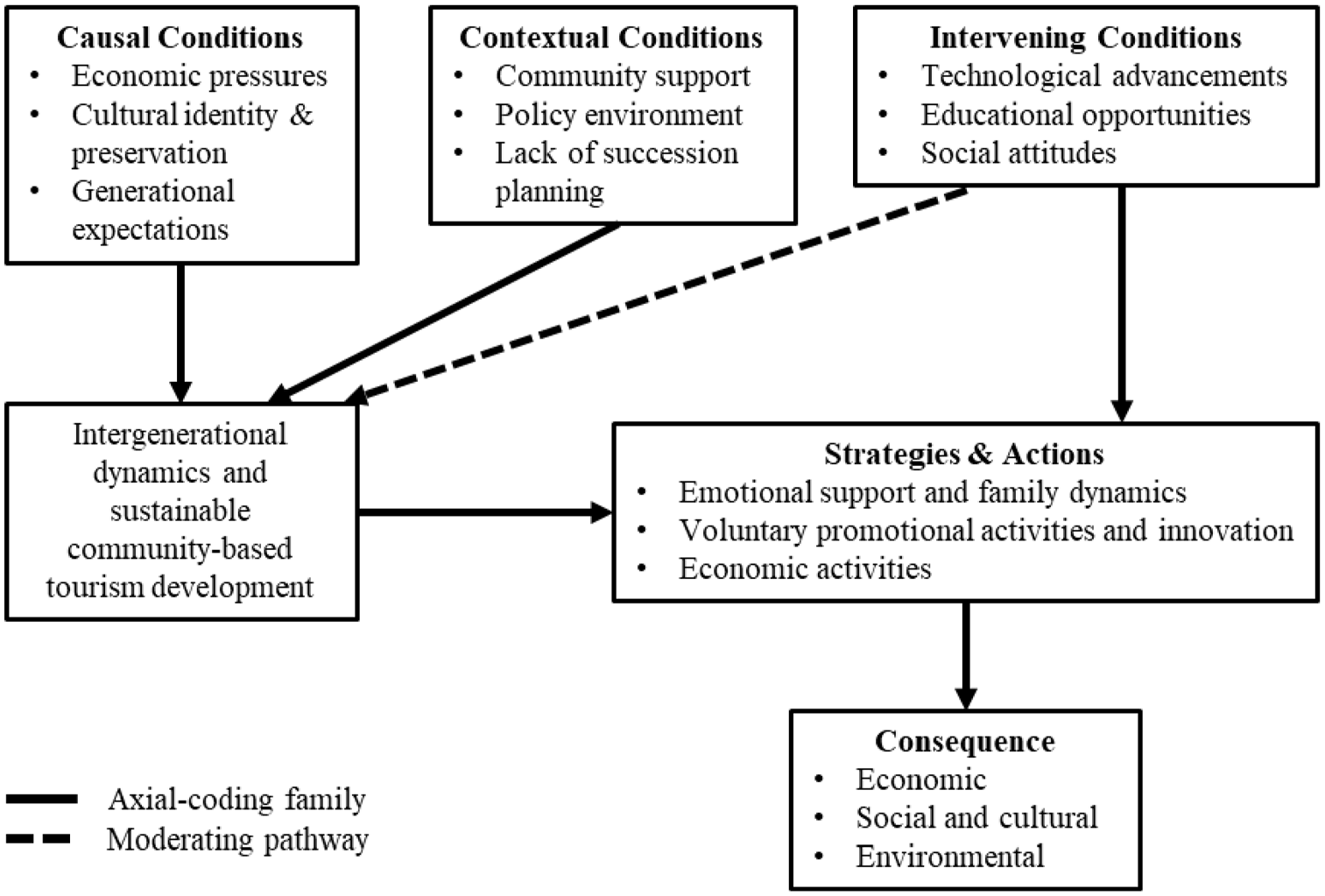
A grounded theory model for enhancing youth involvement in Koh Kret’s community tourism.
Having discussed the causal, contextual, and intervening conditions shaping youth engagement, the following subsection now delineates the specific strategies and actions undertaken to address these challenges.
Strategies and Actions
In response to these conditions, both older and younger participants have employed several strategies to cope with the challenges presented by intergenerational business transitions.
- Emotional Support and Family Dynamics: One key strategy was emotional support between family members, although this was unevenly distributed. Younger family members mentioned emotional stress and guilt associated with refusing to take over family businesses. However, some families managed to negotiate these dynamics by offering emotional support. As one younger participant stated, “My parents understand that I need to explore my own career first, and they support my decision” (S14).
- Voluntary Promotional Activities and Innovation: Many of the older business owners have turned to voluntary promotional activities to boost the visibility of their businesses. These included telling stories to tourists, running arts and crafts workshops (pottery), celebrating cultural festivals. The younger generations, in particular those who involved in digital marketing really made a difference when it came to these innovations. A younger participant noted, “We hit social media to brand our family business and it has impacted a lot. People who tour want to business show people behind the scenes” (S15).
- Economic Activities: Some families have adopted economic activities that bring modernizations but retains the authenticity of culture. These seem to be diversification through other product types and collaborating with businesses complementary to their operation to package tourism packages. You can now visit our shop and experience pottery’ as one business owner described to me “we cannot survive off pottery sales alone — we have to provide something tourists can partake in” (S12). Economic success relates to community engagement and the changes in tourism trends that are catered in new products.
Transitioning to the outcomes of these implemented strategies, the next subsection explores the consequences—economic, social, cultural, and environmental—that have emerged.
Consequences
- Economic Consequences: The consequences of these actions have been mixed. As economic consequences, it ranged from some families making bumper profits because they had taken to new ways to others being firmly squeezed. However, most of the old businessmen still had to be running money for the life time. As one participant stated: “Our revenue is up but not enough to cover (the) substantial increase in costs. The government must enhance its efforts significantly” (S11).
- Social and Cultural Consequences: Koh Kret has managed its cultural heritage to build a sense of community and attract tourists looking for a culturally enlightening experience. Yet with younger generations unwilling to pick up the businesses, it continues to be a pressing issue. Another older participant moaned, “If my children have to take it over this tradition will die with me” (S13).
- Environmental Consequences: Environmentally, the continued upsurge in tourist numbers represents a kind of double-edged sword as more prospective visitors also means that ecological sustainability of Koh Kret is being threatened. Despite the creation of cooperative programs like waste management, additional measures are required to ensure that the development of tourism is consistent with ecological integrity on this Island.
Discussion
Synthesizing these findings, the discussion now situates our empirical insights within the broader theoretical frameworks and literature, emphasizing practical implications and recommendations. The findings from this study highlight the complexity of intergenerational dynamics through the lens of intergenerational solidarity, showing how economic pressures, cultural obligations, and generational differences erode familial cohesion (Bengtson & Roberts, 1991). A grounded theory model for enhancing youth involvement in Koh Kret’s community tourism was proposed (Figure 1). In this model, the arrows indicate directional relationships where contextual conditions mediate between casual conditions and intergenerational dynamics, while strategies and actions lead to specific consequences. The economic pressures (casual conditions), cultural obligations, and generational differences (contextual conditions) present significant challenges to the sustainability of family-run tourism businesses. While elders perceive an obligation to safeguard cultural heritage through ritual-based festivals, younger generations prioritize economic sustainability and individual autonomy. This tension mirrors findings from previous research on intergenerational business transitions in tourism (Wang & Zhang, 2022). One of the paramount concerns delineated in the research is the absence of systematic succession planning, which has rendered the emerging generations inadequately equipped to assume leadership roles within familial enterprises. This is consistent with prior research, which has shown that family businesses often fail due to the absence of clear succession plans (Glowka & Zehrer, 2019). Another key finding is the role of sensory-driven experience pilots in sustaining tourism businesses, with younger members promoting them through digital platforms. This aligns with broader trends in sustainable tourism, where technological adaptation is increasingly seen as crucial to business longevity (Roblek et al., 2021). Nevertheless, this research underscores the necessity for policy interventions—phased digital mentorship (months 1–6) and community workshops (months 7–12)—are necessary to assist family enterprises. Phase 1 (1–6 months): Co-design digital literacy workshops for elders led by youth (e.g., Instagram storytelling). Phase 2 (7–12 months): Establish micro-grant schemes with local banks for youth-led heritage innovation (e.g., pottery-AI fusion exhibits). The lack of infrastructure and limited access to resources was frequently mentioned as a barrier to success, echoing findings from studies on community-based tourism in other developing contexts (Khunnikom et al., 2022). Youth reluctance remains a significant barrier to the continuation of family-run businesses. Cultural expectations and the younger generation’s desire for autonomy conflict with traditional views of familial responsibility, reflecting the growing disconnect between older and younger generations in the context of tourism. This issue calls for targeted strategies incorporating digital mentorship, micro-grants, simplified licensing, and formal youth mentorship programs to overcome local structural barriers in tourism.
Transferability vs. Context-Specificity
We emphasize that the proposed interventions are not universally plug-and-play. The 6-month phased digital-mentorship pilot is intrinsically place-bound: its success hinges on Koh Kret’s boat-centered mobility network and the clan-based Mon apprenticeship ethos. By contrast, the micro-grant template and the succession-planning checklist require only modest capital and light administrative oversight, making them readily exportable to other ASEAN river-island communities facing comparable generational and tourism-dependence pressures. The Limitations section specifies the socio-spatial boundaries that qualify this transferability.
Figure 1 positions Koh Kret’s community tourism within a socio-ecological system framework, revealing how macro-level policy and infrastructure gaps interact with deficits in community support and succession planning to intensify micro-level generational tensions. These multi-level interactions among causal, contextual, and intervening conditions then shape family strategies—emotional support and dynamics, voluntary promotional innovation, and economic diversification—that produce economic, socio-cultural, and environmental consequences. By embedding the model in socio-ecological systems theory, we extend beyond a purely familial lens to capture the systemic, cross-scale processes critical to sustainable community-based tourism.
Solid arrows indicate the five axial-coding families—Digital Mentorship, Financial Confidence, Cultural Continuity, Community Governance, and Ecological Stewardship—while dashed arrows denote the moderating pathways through which intervening conditions amplify or attenuate these core processes.
In summary, these interconnected findings underscore crucial implications for sustainable community tourism, informing both policy interventions and future research directions.
We have embedded Table 3, “Action Matrix for Youth Succession,” which distils the intervention into four analytically aligned columns—Actors, Barriers, Operational Model, and Timeline—and prefaced it with a concise, four-step implementation script that walks practitioners from mentor-pair identification, through micro-grant application, to a Loy Krathong prototype launch, and finally to formal succession-checklist filing; we further echo its policy relevance in the Conclusion by explicitly linking the matrix to Thailand’s “One Tambon One Product” scheme, thereby signaling a clear pathway from local pilot to national scalability.
Action Matrix for Youth Succession.

The intergenerational dynamics in Koh Kret’s tourism sector underscore the challenges and opportunities faced by family-run businesses. While older generations are deeply committed to cultural preservation, younger generations seek economic opportunities that align with modern career aspirations. Bridging this gap requires a multifaceted approach, combining innovation, emotional support, and policy interventions to ensure the sustainability of Koh Kret’s community tourism. The research provides significant contributions to the understanding of the influence of intergenerational relationships on the sustainability of tourism, thereby establishing a foundational framework for subsequent inquiries and the formulation of policy initiatives.
Limitations
Although this scholarly inquiry offers considerable advancements to the domain, it is essential to acknowledge several limitations that exist. First, the qualitative approach, although suitable for in-depth exploration, limits the generalizability of the findings beyond the specific context of Koh Kret. The relatively small sample size, although methodologically justified, might not fully capture all potential perspectives, particularly among younger community members who have relocated. Furthermore, dependence on self-reported information obtained from interviews may engender various biases, including social desirability bias, notwithstanding attempts to alleviate this concern through triangulation and member validation. Future research could incorporate quantitative methods and comparative studies across different contexts to enhance broader applicability. Koh Kret’s insular geography and Mon ethnicity create unique cultural capital transmission pathways distinct from mainland Thai communities. For instance, pottery traditions here involve clan-based apprenticeship—a factor less salient in non-insular CBT contexts. While our findings illuminate island-specific dynamics, future research should test transferability to riverine (e.g., Mekong Delta) or highland (e.g., Northern Thailand) communities where kinship structures and tourism commodification patterns differ.
Taken together, these caveats circumscribe the socio-spatial envelope within which our interventions can travel; readers will find a systematic mapping of these boundary conditions—distinguishing place-bound initiatives from readily exportable tools—in the preceding Discussion subsection, “Transferability versus Context-Specificity.”
Conclusion
This study has delved into the intricate intergenerational dynamics of Koh Kret’s tourism sector, validating the intergenerational solidarity construct by demonstrating how solidarity dimensions—affectual, associational, and normative—shape youth disengagement, including economic pressures, cultural identity and preservation, and generational expectations (Bengtson & Roberts, 1991). Through a grounded theory approach, we extend intergenerational solidarity theory by mapping how affectual, associational, and normative dimensions interact with market and policy pressures to drive youth disengagement. The findings reveal a complex interplay between older generations’ commitment to cultural preservation and younger generations’ aspirations for economic viability and personal autonomy.
This study exposed that explicitly linking between Table 3, “Action Matrix for Youth Succession,” and Thailand’s nationally endorsed “One Tambon One Product” (OTOP) initiative. This alignment underscores that our matrix is not only conceptually robust but also policy-ready, presenting an immediately actionable roadmap that dovetails with existing SME development frameworks. By framing the staged mentorship, micro-grant provision, and heritage prototype stalls within the OTOP policy architecture, we highlight how the model can transition from a localized pilot in Koh Kret to a scalable template for other communities across Thailand, thereby enhancing both its practical resonance and funding feasibility.
The economic pressures faced by traditional businesses, such as rising operational costs and limited profitability, deter the younger generation from assuming ownership. The cultural burden associated with preserving heritage crafts like pottery is perceived by youth as misaligned with modern career ambitions. Generational expectations exacerbate this divide, with familial obligations clashing against the desire for independence. Contextual factors, notably the lack of community support structures and insufficient policy interventions, further hinder the seamless transition of businesses across generations. The absence of formal succession planning leaves younger family members ill-prepared to take over, threatening the continuity of cultural traditions. Intervening conditions such as technological advancements, educational opportunities, and shifting social attitudes present both challenges and opportunities. While technology offers avenues for modernization and broader market reach, a digital divide hampers its adoption. Education equips youth with valuable skills but can also redirect their interests away from family enterprises. Changing social perceptions of success and career prestige influence the younger generation’s engagement with traditional businesses. In response, families have employed strategies like emotional support, voluntary promotional activities, and economic diversification. However, these efforts yield mixed results due to underlying structural issues. The study underscores the necessity for a multifaceted approach to bridge the intergenerational gap. Policy support emerges as crucial, advocating for governmental initiatives that provide financial incentives, cross-regional partnership, and marketing assistance tailored to small enterprises.
The proposed grounded theory model for enhancing youth involvement encapsulates these findings, offering transferable guidance for destinations seeking to integrate innovation with cultural preservation. By implementing co-design digital platforms, fostering open family dialogues, and aligning crafts with contemporary authenticity, there is potential to rejuvenate family-run businesses. This study recontextualizes intergenerational solidarity theory within entrepreneurial sustainability, demonstrating how affectual solidarity (e.g., emotional guilt) mediates youth disengagement—a dimension previously underexplored in tourism succession literature.
This research contributes to the broader discourse on sustainable tourism and community development by illuminating how intergenerational relationships shape the viability of cultural enterprises and offering insights for global tourism practitioners. It calls for policy makers, community leaders, educational institutions, and peer-to-peer online networks to collaborate in nurturing youth engagement while honoring cultural heritage. Future research should implement ritual-driven sensory pilots and assess their effectiveness across cultural contexts in sustaining community tourism. Additionally, investigating the role of external stakeholders, such as tourists and global markets, can provide deeper insights into sustaining traditional businesses in a rapidly evolving economic landscape. In essence, the sustainability of Koh Kret’s community tourism hinges on reconciling the values and aspirations of both generations. By embracing innovation without forsaking tradition, and through concerted efforts at the familial, community, and policy levels, it is possible to ensure that the rich cultural tapestry of Koh Kret continues to thrive for generations to come.
Footnotes

Ethical Considerations
Not required per APA Ethics Code 8.05 (non-sensitive topic, cultural consent norms). This qualitative investigation involved low-risk, non-clinical conversations about community tourism. Interview guides avoided sensitive personal or medical questions, and data were anonymized at source. Audio files and transcripts are stored on an encrypted drive available only to the research team.
Consent to Participate
Verbal consent obtained after full oral disclosure of research parameters. Prior to each interview, participants received an oral explanation of the study’s purpose, the voluntary nature of participation, the right to withdraw without penalty, and the steps taken to protect confidentiality. Consistent with Koh Kret’s cultural norms, participants then provided verbal informed consent. No incentives were offered, and no identifying information appears in the manuscript.
Funding
The authors disclosed receipt of the following financial support for the research, authorship, and/or publication of this article: The author would like to express sincere gratitude to Xi’an International University (XAIU), China, for Initiation Funds for High-level Talents Program of Xi’an International University (grant no. XAIU202526) for carrying out this successful work.
Declaration of Conflicting Interests
The author declared no potential conflicts of interest with respect to the research, authorship, and/or publication of this article.
Data Availabilty Statement
Data sharing not applicable to this article. As no data sets were generated or analyzed during the current study.