




Abstract
Facial recognition services (FRS) are renowned for their efficiency and convenience, yet consumer skepticism persists due to psychological security awareness about privacy and usability, which is affecting their desirability in the hospitality sector. This study draws on the Protection Motivation Theory (PMT) to identify the determining factors and moderating effect of age that influence the adoption of hotel FRS. A combined approach using partial least squares structural equation modelling (PLS-SEM) and artificial neural networks (ANN) is employed to predict the willingness of 300 Generation Z tourists to use hotel FRS. Results of the PLS-SEM model revealed that perceived severity and perceived vulnerability demonstrated directly lower Generation Z’s acceptability for hotel FRS, while coping appraisals (self-efficacy) directly improve the acceptance of FRS by Z generation hotels. The findings of the ANN model indicated that self-efficacy is the most important predictor of willingness to use hotel FRS, followed by perceived severity and perceived vulnerability. Furthermore, the results of the multiple group analysis indicate that gender plays a significant moderating role in the relationship between response cost and willingness to use hotel FRS. This proposed framework contributes to understanding the psychological mechanisms of tourists using FRS in hotels.
Keywords
Introduction
The hospitality sector has encountered a number of challenges in recent years (Tussyadiah, 2020). With technological advances, it has become imperative to integrate technology into this sector to enhance service speed and efficiency, and to elevate the tourist experience (Grundner & Neuhofer, 2021). In today’s world, where technology is playing an increasingly influential role, it is evident that biometrics are becoming a crucial tool for personalizing and enhancing the user experience, as well as streamlining services. These biometric technologies, including facial recognition systems, are being widely adopted and are gradually replacing traditional authentication methods (David-Negre & Gutiérrez-Taño, 2024; Neo & Teo, 2022).
Facial recognition system has been demonstrated to be a valuable tool for a range of industries, particularly the hospitality sector (Boo & Chu, 2022; Hwang et al., 2024; Joo et al., 2024; Kim et al., 2024a, 2024b). Deploying facial recognition service (FRS) in this industry enhances security and operational efficiency in hotels by optimizing the check-in process, enhancing authentication accuracy to deter fraud and theft, and guaranteeing the safety of guests and staff (Morosan, 2019, 2020; Xu et al., 2021). FRS can facilitate touchless interactions in hospitality services, which is particularly important in the post-Covid pandemic context; for example, in hotels, FRS can streamline the check-in and authentication process, thereby increasing speed and convenience (Ciftci et al., 2021; Hwang et al., 2024). Furthermore, Statista Research Department (2024) reported the global Facial Recognition market size was valued at US$4.94 billion in 2024 (Statista Research. It is expected to reach US$8.44 billion in 2030 at a compound annual growth rate of 9.34%In recent years, a number of pioneering hotels, including the FlyZoo Hotel in China and the Hennna Hotel in Japan, have begun to utilize intelligent facial recognition technology with a view to enhancing their guest check-in services and operational efficiency (Xu et al., 2021).
Furthermore, the ageing of the global population is resulting in a shortage of labor in some countries and regions, including Taiwan. Taiwan's persistent labor shortage and rising labor costs, coupled with the popularity of Covid-19, present a significant opportunity for the introduction of FRS (Yang & Chew, 2021). Further, the total number of foreign tourists visiting Taiwan in 2023 exceeded 6.4 million (Tourism Statistics Database of Tourism Administration, 2024). As the capital and an international tourist city, Taipei often experiences long queues at hotel counters during peak seasons or rush hours, affecting customer experience and service efficiency. FRS automates check-ins, reduces wait times, and increases operational efficiency while improving customer safety by preventing safety and theft. As FRS are relatively new in Taiwan's hotel sector, an integrative understanding of the factors influencing consumer intention to use the FRS in hospitality is crucial for the success of the hoteliers’ governance initiatives (Boo & Chua, 2022).
It is crucial to select an appropriate theory to assist users in understanding the processes of technology adoption and utilization more effectively. Several studies have conducted research on users' intention to accept face recognition technologies using models such as such as Task Technology Fit (TTF), Unified Theory of Acceptance and Use of Technology (UTAUT), Diffusion of Innovation (DOI), Technology Acceptance Model (TAM), and Theory of Planned Behaviour (TPB) (e.g., Boo & Chua, 2022; Hizam et al. 2021; Joo et al. 2024; Kim et al. 2024a, 2024b; Moriuchi, 2021). Nonetheless, these models are not without flaws. These models have not explored the individuals’ willingness to use FRS from the perspectives of privacy-security. In contrast, Protection Motivation Theory (PMT) (Roger, 1975) is considered to as one of the most predictive models for anticipating why people’s motives for participating in preventive actions against perceived technology security when adopting new technology usage (Mahmud et al., 2023).
PMT postulates that people will carry out a cognitive process when confronted with threats, weighing the advantages and disadvantages and subsequently generating self-protective motivation and coping behaviors (Floyd et al., 2000). The PMT framework has also been widely adopted within the field of information and communication technology, offering insights into users' coping behaviors in the context of technological risks (e.g., Mousavi et al., 2020; Zhang & Zhang, 2024). Consequently, the current study utilizes the PMT as the fundamental framework for conceptual organization.
In addition to the technological revolution, there is a notable demographic shift occurring among consumers in the hospitality industry (Chen et al., 2022). Specifically, Generation Z in particular has become the largest generation and makes up a third of the world's population (Chen et al., 2022). In accordance with the generational theory (Strauss & Howe, 1991), this generation has been shaped by distinctive socio-economic and technological influences. As consumers, they manifest distinctive values, beliefs and lifestyles, which necessitates an investigation of their behavior within the hospitality industry (Kumar, 2022). Moreover, despite Generation Z's nascent careers and evolving income levels, they represent a significant consumer segment with high spending power (Romero & Lado, 2021) and a proclivity for leisure travel (Pant, 2022). This makes them a pivotal demographic for the hospitality industry in the coming decade (Liu et al., 2022). Also, despite the lack of experience this generation has in staying in hotels independently, their preferences and behaviors are significant in the pre-travel phase of a family's holiday decision-making process (Ozdemir-Guzel & Bas, 2021). Additionally, Generation Z has been significantly influenced by digital technology from an early age, resulting in a high level of technological literacy (Fu et al., 2024). They frequently act as early adopters of emerging technologies, which in turn drive service innovation and technology adoption in the service sector (Vitezić & Perić, 2021). In light of the aforementioned considerations, this study has elected to focus its inquiry on the Generation Z demographic, with the aim of elucidating their intentions towards the utilization of hotel FRS from a standpoint of privacy-security.
Furthermore, extensive research has demonstrated that gender is a key factor influencing the adoption of innovative technology (e.g., Chen & Liu, 2021; Mahmud et al., 2023; Terblanche & Kidd, 2022). Nevertheless, the role of gender in studies on FRS acceptance remains unclear. Additionally, identifying the differences in factors influencing the intention to use FRS between domestic and international tourists can help hotels develop targeted strategies tailored to their specific markets. Domestic and international tourism are significant contributors to hotel revenue (Mechinda et al., 2009), yet existing studies on tourists’ acceptance of FRS have not considered the impact of cultural differences. As a result, this study introduces gender and nationality as the moderator into the model, thereby further expanding the conventional PMT framework.
To sum up, the present study has two principal objectives. First, it aims to appraise the constructs of PMT (perceived severity, perceived vulnerability, self-efficacy, response efficacy and response cost) on Generation Z tourists’ willingness to use hotel FRS for concern of privacy and security. Second, it seeks to evaluate the moderating effect of gender and nationality influencing the connection between PMT constructs and the willingness to adopt FRS for privacy and security concerns.
This article addresses the recognized research gap in the context of FRS adoption behavior in the hospitality industry by achieving these research objectives. This study also offers valuable insights for the development of FRS in the hospitality sector by identifying the role of five key attributes that are critical to FRS adoption (i.e., perceived severity, perceived vulnerability, response cost, response efficacy, and self-efficacy). Finally, this study provides a broader theoretical-practical insight by examining gender and nationality differences in the context of FRS adoption behavior in the hotel sector.
The purpose of this research will address existing gaps in various ways. Thus far, the hospitality studies apply the PMT model or assess its effect on FRS acceptance are rarely. This research successfully tackles a notable void present in the current by developing current knowledge of users’ FRS acceptance intention. This study explores how the threat appraisal and coping appraisal on Generation Z's acceptance for hotel FRS. Furthermore, previous studies on FRS that employed the PMT model have solely utilized cross-sectional methods (Li et al., 2024; Nguyen et al., 2023; Ryu et al., 2023). To bridge these gaps, this study employs a hybrid approach by merging Partial Least Squares Structural Equation Modelling (PLS-SEM) parameter estimation with Artificial Neural Network (ANN) methodology to estimate the proposed model. This approach provides a more comprehensive explanation of the tourist's decision-making process (Leong et al., 2020).
Literature Review and Hypotheses Development
Overview the PMT Framework
PMT offers insight into the framework for predicting the adoption of protective technologies by emphasizing the key role of threat and coping appraisals in people's defensive actions (Rogers, 1975). Threat appraisals focus on “perceived severity (PS)” and “perceived vulnerability (PV)” linked to safe or adaptable actions, whereas coping appraisals are characterized by “response cost (RC),”“response efficacy (RE)” and “self-efficacy (SE).” This research develops a theoretical framework based on the protection PMT model to explain customers’ willingness to use hotel FRS. The PMT framework was selected for this study because it can comprehensively explain and predict consumers’ willingness to use AI-based products (Al-Sharafi et al., 2023).
The tourism and hospitality literature exhibits the PMT is a useful theoretical framework for comprehending people’s adoptions of self-protection behaviors (Wen & Liu-Lastres, 2022; Zheng et al., 2022). For instance, Li et al. (2024) utilized the PMT to predict the resident hospitality amidst COVID-19. Ryu et al. (2023) investigated the role of protection motivation in influencing restaurant patrons’ intentions for self-protection as the epidemic was occurring. Nguyen et al. (2023) combined PMT and theory of interpersonal behavior to explore the motivational and interpersonal factors that influence intention toward sustainable tourism.
FRS technology often raises concerns about privacy, surveillance, and potential misuse, making threat perception a critical role in its acceptance. To emphasize these concerns, PMT will be ideal for this study to evaluate how individuals judge the potential security benefits of FRS (e.g., guest profiling and service customization, privacy protection, faster identification) against privacy risks.
Threat Appraisal—PS and PV Hypotheses Development
Perceived severity (PS) denotes an individual appraise of the extent of severity level of the potential outcomes of an unexpected event (Skalkos et al., 2021). When individuals perceive the extent of threat severity and are vulnerable to that threat, they may evade it or elicit objection behaviors (Sun et al., 2013). Previous research confirmed a higher extent of perceived severity and seriousness of threat decreases the likelihood of individuals adopting recommended actions (Al-Sharafi et al., 2023; Upadhyay et al., 2022). When individuals perceive the severity of a security event as high, they increasingly implement protective measures (Sommestad et al., 2015).
The study conducted by Rodríguez-Priego and Porcu (2022) revealed that the PS has a negative impact on users' intention to adopt location-based mobile apps. Similarly, scholars have found that PS negatively affects students' intention to adopt mobile cloud computing (Alnajrani & Norman, 2020; Nikkhah et al., 2024). In the hospitality sector, Byrd et al. (2022) exposed that the higher the perceived severity of a threat, the less likely individuals were to dine in restaurants. These results imply that if users feel a security threat is serious and possible by the hotel’ FRS, they may become less willing to use it. Therefore, we hypothesize that:
H1. PS has a negative impact on willingness to use hotel FRS.
Perceived vulnerability (PV) implies the degree to which an individual feels that they are susceptible to the threat (Lee et al., 2008). Threat appraisals use PV to explain individuals’ risk appraisals of dangerous encounters (Woon et al., 2005). PV normally relates to the subjective probability of a security threat actually occurring (Verkijika, 2018). The study also affirms PV is relevant to the possibility an individual may become a victim of an unforeseen event, such as a breach of data protection (Vance et al., 2012).
The adoption of new technology is contingent upon the assessment of risks, as the PV has an adverse impact on the implementation of novel technologies (Kim et al., 2010). The study discovered that concerns over privacy regarding biometric technology (specifically PV) significantly diminish employees' willingness to embrace such technologies at work (Carpenter et al., 2018). Scholars have highlighted the effect of PV on the behavioral intentions of different AI tools and systems (Al-Sharafi et al., 2022; Park et al., 2024; Zhang & Zhang, 2024). Kumar and Shankar (2024) demonstrated a negative impact of PV on retail metaverse banking. Similarly, another study exposed that consumers’ PV of threat appraisal negatively affects consumer behavior toward junk food in hospitality (Li et al., 2022). In this study, PV denotes a person’s susceptibility to the threat from the hotel FRS. Regarding FRS security in hotels, PV can be interpreted as the extent to which consumers believe hotel FRS are at risk of security threats. Thus, hypothesis two is:
H2. PV has a negative impact on willingness to use hotel FRS.
Coping Appraisals-RC, RE and SE Hypotheses Development
The goal of coping appraisals was to evaluate people's capacity to handle a threat and how the way they cope with it (Seow et al., 2022). It includes RC, RE and SE. RC refers to the perceived difficulties or barriers that individuals may face when using FRS (Rainear & Christensen, 2017). Consumers would apply various resources, including money, time and effort to usage FRS. Subsequently, they will exploit the perceived capacity of the FRS to circumvent or diminish the risks in comparison to the potential costs associated with its utilization.
The literature on PMT has consistently shown a strong correlation between RC and behavior intention across various contexts (Floyd et al., 2000). Previous study confirmed that RC had a detrimental effect on various innovations in technology (Al-Emran et al., 2021). Recently, Stylios et al. (2022) also evidenced RC negatively impacts individuals’ intention to use behavioral biometrics continuous authentication technology. Al-Sharafi et al. (2023) found that RC had a negative influence on their green behavior. It is reasonable to argue that as operating expenses and effort rise, Generation Z's intention to use FRS will decrease. Thus:
H3. RC has a negative impact on willingness to use hotel FRS.
RE indicates individuals' belief that technology’s protection measures offer their privacy both sufficiently and effectively (Johnston & Warkentin, 2010). RE is thought to have a significant influence on the acceptance of new technologies (Al-Emran et al., 2021; Skalkos et al., 2021; Srivastava et al., 2021). Recently, Al-Sharafi et al. (2023) found that individuals’ eco-friendly behavior was greatly influenced by RE. The literature confirmed that RE can directly promote resident hospitality (Li et al., 2024), and social sustainability of AI chatbots (Arpaci, 2024). This study makes the similar claim that individuals are more likely to use FRS if they believe that FRS is effective in protecting them from security incidents. Thus:
H4. RE has a positive impact on willingness to use hotel FRS.
The degree to which SE is effective correlates with FRS user’s capacity to protect personal privacy and data (Alalwan et al., 2024; Lee & Rha, 2016). Studies have shown that consumers with high SE are more likely to share personal information with businesses in order to receive high levels of customization, and they are also less likely to worry about privacy (Al-Emran et al., 2021; Al-Sharafi et al., 2023). Earlier research has indicated that SE significantly influences users' behavior towards adopting various technologies (Al-Emran et al., 2021). Latest research into what drives the adoption of AI products revealed that SE plays a key factor in determining the environmental sustainability of these products (Al-Sharafi et al., 2023). The literature confirmed that SE can directly promote resident hospitality (Li et al., 2024), and social sustainability of AI chatbots (Arpaci, 2024). As such, it is assumed that If Generation Z feels confident in their capabilities to use new technology, the likelihood of Generation Z embracing technology will increase. Thus:
H5. SE has a direct positive influence on willingness to use hotel FRS.
Gender as a Potential Moderator
Gender plays a pivotal demographic factor, significantly shaping technology acceptance and adoption behavior intentions through both direct and indirect effects (Venkatesh, 2000). It is therefore crucial to understand how gender impacts technology adoption behaviors, given its prominence in the field of consumers’ new technologies acceptance literature (Kim et al., 2023; Mahmud et al., 2023; Radic et al., 2022; Terblanche & Kidd, 2022). Prior research has demonstrated that males tend to exhibit a heightened interest in technology as a whole. Conversely, females have been shown to be more responsive to perceived threat signals and engage in preventive interventions and actions (Guo et al., 2015). However, the findings of the Ameen et al. (2020) study indicated that females were more vulnerable to security threats than males. Furthermore, the nexus between perceived security and behavior intentions can be moderated by gender (Ooi et al., 2021). Chen and Lu (2021) also suggested that the nexus between PS, PV, RC, RE and protection motivation can be moderated by gender. In light of the findings presented by Mahmud et al. (2023), within the framework of PMT, gender has been shown to be the categorical moderating role connected between RE and intention, along with RC and intention. Additionally, Radic et al. (2022) delineated the considerable moderating influence of gender on travellers' acceptance of cryptocurrency transactions. However, there remains a lack of clarity regarding gender's role in technology-driven security research. Moreover, the incorporation of gender as a moderator in the PMT model markedly enhances the model’s explanatory power (Chen & Lu, 2021; Mahmud et al., 2023; Ooi et al., 2021; Radic et al., 2023). Based on the aforementioned studies, we have formulated the following hypotheses.
H6a. Gender moderates the PS and WTU relationship.
H6b. Gender moderates the PV and WTU relationship.
H6c. Gender moderates the RC and WTU relationship.
H6d. Gender moderates the RE and WTU relationship.
H6e. Gender moderates the SE and WTU relationship.
Nationality as a Potential Moderator
It is widely acknowledged that nationality and cultural differences play a pivotal role in technology-based service research (Joo et al., 2024; Kim et al., 2024a, 2024b; Martínez-Navalón et al., 2023). A substantial amount of research indicates that nationality and cultural factors play a pivotal role in shaping tourist behaviour and influencing tourism demand (Guo et al., 2024; Liu et al., 2021; Maghrifani et al., 2024). In particular, the impact of nationality and cultural differences on customer technology adoption has been identified in a number of contexts, including online travel booking services (Li & Zhu, 2023), NFC mobile wallets (Shin & Lee, 2021), and face recognition payments (Hwang et al., 2024; Joo et al., 2024; Kim et al., 2024a, 2024b) have also identified the impact of nationality/cultural differences on customer technology adoption. This includes AR and VR technologies (Jung et al., 2018; Guo et al., 2024).
Additionally, the literature also reveals that nationality differences play a significant role in tourists’ behaviors (Maghrifani et al., 2024), and the international and domestic travellers have different travel intentions and behavior (Das & Tiwari, 2021). By applying these insights to the study, it is anticipated that domestic and international tourists may be motivated by different aspects of hotel FRS services, influencing their willingness to use FRS devices. The following hypotheses are grounded in the aforementioned literature.
H7a. Nationality difference moderates the PS and WTU relationship.
H7b. Nationality difference moderates the PV and WTU relationship.
H7c. Nationality difference moderates the RC and WTU relationship.
H7d. Nationality difference moderates the RE and WTU relationship.
H7e. Nationality difference moderates the SE and WTU relationship.
In light of the study’s objectives, we propose the following research model (Figure 1). The model identifies five independent variables: PS, PV, RC, RE, and SE. These variables are used to predict the intention of Generation Z consumers to use FRS. The connections between the independent and dependent variables were then examined in relation to the subjects’ gender and nationality. By confirming gender and nationality as moderating factors, we emphasize the key distinctions between the sexes and nationalities in specific interactions.
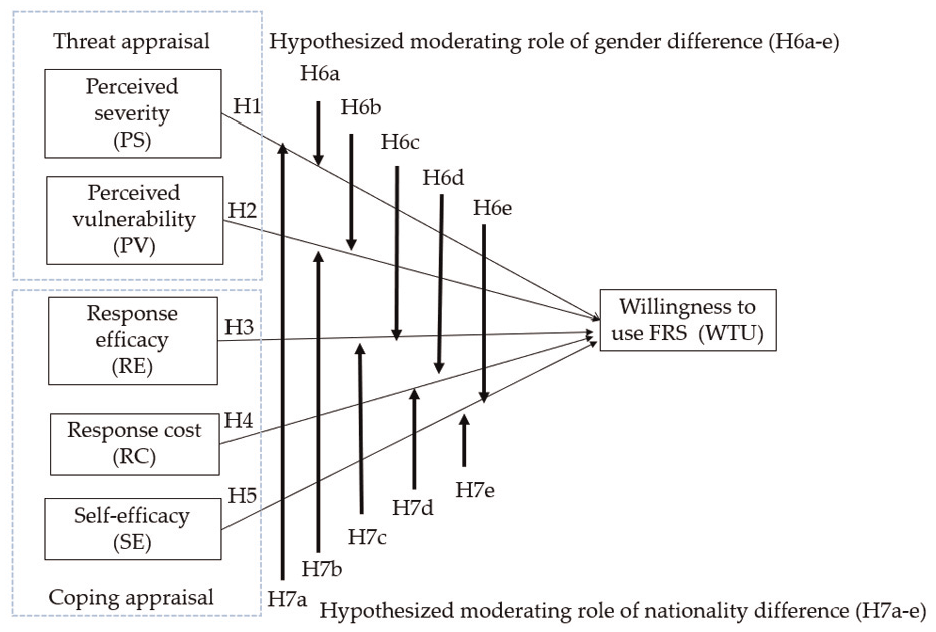
Conceptual model.
Method
Data Collection Procedures and Sample Description
The purpose of this research is to investigate how Generation Z’s willing to use hotel FRS, defined as those born from 1995 to 2010 (Trifan & Pantea, 2023). This generation possesses the required competencies and information to proficiently handle the digital world and exhibits a strong penchant for cutting-edge technologies, according to Al-Sharafi et al. (2023). They seamlessly incorporate AI products in their daily activities due to a greater comfort level and knowledge of innovations. However, it is prohibited for individuals of Generation Z below 18 years of age to reside alone in a hotel. Accordingly, this study confines the extent of Generation Z from the year 1995 to 2005.
Following a comprehensive review of the literature and the framework of the study, a cross-sectional research design with a mall intercept survey technique was used. Mall intercept surveys have been employed in numerous previous studies, including those conducted by Mansoor et al. (2024), Rahman et al. (2024), and Riva et al. (2024). The key advantages of mall intercepts, which led to the selection of this method for the current study, include the ability to collect data representing a broader range of consumer perspectives and the expediency with which data can be gathered (Zikmund et al., 2007).
To empirically validate the proposed research model, responses were collected from various tourist sites in Taipei City, a well-known tourist destination in Taiwan, including the shopping mall (Taipei 101) and Shilin Market, through a face-to-face interview. Compared to an online survey, a face-to-face survey has the advantage of increasing the response rate, increasing respondents’ engagement and attention, reducing misunderstandings, and allowing spontaneous questions (Zeng et al., 2019). To overcome the limitations of data collection in the mall, we also applied the strategy of a time- and place-based systematic approach (Bauer & Strauss, 2016). We observed that the peak time of the mall is between 6:30 pm and 9:30 pm, and then survey questionnaires were distributed to skilled interviewers and were approached the respondents. We asked every participant to complete only one questionnaire and were given a reward with a small gift. Throughout the study, we explained the purpose of this survey to the participants and highlighted the option to participate voluntarily and anonymously and ensured participants of the security of their data.
The questionnaire was originally drafted in English but later translated into Chinese by a group of hospitality scholars who are proficient in both languages. To verify the content of translation authenticity, we conducted a pilot study to gather feedback on the questionnaire. Some of the sentences have been modified to be more comprehensible, and certain questions have been reorganized to improve the coherence of the survey’s structure. Slight adjustments were made to the phrasing of each item to ensure its relevance to the survey’s context.
Over the course of a month (10 March 2023–9 April 2023), we invited 330 participants to take part in our research. We always extended polite invitations to interested tourists. Our team approached participants randomly, and the participants completed self-administered questionnaires. Each participant gave verbal consent, and they were assured their privacy, and anonymity would be rigorously protected throughout the study. Further, the institution’s Research Ethical Board supervised and approved the ethical guidelines during the data collection. The procedures used in this study adhere to the tenets of the Declaration of Helsinki.
After 30 invalid questionnaires were eliminated, the final dataset consisted of 300 responses, with a comprehensive breakdown of demographic information presented in Table 1. The survey data revealed that 58% of the 300 cases were female respondents, and the remaining 42% were male respondents. Domestic tourists constituted the majority (83.7%), while foreign tourists accounted for the remaining 16.3%.
Demographic Profile.

Measures
The PMT measurement items, PV, PS, SE, RE, and RC, were adopted directly from Skalkos et al.’s (2021) study of the PMT model development. The willingness to use (WTU) FRS was sourced from Venkatesh et al. (2012); however, the wording was tailored to suit the context for each survey version. The measurements were executed using a five-grade Likert scale, ranging from 1, meaning strongly disagree, to 5, meaning strongly agree (see Appendix A1). The final section of the survey records participants’ demographic information.
Sample Size
Before conducting PLS-SEM, this study used G*POWER version 3.1.9.7 to assess the statistical power of the sample size (N = 300) against Faul et al.’s (2009) recommendations. For a two-tailed test with a 0.05 error probability and a moderate effect size (0.30), the power (1-β error probability) exceeded the recommended threshold of 0.80, registering at 0.999.
Data Analysis Method
First, given the small number of samples in the present investigation, the research model was analyzed using SmartPLS 4 software with partial least squares SEM (PLS-SEM). PLS-SEM approach is capable of predicting complex models without needing to meet normally distributed assumptions, making it ideal for predicting non-normal datasets. To evaluate the distribution normality assessment, the Shapiro–Wilk and Kolmogorov–Smirnov (K-S) tests were adopted, and their results confirmed the validity of using PLS-SEM.
In the latter stage, this study adopted the ANN approach for analysis. Prior studies on FRS have mainly used single-stage data analysis, with a primary focus on SEM (Boo & Chua, 2022; Li & Li, 2023). Research has indicated that to address this shortcoming, a combination of a SEM model (characterized by linearity and compensation) and a deep learning-infused ANN model (noted for its nonlinearity and non-compensatory nature) leads to more prediction accuracy (Lee et al., 2016). Study has evidenced that ANN is highly effective in predicting social sustainability of AI Chatbots (Arpaci, 2024). Furthermore, the ANN model could recognize both linear and nonlinear correlations among different variables, unlike conventional linear statistical techniques. Additionally, the model is robust, adaptable, and independent of distributional assumptions like linearity, normality, and homoscedasticity (Leong et al., 2020). Finally, Ahani et al. (2017) pointed out that the limitation of SEM analysis in ranking independent variables may restrict its effectiveness in IT/IS adoption studies. To address this limitation, this article presents a combined framework of a two-step SEM procedure and ANN analysis.
Results
Non-Response Bias
Aligning with Hew and Kadir (2017), independent t-tests were used to assess non-response bias for each key variable for early (150) and late (150) respondents. PS (t = −1.093, p = .275), PV (t = 0.306, p = .760), RC (t = −0.302, p = .763), RE (t = 0.442, p = .658), SE (t = −1.087, p = .278), and WTU (t = 0.160, p = .873) have no significant differences. Consequently, non-response bias is not a significant concern in the present research.
Common Method Bias
As this research collected data on multiple variables from the same respondent group, there may be common method bias (CMB) (Loh et al., 2021). In order to achieve this, both procedural and statistical remedies were implemented to address this (Kock, 2015). Regarding our procedure, we used simple language for the questionnaire design to assure the questions in the questionnaire were concise enough to avoid misinterpretation of the questions by the CMB. For this purpose, our items were derived from scales that have been previously validated. In addition, respondents were assured anonymity during the data collection phase and were informed that there was neither a right nor a wrong answer to each question, thus reducing bias due to social desirability (Hew et al., 2018). Furthermore, the survey distinguished between questions pertaining to independent variables and those concerning dependent variables (Nguyen & Llosa, 2023). Drawing on the findings of Harman's single factor test, the single factor explains 37.019% of the common variance, which is significantly below the 50% threshold (Podsakoff et al., 2003). Furthermore, after conducting a thorough collinearity test, it was found that the VIF values (ranging from 1.823 to 3.2) were below the 3.3 threshold (Kock, 2015). Finally, in line with the recommendations set out by Lindell and Whitney (2001), we utilized the marker variable technique to evaluate CMB. The marker variable selected was not theoretically linked to any other constructs in the research framework (Cheng et al., 2020). After incorporating the marker variable did not result in a significant change in the level of significance or the coefficients. Furthermore, the test results confirmed the marker variable had no significant effect on the R2 values (R2 without market variable = 0.539, with market variable = 0.540), representing a change of less than 10% (Lindell & Whitney, 2001). It can therefore be concluded that the issue of CMB does not represent a significant concern in the context of this study, which has focused on the results of three distinct examinations.
Multivariate Statistical Assumptions
The one-sample K-S test was used to verify the normality of distribution. All p-values are smaller than 0.05, implying a non-normal distribution of the data. Because of the non-normal distribution, the variance-based SEM was preferred over the covariance-based SEM due to its increased resilience to non-normal distributions (Leong et al., 2020). SmartPLS 4 is applied to evaluate and test the research hypotheses.
Multicollinearity was checked against variance inflation factor (VIF) and tolerance values. All VIF values were observed to be below 3.3 and above the tolerance level of 0.2 (Hair et al., 2011), suggesting there is no multicollinearity in the independent variables.
ANOVA tests on `deviation from linearity' assumptions were used to assess linear relationships (Hew & Kadir, 2017). PS (p = .789) has a linear relationship with WTU, and PV (p = .043), RC (p = .002), RE (p = .026), and SE (p = .008) have non-linear relationships with WTU. Levene's test (Levene statistic=1.626, p = .026) for homogeneity of variance was conducted to assess homoscedasticity.
Outer Model Assessment
As shown in Table 2, all values of composite reliability (CR), Cronbach's alpha, and Dijkstra Henseler's (rho_A) exceed the 0.7 threshold, indicating that the data are reliable (Loh et al., 2021). Convergent validity is evaluated using the average variance extracted (AVE) and factor loading. With the exception of RC1, all factor loadings exceed the threshold value of 0.70 (Loh et al., 2021). The AVE values range from 0.739 to 0.816, exceeding the minimum threshold of 0.50 set by Fornell and Larcker (1981). Both criteria indicate that the measurement model has good convergent validity.
Factor loadings, Cronbach’s α, rho_A, CR, and AVE.

Note. PS = perceived severity; PV = perceived vulnerability; RC = response cost; RE = response efficacy; SE = self-efficacy; WTU = willingness to use FRS.
p < .05; **p < .01.
In affirming discriminant validity, the Fornell-Larcker (1981) guideline was applied, stipulating that each construct's AVE square root be greater than its correlation coefficient with other constructs (Table 3). Besides, all Heterotrait-Monotrait (HTMT) values (Henseler et al., 2015) are lower than 0.85 (Table 3), meaning there is less correlation among constructs which meets Khan et al.’s (2007) HTMT (<0.85) conditions. As a result, the model demonstrates adequate reliability, discriminant validity, and convergent validity.
Discriminant Validity.

Note. Below the diagonal, correlations between constructs are presented; while the main diagonal displays the square root of the AVE values highlighted in bold; above the main diagonal, the HTMT values are provided.
Inspecting Inner Structural Model
Using 5000 sub-samples, a bias-corrected and accelerated bootstrap procedure was used to test the inner structural model (Hair et al., 2011). Table 4 and Figure 2 display the results, indicating support for all hypotheses except for H3 and H4. Specifically, PS and PV were found to negatively affect WTU (β = −.131, p < .05; (β = −.145, p<0.01). Accordingly, H1 and 2 were corroborated. The outcomes indicated that the perceived severity and vulnerability of threats could diminish Generation Z’s willingness to use hotel FRS. Moreover, SE was found to positively affect WTU (β = .519, p < .001), which supports H5. These results indicated that when Generation Z have high self-efficacy against FRS, they tend to be willing use the FRS. Together, these antecedents explain 53.9% of the variance in WTU.
Structural Model Assessment.


Standardized theoretical path coefficients.
Predictive Relevance, Effect Size and PLS Predict
This study employs the optimal approach recommended by Hair et al. (2017) for the assessment of the predictive relevance of the research model. With respect to the effect size for every hypothesis, it is evident SE has a moderate effect towards WTU, surpassing the moderate threshold value of 0.15 (Cohen, 2013). PV has a smaller effect size on WTU surpassing the cut-off value of 0.02 (Cohen, 2013), and other paths have no effect size (Table 4). Additionally, the WTU construct's Q2 predictive score was above zero, signifying that that PLS-SEM's predictive capability exceeds that of the most fundamental benchmark (Evermann & Tate, 2016). Moreover, the errors in predicting WTU displayed a symmetrical distribution. Therefore, the evaluation of predictive accuracy ought to rely on RMSE (root mean squared error) rather than MAE (mean absolute error). Table 5 reveals that every RMSE score surpasses the PLS-SEM RMSE score, demonstrating the model's substantial predictive ability.
PLS Predict Results.

Global goodness-of-fit evaluation
The present study also performed a confirmatory composite analysis to assess the goodness of fit of our saturated model (Table 6). The results demonstrate that the standardized root mean square residuals (SRMR) was 0.054, which is below the threshold of 0.080 (Hu & Bentler, 1998; Henseler et al., 2016; Benitez et al., 2020). Furthermore, the SRMR, dULS, and dG were within the 95% and 99% quantiles of bootstrap discrepancies (Henseler et al., 2016; Benitez et al., 2020). Additionally, the goodness of fit (GoF) of the model constructed in this study was 0.647, which exceeded the high threshold of GoF of 0.36 (Tenenhaus et al., 2005). This indicates that the proposed model has a good fit with the measurement model.
Global Goodness of Fit.

Note. SRMR = Standard Root Mean Squuare Residual; dULS = Unweighted Least Squares Discrepancy; dG = Geodesic Discrepancy.
Multi-Group Analysis)
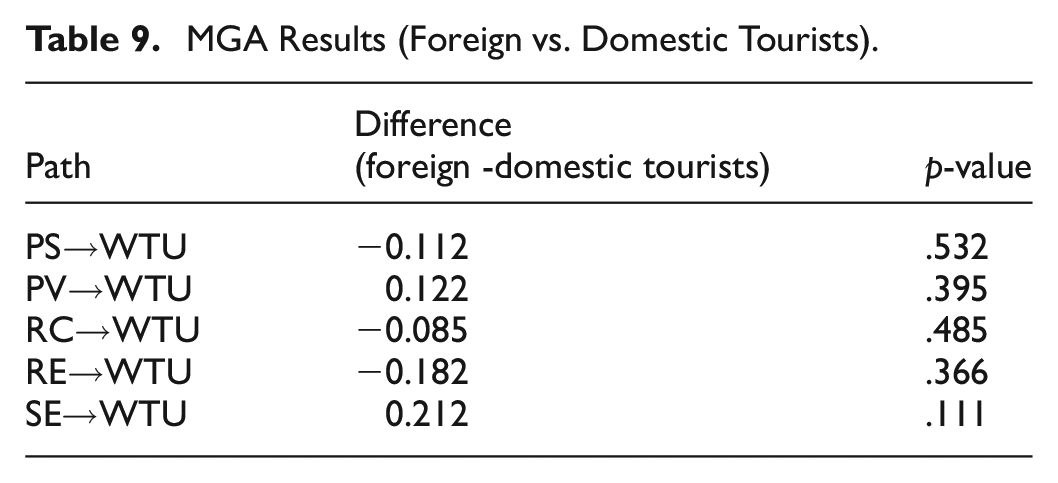
In order to evaluate the moderation effect of gender on the relationships between PMT variables (PS, PV, RC, RE and SE) and willingness to use FRS (WTU), the PLS-SEM with multiple-group analysis (MGA) will be employed. The samples were divided into two groups based on the gender distribution. The relationships between males and females were examined individually in Table 7. It is of particular note that a distinction was identified between the two groups. The results indicated that RC and SE were significantly associated with adoption intention among males (p < .05), while PS, PV and RE were not. In contrast, for females, only PV and SE were significant (p < .05), while PS, RC and RE were not Moreover, it has been found that gender functions as a moderator in the relationships between RC and WTU, with RC having a greater influence on males' readiness to utilize FRS than females (Table 8). As a result, H6c was significant, but H6a, H6b, H6d and H6e were not. Furthermore, the results of the PLS-MGA analysis indicate that there is no significant difference between foreign and domestic tourists for all hypotheses (Table 9).
Comparison of Male and Female Hypotheses.

MGA Results of Gender Differences.

Note.*p < .05.
MGA Results (Foreign vs. Domestic Tourists).
Artificial Neural Networking Analysis
The Artificial Neural Networking (ANN) is able to achieve better precise predictions when integrated with conventional regression methods (Al-Sharafi et al., 2022; Khaw et al., 2022). Nevertheless, a key drawback is black-box nature of ANN which potentially lead to flawed examining relationships and hypothesis testing. To address this, we integrated PLS-SEM with ANN and using only significant predictors from SEM for ANN input in this research (Lee et al., 2016).
This study employs the IBM SPSS (v.26) neural network algorithm for its ANN analysis. To conduct the ANN method, this research utilizes a multilayer perceptron (MLP) with feed-forward back-propagation (FFBP) to train data and evaluate the importance of predictors. The initial stage of the analysis involved the implementation of PLS-SEM, which was used to test the significance of the predictors. The ANN model was constructed based on the significant predictors identified through PLS-SEM, namely PS, PV, and SE. Figure 3 illustrates the ANN structure consists of three input neurons (PS, PV, and SE) that indicate the influential variables and one output neuron (WTU). To facilitate more in-depth learning of the output neuron node, this study follows Lee et al. (2020) to employ a single-hidden-layer ANN structure. Sigmoid activation functions are applied to both output and hidden neurons, with neuron values constrained to [0, 1] for optimized performance (Ahani et al., 2017). The data was trained using the Batch typology, with the optimization algorithm set to scaled conjugate gradient (Kalinić et al., 2021). A ten-fold cross-validation method is implemented to mitigate overfitting, utilizing a 90% training and 10% testing data split (Alkawsi et al., 2021).
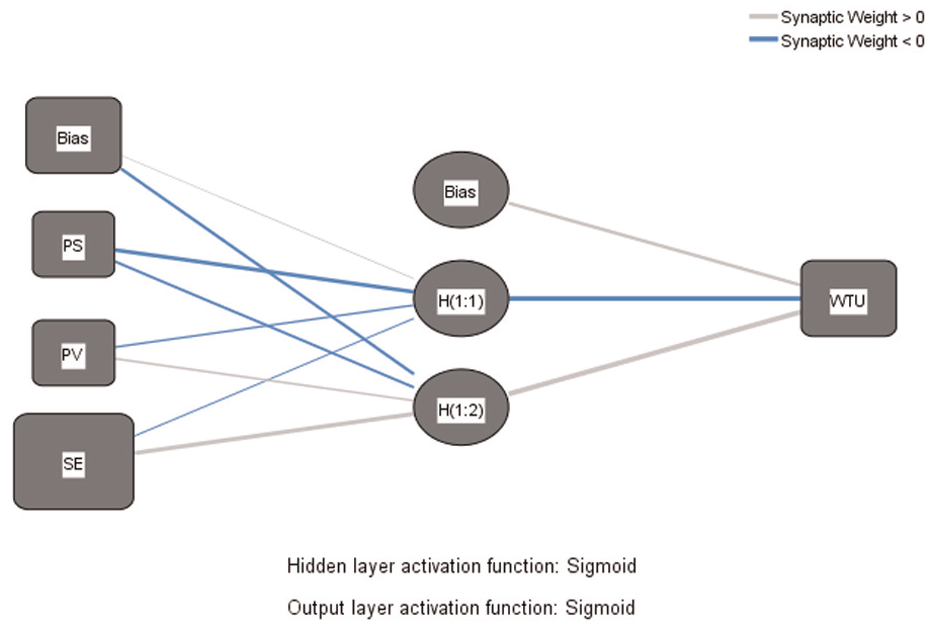
ANN model.
Based on Lee et al. (2020), the ANN model's predictive capability was assessed by adopting the Root Mean Square Error (RMSE) metric. The RMSE mean values are 0.491 and 0.453 for training and testing respectively presented in Table 10. These values are relatively low, which confirms the predictive accuracy of the ANN model (Leong et al., 2020; Talukder et al., 2020).
RMSE Values of ANN Models.
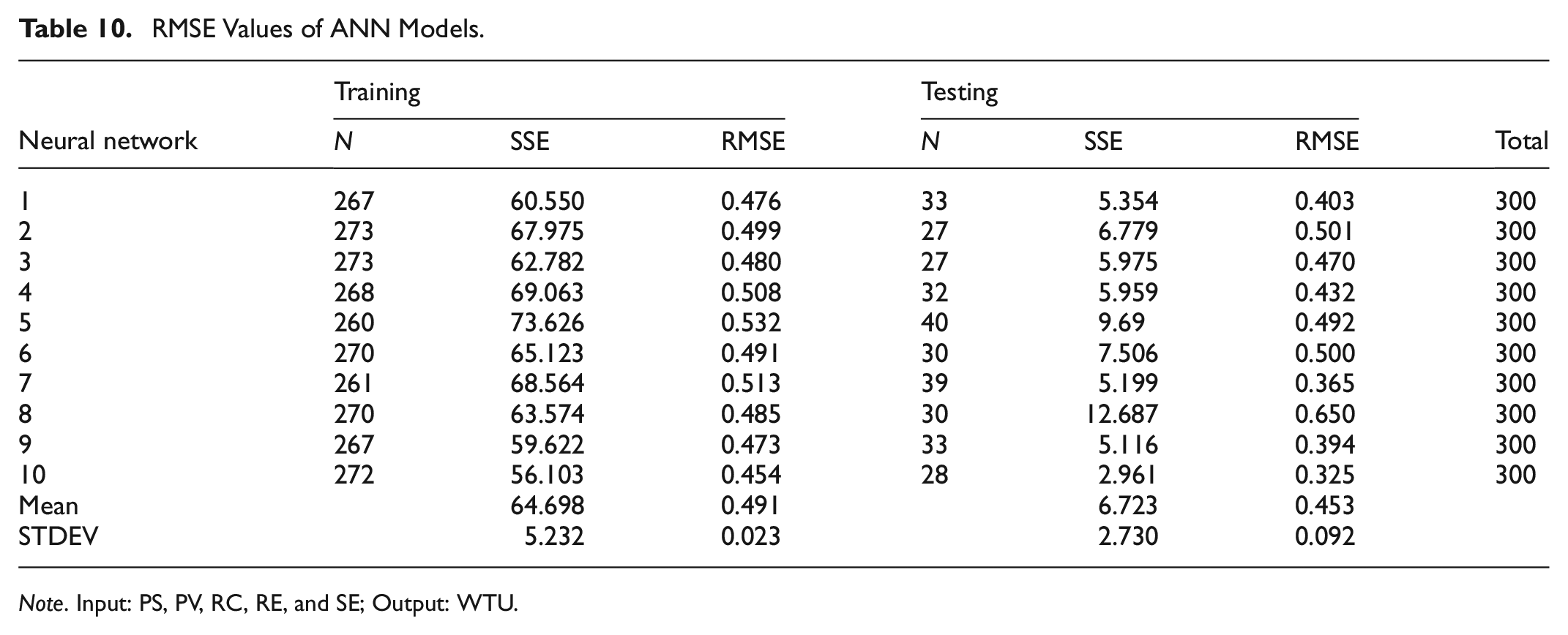
Note. Input: PS, PV, RC, RE, and SE; Output: WTU.
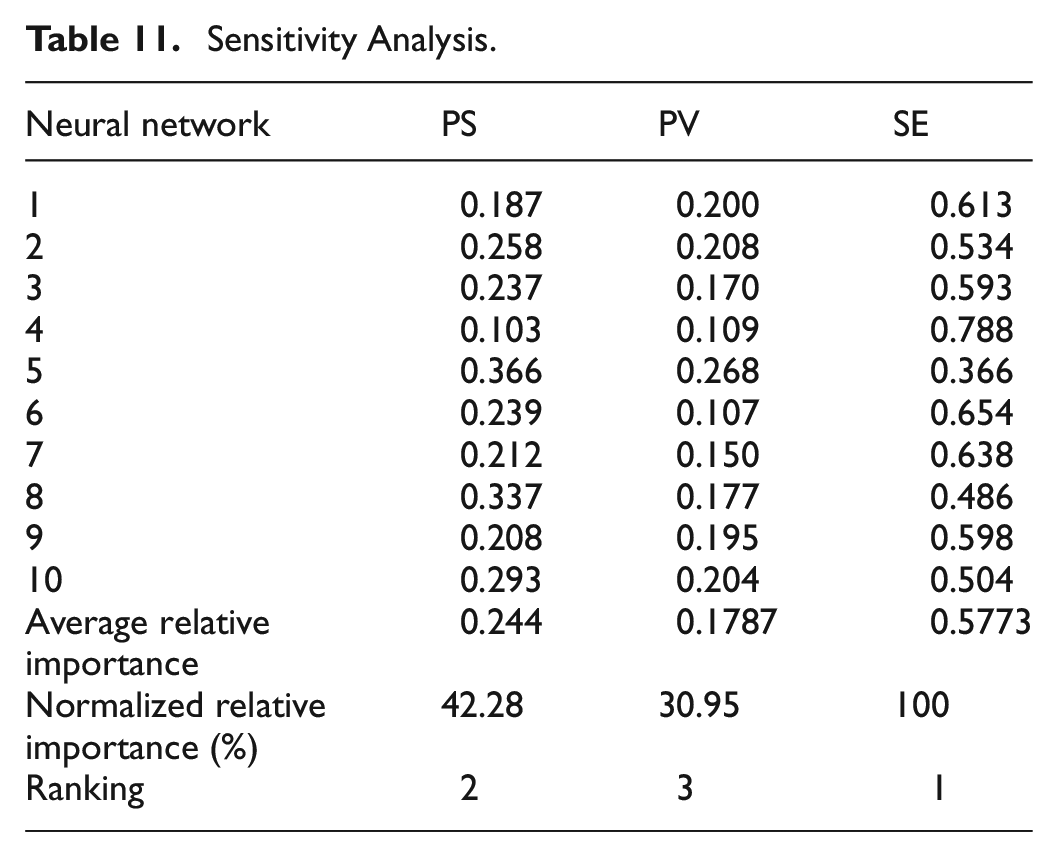
Subsequently, a sensitivity analysis was conducted to evaluate the influence of each variable on tourists' willingness to utilize the hotel FRS. To identify the most influential factors in the proposed model, normalized importance was computed as a percentage of each input neuron's relative importance fraction. As shown in Table 11, these crucial determinants are ranked by their normalized relative importance. In the context of PMT variables, SE emerged as the primary predictor of WTU with 100% normalized relative importance with PS and PV following in significance, corroborating the SEM results. The congruence of PLS-SEM and ANN models affirms the predictive efficacy of our research framework.
Sensitivity Analysis.
Furthermore, a goodness-of-fit measure was calculated to evaluate the predictive capacity of the ANN model, utilizing the following equation: R2 = 1-RMSE/S2 (Alnoor et al., 2024; Leong et al., 2019), where S2 represents the variance of the preferred output in accordance with the average SSE observed during the testing phase. The results demonstrated that the ANN model was able to accurately predict a substantial 93.3% of WTU. Moreover, the analysis utilizing ANN produced a significantly higher R-squared value when compared to the PLS-SEM analysis (R2 = 53.9%). This suggests that ANN offers a more robust explanation for the endogenous constructs, specifically WTU in this scenario.
Discussion
Based on the statistical outcomes, it is necessary to spotlight these important findings. Firstly, the results indicated that perceived severity (PS) was a significant barrier to the intention to adopt hotel FRS. This suggests that tourists who perceive a greater threat from FRS are more reluctant to disclose their privacy through them. This finding is in line with the arguments put forth by Byrd et al. (2022), Rodríguez-Priego and Porcu (2022), and Kumar and Shankar (2024). Next, we also found that perceived vulnerability (PV) negatively influences the willingness to use hotel FRS. PV makes tourists perceive facial recognition systems as more vulnerable to data breaches and cyber threats, resulting in diminished trust in the platform and decreased likelihood of usage. This finding is in sync with other studies (Hudson et al., 2019; Kumar & Shankar, 2024).
Secondly, RC has a negative impact on willingness to use hotel FRS but insignificant. If individuals perceive FRS as a secure and efficient method to enhance hotel security and streamline processes, the potential benefits associated with FRS may overshadow implementation or usage cost concerns. This finding agrees with the propositions of Karahoca et al. (2018) who found, based on PMT theory, the intention to embrace healthcare technology products incorporating IoT does not exhibit a significant association with RC. Furthermore, unlike previous studies on technology adoption intention which showed that RE has a positive influence on behavior intention, such as contactless payment services (Srivastava et al., 2021), the present study found that RE has a positive impact on the willingness to use hotel FRS, but the impact is insignificant. This finding is consistent with Thompson et al.’s (2017) and Rodríguez-Priego and Porcu (2022) findings. These aforementioned results emphasize the need to consider the application of PMT in different contexts when examining technology acceptance, including active and passive acceptance of new technological services. When hotels use FRS as a service, they leave consumers with little option but to accept it. This explains why RC and RE have minimal effect on hotel FRS acceptance intention.
Thirdly, self-efficacy (SE) appears to exert a significant influence on the intention to adopt hotel FRS. It can be inferred that tourists who possess the belief in their own capabilities to regulate and execute the applications and their associated features will be more likely to adopt them. The positive direct relationship between self-efficacy and willingness to use hotel FRS is in alignment with previous research findings (Byrd et al., 2022; David-Negre & Gutiérrez-Taño, 2024; Hwang et al., 2024; Radic et al., 2022; Rodríguez-Priego & Porcu, 2022; Tatiana & Desiderio, 2024). It is notable that self-efficacy has the highest normalized importance in the present study. This highlights the importance of tourists feeling qualified to use FRS. Overall, it can be argued that self-efficacy will lead a tourist to believe in their ability to adopt hotel FRS successfully.
Lastly, the findings of the MGA indicate that gender plays a significant moderating role in the relationship between response cost and willingness to use hotel FRS. Results reveals that males give more importance to response costs than females. These findings agree with Chen and Liu (2021). Nevertheless, the influence of nationality has not been found to moderate the relationships between tourists' perceptions of threat and coping appraisals and their willingness to use hotel FRS. It is possible that the sample size of foreign tourists interviewed was insufficient to provide a representative overview of the discrepancy in question.
Conclusions
This investigation evaluated the relationship between PMT's constructs of threat and coping appraisals and tourists’ willingness to use hotels' FRS. Additionally, it further explored the moderating effects of gender and nationality. Findings showed significant impacts of threat appraisal (perceive severity and perceived vulnerability) and self-efficacy on willingness to use hotel FRS (WTU), and significant moderations of gender on relationships between response costs and WTU. Specifically, findings showed lower willingness to use hotel FRS for tourists perceiving that FRS could result in severe privacy. Furthermore, the willingness to use hotel FRS was found to be higher among individuals who had a positive appraisal of coping strategies, such as their self-efficacy in mitigating the risks associated with FRS usage. In comparison, tourists’ perception of their response efficiency and response costs towards FRS was not a factor in their willingness to use hotel FRS.
Results from multi-group analyses showed that gender significantly moderated the impact of coping appraisal within the PMT framework, specifically in terms of response costs. Specifically, male tourists (vs. female tourists) and high response costs, were more likely to use FRS hotel. However, neither gender nor nationality acted as a moderating factor of the nexus between consumers' threat appraisal and their willingness to adopt hotel FRS. In other words, while the effects of tourists' threat appraisal on willingness to use hotel FRS were consistent regardless of gender and nationality, their coping appraisal (response costs) was influenced by the gender moderating factor. In conclusion, the results indicate that gender may influence tourists' evaluation of the coping situation, but not their appraisal of their threat capability in terms of adopting in hotel FRS. Furthermore, nationality does not appear to impact tourists' evaluation of the threat situation or their coping capability in terms of adopting in hotel FRS.
In this study, the results of the SEM analysis showed that the antecedents of the conceptual framework, namely PS, PV, and SE, had a significant relationship with WTU. SE was found to be a strong predictor with a standardized regression statistic of 0.519. The ANN model achieved high prediction accuracy, reflected in its smaller RMSE value. It highlighted SE playing the role of predominant predictor with a normalized score of 0.5773 and a total normalized importance of 100% for the acceptance of FRS. The multi-method analysis confirmed the importance of SE in advanced AI tools for the diffusion of FRS technologies.
Theoretical Implications
Several theoretical contributions are gleaned from the research findings. First, recently research on the adoption of FRS check-in services in the hospitality industry has increased based on TAM or social cognition theory (Boo & Chua, 2022; Morosan, 2019, 2020; Morosan & Dursun, 2024; Xu et al., 2021) , however, it neglects the role of customers’ threat and coping appraisals in shaping behavioral intentions. Consequently, this research endeavors to bolster its effectiveness by investigating the factors affecting FRS adoption with the PMT framework in AI-based FRS scenarios.
Second, the results of our study align with the core tenets of the PMT model, indicating that threat-appraisal and coping-appraisal are key determinants of FRS behavior intentions. However, there were two exceptions to this, namely RC and RE, which did not perform as anticipated. Furthermore, we examine the moderating influence of gender and nationality on tourists' uptake of hotel FRS. It is notable that PMT has not been extensively examined in this field of research. Furthermore, only a limited number of studies have attempted to incorporate gender and nationality as moderators within this model. Consequently, the findings of our research can significantly contribute to the advancement of PMT theory. Also, the findings demonstrated that coping evaluation (SE) exerts a more pronounced influence in shaping individuals' intentions than the threat appraisal components (PS and PV).
Third, complying with Sohaib et al. (2020), this study represents a major leap in FRS research by integrating ANN with SEM for behavioral analysis, solidifying the PMT model's effectiveness, and using a multi-layer ANN approach to enrich biometric facial recognition research.
Practical Implications
From a practical perspective, this study provides valuable insights into the willingness of Generation Z tourists to use hotel FRS. Drawing from the findings of this study, we present the following considerations for forthcoming policies. Firstly, in order to overcome the obstacles preventing potential tourists from adopting hotel facial recognition services, it is essential that hotels prioritize the security and privacy of their facial recognition systems. Consequently, demonstrating privacy and security toward personal information, gaining customer consent, and compliance with data protection laws should be a priority throughout the implementation and usage of hotel FRS. Developing and enhancing security protocols to reduce the perceived threat severity of consumers should be a prominent strategy. Hoteliers should integrate advanced technology of surveillance systems and access control, regularly assess FRS potential security risks in the hotel environment, training for staff on security protocols and emergency response procedures. Emphasizing the hotel FRS has high levels of security to safeguard client privacy and security is essential, as when customers’ fears and concerns are not appropriately addressed, this readiness issue can actively block the technology diffusion process.
Second, the results elicit consumers' PV has a negative influence on their acceptance of hotel FRS. Based on this finding, hoteliers should address consumers’ PV by implementing practical strategies to effectively mitigate concerns and increase FRS acceptance. For example, implement advanced security protocols to alleviate concerns about data privacy and system vulnerability. Further increase consumers' trust by clearly communicating the security measures implemented within hotel FRS, while actively seeking consumer feedback to continuously improve privacy and security features, such as encryption, access controls, and data retention policies. Secure encryption protocols guarantee the protection of financial transactions and customer data from unauthorized breaches, mitigating the risks of unauthorized access and inadvertent data disclosure (Kumar & Shankar, 2024). Hoteliers should also clearly communicate how hotel FRS compliance with privacy laws and safeguards individuals' personal information. This approach helps individuals understand the level of protection their data receives and reduces their PV.
Lastly, this study emphasizes that when assessing consumer’s hotel FRS acceptance and usage intention, SE is the PMT framework's greatest predominant factor in PLS-SEM and ANN analyses. Based on these findings, hoteliers should offer measures to encourage and boost consumers' confidence in their ability to use FRS technology. For example, employees should explain the hotel's FRS services in detail and offer demonstrations. Hoteliers ought to provide educational resources for guests to boost confidence in using FRS technology, and also share positive experiences and testimonials from guests who have successfully used FRS. Further, make the FRS interface intuitive and easy to use, so as to meet the technical familiarity and comfort of all customers.
Limitations and Future Suggestions
Considering the lack of existing studies on consumers' acceptance of FRS, this study provides an interesting field for future exploration. However, there are various limitations should be addressed in future research endeavours. First, the study primarily applied the PMT framework; in future research could integrate other relevant theories for a more comprehensive understanding of consumers’ behavioral intentions towards hotel FRS. For instance, UTAUT, DOI, and expectancy-value theory. Integrating the PMT with these theories and trust enables a better comprehension of the factors that influence consumer acceptance of AI technology devices in the hospitality industry.
Second, future studies might entail investigating various hotel characteristics including category (such as luxury or low-cost hotels), room size, or certain hotel sorts (e.g. resort, business hotel). Third, refer to prior scholars (Skalkos et al. 2021; Xu et al., 2021), customers’ trust and privacy concerns play as significant factors affecting users’ adoption hotel FRS. It is recommended that future research adopt a multi-dimensional approach to the analysis of trust effects and an integrated view of privacy concerns in order to gain a deeper understanding of consumer acceptance of FRS devices in the hospitality sector.
Lastly, as prior literature has also highlighted an important role in the attitude of consumers toward different cultures perceive the risk of using FRS devices and new AI technology (Chi et al., 2023; Hwang et al.,2024), future research should include the cultural difference and value by collecting data during different group to draw more reliable conclusions.
Footnotes
Appendix
Study Variables and Items with Means, Standard Deviations, Skew and Kurtosis.

| Study variables and items | Mean | SD | Skew | Kurtosis |
|---|---|---|---|---|
| Perceived vulnerability (PV) | ||||
| PV1. If my personal data is leaked through hotel FRS systems, I could be vulnerable to an information security threat. | 1.84 | 0.853 | 0.794 | 0.116 |
| PV2. If my personal data is leaked through hotel FRS systems, my organization could be vulnerable to an information security threat. | 2.05 | 0.909 | 0.513 | −0.317 |
| PV3. If my personal data is leaked through hotel FRS systems, my privacy would be compromised. | 1.82 | 0.871 | 0.945 | 0.542 |
| Perceived severity (PS) | ||||
| PS1. I believe using hotel FRS systems will be harmful to protecting my personal data. | 1.80 | 0.912 | 1.027 | 0.597 |
| PS2. I believe using hotel FRS systems could cause serious anxiety to me. | 1.90 | 0.910 | 0.875 | 0.389 |
| PS3. I believe using hotel FRS systems would bring financial loss to my company. | 2.12 | 0.994 | 0.599 | −0.231 |
| Self-efficacy (SE) | ||||
| SE1. I would use hotel FRS technologies if I only had the system’s manual for reference. | 3.74 | 0.973 | −0.496 | 0.036 |
| SE2. I would use hotel FRS technologies if I see someone else using it before trying it myself. | 3.71 | 0.971 | −0.517 | 0.058 |
| SE3. I would use hotel FRS technologies if I could call someone for help if I got stuck. | 3.82 | 0.910 | −0.554 | 0.206 |
| Response efficacy (RE) | ||||
| RE1. Hotel FRS technology’s ability to prevent others from getting my confidential information from my personal data is adequate. | 3.38 | 1.090 | −0.089 | −0.677 |
| RE2. I am confident that using hotel FRS would be effective at keeping my data safe. | 3.86 | 1.051 | −0.536 | −0.641 |
| RE3. I am confident that information used for hotel FRS will not be used for other purposes. | 3.85 | 0.994 | −0.463 | −0.668 |
| Response cost (RC) | ||||
| *RC1. Using hotel FRS is too much trouble. | 2.91 | 1.082 | 0.205 | −0.449 |
| RC2. Using hotel FRS may cause problems to other programs on my mobile phone. | 3.11 | 1.104 | −0.048 | −0.544 |
| RC3. Using hotel FRS may make me lose critical information. | 3.40 | 1.060 | −0.253 | −0.508 |
| RC4. The cost of using hotel FRS, including the inconvenience it might cause to me, exceeds the benefits. | 3.14 | 1.104 | −0.009 | −0.616 |
| Willingness to use FRS devices (WTU) | ||||
| WTU1. I am willing to receive FRS devices for hotel services. | 3.89 | 0.881 | −0.308 | −0.598 |
| WTU2. I feel happy to interact with FRS devices in hotel services. | 3.87 | 0.937 | −0.443 | −0.262 |
| WTU3. I am likely to interact with FRS devices in hotel services. | 3.92 | 0.928 | −0.505 | −0.277 |
Note. SD = standard deviation.
*Items dropped during path analysis because of low factor loading (< 0.7).

Author Contributions
JiaLiang Pan: Conceptualization, Writing—original draft, Project administration. Yi-Man Teng: Conceptualization, Writing—original draft, Visualization, Investigation. Kun-Shan Wu: Conceptualization, Data curation, Formal analysis, Funding acquisition, Methodology, Writing—original draft, Writing – review & editing.
Funding
The authors declared no potential conflicts of interest with respect to the research, authorship, and/or publication of this article.
Declaration of Conflicting Interest
The authors declare there’s non potential conflicts of interest regarding the submitted manuscript titled “Psychological Aspects of Security Awareness on Facial Recognition Services Adoption in Hotels: A Protection Motivation Theory Approach.” for consideration in Sage Open. The authors declare the there’s non-financial interests here. The research was conducted in the absence of any commercial or financial relationships that could be construed as a potential conflict of interest. As corresponding author, I confirm on behalf of all authors that this Conflict of Interest disclosure is accurate.
Data Availability Statement
The data that support the findings of this study are available upon reasonable request from the corresponding author.