




Abstract
College students’ graduation projects reflect their teamwork abilities. The current research develops a practical framework and causal model of knowledge-sharing behavior, cohesion, and team performance for design college students in Taiwan. Using survey data collected from 115 students who completed their graduation projects in a design college, PLS-SEM was run to test the model. In addition, 11 students who were on teams that won competitions or were shortlisted were interviewed. Results found that knowledge sharing has a significant positive effect on team performance, and cohesion has a significant positive effect on both team performance and knowledge sharing. The students with high cohesion often exhibit knowledge sharing behaviors and excellent team performance. These findings suggest project supervisors should induce knowledge sharing behaviors during the graduation project process in order to enhance student group cohesion.
Keywords
Introduction
According to one study, approximately 75% of employers view collaboration and teamwork as very important to their workplace (Queens University of Charlotte, 2014). Interactions between team members affect the performance of the entire team (Beal et al., 2003). Teams are formed to help members obtain better solutions and work results through knowledge exchange and cooperation. Knowledge within an organization is an essential strategic resource that is required in creative processes. As a result, knowledge management is the most critical factor affecting organizational success (Cummings, 2004). The ability to exchange and share knowledge determines team performance, knowledge creation, and team learning (Şanal & Karimivand, 2020). Therefore, a key issue for practitioners and researchers is determining how to maximize teamwork through knowledge sharing (Andersen & Drejer, 2009; Kang et al., 2008).
Communication and interaction enable team cooperation. Smooth interactions allow knowledge transfer/sharing among team members, helping them to achieve task objectives (Siemsen et al., 2008). However, a Salesforce study found that 86% of executives and employees believe poor collaboration and ineffective communication are major contributors to workplace failures (Stein, 2012). Similarly, according to most scholars and employers, college graduates are frequently deficient in teamwork and team skills (Hughes & Jones, 2011; Loughry et al., 2014).
According to data from Taiwan’s Ministry of Education, there are about 70,000 students across 106 design-related colleges and universities in Taiwan (Ministry of Education, 2021). In many of these programs, students must conduct a group-based graduation project, also known as thematic production. The aim of graduation projects is to provide students the opportunity to apply and express the knowledge they have gained during their time in the program. Since graduation projects are usually done in teams, issues of teamwork are important influences. Pfaff and Huddleston (2003) pointed out that students have many problems or common points in the process of forming teams.
In the case of thematic projects, teams are relatively small and interdependent. Successful teams require extensive knowledge sharing because one person alone may not possess all the necessary skills to complete the required tasks (Imam & Zaheer, 2021). If team members can tolerate each other and accept different opinions, the team is more likely to have a pleasant atmosphere, more harmonious interactions, improved cohesion, higher performance, and a stronger identity (Daspit et al., 2013).
In addition to knowledge sharing, team cohesion, a dynamic process reflected in the tendency for a team to stick together, is essential for understanding team performance (Huang, 2009). In the process of team cooperation, if there are good cohesion and knowledge-sharing behaviors, interaction and communication are enhanced and improve team performance (Imam & Zaheer, 2021; Mathieu et al., 2008; Mesmer-Magnus & DeChurch, 2009).
In sum, mutual support among members requires cohesion and knowledge sharing, which influence the success of enterprise projects. However, few empirical studies have tested the impact of knowledge sharing and cohesion on student team performance. In response, the current study combines individual motivation theories from Maslow’s hierarchy of needs theory (Maslow, 1943, 1971) and advanced cognitive system from collective mind theory (Weick & Roberts, 1993) to explore design school students thematic production performance. Specifically, this study explores following four relationships:
The influence of knowledge sharing on cohesion.
The effect of knowledge sharing on team performance.
The influence of cohesion on team performance.
The possible mediating the effect of cohesion by knowledge sharing in elevating team performance.
In the following sections, we first review the relevant literature and develop several hypotheses. Then, we describe the methodology used to test these hypotheses and report the analytical results. After that, we discuss the results, their implications and the study’s limitations. The paper concludes with a summary of the key findings.
Theory and Hypothesis Development
Theoretical Foundation of the Study
We still know little about the critical success factors for student team performance. According to Maslow’s hierarchy of needs (Maslow, 1943, 1971), to trigger knowledge sharing, individuals’ different levels of sharing needs must be satisfied. When lower-level needs are satisfied, it is challenging to continue to motivate individuals to share knowledge, so it is necessary to stimulate the individual’s knowledge sharing motivation using higher level needs. The higher the extrinsic motivation, the higher the level of need, the stronger the incentive for knowledge sharing and the higher the individual’s learning (Alghamdi et al., 2021).
In addition, we apply Weick and Roberts’s (1993) collective mind theory to analyze cohesion. Collective mind theory refers to structures of collective meaning that emerge in and coordinate the activities of a group (Akkerman et al., 2007). Akgün et al. (2007) noted that members feel obligated to express respect for other members and maintain harmonious relationships through their interaction and cooperation behaviors, developing a collective mind. The collective mind ensures that the processes between individuals can simultaneously be processes within large groups. This suggests that a high level of collective mind leads to a high level of group cohesion. Furthermore, a high level of positive externalism leads to high collective cohesion efficacy (Hong et al., 2021; León et al., 2019; Salmela & Nagatsu, 2017).
Hypothesis Development
Thematic production, also called special studies, is usually problem oriented. Students customize the theme according to regulations or groups and learn problem identification, production planning, and practical implementation during the process (Pfaff & Huddleston, 2003). Project-based learning (PBL), as proposed by Thomas (2000), is a widely used and highly valued learning model based on “themes” to promote independent learning. Students work for a set period and then publish and/or present their work (Larmer & Mergendoller, 2015). The spirit of a thematic project production is to assure students have learned the course content and provide experience with teamwork and communications (Chiang, 2015).
In industrial innovation and R&D projects, problems are solved through mutual communication and knowledge sharing among team members; thus, the cohesion of members has a positive effect on knowledge sharing (Huang, 2009; Kang et al., 2008). In highly cohesive teams, members have intensive contact, internalize resource sharing among members, and have a strong sense—a community or an attitude of “we-ness” (Pearce et al., 2009; Sabin & Alexandru, 2015). In addition, van Woerkom and Sanders (2010) and Graf (2007) stated that cohesiveness can the exchange of advice between team members and enables shared perspectives. This suggests that if thematic production team members can enhance team cohesion, they will perceive greater team harmony and trust, which drives knowledge sharing and communication (Mesmer-Magnus & DeChurch, 2009). Knowledge sharing is an essential facilitator of cohesion. Therefore, it is likely its presence leads to higher cohesion. This leads to the first hypothesis, as follows:
Huang (2013) and Wang (2019) pointed out that if team members are willing to share knowledge, this improves overall team knowledge and generates more innovations or higher job performance. This study extends Maslow’s theory by testing its applicability to knowledge sharing, indicating that Maslow’s needs of hierarchy theory
Most students have previous team experiences in other courses. Thus, they usually have familiar candidates in mind when looking for team members. Therefore, thematic project teams are often formed with a degree of pre-existing cohesion. Cohesion served as a mechanism that
Sabin and Alexandru (2015) concluded that high cohesion drives the positive development of the entire team, promoting the willingness of team members to share resources and know each other. According to Huang (2009), group cohesiveness and knowledge sharing are dynamic processes that are important for knowledge sharing and group performance. Therefore, if members are willing to share their strengths and make joint efforts to share knowledge, the degree of contact with new knowledge and the member goal intentions improves, resulting in better team performance and development (Tung & Chang, 2011;). Following Staples and Webster (2008), and Wang and Kwek (2018), and combined with Hypotheses 1 to 3, cohesion is a mediator between knowledge sharing and team performance. This premise finds that cohesion has a direct connection with team performance. Furthermore, to achieve their goals, in the process of knowledge sharing and team cooperation, members will gradually build trust in each other, which is also helpful for the performance of the entire team (Hwang, 2011). Researcher have also identified that cohesion is a mediator in the relationship between employee attitudes, leader-ship, and performance (Organ et al., 2006). Thus, the fourth hypothesis of this study follows:
The conceptual model with hypotheses is shown in Figure 1.
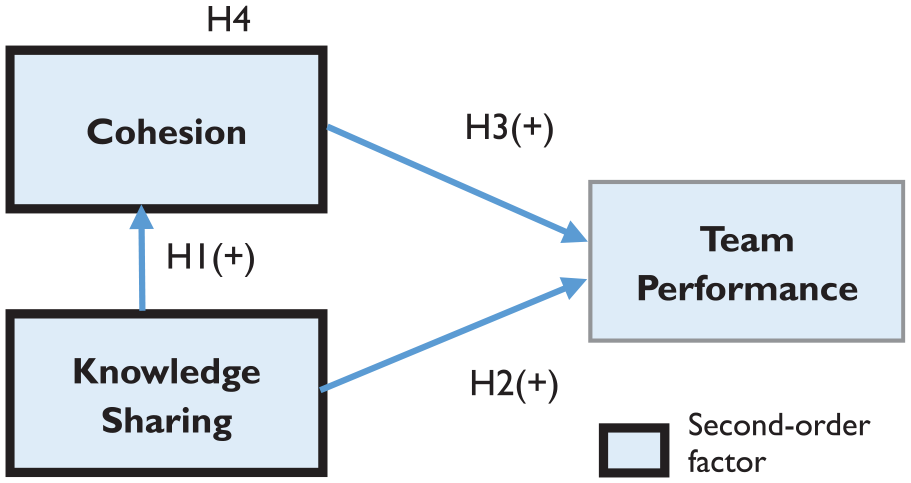
Conceptual model of the research.
Methodology
Data Collection and Sample
The subjects of this study include senior graduates of the School of Design at a Taiwanese university. A total of 146 questionnaires were administered, 31 were returned incomplete or had invalid data and were therefore excluded from the analysis, leaving a total of 115 valid questionnaires, equivalent to a 78.8% response rate. An online questionnaire and paper questionnaire were used and to observe the interactive behaviors of the student teams in real-time. The researchers used the school’s 4-day on-campus exhibition to hand out surveys or administer online questionnaires on the spot.
Operational Definition of Variables
An operational definition of variables (ODV), when applied to data collection, is defined as a clear, concise, and detailed definition of a measure. The definition must specify the characteristics to be studied and how they are observed and measured (Cooper & Schindler, 2013). This study uses three variables: knowledge sharing, cohesion, and team performance. Drawing from the literature, the operational definitions and measurements are described in Table 1. Three items which were inappropriate in all of the item analyses were deleted.
Variable Operational Definitions and Measurements.

Questionnaire Design
A questionnaire survey method was used (Malhotra & Birks, 2007). Responses to items were reported on 7-point Likert scales anchored at 1 (strongly disagree) and 7 (strongly agree). Exogenous variables included knowledge sharing and cohesion. Endogenous variables included team performance.
The questionnaire had three parts. The first part introduced the purpose of the questionnaire. The second part included the measurement items for all the observable variables. The third part, demographics, comprised items capturing respondent gender, the total number of meetings per month, the average time of each meeting, the degree of completion of the thematic project, and discussion methods, and other related factors, totaling five questions.
Interview Procedure
While quantitative survey results helped us understand students in the process of their thematic project class, additional qualitative interviews were conducted to capture their thoughts and feelings. After analyzing the questionnaire, all the winning or shortlisted teams were contacted. From these teams 11 students volunteered to participate in the interviews, which were conducted online using Facebook Messenger in audio.
The semi-structured interviews excluded closed questions. After the six topics were discussed, students had an opportunity add anything on their mind related to the topic. At the end of the interviews, informants were thanked and debriefed as well as offered the study results when completed. Interview duration was 30 to 40 minutes.
Analysis Method (PLS-SEM)
The predicted model of the relationships among knowledge sharing, cohesion, and team performance, as well as validity of the effects of mediation, were analyzed with PLS-SEM, using SmartPLS 3 (Ringle et al., 2015), to determine whether the proposed model was consistent with the data. Reinartz et al. (2009) demonstrated that for small sample sizes, PLS-SEM is the most suitable choice. Previous researchers such as Sözbilir (2018) and Lotfi et al. (2018) have shown that small samples are feasible. Hair et al. (2014) recommends the application of G*Power (Faul et al., 2009) to identify the minimum sample size in PLS-SEM studies. According to the G*Power analysis of this study, a minimum effective sample size of 111 with an α of .05 and four predictors is sufficient to find a medium effect size (R2 = .15, after calculation f2 = 0.176) (Cohen, 1988) with a power of 95%.
When the theory around a research topic is less developed, researchers should consider the use of PLS-SEM, especially if the purpose of the structural modeling is prediction and explanation of target constructs. PLS-SEM is used to develop theories in exploratory research when there is no or little prior knowledge on how the variables are related. It does this by focusing on explaining the variance in the dependent variables when validating the model (Hair et al., 2017, 2019).
Results
Demographic Variables Analysis
In this study, α ≦ .05 was set as the significance level of verification. Female subjects accounted for 61.7% of all valid samples, which was in line with the fact that females outnumber males in Taiwan’s Schools of Design. Most teams (61.7%) had more than five meetings per month. The most common average time for each meeting was 1 to 2 hours (40.9%), followed by 3 to 4 hours. As members hoped to discuss and solve the production problems effectively, meeting times were relatively short. Regarding “discussion method,” respondents reported meetings as the most common method (87.8%) followed by online chat rooms (56.5%). The use of the Internet has made it easier to communicate with distant ties. However, communication via the Internet, messaging, and other technologies involves low interpersonal skills compared to face-to-face meetings (Hwang, 2011). When students discuss their work, they need to express their ideas in many ways, such as sketching ideas with paper and pen and verbally transmitting their ideas to other members face-to-face. Chat rooms were the most common online media.
The number of people who completed more than 90% of the “on-campus exhibition works” was the largest, accounting for 58.2% of the total valid sample. Since the remaining days for the off-campus design exhibition were about 1 month, students took advantage of the on-campus exhibition opportunities, listened to the suggestions of the exhibitors, and used the remaining 1 month to make improvements.
Measurement Model Analysis
Convergent Validity
Hair et al. (2014) pointed out that factor loadings should be higher than 0.7, and composite reliability (CR) should be greater than .7. Both Bagozzi and Yi (1988) and Fornell and Larcker (1981) pointed out the average variance extracted (AVE) should be greater than 0.5, and Cronbach’s α should be higher than .7. In this study, there were 10 cohesion items with factor loadings between 0.765 and 0.916 (Table 2). There were 13 items for the knowledge sharing dimension with factor loadings were between 0.748 and 0.900. There were five items for team performance, with factor loadings between 0.855 and 0.877. Three items did not reach the factor loading limit of .7 and were deleted (Hair et al., 2014). The questionnaire had 25 items in total. The CR of all dimensions was .911to.938, all higher than 0.7. The AVE was .515 − .752, all greater than .5. Cronbach’s α value of the dimension was .873 to .918 (Table 2), greater than .7, indicating that the study had good convergent validity.
Convergence Validity and Reliability.

Determination of discriminant validity of model
The reflective index was analyzed for discriminant validity by means of AVE. Fornell and Larcker (1981) pointed out the square root of the AVE of each dimension should be higher than the correlation coefficient between each pair of variables, indicating each dimension has discriminant validity. Table 3 shows the AVE of all variables was higher than the square of the correlation coefficient; thus, results indicate this study has discriminant validity.
Square Root AVE and Latent Variables.

Structure Model Analysis
Once we confirmed the construct measures were reliable and the models valid, we next assesses the structural model results. When evaluating the quality of the structural model in PLS-SEM, the evaluation is carried out in two parts; the first is the model’s predictive ability; the second is the explanatory ability of the model. Hair et al. (2017) proposed a systematic approach to assessing structural model results. Among the evaluation processes are the following five structural model assessment procedures; Step 1, assess the structural model for collinearity issues (formative indicator model can be omitted); Step 2, assess the significance and relevance of the structural model relationships; Step 3, assess the level of R2; Step 4, assess the f2 effect size; Step5, assess the predictive relevance Q2; Step 6: assess the q2 effect size.
The structural model evaluation confirms whether the path relationships in the research model are significant and evaluates the interpretative ability, predictive ability, and the model fit. The results of the evaluation are shown in Figure 2 and summarized in Table 4.

Structure model analysis results.
Goodness of Fit Test for the Structural Model Evaluation.

p < .05.
Multicollinearity issues can be assessed at the structural model by examining the variance inflation factor (VIF) values of all sets of predictor constructs in the structural model. According to Hair et al. (2017), a VIF value less than 5.0 indicates no potential for multicollinearity issues. Furthermore, the Outer VIF value of each indicator in the measurement model was less than 5.0, indicating no issue of multicollinearity between the latent constructs.
Structural model path coefficients
Based on the bootstrapping result of the path coefficient in Table 4, all the path coefficients in this study were significant predictors, representing strong positive relationships. The path coefficients of the three hypothetical relationships (H1, H2, and H3) in the model were 0.639, 0.469, and 0.313, respectively. In addition, Table 5 shows that the KS construct can indirectly and significantly affect the TP through the CO construct (the indirect effect value is 0.30, significant). The overall effect of the KS construct on the TP construct reached 0.613, which was more important than the CO construct (0.469).
A Summary of the Direct, Indirect, and Total Effects.

p < .05.
Model interpretation ability
Following Hair et al. (2017), the coefficient of determination (R2 value), effect size (f2), and predictive relevance (Q2 and q2) were also examined and reported in Table 4. R2 assessment of a model’s predictive power is calculated based on the squared correlation between a specific endogenous construct’s actual and predicted values (Hair et al., 2017). As evident from the R2 value, CO explained 40.9% (R2 = 0.409) of variance in TP while KS explained 50.6% (R2 = 0.506) of variance in TP. According to Hair et al. (2017), the R2 values of the two endogenous variables KS and TP are considered moderate.
Next, the effect size (f2) of constructs were calculated. The f2 indicates the contribution of independent variables to the dependent variable’s R2. The f2 values were 0.35 (large), 0.15 (medium), and 0.02 (small) (Cohen, 1992). The f2 values in Table 4 show that KS had a large to medium effect on both CO (f2 = 0.691) and TP (f2 = 0.117) and CO had small effect on TP (f2 = 0.264). Overall, the exogenous constructs had a moderate effect on the endogenous constructs.
Model predictability and Model Goodness-of-Fit Index analysis
The values of Q2 and q2 were computed. The Q2 values estimated by the blindfolding procedure represent how well the path model predicts the observed initial values. The relative impact of predictive relevance can be compared to measure the q2 effect size (Hair et al., 2014). Table 4 shows the q2 value for KS→CO was 0.290, CO→TP was .065, and for the KS→TP, it was 0.151. Overall, the exogenous constructs had a medium to small predictive relevance for the endogenous constructs. Goodness-of-fit (GoF) is applied as an index for the complete model fit to verify that the model sufficiently explains the empirical data (Tenenhaus et al., 2005). Table 4 provides GoF results; the value was 0.507, more significant than .36 (Vinzi et al., 2010). Therefore, these results show that the empirical data fits the model satisfactorily and has substantial predictive power over baseline values.
Mediating effect analysis
Sobel (1982) developed an approximate significance test on the indirect impact of the independent variable on the dependent variable through the mediator. In this study, Sobel’s Z test was used to calculate the level of “a×b” to test the construct of knowledge sharing mediating the relationship between cohesion and team performance. Test results show the mediating effect was significant, with a Z value of 3.069 (>1.96), supporting the mediating effect of H4.
Discussion
Meeting Habits of Students in the School of Design
According to interview results, students prefer to predict what to do before a meeting and how to discuss it to avoid wasting time in formal meetings. In addition, students like to use online chat rooms to announce simple information or to hold video or text meetings when people cannot meet face-to-face. The following interview quotes reflect these behaviors:
We will first decide the topic for today’s meeting, . . . Usually, we will find some data . . . It is always like this: 1. Decide the topic; 2. Begin discussion; 3. Find data; 4. Feasibility; 5. Assign the work. Start from the first point . . .(S01). Find the time when everyone can hold a meeting and discuss it. (S08). There are many situations. When we have different ideas, we will discuss them . . . Try not to hold inefficient meetings (S09). If we cannot meet each other, we will also use cell phones and group voice calling functions to discuss topics while operating the computer (S11).
Knowledge Sharing Behavior Positive Impact on Cohesion
When creating works, student teams enhance their cohesion, which is conducive to team harmony and trust and drives knowledge sharing behavior (Collins & Smith, 2006). Knowledge sharing can be viewed as a cooperative behavior of team members that is affected by team cohesion (Al-Rawi, 2008; Graf, 2007; van Woerkom & Sanders, 2010).
In our investigation, we learned that some team members were also roommates, meaning they had already cultivated tacit understandings prior to team formation. In the interviews, students explained that they often chose team members with whom they had already cooperated with in class, having established a good sense of trust. Of course, students also searched for team members with suitable personalities and perceived expertise in the relevant topic, as reflected in the following interview quotes:
Because we have had cooperation before, we got along well (S03, S06). We have a good understanding of each other and believe that the other is a team-mate worth relying on, so I decided to cooperate in the thematic production (S02, S10, S11).
Student Knowledge Sharing Positively Impacts Team Performance
The research results are consistent with those of Cabrera and Cabrera (2005), Kang et al. (2008), and Tung and Chang (2011). Frequent knowledge sharing is related to interactions and communication among student team members. Knowledge sharing and information transmission lead to better team performance. Sharing mental models enhances coordination among team members (Wang & Kwek, 2018). In our observations at the exhibition hall, student teams with high degrees of completion had positive performance and high enthusiasm. For example, the members of the group Excellent and Good Architecture discussed with one another ways in which to modify and improve their project. They also considered visitors’ suggestions on how to improve their work. The group was shortlisted for Taiwan’s Young Pin Design Award for product and process design in 2018. This annual competition has been held for 37 years and attracts 137 design-related departments from 65 Taiwan universities and colleges. Over 10,000 students attend the event. It is the largest student-oriented design exhibition in the world. The Excellent and Good Architecture team shared knowledge and technology and created new ideas together. Moreover, they regarded the graduation project as a rare learning opportunity and experience. This echoes Maslow’s theory that psychological aspects in terms of self-actualization are critical motivational factors.
We are all happy to teach and learn from each other. In the process, it is an excellent chance to learn from each other (S06, S11). We are all willing to teach each other our skills (S03, S09).
Student Cohesion Positively Impacts Team Performance
Results of the current study are consistent with Jarvenpaa et al.’s (2004), Huang’s (2009), and Mathieu et al.’s (2015) research results. High cohesion is significantly related to team performance (Carron et al., 2002). Furthermore, observations showed that the more cohesive teams met more frequently in the school exhibition hall and wore uniforms. Moreover, they were also willing to share their project’s production process and concept with visitors.
Interviews revealed that cohesive team members created emotional bonds, often playing games together, sharing dinner, and talking about life. When team members encountered difficulties, they would find solutions together. Team members would also encourage one another and rarely gave up. When quarrels occurred, these teams calmed down more quickly. After graduation, the members intend to remain in contact with each other. For them, collective mind occurs through alertness, attentiveness and connection among team members (Sapsed et al., 2002). These findings match Huang’s (2009) statement that team members build close relationships that create a sense of belonging, which leads to a greater willingness to spend time on solving mutual problems and concerns. Therefore, the collective mind should be viewed as cohesion characterized by heedful connecting in a team. The following interview quotes reflect these findings:
We often meet, eat together, exercise, and play game togethers to cultivate our friendship (S04, S05, S11). Try to live in peace. It is not good to have disputes. If you encounter difficulties, you should also ask for mutual understanding and solutions (S09, S10). Sometimes I am very confused and feel I am not that smart. Team members often reminded me to do things that I forgot (S08) A large group of people secretly planned a surprise birthday party for one of our members. We had a perfect relationship. We still have occasional contact after graduation (S11).
Student Cohesion Mediates Knowledge Sharing and Team Performance
The student teams were open and honest with each other as they sought to improve the quality of their graduation project product. Team members also developed a sound support system (Hwang, 2011), had good interactions, open communication, low conflict, and were flexible (Sabin & Alexandru, 2015). The current study found that to achieve the team’s goal, the team members continuously and mutually shared knowledge during the graduation project, which made the final product more refined. Fung (2014) confirmed that if there is high cohesiveness among team members, the team will meet its needs more effectively. The interviews showed the winning teams had various knowledge sharing behaviors that highlighted the importance of their project work. The following quotes are relevant examples:
If you do not share, you will not know where you got stuck (S04, S10). If the team members can be made stronger, then the processing work will become more efficient (S06) When you encounter something that none of you know how to do, you should try to learn it together (S09).
Theoretical Implications and Practical Implications
Previous research has examined various factors affecting team performance, such as knowledge sharing, and cohesion (Huang, 2009; Imam & Zaheer, 2021; Kang et al., 2008; Kasemsap, 2013; Mathieu et al., 2015; Mesmer-Magnus & DeChurch, 2009; Siemsen et al., 2008). However, we still know little about the critical success factors for student teams. We can know from the interview that the common point of team cooperation lies in need for excellent communication. A team must have high cohesion and good knowledge sharing and communication factors to achieve good team cooperation and performance. The graduation project teams in the current study were all composed of students from the same academic department. The results of this study show that even members in the same field need excellent communication skills to achieve team harmony and performance. These skills are particularly necessary when the teams are composed of cross-field members.
The proposed research model describes complex teamwork phenomena and reveals some of the factors affecting student cooperation. Although there are limitations resulting from the research topic and research design, this study was to determine a practical framework and model. The cohesion in the team positively mediates the relationship between knowledge sharing and team performance. Furthermore, knowledge sharing is positively correlated with cohesion, cohesion is positively correlated with team performance, and knowledge sharing is positively correlated with team performance is a contribution to the literature.
The award-winning teams in the current study (e.g., Excellent and Good Architecture and Fantasy Blacksmith) met more than five times a month. The time they spent together enabled good interactions, generated tacit understandings, enhanced their sense of team identity, and led to better team performance. These results suggest that student teams should adjust their meeting hours and the total number of meetings, increasing the number of meetings and shortening the length of each meeting—to 1 to 2 hours—to improve efficiency and facilitate team cooperation. Student team members should also draw up a meeting agenda and process in advance to smooth discussions. Student teams should set small goals, get to know each other through the process of implementing these goals, and relax and celebrate together whenever they achieve these goals. These steps can further improve team cohesion. Previous research has suggested that support from an executive is a crucial enabler for employee knowledge sharing behaviors (Kang et al., 2008). In our interviews, students hoped the advising teacher would encourage students more in the process to improve their confidence, induce knowledge sharing behaviors, and improve cohesion (Huang, 2009; Sabin & Alexandru, 2015). Advising teachers should establish and encourage knowledge sharing habits amongst team members. This is especially important for team leaders whose ideas often collide other teammates. Sharing a knowledge database can also facilitate the transfer of interdisciplinary information.
This study makes four notable contributions in the success factor for student organizations’ domain: first, it is positioning cohesion and knowledge sharing as a means through which members’ behavior is linked to team performances; second, there have been relatively few empirical studies on the effect of knowledge sharing and cohesion on team performance in student organizations. We are one of the few; third, this study also researches knowledge sharing as the mediating role between shared leadership and team performance. We know the
Limitations
There are several limitations to the current research. First, this study adopted a cross-sectional research design with a sample of students in a design college working on their graduation projects. While results are consistent with the theoretical predictions, a cross-sectional approach is unable to determine causality. Therefore, future studies should attempt experimental manipulations or longitudinal studies to draw causal inferences. Second, additional factors might affect cohesion and knowledge sharing. These factors include demographic determinants such as gender. Future studies should test the influence of additional factors. Third, the current research was carried out in Taiwan. Taiwan has a supportive culture and high performing organizations that enhances member learning by sharing ideas (Liou et al., 2014). Although culture was not the focus of the present study, it is also worth noting that these findings are consistent with the studies in which cultures are characterized by support culture (Chou et al., 2008). Therefore, the author suggests that culture might influence cohesion and knowledge sharing and should be investigated in future research.
Conclusions
Teamwork is critical in the workplace, in design schools, and in the general curricula of colleges and universities. Students should be encouraged to carry out more team projects to better prepare for the workplace. This empirical study provides some suggestions for team development in both academic and practical contexts. Team relationships require close interactions, discussions, and sharing to establish team identification and improve cohesion;
Due to the need for cooperation of talent across different fields, many schools have changed their structures to allow student cooperation across departments, such as in graduation projects. This approach also stimulates creativity. The development and encouragement of teamwork quality is the key to promote success and sustainability. However, the larger the gap between the professional fields, the more important it is to have a common language that facilitates cooperation. Relationships among team members can be cultivated through close interactions, mutual discussions, and knowledge sharing. These approaches establish a sense of closeness and cohesion within the team.
This study contributes to the current body of knowledge dealing with cohesion and team performance. However, the research did not consider the roles played by contextual factors such personality, department, attitude, motivation, knowledge strategy, or knowledge management. Therefore, future research should investigate different departments and personality models to confirm or extend the current findings.
Footnotes
An Ethics Statement (including the committee approval number) for animal and human studies. If this is not applicable,please state this instead
Participants in this study did not require them to fill in their personal names or IDs, and all participated in a free and open state. Participants can ask to stop at any time during the completion of questionnaires and interviews.
Declaration of Conflicting Interests
The author(s) declared no potential conflicts of interest with respect to the research, authorship, and/or publication of this article.
Funding
The author(s) received no financial support for the research, authorship, and/or publication of this article.
