



Abstract
The United States (US) is a well-known international tourism destination. However, some states, such as Michigan, remain unfamiliar to international tourists. The current study reflects the rapid increase of Chinese residents in the US, targeting this group as potential international tourists to Michigan. This quantitative study seeks to identify factors that determine the visit intentions of this tourist segment. To this end, it examines the relationship between destination image, factors pertaining to the theory of planned behavior (TPB), acculturation, and visit intention. An online survey is conducted, and the collected data are analyzed using partial-least-square structural equation modeling. The results validate the destination image as strongly related to attitudes. Among the TPB factors, perceived behavioral control is most strongly related to visit intention, followed by subjective norms and attitudes. Acculturation partially mediates the relationship between perceived behavioral control and visit intention. The result can be utilized in destinations not renowned as popular international tourism destinations and that need a new business opportunity to revitalize the local economy.
Keywords
Introduction
Foreign students and residents represent groups distinct from other international tourist groups because their visits to foreign countries are primarily motivated by their intention to study, work, or immigrate rather than to enjoy a vacation. The number of Chinese residents in the United States (US) has increased significantly; Chinese residents ranked among the top three foreign populations in the US in 2018 (Echeverria-Estrada & Batalova, 2020; Migration Policy Institute, 2019; hereinafter, Chinese residents indicate students, residents, and immigrants who live in the US). It would be worthwhile to tap this population of Chinese residents as international tourists because of their high likelihood of visiting nearby local destinations that are relatively unknown to international tourists (Babin & Kim, 2001; Michael et al., 2004; Richards & Wilson, 2004). Satisfied Chinese residents would probably spread positive word-of-mouth to their families and friends in China, in turn, increasing the number of inbound tourists (I. K. W. Lai et al., 2018). Considering this possibility, it calls for a necessity to understand Chinese residents’ decision-making process of visiting local tourism destinations.
The concept of the destination image is helpful in determining how tourists think about a tourism site (Gallarza et al., 2002). Destination marketers primarily aim to promote positive images of such locations because they drive the visit intentions of tourists (Chalip et al., 2003; Stylos et al., 2016). Due to its importance, the destination image has been studied more than four decades (Hunt, 1975; Ran et al., 2021), while operationalization of its construct and theoretical base of understanding the decision-making process are still fragmented across different research (Baloglu & McCleary, 1999; M. Li et al., 2010; Nghiêm-Phú, 2014). Overall, destination image has been reckoned as a function of either the sum of beliefs with respect to multiple destination attributes, such as weather and facilities, or the overall evaluation of the destination (Afshardoost & Eshaghi, 2020; Josiassen et al., 2015). Recent studies have argued for beliefs regarding destination attributes as precursors of the overall evaluation of the destination (Afshardoost & Eshaghi, 2020; Josiassen et al., 2015; Stylos et al., 2016). However, further theory-based empirical research is required to support this contention.
This association can be supported by the theory of planned behavior (TPB; Ajzen & Driver, 1991), which indicates that tourists who expect certain destination attributes to be available on their visits and consider such features personally important (i.e., behavioral beliefs) are likely to harbor positive attitudes regarding visiting that destination (i.e., overall evaluation). Ultimately, their positive appraisal would drive them to visit the destination (Ajzen, 1991). When compared with previous destination image studies that focused only on how likely attributes were to exist (Chalip et al., 2003; Chi & Qu, 2008; Park et al., 2017; Woosnam et al., 2020), the application of the behavioral beliefs framework helps comprehend reasons informing the positive attitudes of tourists to visits to particular destinations by considering the importance of specific attributes during their stay (Carsana & Jolibert, 2017).
The TPB can further explain the visit intention by adding subjective norms and perceived behavioral control (Ajzen & Driver, 1991). As not only attitudes but also social pressures and constraints that hinder their visits impact the behaviors of individuals, considering these two factors would be essential, particularly to Chinese residents. Residents in foreign countries generally hold a special bond with a community with which they share the same nationality (Reisinger, 2009). Thus, it is likely that their tourist behaviors are influenced by significant others of the same nationality (i.e., subjective norms). In addition, travel constraints, such as the lack of time, money, and information, likely play a crucial role in explaining their travel behaviors (M. Li et al., 2011; Park et al., 2017; Sparks & Pan, 2009). Thus, their perceived behavioral control of such constraints likely determines their visit intention. Meanwhile, identifying the acculturation level of Chinese residents will help in understanding whether the constraints can more easily be controlled by those who are closer to US culture (Berry, 2008).
Hence, this study aims to understand the destination image of Chinese residents under the TPB framework. More specifically, the current study identifies the Chinese residents’ beliefs toward visiting local tourism destinations (i.e., image of multiple destination attributes); their attitudes toward such visits (i.e., overall evaluation); and whether those attitudes influence their visit intentions. In addition, the study explores the impacts of subjective norms and perceived behavioral control of their visits. Acculturation level is also included to investigate whether their impacts mediate the relationship between perceived behavioral control and visit intention.
Applying destination image to the TPB framework can not only help to understand destination image in a more theoretical approach but also increase the predictive power of the behavioral model. Furthermore, understanding the extent of acculturation helps identify whether cultural differences exert an impact on their visit intentions. The study results can be utilized for local tourism destinations not internationally well-known but present great potential for being introduced to the international tourism market. The next section introduces the theoretical contexts of the hypothesized relationships. Thereafter, the study elucidates the research methods employed, the results of analyses, the discussion of the outcomes of the study, and the conclusion, which includes directions for future research and the acknowledgment of certain limitations of the study.
Literature Review
Destination Image
Destination image is defined as the “sum of beliefs, ideas, and impressions that a person has of a destination” (Crompton, 1979, p. 18). Tourism service is a combination of tangible and intangible products that provide tourism destinations with more multiple attributes than ordinary commercial products do. Therefore, tourists have used combined perceptions toward these attributes to determine the image of the destination, which, ultimately, determines their visit intentions (Gallarza et al., 2002; Zhang et al., 2014).
Researchers have investigated the aspect of destination image for more than four decades because it contributes to tourism marketing strategies (Crompton, 1979; Ran et al., 2021). However, controversies abound about the operationalization of the construct and its relationship with behavioral intentions (Afshardoost & Eshaghi, 2020; Zhang et al., 2014). At the early stages of destination image studies, measurements were made on the basis of characteristics of destinations rather than by following theoretical constructs (Chon, 1990; Echtner & Ritchie, 1993; Gartner & Hunt, 1987; Oppermann, 1996). Later, beginning in the early 2000s, researchers started to classify destination image into affective and cognitive images, which are mostly about the physical attributes of destinations, such as infrastructure, safety, and value for money (Baloglu & McCleary, 1999; M. Li et al., 2010; Nghiêm-Phú, 2014; Qu et al., 2011; Zhang et al., 2014). These two dimensions (i.e., beliefs toward multiple destination attributes) have been employed either as factors that directly explain behavioral intention (M. Li et al., 2010) or as antecedents of an overall destination image, generally measured by asking for the overall evaluation of a destination (Baloglu et al., 2014; Qu et al., 2011; Stylos et al., 2016).
Destination image studies have reported varied results; thus, Josiassen et al. (2015) specifically and extensively reviewed journal articles and concluded that a construct consensus was absent, particularly with respect to multiple destination attributes. Afshardoost and Eshaghi (2020) and Zhang et al. (2014) also conducted meta-analyses to synthesize the associations between diverse destination image dimensions and their effects on behavioral intentions, identifying the varied patterns and magnitudes of such relationships. Thus, Zhang et al. (2014) demanded further empirical investigation of multiple destination attributes and overall destination image using a better theoretical framework. Afshardoost and Eshaghi (2020) further asserted the necessity of considering the conative or behavioral aspect of the destination image. Applying the TPB framework to destination image studies would satisfy this demand because the framework is primarily aimed at explaining behavioral outcomes. The section that follows details the relationship between destination image and visit intention as described by the TPB, while also discussing the associations between the TPB factors.
Theory of Planned Behavior
The TPB assumes that behavioral intentions can be predicted by three factors: attitudes toward particular behaviors, subjective norms, and perceived behavioral control (Ajzen, 2012). The dimension of attitudes toward behaviors represents the favorable or unfavorable evaluation of behavior by an individual. The facet of subjective norms “signifies the perceived social pressure to perform or not perform the behavior” (Ajzen & Driver, 1991, p. 188). The aspect of perceived behavioral control indicates the perceived ease or difficulty in performing the behavior” (Ajzen & Driver, 1991, p. 188). The TPB further asserts that attitudes toward a behavior might be determined by behavioral beliefs, measured with the assumption that individuals do not act merely because of expected behavioral outcomes. Rather, people weigh actions according to the importance they place on their performance (Ajzen & Fishbein, 2008).
The beliefs of tourists apropos their visits to a destination (i.e., behavioral beliefs) can correspond to a destination image comprising multiple attributes because both concepts aim fundamentally to account for the destination attributes expected by individuals when they visit a place. Many relevant studies have measured the construct of destination image by querying the likelihood of destination attribute existence (Chi & Qu, 2008; Kaur et al., 2016). However, the evaluation of destination image factoring in the expected and desired outcomes of tourists visiting a destination (i.e., the importance they accord their performance) would be more suited toward explaining the behavioral intentions of tourists because it would allow the reasons driving their visit to be captured. Further, tourist attitudes toward visiting a destination might be connected to the overall destination image or the general positive or negative impression of a location (Josiassen et al., 2015). The inclusion of the behavioral element in investigations of the overall destination image would better predict tourist visit intentions than general evaluations of destinations would: attempts to identify factors that predict behavioral intentions would be better served by targeting the behavior rather than scrutinizing the object targeted by the behavior (Eagly & Chaiken, 1993).
The relationship between behavioral beliefs and destination image has not been specifically mentioned; however, diverse studies on leisure and recreation and tourism have focused on multiple characteristics of tourism destinations and demonstrated relationships between behavioral beliefs, attitudes, and behavioral intentions (Ajzen & Driver, 1991; Sparks, 2007; Sparks & Pan, 2009; Stylos et al., 2016; Yoo & Chon, 2008). For instance, Ajzen and Driver (1991) identified the behavioral outcomes of five recreational activities and multiplied their significance to compose behavioral beliefs capable of explaining diverse recreational behaviors. Sparks and Pan’s (2009) study also measured destination attributes using the behavioral beliefs format to illuminate attitudes toward visits and visit intentions.
The current study, thus, explores the destination image of Chinese residents as a behavioral belief and the overall destination image as an attitude perspective (hereinafter both concepts are used interchangeably) and demonstrates its relationship with visit intention. Specific hypotheses are illustrated below.
H1: The attitudes toward visiting a destination (overall destination image) are positively determined by behavioral beliefs (destination image).
H2: The attitudes toward visiting a tourism destination are positively related to their visit intentions.
Subjective norms represent the second factor of the TPB. Josiassen et al.’s (2015) destination image study specifically recommended the inclusion of the impact of significant others because it is important to understand who influences potential tourists. It is particularly crucial to apprehend the subjective norms of Chinese residents because Asian cultures are generally more collectivistic than their Western counterparts are (Hofstede, 1991; Meng, 2010). Hence, personal opinions are usually influenced by significant others. In particular, the visit intentions of Chinese residents are likely to be affected by significant others because of the unfamiliar environment and paucity of information.
As the last factor of the TPB, perceived behavioral control can be closely connected to the visit intentions of Chinese residents because they are likely to be under the condition of lack of information, uncertainty about destinations, and cultural and geographical perceived differences (Ajzen, 1991; Quintal et al., 2010; Sparks & Pan, 2009). When compared with domestic residents, Chinese residents are likely to feel difficulties in visiting destinations, which influences their visit intentions. It is, thus, assumed that those who can control constraints are more likely to visit the destination.
Several studies have included subjective norms and perceived behavioral control along with destination image to explain visit intention, while its underlying dimensions and the structural role have differed depending on study contexts (Quintal et al., 2014, 2015; Sparks, 2007; Sparks & Pan, 2009). For instance, Quintal et al. (2014) asserted that while local and international tourists of South Australia both perceived the destination attributes in relatively the same way, international tourists were more likely to be impacted by subjective norms and perceived risks. In the case of the wine tourism studies of Sparks (2007) and Quintal et al. (2015), only perceived behavioral control was significant for the prior study, while, in the latter study, all three factors were significantly related to behavioral intention.
In sum, it can be seen that the contributions of subjective norms and behavioral control on behavioral intention differ in studies. This emphasizes the necessity of further exploring the relationships in different contexts. Specifically, this study evaluated the impact of the community on Chinese residents’ pressure (i.e., subjective norms) and perceived behavioral control on their intentions to visit local destinations. Hypotheses are illustrated as follows:
H3: The subjective norms are positively related to their visit intentions.
H4: The perceived behavioral control is positively related to their visit intentions.
Acculturation
Cultural differences are one of the main factors that can differentiate international tourists from local tourists (Kim & McKercher, 2011; Kozak et al., 2004; Reisinger, 2009; Yu & Lee, 2014). Nevertheless, understanding the cultural components of those residents, students, and workers in foreign countries might be more difficult than understanding those of residents living in their own country. However, one unique cultural component that can be measured by foreigners in other countries is acculturation. Those foreign residents, after all, are going to be impacted by the local culture, thereby complicating the task of differentiating foreign culture from local culture. Accordingly, they are gradually going to be acculturated to the local culture (Berry, 1997; Ozer & Schwartz, 2016; Pham & Harris, 2001; T. Yang, 2010). Acculturation has been characterized as comprehending “those phenomena that result when groups of individuals having different cultures come into continuous first-hand contact, with subsequent changes in the original cultural patterns of either or both groups” (Redfield et al., 1936, p. 149). Acculturation is generally classified into four levels—integration (host + home culture), assimilation (host culture), separation (home culture), and marginalization (care about neither culture; Berry, 2008, 2009).
Acculturation has been applied to contexts having a diversity of cultures, and the studies of immigrants are relatively common (Berry, 1997; Berry & Hou, 2021; Lerman et al., 2009; Weber et al., 2014). These have included studies on international students (Smith & Khawaja, 2011; Snoubar & Celik, 2013; Suanet & Van de Vijver, 2009) and inbound tourists (Rasmi et al., 2014). Related to the tourist behaviors of international residents, globalization has made understanding their acculturation increasingly important, and numerous researchers have investigated their characteristics as a new type of tourist (Cho et al., 2021; De-Juan-Vigaray et al., 2013, 2021; S. H. Lee & Cox, 2007). For instance, De Juan-Vigaray et al. (2013) identified shopping behaviors based on their level of acculturation. S. H. Lee and Cox’s study (2007) confirmed that Korean Australians showed different travel behaviors depending on their level of acculturation.
In sum, the level of acculturation must be considered when a study context targets foreign residents. The current study targeted Chinese residents in the US, and it is anticipated that they possess Chinese and American cultures. Considering that cultural differences, such as languages and norms, generally produce physical and psychological constraints (Pearce, 2005), the current study assumed that acculturation levels will positively mediate the relationship between perceived behavioral control and visit intention (Figure 1). A specific hypothesis is illustrated below:
H5: A higher level of acculturation will positively mediate the relationship between perceived behavioral control and visit intention.

Conceptual model.
Methodology
Study Background
This study focused on Michigan as a tourism destination. Michigan, which is located in the Great Lakes regions of the upper Midwestern United States, provides diverse leisure, recreational, and tourism opportunities on the basis of cultural and natural resources. Since 2006, Michigan has been implementing the Pure Michigan campaign to spread a positive image of Michigan (Pure Michigan, 2018). The successful marketing campaign has attracted increasing numbers of out-of-state visitors (Nicholls, 2012) and in 2014, Michigan hosted 113 million visitors, who spent $22.8 billion in the state—domestic travelers spent $21.3 billion (Rau et al., 2020). In the past, Michigan has not extended the Pure Michigan campaign to international travelers. As of 2016, Michigan government officials had installed several displays at the Detroit Airport to attract more international tourists. However, one study demonstrated that only a small proportion of international travelers visited Michigan for tourism purposes and that most journeys to this region were undertaken for business reasons or to meet friends and relatives (Gargiulo, 2017).
The most visited destinations for inbound Chinese tourists were New York, Los Angeles, San Francisco, and Las Vegas, in sequential order (U.S. Travel Association, 2018). Michigan is less reputed as an international tourism destination than these stated locations are. Nevertheless, the number of Chinese residents comprising students, businesspersons, and immigrants has increased steadily in Michigan (Michigan State University, 2018; Migration Policy Institute, 2019; University of Michigan, 2020). This population growth indicates that attracting the population of Chinese residents in Michigan would be more effective in increasing the number of international tourists in the state rather than targeting inbound Chinese tourists. Ultimately, community of Michigan Chinese residents can interest their friends and relatives in visiting the state via positive word-of-mouth communication.
Sample and Data Collection
The current study targeted Chinese residents (students, business workers, and residents) in Michigan who possess Chinese culture, while the study did not differentiate the Chinese residents by nationalities. There are more than 44,300 Chinese immigrants and at least 7,000 Chinese students in Michigan (Michigan State University, 2018; Migration Policy Institute, 2021; University of Michigan, 2020). The questionnaire was evaluated and approved by the institutional review board to ensure the rights of the study participants. For data collection, an online survey was conducted in the period of October–November 2016. The Detroit Chinese business association helped in distributing the survey through e-newsletters to 3,000 registered Chinese business members residing in Michigan. E-mails were also sent to Chinese college and graduate students using a school e-mail listing system, an open e-mail list categorizable according to the nationalities of international students. Informed consent was offered via an e-mail message and was deemed received when respondents participated in the online survey.
Measurement
To describe the questionnaire structure, specific items to measure the TPB variables (i.e., behavioral beliefs, attitudes, subjective norms, behavioral control, and behavioral intention) and acculturation (see Appendix A) were inserted after a section on sociodemographic variables. The destination image was defined as a “sum of beliefs, ideas, and impressions that a person has of a destination” (Crompton, 1979, p. 18) and was measured using the behavioral beliefs format based on Ajzen’s (1991) depiction of the TPB. Thus, the study measured the outcome evaluation of visiting Michigan’s tourism destinations and the subjective probability that attributes exist. Both the affective and cognitive factors were included in the destination attributes in congruence with Byon and Zhang’s (2010) and Li et al.’s (2011) travel expectation studies with Chinese tourists. Outcome evaluation and subjective probability were measured on a 7-point semantic differential scale (very unimportant–very important; highly unlikely–highly likely). Attitude toward visiting Michigan tourism destinations was described in Ajzen’s (2006) terms as “individual favorable or unfavorable evaluations of the behavior” (Ajzen & Driver, 1991, p. 188). Hence, items related to the adjective (worthless–valuable, bad–good) and experiential quality (unpleasant–pleasant, unfavorable–favorable, not enjoyable–enjoyable) were included on a 7-point semantic differential scale. Moreover, subjective norms (“perceived social pressure to perform or not to perform the behavior”) and perceived behavioral control related to travel constraints, including price, time, information, and overall limitations (“perceived ease or difficulty of performing the behavior”; Ajzen & Driver, 1991, p. 188) were measured on a 7-point Likert-type scale (strongly disagree–strongly agree) in alignment with Ajzen’s (2006) recommendations. Behavioral intention was evaluated by querying the intentions of respondents to visit five distinct Michigan tourism destinations (nature, culinary, sporting and events, historical, and amusement parks) on a 7-point Likert-type scale (extremely unlikely–extremely likely). Regarding acculturation factor, which defined as the extent of cultural adaption (Berry, 1997), Demes and Geeraert’s (2014) simplified acculturation orientation scale was employed (7-point Likert-type scale; strongly disagree–strongly agree).
Data Analysis
The study conducted partial-least-squares structural equation modeling (PLS-SEM). PLS-SEM is useful when a structure is theoretically unstable, but the primary purposes of study are the prediction and explanation of target constructs (Hair et al., 2017). Destination image has been criticized for its lack of theoretical support. Thus, PLS-SEM might satisfy the statistical assumption better than covariance-based SEM, which requires a strict theoretical background.
Results
Characteristics of Respondents
A total of 458 respondents’ data were collected from Chinese residents (n = 126) and students (undergraduate n = 195; graduate n = 137). After cleaning the data, 241 respondents’ data were employed for the analysis (n = 50, 109, 82, respectively). Of those respondents, 32.1% were male, and 67.9% were female. The majority of the respondents were single (78.1%), and 15.9% were married, while the rest of the respondents preferred not to answer (6%). Most of the respondents were between 18 and 29 years of age (87.4%), and the average age was 24.
Measurement Model
The reliability and convergent validities were assessed. Cronbach’s alpha (ranging from .81 to .98) for the identified dimensions exceeded a threshold of .70, and the composite reliability scores exceeded .70, which established the reliability (see Table B1 in Appendix B; Lowry & Gaskin, 2014). The average variance extracted (AVE) score of all the dimensions exceeded .5, which satisfied convergent validity (Hair et al., 2017). Additionally, except for the two items of the destination image, shopping and casino and gambling, all the outer loadings were significantly loaded on corresponding factors with a threshold value of over 0.70 (see Table B1 in Appendix B). While outer loadings for shopping and gambling were 0.65 and 0.46, respectively, the deletion of these two items did not increase the internal consistency reliability, thereby retaining the indicators (Hair et al., 2017). Table 1 exhibits that the discriminant validity was demonstrated by the Fornell–Larcker (F–L) criterion, which found that the correlation between the diagonal scores showed a higher coefficient than that between other constructs did (Hair et al., 2017). In addition, the heterotrait–monotrait (HTMT) ratios of the correlations were all under 0.85, which confirmed the discriminant validity (see Table 2; Hair et al., 2017). Last, the discriminant validity was further supported by the result that the lower (2.5%) and upper (97.5%) bounds of the 95% confidence interval across all the pairs of correlations did not include a value of 1 (Hair et al., 2017).
Discriminant Validity Through the Fornell–Larcker (F–L) Criterion.

The diagonal elements (bolded) are the square root of average variance extracted (AVE).
Heterotrait–Monotrait Ratio (HTMT) of the Correlation.

Structural Model
The variance inflation factor (VIF) was evaluated to check the collinearity of the constructs. The VIF can be determined by the reciprocal of the tolerance (TOL) value, which indicates “the amount of variance of one formative indicator not explained by the other indicators in the same block” (Hair et al., 2017, p. 143). The VIF values for all constructs were below the threshold of 5, demonstrating that there was no multicollinearity issue (Hair et al., 2017).
As recommended by Hair et al. (2017), 5,000 bootstrap samples were generated on the basis of a nonparametric bootstrap procedure. First, the destination image was positively related to attitudes toward visiting Michigan tourism destinations (β = .48, p < .001). Thereafter, the attitudes led to the visit intention (β = .16, p < .05). The subjective norms (β = .24, p < .05) and perceived behavioral control (β = .25, p < .05) also positively explained visit intention. The relationships between behavioral control and acculturation (β = .36, p < .001) and acculturation and visit intention (β = .21, p < .05) were positive, thereby indicating the partial mediating effect. The total indirect effect was 0.08 (p < .05; see Figure 2).
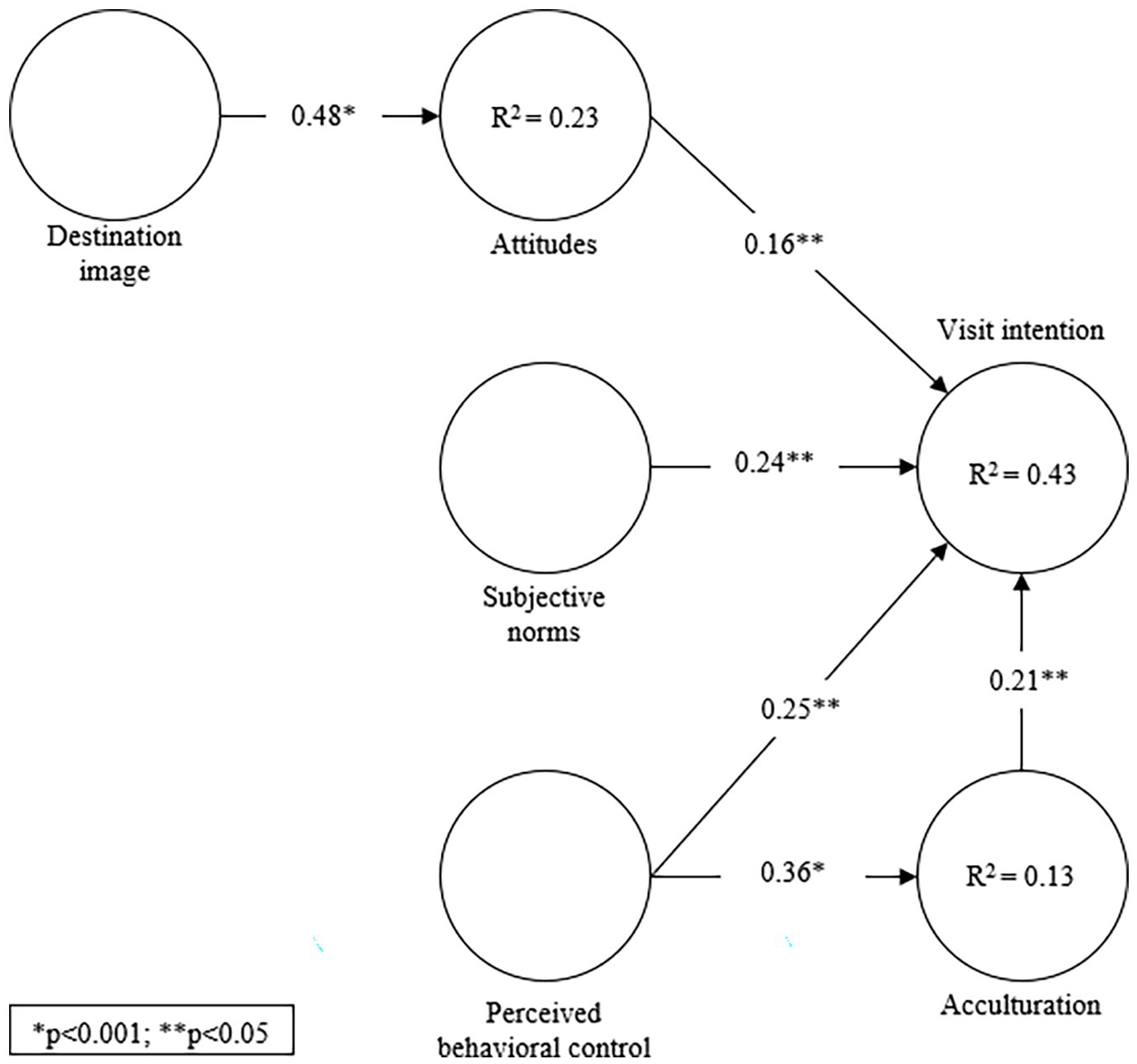
Results of the structural model.
In Figure 2, the coefficients of determination (R2 values) are estimated in each of endogenous factor (attitudes, intention, and acculturation). The R2 values indicate the combined predictive power of the exogenous factors on an endogenous factor (Hair et al., 2017). All the exogenous factors successfully explained the endogenous factors (R2Attitudes = .23; R2Acculturation = .13; R2Visit intention = .43).
Discussion
Theoretical Implications
This study aimed to identify the relationships among destination image, attitudes toward visiting Michigan tourism destinations, subjective norms, perceived behavioral control, and visit intention. In addition, acculturation was included as the mediator of the relationship between perceived behavioral control and visit intention. The study results corroborated that destination image successfully predicted the attitudes toward visiting Michigan tourism destinations (H1), which also led to visit intention (H2). The subjective norms and perceived behavioral control were positively related to visit intention (H3 and H4). Last, the relationship between behavioral control and visit intention was partially mediated by acculturation (H5).
Because of the lack of theoretical support, operationalization of destination image has been controversial for a long time (Kaur et al., 2016; K. Lai & Li, 2015; Stylos et al., 2016). The current study applied the TPB to measure destination image in terms of the behavioral beliefs framework and thus contributed to research on the inconsistent measurement of the destination image. Particularly, when explaining visit intention, many destination image studies disregarded the conative nature of destination image, which implies tourists’ consideration of the place as a future tourism destination (Stylos et al., 2016; Woosnam et al., 2020). Bagozzi (1992) specifically mentioned that not all tourists visit the destination solely because the place is appealing, emphasizing the importance of what image contains visit intention. Given that behavioral beliefs consider expected visiting outcome and its importance, such an approach would be ideal in measuring destination image.
Furthermore, consistent with previous studies (Park et al., 2017; Ran et al., 2021), the destination image was strongly and positively related to the attitudes toward visiting Michigan, which, ultimately, lead to visit intention. Contrary to some other studies that behavioral intention is directly predicted by destination image, which had weak and insignificant relationships (Chalip et al., 2003; Soliman, 2019), the current study demonstrated that the indirect relationship between destination image and visit intention thru the attitudes could be better in increasing the predictive power of the destination image. That is, a positive destination image initially determines individual attitudes toward visit intentions, in turn, affecting the visit intention.
The strongest relationship of perceived behavioral control and visit intention indicates that the factor that contributed most to their visit intention was whether they could control the travel constraints. The result was consistent with those of several previous studies (S. J. Lee & Lina Kim, 2018; Sparks, 2007), evidencing that perceived behavioral control discharged the most important role in explaining visit intentions. This is likely because when compared with domestic tourists and residents, they are more likely to have travel constraints because of cultural differences (Stodolska, 2015). In addition, given that their primary purpose of living in the US is not travel but either study or work, they might have a small window of time for traveling (Davidson et al., 2010). Price is likely to impact their travel intention as well because two-thirds of the sample were students; thus, they might have more burden in travel expenses than general tourists would (Gardiner et al., 2013).
The subjective norms also had a strong impact on visit intention. Similar results were also reported by studies targeting outbound Chinese tourists: their visit intentions were strongly influenced by significant others (Ashraf et al., 2020; Lam & Hsu, 2006; Quintal et al., 2010). In foreign countries, it is common for foreign students and residents to create a community with the same ethnicity to reduce loneliness and obtain information (Sawir et al., 2008; Wu et al., 2015). This likely increases chances that their visit intention is influenced by their own community. Particularly, as tourism products have the characteristics of intangibility and heterogeneity, visit intention is commonly impacted by word-of-mouth (Weaver & Lawton, 2014). This is more likely to happen if the destination is relatively unknown, which is the case for Michigan with foreign residents (Xu et al., 2020).
Last, acculturation partially mediated the relationship between perceived behavioral control and visit intention. This indicates that other mediating factors could exist between these two factors. However, the significant and positive relationship still emphasized the importance of considering acculturation when explaining the tourist behavior of foreign residents. The current study contributed to the literature on the tourist behavior of Chinese immigrants, which classified and explained their behavior by nationality and not by cultural components such as acculturation (Cho et al., 2021; Feng & Page, 2000; Shen et al., 2018). Considering that acculturation would be particularly necessary because those globalized young generations tend to more easily be acculturated than the older generation, in view of which merely classifying them by nationality and length of stay might be not ideal to explain their cultural differences (Cheung et al., 2011). Furthermore, while several cross-cultural studies have identified the cultural components of the behavior of inbound Chinese tourists (Li et al., 2011; X. Li et al., 2015; X. Li & Stepchenkova, 2012), the findings were not applicable to the current study as Chinese residents had been exposed to the local culture longer and more intensely than general inbound tourists did. Thus, investigating acculturation might be more applicable in cross-cultural tourism studies, particularly when a study aims to understand the tourist behavior of foreign residents, students, and employees.
Practical Implications
Several practical implications are also available. First, to increase positive attitudes toward visiting Michigan tourism destinations, tourism managers should further promote the positive image of Michigan, specifically targeting Chinese residents. When compared with internationally renowned tourism destinations, Michigan tourism destinations are relatively unknown among international tourists. Hence, increasing the awareness of the destinations and promoting a positive image would be critical in increasing the number of visits (Stepchenkova & Li, 2012). Specifically, official tourism information websites such as Pure Michigan should proffer information tailored to Chinese tourists. Measures such as translating the website into Chinese and launching tour packages customized to Chinese preferences would probably enhance the impression that the destination state welcomes Chinese tourists (Fei, 2014). Advances in artificial intelligence (AI) have made such translation services easier than they were before (Dew et al., 2018). Tourism managers should consider using AI-based translation services or hire Chinese marketers. Furthermore, a positive destination image could be fostered if destination marketers for Michigan highlighted attributes evincing a scarcity value in China. For instance, marketers could broadcast the clean air and the abundance of natural environments as being of scarcity value to the residents of China, who suffer severe air and water pollution because of the nation’s rapid economic growth (Dong et al., 2021).
In addition, as Chinese residents are easily influenced by their significant others, providing tourism information to community groups, such as Chinese business and international student associations, would be necessary to attract more tourists. Regular trips organized by these associations will increase the visits of Chinese residents, in turn, contributing to the economy of Michigan by attracting more local Chinese residents and inviting their friends and families as inbound tourists (Davidson et al., 2010; X. Li et al., 2015; Michael et al., 2004).
Last, by identifying and evaluating tourism attributes currently being provided, tourism managers must understand travel constraints that are specifically caused by cultural differences and improve potential services or facilities. For instance, the Michigan tourism strategic plan (Nicholls, 2012) identified the lack of public transportation as a major drawback in promoting Michigan tourism destinations. International tourists might find driving private vehicles more problematic, and such difficulties should be resolved to minimize travel constraints. Further, cultural adaptation programs could be offered via tourism activities to increase acculturation levels and simultaneously strengthen the perceived behavioral control of prospective tourists apropos their visit local destinations. Learning opportunities could be provided for self-organized trips, covering issues such as car rentals, driving rules, reserving accommodations, and other travel-related information to facilitate the perceived behavioral control and acculturation of Chinese residents.
Limitations and Future Research
While the current study contributed theoretically and practically to destination image studies, several limitations can be alleviated in future research. Although the study investigated the tourist behavior of Chinese residents in Michigan, it cannot confirm that their behaviors are different from those of domestic tourists. In addition, as they already had lived in Michigan, the opinions of some respondents might be influenced by their previous travel experiences. The study can be further improved upon by comparing the results with those of domestic tourists and including the travel history as a moderating factor of the model. Furthermore, while the current study employed explicit measurement to measure destination image, it is recommended to use implicit measurement of destination image using the implicit association test (IAT). This allows researchers to measure Chinese residents’ implicit social cognitions by minimizing bias caused by social desirability (Tse & Tung, 2020; J. Yang et al., 2012). Last, the current data were collected before the COVID-19 pandemic; thus, the destination image of Chinese residents could be changed. Future research initiatives must compare the destination image evidenced by the current study after the COVID-19 pandemic to identify whether the current global health crisis has degraded the image of the studied destinations. In particular, the acculturation levels and perceived behavioral control of Chinese residents are likely to decrease because of the anti-Asian racism trend witnessed in the US. Pertinent factors such as the risk perceptions pertaining to racism, COVID-19 infections, and the stigmatization of Chinese citizens during the pandemic should be considered to grasp the elements restraining their visit intentions.
Conclusion
Understanding the destination image of potential tourists represents a well-known fundamental step for the development of tourism marketing strategies (Ran et al., 2021). However, the theoretical context and the operationalization of the construct of destination image have been long-debated (Afshardoost & Eshaghi, 2020; Baloglu & McCleary, 1999; Byon & Zhang, 2010; Josiassen et al., 2015; Nghiêm-Phú, 2014; Zhang et al., 2014). This study’s application of the TPB to destination image denotes a superior conceptual standpoint. Specifically, the evaluation of destination image on the basis of the behavioral beliefs format allows the grasp of both, objective and subjective, appraisals of destination attributes. Such an examination illustrates the mediating effects of acculturation—the extent to which cultural adaptation exerts an impact on individual visit intentions. The results of the current study reflect the idea that the current rapid, gushing increase in the number of Chinese residents (Migration Policy Institute, 2021) can be utilized as a steady stream ready to be tapped as marketing targets to pitch destinations in the US that are not yet popular with international tourists. The findings of this study could be applied to regional destinations requiring new business opportunities to revitalize local economies.
Footnotes
APPENDIX A: Questionnaires
The following items assess your attitude toward a possible visit to Michigan tourism destinations in the next 12 months. Please rate each item that best describes your opinion about visiting Michigan tourism destinations in general. Many items might seem similar, however no two items are exactly alike so be sure to answer for each statement.
For me, a visit to Michigan tourism destinations would be. . .
Please indicate your level of agreement with each of the following statements.
Please indicate your level of agreement with each of the following statements.
Please indicate the likelihood that you visit each of the following types of tourism destinations in the next 12 months?
Think about being in the United States. How much do you agree with the following sentences?
When in the United States, it is important for me to . . .
Each of following attributes is intended to measure your belief that Michigan tourism destinations would offer the attribute and its importance for you visiting the destinations. Please rate both side of questions for each of the attributes.
Appendix B
Measurement Reliability and Convergent Validity.

|
|
|
|
|
|
||
|---|---|---|---|---|---|---|
| Expectancy | Importance | |||||
|
|
.98 | .67 | ||||
| Pleasant travel experience | 5.75 (1.35) | 5.76 (1.46) | 0.87 | 40.18 | ||
| Enjoyable travel experience | 5.70 (1.42) | 5.71 (1.46) | 0.86 | 36.74 | ||
| Relaxing travel experience | 5.79 (1.36) | 5.70 (1.41) | 0.84 | 34.17 | ||
| Exciting travel experience | 5.39 (1.45) | 5.40 (1.49) | 0.80 | 26.80 | ||
| Quality infrastructure | 5.29 (1.46) | 5.58 (1.43) | 0.86 | 39.58 | ||
| Suitable accommodations | 5.53 (1.32) | 5.62 (1.50) | 0.90 | 58.40 | ||
| Sufficient tourist information | 5.39 (1.39) | 5.52 (1.53) | 0.87 | 37.04 | ||
| Translated information services | 5.02 (1.63) | 4.98 (1.87) | 0.75 | 22.48 | ||
| Guided tours | 5.01 (1.63) | 4.88 (1.82) | 0.73 | 20.06 | ||
| Good transportation services | 5.05 (1.68) | 5.41 (1.68) | 0.77 | 21.75 | ||
| High standard of hygiene and cleanliness | 5.62 (1.31) | 5.75 (1.43) | 0.91 | 57.38 | ||
| Safe and secure environment | 5.66 (1.38) | 5.96 (1.46) | 0.87 | 43.62 | ||
| Available natural attractions | 5.93 (1.35) | 5.88 (1.41) | 0.85 | 32.59 | ||
| Beautiful scenery | 5.93 (1.37) | 5.94 (1.40) | 0.84 | 30.09 | ||
| Enjoyable climate | 5.52 (1.50) | 5.79 (1.47) | 0.82 | 29.52 | ||
| Friendliness of the local people | 5.74 (1.37) | 5.73 (1.50) | 0.83 | 28.49 | ||
| Shopping | 4.46 (1.71) | 4.68 (1.81) | 0.65 | 15.02 | ||
| Recreational activities | 5.43 (1.44) | 5.58 (1.36) | 0.84 | 40.02 | ||
| Local cuisine and beverage | 5.37 (1.44) | 5.61 (1.46) | 0.86 | 43.85 | ||
| Picking agricultural products | 5.37 (1.47) | 5.22 (1.50) | 0.82 | 34.32 | ||
| Auto attractions | 5.16 (1.53) | 5.00 (1.70) | 0.76 | 21.75 | ||
| Cultural events | 5.22 (1.44) | 5.25 (1.50) | 0.83 | 35.34 | ||
| Historical attractions | 5.10 (1.50) | 5.22 (1.53) | 0.77 | 24.93 | ||
| Casino and gambling | 4.03 (1.90) | 3.73 (2.15) | 0.46 | 9.02 | ||
| Reasonably priced accommodations | 5.59 (1.33) | 5.82 (1.32) | 0.86 | 38.89 | ||
| Inexpensive place to visit | 5.62 (1.33) | 5.65 (1.40) | 0.84 | 36.49 | ||
| Valuable experience for my travel money | 5.73 (1.30) | 5.86 (1.35) | 0.87 | 43.68 | ||
|
|
0.98 | 0.90 | ||||
| Bad–good | 6.01 (1.10) | 0.93 | 63.67 | |||
| Worthless–valuable | 5.83 (1.19) | 0.94 | 91.47 | |||
| Unfavorable–favorable | 5.85 (1.21) | 0.96 | 138.04 | |||
| Unpleasant–pleasant | 5.96 (1.14) | 0.95 | 87.57 | |||
| Not enjoyable–enjoyable | 5.99 (1.15) | 0.96 | 127.04 | |||
|
|
.94 | .81 | ||||
| I would like to take a trip to Michigan tourism destinations in the next |
5.23 (1.76) | 0.87 | 37.96 | |||
| People who are important to me think that it would be good to take a trip to Michigan tourism destinations in the next |
5.02 (1.63) | 0.91 | 67.18 | |||
| Friends, family, or members of my community have recommended that I take a trip to Michigan tourism destinations in the next |
5.07 (1.66) | 0.91 | 56.35 | |||
| I would like to visit Michigan tourism destinations in the next |
5.11 (1.68) | 0.90 | 57.14 | |||
|
|
.92 | .71 | ||||
| I feel that I have enough time to take a trip to Michigan tourism destinations in the next |
4.72 (1.76) | 0.85 | 40.54 | |||
| I feel that I have enough money to take a trip to Michigan tourism destinations in the next |
4.97 (1.65) | 0.85 | 30.66 | |||
| I feel that I have enough ability to interact with Americans to take a trip to Michigan tourism destinations in the next |
5.00 (1.59) | 0.87 | 47.00 | |||
| I feel that I have enough information to take a trip to Michigan tourism destinations in the next |
4.92 (1.66) | 0.83 | 28.59 | |||
| I feel that there is nothing that prevents me from taking a trip to Michigan tourism destinations in the next |
4.68 (1.69) | 0.80 | 23.95 | |||
|
|
.87 | .57 | ||||
| Nature-based tourism destinations | 5.50 (1.65) | 0.72 | 16.76 | |||
| Culinary tourism destinations | 4.88 (1.58) | 0.81 | 28.76 | |||
| Spectator sports and auto-related events | 4.51 (1.68) | 0.68 | 13.00 | |||
| Historic sites | 4.78 (1.55) | 0.78 | 23.75 | |||
| Amusement and theme parks | 4.85 (1.67) | 0.77 | 22.67 | |||
|
|
.91 | .54 | ||||
| When in the US, it is important for me to have Chinese friendsR. | 5.16 (1.71) | 0.72 | 15.68 | |||
| When in the US, it is important for me to have Chinese friendsR. | 4.71 (1.69) | 0.77 | 20.68 | |||
| When in the US, it is important for me to hold on to my Chinese characteristicsR. | 4.79 (1.56) | 0.74 | 17.00 | |||
| When in the US, it is important for me to do things the way Chinese people doR. | 4.23 (1.63) | 0.67 | 13.21 | |||
| When in the US, it is important for me to have American friends. | 5.46 (1.42) | 0.75 | 22.44 | |||
| When in the US, it is important for me to take part in American traditions. | 5.24 (1.38) | 0.77 | 22.52 | |||
| When in the US, it is important for me to hold on to (or develop) my American characteristics. | 4.78 (1.37) | 0.76 | 18.25 | |||
| When in the US, it is important for me to do things the way American people do. | 4.64 (1.48) | 0.72 | 15.82 | |||
Note. OL = outer loadings; CR = composite reliability; AVE = average variance extract; R = reverse coded.
Acknowledgements
Special thanks are due to the former president of the Detroit Chinese Business Association, Jerry Xu, for his help in collecting the data. Dr. Dan McCole is also gratefully appreciated for sharing information related to Michigan tourism destination and for advising on the research process.
Declaration of Conflicting Interests
The author(s) declared no potential conflicts of interest with respect to the research, authorship, and/or publication of this article.
Funding
The author(s) received no financial support for the research, authorship, and/or publication of this article.
Compliance With Ethical Standards
The Institutional Review Board provided approval (Michigan State University, Human Research Protection Programs, Harry McGee, IRB# x16-999e).
