




Abstract
Although the literature abounds with factors that contribute to organizational commitment and commitment to change, it is still unclear what factors influence teachers’ affective commitment to change. This study attempts to examine the relationships between two perceived distributive leadership functions, namely, leadership team cooperation and participative decision-making, and teachers’ affective commitment to change with the mediating effects of intentional, emotional, and cognitive readiness for change. Data consisted of 229 Malaysian teachers selected randomly from 24 secondary schools in Penang, Perak, and Johor. Data were analyzed using partial least squares structural equation modeling approach. Findings revealed either leadership team cooperation or participative decision-making has no significant direct relationship with teachers’ affective commitment to change. However, significant but weak mediating effects were found between participative decision-making and teachers’ affective commitment to change with the mediators of intentional, emotional, and cognitive readiness for change. Limitations, implications, and suggestions for future studies are presented.
Keywords
Introduction
Given the tremendous changes in the workplace to sustain competitiveness in a globalized world, change has become the norm for organizations to sustain their success and existence (Jaros, 2010; Neves, 2011). Education is not an exception (Liu, 2013, 2015; Sales, Moliner, & Amat, 2017). Many countries are seeking to improve or reform their education systems to compete more effectively in facing the globalization challenges (Fullan, 2006, 2008). As teachers are the ultimate implementers of education reform, they need to commit themselves to change initiatives such as instructional changes to ensure the success of educational reform (Fullan, 2008).
With respect to this concern, leadership is considered as one of the significant factors that influence teachers’ affective commitment to change to inform educational improvement. Literature indicates that transformational leadership is one of the predictors that positively related to teachers’ commitment to change with the belief that transformational leaders can engage teachers in school change processes effectively (Leithwood, Menzies, & Jantzi, 1994; Liu, 2015; Yu, Leithwood, & Jantzi, 2002). However, in large schools, it is difficult for school leaders to manage the schools individually. As such, school leaders need to distribute their leadership with other school members through daily interaction (Hulpia, Devos, Rosseel, & Vlerick, 2012). In fact, school leadership has a great influence on school outcomes when it is widely distributed compared with singular leadership (Bush, 2011; Leithwood, Day, Sammons, Harris, & Hopkins, 2006).
An earlier study by Leithwood et al. (2006) has shown that influence from all sources of leadership accounted for 27% variation in student achievement across schools. In essence, such distributive leadership could provoke school team members’ participation, which subsequently affects organizational commitment (Hulpia, Devos, & Rosseel, 2009; Hulpia, Devos, & Van Keer, 2010). Previous studies revealed a significant relationship between distributed leadership functions and organizational commitment (Hulpia & Devos, 2009; Hulpia et al., 2009; Hulpia et al., 2010). However, less emphasis has been paid on the relationship between distributive leadership functions and teachers’ affective commitment to change particularly in Malaysian school context compared with its counterpart in Western countries.
In fact, previous studies were found to have more focus on the relationship between school leadership and teacher commitment at both primary and secondary school levels in Malaysia. The Malaysian studies are limited to the two major issues. The first issue found was related to the investigation of transformational leadership or leadership behavior and teacher commitment (Ibrahim, Ghavifekr, Ling, Siraj, & Azeez, 2014; Wahab, Fuad, Ismail, & Majid, 2014). The second issue was related to the influence of culture toward teacher commitment among the different types of Malaysian primary schools (Raman, Ying, & Khalid, 2015; Razak, Darmawan, & Keeves, 2010). Clearly, investigation on distributed leadership and teachers’ commitment to change is substantially fewer in Malaysian school context.
Furthermore, previous leadership-school outcome studies that involve direct relationship tend to report weak or inconclusive results, whereas studies that involve mediating relationships tend to report significant empirical results (Hallinger & Heck, 1998). In agreement with Hallinger and Heck’s (1998) view, it can be proposed that the influence of leadership on teachers’ affective commitment to change could be direct and indirect. Hence, this study further proposes readiness for change as the mediator of the relationship between distributive leadership functions and teachers’ affective commitment to change. The reason is effective leaders who tend to provide support are able to change employees’ beliefs and attitudes and subsequently make them have a better understanding of the change efforts and thus ready to accept the changes (Van der Voet, Kuipers, & Groeneveld, 2016). Moreover, literature in organizational studies has shown significant mediating effects of readiness for change between leadership and commitment to change (Santhidran, Chandran, & Borromeo, 2013), but research in this area is less explored in educational studies. To address the above-mentioned research gaps, this study attempts to examine the mediating effects of intentional, emotional, and cognitive readiness for change between leadership team cooperation, participative decision-making, and teachers’ affective commitment to change in Malaysian secondary school context.
Educational Policy Reform in Malaysia: An Overview
With the dawning of the 21st century, the Malaysian education policies have experienced a paradigm shift due to globalization (Ahmad & Ibrahim, 2016; Ibrahim, Razak, & Kenayathulla, 2015). The state of globalization urges Malaysia to transform to a knowledge-based economy with compatible human resource as reflected in the high demand of skillful human capital in the labor market through educational reform (Lee, 2002). Globalization has enforced to make English, as a medium of communication and as a subject in school, a need rather than an option (Phan, Kho, & Ch’ng, 2013). As what Phan et al. (2013) emphasized, the language policies of a nation are influenced by universal factor such as the role of English being the global language which carries a greater bearing now than before. In addition to this, Malaysia’s teaching policies are also affected by students’ performance in international large-scale assessments. Malaysian has participated in two international large-scale assessments, namely, the Trends in International Mathematics and Science Study (TIMSS) and the Program for International Student Assessment (PISA) (Thien, 2016). Regretfully, Malaysia performed poorly in TIMSS 2011 and PISA 2009 and 2012. This was evident by the lower than international average score obtained by the country. The low scores are attributed to the poor application of knowledge and inadequate reasoning skills among students in the areas of mathematics, science, and reading literacies (Thien, 2016). This alarming result of educational assessment sparks off the need to initiate changes in the current education system as stated in Malaysia Education Blueprint 2013-2025 (Educational Planning and Research Division [EPRD], 2016a, 2016b). One of the changes includes the new national curriculum reform, known as the Primary School Standard Curriculum (KSSR) and the Secondary School Standard Curriculum (KSSM). Both new curricula put emphasis on higher order thinking skills and science, technology, engineering, and mathematics (STEM) integration education in classroom teaching (Abdullah, Zain, Nair, Abdullah, & Ismail, 2016). The other change introduced into the Malaysian education system is shifting the initial exam-based assessment to school-based assessment (Thien & Mangao, 2016). The latter educational policy reform involved the abolishment of examinations for Year 1, 2, and 3 pupils, which was replaced by a more holistic classroom-based assessment approach (The Malay Mail Online, 2018).
Theoretical Perspective and Hypothesis Development
Teachers’ Affective Commitment to Change
Commitment to change is described as employees’ level of connection in the implementation of a dynamic process. This process includes new work rules, policies, program, budget, and technology (Neubert & Wu, 2009). Deriving from Meyer and Allen’s (1997) original conceptualization of organizational commitment, Herscovitch and Meyer (2002) conceptualized commitment to change as a multidimensional construct that consists of three dimensions: (a) affective commitment to change, (b) continuance commitment to change, and (c) normative commitment to change. According to Herscovitch and Meyer (2002), affective commitment to change refers to “a desire to provide support for a specific change being introduced in the workplace” (p. 475). Continuance commitment to change emphasizes the cost-associated matter with failure to give support for the change, whereas normative commitment to change is based on a sense of agreement to bring support for the change. In general, these three dimensions could be referred as feeling, cost-, and obligation-based commitment to change, respectively.
In particular, affective commitment to change has become an important core value that contemporary organizations need to develop among their employees compared with the other two dimensions (Bouckenooghe, Schwarz, & Minbashian, 2015; Ritz, Shantz, Alfes, & Arshoff, 2012; Rogiest, Segers, & van Witteloostuijn, 2015). Furthermore, literature supported that affective commitment has stronger impact on change’s success compared with the other two dimensions in organizational context (e.g., Cunningham, 2006; Michaelis, Stegmaier, & Sonntag, 2010). These are the main reasons why this current study is only limited to examining teachers’ affective commitment to change instead of including the other two dimensions as a whole.
The current study adopted the conceptualization of affective commitment to change by Herscovitch and Meyer (2002). Teachers’ affective commitment to change can be described by stating that teachers choose to stay with the school because of their attachment to the school emotionally and they want to. Teachers who are affectively committed to change are expected to be able to deal with the changes although the changes may be stressful for them.
Distributed Leadership Theory
Distributed leadership theory ascertains that leadership is stretched over individuals via various ways in which leadership is undertaken through the daily interaction of multiple leaders in an organization (Spillane, Halverson, & Diamond, 2004). These multiple leaders can have formal or informal leadership positions (Spillane, 2006) because leadership rests on a base of expertise instead of hierarchical authority (Woods, Bennett, Harvey, & Wise, 2004). Deriving from social psychology theory, a distributive leader focuses on the pattern of interactions among staff in an organization. With this perspective, Scribner, Sawyer, Watson, and Myers (2007) framed distributed leadership as social influence and interactions, which serve as the core of leadership practices. The influence processes could facilitate that behavioral changes occur in a social context with a dynamic interaction among organizational members (Bandura, 1986). Clearly, the distributed leadership theory reinforces that there are multiple sources of influence within organizations, including shared, collaborative, and participative leadership (Spillane et al., 2004).
Distributive Leadership Functions
Distributed leadership is defined as the extent to which leadership functions are assigned among formal leadership positions in a particular leadership team (Gronn, 2002; Hulpia et al., 2010; Spillane, 2006). Leadership could be distributed through a cooperative leadership team and participative decision-making (Hulpia et al., 2012). A cooperative leadership team is viewed as a leadership team which is characterized by group cohesion (Hulpia et al., 2009). Group cohesion speaks for openness of the team members, mutual trust, and communication. Leadership team cooperation is perceived as support among school leaders that leads to mutual reinforcement and forms a more effective leadership team in administering the school organization (Hackman, 1990). Management literature has shown that leaders’ openness of team members, mutual obligation, and open interactions have constructive influences on organizational commitment (Holtz, 2004). In the education context, teachers’ perception of leadership team cooperation is one of the most important predictors of organizational commitment (Hulpia et al., 2009), which can provide emotional support for individuals’ job satisfaction (Mathieu, 1991) and self-efficacy (Crowther, Kaagan, Ferguson, & Hann, 2002). At this juncture, it is expected that a higher level of leadership team cooperation could affect a higher level of commitment to change. Therefore, this study hypothesizes a positive relationship between leadership team cooperation and teachers’ affective commitment to change. The first hypothesis is advanced as follows:
Participative decision-making allows a more casual style of leadership interactions of the school team members (Gronn, 2002; Spillane, 2006). It also permits teachers to be involved and exerts domination in the decision-making process (Somech, 2005). As such, teachers’ participation in decision-making tends to have an act of ownership and thus promotes a firm belief that increases the level of acceptance and recognition of their contribution, which eventually inspires their engagement to the school (Park, 2005; Somech, 2005). However, the relationship between participative decision-making and organizational commitment remains inconclusive. Hulpia et al. (2009) supported a significant relationship between participative decision-making and organizational commitment, but a nonsignificant relationship was found in studies conducted by Bogler and Somech (2004) and Louis (1998). Previous studies provide insights that participative decision-making could be hypothesized to have a relationship with teachers’ affective commitment to change instead of organizational commitment as a whole. Hypothesis 2 is advanced as follows.
Consequently, readiness to change occurs when the organizational members are receptive to the organizational changes due to the leaders’ influence and their frequent interaction with subordinates (Holt, Armenakis, Harris, & Field, 2017). This is because a continuous interaction among members potentially changes organizational members’ change belief in terms of attitudes, feeling, and thoughts when they face the organizational changes based on the motivation theory of Bandura (1986). As such, the presence of teachers’ change belief is expected to be able to influence their attitude toward change and, in turn, provoke their readiness for change (Kin & Kareem, 2016). Holt et al. (2017) pointed out that once the organizational members are ready for changes, they are motivated to commit themselves to changes when readiness for change becomes a stable part of their behavior.
Readiness for Change
Armenakis, Harris, and Mossholder (1993) viewed individual readiness for change as one’s beliefs, attitudes, and aims regarding the degree to which changes are required and their perception of the individual and the organizational ability to successfully make those changes. Meanwhile, Hanpachern (1997) referred to individual readiness for change as the extent to which individuals are mentally, psychologically, or physically ready, prepared, or primed to participate in organizational development activities. Viewing from a specific manner, Bouckenooghe, Devos, and van den Broeck (2009) conceptualized readiness for change as a multidimensional construct that comprises three dimensions, namely, (a) intentional, (b) emotional, and (c) cognitive readiness for change at individual level. Intentional readiness is defined as the level of energy and effort with which individuals attempt to participate in the process of change. Emotional readiness concerns the feelings of an individual toward specific changes. Cognitive readiness is described as individuals’ belief toward the positive results of the change efforts in an organization, colleagues, and themselves. When readiness for change exists, the organization’s main aim is to encourage change and minimize resistance. If organizational members are not prepared for changes, “the change may be turned down and organizational members may cause negative reactions such as sabotage and absenteeism toward changes” (Bouckenooghe et al., 2009, p. 561). The current study has adopted the conceptualization of readiness for change proposed by Bouckenooghe et al. (2009).
Literature in organizational change emphasizes the role of leadership on readiness for change (Armenakis & Bedeian, 1999). This is because effective leaders who serve as change agents have the tendency to give support that eventually refines the basic values, beliefs, and attitudes of the employees so that they are prepared to acquire and know the change efforts (Armenakis et al., 1993; Van der Voet et al., 2016). In addition, effective leaders are able to create and ensure readiness for institutional change (Walker, Armenakis, & Bernerth, 2007). In contrast, passive leaders might not be able to contribute relevant information and seriously prepare employees for change. Leaders are influential as they are capable of motivating change targets by improving readiness for change and commitment (Whelan-Berry, Gordon, & Hinings, 2003). Previous studies have found an association between leadership behavior and readiness for change in the education context (Nordin, 2012). According to Nordin (2012), about 36.5% of the variance in readiness for change is explained by organizational commitment and leadership behavior in the Malaysian higher education context.
It can also be disputed that leadership has an indirect relationship with commitment to change via readiness for change. This is because individual readiness for change exists before the responsibility to change (Conner, 1992). On the contrary, literature highlighted the positive impact of distributive leadership on teachers’ self-efficacy and motivation (Camburn & Han, 2009; Hallinger & Heck, 1998). Such previous studies infer the possible influence of distributed leadership to motivate teachers’ readiness to change, which in turn affects their commitment to change. Although leadership may have an effect on commitment to change, it may first affect the change readiness that is inevitable to prepare the change initiatives and consequently influence the commitment to change. Hence, this study hypothesized that the three specific dimensions of readiness for change—(a) intentional, (b) emotional, and (c) cognitive readiness for change proposed by Bouckenooghe et al. (2009)—have mediating effects on the relationships between the two distributed leadership functions: (a) leadership team cooperation and (b) participative decision-making, and teachers’ affective commitment to change. The following hypotheses are advanced.
As shown in Figure 1, this study hypothesized the relationships between distributed leadership functions and teachers’ affective commitment to change with the mediating effects of intentional, emotional, and cognitive readiness to change based on the theoretical grounding and literature discussed above.

Research model.
Method
Participants
A cross-sectional survey method was employed in this study. This study used cluster sampling procedure for data collection. Teacher sample was selected from three states—Penang (northern region), Perak (middle region), and Johor (southern region)—to ensure the representativeness of the sample. By considering the cost constraint, eight primary schools were selected randomly from each state. The average number of teacher sample selected from each school was computed using the design effect (deff). The magnitude of deff indicates the amount of the sufficient sample size of this study that needs to be adjusted in quantifying the design efficiency (Dattalo, 2008). Intraclass correlation coefficient (ICC) which is written as rho (ρ) and provides a measure of homogeneity for individuals within cluster was used to compute deff (Kish, 2004). Equation 1 shows the formula to compute the deff (Kish, 2004):

Dattalo (2008) recommended that deff lies between 1 and 3 for a well-designed study (see Equation 2). McCoach and Adelson (2010) suggested that the average ICC ranges from 0.10 to 0.25. Following McCoach and Adelson’s (2010) recommendations, this study adopted a value of 0.20 for the ICC, and the computation of average teacher sample size was as follows (see Equation 3). The result showed that the maximum value of average teacher sample size was 10. This made up the total number of 240 selected teachers from 24 selected schools:


The participation was solely voluntary and confidential. After obtaining the consent from the Ministry of Education and State Education Department, the questionnaires were distributed to the respondents personally. The completed questionnaires were 229. The response rate was about 95%. The sample size of 229 fulfilled the minimum sample size recommendation for a statistical power of 80% at the significance level of .05 as recommended by Cohen (1992). Table 1 shows that the dominant group is the female teachers, whereas 40% were male teachers. More than half of the participants were Chinese, about one quarter were Malays, and the remaining were other Malaysian ethnic groups, including Indians, Ibans, and Kadazans. About 70% of the sample had 10 years and below (35%) and between 16 and 20 years (36%) of teaching experience.
Sample’s Demographic Background.

Instrumentation
Herscovitch and Meyer’s (2002) validated scale was used to measure teachers’ affective commitment to change. The construct was measured by six items with a 7-point Likert-type scale ranging from 1 (strongly disagree) to 7 (strongly agree). The leadership team cooperation was measured by 10 items validated by Hulpia et al. (2010). Each item was rated on a 5-point Likert-type scale ranging from 0 = strongly disagree to 4 = strongly agree. Leithwood and Jantzi’s (1999) validated subscale with six items was adapted to measure perceived participative decision-making to assess the extent to which teachers can participate in school decision-making with a 5-point Likert-type scale ranging from 0 (strongly disagree) to 4 (strongly agree). This study used Bouckenooghe et al.’s (2009) validated scale to measure teachers’ intentional, emotional, and cognitive readiness for change with three items for each dimension of readiness to change. The nine items were rated on a 5-point Likert-type scale ranging from 1 (strongly disagree) to 5 (strongly agree). In total, the questionnaire consisted of 31 items to measure these six constructs.
To measure teachers’ affective commitment to change, the six original items were adapted according to instructional changes as the 21st-century teaching and learning skills in the Malaysian classroom. For instances, the sample items such as “I believe in the value of this change” was revised as “I believe in the value of change regarding the 21st century learning skills in the classroom” and “This change is a good strategy for this organization” was revised as “Instructional changes that involve the 21st century learning skills are a good strategy for this school.” Item adaptation was conducted by the researchers and two content experts from the local universities.
The 31 items in the English version were translated into the Malay language using the forward translation methods followed by the translation into English language again using the backward translation methods. Two content experts, one Malay language expert and one English language expert from the local universities, were involved in this study to ensure the suitability, readability, and comprehensibility of the items. Items were revised and improved based on the feedback from the evaluators. A small-scale pretest was conducted with five primary school teachers to ensure the suitability of wording, formatting, and layout. These five teachers were excluded from participating in the main studies.
Data Analysis Procedure
Prior to data analysis, three negative items of teachers’ affective commitment to change (AC3, AC5, and AC6) and two negative items of cognitive readiness for change (CR1 and CR3) were recoded and termed as AC3R, AC5R, AC6R, CR1R, and CR3R. Partial least squares structural equation modeling (PLS-SEM) using SmartPLS 3.0 (Ringle, Wende, & Becker, 2015) computer software was used to analyze the data. PLS-SEM was used to examine the relationships between the undertaken variables because this statistical approach works well with relative small sample size and its superiority to handle complex structural model and makes practically no assumptions about the underlying data distribution (Hair, Hult, Ringle, & Sarstedt, 2017). For the ease of interpretation, the terms of latent variable and construct as well as indicator and item were used interchangeably throughout this study.
For PLS analysis, a two-step approach, namely, the assessment of reflective measurement model and structural model, was used to assess the research model (see Figure 1) (Chin, 2010; Hair et al., 2017). The assessment of the reflective measurement model aims to examine the validity and reliability of the relationships between constructs and its respective items. Meanwhile, the assessment of the structural model attempts to examine the relationships between the undertaken variables (Chin, 2010; Hair et al., 2017). Bootstrapping procedure with 5,000 bootstrap samples was used to determine the significance of the outer loadings in the measurement model and the relationships between constructs in the structural model assessment, respectively (Hair et al., 2017).
Results
Common Method Bias
When a self-report questionnaire was used to collect data simultaneously from the same respondents, it could be prone to the emergence of the same source bias or common methods variance (CMV; Podsakoff, MacKenzie, Lee, & Podsakoff, 2003). CMV refers to the amount of spurious correlation between variables that can create erroneous conclusion of the study (Podsakoff et al., 2003). As this study collected the data related to the six undertaken variables from the same respondents at one time, a method of partialling out a marker variable proposed by Podsakoff et al. (2003) was used to detect the presence of CMV.
Partialling out a marker variable means we add a theoretical unrelated variable or marker variable to the endogenous variable in the model (Podsakoff & Todor, 1985). In this study, the endogenous variable refers to teachers’ affective commitment to change, and the social desirability scale with seven items adopted from the short-form version of Fischer and Fick (1993) was used as a marker variable for investigating the CMV effects. The CMV analysis was conducted using a two-stage approach. First, the theoretical model without a marker variable was created in SmartPLS software outlook and then the PLS algorithm was run. The R2 value of endogenous variable was observed. Second, the marker variable was added into the model and the R2 value of endogenous variable was observed. A significant increase in the R2 value before and after adding the marker variable evidenced the presence of CMV and vice versa.
Findings showed that the R2 value of endogenous variable was 32% without the marker variable, whereas the R2 value of endogenous variable was 33% after partialling out the marker variable on endogenous variable. The difference in the values of R2 was only 1%. The results have informed the absence of CMV in this study.
Assessment of Measurement Model
Reflective measurement model was measured in terms of convergent and discriminant validity (Hair et al., 2017). Convergent validity was determined by (a) indicator reliability, (b) composite reliability (CR), and (c) average variance extracted (AVE) (Chin, 2010; Hair et al., 2017). To assess indicator reliability, the acceptable value of loading of each indicator on its respective variable is 0.70 and above (Hair et al., 2017). Loadings of items CR2, AC3R, AC5R, and AC6R were found to be lower than 0.70. These four items were excluded and we reran the analysis.
Table 2 shows that loadings for the remaining 27 items were found to be higher than 0.70. CR was measured to determine the internal consistency reliability. The suggested cutoff value of CR is 0.80 (Hair et al., 2017). Table 2 shows that CRs were found to be higher than 0.80 (see column 9). AVE is the grand mean value of the squared loadings of the items associated with its respective construct (Hair et al., 2017). The threshold of AVE is 0.50 or higher (Chin, 2010). Table 2 shows that the AVE of each construct is higher than the threshold of 0.50. The result implied that the convergent validity of the reflective measurement model was highly acceptable.
Results of Measurement Model Assessment.

Note. CO = cooperation; PA = participative decision-making; IR = intentional readiness; ER = emotional readiness; CR = cognitive readiness; AC = affective commitment; AVE = average variance extracted.
CR = composite reliability.
Discriminant validity refers to the degree to which each construct is truly distinct from other constructs in a model (Chin, 2010). The square root value of AVE of each construct should be higher than the highest correlation of the construct with any other constructs in the model to ensure discriminant validity (Fornell & Larcker, 1981; Hair et al., 2017). Table 3 shows that all the square root values of AVE for each construct are higher than its correlation with all other constructs. The result indicated that the discriminant validity of the reflective measurement model was established.
Results of Discriminant Analysis Using Fornell and Larcker’s (1981) Criterion.

Note. Values in diagonal (in bold) represent the square root of AVE. AC = affective commitment; CO = cooperation; CR = cognitive readiness; ER = emotional readiness; IR = intentional readiness; PA = participative decision-making.
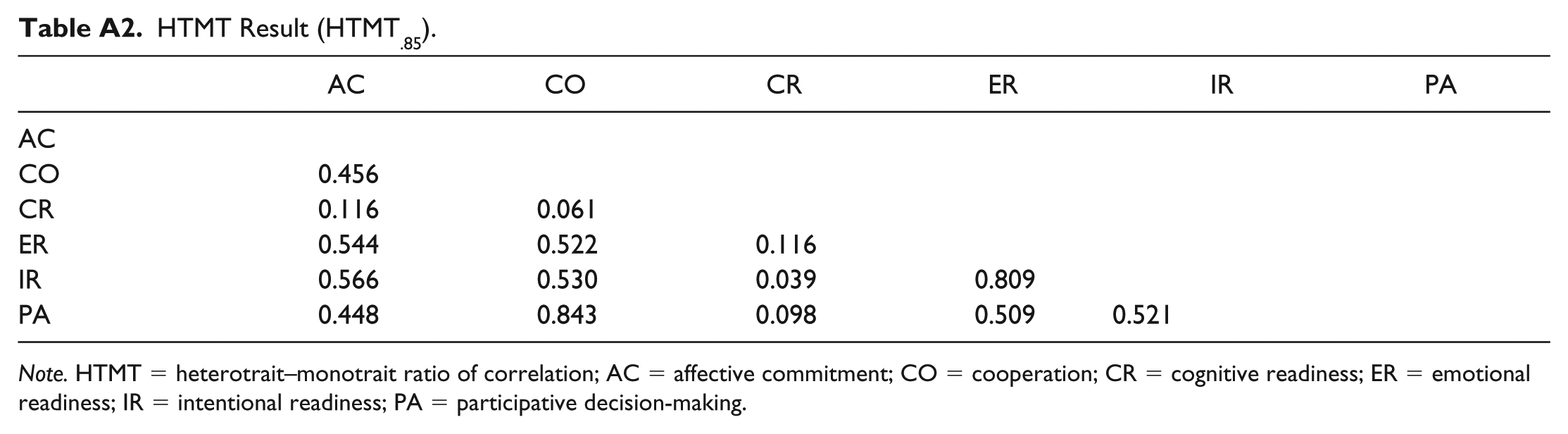
In addition to Fornell and Larcker’s (1981) criterion, there are two alternative methods to assess discriminant validity. First is the cross-loading criterion. Discriminant validity is established if the loadings of items on its respective variable are higher than the loadings on all other variables (Chin, 1998). Second is the heterotrait–monotrait ratio of correlation (HTMT). HTMT refers to the ratio of correlations within variables to correlation between the variables (Henseler, Ringle, & Sarstedt, 2015). Discriminant validity is established if the HTMT values are smaller than 0.85 (HTMT.85) or 0.90 (HTMT.90) (Henseler et al., 2015). Table A1 shows that there exists discriminant validity between the six variables where all items are highly loaded on their respective variables. The result supported the absence of high cross-loading among the variables. On the contrary, Table A2 shows that the HTMT values are smaller than the HTMT.85 value of 0.85 (Henseler et al., 2015). The results indicated that discriminant validity was established for the six undertaken variables in this study.
Assessment of Structural Model
We assessed the R2 measure of the teachers’ affective commitment to change and the path coefficients of direct and indirect relationships in the structural model (see Figure 1). According to Chin (2010), the R2 values of .67, .33, and .19 are considered substantive, medium, and weak, respectively. The five constructs, namely, leadership team cooperation, participative decision-making, intentional readiness, emotional readiness, and cognitive readiness for change, contributed 32% of variance explained on teachers’ affective commitment to change. The R2 value was considered moderate.
Figure 2 and Table 4 show that the direct relationship between leadership team cooperation on teachers’ affective commitment to change is nonsignificant, with the bootstrapping 95% confidence interval containing zero and t value being smaller than 1.96 at the significance level of .05. Similarly, there was no significant direct relationship between participative decision-making on teachers’ affective commitment to change. Thus, H1 and H2 were not supported.

Bootstrapping results of the structural model.
Results of Direct Effects.

Note. CI = confidence interval.
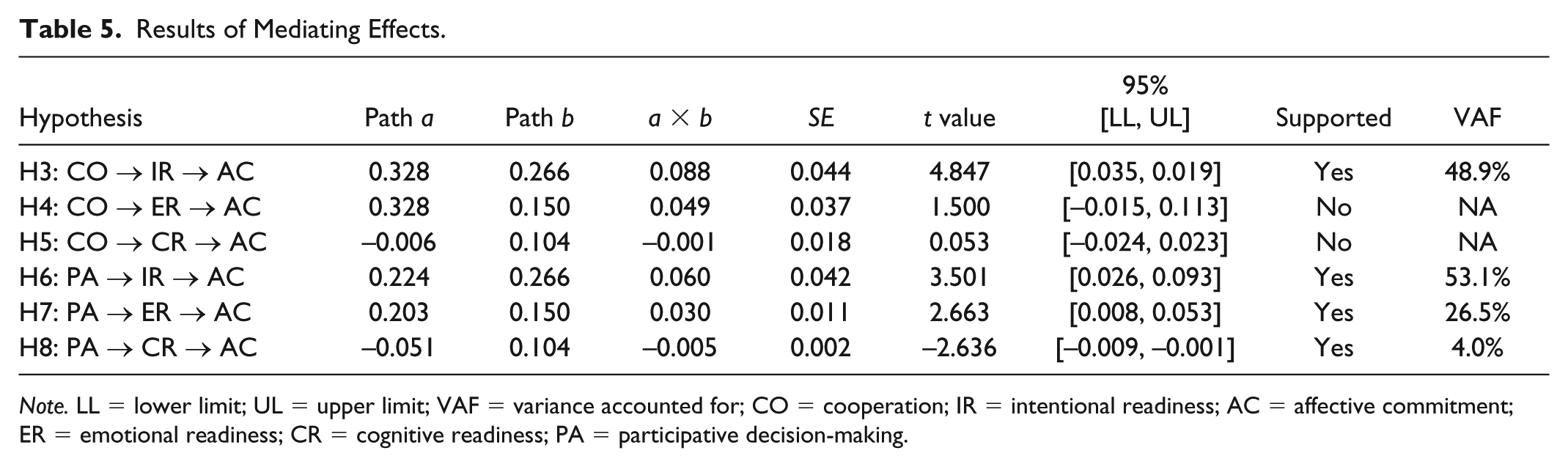
Table 5 shows that intentional readiness for change has significantly mediated the relationship between leadership team cooperation and teachers’ commitment to change (β = 0.087, t > 1.96), with the bootstrapping bias-corrected confidence interval containing no zero and t value being larger than 1.96 at the significance level of .05. Hence, H3 was supported despite the mediating effect of intentional readiness being considered weak with the beta value of 0.087. However, H4 and H5 were not supported because the direct relationship between leadership team cooperation and teachers’ commitment to change with the mediators of emotional (β = 0.049, t < 1.96) and cognitive readiness for change (β = 0.001, t < 1.96) was nonsignificant at the level of .05.
Results of Mediating Effects.
Note. LL = lower limit; UL = upper limit; VAF = variance accounted for; CO = cooperation; IR = intentional readiness; AC = affective commitment; ER = emotional readiness; CR = cognitive readiness; PA = participative decision-making.
Meanwhile, all the three mediators, namely, intentional readiness for change (β = 0.060, t > 1.96), emotional readiness for change (β = 0.030, t > 1.96), and cognitive readiness for change (β = 0.005, t > 1.96), have significant mediating effects on the relationship between participative decision-making and teachers’ affective commitment to change. Thus, H6, H7, and H8 were supported. Notably, the results showed that intentional, emotional, and cognitive readiness for change have weak mediating effects on the relationship between participative decision-making and teachers’ affective commitment to change, with the beta values ranging from 0.005 to 0.060.
This study further estimated the strength of significant mediating effects between leadership team cooperation, participative decision-making, and teachers’ affective commitment to change by computing the variance accounted for (VAF). VAF is indicated by the proportion of indirect relationship to the sum of direct and indirect relationship (Hair, Ringle, & Sarstedt, 2011). If the VAF is less than 20%, then we could conclude that the mediation effect is nearly zero. The VAF value that lies between 20% and 80% is categorized as partial mediation, and VAF above 80% is considered full mediation (Hair et al., 2017). Table 5 shows that intentional readiness for change explained about 49% of variance in mediating the relationship between leadership team cooperation and teachers’ affective commitment to change. This implied that intentional readiness for change has partial mediation effect on the relationship between leadership team cooperation and teachers’ affective commitment to change. Meanwhile, intentional, emotional, and cognitive readiness for change explained about 53%, 27%, and 4% of variance in mediating the relationship between participative decision-making and teachers’ affective commitment to change, respectively. The results implied the partial mediation effect of intentional and cognitive readiness for change on the relationship between participative decision-making and teachers’ commitment to change. The mediation effect of emotional readiness for change between participative decision-making and teachers’ commitment to change was nearly zero.
Discussion and Conclusion
Organizations have to change to survive in a competitive and globalized world. In the education context, the success of the instructional changes such as the 21st-century learning skills lies in the teacher’s affective commitment to change. This study examined the relationships between leadership team cooperation, participative decision-making, and teachers’ affective commitment to change with the mediating effects of three types of readiness for change, namely, (a) intentional, (b) emotional, and (c) cognitive readiness for change.
The results indicated the absence of significant direct relationship either between leadership team cooperation and teachers’ affective commitment to change or between participative decision-making and teachers’ affective commitment to change in the Malaysian school context. Different from previous studies (e.g., Crowther et al., 2002; Hulpia et al., 2009; Mathieu, 1991), leadership team cooperation and participative decision-making could lead to organizational commitment, job satisfaction, and self-efficacy directly, but not teachers’ affective commitment to change.
One of the possible reasons to explain such nonsignificant result was due to the existing centralized and rigid bureaucratic management structure among schools (Bush, 2011; Harris, 2004; Hulpia et al., 2010). According to Hartley (2010), the bureaucratic system at school level remains powerful and serves as a barrier to the successful practices of distributed leadership in school. Related to this rigid bureaucratic system, distributed leadership with more team members in leading the school could lead to the detraction of clarity of school goals and, subsequently, results in a negative impact on teachers’ commitment to change (Hulpia et al., 2012). In Malaysia, the school system practices top-down management. Each school leader is assigned with specific tasks and roles, which, in turn, would limit teachers’ participation in decision-making at school level. Consequently, the Malaysian education policy reform poses challenges among the teachers in executing the reform policies. This is because the teachers perceive these policies from the authorities as unrealistic, which ultimately denies them the ability and opportunity to participate in the decision-making (Ahmad & Ibrahim, 2016). Another reason that could explain the nonsignificant result is the lack of management knowledge in policy making as there is not much effective knowledge sharing among the policy makers at the ministry level, school leaders, and teachers. Research shows that the policy makers are merely using their perceptions and the existing database as guidelines to form new education policies (Zaaba, Ramadan, Aning, Gunggut, & Umemoto, 2011). For instance, the rules and regulations on the implementation of school-based assessment policy at the school level in Malaysia are unclear for both school leaders and teachers (Thien & Mangao, 2016). Thus, both school leaders and teachers are facing difficulties in translating the principles of school-based assessment into practice (Singh, Supramaniam, & Teoh, 2017). Clearly, with the limited knowledge of education policy reform, it is expected that school leadership team members encounter difficulty to lead the implementation of education policy reform at school level and subsequently fail to stimulate teachers’ affective commitment to change. Another reason could be that the analysis has been done in a way without controlling the sample demographic factors, such as teaching experience and school types in the current study. The results, however, support the significant but weak mediating effects of intentional readiness for change between leadership team cooperation and teachers’ affective commitment to change. This indicates that leadership team cooperation could boost up the teachers’ level of energy and effort, thus encouraging impact on their intention of commitment to change despite the weak mediating effect.
On the contrary, the nonsignificant mediating effects of emotional and cognitive readiness for change between the relationship of leadership team cooperation and teachers’ affective commitment to change could be explained as one’s emotional, cognitive, and intentional responses toward changes displayed at different periods or stages in the change process, and these do not necessarily happen concurrently (George & Jones, 2001; Piderit, 2000). In addition, the weak mediating effect of intentional, emotional, and cognitive readiness to change between participative decision-making and teachers’ affective commitment to change could be explained by local context issues. Teachers’ commitment to change could be affected by the influence of the current Malaysian education policy reform. One example of this is the change in teaching and learning practices among the Malaysian school context. In practice, Malaysian teachers are facing difficulties to integrate the 21st-century learning skills in their classroom teaching. Even though teachers perceive the instructional changes as being in line with the current education reform, still they lack confidence to integrate the skills because they lack the necessary exposure and training on the 21st-century teaching and learning strategies (Sulaiman, Muniyan, Madhvan, Hasan, & Abdul Rahim, 2017). Such difficulties could weaken the teachers’ readiness for change and, thus, affect their commitment to change. Another possible reason could be due to the influential factor of school culture and environment (Hallinger & Heck, 1998) to the teachers’ commitment to change. Earlier, Canada-based and Hong Kong–based studies by Leithwood, Jantzi, and Fernandez (1993) and Yu et al. (2002) have supported that in-school condition has contributed 38% and 62% of variance explained on teachers’ commitment to change, respectively. However, this issue is not taken into consideration in this study. Despite the weak mediating effects, the current findings, at least, support that intentional, emotional, and cognitive readiness for change among the teachers are needed to prepare for change initiatives before engaging the teachers to commit to change affectively. The findings further revealed that participative decision-making is crucial to promote teachers’ intentional readiness for change in preparing teachers’ commitment to change. The findings of the current study are found to concur with Conner (1992).
Findings provide managerial implication for the school leaders or administrators whereby they need to prepare teachers for change and subsequently prepare them to actively act to changes. The findings imply that leaders who attempt immediately to intensify commitment to change will fail to transform the organization without creating teachers’ readiness for change, whether it is intentionally, emotionally, or cognitively. For practical implication, school leaders should focus more on teachers’ intentional readiness for change before making any attempts to boost teachers’ affective commitment to change. Less emphasis on initiatives to prepare teachers’ readiness for change will eventually cause failure in any educational or instructional change efforts.
However, this study employed a cross-sectional design where data were only collected at one time and insufficient for drawing causal inferences. The remaining 68% of unexplained variance suggest that other constructs which are not included in this study could be explored in future studies. In addition, this study is limited at individual or teacher level of analysis. Based on these limitations, future studies could employ multilevel or longitudinal research design with multiple sources of data at different levels of analysis. As the current study has only limited to teachers’ affective commitment to change, future studies could shed light on the investigation of the effects of distributed leadership functions and readiness to change on the dimensions of teachers’ continuance and normative commitment to change. It is worthy to note that the return rate of the current study was 95%. Therefore, additional questionnaires of about 5% to 10% could be distributed in future studies. The purpose is to ensure the desired number of respondents could be obtained. In-depth interviews could be conducted to investigate causal impacts among the undertaken variables.
Knowing that the evidence base for educational distributed leadership, teachers’ readiness for change, and commitment to change is still emerging, this study offers contribution to the change management literature by providing empirical evidence for the improvement of managerial and practical practices and change efforts in the education context. Insights into the impact of leadership team cooperation and participative decision-making on teachers’ commitment to change through readiness for change would benefit school organizational practices.
Footnotes
Appendix
HTMT Result (HTMT.85).
| AC | CO | CR | ER | IR | PA | |
|---|---|---|---|---|---|---|
| AC | ||||||
| CO | 0.456 | |||||
| CR | 0.116 | 0.061 | ||||
| ER | 0.544 | 0.522 | 0.116 | |||
| IR | 0.566 | 0.530 | 0.039 | 0.809 | ||
| PA | 0.448 | 0.843 | 0.098 | 0.509 | 0.521 |
Note. HTMT = heterotrait–monotrait ratio of correlation; AC = affective commitment; CO = cooperation; CR = cognitive readiness; ER = emotional readiness; IR = intentional readiness; PA = participative decision-making.
Declaration of Conflicting Interests
The author(s) declared no potential conflicts of interest with respect to the research, authorship, and/or publication of this article.
Funding
The author(s) received no financial support for the research, authorship, and/or publication of this article.
