




Abstract
The literature has shown that personality is linked with subjective well-being. However, the nature of this link and its underlying mechanisms require further investigation. This study examined the potential associations between personality traits and facets of subjective well-being, when the effects of the demographic variables were taken into account. This study also tested the mediating role of sleep quality in these associations. In late 2013, a national probability sample of Australian residents (N = 13,424; M age = 44.3 years; 47% male) completed a questionnaire comprising measures of personality, subjective well-being, sleep quality, and demographic variables. Structural equation modeling showed that when controlling for the demographic variables, each personality trait was uniquely related to facets of subjective well-being. The results also demonstrated that sleep quality partially mediated these associations. Individuals showing higher levels of extraversion, conscientiousness, and emotional stability reported better sleep quality and greater subjective well-being, whereas individuals displaying greater agreeableness reported worse sleep quality and poorer subjective well-being. These results differentiated the personality traits in terms of their connections with the facets of subjective well-being and highlighted the potential role of good sleep quality in promoting subjective well-being.
Introduction
Mental well-being (often operationalized as subjective well-being [SWB]) is now a significant topic in mental health research. According to the World Health Organization (WHO; 2001), the absence of mental illness does not guarantee the presence of mental health. The WHO’s (2001) definition of mental health emphasizes well-being and positive functioning. The number of scientific publications on SWB in 2012 was almost 100 times greater than that in 1981 (Diener, 2013).
The tripartite model is among the most widely endorsed conceptualizations of SWB in the scientific literature (Lucas & Diener, 2015). It consists of one cognitive element (i.e., life satisfaction; LS) and two affective elements (i.e., positive affect [PA] and negative affect [NA]; Diener, 1984). Factor analysis conducted in previous research has shown that SWB is a multidimensional construct and that LS, PA, and NA are separable (Busseri & Sadava, 2010). High levels of SWB (i.e., high LS, high PA, and low NA) generally tend to be accompanied by positive attributes. For example, longitudinal and experimental studies have demonstrated that greater SWB precedes and leads to stronger immune function, greater longevity (Diener & Chan, 2011), greater workplace success, and a lower likelihood of future unemployment (Boehm & Lyubomirsky, 2008).
Given the importance of SWB, several attempts have been made to identify the factors affecting it, such as individual goals, coping ability, social support, and resilience (Brailovskaia, Schönfeld, Kochetkov, & Margraf, 2017; Lucas & Diener, 2015; Richard & Diener, 2009). One of the most replicated findings of the last four decades is that personality strongly predicts SWB (Richard & Diener, 2009; Steel, Schmidt, & Shultz, 2008). Personality is most commonly conceptualized in terms of the “Big Five” personality traits (DeNeve & Cooper, 1998; Steel et al., 2008): openness to experience, conscientiousness, extraversion, agreeableness, and neuroticism. Prior meta-analysis (Steel et al., 2008) has shown that these personality traits are significantly associated with various facets of SWB. In addition to their concurrent relationship, extraversion and emotional stability (the converse of neuroticism) were significant positive predictors of LS 40 years later (Gale, Booth, Mõttus, Kuh, & Deary, 2013). Soto (2015) also demonstrated that positive changes in subsequent SWB were predicted by higher levels of extraversion, agreeableness, conscientiousness, and emotional stability. However, although the research literature has clearly shown that personality is associated with SWB, the mechanisms or processes underlying this relationship have yet to be determined.
The relationship between SWB and personality has been characterized as reciprocal (Soto, 2015), direct (Smillie, Geaney, Wilt, Cooper, & Revelle, 2013), and indirect (Strobel, Tumasjan, & Spörrle, 2011). However, each of these accounts of the relationship has certain limitations. The reciprocal nature of the SWB–personality association has not yet been well studied (Soto, 2015). The neural systems (e.g., the behavioral activation system) suggested to underlie the direct linkage between SWB and personality were found to be only situationally valid (Smillie et al., 2013). In terms of indirect mechanisms, sociability has been shown to be the predominant mediator of extraversion, as extraverts are more sociable, engage in more social activities, and therefore experience greater PA than introverts (Steel et al., 2008). However, experimental studies have suggested that more frequent engagement in social activities does not thoroughly explain extraverts’ greater PA, and that extraverts and introverts react similarly to social contacts (Lucas, Le, & Dyrenforth, 2008). These inconclusive findings encouraged researchers to find alternative explanations.
Sleep quality may play an important role in the relationship between SWB and personality. In sleep research, sleep quality is usually measured by global sleep quality or the observable components of global sleep quality, including subjective sleep quality, sleep onset latency, sleep duration, habitual sleep efficiency, sleep disturbances, use of sleeping medication, and daytime dysfunction (Buysse, Reynolds, Monk, Berman, & Kupfer, 1989). Research using the Pittsburgh Sleep Quality Index (PSQI; a measure of global sleep quality; Buysse et al., 1989) suggests that the prevalence of insomnia is about 35% in the German adult population (Stein, Belik, Jacobi, & Sareen, 2008), about 30% among Chinese adolescents (Cheung & Wong, 2011), and almost 40% among Chinese adults in the Hong Kong population (W. S. Wong & Fielding, 2011). Another study revealed that more than 1.2 million Australians suffer from sleep disorders, which contributes to many health problems (Hassed et al., 2012). For example, empirical evidence has been obtained that global sleep quality and its components are associated with the facets of SWB.
Poorer global sleep quality is related to lower PA among both healthy and mood-disordered individuals (Bower, Bylsma, Morris, & Rottenberg, 2010). Greater daytime dysfunction and lower subjective sleep quality are associated with lower levels of PA and higher levels of NA (Bower et al., 2010; Mccrae et al., 2008). Longitudinally, sleep quality positively predicts LS (Paunio et al., 2009). A retrospective study revealed longitudinal associations between fewer depressive symptoms and the components of global sleep quality (i.e., longer sleep duration, better subjective sleep quality, shorter sleep latency, less sleep disturbance, and less daytime dysfunctions; M. L. Wong et al., 2013). An experimental study also demonstrated that compared with rested individuals, sleep-deprived individuals reported significantly lower levels of PA (Talbot, McGlinchey, Kaplan, Dahl, & Harvey, 2010). Several explanations of the mechanisms through which sleep quality impacts SWB have been offered. First, Silk and colleagues (2007) suggested that better sleep quality may improve affect regulation through enhanced prefrontal cortex functioning, which controls emotional regulation or modulation, and in turn influence the degree of PA and NA an individual experiences. Second, sleep quality may impact limbic activity and emotional response. An experiential study (Yoo, Gujar, Hu, Jolesz, & Walker, 2007) demonstrated that sleep deprivation increases the magnitude of limbic activity and amplifies responsiveness to negative emotional stimuli. Similarly, the relationship between sleep and subsequent LS can probably be attributed to the effect of sleep on brain functions that determine feelings of LS (Paunio et al., 2009).
The Big Five personality traits have been consistently linked not only with the facets of SWB but also with sleep. In a study of young Korean women, higher levels of extraversion, agreeableness, conscientiousness, and emotional stability were significantly related to better global sleep quality (Kim et al., 2015). A study with Turkish participants yielded similar findings (Önder, Beşoluk, İskender, Masal, & Demirhan, 2014). Greater emotional stability was associated with better sleep efficiency in a cohort study conducted with an Australian population (Hintsanen et al., 2014). The results of a cohort study with a Finnish population indicated that greater agreeableness is related to greater sleep duration, and that individuals with higher levels of extraversion, agreeableness, and emotional stability show better sleep efficiency (Hintsanen et al., 2014). These associations may be based on the characteristics of individuals who score high or low for certain traits. For example, low extraversion and emotional stability are related to high stress sensitivity and thus to poor sleep because stress is a predisposing factor for poor sleep quality (Huang, Peck, Mallya, Lupien, & Fiocco, 2016). Individuals with high levels of agreeableness and conscientiousness are more likely to adhere to recommendations for maintaining health, and thus to sleep well (Huang et al., 2016).
Although sleep quality is associated with both personality and SWB, little is known about the role played by sleep in the relationship between personality and SWB. Recently, preliminary evidence was obtained that sleep mediates this relationship. Huang et al. (2016) demonstrated that sleep quality mediates the relationship between personality traits and depressive symptoms (e.g., feeling sad). Global sleep quality has been reported to significantly mediate the association between emotional stability and depressive symptoms. Sleep latency and daytime dysfunction have been shown to mediate the negative association between conscientiousness and depressive symptoms. Therefore, sleep quality may explain the links between personality traits and the facets of SWB.
The aim of this study was to advance the literature by determining whether the links between personality traits and the facets of SWB are mediated by sleep quality. This topic has received relatively little attention from researchers, yet may provide an alternative conceptual understanding of the relationship between SWB and personality. This may suggest a potential mechanism for improving SWB and offer insight into the development of effective interventions to enhance SWB. In this study, global sleep quality was used to examine the mediating role of sleep quality, because some scholars (Magee, Reddy, Robinson, & McGregor, 2016) have suggested that using components of sleep quality may limit researchers’ ability to reveal individual differences in sleep quality, hindering investigation of the relationship between sleep and its correlates. Furthermore, although a great deal of evidence has been obtained concerning the relationships between personality traits and the facets of SWB, studies have demonstrated the necessity of controlling for demographic variables, such as gender, age, marital status, and employment status to accurately analyze the association between personality and SWB (Gutiérrez, Jiménez, Hernández, & Pcn, 2005; Schimmack, Schupp, & Wagner, 2008). Therefore, another aim of this study was to simultaneously demonstrate the relationships between the five personality traits and the three facets of SWB in a single model, controlling for relevant demographic factors. This was expected to consolidate and extend existing understanding of these associations. Based on the evidence discussed here, the following hypotheses were developed.
Method
Participants
The Household, Income and Labour Dynamics in Australia (HILDA) Survey is a longitudinal household-based panel study that was first implemented in 2001. The survey collects data annually from a large national probability sample of Australians older than 15 years (N. Watson & Wooden, 2012). Approval to use the HILDA data was obtained from the Department of Social Services of the Australian government. This study employed the data collected in 2013. Of 17,501 participants sampled, 4,077 had not provided responses to the measures of interest and were therefore excluded. The sample analyzed comprised 13,424 participants (male: n = 6,320, 47%; female: n = 7,104, 53%; M age = 44.3 ± 18.2 years; age range = 15-101 years). Where data were available, comparisons 1 of those included in the study with those excluded due to missing data revealed no significant differences in age, gender, total numbers of hours of paid employment per week, global sleep quality, or LS. However, achieving higher education levels (i.e., from diploma to postgraduate) was less common among the excluded participants (p < .001); being married or divorced was more common among the included participants (p < .001), and being separated but not divorced, widowed, or never married was more common among the excluded participants (p < .001).
Measures
Personality
The five personality traits were assessed by a 36-item version of personality inventory drawn directly from the mini-marker developed by Saucier (1994). Each item was an adjective (e.g., “kind”). The participants were invited to indicate how well each item described them on a 7-point Likert-type scale ranging from 1 (does not describe me at all) to 7 (describes me very well). Based on the results of previous reliability tests and factorial analysis (Losoncz, 2009), eight items were omitted from the scales due to inadequate factor loading (see Losoncz, 2009). Twenty-eight items were assigned to each personality trait based on the outcomes of Losoncz’s (2009) reliability testing and factorial analysis of the scales. Six items measured extraversion, four items measured agreeableness, six items measured conscientiousness, six items measured emotional stability, and six items measured openness to experience (see Losoncz, 2009). In this study, the internal consistencies of the scales were α = .76 for extraversion, α = .78 for agreeableness, α = .80 for conscientiousness, α = .80 for emotional stability, and α = .74 for openness to experience. The measurement model was tested. A latent factor was set to account for the effect of the negative wording in the final measurement model (see model fit in Supplementary Table 1). To fit the structural equation model (SEM), the three indicators with the highest loadings were used to represent each corresponding trait. Using only a few high-quality indicators is recommended, especially for sophisticated models (Hayduk & Littvay, 2012). A minimum of three indicators per latent variable is recommended for model identification (Brown, 2014). Using three but no more indicators retains the measurement part as a just-identified part of the SEM. As a result, the test of fit applies only to the structural part of the SEM.
SWB
A previous study confirmed that single-item measures of LS are highly reliable (Lucas & Donnellan, 2012). Therefore, LS was measured in this study using just one item: “All things considered, how satisfied are you with your life?” The participants were invited to indicate their LS on an 11-point Likert-type scale, ranging from 0 (totally dissatisfied) to 10 (totally satisfied).
PA and NA were assessed using nine items from the Medical Outcomes Scale Short-Form Health Survey (SF-36; Ware & Sherbourne, 1992). The participants were invited to indicate their feelings (i.e., their PA and NA) over the previous 4 weeks on a 6-point Likert-type scale ranging from 1 (none of the time) to 6 (all of the time). Four items were used to measure PA (i.e., Have you been a happy person? Did you feel full of life? Have you felt calm and peaceful? Did you have a lot of energy?) and five items were used to measure NA (i.e., Have you been a nervous person? Have you felt so down in the dumps that nothing could cheer you up? Have you felt down? Did you feel worn out? Did you feel tired?). The internal consistencies of the scales were α = .88 for PA and α = .84 for NA. The measurement model was tested. Two correlated errors were set in the final measurement model (see model fit in Supplementary Table 1). To fit the SEM, the three indicators with the highest loadings were used to represent each affect.
Sleep quality
Sleep quality was assessed using several items consistent with the components of global sleep quality in the PSQI (Buysse et al., 1989). For example, subjective sleep quality was assessed using a single item: “During the past month, how would you rate your sleep quality overall?” with response options ranged from 1 = very good to 4 = very bad. Sleep onset latency, sleep disturbances, use of sleeping medication, and daytime dysfunction were assessed using five similar questions (e.g., “During the past month, how often have you had trouble sleeping because you cannot get to sleep within 30 min?” and “During the past month, how often have you had trouble sleeping because you cough or snore loudly?”) with response options ranged from 1 = not during the past month to 5 = 5 or more times a week. Sleep duration was assessed using a derived item indicating the number of hours of sleep reported by the participants per week. This derived item summed the responses to four questions about sleep duration (e.g., “Thinking of the past month, how many hours of actual sleep do you usually get on a workday/weekday night?” and “How many hours of actual sleep do you usually get on a non-work/weekend night?”). Although the HILDA survey did not use all of the items of the PSQI, the items allowed the PSQI scoring guidelines (Buysse et al., 1989) to be used to work out an index of global sleep quality, with a possible range of 0 to 21. Higher scores represented poorer sleep quality. The internal consistency for global sleep quality was α = .73.
Demographic information
Age, gender, marital status, highest education level achieved, and total numbers of hours of paid employment per week were included in the analysis as control variables.
Statistical Analysis
The first SEM was specified using maximum likelihood (ML) estimation to test the direct relationship between personality and SWB. The five personality traits were specified as predictors of the three facets of SWB.
The second SEM was specified using ML estimation to test the role of global sleep quality in mediating the associations between the four personality traits and the three facets of SWB. This model included only the significant paths, for which p < .05, in the first SEM and specified global sleep quality as the mediator of these paths. The model also excluded openness to experience for the following four reasons: (a) Openness to experience showed only a weak association with one of the three facets of SWB (i.e., PA) in the first SEM; (b) openness to experience was found to have only a weak association or no association with the three facets of SWB in many studies (e.g., Soto, 2015; Steel et al., 2008); (c) openness to experience was not correlated with global sleep quality in this study (see Table 1); and (d) openness to experience has not been found to be related to sleep behaviors, quality, or deficiency in previous research (Hintsanen et al., 2014). The significance of the mediating role of sleep quality was determined using asymmetric confidence intervals (CIs) based on bootstrap methods (MacKinnon, 2008) with a bootstrap draw of 5,000 samples. The mediating effects with a 95% bootstrap CI excluding zero were considered statistically significant. The kappa-squared effect size index was reported as the effect size of the mediation (Preacher & Kelley, 2011). Small, medium, and large effect sizes were defined as .01, .09, and .25.
Descriptive Statistics and Correlations for the Variables Used in the Analysis (N = 13,424).

Note. For global sleep quality, higher scores represent poorer sleep quality.
latent variables.
**p < .001.
Replicate weights were used throughout the analysis and were conducted with MPlus, Version 7.4, with the demographic variables: age, gender, education level, marital, and hours of paid employment as control variables. The covariances between the personality traits were assumed in all models. Due to the use of replicate weights, it was not possible to perform the chi-square test of model fit. Overall model fit was thus evaluated based on the values of the root mean square error of approximation (RMSEA), and the standardized root mean square residuals (SRMR). The RMSEA <.08 (Hooper, Coughlan, & Mullen, 2008) and the SRMR <.08 (Hu & Bentler, 1999) were considered to show an acceptable fit.
Results
Descriptive Analysis
Table 1 displays the descriptive statistics and correlations for the variables. Most of the associations between the key variables were statistically significant, with p < .001. Four associations were insignificant (NA and openness to experience, p = .537; global sleep quality and agreeableness, p = .284; emotional stability and openness to experience, p = .14; global sleep quality and openness to experience, p = .55).
Associations Between Personality and SWB
Figure 1 shows the standardized path coefficients and R2 statistics. This model showed an acceptable fit (RMSEA = .070; SRMR = .075). With the exception of three insignificant relationships (i.e., agreeableness and NA, β = .04, p = .09; openness and NA, β = –.001, p = .94; openness and LS, β = .01, p = .72), higher levels of all traits were significantly related to greater LS (β = .07 to .20, p < .01), greater PA (β = .04 to .39, p < .05), and lower NA (β = –.41 to –.09, p < .001). Overall, this model accounted for 10%, 30%, and 26% of the variance in LS, PA, and NA, respectively.
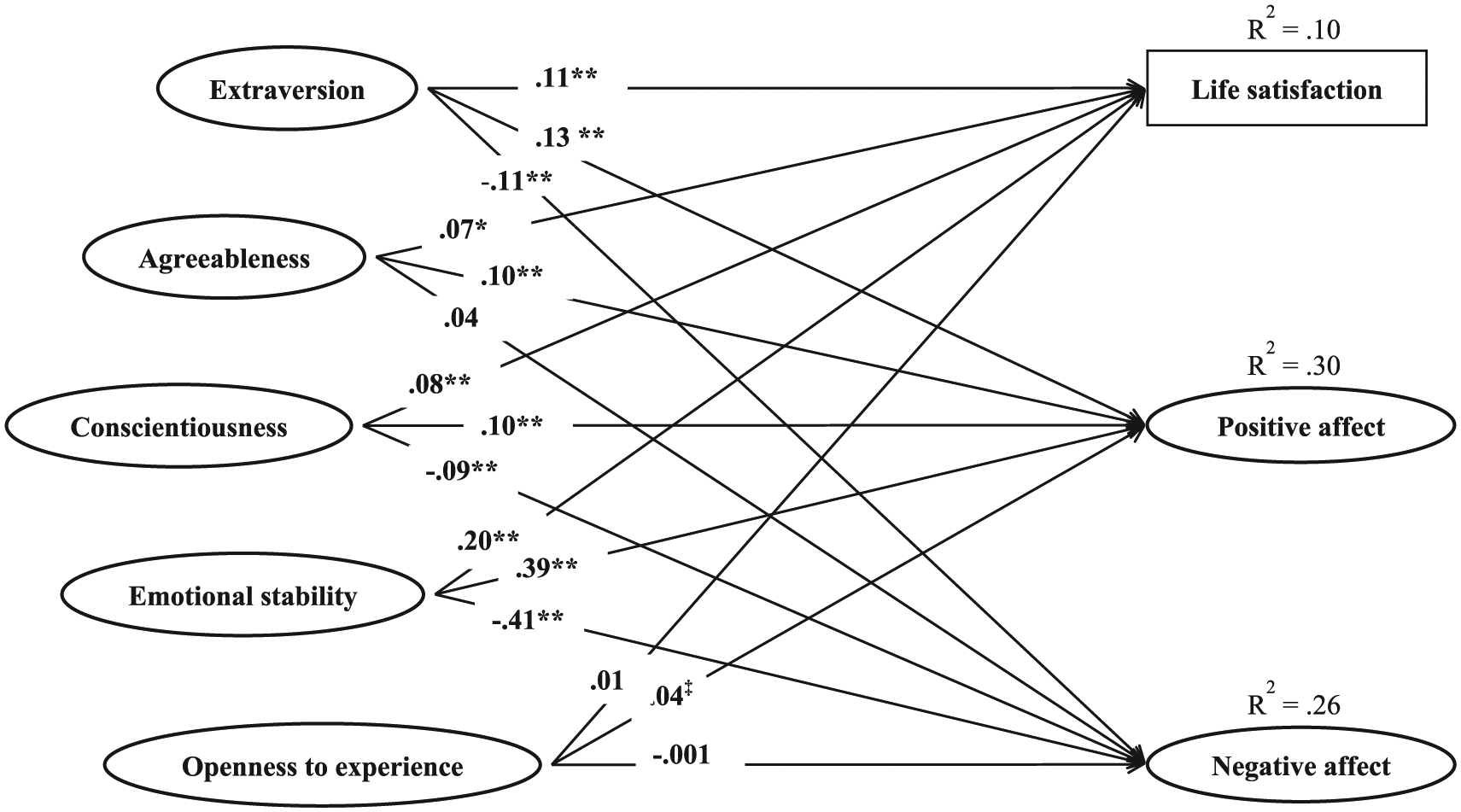
A structural equation model examining the relationship between personality and subjective well-being.
Global Sleep Quality as Mediator
Figure 2 presents the standardized path coefficients and R2 statistics. This model displayed an acceptable fit (RMSEA = .067; SRMR = .059). Global sleep quality was significantly related to the four personality traits (p < .01) and the three facets of SWB (p < .001). Poorer global sleep quality was associated with higher levels of agreeableness (β = .06), greater NA (β = .31), lower levels of conscientiousness (β = –.04), lower levels of extraversion (β = –.04), lower levels of emotional stability (β = –.23), less LS (β = –.23), and less PA (β = –.31). The 11 direct paths from the personality traits to the facets of SWB remained statistically significant (β = –.33 to .30, p < .05) in the presence of global sleep quality as a mediator.

A structural equation model examining the relationship between personality and subjective well-being with global sleep quality as the mediator.
The standardized estimates for direct, indirect, and total effects, the corresponding 95% CIs, and effect sizes are shown in Table 2. Examination of the indirect effects revealed that global sleep quality significantly mediated the associations between extraversion and the three facets of SWB, PA (estimate = .01, p = .006), NA (estimate = –.01, p = .006), and LS (estimate = .01, p = .008); between agreeableness and the two facets of SWB, PA (estimate = –.02, p < .001), and LS (estimate = –.01, p < .001); between conscientiousness and the three facets of SWB, PA (estimate = .01, p = .01), NA (estimate = –.01, p = .009), and LS (estimate = .01, p = .01); and between emotional stability and the three facets of SWB, PA (estimate = .07, p < .001), NA (estimate = –.07, p < .001), and LS (estimate = .05, p < .001). The corresponding effect sizes were at least small (k2 = .01 to .07). The total effects were all statistically significant, with p < .001, except for the total effect of the pathways from conscientiousness to NA (p = .002).
Standardized Effects, Corresponding 95% Bias-Corrected Bootstrap CIs, and Effect Sizes (N = 13,424).

Note. The CIs (.00 or –.00) are not exactly zero. They are ranged from .004 to –.004. CI = confidence interval; k2 = kappa-squared effect size index; PA = positive affect; NA = negative affect; LS = life satisfaction.
95% CI does not overlap with zero. **99% CI does not overlap with zero.
Discussion
This study examined (a) the relationships between five personality traits and three facets of SWB and (b) the role of sleep quality in mediating these associations. The results provided further evidence that personality traits are significantly related to the facets of SWB when the effects of the demographic variables are taken into account. In addition, these significant relationships were all mediated by sleep quality. Although these mediation effect sizes were not large, these findings offer preliminary support for an alternative explanation of the mechanisms underlying the relationship between personality and SWB.
As hypothesized (H1), extraversion, agreeableness, conscientiousness, and emotional stability were significantly related to the three facets of SWB, with the exception of agreeableness and NA. Consistent with the literature (Steel et al., 2008), of the “Big Five” personality traits, extraversion and emotional stability were most strongly associated with the facets of SWB. More extroverted, agreeable, conscientious, and emotionally stable individuals exhibited greater LS and PA and lower NA. As in previous studies (Soto, 2015; Steel et al., 2008), openness to experience was found to be weakly associated with PA and insignificantly related to NA and LS. If such openness merely leads individuals to be more open to new experiences, it is likely to be linked only weakly or not at all with the facets of SWB. These findings offer further empirical support for the hypothesis that each of the Big Five personality traits is uniquely related to the facets of SWB even when the effects of each personality trait and demographic factors (i.e., age, gender, education level, marital status, and employment status) are taken into account.
As expected (H2), sleep quality significantly mediated these associations. Although all of the relationships between the four personality traits and the three facets of SWB were partially mediated by sleep quality, with (at least) small effect sizes, the results differentiated the mechanisms of the association of four personality traits with SWB. Specifically, the results indicated that individuals with higher levels of extraversion, conscientiousness, emotional stability, and lower levels of agreeableness report better sleep quality, greater PA, greater LS, and lower NA.
With the exception of the association between agreeableness and sleep quality, the directions of the associations were in line with past findings. Extraversion, conscientiousness, and emotional stability were found to be positively related to sleep quality (Hintsanen et al., 2014; Huang et al., 2016; Kim et al., 2015; Önder et al., 2014). Stress may be a predisposing factor for poor sleep quality; high levels of extraversion and emotional stability may reduce stress sensitivity (leading an individual to experience less stress) and thus improve sleep (Huang et al., 2016). Regarding the positive association between conscientiousness and good sleep quality, more conscientious individuals tend to follow health advices more closely and have better sleep hygiene, which probably increase sleep quality (Hintsanen et al., 2014).
This study indicated that more agreeable individuals experience lower sleep quality. This finding is somewhat surprising, because previous studies have reported either a significant positive association (Hintsanen et al., 2014; Kim et al., 2015) or an insignificant association (Önder et al., 2014) between agreeableness and sleep quality. Agreeableness is typically connected with positive outcomes, such as lower consumption of caffeine (Kim et al., 2015) and less stress (Törnroos et al., 2012). However, some of the outcomes associated with agreeableness may be linked with worse sleep quality. For instance, greater agreeableness is related to the more frequent use of social media for communication and greater effort to stay connected and show support (Seidman, 2013). The greater use of social media is associated with poorer sleep quality (Woods & Scott, 2016). Hence, agreeableness may be related to worse sleep quality due to the link between agreeableness and the use of social media. Future researchers should attempt to replicate these results and determine a possible explanation.
In terms of the relationships between sleep quality, affects, and LS, the findings were consistent with those of the literature: Better sleep quality was associated with less NA (Bower et al., 2010; Huang et al., 2016), more PA (Bower et al., 2010; Mccrae et al., 2008), and greater LS (Paunio et al., 2009). These findings can probably be explained by the experimentally observed link between sleep loss and mood regulation deficits (Yoo et al., 2007). Sleep deprivation suppresses PA and amplifies NA (Zohar, Tzischinsky, Epstein, & Lavie, 2005). Examining the mechanisms underlying the relationship between sleep quality and LS, Paunio and colleagues (2009) proposed that poor sleep affects brain functions and thus induces low LS. This assumption is consistent with the findings of other neurological research that LS is associated with changes in dopamine level (Larson, Good, & Fair, 2010) and that sleep deprivation may alter dopamine level (Klumpers et al., 2015).
The effect sizes obtained for the mediating role of sleep varied with personality traits. Notably, the effect size obtained for the mediation of the association between emotional stability and SWB was considerably larger than the effect size obtained for the mediation of the associations between other personality traits and SWB. An apparent explanation is that the associations found in this study between emotional stability and SWB were stronger than the associations found in this study between other personality traits and SWB. In general, the mediation effect sizes found in this study between personality and SWB were not large. A possible reason is that the associations found in this study between personality traits and the facets of SWB were generally weaker than those reported in the literature (e.g., Anglim & Grant, 2016; Gallagher & Vella-Brodrick, 2008). In particular, the associations between extraversion and SWB should have been considerably stronger than the associations between SWB and agreeableness and that between SWB and conscientiousness (Steel et al., 2008). This inconsistency may be due to the use of the uncommonly used measures of SWB in this study. Future researchers should deploy widely used measures (e.g., the Positive and Negative Affect Scale; D. Watson, Clark, & Tellegen, 1988) to better examine the mediation effect size.
As the literature supported the hypothesized associations, such as that between sleep quality and subsequent LS (Paunio et al., 2009), the current mediational model was examined. Two limitations were possible: The significance of the mediation effect may have been attributable to the large sample used, and the mediation effect sizes were small. However, this does not necessarily depreciate the findings. Considering the stability of personality (Specht, Luhmann, & Geiser, 2014), less effort may be required to enhance one’s sleep quality than to change one’s personality to improve one’s SWB. In addition, the measure of SWB used in this study was not commonly used. This may have reduced the mediation effect. Nevertheless, the results provide a logical structure and preliminary support for future research based on commonly used measures of SWB.
Despite its limitations, this study was the first to comprehensively examine the role of sleep quality in mediating the relationship between personality and SWB by assessing the Big Five personality traits, the three dimensions of SWB, and seven components of sleep quality. The contributions made by this study are both theoretical and practical. Theoretically, the study advances the literature by using a nationally representative sample to examine the links between personality and SWB, controlling for the effects of the Big Five personality traits and relevant demographic factors. The study also offers insight into the mechanisms underlying the relationship between personality and SWB. Sleep quality is found to play a significant mediating role in this relationship, indicating a possible process linking personality with SWB. This may help to theorize the mechanisms underlying this relationship. Practically, this study offers preliminary evidence that efforts to improve sleep quality may constitute a feasible intervention to promote SWB. For instance, health advice or treatments designed to enhance sleep quality could be used to improve the SWB of individuals with low emotional stability.
In conclusion, this study shows how the Big Five personality traits are associated with the three dimensions of SWB, and demonstrates the mediating role played by sleep quality in this association. The results show that higher levels of extraversion, conscientiousness, and emotional stability, and lower levels of agreeableness are related to better sleep quality, more PA, more LS, and less NA. These findings provide preliminary evidence of an alternative mechanism underlying the relationship between personality and SWB and indicate the potential to enhance SWB by improving sleep quality.
Supplemental Material
SGO773139_Supplemental_Material_CLN – Supplemental material for The Mediating Role of Sleep Quality in the Relationship Between Personality and Subjective Well-Being
Supplemental material, SGO773139_Supplemental_Material_CLN for The Mediating Role of Sleep Quality in the Relationship Between Personality and Subjective Well-Being by Catie C. W. Lai in SAGE Open
Footnotes
Declaration of Conflicting Interests
The author(s) declared no potential conflicts of interest with respect to the research, authorship, and/or publication of this article.
Funding
The author(s) received no financial support for the research, authorship, and/or publication of this article.
Notes
Author Biography
References
Supplementary Material
Please find the following supplemental material available below.
For Open Access articles published under a Creative Commons License, all supplemental material carries the same license as the article it is associated with.
For non-Open Access articles published, all supplemental material carries a non-exclusive license, and permission requests for re-use of supplemental material or any part of supplemental material shall be sent directly to the copyright owner as specified in the copyright notice associated with the article.
