




Abstract
In the modern era, increasing life pressures have placed significant psychological strain on individuals, particularly university students. Many students today exhibit psychological symptoms stemming from academic and life-related challenges. Accordingly, investigating factors influencing subjective well-being offers deeper insight into the psychological mechanisms at play and supports the development of effective interventions for student mental health. This study examines the psychological determinants of subjective well-being among university students, with a particular focus on the roles of trait emotional intelligence and resilience. A quantitative research design was employed, and data from 623 students were analyzed using partial least squares structural equation modeling (PLS-SEM). Findings indicate that resilience is positively associated with both trait emotional intelligence and subjective well-being, while depression acts as a significant negative contributor in these relationships. Additionally, perceived social support was found to positively moderate the relationship between trait emotional intelligence and resilience. Interestingly, contrary to initial expectations, perceived social support did not moderate the link between depression and subjective well-being, a surprising result that warrants further investigation. These findings suggest that individuals with higher levels of emotional intelligence tend to demonstrate greater resilience and lower levels of depression, thereby enhancing their subjective well-being.
Introduction
In recent years, the mental health of college students has become an increasing concern as many students report high levels of stress, anxiety, and depression (Elharake et al., 2023). These psychological burdens can significantly impact subjective well-being (SWB), an aspect that reflects the level of satisfaction and positive emotions an individual experiences in life (Casas et al., 2013). Research on psychological factors affecting SWB not only helps improve the quality of student life but also provides a basis for building more effective psychological support and intervention programs in the educational environment. In Vietnam, several studies have focused on objective factors, such as income, academic achievement, and social status, as predictors of SWB (Chien Thang & Thi Nguyet Trang, 2024; Ha, 2020; La et al., 2021). However, subjective factors such as emotional intelligence, resilience, depression, and perceived social support have not been fully explored. This is a notable gap in the context where these intrinsic factors can be developed and improved through skills training or psychological intervention programs, resulting in sustainable improvements in students’ mental health and SWB.
More specifically, trait emotional intelligence (TEI), which reflects how individuals assess their emotional competence, plays a crucial role in enhancing the quality of social interactions (Perera & DiGiacomo, 2013) as well as their ability to manage stress (McEown et al., 2024). Research shows that people with high TEI are less likely to be negatively affected by external factors and are more resilient (Di Fabio & Saklofske, 2018; Y. Liu et al., 2013; Mohamed et al., 2025) due to their ability to use emotions as a tool to enhance thinking, navigate behavior, and solve problems effectively. Additionally, they tend to maintain a positive emotional state and avoid falling into negative thinking patterns that are detrimental to their mental well-being (Pradhan & Kumar, 2021). Additionally, TEI helps students build and maintain stronger social support networks, contributing to an improvement in the quality of their lives and learning (J. An et al., 2024; Guillen et al., 2022).
Meanwhile, perceived social support (PSS), which is how an individual perceives that the care from family, friends, and teachers is helpful to them, has been shown to improve emotional well-being, enhance the quality of life, and reduce the risk of depression in students (Chernis & Adler, 2023; Guo & Li, 2025; Hamama, 2024). Furthermore, in addition to protective factors such as TEI and social support, resilience—the ability to recover mentally from difficulties and challenges—also plays an essential role in maintaining SWB (Zhou & Chen, 2024). Resilience enables students to regulate their emotions, protect internal resources (Cai et al., 2025), and mitigate the negative impacts of the external environment (Mayordomo et al., 2021). In contrast, in this study, depression was understood as a non-clinical manifestation of mental health impairment, characterized by persistent feelings of sadness, loss of motivation, and negative thinking that do not meet the threshold for a clinical diagnosis. These symptoms can impair social interaction, reduce motivation, increase feelings of isolation, and reduce subjective well-being (Hofer & Hargittai, 2024; L. Zhang et al., 2025). This approach is consistent with non-clinical studies, in which depressive symptoms are viewed as an emotional response to psychological stress or resource depletion, and may fluctuate over time (Clark & Watson, 2013).
Through the conservation of resources (COR) theory and the nature of TEI through trait emotional intelligence theory, this study aims to investigate psychological factors that impact the subjective happiness of university students. Expanding understanding of this issue can help students adapt to the learning environment faster and find solutions to avoid depression and stress. This article also tests in parallel the role of resilience and the level of depression and negativity in university students’ psychology on subjective happiness. Specifically, this study explores TEI, resilience, and depression. It develops knowledge factors related to a SWB orientation while emphasizing the contrast between resilience and depression in the relationship between TEI and SWB.
Theoretical Framework
Conservation of Resources Theory—COR
The COR theory proposed by Hobfoll (1989) has become a popular theoretical framework for explaining how people respond to stress and conflict in personal and occupational contexts (Cheng et al., 2020; Lan et al., 2020; W. Liu et al., 2019; Sliter et al., 2012; Taylor et al., 2017). According to COR, individuals strive to acquire, protect, and maintain resources that they consider valuable (Hobfoll, 2001). These resources can originate from within themselves (emotional states, personal skills) or from external sources (social support; M. Wang et al., 2011).
Stress occurs when an individual is faced with the threat of losing resources, actually losing resources, or investing resources without achieving adequate returns (Hobfoll, 1989). In such situations, people tend to use coping strategies to minimize losses, such as withdrawing from resource-intensive activities to protect themselves (Arkin, 2018, Pham et al., 2025). Individual differences can also be considered resources and can influence how people respond to stress (or loss of resources). For example, some individuals may be better at minimizing losses (Grandey & Cropanzano, 1999).
In particular, COR emphasizes that resources are not only valuable individually but can also help create or access other valuable resources (Hobfoll, 2002). Therefore, having, maintaining, and developing resources helps increase stress resistance and yields positive outcomes for mental health (Hobfoll, 1989). In the context of this study, COR is used as a theoretical foundation to explain the role of TEI and resilience as psychological resources that help individuals enhance SWB and minimize the adverse effects of depression. Individuals’ possession and effective use of these two resources can support the process of coping with stress, thereby contributing to maintaining a positive psychological state and improving overall quality of life.
Trait Emotional Intelligence Theory
Trait emotional intelligence theory was developed by Petrides and Furnham (2001) as a distinct approach from traditional models of emotional intelligence. They developed this theory to define emotional intelligence as a personality trait rather than a cognitive ability. While the models of Bar-On (1997), Goleman (1995), and Mayer and Salovey (1997) view emotional intelligence as a kind of ability or skill that can be measured objectively, TEI emphasizes the inherently subjective nature of emotional experience. Accordingly, TEI is not classified as an “ability” model but is understood as a trait structure within a larger personality system (Petrides et al., 2007).
TEI is a set of emotion-related cognitions located at lower levels in the personality structure (Petrides et al., 2016). It reflects how individuals assess their ability to understand, regulate, and express emotions to adapt to their environment and maintain their health. This theory proposes a mechanism by which individuals differ in how they perceive and manage their feelings, and that such cognitions shape their behavioral tendencies in emotional and social contexts. In the trait approach, TEI is typically measured through self-report instruments (Petrides et al., 2007; Revelle & Scherer, 2009), as assessed by the Trait Emotional Intelligence Questionnaire (TEIQue). This approach differs from emotional intelligence, which evaluates the ability to process emotional information through performance assessments. In terms of manifestation, TEI is expressed through personality traits such as empathy, emotional control, self-confidence, or the ability to regulate mood (Petrides & Furnham, 2003). These are thought to be naturally formed from a combination of genetic factors (Vernon et al., 2008) and personality development from childhood (Petrides et al., 2018).
Several studies have confirmed the strong link between TEI and mental health. TEI has been shown to predict positive outcomes such as happiness and mental health (Martins et al., 2010) while also being a reliable predictor of negative states such as depression (Petrides et al., 2011). Studies have shown a strong link between TEI and psychological resilience (Di Fabio & Saklofske, 2018; Y. Liu et al., 2013; Petrides et al., 2011) as well as disorders such as depression (Gardner & Lambert, 2019). People with high TEI tend to be optimistic, exhibit reasonable emotional control, and adapt flexibly to stressful situations (Armstrong et al., 2011; Zhao et al., 2020). They also frequently participate in social activities and proactively learn about mental health, thereby increasing subjective well-being and reducing negative behaviors.
In this article, TEI serves as the core independent variable, acting as a factor affecting students’ mental state, primarily through two parallel directions of impact: increasing resilience and reducing the risk of depression. Meanwhile, these two factors affect the level of SWB. Resilience is considered a protective psychological resource, while depression is a factor that hinders positive states. Using trait emotional intelligence theory as a foundation not only helps to explain the psychological relationships in the research model rationally but also highlights the importance of developing emotional competence as part of a strategy to improve mental health and quality of life for students.
Subjective Well-Being
E. Diener et al. (2015) defined Subjective Well-Being (SWB) as comprising three closely related components: the presence of positive emotions, the absence of negative emotions, and life satisfaction. The presence of positive emotions and the absence of negative emotions are often related to emotional balance and situational factors. Meanwhile, life satisfaction involves evaluating one’s life (E. Diener, 1984). Seligman et al. (2005) also suggest that SWB is a wholly positive mental state, including satisfaction with life, a sense of self-satisfaction, and a feeling of active appreciation and enjoyment of life. SWB refers to people evaluating their quality of life (Schalock & Felce, 2004; Statham & Chase, 2010). Therefore, SWB is both a research topic and a policy goal. SWB is an essential outcome for psychology in general, encompassing clinical psychology, health psychology, developmental psychology, and senior psychology, as well as educational psychology, organizational psychology, community psychology, and social psychology (Martela & Sheldon, 2019).
Moreover, a quality education also contributes to individual and community satisfaction, which enables students to gain a comprehensive understanding of the cultural and psychological factors that influence their learning and development. Educational leaders and researchers should not only focus on the results but also pay attention to the SWB of students in the academic environment. Shamionov et al. (2020) have also proposed that university educators should be partly responsible for creating a positive learning environment that creates an atmosphere of trust and friendliness by implementing supportive policies. Additionally, Lopes and Nihei (2021) commented that individuals with lower life satisfaction are at risk for many behavioral, psychological, and social problems, such as depression and poor relationships with others. Conversely, high levels of SWB are associated with good adaptability and optimal mental health in young people today. Therefore, life satisfaction and positive affect help minimize the negative effects of stressful life events (Gál et al., 2022) and combat the development of psychological and behavioral problems in youth (Arslan, 2019).
The Relationship of TEI and Resilience
Resilience was initially discussed as a relatively stable personal trait (Block, 1961). In the 1970s, it was conceptualized in the context of clinical research as a state of openness to growth and change (Garmezy, 1971). It began to receive attention in the behavioral research field in the 1990s. Luthans (2002, p. 702) identified resilience as “positive psychological capacity to rebound, to ‘bounce back’ from adversity, uncertainty, conflict, failure, or even positive change, progress and increased responsibility.” It is the most critical positive resource for navigating turbulent and stressful learning environments (Al-Ghazali & Afsar, 2022). Resilience is used more effectively, thanks to TEI. Individuals with high TEI often exhibit emotional flexibility and positive thinking, which helps students recover more quickly and return to a positive state more effectively (Pong & Leung, 2023).
According to Petrides et al. (2007), TEI reflects an individual’s ability to assess their understanding, regulation, and expression of emotions. In particular, the ability to recognize and evaluate emotions helps individuals accurately interpret adverse events, while the ability to regulate and use emotions supports maintaining a positive attitude and proactively responding to adverse situations (Joseph & Newman, 2010). Therefore, individuals with high TEI tend to understand their emotions well, regulate them flexibly, and use emotions as a resource to support adaptive behaviors (Ke & Barlas, 2018). They not only accurately interpret negative events but also can regulate their mental state to maintain an optimistic attitude and positive thinking (Fenwick-Smith et al., 2018). It is the flexibility in handling emotions, combined with a positive perspective on problems, that helps these individuals quickly recover from psychological events and return to a stable state. In addition, TEI in this study is also considered a form of internal resource, contributing to strengthening personal psychological strength.
From the perspective of COR theory, high TEI enables individuals to understand and regulate emotional mechanisms effectively, thereby limiting the “loss of resources” when facing stress or crisis (Hobfoll, 2001). As a result, individuals with high TEI often have better resilience when facing adversity. Empirical studies have demonstrated a positive association between TEI and personal resilience in adults (Sojer et al., 2024; Zhao et al., 2020). At the same time, when experiencing adverse life events, people with low TEI tend to be more vulnerable and less able to adapt than those with high TEI (Armstrong et al., 2011). Among university students, those who have sufficient confidence in identifying, regulating, and using emotions tend to maintain optimism and respond positively to challenges in their studies and personal lives. As a result, they can experience more positive emotions and suffer fewer negative effects from stress. We propose the following hypothesis:
The Relationship Between Resilience and SWB
Resilience is not only the ability to withstand the loss of resources (Smith et al., 2020) but also the ability to proactively seek recovery (Bardoel & Drago, 2021) and accumulate additional resources after facing adversity (Sanchez et al., 2022). For college students, resilience plays a crucial role in enhancing subjective well-being, particularly when faced with academic pressure, social expectations, and concerns about the future (Cai et al., 2025). Students with high resilience often possess a reserve of personal resources, such as problem-solving skills or social support networks, that help reduce the impact of negative factors (Chen et al., 2015). Accumulating and protecting resources through resilience has a direct effect on students’ SWB (Y. An et al., 2023; Bhattarai, Jin, et al., 2021). In particular, students who believe they have the capacity and resources to cope with challenges are less likely to experience adverse psychological outcomes and are more likely to feel satisfied with their lives (Southwick & Charney, 2018).
Previous studies have also shown that resilience is an essential determinant of SWB (Hazan-Liran & Walter, 2025; Oltean et al., 2025; Peleg & Peleg, 2025) as it can protect their mental and emotional health from adversity in life by minimizing the impact of adverse events (Fullerton et al., 2021; Price, 2023). As a result, students can not only maintain a balanced state of mind but also improve their thinking (Ang et al., 2022; Brewer et al., 2022). Because of the stability of the mental state and improvement of SWB that resilience brings (Zarei & Fooladvand, 2022; Zeng et al., 2022), the study proposes the hypothesis:
The Relationship Between TEI and Depression
Besides resilience, depression is also predicted to be another factor that impacts the relationship between TEI and SWB (Delhom et al., 2022; Lew et al., 2019; Walter et al., 2024). As previously stated in the Introduction, depression in the context of social, educational, behavioral, and organizational research is often conceptualized as a non-clinical condition. It is typically understood as a symptom-based experience (Chodavadia et al., 2023), subjective in nature, and may fluctuate depending on circumstances without requiring a formal diagnosis (Hochman et al., 2021; Liang et al., 2025; Luo et al., 2024).
Unlike clinical depression (or major depressive disorder according to the DSM-5), which requires intensive treatment and is more easily recognized by its typical disorder features, non-clinical depression is often silent and easily overlooked or underestimated. It is one of the negative aspects of psychology that college students suffer from, stemming from pressures from education, society, and finance (Gebregergis et al., 2020). Non-clinical depression is not only an emotional loss but also a severe loss of personal resources, including energy, self-confidence, and the ability to cope with challenges (Andrén, 2023; X. Wang et al., 2024). Non-clinical depression differs from clinical depression in that it is not specific to clinical depression (Parker & Paterson, 2015). Non-clinical depression is often characterized by feelings of sadness, loss of motivation, mental fatigue, and depressed mood. Still, it is not too obvious, with a sufficient number of symptoms or severity. Severity to be suspected or diagnosed as clinical depression (Noyes et al., 2022). Although people experiencing non-clinical depression can still maintain normal activities, they often feel a lack of energy, loss of interest, and depressed emotions. Above all, it can be a warning sign of the formation of clinical depression if not resolved promptly.
Numerous studies have found TEI to be closely related to both positive and negative emotions (Gignac, 2006; Koydemir et al., 2013). People with high TEI often experience more positive emotions and are less dominated by negative emotions. Meanwhile, a lack of positive emotions combined with an increase in negative emotions is the cause of people being susceptible to depression, not only in the normal group but also in the group with psychological problems (J. N. Cohen et al., 2017; Lonigan et al., 2003). Therefore, people with high TEI are found to be less at risk of falling into depressive states because they have better emotional management skills and know how to maintain emotional stability in stressful and adverse situations. Conversely, when individuals are deficient in TEI, meaning they do not have enough resources to regulate emotions, they will be vulnerable to psychological stress, leading to the accumulation of negative emotions and causing depressive symptoms (Kuk et al., 2021; Salguero et al., 2012).
In addition, based on COR, trait emotional intelligence can be considered a personal resource that helps individuals cope effectively with stressful or psychologically damaging situations (D’Souza et al., 2023; Kundi & Badar, 2021). More deeply, individuals with high TEI are often able to identify, regulate emotions, and maintain a positive mental state (Le et al., 2024; Yusoff et al., 2021), thereby preserving emotional and social resources (Luque-Rêca et al., 2022). When resources are maintained, the risk of depression may decrease because stress does not accumulate into a persistent negative form (Delhom et al., 2022). In contrast, people with low TEI are prone to fall into a resource-loss spiral, making them more vulnerable to depressive factors. Therefore, we propose the hypothesis:
The Relationship Between Depression and SWB
Depression and depression-related symptoms are considered one of the most serious public health problems today, especially for young people such as students (Chan & Sun, 2021; Melnyk et al., 2023; Wickramasinghe et al., 2023). This group, due to the specificity of their developmental stage and the pressures of the academic, social, and financial environments, becomes particularly vulnerable to this problem (Jahrami et al., 2023; Sun et al., 2024). As one of the core emotional problems, depression is constituted by negative mental states such as persistent feelings of hopelessness and helplessness, accompanied by a deep, persistent sadness (T. Fuchs, 2021), causing loss of interest in daily activities and decreased energy (Rana et al., 2021). As a result, individuals often feel tired and lethargic, struggling to perform even the simplest tasks (Fusar-Poli et al., 2023).
In addition to its effects on emotions and energy, depression also severely impairs students’ ability to manage emotions, leading to a decline in the quality of their social relationships (Prizeman et al., 2023). Isolation, low energy, and feelings of low self-esteem can make it challenging to maintain or develop relationships (Rice et al., 2011). In other words, when depressed, students tend to avoid social interactions and withdraw (Al Banna et al., 2023), which reduces their connection to essential support resources that enhance SWB (Brown-Smythe, 2022; Dew & Bromet, 1991). A lack of resources can create a negative spiral, exacerbating depressive symptoms and hindering students’ mental health and well-being in their lives (Khorrami et al., 2023).
According to COR, depression can cause a downward spiral of resource loss, affecting both emotional and social competence. Individuals experiencing depression often experience reduced emotional capacity (Vanderlind et al., 2020), reduced social engagement, and decreased satisfaction with overall life events (Choi et al., 2021; Clayton McClure et al., 2024; Sayed et al., 2022), all of which are critical personal resources. The depletion of these accumulated resources can significantly reduce SWB (Seijts et al., 2022), as individuals become less able to maintain positive emotions, pursue goals, and achieve overall satisfaction (Zhou et al., 2025). According to this view, depression would serve as a mechanism that further accelerates the loss, leading to impaired SWB (Connolly & Gärling, 2025; S. Ye & Ho, 2024).
The Relationship Between Depression and Resilience
Depression and resilience both have a direct impact on SWB, with depression negatively affecting SWB and resilience improving it. Therefore, it can be predicted that these two factors are closely related. Indeed, many studies have shown that high resilience reduces depression, anxiety, and stress (Kuang et al., 2024; Wadi et al., 2024; C. Ye et al., 2024). However, the notion that depression is associated with lower levels of resilience has not been well-examined in the existing literature (Wermelinger Ávila et al., 2017). According to COR, people continuously strive to protect, maintain, and develop valuable resources to meet personal needs and maintain psychological stability. When experiencing depression, resources are depleted, leading to poor academic performance and mental health, making individuals more vulnerable to stress and negatively affecting social relationships (B. J. Kim & Kihl, 2021; Milić et al., 2024). In this context, depression is not simply a negative emotion but also a “spiral” of resource loss, making it difficult to maintain and develop resilience.
Specifically, depression not only reduces students’ ability to concentrate and study (Fardell et al., 2023; Leigh et al., 2021; Otieno, 2025) but also affects their social relationships (Raniti et al., 2022). In other words, depression causes a lack of resources to replenish the “recovery” of mood, depleting internal coping resources so that students cannot turn on recovery mode more effectively and quickly (Lau, 2022; Meeks et al., 2023; To et al., 2022). The negative problems caused by depression weaken the ability to recover because individuals do not have enough resources to revive themselves (Ang et al., 2022; Gong et al., 2023). It creates a vicious cycle where students are unable to overcome difficulties, which makes their mental state worse (Anderson, 2022; To et al., 2022).
Many studies also suggest that a lack of resources not only negatively affects students’ psychology (Merino et al., 2021; van der Velden et al., 2022) but also causes physical health problems such as reduced sleep quality (Jelleli et al., 2024; Wagner et al., 2022; J. Zhang et al., 2024), making them less flexible in responding to negative problems and slowing down their ability to recover. Resilience requires that individuals have sufficient resources to adapt and overcome difficulties, but when resources are depleted due to depression, this ability is also limited. In other words, depression depletes the “internal resource pool” necessary for building and maintaining resilience.
Perceived Social Support
Perceived social support (PSS) refers to an individual’s assessment of how trustworthy a relationship is perceived to be in times of need (Barrera, 1986). PSS is believed to enhance students’ well-being and ability to navigate academic and life challenges by creating valuable resources such as sympathy, support, advice, and counseling (Falck et al., 2025; Lin et al., 2025). PSS sources from teachers, peers, and family help individuals feel understood, shared, and encouraged, thereby enhancing mental strength as well as the ability to cope with academic and life pressures (Güler et al., 2025; Hamama, 2024; Suvarna et al., 2025). This also corresponds to COR. When individuals perceive that they can rely on support from friends, family, or community, they will have more resources to cope with stress and maintain resilience (K. Li et al., 2024). Students will rely on COR theory, which emphasizes that, in addition to conservation, it is necessary to increase the collection of more resources, specifically social support, which are external resources that individuals use to combat negativity (H. Liu, 2024; W. Liu et al., 2024).
Additionally, PSS has been identified as a factor that influences emotional intelligence (Xing et al., 2023) and an individual’s resilience (Lök & Bademli, 2021). TEI develops thanks to good social skills, so students with high TEI have more stable mental emotions and feel more supported (Saikia et al., 2024). When students possess both high emotional intelligence and reliable external support, their resilience is likely to be better (Zheng et al., 2021). Moreover, PSS is recognized as a factor that reduces the impact of stress and protects individuals from adversity, as studied by S. Cohen and Wills (1985). This statement remains true through recent studies (Faris & Felmlee, 2014; Lee & Goldstein, 2016; F. Li et al., 2021).
Thus, students who receive significant support from trusted relationships at university are more likely to open up and share with their families, which in turn reduces their negative psychological experiences (Yun et al., 2019). Simultaneously, their SWB increases (Itzick et al., 2018). Furthermore, Solmaz (2025) also demonstrated the benefits of perceived social support in reducing depression and enhancing students’ SWB. Therefore, the following hypotheses are proposed:
Materials and Methods
Participants
With the outstanding advantage of being able to collect data quickly and cost-effectively, this study used a convenience sampling method to approach students aged 18 to 23 at various universities across Vietnam. This approach is particularly suitable for initial exploratory studies, where the main goal is to identify trends and preliminarily test relationships in the theoretical model. Based on the preliminary findings, further studies can be designed in more depth, with more rigorous sampling methods to re-examine the results and expand generalizability. The final dataset used in the analysis consisted of 623 valid and complete responses. The sample’s gender distribution was 57.6% female and 42.4% male. In terms of academic majors, the sample included students from Economics - Management (26.9%), Social Sciences and Humanities (26.7%), Medicine (23.5%), and Natural Sciences and Engineering (22.9%).
Instruments
A demographic questionnaire was used to collect the following specific information about the participants: (1) gender, (2) academic year, and (3) academic majors. This was followed by questions measuring the factors in the research model on a 7-point Likert scale, ranging from 1 (“strongly disagree”) to 7 (“strongly agree”). The scales used in this study were selectively inherited from previous typical studies. The concept of trait emotional intelligence is measured by the TEIQue scale of Petrides and Furnham (2003), which includes eight factors used to assess respondents’ perception of trait emotional intelligence with “When I disagree with someone, I usually find it easy to say so,” sensitivity, emotional regulation “I’m usually able to influence the way other people feel,” or even the ability to convince self and others when unexpected problems occur, like “When someone offends me, I’m usually able to remain calm,” “I generally believe that things will work out fine in my life,”…
Using Connor and Davidson’s (2003) 7-item Connor-Davidson resilience scale (CD-RISC), respondents were asked to indicate their ability to cope with difficulties and motivate themselves to do plans like “Able to adapt to change,” “Can deal with whatever comes,” or “Can achieve your goals, know where to turn for help,”… Meanwhile, seven items from Zimet et al.’s (1988) multidimensional scale of perceived social support (MSPSS) were selected to form the perceived social support scale. Questions on this scale direct participants to answer the vital nature of help and sharing in close social relationships, such as “My family or my friends try to help me,” “I can count on my friends when things go wrong,” I can talk about my problems with my family,”…
Subsequently, five questions from the satisfaction with life scale by E. D. Diener et al. (1985) were used to assess the SWB of survey participants. These five observed variables are intended to help survey takers evaluate their level of satisfaction with “In most ways, my life is close to my ideal” and satisfaction with “I am satisfied with my life,” as well as acceptance of all aspects without seeking more, like “If I could live my life over, I would change almost nothing,”…
Finally, in a non-clinical setting, depression was measured using the DASS (Depression Anxiety Stress Scale) self-report instrument (Lovibond & Lovibond, 1995), with seven questions reflecting the negative mental state of the participants. These items contain content such as melancholy, loss of motivation, and hopelessness, such as: “I felt downhearted and blue,” “I felt that I had nothing to look forward to,” or “I found it difficult to work up the initiative to do things,” etc.
What is unique is that, unlike the HAM-D (Hamilton depression rating scale), MADRS (Montgomery–Åsberg depression rating scale) which are used clinically and administered by experts, the DASS is not a clinical diagnostic tool, it is a screening tool widely used in public health, school or business settings, designed to assess symptoms of depression, anxiety and stress in non-clinical or subclinical populations. The depressive symptoms measured in this study should be understood as indicators of psychological distress at a non-clinical level, clearly distinct from clinical depression (usually calculated according to the criteria of DSM-5).
Data Collection Procedure
The survey questions were all presented in Vietnamese. A translation process was carried out to translate from English, ensuring grammatical correctness. Words were selected to be appropriate to Vietnamese culture while still ensuring similarity and adherence to the content of the original questions. Data was collected over 3 months, from May to August 2024. The research sample consisted of 623 university students from various schools across the country. Data collection was carried out with the support of the Student Affairs Departments at the universities through the online survey distribution channel via the internal email system to ensure effective access to the target group. Participation in the survey was completely voluntary and anonymous.
The study adhered to ethical research principles in accordance with the Declaration of Helsinki. Prior to data collection, ethical approval was obtained from a recognized institutional ethics committee. All participants were fully informed of the research purpose and gave their informed consent before participation.
The introduction to the study provided detailed information about the research’s purpose, a commitment to data confidentiality, and a section for participants to acknowledge their commitment to participating in the survey. No personally identifiable information was collected, and all responses were used for research purposes only and reported in aggregate form. Additionally, questions were marked mandatory to ensure that no respondent missed an answer.
Data Analysis
The study conducted data analysis using partial least squares structural equation modeling (PLS-SEM) with SmartPLS 4. This method is particularly suitable for testing indirect and moderating effects, as it enables the simultaneous analysis of multiple relationships within the research model and provides a high level of predictive accuracy (Hair et al., 2019). The analysis process is divided into two main stages: (1) Evaluation of the measurement model and (2) Evaluation of the structural model. The use of PLS-SEM enables the parallel integration of the measurement model and the structural model, providing a more comprehensive and in-depth understanding of the relationship between the research variables (Sarstedt et al., 2022).
In measurement model assessment, the study first assessed the reliability of the scale with Cronbach’s alpha (CA) and composite reliability (CR), and the convergent validity of the scale through outer loading (λ) and average variance extracted (AVE; Hair et al., 2019; Henseler et al., 2015). Next, the study assessed the discriminant validity through the heterotrait–monotrait ratio (HTMT). Henseler et al. (2015) noted that the Fornell-Larcker criterion sometimes fails to detect the lack of discrimination and proposed the use of the HTMT as a more reliable alternative measure. Accordingly, when the HTMT value < 0.9, the concepts are considered to meet the standard of discriminant validity. Finally, the study assessed the phenomenon of multicollinearity through the variance inflation factor (VIF). When the indicators meet the requirements, the next stage is conducted to test the relationships in the model.
The structural model is responsible for establishing relationships between research concepts that are not directly observable. The evaluation process of this model has two main goals: (1) testing the predictive ability of the model and (2) confirming the relationships between the concepts through three criteria: coefficient of determination (R 2), predictive index (Q 2), and path coefficients β (Sarstedt et al., 2022).
Results
Measurement Model Assessment
In Table 1, the values of CA and CR range from .82 to .90 (satisfying the cut-off of .70), demonstrating the reliability of the constructs (Hair et al., 2011). Next, the AVEs range from 0.72 to 0.76 (meeting the requirements of over 0.50), showing that the scales have convergent validity (Henseler et al., 2015). In Table 2, the HTMT ratio is below 0.9, indicating discriminant validity (Hair et al., 2019). In contemporary studies employing the PLS-SEM approach, the HTMT criterion is increasingly favored and recommended as the primary standard for assessing discriminant validity. This preference stems from its high sensitivity in detecting issues related to the lack of discriminant validity. In contrast, the Fornell–Larcker criterion demonstrates comparatively lower sensitivity and often fails to identify such validity concerns effectively (Henseler et al., 2015). Besides, VIF values ranging from 1.56 to 1.87 are within the accepted threshold (below 2), predicting that multicollinearity between constructs does not occur in the research model (Hair et al., 2019). Therefore, all requirements are satisfied.
Data Validity.
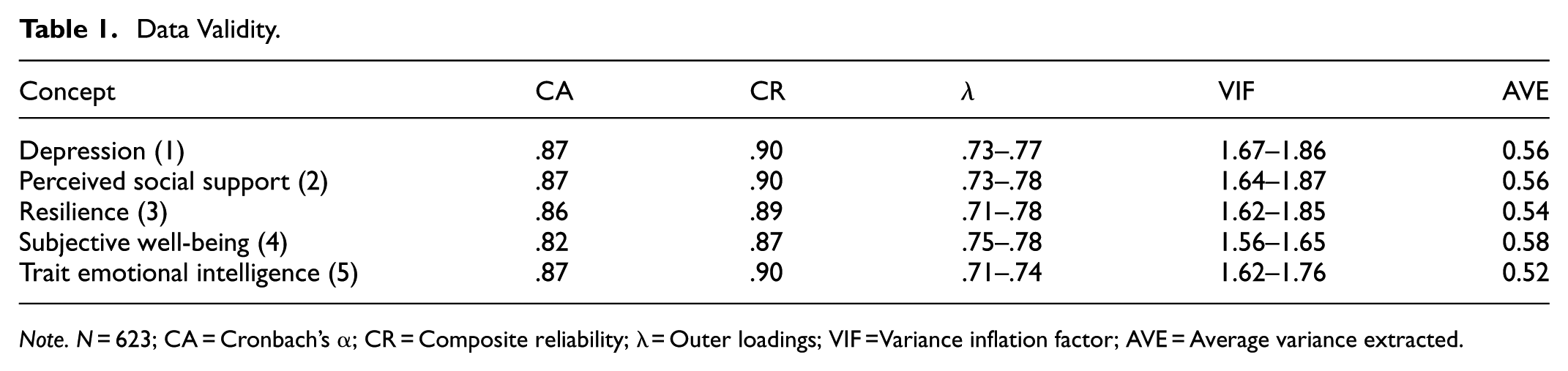
Note. N = 623; CA = Cronbach’s α; CR = Composite reliability; λ = Outer loadings; VIF =Variance inflation factor; AVE = Average variance extracted.
Data Discriminant.

Structural Model Assessment
Structural model assessment, including path coefficient (β), p-value, R 2, and Q 2, is a crucial criterion in the PLS-SEM method (Sarstedt et al., 2022). In which β represents the degree of positive or negative impact between relationships. p-value shows the level of statistical significance at which a decision can be made about rejecting or not rejecting the hypothesis. R 2 explains the explanatory power of the independent variables for the dependent variable, with values of .75, .50, and .25 considered significant, moderate, and weak (Hair et al., 2011). Thus, in Figure 1, depression, resilience, and SWB have an average level of explanation. These results suggest that these variables offer a suitable level of explanation for changes in students’ subjective well-being (SWB). Next, the Q 2 values are positive, with 0, 0.25, and 0.5 representing small, medium, and large prediction levels (Hair et al., 2019). Therefore, the Q 2 values in Figure 2, corresponding to depression (0.60), resilience (0.62), and SWB (0.52), all indicate a relatively significant level of prediction.

Conceptual framework.
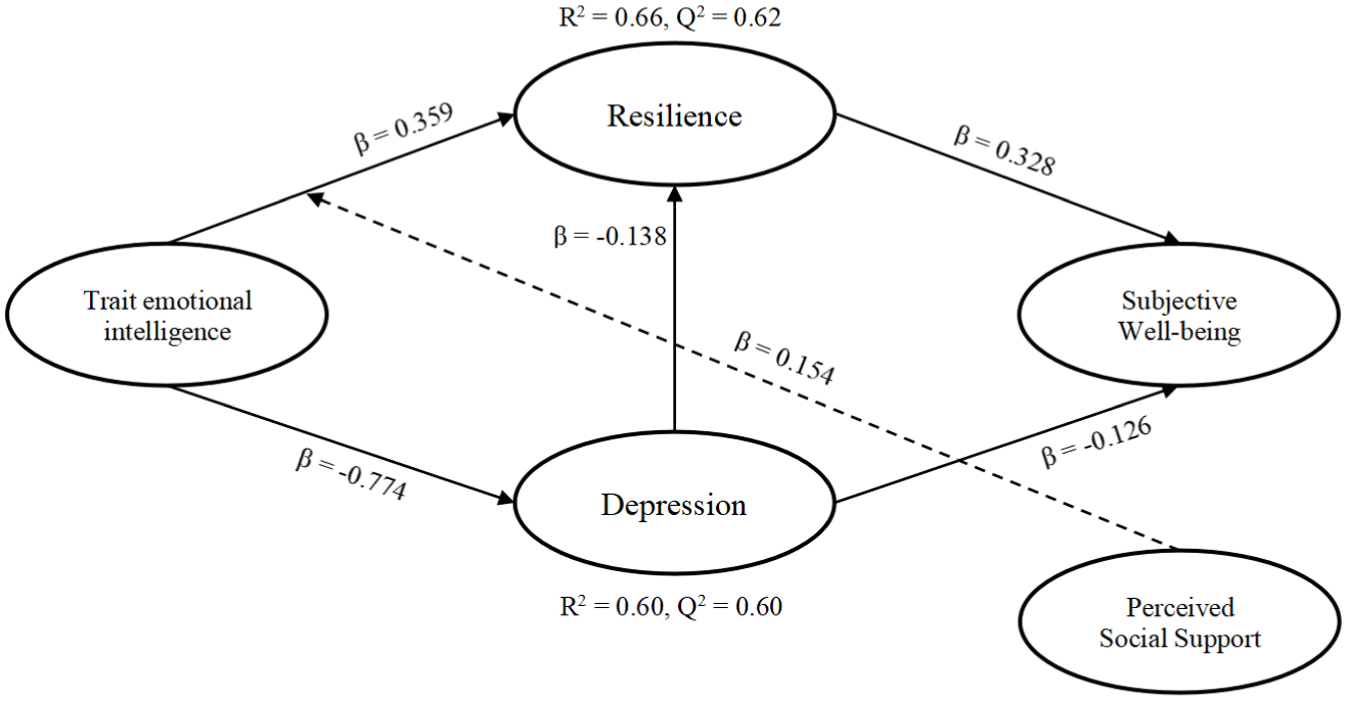
PLS-SEM results (N = 623).
From the results of Table 3, except for the moderating effect of perceived social support on the relationship between depression and SWB (H7), which is rejected (p > .05), the remaining hypotheses all have p-values < .05 or are statistically significant at 95%. Therefore, hypotheses H1, H2, H3, H4, H5, and H6 are all accepted.
Hypothesis Testing.

Note. N = 623; TEI = Trait Emotional Intelligence; RES = Resilience; DEP = Depression; PSS = Perceived Social Support; SWB = Subjective Well-being; SD = Standard Deviation.
Discussions
Vietnam, which emphasizes education as a measure of personal and family success (Truong et al., 2017), has put deep pressure on students, a young generation between the ages of 18 and 23. When grades and academic achievements become criteria for assessing human values, students not only have to shoulder the expectations of their families (Nguyen-Thi et al., 2024) but also face the strict requirements of the academic environment (Truong et al., 2017). The rapid development of social media further deepens the inner insecurity when students are constantly exposed to images of success and happiness that are “fully displayed,” easily causing them to fall into a state of comparison, feeling inadequate, self-conscious, and distant from their true selves (Huynh et al., 2024). Although today’s students have access to better material conditions than previous generations, they live in a volatile world. All these factors create a psychological environment that can easily lead to chronic stress, prolonged anxiety, and depression. In this context, the results of this study show the vital role of TEI as an internal resource that helps students regulate their emotions and protect themselves from adverse environmental and social impacts.
Current research indicates that TEI is positively related to resilience, specifically, TEI enables individuals to control negative emotions, increase positive emotions, and maintain internal balance in high-pressure situations (Koydemir & Schütz, 2012; Salovey & Mayer, 1990). Students with high TEI are more likely to restructure negative thoughts and quickly recover from life’s failures or difficulties (Malik, 2022). Resilience is a factor that helps students preserve their resources according to COR (Awais et al., 2024), allowing them to maintain a positive psychological state and self-confidence, better control over their lives, and even help prevent negative and self-harming thoughts (Z. S. Li & Hasson, 2020; Twum-Antwi et al., 2020). In contrast, students who lack TEI development often have difficulty coping with adversity and tend to have lower happiness scores (Abdollahi et al., 2019).
From the relationship between TEI and resilience, the study further confirmed that resilience has a positive impact on students’ SWB. As pointed out by Tugade and Fredrickson (2007), resilience not only helps students overcome difficulties but also acts as a “psychological buffer,” supporting and protecting them from mental trauma and nurturing SWB. This result is consistent with previous research, which demonstrates that resilience enables individuals to maintain a stable mental state despite life’s difficulties or events (Bhattarai, Smedema, et al., 2021; Drach-Zahavy et al., 2022; Xu et al., 2024). When individuals possess resilience, they have the flexibility to regulate their emotions, adapt to the situation, see opportunities in difficulties, and positively welcome and overcome them instead of succumbing to negativity and deadlock. From the COR perspective, resilience can be viewed as an internal resource that helps individuals maintain or restore mental resources when faced with loss, thereby sustainably improving SWB.
Another striking finding from the study was the negative association between TEI and depression. This suggests that TEI also serves as a necessary “psychological shield” that helps students reduce negative emotions and limit the manifestations of psychological disorders. Specifically, TEI enables individuals to clearly understand their feelings, thereby controlling their psychological responses in challenging situations, limiting the risk of stress progression, and minimizing the manifestations of psychological decline commonly found in the non-clinical group (Ortiz-Bonnin et al., 2022). This result is also consistent with previous studies (Dasor et al., 2023), reinforcing the view that TEI is one of the highly effective endogenous resources in protecting mental health (Sundvik & Davis, 2023; X. Zhang et al., 2023), especially helping individuals avoid adverse emotional developments. This background factor can easily develop into severe depression. Moreover, in the context of this study, depression is examined as a non-clinical condition. This is especially meaningful in the context of Vietnamese students facing high levels of stress and depression due to the influence of social networks, pressure to achieve results, and a lack of emotional connection with family or teachers (Nguyen et al., 2020; Phan, 2024).
Not only that, but the study also showed that depression has an inverse relationship with SWB. It shows that the higher the level of depression, the more the student’s SWB declines. This is easy to explain because depressed students often experience feelings of isolation, disorientation, and loss of meaning in life (Prizeman et al., 2023), leading to a decline in joy and a decrease in happiness (Ho et al., 2010; J. Y. Kim et al., 2019), instead only seeing life as complicated and full of obstacles and deadlocks. In the context that many Vietnamese students do not have full access to psychological care and support services, early detection and adjustment of negative psychological states, stress, and subclinical manifestations of depression are extremely necessary to protect mental health and improve the quality of life for students (Duong et al., 2024). This approach is not only practical in the present but also has the potential to foster and enhance the sustainability of psychology for the future.
In addition, the current research results also confirm that depression not only negatively affects SWB but also reduces students’ psychological resilience. Depression causes negative emotions such as sadness, hopelessness, and loss of motivation that easily accumulate over time, leading to students gradually losing confidence in themselves and their ability to overcome challenges (R. Fuchs et al., 2021; Zhao et al., 2021). If stress persists and becomes more severe, it can develop into a persistent depressive disorder rather than remaining non-clinical (Bertollo et al., 2024; Kaywan et al., 2023). As expectations from family, society, and themselves increase, young people are often not fully prepared with the emotional skills to face and handle pressure (Broderick, 2021). This lack of preparedness can lead to feelings of helplessness and stagnation (Jacob et al., 2022), as well as tendencies towards procrastination and avoidance, ultimately discouraging them from facing difficulties (Lindskov, 2025; Przepiorka et al., 2023). Depression thus erodes inner strength, making it difficult for students to recover after failure, easily discouraging them when facing obstacles, and impairing their ability to regulate emotions flexibly (Kotera et al., 2021; Watson et al., 2020). If this situation persists, it causes students to fall into a vicious cycle: the weaker they feel, the more they withdraw, and the more they withdraw, the greater the opportunity for them to recover mentally is lost.
A notable point in the study is the moderating role of perceived social support. In Vietnamese students, where family and community values still have a profound influence, support from relatives, friends, and schools can create a psychological safety zone, helping students easily share their feelings and overcome crises (Alsubaie et al., 2019; Fu et al., 2022). The results showed that PSS strengthens the relationship between TEI and resilience (β = .154), affirming the view that PSS not only acts as an additional social resource but also has a catalytic function, helping to activate and enhance the effective use of internal resources such as emotional flexibility and self-confidence and positivity, which are characteristic properties of resilience (Wilson et al., 2020; Zhou & Yu, 2021). For students who have not received formal training in emotional skills, PSS can act as a resource for conservation and restoration mechanisms, thereby increasing psychological resilience to adversity (Bhattarai, Smedema, et al., 2021). This suggests that the interaction between internal capacity and external support networks is essential in supporting young people’s mental health.
However, contrary to theoretical expectations, the study did not find a moderating role for PSS in the relationship between depression and SWB. Although many previous studies have emphasized PSS as a buffering factor that reduces the negative impact of depression (Miloseva et al., 2017), the current results suggest that perceived social support may not be practical in severe and prolonged psychological states, which impairs both the ability to receive and benefit from help. This is especially true in the university environment, particularly in a student context, where most students live far from their families (Gál et al., 2022), and social relationships are often broad but not deep enough (Kahu et al., 2020), limiting the quality of support, especially during times of emotional distress. In addition, students often tend to use social media or recreational activities to cope temporarily, rather than seeking genuine support from others (Shiraly et al., 2024). In particular, even when aware of psychological problems, students are often hesitant to seek professional help or share with relatives (Conceição et al., 2022). At this age, students usually have high expectations of themselves and want to overcome challenges without relying on others (Ishikawa et al., 2023). As a result, they tend to avoid sharing their struggles due to fear of being judged, lack of trust in others, or firm belief in their ability to be self-sufficient. In some cases, receiving support is even seen as a sign of failure, causing them to resist or underestimate the help they receive (Adams & Miller, 2025).
Furthermore, depressive problems are often deep-seated and long-lasting, so simple advice or encouragement from friends may not be enough to improve SWB in the long term (Shorey et al., 2022). Even when individuals report receiving support, not all forms of support are equally effective (Cacciatore et al., 2021; Cao et al., 2021; McLean et al., 2023). In this study, it is possible that much of the PSS measured was primarily emotional or verbal support, which may not be sufficient to reduce psychological distress. According to Hobfoll’s (1989) COR, when depression has led to the loss of many personal resources, simply adding social support may not be strong enough to reverse the negative spiral if not accompanied by the restoration of core resources such as trust, self-control, or emotional regulation.
In addition, the timing of measurement may also be a methodological limitation. While depression is a persistent psychological state (Shorey et al., 2022), PSS is measured as a perception at a specific point in time. Because social support often takes time to develop its effects, a momentary measurement may not accurately reflect its cumulative buffering role. The temporal mismatch between persistent depression and perceived social support that is only momentary may lead to statistically insignificant results in the moderator model. In addition, even when support is present, its moderator effect may be limited if it is inappropriate in form, timing, or if the individual is in a psychological state that reduces receptive capacity. Therefore, the hypothesis of a moderating role of PSS between depression and SWB was not supported in this study.
Implications
The article examines the relationship between emotional intelligence characteristics and SWB in both positive and negative directions. The results show that psychological capital, a personal factor of the individual, significantly influences the promotion of the best TEI of students. The levels of TEI and resilience are proportional to each other. The higher the TEI, the higher the resilience, thereby maximizing SWB. In addition, this study also shows that when individual students have negative psychology and depression, this dramatically affects SWB. At this time, resilience cannot impact and reduce an individual’s negative level. It shows the severity of negative psychology and depression. It affects short-term or temporary SWB, but when depression and psychological negativity are pushed to a large enough level, people can harm themselves. At this time, perceived social support is a necessary factor as an exogenous source of support. However, in this case, the study could not find empirical evidence that individuals’ negative psychological level is reduced even when they receive perceived social support.
Therefore, individuals need to enhance their self-trait emotional intelligence and reduce depression by learning, engaging in personal growth, and relying on other sources of support, as emotional intelligence can be developed throughout life through training and continuous learning (Rey et al., 2019). Universities should organize activities and programs to increase and strengthen students’ emotional capacity. Besides, students should proactively seek solutions to alleviate their emotions and thoughts, thereby avoiding constant ruminating about them. It helps them understand themselves better and practice expressing their feelings and thoughts. Students should equip themselves with positive and balanced living skills. Mindfulness can be seen as a mental discipline that involves training attention for the present moment (Hassed, 2016). Practicing mindfulness meditation will also significantly contribute to focusing on self-healing and reducing stress (Ramasubramanian, 2017). Increasing trait levels of emotional intelligence can reduce depression and enhance students’ resilience (Droppert et al., 2019). Proactive forms, combined with the application of TEI-related skills such as empathy, communication, judgment, conflict resolution, and expressing and controlling emotions, can help people understand themselves and others. This is determined because high trait emotional intelligence greatly helps communication relationships (Butler et al., 2022). Understanding and managing emotions helps them recover from adversity more effectively than those who do not. All the above training forms have a positive impact on students’ SWB.
Students can also consider experiential communication and connection activities. They should seek out people who share similar interests, values, or goals through clubs, classes, or volunteer groups, and they will find support and encouragement in that environment. Social support can enhance TEI and resilience after adversity (Neneh, 2022). Communicating regularly with an existing network of friends, family, or colleagues helps students step out of their comfort zone and realize diversity in communication and sharing.
Also, whenever people encounter difficulties, they can ultimately seek help from outside. In addition to receiving support from others, proactively helping others is also essential (Zhou & Yu, 2021). This action makes students feel more connected and valued. It strengthens relationships and enhances a sense of self-competence. Finally, it is also essential for them to consider carefully how to support themselves. Caring for their physical and mental needs can improve students’ emotional intelligence and confidence (Martín et al., 2021). Self-advocacy can also make people more resilient and less dependent on outside sources of support.
Limitations and Future Research
This research is a cross-sectional study, so the data collected is only instantaneous during the survey. This causes subjective psychological factors to influence the results chosen by the respondent significantly. Future studies should employ longitudinal research methods with a more extended implementation period to test the relationship between concepts. This method helps increase the precision in determining the causal relationship between TEI and resilience/depression over the long term, as well as their change over time. This issue is similar to the impact of resilience and depression on SWB.
While the data collected across majors is relatively evenly distributed, this unintentionally makes it impossible to assess SWB, depression, resilience, and TEI across disciplines carefully. In each major, these characteristics may differ significantly. Therefore, future research can consider separating and focusing on a specific group of majors to identify differences among various student groups.
Even though the convenience sampling method in this study offers advantages in terms of feasibility, quick access to a large number of participants, and time savings, it still poses a potential risk of bias in sample characteristics. Specifically, the obtained sample tends to represent the easily accessible group rather than fully reflecting the overall study population, thereby affecting the representativeness and generalizability of the results. Although the number of observations in this study did not differ significantly between industry groups, the risk of sampling bias cannot be completely ruled out. Therefore, future studies should consider applying controlled sampling methods (such as stratified or random) to improve the reliability and applicability of the research results, especially in assessing moderation effects.
Another limitation of the study lies in the relatively small magnitude of the obtained moderation coefficient, a result that is common in PLS-SEM analyses, where the path coefficient (β) typically ranges from 0.05 to 0.15 (Becker et al., 2018). Although this aligns with the technical characteristics of the method, the result still requires revalidation in future studies, for instance, by increasing the sample size or employing alternative analytical approaches, to enhance detection power and confirm the practical significance of the findings.
Ultimately, current research primarily focuses on college students. While this research provides valuable educational insights, studies involving high school students or their experiences have not been explored. Researching factors that affect the development of high school students is also essential for the comprehensive health and mental well-being of adolescents.
Footnotes

Ethical Considerations
We inform you that the survey data of the participants will be used for this research. In addition, a confidentiality commitment is also made, the data provided by the participants is only to conduct this research.
Consent to Participate
All participants provided consent to the collection of information by checking the consent box on the survey form.
Consent for Publication
Survey participants agree that their survey will be used to conduct this research.
Funding
The authors received no financial support for the research, authorship, and/or publication of this article.
Declaration of Conflicting Interests
The authors declared no potential conflicts of interest with respect to the research, authorship, and/or publication of this article.
Data Availability
Data and survey figures of this study will be provided upon request.