




Abstract
This study compared risky sexual behavior (RSB) between migrant and non-migrant Nigerian men, and investigated the individual and community factors of RSB between the two groups. Data for the study were from the 2012 National HIV/AIDS and Reproductive Health Survey in Nigeria. It comprised 15,346 male respondents aged 15 to 64 years and made up of 7,158 non-migrants and 8,188 migrants. The data were analyzed using descriptive statistics, chi-square test, and multilevel binary logistic regression. More non-migrants (37.69%) than migrants (28.43%) were engaged in RSB. RSB among migrants showed significant differences in all explanatory variables except for place of residence and religion. Among non-migrants, significant differences existed between RSB and all the explanatory variables except for awareness of family planning and sexually transmitted diseases. The regression null model showed lower odds of RSB for migrants and non-migrants. In the full model, the intercepts increased odds of RSB for migrants (odds ratio [OR] = 8.55) and non-migrants (OR = 9.21). Variables which increased odds of RSB by migrants included employment status, religion, and place of residence. Education, employment status, wealth index, and place of residence were found to increase the odds of engaging in RSB among non-migrants. The study therefore concludes that social contexts matter for engagement in RSB.
Introduction
Behaviors are a major determinant of health outcomes (Lalonde, 1974; Meade & Emch, 2010; Meade et al., 1988). Not only do negative and harmful behaviors affect susceptibility to diseases, they equally promote exposure to disease-causing conditions. Studies are replete with evidence to show that behaviors, particularly risky sexual behaviors (RSBs), are largely responsible for the spread and transmission of HIV/AIDS and other sexually transmitted diseases. Such risky sexual behaviors include multiple sexual partnerships, sex at early age, and inconsistent condom use with casual partners (Awusabo-Asare & Annim, 2008; Bingenheimer, 2010; Federal Ministry of Health, 2005; Isiugo-Abanihe, 1994; Oyediran et al., 2010; Udoh et al., 2009; Joint United Nations Programme on HIV/AIDS (UNAIDS), 2010; Vu et al., 2011). It also includes extramarital sexual relationships (Coma, 2013; Mah & Halperin, 2010; Mishra & Bignami-Van Assche, 2009; Shelton, 2007).
Research has further shown that the preponderance of risky sexual behaviors is higher among migrants than non-migrants irrespective of the reasons for migration (Hu et al., 2006; Wang et al., 2010). In this context, a migrant is defined as anyone who has changed his or her place of usual residence for a period of at least 1 year (Ajaero, 2017; Ajaero et al., 2017, 2018). Wolffers et al. (2002) and Yang (2004) provide evidence to show that migrant men who get infected with sexually transmitted diseases at their work destinations continued to have sexual contacts with their female partners upon returning to their native places. These suggest that higher RSBs among migrants make them serve as a bridge population for spreading HIV and other sexually transmitted diseases from their destination areas to their areas of origin. However, that RSB is higher among migrants may not necessarily be so when analyzed within the ambits of individual lifestyles, locational contexts, and internal migration. With no fewer than 54% of Nigerians living below the poverty level, internal migration in Nigeria has remained high and a key livelihood diversification and survival strategy for poor and nonpoor households in search of new opportunities, improved livelihoods, and better standard of living (Aworemi & Abdul-Azeez, 2011). The foregoing linkages between migration and RSB, and the fact that not much attention has been given to a comparative study of the variation in RSB among migrants and non-migrants, particularly in Nigeria, inform this study.
Several studies from Africa and other developing countries have shown positive associations between geographical mobility and the spread of sexually transmitted infections (STIs). This is as a result of the vulnerability of migrant and temporary mobile males to engage in risky lifestyle and indulgence in RSB (Akinnawo, 1995; Aniebue & Aniebue, 2009; Ankomah et al., 2013; Sanchez et al., 2008; Yang et al., 2007). Some of the factors promoting RSB among migrants include the nature of the work the migrants are engaged in (Bailey, 2008), the disruption of the migrants’ social networks and its attendant effects on supervision, and sanctions against nonnormative behaviors (Coleman, 1988). Other factors include isolation and loneliness experienced by migrants in their new environment (South & Haynie, 2004; Yang & Xia, 2008), and the likelihood of migrants getting intertwined with peer groups who exhibit higher rates of deviant behaviors in their destination areas (Haynie et al., 2006). These studies have also noted that the relationship between migration and the adoption of risky lifestyles and RSB is linked to a complex set of demographic, socioeconomic, cultural, and environmental factors. These factors include age, place of residence, education, marital status, and wealth index. The complexity lies largely in the nature of the relationships.
Uchudi et al. (2010), for instance, observed that involvement with multiple sex partners is more prevalent among younger people, urban residents, migrants, and individuals who live in societies with early sexual exposure. Like de Walque et al. (2005) and Hargreaves et al. (2008), Uchudi et al. (2010) equally noted that level of education also affects RSB, with more educated people being better at practicing safer sex. In contrast, however, Eaton et al. (2006) and Kirunga and Ntozi (1997) observed an inverse relationship between level of education and RSB. Living in an urban center and higher levels of education were also statistically found to significantly influence risky sexual behavior among females in a study of 28 third world countries (A. Berhan & Berhan, 2012) and among male youths (Y. Berhan & Berhan, 2015). This is in contrast to an earlier study by Voeten et al. (2004) which found out that sexual behavior was more risky in rural areas than in urban areas among women in Nyanza Province of Kenya. The study, however, reports that among men in the study localities, RSB was high in both rural and urban areas. Wealth, however, seems a constant dimension underlying most of the explanations on RSB among men. Increased economic status and higher wealth index have been found to be positively correlated with increased risky sexual behavior (Awusabo-Asare & Annim, 2008; Y. Berhan & Berhan, 2015; Kongnyuy & Wiysonge, 2007; Mitsunaga et al., 2005).
As in the studies elsewhere, richer men were also found to be more likely to have multiple sex partners in Nigeria (Adeolu et al., 2014). Men were also generally found to engage more in extramarital sex in Nigeria (Ankomah et al., 2013; Isiugo-Abanihe, 1994; Izugbara, 2008; Izugbara & Nwabuawele Modo, 2007; Orubuloye et al., 1997; Oyediran et al., 2010), be the resident in urban or rural areas and irrespective of whether the men are in monogamous or polygynous unions (Orubuloye et al., 1991, 1992). The cultural precept of male dominance in Nigeria is believed to be responsible for the high prevalence of multiple partnerships among Nigerian men as this is seen as a feature of masculinity (Adeolu et al., 2014; Izugbara, 2008; Omololu et al., 2004; Vu et al., 2011). Essentially, studies on the associations between these factors and RSB among migrants are generally lacking. Where they exist, they cover isolated locations and date back about two decades making generalization and model building largely impossible. More lacking are studies on these factors, internal migration, and migrant men in Nigeria. This study, therefore, attempts to fill these gaps using a nationally representative population. It also transcends the appraisal of the influence of individual factors on the relationship between RSB among men and migration to the assessment of the extent to which contextual factors influence individual factors in explaining RSB between migrants and non-migrants. The objectives of this study in Nigeria are therefore to compare RSB between migrants and non-migrants, and to investigate the individual and contextual factors which predict RSB in migrants and non-migrants.
Method
Data Source and Description of Variables
This study used data from the 2012 National HIV/AIDS and Reproductive Health Survey of Nigeria (NARHS Plus) conducted on a nationally representative sample of respondents aged 15 to 64 years from 1,116 clusters across all the 36 states of country. The survey questionnaire comprised questions on sociodemographic data, knowledge about HIV/AIDS, sexual practices, and reproductive health. For this study, a total of 15,346 men aged 15 to 64 years made up of 7,158 non-migrants and 8,188 migrants were used.
The study made use of a dependent/outcome of risky sexual behavior variable and two main categories of independent variables. The main categories of the independent variables were (a) contextual-level variables and (b) individual-level variables. The outcome variable of risky sexual behavior was derived as a composite measure from four risky sexual behavior questions in the data set. These questions are as follows: (a) how many sexual partners does the man have (coded as either “1 or more than 1”), (b) if the respondent has ever used condom which has two categories of “yes = 1” and “no = 0” (c) if the respondent is currently using condom which has two categories of “yes = 1” and “no = 0,” and (d) if the respondent uses condom with casual sexual partner(s) with also two categories of “yes = 1” and “no = 0.” Subsequently, we derived a dummy variable of risky sexual behavior (yes = 1 and no = 0) such that respondents who had more than one sexual partner, had never used condom, currently not using condom, or who do not use condom with casual sexual partners were classified as engaging in risky sexual behavior and coded as 1. Others not in any of the categories were classified as not engaging in risky sexual behavior and coded as 0.
The community-level variables were place of residence (rural/urban residence) and wealth index (poor/middle/rich). As the data set lacked information on income of respondents, we generated the community-level variable of wealth index with the aid of “Asset Indices technique” from variables of household ownership of assets. Asset Indices according to Filmer and Scott (2008) are of the basic form:

where Ai is the asset index of household “i,”
The individual-level factors were age (10-year groups), education (none/primary/secondary/tertiary), marital status (never married/married/widowed or divorced), employment (employed/not employed), religion (African traditional/Islam/Christianity), region of residence (comprised of six geopolitical regions of Nigeria), migration duration (<5 years/5–9 years/10+ years), awareness of family planning (yes/no), and awareness of sexually transmitted diseases (yes/no). In terms of exposure, internal migration status was categorized as 1 = migrant and 0 = non-migrants. As the data set has no specific question on migration, we used two variables: (a) age of respondents and (b) number of years the respondent have lived in his present location. If the age of the respondent is more than the number of years lived in a location, the respondent is categorized as a migrant while the rest are categorized as non-migrants. This definition of migrants above was predicated on the fact that previous literature had used 1-year duration of stay in a place (Ajaero, 2017), and 3-year duration of stay in a place (Ajaero et al., 2017; Ajaero et al., 2018) as definitions for migrants. In this study, therefore, the duration of stay away from the place of birth, which was used to differentiate the migrants from non-migrants, was at least 1 year and in some cases up to 15 years (as the data were collected on respondents aged 15–64 years).
Data Analysis
The data were weighted for under sampling and oversampling errors before being analyzed. All the analyses were carried out on the basis of internal migration status. Univariate analysis was used to describe the characteristics of the study population while bivariate analysis, using chi-square, was used to examine if there existed significant differences in the prevalence of the risky sexual behavior between the various contextual-level and individual-level independent variables of the study. Finally, multilevel binary logistic regression models with confident level of 95% were used to determine the influence of contextual-level and individual-level explanatory independent variables on risky sexual behavior of the respondents. The binary logistic regression was used since independent variable of “risky sexual behaviour” is a binary categorical outcome of 1 and 0.
For each of the migrant and non-migrant populations, there were four models. Model 1 was the empty/null model (no explanatory variable was added). It included only a random intercept and was intended only to decompose the total variance into its individual and community components and to identify the existence of possible contextual phenomenon for the risky sexual behavior outcome. In model 2, only the community-level explanatory variables were used to investigate the extent to which risky sexual behavior was explained by contextual factors. Model 3 contained only individual-level explanatory variables so as to access how the individual-level variables influence engagement in risky sexual behavior. Finally, model 4 contained both the contextual-level and individual-level explanatory variables to examine their combined effects on risky sexual behavior. The fixed effects section of the models (measures of association) contained individual-level and contextual-level factors, and the results were expressed as odds ratio (OR) at 95% confidence intervals (95% CI). All the analyses were performed using Stata version 14.0.
Results
About 40% of the migrant sample were aged 40 years and above while the proportion was 26.7% among the non-migrants. As illustrated in Table 1, 37.5% of the migrant population had no formal education, 70.9% were employed, and more than 23% were from the South-West region of Nigeria. In contrast, 50.9% of the non-migrant population were without formal education, 67.6% were employed, and 30.3%, constituting the bulk of the non-migrant population, were from the North West region. In the study sample, more non-migrants (37.69%) than migrants (28.43%) were engaged in RSB. In addition and as shown in Table 2, the prevalence of RSB across the geopolitical regions of the country indicates more migrants (70.40%) from the South West and more non-migrants (41.74%) from the South East were engaged in RSB. The bivariate results of engagement in risky sexual behaviors among migrants showed significant differences in all the contextual and individual variables with the exception of place of residence and religion. Among non-migrants, our results showed significant differences in prevalence of risky sexual behavior on all the explanatory variables with the exception of awareness of family planning and sexually transmitted diseases.
Socioeconomic Characteristics of the Study Population.
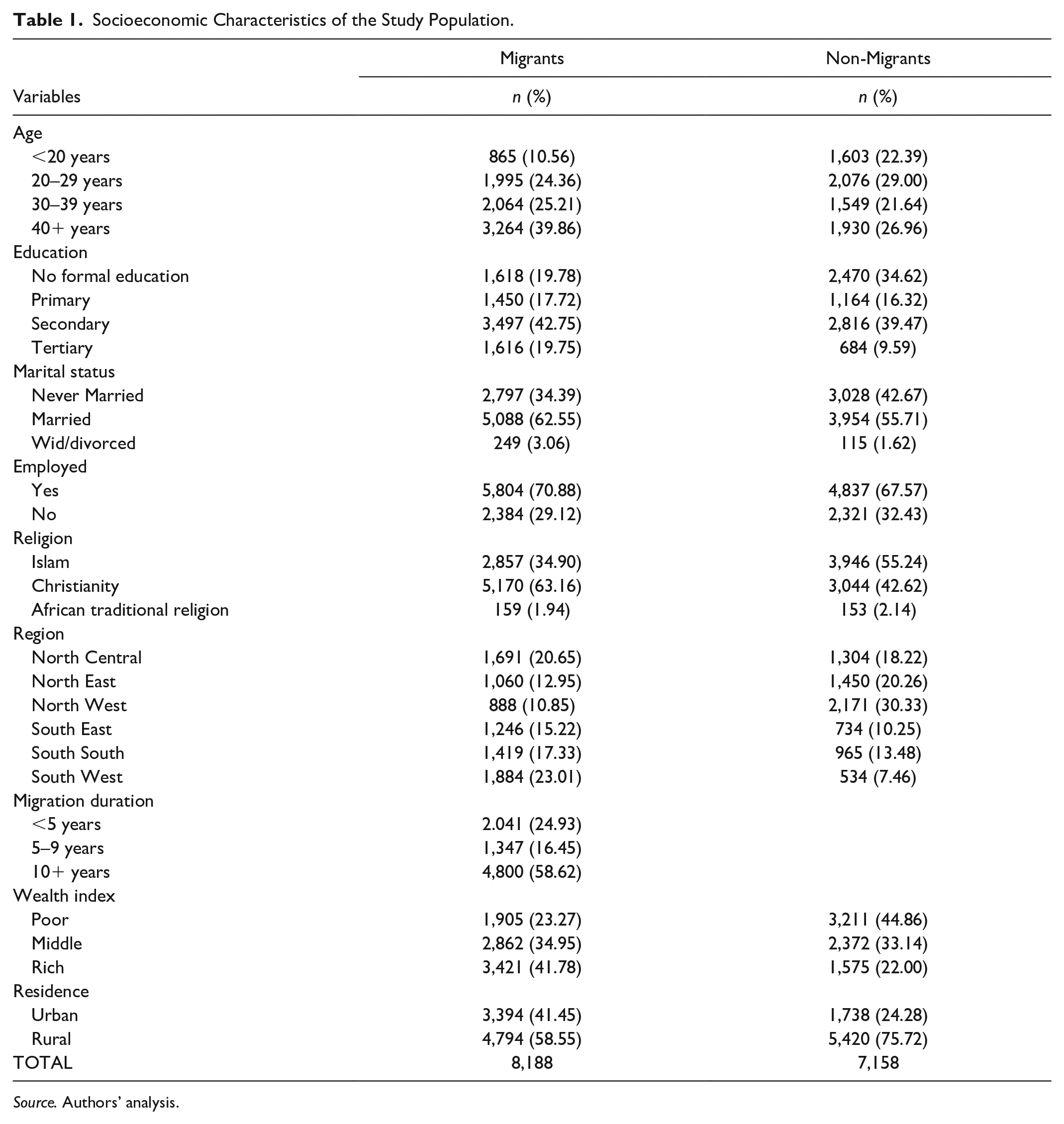
Source. Authors’ analysis.
Bivariate Analysis of Risky Sexual Behavior.

Note. STIs = sexually transmitted infections.
Source. Authors’ analysis.
Table 3 depicts the baseline/null models of RSB of migrants and non-migrants without any explanatory variables. The intercepts of the null models showed that both the migrants (OR = 0.38, 95% CI = [0.36, 0.41]) and non-migrants (OR = 0.59, 95% CI = [0.55, 0.63]) exhibited lower odds of engaging in RSB. The intraclass correlation coefficient (ICC) (ρ) obtained were for non-migrants (6%) and for migrants (10%). The introduction of community/contextual-level variables to RSB in Model 1 as shown in Table 4 did not change the reduced odds of RSB between the migrants (OR = 0.51, 95% CI = [0.43, 0.61]) and non-migrants (OR = 0.60, 95% CI = [0.52, 0.75]). Although respondents in richer wealth quintiles exhibited reduced odds of RSB for the migrants, wealthier non-migrants were associated with increased odds of RSB. On the other hand, both rural migrants and non-migrants were associated with reduced odds of RSB compared with their urban counterparts.
The Null Model of Risky Sexual Behavior.
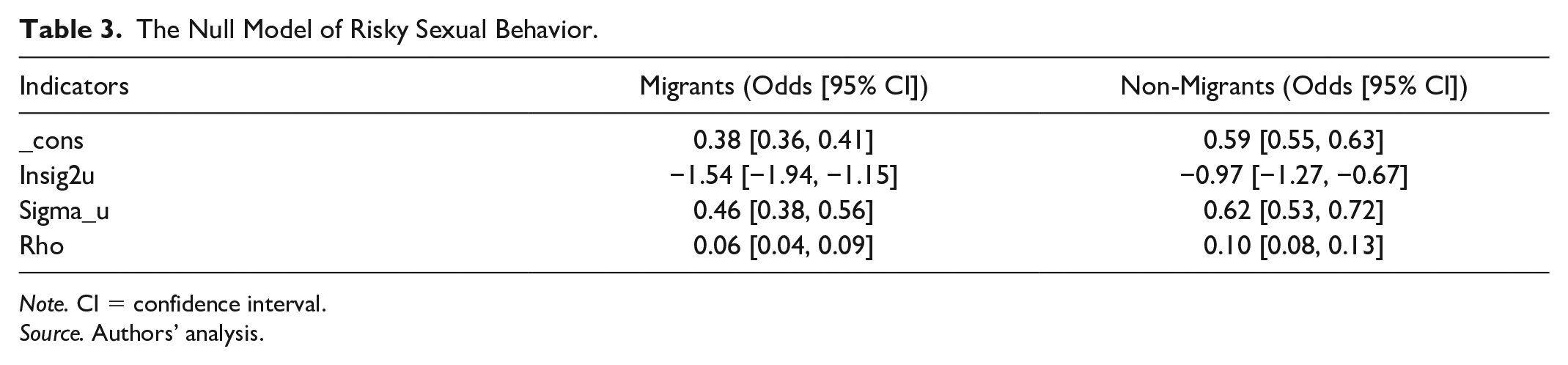
Note. CI = confidence interval.
Source. Authors’ analysis.
Multilevel Logistic Analysis of Predictors of Risky Sexual.
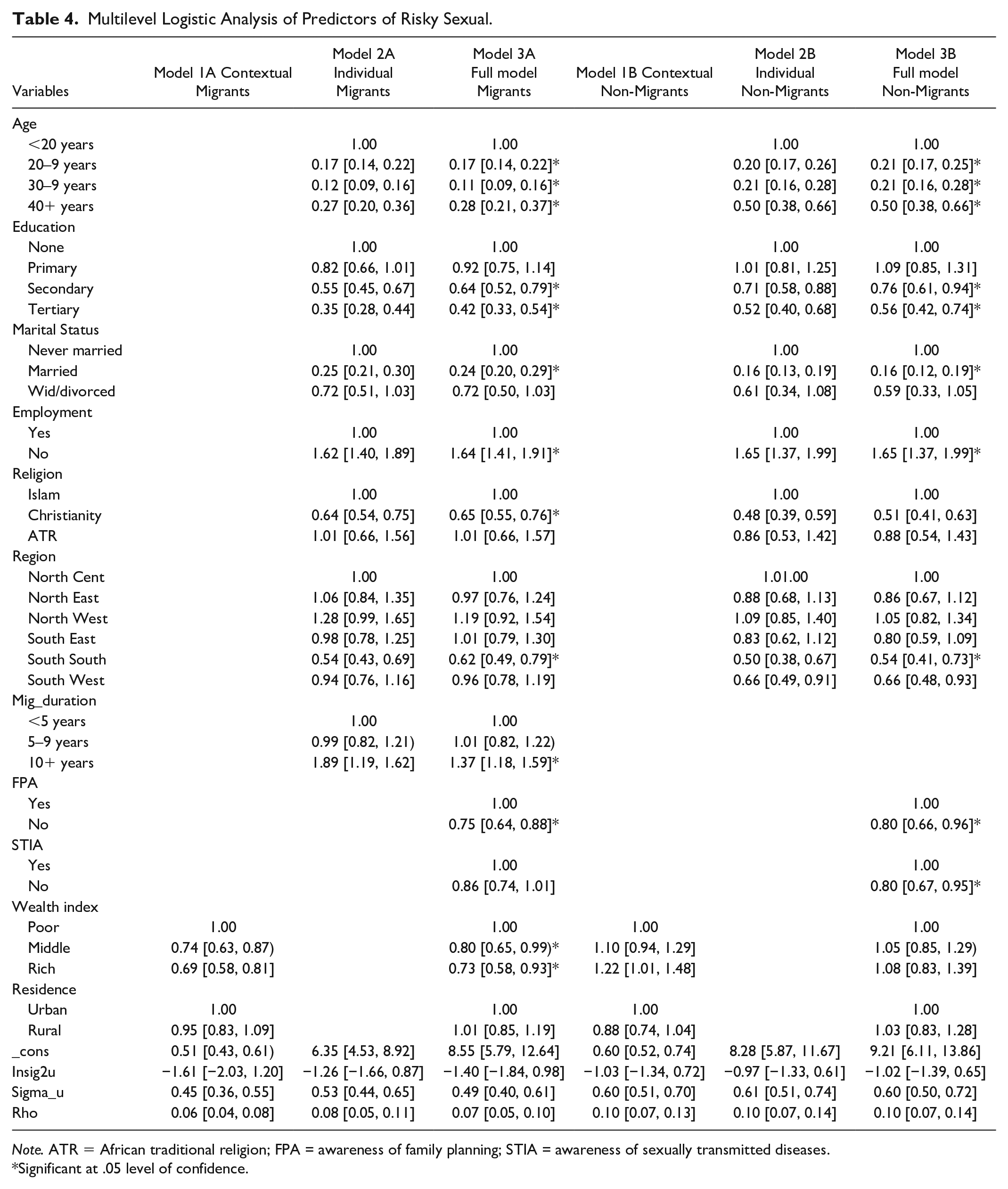
Note. ATR = African traditional religion; FPA = awareness of family planning; STIA = awareness of sexually transmitted diseases.
Significant at .05 level of confidence.
The adjustments for only individual-level factors of RSB in Model 2 still showed increased odds of RSB among migrants (OR= 6.35, 95% CI = [4.53, 8.92]) and non-migrants (OR= 8.28, 95% CI = 5.87, 1.67) in the study area. For both the non-migrant and migrant populations, being employed was significantly associated with increased odds of RSB. Other factors that increased odds of RSB among migrants were being a practitioner of African traditional religion, migration duration of 10 years and above, and region of residence. On the other hand, having only primary education was the only factor that significantly increased the odds of RSB among non-migrants. In the final model which included both the individual-level and contextual-level factors, the odds of RSB for the migrants (OR= 8.55, 95% CI = [5.79, 12.64]) and the non-migrants (OR= 9.21, 95% CI = [6.11, 13.86]) still remained high. Being unemployed, being a member of African traditional religion, having a migration duration of more than 5 years, being a resident of North West region, and being a rural dweller were the variables which significantly increased the odds of RSB among the migrants. Primary education, being unemployed, being a resident of North West region, belonging to middle and rich wealth quintiles, and being a rural dweller significantly increased the odds of RSB among the non-migrants.
Discussion
From the results, migrants had less odds of RSB than non-migrants. This is in contrast to findings in Hu et al. (2006) and Wang et al. (2010), among others, which show that migrants engage more in RSB than non-migrants. This implies that in Nigeria, internal migration status does not significantly determine if men will engage in RSB or not. Although internal migration is a livelihood diversification strategy the world over, the difference in its association with RSB in Nigeria may not be unconnected with the social and cultural contexts of such movements in the country. According to The 2010 Internal Migration Survey in Nigeria (National Population Commission, 2011), the main determinants of migration in Nigeria were to get a job and job mobility (26.4%), unification with spouses (15.9%), educational pursuits (13.4%), and to live near friends and relatives (8.4%). The conditions underlying the movements may have therefore acted to constrain RSB among some of the migrants.
The results also showed decreased differences in the logs of expected RSB outcomes in the null and contextual-level models for both migrants and non-migrants. However, in the individual-level and full models, both the migrants and non-migrants showed increased odds of RSB in the study area. These results agree with Haynie et al. (2006) and Uchudi et al. (2010) that contextual-level and individual-level factors have significant effects on RSB among men. Although part of our findings in the contextual-level model disagrees with other studies such as Awusabo-Asare and Annim (2008) and Y. Berhan and Berhan (2015) which showed that decreased odds of RSB was associated with increase in wealth status, the other part of the model agrees with Uchudi et al. (2010) which showed that urban residents engage more in RSB compared with rural dwellers. This largely reflects the spatial dimensions of wealth and levels of social development in the Nigerian urban and rural landscapes.
Inequality in wealth distribution in Nigeria is largely skewed toward the urban centers and serves as a driving force for rural–urban migration. Available evidence shows that urban residents in Nigeria are wealthier, have higher sexual socialization, and have better access to social infrastructures like the social media, relaxation centers, hotels, and educational institutions. These would surely affect urban residents’ exposure to RSB. On the other hand, rural Nigeria is characterized by widespread poverty, low population, and a close-knit social structure that places primacy on the family institution, both nuclear and extended. The latter particularly fosters a communal life style where everyone is/feels related to the other person and as such sees extra-marital sexual relations with them as a deviation from communal norm. In most rural communities in Nigeria, extra-marital sexual relationships are seen as deviant behavior and punished. The low population size also increases the probability of being caught and would serve to keep RSB lower in the rural areas.
The model of individual-level factors indicated that religion, migration duration, region of residence, and unemployment increased the odds of RSB among migrants. These results are supported by other studies by Bailey (2008) and Haynie et al. (2006) which identified these individual-level factors as having a relationship with RSB. Higher levels of education were associated with decreased engagement in RSB by migrants, and this result agrees with the findings by Morrison et al. (2008) and Uchudi et al. (2010) which noted that more educated people are less likely to engage in RSB. For the non-migrants, region of residence and unemployment were significantly associated with RSB as observed among the migrants. In addition, having no education and being married increased the odds of engagement in RSB. These results confirm earlier findings by Ankomah et al. (2013), Oyediran et al. (2010), and Izugbara (2008) which showed that married men generally engage more in extramarital sex in Nigeria. In the full model, the odds of RSB remained on the increase for both migrants and non-migrants. Unemployment, migration duration, religion, region of residence, and place of residence remained significant factors which increase odds of RSB among the migrants. On the other hand, no education, unemployment, region of residence, richer wealth quintiles, and being a resident of a rural area remained significant factors that increased RSB among the non-migrants.
Conclusion
The results showed that contrary to findings from most studies, migrants engage less in RSB than non-migrants in Nigeria. In addition, the study found that wealth quintile is associated with increased RSB among non-migrants. Wealth quintile was also found to be inversely associated with engagement in RSB for the migrants. Among both the migrants and non-migrants, the contextual-level factors of rural residence increased the odds of RSB which also contradict literature that seems to show that urban residents engage more in RSB than rural dwellers. These findings, therefore, emphasize the need for increased awareness campaigns, especially in the rural areas on the negative implications of risky sexual behaviors. In addition, more employment opportunities and skills acquisition centers should be provided in the rural areas as the results of this study have shown that poverty plays a major role in the engagement of rural dwellers in RSB. If these rural populations are gainfully employed and kept busy with productive jobs, it will go a longer in reducing the prevalence of RSB for both the migrants and the non-migrants.
Footnotes
Acknowledgements
The authors gratefully acknowledge the use of the research facilities of the Demography and Population Studies Programme, Schools of Public Health and Social Sciences, University of the Witwatersrand, South Africa, and the Department of Geography, Faculty of the Social Sciences, University of Nigeria Nsukka in conducting this study.
Declaration of Conflicting Interests
The author(s) declared no potential conflicts of interest with respect to the research, authorship, and/or publication of this article.
Funding
The author(s) disclosed receipt of the following financial support for the research, authorship, and/or publication of this article: The funding for this research was from the Demography and Population Studies Programme, Schools of Public Health and Social Sciences, University of the Witwatersrand, South Africa.
