




Abstract
The conundrum of how to balance economic growth with transportation carbon abatement has never been more vital for the Belt and Road countries. This study analyzes the Transport-Environmental Kuznets Curve nexus and explores the heterogeneity using fixed-effect estimation and panel data from 1981 to 2020 in 64 Belt and Road countries. The findings indicate that there is an N-shaped nexus between transport carbon emissions and economic growth. The environmental rebound effects in some Belt and Road countries are solidified from different perspectives and show a diamond-shaped lock-in feature. Moreover, most Belt and Road countries are still in the “climbing” stage and are struggling to reconcile economic growth with reducing transport carbon emissions. These conclusions have constructive policy implications for the Belt and Road countries at the various stages of “climbing,”“nearing or crossing the top,”“heading downhill,” and “rebounding” to advance the green transportation transformation strategy.
Keywords
Introduction
The Belt and Road Initiative has created an extensive transportation infrastructure, decreased transportation costs, accelerated transportation efficiency, and provided a prominent opportunity for economic growth. Despite some reports indicate that the total actual income generated by the Belt and Road Initiative is less than 2% of regional income (Bird et al., 2020), the improvement in infrastructure will contribute to an increase in employment and a concentration of economic activity, which can further boost income. However, the connectivity of transportation facilities has inevitably led to an unprecedented increase in carbon emissions from transportation that could trap the country or region in an unsustainable development cycle lasting several decades (Solaymani, 2019). This may influence the processes of achieving carbon peaking and carbon neutrality (X. Wang et al., 2021). According to the global greenhouse gas emissions data, transportation is one of the main contributors which account for nearly 27%, and transport carbon emissions are predicted to reach 9.3 billion tons by 2030 (Van Fan et al., 2018; C. Wang, Wood, Geng, et al., 2020). Also, the total carbon emissions from transportation are continuously increasing as communication links are being strengthened in the Belt and Road countries (Figure 1). Especially in developing countries, such as China and India, carbon emissions from transportation are anticipated to increase significantly in the coming years (Gupta & Garg, 2020).

Total transportation carbon emissions in the Belt and Road countries in 2010 and 2020.
Economic growth is often regarded as a key determinant of carbon emissions from transportation (Grossman & Krueger, 1991; Leal & Marques, 2020). However, the Belt and Road countries are very different in terms of their economy, transport, resource, and industrialization levels. Not only do they have to manage their precious opportunity to upgrade their transportation infrastructure, expand investment, and increase trade, but they also face the great risk that their carbon emissions from transportation will increase or rebound. Therefore, a clear understanding of how carbon emissions from transportation change with economic growth will help the Belt and Road countries to formulate targeted policies for limiting carbon emissions in accordance with their various economic levels. In light of this, we mainly focus on the following research questions: Does a T-EKC (Transport-Environmental Kuznets Curve) nexus exist between carbon emissions from transportation and economic growth in the Belt and Road countries? Does the T-EKC nexus heterogeneous in different economic, transportation, resource, and industrial levels?
Hence, the contributions in our research are threefold. First, we confirm the N-shaped T-EKC (Transport-Environmental Kuznets Curve) nexus between carbon emissions from transportation and economic growth in the Belt and Road countries. Compared to most previous studies focusing on the EKC (Environmental Kuznets Curve) nexus between carbon emissions and economic growth, this study expands the EKC hypothesis and fills the research gap regarding carbon emissions from transportation. Second, one important finding of the heterogeneity analysis indicates that the Belt and Road countries with low levels of economic income, insufficient transportation infrastructure, fewer resources and low levels of industrialization are still in the “climbing” stage. Another important finding reveals that the environmental rebound effects in some Belt and Road countries are solidified from the perspectives of the economy, transportation, resources, and industrialization, showing a diamond-shaped locking effect. The main findings in our research have several policy implications to attain a win-win situation in which economic growth is combined with transportation carbon abatement. Third, we ensure reasonableness in screening the control factors and reduce the potential for subjective interference based on Lasso regression, and then effectively solve the endogeneity problem by instrumental variables. The methods and instrumental variables we used have methodological implications for similar researches.
The remainder of this paper is organized as follows. Section 2 is the literature review. Section 3 discusses the empirical research variables and the construction of the econometric regression model. Section 4 covers the data tests and empirical results. Section 5 investigates the endogeneity problems in the models. Section 6 examines the empirical results’ robustness. Section 7 investigates the heterogeneity of the T-EKC relationship. Section 8 provides the discussion. Section 9 offers a conclusion and makes several policy recommendations.
Literature Review
Debates Regarding the EKC Hypothesis
In 1991, Grossman and Krueger first proposed the inverted U-shaped EKC hypothesis regarding environmental pollution and economic growth. They divided the impact mechanisms into scale effects, structural effects, and technological effects (Grossman & Krueger, 1991). After that, the EKC hypothesis has been widely discussed and extensively tested by many scholars (Diao et al., 2009; Kaika & Zervas, 2013; Leal & Marques, 2020). Currently, the main divergences in the academic literature are as follows:
First, a growing number of studies support the EKC hypothesis. Some scholars have tested the EKC hypothesis by looking at different countries or regions, including OECD countries (Awaworyi Churchill et al., 2021), EU15 countries (Alataş (2022)), and other developed or developing countries (Beşe & Kalayci, 2021). Other scholars have implemented different models and estimation methods to investigate the relationship between environmental quality and economic growth, for example by using the integrated Tapio decoupling model (Song et al., 2019; Xie et al., 2019), the log-average division index (Qiao et al., 2021; Wen & Li, 2020), and STIRPAT modeling (Xu et al., 2020; Zhu & Gao, 2019). Their findings all support the notion that there is indeed an inverted U-shaped EKC relationship between pollution and economic growth in the industrialization process.
Second, there are also some studies that question the EKC relationship. The criticism of EKC mainly comes from Arrow et al. (1995) and Munasinghe (1999). These two scholars claim that the EKC hypothesis largely ignores the feedback of environmental pollution on economic growth. Put differently, when a country reaches a sufficiently high standard of living, people will pay more attention to the quality of the environment, and environmental degradation can no longer be ignored. Furthermore, the natural and environmental resources available for economic activities are very limited. From this point of view, policymakers must seek to reform policies in enough time to avoid serious environmental damage (Kirikkaleli & Adebayo, 2021; Roxburgh et al., 2020). The EKC hypothesis also does not take into consideration the fact that developing countries can learn the experiences of post-industrial, developed countries. They can then adjust their social development and industrial structure to avoid high or irreversible environmental damage. This is known as the EKC “tunnel” effect (L. Jiang et al., 2019; Munasinghe, 1999). Moreover, Jevons and some other scholars criticize the notion of technological effects in the EKC hypothesis (Jevons, 1865; Ruzzenenti et al., 2019). They argue that in real societies, improvements in production efficiency will not reduce the demand for natural resources but stimulate it further, leading to a rebound in energy consumption and causing more serious environmental problems (Ceddia & Zepharovich, 2017; Gunderson & Yun, 2017). The above queries are worth reflecting on whether the traditional EKC assumptions are applicable to all cases. If not, what is the curvilinear relationship between transport carbon emissions and economic growth? The answer to this question is beneficial to the expansion of EKC scholarship.
Third, a large number of empirical studies have extended the EKC hypothesis. Some scholars have used more comprehensive environmental degradation variables, such as gaseous waste, solid waste, liquid waste, and energy consumption, to verify the EKC hypothesis (Alshehry & Belloumi, 2017; Rashid Gill et al., 2018; Rauf et al., 2018). Other scholars enriched the EKC model’s explanatory variable. For example, some scholars have found an inverted U-shaped relationship between urbanization and carbon emissions in developed cities (Muhammad et al., 2020), and the EKC hypothesis has also been validated in the long run when economic growth is replaced by economic freedom (Saidi, 2021). Also, some scholars have argued that the EKC relationship is not confined to the inverted U-shape: U-shaped, inverted N-shaped, and positive N-shaped curves have also been confirmed (Caviglia-Harris et al., 2009; Halkos, 2011; Ulucak & Bilgili, 2018).
In general, the traditional inverted U-shaped EKC hypothesis does not cover the relationship between economic development and environmental pollution in all countries. There is considerable scope for expanding it.
A New Concept of T-EKC Nexus
“No road, no economy.” Transportation plays a critical role in economic growth, but the transport sector’s heavy reliance on fossil fuels is unsustainable. How to reconcile economic development and carbon emissions from transportation is a still key issue.
Although some studies have evaluated the relationship between carbon emissions from transportation and economic growth (Alshehry & Belloumi, 2017; G. Yang et al., 2020), most empirical studies explore this issue by focusing solely on a single region or country (Tiwari et al., 2020; Zhang et al., 2020). Moreover, most recent studies have concentrated mainly on the decoupling of carbon emissions from transportation and economic growth (Engo, 2019; Finel & Tapio, 2012; Song et al., 2019), or they have considered the spatial distribution of transport carbon emissions (C. Wang, Wood, Wang, et al., 2020). Though the EKC hypothesis has been tested in developed countries such as the United States (Ali & Puppim de Oliveira, 2018), many Belt and Road countries, particularly developing countries, are still trying to pursue economic expansion by upgrading their transport infrastructure. At the same time, they are increasing industrialization and international trade, thereby generating excessive carbon emissions from transportation (C. Wang, Wood, Geng, et al., 2020; X. Wang et al., 2021). Therefore, we believe that there may be a similar EKC relationship between carbon emissions from transportation and economic growth in the Belt and Road countries, defined as the T-EKC (Transportation-Environment Kuznets Curve) nexus. However, this question has seldom been considered in the empirical literature.
Besides, there may be some differences between the T-EKC relationship and the traditional EKC hypothesis. One reason for this is that there is a significant gap between the levels of economic income and the pollution management capacities of the Belt and Road countries (Han et al., 2020; G. Yang et al., 2020). Some developing countries are still in the upward stage of promoting rapid economic development. The development model of “abatement after pollution” inevitably damages the environment and may even lead to a rebound in carbon emissions (Ulucak & Bilgili, 2018). Another reason for this is that the Belt and Road countries also have large differences in transportation infrastructure, resource, and industrialization (Benintendi et al., 2020; M. X. Huang & Li, 2020). High-income countries started industrialization early, so they have higher economic levels and relatively good infrastructure, but the opposite is true for low-income countries (Muhammad et al., 2020; H. Sun et al., 2020). Few scholars have explored the T-EKC relationship between carbon emissions from transportation and economic growth, and there are few empirical studies of whether there is a heterogeneity of the T-EKC relationship in the economies, transportation systems, resources, and industrialization levels of the Belt and Road countries.
In summary, to respond to the above research gap regarding carbon emissions from transportation, this study empirically explores the T-EKC nexus between transport carbon emissions and economic growth by applying the traditional EKC theory to the Belt and Road countries. It also examines T-EKC heterogeneity by focusing on economics, transportation, resources, and industrialization.
Variables and models
T-EKC Model
The traditional EKC model is as follows:

where
However, the relationship between carbon emissions from transportation and economic growth isn’t always an inverted U-shape. To better estimate the relationship, this paper uses the classical framework of the environmental Kuznets curve (Grossman & Krueger, 1991) and draws on the models of L. Jiang et al. (2019) and Sarkodie and Strezov (2019) to analyze whether there is an N-shaped relationship between carbon emissions from transportation and economic growth in the Belt and Road countries. Meanwhile, to minimize the influence of heteroskedasticity in the model, the non-percentage variables are logarithmically treated, and the basic T-EKC panel econometric model is constructed as follows:

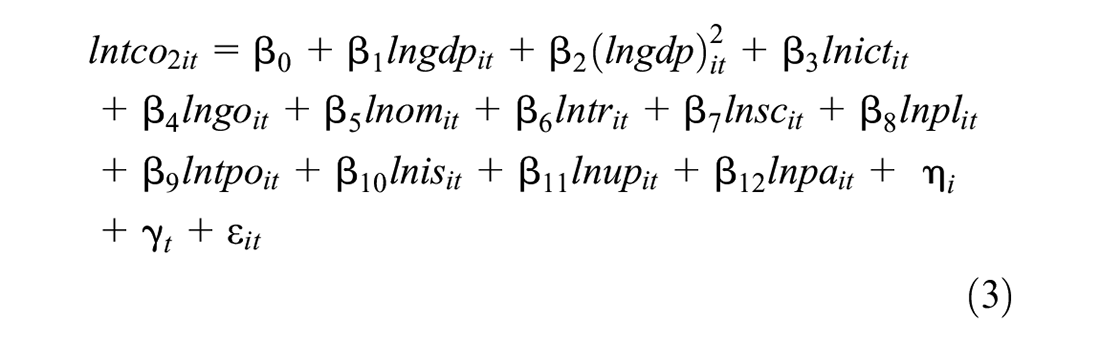
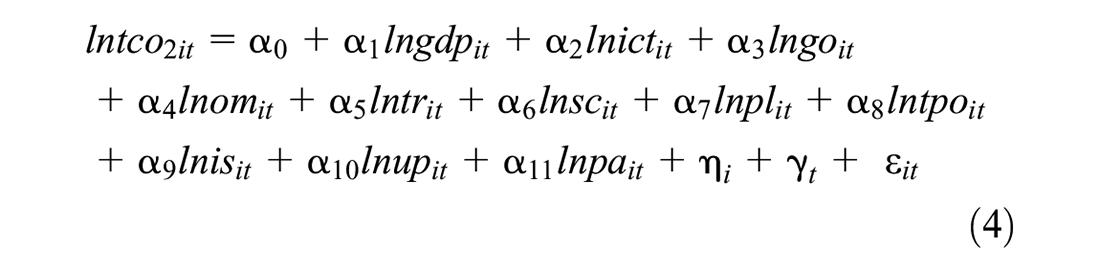
The values of
Variable Description
The carbon emissions from transportation (
Gross Domestic Product (GDP), which uses to express the economic growth, is the independent variable. GDP data are obtained from the WDI database (WDI, 2020).
The selection of control variables is extremely important when constructing regression models. When building a regression model, the best option is not to incorporate as many control variables as possible but to exclude those that are dispensable and adhere to the principle of less is more.
To this end, this study combines the traditional theory of EKC and the research of previous scholars to select different proxy variables as control variables for the economy, energy, transportation, and social development (Y. Huang et al., 2020; Zhang et al., 2020; Zhu & Du, 2019).
However, the inclusion of control variables may be subjective and arbitrary. Therefore, this study uses Lasso regression to identify the optimal control variables.
Lasso regression, first proposed by Tibshirani (1996), provides the best-fit curve obtained from the regression and prevents over-fitting. Lasso regression compresses the variable coefficient with a small absolute value to 0 through the penalty term, thus helping with the selection of variables and removing unimportant variables. The Lasso regression model is as follows:

where
Control Vvariables Selection Results by Lasso Regression.

Empirical Analysis
Descriptive Statistics and Correlation Test
To acquire basic insight into the characteristics of the dataset, we applied a descriptive analysis of 64 Belt and Road countries’ panel data, spanning from 1981 to 2020. This compiled data from the Belt and Road Network, the World Bank, the Peen World Table 10.0, and other databases. Table 2 provides the descriptive statistics for all variables. Since the values of the median and mean are close, all the variables are approximately normally distributed. The difference between the maximum and minimum values shows that there is a large gap between the levels of development of different Belt and Road countries and their carbon emissions from transportation. However, as shown by the size of the standard deviation, the dispersion of the data is small.
Descriptive Statistics.

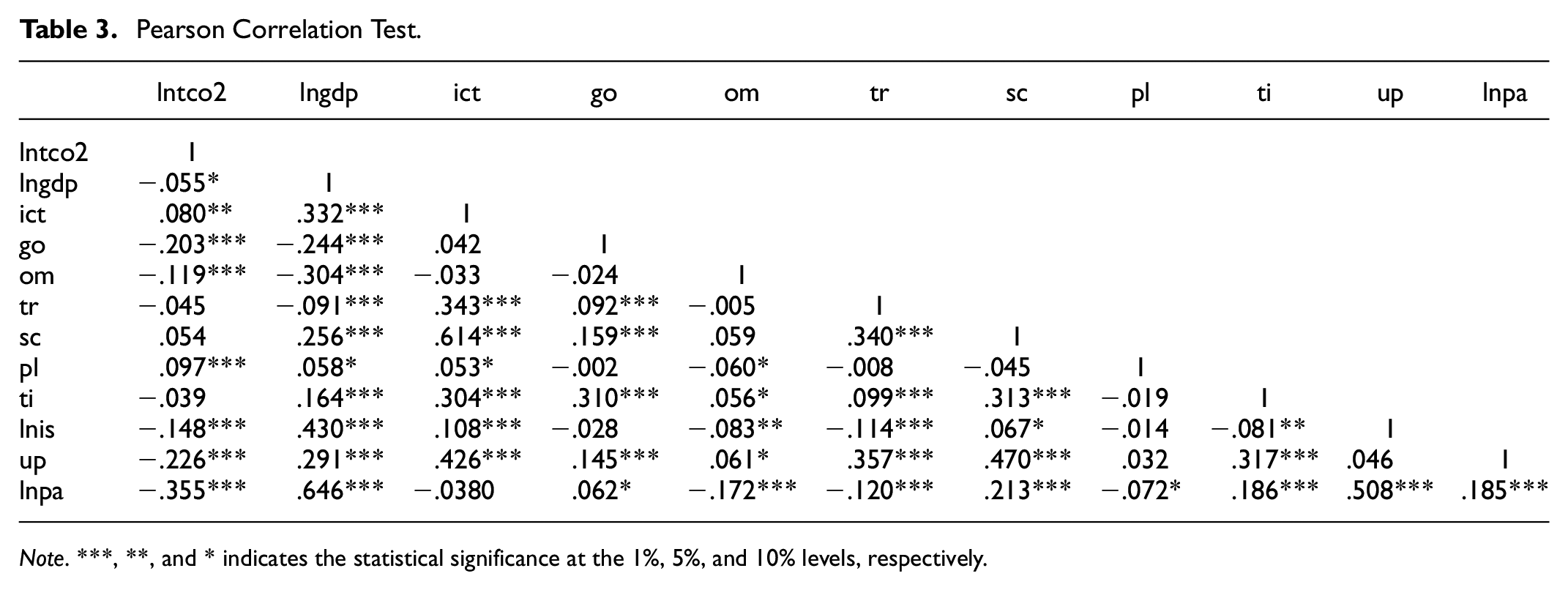
As demonstrated by Cohen et al. (2009), there is a severe linear correlation for variables with Pearson correlation coefficients between .8 and 1.0. However, as shown in Table 3, the absolute value of most of the correlation coefficients between the variables is less than 0.6, and very few of the variables’ coefficients are between .6 and .65. Therefore, there is no multicollinearity in the variables.
Pearson Correlation Test.
Note. ***, **, and * indicates the statistical significance at the 1%, 5%, and 10% levels, respectively.
Unit Root Test and Co-integration Test
The fixed-effects model assumes that the data is robust, but many economic variables are unstable and can easily lead to pseudo-regression (Caner & Hansen, 2001). Therefore, the data’s stationarity should be tested before regression analysis is conducted. This helps to verify the validity and accuracy of the estimation results and avoid pseudo-regression. The common methods used to examine the stationarity of data are visualization (Palachy, 2019) and unit root test (Caner & Hansen, 2001). Visualization, although very intuitive, is more applicable to time series data. Panel data are more likely to use the panel unit root test. If a unit root is present, the data is not stable. In our research, we used the homogeneous root LLC test and the heterogeneous root IPS test to examine whether the data were stationary. The results are shown in Table 4. The homoscedasticity LLC test for all variables rejected the null hypothesis at the level series, while the heteroscedasticity IPS test for the individual variables rejected the null hypothesis at the first level of difference, indicating that all the variables were first-order, single integers, and further cointegration tests could be performed.
Unit Root Test.

Note. ***, **, and * indicates the statistical significance at the 1%, 5%, and 10% levels, respectively.
A cointegration test is used to check whether the variables have long-term equilibrium with each other. The results for this study are shown in Table 5. All the variables were tested using both the homogeneous panel Kao test and the heterogeneous panel Pedroni test (Gutierrez, 2003; Pedroni, 1999). The results all rejected the null hypothesis. This indicated that there is a relationship of cointegration between all the variables, so a long-term regression model could be established.
Co-Integration Test.

Note. ***, **, and * indicates the statistical significance at the 1%, 5%, and 10% levels, respectively.
T-EKC Curve Regression Results
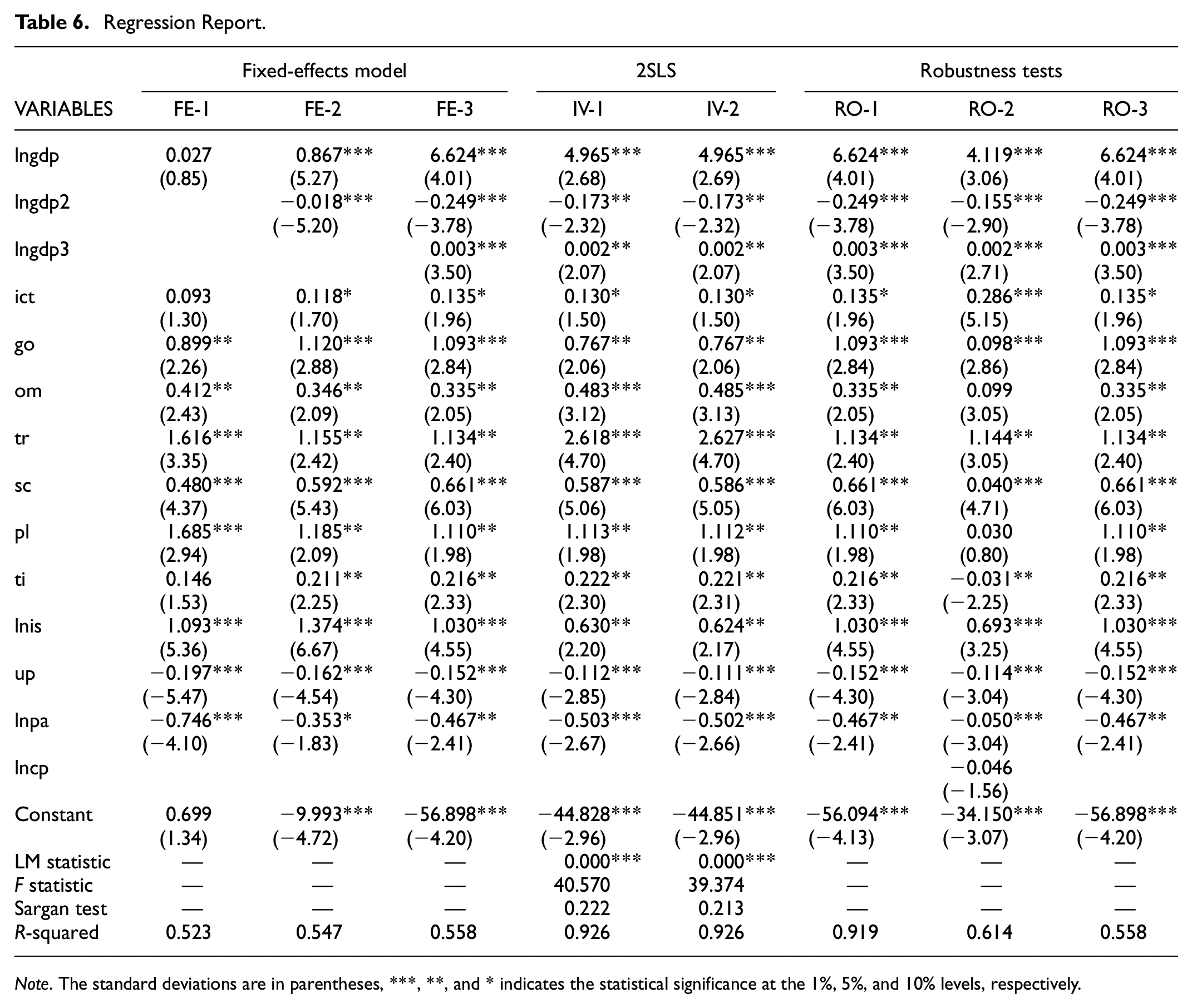
As shown in columns FE-1, FE-2, and FE-3 of Table 6, unlike the earlier empirical EKC studies, the relationship between carbon emissions from transportation and economic growth in the Belt and Road countries evolves from an inverted U-shape to an N-shape (Figure 2). This is shown by the fact that the third term coefficient is significantly larger than 0, the quadratic term’s coefficient is significantly smaller than 0, and the primary term’s coefficient is significantly larger than 0. The results show that the carbon emissions from transportation in the Belt and Road countries have experienced a wave-like evolution with economic growth. The early stage of economic development in the Belt and Road countries was too dependent on the development of a large-scale transportation industry. Transportation technology was developed without any awareness of environmental issues, resulting in higher levels of carbon emitted from transportation. When the economies of Belt and Road countries reach a certain level, people gradually realize that the environmental pollution from transportation is harmful to their living conditions and health. Through upgrades to the industrial structure of the transportation system, advances in transportation technology, and the establishment of environmental protection mechanisms, the Belt and Road countries have effectively limited the trend in the deterioration of the environment. After a certain turning point, carbon emissions from transportation start to decline with economic growth. However, it is not possible for the Belt and Road countries to attain zero growth in carbon emissions from transportation, and it is not possible for them to give up economic development in order to safeguard the environment. With the connection between the transportation infrastructures in the Belt and Road countries, new transportation and environmental problems arise and expand, and carbon emissions from transportation rise with economic growth, meaning that the T-EKC nexus changes into an N-shaped nexus.
Regression Report.
Note. The standard deviations are in parentheses, ***, **, and * indicates the statistical significance at the 1%, 5%, and 10% levels, respectively.

T-EKC nexus of the Belt and Road countries.
From the results of the control variables in Table 6, we find that the increase in urbanization levels (up) and innovation levels (lnpa) in the Belt and Road countries helps to decrease carbon emissions from transportation. However, the estimated coefficients of information and communication level (ict), general government expenditure (go), resource endowment (om), trade openness (tr), human capital (sc), capital stock (pl), transportation infrastructure (tpo), and industrialization level (lnis) are all significantly positive, contributing to the increase of transportation carbon emissions in the Belt and Road countries.
Endogenous Issues and Robustness Tests
Since the selection of the Belt and Road countries in this study was not random, the model may have endogenous problems such as association bias, omitted variable bias, and measurement bias, resulting in errors in the empirical results (Bound et al., 1995; Semadeni et al., 2014). The most common method used to determine whether there is an endogeneity problem as described above is the panel two-stage least squares (2SLS) method. Compared to other methods, the panel 2SLS method has no restrictions on the distribution of the variables. The method can be used regardless of whether the variables are normally distributed or not (James & Singh, 1978). Therefore, our research used the panel 2SLS method and combined the external instrumental variables and lagged period instrumental variables to effectively control and solve any problems with endogeneity.
According to the instrumental variables’ basic method, the instrumental variables should satisfy the correlation and the exogeneity (W. Jiang, 2017; Larcker & Rusticus, 2010). In other words, the instrumental variables should be correlated with the endogenous variables and uncorrelated with the random disturbance terms. The reason for choosing natural disasters as the exogenous instrumental variable was that severe natural disasters can harm national economic growth, which satisfies the correlation condition. On the other hand, there is no direct relationship between natural disasters and carbon emissions from transportation, and natural disasters can only impact carbon emissions from transportation through economic growth, which satisfies the exogeneity condition. Deaths and damage from natural disasters (calculated in US dollars) were selected as the proxy variables for natural disasters for enhancing the robustness. The data were gathered from the EM-DAT emergency disaster database. The lagged period instrumental variable was selected because the lagged period GDP has a strong correlation with the current period GDP. However, it only has an impact on carbon emissions from transportation through the current period GDP, whereas the lagged period GDP has no direct relationship with the current period carbon emissions from transportation. This satisfies the conditions of correlation and exogeneity.
The test results are shown in Table 6. Column IV-1 displays the results of deaths from natural disasters as the instrumental variable, and column IV-2 displays the results of damage from natural disasters as the instrumental variable. The regression results derived from the instrumental variables and the fixed effects model do not differ significantly. They differ only slightly in the magnitude of the coefficients of the variables, indicating that the original model did not suffer from serious problems of endogeneity. Moreover, the instrumental variables passed the under-identification test (Kleibergen-Paap LM), the weak instrumental variable test (Cragg-Donald Wald), and the over-identification test (Sargan). The LM test was significant with F-values considerably greater than 10, demonstrating that the lagged first-order instrumental variables for natural disasters and GDP satisfied the correlation condition, and there was no problem with weak instrumental variables. Also, the Sargan test accepting the null hypothesis shows that there was no over-identification in the instrumental variables, confirming that the instrumental variable selection was reasonable and valid.
To determine the reliability of our findings, we performed three robustness tests as follow. The results are reported in Table 6.
First, we replaced the regression model. From the results of the instrumental variables test, it was clear that the model did not have serious endogeneity problems and was consistent with the assumption of OLS regression unbiasedness. Therefore, we used OLS regression to replace fixed-effects regression for robustness testing. The results are shown in Table RO-1. Compared with the fixed-effects model regression results, there was only a difference in the magnitude of the coefficients, proving that the regression results for the original model were robust.
Second, corruption and procurement are major causes of pollution in many countries and may influence the shape of the T-EKC curve. For this reason, we have included corruption and procurement (lncp) as a new control variable in the model. The data was gathered from WDI database (WDI, 2020).As shown in column RO-2 of Table 6, the correlation signs between the transport carbon emission and GDP did not change significantly, verifying the results’ robustness.
Finally, we shortened the time dimension to 1990 to 2020. Outdated data may have statistical errors or serious gaps, so we shortened the sample period to 1990 to 2020 to prevent errors in the data from interfering with the empirical results. The results are shown in column RO-3 of Table 6. The coefficient magnitudes of the variables do not show serious deviations from the positive and negative signs, indicating the robustness of the results.
T-EKC Heterogeneity Analysis
Using a fixed effects model, we found that there was an N-shaped T-EKC relationship between carbon emissions from transportation and economic growth among the Belt and Road countries, but our conclusion was based on the assumption of homogeneity. Put differently, it assumed that all Belt and Road countries are influenced by economic growth and other control variables in similar ways, with no heteroskedasticity. However, according to previous relevant studies, the heterogeneity in Belt and Road countries mainly differ in terms of their economics (Tian & Li, 2019), transport infrastructure (You et al., 2020), resources (Yu et al., 2020), and industrialization (Opoku & Aluko, 2021). Therefore, based on the consensus of most scholars, we have investigated the T-EKC heterogeneity in the Belt and Road countries from the four aspects mentioned above. The national economic income classification was based on the WDI database (WDI, 2020), however, there were no unified grouping criteria for transportation infrastructure, resource endowment, or industrialization. Therefore, we relied on the studies and used threshold regression to calculate the threshold value for grouping.
The threshold regression model is an analytical method that addresses the problem of how to determine the critical value that arises in the empirical testing process. The basic threshold regression model is as follows:

Where
If the two thresholds

The threshold
Transportation, Resource, and Industrial Threshold Regression Grouping Results.

The regression results of heterogeneity analysis are as follows.
First, in view of the large differences between the economic scale and economic prosperity in the Belt and Road countries, we classified the Belt and Road countries into high-income and low-income groups according to the latest country classification in the WDI database (WDI, 2020). We then conducted fixed effects regression analysis in turn. As shown in Table 8, there is a monotonically increasing linear relationship between carbon emissions from transportation and economic growth in the low-income Belt and Road countries, whereas there is an N-shaped T-EKC relationship in the high-income countries, indicating that the high-income Belt and Road countries have started to experience the environmental rebound effect. In these countries, carbon emissions from transportation have crossed the second inflection point with economic growth and are now in the rising stage with economic growth. Low-income Belt and road countries, by contrast, have not yet reached the first turning point.
Regression Results for Economic Income Subgroups.
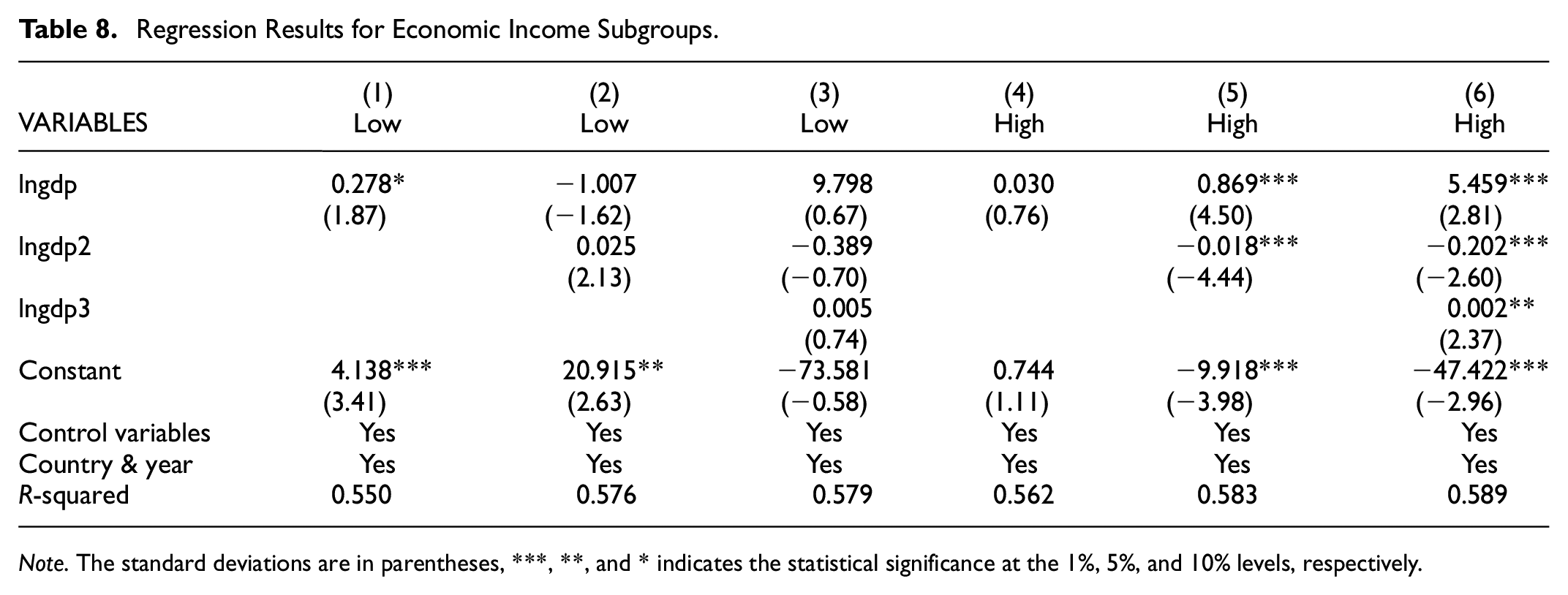
Note. The standard deviations are in parentheses, ***, **, and * indicates the statistical significance at the 1%, 5%, and 10% levels, respectively.
Second, most Belt and Road countries have relatively poor transportation infrastructure. There is still a large gap between them and developed countries. Therefore, promoting transportation infrastructure connectivity has become a key part of the development of Belt and Road countries. Based on the transport infrastructure threshold of 3.463 and 4.096, the Belt and Road countries can be divided into those with poor transport infrastructure (tpo ≤ 3.463), those with average transport infrastructure (3.463 < tpo ≤ 4.092), and those with good transport infrastructure (tpo > 4.092). The regression results are shown in Table 9. Only the good group shows an N-shaped T-EKC relationship, while the poor and average infrastructure groups only show monotonic and positive relationships, respectively. This indicates that the Belt and Road countries with perfect transportation infrastructure have begun to experience the environmental rebound effect, and carbon emissions from transportation are now increasing with economic growth. Meanwhile, the Belt and Road countries with medium and poor levels of transportation infrastructure are still far from the first turning point.
Regression Results of Transportation Infrastructure Grouping.

Note. The standard deviations are in parentheses, ***, **, and * indicates the statistical significance at the 1%, 5%, and 10% levels, respectively.
Third, the Belt and Road countries are rich in resources and have strong economic complementarities (Cui & Song, 2019; Zhang, 2019). They can attain rapid economic growth through large-scale exploitation of resources and trade, but the process of resource extraction is bound to cause environmental damage, and the extracted resources will ultimately increase carbon emissions from transportation. This will seriously impact sustainable development. Taking full advantage of resources while reducing carbon emissions from transportation and environmental pollution has become a dual challenge for the Belt and Road countries. According to the resource endowment thresholds of 1.259 and 8.834, the Belt and Road countries can be divided into groups with scarce resources (om ≤ 1.259), medium resources (1.259 < om ≤ 8.834), and rich resources (om > 8.834). As shown in Table 10, there is a monotonically increasing linear relationship between carbon emissions from transportation and economic growth in the group with scarce resources, and there is an N-shaped T-EKC relationship in the groups with medium and rich resources. This demonstrates that carbon emissions from transportation in the Belt and Road countries are affected by heterogeneity in their resource endowments. From this point of view, the countries with medium and rich resources have already experienced the effects of an environmental rebound, and their carbon emissions from transportation are increasing with economic growth. Meanwhile, countries with scarce resources are monotonically increasing carbon emissions from transportation with economic growth.
Regression Results of Resource Endowment Grouping.

Note. The standard deviations are in parentheses, ***, **, and * indicates the statistical significance at the 1%, 5%, and 10% levels, respectively.
Finally, based on the history of developed countries, industrialization is a necessary stage for the Belt and Road countries’ economic development. This is especially true for the less developed countries. Although the Belt and Road Initiative has made great progress in the industrialization of many developing Belt and Road countries, the majority of those countries are still in the early or middle stages of industrialization with labor-intensive and capital-intensive industries. There is a big gap between them and the industrialized countries. Based on the industrialization threshold of 22.209, the Belt and Road countries can be divided into a low industrialization group (lnis ≤ 22.209) and a high industrialization group (lnis > 22.209). The regression results are shown in Table 11. They show that there is a monotonic and positive relationship between carbon emissions from transportation and economic growth in the low-industrialization group, whereas there is an N-shaped T-EKC relationship in the high-industrialization group. With the development of the industrial structure, the environmental rebound effect has already appeared in highly industrialized countries, whereas the less industrialized countries have not yet reached the first turning point.
Regression Results of Industrialization Degree Grouping.

Note. The standard deviations are in parentheses, ***, **, and *indicates the statistical significance at the 1%, 5%, and 10% levels, respectively.
Discussion
Explanation of the “Climbing” Phenomenon
The Belt and Road countries with low economic incomes, poor transport infrastructure, low levels of industrialization, and scarce resources are still in the “climbing” stage. This is when carbon emissions from transportation increase with economic growth and are unable to cross the first inflection point of the T-EKC nexus (Figure 2). The possible reasons are as follows.
First of all, “no road, no economy.” As the transportation infrastructure is steadily improving, the aforementioned countries are gradually expanding. However, the demand for transportation resources and carbon emissions from transportation is also increasing, making it difficult to balance the relationship between reducing transportation carbon emissions and sustaining economic growth (Hu et al., 2020). Moreover, the aforementioned countries have not yet escaped from the “poverty trap” or the “middle-income trap” (Alves, 2021). To narrow the economic gap with developed countries as soon as possible, they have to take over the energy-intensive and highly polluted industries from some developed countries, sometimes becoming a “pollution paradise” (Mahadevan & Sun, 2020). Finally, countries with scarce resources along the Belt and Road are significantly affected by the Belt and Road Initiative. Although cooperation regarding large-scale transportation infrastructure and energy resources will, to a certain extent, stimulate economic growth in the host countries, it will also increase the burden on the environment. Therefore, the aforementioned countries should pay more attention to green development, usher in the first inflection point with a lower peak as soon as possible, and avoid turning back on the old road of “abatement after pollution.”
Explanation of the Environmental Rebound Effect
The Belt and Road countries with high economic incomes, advanced transportation infrastructures, high levels of industrialization, and abundant resources have already crossed the second turning point of the T-EKC relationship, showing a significant environmental rebound effect with carbon emissions from transportation rising again (Figure 2). The possible reasons are as follows.
First, the aforementioned countries have successfully passed the initial stage of rapid economic growth, and crude economic development has gradually been replaced by green, sustainable development. However, the existing green technologies are not sufficient to support a complete transition to green forms of transportation. With the influx of investment and the expanding demand for further improvements in the transportation infrastructure, the rapid expansion and agglomeration in the transportation sector stimulate a higher amount of carbon emissions from transportation production, resulting in a significant environmental rebound effect and an abrupt change in the T-EKC nexus.
Besides, it is worth noting that, unlike the “steady decline” phase of the developed countries, the aforementioned Belt and Road countries have just crossed the first turning point and are still at relatively low levels of income. Thus, the transient balance between economic growth and carbon emissions from transportation is fragile. At the same time, the re-industrialization strategies for economic development initiated by some developed countries dovetail closely with the Belt and Road Initiative, attracting direct investment from other countries, such as China, while inexorably hurting the environment and increasing carbon emissions from transportation. This will eventually lead to an environmental rebound effect and a new “climbing” phase. Therefore, the aforementioned countries need to learn from the successful experiences of developed countries when it comes to green transformation. They must pay more attention to actively improving the environmental rebound effect.
Finally, though some Belt and Road countries have unique resource advantages and strong economic complementarities, most of the cooperation regarding resource management and trade has promoted economic growth at the expense of increases in transport carbon emissions. This is the reason why most resource-rich Belt and Road countries are experiencing the “resource curse” (Z. Sun & Cai, 2020). For example, due to the “oil curse,” Russia has been trapped in an economic development dilemma for decades (J. Yang et al., 2021). Therefore, the questions of how to enhance the efficiency of the use of resources and how to transform the “resource curse” into a “resource blessing” are vital for resource-rich countries. They will help them avoid environmental rebound effects and harmonize the relationship between the reduction of transport carbon emissions and economic growth.
Conclusions and Policy Recommendations
Summary
Based on the above discussion, there are three main conclusions that we can draw from this research.
First, unlike the traditional EKC hypothesis, we confirm that the relationship between carbon emissions from transportation and economic growth in the Belt and Road countries is an N-shaped T-EKC. This enriches our knowledge about the EKC and fills the research gap on carbon emissions from transportation.
Second, through the results of the T-EKC regression and heterogeneity analysis, we find that the environmental rebound effect in some Belt and Road countries is solidified in various ways when it comes to the economy, transportation, resource management, and industrialization, showing a diamond-shaped locking effect.
Third, the Belt and Road countries with low levels of economic income, poor transportation infrastructure, scarce resources, and low levels of industrialization are still in the “climbing” stage and have not yet crossed the first inflection point.
Policy Implications
The Belt and Road countries that are stagnating in the T-EKC “climbing stage” face the dilemma that they cannot follow the developed countries’ old path of “abatement after pollution,” but they must still prioritize economic growth. However, the difficulty of achieving a “positive balance” is too great to be taken lightly. Reducing carbon emissions from transportation not only requires countries to have higher level of economic development but also depends on other factors such as a reasonable industrial structure, advanced technology, strict environmental regulations, and awareness of green, low carbon transportation(Dong et al., 2020). These factors define the feasible interval for policy regulation. In other words, they compensate for the lack of input in the economic system. To this end, countries in the “climbing” stage should learn from the successful experience of emerging countries such as China. They should implement effective policies to shorten the time of carbon peaking, enter the “rebalancing zone” as soon as possible, and escape from the trap of the environmental Kuznets curve.
According to the T-EKC nexus, an important sign that carbon emissions from transportation have crossed the peak is when reductions in carbon emissions from transportation and economic growth begin to develop in tandem. But this “equilibrium” may be short and fragile. Therefore, for those Belt and Road countries that are close to crossing the T-EKC turning point, the key is to stand firmly at the T-EKC nexus’ top and avoid falling back to the left side of T-EKC. This is not easy to do so. On the one hand, the carbon emissions from transportation at this stage are prone to increase significantly. On the other hand, the economy must be completely transformed and upgraded from the resource-driven and factor-driven development path to the technology and innovation-driven development path in the long term (C. Wang, Wood, Geng, et al., 2020).
For those Belt and Road countries or regions that have completely crossed the first T-EKC apex and escaped the environmental Kuznets trap, three points are crucial. First, during the fundamental improvement in the relationship between the transportation environment and economic growth, more attention should be paid to technological innovation and green economic growth. This will enhance countries’ ability to resist various uncertainties including climate risks and major global public health emergencies (Lin et al., 2019). It will also help them to improve their economic growth. Also, the baseline and boundary of ecological security must be stick, and more focus should be given to the harmonious coexistence of humans and nature. These thoughts should be further internalized into the development of various socio-economic fields. They should become the “genes” and “blood” that penetrate socio-economic development. Moreover, economic growth should be decoupled from transport carbon emissions as much as possible. A harmonious linkage with green, low carbon transport should be established, leading to complete freedom from the environmental Kuznets trap (Joshua, 2019).
Based on the previous discussion, the T-EKC rebound effects show the economic complexity and the difficulty of transferring to green forms of transportation. When they reach a higher economic level, some Belt and Road countries loosen their environmental regulations. When they fall back into the environmental Kuznets trap, Belt and Road countries have to deal with environmental problems such as transport carbon emissions. Therefore, those Belt and Road countries that are experiencing transportation carbon emission rebound effects should pay more attention to the potential damages of some “poisonous technologies.” For example, the question of whether vehicles driven by new kinds of new energy are cleaner and more sustainable has always been controversial (L. Jiang, 2020). There is also an urgent need to strengthen environmental standards and regulations to prevent countries from becoming “pollution paradises.” For countries with large areas, dense populations, and uneven economic development, attention should also be paid to the promotion of green economic recovery and the avoidance of excessive domestic transfers of transport carbon emissions.
Limitations and Future Research Directions
There are still some limitations in this paper. First, although we found as many control variables as possible through lasso regression to weaken the interference of the random error term, it was still not achieved that the random error term was same for all countries. Spatial linkages and geographical distances between different countries should be included in the analytical framework in future studies. Second, the influencing factors and mechanisms between transport carbon emissions and GDP can be very complex. For example, there may be multiple mediating or moderating effects. Traditional regression analysis is difficult to reveal such relationships comprehensively, but machine learning method could be tried in the future because this method is not only applicable to high-dimensional data, but also can avoid over-fitting through regularization.
Footnotes
Author Contributions
Liguo Zhang: Conceptualization, Visualization, Writing - review & editing. Xiang Cai: Visualization, Supervision, Validation, Writing -review & editing. Cuiting Jiang: Methodology, Data curation, Software, Writing - original draft, Writing - review & editing. Xin Huang: Methodology, Data curation. Jun Wu: Formal analysis, Data curation. Ping Chen: Methodology, Visualization.
Declaration of Conflicting Interests
The author(s) declared no potential conflicts of interest with respect to the research, authorship, and/or publication of this article.
Funding
The author(s) disclosed receipt of the following financial support for the research, authorship, and/or publication of this article: We are grateful for the financial support provided by the National Natural Science Foundation of China (No.71463010, No.72164007, and No.72064005), the Natural Science Foundation of Guangxi Province (No.2020GXNSFAA159041), the Philosophy and Social Science Planning Research Project of Guangxi Province (No.21FYJ053, No.22FJL011), Natural Science Foundation of Jiangsu Province, China (BK202220462) and research participants for their suggestions for the design of this study. We also appreciate the data provided by The World Development Indicators (WDI) and Penn World Table version (PWT) 10.0.
