




Abstract
The fitness industry has been the subject of numerous studies aimed at analyzing the perceived quality within management systems and strategies as a formula to survive the competition. This study analyzes the loyalty chain through the service convenience and its influence on different dimensions of perceived value, and their effect on customer satisfaction as a way to achieve the behavior intention, and with it, increase the competitive capacity, management efficiency and economic growth of sports services within the fitness industry. Data from 326 participants were collected using a convenience sampling technique. The data was analyzed using confirmatory factor analysis and covariance-based structural equation modeling (CB-SEM) in Amos (v.22). The results showed that the service convenience has a positive influence on the four dimensions of the perceived value (social value, functional value, emotional value, and economic value). However, only two of these dimensions offered a significant influence on customer satisfaction, with the economic value dimension showing the highest predictive value. Finally, a direct positive effect was found between customer satisfaction and behavioral intention. Therefore, the current study provides a significant sequential pathway between service convenience, economic value, customer satisfaction, and behavioral intention, allowing to improve the understanding of the multidimensionality of the perceived value construct and representing an important contribution to the literature on the fitness industry and to improve the competitiveness of organizations.
Plain language summary
This study analyzes the loyalty chain through the service convenience and its influence on different dimensions of perceived value, and its effect on customer satisfaction as a way to achieve behavioral intention. Data from 326 participants were collected using a convenience sampling technique, analyzed by confirmatory factor analysis and covariance-based structural equation modeling (CB-SEM) in Amos (v.22). The present study provides a significant sequential pathway between service desirability, economic value, customer satisfaction, and behavioral intention, which allows for better understanding of the multidimensionality of the perceived value construct and represents an important contribution to the literature on the fitness industry and improve the competitiveness of organizations. The results offer managers of fitness centers new opportunities to positively influence the perceived value, and create facilities where they can manage their transactions, taking into account that each fitness member attaches importance to different elements of value. Consequently, the more fitness center managers can increase functional value elements, the more members can increase their service convenience. Regarding limitations, the perceptions of value perceived by the client can change over time in different individuals and samples, and can cause different relationships between the variables. Furthermore, the inclusion of personal variables (such as length of membership) in this established model will allow for a better understanding of member perceptions of ease of service, multidimensional perceived value, service convenience, and behavioral intention.
Keywords
Introduction
The European Health and Fitness sector serves over 56.3 (+2.0%) million consumers, has a revenue of over 17.1 billion Euros and consists of 63,173 (+0.2%) fitness facilities (Europe Active, 2022). Apart from the pandemic period, the European Health and Fitness sector continues to be a constantly growing sector. Each country grew its average health and fitness market by 4.6%. More than 201,000 fitness centers around the world have more than 184 million members (International Health, Racquet and Sportsclub Association, 2020). In Turkey, the growth in the fitness industry with each passing year (1,830,000 in 2017; 1,950,000 in 2018; 2,100,000 in 2019) continues in a stable fashion. Turkey is one of the countries with the highest growth potential (Deloitte, 2022). Although Turkey ranks ninth in the fitness industry, it is one of the two countries with the highest membership growth along with Russia. It is also estimated that the fitness sector within the country will grow more in the medium and long term (Şirin et al., 2023).
In spite of the stable growth in the fitness industry and generally increasing fitness clubs and members in Turkey, unique in Europe in general, memberships appears to be easily ended in the sector (Jeon et al., 2021). Additionally, due to the online education possibilities in the fitness industry and the increase in the use of fitness technology on a global scale (Moustakas et al., 2020), some individuals may meet their physical activity requirements by using fitness technology without being members of fitness centers (Sevilmiş & Şirin, 2022). Free access to fitness content and applications, increased competition and the proliferation of alternative fitness businesses has left fitness centers in a difficult situation. Fitness centers may extract themselves from this difficult situation by improving perceptions of consumers related to time and effort. Fitness center members attach value to centers they think will involve less time and effort. This situation affects the behavioral loyalty perceptions of consumers. In conclusion, fitness centers may compete with the value they obtain in this context (García-Fernández, Gálvez-Ruiz, Fernández-Gavira, et al., 2018). Stated differently, offering products that reduce the perception of time and effort related to purchase or use of a service by consumers may improve the value and customer satisfaction perceptions, which are true drivers of business (Jiang et al., 2023; Zeqiri et al., 2022).
Generally, perceived value is widely used in the fitness literature specific to service to conceptualize assessments of functional, social, economic and emotional factors (Carvache-Franco et al., 2022). Additionally, the multidimensional construct is accepted as affecting customer satisfaction and behavioral intention variables (El-Adly, 2019; Sevilmiş et al., 2022). Though perceived value was determined to be an important factor in the decisions of fitness center members, it can be said there are limited studies about understanding the effects of service convenience on multidimensional perceived value, loyalty and behavioral intention in the fitness literature.
Research by Jebarajakirthy and Shankar (2021) identified positive significant effects between access, evaluation, transaction, benefit and post-benefit convenience with perceived utilitarian values. In spite of this, a positive significant effect could not be identified between search convenience and perceived utilitarian values. At the same time, while significant effects were identified between access, evaluation, benefit and post-benefit convenience with perceived hedonic value, no significant effects could be identified between search convenience and transaction convenience with perceived hedonic value. When this research is assessed in a general sense, service convenience perceptions may be said to affect or not affect each dimension of value at different levels. For this reason, it is considered that a multidimensional assessment will be beneficial to better understand the role and structure of value in the relationship between service convenience and values.
Additionally, studies in the field of fitness determined the effect of service convenience on value (García-Fernández, Gálvez-Ruiz, Fernández-Gavira, et al., 2018), the results of multidimensional perceived value on customer satisfaction (Sevilmiş et al., 2022), and the effect of satisfaction on behavioral intention (Baena-Arroyo et al., 2020; Eskiler & Altunişik, 2021).
As a result, this study contributes to a conceptual model showing the effect of service convenience (SC) on functional, emotional, social and economic value, and effects of functional, emotional, social and economic value perceptions on customer satisfaction (CS) and behavioral intention (BI). This study is thought to provide the opportunity to determine which service convenience, and then which dimensions of value more strongly affect CS to strengthen BI of fitness center members.
Theoretical Framework and Hypotheses Development
The Introduction of the Service Convenience in the Fitness Industry
Berry et al. (2002, p. 4) defined SC as “the perceived time and effort related to buying or using a service by a consumer”. Consumers expend time and effort to search for product information, choose a seller, access a store or complete a purchase. Consumers chose businesses they think will reduce this time and effort (Eryiğit & Fan, 2021; Jiang et al., 2023; Kumar et al., 2020). SC plays an important role in understanding the perceptions, attitudes and behavior of consumers (Jebarajakirthy & Shankar, 2021).
Different scales are used in the literature with the aim of assessing SC perceptions. For example, some researchers assessed SC by expanding it into five dimensions of decision, access, process, benefit and post-benefit convenience (Colwell et al., 2008; Eryiğit and Fan, 2021; Kumar et al., 2020). If differentiation is to be made between SC scales and models created in this framework, it was proposed that SC may be measured with a range of elements in a unidimensional approach (Jiang et al., 2023). Researchers defending this idea measured SC in a single dimension focusing on the primary determinants of perceived SC related to the non-monetary expenditures of time and effort (Jiang et al., 2023; Zeqiri et al., 2022).
In this way, SC aims to minimize the sacrifice or psychological stress associated with purchasing or using a service, which can be of different types. In fitness services, it is considered as the elements that reduce the time and effort spent by the member while using the fitness service (García-Fernández, Gálvez-Ruiz, Fernández-Gavira, et al., 2018). Time and effort are non-monetary costs that consumers have to incur in order to obtain the service. In general, the greater the time costs associated with the service, the lower consumers’ perceptions of SC (Berry et al., 2002). Considering that customer comfort is an important factor in fitness businesses, serviceability is a key factor for the fitness industry. Although the service is provided face-to-face, members who consume fitness services face many difficulties in terms of time and energy expenditure. This reveals the importance of investigating the SC in fitness centers. For example in this industry, non-monetary sacrifices such as the time it takes to go to the facility from the fitness member’s workplace or home, the accessibility of the fitness room, public transportation services, access to private parking, importance or need can be counted as SC (García-Fernández, Gálvez-Ruiz, Fernández-Gavira, et al., 2018).
The Proposal Model Between Service Convenience, Multidimensional Perceived Value, Customer Satisfaction, and Future Intentions in the Fitness Industry
Perceived value is “the customer’s overall assessment of the benefits of a product based on their perception of what is given and received in return” (Zeithaml, 1988, p.14). Value includes many benefits and sacrifices (Patterson & Spreng, 1997). In the literature, the effect of SC on perceived value was proven, with both SC and perceived value considered unidimensional constructs (Chang et al., 2010). Zeqiri et al. (2022) identified a positive effect of SC on perceived value in research completed about people shopping online. In research completed with smart cabinet customers, Yuen et al. (2019) stated SC had a positive impact on perceived value. In the fitness literature, García-Fernández, Gálvez-Ruiz, Fernández-Gavira, et al. (2018) identified that SC perceptions of fitness center members affected unidimensional perceived value.
However, perceived value is a multidimensional construct derived from price, quality, quantity, benefit and sacrifice (Sánchez-Fernández & Iniesta-Bonillo, 2007; Sevilmiş & Çevik, 2021). Some researchers consider the multidimensional construct of perceived value (functional-price/value for money and performance/quality, emotional and social dimensions of value) to be valid and reliable (El-Adly, 2019; Jebarajakirthy & Shankar, 2021; Sevilmiş et al., 2022). As a result, perceived value is proposed to be based on a multidimensional construct encompassing emotional, functional, social and economic dimensions that critically create positive emotions and CS (Carvache-Franco et al., 2022). For this reason, in this research, it is considered that the benefits obtained from the fitness value are a concept that includes emotional, functional, social and economic dimensions as well as individual assessment as opposed to the sacrifice required. As described above, we propose the following hypotheses between SC and perceived value dimensions:
H1: SC positively affects social value (SV) in fitness center members.
H2: SC positively affects functional value (FV) in fitness center members.
H3: SC positively affects emotional value (EMV) in fitness center members.
H4: SC positively affects economic value (ECV) in fitness center members.
In relation to the CS concept, Hallowell (1996, p. 29) defined CS as the “result of a customer’s perception of the value received”. When the relevant literature is examined, research related to perceived value and CS focuses on the fact that perceived value has a one-dimensional structure and emphasizes that this perceived value can be measured with a single general expression (Chiu et al., 2017; García-Fernández, Gálvez-Ruiz, Fernández-Gavira, et al., 2018; García-Fernández, Gálvez-Ruiz, Vélez-Colon, et al., 2018; Yu et al., 2014). However, sports researchers stress that perceived value is a multidimensional structure consisting of interrelated qualities (Kunkel et al., 2017). The benefits that fitness members receive from fitness centers have a multidimensional feature (Sevilmiş and Çevik, 2021). For example, Sevilmiş et al. (2022) report that fitness members highly regard SV, FV, ECV, and EMV benefits. In fact, they value product attributes (physical attributes) that provide functional benefit to consumers, as well as its acceptance by other members of society and/or the product or service meeting the desired value, providing innovation, satisfying knowledge and desire (epistemic value). Therefore, in this study, the relationship between perceived value multidimensionality (SC, FV, ECV, and EMV) and CS is discussed. All this leads us to propose the following hypotheses:
H5: SV positively affects CS in fitness members.
H6: FV positively affects CS in fitness members.
H7: EMV positively affects CS in fitness members.
H8: ECV positively affects CS in fitness members.
On the other hand, behavioral intentions are defined as “the behavioral tendency of the consumer that emerges based on the perceived feeling, experience and cognitive evaluation of consumption” (Spears and Singh, 2004, p. 55). Behavioral intentions have often been investigated in the fitness sector literature (Çevik and Sevilmiş, 2022). Some studies have seen CS as the antecedent variable affecting BI, and positive CS experience can affect fitness members’ decisions, such as repurchase and recommending to others (Baena-Arroyo et al., 2020; Eskiler & Altunişik, 2021). It has been revealed that if the member is not satisfied with the fitness center, they develop counter-intentions such as leaving the center (Yu et al., 2014). As a result, it can be said that the most important variable that reveals this is CS, while behavioral intentions provide a clue about whether fitness members will repurchase the fitness service. Based on this entire theoretical conceptual framework, the following hypotheses have been proposed:
H9: CS positively affects BI in fitness members.
Methodology
Research Design
This study used CB-SEM, a more demanding method with data and especially indicated when the objective of the investigation is the verification and confirmation of the theory (Dash & Paul, 2021), in this case considering the theory and previous investigations as a starting point.
Sample and Study Context
A total of 326 participants (180% or 55.2% men, and females were 146 or 44.8%) enrolled in the study, which used intentional non-probability sampling, a method according Tongco (2007) that is more effective when one needs to study a certain cultural domain. The average age of the fitness members participating in the study was 27.65 (±9.34) years. It was determined that 38% of the participants were high school graduates and 61% were single. In addition, 54.6% of the participants are members of the fitness center for up to 6 years.
Measures
The measurement tool was created by making use of previous research. The questionnaire was extensively reviewed, modified and approved by a group of four (two academics and two linguists) experts in the research methods, consumer behavior and fields. The content validity was determined in order to provide evidence of the suitability of the instrument in the content area that is to be measured (Muijs, 2011). To do so, the questionnaire items were distributed to 12 fitness members. At this stage, fitness members were asked to report general comments on the questionnaire items (such as their comprehensibility). The opinions of fitness members were taken into account and small subsequent changes were made to the survey. The measurement items were adapted for SC types from García-Fernández, Gálvez-Ruiz, Fernández-Gavira, et al. (2018) and Baena-Arroyo et al. (2020), for the perceived value dimensions from Kim et al. (2020) and Sweeney and Soutar (2001), for CS from Chiu et al. (2019), Glaveli et al. (2021), Fernández-Martínez et al. (2020) and Foroughi et al. (2019), and for BI from García-Fernández, Gálvez-Ruiz, Fernández-Gavira, et al. (2018), García-Fernández et al. (2020), and García-Pascual et al. (2020). SC was measured with five items, the perceived value dimensions with 22 items (eight items to SV, five items to FV, five items to EMV, four items to ECV), CS with four items, and BI with four items. All research items was used a 5-point Likert scale ranging from strongly disagree (1) to “strongly agree” (5).
Procedure
The data was collected in Hatay, one of the metropolitan cities of Turkey, considering suitable those fitness centers that met a series of characteristics: at least two thousand members, offering cardiovascular, strength and group training. To carry out the investigation, the different fitness centers was first contacted, and necessary permission was obtained for the collection of information. The data were collected before and/or after the training so that fitness center members could correctly answer the scales used in the research context. Before starting, the participants had information about the objectives of the study, voluntary and anonymous participation, as well as written informed consent that they were required to accept in order to begin answering the questionnaire, whose approximate completion time was 10 to 15 min.
Data Analyses
The hypotheses created depending on the theoretical and conceptual framework were tested through structural equation modeling (SEM) using Amos 22.0 software. Confirmatory factor analysis (CFA) of the measurement model was carried out using maximum likelihood estimation. For both CFA and SEM analysis, goodness-of-fit was assessed using different indices: χ2/df, CFI, IFI, TLI, PCFI, RMSEA. Additionally, internal consistency criteria were provided with Cronbach’s alpha (α) and composite reliability (CR), the average variance extracted (AVE) was estimated to evaluate the convergent validity, and lastly, the discriminant validity were also evaluated.
Results and Discussion
The results of the CFA showed that what was hypothesized, which includes service convenience, the customer value dimension (composed of the SV, FV, EMV, and ECV) CS, and BI, provided an acceptable fit to the data (Kline, 2011): χ2 (539) = 1546.69; χ2/df = 2.87; CFI = 0.938; IFI = 0.938; TLI = 0.931; PCFI = 0.850; RMSEA = 0.076 [CI = 0.071, 0.080].
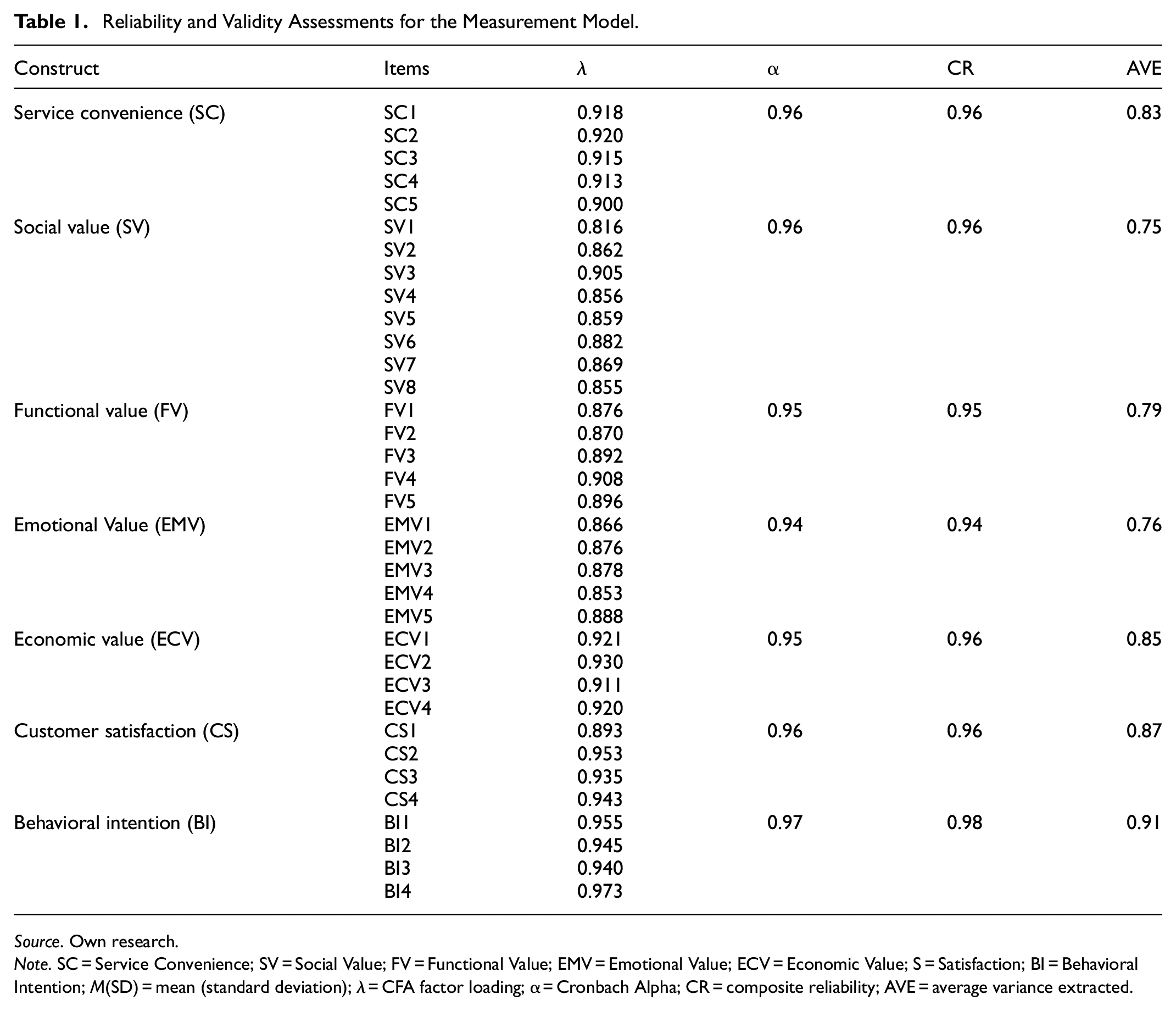
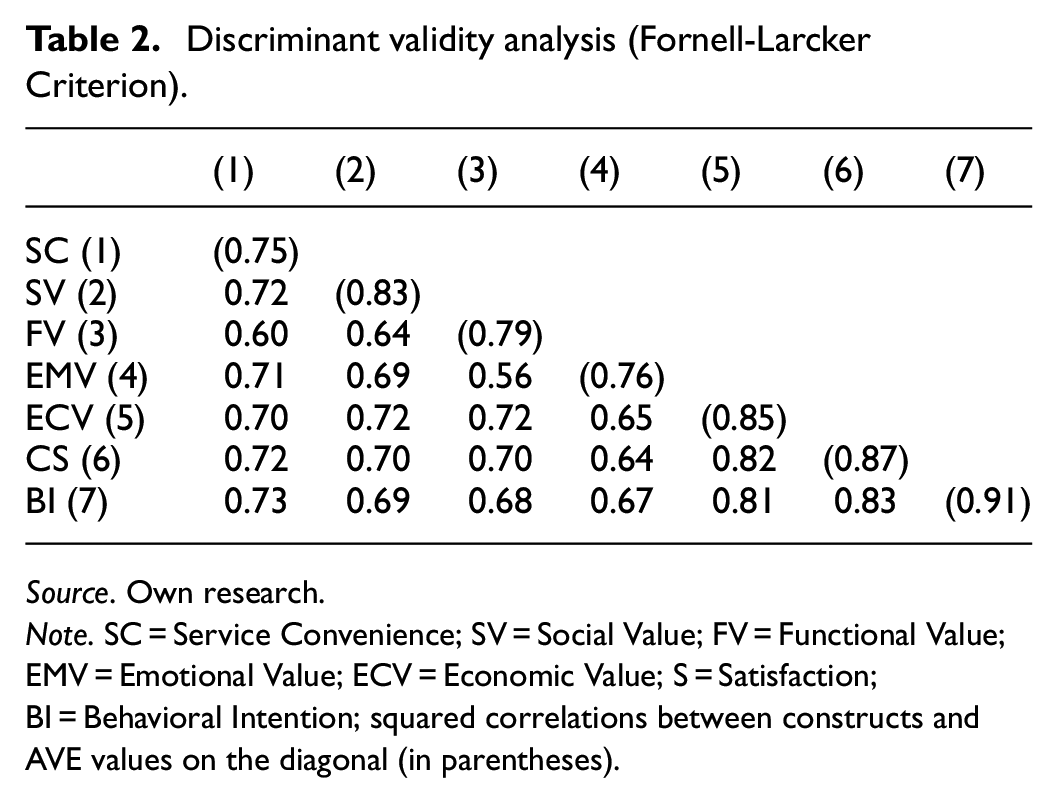
The factor loadings (λ) obtained in the CFA were verified, obtaining in all cases values greater than 0.50 (Kerlinger & Lee, 2002), sufficient saturation to consider that the items are indicators of their respective factor. The second test was the Cronbach’s alpha value of the dimensions (α), with results greater than the recommended 0.70 (Tay and Jebb, 2017). The last test was to check the CR and AVE. In the first case, the values obtained exceeded the threshold of 0.80 recommended by Hair et al. (2010) (Table 1); in the second case, all values were greater than 0.50, specifically between 0.75 and 0.91, indicators of adequate convergent validity. In addition, to check the discriminant validity (Table 2), the analysis of the square root of the AVE of each construct was greater than the correlation of the other constructs (Fornell and Larcker, 1981).
Reliability and Validity Assessments for the Measurement Model.
Source. Own research.
Note. SC = Service Convenience; SV = Social Value; FV = Functional Value; EMV = Emotional Value; ECV = Economic Value; S = Satisfaction; BI = Behavioral Intention; M(SD) = mean (standard deviation); λ = CFA factor loading; α = Cronbach Alpha; CR = composite reliability; AVE = average variance extracted.
Discriminant validity analysis (Fornell-Larcker Criterion).
Source. Own research.
Note. SC = Service Convenience; SV = Social Value; FV = Functional Value; EMV = Emotional Value; ECV = Economic Value; S = Satisfaction; BI = Behavioral Intention; squared correlations between constructs and AVE values on the diagonal (in parentheses).
The structural model was evaluated using seven factors and nine relationships which, between them, correspond to the established hypotheses. The structural coefficients presented in Figure 1 indicated that the SC was directly and positively related to all the customer value dimensions, confirming hypotheses H1 to H4: SV (β = .92, p < .001), FV (β = .83, p < .001), EMV (β = .87, p < .001), and ECV (β = .89, p < .001). However, not all the customer value dimension revealed a significant interaction toward customer satisfaction, hypotheses H5 (SV: β = .14, p < .017) and H7 (EMV: β = .06, p < .261) not being supported. Finally, we confirm the significant relationship between CS and BI (β = .94, p < .001). The results revealed an acceptable fit for this model, supporting the originally proposed model: χ2 (551) = 1789.36; χ2/df = 3.24; CFI = 0.924; IFI = 0.927; TLI = 0.917; PCFI = 0.855; RMSEA = 0.083 [CI = 0.079, 0.087].
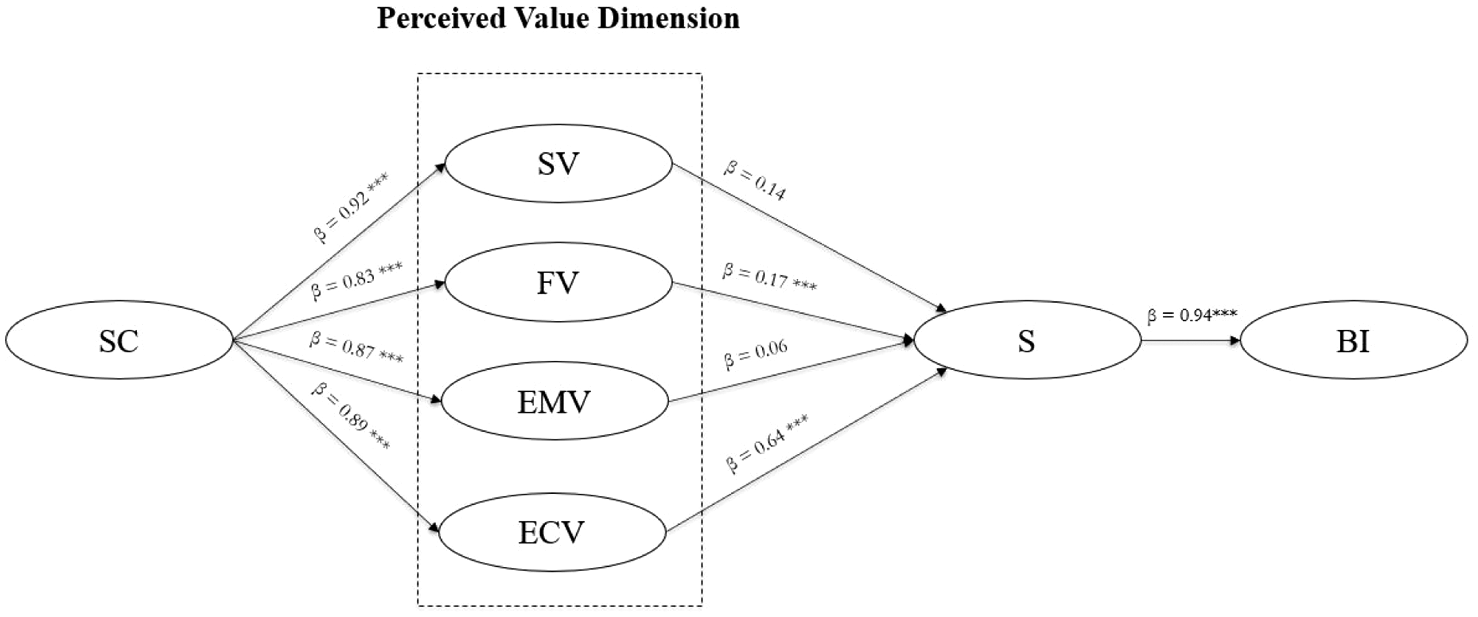
Causal relationships model results.
The results of this study expand our understanding of the relationship between SC, the customer value dimension, CS and behavioral intention in fitness centers. We observed a direct and positive relationship between SC and SV, FV, EMV and ECV. SC is considered an important part of the non-monetary value of a consumer service delivery (Berry et al., 2002). Therefore, it can be said that the convenience of non-monetary service in fitness centers is related to getting to the facility, effort, waiting time, and the orientation of the product to the market. One may also say that the improvement of these elements will positively affect the value perceptions of the members. Hsu et al. (2010) argued that when customers comfortably and easily experience the benefits of services, they are more likely to value them, be satisfied, and use them again. Members use their own resources to take advantage of the fitness service. The less resources they spend (i.e., the more convenience), the higher their perceived value (i.e., the more CS) (Thuy, 2011).
Related to our findings, a service provider hoping to improve the level of value perceived by the customer should provide SC to its customers (Liang and Wang, 2006). When the alternative service literature studies were examined, a positive effect was found between SC and perceived value (Chang et al., 2010). The fitness literature also leads us to similar conclusions. When the previous fitness literature was examined, the relationship between SC and the customer value dimension was not discussed at all, but a positive significant effect was found between SC and perceived value (García-Fernández et al., 2016; García-Fernández, Gálvez-Ruiz, Fernández-Gavira, et al., 2018). However, the sport management literature in general and the fitness literature in particular focus on SC and a one-dimensional perceived value relationship. The contribution of this research to the literature is that it examines the relationship between SC and each dimension of perceived value.
It is possible to make the following inferences from the relationship between SC and the SV, FV, EMV, and ECV. In a service environment, the service friendliness perceptions of members may have affected the SV, FV, EMV, and ECV, since serviceability facilitates the service process and causes customers to benefit from the expected benefits. Alternative service quality studies show a parallelism with our research. Chiang (2018) found an effect between SC and FV in hotels in his research. For example, when we consider the FV as an element related to the quality of the product, there are studies that show a parallelism with our research (Nguyen et al., 2012). Lloyd et al. (2014) found an effect between SC and utilitarian value. All these results show that the value given to time causes effects on SC, the SV, FV, EMV, and ECV. As a result, time savers are a scarce resource for fitness members, and it has been found to be an important tool for them to value fitness centers that use this scarce resource to their advantage. Other results obtained were the relationship of each value sub-dimensions with CS, findings an effect between the FV and ECV and CS, but not between the SV and EMV and CS.
Considering the studies that measure value unidimensionally, a positive effect was found between value and CS (García-Fernández et al., 2020; Sirin et al., 2023). However, studies measuring value multidimensionally have obtained different findings between value and CS (El-Adly, 2019; Gallarza et al., 2016; Sevilmiş et al., 2022; Slack et al., 2020). All these results point to the necessity of measuring perceived value in a multidimensional way in order to fully explain the value that fitness consumers will obtain from fitness services (Chang et al., 2018; El-Adly, 2019; Sevilmiş et al., 2022). When alternative service studies are evaluated (tourism), the results of the relationship between the multidimensional structure of perceived value and CS differ from each other. For example, Williams and Soutar (2009) found an effect between the FV, ECV, EMV and CS in their study, but could not detect an effect between the SV and CS. At the same time, there are many studies supporting us which test and research the relationships between multidimensional value dimensions and CS (El-Adly, 2019; Lee et al., 2018). Our last finding in our research is the effect of CS on BI. These findings support the relationship between CS and BI in previous fitness studies (Chiu et al., 2017; Sevilmiş & Cevik, 2021; Sirin et al., 2023; Yu et al., 2014).
Conclusion
The results of this study show the importance of service friendliness in raising perceived value perceptions. As a result, fitness center managers who want to increase the SV, ECV, FV and EMV should constantly seek ways to meet the service friendliness needs of their members.
Another important result of this research is that two dimensions of perceived value (ECV and FV) in the context of fitness centers affect CS, while two dimensions (SV and EMV) have an insignificant effect on CS. In the last finding of our study, a relationship was determined between CS and BI.
Limitations and Future Research
Although the current study contributes to the understanding of the effects of SC, multidimensional perceived value, CS and BI in fitness centers, there are limitations in this study. First of all, the perceived value perceptions for the customer may change over time in different individuals and samples (El-Adly, 2019; Gallarza et al., 2016; Sevilmiş et al., 2022). This may cause different relationships between the variables. For this reason, conducting different studies in different countries or in different sample groups will allow a better understanding of the relationship between SC, multidimensional perceived value and CS. In addition, the inclusion of personal variables (such as membership duration) in this established model will allow a better understanding of the members’ perceptions of ease of service, multidimensional perceived value, CS and BI.
Implications of the Study
First of all, the effect of SC on the SV, FV, EMV and ECV was determined. This result shows that the conveniences provided to fitness customers affect each value perception positively. For this reason, fitness center managers can offer suggestions that can provide more convenience to fitness members. The main point here is to determine the positive effect of SC on each value sub-dimension. This situation offers fitness center managers new opportunities to positively affect perceived value. In other words, the ease of transaction, access, decision and benefit provided to fitness members positively affects each of their value elements. For this reason, fitness managers should create facilities where they can handle their transactions more easily without making the customer wait. Here, fitness managers should consider not only factors such as perceived quality, but also other factors such as time and effort to provide SC in order to increase their customers’ perceptions of value. Many research results report that SC will lead to higher value (García-Fernández et al., 2016; García-Fernández, Gálvez-Ruiz, Fernández-Gavira, et al., 2018).
One of the other important results of this study is that while there is a direct effect between the ECV and the FV and CS, no effect was detected between the SV and the EMV and CS. These findings may have important implications for fitness managers. First of all, each fitness member attaches importance to different value elements. The most important factor affecting CS is ECV. Here, fitness center managers can attempt to increase the output that members get from the fitness product for the money they pay, because CS is related to perceived utility. For this reason, fitness center managers can primarily provide services for the benefits that fitness members will perceive from the fitness product. Considered in this context, the fitness customer can take measures to maximize these benefits in return for the money they pay, with whichever motivation factor (weight loss, weight gain, muscle building) brings about their visit to the fitness center.
Another finding is the effect between the perceived FV of fitness members and CS. The more fitness center managers can increase FV elements, the more members can increase their CS. Considering that perceived value is related to factors such as physical performance quality, the fitness center managers’ emphasis on these factors will increase the CS perceptions of the members.
Footnotes

Ethical Considerations
The study included an explanation of the purpose and the voluntary nature of participation. Participants were also guaranteed the anonymity and confidentiality of their data, and not offered any financial incentive for their participation in the study. Written informed consent was obtained from all participants.
Funding
The author(s) received no financial support for the research, authorship, and/or publication of this article.
Declaration of Conflicting Interests
The author(s) declared no potential conflicts of interest with respect to the research, authorship, and/or publication of this article.
Data Availability Statement
Data sharing not applicable to this article as no datasets were generated or analyzed during the current study.