




Abstract
This study aims to determine how the quality characteristics of a restaurant SNS (social network service), which is rapidly growing, affect user satisfaction and how user satisfaction affects intention to visit and word of mouth. A total of 305 people responded to the survey conducted from May 9, 2021 to August 17, 2021. The validity and reliability of variables were verified. Moreover, confirmatory factor analysis and discriminant validity analysis were performed through structural equation modeling, and hypotheses were verified through path analysis. The analysis results were as follows. Among the quality characteristics of dining out SNS, reliability, playfulness, convenience, and customization were analyzed to have a statistically significant positive effect on customer satisfaction. However, interactivity does not have a significant effect. Moreover, customer satisfaction has a positive impact on the intention to visit and word-of-mouth intention, and intention to visit also has a positive effect on word-of-mouth intention. Restaurant companies should supplement their SNS marketing strategies, considering the critical factors when consumers use SNS for dining out. This study analyzed the factors that consumers value among the quality characteristics of SNS for dining out and provided meaningful implications. Although most of the previous studies investigated only the effect of the quality characteristics of dining out SNS on satisfaction and revisit intention, this study has originality because it also investigated the word of mouth of customers.
Keywords
Introduction
SNS attracts attention in online marketing because it is productively used for information sharing and product sales and purchases. Moreover, SNS is developing in various forms of active real-time product purchase and consumption based on SNS, such as Instagram, Facebook, Twitter, and KakaoTalk. SNS marketing is emerging as new marketing in product promotion, communication with customers, and customer management (Joo & Kim, 2020). Among them, if an individual with expertise in a specific field uses SNS to share information and influence based on communication with other users, then he/she can be referred to as an influencer. An influencer is a person who influences the public through numerous followers on SNS. In other words, small business owners and companies can do low-cost, high-efficiency marketing in virtual spaces in a more natural and friendly way than using existing advertising media. Various studies conducted in Korea have proven the marketing performance of the restaurant industry through SNS. In particular, looking at previous studies that combined the restaurant field with SNS, Ahn and Han (2011) identified the relationship between information quality, interface quality, system quality, and service quality of SNS with the brand reputation of restaurant companies and purchase intention. In addition, research showed that marketing strategies affect the establishment of brands and ways to utilize SNS efficiently to present helpful marketing strategies to restaurant companies. Moreover, Ismagilova et al. (2020) looked at the concepts related to the SNS characteristics of restaurant companies and defined each characteristic. They also conducted a study to measure how SNS characteristics affect the satisfaction of customers using restaurant companies and purchase intentions leading to actual purchase behavior. Yoo et al. (2018) understood the effect of SNS marketing activities used by restaurant companies on purchasing behavior. They suggested the efficient operation of SNS to expand customers’ revisits and purchase intentions through an analysis of purchasing behavior based on consumption value perceived by consumers. Based on this research background, the current study first attempts to summarize the concept of SNS that enables various community activities. The five characteristics selected by reviewing previous studies to date, such as information reliability, information playfulness, access convenience, interactivity, and customization, are defined, including the direction of the study. Second, we want to determine how information reliability, information playfulness, access convenience, interactivity, and customization, which are the characteristics of SNS discussed above, affect user satisfaction. We also aim to understand the influence relationship among variables. Third, by recognizing the effect of user satisfaction because of the SNS characteristics of restaurant companies on visit intention, we would like to check whether SNS marketing directly affects visit intention during the COVID-19 pandemic. Fourth, we want to understand how the intention to visit affects online word of mouth and verify the effect of online word of mouth caused by visiting a restaurant. This study aims to confirm the effect of SNS marketing by confirming the influence of SNS characteristics on user satisfaction and the intention of word-of-mouth and to suggest an efficient SNS marketing plan for the restaurant business. Most of the existing researchers investigated the effect of quality characteristics of SNS on satisfaction and intention to revisit (Ahn & Han, 2011; Ismagilova et al., 2020; Yoo et al., 2018). However, this study is different from previous studies in that the word-of-mouth variable was added to the structure investigated by previous researchers.
Literature Review and Theoretical Background
SNS Concept
SNS is an abbreviation for social network service. SNS can be defined as a web-based service that supports the establishment of social relationships among users with similar interests online. SNS also performs various community activities, such as information sharing and network management through accumulated human relationships (B. C. Jung & Koo, 2013). In other words, SNS can disclose or partially disclose one’s personal information. You can set a list of other users related to you, share information, such as thoughts and experiences, with others, and strengthen your relationships with acquaintances. Alternatively, SNS can be defined as an online communication system that establishes new human relationships and forms a vast human network (Miller et al., 2010). The emergence of SNS has established not only new relationships but also a paradigm of life. The importance of SNS as a business model is being emphasized along with the development of smartphones. Thus, many companies and individuals are already constructively using SNS for various purposes and fields.
Characteristics of SNS
SNS characteristics exist for individual self-expression, joint activities, sharing of various information and content, and means of dialogue for communication; activities to expose personal reputation; and relationships that form broad relationships. SNS can also be divided into identity as a means of expressing subjectivity, information, accessibility, information search, ease of use, interactivity, real-time, liveliness, reliability, commonality, consent, and accuracy. It has characteristics, such as entertainment (Jo, 2019). These various SNS characteristic factors are classified slightly differently for each researcher, and thus, previous studies related to SNS characteristics should be examined. Ismagilova et al. (2020) studied the effect on customer satisfaction and purchase intention by setting three factors as SNS characteristics: interactivity, information provision, and accessibility. Among the characteristics of SNS, interactivity had the greatest effect on customer satisfaction, in the order of information usability and accessibility. However, interactivity did not affect purchase intention, and only information usability and accessibility affect purchase intention. Kim et al. (2017) studied the effect of SNS characteristics on brand assets and consumer purchase intentions by dealing with four factors: playfulness, customization, interactivity, and word of mouth as characteristics of SNS. S. M. Jung and Kim (2015) viewed SNS characteristics as having three factors: information playfulness, information reliability, and information neutrality. They studied the effect on the intention to visit restaurant companies. Therefore, based on previous studies, the current study consisted of five factors: information reliability, information playfulness, access convenience, interactivity, and customization.
Reliability
Information reliability is a characteristic that can be said to be the degree to which the person who accepts the information trusts the information provided to him/her (Kozinets et al., 2010). For the subjective evaluations that feel that the information provided to you on SNS is realistic and objective, as reliability increases, the behavior and attitude of the person who accepts the information also become more positive (Lis, 2012). According to Brackett and Carr (2001), reliability has been identified as a crucial factor influencing users’ attitudes toward online marketing. Moreover, according at Yang and Cho (2012), inducing positive beliefs of users on SNS can lead to positive word-of-mouth effects. In SNS marketing, the relationship between information providers and users is an essential factor in purchasing decisions based on information reliability. Thus, SNS characteristic factors should be considered.
Playfulness
Information playfulness is a characteristic of having a pleasant, interesting, and pleasant concept of information provided to the person who accepts the information (Ballou & Pazer, 1985). Interesting information is likely to raise the recipient’s attention and evoke positive emotions (Webster & Martocchio, 1992). Through this information playfulness, users experience a flow that ultimately increases their intention to use by inducing participatory behavior with positive emotions, making them positively aware that it is not commercial marketing, making it a factor for users to access products and services easily.
Moon and Choi (2003) analyzed that the interest perceived on SNS, that is, playfulness, has a significant effect on community consciousness and loyalty, and purchase intention. Therefore, in SNS marketing, information playfulness has a continuous relationship between information providers and users. Therefore, information playfulness should be examined as an essential factor among SNS characteristics.
Convenience
Accessibility is a minimal access structure that allows users to quickly and easily search for the information they seek, and it also includes the convenience of exploration (Bachiochi et al., 1997). As SNS can conveniently access information with a minimum click, users can have a continuous relationship with many users with the same interests so that they can have a positive attitude according to SNS access (Oh & Kim, 2014). As the convenience of accessibility increases, the cost can decrease, which can be compared to the effort incurred when using the service for the first time. In addition, having accessibility is necessary to receive related services because it activates the untact service by trading with smartphones and the latest devices that continue to develop (J. Park & Lee, 2021). Therefore, among the characteristics of SNS, accessibility can be said to be an essential factor inducing consumption in the modern restaurant market.
Interactivity
Interactivity is a fundamental characteristic that can distinguish between traditional and Internet media (Premazzi et al., 2010). It is a message exchange process in which individual responses and characteristics are collected, remembered, and then reacted appropriately to others through information obtained in the communication process (Deighton, 1996). In particular, interactivity is said to be an important characteristic that can remind companies of a positive image (S. J. Park & Lee, 2015) to maintain a relationship that continuously exchanges opinions. In SNS, which is the core of establishing and continuing a comprehensive human relationship, interactivity is used as an SNS tool to create an environment where users can continue to exchange opinions on restaurants to remind them of their image. In addition, given that interactivity has a significant influence on purchase intention along with customer satisfaction (Ismagilova et al., 2020), it should be examined among the characteristics of SNS as a vital factor.
Customization
Customization is a characteristic of producing and providing services or products that reflect the needs of specific users. Given that users purchase services or products that can meet their needs of users rather than companies that repeat uniform services, companies must design and build customization to meet the needs of consumers (Gilmore & Pine, 1997). According to Gotlieb and Sarel (1992), people who are similar think that they have the same value or purpose. In addition, they more actively accept the messages provided by people who think they are similar. Brown and Reingen (1987) said that accepting the information is easier when it is provided by a well-informed person. In addition, Katona et al. (2010) noted that people who are more connected to a specific product are more likely to accept the product actively. Thus, customization among SNS characteristics is an important characteristic that has a positive effect on companies. Therefore, this study aims to confirm the effect on user satisfaction, visiting intention, and online word of mouth, focusing on five factors selected as important factors among SNS characteristics, information reliability, information playfulness, access convenience, interactivity, and customization.
Satisfaction
The concept of satisfaction is the most frequently mentioned concept in consumer behavior research and has been known to be the most crucial factor in understanding and predicting user behavior (Choi, 2008). It has been used as a tool to measure the concept of satisfaction in many fields, particularly in the marketing field. Satisfaction is recognized as an important goal of marketing activities for companies through behaviors identified by analyzing the responses of customers who purchased products. According to the American Marketing Association, user satisfaction occurs when consumer expectations are met, and dissatisfaction occurs when consumer expectations are not met. This user satisfaction is the most important concept of consumer behavior. In addition, from the current marketing point of view, user satisfaction is the most basic marketing concept and is an action representing customer response. According to K. H. Lee and Park (2014), customer satisfaction is an important factor in corporate management and marketing because it affects consumer maintenance and security. Cha et al. (2021), and Cha and Lyu (2019) proved by empirical analysis that the service characteristics of SNS affect the satisfaction of dining-out consumers in Korea. It also has a significant effect on corporate profitability, a beneficial effect on marketing costs, and a positive word of mouth. In general, the satisfaction of eating out consumers is met by the price-quality ratio of food, the atmosphere of the business place, the friendliness of the employees, and the personal special experience. In addition, it has been proven that such satisfaction from eating out consumers leads to revisiting in most cases (Cha, 2020). Therefore, this study aims to confirm the effect of SNS characteristics of restaurant companies on user satisfaction based on these preceding studies.
Intention to Visit
Intention refers to an expression that contains an individual’s willingness to implement some planned future behavior. Intention pertains to willingness and belief that is likely to be achieved, not necessarily performed because it differs depending on an individual’s experience and stimulation by the exposed environment. Visit intention refers to a factor that directly affects visit behavior as an individual’s future willingness and beliefs after an attitude toward a specific product or company and service is formed (Cho, 2013). Therefore, this study aims to confirm the effect of user satisfaction on visit intention according to the SNS characteristics of restaurant companies based on previous studies.
Word of Mouth
Online word-of-mouth communication is conducted at a collective and open level that is distinct from the word of mouth transmitted from the mouth (Gelb et al., 2002), which is called online word of mouth (Chatterjee, 2001). The importance of the information provided through word of mouth is emphasized because it is more reliable than the information obtained through other channels. In particular, SNS is said to have a great influence on consumers’ purchasing decisions because online word of mouth is actively engaged in exchanging experiences with users (J. S. Lee et al., 2016). Therefore, this study aims to confirm the effect of user satisfaction according to the SNS characteristics of restaurant companies on online word of mouth, including the effect of visit intention on online word of mouth.
Theoretical Model and Hypotheses Development
Research Model
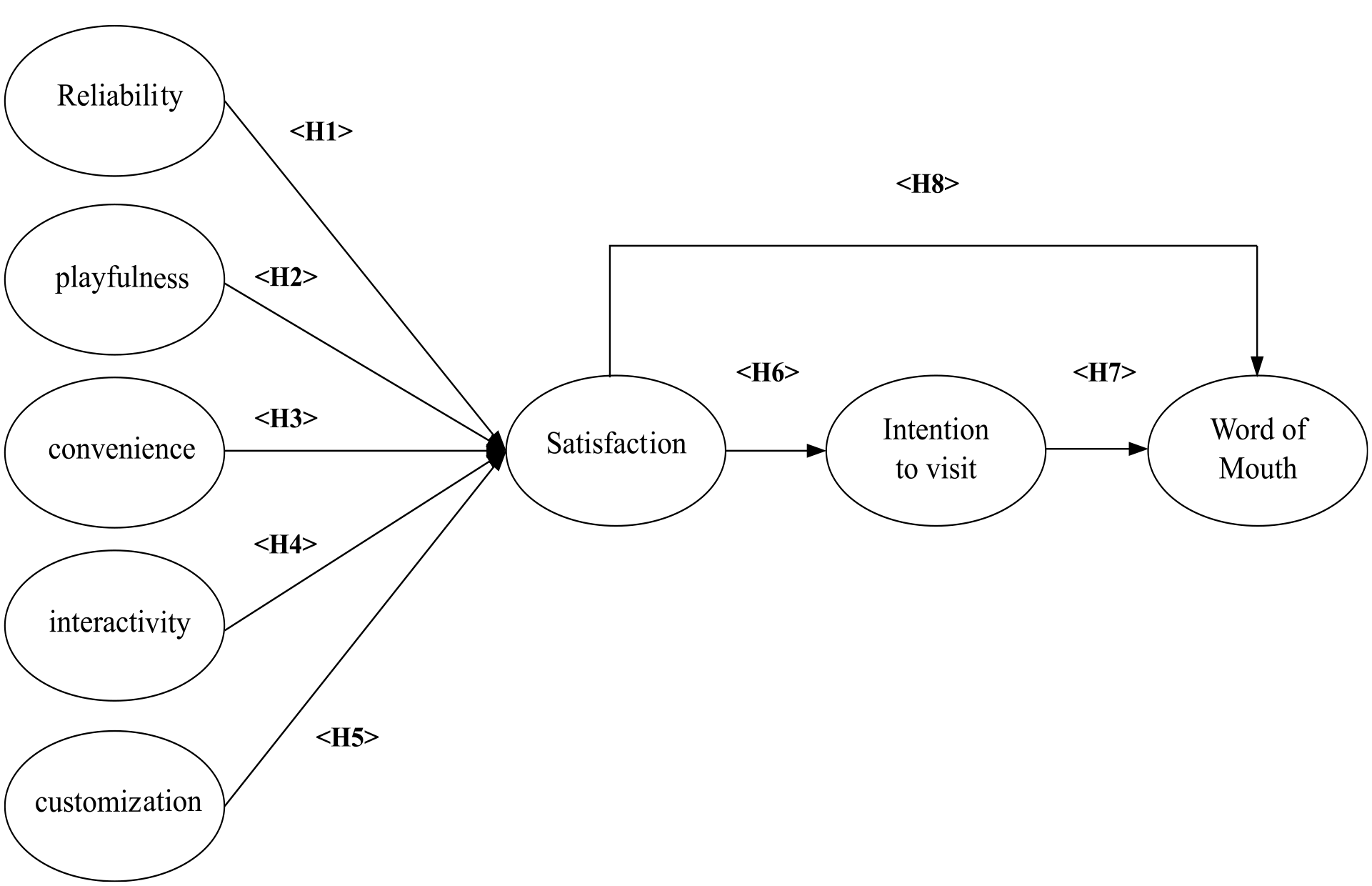
In this study, we will investigate the characteristics of SNS that affect the satisfaction of SNS users. In addition, the effect of satisfaction on visit intention and word-of-mouth intention is to be explored. Figure 1 shows the research model of this study.
Research model.
Research Hypothesis Setting
The characteristics of SNS, such as information reliability, information playfulness, access convenience, interactivity, and customization, provide information on restaurant companies and services to consumers who use SNS information and help them make rational decisions. Based on previous studies, understanding the effect of SNS characteristics on SNS user satisfaction will be possible. Thus, the following hypotheses can be established.
H1. The reliability of SNS will have a significant effect on satisfaction.
H2. Playfulness of SNS will have a significant effect on satisfaction.
H3. The convenience of SNS will have a significant effect on satisfaction.
H4. The interactivity of SNS will have a significant effect on satisfaction.
H5. Customization of SNS will have a significant effect on satisfaction.
Visit intention is an area of behavioral intention. Considering that many companies’ decisions are made by predicting consumer behavior, most studies identified attitude change as a prerequisite for behavioral change. Unlike offline word of mouth, online word of mouth guarantees the anonymity of providers’ personal information. Consumers spread their opinions, complaints, and information more actively than offline because of untact and low communication costs (Oh & Kim, 2014).
H6. Satisfaction with SNS characteristics will have a significant effect on the intention to use.
H7. Intention to visit will have a significant effect on word of mouth.
H8. Satisfaction with SNS characteristics will have a significant effect on word of mouth.
Research Method
Operational Definition
Table 1 shows the operational definition and measurement contents of the variables used to verify the research model and hypotheses.
Operational Definition and Measurement Contents of Variables.

Research Design and Analysis Method
Time and Subject of Investigation
The survey of this study formed a Google Form. Users in their 20s to 50s living in Seoul, the capital city of Korea, who have searched for information on restaurants using SNS were asked to explain the purpose of the study and answer the questionnaire. At first, 310 copies of the questionnaire were distributed, and a total of 305 questionnaires were used for the final analysis, excluding 5 incomplete copies from May 9, 2021 to August 17, 2021. According to the study of Fritz and MacKinnon (2007), Wolf et al. (2013), and Schoemann et al. (2017), the sample size is considered sufficient if the number of samples is 300 or more in the case of structural equation modeling.
Questionnaire Composition
The questionnaire items used as data collection tools in this study were measured using a seven-point Likert scale and multiple-choice questions. Table 1 shows the composition of the questionnaire.
Analysis Method
In this study, each questionnaire was scored and statistically processed, and statistical processing was analyzed using the SPSS v20 program. First, exploratory factor analysis was conducted to determine whether access convenience and reliability influenced visit intention. Second, confirmatory factor analysis results were shown to verify the relationship among SNS sub-characteristics. Third, to confirm whether measurement factors exist independently, the reliability verification was confirmed by performing discriminant validity through correlation analysis.
Analysis Results
Characteristics of Respondents
Demographic Characteristics of Respondents
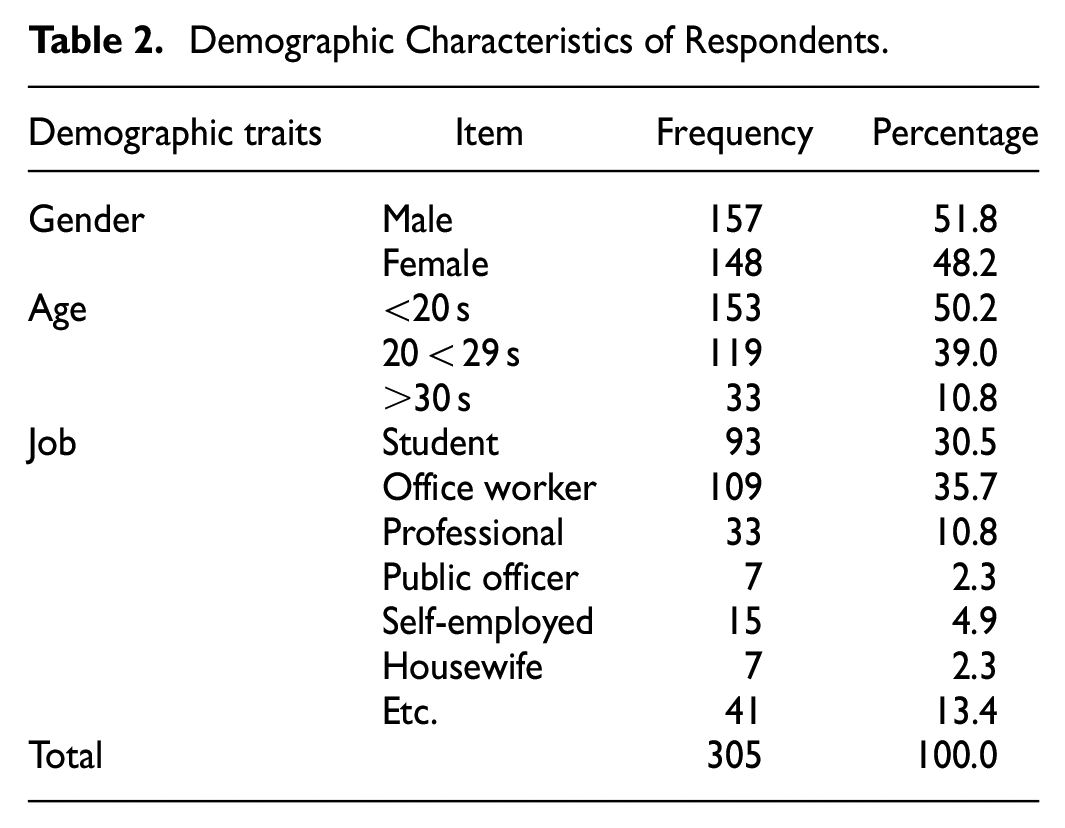
A total of 305 people responded to the survey conducted from May 9, 2021 to August 17, 2021, with 157 men and 148 women. The age of the respondents was 153 in their 20s or younger, 119 in their 30s, and 33 in their 40s or older, with 93 college students, 109 office workers, 33 professionals, 7 public officials, 15 self-employed, 7 housewives, and 41 others. In addition, office workers accounted for the largest percentage of respondents, with 109 (35%). Table 2 shows the demographic characteristics of respondents.
Demographic Characteristics of Respondents.
How the Person Answering the Questionnaire Uses SNS
Table 3 shows the respondents’ use of SNS. The most preferred SNS was Instagram, accounting for 29.9%, then 86.9% of respondents used SNS for more than 2 years, and 25.2% of respondents used SNS for more than 1 hr and less than 2 hr a day. The number of studies for restaurants through SNS was 50.8%, which is more than four times, indicating that many consumers collect and share information about restaurants through SNS.
Respondent’s SNS Usage Type.

Verification of Reliability and Descriptive Statistics for Research Concepts
Through the survey of this study, reliability analysis was conducted to determine whether the respondent consistently responded to the survey. To verify this, Cronbach’s alpha coefficient was used. As for the variables of this study, all of Cronbach’s alpha coefficients were 0.8 or higher, so we determined that the reliability was high, and all items were used for analysis.
Hypothesis Test
Effect of SNS Characteristics on User Satisfaction
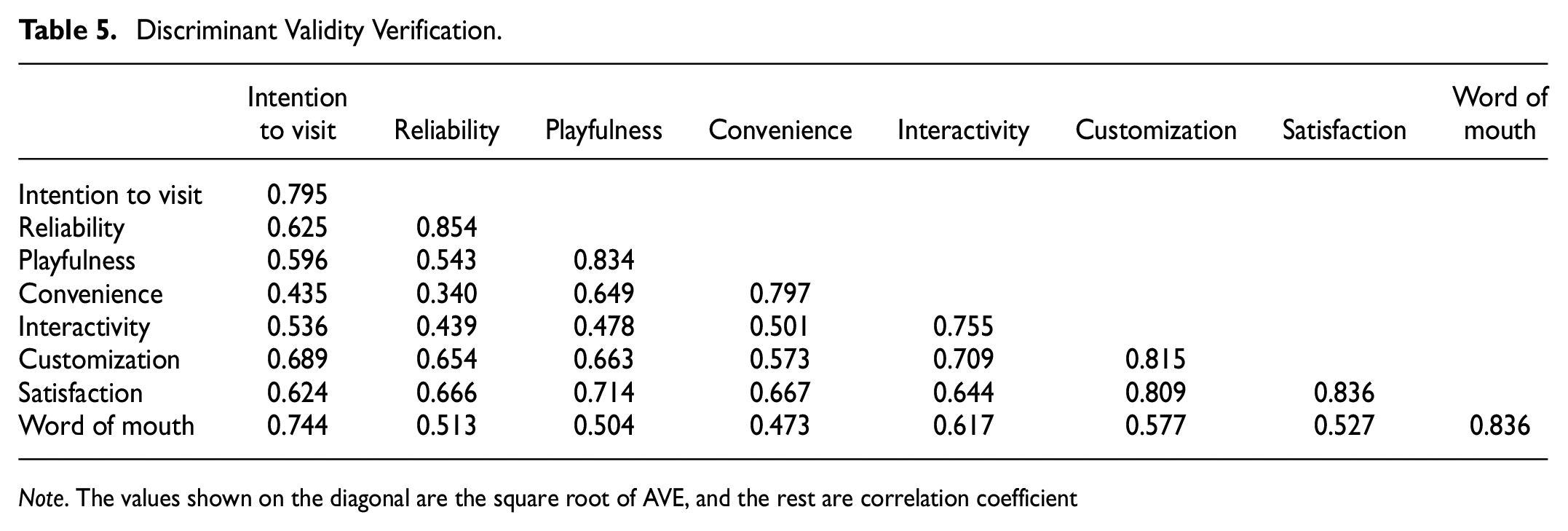
Multiple regression analysis was conducted by setting SNS characteristic sub-factors as independent variables and setting user satisfaction as dependent variables to determine the effect of SNS characteristics on user satisfaction. Table 4 shows that reliability, playfulness, customization, interactivity, and convenience all had a positive effect on user satisfaction. As shown in Table 4, all factors showed good factor loading. In addition, the average variance extraction value and conceptual reliability were found to be average variance extracted (AVE) >0.5 and CR >0.7 or higher, respectively. Moreover, the measurement items were judged to have sufficient convergent validity. As shown in Table 5, the square root of AVE was used to verify the discriminant validity between each factor with proven single dimensionality. As a result, the square root value of AVE other than interactivity was greater than 0.5. All factors were large in correlations other than diagonal lines in related rows and columns.
Confirmatory Factor Analysis Results.

Discriminant Validity Verification.
Note. The values shown on the diagonal are the square root of AVE, and the rest are correlation coefficient
Effect of User Satisfaction on Visit Intention
The result of performing a simple regression analysis by setting user satisfaction as an independent variable and setting visit intention as a dependent variable shows that the F value was 152.198 (p < .001), which was significant. The modified R2 value is .332, showing 33% explanatory power. The result of regression analysis shows that user satisfaction has a significant effect on visit intention.
Effect of Visit Intention on Online Word of Mouth
In performing a simple regression analysis by setting visit intention as an independent variable and setting online word of mouth as a dependent variable, the F value was found to be 244.301 (p < .001), which was significant. The modified R2 value is 0.445, showing 44% explanatory power. As a result of the regression analysis verification, the intention to visit has a significant effect on online word of mouth.
Effect of User Satisfaction on Online Word of Mouth
In performing a simple regression analysis by setting user satisfaction as an independent variable and setting online word of mouth as a dependent variable, the F value was found to be 102.623 (p < .001), which was significant. The revised R2 value is 0.251, showing 25% explanatory power. As a result of the regression analysis verification, user satisfaction has a significant effect on online word of mouth.
Figure 2 shows the path analysis results. In path analysis, the results were similar to those in regression analysis. Reliability, playfulness, convenience, interaction, and customization, which are sub-characteristics of SNS, were found to have a positive (+) effect on user satisfaction, except for interactivity. In addition, user satisfaction had a positive (+) effect on visit intention and a positive (+) impact on online word of mouth. In addition, the intention to visit also had a positive (+) effect on online word of mouth.

Result of research model.
Table 6 presents the verification results for the detailed hypotheses for H1 to H8 based on the analysis results. Reliability, playfulness, convenience, and customization had a positive (+) effect on user satisfaction, and H1, H2, H3, and H5 were adopted. However, H4 was rejected as interactive factors were not influential. In addition, H6 was adopted as user satisfaction has a positive (+) effect on visit intention. H7 was adopted as visit intention has a positive (+) effect on online word of mouth. Furthermore, H8 was adopted as user satisfaction has a positive (+) effect on online word of mouth. Table 6 shows the analysis results.
Hypothesis Test Results.

p < .05. ***p < .001.
Conclusion and Implications
Conclusion
The purpose of this study was to derive characteristic factors of SNS and determine whether each characteristic factor affects online word of mouth and intention to visit restaurants through the parameter of user satisfaction of SNS. Based on previous studies, this study set reliability, playfulness, convenience, interactivity, and customization as the characteristic factors of SNS. The concept, definition, and constituent factors for empirical analysis were presented in the theoretical consideration of SNS, consumer attitude, visit intention, and online word of mouth. A survey was conducted on 305 consumers who had experience using SNS and visited restaurant companies. Factor analysis, frequency analysis, correlation analysis, and reliability analysis were conducted based on the results.
The conclusion of this study is as follows. First, among the five factors in verifying the causal relationship between the characteristic factors of SNS and the user satisfaction of SNS, the factors, reliability, playfulness, convenience, and customization, were found to significantly affect on consumer satisfaction. These analysis results can be understood as being satisfied with SNS when users can easily access the information provided by SNS. However, among the five factors, interactivity did not have a significant effect. This event is believed to have been attributed to the inaccuracy of SNS in providing appropriate information to individual consumers after big data analysis, including the lack of communication with SNS users other than friends through SNS. Second, the satisfaction of SNS users had a significant effect on consumers’ intention to visit restaurants. Users who get considerable information on SNS and are satisfied with SNS obtain information about the restaurant they want to go to before visiting the company. Through information, the company seems to have a positive perception, which has a significant effect on the intention to visit the restaurant. As times develop, data can be obtained online without having to visit the company in person. In addition, restaurant companies can strategically use the fact that the intention to visit restaurants is affected by consumers who use SNS. That is, they share information obtained after visiting them online. Third, SNS user satisfaction had a significant effect on online word of mouth. Unlike in the past, SNS is ubiquitous, and can always be accessed as each mobile device usage continues to increase. Through SNS, information previously conducted is exchanged through offline meetings, or meetings can take place online through SNS. Naturally, users who are satisfied with the use of SNS become increasingly fond of online communication, and through this, online word of mouth will be made. Fourth, the intention to visit a restaurant had a significant effect on online word of mouth. Consumers who visited restaurant companies are believed to have contributed to natural online word of mouth by providing information and evaluating restaurant companies through individual SNS. As SNS is a space for recording individual daily life and communicating for friendship, the number of cases of voluntarily providing information to individual consumers naturally has a significant effect on online word of mouth.
Implications
SNS originally started as a virtual space service that records an individual’s daily life or communicates for friendship. However, as the number of cases in which SNS users voluntarily provide information on their recuperated life information and specialized fields increases, SNS is in the spotlight as a source of new social content. From this point of view, this study attempted to understand the effects of SNS characteristics (reliability, playfulness, convenience, interactivity, and customization) on user satisfaction. To determine the effect of user satisfaction on the intention to visit restaurants and online word of mouth, we tried to present helpful information on efficient SNS utilization and marketing strategies of restaurant companies. SNS marketing has emerged as new marketing in product promotion, communication with customers, and customer management (Joo & Kim, 2020). In addition, given that it promotes user consumption, small business owners and companies in virtual spaces were able to market at a low cost with high efficiency in a more natural and friendly way than using existing advertising media. With the development of technology, numerous people meet online on SNS rather than offline meetings. Moreover, the information obtained through these meetings has a significant impact on the intention to visit restaurants and new online word of mouth.
The theoretical implications of this study are as follows. First, the study verified that the reliability of the SNS of restaurant companies has a statistically significant effect on user satisfaction. This result is consistent with existing studies, such as Cha and Lyu (2019), that the reliability of SNS affects customer satisfaction. Second, this study verified that the enjoyment of SNS for dining out consumers affects their satisfaction. According to Gao et al. (2017), the sense of belongingness of SNS affects playfulness, which affects users’ addiction. The results are similar to those of previous studies. Third, the convenience of SNS for dining-out consumers affects their satisfaction. Lee et al. (2020) reported that the convenience of sending SNS gifts gives users satisfaction and directly and indirectly affects user satisfaction and decisions. Fourth, the study found that the interactivity of SNS did not affect the satisfaction of consumers eating out. This result is similar to that of previous studies, such as Cha and Lyu (2019), where SNS interactivity does not affect the brand image of the company. Fifth, the study verified that SNS customization for dining-out consumers affects their satisfaction. According to J. Park et al. (2011), SNS can be summarized into four characteristics: interaction, word of mouth, entertainment, and customization. The degree of influence of SNS characteristics on brand loyalty was interaction, word of mouth, and customization. The results are similar to the findings of this study.
The influence of these quality characteristics of SNS on satisfaction has been studied in various industries (fashion clothing, interior furniture, food, etc.). This is because eating out consumers react more sensitively to factors such as taste, service, atmosphere, price, and entertainment factors of food service. Some users will also be reluctant to visit offline stores because of the intensifying COVID-19 situation. Thus, restaurants can suggest that online word of mouth among users should be used more effectively as a marketing tool through untact consumption delivery or meal kit products. The reason is that word of mouth through social media has a much more efficient and powerful propagation power than word of mouth offline. Nevertheless, word of mouth offline will be able to guarantee higher reliability than word of mouth online. Thus, a follow-up study should compare the consumers’ offline store visits, delivery, and use of untact consumption methods, such as meal kits, in the COVID-19 situation to examine the development of new untact consumption methods by restaurants. In this study, we analyzed the characteristics of SNS which is not only a communication tool but also a newly attracting publicity channel. We also investigated which SNS characteristics affect the satisfaction of dining-out consumers and how the satisfaction affects word-of-mouth intentions. Thus, the study findings will provide restaurant businesses with basic information about their social media marketing strategy.
The managerial implications of this study are as follows. First, the SNS marketing of restaurant companies should be approached more effectively and strategically by understanding the characteristics of consumers who use the SNS in advance. In this study, when looking at the demographic characteristics and social network usage characteristics of current consumers regarding SNS usage type and frequency of use, consumers’ SNS use is gradually diversifying and increasing. Therefore, catering companies need to prepare SNS marketing plans by selecting customer groups that fit the characteristics of SNS. Second, consumers of restaurant companies who use SNS note that reliability is essential in the quality characteristics of SNS. When food service companies develop SNS or market through SNS, consumers should be assured that personal information cannot be leaked and that SNS is reliable. We are well aware of how Facebook suffered in the past because of the leakage of personal information. Third, restaurant business consumers positively influence their active purchasing behavior because of the pleasure among the characteristics of SNS marketing. When consumers visit the restaurant, they post photos of high-end restaurants or famous restaurants and leave reviews to post on Instagram or Facebook and show off. From the standpoint of a company, such posts can induce the company’s publicity through the active participation of consumers. Therefore, when planning marketing, such as event planning, marketing measures that induce the participation of consumers and give them pleasure should be continuously developed. Fourth, another factor that customers feel satisfied with using SNS for dining out is convenience. The advantage of SNS is that it enables accessible communication. The point is that you can easily share and communicate your thoughts on the Internet with people of other nationalities and outside the region. The SNS provided by the food service company actively helps purchase behavior by acquiring various and up-to-date information and performing comparative analysis. For example, information on food service companies, discount menus, events, information on new menus, and other benefits can be more conveniently delivered to consumers. Therefore, a marketing plan that allows consumers to easily and conveniently choose a restaurant service provider must be continuously developed. Fifth, consumers of restaurant companies using SNS posit that customization is important in the quality characteristics of SNS. Presently, a myriad of information has been created along with the development of technology that can collect and store big data, unlike in the past. Accordingly, the effective production of information and its management has become essential. Therefore, delivering personalized information based on SNS is now possible, and restaurant consumers seem to be very satisfied with the customized quality characteristics of SNS. Last, SNS is continuously developing and substantially influences the food service sector.
Nevertheless, this study has the following limitations. First, the quality characteristics of dining out SNS were limited only to Reliability, Playfulness, Convenience, Interactivity, and Customization. In future studies, it is necessary to additionally confirm the studies of other researchers and introduce more diverse variables such as information accuracy, diversity, and comparability. Second, this study looked at the endogenous variables affected by the exogenous variables of the quality characteristics of dining out SNS in the structural equation modeling only with satisfaction, revisit intention, and word of mouth. In future studies, it is considered that it is necessary to conduct more diverse analyses by adding the intergroup moderation effect on gender, age, and lifestyle by taking advantage of structural equation modeling. Also, in recent years, eating-out consumers not only leave reviews on SNS but also take pictures and share images with many unspecified people. It will also be necessary to study the effect of these recently popular Instagrammable elements on the satisfaction of dining-out consumers and their intention to revisit.
Footnotes
Acknowledgements
We thank Dr. Min-Kyu Kwak (Eulji University) for sharing his concept idea of the article at the beginning of the research.
Declaration of Conflicting Interests
The author(s) declared no potential conflicts of interest with respect to the research, authorship, and/or publication of this article.
Funding
The author(s) received no financial support for the research, authorship, and/or publication of this article.
