




Abstract
This article examines how Indonesia’s State Administrative Courts Act (SAC) and Government Administration Act (GAA) shape the concept of administrative decisions. While the GAA introduces broad notions, the SAC has a more restrictive approach. Although the two laws are based on different philosophies, they should be synchronized. Ignoring the SAC can lead to errors in interpreting the intrinsic meaning of GAA rulings. Using a contextual and systematic interpretation, this study analyzes several court rulings and jurisprudence to explore dualism and contradictions in the concept of administrative decisions. It highlights how judicial interpretation can clarify the provisions of the acts or their inherent meaning, influencing administrative decision-making, the scope of administrative power, and judicial boundaries. To address conflict and dualism, the study suggests applying the law incrementally in specific cases and calls for comprehensive legislative harmonization.
Introduction
The notion of administrative decision is central to administrative law (Wolf, 2017). It serves as a crucial tool for governments to implement public policy. In Indonesia, the State Administrative Court Act (SAC), enacted as Act No. 5 of 1986, regulates a decision as a legal action with legal implications. Although the SAC has been revised twice through Act No. 9 of 2004 and Act No. 51 of 2009, its core framework remains unaltered. The SAC establishes a restrictive understanding of government decisions and limits the jurisdiction of the administrative court.
In its development, SAC has proven insufficient in addressing the diverse and evolving nature of government affairs and administrative tools. Many public agencies are difficult to absorb into the idea of administration presented in SAC, and sectoral administrative issues have arisen that courts are often ill-equipped to handle.
Act No. 30 of 2014 on Government Administration (GAA) addressed these limitations. It expanded the construction of administrative decisions, allowing courts to scrutinize both written decisions and factual actions (see Table 1). However, the GAA’s broad language has prompted varying interpretations due to the lack of thorough explanation. Furthermore, the exclusion phrases in Articles 2 and 49 of the SAC remain unaltered, creating conceptual ambiguities and contradictions.
Comparison of Administrative Decisions in the SAC and GAA.

Several key issues arise from these differing conceptions: (a) the dualism of administrative decisions; (b) the application of the SAC’s exclusion provisions to the GAA’s broader concept; (c) the proper interpretation of the GAA’s broad concept of administrative decisions; and (d) the definition of factual government actions. These issues remain unresolved and continue to be debated today.
This paper is organized into several parts. The first section discusses the SAC’s narrow conception of administrative decisions and examines the cumulative elements that constitute a decision under the SAC. The second section discusses the intrinsic meaning and the essential components that must be contained in a decision, supported by judicial opinions that provide a more contextual and systematic interpretation of the Act. The third section discusses the GAA’s broad conception of administrative decisions and its relationship with the SAC, which has led to a wider variety of administrative decisions. The analysis is framed through the lens of judicial interpretation. The fourth section analyzes the legal harmonization of the SAC and GAA. This section highlights the need for revisions and linkages between the two Acts. Judicial interpretation is used to clarify meanings, principles, and recommendations for change, while also addressing efforts to balance judicial interpretation. The final section addresses the functional and dialectical relationship between administrative and judicial power. It explores the institutional dialog within the framework of checks and balances.
Literature Review
The Conception of Administrative Decision in the Indonesian Context
Administrative authority derives from executive power, which acts to enforce laws (Mortenson, 2020). It can be exercised through administrative actions or inaction (Levinson, 2016). Administrative decisions serve as instruments for implementing state functions (Schiavo-Campo, 2023). A key challenge is ensuring administrative organizations operate without engaging in illegal acts (Michaels, 2015). Administrative law involves accountability and responsibility and the limits of discretion (Sossin, 2021).
Dutch law has a significant influence on Indonesian legal traditions (Lev, 2013). A key feature of the Continental European legal system is the distinction between public and private law (Lindsey & Butt, 2018). Private law governs relationships between private individuals or legal entities (Davis, 2019), while public law constitutes the exercise of government authority to serve the public interest (Kaganovska et al., 2022; Verkuil, 2006). The concept of administrative activity serves as the foundation for the traditional classification of governmental actions (Barkhuysen et al., 2012).
Administrative acts can be categorized into three types: factual, non-factual, and legal acts (Ridwan, 2018). Alternatively, they are often divided into two categories: legal activities and factual activities (Hadjon et al., 2019). Legal activities are intended to produce direct legal consequences, distinguishing them from factual actions (Barkhuysen & van Emmerik, 2019). Administrative decisions or acts consist of constitutive elements that generate both direct and indirect legal consequences (Wolf, 2017).
Legal Pluralism, Interpretation, and Judicial Activism
Legal pluralism reflects the coexistence of multiple legal systems within a society, highlighting both unity and diversity in law (Gebeye, 2017; Griffiths, 2015). It has significant consequences for institutional design and policy-making (Swenson, 2018; Tamanaha, 2017). From a pluralist viewpoint, authoritative interactions tend to be dialectical rather than hierarchical (Berman, 2009), emphasizing the expansion of a common set of rules and solutions (Webber, 2006). Legal pluralism is a prominent aspect that offers alternative legal structures to support the functions of the rule of law (Tamanaha, 2011).
Legal interpretation is the process of concretizing legal standards (Bruns et al., 2021, p. 50), identifying current legislation, and developing new ones (Raz, 1996). It is an evaluation of what the law requires (Marmor, 2017) and influences institutional relations and bargaining power between parties through rule changes or choices (Soriano, 2007). Interpretation is not limited to analyzing legal documents but also extends to contextual legal concepts (Zhou, 2020). It is a highly decisional activity involving choices or information (Pino, 2019). According to the constructive thesis, interpretation is a dialectical effort aimed at creating better, more legitimate interpretations (Georgosouli, 2010). The judiciary is responsible for interpreting legal texts and resolving flaws, ambiguities, or disagreements (Jarrah et al., 2024). Language also plays a significant role in how legal writings are interpreted (Bercea, 2014). Judges’ legal culture can explain the judicial behavior (Aguiar-Aguilar, 2022). Judicial virtue is necessary to attain effective interpretation and legal reasoning (Amaya, 2019).
Judicial activism is not a single concept but encompasses various jurisprudential principles (Kmiec, 2004). Activist judges utilize their judicial power to advance their notion of social benefit, while judicial restraint concentrates on broadening the range of permissible judicial decisions under the statute (Lindquist & Cross, 2009). Judicial activism can be categorized into institutional activism and ideological activism (Lindquist & Cross, 2009). It may arise in situations when there are no precedents or there is a need to navigate interpretive crossroads (Thornton, 2009). The court has the power to scrutinize government actions and protect the people’s rights from unfair or unlawful infringement (Chowdhury, 2011).
The Process of Legal Harmonization
A coherent legal framework can facilitate the social or economic environment functioning properly (Cahoy & Oswald, 2021). Harmonization formalizes the relationships between different laws (De Poli & de Gioia Carabellese, 2019), and various harmonization regimes influence the outcomes (Gomez & Ganuza, 2011). The contexts and discrepancies of legal traditions vary between jurisdictions, creating impediments for harmonization (Wei, 2020). Adopting an inclusive understanding of these differences is essential for assessing processes and developing effective strategies (Sanchez Lasaballett, 2019). Harmonization is best achieved through consensus and iterative methods to ensure uniformity (Hill, 2023).
Successful harmonization of laws necessitates aligning the perspectives of policy actors and intergovernmental processes (Klafki, 2018). The approach requires not only the convergence of unified substantive standards but also the centralization of the enforcement authority (De Poli & de Gioia Carabellese, 2019). A systematic method for analyzing the content and aims of laws is necessary to understand the process and goals of legal harmonization (Rus & Jderu, 2024). Instead of enacting new or uniform regulations, it may be preferable to improve existing laws (Wagner, 2012).
Research Method
This research employed a combination of interpretive approaches. Contextual interpretation examines legal rules within their social, moral, and case-specific contexts (Crowe, 2013). It helps determine the meaning of the law based on the context and the interpreter’s perspectives (Baude & Sachs, 2017). Systematic interpretation, on the other hand, analyzes legal texts in relation to other laws and concepts within the legal system (Ammann, 2020). It seeks meaningful interpretation through logical reasoning and value-oriented viewpoints from a larger social context or the real world (Banakar, 2015; Padjen, 2020). Laws should operate by reality or social institutions (Tamanaha, 2022).
Systematic analysis was used to examine and compare the design of administrative decisions in the SAC and GAA, as well as their application in a real case. The contextual approach explored how judges perceive the two Acts and apply them in specific contexts. These methodologies were utilized to understand the essential and substantive meaning of both Acts through judicial decisions and constructive arguments. The key legal sources include Act No. 30 of 2014 (Government Administration Act, GAA), Act No. 5 of 1986 (State Administrative Court Act, SAC), Act No. 6 of 2023 (Job Creation Act), and several Supreme Court Regulations and Circular Letters.
Several judicial decisions were also cited to support the research analysis. These decisions serve as authoritative legal sources for understanding cases and arguments based on judicial descriptive and prescriptive elements (Mackor, 2011). They investigate their compatibility with the formulation in the SAC and GAA. Judicial decisions were selected based on the following criteria: (a) issued after the enactment of the GAA; (b) landmark decisions and legal precedents; (c) relevant to the core legal disputes of this study; and (d) include elements and inherent meaning of administrative decisions. Court decisions are accessible via the official website or database of the Supreme Court of the Republic of Indonesia: https://putusan3.mahkamahagung.go.id/. Additional case descriptions were sourced from online media, including articles highlighting comparisons with Dutch and French law, which have significantly influenced Indonesia’s legal history and development. Both countries adopted the continental European legal system and the conception of administrative decisions, which are nearly identical but differ in the practice of administrative justice systems.
Results and Discussion
The Narrow Conception of Administrative Decisions: Legislative Conception of the SAC
According to Article 1 point 9 of the SAC, an administrative decision is a written decree issued by an administrative agency or official containing legal actions based on applicable laws and regulations that are concrete, individual, and final, with legal consequences for a person or civil legal entity. This definition is limited to legal actions by administrative officials and excludes generic types of decisions, such as policy rules and guidelines. It shares similarities with Dutch law under the General Administrative Law Act (GALA). In Dutch law, beschikking refers to written decisions by administrative authorities that include individual norms, public law acts, and legal implications (Barkhuysen et al., 2012). In French law, acte administratief is a unilateral and formal administrative decision in various forms. It contains individual or general patterns and legal consequences (Bell & Lichère, 2022).
Articles 2 and 49 of the SAC further confine the scope of administrative decisions. These articles exclude certain types of administrative decisions from the definition in Article 1, such as government decrees with civil law features, regulatory or legislative decisions, inconclusive decisions, decisions involving criminal law principles, decisions enforcing final court verdicts, matters falling under military law, and decisions related to general election results. Article 49 precludes discretionary decisions from Article 1, placing them beyond the administrative court’s jurisdiction.
The term “written” relates to the content of a decision, not its format. It should be documented for evidential purposes. An exception is made for fictitious-negative decisions, defined in Article 3 of the SAC as the government’s failure to respond (i.e., silence) to an applicant’s requests within a certain period. This silence is treated as a refusal by the administrative officer.
The term “authority” indicates that a decision must be issued by an administrative body or official who has been granted specific authority. It has to be interpreted functionally, not structurally. Private or semi-public bodies outside the executive can be termed administrative bodies if they perform government functions. The term “legal consequences” refers to a government action intended to produce legal effects, create new conditions, or terminate legal relationships. A decision must clearly state the government’s intent and its authority, and it must be free from legal flaws resulting from coercion, fraud, or deception.
Additionally, a decision must be concrete, individual, and final. Concrete means that the decision must be clear and unambiguous. Individual means that the decision must address a specific individual or legal entity. Final implies that the decision has received all necessary approvals and is ready for implementation. Finality establishes a legal connection between the government and an individual or legal entity, defining their respective rights and obligations. These substantive requirements are cumulative and must all be met.
The SAC also contains several essential legal principles to understand the meanings behind legal texts. The first concept concerns the nature of executive power. The government should only make decisions within the scope of its power. A legislative, judicial, police, political, or contractual instrument cannot be considered an administrative decision. The second principle is administrative autonomy, which enables the government to make autonomous assessments, particularly in emergencies. The discretionary authority enables the government to efficiently take necessary actions in response to critical public interests (Thorburn, 2008). While courts must respect this autonomy, its potential negative effects must be monitored, as it might lead to self-interest and deviation from public objectives (Bach, 2018). The separation of powers limits the courts’ ability to monitor the legal accountability and autonomy (Cane et al., 2008; Lindseth, 2019).
The third principle is the decisiveness and finality of decisions. A decision must be final, have immediate legal consequences, and affect the rights and obligations of individuals or legal entities. Decisions pending approval are not considered final, and the administrative courts lack the authority to examine decisions that do not meet these principles.
The Intrinsic Meaning of SAC: Judicial Lens and Legal Precedents
In practice, administrative courts move beyond the textual interpretation of the restricted ideas in the SAC to address concrete legal issues (see Table 2). The interpretative technique is useful for addressing legal issues since it focuses on the context and critical reasoning of the case (Barnes, 2018). The dynamic judicial reading may provide a more logical and applicable interpretation, as well as the intrinsic and dynamic meaning of statutory provisions (Eskridge, 1987).
Judicial Decisions Relating to the SAC.

One interpretation that constitutes a legal breakthrough concerns the definition of administrative bodies or officials governed by the SAC. Supreme Court (SC) Decision No. 269K/TUN/1996 established a precedent for subsequent decisions. The case involved a dispute between a lecturer and the vice chancellor of a private university. The crux of the dispute was whether the vice chancellor’s decision qualified as an administrative decision under the SAC. The Supreme Court ruled that the vice chancellor was an administrative official, and therefore, the decision was administrative in nature. The private university was deemed an administrative organization since it performed executive or governmental functions in higher education. As a government official, the vice chancellor exercised his authority derived from statutory laws and state delegation.
The interpretation of administrative bodies was further applied in the Jakarta Administrative Court (JAC) Decision No. 107/G/1992/PTUN-Jkt., which recognizes state-owned enterprises (SOEs) as administrative entities, as their public power stems from statutory provisions. Additionally, Bedner (2001) describes SOEs’ fee billing as a written administrative decision. The decision highlights that government functions can be performed by private institutions with delegated public authority. Power delegation and sub-delegation can occur directly when the implementing agency’s role is defined by legislation or indirectly through operational authority to engage in public service delivery. Statutory regulations have an important role in determining administrative power. For example, the State Electricity Company is granted public authority for electricity delivery through specific legislation.
Other legal decisions, however, have different meanings of the term “executive or government affairs.” In SC Decision No. 48PK/TUN/2002, the court ruled that the vice chancellor of a private university is not necessarily an administrative organ. The legal relationship between the vice chancellor and faculty members is not governed by public law, as they are not civil servants or hierarchically subordinate to the Ministry of Higher Education. The partnership between private universities and the ministry does not represent an organizational relationship but rather a coordination of education delivery. This case demonstrates that judicial interpretations of SAC provisions can vary depending on the context.
The intrinsic meaning of terms such as “public authority,”“governmental or executive affairs,” and “public law” form the substantive requirements for defining administrative bodies and decisions under the SAC. Administrative decisions depict the context of a connection established under public law rather than private law. The concept of a public body is also essential to the Dutch legal system. Article 1 of the GALA defines an administrative body as a public legal entity or another person or body, including private entities, exercising public authority (Albers et al., 2017, p. 238).
The elements of public law are mentioned in SC Decision No. 62.K/TUN/1998. The court ruled that a notarial deed is not an administrative decision, as it is governed by civil or private law, despite being issued by a public notary. It is not subject to public law since its purpose is to establish contractual agreements between parties. Such decisions are prohibited by Article 2 (a) of the SAC, which excludes them from the administrative court jurisdiction. Administrative decisions aimed at regulating contractual relations, implementing a contract, or referring to a contractual term are considered to have been unified as acts in civil or private law, forming the foundation for legal relationships between parties.
A meaning of the legal relationship is also presented in SC Decision No. 547/K/TUN/2015 concerning the Indonesian Railways Company. While the Constitutional Court’s Decision No. 48/PUU-XI/2013 had previously recognized SOEs as administrative bodies, it is not a “one-size-fits-all” interpretation. The Supreme Court interpreted that the meaning of “authority or government affairs” must be based on the core disputes between parties. Decisions related to civil or private law matters, such as debt amount assessment as well as auctions for goods and services, cannot be classified as administrative decisions. Such relationships are prohibited by Article 2(a) of the SAC. In this case, although the Indonesian Railway Company performs government functions, it cannot be considered an administrative body, as it purchases goods and services using its internal budget rather than state funds.
Another essential element of administrative decisions is the “statement of government will” or their “unilateral nature.” It originates from the SAC’s definition of a decision as a legal action designed to produce legal repercussions for individuals or civil entities. In the other decisions, the courts provided several interpretations of this aspect.
For example, in SC Decision No. 312K/TUN/1996, the court argued that the auction minutes released by the state auction committee did not contain an element of a binding statement of the will of the administrative authority authorized to make the decision. The auction minutes solely included details regarding the auction procedure and the parties involved. Another SC Decision No. 47.K/TUN/1997 and No. 245.K/TUN/1999 concerning sale records, corroborate this interpretation. They were deemed to contain no unilateral or constitutive elements, but only declarative statements, serving only as documentation of contractual relationships. These cases established a legal precedent for subsequent judicial decisions. In Dutch law, administrative courts cannot evaluate a government decision containing a contractual relationship or administrative contract between the government and another party. It is under the jurisdiction of the general courts. In contrast, French law allows administrative courts to assess government contracts based on public law because they involve a distinct or unequal relationship between the administrative bodies and other parties (Bell & Lichère, 2022).
The “concrete and individual” aspects of administrative decisions were addressed in The Jakarta Administrative Court (JAC) Decision No. 257/G/2014/PTUN-JKT. The court determined that the notification letter of the prospective workers’ selection results at the Ministry of Finance in 2014 qualified as an administrative decision. The letter contained constitutive substances rather than declarative information. The notification explicitly included the names of the participants, allowing it to be classified as a “concrete” component of an administrative decision. This interpretation is consistent with the legislative construction in the SAC that the “concrete” aspect of a decision implies that it should not be abstract but tangible or determined. Furthermore, the statement was considered “individual” as it applied to specific parties rather than the general public.
The requirements of “finality” and “legal consequences” are equally necessary in an administrative decision. Non-final decisions cannot be considered constitutive. They do not have concrete legal implications since they still require permission from higher-level officials or other agencies. They have not yet resulted in changes to the legal conditions governing the rights and interests of those affected by the decision. Both features are connected and cumulative. “Finality” and “legal consequences” are critical for legal standing under Article 53 of the SAC, which allows individuals or legal entities to challenge the administrative decisions in court.
For example, in Samarinda Administrative Court Decision No. 36/G/2013/PTUN.SMD, the court ruled that the decree of the Chairman of the Regional House of Representatives containing the proposal letter for interim replacement of parliament members is not definitive, as it must be carried out in phases. The mayor must submit a proposal letter to the governor for approval before the decision can be implemented. As a result, it failed to meet the cumulative requirements of finality and legal consequences. Furthermore, such decisions are prohibited under Article 2(c) of the SAC. The mayor’s concrete action was deemed a prerequisite for the decision’s finality and legal effects.
Administrative efforts are also required to establish the finality of a decision. A lawsuit in the administrative court cannot proceed until the plaintiff has exhausted all possible administrative remedies. This aspect concerns the fulfillment of standing to sue in court. Administrative attempts typically involve two stages: an objection to the administrative official who made the decision and an administrative appeal to the official’s superior or an approved external body. These steps are mandatory in every case and bind the judge.
In conclusion, an administrative decision under the SAC must fulfill several fundamental and inherent components: (a) a legal action with intended legal effects; (b) an executive act reflecting the exercise of public authority; (c) the application of public law; (d) a unilateral act or statement reflecting the government’s will; (e) a legal relationship governed by public law; and (f) a conclusive or constitutive nature.
Article 1 of the SAC outlines the substantive prerequisites for administrative decisions. However, court rulings have demonstrated that the textual norms of the SAC have an inherent meaning that may not be fully understood without a contextual, systematic, or functional interpretation. Judicial interpretations have clarified the meaning of administrative decisions and established legal doctrines to address concrete legal cases. These interpretations can evolve over time, reflecting changes in legal disputes.
The GAA of 30/2014: Extensive Decisions and the Conflict of Norms
After the enactment of GAA of 30/2014, the SAC was fundamentally revised. The act was regarded as a turning point in Indonesia’s legal and public administration systems. It introduced substantive administrative law reforms aimed at promoting a more responsive government. Key changes included broadening the meaning of administrative decisions, creating procedures for discretionary authority, and mandating responsibility in decision-making. One of the GAA’s fundamental tenets is the safeguarding of human rights, reflecting the influential relationship between law enforcement and governance quality (Colombi Ciacchi & von der Pfordten, 2023).
Article 87 of the GAA is an extensive administrative decision (see Table 3). The GAA does not eliminate Article 1 of the SAC; it simply alters its normative framework, creating a dualism in the conception of administrative decisions. The GAA expands the scope of administrative decisions, requiring a broader interpretation of the SAC’s narrow definition, including its inherent components. The shift has influenced the dynamics of judicial interpretations.
Extensive Conception of Administrative Decisions.

The GAA’s broad definition of administrative decisions includes written decisions, which also include factual government actions. Factual actions may be taken based on the government’s authority or to implement administrative decisions. As a result, the court’s authority also expands to include examining the legality of factual actions (see Table 4). This authority was transferred from the jurisdiction of the general court. In contrast to Dutch law, judicial examination of factual government actions is still scrutinized by general courts based on civil law (Albers et al., 2017, p. 247). In French law, administrative courts have jurisdiction over factual government actions that involve aspects of public service or public authority (Flavier & Froger, 2016).
Judicial Decisions Relating to the GAA.
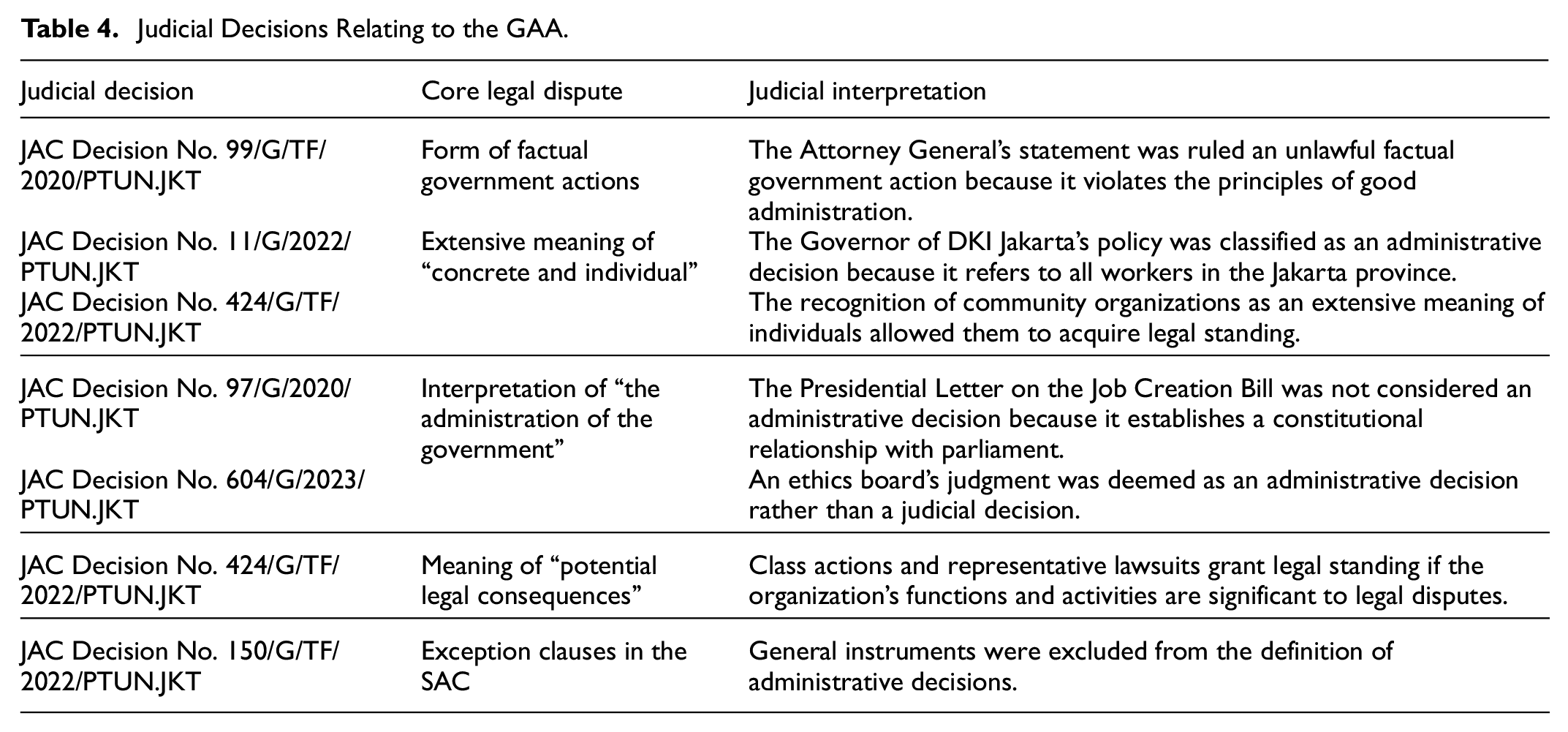
A notable case illustrating this shift is the Attorney General’s statement during a parliamentary working meeting on January 16, 2020. The Attorney General stated that the cases of mass demonstrations and the disappearance of several activists in Semanggi I and II in 1998 and 1999 did not indicate serious human rights violations under existing laws. Human rights advocates and the victims’ relatives responded strongly to the remark. The case was adjudicated in JAC Decision No. 99/G/TF/2020/PTUN.JKT, where the court ruled that the Attorney General’s statement constituted an unlawful factual government action. The court established the criteria for defining factual actions, which should be understood, determined, or observed. Factual actions may involve active execution (commission) and passive execution (omission). Thus, it is possible to qualify the administrative silence as a concrete act.
As the case’s investigation was still ongoing, the judge ruled that the statement violated the laws and principles of good administration. The prosecutor’s remarks were considered to undermine the reasonable expectations of the victim’s family for a resolution and could potentially disrupt the investigation. This court judgment became a significant turning point and an established legal precedent for administrative courts to review various disputes regarding the government’s factual actions.
The new construction of the administrative decisions in the GAA also redefines the “concrete and individual” elements regulated in the SAC. Under the GAA, decisions can contain general norms, provided they are not statutory regulations or abstract norms. This broader interpretation is reflected in the SC Circular Letter No. 1 of 2017, which recognizes policies issued by regional heads as administrative decisions. For example, in JAC Decision No. 11/G/2022/PTUN.JKT, the court ruled on a lawsuit challenging the Governor of DKI Jakarta’s decree on the 2022 minimum wage. The decree applied to all workers in the province, not just specific individuals. The court interpreted the policy as an administrative decision under the GAA, ultimately canceling the decree.
Additionally, administrative decisions no longer need to identify affected parties or individuals in detail. Under Article 87(f) of the GAA, decisions can be directed at the general public. This provision opens the door for class action lawsuits or citizen lawsuits. For instance, in JAC Decision No. 424/G/TF/2022/PTUN.JKT, several community organizations (the Alliance of Independent Journalists, the Media and Creative Industry Workers Union for Democracy, and the Digital Freedom Advocacy Team) challenged the Ministry of Communication and Information’s decision to block access to certain websites and digital platforms. Despite the ministry’s objection to the plaintiff’s legal standing, the court accepted the lawsuit, citing precedents from environmental cases and statutory regulations, including Act No. 32 of 2009 concerning Environmental Protection. Such lawsuits are ruled admissible if the plaintiffs do not seek compensation, the plaintiffs are legal entities, and their interests align with the case.
It would have been different if the court had continued to use an interpretation based on Article 2(b) of the SAC, which excludes such general decisions from the limited concept of administrative decisions. Understanding the relationship between the two Acts requires systematic interpretation.
The GAA shifts away from the SAC’s focus on “the administration of government” by introducing broader functions such as public service, development, empowerment, and protection. However, this expansive phrasing lacks clear boundaries, blurring the lines between “administration” and “government.” This ambiguity conflicts with the SAC’s narrower concept of “government affairs” as the implementation of executive activities. Furthermore, administrative decisions are allowed to be made by administrative officials in the executive, legislative, judicial, and other state institutions, as specified in Article 87 (b) of the GAA. However, not all government decisions are administrative. Some decisions relate to political, legislative, constitutional, and military matters. The GAA does not provide a detailed explanation on this distinction.
JAC Decision No. 97/G/2020/PTUN.JKT regarding the Presidential Letter on the Job Creation Bill is a relevant example. The president’s legal representatives asserted that the letter was not classified as an administrative decision under the SAC. The President only introduced the submission of bills and academic papers to the Chairman of the House of Representatives. The letter was a constitutional action of the president, a form of law-making relationship between state bodies that includes political elements. The judge agreed with the approach and held that not all government decisions can be categorized as administrative decisions. Under French law, the Conseil d’Etat cannot also examine decisions that constitute acts of the state or constitutional decisions that are referred to as actes du gouvernement (Bell & Lichère, 2022).
In another case, the court took a different approach, ruling that an ethics board’s decision could qualify as an administrative decision. This is illustrated in JAC Decision No. 604/G/2023/PTUN.JKT, which addresses the dismissal of the Chief Justice of the Constitutional Court in 2023. The case clarifies the meaning of “government affairs” in context. Based on the Code of Judicial Ethics, the Constitutional Court’s Ethics Council decided to dismiss the judge after an ethical review. The court ruled that this decision was administrative in nature, as it involved administrative activity rather than the exercise of judicial authority.
The GAA substitutes the SAC’s narrow definition of finality with the concept of “finality in a broader sense.” However, the GAA does not offer a thorough explanation of this term, leading to different interpretations regarding the boundaries and assessment of broad finality, as well as the elements and conditions of legal repercussions. This ambiguity directly impacts the requirements for legal standing in court.
The GAA introduces the concept of “potential legal consequences” in Article 87(e), which differs from the SAC’s focus on actual legal consequences. Under the SAC, legal harm or repercussions must arise from real circumstances, not conjecture, reflecting a change in an individual’s legal status. It is a prerequisite for a legal position.
In contrast, the GAA’s concept of potential consequences does not require an individual to demonstrate actual legal injuries as a result of a government decision or action. It allows for the logical conclusion that such consequences could occur. This norm causes an expansion of the principles of standing to sue in court. The challenge is how to interpret the potential injuries in concrete cases. An individual cannot have legal standing without having a direct interest. There must be a causal link between the decision or factual action and the injuries or legal consequences. The concept of loss or legal consequences differs from Dutch law, which requires legal standing to include personal, direct, and objective interests. Legal concerns must be based on actual events, not hypothetical reasons (Albers et al., 2017, p. 239). In French law, the Conseil d’Etat has the competence to take over disputes involving the protection of the public interest, even if the cases are outside its jurisdiction, as long as they involve the exercise of public power (Bell & Lichère, 2022). French law provides a broader standing or grounds criterion through the principle of actio popularis, the active judge, and the doctrine of decisional economy (Massot, 2010).
A relevant example is JAC Decision No. 424/G/TF/2022/PTUN.JKT, discussed earlier, which involved a class action lawsuit against the Ministry of Communication and Information. The government argued that most of the plaintiffs had no direct interests in the case, as it was only based on assumptions and inferences without any legal foundation. The court contended that there were two definitions of legal interest: interest as a value that is legally protected and interest as the objective that must be attained through the litigation process. The court ruled that in a legal context, “actual injuries” or “potential injuries” must logically result from a government action or decision, and a lawsuit is the only means to address such concerns.
The GAA does not amend or revoke Articles 2 and 49 of the SAC, which outline exceptions to the definition of administrative decisions. In other words, both articles remain valid and binding, limiting the broad conception of GAA. As a result, the two Acts must be linked to understand the meaning of administrative decisions.
Several court decisions illustrate the above systematic approach. One example is the exclusions to general decisions outlined in Article 2(b) of the SAC. This principle is illustrated in JAC Decision No. 150/G/TF/2022/PTUN.JKT, which involved a dispute between the Indonesian palm oil monitoring association (the plaintiff) and the President and Ministry of Trade. The plaintiff claimed that the government failed to conduct evaluations and oversight to ensure adequate supply and stable prices of palm oil, resulting in a supply shortfall and a high price. Despite submitting recommendations, the government took no action, which the plaintiff argued constituted an unlawful factual action.
The court took a different view, ruling that the President and the Ministry of Trade had taken steps to address, review, and supervise the issues through the issuance of general policies. These policies were followed by different actions in compliance with Ministry of Trade regulations. The court interpreted the case using Article 1, Point 8, and Article 87(a) of the GAA. However, the court explained that the policies and general rules underlying the factual actions cannot be classified as administrative decisions, as Article 2 (b) of the SAC excludes decisions containing general norms. Since the ministerial regulation was enacted to safeguard the supply and price stability of palm oil for the general public, the President’s and Ministry of Trade’s decisions and their factual actions were not considered administrative decisions under the SAC.
The GAA further expands administrative decisions by including fictitious-positive decisions, which are essentially a type of administrative silence with different conceptual and legal implications. The decisions are made when an individual or civil entity requests the government to issue a written decision or carry out a factual action, but the request is not answered within a reasonable time frame. The request should therefore be regarded as accepted. It differs from the fictitious-negative decisions under the SAC, which are treated as rejections. For formalization purposes, applicants may request the issuance of a fictitious decision to the administrative court if the administrative officer refuses to issue the decision. However, the Job Creation Law has removed that authority from the administrative court.
The evolving concept of fictitious decisions is primarily motivated by the legislative aim to encourage the government to be more responsive and proactive. Citizens should not be treated as objects but as subjects in the administration of government. The fictitious decision is intended to inspire the improvement and acceleration of public services. However, the GAA does not eliminate the fictitious-negative decisions under the SAC, creating a dualism of norms and conceptions, as well as complicating judicial jurisdiction in investigating such cases. Although this jurisdiction was repealed by the Job Creation Act, the court scrutinized several lawsuits involving the government’s silence or fictitious decisions through the inquiry of unlawful factual government actions.
The GAA also regulates the government’s discretionary powers, restricting administrative discretion for a variety of reasons, including whether the legislation provides options or is incomplete, ambiguous, or silent, or where government stagnation occurs. Article 24 of the GAA sets cumulative conditions for discretionary decisions: (i) conformity with discretionary objectives; (ii) adherence to the principles of good governance; (iii) based on objective reasons; (iv) absence of conflict of interest; and (v) carried out in good faith. The Job Creation Law eliminated one requirement: discretionary decisions must not conflict with statutory provisions. This change contradicts the characteristics of discretionary authority, which is inherently exceptional and difficult to limit through law. The SAC and GAA approach discretionary decisions in different constructions. According to Article 49 of the SAC, such decisions are made in response to an emergency or dangerous situation that threatens public interest. The two Acts are conceptually different; the SAC is based on emergency factors, while the GAA is grounded in legislative norms and concerns. The GAA does not specify whether courts have the authority to examine discretionary decisions, a power that is only mentioned in Article 49 of the SAC, which excludes such decisions from judicial jurisdiction.
However, the potential for reviewing such discretionary decisions exists under Article 19 of the GAA, which permits the court to investigate misuse of government authority. Abuse of power can take three forms: exceeding authority, mixing authorities, and arbitrary actions. This provision defines abuse of power as the government’s arbitrary decisions or discretionary actions. It may result in a dualism of judicial competence between the SAC and the GAA.
The expansion of administrative decisions in the GAA has led to the increased use of various government instruments, including guidelines, standards, general planning documents, and other regulatory or policy tools. These standard instruments are designed to regulate criteria, methods, and regulations to implement government tasks (Ridwan, 2018). However, such instruments have the same legal binding force as statutory laws. In practice, administrative courts are reluctant to investigate such instruments due to Article 2(b) of the SAC, which exempts decisions that comprise general norms from judicial review.
Legal Harmonization and Interpretive Balance
The Need for Legal Harmonization
The expansion of administrative decisions under Article 87 of the GAA represents not just a textual but also a fundamental and conceptual shift. It broadens the scope of administrative decisions, including not only written decisions but also factual actions. This formulation contains various terminological and conceptual issues. Both government acts have distinct forms and meanings. Furthermore, expanding the normative definition of administrative decisions extends the administrative court’s authority.
Normatively, the SAC and GAA govern two distinct issues: the scope of administrative decisions (restrictive or comprehensive) and the administrative court’s authority. The SAC is a special law (lex specialis) that governs the administrative court’s competence, including its substantive or procedural laws. The GAA serves as the legal framework for government administration. The two Acts regulate different branches of power. If two legal norms conflict, the special law takes precedence over the general law (Agustina, 2015).
The SAC governs various aspects of administrative court procedural law to assess administrative decisions as the object of disputes. It regulates the restrictive definition of administrative decisions, as well as the substantive and procedural standards of decision-making. On the other hand, the GAA governs aspects of government administration, including decision-making procedures, the use of administrative authority, and discretionary powers. The GAA broadens the scope of administrative decisions and the court’s competence. Both Acts therefore remain interconnected and indispensable sources of law for the court and the government.
The court and the government view administrative decisions from different perspectives. The court interprets a decision as an object of dispute with a legal protection function, whereas the government views decisions as a type of government action with an instrumental function. The fundamental differences are the construction of administrative decisions in the SAC and GAA. Despite these differing perspectives, the SAC and GAA cannot be separated, as they both regulate the same variable: administrative decisions.
Legislative changes can eliminate a norm. However, in this case, the GAA “only” modifies, rather than eliminates, the SAC’s limited framing of administrative decisions. The SAC remains valid and relevant, as it not only governs the textual definitions of administrative decisions but also encompasses fundamental principles and concepts. Consequently, various judicial decisions before the enactment of the GAA can be used as legal references and sources to better understand the GAA’s administrative decision-making concepts.
The GAA does not revoke or amend Articles 2 and 49 of the SAC, which outline exclusionary restrictions. Both articles have an inherent meaning and legal principles that are revealed through judicial interpretation. The significance of legislative rules in the SAC becomes evident both contextually and systematically. These interpretations are critical for understanding the significance and limitations of the GAA’s broad formulation. It is critical to avoid ambiguity and conflicting interpretations of court decisions and the GAA.
Harmonizing various provisions is critical for minimizing interpretation variations and legal confusion. Concerning the “finality” concept, the SAC defines finality more clearly, stating that a final decision with legal effects no longer requires further approval. In contrast, the GAA applies the concept of finality broadly, without providing a comprehensive explanation of the conditions for finality or when a decision is final, leading to interpretive challenges.
A reason for harmonization is also linked to the definition of “potential legal consequences” in the GAA, creating contradictions in the measurement of the form and time of injuries, raising questions about whether the court must assess them concretely or potentially. The SAC excludes such decisions from the concept of administrative decisions, preventing courts from reviewing them, emphasizing the need for direct interest under Article 53.
Additionally, the “concrete and individual” aspect in the SAC is no longer an essential requirement in an administrative decision since the GAA uses expansive notions to define administrative decisions. Article 87(f) of the GAA states that a decision may be applied to the general public, not just individuals or civil entities, as intended by the SAC. In other words, the definition of “concrete and individual” has changed.
These changes necessitate revisions to exclusions in Article 2 of the SAC, including Article 2(b), which excludes decisions with general norms from the qualification of administrative decisions and the object of judicial review. This article is no longer normatively relevant unless it is a legislative rule or an abstract norm. Similarly, Article 2(c), which excludes non-final decisions, conflicts with the GAA’s broader concept of finality, where “approval” is no longer an absolute.
In practice, the dualism of the formulation of administrative decisions under the SAC and GAA has led to multiple interpretations. Harmonization should be accomplished by amending both Acts, particularly by providing legislative explanations for conflicting, ambiguous, and imprecise provisions. Furthermore, the SAC and GAA should be harmonized with other relevant laws and Supreme Court regulations to ensure consistency and clarity.
Judicial Boundaries and Interpretive Balance
Judicial competence is determined by the normative framework specified in the Acts. The administrative courts’ authority is governed by the normative design of administrative decisions, which serve as the object of legal disputes. While the SAC governs a restrictive interpretation of administrative decisions, the GAA extends it, influencing the reach of the court’s power. Ultimately, the judicial authority is determined by the object it oversees.
Administrative decisions are governed by Article 1 of the SAC and Article 87 of the GAA, as well as the exclusionary provisions in Articles 2 and 49 of the SAC. The courts have the authority to review decisions that meet these criteria, but such reviews should be conducted systematically. The GAA cannot be interpreted in isolation from the SAC. Instead, judicial decisions and the SAC’s principles, conceptions, and fundamental meaning should be interpreted contextually.
Several legal principles and concepts limiting judicial interpretation include (a) the principle of separation of powers; (b) judicial deference to government authority; (c) the principle of government autonomy; (d) elements of legal relations based on public or administrative law; (e) the dichotomy of public and private law; (f) the government’s or administration’s special position to fulfill the public interest; and (g) decisions or actions that contain political or constitutional content. These principles are essential for understanding the limits of judicial authority when reviewing administrative decisions.
The extension of administrative court authority may enhance the government’s supervisory functions, promoting the rule of law and good governance. Courts can take corrective action against the unlawful government decisions and provide a remedy to the injured parties, thereby expanding access to justice and increasing administrative accountability. This role is critical for ensuring legal protection for the community.
However, excessive judicial activism may arise if the courts ignore the limits of their jurisdiction, crossing its jurisdictional boundaries and interfering with the government’s authority. This could lead to an overflow of disputes, overwhelming the judiciary and undermining the principle of separation of powers. Courts must avoid acting as administrative bodies, as it risks eroding the balance of power.
Judicial review allows judges to be either flexible or restrained in their interpretation of the GAA. Judicial activism is not new, as evidenced by past cases under the SAC. The judicial attitude is determined by whether a judge attempts to go beyond the legislative language or limits himself and develops interpretations to contextualize the law for specific instances. The purpose of interpretation influences the court’s active or restrained approach.
The text of the SAC and the GAA serve as both references and constraints for courts to interpret. Judicial flexibility is possible when judges seek to investigate the intrinsic meaning of the formulation and parts of administrative decisions using multiple interpretations. In other words, there is an interval space that allows judges to look further than the literal meaning of the text and seek a more relevant or contextual interpretation of the case. The judicial examination can be carried out incrementally depending on the context and purpose of the interpretation of the case (the incremental legal application principle). However, this process begins with carefully reading the text.
Courts must formulate constructive arguments to answer the most relevant questions in a case. Their interpretation and considerations contribute to a clearer understanding of the rules in the SAC and GAA. The GAA’s broad formulation is inherently flexible, allowing multiple interpretations. However, courts must systematically link the GAA to the principles of the SAC and other relevant legislation. There is no definitive interpretation or “one-size-fits-all” that can be applied to all situations. Judges must carefully analyze each case and apply the GAA or SAC based on the specific context of the disputes.
Judicial interpretations must also be coherent with the precedents set by previous decisions. While these precedents are not mandatory, they serve as persuasive guidance, as each case has unique characteristics (Putrijanti et al., 2018). Administrative judges have the flexibility to make suitable interpretations and can provide justice and effective resolution for the parties involved.
The Dialectics of the Relationship Between Administrative Courts and Administrative Power
The judiciary and administration have a checks-and-balances relationship. Administrative courts supervise the government by reviewing and correcting its decisions and actions. The scope of judicial authority is shaped by the definitions of administrative decisions in the SAC and GAA, as well as the exceptions outlined in these Acts.
From a restrictive perspective, no judge possesses the same vast authority as the government. The courts’ supervisory function over administrative power is asymmetrical, rather than symmetrical. The judiciary must not interfere with the government’s autonomy or exclusive authority. Excessive judicial activism could undermine this balance, giving courts undue control over administrative functions.
In a welfare state, the government is the primary actor accountable for achieving public goals (Dimyati et al., 2021). The role of the judiciary is to ensure that the government does not abuse its authority for reasons other than those specified in statutes and the constitution. If the existence of the government is viewed as a “thesis” of the principle of public interest, the courts might be viewed as an “antithesis” that acts to correct the government’s mistakes. The establishment of judicial supervision is justified by the “synthetic” premise of public interest protection.
Court decisions are universal (erga omnes), meaning they are binding on the public. The dialectic relationship between the two judiciaries and the government represents a functional and dialogical relationship in which the judiciary serves as a neutral third party between the government and the people. The court can create a broader interpretation to achieve justice and protect the rights of the community (Shen, 2022).
The government holds significant authority to act unilaterally in the public interest. However, this privilege is not without constraints. Legislation serves as the limit for administrative decisions. Government decisions have both moral and legal implications (Kusbandrijo & Widanti, 2019). The government cannot avoid accountability on behalf of public interest. This extensive jurisdiction has the potential to be abused for illegal purposes. The concept of specialization requires the government to utilize its authority only for legal purposes (Hadjon et al., 2010, p. 25).
Courts are responsible for determining the legitimacy of administrative actions or decisions and addressing abuse of authority by administrative organizations. The review must be founded on statutory laws and universal principles of good administration. However, judges are limited to either upholding or canceling decisions; they cannot correct or change their substance (Cane, 2009). Judges cannot consider the case from a non-legal standpoint, and courts cannot interfere with administrative decisions’ polycentric considerations (Creyke et al., 2019). The court’s role is that of an interpreter and not a decision maker. This reflects the principles of judicial deference and separation of powers, which recognizes administrative autonomy (Zhu, 2019). It is important to consider other factors. Aside from the law, there are other aspects influencing government performance: cognitive culture, political commitment, and leadership (Salomo & Rahmayanti, 2023).
The GAA enhances access to the courts, underscoring the growing importance of legal protection in society. By exercising judicial authority over administrative decisions, courts can improve decision-making quality. The judiciary should be viewed as a strategic “partner” rather than a “rival” to the administration. This relationship is one of the true manifestations of the rule of law (Otto, 2012).
Conclusion
The alterations of the SAC have prompted significant philosophical discussions. Long-held views regarding administrative decisions were challenged when Article 87 of the GAA broadened the definition. However, several ambiguous notions and constructions in the GAA remain. Additionally, the SAC’s exclusionary clauses remained unchanged, despite being less relevant to the GAA’s decision-making approach. As a result, the ideas and principles outlined in the SAC must be considered while interpreting the law. The SAC becomes a key reference for evaluating the extensive administrative decisions. Certain conditions limit courts’ ability to supervise the government (Stack, 2015). Consequently, the management of government decision-making becomes increasingly critical as the administrative state has elements that may cause moral dangers to the integrity of the government (Rosenbloom, 2023). Given the conflicts of norms and principles between the SAC and GAA, legal harmonization is urgently needed.
Footnotes
Acknowledgements
The researchers thank some experts from the Faculty of Law, Padjadjaran University, University of Indonesia, Airlangga University, and the Ministry of State Apparatus Empowerment and Bureaucratic Reform, and judges from administrative courts who have provided valuable discussions in this research.

Funding
The author(s) disclosed receipt of the following financial support for the research, authorship, and/or publication of this article: The author(s) received financial support for the publication of this article from the National Institute of Public Administration in Indonesia and the Polytechnic of STIA LAN Bandung.
Declaration of Conflicting Interests
The author(s) declared no potential conflicts of interest with respect to the research, authorship, and/or publication of this article.