



Abstract
Obtaining a successful ABET accreditation for an academic program requires academic strategies and the implementation of efficient academic practices. An ABET-accredited program exhibits global educational standards, and its graduates are competent. Numerous studies focused on ABET accreditation frameworks, ignoring ambiguities and discussing the program’s continuous improvement selectively. An integrated approach that covers effective strategies and standard educational practices for continuous improvement of the academic program needs to be developed. This study presents both novel strategies and quality practices for academic excellence. The study’s triangulation research design justifies its objectives. The integrated approach was observed at a Saudi university for its eight programs under the ABET-CAC and EAC disciplines. Besides, it helps determine the significant contributing factors (SCFs) that enable academic quality culture and contribute to the accreditation process. The Fuzzy AHP method was employed to determine these factors’ significance and correlate their importance for continuous academic quality improvement. The approach is a core facilitator in obtaining ABET accreditation for the two terms and is significant in developing a quality culture for sustaining academic excellence. It is an incredible method for program administrators and university decision-makers seeking ABET accreditation and desiring to enhance the program’s quality performance.
Keywords
Introduction
Achieving institutional talent goals, academic programs’ accreditations, and quality delivery of academic programs are significant priorities for higher education institutions (HEIs) in the current era (Shafi et al., 2019). For sustainable quality education, HEIs must develop standard policies and implement practical approaches involving top management and stakeholders of academic programs (Almuhaideb & Saeed, 2020). Indeed, the performance of an academic program must be evaluated and acknowledged. An accreditation process certainly enables a platform for the program performance evaluation and certifies the performance quality by an accreditation commission (Rashideh et al., 2020). The Accreditation Board of Engineering and Technology (ABET) is the most popular commission that accredits academic programs under two disciplines: the Computing Accreditation Commission (CAC; Zaid Abualkishik et al., 2022) and the Engineering Accreditation Commission (EAC; Hussain et al., 2020). In Saudi Arabia, the National Commission for Academic Accreditation and Assessment (NCAAA) controls, monitors and evaluates academic program performance and awards national accreditation status (Saeed et al., 2021). Saudi HEIs have been given the utmost priority to quality development of education and accreditation for academic programs (Ahmad & Qahmash, 2020). Indeed, the ABET accreditation process enables an understanding of quality development practices for university academic programs (Almuhaideb & Saeed, 2020). Noticeably, many studies on higher education development have been published, enabling support for accreditations and highlighting the practices for continuous improvement (Zaid Abualkishik et al., 2022). It is difficult for readers to determine best practices and factors that sustain academic quality development and help obtain ABET accreditation (Ahmad & Qahmash, 2020). An approach that emphasizes effective academic strategies and determines significant contributing factors that facilitate continuous improvement and compelling ABET accreditation framework needs to be present.
The current work presents an approach that includes novel strategies, best academic practices for obtaining ABET accreditation and the program’s continuous improvement. It determines the most significant contributing factors (SCFs) for academic quality improvement that facilitate the ABET accreditation process. An accreditation process involves the program’s stakeholders and establishes the continuous quality improvement process (Mohiuddin, Islam, et al., 2019). Therefore, the aspirants of ABET accreditation should realize the importance of an approach that serves quality program delivery, outcome-based learning (Zaid Abualkishik et al., 2022), continuous academic improvement (Ahmad & Qahmash, 2020), sustained educational excellence and successful accreditation (Saeed et al., 2021). The presented work is significant for aspirant institutions seeking ABET accreditation for CAC or EAC programs.
Enlightening the process of ABET accreditation, many studies emphasized the accreditation criteria, such as student outcomes (SOs) and the program’s continuous improvement (Ahmad & Qahmash, 2020), ignoring standard practices. Practical approaches should focus on outcomes-based assessments, performance evaluation, program constituencies, and associated entities for successful accreditation (Zaid Abualkishik et al., 2022). Existing practices for evaluating an academic program’s performance should consider the accreditation framework (Mohiuddin, Islam, et al., 2019) and integrate performance outcomes (Mohiuddin, Islam, Talukder, et al., 2020) for the quality delivery of the program and facilitating the accreditation process.
The presented framework has been observed at a Saudi university for continuous improvement and accreditation for the initial (2016) and the renewal (2022) of the eight programs from EAC and CAC disciplines. For the renewal of accreditation, out of eight programs, six programs performed well, and only two programs were graded with one “concern” (from the ABET three performance grades—concern, weakness, deficiency) after the program evaluation (Almuhaideb & Saeed, 2020). Indeed, the framework aligns with the global standards and enables a pathway for successful accreditation.
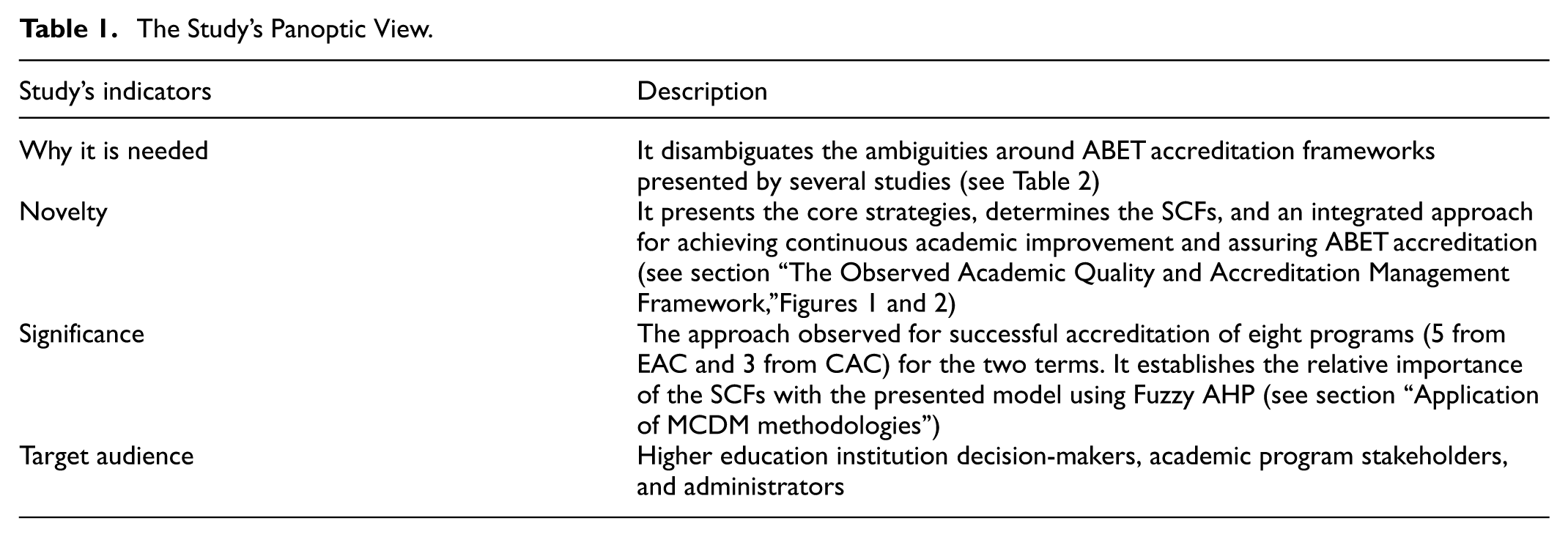
This research design attempts to fill the literature lacuna of effective strategies for a program’s continuous improvement and ABET accreditation management. It aims to present the core aspects of quality improvement and the accreditation process framework (Rahman et al., 2019) that facilitate an intended program for obtaining both. It highlights the ambiguities (see Table 2), discusses the presented framework, determines the SCFs and establishes the significance of SCFs with the presented approach using Fuzzy AHP-fuzzy analytical hierarchy process. Noticeably, readers of this study will know about the critical aspects of accreditation, and stakeholders find it very useful for ABET accreditation preparation. Significantly, the study’s outcomes facilitate institutions obtaining successful accreditation and sustainable academic performance (Table 1). It develops the three research questions following the literature gap, and these questions also align with the study’s objectives.
The Study’s Panoptic View.
Related Work
Following the ABET accreditation requirements, many studies have discussed frameworks and approaches (Rahman et al., 2019) adopted for obtaining accreditation for academic programs (Rashideh et al., 2020) under EAC and CAC disciplines. These studies aim to help institutions pursue accreditation for academic programs in HEIs. Several other studies have discussed and compared ABET accreditation requirements and similarities with the Saudi national accreditation process (Hussain et al., 2020; Ilyas, 2019; Saeed et al., 2021). These studies focused on discussing the accreditation process frameworks and intended to enable a platform well prepared for program evaluation by the accreditation commission (Mohiuddin, Islam, et al., 2019). The adopted approaches of such studies facilitate institutions and stakeholders preparing national (e.g., NCAAA accreditation for Saudi universities) and global accreditations, that is, ABET (Saeed et al., 2021). An accredited academic program in HE results from a performance evaluation done by an accrediting commission and formally recognizes that the program met the required standards or criteria (Vliasceanu et al., 2004).
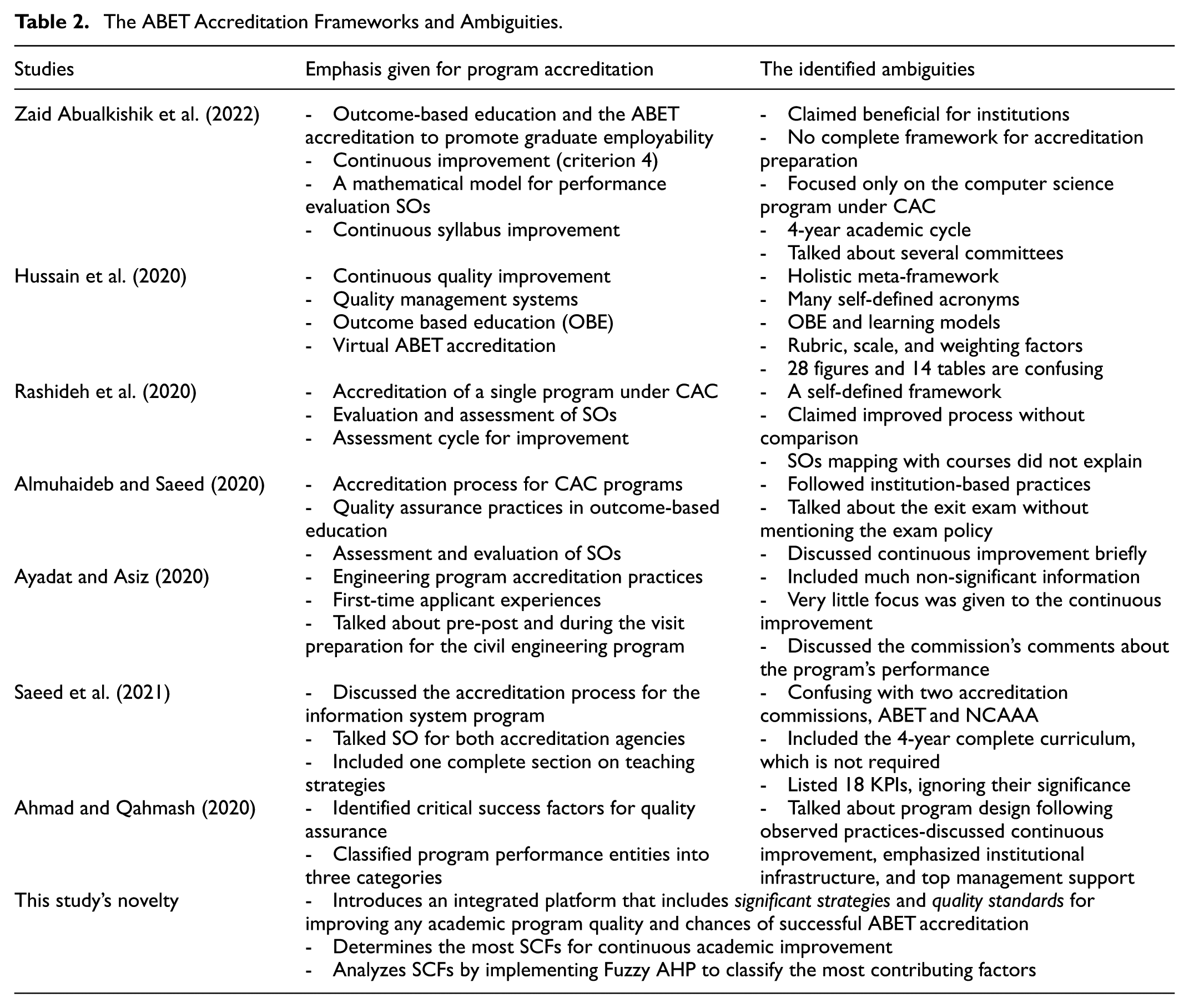
At the same time, several studies have focused on developing an academic quality culture and the program’s continuous improvement, in addition to the ABET accreditation framework (Ahmad & Qahmash, 2020). Similar studies emphasized the need for novel approaches to accreditation process management in higher education (Almuhaideb & Saeed, 2020). Establishing a quality improvement system, a sustainable academic model, and the ABET accreditation framework is of utmost priority for such studies. Noticeably, academic quality improvement and program accreditation framework that follows dynamic concepts in multilevel settings in a multidimensional approach is highly desirable. The UNESCO CEPES project objectives were to introduce new terms of quality and accreditation in the contextual settings of an academic program in a university environment (Vliasceanu et al., 2004). Academic service quality in HE is dynamic and contextual, relating to the course and teachers (El Alfy & Abukari, 2019). Academic service quality factors and functional aspects greatly influence improving HE quality (Teeroovengadum et al., 2019). Table 2 includes studies that emphasized academic quality practices for ABET accreditation and shows the ambiguities around accreditation frameworks determined by the presented study. Ambiguities around academic quality standards, assessment approaches, and accreditation must be considered (Vliasceanu et al., 2004) for program performance in HE.
The ABET Accreditation Frameworks and Ambiguities.
Ascertainment of Articles in Literature
A comprehensive search was conducted for the most relevant articles following the study’s objectives. The keywords “ABET accreditation” and “academic quality improvement in higher education” were searched on the Web of Science, Scopus, and Google Scholar databases. Three core aspects were emphasized while scrutinizing the collected articles: the ABET accreditation framework, contributing factors and academic quality improvement. This scrutiny involved thoroughly reviewing the articles to ensure they met the study's objectives. Among several articles, 25 were relevant and close to the study’s objectives. These articles were instrumental in developing this study; hence, all articles were cited following the significance and content flow.
The Observed Academic Quality and Accreditation Management Framework
The adopted framework has followed international and national academic standards, such as the national quality framework (NQF), the university’s academic policies, the ABET accreditation standards and the department quality-intensive approaches (Mohiuddin, Islam, et al., 2019). The framework has been adopted over the years, involving top management and the program’s stakeholders (Ahmad & Qahmash, 2020) for academic excellence, professionalism, integrity and inclusiveness in the university environment. Figure 1 illustrates the program assessment cycle, which includes program performance indicators and the constituencies. The department evaluates the program performance at multiple levels in a cyclic way. Figure 2 demonstrates the program quality assurance process by including the associated program performance entities.

Program performance assessment cycle.

The program quality assurance process.
Strategies for Continuous Improvement
For continuous academic improvement, the department follows a cyclic assessment process (see Figure 1), which includes program performance and the SOs performance evaluation process (Shafi et al., 2019). Significantly, the assessment cycle has shown tremendous improvement in program performance over the years. Indeed, the observed framework was appreciated during the program evaluation by the ABET accreditation commissions on all the candidate programs. Here, this study’s authors discuss one candidate program (from CAC) as a sample case out of eight programs that have been offered at the university.
The program’s quality performance is supervised and evaluated by two core committees: the academic development and quality committee (ADQC) and the program educational unit (PEU). Faculty members from these committees are responsible for developing academic strategies and implementing associated practices in a coordinated approach in the department (Ahmad & Qahmash, 2020). Senior members conduct workshops and training programs focusing on such strategies and emphasizing teaching methodologies, thinking-based learning, and potential assessment methods for evaluating program learning skills performance (Mohiuddin, Islam, Talukder, et al., 2020). The outcomes of such practices improve teaching-learning abilities and contribute to the quality delivery of the program. The following sections (see “Strategies for Continuous Improvement” to “Study’s Context”) include the core strategies observed for the program quality improvement and accreditation purposes.
Effective Practices
The candidate program follows an effective standard documentation process for continuous improvement (Zaid Abualkishik et al., 2022). Several document templates for this purpose are being provided by the Saudi national educational monitoring agency (i.e., NCAAA), which are also efficient for ABET accreditation (Ahmad & Qahmash, 2020). Some of these templates, course specification (CS), course report (CR), and course file (CF) are followed for academic activities (Mohiuddin, Islam, Talukder, et al., 2020) throughout the semester. The department adopts these documents for delivering the curriculum courses and quality delivery of the program. Additionally, the annual program report (APR) is used to record the program’s performance, including the measurement of program key performance indicators (KPIs) at the end of the semester (Mohiuddin, Islam, et al., 2019). Besides, the department schedules stakeholders’ surveys to evaluate the program’s performance. These documents are developed, revised, and reviewed by the ADQC for program improvement and made available for faculty members and stakeholders. The department has adopted a central document repository mechanism to manage documents and evidence and allow authorized access.
PEOs Formulation and Evaluation Process
The department follows a well-structured feedback system for developing and reviewing the PEOs (Rahman et al., 2019). It reviews PEOs periodically involving the program stakeholders, such as the external advisory board, faculty members, graduating students, alumni, and potential employers (see Figure 1; Ahmad & Qahmash, 2020). The ADQ committee schedules PEOs’ surveys, conducts meetings with the external advisory board, analyses participants’ responses and prepares outcome-based reports (Zaid Abualkishik et al., 2022). The department embraces stakeholders’ recommendations and suggested improvement actions and considers them in each revision of PEOs and program improvement plans (Rashideh et al., 2020). Additionally, the whole process of PEOs’ evaluation occurs periodically in the cycle of achieving the program’s continuous quality improvement.
Student Outcomes and Performance Evaluation
For an academic program, student outcomes (SOs) are the statements that describe the program’s learning skills (Zaid Abualkishik et al., 2022). Generally, SOs are developed by involving program stakeholders and aligning with the program goals, mission, and PEOs (Shafi et al., 2019). In addition, the ABET accreditation requirements for SOs are considered while formulating SOs. After the necessary approval, SOs are made available in the public domain, and the whole process repeats on each review cycle.
For SO’s performance evaluation, the department assesses them under the direct assessment method. Every semester from the curriculum, 8 to 10 core courses, including the capstone project, are selected to evaluate SO’s performance using predefined KPIs and applying rubrics (Ahmad & Qahmash, 2020). Faculty members evaluate student course performance by following the course assessment methods (from the course delivery plan) and measuring course learning outcomes (CLOs) against each SO (Shafi et al., 2019). The assessment outcomes are recorded in a course report (course executed summary) and a course file. The course file comprises documents and evidence (Mohiuddin, Islam, et al., 2019) that are generated during a course's delivery and at the course completion every semester. The outcomes of SOs’ performance measurement and course files of all offered courses are organized in the ABET preparation room for future reference. Besides, the department evaluates SO performance yearly by conducting the exit exam (Rashideh et al., 2020). The exam questions are designed following the predefined exam policy mentioned in a course execution plan. The outcomes of SO performance data are benchmarked with the set targets, correlated to strategic planning, and developed various reports for performance improvement (Mohiuddin, Islam, Talukder, et al., 2020). The department ADQ committee analyzes these reports and identifies actions to improve the program’s performance (Zaid Abualkishik et al., 2022).
Closing Assessment Loop (CAL)
The candidate program learning skills are defined in six SOs (a–f), and their performances are evaluated following the close assessment loop approach (Mohiuddin, Islam, et al., 2019). The selected courses’ performances against SOs are evaluated, and performances are measured using the KPIs and applying rubrics (Mohiuddin, Islam, Talukder, et al., 2020). The measured performances are compared with the previously set SOs’ targets to verify SO’s attainment (Shafi et al., 2019). Usually, course coordinators, in coordination with the course teachers, are responsible for assessing the SO performance throughout the semester and submitting the final evaluation reports to the ADQ committee to prepare each SO's consolidated performance report (Zaid Abualkishik et al., 2022). The committee analyses the SO’s evaluation reports and extracts strengths, weaknesses, and suggested actions. The committee takes the necessary initiatives to implement the suggested actions and monitors the implementation in the subsequent delivery of the program. The SO's performance evaluation cycle repeats each semester and achieves PEOs.
Novel Accreditation Management Strategies
This section discusses the novel strategies, the core aspects, and the required practices for obtaining ABET accreditation for an academic program. These practices have been proven successful in obtaining the accreditation of the university’s eight programs for the two accreditation cycles, that is, 2016 (first) and 2022 (renewal). The following paragraphs discuss the essentials of ABET-SSR criteria for program accreditation (Ayadat & Asiz, 2020) and the adopted accreditation management.
Criterion 1: An aspirant/candidate program must talk about student admission to the program, methods of student performance evaluation, student transfer and credit hours transfer policies. Additionally, it is advisable to highlight the transfer policies between academic programs, colleges, and universities. Furthermore, it should include work in lieu of course guidelines and graduation requirements. Finally, a minimum of five randomly/alphabetically selected students’ recent transcripts must be attached.
Criterion 2: Program educational objectives (PEOs) and mapping PEOs with the program mission, college mission and university mission must be discussed in this criterion. Noticeably, consistency should be maintained when relating PEOs with the other constituencies of the program. The PEOs must be revised periodically, considering program goals, contemporary technologies, and industry requirements. The PEOs of an academic program should be formulated considering the feedback of program constituencies, such as the program’s external advisory board, employers, faculty members, and alumni. Indeed, it is suggested that the relation between the program constituencies should be showcased using a graphical representation, that is, the program tree, which will be more significant under this criterion.
Criterion 3: It involves student outcomes (SOs) and their association with the PEOs and the program curriculum. These outcomes are expected to be attained by the graduating students upon completion of the program. The program administrators can develop new SOs or adopt them from the ABET disciplines (CAC or EAC). Additionally, the relationship between SOs and PEOs through graphical mapping can be more effective. Besides, a matrix must be prepared by showcasing SOs mapping with the curriculum courses and including the course competency level with the coding, such as (I: Introductory, R: Reinforced, E: Emphasized). Indeed, the SOs should be published in the public domain, such as on the Internet, in the program brochure and on the institution’s premises.
Criterion 4: Continuous improvement is the core criterion of the ABET-SSR and is crucial for effective program delivery. This criterion requires well-defined strategies and effective practices for attaining SOs, PEOs and quality program delivery. Noticeably, this criterion plays a vital role in obtaining ABET accreditation. We discussed the strategies and practices for program continuous improvement in section “The MCDM-Based Methodologies.” A candidate program must follow some essential practices while delivering the program-associated activities. It involves the program stakeholders and their active participation in evaluating program performance (using direct and indirect assessment methods) and achieving program learning skills. The outcomes of the program’s performance help students and faculty members improve their learning-teaching abilities. Besides, these academic practices enable a platform for the program’s continuous improvement.
The program administrators should develop some essential documents for course delivery effectiveness, such as a course specification and a course report. Some additional documents must be designed to evaluate and measure SOs’ performance. Managing a course file that includes samples of course execution documents will be significant. These documents should be developed, revised, and available to program stakeholders. Indeed, these documents facilitate recording the direct and indirect assessment outcomes of the program’s performance for future reference.
For a direct assessment method, the administrators should select 8 to 10 core courses for evaluating SOs’ performances. The course performance can be evaluated and measured using predefined KPIs and rubrics. Alternatively, an exit exam can be conducted for the graduating students in the core courses, and the exam performance can be analyzed to determine SO’s performance. The performance outcomes must be considered for the program’s improvement plan. Under the indirect assessment method, the program supervisors must plan surveys for the program stakeholders, such as alumni, graduating students, faculty, employers, and EAB members. Indeed, the surveys’ outcomes should be used to improve the program delivery along with the CAL indicators for the program’s continuous improvement.
Criterion 5: Under this criterion, curriculum details should be covered, highlighting the total number of courses, credit hours, and course levels. Essentially, the courses must be categorized according to the ABET curriculum requirements. These courses are usually classified into general, program, and program-specific criteria (considering the program disciplines). Finally, course syllabi should be written in the ABET template in the SSR appendix.
Criterion 6: This criterion talks about faculty details of the candidate program. It should include the faculty member details, such as the number of faculty members, qualifications, rank, specializations, experience, courses taught, and workload. Moreover, it should include the program’s provision for faculty professional development, such as scientific research and academic development training.
Criterion 7: Facility enables an effective platform for delivering an academic program in a university environment. A candidate program must discuss static and operational facilities, such as staff and faculty offices, learning resources, student clubs and related facilities. Further, the program should discuss laboratory facilities, computing resources, research facilities, controlling and maintenance policies, and general facilities. A graphical representation of the facilities is suggested to showcase them more effectively.
Criterion 8: Institutional support is the crucial criterion of the SSR. It requires discussing the institution’s leadership, including higher and program-level administration. Besides, it is preferable to showcase different administrative levels through organizational charts. Further, the program administrators should discuss the role and responsibilities of the program chair. Financial sources and support for the program must be explained, possibly with budgeting. Faculty members' hiring and retention policies should also be highlighted. Finally, faculty professional development support and the program criteria should be discussed. Notably, the required appendices should be attached to the SSR; for instance, Appendix A must include course syllabi.
Study’s Context
Saudi universities have expedited the academic programs’ accreditation process following the Saudi Vision 2030 higher education objectives (Mohiuddin et al., 2023). The presented study discusses the successful accreditation management observed at a prestigious Saudi university for its eight programs (5 from EAC and 3 from CAC). The study was conducted at the university, the leading one in the Southern region of Saudi Arabia. It is one of the largest universities in the Gulf region with a geographical area of 10 km, with more than 72,000 students enrolled in 50 colleges for the academic year 2021 to 2022 and 3,721 faculty members from across the world (Ahmad & Qahmash, 2020; Mohiuddin et al., 2023). The program accreditation management’s core aspect is the framework adopted for academic excellence and successful accreditation.
Participated Academic Experts (PAE)
The eight heads of academic development and accreditation units, 32 senior faculty members, eight heads of the department of the candidate programs, two vice-deans of academic development and quality units and three deans of the colleges contributed to the quality delivery of the academic programs. Moreover, these experts were actively involved in obtaining the ABET accreditation for the eight programs and agreed with the objectives of the current research. Significantly, their suggestions were integral for developing the study’s scope, designing the research objectives, and determining the core dimensions and their SCFs (see Table 3).
Academic Experts Involved in the Program Accreditation Process.

Significant Contributing Factors (SCFs) and Dimensions
Academic quality and accreditation are the most substantial aspects of higher education. According to the UNESCO-CEPES 2007 project (Vliasceanu et al., 2004), academic quality is defined as quality as excellence, and accreditation is “accreditation is the process by which a non-governmental or private body evaluates the quality of a specific educational program in order to formally recognize it as having met certain pre-determined minimal criteria or standards.” In literature, (Ilyas, 2019) highlighted six commonly accepted sources for total quality management, and it determined five SCFs for accreditation. Noticeably, (Ahmad & Qahmash, 2020) identified eleven CSFs and classified them into three domains for establishing academic quality excellence and obtaining ABET accreditation. The current study observed the following four dimensions (sections “Academic Strategies [AS]” to “Feedback and Surveys [FS]”) that are core for developing the academic quality culture and obtaining ABET accreditation for the eight programs in the university. The selected dimensions and 16 SCFs are discussed further and depicted in Table 4.
Academic Quality Dimensions and Their Factors.

Academic Strategies (AS)
Academic programs need to be reviewed, restructured, and attractive to students. Robust strategies are required to improve program effectiveness, program quality delivery, employability of the program graduates, and program sustainability (Wiek et al., 2011). The current study emphasizes the following strategies and determines four SCFs (see Table 4) under the academic strategies dimension. These factors are significant for academic quality and curriculum design. A curriculum design regards specific strategies and the program’s scientific knowledge. It should consider the stipulated components (Ahmad & Qahmash, 2020), such as skill development, industry-focused, practical-oriented, accessibility to learning resources, career readiness, lifelong learning, and provision of innovative learning paradigms.
Outcome-Based Learning (OBL)
Outcome-based learning is a paradigm shift in HE and has proven to be one of the pivotal requirements of job markets and accreditation agencies (Mohiuddin et al., 2023). Indeed, HEIs must practice certain factors (see Table 4) that contribute to OBL involving innovative and effective pedagogy. It brings a sustainable paradigm shift to traditional learning approaches and assures graduate employability. Noticeably, many HEIs successfully practice outcome-based learning and involve all stakeholders to achieve institution talent goals (Almuhaideb & Saeed, 2020).
Continuous Academic Improvement (CAI)
Achieving academic excellence is the topmost priority of HEIs and shall be achieved through continuous quality academic performance (Mohiuddin et al., 2023). Quality in HE is defined by considering stakeholders’ perspectives. A study (Tsinidou et al., 2010) included the perception of quality in HE, such as perfection and value for money. Another study (Ahmad & Qahmash, 2020) highlighted the quality improvement structure of an academic program. It raised the importance of program performance elements, such as PEOs, SOs, curriculum, and CLOs, for continuous improvement. The current study reconfirms these elements’ significance and finds that the following factors (see Table 4) contribute most to continuous academic improvement.
Feedback and Surveys (FS)
For quality delivery of an academic program, stakeholders’ feedback and conducting various surveys are the most vital approaches in HEIs (Mohiuddin et al., 2020). Saudi universities emphasize these practices for improving the educational system, university ranking, and obtaining national and global accreditations (Almuhaideb & Saeed, 2020; Mohiuddin et al., 2023). The feedback mechanism should involve the program constituencies (see Table 4) since their feedback significantly contributed to the program’s quality assurance.
Methodology
Regarding the study’s scope, the design follows its research objectives and the actions required for the problem (Mohajan & Mohajan, 2018) or ambiguities in section “Introduction.” It adopts a qualitative empirical research and analytical method (Tsinidou et al., 2010), and it is described as follows: First, a literature review was done to find the ABET accreditation frameworks that cover the core aspects, contributing factors, and sustained educational development. Secondly, it showcases the adopted framework (Mohiuddin, Islam, et al., 2019) and the observed methods for the accreditation management for the university’s eight multiple programs (five from EAC and three from CAC disciplines), see section “The Observed Academic Quality and Accreditation Management Framework.” Thirdly, the research design explores analytical methods to rank the relative importance of the SCFs and applied Fuzzy AHP (Ahmad & Qahmash, 2020) to determine the SCFs’ contribution to sustained education development (Tsinidou et al., 2010); see section “Application of MCDM Methodologies.” Several participants (see Table 3) helped the study’s authors determine the SCFs and agreed with the study’s objectives. Finally, it answers the research questions (see section “Introduction”) that were framed considering the literature gap.
The MCDM-Based Methodologies
Improved accuracy is desirable when analyzing several competing criteria and factors for decision-making (Ahmad & Qahmash, 2020). The current study adopted the analytic hierarchy process-group decision-making (AHP-GDM) methodical group decision-making technique to eliminate the study’s participants’ biases and to analyze the SCFs considering the recommendations (Noorulhasan Naveed et al., 2020).
AHP-GDM Methodology
Many researchers employed AHP, a systematic decision-support method developed by (Saaty, 2008), to achieve accuracy when a multi-criteria decision-making process is involved, for example, rank hierarchies (1–5). Moreover, AHP is a structured method that solves complex decision-making problems using a systematic approach. It supports effective solutions methodically where different degrees of structural complexity problems are involved in the MCDM process (Muhammad et al., 2021). Decision makers’ (DMs) judgment is critical in pairwise comparison problem-solving, and DMs’ expertise is influential in obtaining solutions (see Table 5). However, it leads to biases when only one DM participates in the decision-making process, and the result could be misleading. Increasing DMs in problem-solving assures the most accurate and robust decision-making method. Besides, the GDM procedure involves additional DMs, and the obtained result applying it will be comparatively more significant. Noticeably, the GDM integration with AHP gives remarkable results in the decision-making problem-solving approach (Noorulhasan Naveed et al., 2020). The following is the AHP-GDM process explaining the current study approach.
AHP Scale (Saaty, 2008).

Step 1: The study’s components, factors, dimensions, and goals are defined using the AHP process, emphasizing the decision problem, and the process’s final objective (Ahmad & Qahmash, 2020).
Step 2: The hierarchical framework is used to classify the study’s objectives: the problem’s goal, dimensions, and the associated factors for each dimension. The highest progressive level, that is, dimensions, are divided into criteria and further split into sub-criteria (factors). Hence, the four dimensions at Level 1 and the associated factors at Level 2 are determined in the process.
Step 3: A decision matrix can facilitate a pairwise comparison to characterize the relative importance of each criterion. Following the nine-point scale (see Table 5), a group decision survey is used to enlist the assistance of expert decision-makers in the comparison process. In contrast, the components of an identical hierarchical structure are contrasted (Muhammad et al., 2021). For instance, a node with “n” items in the hierarchical structure needs n (n − 1)/2 comparisons. The study’s SCFs are structured to develop a single hierarchy, and later, a decision matrix or pairwise matrix “D” is formulated. The elements, dmn of the matrix D, are compared, that is, mth with nth to determine the element’s importance level.

Step 4: A procedure, eigenvectors, is used to determine the elemental priority weights following the synthesis of the pairwise comparison values. These weights are determined using the maximum eigenvectors and eigenvalues, as suggested by (Muhammad et al., 2021). The eigenvectors (λ_max) are calculated by applying equation (1).

Step 5: The decision consistency and pairwise comparisons are checked. Further, the consistency index (CI) is applied to measure the inconsistency level and consistency ratio (CR) for coherence. These are calculated using equations (2) and (3). The largest eigenvalue is represented by λ max and “n” is the number of elements of each matrix. Radom index (RI) is generated randomly, and the CI of the matrices. The maximum acceptable limit of CI and CR is .1 (Naveed et al., 2021). Besides, see the RI values in Table 6 for a different matrix size: N.


Step 6: To determine the priority weights (local weight), every element is considered and acquired by adding DM’s assessments (Naveed et al., 2021). Regarding the study’s objectives, finding, calculating, and figuring the final global weights, every element is adjusted in the diminishing request as per global prioritization and FAHP (Saaty, 2008).
N Versus RI Values (Saaty, 2008).

Fuzzy AHP Methodology
In the FAHP, a fuzzy set theory with an extension principle is indispensable when the inaccuracy in decision-making should be removed, and the possibility of causing human errors in judgmental decisions should be eliminated (Naveed et al., 2021). This methodology effectively reduces errors and improves decision-making accuracy (Naveed et al., 2019).
Fuzzy Set Theory
It is helpful in robust decision-making and when DMs decide in a crisp environment. It does not offer more alternatives to DMs, hence sometimes possessing judgmental bias and vagueness; incomplete information in crisp form may be misleading (Ahmad & Qahmash, 2020). For instance, the triangular fuzzy numbers (m1, n1, o1) or trapezoidal numbers (m1, n1, o1, p1) is used in pairwise decision-making.
The fuzzy set theory makes use of triangular fuzzy numbers (TFNs) for different arithmetic operations; two TFNs may be used, and multiplication is carried out using two TFNs (Ahmad & Qahmash, 2020). For instance, two TFNs: P1





Application of Extent Analysis Using MCDM-Fuzzy Approach
The comparison of two TFNs is carried out using the extent analysis principles (Ahmad & Qahmash, 2020). Following this study’s scope, two sets of (dimensions) and (factors) are considered as Y = {

Where
Stage 1: Establishing a hierarchy structure:
The study’s dimensions and CSFs are grouped into multiple levels of the hierarchy. The hierarchy is determined using the DMs’ feedback; thus, it is essential to frame a hierarchical structure for ranking (Noorulhasan Naveed et al., 2020). Therefore, the final hierarchy structure is obtained and the ranking for dimensions and CSFs is established.
Stage 2: Establishing the pairwise comparison using TFNs:
The dimensions and SCFs are compared considering DMs’ feedback (Ahmad & Qahmash, 2020). Further, the pairwise comparison is established using a comparison matrix, whereas the TFNs are used to associate relationships among such comparisons.
Stage 3: Obtaining the value of fuzzy synthetic extent:

Using fuzzy summation of TFNs, m extent analysis values

and

The inverse of the vector may be obtained as:

Stage 4: Obtaining the degree of possibility of supremacy for two TFNs:
That is,

and can be represented as:


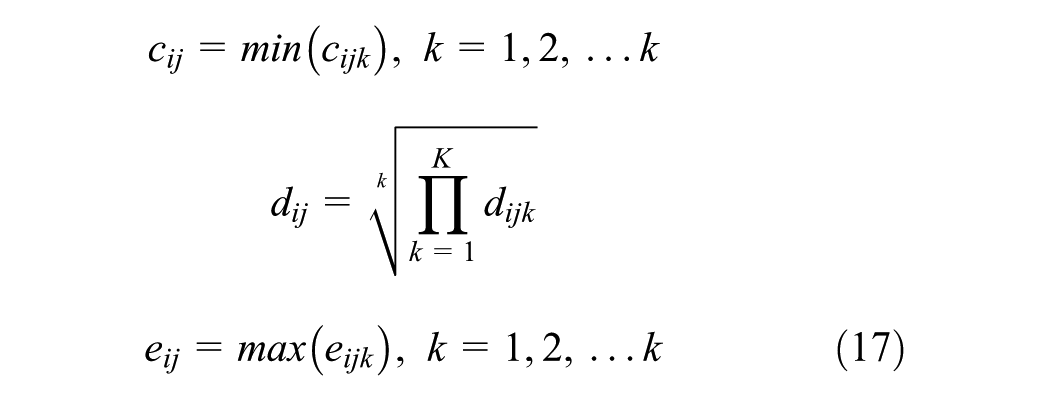
Here, various DMs are involved in group decision-making, for instance k, and the relative importance of the elements i to j is represented. Further, the aggregation is obtained using equation (17).
The two TFNs
Stage 5: Obtaining the degree of possibility for a given convex fuzzy number, greater than k convex:
Fuzzy number


Weight vector is derived as
Such that
Stage 6: Obtaining normalized weight vectors:
The normalized weight vector is calculated using equation (20), where C denotes the crisp number.

Stage 7: Obtaining the overall score for prioritization:
The overall priority weights for each dimension and SCFs are obtained by multiplying local and global weights, whereas the global weights are arranged in descending order (Muhammad et al., 2021). Finally, the overall rank and the required prioritization are obtained.
Application of MCDM Methodologies
The determined SCFs are evaluated and prioritized using MCDM-based approaches like AHP-GDM and FAHP (Ahmad & Qahmash, 2020). Significantly, AHP offers synthetic evaluation, which is adequate for decision-making and crucial for qualitative evaluation. Besides, FAHP aids in eliminating bias in decision-making (Naveed et al., 2021). A thoughtful literature evaluation was conducted to discover the SCFs for ABET accreditation management, and the four dimensions and the associated factors were determined (see Table 4). Figure 5 illustrates the framework used for MCDM methodologies for evaluating and prioritizing the factors.
Discussion and Conclusion
Saudi Vision 2030 is the reason for expediting the ABET accreditation drive of professional academic programs in HEIs (Mohiuddin et al., 2023). Besides, the Ministry of Education constantly monitors the accreditation status of HEI programs (Ahmad & Qahmash, 2020). For Saudi HEIs, ABET accreditation is the most prestigious international accreditation for CAC and EAC programs. Moreover, it is an opportunity to evaluate the program’s quality performance with the global agency and gain acknowledgement for meeting educational standards (Mohiuddin, Islam, et al., 2019). To obtain ABET accreditation, a candidate program’s administrators must handle program constituencies, the accreditation management framework, standard academic practices, and specific educational strategies (Almuhaideb & Saeed, 2020) effectively.
The administrators implement such strategies for the program’s continuous improvement and obtaining the ABET accreditation (Rashideh et al., 2020). These strategies are crucial for the program’s quality improvement and achieving PEOs. Indeed, implementing these strategies improves the teaching-learning process and the quality of the program delivery. Notably, the program quality performance can be assessed by evaluating SOs’ performances (Shafi et al., 2019) and measuring the program performance indicators (Mohiuddin, Islam, et al., 2019). Often, the program performance evaluation outcomes are significant when developing such strategies. Besides, the student outcomes’ recommendations and suggested actions are considered in developing and adopting such academic strategies (Almuhaideb & Saeed, 2020). The program’s stakeholders are involved in developing these strategies (Mohiuddin et al., 2023) and contribute their best in achieving the department’s talent goals. Furthermore, standard academic development activities are performed in the program development cycle for academic excellence. The program administrators exhibit their coordinated efforts to achieve PEOs, program learning skills, and the desired SOs’ performances.
Several studies (see Table 2) discussed the ABET accreditation frameworks and the practices used to secure accreditations. However, these studies overlooked certain ambiguities that exist within these frameworks. For instance, (Zaid Abualkishik et al., 2022) discussed an incomplete framework, (Hussain et al., 2020) presented a holistic meta-framework with numerous figures and tables, leading to several ambiguities. The absence of SOs mapping with the curriculum courses is a significant oversight (Rashideh et al., 2020). The discussion on the exit exam (Almuhaideb & Saeed, 2020) did not highlight the exam policy, while (Ayadat & Asiz, 2020) focused more on the commission’s comments. Moreover, Table 2 encompasses several ambiguities that our current study has identified, potentially leading to misinformation for readers.
This study presents a novel approach integrating academic quality improvement standards and effective strategies for obtaining ABET accreditation. The study’s significance includes determining SCFs for continuous improvement and performing a Fuzzy AHP analysis of these factors to classify their contributions to the accreditation management framework. Besides, the study answers the research questions that were framed considering the literature gap.
For HEIs, continuous academic improvement is the most significant domain for educational sustainability and provides a compelling platform for obtaining ABET accreditation (Ahmad & Qahmash, 2020) for an academic program (RQ1). Numerous studies discussed accreditation frameworks (Mohiuddin, Islam, et al., 2019; Rashideh et al., 2020; Shafi et al., 2019) and the continuous improvement of academic programs (Mohiuddin et al., 2020) in a selective manner. However, there is a clear need for an integrated approach (RQ1), and the current study aims to address this literature gap.
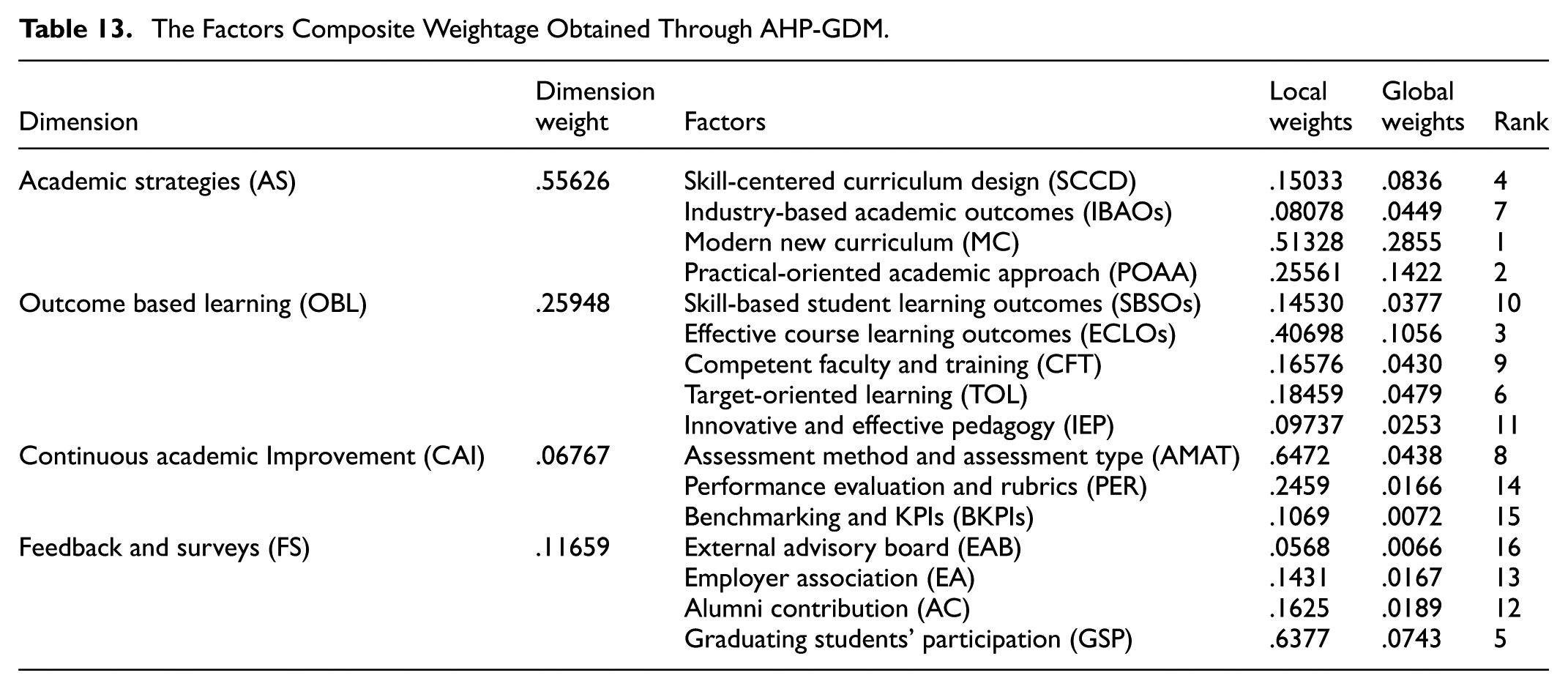
This study found a few factors associated with accreditation and academic quality improvement (Ahmad & Qahmash, 2020; Ilyas, 2019) in the literature (RQ2). The presented approach rigorously determined sixteen SCFs and conceptually distributed them into four interrelated dimensions (see Table 4) that were observed for academic quality excellence and obtaining ABET accreditation for the university’s eight programs. A few of these factors are similar to those that were published with the same objectives. These factors were analyzed using a qualitative empirical approach and ranked in relative importance using the Fuzzy AHP analytical method (RQ3). Figures 3 to 6 and Tables 7 to 17 demonstrate the results of the applied methodology. The authors ensure that Fuzzy AHP is one of the most effective methods for ranking and correlating such factors (Figures 7 and 8).

Triangular fuzzy number (P).

The intersection of TFNs (Noorulhasan Naveed et al., 2020).

The MCDM model for prioritizing SCFs.

Dimensions and their contribution.
The Dimensions’ Pairwise Comparison of Dimensions Using AHP-GDM by DM1.

Note.λ max = 4.128; CR = .047; CI = .043; RI = .900.
The Dimensions’ Pairwise Comparison of Dimensions Using AHP-GDM by DM2.

Note.λ max = 4.238; CR = .087; CI = .079; RI = .900.
The Dimensions’ Pairwise Comparison of Dimensions Using AHP-GDM by DM3.

Note.λmax = 4.152; CR = .055; CI = .051; RI = .900.
The Dimensions’ Pairwise Comparison of Dimensions Using AHP-GDM by DM4.

Note.λmax = 4.177; CR = .065; CI = .059; RI = .900.
The Dimensions’ Pairwise Comparison of Dimensions Using AHP-GDM by DM5.
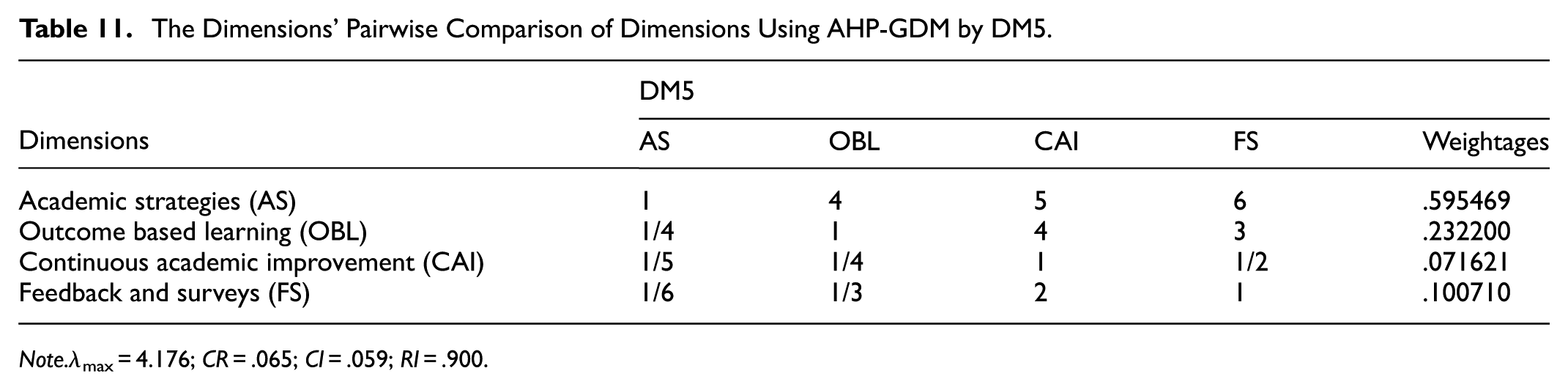
Note.λmax = 4.176; CR = .065; CI = .059; RI = .900.
Synthesizing of Pairwise Comparison of Dimensions.

Note.λmax = 4.187; CR = .069; CI = .062; RI = .900.
The Factors Composite Weightage Obtained Through AHP-GDM.
The Dimensions’ Pairwise Comparison Using FAHP.

Note.λmax = 4.187; CR = .069; CI = .062; RI = .900.
The Factors’ Composite Weightage Obtained Through FAHP.

The Factors’ Comparison of Composite Weightage Using AHP-GDM and FAHP.

The Factors’ Classification and Severity of Influence in AHP-GDM and FAHP.


Factors (SCFs) and their contribution.

Factors’ comparison ranks using AHP and FAHP.
The authors faced various challenges, such as the ambiguities around the accreditation management frameworks, limited contributing factors, and the absence of an integrated approach that assures successful accreditation, continuous improvement, and sustainable academic excellence. The authors’ initial concern was that many published studies ignored the integrated approach that facilitates together continuous improvement, effective educational practices, and the effective accreditation management framework for accomplishing the academic program quality performance objectives in HEIs. The study’s scope is limited to the framework for the ABET accreditation, the academic quality improvement dimensions, the associated SCFs, the sustainable educational strategies, and the rest to readers’ perception. The study’s implications define the integrated approach’s relevance to academic programs in HEIs, strategies for standard educational practices, SCFs, ABET accreditation framework, continuous improvement, and academic excellence. The top management of HEIs, decision-makers, and the academic program administrators find the presented approach is an enabler for achieving the program performance educational objectives and institutional talent goals. Future studies should consider the integrated approach for evaluating an academic program’s performance and adopt the accreditation framework for obtaining national and global accreditations for an academic program. Incredibly, an academic program’s stakeholders will find the presented approach more effective for any multidisciplinary education program for continuous academic improvement and sustainability.
The current study fosters an accreditation management framework and presents an integrated novel approach for the continuous improvement of an academic program in HEIs. Moreover, this approach ensures academic excellence and promises to significantly enhance the chances of successful accreditation of a candidate program in HEIs. It attracts HEIs’ top management and helps the academic program stakeholders achieve their educational goals. Indeed, HEIs’ program administrators should adopt the study’s presented approach to accomplish the program’s educational and performance objectives, such as continuous academic improvement, successful ABET accreditation, quality delivery of the academic program, and academic excellence. For instance, the presented approach has been adopted for several years; it has achieved remarkable results in obtaining ABET accreditation for the university’s eight programs, thereby ensuring sustainable education and academic excellence.
Footnotes
Acknowledgements
The authors would like to express their gratitude to King Khalid University, Saudi Arabia for providing administrative and technical support.

Ethical Considerations
The academic development and quality committee (ADQC) is one of the core committees of the university, which controls and monitors educational development and the accreditations (national and international) management following the university education policies and guidelines. The committee appreciated the idea and approved the study “Captivating strategies and cultivating quality standards for obtaining successful ABET accreditation and academic excellence: Analyzing the contributing factors by implementing Fuzzy AHP” in one of its meetings on February 02, 2024 with approval number BIS/ED-DEV/11022024. Although ethics approval may not be required for this study type, the committee issued this statement at the authors’ request.
Author Contributions
Khalid Mohiuddin: Conceptualization, writing original draft, funding acquisition, investigation, resources, interpretation of the outcomes. Quadri Noorulhasan Naveed: Methodology-designed revised methodology, software and validation of the methodology outcomes. Osman A. Nasr: Investigation, review and editing, project coordination, project administration, resources-provided computing resources at the project site. Nasser Tairan: Supervision and review of the paper, critically validate the result, and reviewed the final draft of the result section.
Funding
The authors disclosed receipt of the following financial support for the research, authorship, and/or publication of this article: The authors extend their appreciation to the Deanship of Scientific Research and Graduate Studies at King Khalid University, KSA, for funding this work through General Research Project under grant number: GRP/112/46.
Declaration of Conflicting Interests
The authors declared no potential conflicts of interest with respect to the research, authorship, and/or publication of this article.
Data Availability Statement
The authors of the manuscript certify that the current study’s domain does not require to apply any dataset. Hence data sharing is not applicable to this article as no new data were created or analyzed in this study.