



Abstract
Language and communication skills in children have an important place for full participation in social and independent life. Families and teachers have a great role to play from early childhood onwards, especially for children with DHH to be included in an environment rich in language and communication skills. Thus, based on the idea that it is significant for teacher candidates who will work in this field in the future to know why language and communication skills are significant for DHH children, what they should pay attention to while teaching, and what kind of arrangements should be made, the study aims to determine the opinions of teacher candidates about supporting DHH children’s language and communication skills and determine their perceptions about what kind of competencies teachers should have in communication skills. The study that included 76 teacher candidates studying in the Department of Special Education was conducted in line with phenomenology design in qualitative research method. The interview form was utilized as the data collection tool, the data were collected through interview technique and evaluated with content analysis. The main themes obtained are “Factors affecting the development of communication skills, Importance of supporting communication skills, and Components of effective intervention.” Participants emphasized the cooperation with families in early diagnosis and intervention, accessibility of the services provided to DHH children, and measures to monitor and increase the quality of practices.
Introduction
The communication approaches used by Deaf and Hard of Hearing (DHH) in their daily and educational life can differ around the world according to the preferences of the children and families. Following the early diagnosis of these children, the main purpose of special education is to teach native language in the early period through verbal language based on speech or sign language for the children to acquire communication and literacy skills (Adlof et al., 2022). According to Gallaudet Research Institute (2010), it is stated that early diagnosis, intervention, hearing aid implementation, and exposure to language acquisition have significant impacts on the development of DHH children’s spoken language. Miller et al. (2013) stated that purpose-oriented interaction and exposure to language skills in the early period support language development in DHH children. Gallaudet Research Institute (2010), drawing attention to using the sign-supported communication approach for DHH children besides these characteristics of spoken languages, stated that some children use sign language more easily in their language skills. In some studies, it is stated that these children use especially sign systems more easily in terms of phoneme and morpheme components of the language and thus they are more successful in reading and reading comprehension skills (Bennet et al., 2014).
In Turkey, newborn hearing screening tests have been used for early diagnosis and recording of hearing loss since 2005 (Republic of Turkey Ministry of Health, 2014). However, it is observed that there is a lack of clear information on the developments regarding the age at which hearing aids and education begin after diagnosis. In addition to this, it is seen that DHH children encounter spoken language later in their communication approaches due to individual differences of children, socioeconomic characteristics of the family, linguistic differences, deficiencies in the equal utilization of educational services for all children, lack of appropriate intervention, being in the risk group and delayed device use. Therefore, it is seen that DHH children without early intervention in our country prefer sign language more in their communication skills, while spoken language develops more in children with early intervention (Turan, 2018). In the language development of DHH children who are diagnosed and intervened early; trainings should be included in subjects such as phonological awareness, vocabulary, grammar, semantic knowledge, development of morpho-syntactic knowledge and using language in the appropriate context (Foorman et al., 2015). In this regard, Ingvalson et al. (2020) emphasized the importance of interventions in analyzing phonological codes and making sense of the analyzed codes in the development of spoken language. Similarly, Wie et al. (2020), referring to the richness of vocabulary, stated that increasing the vocabulary of DHH children will positively affect their comprehension skills and emphasized the importance of early education for this. Regarding language acquisition in the auditory verbal method, Zussino et al. (2022) stated that the morphological features in language structures are difficult for DHH children and that there are more difficulties in the use of inflectional morphemes. These difficulties are also valid for Turkish language and it is seen that children have difficulty in using complex structures in the language. Based on all this information, it is important to plan interventions that include vocabulary, auditory verbal therapies with technological developments, morpho-syntactic skills, pragmatic skills, and skills such as meaning extraction and expression in the development of auditory verbal language skills of DHH children from the early period (Cannon et al., 2021; Mood et al., 2022).
As stated in the literature, it is seen that there is no single approach that is appropriate for everyone such as auditory-verbal or sign language in DHH children’s language and communication skills. These children can use different languages, communication instruments, and technologies in different environments. Along with all this diversity, it is necessary to be exposed to sign language and/or spoken language in the early period and continuously (Joint Committee on Infant Hearing [JCIH], 2019). The development of DHH children who are together with the people whom they will take as role models in an environment rich in language and communication skills with hearing technologies is inevitable (Kushalnagar et al., 2010; Loy et al., 2010). Children decide on the best and most comfortable communication types for themselves in line with their communication preferences. Families can use multiple language and communication methods with their children, especially from early childhood. Similar to the literature, Moravkova (2011) stated that children’s preferences about language and communication skills differ according to individual characteristics such as whether deafness occurred before/after language, degree of deafness, and place of loss. It is seen that Martin (2009) mentioned the importance of the language used at home, family-school cooperation, time of intervention, and educational options at school in the following period in DHH children’s preferences related to communication and language skills. They also stated that a single approach, auditory-verbal or sign language, is not enough for DHH children; multiple approaches must be used together.
Achievements obtained in language and communication skills support all areas of children’s development, including emotional, social, intellectual, and personal skills. DHH children face many difficulties in communication, academic, and social skills, especially language skills, due to hearing loss (Adlof et al., 2022; Werfel & Lawrence, 2020; Zussino et al., 2022). Children with DHH, who have difficulty in acquiring expressive language and using it in connection with the environment, especially from early childhood, may face many problems in social-emotional skills. Several factors are important in coping with these problems and supporting children in terms of language and communication skills: (a) Families should be provided with information and support about their children’s use of hearing aids or cochlear implants from an early period. (b) School-family cooperation should be ensured to create an environment as rich as possible in language preferences such as sign language/verbal language in the child’s social environment. (c) DHH children should interact and communicate with their environment from early childhood (Costa et al., 2019; Preisler et al., 2002, Werfel & Lawrence, 2020). DHH children have different communication skills. These differences are due to factors such as child-specific and environmental variables (Werfel & Lawrence, 2020). These variables include factors such as degree, type, and diagnosis time of hearing loss, starting to education, and frequency of exposure to language (Geers et al., 2019). Regarding communication skills, it is seen that DHH children have difficulty expressing themselves, and starting, maintaining, and ending communication with their peers and teachers (Ministry of Education, 2016). According to inclusive education practices, a meaningful communication environment should be provided in the classrooms where DHH children attend. This environment is only possible with the use of spoken, written, and/or sign language (Lee et al., 2021). Thus, teachers should support students in this regard, take DHH children’s strengths and communication preferences into account, and make regulations for this. In fact, students who experience negativities in communication skills may experience behavioral problems, peer rejection, introversion, and a sense of loneliness. Thus, teachers working in special education or other fields should prefer correct communication methods and find a suitable intervention when working with DHH children. These competencies should be provided to teachers at the educational stages from the pre-vocational process before they start the profession and teacher candidates should be provided with opportunities to practice.
Education and training is a whole that starts in the family environment and continues in schools. In this process, the existing performances, interests and skills of children should be taken into consideration by families and teachers. It is a legal obligation in our country, as it is all over the world, for DHH children to receive education with a fair understanding of education with their peers in the educational environments they attend. Therefore, access to quality education should be ensured in the educational environments of DHH children with the cooperation of family and school. In the quality of education services and cooperation with the family, teachers’ knowledge on language and communication skills of DHH children, effective teaching skills, preparation and implementation of Individualized Education Plans, assessment skills, organizing the physical environment, and preparing and using teaching materials appropriate to the type of needs of students come to the fore.
In this study, special education teacher candidates’ opinions based on their perceptions about how they will support DHH children’s language and communication skills and what kind of social and academic adaptations they will make when they start their professional lives were investigated. This study aims to determine the opinions of teacher candidates about supporting DHH children’s language and communication skills and determine the perceptions of teachers who will work with DHH children about what kind of competencies they should have. Considering that opinions based on supporting DHH children’s communication and language skills will directly affect their education, reading skills, and classroom participation when working with students, the results of this study are thought to provide awareness about the methods used for DHH children’s language and communication skills and importance of language and communication skills. In line with the aim of the study, the study was based on the opinions of the teacher candidates who had taken the Supporting DHH children’s Communication Skills course, and answers to the following questions were sought:
According to special education teacher candidates, what do DHH children experience in daily life and school environments regarding communication and language skills?
What are the perceptions of special education teacher candidates about the responsibilities of teachers to support DHH children’s communication and language skills?
Method
This study was conducted in line with the phenomenology design in the qualitative research method. Qualitative studies are studies that focus on the experiences and direct opinions of the participants. The data sources of these studies are frequently obtained from observation, interview, and document analysis techniques. In the studies conducted in phenomenological design, the researchers focus on the perceptions and experiences of the participants related to a phenomenon or concept (Creswell & Creswell, 2018). In qualitative studies, the researchers focus on the nature of the reality. Determining reality requires both power and distinguishing quality indicators. When stating the visibility of the data as a whole, context is significant and alternacy and systematicity should be taken into account. For this purpose, the main questions of the study are “Why?, By whom?, For whom?, and With whom?.” The researchers must answer these questions (Banks et al., 2023).
Participants
76 teacher candidates studying in the Department of Special Education at the end of the fall semester (the first semester) of the 2022 to 2023 Academic Year took part in this study. All participants took and completed the course on supporting DHH children’s communication skills during the fall semester. In sample selection, maximum diversity and criterion sampling techniques were taken into consideration among purposive sampling methods. The authors chose pre-service teachers who would have responsibility for supporting DHH children’s communication skills in formal educational settings because they wanted to examine participants’ views on practices to support communication skills when working with DHH children. What should these practices be like, what is the level of knowledge of pre-service teachers who have not yet started their careers about evidence-based practices, what are their suggestions for educational arrangements and family involvement? How do they perceive these issues, the researchers wanted to determine the answers to these questions. The researchers took into account certain principles in the planning of the study, identification of participants, preparation of the data collection tool and data collection, data analysis and findings, and discussion and conclusion sections. The first of these principles is to clarify the rationale through a literature review and to conduct a preliminary interview with the participant group within the framework of the research problem. They applied the principle of ethical principles and the principle of informing about the research to determine the participants with the principle of volunteerism and criterion sampling technique. A face-to-face announcement was made by the first author to the students taking the course. The students were informed, and among the students who successfully completed the course, those who volunteered to participate in this study were identified.
Inclusion and exclusion criteria were determined. These criteria were explained to the students verbally and in writing as follows.
Inclusion criteria:
The main criteria sought in the participants who will contribute to the data collection phase are as follows:
(a) Continuing education in special education teaching undergraduate program, (b) taking and completing a course on supporting communication skills of children with DHH, (c) being willing and voluntary to participate in the research
The exclusion criteria were as follows
Students who did not meet the inclusion criteria and did not give written and verbal consent to the announcements were not included.
The course content on supporting communication skills of DHH children is as follows: What is communication, the importance of communication and communication skills in DHH children, language acquisition theories, speech perception, communication methods used by DHH children, listening support devices, etc. The researchers aimed to reflect on how teacher candidates support DHH children’s communication skills and variables regarding this with a critical view. The semi-structured interview technique was decided to be used in data collection. In Turkey, the candidates who want to be Special Education Teachers are enrolled in the program with a national exam and receive a 4-year undergraduate education. They graduate by receiving theoretical and elective field education courses and completing 240 ECTS (Council of Higher Education [YÖK], Special Education Teaching Undergraduate Program, 2018). In the 2022 to 2023 academic year when the data were collected, 76 teacher candidates participating in the study were final-year students in the special education teaching undergraduate program. The data were collected in the seventh semester of the participants, undergraduate education is a 4-year (4 years/8 semesters) education. The average age of the participants, 44 female and 32 male, is 23. All participants took the supporting DHH children’s communication skills course in the seventh semester.
Data Sources
In this study, the focus is directly on the opinions of the participants and understanding their perceptions about the phenomenon (Denzin & Lincoln, 2017). The data of the study consist of the interview form that the participants answered in writing and answers they gave to the same questions in the face-to-face interviews. The data were collected through the interview technique. The interview form which was prepared by receiving experts’ opinions consisted of five open-ended questions. The researchers first prepared a draft form based on the literature and submitted it to the opinions of experts, a special education teacher working with DHH children and a faculty member in the department of special education. The special education teacher suggested emphasizing the teachers’ roles in supporting DHH children’s communication skills. The first author conducted a pilot study with a teacher candidate using the form organized after receiving the experts’ opinions. According to the results of the pilot study, the first and second authors assessed the questions included in the form in terms of comprehensibility, clarity, and data collection time. The final form of the interview form consisted of demographic information and five open-ended questions (Appendix A). In the questions, it was taken into account that the questions were purpose-oriented and understandable and participants might detail their perspectives while answering the questions (Wilkinson et al., 2004). Thus, it was aimed to determine opinions in-depth.
Context and Setting
The data were collected as follows: The first researcher determined the day and time stated as appropriate by all participants. The participants were informed about the next week’s course day and time in the semester. The time of the meeting and classroom where they would meet physically were confirmed with the participants 1 day in advance. Sixty-five people explained that they would attend the meeting and 11 people stated that they could meet face-to-face at a different time on weekdays. Sixty-five participants gathered in a physically suitable classroom where there were tables and chairs for each participant. The first researcher explained the aim, duration, and implementation stages of the study. She collected data with 11 of 76 participants in her own office through face-to-face individual semi-structured interviews. These 11 participants were the participants with the code names between P66 and P76. The data collection process was completed in 2 weeks. The recommended time for the first 65 participants who gathered in the same classroom to express their opinions in writing was one-course session, 45 min. However, they were informed that time was flexible when they answered the questions and/or they needed additional time. In the face-to-face interviews conducted with 11 participants, the researchers avoided being directive for an effective data collection process, they encouraged conversation and gave feedback when something was incomprehensible. They acted unbiased and objective (Marshall & Rossman, 2016).
Transcribing Process and Trustworthiness
In this study, a series of processes were performed for the transcribing process and credibility. First, the same order of questions was followed for all teacher candidates in the written and face-to-face interviews. The participants who stated written opinions were reminded that they could start and complete any question they wanted and when they could not understand the question, they could ask the researcher. After the face-to-face interviews were conducted with 11 participants, participants’ approval was obtained for the written notes, the first researcher took written notes of what they said (The participants stated that they preferred written recordings of what they said instead of voice recordings). After collecting all field notes and data, the second researcher made the descriptive transcription of written documents. She added descriptive index and interviewer comments in accordance with the context by making the descriptive transcription and data organization of the individual interviews that the first researcher conducted face-to-face. She collected the transcriptions under a single file by taking into account the relationships of the data holistically and systematically. Thus, both researchers contributed to the data collection and preparing the data for analysis. The researchers used participant codes for each participant and defined a number for each of them. For example, P1, P2, P3, etc. As stated in the literature, in qualitative studies, to provide interpretive, constructive, critical, and creative information generation, the researchers asked themselves who, for whom, with whom, and from whom are they affected. They read the data over and over again in line with the principle of reflexivity (Banks et al., 2023; Esposito & Evans-Winters, 2022).
Data Analysis
The data analysis was conducted thematically according to content analysis. The six steps emphasized by Creswell and Creswell (2018) were followed. First, the data were organized and prepared, a holistic transcription was made. The researchers numbered the forms for each participant. Both researchers read the data; the first author compared the field notes and the literature scanning of the second author. In the third step, they coded the data. The researchers determined a code that has conceptual integrity for each unit they read. They reached themes and sub-themes from the codes. They compared different code lists and interpreted them in the themes. They calculated the percentage of matching and finally reached the findings. In conclusion, the data of the study were analyzed in the preparation, organization, and data reporting stages by taking the conceptual frame of the study and study questions into account. The data obtained from each unit analyzed at these stages were converted into themes as content analysis, the findings were reached by turning conceptual structures and data into quantity (Elo & Kyngas, 2008). The researchers made an in-depth and continuous effort to understand the opinions and experiences of the participants in the data analysis (Patton, 2015). Reflection is also significant in qualitative studies. As an indicator of quality, the reflection in this study is the fact that the students did practice in the school-department where the course was given during the fall semester and the course plans written/made by teacher candidates who did internships in the schools where DHH children studied in their practice files. These plans and reflections show the teaching practice product of teachers regarding DHH children. Another reflection is that both two researchers gave supporting DHH children’s communication skills course in the undergraduate level teaching education program where they worked and took notes about this process. They took these notes into account in the analysis process and sought a holistic answer to the question of what special education teacher candidates say and perceive about supporting DHH children’s communication skills. In qualitative studies, the fact that the participants and researchers reflect as an indicator of quality is significant for validity, reliability, and transparency. In this study, a significant detail about reflection and context is that the first researcher was responsible for the teaching practice course of the teacher candidates who constituted 10% of the participants and she conducted a practice course regarding supporting DHH children’s communication and language skills. The daily notes she took during the practices were reflected in the analysis process.
Coding Structure and Coding Reliability
The researchers carried out repeatability and inter-coder reliability calculations to provide reliability. In order to ensure inter-coder reliability in the research and to reduce possible biases against the reliability of the data, researchers with qualitative research expertise worked in the coding process. All analyses were conducted with the participants’ statements intact. While carrying out these steps, they took the following precautions suggested by Brantlinger et al. (2005): They chose the participants in line with the purpose and informed them about the ethical rules. They paid attention to the principle of transmissibility of data. In the context, they wrote with which questions and in what kind of an environment the interviews were conducted, they also wrote the processes such as participant determining criteria into this report with transparency. To avoid prejudices, the two researchers made coding independently in the data analysis and inter-coder “reliability analysis” was carried out. The themes and sub-themes obtained in the last stage of the reliability process were converted into themes that reflect the opinions of teacher candidates about DHH children’s communication skills, effective factors in supporting communication skills, and how teachers should support DHH children. The inter-coder reliability result was calculated as 91% in the reliability analysis. It was seen that the inter-coder compliance percentage was high and this result showed that the measurement reliability was high (Creswell & Creswell, 2018). The researchers made this calculation in accordance with Reliability = [Agreement/(Agreement + Disagreement)] × 100 formula (Miles & Huberman, 1994). Triangulation was included. Triangulation is a method used to increase the credibility and reliability in the study (Cohen et al., 2002). The researchers received written and verbal data from the teacher candidates in the scope of the course, addressed multiple data sources. For this purpose, the opinions of teacher candidates were received in writing and verbally, and the first author took field notes. The first author who gave the course benefited from the notes she took regarding the internship courses at school during the semester, observation, related teacher candidates’ classroom participation and homework they gave, and the instructional plans prepared to be applied in the classrooms where DHH children attended. Both two researchers who hold doctoral degrees in special education had Turkish Sign Language Instructor certificates. They gave Turkish Sign Language Education Courses in special education teacher training programs.
In conclusion, they have a comprehensive knowledge of what the teacher competencies are to provide quality and inclusive education with equal opportunities to DHH children by special education teacher candidates. They wanted to determine and understand in-depth what teacher candidates say about DHH children’s education, supporting their communication skills, and the problems they experience. The researchers benefited from two or more data sources in this study. About the reality of reflections, the first author asked the question “Is there any other opinion you would like to add?” in the form that include opinions in writing, this question was included in the form in writing, and she received the confirmation of 11 teacher candidates about what she said at the end of the interviews. The principles of reflection, confirmation, and transmissibility were taken into account; while they reflected the processes they conducted in all steps of the study report, they took the rules about the roles of the researchers into account (Mays & Pope, 2000).
Results
In accordance with the content analysis, the data collected were submitted under 3 main themes and 12 sub-themes. The researchers transcribed the data holistically and the conceptual frame was created in accordance with the study questions. These main themes are “Factors affecting the development of communication skills, Importance of supporting communication skills, and Components of effective intervention” as stated in Table 1.
Main Themes and Sub-themes.
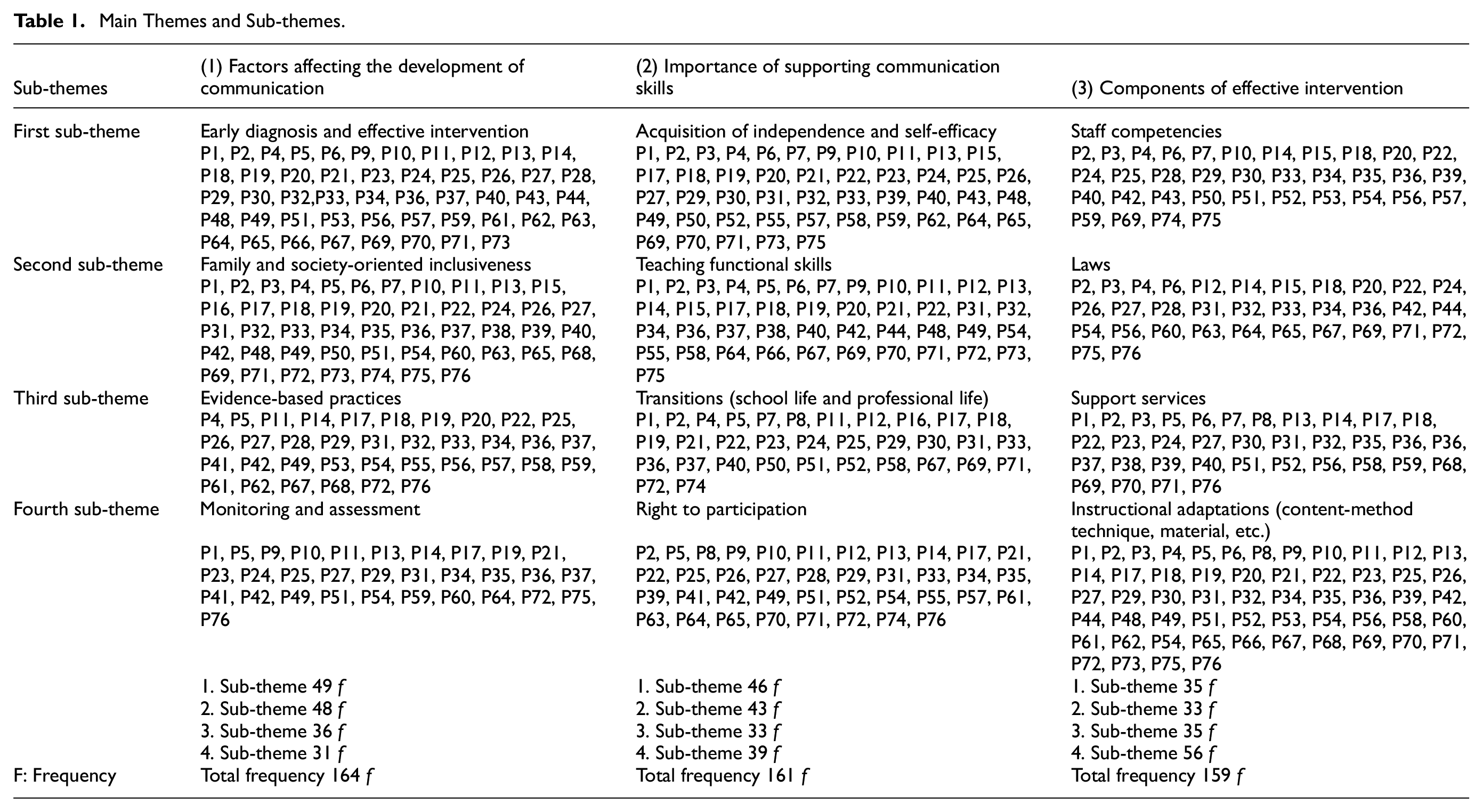
Each main theme contained four sub-themes. In 12 sub-themes in total, frequencies were calculated by taking into account the opinions stated by the participant teacher candidates about that sub-theme. The total number/frequency of opinions related to that main theme was calculated as statements based on the frequency calculation of the opinions. For example, the first main theme “Factors affecting the development of communication skills” consisted of “Early diagnosis and effective intervention” 49 (f), “Family and society-oriented inclusiveness” 48 (f), “Evidence-based practices” 36 (f), “Monitoring and assessment” 31 (f), 164 (f) in total (While reading the findings, they should be interpreted by taking into account that each teacher candidate can state opinions under more than one sub-themes and main themes). For example, in the first main theme, as seen in. Table 1, 49 (f) of 164 (f) opinions emphasized “Early diagnosis and effective intervention” as the first sub-theme. On this subject,
P2 said “… early diagnosis is very important. For the DHH child to become a part of society, early intervention should be started and communication preference of the child should be based on. When the child acquires communication skills, his/her interaction with his/her peers will also be positively affected.”
P34 said “In the studies conducted in recent years, the critical time for DHH children is before the age of 2. It is stated that they benefit from the opportunities of early intervention and this situation will contribute to language development. The factors affecting DHH individual’s communication skills and language development are the time of the diagnosis, the time of the hearing aid, whether the family received education, using the appropriate methods, age of starting education, and level of hearing loss.”
In the “Family and society-oriented inclusiveness” sub-theme, P6 said “The first social environment of DHH children is their family. Today, with newborn scanning in line with technological developments, DHH children can be detected when they are born. The early diagnosis and early implementation of hearing aids are related to the interest and effort of the family.”
P17“…family is the first source of communication for DHH children and it has an important power in terms of providing a language model. Families can contribute to the language development of children. Thus, family education is important. When talking to their children, parents should form short and simple sentences and take the visual attention and their interest in materials into account.”
About “Evidence-based practices,” the participants most often mentioned the necessity of obtaining information about evidence-based practices in the pre-vocational period. They stated that family education should be carried out to provide social awareness. For giving information to the parents about scientific practices, they suggest that the media should include quality education programs and that experts should conduct studies based on interdisciplinary social cooperation at schools. They drew attention that evidence-based practices will be effective in DHH individuals’ employment after education and being productive individuals.
P14 said “The main determinant of the approach on which the educational process will be conducted is the communication method to be used in educational activities. So, firstly teachers should know DHH children’s communication preferences and alternative communication methods and can distinguish science-based practices.”
P17 said “…Communication should be planned with written, verbal, sign language, and most importantly, child’s interest and strengths. Scientific developments should be followed and material support should be provided at school.”
P32 said “…Our priority is to understand DHH children, show sympathy towards them, and provide support without putting pressure on them, we should provide science-based practices and social participation-based support.” The participants, emphasizing the importance of “monitoring and assessment,” mentioned the effect of legal regulations and inclusive attitudes at schools. They emphasized the extent to which DHH children benefit from educational services and the reflection of the data regarding participation in education into legal regulations as educational policies.
For example, P37 said “While working with DHH children, prerequisite skills that will enable them to acquire new skills in the following years should be taught as priority skills. While determining prerequisite skills, DHH child’s initial performance level should be based on.” In general, teacher candidates stated opinions about cooperation with family in early diagnosis and intervention, accessibility of the services provided to DHH children, and monitoring to increase quality.
The second main theme of the study is the “Importance of supporting communication skills.” This theme included 161 (f) in total. In the first sub-theme, “Acquisition of independence and self-efficacy” is 46 (f), “Teaching functional skills” is 43 (f), “Transitions (School life and professional life)” is 33 (f), “Right to participation” is 39 (f) respectively; 161 (f) frequencies in total were included in the findings. Teacher candidates, emphasizing supporting independence and self-efficacy both in the family and in the school in “Acquisition of independence and self-efficacy” sub-theme, mentioned the use of various communication channels in DHH children’s social participation skills. For example,
P21 said “It is important that teachers or parents study with the children as a guide or model. This highly contributes to the DHH child’s speed of learning, a child who learns fast is positively affected in terms of self-confidence and motivation. While communicating with a DHH child, the teacher should pay attention to choosing concrete concepts and forming sentences with one instruction, benefit from visuals, and support child’s comprehension….”
P57 said “Sense of success should be supported in the learning environment by using different materials. For example, including toys, items suitable for daily routines, and natural materials in instructional plans prepares children for life. It is necessary to include tools and instruments that will provide visual support in teaching: graphics, videos, visual cards, maps, and pictures provide obtaining good results in DHH children’s education.”
P58 said “DHH children’s independent life skills depend on whether they have hearing aids. Activities that will support the development of receptive and expressive language should be conducted. For example, rich teaching in terms of visuals and concrete experiences should be provided in preschool and early childhood in teaching. We should work with story completion (verbal), an activity with tongue twisters, and listening activities.”
They drew attention to the importance of the early childhood period for DHH children and the contribution of the fact that families and teachers include adaptations that will support self-efficacy in DHH children, concretization, and interpretation practices through materials that draw the child’s attention.
The teacher candidates, emphasizing “Teaching functional skills,” focused on social and communal participation.
P40 said “To minimize the problems and difficulties related to DHH children’s social acceptance by their peers and environment, functional daily life skills should be provided in the early childhood. In the critical period, during language acquisition, families and the environment must offer alternative options in communication with the individual and support the confidence of expression.”
P42 said “Due to hearing, DHH children may have difficulties in distinguishing sounds, writing skills, distinguishing inflectional and derivational suffixes, and word order in the sentences; the purpose is DHH children’s education in environments where they can communicate and be supported in term of this. For example, while reading, it can be explained with visuals, showing the plot of the study with cards, videos, and drama.”
P44 said “DHH children should be supported with visual materials more. We should choose our aims in accordance with the DHH child’s level, communication and language skills, and attention skills especially while preparing materials. Acquisition of daily life skills can be provided by using concrete objects that address three-dimensional visuality, if possible. Materials that represent parts and the whole and can be disassembled and reassembled, pictures, photographs, beads of various sizes and colors, matching cards, and real objects can be used. Concrete materials regarding the courses such as mathematics and chemistry, cards describing everyday natural facts, and visuals will be highly effective. Rules of social life should be taught for social participation and teaching should be provided by being a model.” and stated their opinions about communication preferences, attention skills, and regulations supporting participation in communication including the early childhood period.
In the “Transitions (School life and professional life)” sub-theme, the participants emphasized DHH children’s acquisition of skills related to family, school, and social life and generalization. For example,
P22 expressed opinions by saying “For cooperation, the teachers and school principals working in the school should determine the needs first by contacting the teacher who is in the support service education of the institution where the child attends and the child’s family. Inclusiveness is very important. Physical arrangements, materials, and structure of the classrooms should be monitored and be accessible in the schools where DHH children attend.”
The last theme of the findings is “Components of effective intervention.” This theme which is 159 (f) in total consists of “Staff competencies” 35 (f), “Laws” 33 (f), “Support services” 35 (f), and “Instructional adaptations (content-method, technique, material, etc.)” 56 (f).
About “Staff competencies,”P40 said “…They must be able to plan social story activities supporting communication skills, plan group activities and cushion activities within educational games supporting mutual communication skills, conduct short story activities based on visuals and revised with Braille alphabet to support communication skills, can conduct role-playing activities by writing the instructions that include communication skills on a paper and children can act the instructions on the paper.”
In “Laws” sub-theme, they stated that it should be monitored how the laws reflect on the practices. For example, P28 said “First, I would try to arrange the classroom by cooperating with school management. I would prepare materials in line with the level of the children and try to increase variety.”
In the “Support services” sub-theme, P30 said “I would first approach comprehension skills for the development of communication skills while working with DHH children. Then, I would approach reading comprehension skills. It is necessary to work in cooperation with the family while working with DHH children. Because the children spend most of their time with their family outside of the school.”
P31 said “Drama activity would be a suitable activity for language development. It contributes to the development of DHH children’s language and communication, problem-solving, and creativity skills.” Regarding the “Instructional adaptations (content-method technique, material, etc.)” sub-theme, P69 said “I use concrete materials intensely. I would actively use the sense of sight in 100 % as the children have problems in communication. I also use activities such as touching, lifting, playing, and throwing which are related to psychomotor skills.”
In conclusion, it draws attention that the participants see teachers as the most important shareholders in carrying out accessible service arrangements and providing quality education with the principle of full participation from early childhood.
Discussion
In the first theme of the study, “Factors affecting the development of communication skills,” it is seen that the teacher candidates pay attention that early diagnosis and intervention, evidence-based practices, and inclusiveness should be carried out as family and society-oriented and these children should definitely be evaluated in the process. DHH children show different characteristics in many subjects such as the age of diagnosis, educational background, and cultural characteristics. Studies show that these children show great development in terms of language and communication skills when they are constantly and completely exposed to using sign language, verbal language, or both from their diagnosis in the early period (JCIH, 2019; Tobey et al., 2013). These studies also mention the importance of growing up in an environment that is rich in terms of language, being provided with family and school-based sample models, and implementation of necessary aids in the early period (Tobey et al., 2013). National Center for Hearing Assessment and Management (2018), drawing attention that support services should be provided for the families’ needs, aims, and desires for DHH children, emphasized that families can learn multiple language and communication methods and should determine the needs and the best communication method and use the methods accordingly. Similar to the literature, in our study, teacher candidates emphasized that DHH children should be supported in terms of the development of language and communication skills from the early childhood period and families have an important role in the children’s language development as the family is located in the center of this subject. In the literature, it is also stated that parents with normal hearing have difficulty communicating with their DHH children in the early period and children experience difficulties in the development of language skills as a result (Mitchell & Karchmer, 2004). Similar studies also state that delays in the spoken language of children decrease with early intervention services with newborn hearing scanning (Culbertson et al., 2022; Meinzen-Derr et al., 2011). In the development of communication and language skills, in addition to the factors caused by DHH children, the quality and quantity of language input of parents which are known as external factors play an important role. In studies drawing attention to the importance of parents, it is stated that DHH children’s effective relationship with parents in a rich environment in the early period will positively affect the development of communication and language skills (Arjmandi et al., 2021). In effective communication, parents’ contributions in terms of less complex sentence structures, shorter length of speech, and enriching the world variety are supported (Ambrose et al., 2015). In brief, it is seen that similar results with many studies are obtained in the scope of this theme, parents have difficulties in communication with their DHH children from the early period. Arjmandi et al. (2021) stated that quality and quantity of language are important variables in parents’ language and communication skills, Dilley et al. (2020) expressed that the complexity of parents’ communication skills with their child is adapted according to the child, Ambrose et al. (2015) stared that parents keep their mean length of utterance shorter and pay attention to the differences in words.
In the second theme of the study, it is seen that teacher candidates stated their opinions in writing about providing functional skills, supporting the transition to school/professional life, and providing self-efficacy in terms of supporting DHH children’s communication skills. The World Health Organization (2019) states that hearing loss may cause problems in individuals’ effective communication with others. Thus, individuals’ social-emotional development, self-efficacy, and some functional skills for daily life are affected negatively (Stevenson et al. 2015). In this regard, it is seen that Dammeyer (2010) states that DHH children experience difficulties in terms of psychosocial skills compared to their peers with normal hearing while DHH children who can effectively use sign language or verbal language in terms of communication and language skills do not have difficulties in psychosocial skills. Similarly, Hancock et al. (2017) stated that the problems in DHH children’s language and communication skills cause social phobia, anxiety, and social-emotional problems compared to their peers with normal hearing. Parallel to the studies in the literature, in our study, it is seen that teacher candidates stated opinions about DHH children’s acquisition of language and communication skills, self-efficacies, and functional skills related to daily life. Besides, another important subject emphasized in our study is supporting the transition to school and professional life.
In the third theme of the study, teacher candidates, who drew attention to the components of effective intervention, stated their opinions in writing about the importance of staff competencies, laws, support services, and instructional adaptations. Stevenson et al. (2015) stated that DHH children experience social-emotional difficulties regardless of the level and type of hearing loss. Besides support services for these children in inclusive environments, it is necessary to use effective intervention methods to develop their social communication with their peers. When these children who have additional needs are supported with assistive technologies in educational environments, their academic and social-emotional development is affected positively (Schwab, 2019). Thus, full participation of DHH children in inclusive education environments with their peers becomes easier. In the literature, in terms of DHH children’s successful participation in courses, it is stated that the most common problems are that their peers with normal hearing and teachers have limited knowledge about hearing loss and teachers have limited skills in the use of audiological materials and supporting children (Edmondson et al., 2019). In our study, teacher candidates stated that teachers need support in teacher competencies, methods to be used, and support services regarding DHH children. The findings of our study include that children who are not provided with sufficient access to auditory information in classroom environments have difficulties in academic and social interaction. In a study on this subject in the literature, it is stated that DHH children experience difficulties in language and communication in classroom group discussions even though they have sufficient speaking skills (Punch & Hyde, 2011). Zaidman-Zait and Dotan (2017) stated that DHH children have difficulty keeping up with the speed of speech and comprehension skills when talking to their peers and thus, they experience stress and isolate themselves socially. Thus, it is necessary for teachers to know what to do to create a positive classroom climate in inclusive environments and include activities that will support DHH children’s language, communication skills, and social-emotional development (Zaidman-Zait & Dotan, 2017) In the scope of the third theme, teacher candidates drew attention to the importance of laws and stated that teachers and other staff should know the legal rights of DHH children and conduct necessary arrangements in inclusive environments. In the literature, the studies conducted about legal rights state that it is important for teachers to improve their knowledge and comprehension about DHH children’s hearing loss and basic needs. The studies that express that policies and legislation should be developed about the participation of these children in educational services state that these children have the right to education in general education classrooms with equal opportunities with their peers with normal hearing (Edmondson & Howe, 2019). Thus, it is seen that teachers’ and families’ perceptions change positively with the participation of DHH children in educational services. Besides, many positive effects on DHH children’s academic, language, communication, and social development are mentioned (Edmondson & Howe, 2019).
Study Limitations
In this study, only special education teacher candidates’ perceptions and opinions based on their experiences were received. This may be a main limitation, the fact that the participant group consists of undergraduate students who will start the profession a few months later can also be a limitation. However, opinions of teachers working with DHH children can be obtained, opinions of special education teacher candidates who have not taken Supporting DHH Children’s Communication Skills course and/or teacher candidates who attend other undergraduate programs, and opinions of teachers working with DHH children can be investigated comparatively. The education of DHH children and the difficulties they experience in communication and language skills can be investigated based on their and their parents’ opinions.
Conclusion and Future Research
In conclusion, it is seen that teacher candidates have different experiences in supporting DHH children’s language and communication skills. According to the opinions of teacher candidates, the main factors affecting DHH children’s communication and language skills are early diagnosis and intervention respectively. Thus, it is stated that children will be able to catch the critical processes for the development of language and communication and acquire similar language and communication skills with their peers with normal hearing. Teacher candidates, emphasizing the importance of families’ support according to DHH children’s communication preferences, draw attention that inclusive services should be conducted with school-family cooperation. It is seen that they wrote their opinions about conducting practices regarding the development of language and communication skills with school-family cooperation and the necessity of assessment of these practices’ effectiveness. Intervention in the early period plays an important role in the acquisition of language and communication skills in all children. Thus, when thinking that DHH children experience similar processes with their peers with normal hearing, school-family cooperation, early intervention, and assessments are inevitable.
Another important result obtained from the written documents of teacher candidates is that they stated that supporting DHH children’s language and communication skills becomes prominent in independent life skills and acquisition of self-efficacy and it is necessary to provide children with functional skills. It is stated that DHH children who show effective language and communication skills with their peers and environment are more self-confident and more competent in social skills. It draws attention in the written documents that thus, their transition to school and professional life becomes easier, they feel more comfortable, and their anxiety levels decrease.
The other result obtained in the research is related to what teachers should do for DHH students in inclusive environments. Teachers should have characteristics such as creating an inclusive environment for DHH children, providing support services to students, making instructional adaptations, and having knowledge about the laws on this subject. The right to equal participation in inclusive education environments applies to all children all over the world, there are common opinions in written documents about providing awareness of the teachers, acquisition of knowledge, and creating a positive classroom climate for DHH children to benefit from these services. It is also stated that appropriately providing support services will contribute to the development of language and communication skills and the acquisition of social skills with their peers. Teacher candidates lastly drew attention to the legal rights and stated that teachers should create a positive classroom climate and cooperate with families and other staff regarding language and communication skills.
Based on the findings of the research, applied studies can be recommended for further research for the development of language and communication skills of children with DHH. In addition, studies based on teacher-family cooperation based on the development of language and communication skills of children with DHH can be recommended.
Footnotes
Appendix A
Acknowledgements
The authors would like to thank the teacher candidates who shared their thoughts and time with us.

Ethical Considerations
All procedures in studies involving human participants were performed following the ethical standards of the institutional and/or national research committee and with the 1964 Declaration of Helsinki and its later amendments, or comparable ethical standards. For this study, ethical permission has been obtained from Zonguldak Bülent Ecevit University Human Research Ethics Committee (Document number: 270987). Informed consent was obtained from all individual participants included in the study.
Funding
The author(s) received no financial support for the research, authorship, and/or publication of this article.
Declaration of Conflicting Interests
The author(s) declared no potential conflicts of interest with respect to the research, authorship, and/or publication of this article.
Data Availability Statement
Data sharing not applicable to this article as no datasets were generated or analyzed during the current study.