




Abstract
Mathematics is crucial in science, technology, and engineering career paths for all individuals, including Students with Visual Impairments. This study examined teachers’ perceptions of experiences and challenges that primary and secondary school Students with Visual Impairments faced concerning the learning of mathematics in Botswana. A descriptive survey research design was used in this study and data was collected from 84 participants. Mann Whitney U and Kruskal-Wallis tests were used to determine differences in teachers’ perceptions by position and school type respectively. Moreover, content analysis was used to summarize responses to open-ended questions. Teachers perceived that Students with Visual Impairments experienced barriers in key areas such as concept development and problem-solving, braille literacy, resources and support, instructions and modifications, and attitudes and the learning environment. Significant differences were noted among teachers’ perceptions based on whether they taught at a primary or secondary school. It is recommended that mathematics interventions for SWVIs should include creating a supportive learning environment, as well as collaboration within schools, between schools, and with external entities.
Plain Language Summary
Mathematics is an important subject that helps individuals to successfully undertake careers in science, technology, and engineering. This subject is equally important for individuals who are unable to see well despite the use of eyeglasses. The reason for carrying out this investigation was to learn about teachers’ experiences in schools including challenges that students with visual problems encountered in primary and secondary schools in Botswana concerning the learning of mathematics. This investigation further established if the views of primary teachers and secondary teachers and those of special education teachers and other teachers differed concerning challenges of students in mathematics. A questionnaire with closed and open-ended questions was used to gather information from teachers. A total of 84 teachers shared their views. Teachers indicated that students with visual problems struggled with learning and understanding concepts, failed to solve mathematics questions, and had difficulty reading and writing braille. Teachers further noted that there was a shortage of resources in schools and lack of support, proper teaching methods, negative attitudes toward mathematics, and learning environments that are not conducive. It was also noted that the views of primary teachers and secondary teachers differed. However, it is worth noting that only teachers shared their views in this investigation and no student did so. Given the results of the investigation, strategies in mathematics regarding students with visual problems should include creating a supportive learning environment, as well as working together of all school staff and other stakeholders for the benefit of students.
Introduction
Sustainable Development Goals (SDGs), particularly SDG4, calls for each state worldwide to provide an inclusive, equitable, and quality education for all its citizens (UNESCO, 2015). Inclusive education means that despite their unique differences, all learners, including those with visual impairments, should be provided with appropriate accommodations in schools, outside the school environment, and in post-school activities. For instance, the subsequent target of Education 2030 is to eliminate all disparities and to ensure “equal access to all levels of education and vocational training for the vulnerable, including persons with disabilities and building and/or upgrading facilities that are child, disability and gender sensitive and providing safe, non-violent, inclusive, and effective learning environments for all” (UNESCO, 2015, p. 21). Teachers are highly recognized as prime partners in the realization of the SDG4 because they are the ones who could identify learners with disabilities as well as provide them with the necessary services and supports behind closed classroom doors. For instance, as they interact with learners, teachers can recognize the needs and strengths of students as well as identify behavioral indicators for all students, including those with visual impairments.
Regarding Students with Visual Impairments (SWVIs), evidence suggests that one critical area where they usually lag behind compared to their sighted peers relates to the learning of mathematics (Klingenberg et al., 2019). Nonetheless, the role mathematics plays in the science, technology, and engineering career paths cannot be overemphasized for all individuals. Comprehensive understanding of mathematical concepts and principles increases educational and career opportunities for all individuals (Kuchkarov et al., 2023). For instance, the employment arena largely depends on enhanced computational and technological skills; thus, individuals who lack these skills are limited in career options (Fry et al., 2021). Vision is critical for allowing access to information that is necessary for establishing a conceptual understanding of foundational concepts in mathematics. It has been established through research that SWVIs are significantly disadvantaged concerning the learning of mathematical concepts which are highly dependent on the sense of sight (Ookeditse, 2018; Medina Herrera et al., 2019). Thus, they are more likely to experience difficulties concerning acquiring of mathematical skills given the extent to which numerous crucial concepts can be abstract as well as the visual nature of the content presentation (Bell & Silverman, 2019).
It is also worth noting that having a visual impairment can lead to challenges regarding acquisition and understanding of concepts in the learning process. Regarding mathematics, low achievement scores for SWVIs have partly been attributed to challenges in braille literacy as observed by teachers of students with visual impairments (TSVIs; Kana & Golga, 2024; Van Leendert et al., 2021; Wanja et al., 2021). SWVIs have been found to experience more challenges than their sighted counterparts, even including learning the most foundational concepts in mathematics (Spinczyk et al., 2019). Challenges in learning mathematical concepts entail difficulty with problem-solving, failure to obtain access to the instructional and problem information, poor representation of problem information, as well as difficulty computing the answer. Moreover, mathematics is a subject that is particularly visual in nature and usually includes the use of graphics for conveying essential information, thereby posing further difficulty for SWVIs (Spinczyk et al., 2019).
As a result of the predominance of visual images in numerous mathematics texts, students with blindness find these texts wholly or highly inaccessible. Emerson and Anderson (2018) conducted a study on 44 SWVIs to examine the extent to which descriptions were adequate to convey mathematical content in various kinds of images. The researchers used representative mathematics texts from grades 5, 8, and 11 as well as identifying mutually exclusive, clear, and comprehensive image types. Digital files of the images, textures, words, and all elements concerning the images were prepared and readable through Job Access with Speech (JAWS). When students listened to the digital mathematics pages and responded to questions regarding the image content, the results revealed that they performed better on content-related items with more description. However, considering four description conditions with distinct levels of description the maximum correct rate was low (29%) while in individual image types, students obtained the highest correct responses for number lines (41.0%), followed by 20% to 33% correct answers on shapes, tables, line and bar graphs, and other diagrams, and about 15% correct responses for equations, pie charts, and maps. These results indicate the extent to which descriptions of visual images can convey crucial mathematical information as well as the presence of images where no level of description is adequate.
Furthermore, it has been observed that the difficulty of learning mathematics for SWVIs compared to their sighted peers is a contributing factor to limited participation in higher education programs and professions that are heavily mathematics-focused (Bell & Silverman, 2019; Palan, 2021). Algebra is one critical area of mathematics that can be a roadblock for SWVIs. In many instances, students are not proficient in fundamental algebra concepts such as decimals, division, fractions, and unit conversion (Rosenblum et al., 2021). Unless students pass algebra, they are less likely to pursue mathematics, science, and engineering-related careers.
Some of the difficulties that SWVIs experience regarding the learning of mathematics can be minimized or eliminated through delivering content in an effective fashion such as the use of programmed instruction (McClelland et al., 2023). The use of programmed instruction encompasses the development of a series of instructional tasks, and this could enhance learning outcomes and promote the level of motivation in SWVIs. Research has noted the need for children with visual impairments to acquire mathematical concepts and skills at the same level as their peers without visual impairments (Oyebanji & Idiong, 2021). It is imperative for children with visual impairments to be given ample opportunities to explore mathematics through the use of various instructional tools and instruments during the early years of their development as these grounds them for mastery of concepts in the future (Miyauchi, 2020). In addition, students’ exposure to experiences in distinct environments maximizes their natural development and acquisition of mathematical skills, consequently resulting in positive attitudes toward mathematics and increasing the confidence of SWVIs (Klingenberg et al., 2019).
Mathematics Curriculum and SWVIs in Botswana
Botswana just like other countries, has since embraced the SDGs. This is attested by her policies and strategic plans such as Inclusive Education Policy (IEP) which guides the process of achieving an inclusive education to all irrespective of learners’ differences (Ministry of Tertiary Education, Research, Science and Technology, 2018). Other policies include the Revised National Policy on Education (RNPE) which promotes accessible, equitable quality education, and lifelong learning, Botswana Qualification Authority (BQA) norms and standards, and the Education and Training Sector Strategic Plan (ETSSP), a framework which emphasizes quality and relevance in education with focus on teacher training and development, especially in science and mathematics (Ministry of Tertiary Education, Research, Science and Technology, 2018). Notwithstanding the efforts made by the government, there remains some operational challenges in schools and/or classrooms which may cause hiccups regarding the smooth implementation of these policies, particularly in cases of SWVIs in a mathematics class.
To “prepare Batswana for the transition from a traditional agro-based economy to the industrial economy that the country aspires to” (Republic of Botswana, 1994, p. 5) as the RNPE suggests, it is imperative to train citizens in mathematics and science-related courses which are fundamental in building an industrialized economy. Mathematics equips individuals with reasoning, critical, logical, creative, and thinking skills that are required to come up with brilliant, creative, and innovative ideas that will shift the economy to what Botswana aspires to. Realizing the importance of mathematics and science, the RNPE noted as one of its overall objectives to encourage the teaching of science and technology-related courses in schools (Republic of Botswana, 1994). However, the RNPE failed to outline efforts that the government will make to ensure that students with disabilities have access to mathematics and science curriculum.
The main communication mode for SWVIs in Botswana emanating from traditional inclination is braille. The problem arises from exposure of SWVIs to two types of braille, the Unified English Braille and the Standard British Braille, which is detrimental to their learning. The practice repudiates all positive efforts aimed at helping students to attain their unique educational goals. This problem is coupled with errors in brailled work and numerous learning challenges that SWVIs experience, a practice atypical of inclusionary tendencies (Ookeditse, 2018). Although not all SWVIs have serious challenges with the use of both Unified English Braille and Standard British Braille, Habulezi (2016) noted that there was a significant proportion (45%) of SWVIs that complained about the ordeal. This was compounded by issues of braille grades 1 and 2 in addition to the aforementioned codes which culminated in multiple braille codes, thus negatively affecting students’ academic performance.
In addition, it is worth noting that in Botswana, the majority of SWVIs are educated in general education classrooms where they are not given sufficient instruction in the braille code for mathematics and science (Nemeth code). Lack of adequate instruction in the Nemeth code makes it especially difficult for SWVIs to be successful in postsecondary education particularly in mathematics and science-based programs (Vandana, 2022). Again, evidence suggests that there is lack of science and mathematics braille textbooks at secondary schools which is attributed to shortage of experts in mathematics and sciences to support the production of educational materials (Ookeditse, 2018). Perhaps there is an element of laxed supervision, monitoring, and evaluation at both points of production and consumption as the production rates are low.
It is also reported that in Botswana teachers engage in fixed educational material enlargements without due regard to differing font sizes and color specifications for individual learners (Habulezi, 2022). The researcher further argued that teachers modify assessment items without requisite subject matter content and skills, as well as inappropriately modified tactile graphics making the educational journey of SWVIs more frustrating. In corroboration with Habulezi (2022), Maćkowski et al. (2023) noted learning challenges that SWVIs experienced regarding tactile graphics that were either inappropriately prepared or not relevant for tasks in mathematics and science related subjects. Some of the tactile graphics were found to be difficult to recognize, especially regarding shapes of figures, lengths of the sides of figures, and angles of figures. These inappropriately modified graphics contributed to poor learning outcomes for SWVIs. If not properly adapted and modified, educational materials have the potential to cause anguish in the lives of learners (Habulezi et al., 2017; Oyebanji & Idiong, 2021). Thus, tactile graphics need to be redesigned to convey the essential information from the visual graphics at a level appropriate for the student’s cognitive, fine motor, and tactile discrimination abilities (Maćkowski et al., 2023).
In a qualitative study conducted in Botswana with 14 learners and five teachers, Habulezi et al. (2017) explored factors that influenced the poor academic performance of SWVIs in mathematics and science-related subjects at one educational institution. The findings revealed that shortage of human and material resources, impoverished teaching methods, as well as teachers’ and students’ attitudes influence the poor performance of SWVIs. It is clear from the findings that SWVIs are experiencing challenges in learning mathematics and sciences that are a result of deficient pedagogical practices, shortage of specialized teachers of science, and material resources. However, it is worth noting that the study focused on a single school with its unique ecology. Therefore, this calls for the need to broaden the study and cater for divergent views of other participants and other school ecologies, a gap the current study intended to address.
It is also regrettable that there is limited research on teachers’ perceptions of mathematics-related barriers for SWVIs not only in developed nations, but in developing nations like Botswana. Perception refers to a person’s way of viewing a situation which involves the processing of stimuli as well as embracing one’s recollections and experiences for better understanding of the situation (Margot & Kettler, 2019). Teachers need to realize the extent to which their perceptions can positively or negatively mold their expectations for students, consequently influencing students’ academic performance (Contreras, 2011). It is imperative to have a clear understanding of teachers’ experiences and views about supports and challenges that SWVIs face regarding the learning of mathematics. Such understanding is crucial to inform practice and improve educational provisions and support for SWVIs in mathematics, thereby enhancing their academic performance in the subject. Also, the importance of teachers in facilitating students’ learning and success in mathematics cannot be overemphasized. Unfortunately, Oyebanji and Idiong (2021) noted that most teachers were not adequately trained to facilitate mathematics learning for SWVIs.
Purpose of Study
Undoubtedly, there is a paucity of research in Botswana about the challenges that SWVIs encounter daily regarding the learning of mathematics. Knowledge of the educational barriers that students come across will provide a foundation for the improvement of teacher training programs, implementation of appropriate teaching strategies, and acquisition of resources to facilitate students’ learning of mathematics. This will in turn enhance students’ academic performance, enhance students’ post-school outcomes, as well as contribute significantly to the knowledge-based and industrialized economy that the country desires. Therefore, the purpose of this study was to examine experiences and challenges that primary and secondary school SWVIs faced concerning the learning of mathematics in Botswana. The study focused on both general education teachers and TSVIs to understand what factors contributed to the poor performance of SWVIs in mathematics. The study answered the following research questions:
a. What are the perceptions of primary and secondary school teachers regarding mathematics-related barriers of SWVIs in Botswana?
b. What are the differences between general education teachers and teachers of students with visual impairments (TSVIs) on how they perceive mathematics-related barriers of SWVIs?
c. What are the differences between primary and secondary school teachers on how they perceive mathematics-related barriers of SWVIs?
Method
Research Design
A descriptive survey research design was used in this study. Data was collected through a questionnaire comprising of both closed and open-ended items. This approach was chosen given that providing access to education for students with diverse educational needs may have distinct meanings. The chosen approach allowed the researchers to capture the multidimensional aspects of SWVIs through both quantitative and qualitative information. In addition, the use of two different sets of data gave a more comprehensive picture of mathematical barriers that SWVIs faced, thus enhancing the validity and integrity of the findings.
Research Setting
The research setting for this study included two primary schools, a junior secondary school, and a senior secondary school in Kgatleng and North-East regions of Botswana. These are the only public schools in Botswana that provide special education services to SWVIs and they represent primary and secondary education in semi-urban and urban locations of Botswana. Primary schools represent the first 7 years of elementary education whereas junior secondary and senior secondary schools represent the next 3 and last 2 years of secondary education respectively.
Participants
Data was collected from general education teachers and TSVIs responsible for delivering mathematics instruction and content to SWVIs enrolled in primary and secondary schools in Botswana. Given that this was an exploratory study and the key role of teachers in facilitating mathematics’ learning for students, only teachers’ perceptions were considered in this study. The schools that were involved in this study have resource rooms where SWVIs who learn alongside their sighted peers in general education classrooms receive additional accommodations. Teachers aged from 20 years and above were included in the study.
Participants were selected from primary and secondary schools in two education regions (Kgatleng and North-East) using purposive sampling. Purposive sampling refers to a non-probability approach for choosing participants that entails selecting a sample relying on distinct characteristics and aspects of a population and the aim of the study (Klar & Leeper, 2019). Only teachers who taught SWVIs during the time of this study were allowed to participate. Kgatleng region was worth including in the study as it has three schools (i.e., one primary school, one junior secondary school, one senior secondary school) that admit and serve SWVIs. In addition, North-East region has one primary school responsible for educating SWVIs, hence the reason for selection in this study. Therefore, participants were selected from a total of four schools. A total of 103 teachers were expected to participate in this study. However, only 84 teachers completed the questionnaire leading to a return rate of 81.6% (see Table 1).
Participants’ Demographics (N = 84).
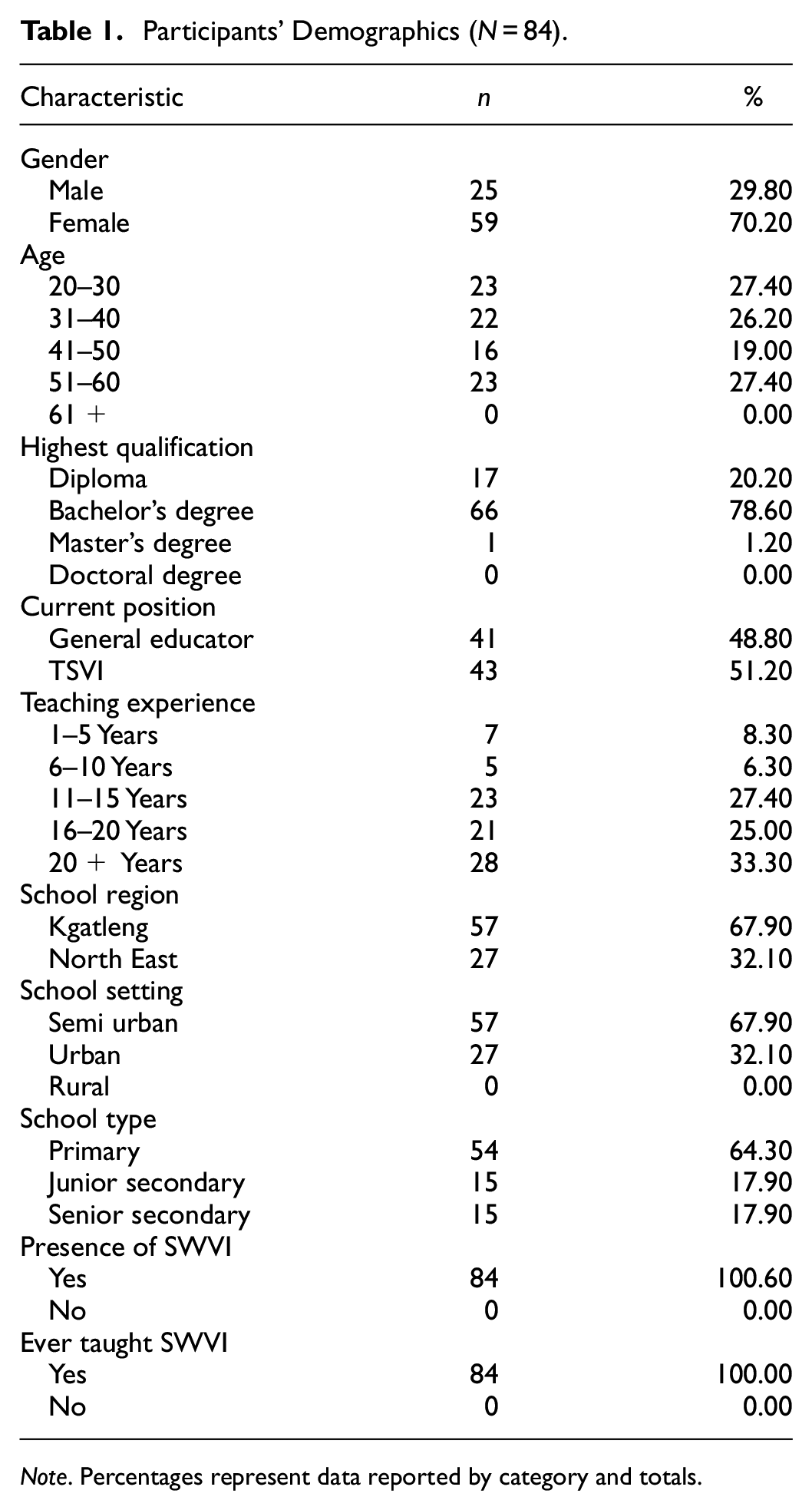
Note. Percentages represent data reported by category and totals.
Instrument
A questionnaire was designed based on professional literature regarding evidence-based interventions for delivering mathematics instruction to SWVIs, mathematical barriers, and considering the learning contexts in primary and secondary schools in Botswana. The questionnaire had four sections. Section 1 focused on the purpose of the questionnaire and section 2 related to participants’ demographic information. Section 2 had among others, items on gender, age, education qualification, experiences of teaching SWVIs, and type of teacher. Section 3 consisted of Likert-type items designed to elicit information on participants’ knowledge of barriers that SWVIs faced in the teaching and learning of mathematics. This section contained close-ended questions to collect information on teachers’ perceptions about mathematical challenges experienced in schools that affected SWVIs. Areas of challenges in the questionnaire included concept development and problem solving, braille literacy, resources and support, instructions and modifications, as well as attitudes about mathematics and the learning environment. Section 4 focused on the use of open-ended questions to collect qualitative data for capturing of additional barriers and provision of plausible explanations to observed trends.
Reliability and Validity of the Instrument
The questionnaire was given to three experts of special education to review. They were required to rate each of the items as “relevant” or “not relevant” and their feedback was used to improve the questionnaire further. This process helped with increasing the face validity of the instrument. Again, the three experts assessed the instrument to determine construct validity and they made minor corrections as some survey items were rearranged and rephrased. The survey instrument was then pilot tested on 30 in-service teachers who had experience of teaching in primary and secondary schools in Botswana. This step helped to determine how user-friendly the instrument was, establish content validity of scores on the instrument, as well as to further improve survey items. The Cronbach reliability coefficient for the Likert scale of the final instrument was computed and found as 0.83. This figure further validated the internal consistency of the instrument.
Data Collection Procedure
Permission to conduct the study was obtained from the University of Botswana’s Office of Research and Development, the Ministry of Education and Skills Development, and regional education directors. Thereafter, the questionnaires were distributed to primary and secondary school teachers responsible for teaching mathematics to SWVIs. Research assistants distributed questionnaires to participants in the selected schools. Written informed consent was obtained from all participants and ethical guidelines were followed throughout the study. Each questionnaire had a cover page that informed the participants about the study and that participation in the survey was voluntary. The questionnaires were collected from teachers on subsequent visits. Each questionnaire was allocated a specific number that was entered into SPSS system.
Data Preparation and Analysis
The information gathered through questionnaires was coded and entered in the worksheet of SPSS version 27. A 5-point Likert-type scale was used (i.e., 1 = Strongly Disagree, 2 = Disagree, 3 = Agree, 4 = Strongly Agree, 5 = Do Not Know). The researchers recoded Do Not Know responses as system missing resulting in a true 4-point scale. Lack of knowledge on certain survey items would warrant introduction of professional development activities to enhance teachers’ knowledge provided a 25% cut-off was exceeded. Both descriptive and interpretive statistical approaches were used for data analysis and interpretation of the data obtained from participants. Mann Whitney U and Kruskal-Wallis tests were used to determine differences in mathematical barriers between participants by position and school type respectively. The Mann Whitney U test was used considering that the assumptions of normality of the population distributions and homogeneity of variance were violated. Also, the Kruskal-Wallis test was used given that the assumption of normality was not satisfied. Field (2012) stated that the Mann Whitney U and Kruskal-Wallis tests do not depend on the assumption of normality particularly when dealing with unequal groups and small samples. The information gathered through open-ended items was transcribed into Microsoft Excel 365 and then uploaded in AllasTi8 using the appropriate protocol. Hence, content analysis (Lincoln & Guba, 2013) was used for the purpose of summarizing responses to open-ended questions. The qualitative analysis of the data was primarily to supplement and verify quantitative data.
Results
Table 1 shows that most teachers were female (70.2%). The majority of participants in this study were aged 20 to 30 years and 51 to 60 years (27.4%). The highest qualification for most participants was a bachelor’s degree (78.6%) and none of them had a doctoral degree qualification. The proportions of general education teachers and TSVIs were almost equal (51.2% and 48.8% respectively). Most participants had teaching experience of more than 20 years (33.3%) and only 8.3% of participants in this study had the lowest teaching experience of 1 to 5 years. Kgatleng region had the highest proportion of participants (67.9%) and most participants in this study were employed in primary schools (64.3%). All participants reported that they had SWVIs in their classes during data collection and that they had taught other SWVIs in the past.
The findings of this study showed that some participants reported that they lacked knowledge of some items regarding mathematics-related barriers of SWVIs, hence selected “Do Not Know” in response to those items. The “Do Not Know” items were recoded as system missing for analysis as descriptive data. The findings revealed that the percentage of participants who lacked knowledge of certain items ranged from 1.2% to 21.4%, thus below the 25% cut-off point that would warrant the need for teachers to participate in professional development activities before completing the survey.
The average mean rating for participants’ perceptions of mathematics-related barriers of SWVIs was (M = 3.24), suggesting that participants agreed that SWVIs experienced the stipulated transition challenges in the teaching and learning of mathematics. Mean ratings of teachers’ perceptions of mathematics-related barriers of students ranged from 2.35 to 3.90 (SDs = 0.30–1.18), with a mean difference of 0.88 computed from the maximum and minimum mean rankings (see Table 2). The mean difference and high overall mean score indicate that, generally teachers agreed that the mathematics-related barriers as noted in Table 2 affected SWVIs.
Overall Mean Ratings for Respondents’ Perceptions of Mathematics-Related Barriers (N = 84).

Mann Whitney U tests were run based on teacher position (i.e., general education teacher, TSVI) to determine if significant differences existed concerning teachers’ perceptions on mathematics-related barriers of SWVIs (see Table 3). There were no significant differences between general education teachers and TSVIs for most items. Significant differences between the two groups of teachers were noted in two items only. Thus, general education teachers agreed more than TSVIs that there was lack of support from the school administration for students to learn mathematics (p < .05). Moreover, general education teachers tended to strongly agree more than TSVIs that there were predominant and inaccessible visual images in mathematics textbooks (p < .05).
Mann Whitney U Analysis for Respondents’ Perceptions of Mathematics-Related Barriers by Teacher Position (N = 84).
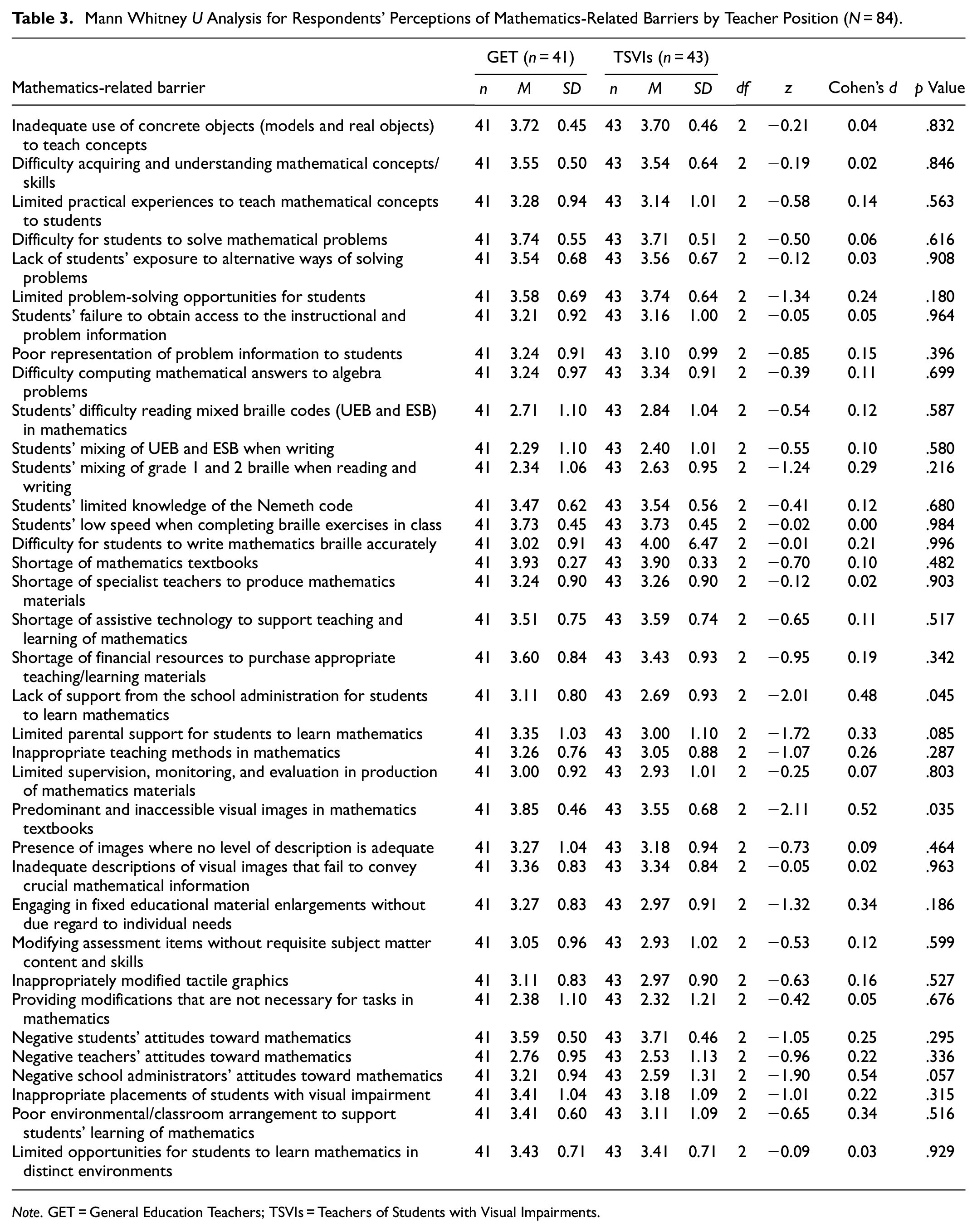
Note. GET = General Education Teachers; TSVIs = Teachers of Students with Visual Impairments.
Table 4 displays results from Kruskal-Wallis tests run based on school type to determine if significant differences existed concerning teachers’ perceptions of mathematics-related barriers of SWVIs. Significant differences were noted on teachers’ perceptions by school type (p < .05) on whether SWVIs experienced difficulties with solving mathematical problems with a large effect size. A Mann Whitney U post hoc test revealed that primary school teachers agreed more than senior secondary school teachers that SWVIs experienced difficulties with solving mathematical problems (z = −2.86, p < .05).
Kruskal-Wallis Analysis for Respondents’ Perceptions of Mathematics-Related Barriers by School Type (N = 84).
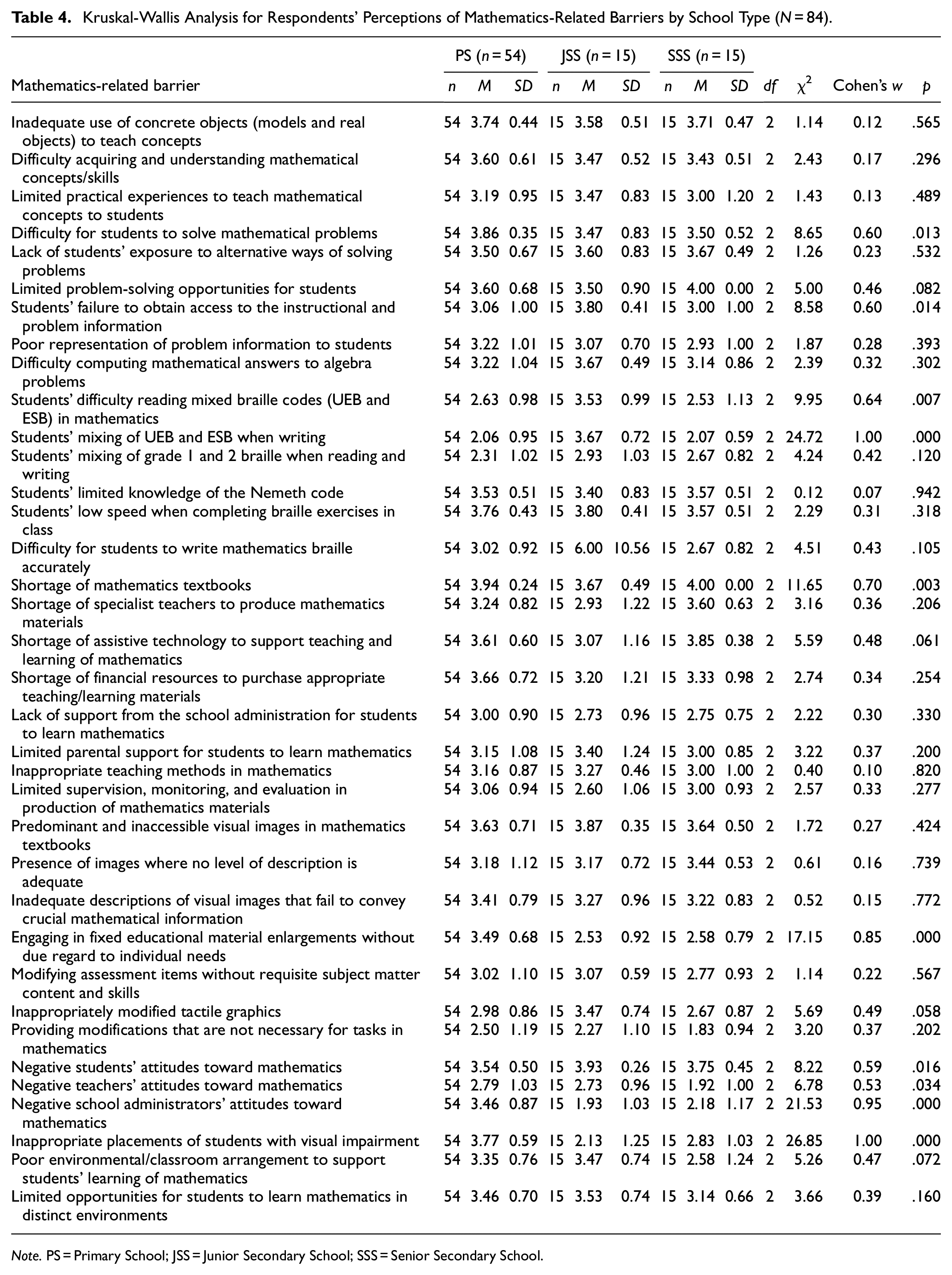
Note. PS = Primary School; JSS = Junior Secondary School; SSS = Senior Secondary School.
Significant differences were also noted on teachers’ perceptions by school type (p < .05) on whether SWVIs failed to obtain access to the instructional and problem information with a large effect size. A Mann Whitney U post hoc test indicated that junior secondary teachers agreed more than primary school teachers that SWVIs failed to obtain access to the instructional and problem information (z = −2.75, p < .05). Junior secondary teachers agreed more than senior secondary teachers on this item (z = −2.67, p < .05).
Moreover, significant differences were recorded on teachers’ perceptions by school type (p < .05) on whether SWVIs experienced difficulties reading mixed braille codes (UEB and ESB) in mathematics with a large effect size. A Mann Whitney U post hoc test showed that junior secondary teachers agreed more than primary school teachers that SWVIs experienced difficulties reading mixed braille codes in mathematics (z = −3.07, p < .05). Junior secondary teachers agreed more than senior secondary teachers on this item (z = −2.55, p < .05).
It is also worth noting that significant differences were identified on teachers’ perceptions by school type (p < .001) on whether SWVIs mixed UEB and ESB when writing with a large effect size. A Mann Whitney U post hoc test showed that junior secondary teachers agreed more than primary school teachers that SWVIs mixed UEB and ESB when writing (z = −4.68, p < .001). Junior secondary teachers agreed more than senior secondary teachers on this item (z = −4.22, p < .001).
Regarding whether there was a shortage of mathematics textbooks, significant differences were noted on teachers’ perceptions by school type (p < .05) with a large effect size. A Mann Whitney U post hoc test showed that primary school teachers agreed more than junior secondary teachers that there was a shortage of mathematics textbooks in schools (z = −2.88, p < .05). Senior secondary teachers agreed more than junior secondary teachers on this item (z = −2.33, p < .05).
Furthermore, significant differences were noted on teachers’ perceptions by school type (p < .001) on whether teachers engaged in fixed educational material enlargements without due regard to individual needs with a large effect size. A Mann Whitney U post hoc test showed that primary school teachers agreed more than junior secondary teachers that teachers engaged in fixed educational material enlargements without due regard to individual needs (z = −3.38, p < .001). Primary school teachers agreed more than senior secondary teachers on this item (z = −3.26, p < .05).
Significant differences were also noted on teachers’ perceptions by school type (p < .001) on whether SWVIs had negative attitudes toward mathematics with a large effect size. A Mann Whitney U post hoc test indicated that junior secondary teachers agreed more than primary school teachers that SWVIs had negative attitudes toward mathematics (z = −2.73, p < .05). In addition, significant differences were noted on teachers’ perceptions by school type (p < .05) on whether teachers had negative attitudes toward mathematics with a large effect size. A Mann Whitney U post hoc test showed that primary school teachers agreed more than senior secondary teachers that teachers had negative attitudes toward mathematics (z = −2.51, p < .001). Junior secondary teachers agreed more than senior secondary teachers on this item (z = −2.12, p < .05).
Concerning whether school administrators had negative attitudes toward mathematics, significant differences were noted on teachers’ perceptions by school type (p < .05) with a large effect size (0.95). A Mann Whitney U post hoc test showed that primary school teachers agreed more than junior secondary teachers that school administrators had negative attitudes toward mathematics (z = −4.17, p < .001). Primary school teachers agreed more than senior secondary teachers on this item (z = −3.26, p < .05).
Last, significant differences were identified on teachers’ perceptions by school type (p < .001) on whether SWVIs were inappropriately placed with a large effect size. A Mann Whitney U post hoc test showed that primary school teachers agreed more than junior secondary teachers that SWVIs were inappropriately placed (z = −4.87, p < .001). Primary school teachers agreed more than senior secondary teachers on this item (z = −3.42, p < .001).
Qualitative data collected from participants yielded several themes. Participants indicated that lack of mathematical equipment and materials such as Taylor boards and pins, abacuses, talking calculators, and digital talking watches were other mathematics-related challenges that SWVIs faced. One teacher indicated that: Students are not able to draw mathematical diagrams when they are required to do so. This is brought by the fact that there is no equipment that students can use to accomplish this task and they do not have requisite skills to prepare mathematical drawings. Moreover, there are no measuring instruments with braille markings that students can use to solve problems, for example, measuring lines and shapes.
Participants noted that lack of mathematics equipment and materials often brought frustration to SWVIs. It was also argued that even in cases where students had some materials to complete mathematics activities, they often made mistakes regarding writing mathematical operations in braille. Participants recorded that students experienced problems with writing long division and multiplication problems and other mathematical problems vertically on a braille paper. Given the fast pace at which students were taught in general education classrooms, participants indicated that it was difficult for SWVIs to follow as they needed more time to comprehend concepts due to vision limitations. Thus, the teaching pace driven by the intention to complete the syllabus without ensuring that set objectives were met was of concern to participants.
Participants argued that mathematics-related barriers that SWVIs encountered mainly emanated from students’ lack of interest in the subject, lack of mathematics laboratories, shortage of teachers who majored in special education and mathematics, and teaching students in general education classrooms without providing necessary supports and services. Furthermore, participants stated that some teachers had negative attitudes toward students with visual impairments. In instances where some mathematics materials and equipment were available, participants noted that students were not trained adequately to use these effectively. Participants also demonstrated that teachers used abstract methods to deliver mathematics content, thus failing to meet the needs of SWVIs. The presence of additional disabilities in SWVIs was also said to make it even more difficult for students to grasp mathematics content.
Participants noted that challenges that mathematics-related barriers of SWVIs in schools could be minimized or eliminated through motivating students to develop interest in mathematics and increased financial support in schools to enable acquisition of appropriate mathematics materials and equipment. They further indicated the necessity of providing teachers with professional development activities on evidence-based strategies for teaching mathematics and provision of appropriate accommodations and modifications to address unique individual needs in mathematics. Moreover, participants argued that as one of the critical accommodations for students, additional time was required to allow students to comprehend mathematical concepts.
Discussion
The purpose of this study was to examine experiences and challenges that primary and secondary school SWVIs faced concerning the learning of mathematics in Botswana. Participants perceived that SWVIs experienced several barriers in five key areas. The five areas where SWVIs experienced difficulties include concept development and problem-solving skills, braille literacy, resources and support, instructions and modifications, as well as attitudes and the learning environment.
The mathematics-related barriers that SWVIs were perceived to experience are consistent with those reported in professional literature. For example, teachers were concerned about the inadequate use of concrete objects to teach concepts and students’ difficulty to acquire and understand mathematical concepts/skills. They were also concerned with limited practical experiences to teach mathematical concepts to students, as well as limited problem-solving opportunities for students. However, research has demonstrated that lack of understanding of mathematical concepts and principles decreases educational and career opportunities for individuals, including those with visual impairments (Kuchkarov et al., 2023). The use of concrete manipulatives helps students to easily remember what they were taught and to explain concepts when solving mathematical problems. It is also worth noting that limited computational and problem-solving skills among SWVIs limit their career options (Fry et al., 2021). Adequate financial resources, positive attitudes toward mathematics, and adequate teacher-training are prerequisites for acquisition and appropriate use of concrete manipulatives to teach mathematics concepts and problem-solving skills to SWVIs, all of which were found to be of concern to teachers in this study.
The findings that students were perceived to mix braille codes (UEB and ESB) and braille grades (grade 1 and 2) when reading and writing mathematics as well as students’ limited knowledge of the Nemeth code are consistent with Habulezi (2022). Mixing of braille codes makes the understanding of mathematics and problem-solving even more difficult. Accurate writing and reading of braille for mathematics and science notation has been identified as an effective approach that gives SWVIs access to mathematical tasks, thus allowing them to compute solutions to problems (Kana & Golga, 2024). Given that the Nemeth code was developed to introduce standards and strategies for presenting braille equivalents for the complex signs, symbols, and arrangements of print mathematics and science, there is need for both teachers and students to undergo regular updating and refining to ensure the use of correct braille.
As Botswana has adopted the UEB, it is important for TSVIs to be proficient in both braille codes if they are to convert accurately from one braille code to the other. Lack of knowledge of both braille codes makes it especially difficult for SWVIs to learn alongside their sighted counterparts in mathematics. It is the role of TSVIs to ensure that when teaching mathematical concepts, students are presented with accurate braille which is consistent with all mathematical code’s rules (Van Leendert et al., 2021). There can be some level of confusion if changes to the print form symbols are made, implying maintenance of the correct form. Given that TSVIs are usually expected to provide instruction in advanced mathematics, there is need to consult with general education teachers in the event they are not sure of the meaning of certain print symbols. This is necessary to ascertain that SWVIs correctly interpret symbols. Unless TSVIs develop confidence to provide instruction in the Nemeth Code and UEB, it may become even more difficult to establish that students have proper access to all areas of mathematics.
The shortages of mathematics textbooks, specialist teachers to produce mathematics materials, assistive technology to support teaching and learning of mathematics, financial resources to purchase appropriate teaching/learning materials, and lack of support from the school administration and parents for students to learn mathematics are concerning in this study. Considering the importance of mathematics on daily living and employment, schools in Botswana need to emphasize mathematics instruction without ignoring SWVIs in this exercise. Lack of financial support to purchase appropriate mathematics materials, inadequate training of teachers, and lack of support from administrators and parents have been found to hinder the performance of SWVIs in mathematics (Habulezi, 2016). A major emphasis has been placed on the need for teacher preparation programs for TSVIs to focus much on training in braille mathematics to ascertain the inclusion of SWVIs (Bell & Silverman, 2019). It is worth noting that TSVIs are expected to equip students with specialized problem-solving strategies such as using the Nemeth code, an abacus, and the use of various braille writing devices, all of which were found to be of concern in this study.
It is the role of TSVIs to provide meaningful instruction in mathematics and engage in progress monitoring efforts to ensure that SWVIs make reasonable progress in attaining mathematical concepts and skills (Klingenberg et al., 2019). Nonetheless, teachers in this study reported among others the use of inappropriate teaching methods in mathematics, limited supervision, monitoring, and evaluation in production of mathematics materials, inaccessible visual images in mathematics textbooks, and poorly modified images and graphs. These are appalling results that call for concerted efforts between teachers to attain students’ goals in mathematics. Without a collaborative teamwork between TSVIs and general education teachers, addressing the educational needs of SWVIs in mathematics will be in vain (Miyauchi, 2020). Combining the knowledge of educational adaptations and accommodations for students that the TSVIs brings and knowledge of mathematics content that the general education teacher possesses enhances students understanding of mathematics. In addition to collaborative efforts between teachers, TSVIs need to go an extra mile to implement formal and informal assessment methods, teach specialized problem-solving strategies, and demonstrate effective ways of interpreting and utilizing tactile graphs, as well as providing modified mathematical learning aids and materials (Rosenblum et al., 2018).
Furthermore, it is concerning that negative attitudes from students, teachers, administrators about mathematics, inappropriate placement options for SWVIs, and poor learning environments that are not supportive of students’ learning of mathematics were reported in this study. Spinczyk et al. (2019) contended that SWVIs need to have self-confidence and be highly motivated to learn mathematics. SWVIs experiencing poor psychological adjustment, poor quality of life, having limited adaptive behavior, having poor social interactions with sighted peers, and having poor academic performance may have poor self-esteem and be poorly motivated to learn mathematics (Augestad, 2017). The poor self-esteem and low motivation may explain why teachers in this study believed that SWVIs had negative attitudes in mathematics. Having teachers and administrators who are expected to be at the forefront of students’ education with negative attitudes toward mathematics makes it even more difficult for SWVIs to benefit from the subject. Negative attitudes toward mathematics may further explain why less resources and limited support are channeled toward mathematics. Although in Botswana school SWVIs are taught in general education classrooms alongside sighted peers, this placement option may not work for all students considering the varying nature and degree of visual impairment among students. Hence, this calls for distinct educational supports and services among students. These variables including cognitive functioning and personal interests may contribute to a student’s placement alternative and the development of mathematical understanding and learning to think mathematically (Klingenberg et al., 2019).
The findings that general education teachers agreed more than TSVIs that there was lack of support from the school administration for students to learn mathematics and that there were predominant and inaccessible visual images in mathematics textbooks are meaningful. In Botswana schools, general education teachers are responsible for delivering mathematics content to all students. On the other hand, TSVIs ensure that appropriate accommodations and modifications are made to allow SWVIs access to the content. Considering the role of general education teachers as forerunners and experts in mathematics, they are expected to work closely with the school administrators and TSVIs in acquisition of classroom materials, creating accessibility, and organization of professional development activities. Moreover, general education teachers are responsible for prescribing mathematics textbooks which are mostly available in regular print form which is inaccessible to SWVIs. Given general educators lack of expertise in preparing accessible images, the inaccessible visual images found in regular print textbooks become of much concern to them.
In addition, the finding that primary school teachers agreed more than senior secondary school teachers that SWVIs experienced difficulties with solving mathematical problems reflects the difficulties teachers face during the early school years in helping students to grasp basic mathematical concepts. An abacus is a foundational tool for teaching basic skills such as setting, counting, addition, and subtraction during initial school years (Senjam et al., 2022). Thus, with limited availability of abacuses at primary school level, SWVIs are likely to struggle to compute mathematical problems. Furthermore, shortage of assistive technology makes it even more difficult for secondary school SWVIs to use this technology to compute higher level mathematical problems.
It is worth noting that junior secondary teachers agreed more than primary school and senior secondary teachers that SWVIs failed to obtain access to the instructional and problem information, that students experienced difficulties reading mixed braille codes in mathematics, as well as that they mixed UEB and ESB when writing. These indicate the extent to which junior secondary schools need to improve access to mathematics instruction and to collaborate with primary schools to ensure consistency in braille use. Although the Ministry of Education and Skills Development in Botswana has adopted UEB as the braille code for use in schools, teachers continue to confuse this code with ESB which was previously used (Habulezi, 2022). This is especially true in junior secondary schools where teachers provide support to SWVIs without due regard to what they were taught at primary schools; a flaw in the transition planning process (Ookeditse, 2018).
Moreover, the result that primary school teachers agreed more than junior secondary teachers that there was a shortage of mathematics textbooks in schools are attributed to the higher proportion of SWVIs in primary schools compared to junior secondary schools. This proportion leads to difficulty in preparing braille textbooks for all students, given the time and expertise required. Again, there are more braillists at the junior secondary school in this study than at primary schools and the only senior secondary school included in this study who usually work with TSVIs to convert regular print textbooks into braille. The shortage of mathematics textbooks at senior secondary school is compounded by teachers’ lack of understanding of the Nemeth code which contains complex mathematical braille symbols and signs that are found in textbooks at this level of education as Habulezi (2016) noted.
As a result of more SWVIs in primary school classrooms than junior and senior secondary schools, it is not surprising that primary school teachers agreed more than junior and senior secondary teachers that fixed educational material enlargements were done without due regard to individual needs. This is consistent with Ookeditse (2018) who argued that given the congested curriculum, large class sizes, and poor collaboration between general and special education teachers at lower grades, the unique needs of students with special needs were inadequately addressed. Regarding the result that primary school teachers believed more than secondary teachers that SWVIs were inappropriately placed, it is worth noting that all students at primary level receive their education in general education classrooms irrespective of their needs, abilities, and interests. Despite the benefits associated with the general education classroom, Miyauchi (2020) noted that this setting should go beyond simply bringing sighted students and those with visual impairments together in one place, but to ensure that appropriate supports and services are provided to allow students to participate more fully in classroom activities.
It is also critical to note that at junior secondary school level, specialist teachers in mathematics provide instruction to all students, including those with visual impairments. However, at primary school level general education teachers are responsible for teaching all subjects offered at a particular grade level. This makes it difficult for primary teachers to determine students’ attitudes across the different subjects taught than teachers who focus in one subject at junior secondary school. Hence, the reason why junior secondary teachers agreed more than primary school teachers that SWVIs had negative attitudes toward mathematics.
Although primary school and junior secondary school teachers agreed more than senior secondary teachers that teachers had negative attitudes toward mathematics, the fact remains that such attitudes are detrimental to the success of SWVIs in the subject. Literature suggests that teachers with adequate mathematics knowledge and with sufficient practice in teaching the subject have more positive attitudes toward the subject than their counterparts with limited knowledge and teaching practice (Russo et al., 2020). Moreover, the negative attitudes toward mathematics demotivate students consequently resulting in development of negative attitudes toward the subject. Therefore, if SWVIs are to excel in mathematics, they need to have positive attitudes toward the subject together with their teachers. In the absence of teachers’ positive attitudes toward SWVIs as found in this study, efforts to meet students’ mathematics needs becomes an impossible task to accomplish.
Conclusion and Implications for Practice
The findings of this study suggest that overall, primary school and secondary school teachers in Botswana have knowledge of mathematics-related barriers that affect SWVIs in schools. These barriers relate to concept development and problem-solving, braille literacy, resources and support, instructions and modifications, as well as attitudes and learning environment. Hence, the time is now for a collaborative team approach between general education teachers, TSVIs, administrators, students, parents, the Ministry of Education and Skills Development, and other stakeholders to ensure that the unique mathematical needs of SWVIs are met. This will help students to develop to their full potential in the subject. Given the challenges and complexity of teaching mathematics to SWVIs, it is high time that all teachers responsible for supporting the needs of students in mathematics are exposed to professional development activities. Activities such as seminars, workshops, and conferences are necessary to reduce the discrepancies that exist among teachers in the delivery of mathematics instruction. Moreover, it is imperative to review teacher training programs to ensure preparation of enthusiastic general education teachers and TSVIs who are equipped with evidence-based strategies for supporting the mathematical needs of SWVIs in schools at all levels of education, including motivating students to develop feelings of accomplishment and success.
Considering the lack of resources to support students’ mathematical needs, the Ministry of Education and Skills Development needs to increase its annual budget to facilitate purchase of adequate learning materials, assistive technology, and hiring of specialist teachers in mathematics. Besides government funding, schools also need to go an extra mile to seek funding from private entities that may be willing to support mathematics education for SWVIs. In the absence of school administrators’ support, all efforts to promote students’ learning will be in vain as administrators are responsible for spearheading administrative activities, managing facilities and employees, as well as overseeing the decision-making process that can impact on SWVIs positively or negatively. In general, mathematics interventions for SWVIs should include creating a supportive learning environment, setting realistic expectations for students, using explicit and individual teaching methods, and the use of embodied mathematics which entails using students’ bodies as measurement tools when making various estimations (Klingenberg et al., 2019). However, without the commitment of schools, the government, external entities, and other key education players to support the needs of SWVIs, the intention of Botswana to transition from a resource-based economy to a knowledge-based economy will never amount to reality.
Limitations
This study comprised of unequal groups of participants particularly based on school type. Thus, the numbers of junior secondary and senior secondary school teachers were relatively small compared to the number of primary school teachers. It is possible that there was a general loss of power in this study given the unequal group sizes. Loss of power can limit the generalizability of the results of a study (Kang, 2021). Although a descriptive survey research design was used in this study in which a questionnaire containing both closed and open-ended items was used to collect data, not all reported trends could be sufficiently explained. The use of focus group discussions may have helped to yield more plausible explanations for observed mathematics barriers (Sim & Waterfield, 2019). Lastly, perceptions of SWVIs who are at the center of the learning process regarding mathematics were not captured. Students’ views could help to provide a more comprehensive understanding of mathematics-related barriers in schools.
Footnotes
Acknowledgements
We would like to acknowledge God Almighty for direction, our families for their support, and all colleagues who provided technical support and contributed in different ways to make the writing of this article a reality.
Declaration of Conflicting Interests
The author(s) declared no potential conflicts of interest with respect to the research, authorship, and/or publication of this article.
Funding
The author(s) received no financial support for the research, authorship, and/or publication of this article.
Ethical Approval
The University of Botswana Office of Research and Development Ethics Committee provided approval.

Data Availability Statement
Data sharing not applicable to this article as no datasets were generated or analyzed during the current study.