




Abstract
This study aimed at exploring the level, preference, and use of communication skills among undergraduate students in an online EFL learning context and to examine whether there are significant differences according to their gender and mode of study. A survey method was applied through quantitative data collection. For this purpose, a questionnaire was distributed to 200 undergraduate students at a public university in China. The communication skills inventory consisted of 26 items, which were developed based on previous studies. Factor analysis was conducted to assess the reliability and validity. Findings indicated that the undergraduate students had a medium level of communication skills, with intercultural skills ranking the highest, followed by production and reception communication skills. In addition, there was no significant difference in the usage of communication skills among undergraduate students in terms of gender, but there was a significant difference in terms of the mode of study. Students used more communication skills in synchronous than in asynchronous online learning.
Plain language summary
This study aimed at exploring the level, preference, and use of communication skills among undergraduate students in an online EFL learning context and to examine whether there are significant differences according to their gender and mode of study. A survey method was applied through quantitative data collection. For this purpose, a questionnaire was distributed to 200 undergraduate students at a public university in China. The communication skills inventory consisted of 26 items, which were developed based on previous studies. Factor analysis was conducted to evaluate the three underlying constructs, namely reception, production, and intercultural communication skills. The findings indicated that the instrument was reliable and valid. The undergraduate students had a medium level of communication skills, with intercultural skills ranking the highest, followed by production and reception communication skills. In addition, there was no significant difference in the usage of communication skills among undergraduate students in terms of gender, but there was a significant difference in terms of the mode of study. Students used more communication skills in synchronous than in asynchronous online learning.
Introduction
Human beings are by nature in need of communication (Cüceloğlu, 2000). Communication entails a systematic and inter-playing process of speaking, listening, and understanding. It entails not only the passing on of knowledge but also the transmission of emotions and thoughts. According to Metusalem et al. (2017), communication, as a 21st-century success skill, encompasses the subdomains of reading, writing, speaking, and listening, which can occur in various contexts and content areas, take various forms, and serve various goals. To elaborate in detail, they define communication as the ability to express opinions effectively with spoken, written, and nonverbal communication skills in various forms and contexts; listen effectively to analyze meaning, including values, attitudes, knowledge, and intentions; communicate for a variety of purposes (e.g., to persuade, inform, motivate and instruct); use multi-media and technologies, and know how to evaluate their influences; and use communication properly in different environments (including multilingual and multicultural). This definition does not only cover the basic and applied English language arts but also incorporates technology use and cross-culture communication.
Communication skills are one of the components of generic skills or “soft skills” that are identified as essential for university students (Iksan et al., 2012). In order to perform effective communication, skills are needed so as to clarify and specify messages we send and to comprehend precisely the information we get. Students may apply these skills both in and out of the classroom, for instance, for presentations and society activities. Good communication is clear, concise, concrete, correct, coherent, complete, and courteous It is essential and crucial in every aspect of life. In the educational field, the training of communication skills accounts for 50% of teaching, and another 50% for imparting knowledge.Teachers and students exchange information, ideas, and emotions through effective classroom communication.
Currently, there is a significant growth in online programs in colleges and universities (Albrahim, 2020; Sun et al., 2024). This is mainly because online learning bears the merits of flexible access, economic benefits, and global collaboration.. An increasing number of university courses are designed to be delivered fully online. What is more, with the influence of the Covid-19 pandemic, online learning has fully or partially replaced traditional face-to-face learning in many prestigious universities all over the world (Wang et al., 2023). Therefore, how teachers and students communicate over the Internet has raised a lot of attention.
Compared with face-to-face learning, online learning faces challenges such as limited social interaction and the absence of nonverbal cues in communication (Mukhtar et al., 2020). It is possible for communication to take place even when there is no use of words at all in a face-to-face classroom. However, online learning relies heavily on words or written communication. Lexicon, semantics, and syntax have a major influence on the expression and interpretation of written messages. Therefore, teacher-student classroom interactions and communications may be adapted when the mode of instruction shifts from offline to online. Bear in mind that online communication between faculty and students is perceived as the most important factor influencing the quality of online education (Alawamleh et al., 2022; Wang et al., 2023). Teo (2019) stated that communication, cooperation, and critical thinking were among the skills called “real global skills” in the 21st century. To explore and equip students with necessary communication skills is essential for successful online learning.
Rationale and Significance of the Study
Communication skills are perceived as the most significant generic skills for university students in that they are crucial not only for professional but also for personal development. However, it does not get as much attention as it deserves. Most students feel incompetent at work after graduation due to a lack of communication skills. They complain that there is not enough training for these skills in their undergraduate study and there is no effective faculty-student and student-student communication. Much importance has been attached to the technical and academic skills neglecting the most indispensable communication skills (Ahmad, 2016).
Numerous studies have been conducted on communication skills in traditional courses where students learn face-to-face, or on the correlation between communication skills and emotional intelligence, self-esteem, social anxiety, empathy, social competence, and other factors in traditional learning settings (Ahmetoglu & Acar, 2016; Albalawi & Nadeem, 2020; Koç & Dündar, 2018; Ozkaral & Ustu, 2019; Uyanik Balat et al., 2019; Yavuz & Guzel, 2020). In the global setting, students’ communication skills are essential for interactive survival, and the development of these skills has become a vitally important goal in higher education (Ong, 2017).
It is, therefore, agreed that communication competency is essential for online education, and most previous studies concerning online learning had been centered on students’ or teachers’ emotions and experiences (Wang et al., 2023); how they interact or participate in online learning has been somewhat neglected. Under the influence of the pandemic, there is a rise in research on communication in online learning. Alawamleh et al. (2022) studied the effect of online learning on communication between instructors and students during Covid-19 pandemic. Yuliansyah and Ayu (2021) reported that project-based assignments in online learning were beneficial for the development of communication skills. Wang et al. (2023) investigated the moderating effect of participation in online learning activities and the perceived importance of online learning on EFL teachers’ teaching ability and concluded that 66% of the variance in the perceived importance of online learning could be predicted and explained by teacher’s participation in online learning activities. What is more, students’ and teachers’ technology acceptance is also related to their willingness to communicate and the availability of knowledge and skills on technology integration (Zhi et al., 2024). Zahra et al. (2024) explored how online communication tools enhanced learners’ interaction, cooperation, and participation and addressed the importance of integrating online communication tools to cultivate an interactive learning atmosphere. Chiablaem (2021) investigated English communication skills using Google apps for education, and announced that there was little research on communication skills in online learning environments with English as a communication tool.
English, as a global language, has received great attention in that it can be used as an international communication tool across the world. However, few studies have investigated communication skills with second language learners or foreign language learners both in China and abroad (Sonnenschein & Ferguson, 2020; Tazijan et al., 2017). Moreover, to date, insufficient research has been conducted to explore the actual use or perceptions of students on communication skills in an online EFL context, even though studies have indicated that communication skills are critical parameters for the quality of online learning, and speaking skills can be a challenge for EFL learners, especially in online courses (Alawamleh et al., 2022; Asmawi & Sun, 2023; Levinsen, 2007). Thus, it is necessary and critical to have a thorough and fundamental understanding of the communication skills that are needed in an online EFL learning environment so as to enhance and optimize the performance and quality of online learning.
Gender too is a popular variable and demographic factor that can influence the quality or outcome of online education (Wang et al., 2023).Many researchers have compared the difference in communication skills between males and females yet have not reached a consensus. For example, Ocak and Ersen (2015) discovered a statistically significant difference in communication skills according to gender. Eriguc et al. (2013) found that the communication skills of female students were higher than their male counterparts. Ustun et al. (2017) conducted a survey on time management and communication skills of 233 randomly chosen physical education and sports students and reached a conclusion that females had better mental and behavioral communication skills than males. On the contrary, Abdullah (2012), based on the perception of 460 undergraduate students from public universities, concluded that male students were more inclined to rate their communication skills higher than female students. Additionally, Abdul Karim et al. (2012) carried out a survey on 10,140 students and reached the same conclusion; that male students scored higher than female students in communication skills. Nevertheless, many researchers announced that there was no significant difference in communication skills based on gender (Ismet, 2018; Kana, 2015). It seems that scholars reached different conclusions under various circumstances. What is clear thus far is that little related research has been done in an online learning environment. Thus, this paper aims to tap into this aspect.
There are two distinctive modes of online learning: synchronous versus asynchronous.
Synchronous learning occurs in real-time and requires the instructor and learner to be online at the same time, whereas asynchronous learning allows a time lag between the communication of the instructor and student, and can occur at any time at the convenience of the learner. Synchronous online communication in language learning offers the opportunity to have real-time communication with proficient or native speakers, which could improve oral and listening skills as well as increase students’ motivation and cultural understanding of the target language (Rodrigues & Vethamani, 2015). However, students may experience tension to a timely response and they may send brief and informal messages with respect to the conventions of grammar and spelling, employing short-cuts (e.g., the acronym “ASAP” for “as soon as possible”) (Lapadat, 2002), which may make their responses lacking in depth. Sometimes, too many people type or speak simultaneously, causing many topics or voices to trail off or move to private communications. In addition, synchronous communication is easily impeded by technology breakdowns.
Asynchronous activities on the other hand include tests, group discussions, reflection and feedback, assignments online meetings, and video-based activities (Wang et al., 2023). These activities are not real-time, allowing learners to respond at their convenience, thus resulting in flexibility. Some researchers state that the time lag in an asynchronous activity allows learners to provide more thoughtful and reflective responses, enabling “richer discussions involving more participants” (p. 9), beneficial for higher-order thinking (Means et al., 2013). What is more, writing in asynchronous activity is more like formal written language which requires metalinguistic thinking - thinking about language, and how to use words to accomplish their purposes (Lapadat, 2002). Considering the distinguishing nature and characteristics between these two modes, the paper aims to explore how students differ in communication skills under these two learning modes.
Social Constructivism
According to social constructivism, a social learning theory proposed by Vygotsky, knowledge is constructed through interaction with others (McKinley, 2015). Learners are active participants in the creation of their own knowledge and learning takes place mainly in social and cultural settings (Agopian, 2022). Vygotsky (1978) emphasized the role of social interaction in the development of cognition, and stated that it developed on a social level first, and then within the individual. Roth (2000) also supported this by stating that learners first constructed knowledge during their interactions with their surroundings and then internalized the knowledge. He believed that social interaction led to knowledge acquisition. Another important concept put forward by Vygotsky is the Zone of Proximal Development (ZPD), which he defined as “the distance between the actual developmental level as determined by independent problem-solving and the level of potential development as determined through problem-solving under adult guidance, or in collaboration with more capable peers” (Vygotsky, 1978, p. 86). Hence, he emphasized that scaffolding was vitally crucial for teaching, and this was widely acknowledged and applied in education (Guo et al., 2023).
Social constructivists emphasize that learning takes place in interactions when individuals endeavor to make meaning. The ideal learning environment entails four essential elements: context, collaboration, communication, and meaning construction. The context should be authentic and favorable to the learner’s construction of the meaning of what is learned. Collaboration between teachers and students, and among students, should run through the whole process of learning activities. Communication is a vital part of collaboration and a crucial approach to promoting the learning process of each learner. The construction of meaning is the ultimate goal of teaching activities (Abdullah Alkhabra, 2022).
Social constructivism in online education focuses on students’ interaction with their peers and teachers believing that these interactions improve their learning (Bada & Olusegun, 2015). However, in EFL learning, students may encounter many difficulties in communication either because of language deficiency, or technological or cultural issues. Effective use of online communication skills is beneficial for supporting interactions during online learning. In line with Constructivism, it promotes students’ ideas exchange and collaboration in learning activities (Bada & Olusegun, 2015). Therefore, good online communication skills are conducive to forming effective online communication, leading to good online learning performance. The Findings of this research could bring new and practical ideas to teachers and students in various online learning settings.
According to Metusalem et al. (2017), communication involves reading, writing, listening and speaking across diverse contexts and subjects, manifesting in different formats to achieve various objectives. Communication skills encompass three major categories: production, reception and intercultural skills. This study is designed based on this theoretical framework which will be further explained in the method section.
Purpose
This paper aims to explore the communication skills used among undergraduate students in an online EFL learning context and examine whether there are differences according to their gender and mode of study in online learning.
Research Questions
What is the level of communication skills for undergraduate students in an EFL online learning environment?
What are the communication skills preferred by undergraduate students in an EFL online learning environment?
Is there a significant difference in the use of communication skills among undergraduate students in terms of gender and mode of study in an EFL online learning environment?
Hypothesis
The undergraduate students bear a high level of communication skills in an EFL online learning environment.
The undergraduate students prefer production skills to reception skills and intercultural skills in online learning.
There is a significant difference in the usage of communication skills among undergraduate students in terms of gender.
There is a significant difference in the usage of communication skills among undergraduate students in terms of the mode of study.
Methodology
Research Context
With the outbreak of the Covid-19 pandemic, most universities have started online learning from March 2020, and with frequent revisiting of the pandemic, most universities in China have performed blended learning until 2023. Apps such as Ding Ding, QQ, WeChat, Superstar and others were applied to facilitate online learning and teaching. The current study was conducted in a public university that offers online courses related to foreign languages, such as English, Russian, Japanese, and Spanish. In addition, some colleges with sino-foreign programs such as the College of Mechanical Engineering and the College of International Exchange Education, offer online courses with professional knowledge in English. Most of the courses are offered synchronously, and a few courses are offered asynchronously using video recordings combined with asynchronous discussions.
Participants
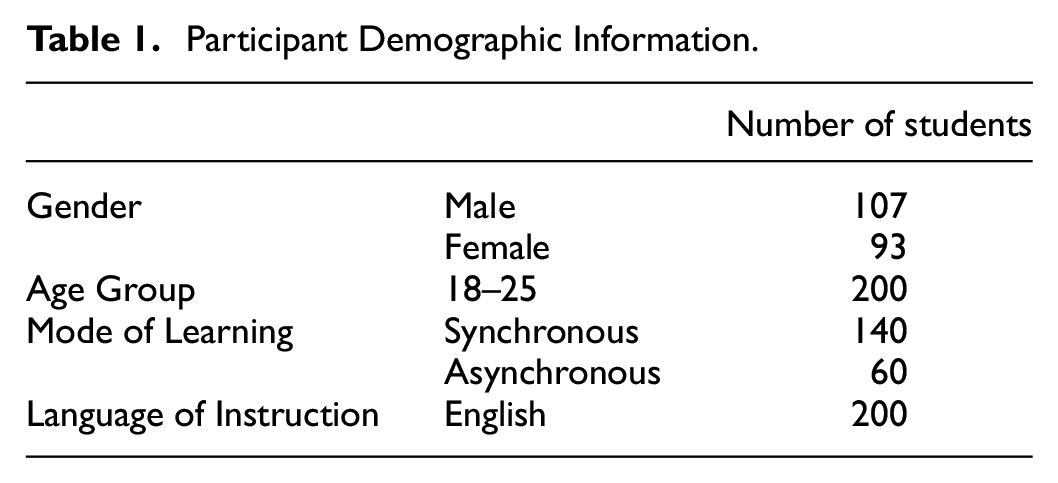
This study adopted a quantitative design to achieve the research aims and objectives. The random sampling method was adopted. The participants were 200 undergraduate students randomly selected from those taking online courses in English. They were between 18 and 25 years old. The population involved was from various programs: English Language and Literature, Mechanical Engineering, International Education, Computer Science and Technology, Civil Engineering and Architecture, Electronic Engineering, Chemical Engineering, and Big Data.Most of the students were engineering majors since it was emphasized by numerous researchers that communication skills were vitally important for engineering majors (Kovac & Sirkovic, 2017; Kovalyova et al., 2016; Riemer, 2007) and communication skills was listed as one of 7 key outcomes required of an engineering undergraduate in the ABET Engineering Criteria 2022-2023. The students had online English courses for around 2 to 14 hours per week. Many of them were freshmen who took English listening courses online. Students who took other courses such as English writing, culture, mechanical engineering, and education, were sophomore and junior students in general. The male-to-female gender ratio was about 10:9. Table 1 shows the demographic information of the participants.
Participant Demographic Information.
Instrument
A survey instrument was designed and adopted in this study to collect most of the data. The survey items were drawn from a review of the literature and were tested for validity and reliability.
Theoretical Basis of the Instrument
The instrument was based on the following theoretical framework, as seen in Figure 1.

Classification of communication skills (Metusalem et al., 2017).
As can be seen in Figure 1, communication skills can be divided into three major categories: production skills, which entail oral and written presentation and interpersonal communication; reception skills, which involve active listening and reading skills; as well as intercultural skills which encompass the recognition of different culture customs and strategies in cross-culture communication (Metusalem et al., 2017).
The Description of the Instrument
The survey instrument contained three parts. The first part was an introduction, which explained the goal of the survey: to explore the communication skills used among undergraduate students in an online learning environment. Respondents were informed that the data would be used only for research purposes and for the improvement of professional education. Next, the items and the measurement of communication skills were explained. Last, instructions were given on how to submit the instrument after completion. The second part involved six questions concerning demographic information such as gender, grades, majors, and mode of study. The third part was dedicated to communication skills for online learning. There were three constructs for the survey: production skills, reception skills, and intercultural skills. There were 26 items in total, and the items were gathered from research and instruments in the literature on corresponding topics. There were 10 items to evaluate production skills, 12 items for reception skills, and 4 items for intercultural skills. The whole survey took about 10 to 15 minutes to complete.
A Likert-type scale was used for all items on the instrument. Respondents were asked to rate each item against a five-point scale. The proposed responses for the communication sub-scale were:
1 = Almost never
2 = Rarely
3 = Sometimes
4 = Quite often
5 = Always
The mean score of the students’ communication skills was interpreted in three levels, as shown in Table 2.
Interpretations of Mean Scores.

As shown in Table 2, a mean score between 1.00 and 2.33 indicates a low level of communication skills, a mean score between 2.34 and 3.66 a medium level, and a mean score between 3.67 and 5.00 a high level.
Reliability of the Instrument
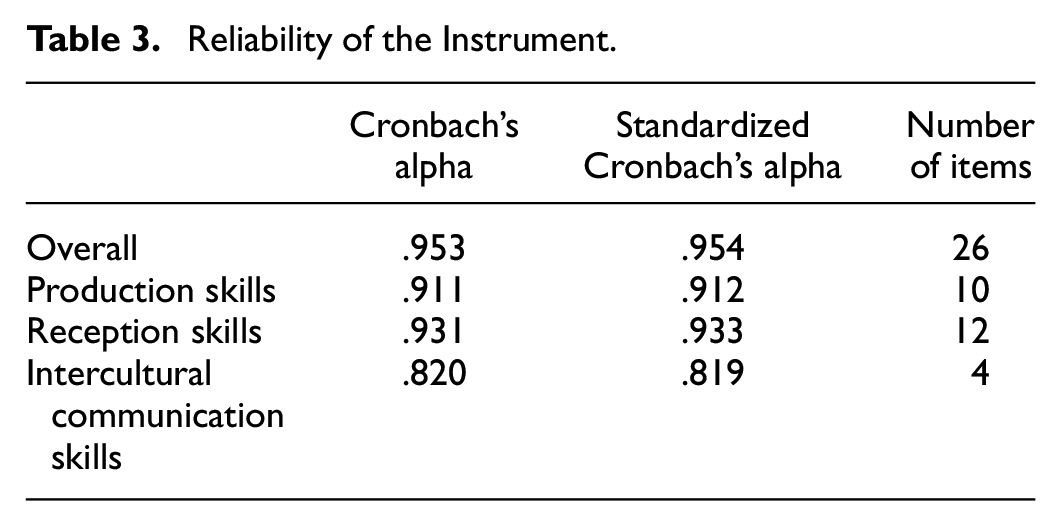
Cronbach’s alpha was tested to analyze the reliability of the instrument. The results showed that the whole standardized Cronbach’s alpha was .954, while the standardized Cronbach’s alpha for each construct (production, reception, and intercultural) was .912, .933, and .819 respectively. As is shown in Table 3, all the Cronbach’s Alpha scores were above .8, which indicated a very high inner consistency of the instrument and that the survey was highly reliable.
Reliability of the Instrument.
Content Validity and Face Validity of the Instrument
The survey items on communication skills in online learning were adapted and compiled based on a thorough review of relevant literature. In the literature, Rodzalan et al. (2016) investigated students’ communication development before and after industrial training with a survey they made, categorizing communication skills into two groups: adjustment and message. Madhura (2017) measured the communication skills of college students who majored in Business with face-to-face learning using a survey instrument designed by himself. He divided communication skills into listening, writing, reading, and speaking. Albrahim (2020) and Thompson (2020) also offered some insights into communication skills in the online learning environment. The items of the survey for this study were selected, adapted, and designed from the above-mentioned articles, and the items were proofread by two professors in this field. Face validity was established. The Chinese version was also provided when distributing the survey. The translation was done by the authors and verified by two Chinese professors in English translation and one American teacher who studied Chinese for 5 years.
Construct and Discriminant Validity of the Instrument
The construct validity was tested through exploratory factor analysis. The following results were yielded.
As is displayed in Table 4, the KMO value was 0.933, which was higher than 0.9 and sig. value was 0.000, lower than 0.001, indicating that it was very suitable to conduct factor analysis. Then exploratory factor analysis was conducted, and the results were exhibited in Table 5.
KMO and Bartlett Test.

Rotated Components Matrix.

Note. Extraction method: principal component analysis. Rotation method: varimax with Kaiser normalization.
Rotation converged in six iterations.
Table 5 showed the factor loading based on principal component analysis. Factor loading reveals the intensity and direction of the association between each variable and the latent factor(s) identified during factor analysis (Vinzi et al., 2010). Hair and Alamer (2022) suggested that a factor loading value exceeding 0.5 is considered acceptable, and is regarded as good for a single indicator when it reaches 0.7 or higher. As is shown in Table 5, the factor loadings of the items for each component were above 0.5, indicating that the matrix suits the theoretical category perfectly.
Besides that, the construct validity and discriminant validity were also tested using SmartPLS 4, and the following results were yielded.
Composite Reliability (CR) shows the internal consistency of the construct. The commonly accepted value is above 0.70 (Hair Jr et al., 2017). The average variance extracted (AVE) assesses the degree to which items within a particular construct exhibit positive correlations and share a significant amount of variance. It indicates the convergent validity of the construct if the values are equal to or greater than .50.
From Table 6, the average variance extracted for all factors was above 0.5, and the composite reliability was above 0.7 which showed that the questionnaire had a good construct validity (Hair & Alamer, 2022).
Construct Validity of the Instrument.

Discriminant validity reflects the extent to which the construct conceptually differs from other constructs. The heterotrait-monotrait ratio (HTMT) of correlations is widely used to assess discriminant validity. It measures how well a construct accounts for the variation in its own indicators versus that of other constructs. Typically, a cautious threshold of HTMT <0.85 is recommended (Hair & Alamer, 2022). As is shown in Table 7, the HTMT values were all below 0.85, which indicated that there was a good level of discriminant validity.
Discriminant Validity of the Instrument.

Finally, the survey was divided into three constructs: items 1 to 10 belonged to Construct One, production skills; items 11 to 22 belonged to Construct two, Reception skills; and items 23 to 26 belonged to Construct Three, Intercultural communication skills. Therefore, the reliability and validity were all established, and the final survey was ready to be applied to measure undergraduate students’ communication skills in online learning.
Data Collection and Analysis
The survey link was sent to relevant students with an instruction stating that their participation was voluntary and highly appreciated. The students were required to state their willingness to participate in this research before filling out the survey. It took a week to get 213 responses and eliminate invalid answers; there were 200 valid responses left. Data analysis was carried out using SPSS 20. Descriptive statistics were displayed, the normality of the data was tested and independent sample T-test was used in this study.
Results and Discussion
This part of the study presents the data obtained from data analysis. In order to answer RQ1:
What is the level of communication skills for undergraduate students in an EFL online learning environment?
scores for each type of communication skill were shown based on the descriptive statistical analysis in the following Table 8.
Descriptive Statistics of Communication Skills Level of Undergraduate Students.
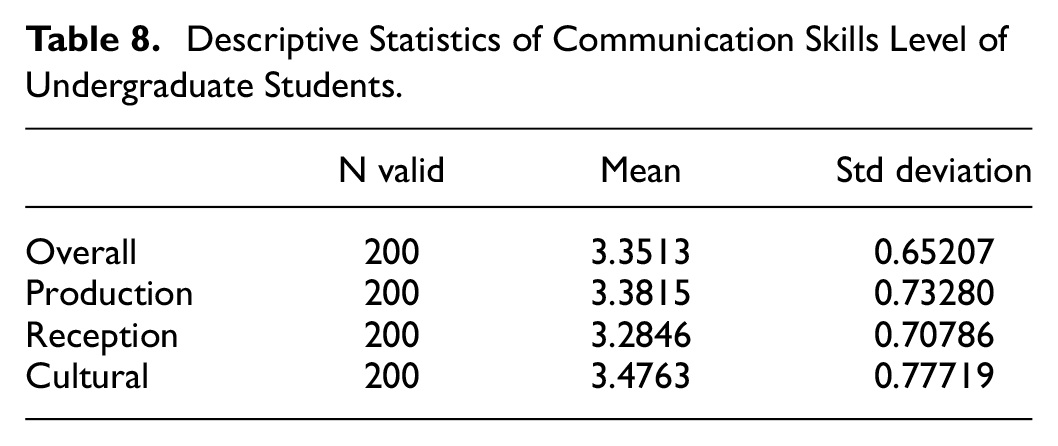
Based on Table 8, it can be concluded that the undergraduate students had a medium level of communication skills (mean score of 3.35). This was in contrast to several researchers who stated that students possessed a high or good level of communication skills when learning online (Iksan et al., 2012; Ismet, 2018; Kana, 2015; Kucuk, 2012; Said, 2015). Therefore, Hypothesis 1 that the undergraduate students bear a high level of communication skills when learning online was rejected.
The results can be attributed to several reasons. First, communication skills have long been undermined or overlooked in college education in China (Xin & Cao, 2011; Yu & Shang, 2015). Instructors have limited knowledge of the value of communication skills and put more emphasis on academic issues. They have not treated communication skills as equal to pedagogical, educational and research skills (Bi, 2009). Second, the curriculum design has hindered the cultivation of communication skills (Yu & Shang, 2015). Few lessons were offered to foster communication capability, and there is no systematic training for communication skills. Third, most classes were more teacher-centered, and students had limited opportunities to practice communication skills. Therefore, the students manifested a medium level of communication skills.
Looking at the sub-constructs in Table 8, it manifested that students were more proficient in using intercultural skills with the highest mean score (3.48), followed by production communication skills (mean score of 3.38), and reception communication skills (mean score of 3.28). Therefore, Hypothesis 2 that the undergraduate students prefer production skills to reception skills and intercultural skills in online learning, was rejected.
This may be because Chinese students were very respectful to teachers and there were relevantly fewer chances for them to communicate with foreigners, so they paid more attention to cultural issues. This echoed Guo and Asmawi (2023) that students had no cultural issues when communicating with teachers online. What is more, they used slightly more production skills than reception skills. This can be explained by the specific content of the skills. Production skills in this paper focused more on the correctness of the vocabulary, grammar, pronunciation, intonation, and formality, which had been a main focus for Chinese learners. Chinese English instructors tended to favor focus-on-form instruction for both grammar and vocabulary teaching (Sun & Zhang, 2021). Consequently, it is natural that students focused more on accuracy when generating English output. The reception skills in this paper centered more on the ability to grasp, detect, summarize, concentrate, analyze, infer, and synthesize, which demanded a higher level of cognitive processing. Thus, the learners may have found it a little more difficult, resulting in less use of these skills.
The opinions of undergraduate students regarding their communication skills in online learning is shown in Table 9, which answers RQ2: What are the communication skills preferred by undergraduate students in an EFL online learning environment?
Communication Skills Most and Least Adopted by Undergraduate Students in Online EFL Learning.

In Table 9, it can be seen that students tended to abide by the rules of netiquette, and respect, and considered cultural differences during online communication. They could identify important information and form grammatically correct sentences in online writing. However, they were not as familiar with various formats of written communication, specialized vocabulary, or online grammar, and they were not confident in pronouncing and speaking at the appropriate level of formality in online classes. More importantly, they faced difficulties in using grammatically correct sentences when talking in online classes. This contrasted with the above discussion that they could form grammatically correct sentences when writing online. This is easy to understand since writing allowed them time to think and check what has been written while speaking was more prompt, and thus, students were prone to making grammatical mistakes.
RQ3. Is there a significant difference in the use of communication skills among undergraduate students in terms of gender and mode of study in an EFL online learning environment?
Independent Sample T-test was conducted to compare the communication skills of male and female students. Prior to T-test, the Normality of the data was first tested. The results are shown in Figure 2.

Normal distribution of the data.
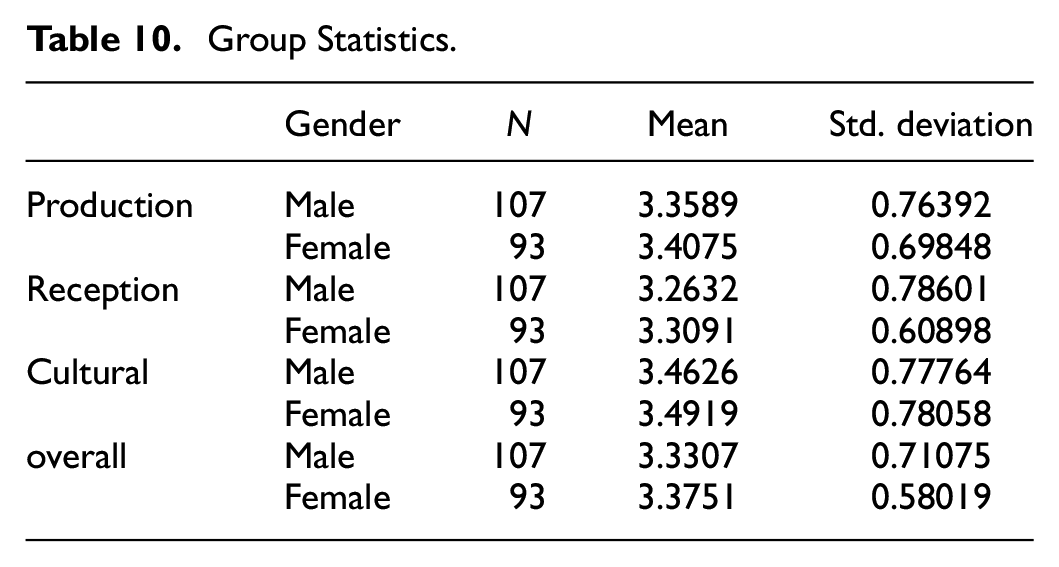
As is seen in the Q-Q Plot, the overall data was normally distributed. Table 10 illustrated the overall patterns of communication skills of male and female students, and Table 11 displayed the results of independent T-test.
Group Statistics.
Independent Sample T-Test.

In Table 10, it can be drawn that female students were slightly more proficient in using communication skills than male students, but Table 11 exhibited that the p-value was above .05, indicating there is no significant difference in terms of gender among undergraduate students when using communication skills. Therefore, hypothesis 3 was rejected.
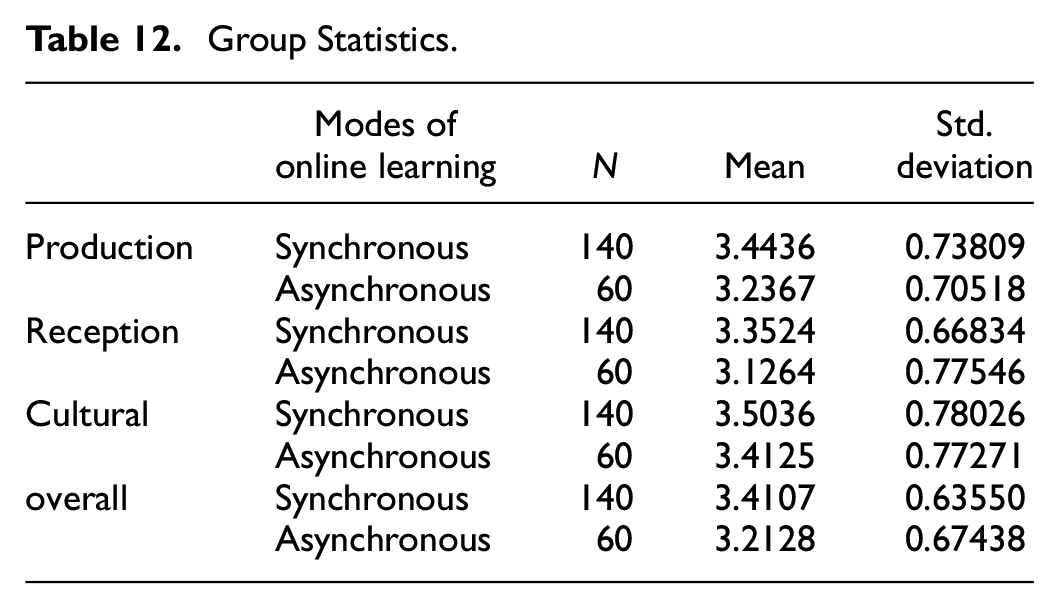
Independent Sample T-test was conducted to compare the communication skills in terms of synchronous and asynchronous modes of online learning. The results are shown in Tables 12 and 13.
Group Statistics.
Independent Sample T-Test.
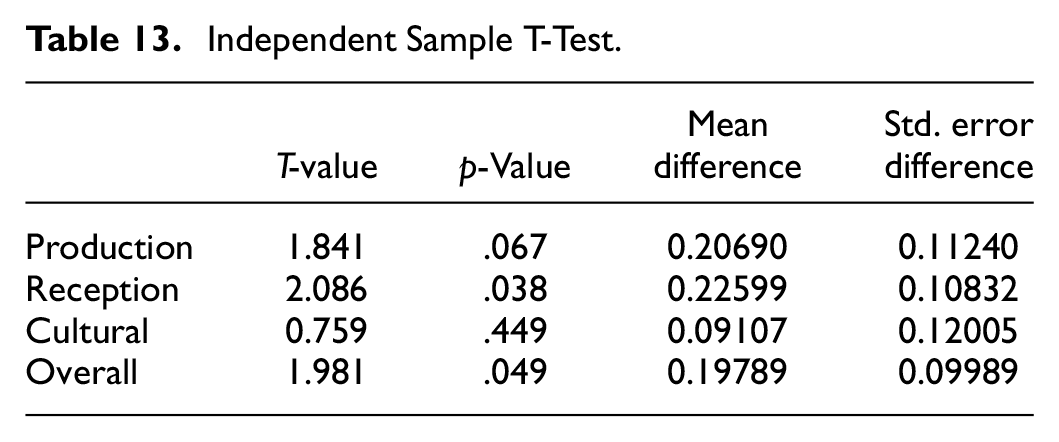
From Table 12, it can be drawn that students who had synchronous online courses were more proficient in using communication skills than those who had asynchronous online learning. According to Table 13, there was no significant difference in the students’ use of production and intercultural communication skills between synchronous and asynchronous online learning, but they did differ significantly in the use of reception communication skills (p = .038 < .05), and overall communication skills (p = .0049 < .05). Therefore, hypothesis 4 was confirmed.
As for gender, the results in this paper are in line with Ismet (2018), Hoon et al. (2017), and Kana (2015), who concluded that no significant difference was found in gender for communication skills. This may be because most students have an average level of communication skills, and there is no distinctive difference between males and females in terms of using communication skills. With respect to the mode of learning, it is understandable that synchronous learning emphasized different skills compared with asynchronous learning. For synchronous learning, students were more actively involved in the discussion and participation in class activities, and they got immediate feedback (Lin & Gao, 2020), which could build a strong sense of connection with classmates and teachers (Yamagata-Lynch, 2014). In this case, skills focusing on concentration and fluency were more important, and both production and reception skills were needed to enhance better communication. For asynchronous learning, there was flexibility for students to learn at their own pace (Pang & Jen, 2018), and it allowed more time for students to think and give detailed responses or express their opinions extensively (Brierton et al., 2016; Lin & Gao, 2020). In this case, skills related to accuracy and formats were used more frequently. Students experienced less pressure to communicate in an asynchronous learning environment, which lead to the difference in the use of communication skills in these two modes.
Conclusion
This study aims to explore the communication skills used among undergraduate students in an EFL online learning environment. The findings reveal that the undergraduate students have a medium level of communication skills, with intercultural skills ranking the highest, followed by production and reception communication skills. There is no significant difference in the usage of communication skills among undergraduate students in terms of gender, but there is a significant difference in terms of the mode of study.
Theoretically, this study offered a valid and reliable instrument to assess communication skills in an online EFL learning context. Technologically, it shed some light on the design of online learning platforms where more functions to facilitate communication, such as emoji, translation, and interactive games could be installed. Pedagogically, it provided a group of communication skills that could be applied in online EFL learning. Thus, students should be made aware of these skills, and universities and government officials are advised to establish new policies or teaching ideologies to cultivate communication skills among the students. Even in English-speaking countries, the idea of explicit teaching of communication skills in EFL classes has not yet been reflected in general teaching practice (Hmaid, 2014). Chinese instructors too, tend to focus more on knowledge imparting and form correctness, neglecting communication skill training. Various types of learning activities should be implemented to enhance student engagement and practice their online communication skills, such as presentations, group discussions, role-play, and so on. Furthermore, according to Wang (2024), most teachers and students perceive online learning to be more boring than face-to-face learning, mainly due to “lack of paralinguistic signs such as eye-contact and facial expressions,”“lack of convenient interaction,”“limited participation,”“untimely feedback”“unengaging activities” and “tedious speech” (pp. 6–7). A proficient and flexible use of communication skills can effectively overcome these difficulties, which are primarily associated with communication in online learning. Therefore, students and teachers may benefit from these skills in expressing and communicating online so as to achieve an optimal learning performance. Teachers are recommended to design their online instruction to be interactive with a view to encouraging student learning that is aligned with faculty, student, and institutional perceptions of online education. In addition, this study draws attention to the intercultural aspects of communication, which may be an asset for international teachers and students who can apply these skills in their future teaching and learning.
There are certain limitations in this study. First, the sample is not large enough, and therefore, future research can use a larger sample to test the validity and reliability of the instrument. Second, this study only used the survey method, so there is a lack of thorough perception of students in terms of their communication skills, and thus, future research may use a mixed-mode method approach (both survey and interview). Thirdly, future research should focus more on how to improve communication skills through various activities or policy implementations.
Footnotes
Acknowledgements
The authors would like to acknowledge Lecturer Liu Jinfeng and Liang Yingping of Taiyuan University of Technology for their time and efforts in helping with data collection.
Declaration of Conflicting Interests
The author(s) declared no potential conflicts of interest with respect to the research, authorship, and/or publication of this article.
Funding
The author(s) received no financial support for the research, authorship, and/or publication of this article.
Ethics Approval and Consent
The participants are informed that their participation is completely voluntary. There are no questions or languages that cause discomfort for the participants. It is in accordance with the Universiti Malaya Research Ethics Guidelines and was approved by the Universiti Malaya Research Ethics Committee (UMREC), and the reference number is UM.TNC2/UMREC_2722.

Availability of Data and Material
All materials and data (surveys and results) are available upon request.