




Abstract
This study examines the relationship among gender, democracy, and national development in Nigeria. This translates to a discussion of the possible linkages among gender identity, gendered representation, and national development in the country. Beyond the typical gender theorization, this article squarely focuses on women’s political representation within the Nigerian state and the power implications of the inherent challenges. The work reechoes the issue of underdevelopment as a societal phenomenon. The methodology of the contribution is normative argumentation. The theoretical framework is the power theory. The study concludes that the disarticulations between gendered representation and democracy have invariably led to contentious national development in Nigeria.
Keywords
Introduction
The subjugation of women in the Global South is the moral challenge of this era (Kristof in Htun, 2014, p. 1). Htun further asserts that today there is widespread gender injustice across all kinds of emerging democracies (such as the Nigerian state in West Africa). This work is, thus, purposively focused on the Nigerian state, which typifies a location where the crises of gender identity, democracy, and national development persist. The empirical focus of the contribution is from 1999 to 2019 (covering a period of apparent return to democracy in the country, after a prolonged era of military interval). Former presidents Olusegun Obasanjo, Umaru Musa Yar’Adua, and Goodluck Jonathan and the current President Muhammadu Buhari have led the Nigerian nation at different times of this historical division. References that are not necessarily chronological are accordingly made to these administrations in this article as the relationship among gender, democracy, and national development is investigated. The overarching research problem of this article borders on the nature of this relationship. Hence, the issues under study necessitate framing the work on a nation-state, for which Nigeria is the choice under purposive sampling methodology.
Gender, democracy, and development have indeed continued to compel research attention in Nigeria. The national average of women’s political participation in the country has remained 6.7% in elective and appointive offices, certainly below the global average of 22.5%, the African regional figure of 23.4%, and the West African subregional figure of 15% (Oloyede, 2016). The more women demand political inclusion in the Nigerian nation, the less democratic the spaces for inclusion open to women seem to become (Quadri, 2015). Politics in Nigeria thus remains mainly a male affair (G. M. Okeke, 2015; Olurode, 2013). Htun (2014, p. 1) further wonders, How can representative governments promote gender justice in advanced and emerging democracies and make headway against the widespread subjugation of women? What are the prospects of such issues being conscientiously addressed and adequately resolved? What are the chances that national development SGO923350 may be achieved under such continuing gender exclusivities? This work seeks answers to these questions, fundamentally within a Nigerian context.
The gender, democracy, and development nexus in Nigeria has undoubtedly generated significant interest in scholarly and lay literature (Akanle, 2011; Aluko, 2011; Ayeni & Ajibogun, 2013; Ejumudo, 2017; Eme et al., 2014; Ibeanu, 2009; Makama, 2013; Ogbogu, 2012; Okafor et al., 2007; Oloyede, 2016; Onyeji, 2019; Quadri, 2015; Williams, 2019). Despite the existence of these contributions, there are still research gaps. The embedded issues have not been sufficiently framed in the contexts of power equations. This article thus attempts to situate the gender and democracy dynamics in Nigeria specifically within the contexts of power struggle as a prelude to the understanding of how gender–democracy linkages lead to development. The general objective of the article, therefore, is to determine how the linkages among gender, democracy, and development in Nigeria are locatable within the milieu of contests for power between the two gender divides. The work is accordingly premised on the power theory of political analysis as there still exists, generically, a research gap in situating the gender issues in politics as a contest for power. Clegg and Haugaard (2009, p. 1) in these regards argue that the concept of power is central to any understanding of society. Power is accordingly treated in both the normative and empirical nuances in this work, as there are theoretical and practical issues in the question of power. Attempt has, therefore, been made in the article to contribute to the filling of the perceived gaps in treating gender issues under power relations. The study’s theoretical framework and its application are, however, fully treated in two subsections of the work titled “Theoretical Framework of the Study: The Power Theory” and “Reemphasizing the Theoretical Framework of the Study.”
Within the specific Nigerian context also, there appears to be the assumption of patriarchy as the dominant causative factor of gender disparities in politics (Ejumudo, 2017; Izueke & Ezichi-Ituma, 2018). This article, as part of its theoretical significance, questions the continuity of this supposition. Furthermore, it largely remains true that the concept of democracy (one of the key variables of the study) is multifaceted, with some of the major conceptions as the electoral, liberal, social, and participatory democracies (International Institute for Democracy and Electoral Assistance, 2017). This study is situated within the framework of participatory democracy, with gendered representation for further emphasis. Results from earlier studies additionally lead to the expectation that, on average, subjective feelings of insufficient representation are associated with democratic discontent (Dahlberg et al., 2015, p. 21). Are such gender-related ill feelings (where prevalent) not detrimental to national development contributions expected across gender divides?
Besides the specific identification previously made of the two subsections relating to the theoretical framework, the rest of this contribution is organized in the following order. The introduction gives an overview of the work’s design and significance. The next section on conceptual explication theorizes gender, elucidates democracy in the context of representation and national development, and further explicates national development. Following this section is an abridged literature review on gender, democracy, and national development, providing the setting under which this article makes its contributions. There is the section on gender and democracy in post-military Nigeria, detailing the plight of the female gender in democracy since the exit of the military in 1999 from covert partisan politics in the country. Following this section is an attempt at context internationalization, in juxtaposition of the gender relations experiences in other sociopolitical environments with the Nigerian position. Section “Gender and National Development in Modern Nigeria: Contestations and Contradictions” interrogates the existing notions on the fate of the female gender in the country’s democracy and suggests that positive linkages between gender and democracy are critical to the engendering of national development in Nigeria and beyond. The last section contains the conclusion.
Conceptual Explication
Theorizing Gender
Despite all explicatory disputations, gender questions often connote issues bordering on men–women and male–female categorizations and their proposed reconciliations (Ayeni & Ajibogun, 2013; Jaramillo, 2013; Okafor et al., 2007; Randall, 2011; Rossi, 1984; West & Zimmerman, 1987). Gender issues highlight instances of extensive and deep-rooted discrimination against women. Over the past few decades, therefore, much of the interests in gender relations have been due to feminism, although the term gender has been widely used. Feminists of all persuasions have depicted gender relations as issues of inequality and subordination (Sarker, 2006; Waylen, 1996). There is, accordingly, currently an international consensus, which accepts gender equity as a goal of (national) development (Ferrant, 2011). Feminist academics have also been attempting to ensure that gendered analysis becomes incorporated into every area of development plans and projects, particularly in the developing countries (Sarker, 2006). But gender is not the mere categorization of the social world in dual perspectives as it may sometimes be tempted to be done (Connell, 1985; Millett, 1970). It is more of a cultural category, underpinned by socially constructed (and contested) beliefs and rules about identity and sexuality. These beliefs and norms are in contemporary society manifest in certain ideas and practices, which guide (and constrain) human actions, and how individual actors may project their identities take hold of opportunities and experience well-being in life (Arsel et al., 2015). There are accordingly variations in the disputations and contestations embedded in gender relations. Among the most prevalent of these tendencies is the notion of gender equality or parity, as preferred by women and suggested by democratic tenets (Ejumudo, 2017; Htun, 2014). Gender parity, however, necessitates politics as the contest for power is central to the political process. Democracy and its representative imperatives, which are desirable for national development, remain interlinked with power relations in gender agitations.
Elucidating Democracy in the Context of Representation and National Development
Democracy, as Scott and Marshall (2009, p. 143) argue, has become virtually meaningless in its everyday use, as the label is now used to legitimize almost every kind of political power arrangement. Quite appropriately, John Scott and Gordon Marshall trace the origins of democracy as an idea and a practice to the city-states of Greece in the 5th century BCE, where at that time it meant simply “rule of the citizens.” Still from Scott and Marshall (2005, p. 143), it is highlighted that this ancient Geek democracy excluded women. Democracy has accordingly continued to undergo some due and probably some undue metamorphoses, as it becomes the preferred system of government globally. It is a form or system of government under which the governing power is utilized either directly or through the representatives that the people elect periodically (Ayeni & Ajibogun, 2013). What the people prefer is therefore at the center of democracy. Participation and representation are, accordingly, core elements of democracy. Plotke (1997) thus opines that representation is democracy, and this of course includes gender representation. Hence, the input of the people is of prime consideration in democracy. The representativeness of the input–output process is then also of vital importance. Democratic institutions can, therefore, no longer be viewed as carved in stone; they are increasingly subject to calls for reform and to political struggles (Bachtiger & Landwehr, 2018). The calls, reforms, and struggles are all geared toward sufficiency in representation.
Democratic representation accordingly implies the capacity of citizens to access and influence the political institutions (Dovi, 2002). Representation is an intrinsic part of what makes contemporary democracy possible (Urbinati & Warren, 2008, p. 395). However, underscoring the multifaceted and evolving landscape of democracy, Urbinati and Warren suggest that neither the standard model of representation nor the participatory prototype can embody the democratic ideal of inclusion of all affected by collective decisions. To begin to approach this ideal, Urbinati and Warren recommend complex forms of representation, inclusive of electoral representation and other new forms, capable of representing latent interests and transnational issues. In all of this, however, the core issue is that power belongs to the people in a democracy, which is much more than representation. Democracy also refers to a generic community attitude for freedom through equal opportunities. Equality is accordingly an important value of democracy, and quality in this sense must not be seen in absolute terms but more plausibly as equality of opportunities, manifested in inclusion, open competition, particularly in the creation of room for equal chances in governance. The notion of democracy (and democratization) therefore also implies that every effort by the citizen, regardless of color, sex, religion, and so on, must be rewarded equally (Ayeni & Ajibogun, 2013). Does democracy really work as advertised? Seeking answer to this question, Taylor (2017) highlights that under modern democracy, the people only rule via a complex system of representatives, with the addition of checks and balances considered essential to democracy and the rule of law. Then the sum of these arrangements often makes their workings opaque and engenders latent and manifest unhappiness. Hence, discontent regarding representation contributes to democratic shortfalls, which in the end could translate to illegitimacy (Dahlberg et al., 2015). Democracy and inclusion are thus highly interrelated, whereas national development and (gender) exclusion seem to be some opposing variables (Ejumudo, 2017).
Explicating National Development
The illuminations on national development in this section of the article are Nigerian-anchored. Development implies positive social change and improvements in the living standards of people (Okafor et al., 2007). According to R. C. Okeke and Ifeagwazi (2018, p. 329), national development refers to nationwide development in a nation-state and implies the well-being of a manifest majority of the citizens of such a state in material terms. It therefore denotes decreases in inequality levels and means the guarantee of security of lives and property in the nation-state. Then, insecurity in Nigeria, argue Obarisiagbon and Akintoye (2019, p. 44), has recently assumed an alarming rate, affecting every facet of Nigerian life, with no end in sight. This detracts from national development ideals. Although national development is preferably indicated by economic indices, it is not synonymous with economic development. National development, therefore, is not essentially indicated by the gross domestic product (GDP) paradigm, which leaves the average citizen bewildered (even neglected). From a record low of US$4.20 billion in 1960 (year of country’s independence) to US$397.30 billion in 2018, GDP in Nigeria has continued to grow. It averaged US$125.26 billion from 1960 until 2018, reaching an all-time high of US$568.50 billion in 2014 (Trading Economics, 2019). What do these GDP figures truly prove in the face of abject poverty prevalence in the same country? Okeke and Ifeagwazi further argue that the occurrence of national development entails a process, which is indisputably in evolution, and once disputes begin to arise about the progress in this positive developmental movement, it is symptomatic of underdevelopment.
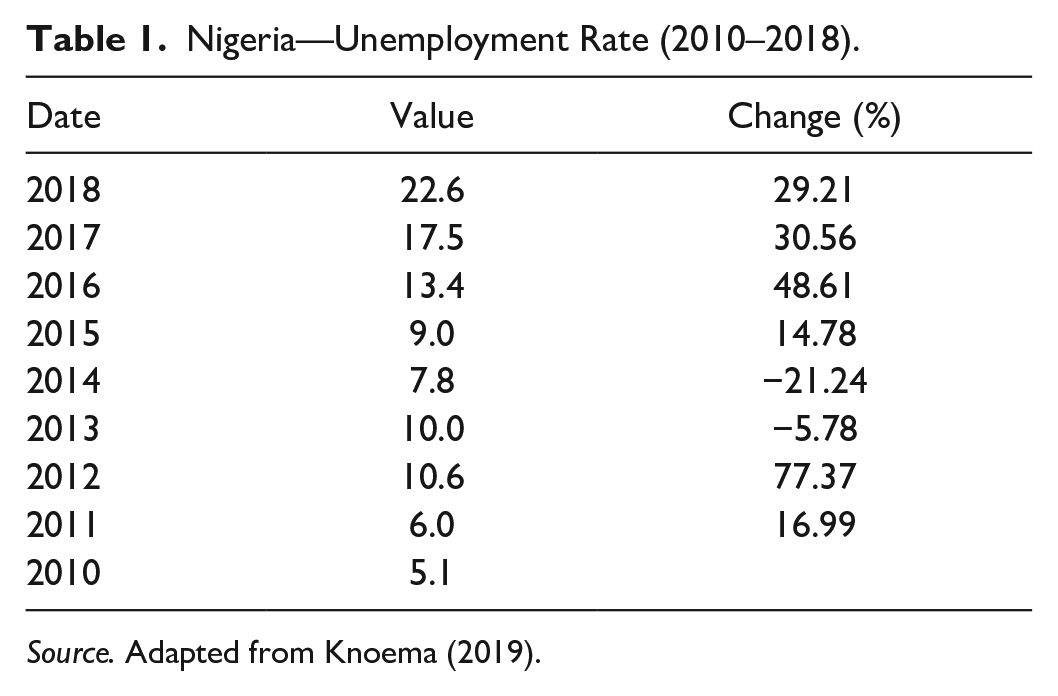
In June 2018, the United States–based Brookings Institution highlighted in Kharas et al. (2018) that Nigeria had overtaken India as the country with the largest number of the extreme poor in the world. At the end of May 2018, this report suggests that Nigeria had about 87 million people in extreme poverty, compared with India’s 73 million. Moreover, extreme poverty in the country continued growing by six people every minute (while poverty in India continued to fall). Poverty and underdevelopment are interwoven. Figure 1 graphically depicts the upward (negative) movement of Nigeria in global poverty ranking, as the rating of India, former holder of the world’s worst poverty position, improved. The 86.9 million Nigerians living in extreme poverty represent nearly 50% of its estimated 180 million population in May 2018 (Kazeem, 2018). An estimated 90.8 million Nigerians were actually living under extreme poverty in December 2018. This figure constituted a staggering 46.4% of its estimated 195.6 million total population at this period (Toromade, 2018). Such humongous poverty levels are antithetical to national development. They indicate patent national weakness. Unemployment rate in the country (2010–1018) is also suggestive of national developmental challenges. Table 1 shows there was a marginal negative change of −5.78% in 2013 and another significant negativity in 2014 (−21.24%). In all other years of analytical attention, however, the unemployment trend was on the increase. In 2018, the unemployment rate of Nigeria was 22.6%. It increased from 10.6% in 2012 to 22.6% in 2018, growing at an average annual rate of 16.02% (Knoema, 2019). There cannot therefore be national development where abject poverty and dismal unemployment levels prevail. Positive social change, signifying development, entails the reversal of rising abject poverty and gloomy unemployment trends in a nation-state.

Changes in poverty ranking for Nigeria and India.
Nigeria—Unemployment Rate (2010–2018).
Source. Adapted from Knoema (2019).
An Abridged Literature Review
This section of the article provides a condensed position on the attempts made in the existing literature to establish linkages among gender, democracy, and national development (in Nigeria). It is within the contexts of the gaps in these earlier studies that the current work makes its own contributions. Okafor et al. (2007) had accordingly concluded that considering gender inequality in development, the gender-sensitive policies formulated to tackle this problem in Nigeria appeared to have produced little or no impact on many of the Nigerian women. Beer (2009) reemphasizes that women’s participation should be included as an important component of democracy. Aluko (2011) found that political leadership in Nigeria is stratified on the bases of gender distinction, thereby calling to question the assertion of gender neutrality in the political arena of the nation. Eme et al. (2014) disclose that for millions of Nigerian women, taking part in elective politics was not easy, as women often did not receive the support and mentoring they needed to compete with their male counterparts. In turn, many voters do not fully appreciate the benefits of having a mix of men and women in government in Nigeria, leading to low representation of women at all levels of government in the country. The study of Sarker (2006) on gendered approaches to development highlights the efficiency approach among the plausible methodologies whereby development plans and projects are made more efficient and effective through women’s economic contribution, with the active involvement of women in development policies and projects. This efficiency approach is a function of democracy. (It is predicated on the existence of democracy.) Ferrant (2011) suggests that gender inequality may be an explanation for economic development differences.
Akanle (2011) found that although democracy in Nigeria’s post-military era had somewhat influenced gender relations relative to equality and the legal environment, translating this to development remained critically unattainable. However, there is an issue of putatively improved gender relations in this position of Akanle, giving rise to the lack of positive impact on development. This article interrogates these absences of linkages and their causative factors. Ewuim et al. (2015) argue that there cannot be genuine sustainable development aimed at poverty alleviation (in Nigeria), without mainstreaming women in all development structures and processes. Seamless gender relations are without doubt, therefore, necessary for effectual democracy, as these two conditions remain critical to national development. Nevertheless, the study of Quadri (2015) revealed that the more women agitated for political inclusion in Nigeria through their various platforms, the less democratic the spaces for inclusion open to women became. Invariably, the efforts expended by Nigerian women in political agitations are fruitless exercises in the democracy project of the nation. These futile agitations, therefore, have not only negatively affected democracy in the country but have also impaired national development, as the women agitators’ national contributions remain stunted.
Theoretical Framework of the Study: The Power Theory
The article’s theoretical framework is the power theory. Power is invariably the central concept of the social sciences (Clegg & Haugaard, 2009, p. 1). Although conventional power theory in political science indeed falls within the specific segment of international relations, this theory is increasingly utilized in the analysis of other political developments. Moreover, the foremost power theorist in international relations was Hans Morgenthau (Holsti, 1964). Morgenthau saw power as man’s control over the minds and actions of other men (Morgenthau, 1967, p. 29). Power is also a concept on which, despite its long history, there are, on analytical fronts, major disagreements about its exact definition and about other features of the conceptual contexts in which it should be positioned. It is, accordingly, an essentially contested concept (Gallie, 1956; Lukes, 1974). It probably at best represents a cluster of concepts (Clegg & Haugaard, 2009, p. 4). Yet power has been seen as a capacity to define reality. This definition of the real (and the moral) thus enables the definer to personally create the conditions for legitimacy (Clegg & Haugaard, 2009; Nietzsche, 1968). Hence, power can be either legitimate or based on the threat of violence (Clegg & Haugaard, 2009; Weber, 1978).
Still, there is a core complex of the meaning of power, which has to do with the capacity of people or collectivities to get things done effectively, particularly when their goals are hindered by some kind of human defiance or opposition. The problem of coping with this opposition then leads to the issue of the role of coercive measures (inclusive of the use of physical force) and the relating of coercion to the voluntary and consensual aspects of power equations (Parsons, 1963). Power, furthermore, may refer to the position of an individual or an emanation from a concourse of forces. Speaking of the “power” of a government (a department of state), a local authority, a military commander, or a manager in an organization, for instance, is therefore a substantiation of that emanating from an assemblage of forces by which certain objectives and interdictions can determine (deter) the actions and calculations of others (Rose & Miller, 2010). This does not, however, suggest that power merely refers to the preserve of the powerful to dominate those with less power or the powerless (Shokri, 2017).
Generally, however, power in political science is definable as the ability of one political actor to get another actor to do what it wants, at the international, national, and local levels (Roskin, 2018). The linkages among gender, power, and politics (it must be underscored) are as complex as they are dynamic (Omotola, 2007). Nevertheless, in the midst of these complexities and dynamisms, the specific relationship between power and politics is never hazy. In the application of power theory to this work, therefore, gender issues are related to power politics. For instance, Morriss (1987, p. 96) argues that the assumption of group power is based on very faulty foundation as diffuse groups such as men or women lack the capacity to act as a group because the larger a group, the less power it is likely to exercise. So according to Morriss, the reference to men as more powerful than women is to a typical individual man being more powerful than the typical individual woman is. A central question on which the theoretical framework of this research revolves borders on how the individual Nigerian woman has positioned herself in the gender and democracy power struggles for national development contributions.
Gender and Democracy in Post-Military Nigeria
Post-military Nigeria in this section of the article alludes to the phenomenon of the long stay of the army in the politics, leadership, and developmental experimentations (possibly the underdevelopment of the country) from 1966 to 1999. After Nigeria became independent from Britain (the erstwhile colonial masters in 1960), the emergent civilian government was toppled by the military in 1966. The bloody coup d’état that ushered in the military precipitated a series of crises, leading to national orgies of bloodletting, embedding a civil war (1967–1970), and at the end of the war, there were subsequent coups and counter-coups (mainly bloody), indicative of some game of musical chairs by the military despots in governance. Civilians only tasted power intermittently at these periods. The democratic system of government seems to have survived in Nigeria since 1999, leading to a reasonable benchmark for the assessment of democracy in the country. Relating freedom to democracy at this period, Freedom House (2019) indicates that between 1999 and 2019 the yearly rating of Nigeria on the Freedom in the World index has consistently remained at the level of “partly free.” As also shown in Table 2, using political rights as democracy indicator within this period, the country’s score on a scale of 1 for most free and 7 for least free has been mainly median. Positive linkages between democracy and national development in post-military Nigeria thus require advancements from the scales of partly free and median ratings to more robust positions.
Freedom in the World Rating of Nigeria: 1999–2019 (Freedom House Index).

Source. Authors’ extracts from https://freedomhouse.org/report/freedom-world/2019/nigeria.
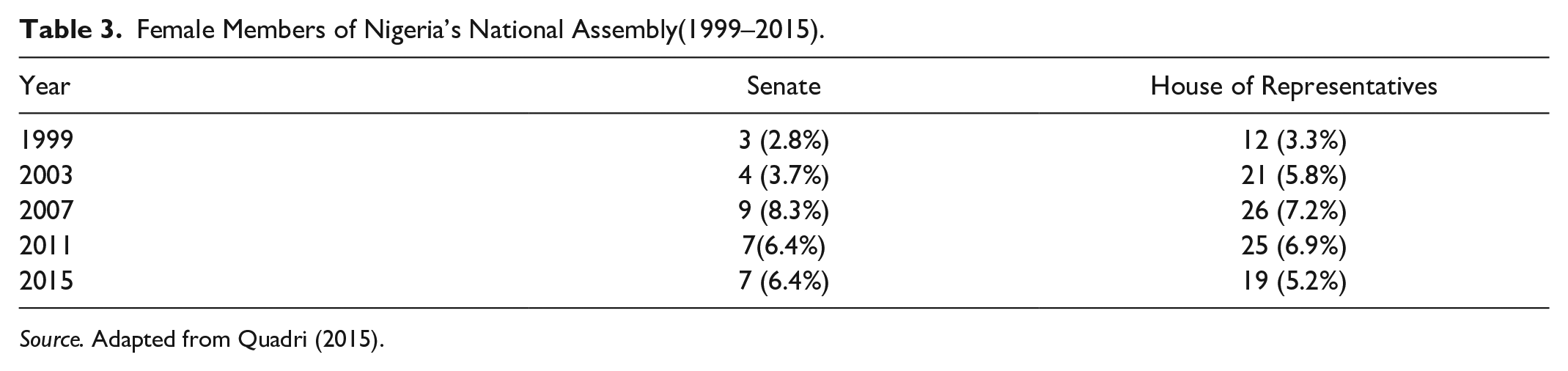
What then has been the relationship among gender identity, gendered representation, democracy, and national development at this period in Nigeria? Table 3 is illustrative of the position in the Nigerian Parliament, from 1999 to 2015, translating to a poor quality of gendered representation, which implies impaired gender identity for the female gender.
Female Members of Nigeria’s National Assembly(1999–2015).
Source. Adapted from Quadri (2015).
Onyeji (2019) highlights that of the 84 million registered voters in the 2019 election in Nigeria, women accounted for almost 40 million (47.14%). Yet gender intolerance has remained prominent in national politics in the country. According to Ogunyinka (2019), the number of women elected into the Nigerian Senate reduced from seven in 2015 to six in 2019. The House of Representatives also suffered a decline from 20 women in 2015 to 12 in 2019 (Quadri, 2015, mentions 19 for House of Representatives: Following a postelection litigation and subsequent rerun in the country’s Rivers state, a female member joined the House between the time of Quadri’s work and Ogunyinka’s report). In combination, however (the Senate and House of Representatives), only 3.8% of members of the National Assembly in Nigeria are women in 2019, the lowest rate for women’s legislative participation in sub-Saharan Africa and far below the region’s average of 24% (Ogunyinka, 2019). In the executive arm of government, the narrative is also of similar scenarios. However, between 1999 and 2015, the three previous leaders (Olusegun Obasanjo, Musa Yar’Adua, and Goodluck Jonathan) actually appointed a number of women into the Federal Executive Council (Ekpenyong et al., 2015). However, when Nigeria’s President Buhari succeeded President Jonathan in 2015, his 36-member cabinet had only six (17%) women among them, whereas in his predecessor’s team of 40 members there were 13 (32.5%) women (Akutu & Opara, 2015). On President Buhari’s reelection in 2019, his cabinet has 42 members, and only seven (17%) are women (Williams, 2019).
Nigeria as a nation is therefore still performing below generic expectation concerning gender equality, but this may be because the women have not recognized that embedded in the gender issues are large degrees of power equations. This necessary power positioning necessitates mainstream policies of self-extension on the part of the women. Political representation portrays political power (Ferrant, 2011). Gender activists in the Nigerian state and elsewhere are essentially engaged in contestations for power. Yet, the voice of women has not been heard in resounding trajectories on very many issues which have arisen since the restoration of democracy in Nigeria. For instance, when some 276 female students were abducted from their school dormitory at Government Secondary School in the town of Chibok, Borno State, Northeastern Nigeria, in April 2014 by the Boko Haram terrorist group, the voice of women remained marginal. The Nigerian female voice has not been particularly prominent in the international clamor for the complete release of the Chibok girls. Power positioning indeed entails strong objections to such treatments of the girl child. The world will not go to the homes of women, knocking on their doors to come and receive political power.
Women politicians are also sometimes portrayed as less corrupt (Randall, 2011, p. 5). In Nigeria, however, many high-profile women in the public sector have been successfully investigated and indicted of corruption (Okonkwo, 2016). Such developments do not reinforce the positions of gender activists in the country for parity in political representation. Furthermore, as different from some deprived groups, women (even in Nigeria) are not a minority (Beer, 2009, p. 219). In a sense, argues Inglehart et al. (2002), the link between women’s representation and democracy should be self-evident, as women account for over half the population of most societies. There is no evidence anywhere that the ballots of female voters are usually canceled in Nigeria. Neither are there official documentations against the candidature of women in Nigerian elections. Hence, from 1999 to 2015, five general elections have been held in Nigeria and the female politicians have consistently performed poorly in the electoral contests. The gender scorecard thus calls for revalidation by the women themselves, in the context of power relations. The relationships between gender equality and the quality of democracy are seemingly imprecise (Bego, 2014; Paxton, 1997; Richards & Gelleny, 2007; Yoon, 2001). Studies that are more particularistic have, however, examined the political, economic, and security dimensions of democracy and gender and have reached conclusions that are more robust. Thus, research proves that democracy and gender equality possess mutually strengthening relationships, and in these regards, higher levels of liberal democracy are necessary but not sufficient grounds for higher levels of gender equality (Högström, 2015; Piccone, 2017). Gender activists and female political actors in Nigeria (and other locations) therefore need to brace up to all the exigencies that may arise in the process of seeking power which gender equality in politics means.
An Attempt at Context Internationalization
Women’s movement in many countries has canvassed the need for reversal of institutional barriers and structural biases, and the altering of the rules of the democratic game, to engender equal opportunities and affirmative action to get women into elective offices and positions. The use of quotas in the selection of female candidates for legislative posts has been suggested, and over a hundred countries have recently resorted to quotas in such selections (Krook, 2006). The quota option has therefore led to increases in the number of female legislators in countries like Senegal, South Africa, Kenya, Rwanda, and Malawi, among others, and is also considered plausible for Nigeria (Inglehart & Norris, 2003; Quadri, 2015). In Europe, legislated and legally binding quotas for legislative houses elections have been introduced in Albania, Armenia, Belgium, Bosnia and France, Herzegovina, Ireland Macedonia (the former Yugoslav Republic), Poland, Portugal, Serbia, Slovenia, and Spain. In Austria, the Czech Republic, Germany, Norway, Sweden, or the United Kingdom also, some political parties have applied voluntary quotas while presenting party lists or allocating candidates to single-seat constituencies (Orji et al., 2018, p. 44). Then the fact remains that (with a few cases of exceptions in China, Japan, Ireland, France, and the United States) democratic societies usually have more women in their legislatures than the undemocratic ones (Inglehart et al., 2002).
Within the specific context of the developing countries, however, is the high degree of gender inequality explainable by underdevelopment itself, or do the poor societies incline to certain cultural tendencies, which lead to gender inequality? Jayachandran (2015) contends in these regards that many poor countries today possess cultural norms, which exacerbate favoritism toward the male gender. Jayachandran suggests that gender gaps contract as countries grow, but although much of the GDP/gender-inequality relationship is explainable by the process of development, society-specific issues are also considerable. Hence, many current poor countries possess cultural norms, which intensify favoritism toward males. These norms include patrilocality and concentration on women’s “purity” in India and China, which help to explain the male-skewed sex ratio in these countries and low female employment in the Middle East, India, and North Africa (Jayachandran, 2015).
In an overall context, the lingering question, as posed by Paxton et al. (2007, p. 263), is this: Does having more women in office make a difference to public policy? This is because self-evident national development is a function of effective public policies. Then it appears as if national development has remained disputable in Nigeria because women participation in policy articulation, formulation, and execution in the nation also fall largely below the level of opportunities available to men. The absence of explicit national development in this state is consequently blamable on the males and their overbearing tendencies. The question on if having more women in office may make a difference to public policy is thus to be answered by actually having more women in office. It is not debatable that the full and complete development of a country (national development) requires the maximum participation of women on equal terms with men in all fields (CEDAW, 1979). Elections are not necessarily the full test of democracy, but they invariably present an opportunity for testing democracy. Hence, the degree to which women may register as voters, participate in elections as candidates, actually cast their votes in secret, and take part in decision-making at the highest levels, indeed all give an indication of inclusive democracy. The more women participate in elections as voters, candidates, leaders of political parties, and electoral administration officials, the more accepted their place in the political process (Inter-Parliamentary Union, 2018). Invariably, the more would be the contributions of such women to national development.
Gender and National Development in Modern Nigeria: Contestations and Contradictions
It continues to appear as if the gender imbalance in Nigerian politics is rooted in cultural history, characteristic of patriarchal African societies (Izueke & Ezichi-Ituma, 2018, p. 212; Makama, 2013; Oloyede, 2016; Omotola, 2007). There is, however, also a contradiction in this mainstream thinking in Nigerian gender studies as some scholars have demonstrated under the same historical matrixes that in the precolonial, colonial and postcolonial periods, Nigerian women had/have taken significantly active parts in politics and leadership (Badejo, 2013; Ekpenyong et al., 2015; Nwosu, 2018; Obasoro, 2013; G. M. Okeke, 2015). Is patriarchy therefore actually the predominant feature of the current Nigerian gender relations in politics and democracy? Patriarchy refers to the systemic societal structures, which institutionalize male physical, social, and economic power over women, a way of life in which men are believed to be superior to women (Okafor et al., 2007; Reeves & Baden, 2000). Essentially, has patriarchy stunted the participation of women in national development in Nigeria?
A woman (Aloma Mukhtar) was Chief Justice of Nigeria, from July 2012 to November 2014, and consequently conferred with the Nigerian National Honour of Grand Commander of the Order of the Niger (GCON). Professor Grace Alele Williams (a Professor of Mathematics) was Vice Chancellor of Nigeria’s prestigious University of Benin, from 1985 to 1991. She holds the National Honor of Officer of the Order of the Niger (OON). Women have been Deans of Faculties, Directors of Institutes, and Heads of Departments in many Nigerian universities. Mrs. Olusola Obada was Nigeria’s Minister of State for Defence from 2011 to 2012 and then the substantive Minister of Defence from 2012 to 2013 (superintending over the Nigerian military structures). Fidelia Njeze was appointed Nigeria’s Ambassador to Switzerland and Liechtenstein on June 12, 2012. She was previously appointed Nigeria’s Minister of Aviation on April 6, 2010, and Minister of State for Defence in July 2007. She earlier served as Minister of State for Agriculture and Water Resources, and in March 2011, the Federal University of Technology, Owerri, Nigeria, conferred on Mrs. Njeze an Honorary Doctorate Degree of Management Technology (profiles of the women updated through internet media sources).
Professor Viola Onwuliri was Nigeria’s Foreign Affairs Minister between 2013 and 2014. Mrs. Diezani Alison-Madueke was Nigeria’s Minister for Transportation, from July 26, 2007, to December 17, 2008, Minister of Mines & Steel Development, from December 17, 2008, to March 17, 2010, and Minister of Petroleum Resources, from April 6, 2010, to May 28, 2015. Mrs. Bianca Ojukwu was Senior Special Assistant to the President of Nigeria on Diaspora Affairs, Nigeria’s Ambassador to Ghana and Spain, and subsequently the country’s Permanent Representative to the United Nations’ World Tourism Organization. Princess Stella Oduah, once elected to the Nigerian Senate, is a former Minister of Aviation in the country (July 4, 2011, to February 12, 2014). Dr. Kema Chikwe, who holds a Doctorate Degree in Curriculum Studies, was Nigeria’s Minister of Transport from June 1999 to 2001 and Minister of Aviation from 2001 to May 2003. She became Nigeria’s Ambassador to Ireland in 2009 (profiles of the women updated through internet media sources).
These positions (and others) have been held by women in the country assumed to possess systemic societal structures, which promote male physical, social, and economic power over women and where men are believed to be superior to women. The overarching factor, accounting for the undeniable gender imbalance in the Nigerian democracy processes, seems to relate more to actually noninstitutionalized male-gender prejudice, which leads to a masculine model of politics (Quadri, 2015; Orji et al., 2018). Even at that, the critical question borders on what is the net position of affairs in modern Nigeria. Modernization drives cultural change and the continuing promotion of progressive liberal values, inclusive of democracy and gender equality (Inglehart et al., 2002; Piccone, 2017). This fact should not be lost on the victims of the occasioning fixation in the characterization of the modern Nigerian system as an abject patriarchy.
Women have decisively won elections to the Nigerian National Assembly, the various State Assemblies in the country, and at the Local Government level, even in their negligible numbers. How did such female representatives win the elections? It seems that the other female candidates who usually present marginalization and patriarchy as the precipitations of their defeats have not studied and applied the strategies of the earlier women winners. If men did not prevent the earlier victorious women and the patriarchal society did not also stop them from participating (and winning in the elections), the neophyte female politicians may not also be stopped when they apply the winning political strategies. It seems, however, as if the female new entrants to the political platform usually depend on their male counterparts to teach them the game of politics, and it is indeed an inappropriate method of seeking power to rely on a corporate adversary to hand over power to its bloc of challengers. Then as the gender imbalance remains, democracy becomes inchoate and national development remains stunted.
Then relatedly on agricultural production in the country, there seems to be a growing incongruous incidence of female masculinity and male femininity (Francis, 2010). Hence, while women increasingly engage in agricultural production, the men continually opt out. The myth of the “male-as-breadwinner” is thus being seriously questioned in many middle- and low-income Nigerian families by the increasing tendency of women to take up economic roles previously perceived as reserved for men (Ibeanu, 2009; Orji et al., 2018, p. 50). The men, on the contrary, maintained their dominant position in politics by outnumbering the women in representative and other public service offices. The occasioning contradiction is a harbinger of underdevelopment, and here is a brand of feminization of underdevelopment. Okafor et al. (2007, p. 237) had earlier referred to feminization of underdevelopment as the tendency for women to be in disadvantaged situations, which inhibit their living standards and impair their contributions to development, but it means in this article the shifting of the burden of underdevelopment to women. The ascendancy of women in economic matters in Nigeria needs to be reinforced by progressive male strides, for national development to become self-evident. What obtains currently is the position of a society in denial, which remains fixated to the theory of patriarchy.
Postulations on gender imbalance in the Nigerian national system must avoid such overgeneralizations and oversimplifications and focus on across the board-gendered representation, which is integral to the democratic system of government. Gender-balanced representation is therefore critical to the sustenance of democracy in Nigeria and is furthermore necessary for catalyzing national development (Obasoro, 2013; Ogbogu, 2012; Orji et al., 2018). The relationship among gender identity, gendered representation, and national development in the country remains disarticulated. Table 1, showing unemployment rate (2010–2018), Table 3, portraying a high degree of gender insensitivity, and Figure 1, demonstrating massive abject poverty, all suggest that gender intolerance may be accountable for contentious national development in the country. Gender inclusion is indicative of democratic tendencies. Gendered representation accordingly becomes recommendable in seeking positive linkages among gender, democracy, and national development in Nigeria. Nevertheless, it is only within the milieu of contest for power between the two gender divides that gendered representation may be guaranteed in the Nigerian brand of democracy and beyond.
Reemphasizing the Theoretical Framework of the Study
Some suggestions have been canvassed for changing the lot of women in politics and democratic representation in Nigeria. These propositions include providing aspiring female politicians with training and support, and collaborative efforts of men and women (Eme et al., 2014). These proposals indeed do not seem to rhyme with the methodologies of resolute power seekers, as they merely rely on the collaborative readiness of the men (the current trustees of power) to make them successful. Its current wielders do not easily give power away. Men are the current power controllers. Gender understanding thus entails the giving up of some of the powers in the hands of men. It will take intense struggle on the part of women to achieve this position. Political power is not usually freely given and never handed over to any group of people on a platter of gold. It invariably entails a struggle—for power (G. M. Okeke, 2015). The onus of seeking and actualizing a better balance of power rests with the power seekers, in this case the women, who seek to establish power equality with men (Aluko, 2011, p. 53). G. M. Okeke (2015, p. 391) points out that some of the inhibitions against women in political participation and democratic representation (in Nigeria) are self-inflicted. Women in Nigeria, for instance, are founders and leaders of many all-female faith-based organizations and other associations with massive female-only memberships. It therefore reflects surprises that women in the country have not translated such significant numbers into electoral fortunes (for the benefits of their gender and others). Okeke further highlights that democracy supposes the alternation of power relations between the male and female gender, by promoting equal opportunities in the distribution of power and influence. In other words, gender parity implies parity of powers in gender relations. Even when denoted as gender tolerance or gender accommodation, the critical issues still border on power shifts, in favour of women. Power relations are not altruistic issues.
Izueke and Ezichi-Ituma (2018) studied self-defeatism as the bane of women participation in Nigerian politics. It was a plausible study. Chukwuma and Ohabuenyi (2018) then caution that affirmative action should not create new injustices against the men who did not cause the inequalities of the past. The rights of such men are as legitimate as the quest for affirmative action. Against these backgrounds, Omotola (2007, p. 33) opines that if the gender discourse will ever be productive, it would have to be undertaken within the framework of power politics. Again, there is the problem of political culture (Inglehart et al., 2002). Culture refers to the way of doing things in a particular place. If the culture of a people tends toward gender inequality, then democracy may not ordinarily improve women’s position there (Beer, 2009). The intervening variable hence becomes the element of power struggle.
Conclusion
National development remains stunted in Nigeria as gendered representation remains impaired. The lingering question borders on why the female gender in this specific country and elsewhere continues to think that the current male wielders of power would willingly cede their positions to their female challengers. The realist framework of this study consequently remains germane as the nexus of gender and democracy alludes to power relations. The historically male-prone gender representation in the Nigerian version of democracy indeed seems to have only led to a net position of poverty and underdevelopment. Gender studies in the country therefore should necessarily focus on the element of power in democracy. The ultimate aim on either side of the gender divide, however, should be to utilize such powers for national development. Then finally, this study has questioned the generic patriarchy notion as the consummate inhibiting factor of Nigerian women in the nation’s representative government and national development. Nigerian women can still use the powers inherent in their massive voting rights (during periodic elections) to reverse the current unconstructive trends in gender, democracy, and national development in the Nigerian state. The current disarticulations between gendered representation and democracy have invariably led to contentious national development in Nigeria.
Footnotes
Declaration of Conflicting Interests
The author(s) declared no potential conflicts of interest with respect to the research, authorship, and/or publication of this article.
Funding
The author(s) received no financial support for the research and/or authorship of this article.
